
|
Getting your Trinity Audio player ready...
|
What if Jordan Peterson unpacked this We Who Wrestle with God summary with Rabbi Sacks and N.T. Wright—live, unscripted, and brutally honest?
If you’re looking for a We Who Wrestle with God summary, you have to start with something uncomfortable: the Bible is not primarily a book of quaint religious opinions. It’s a condensation of hard-won wisdom—stories that survived because they describe patterns of human catastrophe and human redemption with brutal accuracy. And the reason that matters now is that we’re living in a time when people are ideologically possessed, morally confused, and—often without realizing it—desperately hungry for something that can organize their lives around meaning instead of resentment.
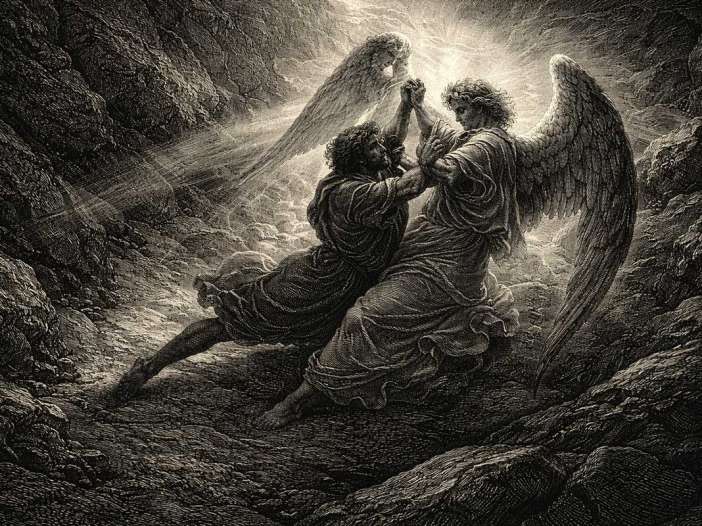
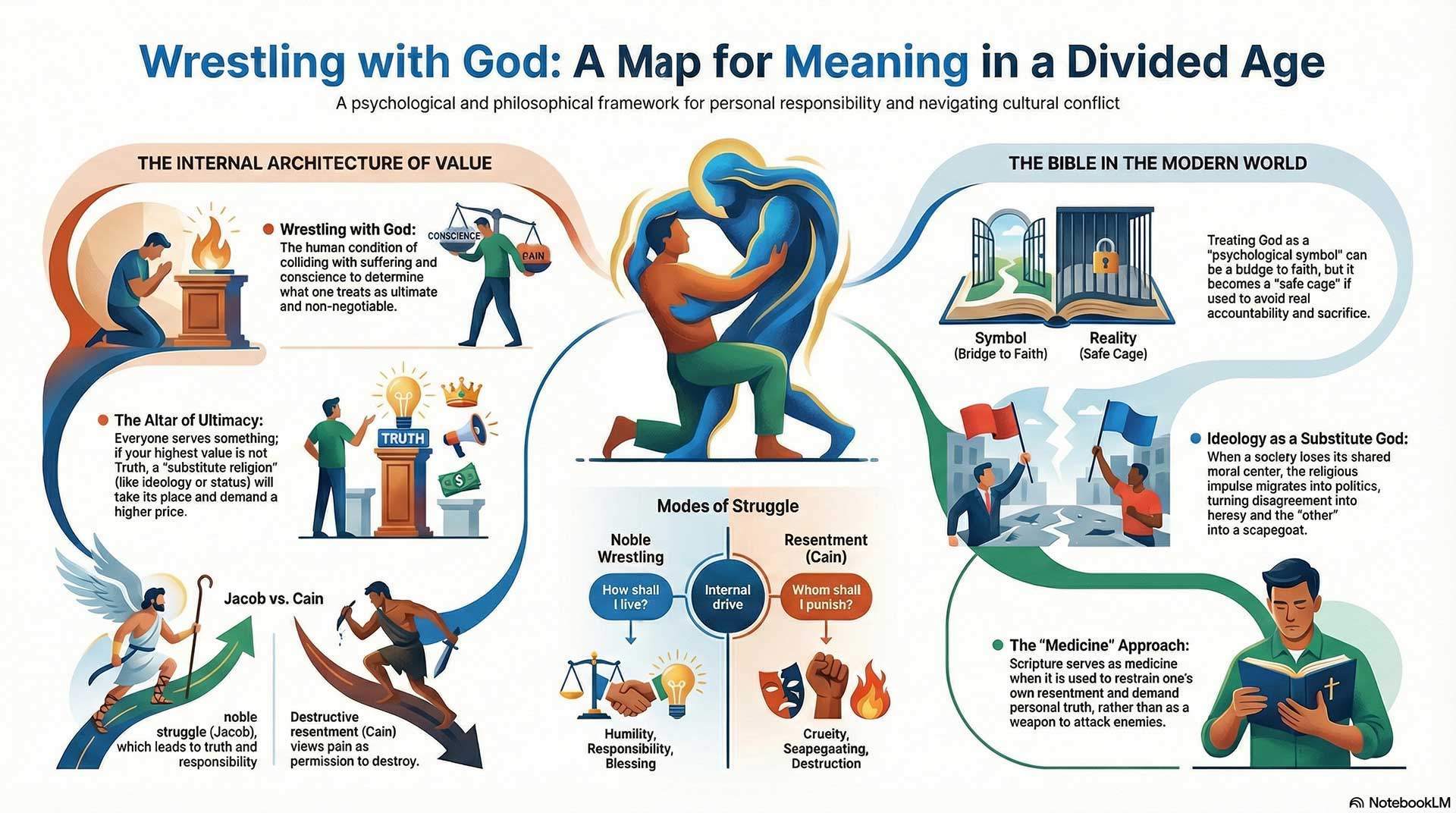
The phrase “wrestling with God” names the human condition at its most honest. You’re going to collide with suffering. You’re going to discover that your own motives are mixed. You’re going to find out that the world does not conform to your wishes, and that reality has consequences whether you like it or not. The ancient stories don’t let you escape that collision. They force you to see what happens when you lie, when you envy, when you scapegoat, when you worship false idols—whether those idols are money, status, sex, power, or the seductive certainty of ideology.
Now, you can argue about whether God is best understood as a transcendent Being or as the highest organizing principle of the psyche. But the argument can’t be allowed to become a loophole. Because in practice, you will serve something. You will sacrifice for something. You will place something at the top of your hierarchy of values. And if that “something” is not the highest good—truth, in the deepest sense—then what replaces it will not be neutral. It will be a substitute religion, and it will demand sacrifices that you won’t want to pay.
So this series takes five topics and treats them like pressure tests: faith and conscience, belief and identity, God and symbol, Genesis and interpretation, culture war and cohesion. The question isn’t, “Can we win an argument?” The question is, “Can we tell the truth in a way that makes us less dangerous to ourselves and to one another?” Because if we can’t, then we will produce the Cain story again—at scale—and we’ll call it progress while we do it.
(Note: This is an imaginary conversation, a creative exploration of an idea, and not a real speech or event.)
Topic 1 — Wrestling with God: Faith, Conscience, and the Price of Truth
Moderator: Jonathan Sacks
Participants: Jordan Peterson, Bishop Robert Barron, John Vervaeke, Viktor Frankl, Simone Weil
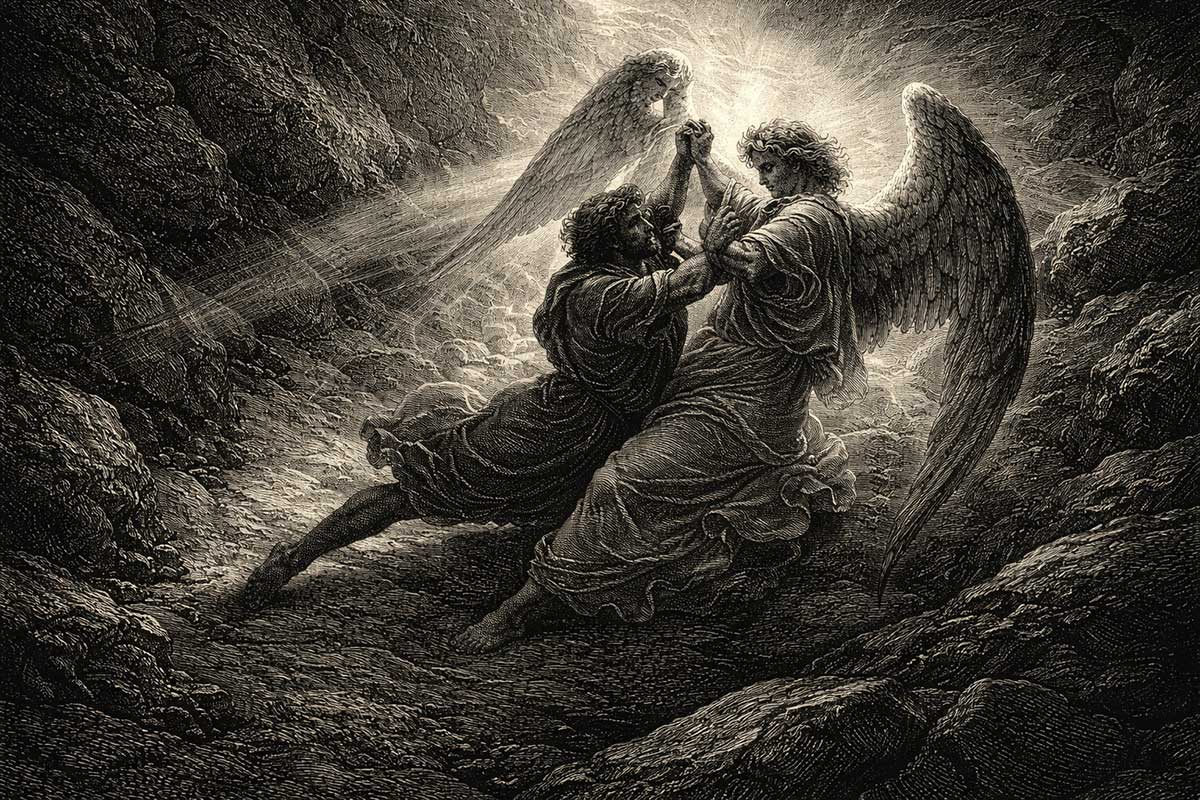
The room feels like a chapel-library hybrid—warm wood, quiet lamps, a long table with worn pages and empty space for hard questions. Rabbi Jonathan Sacks sits at the head, not as a referee with a whistle, but as someone who’s spent a lifetime watching people argue with Heaven—and still choose to live morally afterward.
He looks around, hands folded, and begins gently.
The first question
When people say they’re “wrestling with God,” what are they actually wrestling with: a living Being, the moral law within them, or the brute fact of suffering—and how can we tell the difference?
Jordan Peterson
If you’re serious, you can’t dodge the fact that “God” is the thing you treat as ultimate—what you sacrifice for, what you won’t betray, what you orient yourself toward when the world fractures. Many people say they wrestle with God when they’re really wrestling with the consequences of their own lies, or with tragedy that blows apart their naïve assumptions. But the distinction matters. If it’s the moral law within you, it speaks like conscience: it accuses, it demands, it doesn’t flatter. If it’s suffering, it’s more like the world’s indifference—cold, crushing, seemingly unjust. And if it’s a Being, then wrestling becomes relationship: you’re not negotiating with an idea, you’re confronting Someone who can demand the whole of you. The clue is what happens afterward: do you become more truthful and responsible, or more bitter and resentful?
Viktor Frankl
In the camps, people spoke of God in different registers, but the deepest struggle often sounded the same: “Is there any meaning left that cannot be taken from me?” Those who wrestled only with suffering tended to collapse into despair or numbness. Those who wrestled with conscience were fighting for a human core—something that refused to become an animal even when treated like one. Those who wrestled with God as a Thou—an addressable presence—often found strength not because the pain disappeared, but because their dignity did not. You can tell the difference by the direction of the soul: suffering alone pulls you downward; conscience pulls you toward integrity; God—when experienced—pulls you beyond yourself, toward love and responsibility that exceeds your capacity.
Bishop Robert Barron
The biblical tradition is not embarrassed by struggle. Abraham argues. Moses protests. Job demands an audience. Jacob literally grapples in the night and leaves marked. If God were merely a projection, the wrestling would be a monologue. But the biblical “wrestling” has the structure of prayer: it is an exchange that changes you. Conscience is part of it, yes—because the moral law is written on the heart. Suffering is part of it, yes—because the world is wounded and we are not gods. But the decisive mark is transcendence: the encounter leaves you with humility, with awe, with a sense that reality is not reducible to your psychology. If the struggle ends with self-justification, it wasn’t God. If it ends with surrender to truth, you’re closer.
Simone Weil
We must be careful. People use “God” as a cloak to avoid looking at affliction. They call it “wrestling” when it is simply the refusal to accept reality. Affliction is not only pain; it is the experience of being crushed, of losing social place, of being reduced in the eyes of others and in your own. In such a state, the soul can no longer pretend. If God is real, He will not be found in consolations or slogans but in attention—pure, naked attention to what is. Conscience is real but weak; suffering is real but often meaningless by itself. The only way to tell is whether the wrestling produces truthfulness without bitterness—an obedience to reality even when reality offers no reward.
Jonathan Sacks
So we have three “voices” of the struggle: the cold voice of suffering, the sharp voice of conscience, and the relational voice of God. Yet people often confuse them. Let me press further.
The second question
Does wrestling purify faith because it forces honesty—or does it quietly replace faith with self-therapy and clever language?
John Vervaeke
There’s a real danger here. Modernity has trained us to treat spiritual realities as inner states to be managed—like stress reduction. That can become spiritual consumerism. But wrestling can also be a form of serious “aspiration”—the transformation of how you perceive and participate in reality. The test is whether the struggle changes your patterns of attention and action, not just your vocabulary. If it becomes therapy alone, it makes you feel better without making you better. But if it becomes wisdom, it reorders the self—less vanity, less self-deception, more capacity for truth, love, and sacrifice. Wrestling is legitimate when it opens you to what is beyond you, rather than closing you into your own narrative.
Bishop Robert Barron
Faith is not merely a mood; it is a theological virtue—an orientation to God as God. But it’s true: our era loves to psychologize everything. “I’m on a journey.” “I’m processing.” Those can be fine words, but they can also be evasions. Wrestling purifies faith when it drives us to prayer, repentance, confession, worship—real acts that reorder the self toward the Lord. It replaces faith when it becomes endlessly interpretive, endlessly ironic, forever unable to say “I believe” in any robust sense. Christianity doesn’t ask you to have a clever theory about God; it asks you to kneel.
Jordan Peterson
I’d put it bluntly: if the wrestling doesn’t cost you something, it’s probably fake. People can spin interpretations forever. But real wrestling means you find the place where you’re lying—where you’re cowardly, where you’re resentful, where you’re pretending—and you stop. That’s sacrifice. That’s the offering of what you want now for what you could be. Self-therapy without sacrifice turns into narcissism. It becomes “my feelings” as the center of the universe. Wrestling becomes real when you confront the fact that the truth is not your possession; it’s something you serve. And that’s already religious, whether you like the word or not.
Simone Weil
Cleverness is an obstacle. It gives the ego a hiding place. Faith that has not been stripped by affliction is often sentimental. But affliction can also destroy. The purification is not guaranteed. It depends on whether the soul consents to reality without demanding consolation. Self-therapy is frequently a demand for consolation: “Make me feel whole.” The soul is not made whole by comfort; it is made whole by attention and obedience—obedience to truth. Faith becomes pure when it no longer seeks itself.
Viktor Frankl
When a person suffers, the temptation is to ask only, “How do I stop hurting?” That is understandable, but it is not yet the question of meaning. Wrestling becomes therapeutic escapism when it avoids responsibility: “I am wounded, therefore I cannot choose.” Wrestling becomes purification when it leads to a “yes” in spite of everything: “This suffering will not make me a liar. It will not make me cruel. It will not make me empty.” Whether you call that God or conscience, the existential decision is the same. And it is never merely talk.
Jonathan Sacks nods slowly, as if weighing each answer like a stone.
The third question
What’s the line between noble wrestling and destructive resentment—when does struggle turn into Cain?
Viktor Frankl
Cain is the man who interprets his pain as permission to destroy. He feels slighted, unseen, humiliated—and instead of transforming his suffering into meaning, he converts it into accusation against existence. The line is crossed when one’s inner story becomes: “Because I suffer, the world must pay.” That is the birth of cruelty. Noble wrestling asks, “How shall I live?” Cain asks, “Whom shall I punish?” The first preserves humanity; the second abolishes it.
Jordan Peterson
Cain is resentful because reality doesn’t meet his demands. He offers something half-hearted—symbolically—and then feels wronged when it’s rejected. And instead of improving the offering, he attacks what’s good. That’s the culture-war pathology too: “I can’t build, so I’ll tear down.” The line is crossed when you stop aiming upward and start aiming at your enemy. When your identity becomes opposition. When your sense of meaning is fueled by hatred. At that point you’re not wrestling with God; you’re trying to murder God in the image of your brother.
Bishop Robert Barron
In theological terms, resentment is a refusal of grace. Cain refuses the invitation to conversion. The Lord even warns him: sin is crouching at the door, but you must master it. In other words, the turning point is always moral. Noble wrestling is intimate with humility: “I do not understand, but I will not betray the good.” Resentment speaks with entitlement: “I deserve the good, and if I don’t get it, I will corrupt it.” The poisonous fruit is scapegoating. When you must find a brother to blame, you have already left the path.
John Vervaeke
Resentment is also a cognitive trap. It narrows your salience landscape: you only see insult, threat, and status games. It creates a self-sealing worldview—every counterexample becomes further evidence of conspiracy or betrayal. Cain is the collapse of wisdom into identity defense. Noble wrestling keeps the self porous. It keeps learning possible. It keeps love possible. The line is crossed when your suffering becomes your identity and your identity demands enemies.
Simone Weil
Resentment is the refusal to consent to one’s place in the order of the world. It is a demand that reality kneel to the ego. Cain cannot bear the sight of favor that is not his. He cannot bear that the good exists outside him. Therefore he hates it. Noble wrestling looks at the good and says, “Teach me.” Cain looks at the good and says, “How dare you.” The cure is attention—attention that empties the ego, that makes room for grace. Without that, suffering becomes a weapon.
Jonathan Sacks lets the silence breathe for a moment—long enough that it feels like part of the lesson.
Jonathan Sacks (closing the topic softly)
The Bible does not flatter us. It tells us that struggle can lead to blessing—or to bloodshed. The wrestle is not the problem; the aim of the wrestle is the problem. If the struggle drives you toward truth, responsibility, and reverence, it becomes Jacob: wounded, yes, but renamed. If it drives you toward accusation, envy, and vengeance, it becomes Cain.
He looks around the table.
“And perhaps the most frightening takeaway is this: the difference is not intelligence. It is not education. It is not even suffering. The difference is what you choose to love when the night is long.”
Topic 2 — Is Jordan Peterson “Christian”… and what even counts as “Christian” today?
Moderator: N.T. Wright
Participants: Jordan Peterson, Russell Brand, Augustine of Hippo, Ayaan Hirsi Ali, Alister McGrath
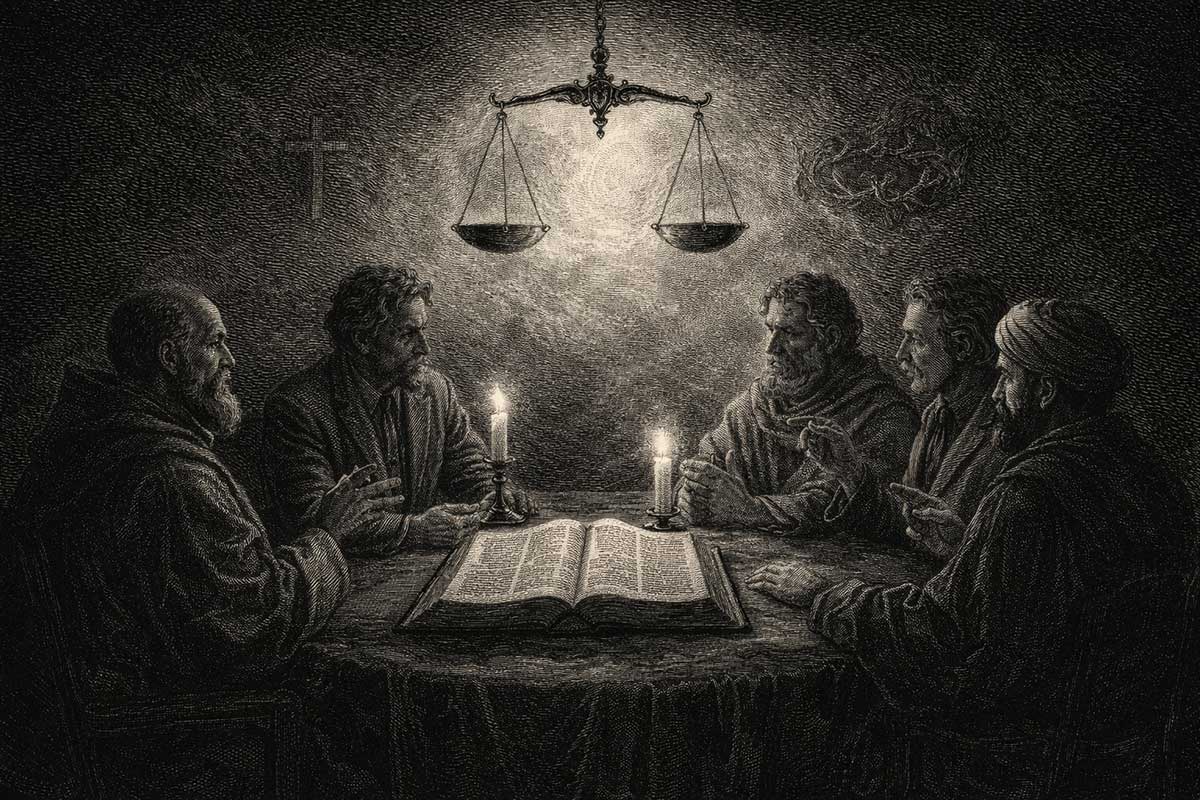
The room shifts tone from the first topic’s haunted intimacy into something more like a courtroom with candlelight—still warm, still human, but sharper around the edges. N.T. Wright sits forward, calm and precise, like someone who has spent decades separating words people use from realities they mean.
He doesn’t open with a speech. He opens with a definition problem.
He looks at Jordan Peterson first, then the others.
The first question
What’s the minimum requirement for someone to be meaningfully called “Christian”: belief, allegiance, practice, church, the resurrection claim—what actually counts?
Alister McGrath
Historically, Christianity isn’t merely an ethical program or a poetic myth. It’s anchored in claims: God has acted in history through Israel, and climactically in Jesus—especially in the resurrection. And it’s embodied in a community that worships, baptizes, confesses, and is formed by Scripture. So yes: practice matters, but practice without the core claims becomes a moral philosophy with Christian furniture. If we’re being honest, “Christian” means a person who confesses Christ—not merely appreciates biblical archetypes.
Jordan Peterson
I’m wary of cheap labeling because people use labels as tribal badges. But if you’re asking what counts, I’d say: what do you serve? What do you sacrifice for? What do you treat as ultimate? If someone says they believe but their life is a concatenation of cowardice, deception, and cruelty—what exactly is that “belief”? At the same time, if someone acts out the highest ethical demand of Christianity—truth, mercy, responsibility—yet can’t utter metaphysical certainties without hypocrisy… are we going to call that nothing? I’m trying to speak in a way that doesn’t turn sacred things into slogans.
N.T. Wright
But Jordan, you see the tension, yes? Christianity is a way of life, but it’s also a declaration about who Jesus is and what God has done. We can’t dissolve it into mere aspiration.
Ayaan Hirsi Ali
I’ll answer bluntly. If “Christian” means anything, it can’t be endlessly elastic. Either Christ is at the center or he isn’t. Yet I also understand why people hesitate. In the modern West, to say “I’m a Christian” is not just a private claim—it’s an alignment that triggers social and political reactions. Many people are drawn to Christianity because they believe it has moral and civilizational value: it shaped law, human dignity, conscience. But they fear being forced into a caricature of religious identity. Still, if you won’t affirm the central truth-claims, you’re not Christian in the traditional sense. You may be sympathetic. That’s not nothing, but it’s different.
Augustine of Hippo
We must distinguish between the name and the reality. Many wear the name and do not live the truth; many hunger for truth and have not yet found how to name it. Yet the minimum is not cleverness. The minimum is love—what you love most. For the Christian, Christ is not a symbol among symbols. He is the living Lord who calls the heart. The church is not a club; it is a body. But I do not condemn the one who stands at the door, trembling. God can begin with desire. He often begins there.
Russell Brand
I’ve been around enough “certainties” to be suspicious of people who say they’ve got it all boxed up. But I also know that if you reduce Christianity to vibes, it becomes self-help with incense. For me, the minimum is surrender—like, you actually submit your life to something higher than your appetites and ego. And yes, Jesus is the axis. If you keep Jesus as a metaphor you can rearrange whenever it’s inconvenient, that’s not surrender; that’s interior decorating.
Wright nods, like he’s letting the room admit the obvious: the word “Christian” is both a confession and a consequence.
He turns the question slightly, like rotating a prism.
The second question
If someone lives by Christian moral insights but treats God as symbolic, is that a stepping-stone toward faith… or a permanent substitute that blocks it?
Jordan Peterson
It can be both. Symbolic language is a necessary bridge for modern people because our speech has become corrupt—we talk about “belief” as if it’s merely an opinion. But religious belief is not like believing the weather report. It’s closer to what you dare to stake your life on. People who start with symbolism can progress into something deeper if they discover that the symbol isn’t arbitrary—that it grips you, judges you, demands sacrifice. But there’s also a failure mode: symbolism becomes a safe cage. You get the emotional resonance and avoid the terrifying implication that God might be real, which would mean your life belongs to Him.
Alister McGrath
Exactly. Symbolic interpretation can be an entry point, but it can also be a cul-de-sac. Christianity has always used symbol and sacrament, but never as an escape from truth. If you say “God is just a symbol,” you immunize yourself against revelation. You don’t have to obey a symbol; you can reinterpret it. The Christian God is not a metaphor you manage—He is the One who addresses you.
Russell Brand
This is where people in our age get tangled. They want the fruits—meaning, community, beauty, moral clarity—but they want none of the surrender. A symbolic God gives you all the aesthetics with none of the accountability. It’s like wanting a marriage ceremony without the marriage. But—and I’ll say this carefully—sometimes people start with symbol because they’re wounded, because they’ve seen hypocrisy, because they’re terrified. If symbolism keeps them near the fire long enough to feel warmth, maybe it becomes faith.
Augustine of Hippo
A symbol can awaken desire, but it cannot satisfy it. The heart is restless until it rests in God. If “symbol” means you have not yet dared to love God as God, then perhaps it is a beginning. But if “symbol” means you refuse to be confronted—if you insist upon being the judge of God—then it is pride dressed as humility. Beware the posture that says, “I will accept God only if He is safe.”
Ayaan Hirsi Ali
I’m less romantic about the bridge. People can live for decades in the symbolic zone because it offers social benefits: you can speak about tradition and morality without being accountable to doctrine. And in public discourse, it lets you appeal to religious audiences without committing. That’s why people press Jordan with the question—because ambiguity can function as a shield. Still, I do think the symbolic approach can be a real path for secular people who have been trained to mock anything transcendent. The question is: do they ever cross the line from admiration to commitment?
Wright doesn’t interrupt. He lets the phrase land: admiration to commitment.
Then he leans in with something almost psychological in its bluntness.
The third question
Why do people need Peterson to “declare” himself—what hunger or anxiety in modern culture does that question reveal?
Russell Brand
People are starving for authority that isn’t fake. That’s what it is. We’ve had institutions lie, we’ve had leaders perform, we’ve had gurus monetize the soul. When someone like Jordan talks about responsibility and truth, people go, “Finally—someone serious.” Then the crowd wants a baptism. They want the stamp: “Are you in or out?” Because it’s safer. It turns a complicated human journey into a team jersey.
Ayaan Hirsi Ali
And because religion has become a proxy battlefield. In the culture war, “Christian” is not a neutral label. It’s read as political orientation, social policy, attitudes toward gender, sexuality, authority, nationhood. So people are not only asking Jordan about his soul—they are asking which side he’s on. That’s not noble. It’s tribal sorting. But it’s real. And Jordan’s refusal to be easily sorted frustrates people who want a simple map.
Jordan Peterson
That’s right. They want me as a token for their side, or they want me as a target. But the deeper hunger is for something like a shared moral language. The West is fragmenting because we don’t agree on what’s sacred. When I talk about the Bible, some people hope I’ll hand them a stable foundation without forcing them into religious institutions they mistrust. Others hope I’ll confess in a way that validates their faith. And critics hope I’ll confess so they can prosecute. It’s not really about me. It’s about the collapse of shared meaning.
Alister McGrath
There’s also an intellectual hunger. Many modern people feel the “meaning crisis” but don’t know how to return to Christianity without feeling intellectually dishonest. Peterson has given them a vocabulary that makes Scripture speak again. That’s a genuine service. But it creates a dilemma: is he offering a path into the faith, or a rebranded alternative to it? People press for a declaration because they sense the fork in the road.
Augustine of Hippo
When a culture loses its highest love, it becomes anxious. It demands signs, banners, proofs, declarations. But God does not always grant the timing of such things. There is a season of seeking. Yet—hear me—there is also the danger of never choosing. The soul can wander forever, admiring light from a distance. The hunger you describe is the hunger for a home. But no one comes home by commentary alone. One must enter. One must kneel, or at least begin to.
Wright sits back, absorbing the weight of that last line. He doesn’t “wrap it up.” He redirects the energy forward.
N.T. Wright (bridging into what comes next)
So we’ve clarified three tensions that modernity can’t stop poking:
Christianity as confession, not merely ethics.
Symbol as either bridge or barricade.
Our culture’s hunger to sort people into tribes rather than face the deeper question: what is true, and what is worthy of worship?
He looks across the table, eyes kind but unblinking.
“Next, we need to face the most explosive piece: when people say ‘God’ in this conversation—do they mean a living Reality, or the highest human ideal? And what happens to a society when it can’t tell the difference?”
Topic 3 — God as Living Reality… or Psychological Symbol?
Moderator: William James
Participants: Jordan Peterson, Carl Jung, René Girard, Paul Tillich, Bret Weinstein
The atmosphere changes again—less chapel, more study. A quiet New England–style room: books stacked in uneven towers, a winter-gray window, and a table that looks like it’s hosted a hundred earnest arguments. William James sits with an amused seriousness, the way a good doctor listens: open, but not gullible.
He taps a finger lightly on the tabletop.
The first question
When you say “God,” do you mean a living Being… or do you mean the highest organizing principle of the psyche—and what changes in a human life depending on which it is?
Paul Tillich
If I may, I think the opposition is too simple. “God” is not one being among other beings; God is the Ground of Being—what makes being possible at all. When people argue “Being versus symbol,” they often miss that symbols participate in what they reveal. A symbol is not merely a sign. It carries power because it opens depth. Now, if a person treats God as only an inner principle, they risk shrinking the holy into something manageable—something they can negotiate with. But if God is only imagined as a cosmic person “out there,” they risk superstition. The question is: does the reality called “God” seize you as ultimate concern? If yes, your life reorganizes around it—ethically, existentially, socially.
Carl Jung
From a psychological perspective, the image of God is an expression of the deepest organizing center of the psyche—the Self. But that does not mean it is “merely” subjective. The psyche is a fact. The archetype is a fact. People are possessed by it when they do not relate to it consciously. Whether God exists metaphysically is not my specialty. What I can say is that if you live as if the highest value is negotiable, you become fragmented—prey to compulsions, ressentiment, ideology. If you take the God-image seriously, you are forced into individuation: truthfulness, sacrifice, integration. The danger is literalism without inner transformation—or symbolism without reverence.
Jordan Peterson
The distinction matters because it changes what “obedience” means. If God is a mere principle, then you’re still the ultimate judge—you can tweak the principle when it costs too much. But if God is a living reality, you’re not negotiating; you’re being called. Now, psychologically, we can observe that people always serve something. They have an ultimate value—an altar—whether they admit it or not. If you aim at the highest good, your life becomes coherent. If you aim at comfort, status, revenge, you disintegrate. I keep circling the same point: what you treat as ultimate will extract sacrifices from you regardless. The question is whether you choose the right ultimate.
René Girard
What changes most is how you understand violence. If “God” is only an inner ideal, societies will quietly continue worshiping the sacred violence that holds them together—scapegoating, collective accusation, righteous frenzy. The biblical revelation exposes that mechanism. It unveils the victim. It undermines the false sacred that binds communities through shared hatred. A living God who reveals truth is a threat to sacrificial systems. A psychological principle can become polite—safe—incapable of interrupting collective madness.
Bret Weinstein
I come at this as someone suspicious of sloppy metaphysics and also suspicious of modern ideological possession. Here’s what’s pragmatic: humans behave as though they have a highest value. If that highest value is aligned with something like truth, responsibility, flourishing, you get stable societies. If it’s aligned with status games or tribal dominance, you get catastrophe. Whether “God” is metaphysical or symbolic might be undecidable at the level of argument. But the downstream consequences are not. The problem is when “symbolic God” becomes a rhetorical loophole—allowing people to gesture at transcendence while refusing accountability.
William James nods as if he’s collecting samples, not votes.
The second question
Can a “symbolic God” actually command sacrifice when it becomes inconvenient—or does real sacrifice require a God who stands over you, not inside you?
Jordan Peterson
People sacrifice for symbols all the time. Nations, flags, ideologies—those are symbols. The issue isn’t whether symbols can command sacrifice; it’s whether the sacrifice is oriented toward the good or toward something demonic. Ideology can demand your children. It can demand your honesty. It can demand your compassion. It can demand blood. So “symbolic God” can command sacrifice—absolutely. The question is: does it command the right sacrifice? If “God” is only your inner preference, then the sacrifice collapses into self-worship. But if the symbol is connected to something objective—something that judges you—then sacrifice becomes real.
Carl Jung
Exactly. The psyche is not a pet you control. The unconscious has autonomy. The archetype can demand sacrifice with terrifying intensity, whether you call it God or not. If the God-image is repressed, it returns as shadow—often as collective possession. The problem with “symbolic only” is that it may deprive the symbol of numinosity—the awe that restrains the ego. Without awe, the ego inflates. And an inflated ego will sacrifice others, not itself.
Paul Tillich
Sacrifice requires ultimacy. The question “inside or outside” is misleading. The holy is not merely inside; it confronts. It demands. It shatters. If your “symbolic God” is simply a concept you manipulate, it cannot command you. But if the symbol mediates ultimacy—if it truly represents the Ground of Being—then it commands you with the weight of reality itself. The modern fear is surrender. We prefer analysis to obedience. But transformation requires being grasped.
René Girard
Let me sharpen it: false gods demand sacrifice of victims. The true God demands sacrifice of scapegoating—meaning, the renunciation of the old violent unity. That is deeply inconvenient. It threatens the cohesion of the crowd. It strips you of your righteous enemy. So yes, symbolic religion can command sacrifice—but it often commands the wrong sacrifice. The living God revealed in Scripture demands the end of sacred violence, which is a far harder offering than ritual.
Bret Weinstein
If your “God” is only metaphor, it becomes easy to walk away the second it costs you status. The social environment punishes sacrifice that doesn’t serve the tribe. So you need something that can out-compete tribal incentives—something that says, “Even if they mock you, even if you lose, this is still the path.” Whether you interpret that as metaphysical God or as an objective moral reality, it has to be strong enough to override the short-term payoff of conformity. Otherwise, your “symbolic God” is just decoration.
James smiles a little, like someone pleased the group is finally talking about consequences rather than words.
The third question
Are humans inevitably religious—devoted to some ultimate—so that if “God” fades, ideology rushes in as a substitute god?
René Girard
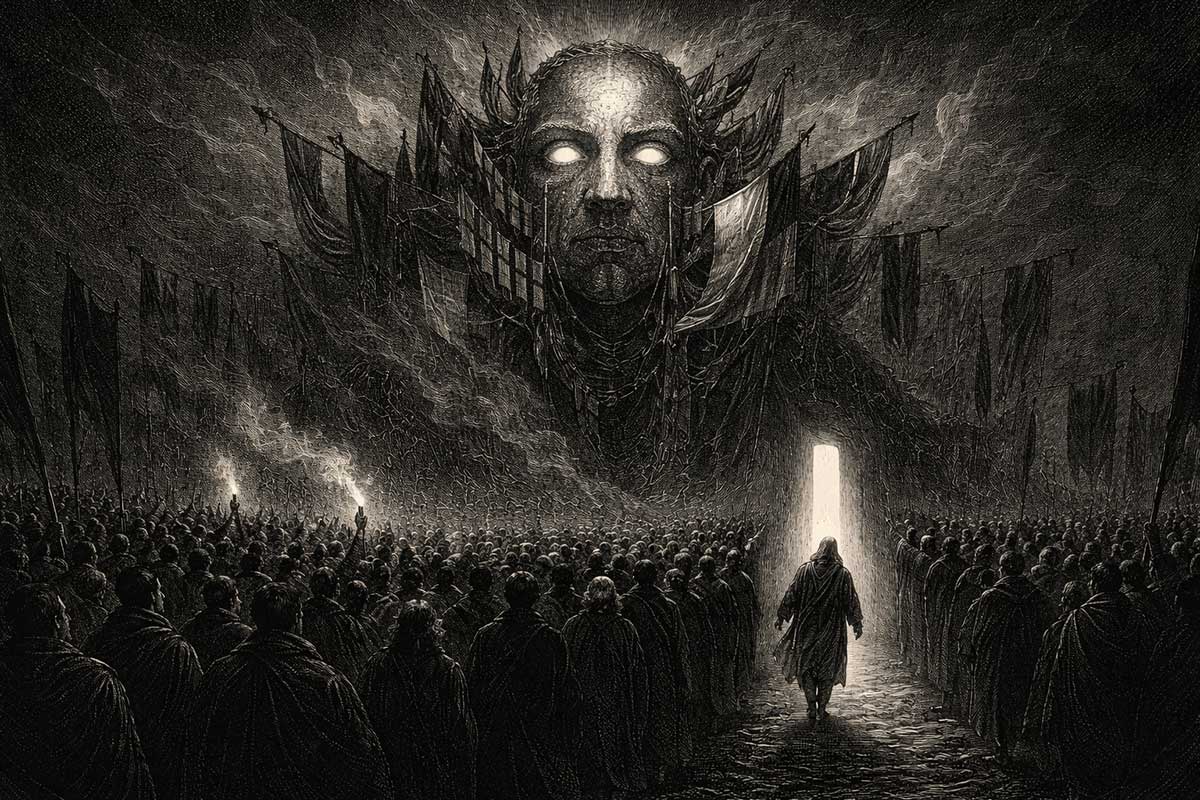
Yes—because communities require a sacred center. When God is rejected, the sacred does not disappear; it migrates. It attaches itself to the political, the national, the racial, the revolutionary. Then the scapegoat returns. The crowd needs a victim to restore unity. In modernity, we pretend we are beyond religion, yet we rehearse religious rituals of denunciation and purification constantly. The question is whether the sacred will be revealed as truth and mercy—or disguised again as righteous violence.
Jordan Peterson
Humans can’t live without an ultimate aim. If you remove God, you don’t get neutrality; you get replacement gods. And the replacements tend to be worse because they masquerade as moral while being powered by resentment. People become possessed by systems that promise utopia and deliver tyranny. The antidote is not merely “belief” as a claim—it’s truth as a practice. If you practice truth, you align with the highest good. If you practice lies, you invite hell—psychologically and socially.
Bret Weinstein
I’d put it in evolutionary terms. Our species seems built to orient around shared narratives that coordinate behavior. Those narratives can become sacred. When traditional religion weakens, the machinery doesn’t vanish; it retools. Then you get ideologies with heresy trials and purity spirals. Some of that can be understood as an attempt to solve real problems—inequality, injustice, meaninglessness—but the structure becomes cultic quickly. The solution isn’t simply to “return” to old forms; it’s to recover the functions—truth, restraint, humility, shared moral grammar—without becoming captive to propaganda.
Carl Jung
When the God-image is rejected consciously, it returns unconsciously—often in monstrous form. This is not poetry; it is psychological law. What is not made conscious is lived as fate. The modern person says, “I believe in nothing,” and then becomes zealously devoted to a political identity, or to a romantic obsession, or to a career idol, or to the collective hatred of an out-group. Religion is the relation to the numinous. If you do not choose that relation wisely, it chooses you blindly.
Paul Tillich
Human beings always have an ultimate concern. If the ultimate concern is finite—nation, party, success—it becomes idolatry. Idolatry is not merely “a wrong opinion,” it is a spiritual disease that demands everything and gives nothing lasting. The culture war is in part the collision of idolatries. The recovery is not mere tolerance; it is depth—an encounter with ultimacy that humbles the ego and grounds courage.
William James lets the final words hang and then leans forward, almost kindly.
William James (closing the topic)
What I hear is this: whether you speak metaphysically or psychologically, humans are not built for emptiness. We worship—if not in churches, then in choices. The argument isn’t just “Is God real?” but “What happens to your life when you live as if something is ultimate?”
He glances around the table.
“And perhaps the most practical test is this: when you’re under pressure—when it costs you—what do you still refuse to betray?”
Topic 4 — Genesis: Interpretation… or Reinvention?
Moderator: Robert Alter
Participants: Jordan Peterson, James Kugel, Tim Mackie, Avivah Gottlieb Zornberg, Mehmet Oz
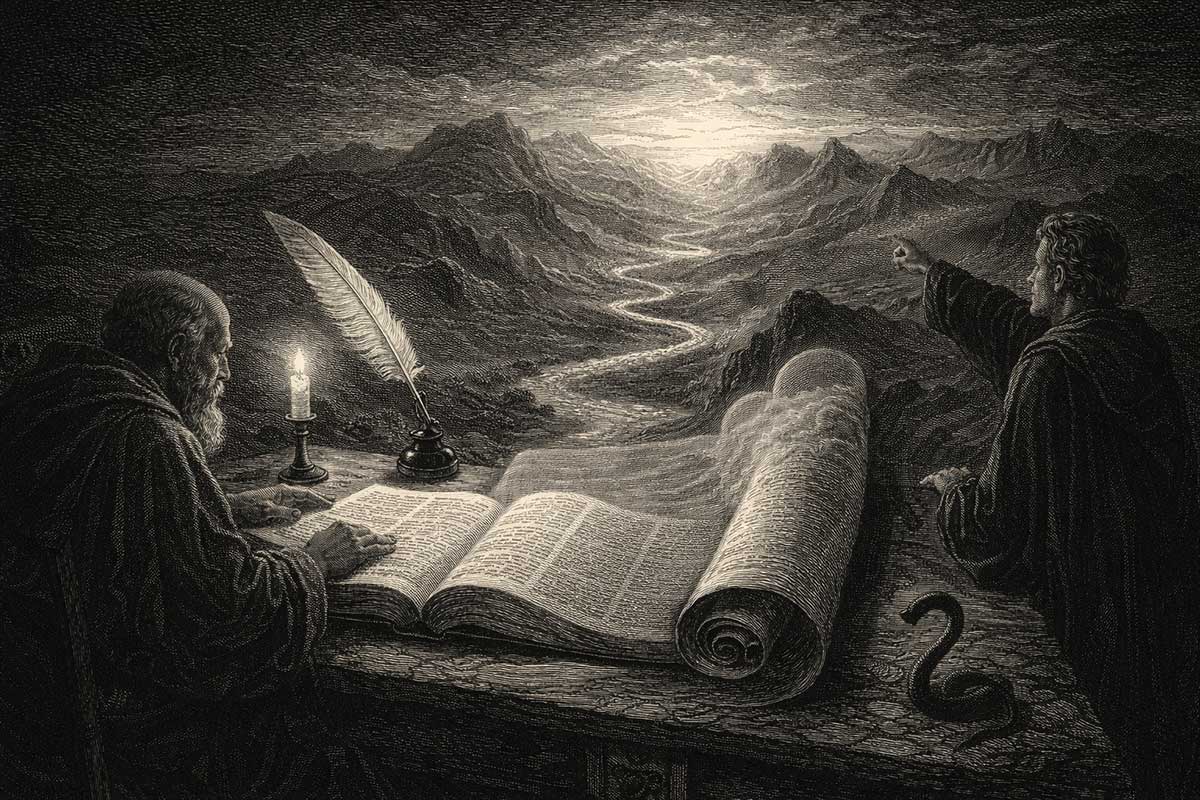
The room feels more like a seminar than a sanctuary now—wide table, thick books, the kind of quiet where even turning a page sounds like a statement. Robert Alter sits with a copy of Genesis that looks properly used: marked, worn, respected. He doesn’t look interested in winning an argument. He looks interested in stopping bad arguments from spreading.
He begins without drama.
The first question
When does symbolic interpretation become distortion—what’s the test for staying faithful to the text rather than using it as a mirror?
Robert Alter
Let me make the standard plain. Genesis is not raw clay for modern commentary; it is crafted narrative with a specific Hebrew texture—repetition, type-scenes, loaded wordplay, moral ambiguity that refuses simple propaganda. A reading is faithful when it can answer: What is the text actually doing here? Not merely, “What do I feel it means?” Symbolic readings can be legitimate, but the symbol must arise from the story’s language and structure, not be imposed from outside.
Avivah Gottlieb Zornberg
I’d add: faithful reading is not simply literalism. The rabbinic tradition has always heard more than one register in the text—psychological, ethical, mystical. But it listens with a kind of reverence for detail. Distortion begins when the reader becomes impatient with the text’s strangeness—when you rush to make it “relevant” and therefore flatten it. The text resists us on purpose. That resistance is part of its teaching.
Jordan Peterson
Fair. The danger is turning the Bible into a Rorschach test. But there’s also a danger in treating it like a museum artifact, insulated from human life. The symbolic approach I use is an attempt to articulate why these stories have endured—why they grip us. That doesn’t grant me permission to say anything whatsoever. The constraint is pragmatic: does the interpretation illuminate the moral and psychological pattern in a way that’s consistent across stories and across cultures, and does it generate a demand for truth and responsibility rather than an excuse for ideology?
James Kugel
The test is also historical memory. Ancient interpreters—Jewish and Christian—did not approach Genesis like modern literary critics. They assumed it was God’s word and therefore layered, harmonized, full of instruction. They read creatively, yes, but within a community of interpretation and with boundaries. Modern symbolic readings often forget that they are late arrivals. If you claim Genesis “means” X, you must ask: Did anyone for two thousand years see that? If not, why not? Sometimes you’ve discovered something. Sometimes you’ve invented it.
Tim Mackie
I like that. I’d frame the test as: are you letting the narrative sequence and its themes guide you? Genesis is a unified story about God, humanity, blessing, exile, and the slow, surprising strategy of redemption. Symbolic readings become distortion when they detach scenes from that arc and make them standalone self-help lessons. Good biblical theology keeps you inside the story’s movement—creation to fall to covenant to hope.
Mehmet Oz
From the “bridge to modern audiences” angle, I see people do both extremes: they reduce Genesis to literal science debates, or they reduce it to vibes. The most compelling interpretations, to me, show how the stories shape behavior—family systems, guilt, envy, reconciliation—without claiming that psychology replaces God. The line is crossed when symbolism becomes a way to avoid being challenged by the text.
Alter nods, as if that last sentence is the key: symbolism shouldn’t be anesthesia.
The second question
If Genesis is read primarily as archetype, what happens to revelation, covenant, and commanded moral order—do those survive, or do they dissolve into psychology?
Tim Mackie
They survive only if you keep the God of Genesis as a speaking, acting character—not a metaphor. The covenant with Abraham isn’t just “archetypal hero journey.” It’s a claim that God binds himself to a people and promises to bless the nations through them. If you dissolve that into psychology, you lose the Bible’s storyline: God’s faithfulness through human failure. Archetype can serve as a lens, but it can’t be the foundation.
Jordan Peterson
I don’t think it has to dissolve. Archetype is a way of describing the pattern by which the story grips the human mind and culture. But revelation and moral order… those are expressed in how the narrative judges you. Genesis doesn’t flatter anyone. It exposes self-deception and pride and resentment from page one. If you read it archetypally and it still forces you toward truth and sacrifice, you haven’t dissolved it—you’ve translated its demand into terms modern people can’t immediately dismiss.
James Kugel
Yet translation can become substitution. If “God” becomes “the highest value,” you may preserve moral seriousness, but you risk losing the Bible’s audacity: that God is free, that God chooses, that God commands, that God interrupts history. Covenant is not just internal alignment; it is relationship and obligation. Ancient readers knew that. If archetype becomes the main frame, covenant can shrink into personal development.
Zornberg
And the covenant’s drama is precisely the tension between the human and the divine. Abraham is not merely “the archetype of faith.” He is a man in fear, bargaining, failing, learning. The revelation is not information; it is encounter—often bewildering, often ethically unsettling. Psychology can help us hear the text, but it cannot domesticate it. If it does, we lose the terror and the tenderness of being addressed.
Mehmet Oz
Let me try to connect both sides: psychology helps explain why stories form human conscience and culture. But covenant is what gives the story its sharp edge—because it introduces accountability beyond the self. When modern people say, “It’s just symbolic,” they often mean, “I’m not accountable to it.” If archetype is used to increase accountability, it supports the covenantal demand; if it’s used to dodge accountability, it dissolves it.
Robert Alter
I’ll underline something: Genesis is full of moral complexity, but it is not morally neutral. It has a pulse. It tracks consequences. It traces the corrosion of human speech and trust. If your archetypal reading preserves the narrative’s moral pressure and its distinctive God-talk, it may serve. But if it turns the text into a generalized myth with interchangeable deities, you have stepped outside Genesis.
Alter looks at Peterson with a frankness that isn’t hostile—just exacting.
The third question
What’s the strongest steelman critique of Peterson’s approach—and what’s the strongest defense?
James Kugel
Steelman critique: your method risks making the Bible valuable because it is psychologically useful, not because it is true in the sense the tradition claims. That can convert Scripture into a tool—one more wisdom resource—rather than revelation. It also risks overconfidence: treating your synthesis as if it were what the text “really means,” when it may be only one modern way of extracting meaning.
Tim Mackie
Another critique: by emphasizing the Old Testament stories as archetypal moral psychology, you can inadvertently leave Jesus offstage—so Christian readers wonder: where is the culmination? Genesis is the front porch of a much larger house. If the reading stops at “pattern recognition,” it may not deliver the narrative’s ultimate horizon.
Avivah Gottlieb Zornberg
And a critique from within the Jewish reading tradition: the text is not only about universal human patterns; it is also about a particular people and an ongoing covenantal life. Universalizing can sometimes erase the specific. The Bible is intensely interested in the concrete and the communal—not only the inner self.
Mehmet Oz
From a mainstream culture lens, a critique is that the approach can sound like you’re smuggling theology through psychology. People hear the moral authority and think, “Is this a sermon disguised as science?” That suspicion is part of why the culture-war temperature rises around the project.
Jordan Peterson
Fair critiques. Here’s the defense. We’re living in a time when many people are locked out of religious language because it’s been politicized, sentimentalized, or weaponized. They don’t know how to take Scripture seriously without feeling foolish. The symbolic-psychological frame is a bridge back to seriousness. Not a replacement for God, but a doorway into the question: “What if this is more real than I’ve allowed?” And the proof of the method is whether it produces humility, truth-telling, and moral courage rather than ideology.
Robert Alter
Let me steelman the defense in my own terms: your approach can reawaken attentiveness. It can make readers slow down and realize these stories are not simplistic children’s tales but high literary art with moral consequence. If it drives people back to the text itself—to read carefully, to notice patterns, to confront their own motives—that is not trivial.
He pauses, then adds the line that makes the whole table feel a little quieter.
“But you will always be judged by your fidelity to what the words actually say.”
The room holds that for a moment—exactly the kind of constraint a culture-war environment tends to hate.
Topic 5 — Culture War: Gasoline or Medicine?
Moderator: Jonathan Haidt
Participants: Jordan Peterson, Konstantin Kisin, Douglas Murray, Cornel West, Yuval Noah Harari
The room feels less like a library now and more like a civic hall—still intimate, but with the hum of public consequence. Jonathan Haidt sits at the head with a small notebook, the posture of someone used to watching people turn moral concern into moral combat.
He looks at the group and says, almost conversationally:
“Let’s keep this human. Everyone here cares about something real. The question is whether the care turns into cruelty.”
The first question
Why do biblical stories instantly become political weapons now—what changed in our moral imagination that makes Scripture feel partisan?
Konstantin Kisin
Because everything is partisan now. We’ve turned identity into a religion and disagreement into heresy. So when Peterson talks about Genesis, people don’t hear “ancient wisdom,” they hear “code.” They assume it’s a dog whistle for patriarchy, nationalism, anti-modernism—whatever their enemies fear. And on the other side, some people want it to be a weapon. They want Scripture as ammunition against their opponents. The culture war turns every symbol into a badge.
Cornel West
Brother, we are living in a spiritual catastrophe of greed and fear. Scripture becomes partisan when it is severed from the prophetic tradition—justice, mercy, truth, care for the poor. When the Bible is used to sanctify empire or to police bodies, it becomes a weapon. But when it is used to expose the lie of domination, it becomes liberation. What changed? We got addicted to power. And power always tries to recruit God.
Douglas Murray
There’s also a civilizational anxiety. People sense that something has collapsed—shared norms, shared narratives, basic cohesion—and they look for foundations. The Bible was historically one of those foundations in the West. So returning to it is seen either as repair or as regression. That splits instantly along political lines because the culture war is partly a dispute about what “progress” means and whether modernity can sustain itself without inherited moral capital.
Yuval Noah Harari
From a secular perspective, all large societies require shared stories to coordinate cooperation. Religion was historically one of the strongest story systems. In the modern era, we replaced religious narratives with national and ideological narratives. The Bible becomes partisan because people now use it as a tool in the competition between narratives—some want to restore it as the core story; others fear it will undermine liberal pluralism. The conflict is not only theological; it’s about governance, identity, and legitimacy.
Jordan Peterson
And we should be honest: the Bible contains demands that cut against both left and right impulses. It condemns exploitation and hypocrisy. It also condemns resentment and the denial of hierarchy’s necessity. But modern politics has trained people to read everything through the lens of power: who wins, who loses, who is oppressed, who is oppressor. So Scripture becomes either a weapon for control or a weapon for revolt. Peterson’s—my—aim is to treat it as a map of human failure and redemption, which should humble everyone. But humility is not popular online.
Haidt nods, then steers them away from “who started it” and toward mechanism.
The second question
Is the culture war mainly about values—or about status and belonging—and how does Peterson’s framing feed one or the other?
Jonathan Haidt (briefly, as moderator)
I’ll just name the frame: people often think they’re arguing about values, but they’re also defending tribes. Let’s hear it.
Douglas Murray
It’s absolutely about belonging. People pretend it’s philosophy, but it’s often social survival. Say the wrong thing and you’re out. Peterson’s framing is attractive because it offers a third identity: “I’m not left or right—I’m for truth.” But it can also become its own tribe. The danger is that “truth” becomes a banner under which people simply fight their enemies with better rhetoric.
Konstantin Kisin
Exactly. A lot of people come to Peterson because they feel gaslit by institutions. They want someone to say, “You’re not crazy.” That’s belonging. It’s community through shared disbelief in the official narrative. That can be healthy—resisting propaganda—but it can also harden into a counter-tribe that reflexively distrusts everything outside it.
Cornel West
Belonging is real, but values are real too. I worry when the talk becomes only about status games, because then we excuse the moral content. The culture war is driven by wounds—economic wounds, racial wounds, spiritual wounds. People want dignity. Peterson helps some people regain dignity through responsibility. But responsibility without love can become harshness. The question is: does the community formed around “truth” also form compassion? Or does it form contempt for the “weak” and the “woke” and the “other”?
Yuval Noah Harari
From my perspective, values and belonging are entangled. A value system is also a membership signal. What Peterson does is re-legitimize older value structures—order, tradition, hierarchy, responsibility—in a time when those are contested. That strengthens the identity of people who feel those values are under attack. It can stabilize them. But it also intensifies conflict if others see it as a threat to equality, diversity, or emancipation.
Jordan Peterson
I’m acutely aware of the tribal trap. I’ve watched it happen in real time: people want to recruit you as a symbol. But I’d insist: the antidote to tribalism is not pretending you have no values. It’s aiming at the highest value—truth—and paying the price personally. If people use my work as a club, that’s a betrayal of the work. The whole point is: fix yourself, stop lying, stop scapegoating. And yes, that includes “my side,” whichever side people think I’m on.
Haidt’s expression says: good, now we’re close to the real nerve.
The third question
If a society can’t agree on God, can it still agree on a shared moral center—what would that look like without collapsing into ideology?
Yuval Noah Harari
It can, but it’s fragile. You can build moral consensus around secular principles—human rights, democratic institutions, scientific norms. But these also require shared myths and trust. If trust collapses, the principles become empty words. The danger is that without some sacred restraint—whether religious or civic—power will fill the void. And then morality becomes whatever the strongest group can impose.
Cornel West
A shared moral center without God is possible only if we retain what I’d call the prophetic fire: compassion for the least, truth-telling against the powerful, and humility before the mystery of life. Call it God or not—if you lose reverence, you lose restraint. And without restraint, you get the rule of the strong. We need a love ethic. Not sentimentality—love as a discipline.
Douglas Murray
We’ve been living off the moral inheritance of Christianity while pretending we don’t need it. That’s the honest diagnosis. You can’t cut down the tree and expect to keep the fruit. A shared moral center requires shared metaphysical assumptions—or at least shared sacred boundaries. If everything is negotiable, then morality becomes trend.
Konstantin Kisin
I think we can agree on a moral center if we stop demanding ideological purity and start demanding basic decency: free speech, rule of law, dignity of the individual, responsibility. But the moment you try to enforce morality through public shaming and coercion, you get pseudo-religion—the worst kind, because it has no forgiveness. That’s what ideology does: it creates sin without redemption.
Jordan Peterson
The shared moral center is truth. But not “truth” as a slogan—truth as the refusal to lie, the refusal to scapegoat, the willingness to take responsibility. The biblical stories are valuable because they dramatize what happens when societies abandon truth: chaos, tyranny, sacrifice of the innocent. If we can’t agree on God metaphysically, we can still agree on the necessity of honesty and the danger of resentment. But if we can’t even agree on that—if we can’t agree that truth is good—then ideology will absolutely devour us.
Haidt lets the last lines settle, then closes in his signature way—less sermon, more diagnosis.
Jonathan Haidt (closing the topic)
Here’s what I’m hearing: the culture war runs on moral emotions—especially sacredness and disgust and loyalty—whether people admit it or not. The Bible becomes gasoline when it’s used to sanctify a tribe. It becomes medicine when it’s used to restrain scapegoating and demand personal truth.
He looks at the group, then at the imaginary audience beyond the room.
“And the most uncomfortable question for all of us is this: are we using these stories to become wiser… or to become more certain that our enemies are evil?”
Final Thoughts by Jordan Peterson
Here’s the thing that people miss when they reduce these stories to politics, or psychology, or mere literature: they’re not simply describing what happened. They’re describing what happens. Always. The Bible is a mirror held up to the human soul and to the structure of society, and it shows you—again and again—that the line between order and chaos is not only “out there.” It runs through the individual heart. It runs through your own willingness to speak truth, to shoulder responsibility, to restrain your resentment, and to make the right sacrifices.
“Wrestling with God” is the alternative to two equally dangerous temptations: naïve belief that never confronts tragedy, and cynical disbelief that hides from moral obligation. The wrestle means you take the highest thing seriously enough to contend with it. You don’t just mouth the words. You don’t just use the tradition as a tribal weapon. You allow yourself to be judged by it. And that’s painful—because it requires you to admit where you’re lying, where you’re cowardly, where you’re using your suffering as an excuse to hate.
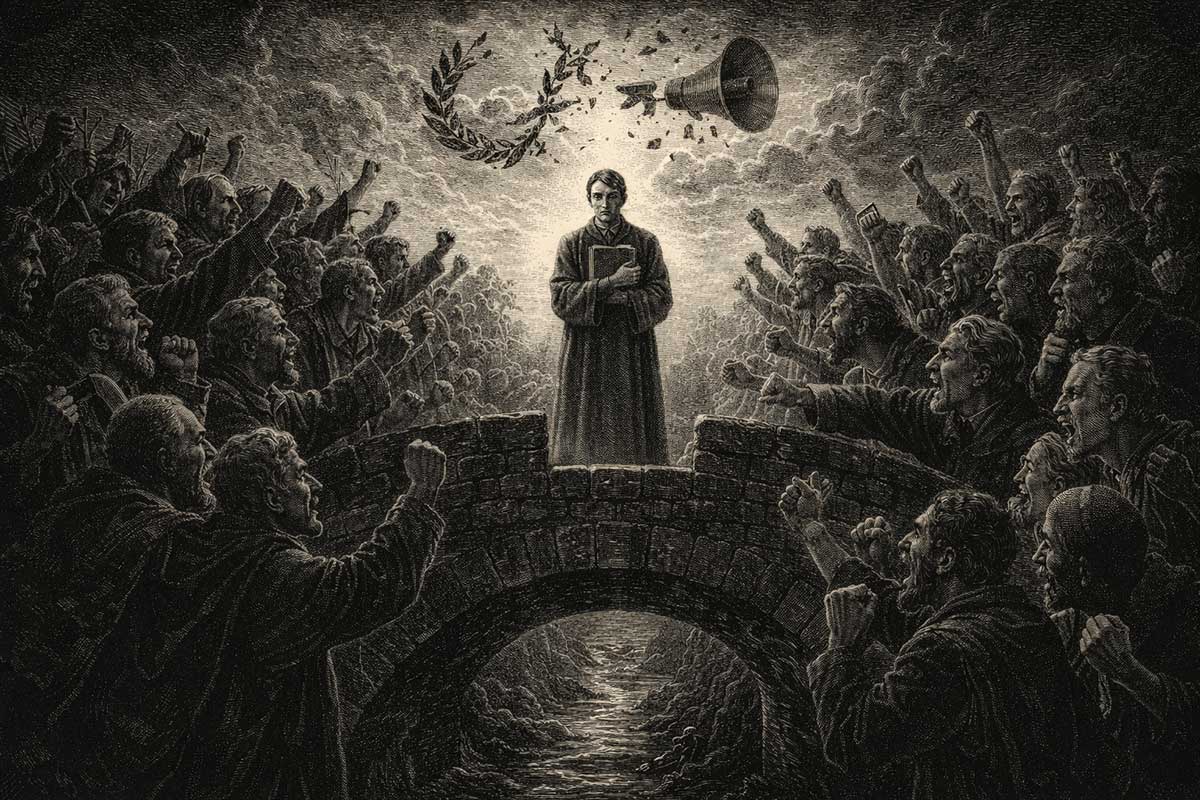
If you want a practical takeaway, it’s this: don’t aim at your enemy. Aim at the highest good you can conceive of, and tell the truth about what you see on the way there. If you do that, you’re far less likely to become ideologically possessed. You’re far less likely to scapegoat. And you’re far more likely to become the kind of person who can stand in the middle of a divided bridge—so to speak—without turning the book into a club.
Because the culture war is not only a conflict between groups. It’s a conflict between ways of being: resentment versus responsibility, lies versus truth, victimhood as identity versus sacrifice as redemption. And the terrifying claim embedded in these ancient narratives is that you always get to choose. You’re always choosing. The only question is whether you’re willing to choose what elevates you… or what corrupts you.
If you wrestle properly, you may limp. But you’ll be marked by something better than bitterness: you’ll be marked by the truth.
Short Bios:
Jordan B. Peterson is a Canadian psychologist and author known for blending clinical psychology, myth, and biblical narrative into arguments about meaning, responsibility, and modern ideological conflict.
Rabbi Jonathan Sacks was a leading Jewish thinker and former Chief Rabbi of the United Hebrew Congregations of the Commonwealth, celebrated for explaining the Hebrew Bible’s moral vision in ways that bridge faith, ethics, and modern society.
Bishop Robert Barron is a Catholic bishop and founder of Word on Fire, known for making classical Christian theology accessible and for engaging modern culture with a strong intellectual and pastoral voice.
John Vervaeke is a cognitive scientist and professor whose work explores the “meaning crisis,” wisdom traditions, and how attention, perception, and practice transform human identity.
Viktor Frankl was an Austrian psychiatrist and Holocaust survivor, founder of logotherapy, and author of Man’s Search for Meaning, emphasizing purpose, conscience, and dignity under suffering.
Simone Weil was a French philosopher and mystic whose writing confronts affliction, justice, and spiritual attention, insisting that truth requires humility and radical honesty.
N.T. Wright is a prominent New Testament scholar and former Anglican bishop, known for historical work on Jesus and Paul and for framing Christianity around the resurrection and God’s kingdom.
Russell Brand is an English comedian and commentator who has increasingly focused on spirituality, cultural critique, and the search for moral and religious renewal in modern life.
Ayaan Hirsi Ali is a writer and public intellectual known for critiques of religious extremism and, more recently, for arguing that Christianity provides a vital moral foundation for Western civilization.
Alister McGrath is a theologian and historian of Christianity whose work clarifies doctrine, intellectual history, and the relationship between faith, science, and modern skepticism.
William James was an American philosopher and psychologist, a founder of pragmatism, whose work on religious experience asks how beliefs transform life in practice.
Carl Jung was a Swiss psychiatrist and founder of analytical psychology, known for theories of archetypes, the collective unconscious, and the psychological power of religious symbols.
René Girard was a French thinker famous for mimetic theory, arguing that desire, rivalry, and scapegoating shape culture—and that biblical revelation exposes sacrificial violence.
Paul Tillich was a Christian theologian who described God as “ultimate concern” and the “ground of being,” bridging existential philosophy and theology.
Bret Weinstein is an evolutionary biologist and podcast host known for critiques of institutional narratives and for framing cultural conflict through evolutionary and systemic lenses.
Robert Alter is a literary scholar renowned for landmark translations of the Hebrew Bible and for close-reading the Bible as serious narrative art with moral complexity.
James Kugel is a biblical scholar known for explaining how ancient Jewish and Christian interpreters read Scripture and how modern assumptions differ from classical interpretation.
Tim Mackie is a biblical scholar and co-founder of The BibleProject, known for teaching the Bible’s narrative structure and themes in accessible, story-driven ways.
Avivah Gottlieb Zornberg is a Torah scholar and writer celebrated for psychologically rich, text-faithful interpretations of Genesis and Exodus through Jewish midrashic tradition.
Mehmet Oz is a physician and media figure who often discusses health and human wellbeing and, in this context, serves as a bridge voice between mainstream audiences and big “meaning” debates.
Jonathan Haidt is a social psychologist known for moral foundations theory and research on polarization, explaining how moral emotions and group identity drive culture-war dynamics.
Konstantin Kisin is a commentator and co-host of TRIGGERnometry, known for critiques of ideological conformity and for defending open debate in polarized public life.
Douglas Murray is a writer and cultural critic focused on civilizational cohesion, immigration, and the pressures modern politics places on Western institutions and identity.
Cornel West is a philosopher and public intellectual in the prophetic Christian tradition, known for moral critique of power, injustice, and spiritual emptiness in public life.
Yuval Noah Harari is a historian known for explaining how shared narratives shape societies, often analyzing religion and ideology as large-scale coordination systems.
Leave a Reply