
|
Getting your Trinity Audio player ready...
|
What if death is not the end we think it is?
Introduction by Nick Sasaki
Welcome, everyone.
Tonight we are taking up one of the oldest and most personal questions a human being can ask: what really happens after death? Not as a slogan, not as a creed repeated on command, and not as a cold argument cut off from human pain. We are here to listen carefully, think honestly, and stay close to both evidence and experience.
This question reaches into every life. It touches the hospital room, the hospice bed, the funeral, the private fear no one says out loud, and the hope that perhaps death is not the whole story. It touches science, faith, memory, philosophy, grief, and love. And maybe that is why no single field has ever been enough to contain it.
So I do not want this conversation to begin with certainty. I want it to begin with respect. Respect for the dying. Respect for the families who have seen things they cannot easily explain. Respect for researchers who have tried to study the edge of life with discipline. Respect for skeptics who insist that mystery should not be used as an excuse for weak thinking. Respect for the great spiritual traditions that have wrestled with death long before any of us arrived.
Across these conversations, we will ask what people often experience in their final hours, what near-death experiences may or may not show, whether consciousness can be reduced to the brain, how far the skeptical case can really go, and what the great traditions still have to say when proof runs out and mortality remains.
I am not here to force agreement. I am here to make room for a better kind of disagreement — one that is serious, humane, and unafraid. If death is a wall, let us at least walk up to it honestly. If it is a door, let us not pretend we know too quickly what stands on the other side. And if this question cannot be solved in one night, it may still change us by the way we face it.
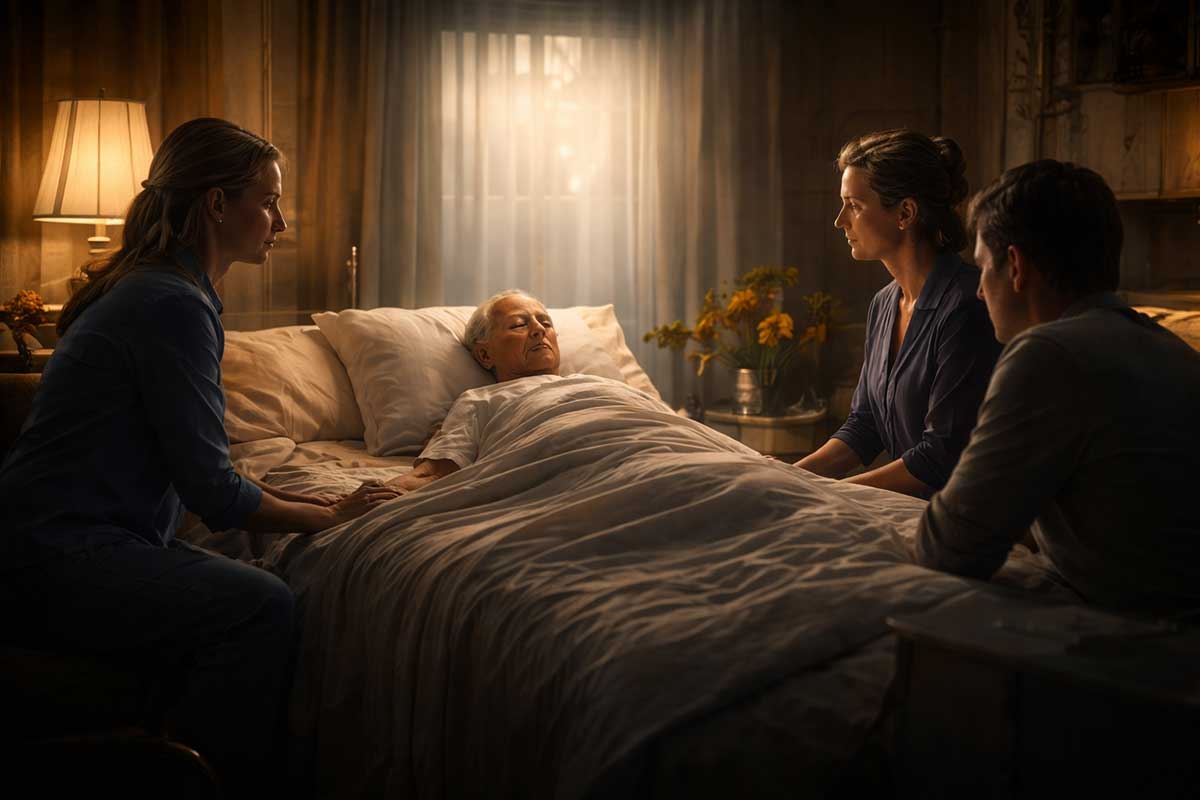
So let us begin close to where all real questions about death begin: not in abstraction, but at the bedside, in the final hours of life, where the body grows quiet and something in us still seems to search for meaning.
(Note: This is an imaginary conversation, a creative exploration of an idea, and not a real speech or event.)
Topic 1 — What Do People Actually Experience in the Final Hours of Life?
Participants:
Nick Sasaki, Elisabeth Kübler-Ross, Cicely Saunders, Ira Byock, Sherwin Nuland, Christopher Kerr
Three questions for this topic:
What patterns appear again and again in the last hours or days of life?
How should we read deathbed visions, final lucidity, and last conversations with unseen loved ones?
What do families and caregivers witness near death that medicine still struggles to explain well?
Nick Sasaki
Welcome, everyone.
For this first topic, I want to stay very close to the bedside. Before we get into theology, philosophy, or arguments about the afterlife, I want to ask something simpler and more human: what do people actually go through in the final hours and days of life? What do they say, what do they see, what changes in them, and what patterns keep showing up often enough that we should pay attention?
Dr. Kübler-Ross, may I begin with you? After sitting with so many dying patients, what struck you most?
Elisabeth Kübler-Ross
What struck me first was that dying people often know more than the people around them.
Families may be trying to stay cheerful. Doctors may be checking numbers. Nurses may be busy with tasks. Yet the patient often senses, very quietly, that a crossing is near. And once we stop talking over them, stop correcting them, stop treating them like passive bodies, they tell us many things.
One pattern I saw again and again was withdrawal without emptiness. The dying person may speak less, eat less, turn inward, sleep more, and seem farther away. People often mistake this for absence. Many times it is not absence at all. It is a shift of attention. The person is less bound to the room, less interested in ordinary social performance, less willing to pretend.
Another pattern is that the dying often become strangely clear about what matters. Old resentments fall away. Pride weakens. They want one child to come. They want forgiveness. They want permission to rest. They want someone to tell them, “You do not have to keep fighting for us.”
And then there is the mystery that many people are afraid to mention: the dying often begin to speak of those who have already died. A mother may say her own mother is near. A husband may say his brother has come. If we dismiss that too quickly, we may miss something sacred in the room.
Nick Sasaki
That is beautiful, and strong. Dame Cicely, you helped change the whole way care of the dying is understood. When you listen to what Elisabeth is saying, what patterns would you add from hospice work?
Cicely Saunders
I would add that the final stage of life is often misunderstood in two opposite ways. One is that it is treated as a purely medical failure. The other is that it is romanticized. Neither is kind.
What we saw in hospice is that dying is often marked by a gradual loosening from the ordinary structures of life. Appetite changes. Sleep deepens. Speech becomes economical. Attention narrows. The body tires. Yet this is not merely biological decline. It is the person moving through an experience that is physical, emotional, relational, and spiritual at once.
I used the phrase “total pain” because suffering at the end of life is not only pain in the body. A person may hurt in memory, in fear, in unfinished business, in loneliness, in shame. When that suffering is met with real care, something changes. A calmer dying is often a more truthful dying.
Many people near death speak symbolically. They say they are packing, going home, waiting for a train, seeing a path, preparing for a journey. I do not rush to explain this away. Human beings often speak truth in images when plain speech no longer reaches far enough.
And one more thing: many dying people are trying to do one last act of care for the living. They may wait for a relative to arrive. They may leave after everyone has stepped out. They may seem to choose their moment with surprising delicacy. Medicine has often been too crude to notice that dying can be relational right to the end.
Nick Sasaki
That line stays with me: dying can be relational right to the end.
Dr. Byock, you’ve spoken often about the end of life as a time of human completion. When you look at repeated patterns in the final days, what do you see?
Ira Byock
I see that people often keep growing right up to the end.
That may sound strange in a culture that treats dying as a shutting down, yet I found again and again that people still have work to do. Not career work. Human work. There are things they want to say. There are bonds they want to mend. There are simple phrases that become immense at the bedside: please forgive me, I forgive you, thank you, I love you.
Those are not sentimental lines. They are pillars. Many people cannot settle until something along those lines is spoken, heard, or at least offered in spirit.
A second pattern is that meaning becomes more valuable than duration. Families often come into a room asking, “How much time?” The patient, when able to speak from the heart, is often asking something else: “Will I be heard? Will I be abandoned? Will my family be all right? Am I still myself, now that I am so weak?”
A third pattern is that presence matters more than performance. Families think they need the perfect words. They do not. Dying people usually need truth, touch, quiet, and permission. Permission is huge. Many hold on out of love, worry, or duty. When someone trusted says, “We will be okay. You can rest,” the room often changes.
So, yes, there are physical patterns. There are clinical signs. Yet the deepest repeated pattern may be this: human beings want to remain human all the way through dying.
Nick Sasaki
Dr. Nuland, you often wrote with clinical honesty and a refusal to flatter people. I want your grounded view here. When others speak of symbolic language, relational timing, and inward shifts, what do you accept, and where do you urge caution?
Sherwin Nuland
I accept far more than people may expect, but I urge discipline in how we describe it.
Death is, in large part, a biological event. Systems fail. Circulation weakens. Organs shut down. Consciousness changes in relation to those changes. Many of the outward patterns my colleagues describe have bodily explanations mixed in with emotional and cultural ones. Reduced intake, altered awareness, sleep, irregular breathing, moments of agitation, confusion, and calm are all familiar parts of decline.
I grow uneasy when ordinary features of dying are turned too quickly into evidence of another world. That leap is too easy. The brain under stress can produce vivid images, distortions of time, intense emotional states, and surprising fragments of lucidity. One should not be naive.
Yet I would be just as uneasy with the opposite error, which is a sterile reductionism that assumes a description of mechanism is a full account of meaning. It is not. If a dying woman says, “My sister is here,” and that statement gives shape, courage, peace, or coherence to her final hours, then the clinical explanation, whatever it may be, does not exhaust the human significance of the moment.
The pattern I saw often was not supernatural spectacle. It was something plainer and, in its own way, more moving: dying strips away pretense. People become elemental. The room becomes honest. Many who have lived guarded lives become simple. That simplicity can look almost luminous, though I would prefer to say psychologically stripped rather than mystically charged.
Nick Sasaki
That gives us a needed balance.
Dr. Kerr, your work brings more recent clinical study into this area, especially with dreams and visions near the end of life. From what you have documented, what repeats most often?
Christopher Kerr
One of the clearest patterns is that end-of-life dreams and visions are not random noise to patients. They are meaningful, structured, and often deeply relational.
Patients frequently report seeing deceased loved ones, preparing for travel, returning home, being welcomed, or revisiting unresolved moments. The content is often tied to attachment, identity, guilt, grief, reunion, or comfort. These experiences are not always peaceful, by the way. Some are distressing. Yet many bring calm, orientation, and reduced fear.
What moved me most was how often these experiences helped patients emotionally. A veteran haunted for decades may have a dream that softens something. A grieving parent may see a lost child and wake with tears, yet less terror. A person afraid of dying may begin to speak of transition rather than extinction.
Families often tell us, “He was talking to someone,” or “She kept saying her mother was waiting,” or “He said he had to get ready to leave.” Staff may be tempted to code this as confusion. In many cases, the patient is less confused than we are. The experience has an inner order. It fits a psychological and relational arc.
So the pattern is not merely altered cognition. It is meaningful experience near life’s end, often centered on connection.
Nick Sasaki
I want to stay on this first question just a little longer.
If a family member were sitting with us tonight and asking, “What should I look for in the last days? What should I expect?” how would each of you answer in a way that is truthful without being cold?
Dr. Kübler-Ross?
Elisabeth Kübler-Ross
I would say: do not expect your loved one to die the way films tell you people die.
The last days are often quieter, slower, stranger, and more inward. Your loved one may not speak much. They may seem far away. They may suddenly say something that does not fit the room. They may call for someone long dead. They may stop caring about ordinary conversation. Do not panic. Sit close. Listen. Let them lead.
And do not keep pulling them back for your sake. Very often the living are the ones who cannot let go. The dying person then must do double labor: the labor of dying and the labor of reassuring everyone else.
Tell the truth gently. Speak love plainly. Do not wait for the perfect moment.
Cicely Saunders
I would tell the family to pay attention to comfort, but not reduce comfort to medication. Comfort includes tone of voice, light, silence, prayer if it is wanted, familiar music, honest touch, and the absence of frantic correction.
If the patient speaks symbolically, enter the image with respect. If she says she is going on a journey, you need not reply, “No you’re not.” You may ask, “Do you feel ready?” or “Will someone be with you?” Such questions honor the person.
And I would tell families that the body has its own wisdom near the end. The lessening of food and drink is often part of the process, not neglect.
Ira Byock
I would keep it very simple.
Show up. Say what matters. Forgive where you can. Ask for forgiveness where you should. Thank them. Love them. Give them permission to rest. And do not assume that unresponsiveness means nothing is getting through. Hearing may remain. Presence may still be felt.
The last days are not only about loss. They can be a time of completion.
Sherwin Nuland
I would tell them to prepare for irregularity. There will be changes in breathing, alertness, appetite, skin color, sleep, responsiveness. Families often think each change means a sudden emergency. Sometimes it is simply the body following the path it must follow.
Yet I would urge them to remember that medical realism need not erase tenderness. The fact that something has a physiological basis does not make it any less worthy of reverence.
Christopher Kerr
I would tell them: write things down. Listen carefully. Ask staff about dreams or visions. Many families later realize these moments were among the most meaningful things their loved one ever said.
Do not brush past them.
Question 2
How should we read deathbed visions, final lucidity, and last conversations with unseen loved ones?
Nick Sasaki
Now I want to move to the heart of the mystery.
Many families report the same kinds of moments. Someone near death begins speaking to a dead parent. Someone looks into a corner of the room and smiles at a person nobody else sees. Someone who has been confused for days becomes suddenly clear and says goodbye with striking coherence. Some call this brain chemistry. Some call it comfort. Some call it evidence that the boundary between worlds grows thin.
How should we read these moments?
Dr. Kerr, maybe start with the clinical side.
Christopher Kerr
The first step is to stop mocking the experience.
For too long, patients have shared these moments only to be corrected, sedated more heavily, or dismissed as delirious. Yet when you ask gently and document carefully, a pattern appears: many of these experiences are coherent to the person having them, emotionally significant, and consistent with themes of attachment and transition.
Now, does that prove that a deceased relative is objectively present? No, I cannot claim that from my role as a physician. But I can say something just as serious: these experiences are often too organized and too meaningful to be treated as mere garbage from a failing brain.
Final lucidity is another striking matter. A person thought to be unreachable may suddenly become oriented, affectionate, and articulate. Families treasure these moments. Science does not yet account for them very well. We can describe them. We have trouble containing them in neat models.
So my reading is careful but open. These moments deserve study, respect, and restraint from premature conclusions.
Nick Sasaki
Dr. Nuland, you called for discipline a moment ago. How would you answer this?
Sherwin Nuland
With caution and sympathy.
The human brain is capable of astonishing phenomena under ordinary conditions, let alone under stress, medication, oxygen shifts, metabolic breakdown, fever, exhaustion, and the immense emotional conditions of dying. One should never underestimate what altered brain states can generate.
A dying patient seeing a dead spouse may reflect memory, longing, identity under pressure, or neurophysiological change. Final lucidity may indicate that the brain, under certain poorly understood conditions, can transiently reorganize function. That is a mystery, yes, but mystery is not license to make metaphysical claims.
Still, I do not believe physicians serve patients well by flattening these events into clinical jargon. If a moment brings reconciliation, peace, or courage, then the experience has value no matter what mechanism underlies it.
So how should we read it? Carefully. Humanly. Without ridicule. Without inflation.
Elisabeth Kübler-Ross
Sherwin is right to guard against inflation. Yet I must say that many physicians guarded so strongly against error that they blinded themselves to what was in front of them.
I sat with dying patients who spoke with a serenity impossible to explain by pathology alone. I saw children close to death describe realities they had never been taught. I saw adults greet unseen loved ones with recognition, relief, and joy. Again and again, not once, not twice, but enough that any honest observer must stop and ask whether our model of the human person is too small.
I am not interested in sensational claims. I am interested in witness. And the witness of the dying deserves respect.
Final lucidity, to me, is among the most moving signs that our categories are incomplete. A person may be considered gone in all practical terms, and then, suddenly, love comes through with full clarity. A farewell is spoken. A blessing is given. Then the person slips away. Are we to call that irrelevant? I do not think so.
Cicely Saunders
I would place emphasis on reverence in practice.
When a patient says, “My mother is here,” the caregiver faces a choice. One can impose one’s own system onto the moment, or one can accompany. Good care often means accompanying without colonizing.
I do not need to decide the full metaphysical status of the vision in order to know that the moment is real to the patient. It asks something of us: humility. We are in the presence of a person at the threshold of life’s end. That threshold is not well served by blunt correction.
As for final lucidity, I agree that it is one of the places where medicine should be more modest. There is more here than our current language can hold.
Ira Byock
My approach has long been practical and relational.
At the bedside, the urgent question is often not “Can we prove this?” but “How shall we respond well?” If a dying father says his own father is waiting for him, the family does not need a lecture on neurons. They need help entering the moment with love.
One can say, “That sounds comforting.” Or, “Do you want to tell me about him?” Or, “It sounds like you are not alone.”
Those responses do not require false certainty. They require tenderness.
And I would add that final lucidity often gives families a gift that shapes grief for years. That last coherent exchange can become a kind of anchor. It may not answer what death is, but it changes how the living carry the loss.
Nick Sasaki
Let me press a little more.
Suppose a viewer asks, “Are deathbed visions real?” If you had to answer in one honest paragraph, what would you say?
Dr. Kübler-Ross?
Elisabeth Kübler-Ross
I would say: they are real as experiences beyond dispute, and many of them bear qualities that suggest more than hallucination. I would not demand that everyone accept my interpretation, but I would ask them to look with courage at the testimony of the dying before they dismiss it.
Cicely Saunders
I would say: they are real in the life of the person who experiences them, and they often carry peace, meaning, and relational truth. Whether they are purely internal or open onto a larger reality is a question that asks for humility.
Ira Byock
I would say: real enough to honor, common enough to notice, meaningful enough to change how we care for people.
Sherwin Nuland
I would say: they are real experiences with serious human significance, yet their existence does not compel one interpretation. A wise person should resist both contempt and certainty.
Christopher Kerr
I would say: whatever their ultimate source, they are too patterned, too significant, and too recurrent to be pushed aside as nonsense.
Nick Sasaki
That is a very strong range of answers.
One more piece here: final lucidity. A person long confused, unresponsive, or cognitively devastated becomes clear shortly before death. Families find this stunning. Some feel it is a gift. Some feel it points to a self deeper than brain damage. Dr. Nuland, what do you make of that?
Sherwin Nuland
I make of it a fact that medicine does not fully explain.
That should not embarrass us. Medicine is full of incomplete explanations. The error comes when incompleteness is treated either as defeat or as permission for extravagant conclusions.
Final lucidity is real in the sense that many credible observers report it. The question is what level of theory best fits it. We do not yet know.
Elisabeth Kübler-Ross
And I would add: not knowing should make us larger, not smaller.
Sherwin Nuland
On that, Elisabeth, I agree.
Question 3
What do families and caregivers witness near death that medicine still struggles to explain well?
Nick Sasaki
For this last part of Topic 1, I want to focus on witnesses — families, nurses, hospice staff, caregivers.
There are moments around death that people never forget. A change in the room. A sudden peace. A timing nobody can explain. A person waiting for one last goodbye. A patient speaking in symbols that only make sense later.
What do people around the dying witness that medicine still has trouble accounting for?
Dr. Byock, may I begin with you?
Ira Byock
Yes.
Families often witness a kind of timing that feels almost intentional. A person may linger until a daughter arrives from another state, then die an hour later. A mother may hold on through a birthday, an anniversary, a holiday, a final gathering. Or, in a different pattern, someone may die in the five minutes when loved ones step out for coffee or use the restroom, as if sparing them the actual moment.
Can I prove intention there? No. Yet the repeated nature of these stories should make us cautious about dismissing them.
Families witness unfinished relationships coming to the surface in compressed form. A son who has not cried in forty years breaks open at the bedside. A patient who has been mostly silent says one sentence that rearranges a family’s memory. A last touch heals something old.
Medicine can chart pulse, pressure, oxygen, urine output. It is less able to chart reconciliation, permission, or the way one room can become heavier or gentler as people tell the truth.
Christopher Kerr
I would add that families often witness content that surprises them.
A patient may dream of a dead brother whose existence staff did not know about. A woman may use imagery that perfectly matches a grief she never spoke aloud. A child may report a visitor from the past in a way that startles the family with its precision.
Again, precision does not settle the metaphysical question. Yet it does challenge the idea that all these moments are random fragments.
Families often say, “Something shifted.” That is hard language for science, but very common language for life. The patient becomes less afraid. The face relaxes. The agitation eases. There is a sensed nearness of something meaningful, though nobody can put it on a monitor.
Cicely Saunders
Nurses often know this terrain very well, though medicine has not always listened to nurses as carefully as it should.
Those who spend long hours at the bedside notice atmospheres, patterns of settling, points of readiness. They know when a patient is not simply declining but preparing. There may be a sudden need to put things in order, to give away belongings, to call a person by name, to speak a blessing.
Families witness what I might call the moral clarity of the dying. Trivialities are of no interest. A deeply wounded relationship may become the whole room. A simple hymn, a prayer, or one sentence from Scripture may suddenly matter far more than any intervention.
Medicine struggles with these things because they are not reducible. Yet care without room for them is too narrow.
Elisabeth Kübler-Ross
I would say families often witness that the dying are less afraid than the living.
This is one of the great ironies. The family enters terrified. The patient, if allowed to speak truthfully, may already be moving into acceptance. They may be consoling the very people who imagine they are protecting them.
Families witness the dying person becoming transparent in a beautiful sense. Masks fall away. Social roles soften. The person becomes more purely who they are.
And, yes, they witness what many call presence. A room changes. The dying person looks somewhere with tenderness. They speak to someone unseen. You may tell me there are many possible explanations. Fine. But let us not bully families out of their own witness.
Sherwin Nuland
I respect that, with one qualification. Family witness is real, yet grief can color perception. Memory is edited by love, guilt, shock, and yearning. So we must not treat every account as untouched data.
Still, there are three things that remain genuinely difficult.
First, the recurrence of similar symbolic patterns across many settings. Second, episodes of lucidity that exceed expectation. Third, the apparent relation between emotional permission and the moment of death. These are not easily fitted into clean predictive models.
I do not say medicine has no answers. I say medicine does not yet have enough answers.
Nick Sasaki
That is a strong sentence.
Before we close this topic, I’d like each of you to speak to one person: the son, daughter, spouse, friend, or nurse who has seen something near death and has been afraid to tell anyone because they thought people would call them foolish.
What would you say to them?
Christopher Kerr
I would say: you are not alone, and you are not foolish. Write down what you saw. Do not let embarrassment erase it. Many people have witnessed similar things.
Sherwin Nuland
I would say: honor the experience, but do not force it into a conclusion before it has had time to ripen in you. Some truths need patience.
Ira Byock
I would say: if the moment carried love, peace, forgiveness, or connection, trust that it matters. Its value does not depend on winning an argument.
Cicely Saunders
I would say: keep company with the memory reverently. Some bedside moments are too deep for quick explanation.
Elisabeth Kübler-Ross
I would say: the dying often teach the living, and sometimes their last lesson begins where our certainty ends.
Nick Sasaki
Thank you.
What I hear in this first conversation is not a simple answer, but a pattern too human and too repeated to dismiss. In the final hours of life, people often turn inward without becoming empty. They speak in symbols. They reach for love, forgiveness, and permission. Many seem to sense a nearness that the rest of us cannot measure. Families and caregivers witness moments of peace, timing, lucidity, and connection that medicine can describe only in part.
That does not settle what death is. Yet it does tell us something vital: the last stage of life may be more conscious, more relational, and more meaningful than our culture has allowed itself to believe.
And that takes us naturally to the next question, which may be even harder: when people come close to death and return, what exactly are they bringing back with them?
Topic 2 — What Do Near-Death Experiences Really Show?
Participants:
Nick Sasaki, Raymond Moody, Bruce Greyson, Sam Parnia, Pim van Lommel, Peter Fenwick
Three questions for this topic:
Which elements repeat across many near-death experiences, and how much weight should that repetition carry?
Can any part of a near-death experience be tested against real-world observation?
Do near-death experiences point to survival of consciousness, or do they reveal an extreme brain state at the edge of death?
Nick Sasaki
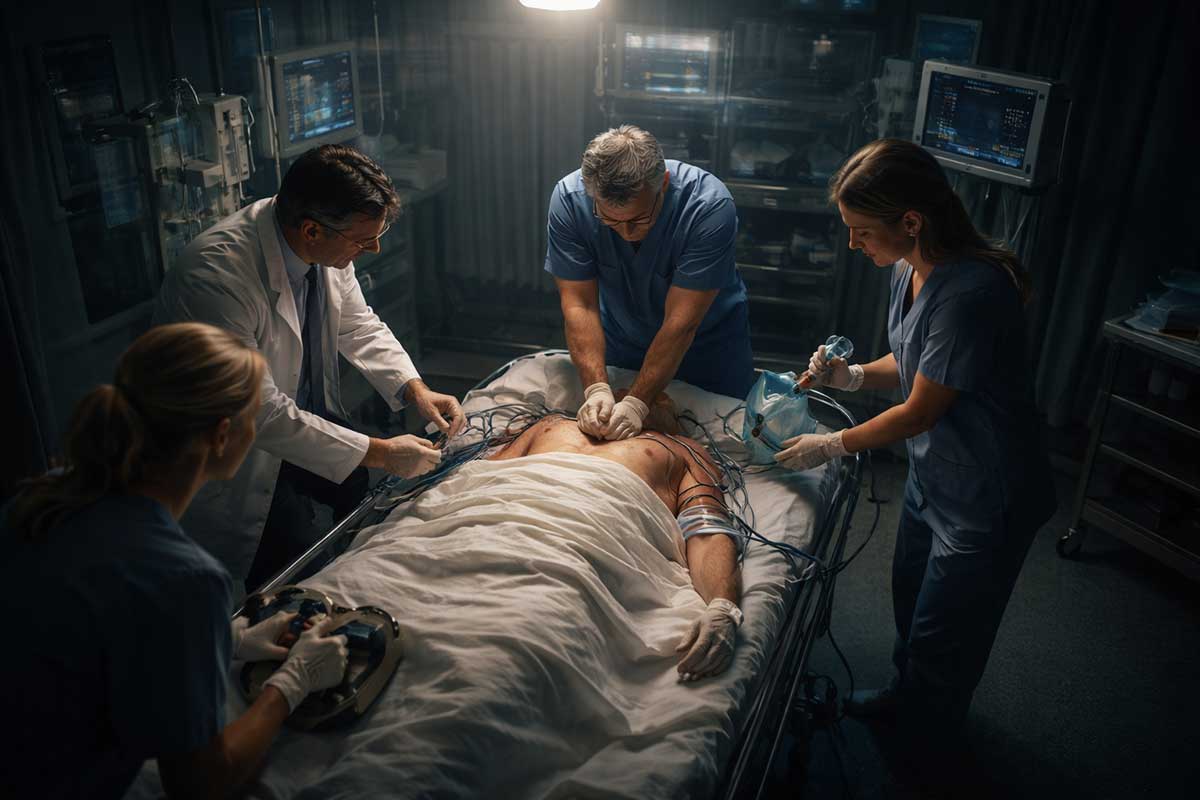
In our first topic, we stayed near the bedside and asked what people often experience in the final hours of life. Now I want to move one step further into the mystery: people who came very close to death and then returned.
Across many stories, people describe peace, separation from the body, a tunnel, light, deceased loved ones, a life review, a border, and a deep reluctance to come back. The details vary. The emotional force does not.
So I want to begin with the most basic question. When you study near-death experiences over time, what keeps repeating often enough that we should take it seriously?
Dr. Moody, may I begin with you?
Raymond Moody
Yes, gladly.
What struck me from the beginning was not one strange story, but the family resemblance across many stories. People from different ages, backgrounds, and temperaments would describe a surprisingly similar structure. There is often a sense of leaving the body, moving through darkness or transition, encountering light, meeting a presence or presences, reviewing one’s life, reaching some kind of boundary, and then returning.
Now, I never felt the force of this lay in rigid uniformity. Human beings do not experience anything in perfectly identical form. What matters is pattern. It is the same way we know a dream, a grief, or a great love has recognizable features without becoming mechanical.
The most striking element, to me, has always been the transformation afterward. Many people return less afraid of death, less materialistic, more compassionate, more attuned to the moral weight of their choices. That change has always mattered to me as much as the experience itself. A hallucination may startle. These experiences often re-order a life.
So, yes, repetition matters. It does not settle every argument. Yet it gives us reason to say that something real is happening, something worthy of deep and respectful study.
Nick Sasaki
Dr. Greyson, you brought much more structure to this field. When you hear Raymond speak of pattern, how do you frame that more carefully?
Bruce Greyson
I would say the repeated features matter a great deal, though we have to be disciplined in how we use them.
Across many reports, we find certain recurring elements: a sense of peace, heightened clarity, separation from the physical body, movement through darkness or toward light, meeting other beings, encountering deceased relatives, panoramic memory, and a decision or instruction to return. These patterns show up too often to dismiss as random fragments.
At the same time, repetition alone is not proof of any one interpretation. Human brains share architecture. Human beings face common fears and hopes. So the fact that reports overlap does not by itself prove survival after death.
Yet there is another layer here. The experiences are not merely similar in content. They are often similar in depth, conviction, and aftereffects. People do not usually describe them as dreams. They describe them as more real than ordinary waking life. That is a very important feature.
What repetition gives us is not a final verdict. It gives us grounds for serious inquiry. It tells us we are not dealing with isolated fantasy.
Nick Sasaki
Dr. Fenwick, you’ve spent years studying consciousness, dying, and these threshold states. What stands out most to you in what repeats?
Peter Fenwick
Two things stand out.
First, the coherence. These experiences often have an internal order. The person does not come back babbling nonsense. They often return with a striking narrative arc: I was out of my body, I observed, I moved, I encountered, I understood, I was told, I returned. There is structure.
Second, the emotional and existential force. People often say, “This was not like a dream.” They may struggle for language, yet they speak with unusual certainty. It alters their relation to death in lasting ways.
That does not mean every report is pure. Memory may shape description afterward. Culture may dress the experience in different imagery. Yet beneath those variations, one senses a core event.
I have long felt that near-death experience is one of those places where science meets a frontier it cannot dismiss and cannot yet master.
Nick Sasaki
Dr. van Lommel, you have argued more strongly than some others that these cases challenge the standard brain-only model. When you hear about repetition, what does it mean to you?
Pim van Lommel
To me, the repetition points to something profound. Patients who were clinically in extreme crisis, sometimes during cardiac arrest, later described experiences with clarity, continuity, and lasting meaning. That should not happen so easily under the standard assumption that consciousness is simply produced by the brain in a straightforward way.
The repeated elements matter, yes. Out-of-body perception matters. Life review matters. Meeting deceased persons matters. The feeling of entering a wider reality matters. Yet the deepest issue is this: how is there such vivid experience at a point when brain function should be severely compromised?
This is why I came to think that consciousness may not be located in the brain the way we usually assume. The brain may participate in consciousness without fully generating it. The brain may function more like an interface or receiver than a factory.
I know that language makes many scientists uneasy. Still, the data should make us uneasy too, in a good way. It should push us past smaller models.
Nick Sasaki
Dr. Parnia, you have worked closest to resuscitation medicine and prospective study. You are usually more careful with conclusions. What do you make of the repeated features?
Sam Parnia
I agree that there are recurring patterns, and I agree those patterns deserve careful attention.
People who survive cardiac arrest and other extreme crises sometimes report lucid, structured experiences. Common themes do arise. That is an empirical fact. Our duty is to document them carefully, compare them, and ask what physiology can and cannot explain.
Where I grow cautious is the next step. Repeated features do not yet tell us the mechanism. Nor do they automatically reveal the ontological status of what is experienced. We need to separate description from conclusion.
The field has suffered at times from overstatement on both sides. Some dismiss everything as anoxia or hallucination without adequate evidence. Others leap to claims that the afterlife has been proved. I accept neither move.
Near-death experiences are important precisely because they force careful science. They raise serious questions about consciousness at the brink of death. That is already a major finding.
Question 1
Which elements repeat across many near-death experiences, and how much weight should that repetition carry?
Nick Sasaki
Let me press this a little further.
When ordinary people hear about near-death experiences, they often ask, “Are the stories really that similar?” So let’s be concrete. Which features show up again and again, and which ones vary?
Dr. Greyson?
Bruce Greyson
The most consistent features include a sense of peace, unusual clarity, separation from the body, an expanded awareness, movement or transition, encounters with light or beings, life review, and a return that feels either chosen or imposed.
What varies is the imagery. One person may describe a tunnel. Another may not. One may see a religious figure. Another may encounter a more ambiguous presence. One may meet deceased relatives. Another may feel only a luminous intelligence.
That is exactly what I would expect if there is a shared core interpreted through personal language and background. Variability does not erase the underlying pattern. In fact, some degree of variation makes the data more believable, not less.
Raymond Moody
Yes, I agree. People often focus too much on literal uniformity. They say, “One person saw this, another saw that, so it cannot mean much.” Yet anyone who has studied human experience knows this is a weak objection. No two people describe falling in love in identical words. No two people describe grief in identical words. Still, we know both are real.
The repeating skeleton matters more than the costume.
I would add one element people often overlook: a sense of being known completely. During the life review, many report not only seeing their actions, but feeling their moral and emotional effects on others. That feature has always struck me as central. It is not only visionary. It is ethical.
Peter Fenwick
And that ethical quality is one reason the aftereffects can be so strong. People return saying, in one form or another, “Love mattered more than I thought. My actions mattered more than I knew.” That does not sound like random neural debris. It sounds like encounter with meaning.
Sam Parnia
It may sound like that, yes. Yet again, I would separate the phenomenology from the interpretation. The ethical dimension is extremely interesting. The clarity is extremely interesting. The persistence of memory is extremely interesting. These are exactly the features that demand further study.
Pim van Lommel
Sam is right to protect the method. Yet the method must not become a shield against what the reports are pointing toward. There is a reason these experiences often feel more real than ordinary life. Many patients insist on that point with extraordinary conviction. We should not flatten that testimony.
Nick Sasaki
Dr. Parnia, when you hear that phrase — “more real than ordinary life” — how seriously do you take it?
Sam Parnia
Very seriously as a report. The intensity and lucidity described by many patients are striking. That is why I reject casual dismissal.
At the same time, intensity of conviction is not in itself proof of external reality. Many states of consciousness can feel overwhelmingly real. The scientific task is to ask what features of these reports can be corroborated, what physiology was present, what timing is possible, and what explanatory models survive contact with the data.
Question 2
Can any part of a near-death experience be tested against real-world observation?
Nick Sasaki
Now we come to the part that many viewers care about most. People often say: “Fine, someone felt peace, saw light, or had a life review. But did they observe anything they could not have known?”
In other words, can any part of a near-death experience be tested?
Dr. Parnia, perhaps this should begin with you.
Sam Parnia
Yes. This is where prospective study becomes very important.
One of the most discussed aspects of near-death reports is the claim of out-of-body perception — the sense of observing one’s resuscitation, the room, conversations, or events from a vantage point outside the physical body. In principle, such claims can be examined. One can compare the patient’s report with actual recorded events, staff testimony, timing, equipment data, and other measurable details.
This is very hard work. Cardiac arrest is chaotic. Survival rates are limited. Memory after resuscitation is fragile. Yet it is the right direction. We need carefully designed studies, not anecdote alone.
Some cases are intriguing. A few patients have reported details that appear accurate and difficult to explain in conventional terms. Yet the data set remains limited. My view is that we have enough to justify serious continued investigation, but not enough to declare the matter settled.
Nick Sasaki
Dr. van Lommel, what do you regard as the strongest kind of case here?
Pim van Lommel
The strongest cases, to me, are those in which patients report verifiable details from periods when one would expect severely compromised brain function, often during cardiac arrest. When a patient later recounts elements of the resuscitation scene with precision, one must ask very carefully: how did that conscious access occur?
I do not claim that every such report is clean. Memory contamination can happen. Staff may talk afterward. Details can be inferred. Yet some cases remain stubborn. They do not fit comfortably inside the standard view.
This is where the conversation changes from “people felt something” to “there may have been conscious perception under conditions that should have made that extremely unlikely.”
Bruce Greyson
I would add that the evidential cases matter, but they are not the whole field. Sometimes skeptics behave as though only perfect verification counts, and everything else is worthless. That is too narrow. Human experience is often studied by convergence of clues, not one dramatic silver bullet.
We have patterns of report, striking aftereffects, occasional corroborative details, and major unanswered questions about consciousness in extreme states. The sensible response is not triumphalism. It is sustained attention.
Raymond Moody
Yes, I share that. There is a temptation in modern culture to think nothing counts unless it can be turned into a laboratory trick. Yet some of the deepest human realities resist that sort of capture.
That said, I welcome careful verification where possible. It helps clean the field. It helps sort noise from signal. Still, I would not want the mystery reduced to only the handful of cases that contain externally checked details. The rest of the phenomenology still matters.
Peter Fenwick
There is another point here. Even if one never found a perfectly verified out-of-body case, one would still need to explain the striking structure, coherence, and transformative power of these experiences. Verification is important. It is not the only important thing.
Nick Sasaki
Let me put this in a sharper way.
Suppose a viewer asks, “Has anyone ever come back from clinical crisis with information they should not have had?” What would each of you say, in one clear answer?
Sam Parnia
I would say: there are reported cases that are intriguing and some that deserve close attention, but the evidence remains incomplete and should be approached with discipline.
Pim van Lommel
I would say: yes, there are cases that strongly suggest conscious perception beyond what our usual brain model predicts, and they should not be brushed aside.
Bruce Greyson
I would say: some cases are difficult to explain conventionally, yet the field is broader than those cases alone. The full pattern matters.
Raymond Moody
I would say: yes, the literature contains reports that raise serious questions, and the responsible response is neither blind belief nor quick dismissal.
Peter Fenwick
I would say: enough has been observed to keep the door open very wide.
Nick Sasaki
That is a very vivid range.
Let me ask one more thing here. What is the biggest mistake people make when they hear one dramatic NDE story?
Bruce Greyson
Treating one story as final proof.
Sam Parnia
Or final disproof.
Raymond Moody
Yes. The field is not one story. It is a chorus.
Question 3
Do near-death experiences point to survival of consciousness, or do they reveal an extreme brain state at the edge of death?
Nick Sasaki
Now we reach the largest and hardest question.
Do near-death experiences suggest that consciousness can continue apart from the body? Or are they powerful experiences generated by a brain in crisis, perhaps with features we still do not grasp?
Dr. Fenwick, may I start with you this time?
Peter Fenwick
I would say they force the question open.
I am not satisfied by crude reduction. “The brain did it” is often spoken as though it were an explanation, when in fact it is sometimes only a label. What exact brain process gives rise to such coherent, transformative, morally structured, often lucid experiences under extreme conditions? That remains poorly explained.
Do I think near-death experiences prove survival? I would not use that word lightly. Yet I do think they challenge the assumption that consciousness is exhausted by current material models. They suggest a larger field of mind than our usual maps allow.
Raymond Moody
I would say something close to that. These experiences do not hand us a neat doctrinal package. They do not erase every question. Yet they press against the boundaries of reductionism. They ask us whether mind is more spacious than we have assumed.
What has always interested me is not only the imagery, but the unmistakable sense many people have that they touched a reality more fundamental than ordinary waking life. One can reject that claim, of course. Yet one should not reject it cheaply.
Bruce Greyson
I tend to frame it this way: near-death experiences do not settle the metaphysics, but they do expose weakness in simplistic assumptions.
For years, many scientists carried an implicit belief that consciousness is simply what the brain does, full stop. Near-death experiences complicate that confidence. The data do not fit neatly inside a single box.
At the same time, I prefer not to force a conclusion beyond what the evidence can bear. Survival may be one interpretation. An extreme state of consciousness not yet understood may be another. The honest position, to me, is openness with rigor.
Pim van Lommel
I would go further.
The idea that consciousness is produced by the brain in the usual mechanistic sense is, in my view, no longer sufficient. Near-death experiences, especially under cardiac arrest, point toward nonlocal consciousness. That does not mean we understand it fully. It means our framework must expand.
When patients report leaving the body, encountering a realm of profound interconnectedness, reviewing their lives in a morally vivid way, and returning transformed, this is not well captured by saying the cortex fired strangely for a moment. That language is too thin.
I believe these experiences point toward continuity of consciousness beyond bodily death. I understand the caution of my colleagues. Yet I think the evidence has already pushed us past mere agnosticism.
Sam Parnia
I would say the evidence has pushed us toward serious re-examination, yes. I would stop there.
We know that death is not always a single instant. It can be a process. During that process, consciousness and awareness may behave in ways not previously appreciated. That alone is a major scientific and human finding.
Do these experiences prove survival after permanent death? No, not at present. Do they challenge simplistic accounts of mind and brain? Yes, certainly. Do they justify further rigorous study? Absolutely.
I do not think caution weakens the field. I think it protects it.
Nick Sasaki
Let me put the two poles plainly.
Dr. van Lommel, you are saying the evidence points toward continuity of consciousness beyond bodily death.
Dr. Parnia, you are saying the evidence points toward unresolved questions about consciousness near death, without yet proving continuity after death.
Is that fair?
Pim van Lommel
Yes, that is fair.
Sam Parnia
Yes.
Nick Sasaki
Dr. Moody, where do you stand between those poles?
Raymond Moody
Somewhere between, with sympathy toward the larger view.
I am moved by the reports, by the repetition, by the deep moral structure, by the aftereffects, and by cases that appear evidential. All of that inclines me away from strict reductionism.
Yet I am wary of turning mystery into a slogan. I would rather say near-death experiences strongly suggest that consciousness is more than our ordinary medical model has allowed, and they may be openings onto a reality that survives bodily death. That is a strong claim. It is also, to my mind, a measured one.
Bruce Greyson
And I would say something very similar.
Nick Sasaki
Let me ask each of you one direct closing question for this topic.
When a thoughtful person asks, “What should I honestly conclude from near-death experiences?” what is your answer?
Raymond Moody
Conclude that death may be far less simple than modern materialism has told us, and that human consciousness may reach further than we thought.
Bruce Greyson
Conclude that the evidence deserves serious respect and that easy dismissal is no longer an intellectually responsible position.
Sam Parnia
Conclude that profound conscious experiences can occur at the edge of death, and that the science of mind and death is still incomplete.
Pim van Lommel
Conclude that consciousness may not end where the body ends, and that our current model of reality is too small.
Peter Fenwick
Conclude that the frontier is real, and we have only just begun to study it with the seriousness it deserves.
Nick Sasaki
Thank you.
What I hear in this topic is that near-death experiences cannot be dismissed as scattered fantasy. Too many features repeat. Too many lives are altered. Too many cases press against easy explanations. Yet the panel does not give us one simple verdict. Some of you see these experiences as strong signs that consciousness continues beyond bodily death. Others see them as major evidence that our science of mind is incomplete, even if the final metaphysical claim remains open.
Either way, one thing seems clear: the old habit of shrugging these reports off as meaningless is no longer enough.
And that brings us to our next step. If these experiences raise real questions about mind and brain, then we have to ask the deeper thing directly:
Can consciousness exist apart from the brain at all?
Topic 3 — Can Consciousness Exist Apart from the Brain?
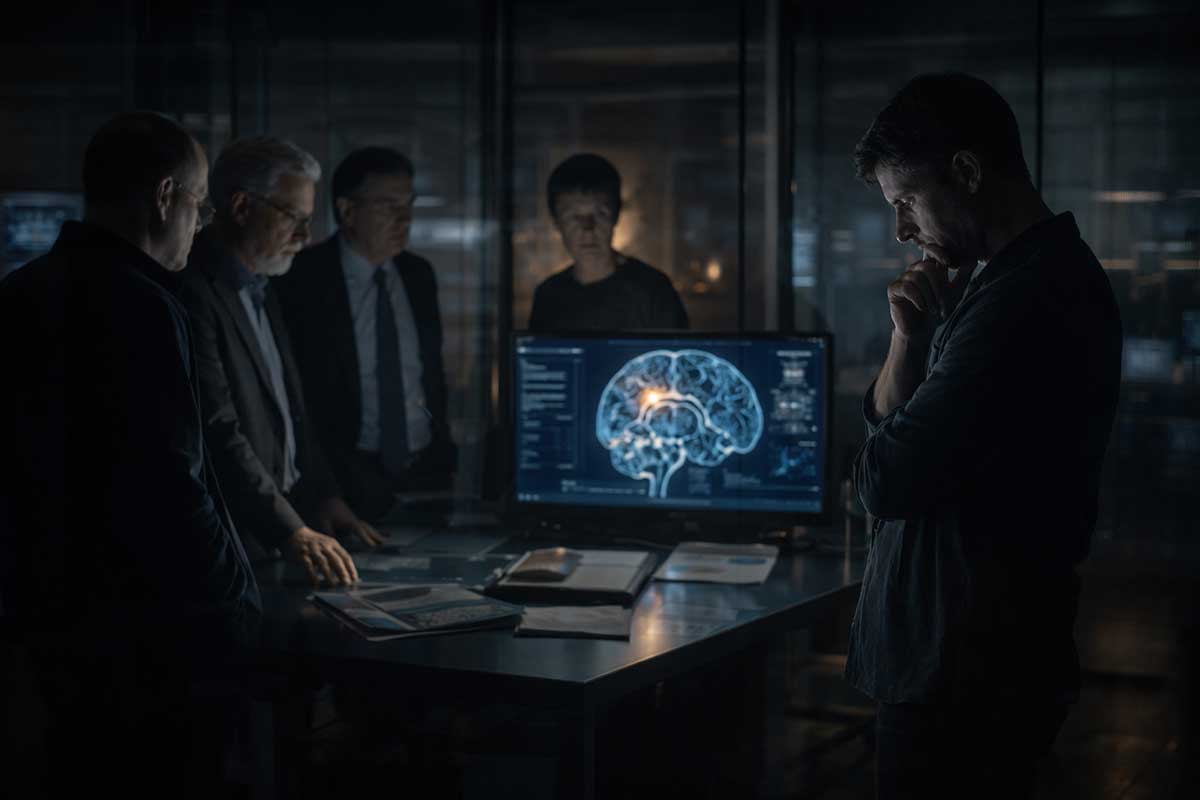
Participants:
Nick Sasaki, William James, Wilder Penfield, Roger Penrose, Christof Koch, Antonio Damasio
Three questions for this topic:
Is consciousness fully produced by the brain, or does the brain disclose or filter a deeper mind?
What do brain injury, brain stimulation, anesthesia, coma, and split-brain research tell us about the bond between mind and brain?
Which view best fits the hardest cases raised by lucid experience, near-death reports, and the felt unity of the self?
Nick Sasaki
In our last topic, we heard that near-death experiences raise serious questions that are not easily pushed aside. That brings us to the heart of the matter.
If a person can have vivid, ordered, meaningful experience close to death, then we have to ask a harder question than before: what is consciousness in the first place? Is it something the brain makes, like bile from the liver or electricity from a machine? Or is the brain less like a factory and more like an instrument through which mind appears in ordinary life?
I want to begin with the widest question and let each of you open the door from your own discipline.
Professor James, when you ask whether consciousness exists apart from the brain, where do you start?
William James
I start with humility before the facts of experience.
The temptation in many ages is to take the reigning model of matter and force, then squeeze the whole of mind into it. Yet consciousness is the one thing each of us knows from the inside before we know anything else. We know thoughts, feelings, will, memory, pain, longing, attention. We know the stream.
Now, I never denied the intimate bond between mind and brain. Injury the brain, and consciousness changes. Drug the brain, and consciousness changes. Exhaust the brain, and consciousness changes. All that is plain. Yet such facts do not settle the whole metaphysical issue. They show relation. They do not prove production.
I once suggested that the brain may have a transmissive or permissive role. By that I meant that the brain may limit, shape, and channel consciousness into the form needed for earthly life, rather than generate the whole of it from nothing. Break the window, and the light in the room changes. That does not mean the window created the sun.
I do not say that image proves the matter. I say it keeps thought open where a narrow dogma would close it.
Nick Sasaki
Dr. Penfield, you spent years stimulating living brains during surgery. Few people came closer to the mechanics than you did. After all that work, did you come away more certain that the brain makes the mind, or less certain?
Wilder Penfield
Less certain, by a very large margin.
During surgery, when I applied electrical stimulation to parts of the cortex, patients could move a hand, hear a sound, relive a memory fragment, smell an odor, or feel a bodily sensation. One could produce many effects. Yet one thing stood out to me: the patient often remained a witness to what was happening. He could say, “You moved my arm,” or “You made me hear that.” There was, in many cases, a observing self that was not identical with the stimulation itself.
I could trigger movement, yet I could not trigger the full inward act of judgment. I could excite memory traces, yet I could not find the point at which the self, as chooser, thinker, knower, was reduced to a mechanical switchboard. The cortex was splendidly involved. It was not the whole story.
That does not mean I embraced a careless spiritualism. It means the data of surgery left me with a real puzzle. The brain is indispensable for ordinary conscious life. Yet the mind, in its unity and agency, did not seem to me exhausted by what my electrode could reach.
Nick Sasaki
Dr. Damasio, I suspect you would frame that puzzle in a different way.
Antonio Damasio
Yes, I would.
I agree that consciousness cannot be reduced to simple slogans. It is not enough to say “the brain does it” and imagine one has finished the work. The processes are layered, embodied, and tied to regulation of the organism as a whole. Consciousness is linked to feeling, body mapping, memory, attention, and the construction of a self in relation to the world.
Yet I do not find it necessary to place consciousness outside the brain in order to honor its depth. The brain is not a crude machine that spits out thought. It is part of a living organism, in constant relation with the body. Mind arises from that living process. The self is not a ghost. It is a biological achievement of extraordinary richness.
When patients suffer damage to certain networks, parts of selfhood, memory, feeling, language, or recognition can fracture. That matters. It tells us that the mind depends on neural and bodily structures in very intimate ways.
So I would say the mystery is great, yes. The answer need not be dualistic.
Nick Sasaki
Dr. Koch, you have spent much of your life trying to place consciousness within science without flattening it. Where do you stand?
Christof Koch
I stand in a place that takes consciousness as fully real and fully part of nature.
For a long time, many scientists behaved as if consciousness were an embarrassing leftover, something that would disappear once the right computations were named. I think that was a mistake. Experience is real. Pain is real. color is real as experience. The taste of coffee is real as experience. If science excludes that, science has left out the very thing that makes a world appear.
Now, do I think personal human consciousness can float free of the brain in ordinary earthly conditions? No. Damage the cortex and thalamus in certain ways, and conscious contents vanish or alter. Deep anesthesia, coma, sleep, seizure, lesion studies — all of these show strong dependence.
Yet I am not a simple reductionist. I think consciousness is tied to physical organization in a deep way. A system with the right causal structure may possess inner experience. That makes the picture stranger than old materialism, not smaller.
So I would say mind is in nature, not outside it. The harder question is what kind of nature we are talking about.
Nick Sasaki
Sir Roger, your work has pressed against the idea that mind can be captured by computation alone. How does that bear on this question?
Roger Penrose
It bears on it directly.
If human conscious insight were merely algorithmic computation, one might hope to explain it in terms of ordinary information processing. Yet I have long doubted that. Human mathematical insight, conscious grasp, and the unity of awareness seem to outrun purely mechanical rule-following. Something non-computational appears to be present.
I do not say that this gives us a full theory. Far from it. Yet it suggests that our current physical account of the brain may be incomplete at the very level where consciousness arises. I have entertained the possibility that quantum processes may play some role in conscious events, though this remains contested.
What matters for our discussion is this: if the physics we use for ordinary objects is not the whole story, then one should be cautious before declaring the mind fully explained by present neuroscience. Present neuroscience is admirable. It may still be operating within a partial frame.
Question 1
Is consciousness fully produced by the brain, or does the brain disclose or filter a deeper mind?
Nick Sasaki
Let me put the issue in a sharper form.
When the radio is damaged, the music changes. One person sees that and says, “The radio produced the song.” Another says, “No, the radio received and shaped the song.” Our topic is not radios, of course. Our topic is us. Still, the shape of the dispute is there.
Professor James, when you speak of a transmissive role for the brain, what makes that view worth keeping on the table?
William James
Its worth lies in the fact that it honors two classes of evidence at once.
On one side, there is no denying the close traffic between brain states and mental states. On the other side, there are features of consciousness, religion, mysticism, genius, sudden moral change, and perhaps survival-related phenomena that make a purely productive theory feel premature.
The productive theory says: no brain, no mind. The transmissive theory says: the brain may be the condition for personal expression in this life, yet not the whole source of consciousness itself. It allows dependence without total reduction.
One need not accept that theory as final truth. One should grant it at least the dignity of a serious hypothesis.
Antonio Damasio
I would reply that the transmissive view gains its appeal from the gaps in our present account. Yet gaps are not themselves evidence for an external mind. They are invitations to better biology.
The organism needs to maintain life, regulate the body, track the world, value things, remember, anticipate, and construct a point of view. Consciousness serves those tasks. It is profoundly rooted in living regulation. That rootedness should not be brushed aside.
The felt unity of self may seem too rich for biology only if biology is imagined in a poor, mechanical form. A living organism is not poor in that sense. It is full of layered processes that yield felt experience.
Wilder Penfield
Antonio, I do not deny any of that richness. Yet from my own work I cannot dismiss the sense that the self stood apart from the stimulated machinery in a way that mere layered processing did not fully capture.
When I moved a patient’s arm with an electrode, the patient might say, “I did not do that. You did.” That distinction between action and witnessed event is not trivial.
Antonio Damasio
No, it is not trivial. Yet that distinction can still arise within brain systems that monitor agency, intention, sensory feedback, and self-modeling. The existence of an observer feeling does not place the observer outside biology.
Christof Koch
This exchange is very useful. It shows the real pressure point.
There is a tendency to think only in two boxes: crude materialism or floating soul. The facts may fit neither box neatly. One can accept strong neural dependence and still say that consciousness points to features of the physical world that our older theories barely noticed.
In that sense I have some sympathy with James’s wish to keep the picture open, even if I do not frame it in religious terms.
Roger Penrose
Yes. The danger is overconfidence. A scientist may say, “We have mapped this circuit, this oscillation, this network, so the matter is nearly done.” No. Correlation is not identity. Neural patterns correlate with conscious states. That is valuable. Yet the inner fact of conscious apprehension remains deeply puzzling.
Nick Sasaki
Dr. Koch, let me press you. If a viewer asks, “Do you believe consciousness can exist without a brain?” what is your cleanest answer?
Christof Koch
My cleanest answer is this: personal human consciousness as we know it depends very heavily on the functioning brain. Beyond that, the relation between consciousness and the fabric of reality may be wider than classical neuroscience once assumed.
Nick Sasaki
Dr. Damasio?
Antonio Damasio
I would say consciousness, in the form we know as a human self in a living body, arises from the activity of the organism and brain together. I see no good reason, at present, to detach it from that living basis.
Nick Sasaki
Dr. Penfield?
Wilder Penfield
I would say the brain is necessary for ordinary mental life, yet I was never persuaded that necessity proves identity.
Nick Sasaki
Professor James?
William James
I would say the evidence proves commerce between brain and mind, not final metaphysical closure.
Nick Sasaki
Sir Roger?
Roger Penrose
I would say current science has not earned the right to say the whole matter is settled.
Question 2
What do brain injury, brain stimulation, anesthesia, coma, and split-brain research tell us about the bond between mind and brain?
Nick Sasaki
Let’s move from broad views to hard cases.
People lose language after stroke. Personality can shift after injury. Memory can vanish. Certain lesions erase the recognition of faces or the sense of ownership over one’s own limb. Brain stimulation can trigger motion, images, fear, laughter. Anesthesia can turn off conscious experience. Split-brain research raises questions about unity itself.
For many people, these facts settle the case. They say: if the brain changes the mind, the brain must produce the mind. End of discussion.
Dr. Damasio, start us there.
Antonio Damasio
These cases matter immensely.
Neurology shows, again and again, that features we cherish as parts of personhood are vulnerable to physical disruption. That is not a side note. It is central evidence. Damage certain areas and the autobiographical self collapses. Damage others and emotional valuation changes. Damage others and the world itself is no longer recognized in familiar form.
Anesthesia is instructive too. A pharmacological intervention can abolish ordinary conscious experience. Restore the chemistry, and consciousness returns. That fact should weigh heavily in any theory.
This does not mean we know every detail of how consciousness arises. It does mean the bond is intimate and systematic.
Wilder Penfield
Yes, the bond is intimate. No one here denies that.
My concern is with the leap from “intimate and systematic” to “nothing but.” In surgery I saw that neural stimulation could evoke fragments, movements, sensations. Yet the patient as knower, the one who judges, often remained distinct from the induced event. That persistent witness troubled simple identity theories.
William James
One may say that brain injury changes the field of consciousness much as damage to an organ of vision changes sight. That does not by itself settle whether consciousness in its source is exhausted by the organ. It shows dependence in manifestation.
Antonio Damasio
Yet if every known route into conscious life passes through embodiment and neural function, should that not command great respect?
William James
It should command respect. It should not command worship.
Nick Sasaki
That sounds very much like William James.
Dr. Koch, how do you read anesthesia and coma? Are they strong evidence that consciousness switches off with certain brain states?
Christof Koch
They are strong evidence that conscious experience depends on certain kinds of organized causal activity in the brain. In dreamless anesthesia, the integrated patterns needed for experience are disrupted. In wakeful consciousness, they return. This is not mere association. It is a deep lawful bond.
Still, one must be careful with the word “off.” From the outside, a patient may seem fully gone, yet inner states can be more difficult to judge than we assumed in past decades. Disorders of consciousness have taught us humility. Some patients once thought absent retain hidden awareness.
So the lesson is dependence, yes, with a warning against careless certainty at the bedside.
Roger Penrose
I would add that our tools detect many valuable things and miss many others. The fact that altered brain function tracks altered consciousness is not in dispute. The harder issue is whether present physical theory is rich enough to explain the emergence of subjectivity from those processes. I doubt that it is.
Nick Sasaki
Let’s bring in split-brain work for a moment. If one brain can, under experimental conditions, behave almost like two centers of processing, what happens to the unity of self? Does that wound the idea of one enduring mind?
Christof Koch
It certainly complicates naive ideas of unity. The self is more constructed than common sense likes to admit. Under split-brain conditions, dissociations appear that suggest parallel centers of processing with partial independence.
Yet I would not say the self is an illusion in the cheap sense. It is a real construction, if I may put it that way, grounded in neural organization.
William James
The stream of thought was never a rigid block to begin with. It has fringes, shifts, transitions, submerged material, competing impulses. The split-brain findings do not destroy the seriousness of mind. They show that our interior unity has a more dynamic form than old metaphysics sometimes imagined.
Nick Sasaki
Dr. Penfield, what do cases like terminal lucidity do to this discussion? A person deeply impaired becomes clear near death. Many families see it. Science still struggles to place it neatly.
Wilder Penfield
They trouble final certainties. One must never build a full doctrine on a puzzling class of reports, yet one must not avert one’s eyes either.
If severe impairment appears to loosen, for a brief interval, into clarity, then the relation between damaged brain and manifest mind may have more hidden pathways than we thought. That does not prove a separable soul. It does say the story is not yet finished.
Antonio Damasio
I agree with that last sentence. The story is not finished.
Question 3
Which view best fits the hardest cases raised by lucid experience, near-death reports, and the felt unity of the self?
Nick Sasaki
Now I want each of you to do something difficult.
Take the hardest things on the table all at once: the vivid order of near-death reports, the witness-like quality Dr. Penfield saw in surgery, the dependence shown by neurology, the challenge of subjectivity itself, the persistence of selfhood, and the mystery of terminal lucidity.
What view of consciousness fits this whole pile of evidence best?
Professor James?
William James
A pluralistic empiricism with metaphysical modesty.
By that I mean this: start with the full range of facts, not only the ones that flatter current theory. Keep open the possibility that brain and consciousness stand in relation without one being simply reducible to the other. Admit that mystical, religious, and borderland experiences may carry some weight in the final reckoning. Refuse dogmatic closure.
The world is not under obligation to fit our first neat scheme.
Wilder Penfield
I would say a dual-aspect or two-level view fits best. The brain is the organ through which mental life is lived in ordinary conditions. Yet the mind, in its unity and agency, is not easily collapsed into neuronal firings. My operating room taught me respect for matter. It taught me respect for mystery as well.
Antonio Damasio
I favor an embodied biological account that is far richer than old mechanistic models. The self emerges from living regulation, feeling, memory, and the brain’s mapping of body and world. Many of the so-called mysteries are invitations to refine that account, not to abandon it.
Near-death reports and terminal lucidity raise real questions. They do not yet compel a move outside biology. For me, the wisest course is patient expansion of biological theory, not metaphysical escape.
Christof Koch
I favor a view in which consciousness is a basic feature of certain physical organizations. Human consciousness depends on the living brain. Yet the physical world may contain inner life more deeply than classical materialism allowed. That keeps science in the game and honors the reality of experience from the inside.
Roger Penrose
I favor the view that present physics and present neuroscience are incomplete at the point where consciousness appears. I do not think algorithmic computation gets us there. Some new principle, perhaps tied to deeper physics, may be required. That leaves open a future in which mind is neither supernatural in the old sense nor reducible in the old sense.
Nick Sasaki
Let me make this personal.
A thoughtful viewer, maybe a little afraid, maybe a little hopeful, asks: “When my brain dies, do I disappear?”
Each of you gets one answer.
Professor James?
William James
I would say no honest thinker can answer that with final certainty. Yet the evidence does not force the bleak confidence that you simply vanish.
Wilder Penfield
I would say the link between brain and mind is plain, yet I never found reason to believe the mind had been explained away.
Antonio Damasio
I would say our conscious self is deeply rooted in living organism and brain. What lies beyond death remains outside firm scientific demonstration.
Christof Koch
I would say your personal waking mind depends on your brain. The larger relation between consciousness and reality remains an open and profound question.
Roger Penrose
I would say current science has not reached the depth required to answer you with confidence.
Nick Sasaki
That may be the most honest panel answer anyone could ask for.
What strikes me in this conversation is that no one here accepts the cheap version of the story. No one says consciousness is a trivial byproduct. No one says the brain is irrelevant. The real dispute lies in something subtler and deeper.
Is the brain the whole maker of mind?
Or is it the place where a wider mind becomes personal, local, and usable for life in this world?
Tonight, we did not close that question. We made it sharper. Neurology shows deep dependence. Surgery shows puzzling distance between stimulus and self. Physics may still be incomplete. Biology may be richer than many older theories allowed. The very fact of subjectivity still stands in front of every system like a gate no one has fully opened.
And that takes us to the next turn in our conversation.
If science has not settled the matter, then the skeptic deserves a full hearing. Not a cartoon skeptic. A serious one.
How hard does the skeptical case hit all of this, and what still remains after the strongest objections are made?
Topic 4 — How Hard Does the Skeptical Case Hit?
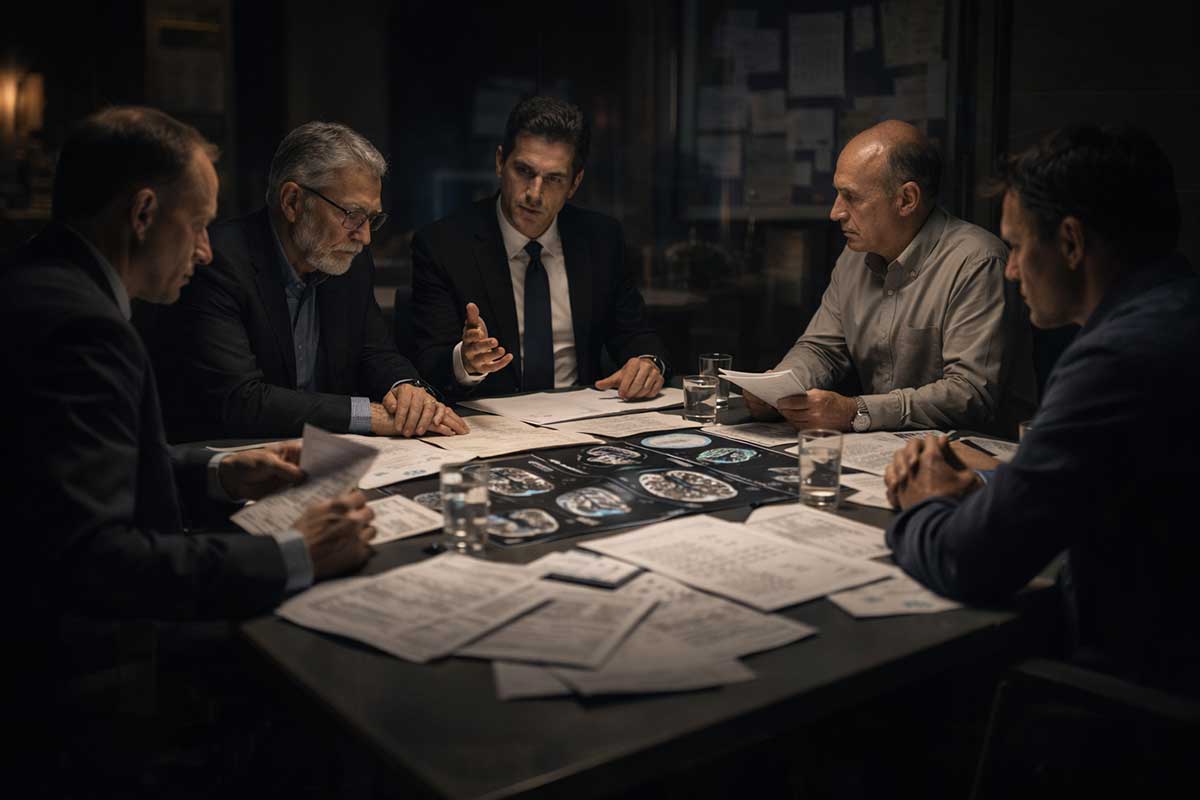
Participants:
Nick Sasaki, Susan Blackmore, Kevin Nelson, Steven Novella, Anil Seth, Michael Shermer
Questions for this topic:
Can tunnel light, peace, out-of-body perception, and life review be explained by known brain processes?
How much of near-death testimony is shaped by memory, culture, expectation, and retelling after the event?
After the strongest skeptical case is made, what part of the mystery still refuses to go away?
Nick Sasaki
Up to this point, our conversation has opened the door wide. We’ve heard from hospice pioneers, near-death researchers, philosophers, neuroscientists, and surgeons who all, in one way or another, said the old easy answers no longer feel big enough.
Now I want to do something important for the health of the whole conversation. I want to give the skeptical case its full dignity.
Not the mocking version. Not the lazy version. I mean the strongest, fairest, most serious skeptical challenge.
If someone says, “Near-death experiences are powerful, yes. Meaningful, yes. Yet none of that proves consciousness survives death,” what is the strongest case for that view?
Susan, may I begin with you?
Susan Blackmore
Yes.
I think the strongest skeptical case begins with a simple reminder: a powerful experience is not the same thing as a reliable report about external reality.
I say that with some sympathy, since I did not begin as a skeptic. I was drawn to these questions because the experiences sounded extraordinary. Yet the more I studied them, the more I came to think that we do not need to leave the brain to explain most of what people report.
Tunnel vision can arise from changes in blood flow and visual processing. Bright light can come from cortical disinhibition. Peace and detachment can come from endorphins, dissociation, or protective brain states under severe stress. Out-of-body sensations can be linked to disruptions in body representation. Life review may reflect memory activation under extreme conditions. A sense of the sacred may emerge from brain states that dissolve the ordinary boundaries of self.
None of that makes the experiences trivial. It only means that extraordinary feeling does not equal proof of another world.
Nick Sasaki
Dr. Nelson, your work goes right into the neurology of these threshold states. When people describe the tunnel, paralysis, vivid presence, floating above the body, or a strange mixture of terror and clarity, how much can be explained within the brain?
Kevin Nelson
A great deal can be explained there.
One of the things I’ve argued is that many features of near-death experience overlap with REM intrusion into waking consciousness. In REM sleep, you get vivid imagery, paralysis, intense emotion, unusual bodily sensations, and dreamlike narrative force. Under extreme stress, or in people with certain predispositions, elements of that system may intrude into waking states.
That helps explain why some near-death accounts include floating, presence, movement through a strange space, vivid scenes, and overwhelming conviction. The experience feels real because it is neurologically real. The brain is doing something powerful.
People sometimes hear that and think the skeptic is trying to cheapen the event. I’m not. The brain is fully capable of generating realities that feel more real than ordinary life. Dreams can do it. Panic can do it. Seizures can do it. Migraine aura can do it. REM intrusion can do it.
So the skeptical position is not “nothing happened.” The skeptical position is “something happened in the brain, and that may be enough.”
Nick Sasaki
Dr. Novella, where do you come in?
Steven Novella
I come in at the level of standards.
When people talk about near-death experiences, a lot of different claims get bundled together. One claim is that people have vivid, structured experiences near death. I accept that. Another claim is that these experiences reveal consciousness outside the brain. That is a much bigger claim, and it requires much stronger evidence.
The skeptical case says: first explain what we already know the brain can do under stress, trauma, hypoxia, drugs, anesthesia emergence, seizure activity, REM intrusion, dissociation, and memory distortion. Then look at expectation, story shaping, cultural framing, and hindsight editing. Only after all that has been ruled out should one move to more radical interpretations.
My concern is that people often reverse that order. They hear a moving story, then leap straight to metaphysics.
Nick Sasaki
Anil, your work on consciousness often points to perception as a kind of controlled construction. How does that shape the skeptical reading of these reports?
Anil Seth
It shapes it quite deeply.
Our ordinary conscious experience is not a direct window onto reality. It is an active construction by the brain, guided by sensory input, prediction, bodily regulation, and prior expectation. Under normal conditions, that construction is constrained by the world around us. Under extreme conditions, those constraints can loosen.
Near-death experience can be seen through that lens. A brain under massive threat may generate a highly organized experience that pulls from deep models of self, memory, social bonds, light, movement, and meaning. It may feel more vivid than everyday life because the predictive machinery is in a very unusual state.
The important thing here is that hallucination is often misunderstood. People hear the word and think “random nonsense.” Many hallucinations are not random at all. They are structured, emotionally loaded, and deeply revealing of how the brain makes a world.
So I would say the skeptical view is not dismissive. It is actually trying to take the generative power of the brain seriously.
Nick Sasaki
Michael, you’ve written a lot about human beings seeing patterns, agency, and meaning even when the data are thin. How do you view this whole subject?
Michael Shermer
I start with the fact that humans are meaning-making animals. We are built to find pattern, intention, story, and moral signal. That tendency is useful. It helps us survive. Yet it can push us too far.
When someone nearly dies, then has a profound experience, then comes back into a culture full of images about tunnels, light, heaven, soul, spirits, reunion, and purpose, the story is going to be shaped. That doesn’t mean the person is lying. Quite the opposite. They are making sense of something overwhelming with the tools their mind and culture give them.
Memory itself is not a recording device. It is reconstructive. Each retelling can sharpen, simplify, dramatize, moralize, and stabilize the narrative. By the time the story reaches a researcher, a family, a church, or a television audience, it may feel very clean. The original experience may have been much messier.
So the skeptic’s job is to ask: how much of the final story was present in the raw event, and how much was built afterward?
Question 1
Can tunnel light, peace, out-of-body perception, and life review be explained by known brain processes?
Nick Sasaki
Let’s slow down and take the classic pieces one by one.
People hear these recurring elements: tunnel, light, peace, floating, meeting others, life review, reluctance to return. They sound so specific that many people think the pattern itself proves something beyond the brain.
Susan, when you hear that argument, how do you answer it?
Susan Blackmore
I answer by saying the pattern is exactly what you would expect from shared human brains under shared extreme conditions.
People have similar nervous systems, similar sensory architecture, similar emotional circuitry, similar vulnerabilities under stress. So it is no surprise that certain features recur.
Tunnel effects can emerge from loss of peripheral vision. Bright light can emerge from visual system disturbance. Floating can emerge from disruption in the integration of body signals. Peace can emerge as the brain shifts into protective states. A life review may reflect the activation of emotionally loaded memory networks. Presence can emerge from the brain’s social and self-modeling systems.
The pattern matters, yes. It just does not point only one way.
Kevin Nelson
I agree.
The overlap with REM features is worth stressing again. Vivid experience, bodily paralysis, presence, movement, bizarre certainty, striking imagery — all of that has neurological grounding. The brain has built-in modes that can generate states people later describe in spiritual terms.
There is no insult in saying that. The brain is extraordinary.
Nick Sasaki
Steven, what about the feeling people describe: “This was more real than real”? That phrase carries a lot of force.
Steven Novella
It carries emotional force, yes. It does not carry evidential force by itself.
Many altered states come with heightened reality feeling. People on certain drugs report it. People in temporal lobe seizures report it. People in dreams can report it. People in panic or ecstatic religious states can report it. The conviction is part of the experience.
The skeptic has to say something people may not like: subjective certainty is a poor guide to objective truth.
Nick Sasaki
Anil, would you put it that strongly?
Anil Seth
Yes, with one nuance.
Subjective certainty is poor evidence for objective claims about the external world. Yet it is excellent evidence that the conscious state itself is powerful and worthy of study.
That distinction matters. If someone says, “This felt more real than waking life,” I take that very seriously as a report of conscious character. I do not then jump to “So the soul left the body.”
Nick Sasaki
Michael, where does life review fit in?
Michael Shermer
Life review is interesting because it sounds morally organized. People hear that and think, “Aha, judgment.” A skeptic says, “Maybe. Or maybe the mind under extreme threat is scanning autobiographical memory at high intensity.”
Human beings are narrative creatures. When the brain is pushed into crisis, it may flood the person with emotionally dense memory fragments and moral self-evaluation. After all, our brains are built for social life. They track harm, guilt, love, betrayal, duty, shame, belonging. It would be odd if a death crisis did not light up those systems.
Nick Sasaki
Let me push back a little.
If the brain can explain tunnel, light, peace, floating, life review, then why do so many people still feel the skeptical explanation is too small?
Susan Blackmore
Because the experience is bigger than the explanation sounds.
When a skeptic says, “This may be hypoxia, REM intrusion, dissociation, memory activation,” the words sound dry and thin. The person hearing them remembers a life-shattering event. So the explanation feels emotionally insulting.
That emotional mismatch is real. Yet emotional mismatch is not evidence that the explanation is wrong.
Kevin Nelson
Yes. The language of neurology often sounds bloodless. The event did not feel bloodless. That tension shapes the whole debate.
Question 2
How much of near-death testimony is shaped by memory, culture, expectation, and retelling after the event?
Nick Sasaki
Now I want to move from the event itself to the story that comes after.
A person nearly dies. They survive. Then they remember, interpret, tell, retell, compare, search, read, and maybe slowly build a stronger narrative around the experience.
How much shaping happens there?
Michael, start us off.
Michael Shermer
A lot.
Memory is reconstructive from the start. It is not a file pulled unchanged from storage. It is rebuilt every time. That means a striking event can become more coherent over time, not less.
People fill gaps. They borrow language. They absorb reaction from family, doctors, pastors, interviewers, books, and media. They notice which parts make people lean in. They may sincerely polish the story without knowing they are polishing it.
Culture matters too. A Christian may frame an encounter one way. A Hindu another way. A secular person may talk about light, energy, or consciousness. The skeleton may overlap. The costume changes.
So the skeptic says: before you treat a reported account as raw data, ask how many hands have touched it, including the narrator’s own mind.
Nick Sasaki
Steven?
Steven Novella
Yes, exactly.
This is a major issue in all eyewitness testimony, not just near-death experiences. Memory drifts. Suggestion matters. Leading questions matter. Retelling reinforces certain paths. Uncertainty gets replaced by confidence. Ambiguity gets replaced by clean sequence.
That doesn’t make people fraudulent. It makes them human.
One thing skeptics ask for is immediate documentation, before the story hardens too much. That’s hard in real medical emergencies, of course. Yet it matters.
Nick Sasaki
Anil, from the standpoint of consciousness science, how much of the meaning is present at the event, and how much is created later?
Anil Seth
Both, I think.
The event may already be meaningful in a deep way because perception is never just raw sensation. Experience is shaped by prior models, memory, emotion, and bodily significance from the beginning. Then later narrative work adds another layer.
So it is not a pure event first and story later. Story is already present in perception. Then later storytelling thickens it.
This is not a flaw in the human mind. This is how conscious beings make reality usable.
Nick Sasaki
Susan, you changed your mind over time. Was memory and retelling part of that change?
Susan Blackmore
Yes, very much.
At first I was impressed by the certainty of the reports. Later I became more impressed by how stories evolve, how patterns can arise from selective attention, and how much weight people place on the polished version of an event rather than the first uncertain fragments.
That does not erase the power of the experience. It changes how I evaluate what the story can prove.
Kevin Nelson
I would add something from the medical side. The line between unconsciousness and consciousness in crisis is often not neat. There can be fragments, partial awareness, broken impressions, distorted timing. After recovery, the mind may weave those fragments into a continuous narrative. That is very human.
Nick Sasaki
Let me put the sharpest skeptical challenge on the table.
What if near-death experience is real as experience, real as transformation, real as memory, yet still not evidence of survival after death at all? What if it is one of the most powerful stories the brain can tell itself under extreme threat?
Steven?
Steven Novella
That is very close to my position.
Susan Blackmore
Mine too.
Anil Seth
I would say it is a very strong hypothesis.
Kevin Nelson
Yes.
Michael Shermer
That phrasing fits the skeptical side quite well.
Question 3
After the strongest skeptical case is made, what part of the mystery still refuses to go away?
Nick Sasaki
Now I want to ask the question that matters most for fairness.
You’ve all laid out the skeptical case with real force. Brain states can explain a great deal. Memory reshapes. Culture clothes experience. Subjective certainty proves very little by itself.
Fine.
After saying all that, what still remains hard? What still nags at you? What part of the whole thing does not disappear so easily?
Anil, may I begin with you this time?
Anil Seth
Yes.
What remains hard is consciousness itself.
The skeptical case can explain why one should be careful about making big metaphysical claims from intense experiences. Yet that caution does not solve the deeper problem of why any brain process should feel like anything from the inside at all. Why should neural activity become light, fear, love, presence, selfhood, or timelessness?
So even if every near-death account were fully explained within the brain, the hard problem of conscious experience would still stand.
Nick Sasaki
Steven?
Steven Novella
For me, the hardest remaining issue is not the supernatural claim. It is the gap between neural description and lived experience. We are getting better at mapping function, state, and mechanism. Yet first-person experience is still difficult to bridge from third-person data.
I would not say that gap points to survival after death. I would say it keeps philosophers and neuroscientists employed.
Nick Sasaki
Susan?
Susan Blackmore
For me, what remains hardest is the sheer depth of the transformation some people show afterward. Fear of death drops. Priorities change. Compassion grows. Material ambition weakens. The event can reorder a life.
Now, a skeptic can say that deep transformation happens after many intense experiences, and that is true. Yet near-death experiences seem to carry unusual weight for many people. That still interests me.
Nick Sasaki
Kevin?
Kevin Nelson
What nags at me is the precision with which some people feel they experienced events around them, paired with how chaotic and unstable the actual medical state can be. I still think neurology explains a great deal. Yet the exact timing and structure of certain reports remain difficult.
Not impossible. Difficult.
Nick Sasaki
Michael?
Michael Shermer
I would say two things remain.
First, people do not merely report fireworks. They often report moral seriousness — that love matters, actions matter, connection matters. That doesn’t prove cosmic truth, yet it is striking.
Second, human beings keep reaching for something larger than material survival. That hunger itself is a fact. A skeptic should not pretend that explaining mechanisms cancels existential weight.
Nick Sasaki
Let me ask each of you one clean closing question.
After everything you’ve said, what is the most honest skeptical conclusion a thoughtful person should walk away with?
Susan?
Susan Blackmore
Near-death experiences are profound human events, yet they do not require belief in an afterlife to be taken seriously.
Kevin Nelson
Many classic features of near-death experience fit known brain processes under stress better than most people realize.
Steven Novella
The burden of proof for consciousness surviving death remains very high, and current evidence does not yet clear that bar.
Anil Seth
The brain is capable of generating worlds of immense reality and meaning, especially at the edge of life.
Michael Shermer
A moving story should open your mind, not suspend your standards.
Nick Sasaki
Thank you.
What I hear in this topic is that the skeptical case is far stronger than many believers want to admit. Tunnel, light, peace, floating, presence, life review, certainty, memory, and transformation can all be approached through the brain without turning the experience into nonsense. The skeptic is not saying nothing happened. The skeptic is saying the brain may be far more powerful, narrative, and world-making than we usually think.
Yet one thing did not vanish tonight. Consciousness itself still stands there. The felt reality of experience still stands there. The moral force of some near-death accounts still stands there. The hardest cases still stand there.
So after the skeptic has had a full hearing, we are left in a better place: less gullible, less smug, and perhaps more honest.
And now the final turn becomes possible.
If science cannot close the question, and skepticism cannot fully drain it of meaning, then how have the great spiritual traditions tried to answer what happens after death, and what do they still say to us now?
Topic 5 — What Do the Great Spiritual Traditions Say Happens After Death?
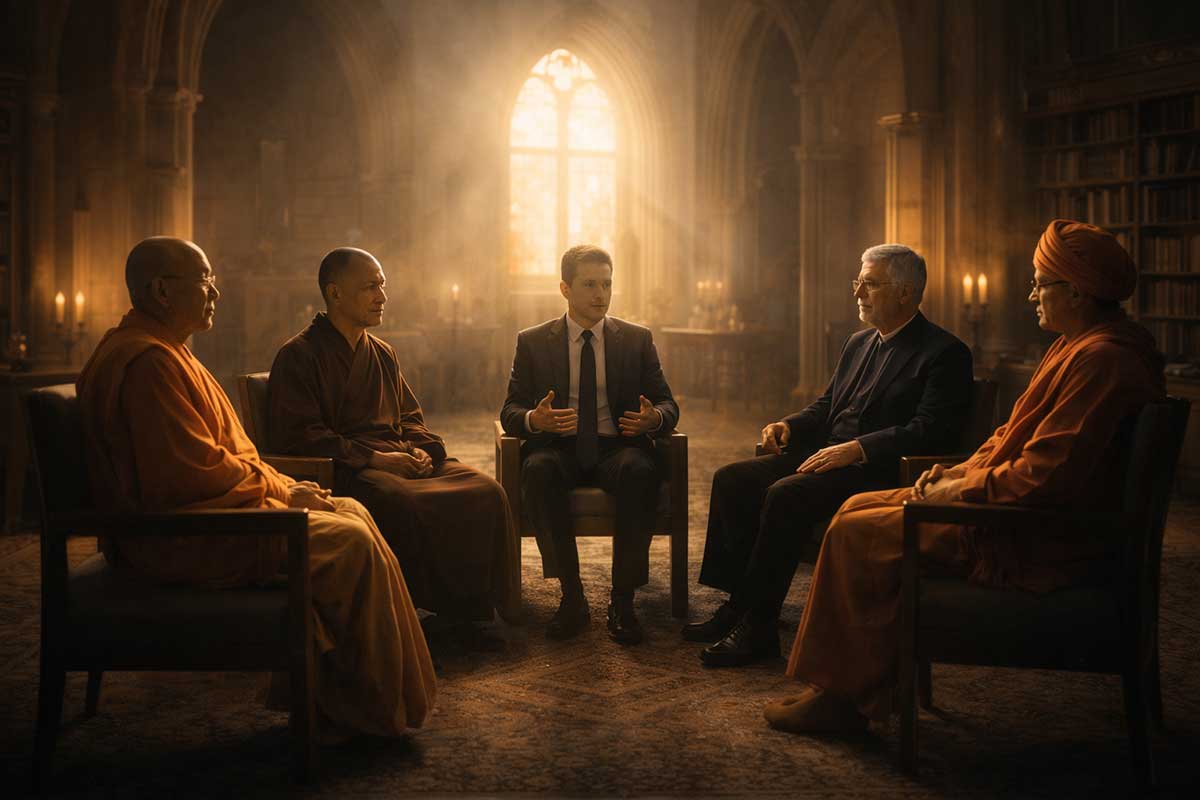
Participants:
Nick Sasaki, The Dalai Lama, Thich Nhat Hanh, N. T. Wright, Swami Vivekananda, Huston Smith
Three questions for this topic:
What do the great spiritual traditions actually say happens after death, and where do they meet or part ways?
Are heaven, resurrection, rebirth, liberation, and continuation pointing to one truth through different language, or to very different realities?
If none of these visions can be proved in a laboratory, how should a thoughtful person live in the face of death?
Nick Sasaki
We’ve come a long way.
We began at the bedside, listening to what many people experience in the final hours of life. Then we moved into near-death experience, then into the question of consciousness and the brain, and then we gave the skeptical case a full and serious hearing.
Now I want to turn to the traditions that have lived with this question for centuries, sometimes for millennia. Not one passing argument. Not one isolated study. Whole civilizations have asked what death is, what survives, what ends, what continues, and how we should live if death is real and near.
So I want to begin very plainly.
When a human being dies, what do your traditions say happens?
Your Holiness, may I begin with you?
The Dalai Lama
Yes.
In the Tibetan Buddhist view, death is not the destruction of some permanent self, because we do not believe there is such a permanent self to begin with. What we call a person is a stream of causes and conditions, mental and physical, changing from moment to moment. Death is a major change in that stream, not the end of causation.
At death, the gross body ceases, yet the subtlest continuity of consciousness is said to continue. This continuity then moves through further states, shaped by karma, habit, attachment, fear, compassion, and the state of mind cultivated in life.
So from this view, what continues is not a fixed soul in the Western sense. It is a continuity, a stream, a process.
This is why preparation for death matters so much. The state of mind at death has great importance. A person who has cultivated compassion, less attachment, less anger, and some familiarity with impermanence is in a better condition for that passage.
Nick Sasaki
Thank you. Thay, how would you answer the same question?
Thich Nhat Hanh
I would say that our deepest mistake is to think we are born once and die once.
Looking deeply, we see that there is no separate self that comes from nothing and then becomes nothing. There is continuation. The body changes, feelings change, perceptions change, consciousness changes, yet nothing is lost. It transforms.
In Buddhism we speak of no birth and no death. This does not mean nothing matters. It means our way of seeing is often too small. A person does not vanish into nonbeing. At the same time, there is no eternal separate ego traveling intact forever.
What continues is action, energy, consciousness in continuity, the effects of our life, and the deep interbeing we already share with all others.
If you touch life deeply in the present moment, fear of death becomes smaller.
Nick Sasaki
Bishop Wright, I suspect you will frame the answer quite differently.
N. T. Wright
Yes, in some respects very differently.
In historic Christianity, the final hope is not the immortality of the soul in a vague disembodied sense. The Christian hope is resurrection. That means God’s faithful raising of the person into new life, not merely survival as a floating spirit. It is rooted in the resurrection of Jesus and in the promise of new creation.
Now, Christians have often spoken loosely about “going to heaven when you die,” and there is a sense in which the dead are safe with God. Yet the full Christian hope is larger than that. It is not escape from creation. It is the redemption and renewal of creation.
So when a person dies, there is an intermediate state, yes, being with Christ, resting in God. Yet that is not the final destination. The final Christian hope is resurrection life in God’s renewed world.
That is quite different from simple reincarnation, and it is worth being precise about the difference.
Nick Sasaki
Swami Vivekananda, how would you answer?
Swami Vivekananda
I would say first that man is not the body. Man is not even the mind in its changing forms. Behind body and mind is the Atman, the true Self, birthless, deathless, pure, divine.
Death belongs to the body. Change belongs to the mind. The Self does not die.
Yet in ordinary life we do not know ourselves as that Self. We identify with body, personality, pleasure, pain, memory, family, ambition. So we move through repeated birth and death under the law of karma, gathering experience, learning, suffering, striving, rising.
Rebirth is not punishment in some crude sense. It is the continuation of the soul’s journey until freedom is realized. The highest truth is not endless return, but liberation — moksha — freedom in the knowledge of our real nature.
So what happens after death? For most, continued journey. For the liberated, freedom.
Nick Sasaki
Professor Smith, you spent much of your life helping modern people hear these traditions without flattening them. When you hear these first answers, what do you notice?
Huston Smith
I notice both kinship and serious difference.
All four voices reject the idea that death can be understood only as biological shutdown. All four insist that moral and spiritual formation in life matters deeply. All four refuse the notion that the ego, as modern individualism imagines it, is the last word.
Yet the differences are not cosmetic. Buddhism, especially in its classical form, does not affirm an eternal soul in the same way Vedanta does. Christianity does not aim at escape into impersonal unity, nor does it teach endless cycles of rebirth. Vedanta speaks of the eternal Self. Christianity speaks of personhood fulfilled in God and creation renewed. Buddhism speaks of continuation without permanent ego.
So the first act of honesty is to resist saying, “They all mean the same thing.” They do not.
Question 1
What do the great spiritual traditions actually say happens after death, and where do they meet or part ways?
Nick Sasaki
Let’s stay right there.
A lot of people today like the sentence, “All religions say the same thing.” It feels peaceful. It feels generous. Yet it may not be true.
Where do you really meet, and where do you part?
Professor Smith, stay with us a moment.
Huston Smith
They meet most clearly in three places.
First, they agree that a human being is more than a temporary consumer body moving toward extinction. Second, they agree that how one lives shapes what death means. Third, they agree that self-centered living blinds us.
Where they part is in what exactly continues and what the end goal is.
For Christianity, the drama is covenant, judgment, grace, resurrection, communion with God, and the renewal of creation. For Hindu Vedanta, the deepest truth is the eternal Self and liberation from ignorance. For Buddhism, there is continuity and karmic unfolding, but no abiding ego-self in the strong sense. That is a very large difference.
A mature comparative view honors both shared depth and real disagreement.
Nick Sasaki
Your Holiness, do you hear Christianity and Vedanta as close neighbors to Buddhism here, or do you hear a real gap?
The Dalai Lama
There are both.
There is closeness in ethics: compassion, truthfulness, discipline, less self-clinging, care for others. There can be closeness in contemplative practice too, in the training of attention and reduction of egoism.
Yet philosophically there are differences. Buddhism does not accept an eternal creator God in the Christian sense, nor an eternal Self in the Vedantic sense. We speak of emptiness, dependent origination, impermanence, and compassion. The person continues by causes and conditions, not by a fixed essence.
That difference should be respected, not hidden.
At the same time, from the practical point of view of death, if a tradition helps a person die with less fear, less hatred, and more compassion, that has very great value.
Nick Sasaki
Bishop Wright, do you think modern people blur these differences too easily?
N. T. Wright
Very much so.
There is a modern habit of saying, “Well, all spiritual paths tell us that something nice happens after death if we are decent.” That is not serious engagement with the traditions. Christianity is not merely a general message of survival. It is about God’s action in history, the defeat of death, the resurrection of Jesus, and the promise that creation itself will be set right.
That is not the same as saying the soul keeps cycling until enlightenment. It is not the same as saying the self dissolves into a larger whole. It is not the same as saying continuity unfolds without permanent personal identity.
Now, one can still have respectful dialogue. Yet respect begins with clarity.
Nick Sasaki
Swami Vivekananda, how do you respond to that clarity?
Swami Vivekananda
I welcome it.
Truth does not need politeness that blurs distinctions. If one tradition says there is an eternal Self and another says there is not, we should say so plainly. If one says one earthly life followed by resurrection and another says many births under karma, we should say so plainly.
Yet differences in doctrine do not cancel the possibility that many traditions have touched aspects of a truth larger than the language used to express it. Men approach the Real through different temperaments, histories, disciplines, and symbols.
Still, I would agree with Dr. Wright on this much: careless mixing makes weak religion and weak philosophy both.
Nick Sasaki
Thay, how do you speak into this without making the traditions collapse into one another?
Thich Nhat Hanh
We can honor difference without losing peace.
If we are too eager to say “same,” we become shallow. If we are too eager to say “different,” we may lose compassion. The practice is to listen deeply.
A Christian may use the language of resurrection. A Buddhist may use the language of continuation, karma, and no-self. A Hindu may speak of Atman and liberation. Their language is not the same. Yet each may be trying to free human beings from fear, selfishness, and despair.
For me, the most important point is whether a teaching helps you live with more love and less illusion.
Nick Sasaki
Let me make this very practical.
A viewer asks: “Do I continue after death as me?”
That is the question hiding inside this whole discussion.
Your Holiness?
The Dalai Lama
Not as a permanent unchanging ego, no. Yet there is continuity. Karma continues. Mindstream continues. Causes continue.
Thich Nhat Hanh
You continue, but perhaps not in the way your fear or hope imagines. The separate self is not the whole truth of you.
N. T. Wright
Yes, in the sense that God does not abandon the person. Yet the final Christian hope is not mere continuation of present ego. It is transformed personal life in resurrection.
Swami Vivekananda
Your real Self continues always. Your passing personality changes. The deepest “you” is not touched by death.
Huston Smith
And there, in five answers, the real map is already visible.
Question 2
Are heaven, resurrection, rebirth, liberation, and continuation pointing to one truth through different language, or to very different realities?
Nick Sasaki
Now we come to a question that many modern readers love to ask.
Are all these traditions describing one final reality from different sides? Or are they speaking about very different realities, and we should stop pretending they fit neatly together?
Bishop Wright, start us here.
N. T. Wright
I would say they are not simply interchangeable descriptions of one thing.
Christian resurrection is not just another word for rebirth. It is not merely the soul escaping the body. It is not simply absorption into the divine. It is God’s act of new creation, the healing of the whole cosmos, and the raising of embodied life into incorruptibility.
So I resist the idea that all roads here merge into one vague summit. That metaphor often hides more than it reveals.
Now, do other traditions raise profound questions and carry deep wisdom? Of course. Yet Christianity makes historical and theological claims that cannot be dissolved into a general spirituality without loss.
Nick Sasaki
Swami Vivekananda?
Swami Vivekananda
I would say one should distinguish between lower harmonizing and higher harmonizing.
Lower harmonizing says, “All words are the same, all paths are the same, all teachings are the same.” That is careless. Higher harmonizing sees that behind the forms of doctrine there may be one infinite Reality, yet minds behold it according to their own capacity and discipline.
So I would not say resurrection and rebirth are identical ideas. They are not. Yet I would say that the soul’s destiny, union with the Divine, and release from bondage all point toward a truth greater than the forms that carry them.
Still, let us not become lazy. Difference is part of truth too.
Nick Sasaki
Your Holiness, do you hear one truth here, or distinct truths?
The Dalai Lama
From the Buddhist point of view, some teachings may be skillful means suited to different minds. Yet that does not mean every doctrine can be combined without contradiction.
If one teaching says permanent self, another says no permanent self, they cannot both be literally true in the same sense.
From the side of compassion and practice, there can be common ground. From the side of metaphysical detail, there are real differences.
So I would say there may be shared ethical and contemplative fruits, but one should not say too quickly that all final descriptions are the same.
Nick Sasaki
Thay, your voice often helps people hold difference without panic. How would you answer?
Thich Nhat Hanh
I would say that language can help and language can trap.
“Heaven,” “rebirth,” “resurrection,” “liberation,” “continuation” — each word opens one door and closes another. The question is not only whether the words point to the same thing. The question is whether the listener is becoming more free from fear and more able to touch life deeply now.
Still, I agree with the others. We should not force sameness where there is real difference.
Perhaps one gentle way to say it is this: the traditions may not be saying the same thing, yet they are often trying to heal the same wound — the wound of fear, separation, and ignorance.
Nick Sasaki
Professor Smith, if you had to give the most balanced answer of all, what would it be?
Huston Smith
My answer would be: both similarity and non-similarity are real, and mature religion requires the nerve to face both.
The traditions often agree that ordinary ego-consciousness is not the last word, that moral life matters, that death does not make human significance absurd, and that spiritual practice reshapes one’s relation to fear.
Yet their maps of the final state differ in major ways. Some are cyclical, some linear. Some affirm enduring soul, some deny it. Some place the center in God, some in awakening, some in realization of the Self.
A wise comparative mind does not rush to flatten. It learns to hear harmony without denying dissonance.
Nick Sasaki
Let me ask a sharper version.
If a person wants simple comfort, they may want the sentence: “Don’t worry, all religions agree you’ll be fine.”
Can any of you honestly say that?
N. T. Wright
No.
The Dalai Lama
No.
Swami Vivekananda
No.
Thich Nhat Hanh
Not in that simple form.
Huston Smith
No, and honesty is kinder than false ease.
Question 3
If none of these visions can be proved in a laboratory, how should a thoughtful person live in the face of death?
Nick Sasaki
This brings us to the question that may matter most.
Suppose someone says: “I’ve listened to the scientists, the hospice doctors, the near-death researchers, the skeptics, and now the spiritual traditions. I still do not know exactly what happens after death.”
Fair enough.
Then how should that person live?
Thay, may I begin with you?
Thich Nhat Hanh
Yes.
Do not wait until death is near to begin touching what is deathless in life.
When you breathe with awareness, walk with awareness, and look deeply into your body, your feelings, your ancestors, your loved ones, the trees, the sky, the suffering of others, the idea of a separate lonely self begins to soften. Fear becomes smaller.
If you do not know exactly what happens after death, that is all right. You can still live so that each day contains less regret, less harshness, less grasping. Then death will not find you unprepared.
The best answer to fear of death is a life of presence and compassion.
Nick Sasaki
Your Holiness?
The Dalai Lama
I would say cultivate compassion and train the mind.
If you think about death only when it is coming, the mind will be weak and frightened. If you reflect on impermanence during life, the mind becomes more realistic and less shocked.
One should reduce anger, reduce attachment, reduce selfishness, practice kindness, meditate, and prepare. If there is future life, these qualities help. If there is not, these qualities still make this life meaningful and good.
So no loss.
Nick Sasaki
Bishop Wright?
N. T. Wright
Live in hope, faith, love, and fidelity.
For the Christian, the answer to death is not private spiritual technique alone. It is trust in the God who raised Jesus and who will one day set the world right. That hope does not make present life less important. It makes it more important. What you do in the present, in love, justice, mercy, worship, and service, is not wasted.
If the final hope is resurrection and new creation, then this world matters. Bodies matter. Justice matters. Beauty matters. Care for the poor matters. Forgiveness matters.
So the Christian answer is not “escape this world.” It is “live in this world as a sign of the world God will renew.”
Nick Sasaki
Swami Vivekananda?
Swami Vivekananda
Know yourself.
That is the heart of it. Not merely your name, habits, preferences, profession, and wounds. Know the divine Self behind the restless surface.
A man who lives only for body and pleasure will fear death always, because death takes both. A man who begins to know the Self becomes free. Work selflessly. Love greatly. Meditate deeply. Seek truth. Serve others as forms of the Divine. Purify the mind. Then death loses much of its tyranny.
The question is not only what happens after death. The question is: who are you now?
Nick Sasaki
Professor Smith?
Huston Smith
I would say: live as though depth is real.
One need not pretend certainty one does not possess. Yet one can still refuse the flat view of life. The great traditions, for all their differences, converge in asking us to be less self-enclosed, more disciplined, more compassionate, more awake to transcendence, more serious about the moral shape of life.
If death remains partly hidden, that need not paralyze us. It may sober us. It may humble us. It may call us into seriousness.
A shallow culture tries to distract itself from death. A wise life lets death clarify value.
Nick Sasaki
Let me ask each of you for one last answer, as cleanly as possible.
A thoughtful person says, “I still do not know what happens after death.”
What is the one sentence you most want to give them?
The Dalai Lama
Prepare the mind with compassion and wisdom, and death will frighten you less.
Thich Nhat Hanh
Touch life deeply now, and the fear of nonbeing will begin to loosen.
N. T. Wright
Live in trust that love and faithfulness are not wasted, and that death will not have the final word.
Swami Vivekananda
Know the Self, and death will be seen as only a change of condition.
Huston Smith
Let death instruct your life without letting fear rule it.
Nick Sasaki
Thank you.
What I hear in this final topic is not one answer, but something just as weighty.
The great traditions do not all say the same thing. They should not be made to say the same thing. Christianity speaks of resurrection and new creation. Buddhism speaks of continuity without a permanent ego. Vedanta speaks of the eternal Self and liberation. Comparative religion can show kinship, yet it cannot honestly erase difference.
And still, after all those differences, a shared call keeps appearing.
Do not live carelessly.
Do not cling too tightly to the small self.
Do not wait until the final hour to ask what matters.
Train the heart.
Train the mind.
Love more truthfully.
Live in such a way that death does not find you entirely unprepared.
So after five topics, where have we arrived?
Not at certainty.
Not at proof.
Not at one doctrine that silences all others.
We have arrived at something more human and maybe more demanding: the possibility that death is still mystery, yet not nonsense; still hidden, yet not empty; still feared, yet perhaps not final in the simple way modern life has often imagined.
And that may be why this question never leaves us. It is not only asking what happens when we die.
It is asking how we should live before we do.
Final Thoughts by Nick Sasaki
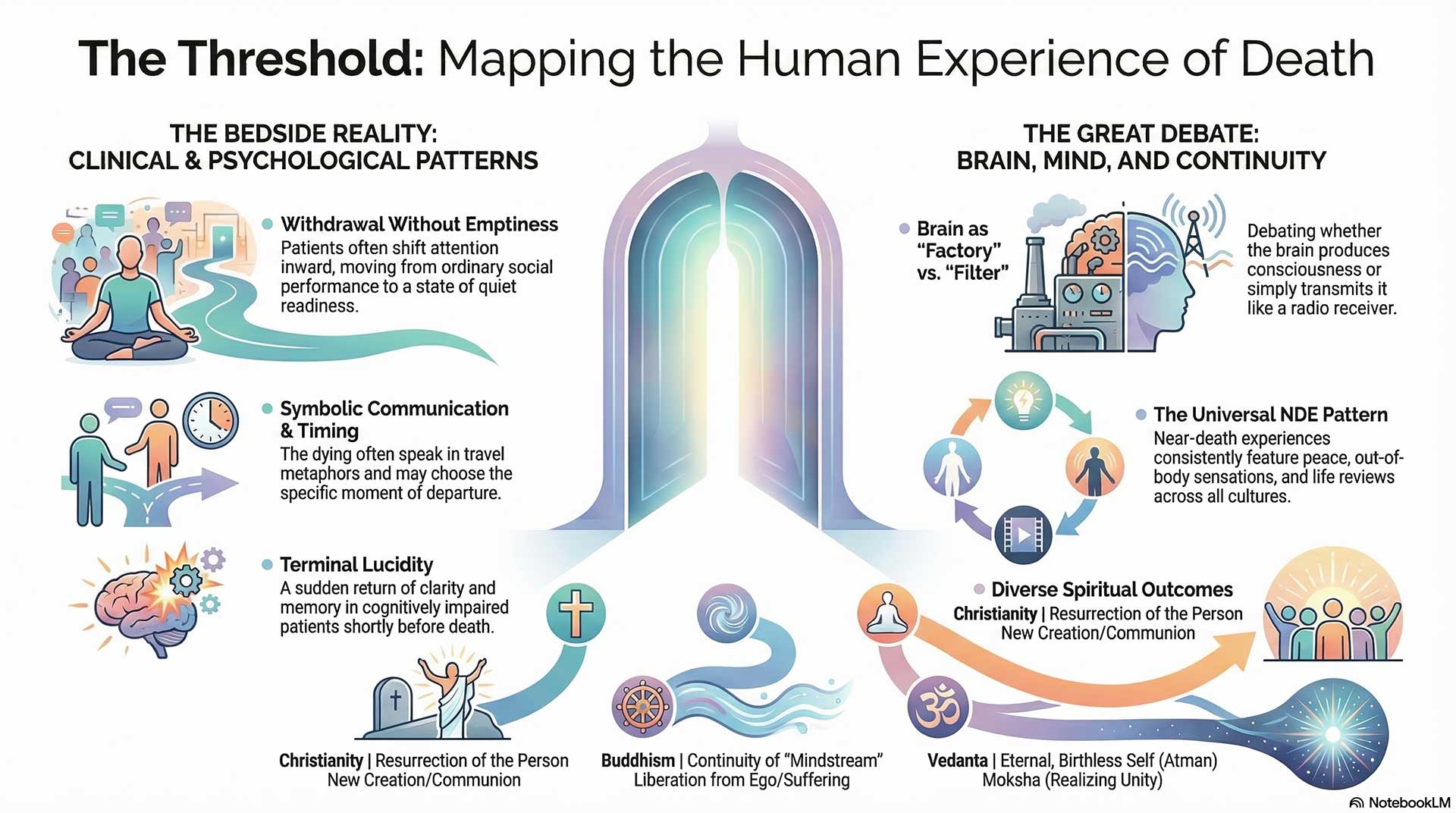
After listening to all five conversations, I do not feel smaller. I feel sobered, stretched, and strangely less willing to accept easy answers from any side.
The bedside witnesses reminded us that the final hours of life are often far richer, stranger, and more relational than our culture likes to admit. The near-death researchers showed us that too many patterns repeat to wave away with a shrug. The philosophers and neuroscientists made it plain that consciousness is still not fully accounted for, no matter how confident modern language may sound. The skeptics did something valuable too: they stripped away exaggeration and forced us to see how much the brain can do without our permission. Then the spiritual voices took us into older territory, where death is not only an event to analyze but a mirror held up to the way we live now.
So where does that leave me?
Not with proof. Not with one final system that neatly locks every door. And not with the smug comfort of saying that all views are really the same. They are not. Real differences remain. Yet so does something deeper than agreement.
Again and again, this conversation returned to the same human demand: live in such a way that death does not catch you completely unprepared. Make peace where you can. Tell the truth sooner. Love more cleanly. Loosen your grip on the smaller self. Train your mind. Guard your heart. Do not wait for the last hour to ask what your life was for.
I began this series wanting to ask what happens after death. I end it feeling that death has been asking something of us the whole time. It has been asking whether we will live numbly or wakefully. Whether we will cling or deepen. Whether we will treat life as consumption, distraction, and delay, or as something sacred enough to meet with attention before it slips from our hands.
Maybe that is part of the reason this question never disappears. Death is not only a puzzle at the far edge of life. It is a teacher standing in the middle of life, asking us, every day, what we intend to do with the time we still have.
Short Bios:
Moderator
Nick Sasaki — Writer, creative strategist, and founder of ImaginaryTalks.com, known for dialogue-driven content that blends timeless wisdom with modern storytelling.
Topic 1
Elisabeth Kübler-Ross — Swiss-born American psychiatrist whose work on death, dying, and grief helped reshape end-of-life care.
Cicely Saunders — English nurse, social worker, and physician widely recognized as the founder of the modern hospice movement.
Ira Byock — Palliative care physician, author, and public advocate known for improving care for people facing serious illness and the end of life.
Sherwin Nuland — Yale surgeon and acclaimed writer on medicine, mortality, and ethics, best known for How We Die.
Christopher Kerr — Physician and researcher, Chief Executive Officer and Chief Medical Officer of Hospice & Palliative Care Buffalo, known for work on end-of-life dreams and visions.
Topic 2
Raymond Moody — Physician, philosopher, and bestselling author of Life After Life, widely known for bringing near-death experience research into mainstream discussion.
Bruce Greyson — Psychiatrist and University of Virginia professor emeritus whose work made him one of the leading academic researchers of near-death experiences.
Sam Parnia — Critical care physician at NYU Langone who studies cardiac arrest, resuscitation, and consciousness near death.
Pim van Lommel — Dutch cardiologist known for long-term research on near-death experiences in cardiac arrest survivors and for his book Endless Consciousness.
Peter Fenwick — British neuropsychiatrist and neurophysiologist known for work on epilepsy, consciousness, and end-of-life experiences.
Topic 3
William James — American philosopher and psychologist, a central figure in pragmatism and one of the founders of modern psychology.
Wilder Penfield — American-born Canadian neurosurgeon who advanced epilepsy surgery and mapped major functions of the human brain.
Roger Penrose — Oxford mathematician and mathematical physicist, Nobel laureate, known for major work in black holes, cosmology, and consciousness theory.
Christof Koch — Neuroscientist and Meritorious Investigator at the Allen Institute, known for decades of research on the neural basis of consciousness.
Antonio Damasio — Neuroscientist at USC and director of the Brain and Creativity Institute, known for work on emotion, decision-making, and consciousness.
Topic 4
Susan Blackmore — Psychologist, writer, and visiting professor at the University of Plymouth known for research on consciousness, anomalous experience, and skepticism.
Kevin Nelson — University of Kentucky neurologist and professor whose research connects REM consciousness, brain states, and near-death reports.
Steven Novella — Yale clinical neurologist, science communicator, and skeptical thinker, known for The Skeptics’ Guide to the Universe and Science-Based Medicine.
Anil Seth — Professor of Cognitive and Computational Neuroscience at the University of Sussex and director of the Sussex Centre for Consciousness Science.
Michael Shermer — Science writer, historian of science, and founding publisher of Skeptic magazine, known for promoting scientific skepticism.
Topic 5
The Dalai Lama — Tenzin Gyatso, the 14th Dalai Lama, is the spiritual leader of Tibet and one of the world’s best-known voices for compassion and interfaith respect.
Thich Nhat Hanh — Vietnamese Zen master, poet, and peace activist whose teachings helped bring mindfulness to a global audience.
N. T. Wright — Leading New Testament scholar and theologian, former Bishop of Durham, now a senior research fellow at Wycliffe Hall, Oxford.
Swami Vivekananda — Hindu monk and reformer who helped introduce Vedanta and yoga to the modern West, especially after the 1893 Parliament of Religions.
Huston Smith — Influential scholar of religion and author of The World’s Religions, admired for making major spiritual traditions accessible to modern readers.
Leave a Reply