
|
Getting your Trinity Audio player ready...
|
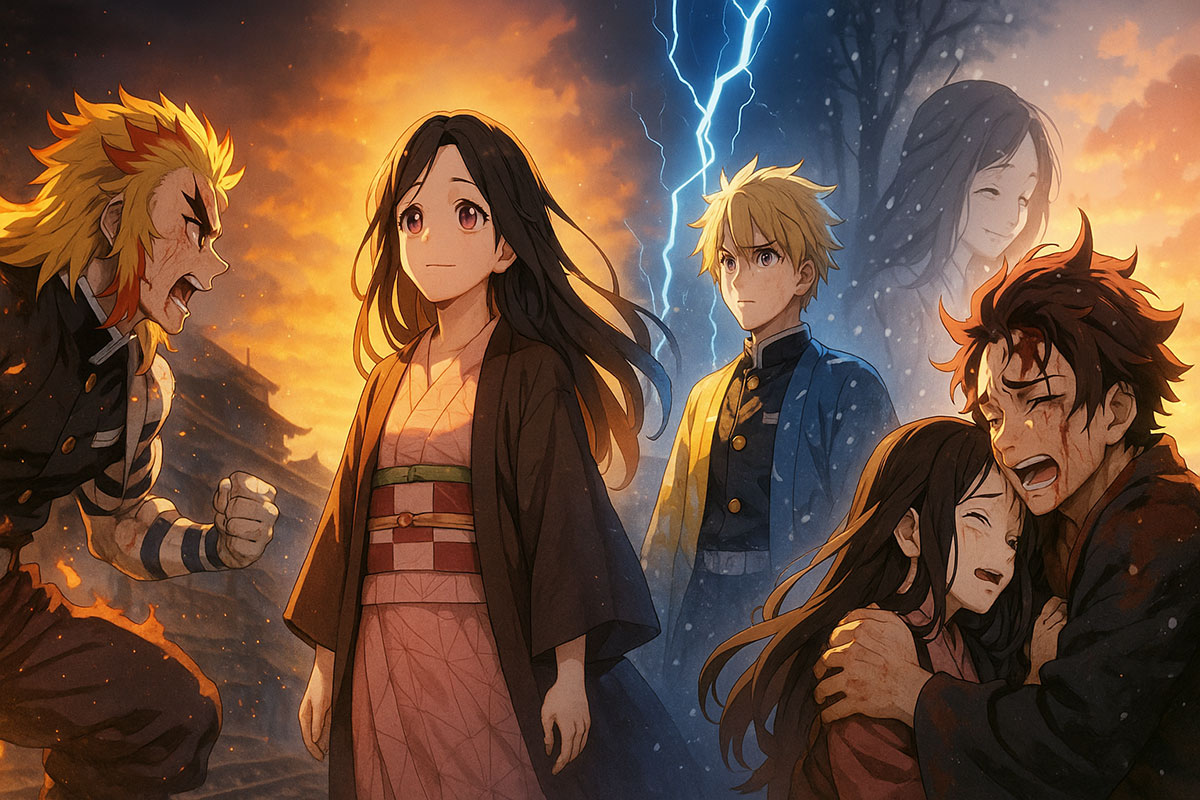
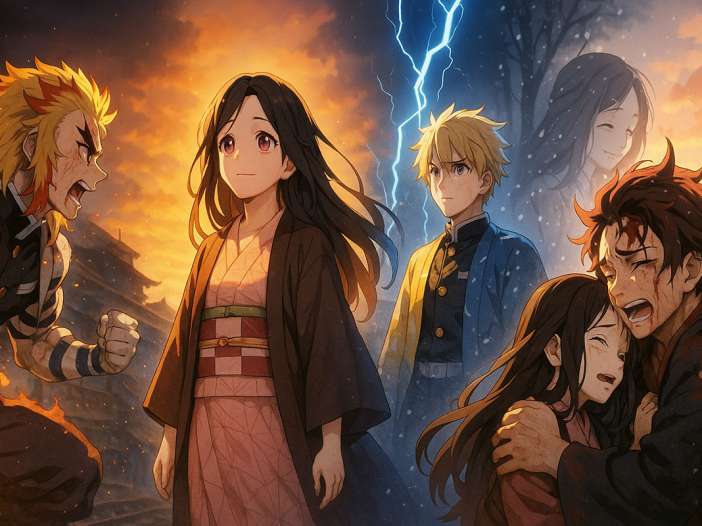
Introduction by Kagaya Ubuyashiki
(Soft, calm, fragile voice — the tone of a man whose body is failing, but whose spirit is infinite.)
Long ago, I inherited a curse: a bloodline shadowed by Muzan’s cruelty. This body of mine will not live long, but what time I have, I have given to those who carry the flame.
In this play, you will witness the cost of that flame. You will see the bravery of men and women who chose to fight, though death walked beside them. You will see bonds of family stronger than steel, kindness that endures even when the world is cruel, and the fragile miracle of hope rising where despair should have reigned.
Each act you see is not mere story, but memory. Not just battle, but prayer. These five moments are the heartbeat of our Corps—the proof that even in the face of demons, humanity burns brighter.
Come, then. Bear witness with me. To Rengoku, who taught us to set our hearts ablaze. To Nezuko, who walked into the sun. To Zenitsu, who made thunder out of fear. To Akaza, who remembered his name in the falling snow. And to Tanjiro, who returned to us from the edge of darkness because love called him home.
Let us begin. May their stories light the path before us.
Scene 1 — Set Your Heart Ablaze (The Mugen Train Night)
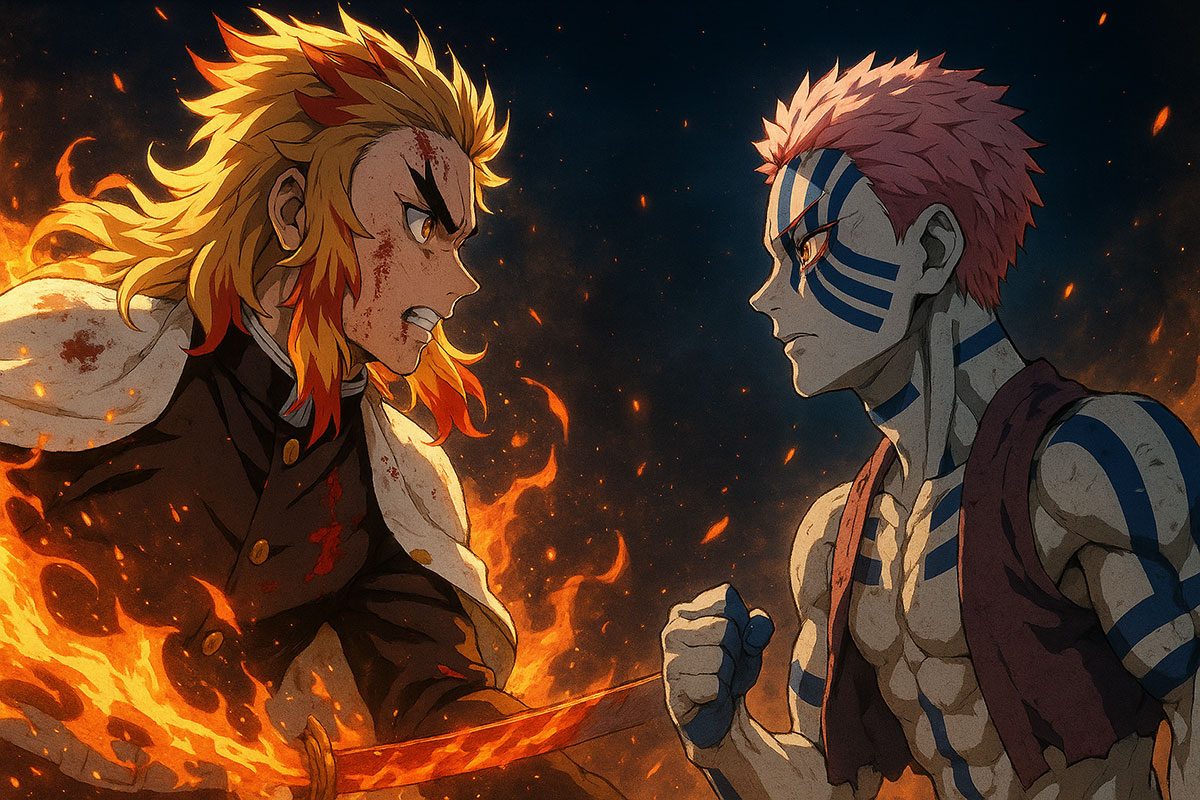
(I’m just a lowly Kakushi, one of the hidden workers who clean up the aftermath. I kneel in the dirt by the rails, the iron tang of blood and burnt wood filling my lungs. The wrecked train groans, and fireflies of embers float in the night. Amid the smoke, a figure in a flaming haori blazes like a beacon. Kyojuro Rengoku. Facing him, the Upper Rank Three—Akaza—smiling like a demon who found paradise in slaughter. Two worlds colliding: fire and ice, life and death.)
I whisper:
“My God… no human should be able to stand like that…”
(Rengoku lifts his sword, and the fire in his eyes sears more than the flames themselves. Akaza moves, his fists splitting the air with sonic cracks. The two clash, every strike like the earth itself is breaking. I want to run in, to help, but my legs lock in terror. This isn’t a place for me. This battlefield is a furnace where only those willing to burn their lives can exist.)
Rengoku’s voice thunders:
“Set your heart ablaze!”
(The sound alone scorches me. The blade arcs in a circle of fire, painting the dark with sunrise. Akaza laughs, drunk on violence, praising his opponent. My breath shatters in my throat. The train, the passengers, the night itself—everything is watching this duel.)
I choke:
“Please… please win…”
(Tanjiro screams somewhere behind me. Inosuke howls. Everyone is alive because of this one man holding back the tide of death. Akaza tempts him with immortality, promising power beyond limits. But Rengoku… he smiles. Even as his skin splits, even as his ribs crack, he smiles with kindness. He refuses. He stands straighter. And in that refusal, I feel something greater than strength.)
Akaza roars:
“Humans are weak! You’ll die like the rest!”
Rengoku answers:
“Strength is protecting the weak! That is why I’ll never become like you!”
(The clash is brutal, the sound of flesh tearing, bone splintering. His breath rattles. And yet his eyes—they see me. Me, a faceless helper. Me, cowering in the dirt. He sees everyone. And in that moment, I’m ashamed, because I can’t even lift a hand. But he carries us all on his shoulders.)
(Akaza flees into the dark, running from the dawn. Tanjiro hurls his sword after him, his scream ripping through the silence. I collapse to my knees. My bucket rolls in the dirt, useless. The embers fall, and I crawl toward him. Rengoku is down. But not defeated. Never defeated.)
Tanjiro shouts through tears:
“You did not lose! You protected everyone! You fought to the very end!”
(I stumble closer. His breath is shallow, each inhale a paper-thin flame. But his presence… his presence is endless. I want to tell him something, anything. My throat shakes. Words crumble into sobs.)
Rengoku whispers:
“You’ve all… done well. Live on. Mother… I… did it…”
(His lips curve, and the light in his eyes is not of a dying man—it’s the sunrise itself. My tears scald my cheeks. I press my forehead to the ground. I swear, silently, violently, desperately:)
“I’ll carry your flame. We all will. I promise.”
(The embers drift upward, vanishing into the sky. The night is still, but inside me, a fire is roaring. His fire. A fire that says: burn bright, even in the dark.)
Blackout.
Scene 2 — Her Name Is Morning (Nezuko Conquers the Sun)
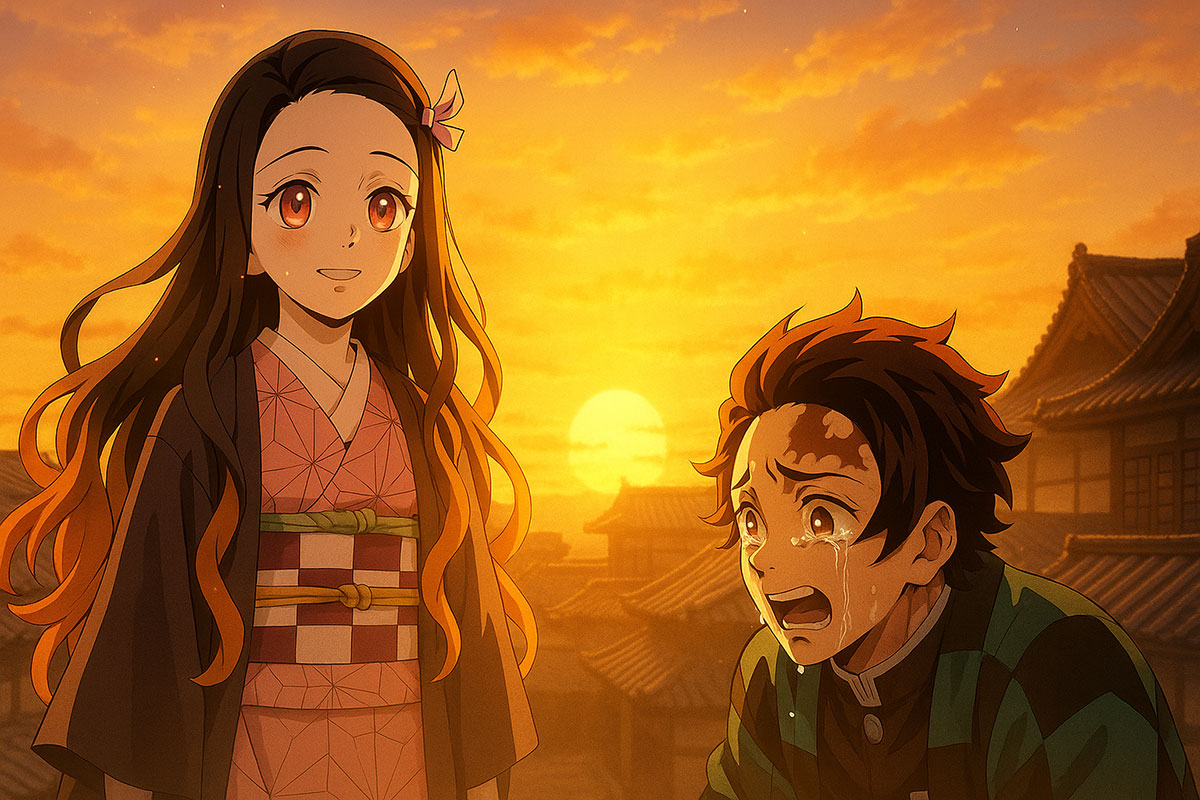
(I’m Tanjiro. My lungs are on fire. My throat tastes like iron and gunpowder. The last fragments of Hantengu’s monstrous laughter scatter on the wind. My sword is heavy, my knees buckle. And then—my world freezes. Because Nezuko isn’t behind me. She’s walking forward. Toward the sunrise.)
The horizon bleeds gold. The roofs of the Swordsmith Village glisten in the light. I stumble, half-blind, my voice tearing from my chest.
“Nezuko! Don’t—don’t go out there! The sun will kill you!”
My legs move without thought, wading through mud, through broken tiles, through the blood of friends and enemies. I claw at the earth just to move an inch closer. She turns. Smiles. Her eyes curve like they always did, soft, playful, reassuring.
And she doesn’t say words—but I hear them anyway. It’s okay, big brother. I’ll be fine.
The sun is cresting. Birds are not yet singing. The light floods over her hair, her skin. I scream her name until my throat rips raw.
“No, no, Nezuko! Don’t leave me! Please—God, please—”
I remember every small thing: the nights by the hearth, her cold little hands that always warmed when I held them, her laugh when she teased the younger siblings. And I feel them all slipping through my fingers like sand. My prayer is a roar, desperate, childish:
“If there’s a God—don’t take her from me!”
I reach her. My hands grasp hers—warm, warm, too warm. The smell of the morning clings to her: soil, grass, baked sweet potato, firewood. And then she opens her mouth, a tiny sound spilling out.
“…ah.”
Not words. Just life. Just proof. The sun lights her face, and she doesn’t burn. She glows. She glows.
My knees give way. My tears salt the dirt. My sister—my Nezuko—is standing in the light. A miracle clothed in fire. She lifts her hand and taps my cheek, the way she used to when we were kids, the way she always said: don’t cry, brother. It’s okay.
“Nezuko… Nezuko!”
I pull her into my arms, and the villagers watch from their doorways, mouths agape. Muichiro, the Mist Hashira, widens his eyes. Mitsuri, the Love Hashira, breaks into tears and laughter all at once. The entire world stops, and for one heartbeat, all of it is good.
She laughs silently. Her lips curl, her eyes shine. My chest bursts with gratitude and terror all at once. Because if she can walk in the sun, Muzan will come for her. He’ll want her. He’ll want her blood.
But I don’t care. Not now. Not today. Today, my sister is alive. Alive in the light.
I whisper against her hair:
“Let’s go home. Wherever it is, we’ll go together.”
She nods. And the sunlight crowns her like it had been waiting just for her. I realize then—she’s not just my sister anymore. She’s hope itself. For me, for the corps, for everyone.
The sun climbs higher. Shadows shorten. We walk together, our feet dragging from exhaustion but our hands locked. One shadow, two figures. One heart.
And as I breathe in the morning, for the first time in forever, it doesn’t taste of blood. It tastes of tomorrow.
Blackout.
Scene 3 — Thunder from a Frightened Heart (Zenitsu vs. Kaigaku)
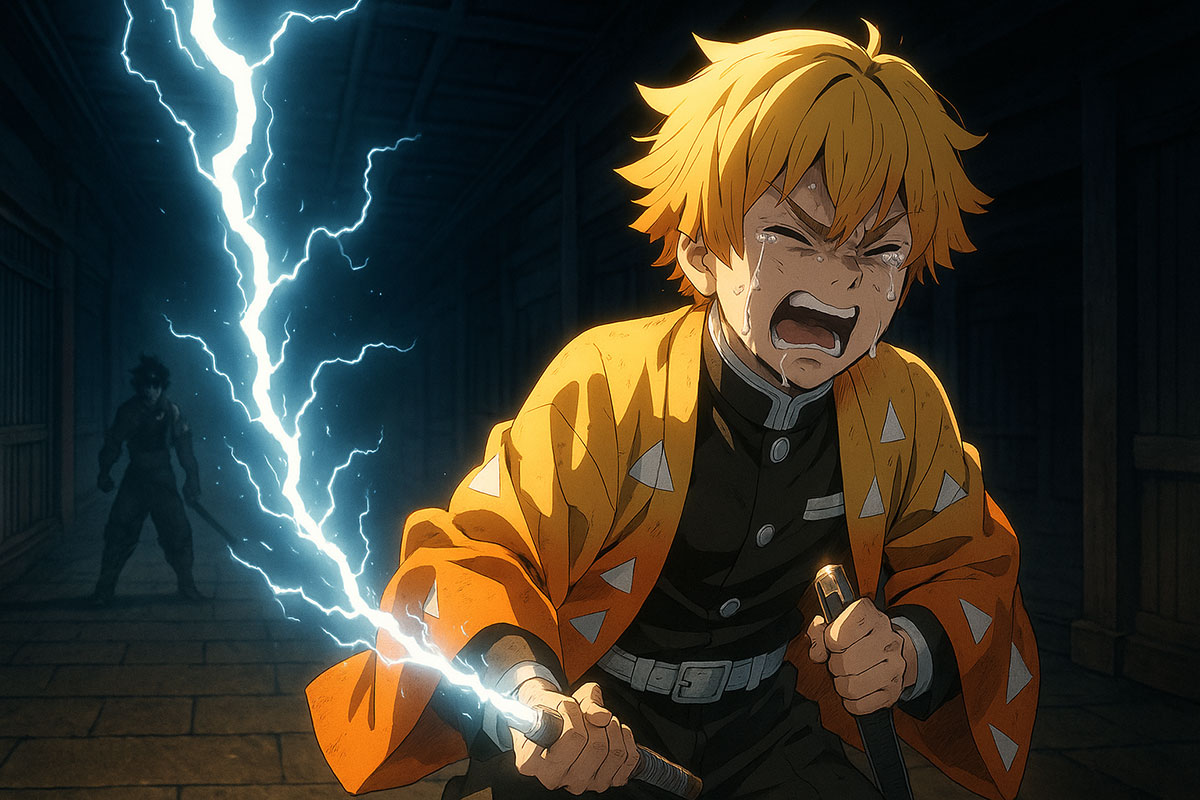
(I’m Zenitsu. My knees won’t stop laughing. The rest of me isn’t in on the joke. The temple stones are cold under my feet; the air smells like copper and rain. Across from me stands Kaigaku—once my senior, now a demon with lightning in his grin.)
Kaigaku sneers:
“Still a crybaby, Zenitsu? Still clinging to that one pathetic form?”
My tongue finds the roof of my mouth. Words turn to dust. I want to run the way I always have—down hallways, out doors, into bushes, anywhere but here. But the old man—my master—fills the space behind me like a mountain. He’s not really here, but he is. He always will be.
I breathe. The world narrows to the click of my thumb on the tsuba, to the eyelash-thin gap between steel and sheath. Thunder is born in small places—between fear and the first step.
Kaigaku darts forward, his blade carving black lightning. He’s fast—faster than memory, faster than excuses. Sparks burst where our swords kiss; the sound is a flock of bells breaking.
He laughs, delighted by his own speed.
“Face it. You were dead weight. A coward. You learned nothing!”
I hear the old man’s voice, rough with love: “If you can do one thing perfectly, boy, you can protect the whole world with it.”
I’m afraid. I’m always afraid. My fear is a room I was born in and never left. But there’s a door. It’s small and it’s locked and every time I touch it my hands shake so badly I drop the key. Tonight, I keep the key.
I speak for myself, just once:
“I’m still scared, Kaigaku. But I’m not leaving.”
He snarls and the corridor explodes with his thunder. In that flash I fall—not backward, not away—inward. Into the single line I’ve walked a thousand times: draw, step, cut, return. A road so narrow only one truth can walk it.
Thunder Breathing—Seventh Form.
The note is too high to hear; it becomes light. My body vanishes into the line I’ve chased in dreams, the stroke the old man begged me to find. For him. For the me who couldn’t.
Kaigaku’s storm collides with my single bolt. His fury is wide, spectacular. Mine is straight. Mine is scared. Mine is true.
We pass each other. I don’t feel the strike land—only the after, the way a bell keeps singing when no one touches it. Knees trembling, I slide the blade home. The sheath clicks. It sounds like a prayer closing.
Kaigaku stumbles, clutching at something that isn’t there. He’s looking for the boy I was to sneer at him one last time. I’m gone. Or maybe I’ve finally arrived.
I whisper to the old man, to the empty air that smells like rain:
“Did I do it right?”
Wind races through the temple, scooping up dust and old leaves and something else—something warm—that makes my eyes sting. If courage is anything for someone like me, it isn’t the absence of fear. It’s holding the hand of fear and sprinting anyway, faster than thunder, straight as a line drawn by a shaking boy who finally learned not to look away.
Outside, dawn presses pale fingers against the clouds. I bow to where my master isn’t, then to where Kaigaku is. My legs quit pretending to be brave and simply hold.
I am a coward. And I am a swordsman. Those truths don’t cancel each other; they hold each other upright.
Blackout.
Scene 4 — The Snow That Says My Name (Akaza Remembers)
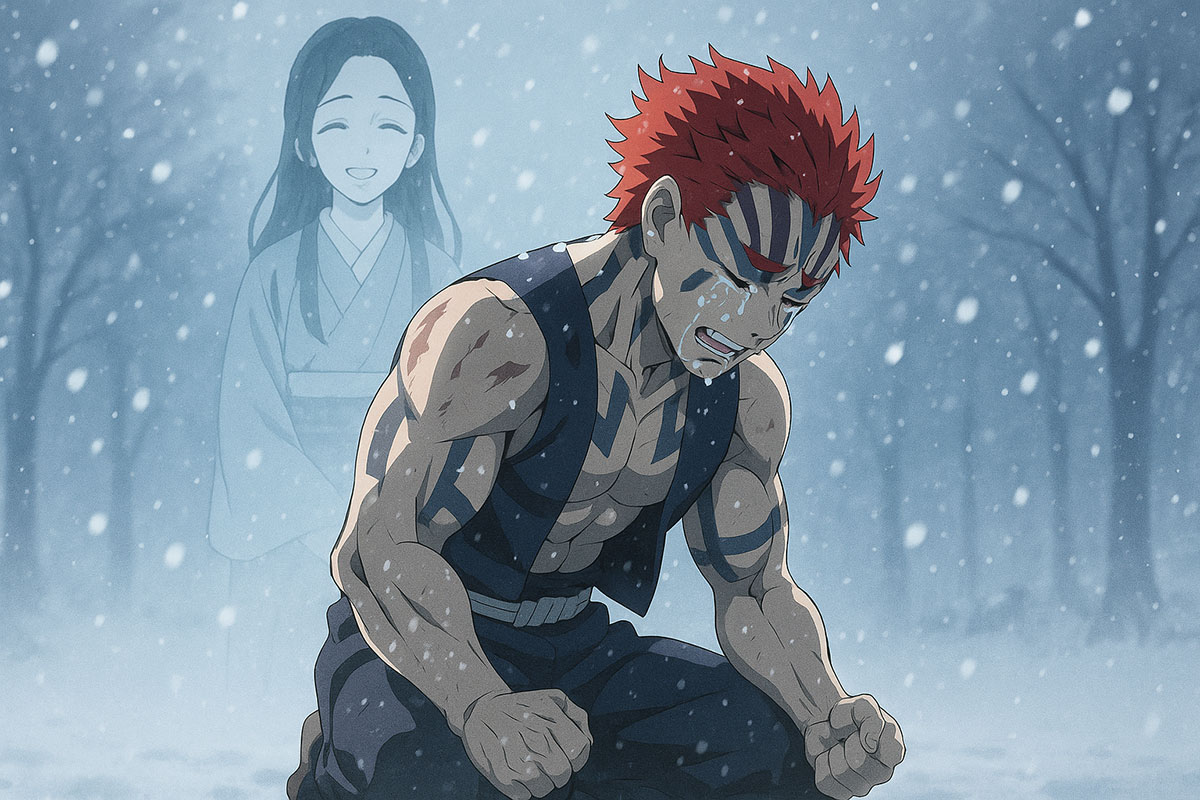
(I’m Akaza—but that’s the name the night gave me. Somewhere under it lies another: Hakuji. I don’t say it. Names are doors; some open to rooms you can’t survive. Still, tonight the snow won’t stop knocking.)
The battlefield smells of iron and pine. A boy with a scar on his head stands before me, his eyes too clean for this world. His blade keeps finding me, and each time it bites, something old rings like a wind chime in an abandoned house.
He yells through blood and breath:
“Remember! You were human!”
No. Humans break. Humans lose what they can’t live without and keep going anyway until they fall apart in the middle of a road no one sweeps clean. I chose strength so I would never kneel, never beg, never be left with empty hands watching a door that won’t open.
But the snow keeps falling, and every flake is a syllable. Lo-ve. Fa-ther. Ho-me. I see a tiny room where sunlight has to squeeze in sideways. A girl coughs and laughs at the same time, like the world doesn’t get to decide what happens to her. Koyuki. She pours tea with shaking hands and calls it a feast. She says my name like it’s something worth keeping.
Then poison takes them. Not fate or gods—just men who were hungry for what wasn’t theirs. I made the sky red with my fists and it didn’t change a thing. The hunger inside me learned a terrible lesson: break the world before it breaks you.
The demon’s blood promised me a body that wouldn’t fail. Power that couldn’t be taken. I swallowed it like it was prayer.
Now the boy’s blade slips through my guard again. Another memory tumbles loose—Koyuki’s fingertips warm against my cheek; my father’s rough hand heavy on my shoulder. We were poor. We were breakable. We were whole.
“Come back,” the boy says, as if there’s a bridge. As if the river isn’t made of years and rage and all the people I broke to prove I couldn’t be broken.
Snow drifts onto my knuckles. For the first time in a century, they look small. A woman’s voice—hers—threads through the cold:
“Hakuji.”
It’s so gentle the word itself seems afraid to hurt me. My fists unclench. Strength has never felt so heavy. I realize I’ve been carrying a body around a hole, calling the hole victory.
“I’m sorry,” I say, and the apology keeps going, past my lips, past the snow, down into the earth where the dead keep their quiet.
The world brightens painfully. Not because of daybreak—because I lift my face. Because I stop hiding it like a crime scene. The boy is still there with those impossible eyes. He isn’t gloating. He’s grieving for a stranger.
I think of Koyuki’s laugh, of the tea that tasted like first chances. My father’s hand. The cheap, thin sunlight that still managed to find us. A life small enough to treasure, fragile enough to teach.
The snow says my name again. Hakuji. I bow to it. I bow to them. The demon in me howls like a dog losing its bone, then fades, because there’s finally something heavier than hunger. Memory. Love. The permission to stop fighting.
I let go, and for the first time, the falling doesn’t feel like losing. It feels like being caught.
Blackout.
Scene 5 — Come Back to Me (Nezuko Brings Tanjiro Home)
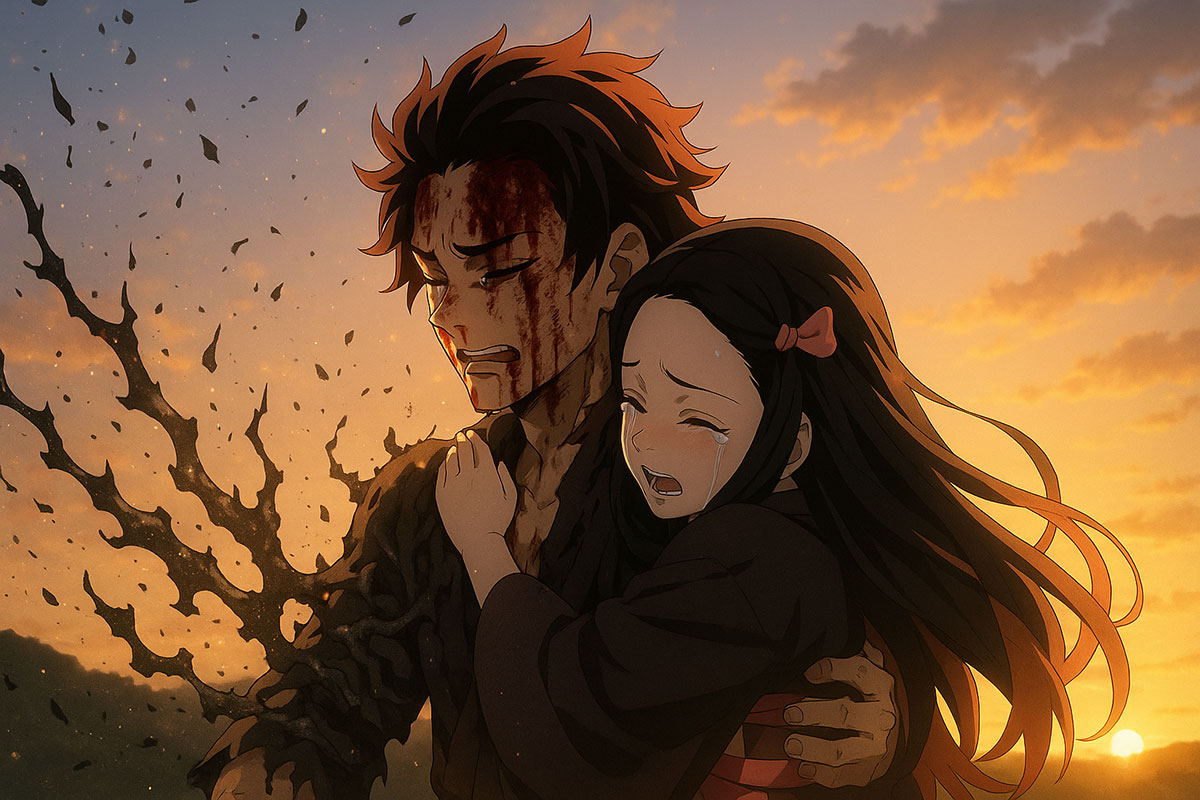
(I’m Nezuko. The world splits and a forest of thorns grows out of my brother’s back. They coil and bloom with eyes and teeth. People scream. Friends draw blades. Tanjiro’s voice is gone; a monster borrowed his mouth and doesn’t know how to say my name.)
I step forward. The thorns slash my arms, and the pain is bright and mean, but I’ve known worse. I’ve known the pain of waking in a world where our family’s voices were ash. Compared to that, this is just a gate I have to walk through.
“Ne…zu…ko…” someone warns, afraid for me. They should be. But fear is a bad navigator and an excellent lifeguard—you don’t let it steer, you let it remind you to hold on tighter.
I remember small things: the creak of floorboards in winter, Mother’s hands smelling of rice flour, Tanjiro’s clumsy humming while he chopped wood. He would fall asleep sitting up and I would tap his cheek, soft, soft, to wake him. I learned his face like scripture.
I reach him. The monster thrashes. I lay my forehead against his, the way I did when he burned with fever. He bites the air beside me and the sound is a saw chewing a doorframe. I don’t move. I bring my hands to his cheeks—hot with wrongness—and I hold, and my tears drip onto his skin and decide to be holy.
Inside the thorns, I hear it—the faintest rhythm, a shy heartbeat hiding under a storm.
“Tanjiro,” I say, which is to say: listen.
“Ta-n-ji-ro,” I say again, which is to say: come back the way you left: with your name.
Blades flash around us—friends trying to save us by pulling us apart. I don’t look. I don’t let go. I speak in the languages I have: the warmth of my palm, the weight of my head on his shoulder, the tap-tap on his cheek that means it’s okay to stop fighting now.
The thorns hesitate, then shudder, confused by softness. The growl in his throat scrapes into something uglier, then—strangely—something sadder. Grief is a map. If he can feel that, he can find his way.
I press closer, ignoring the sting and the blood. My voice is small and breaks in the middle, but small things move mountains every day: water, light, love.
“O-nii…chan.” Big brother. The first phrase I ever learned. The last one I’ll ever need.
The forest around us collapses petal by petal. The teeth dull, the eyes close. What’s left is heavy and familiar. He sags into my arms, and I take his weight without thinking, because that’s what you do with family—you don’t measure it, you carry it.
He draws a breath like someone opening a door that’s been stuck for years.
“Ne…zu…ko.”
The name pierces me like an arrow and blooms like a flower at the same time. I laugh, which makes me cry harder. I tap his cheek—our signal, the one that says I’m here. He blinks, confused, human, beautiful.
Around us, the friends who were ready to cut us apart are weeping openly. Relief sounds like surrender. Morning leans around the corner of the sky, deciding whether to arrive. I choose for it.
I take his hand. It’s slightly cold and already warming. We’ve walked like this our whole lives—sometimes in the light, sometimes through rooms the light forgot. Our fingers lace into a knot demons can’t untie.
“Let’s go home,” I tell him. Where is home? Anywhere we bring each other to.
He nods, and we turn toward the sound of birds arguing about breakfast. The battlefield is still littered with what we’ve lost, but for the first time, it doesn’t look like the end of something. It looks like the beginning you get only after you refuse to let love be interrupted.
We walk. Two shadows on the ground, one heartbeat between them. The morning finally shows up, late and apologetic, and we accept its apology. That’s what family does, too.
Blackout.
Final Thoughts by Kagaya Ubuyashiki
(Quiet, reverent, like a father offering his final blessing. A long pause before he begins.)
What you have seen is not only the sorrow of battle—it is the truth of being human. Life is fragile, but within its brevity lies something eternal. Love. Sacrifice. The bond that ties one heartbeat to another.
Rengoku’s fire still burns in the courage of his comrades. Nezuko’s light still shines in every dawn. Zenitsu’s thunder still echoes in the hearts of the timid who find strength. Akaza’s tears remind us that even those lost in darkness once longed for warmth. And Tanjiro’s return tells us that love is the strongest blade of all.
Their lives were not wasted. Their deaths were not in vain. They form a tapestry of sacrifice that has guided us, even in despair. And if you carry their stories with you, then they still walk among us.
Remember them. Honor them. And in your own fleeting life, choose to live with the same flame—for in that choice, you too will become eternal.
May the gods receive them gently. And may their spirits forever rest in peace, as the morning sun rises on a world they saved.
Short Bios:
Kyojuro Rengoku
The Flame Hashira (Pillar), known for his fiery spirit, optimism, and unwavering resolve. Even when mortally wounded in the battle against Akaza on the Mugen Train, he inspired others with his mantra: “Set your heart ablaze.” Rengoku represents the ideal of selfless sacrifice.
Nezuko Kamado
Tanjiro’s younger sister, turned into a demon after their family was slaughtered. Despite her transformation, she retains her humanity and fierce love for her brother. In the Swordsmith Village arc, she achieves the impossible—conquering the sun—becoming a beacon of hope against Muzan.
Tanjiro Kamado
The kind-hearted protagonist who becomes a Demon Slayer after his family is killed. Guided by compassion, Tanjiro fights demons while seeking a cure for Nezuko. His empathy even extends to enemies, and in the final battle, he nearly succumbs to demonhood himself before Nezuko and his comrades bring him back.
Zenitsu Agatsuma
A cowardly yet pure-hearted Demon Slayer, often paralyzed by fear—until unconscious instinct takes over. Though he believes himself weak, Zenitsu proves his strength when facing his former brother-in-training, Kaigaku. By creating his own Seventh Form, he shows that fear can fuel courage.
Akaza (Hakuji)
Upper Rank Three of the Twelve Kizuki, a demon obsessed with strength. Beneath his monstrous form is Hakuji, a tragic figure who once longed only to protect his loved ones. In death, he remembers his humanity—particularly the gentle presence of his fiancée, Koyuki—making his end one of the most heartbreaking in the series.
Kagaya Ubuyashiki
The leader of the Demon Slayer Corps, frail and cursed but deeply wise. He views each member as his own child, offering them unwavering compassion. His calm, fatherly presence frames the story as a prayer and eulogy, honoring both the fallen and the living.
Leave a Reply