
|
Getting your Trinity Audio player ready...
|
1. The First Time He Heard Silent Night
The first time Noah heard Silent Night, he was three years old and sitting on the kitchen counter, his legs swinging in the air like small clock pendulums.
Snow drifted lazily outside the window, soft and uncertain, as if the sky couldn’t decide whether it was really winter yet. The little apartment smelled like instant noodles and laundry detergent, the two permanent scents of his childhood.
His mother stood at the stove, stirring a pot of soup that wasn’t quite thick enough to be comforting, but she hummed as if it were a feast.
“Can I stir?” Noah asked, reaching for the wooden spoon.
“You stir,” she said, kissing the top of his head, “and I’ll sing. Deal?”
He nodded solemnly. She handed him the spoon and he wrapped his small hands around it, careful, serious. He stirred as if the soup were the most important thing in the world.
His mother’s voice—soft, a little worn at the edges—filled the cramped kitchen.
“Silent night… holy night…”
Noah didn’t know the words. He didn’t know what “holy” meant. He only knew that whenever she sang that song, something in the room changed, like the air became thicker and warmer, wrapping around him like one of the blankets she tucked under his chin at night.
“Mom, is it a Christmas song?” he asked.
“It is,” she said, leaning against the counter, watching him with tired eyes that somehow still looked like the first morning of summer. “But it’s also a… what do you call it… a song that makes your heart sit down and rest for a while.”
“Like nap time?” he asked.
She laughed. “Yeah. For grown-up hearts.”
He thought that was funny. Grown-up hearts needed naps too.
When the soup finally simmered, they sat at their tiny table with the chipped edges and mismatched chairs. The snow fell harder, thickening into something more serious. His mother looked out the window, then back at him.
“Someday,” she said, reaching across to wipe a smear of soup from his chin, “when I’m old and wrinkly, you’re going to sing that song to me. Deal?”
“You won’t be old and wrinkly,” Noah said, offended by the idea.
She smiled, and there was something bright and sad in it that he wouldn’t understand for many years.
“We’ll see,” she said. “Just promise you’ll sing.”
“I promise,” he said. At three, he meant it with the unbreakable certainty of a child who believes his mother will live forever.
2. A Childhood Built from Almost Nothing
Life did not treat his mother gently, but she greeted it every morning as if it might still surprise her with kindness.
She worked at a supermarket during the day, loading shelves until her back ached, and cleaned offices at night. Sometimes she’d pick Noah up from his neighbor’s place with the same apology in her eyes: “Sorry I’m late, my love. Grown-up time moves different.”
They didn’t have much. The rent took most of her paycheck. The rest went to food, bus passes, and the mysterious category she always called “keeping the lights on.” New toys were rare, restaurant meals were nonexistent, vacations were stories other people told.
But every December, without fail, she made Christmas out of nearly nothing.
There would be a tiny tree, usually bought from the discount section, with a few colorful ornaments and a single string of lights that sometimes flickered out and then came back as if they were as stubborn as she was. There would be hot cocoa thinned with extra water. There would be one present, wrapped in newspaper, that she would insist on making him open slowly, savoring the moment.
And there would be Silent Night.
The song became their ritual. On Christmas Eve, she would turn off all the lights except the tree, sit on the edge of his bed with the blanket pooled around her like a small hillside, and sing.
“Silent night… holy night…”
Sometimes she sang in English, sometimes in the broken bits of another language she had grown up with, syllables Noah never learned but loved the sound of. He would close his eyes and imagine the whole world being wrapped in the same kind of gentle darkness, all of it held in someone’s careful, invisible hands.
“Mom,” he asked once, when he was eight, “who is the baby in the song?”
“Jesus,” she said.
“Like in church?”
She didn’t go to church. Too much work, too little time, not enough feeling worthy of a place where people wore nicer clothes and carried unbroken lives.
“Like in the story,” she said instead. “A baby who came when things were hard and dirty and unfair, and somehow made that night feel like it belonged to heaven.”
He thought about their cracked walls, the occasional roaches that found their way into the bathroom, the nights the heating didn’t quite work.
“Is this place like that?” he asked. “Hard and dirty and unfair?”
She laughed softly. “Sometimes.”
“But is it… holy?” He whispered the word, unsure.
She looked around the room slowly—the crooked poster on the wall, the secondhand dresser, the stuffed bear with missing fur. Then she touched his cheek.
“It is when I’m with you,” she said.
That night, he fell asleep to her voice and the slow, rhythmic beating of her heart beneath his ear as she let him rest against her.
3. When Illness Entered Their Lives
He was twelve when she collapsed at work.
She called it “a fainting spell” at first, tried to make a joke of it. “Your mom’s just being dramatic, don’t worry.” But the doctor’s faces were too serious, the tests too many, the bills too impossible to ignore.
Words appeared in their lives that didn’t belong in a child’s vocabulary: malignant, stage three, treatment plan.
Noah tried to be brave.
His mother tried to be the same as always.
“Go to school,” she said, tying a scarf around her thinning hair. “Do your homework. Bring me home A’s. I’ll beat this thing with your report card.”
He smiled like he believed her.
She slept more. She lost weight. Some days she could barely sit up, but she still asked about his day. “Tell me something funny,” she’d say, as if laughter might be a medicine they could afford.
December came again.
That year, there was no tree. She said she was too tired to decorate, and he was too busy helping with the laundry and learning to cook instant noodles the way she did.
One evening, a week before Christmas, he found her sitting on the edge of his bed, breathing a little too heavily, looking smaller than he’d ever seen her.
“Hey,” she said, patting the space beside her. “Come here.”
He sat, trying not to show how careful he was being. Her hands trembled when she took his.
“Remember our deal?” she asked.
“Which one?” he said, heart thudding. “The one where I have to mow the lawn when we have a lawn someday? Or the one where you promised we’d go to the beach when—”
“The song,” she said gently. “Our Christmas song. You promised you’d sing it to me when I got old and wrinkly.”
“You’re not old,” he said quickly. “And you’re not wrinkly.”
She smiled. “My bones might disagree, but I’ll take it.”
He looked down at their joined hands. “You’ll get better,” he insisted. “The doctor said the treatment is working.”
He had heard other things in the hallways. Phrases spoken in low voices. But he locked those away. He only allowed hope inside his room; fear could wait outside with the trash bags.
She didn’t argue. “Maybe,” she said. “We’ll see. But whether I live to be ninety or… not,” she said carefully, “I want to hear you sing it. At least once. While I can still listen.”
His throat felt tight. “Now?”
“Now.”
4. The Last Night at Home
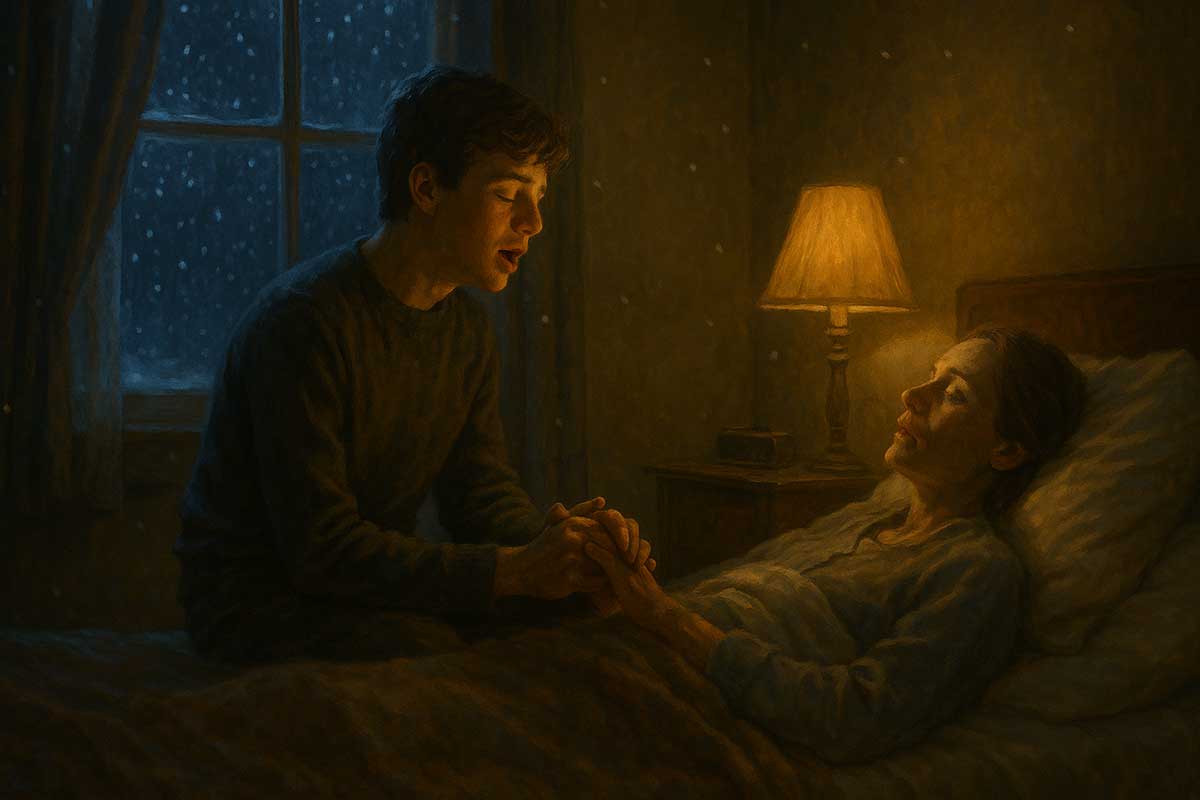
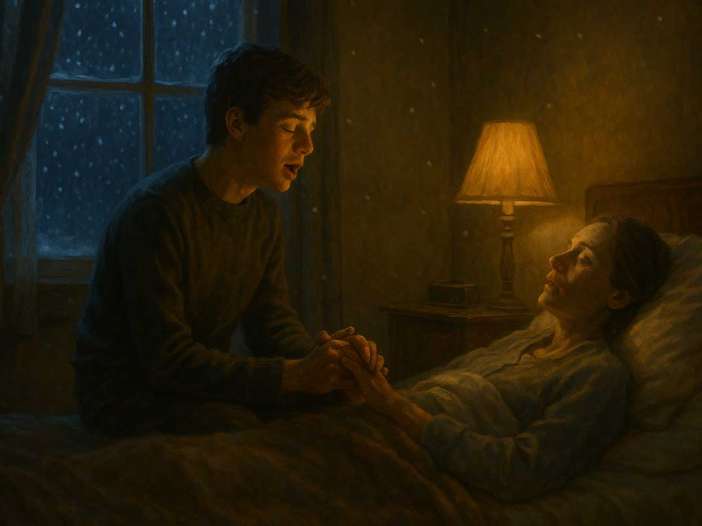
He knew the words by heart. He had never sung the song alone; it had always been her voice, hers woven around him like a warm scarf. When he opened his mouth and the first note came out, it sounded thinner than hers, but steady.
“Silent night… holy night…”
Her eyes filled with tears before he reached the second line. She didn’t sob. They just spilled over, quiet and continuous, like a river that had been waiting a long time to overflow.
By the time he finished, his own tears were dripping down his cheeks. The room was dim, the ceiling a faint blur. They sat in that trembling silence for a while.
“That was beautiful,” she whispered finally. “You kept your promise.”
“Yeah,” he said, voice cracking. “So… you have to keep yours.”
“Which one?”
“You promised you’d be there when I graduate. And when I get married. And when I…” He couldn’t finish.
She reached up and cupped his cheek with a hand that felt too light, too fragile—like a bird that might take flight at any moment.
“I remember,” she whispered. “I want all of that too. More than you know.”
“Then stay,” he said. It sounded childish, desperate. He didn’t care.
She closed her eyes for a long moment, as if choosing her next words carefully. When she opened them, they shone—not with fear, but with the kind of steady warmth she carried through every hardship of her life.
“Noah,” she said, “I am trying. I promise you—I am trying so hard. But if… if my body can’t keep up, I need you to know something.”
He swallowed hard. “What?”
“My love for you doesn’t stay here,” she whispered, pressing her hand weakly to her chest. “It doesn’t stop at skin or breath. Love… real love… it lasts. So even if I’m not here, I’m still with you. And every time you hear that song—every time, my heart will sit beside yours.”
He bit his lip until it hurt. “I don’t want a song. I want you.”
“I know,” she said, her voice breaking on the last word. “But one day, you’ll understand that love is the only thing that doesn’t leave.”
She lay back against his pillows, exhausted from the short conversation. He pulled the blanket up around her shoulders. She smiled faintly.
“Sing it again?” she whispered.
He nodded, wiped his cheeks, and began again. His voice trembled, but he did not stop.
When he reached “sleep in heavenly peace,” her eyes were closed—not from pain this time, but from rest.
She held his hand until she drifted into sleep.
It was the last night she stayed in his room.
5. A Song for Her Final Moments
The hospital smelled like bleach and winter and fear.
Noah spent every afternoon there, his backpack on the floor, his homework ignored. He read to her. He played soft music on his phone for her. He told her jokes—even the bad ones—just to see the faintest flicker of amusement in her tired eyes.
But she was fading.
The week before Christmas, the doctor asked him to step into the hallway. He was fifteen now. Old enough, they said. Old enough for the truth.
He wasn’t ready.
When he returned to her room, she was awake, waiting for him.
“It’s time,” she said gently.
“No,” he said, shaking his head. “No, not tonight. Please, Mom. Please wait.”
She reached for his hand. “Come sit with me.”
He sat. He shook. He tried to be a man and failed. His tears came in a quiet, uncontrollable flood.
She didn’t cry. She seemed beyond tears. Her face was soft, peaceful in a way that frightened him more than anything.
“You remember what you promised me?” she asked.
He nodded, unable to speak.
“Then sing.”
“But… I can’t,” he whispered. “Not while you—”
She squeezed his hand, though her grip was weak.
“Let me go hearing your voice.”
His chest felt like it was cracking open, but he lifted his head. He wiped his face. He looked at her—really looked—and understood this was the last gift he could give.
He began.
“Silent night… holy night…”
His voice sounded older now. Not like a child singing to his mother, but like a young man singing through sorrow, holding onto something breaking inside him.
She watched him as long as she could. Her breathing slowed. Her eyes softened.
On the final line, he placed his hand gently on her forehead.
“Sleep in heavenly peace.”
Her lips moved faintly, as if she wanted to say it with him.
She exhaled.
And did not inhale again.
The monitors hummed on. Snow fell outside the window.
Noah held her hand until it went cold.
6. The Song That Never Left Him
Grief did not come all at once.
It came in slow, crushing waves—on mornings when he woke expecting to hear her voice, on nights he forgot she was gone until the silence reminded him.
But every December, he kept their ritual.
He’d sit alone in his room, turn off all the lights except a small lamp, and sing Silent Night. Sometimes he sang softly. Sometimes he sobbed through the words. Sometimes he just let the melody play in his head, a lullaby only one heart needed to hear.
Years passed.
He graduated high school. His aunt took him in. He worked part-time jobs, saved money, studied hard. He carried his mother’s memory like a lantern—something fragile but shining, something that guided rather than weighed him down.
By the time he entered college, the memory of her voice had become both sharp and soft—painful at the edges, warm in the center. He didn’t talk about her much. Most people didn’t understand grief that lived quietly rather than loudly.
But he knew she was there—hidden in the gentle moments, in the way he tied his shoes, in the way he always offered the bigger half of a sandwich to a friend, in the way he remembered to hold doors open and smile at strangers who looked lonely.
She had shaped him so thoroughly that sometimes he saw her in himself.
And every Christmas Eve, he sang.
Always.
Years later, on a snowy December evening, Noah stood outside a retirement home holding a folder of sheet music. He was volunteering with a small group from his college choir—singing carols for the elderly.
He hadn’t planned to join. He was busy with finals, tired from work, unsure he was emotionally ready for Christmas music this year. But something nudged him—a quiet, persistent tug.
He walked into the lobby, where warm lights glowed and a small tree flickered. Residents in soft sweaters gathered slowly, some wheeled in by nurses.
When the choir began, the voices rose carefully, blending into something simple but beautiful.
Then the choir director looked at Noah.
“Would you like to lead the next song?”
He froze. “Which one?”
She smiled gently.
“Silent Night.”
His breath caught.
He hadn’t sung it for anyone in years.
The group waited. The room seemed to grow still. Snow pressed against the windows in soft white patterns.
Noah stepped forward.
He closed his eyes.
He pictured a small kitchen with chipped counters. The smell of thin soup. His mother’s fingers stirring. Her voice wrapping around him like a blanket. Her laugh. Her tired but bright eyes. The night he sang to her for the last time.
He opened his mouth.
And the song came out—clear, rich, steady, full of every moment he had ever loved her.
“Silent night… holy night…”
When he reached the second verse, he opened his eyes. Several residents were crying. A nurse wiped her cheeks quietly. An elderly woman reached for the hand of the man beside her.
It struck him then—his mother’s lullaby was not gone. It had simply moved. First into him. Now into them. It was alive in every person who heard it tonight.
He felt something warm rise in his chest—something that softened the edges of grief. Something like peace.
After the performance, as people thanked him, an elderly woman approached him slowly, leaning on her cane.
“My dear,” she said, voice trembling, “you sing like someone who has loved deeply.”
He swallowed. “I have.”
“And lost deeply?”
He nodded.
She placed a hand over his. “Songs like that… they don’t come from perfect lives. They come from brave ones.”
He felt tears fill his eyes.
“Thank you,” he whispered.
She smiled and moved on.
That night, Noah returned to his small apartment, made himself tea, and sat in the quiet. Snow was falling again, the same hesitant, gentle flakes he remembered from childhood.
He turned off all the lights.
He sat on the edge of his bed.
And without prompting, he sang one more time.
Not out of grief.
Not out of duty.
But out of gratitude—for every lullaby she had given him, for every night she had stayed awake working, for every gentle word she’d spoken even when life had given her so few in return.
When he finished the song, he whispered into the still room:
“Sleep in heavenly peace, Mom.”
And for the first time in years,
the silence that followed felt like she was answering back.
Short Bios:
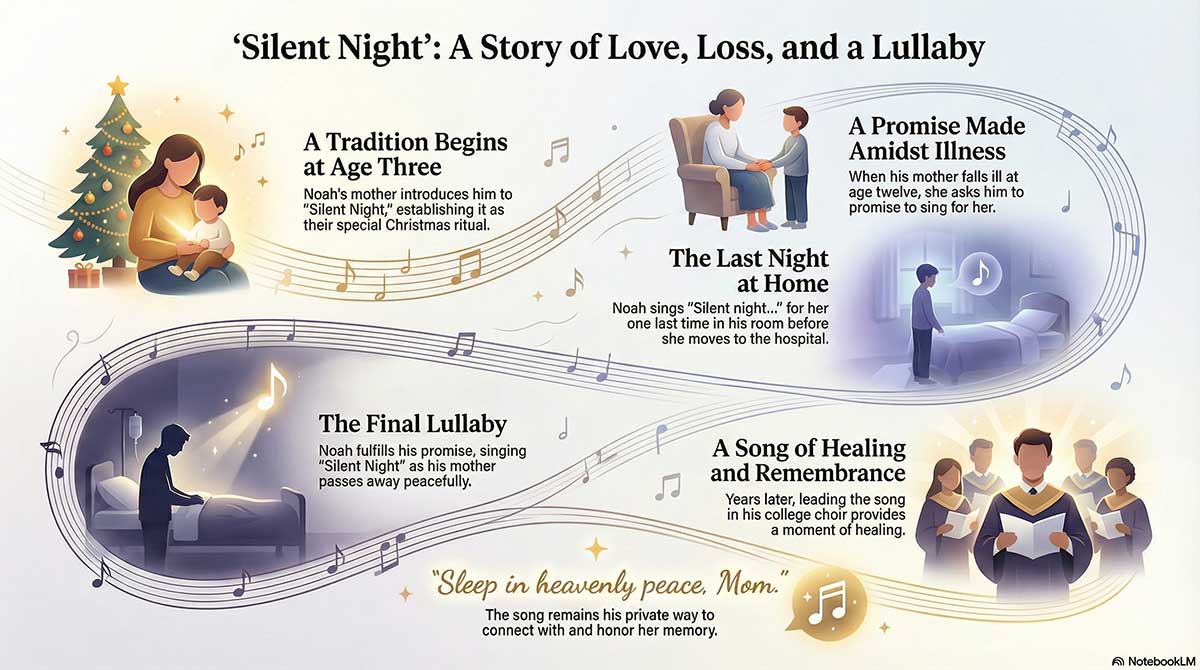
Noah grows from a tender, wide-eyed three-year-old into a thoughtful young man shaped by his mother’s quiet strength. Sensitive, observant, and deeply loyal, he carries their shared ritual of Silent Night as both a memory and a form of survival. His grief matures into compassion, guiding him toward a life where small kindnesses matter and where love remains the anchor he returns to each December.
Noah’s mother is a hardworking single parent whose love is expressed through small, steadfast acts—thin soup stirred with warmth, discount Christmas trees she insists are beautiful, lullabies sung after long shifts. Despite financial hardship and illness, she radiates gentleness and humor. Her final request for Noah to sing Silent Night becomes a lasting gift that shapes his understanding of love, loss, and presence.
The choir director is a compassionate leader who senses Noah’s quiet depth and offers him an unexpected moment of healing by inviting him to lead Silent Night. She serves as a gentle bridge between his past and present, opening a space where his voice becomes an instrument of remembrance.
The elderly woman, a resident with a fragile gait and a perceptive heart, recognizes the emotional weight in Noah’s singing. Her simple words—“You sing like someone who has loved deeply”—mirror the truth he has long carried. She represents the universal thread between grief and human connection.
Noah’s aunt steps in after his mother’s passing, offering him stability without trying to replace what he lost. Quiet, steady, and protective, she helps guide him into adulthood while honoring the presence of his mother in his life.
Leave a Reply