

|
Getting your Trinity Audio player ready...
|
What If the World’s Greatest Peace Thinkers Planned for 2026 Today?
Dag Hammarskjöld:
Peace is not the absence of conflict.
It is the presence of restraint.
Those who seek peace often begin by asking how violence may be stopped.
A harder question is whether humanity is prepared to live without the habits that produce violence.
Power without conscience, justice without dignity, identity without responsibility—these are not failures of policy. They are failures of maturity.
We live in an age where our instruments have outgrown our wisdom.
Our reach exceeds our readiness.
Our speed outruns our judgment.
The five conversations that follow do not promise peace.
They ask something more demanding: whether we are willing to become the kind of human beings for whom peace is possible.
We begin not with nations, but with the inner life.
Not with systems, but with conscience.
Not with victory, but with restraint.
Peace is never achieved once and for all.
It is entrusted—briefly, imperfectly—to each generation.
This gathering is not a celebration.
It is a responsibility.
(Note: This is an imaginary conversation, a creative exploration of an idea, and not a real speech or event.)
Topic 1 — The Inner Roots of War: Why Humans Need Enemies

Moderator: Krista Tippett
The room is quiet in a way that feels intentional. Not tense, not ceremonial—simply attentive. Krista Tippett sits slightly forward, hands folded, not as someone about to instruct, but as someone about to listen deeply.
She speaks gently.
“We often talk about war as something that happens between nations, ideologies, or leaders. But again and again, history suggests that conflict begins somewhere closer—inside the human being. I’d like us to begin there.”
She pauses, then offers the first question.
Why do human beings repeatedly create enemies, even when cooperation is possible?
Hannah Arendt speaks first, her voice calm, precise.
“Because thinking is hard. I do not mean intelligence—I mean the inner activity of examining oneself. When people stop thinking, they begin to rely on clichés, inherited narratives, and collective identities. Enemies provide ready-made meaning. They relieve us of the burden of judgment.”
She looks around the table.
“When thinking ceases, moral responsibility dissolves. At that point, violence does not feel like a choice—it feels like obedience.”
Gautama Buddha follows, speaking softly, almost conversationally.
“Enemies arise from craving. The mind grasps at identity—‘this is me, that is not.’ From that division comes fear. From fear, aggression. Even when cooperation is possible, the untrained mind prefers certainty over peace.”
He smiles faintly.
“To release the need for enemies, one must first release the illusion of a permanent self that must be defended.”
Carl Jung leans back slightly, fingers interlaced.
“We do not merely create enemies—we discover them, or so it feels. What we refuse to see in ourselves, we encounter in others. The shadow does not disappear when denied; it becomes externalized.”
He nods toward Arendt.
“When societies lose the capacity for self-reflection, the shadow goes collective. At that point, the enemy becomes not just necessary, but sacred.”
Viktor Frankl speaks next, measured and humane.
“Where meaning collapses, hostility rushes in. An enemy provides a tragic form of purpose. It answers the question ‘Why am I suffering?’ without requiring inner work.”
He pauses.
“A person who knows why they live does not need someone to hate.”
Baruch Spinoza speaks last, with clarity and restraint.
“Hatred arises from inadequate ideas. When people do not understand causes, they personalize effects. Fear becomes blame. Blame becomes hostility.”
He inclines his head slightly.
“Understanding does not excuse wrongdoing—but it dissolves the emotional fuel of war.”
Krista Tippett lets the silence linger before moving on.
What inner condition makes peace psychologically sustainable—not just morally desirable?
This time, Viktor Frankl begins.
“Peace requires meaning that is not dependent on victory. If one’s sense of worth depends on dominance, peace will feel like humiliation. But when meaning is rooted in responsibility—toward others, toward life—peace becomes compatible with dignity.”
Carl Jung follows.
“Peace requires the courage to encounter the shadow consciously. Without that, peace is merely repression, and repression always seeks release.”
He adds quietly,
“The most dangerous people are those who believe they have no darkness.”
Gautama Buddha continues.
“Sustainable peace arises from awareness. When one sees how suffering arises, one no longer seeks to pass it on. This is not moral superiority—it is clarity.”
He gestures gently.
“A mind at peace does not need to win.”
Baruch Spinoza nods slightly before speaking.
“Peace is sustained by joy born of understanding. When humans act from reason, they seek cooperation because it increases their power to live.”
He looks around the table.
“Hatred weakens us. Understanding strengthens us.”
Hannah Arendt closes the round.
“Peace becomes sustainable when people reclaim the habit of thinking. Not ideology, not slogans—but inner dialogue. A society that thinks cannot easily be mobilized into hatred.”
Krista Tippett takes a breath, then asks the final question.
What early warning signs show that a society is psychologically drifting toward war?
Carl Jung answers first.
“When projection accelerates. When complexity is replaced by myth. When people speak of others as symbols rather than persons.”
He adds,
“That is when the shadow has taken the stage.”
Hannah Arendt follows.
“When language becomes empty. When words lose meaning and are replaced by slogans. When people stop asking, ‘Is this true?’ and begin asking only, ‘Is this ours?’”
Baruch Spinoza continues.
“When fear becomes the dominant public emotion. Fear seeks control. Control seeks enemies.”
Gautama Buddha speaks quietly.
“When compassion is mocked. When stillness is feared. When anger is praised as strength.”
Viktor Frankl closes.
“When suffering is no longer transformed into meaning, but redirected into blame.”
Krista Tippett sits with the moment, then offers a closing reflection.
Moderator’s Closing Reflection — Krista Tippett
“What I hear across all of you is something both sobering and hopeful.
War does not begin with weapons.
It begins with unexamined fear, unintegrated pain, and unmet meaning.
And peace does not begin with treaties.
It begins when human beings become capable of living without enemies.
That is not naïve.
It is demanding.
And it may be the most realistic work we have left.”
The room remains quiet—not because the conversation is finished, but because something deeper has begun.
Topic 2 — Justice Without Revenge: Can Societies Heal Without Punishing?

Moderator: Amartya Sen
The atmosphere in the room is heavier than before—not tense, but weighted with history. Amartya Sen looks around the table slowly, aware that every person present has faced injustice not as theory, but as lived reality.
He begins carefully.
“Justice is often spoken of as balance, retribution, or deterrence. Yet history suggests that punishment frequently reproduces the very violence it claims to prevent. I’d like us to explore whether justice can heal rather than harden.”
He pauses, then asks the first question.
Is punishment necessary for justice, or does it secretly guarantee future violence?
Immanuel Kant speaks first, firm and exact.
“Justice without accountability is incoherent. If wrongdoing is not answered by law, society dissolves into arbitrariness. Punishment is not revenge—it is respect for moral agency.”
He inclines his head slightly.
“To treat a wrongdoer as responsible is to take them seriously as a moral being.”
Nelson Mandela responds next, his tone calm, reflective.
“I agree that accountability matters. But punishment that humiliates creates a memory that survives the sentence. In South Africa, we learned that punishing the past can imprison the future.”
He pauses.
“We needed truth more than revenge. And dignity more than victory.”
Eleanor Roosevelt follows, measured and resolute.
“Justice must protect the human person on all sides. When punishment erases dignity, it ceases to be justice.”
She looks toward Kant gently.
“Law exists to preserve humanity, not to avenge it.”
John Rawls speaks next, thoughtful.
“Punishment may be necessary, but only insofar as it sustains a fair system. If punishment deepens inequality or resentment, it undermines the stability of justice itself.”
He adds,
“A just society is one people are willing to remain part of—even when they lose.”
Abraham Lincoln speaks last, quietly.
“During war, I learned that punishment can satisfy the present but poison the future. We faced a choice: destroy our enemies, or restore our country.”
His voice steadies.
“With malice toward none was not sentiment. It was strategy.”
Amartya Sen lets the words settle before moving on.
How can societies hold wrongdoing accountable without humiliating or dehumanizing?
This time, Eleanor Roosevelt begins.
“By anchoring justice in human rights. Rights are not rewards for good behavior; they are safeguards against cruelty.”
She continues,
“When dignity is non-negotiable, accountability becomes corrective, not vengeful.”
John Rawls follows.
“Design matters. Procedures must be fair, transparent, and equal. When people believe the process is just, outcomes—even painful ones—are accepted.”
Nelson Mandela speaks next.
“We invited perpetrators to speak the truth publicly. Not to excuse them—but to break the silence that feeds hatred.”
He adds,
“Truth disarms resentment.”
Immanuel Kant responds, carefully.
“Humiliation is not intrinsic to punishment. It arises when punishment is administered without respect for rational dignity.”
He nods slightly.
“A lawful sentence can affirm humanity even while restraining freedom.”
Abraham Lincoln closes the round.
“Mercy without responsibility breeds chaos. Responsibility without mercy breeds rebellion.”
Amartya Sen leans forward slightly and asks the final question.
What signals show that a justice system is turning into an engine of revenge rather than peace?
John Rawls answers first.
“When punishment disproportionately affects the least advantaged. That is the clearest warning.”
Eleanor Roosevelt follows.
“When fear replaces fairness. When people are afraid of the law rather than protected by it.”
Immanuel Kant speaks next.
“When punishment is used for spectacle or deterrence rather than moral accountability.”
Nelson Mandela continues.
“When prisons become warehouses of despair rather than places of restoration.”
Abraham Lincoln concludes.
“When justice is spoken of as victory.”
Amartya Sen allows a pause, then offers his closing reflection.
Moderator’s Closing Reflection — Amartya Sen
“What I hear is not a rejection of justice—but a refusal to confuse justice with revenge.
Punishment may restrain behavior.
But only dignity can restore society.
A just world is not one without consequences.
It is one where consequences do not multiply suffering beyond necessity.
Peace depends not on forgetting wrongdoing,
but on preventing it from becoming destiny.”
The room remains still, the silence thoughtful rather than resolved.
Topic 3 — Power Without Domination: What Kind of Leadership Creates Peace?

Moderator: Fareed Zakaria
The mood in the room shifts. This is the topic where ideals collide with reality—where philosophy meets the hard gravity of power. Fareed Zakaria sits upright, attentive, aware that every voice here has confronted authority from a different angle.
He begins plainly.
“History tells us that power is unavoidable. The question is not whether power exists, but whether it must dominate to be effective. I’d like us to explore what kind of leadership can hold authority without provoking resistance.”
He pauses, then opens the first question.
Why does power so often slide into domination, even when leaders begin with good intentions?
Václav Havel speaks first, reflective.
“Because power tempts people to stop listening. When leaders begin to believe their role excuses them from truth, domination quietly replaces responsibility.”
He adds softly,
“Power isolates before it corrupts.”
Confucius follows, steady and composed.
“When virtue weakens, force fills the gap. A ruler who relies on punishment reveals his failure to lead by example.”
He looks around the table.
“People obey fear temporarily. They follow moral authority willingly.”
Dag Hammarskjöld speaks next, reserved but firm.
“In institutions, domination often arises from anxiety—fear of disorder, fear of failure. Leaders tighten control to compensate for uncertainty.”
He pauses.
“Restraint requires inner security.”
Mahatma Gandhi responds, calm yet resolute.
“Power corrupts when it is separated from self-discipline. Without mastery of oneself, mastery over others becomes cruelty.”
He smiles faintly.
“True authority persuades conscience, not behavior alone.”
Laozi speaks last, almost quietly.
“When leaders act too forcefully, they provoke resistance. Domination is the result of striving.”
He lets the words settle.
“Those who do not contend are rarely opposed.”
Fareed Zakaria nods, then moves to the second question.
What form of power creates stability without coercion?
This time, Laozi begins.
“Power that does not announce itself. When people feel they have acted freely, harmony endures.”
Confucius continues.
“A leader’s conduct shapes the state. If the ruler is upright, the people correct themselves.”
Gandhi follows.
“Nonviolence is not passivity. It is disciplined strength that refuses to humiliate.”
He adds,
“Humiliation breeds rebellion.”
Dag Hammarskjöld speaks next.
“Institutions gain legitimacy when they limit themselves. Authority grows when restraint is visible.”
Václav Havel closes the round.
“Power remains stable when it remains answerable—to truth, to conscience, to those it governs.”
Fareed Zakaria leans forward slightly for the final question.
How can societies tell when leadership has crossed from authority into domination?
Dag Hammarskjöld answers first.
“When secrecy replaces accountability. When power becomes allergic to scrutiny.”
Confucius follows.
“When laws multiply but trust disappears.”
Václav Havel continues.
“When truth becomes dangerous to speak.”
Laozi adds.
“When force increases but harmony declines.”
Mahatma Gandhi concludes.
“When obedience is obtained at the cost of dignity.”
Fareed Zakaria pauses, allowing the convergence of ideas to land, then offers his closing reflection.
Moderator’s Closing Reflection — Fareed Zakaria
“What emerges here is a demanding truth.
Power does not fail because it is weak.
It fails because it forgets restraint.
Leadership that creates peace does not dominate—it invites.
It does not coerce—it persuades.
It does not fear dissent—it learns from it.
The paradox is this:
The more power relies on domination, the less authority it truly has.
Peace depends not on the absence of power,
but on the courage to limit it.”
The room grows quiet—not in agreement, but in recognition.
Topic 4 — Systems That Don’t Create War: Economy, Ecology, and Structure

Moderator: Kate Raworth
The atmosphere changes again—less intimate, more structural. This is the room where abstractions quietly decide human fate. Kate Raworth sits centered, composed, with the practiced calm of someone who knows systems can liberate or crush depending on how they are designed.
She begins.
“Most conflicts today are not born from ideology alone. They emerge from pressure—economic, ecological, systemic. I want us to examine how our structures quietly manufacture instability, even when no one intends harm.”
She pauses, then asks the first question.
How do economic and ecological systems unintentionally generate conflict?
Rachel Carson speaks first, her voice steady but grave.
“When nature is treated as expendable, conflict becomes inevitable. Environmental collapse does not announce itself as violence—but it arrives as scarcity, displacement, and desperation.”
She adds,
“War often begins long after the damage is done.”
Adam Smith follows, measured and thoughtful.
“Markets fail when moral sentiment is removed from them. Competition without sympathy degrades trust. When people feel exploited, resentment accumulates.”
He looks around.
“Economic systems require ethical foundations to remain peaceful.”
Buckminster Fuller speaks next, animated but precise.
“People don’t fight because they’re evil. They fight because the system makes cooperation impossible.”
He gestures lightly.
“You don’t fix war by fighting people—you fix it by redesigning the system.”
Albert Einstein follows, reflective.
“We have created instruments of efficiency without instruments of wisdom. When systems optimize output without moral imagination, they accelerate collapse.”
David Bohm speaks last, quietly.
“Our systems mirror our thinking. Fragmented thought produces fragmented institutions. Conflict is the visible symptom of incoherent design.”
Kate Raworth nods, then moves to the second question.
What principles should guide the design of systems that naturally reduce conflict?
This time, Buckminster Fuller begins.
“Design for abundance, not competition. When basic needs are met by default, war loses its economic rationale.”
Kate Raworth listens closely as Rachel Carson continues.
“Respect limits. Systems that deny ecological boundaries create crises that no policy can contain.”
Adam Smith follows.
“Encourage mutual benefit. When cooperation is rewarded, peace becomes profitable.”
David Bohm speaks next.
“Design for wholeness. Systems must reflect interdependence, not fragmentation.”
Albert Einstein closes the round.
“Ensure moral oversight. Technology must remain accountable to human values.”
Kate Raworth leans forward slightly for the final question.
What warning signs show that a system is drifting toward conflict?
Albert Einstein answers first.
“When efficiency is valued more than humanity.”
Rachel Carson follows.
“When damage is invisible to those who benefit.”
Adam Smith continues.
“When trust erodes and speculation replaces productive contribution.”
David Bohm adds.
“When complexity is managed by force rather than understanding.”
Buckminster Fuller concludes.
“When people are blamed for failures designed into the system.”
Kate Raworth allows a brief silence, then offers her closing reflection.
Moderator’s Closing Reflection — Kate Raworth
“What emerges here is a sobering insight.
War is often not a moral failure—it is a design failure.
When systems reward extraction over care,
when efficiency outruns wisdom,
when abundance is hoarded instead of shared,
conflict becomes structural.
Peace, then, is not merely an aspiration.
It is an engineering challenge.
And the question before us is not whether peace is possible,
but whether we are willing to redesign the systems that prevent it.”
The room settles—not resolved, but recalibrated.
Topic 5 — Expanding Human Identity: From Tribe to Planet

Moderator: Yuval Noah Harari
The room feels different now—quieter, wider. This is not a discussion about policy or power, but about who humans believe themselves to be. Yuval Noah Harari sits forward, attentive, aware that identity is the deepest technology humanity has ever built.
He begins.
“For most of history, humans survived by belonging to tribes. Today, that same instinct threatens our survival. I’d like us to ask whether human identity can expand faster than the tools we’ve created.”
He pauses, then offers the first question.
Why does tribal identity remain so powerful—even when it leads to destruction?
Moses speaks first, voice grounded and grave.
“Because identity without law becomes chaos, and law without identity becomes tyranny. People cling to tribe when they fear dissolution.”
He looks around the table.
“Tribe offers belonging. Without moral boundaries, it also justifies cruelty.”
Confucius follows, composed and measured.
“Human beings learn who they are through relationships. When those relationships narrow, identity shrinks.”
He adds,
“A person rooted only in faction loses the wider sense of humanity.”
Carl Sagan speaks next, reflective.
“Tribalism feels intimate in a vast universe. When people feel small, they cling to symbols that tell them they matter.”
He smiles faintly.
“But the universe tells a larger story—one in which every human shares the same fragile home.”
Jesus of Nazareth follows, voice gentle yet direct.
“Fear binds people to tribes. Love frees them from it.”
He pauses.
“When identity is built on exclusion, someone must always be cast out.”
Martin Luther King Jr. closes the round.
“Tribal identity persists because injustice persists. People retreat into groups when dignity is denied.”
Harari nods, then moves to the second question.
What enables human identity to expand beyond nation, religion, and group?
This time, Carl Sagan begins.
“Perspective. When people see Earth as a single, shared world, division becomes irrational.”
Martin Luther King Jr. follows.
“Justice. When people experience fairness, they no longer need tribal protection.”
Confucius continues.
“Education in responsibility. Teach people to see themselves as moral actors within a larger whole.”
Jesus of Nazareth speaks next.
“Love that crosses boundaries. Not sentiment—but action toward the stranger.”
Moses concludes.
“Law that restrains power. Without justice, expanded identity collapses into domination.”
Harari leans in slightly and asks the final question.
What signs show that humanity is failing—or succeeding—at expanding identity?
Jesus of Nazareth answers first.
“When compassion becomes conditional, identity is shrinking.”
Carl Sagan follows.
“When scientific knowledge is used to divide rather than unite.”
Confucius continues.
“When respect disappears from public life.”
Moses adds.
“When law serves tribe instead of justice.”
Martin Luther King Jr. concludes.
“When people accept inequality as normal.”
Harari allows the moment to breathe, then offers his closing reflection.
Moderator’s Closing Reflection — Yuval Noah Harari
“What emerges here is a difficult but necessary insight.
Human identity is not fixed.
It is a story we tell—and retell—about who belongs.
For thousands of years, that story was tribal, national, religious.
Those stories built civilizations.
They can now destroy them.
The future of peace depends on whether humanity can tell a new story—
one large enough to include everyone,
yet grounded enough to preserve dignity, justice, and responsibility.
If identity does not expand, conflict will.
That is not ideology.
It is history.”
The room settles into a silence that feels final—not because the conversation is over, but because its implications are unavoidable.
Final Thoughts by Dag Hammarskjöld
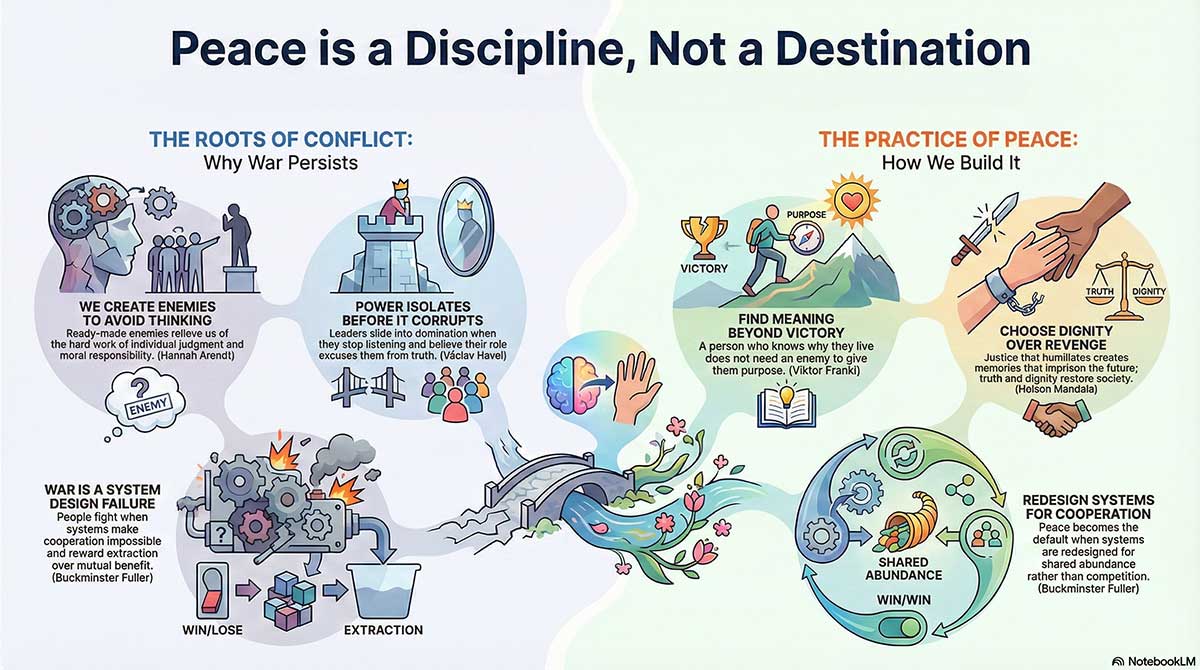
We have listened to five conversations that circle a single truth.
War is not inevitable.
But neither is peace.
Peace depends on choices that rarely announce themselves as historic:
the choice to think before obeying,
to restrain power when domination is possible,
to design systems that do not reward despair,
to widen identity beyond fear,
to uphold dignity even when punishment is easier.
These choices are quiet.
They are easily postponed.
And they are always costly.
History teaches us that humanity does not fail because it lacks knowledge.
It fails because it avoids responsibility.
The future will not judge us by the ideals we admired,
but by the limits we accepted—
on power, on vengeance, on indifference.
Peace is not a state we reach.
It is a discipline we practice.
And it begins, as it always has,
with the courage to govern ourselves.
Short Bios:
Dag Hammarskjöld
Second Secretary-General of the United Nations, known for his quiet moral authority, spiritual depth, and belief that restraint and responsibility are the foundations of peace.
Krista Tippett
Journalist and interviewer recognized for creating deep, humane conversations at the intersection of spirituality, ethics, psychology, and public life.
Amartya Sen
Economist and philosopher whose work on justice, human capability, and development reshaped how societies understand fairness and human dignity.
Fareed Zakaria
Political analyst and author known for exploring global power, leadership, and the balance between authority, legitimacy, and restraint.
Kate Raworth
Economist and systems thinker best known for Doughnut Economics, a framework that balances human well-being with planetary boundaries.
Yuval Noah Harari
Historian and philosopher examining how stories, identity, and technology shape human civilization and its future.
Gautama Buddha
Spiritual teacher whose insights into suffering, desire, and awareness laid the foundation for inner peace as the path to ending conflict.
Carl Jung
Psychologist who explored the unconscious, the shadow, and how unintegrated inner conflict becomes projected outward as collective violence.
Viktor Frankl
Psychiatrist and Holocaust survivor who taught that meaning, even in suffering, is essential for preserving human dignity and preventing despair.
Hannah Arendt
Political thinker who analyzed totalitarianism, moral responsibility, and how thoughtlessness enables great evil.
Baruch Spinoza
Philosopher who argued that understanding and reason dissolve fear, hatred, and destructive passions.
Nelson Mandela
Leader who guided South Africa from apartheid to reconciliation through forgiveness, dignity, and moral courage.
Abraham Lincoln
U.S. president whose leadership during civil war emphasized unity, restraint, and reconciliation over vengeance.
Eleanor Roosevelt
Diplomat and human rights advocate who helped shape the Universal Declaration of Human Rights, grounding peace in human dignity.
Immanuel Kant
Philosopher who articulated the moral foundations of law, duty, and the conditions for lasting peace between nations.
John Rawls
Political philosopher whose theory of justice emphasized fairness, equality, and stability as prerequisites for peace.
Laozi
Ancient philosopher who taught that true power lies in humility, non-coercion, and alignment with the natural order.
Confucius
Teacher and moral philosopher who emphasized harmony, ethical leadership, and responsibility within human relationships.
Mahatma Gandhi
Leader of nonviolent resistance who demonstrated that disciplined moral action can transform power without domination.
Václav Havel
Writer and statesman who showed how truth, conscience, and moral responsibility can reshape political life.
Dag Hammarskjöld
International civil servant who believed that leadership must be guided by inner discipline, restraint, and service rather than ambition.
Buckminster Fuller
Visionary designer who argued that humanity must redesign systems so cooperation replaces competition and conflict.
Adam Smith
Moral philosopher and economist who stressed sympathy and ethical behavior as essential to healthy markets and societies.
Rachel Carson
Scientist and writer who revealed how environmental destruction undermines peace by creating long-term scarcity and instability.
Albert Einstein
Physicist and moral thinker who warned that technological power without ethical maturity leads to catastrophe.
David Bohm
Physicist and philosopher who explored how fragmented thinking produces fragmented societies and conflict.
Moses
Lawgiver and moral leader who emphasized justice, restraint, and responsibility as the foundation of communal life.
Jesus of Nazareth
Teacher whose message of love, forgiveness, and universal compassion challenged tribal identity and cycles of violence.
Martin Luther King Jr.
Civil rights leader who framed justice, love, and nonviolence as inseparable foundations for lasting peace.
Leave a Reply