
|
Getting your Trinity Audio player ready...
|
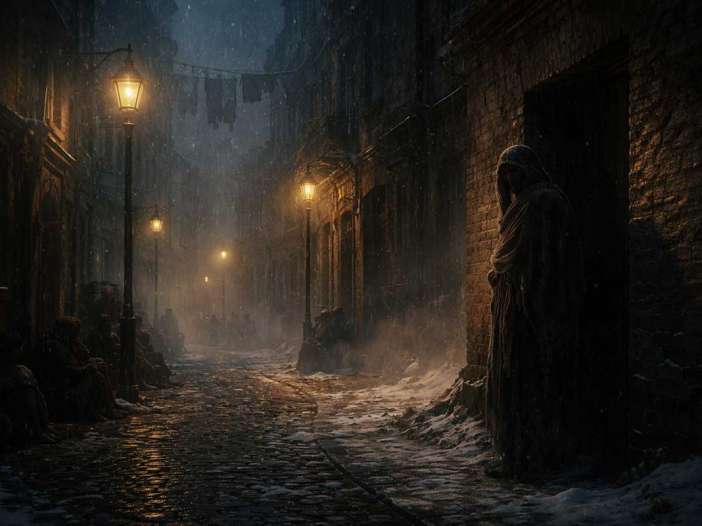
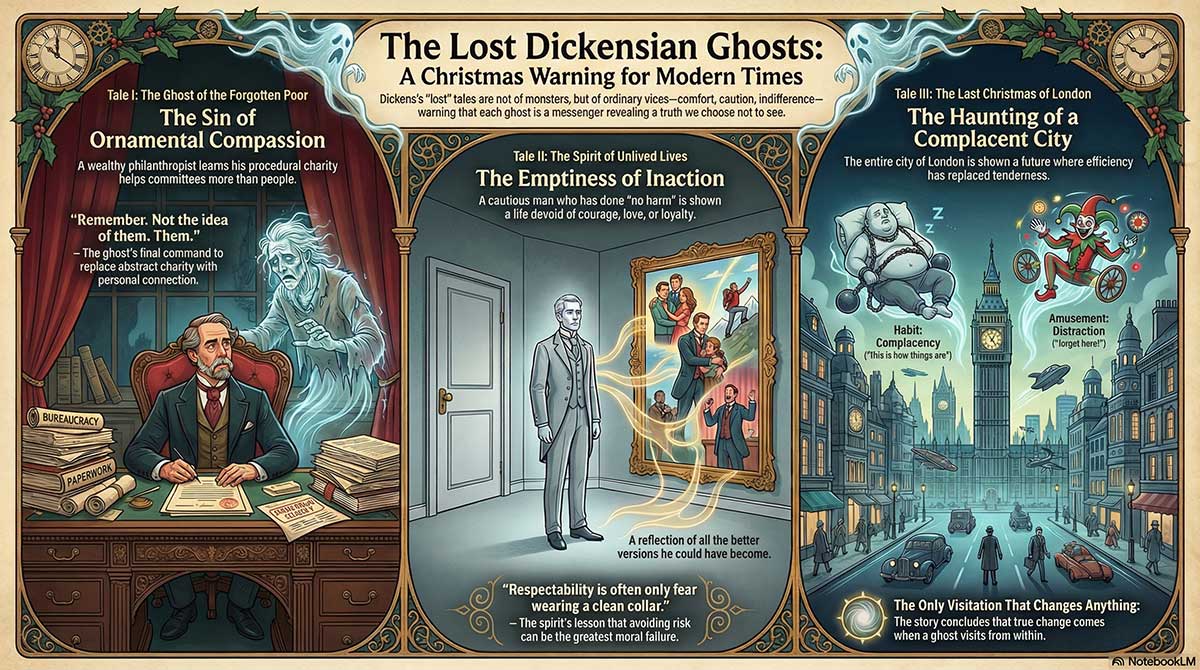
What if Charles Dickens wrote three darker Christmas ghost stories—but never published them?
Main Introduction — In the Voice of Charles Dickens
I have long believed that Christmas, of all seasons, has a peculiar talent for loosening the tongue of conscience. At no other time does the world grow so strangely willing to listen to truths it spends the rest of the year industriously avoiding. The hearth grows warm, the streets grow bright, and yet—if we are honest—the shadows do not retreat; they merely step closer to the fire.
It has been my habit, when thinking of ghosts, not to imagine them solely as visitors from the grave, rattling chains for our amusement, but as messengers of memory, of regret, and of responsibility. A ghost, properly understood, is not an interruption of life, but an explanation of it. It is the shape taken by those things we have chosen not to see.
In the following three tales, I have not confined myself to one miser, one household, or one conscience. I have allowed the hauntings to widen. Here you will meet not only the forgotten poor who stand patiently at the margins of our vision, but the unlived lives that follow respectable men like quiet shadows, and at last, a city itself—vast, powerful, and perilously capable of forgetting its own soul.
These are not stories of monsters. They are stories of ordinary comfort, ordinary caution, and ordinary indifference—those three mild vices which, taken together, can do more harm than any villain with a dagger. If they trouble you, I ask only that you do not dismiss the discomfort too quickly. Unease, like hunger, has its uses.
Should you find in these pages something that resembles your neighbour, your city, or yourself, do not suppose the likeness accidental. Christmas is generous with mirrors, and the bravest act of the season is not to admire our reflection, but to correct it.
(Note: This is an imaginary conversation, a creative exploration of an idea, and not a real speech or event.)
I. The Ghost of the Forgotten Poor
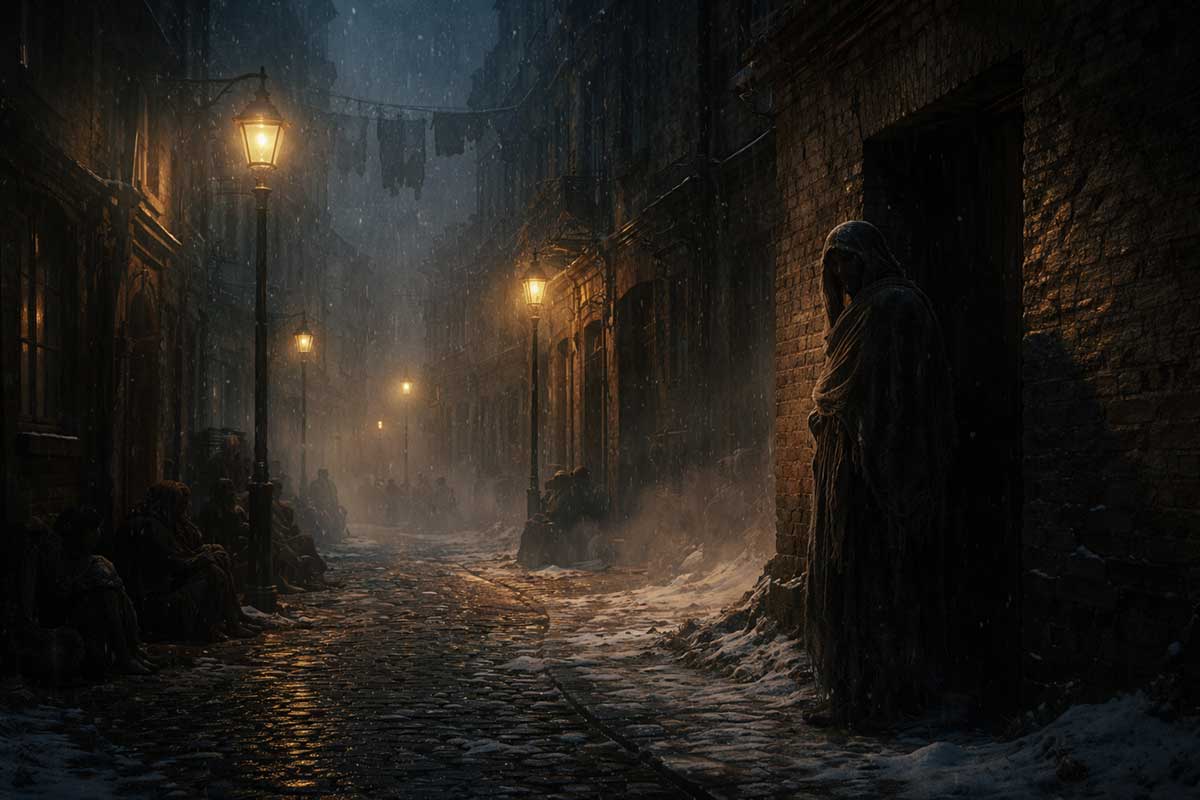
A Fragment from the Supposed Papers of C. D., Discovered Among Miscellaneous Leaves and Fair Copies, Undated
There are certain gentlemen in this world who are charitable as clocks are punctual: at stated hours, with a regularity that comforts them exceedingly, and with a sound which, being heard by others, assures them they exist to good purpose. If you were to suggest to such a gentleman that his charity might need a heart as well as a purse, he would look at you with a mild surprise—much as if you had proposed to wind the sun up of a morning, lest it should forget its duty.
Mr. Edmund Hargreaves was one of these. His name was carved in stone above an infirmary gate; painted in gilt upon a subscription list; and engraved upon the lids of certain handsome boxes in which the grateful committees of divers institutions kept their minutes and their tea-cakes. He had a face well practised in benevolence; a hand well trained to the public shake; and a voice so full of humane generalities that it could have comforted the entire human race—provided the human race did not come too near.
On Christmas Eve (that day when even a miser may be ashamed to be seen counting), Mr. Hargreaves supped alone in his house in a square of good repute, where the very lamps seemed to burn with a steadier flame than in poorer streets, lest they should be accused of flickering at respectability. His dinner was of that order which admits no surprise—save the surprise that it can be eaten with relish in solitude—and he read, afterwards, some pamphlet on the Improvement of the Lower Orders, composed by a gentleman who had never been one.
At a late hour, Mr. Hargreaves rose, as a man rises from his conscience when it becomes tiresome, and retired to his bedchamber. He had scarcely drawn the curtains, when he observed—at first in the glass, and then in the room itself—an appearance not to be set down among the usual furniture of a gentleman’s life.
It was a figure, thin to transparency, wrapped in rags so slight that the candlelight passed through them as through smoke. It bore no chains, no rattling iron, no theatrical appurtenance; it was the more dreadful for being plain. Its face had the pallor of hunger, and in its eyes there was that patient astonishment which belongs to those who have been disappointed too often to expect anything better.
Mr. Hargreaves, being a rational man (as rational men call themselves), would have spoken, but found his voice to be oddly mislaid.
“I am,” said the figure, in a tone no louder than the falling of snow, “the Ghost of the Forgotten Poor.”
Mr. Hargreaves, with that promptness which attends a gentleman’s mind when it is in danger, recovered his voice at once.
“Forgotten!” he repeated. “My good fellow—if you will allow the expression—forgotten is hardly the word. I have subscribed—handsomely—year after year—”
The ghost lifted a hand, and Mr. Hargreaves ceased as if a curtain had dropped between him and his own argument.
“Come,” said the ghost; and before Mr. Hargreaves could protest (which is the privilege of comfort), the room dissolved, and he stood in a street he had traversed daily, and yet had never seen.
There were shops, certainly; there were wheels, certainly; there were people, certainly. But in the corners, in the doorways, under the very noses of the passers-by, were lives so pinched and quiet that they might have been shadows cast by London itself. A woman sat with a baby at her breast and another child asleep against her knee. She had the look of one who had once been clean and orderly, and who now, having fallen, could not find the stair again.
“She applied,” said the ghost.
“To whom?”
“To your committee. She was told her papers were irregular.”
Mr. Hargreaves, who had always believed committees to be beneficent animals, felt a sudden distaste for them.
They passed on, and came upon a man, pale and thin, with an arm bound in cloth. He leaned against a wall and watched his own breath, as if it might teach him what to do next.
“He was injured,” said the ghost, “in the service of a company in which your money sits very comfortably.”
“I do not manage the company,” said Mr. Hargreaves quickly.
“No,” returned the ghost, “you only profit.”
They turned into a narrow court, where a child with a face too old for his years stood gazing at a bright window wherein a little feast was spread. The child did not beg; he did not even cry. He looked as if he had learned, already, that the world’s pity is a coin too often counterfeit.
“He was refused schooling,” said the ghost. “Not from cruelty, but from—”
“Regulations,” Mr. Hargreaves supplied, with the faint air of one repeating a familiar hymn.
The ghost inclined its head.
Mr. Hargreaves began to speak again of his subscriptions—how they had bought blankets, and broth, and coal. The ghost did not dispute it. Instead, it showed him the rooms where those blankets were discussed, the meetings where those coals were delayed until the cold had done its work, the polite debates in which suffering was translated into figures, and mercy into budgets.
He saw himself in those rooms. Not as a monster, but as a man of good temper who disliked disturbance. He saw himself smoothing a difficult question with a smile; postponing an uncomfortable decision to a more convenient week; praising prudence; admiring moderation; and calling it all humanity.
Then the ghost carried him—swift as thought—into a future of neatness.
The infirmary with his name upon it stood larger than before. The lists were longer. The committees were busier. The poor were still poor, but better catalogued; their misery was better distributed; their hunger was better managed. A great machine of charity turned, oiled by gentlemanly satisfaction, grinding quietly on.
In a clean room, a clerk read aloud a report: “The numbers are improved.” Outside, in a cold street, a woman coughed until her body shook as if it would come apart.
“This,” said the ghost, “is what happens when compassion becomes an ornament.”
Mr. Hargreaves, who had never feared a poor man, now feared his own respectability.
“Spirit,” he said hoarsely, “tell me what I must do!”
The ghost looked at him with that patient astonishment again.
“Remember,” it said. “Not the idea of them. Them.”
With that, the ghost faded—not in a flourish, but as hunger fades from a rich man’s mind when his dinner is served.
Mr. Hargreaves awoke in his bed with the morning light upon the curtains, and the ordinary world ready to resume its ordinary falsehoods. But he did not rise as before. He sat, and listened, as if London itself had something to confess.
That day, he did not send for a committee. He went out, alone, to the courts and alleys where his money had never walked. He did not arrive with speeches; he arrived with ears. He spoke with the woman whose papers were irregular, and learned how quickly paperwork becomes a wall. He sought the injured man, and found that justice is often delayed until it is indistinguishable from refusal. He stood before a schoolmaster and offered not a donation, but a door.
Then—most astonishing of all—he went into those boardrooms where he had once sat pleasantly, and became unpleasant. He offended men who had dined with him. He interrupted the smooth language of prudence with the rude language of need. He discovered that influence, like money, is only useful when spent; and that the cost of spending it is the displeasure of those who preferred you quiet.
It was said, later, that Mr. Hargreaves had grown eccentric. It was whispered that he had become political. Certain persons no longer mentioned him with admiration. He lost invitations; he lost friends; he lost the easy warmth of belonging to those who never had to fear the cold.
But in the streets—where names are not carved in stone—there were those who spoke of him differently. They did not say he was benevolent. They said he was present.
And if, upon some winter evening, he fancied he saw in a doorway a thin figure wrapped in rags, with eyes of patient astonishment—he did not argue, but bowed his head, and remembered.
II. The Spirit of Unlived Lives
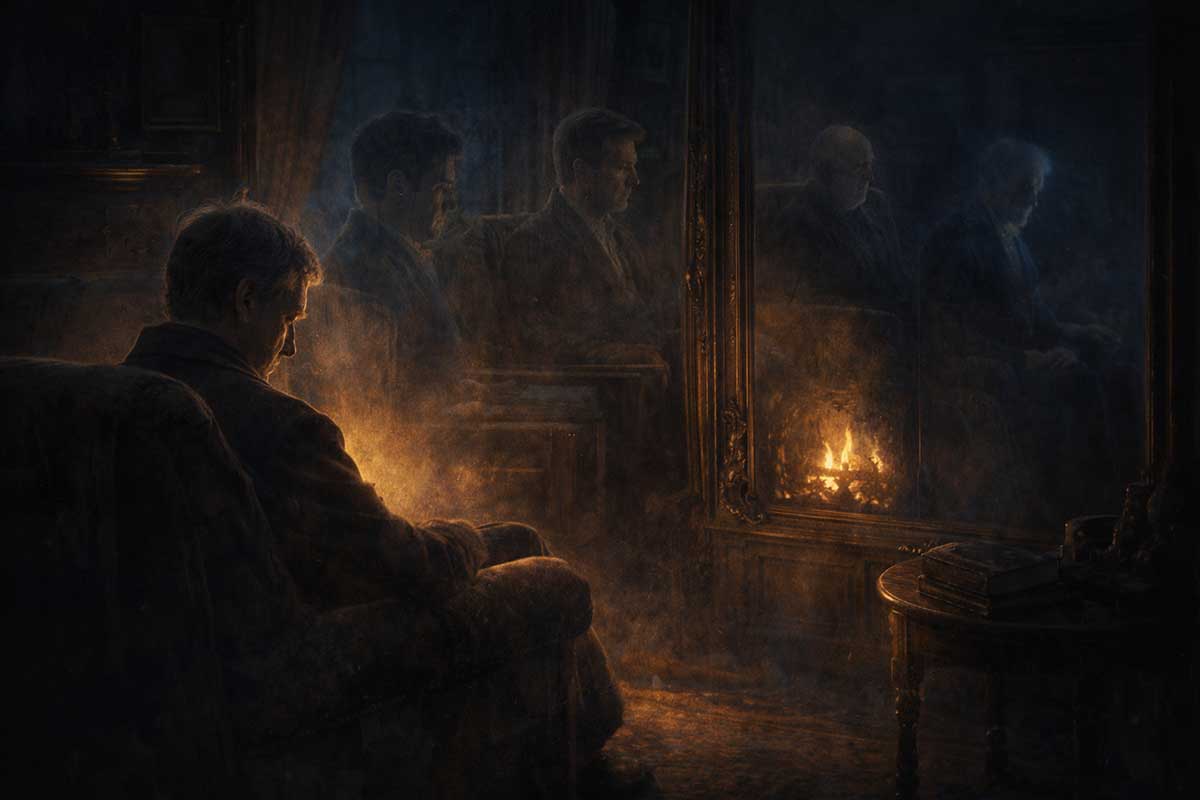
Being Another Supposed Christmas Paper, in the Same Hand, with Marginal Notes in a Smaller Script
Mr. Arthur Bellows was not a wicked man. He had never struck anybody in anger, never robbed a poor-box, never cheated an orphan. He paid his bills, attended church with moderate regularity, and spoke civilly to his inferiors in a manner that made them grateful for his civility. If there is any virtue in doing no harm—provided you do no good either—Mr. Bellows had earned a crown.
He lived in lodgings of respectable plainness; he kept his heart, like his furniture, carefully covered; and he had made of his life a kind of narrow path edged with hedges, so that no unexpected thing might step out upon him.
On Christmas Eve, he dined with his sister—an excellent woman who praised him chiefly for being so “steady”—and returned home through streets alive with the cheerful disorder of the season. In windows he saw families gathered; in doorways he saw laughter; and in himself he felt, for a moment, a curious ache, as if some part of him had once desired such warmth and then forgotten how.
At home, he warmed his hands at the fire, took a book (which he did not read), and began to prepare himself for sleep with the same cautious obedience with which he prepared himself for everything. It was then that he heard a sound like a page turning in a room where no one sat.
He looked up, and saw—standing by his chair—a figure whose appearance he found more unsettling than any chain or spectre might have been; for the figure resembled him.
Not precisely him as he was, but him as he had been, and might have been, and feared to be. Its face shifted as he stared: now younger, with hope unbroken; now older, with a softness he had never allowed himself; now worn and weary, yet strangely alive.
“I am,” said the figure, with a voice like his own, only truer, “the Spirit of Unlived Lives.”
Mr. Bellows attempted a smile that would have served him admirably at a dinner-table.
“Unlived?” he repeated. “I assure you, I have lived—”
The spirit regarded him with a mild compassion.
“You have existed,” it said. “Come.”
In an instant, Mr. Bellows stood in a schoolroom, bright with winter sunlight. A man moved among children with chalk upon his sleeve and laughter in his eyes. The children listened as if the world were opening before them.
“That is not I,” said Mr. Bellows quickly.
“It is you,” said the spirit, “who chose another road.”
He saw a moment—small, almost ridiculous—in which, as a young clerk, he had been offered a post assisting at a charity school, for modest pay and some inconvenience. He had declined. His sister had said it was impractical. He had agreed.
The scene shifted, and he stood in a modest home where a woman—his own wife in this other life—sat by the hearth. The room was poor, but it was full of talk. They argued, yes; they wept, yes; they forgave, yes. There was a child on the floor, playing with a wooden horse, looking up with that faith which is a kind of wealth.
Mr. Bellows felt his throat tighten.
“That woman—” he began.
“She was the woman you loved,” said the spirit, “before you decided love required too much.”
He saw himself, years ago, in a quiet parlour, with a woman’s hand trembling in his. She asked him to speak plainly of his intentions. He feared the cost, feared change, feared the unknown; and he spoke in those careful phrases that mean nothing while pretending to mean everything. The woman withdrew, not in anger, but in grief. He had called it a mutual understanding. He saw now that it had been a cowardice.
Next the spirit carried him to a smoky tavern. A man sat alone at a table, his face buried in his hands, while at other tables men whispered. The man was a friend of Mr. Bellows—once. He had been accused of wrongdoing at his office. Perhaps he was guilty; perhaps not. But he was certainly abandoned.
In the corner, Mr. Bellows—his younger self—stood half-risen from his chair, as if about to cross the room. Then he sat down again. He chose safety. He later told himself it was none of his business.
“Respectability,” said the spirit softly, “is often only fear wearing a clean collar.”
Mr. Bellows protested—now with less conviction—that he could not fight every battle; that a man must be prudent; that society had its rules.
The spirit showed him his future, and it was not dreadful in any dramatic way.
He saw his own death: tidy, quiet, remarked upon with politeness. A neighbour said, “He was a good fellow.” Another said, “He kept to himself.” A third said, “He was steady.” There were no tears that surprised the room. There were no empty chairs that made anyone ache. His possessions were sorted; his papers were filed; his name appeared briefly in a column and disappeared.
Most terrible of all, the spirit showed him a moment after the funeral, when a man paused on the pavement and said, with mild uncertainty, “What was his name again?” and walked on.
Mr. Bellows fell upon his knees before the spirit as if the floor were suddenly holy.
“Spirit,” he cried, “I have done no harm!”
The spirit’s shifting face settled—just for an instant—into the face of the boy Mr. Bellows had been.
“And you have done so little good,” it whispered.
He seized at the spirit’s garment, but it was like grasping smoke. The room whirled; the fire flared; and he awoke in his chair with the morning light upon his hands.
He sat very still. The old habit urged him to smooth the moment into forgetfulness. But something in him—small, long ignored—rose like a bird that had been caged too long.
That Christmas Day, Mr. Bellows went first to the home of a young widow in his building and asked if she required anything. He did not offer advice; he offered time. He visited his sister and spoke a truth he had avoided for years: that her praise of steadiness had been a kind of chain. He wrote to the friend he had abandoned—if the man still lived—and asked forgiveness without excuse.
Then, because redemption is not accomplished by grand gestures alone, he began to live—awkwardly at first, like a man learning a language late. He joined a school committee not to be admired, but to fight. He learned to endure disapproval. He learned to speak plainly. He learned that the cost of courage is often embarrassment, and that embarrassment is a small price for a soul.
He did not become famous. He did not become saintly. He did not even become comfortable. But he became present in his own life.
And sometimes, on quiet nights, when he heard the faintest sound like a page turning, he would smile—not carefully, but truly—and say aloud, “Not that life. This one.”
III. The Last Christmas of London
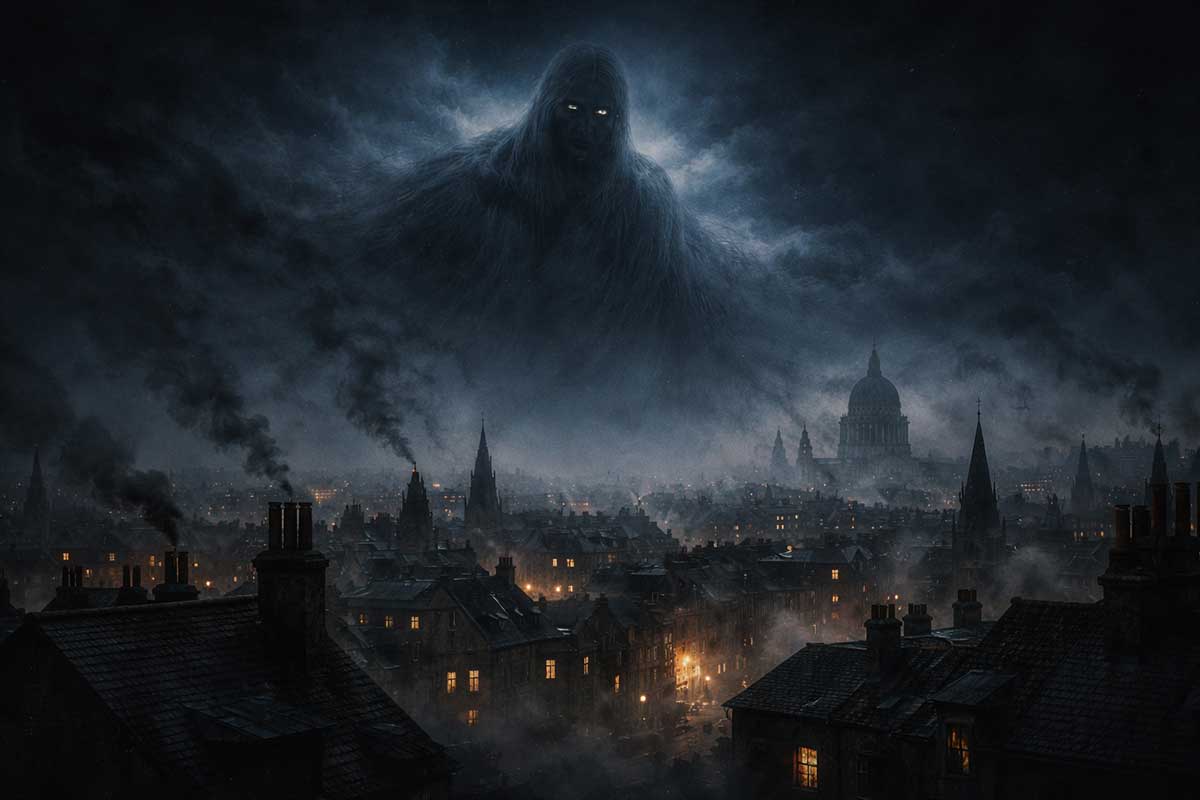
Alleged to Have Been Intended for a Public Reading, but Set Aside as Too Strange for Comfortable Audiences
It is a curious thing, and worthy of note by those who suppose themselves practical, that a city has a spirit as surely as a man has one. You may build streets as you build sentences; you may light lamps as you light ideas; you may feed the poor with soup and the rich with flattery; but underneath the bricks and the smoke there is a temper, a mood, a conscience—or the lack of it—that belongs to the whole. London, in particular, being large enough to swallow sins as easily as it swallows fog, has a spirit that can be magnanimous one hour and monstrous the next, without ever quite noticing the difference.
On a certain Christmas Eve—one of those nights when the air is so sharp it seems to cut the sound in two—something unusual happened to London.
It began with a stillness.
The bells rang, but their music did not carry. Carriages rolled, but their wheels sounded muffled, as if the streets were suddenly soft. In taverns, men raised their glasses and paused, uncertain why their laughter had turned thin. In parlours, ladies laid out cakes and felt, without reason, that the sweetness would not satisfy. Even the children, those little rebels against sorrow, grew oddly quiet, as though listening for a story that had not yet been told.
In the poorest streets, where the night usually brought its own rough chorus, the very quarrels faltered. In the richest squares, where comfort normally seals the ears, the fires burned with a strange reluctance, as if the coals themselves were thoughtful.
Then—over the roofs, above the river, through the fog—a shape began to gather.
At first it was only a thickening of the air; then it became a figure, immense and indistinct, formed of smoke and brick-dust, of chimney soot and human breath, with the faint glimmer of windows for eyes. Its voice was not a voice, but the sound of London speaking through every crack in its own walls.
And it spoke—not to one man, but to all.
Those who were awake heard it. Those who slept dreamed it. Those who would have dismissed it found dismissal impossible, for it rose within them like a memory of something they had promised long ago.
“Remember,” said the spirit of London, “what you have made.”
In an instant, Londoners—rich and poor, young and old—saw their city as it would become, if it continued in the same respectable direction.
It was not a vision of flames and ruin. That would have been easy, for disaster always flatters the spectator with the belief that he would have acted differently if only he had known. No: the vision was of continuation.
London grew cleaner. Its streets were more orderly. Its institutions expanded. Its charities multiplied like well-fed rabbits. There were more reports, more committees, more improved methods for dealing with human misery. The poor were housed—certainly—but in buildings so carefully regulated that the very air seemed to be rationed. Children were fed—certainly—but with food that filled the stomach while leaving the spirit starving. The sick were treated—certainly—but as cases rather than souls. Everywhere was efficiency; nowhere was tenderness.
Christmas persisted—certainly. Shops were brighter than ever. Candles multiplied. Carol-singers sang in greater numbers. But the singing had become a performance, the giving an obligation, the goodwill a costume worn for a day and hung up, unchanged, in the closet of the year.
In that future London, men still spoke of “the spirit of Christmas,” but as they spoke of fashion: a thing to be displayed. They said “peace” as they said “weather.” They used “charity” as they used “soap”—to wash the hands and feel clean.
Worst of all, in that future, no one was particularly wicked. There was no Scrooge to blame. The machinery ran smoothly on ordinary selfishness, on small indifferences, on the daily choice not to look too closely.
Then the vision shifted, and London was shown the two children that walk beside every society—whether it knows it or not.
They were not the same as Ignorance and Want, though they were kin. One was called Habit, and the other Amusement.
Habit sat with a comfortable face and a heavy body, whispering: “This is how things are. This is how they have always been. There is no use struggling. Let the committees handle it.” Amusement danced around him, jingling bright toys, crying: “Look here! Laugh here! Buy here! Forget here!” And the city, like a man distracted in the midst of a moral decision, followed their gestures and forgot its own hunger for meaning.
When Londoners awoke—if awakening it could be called—they did not find the spirit standing in their rooms like a ghost that might be pushed out with a prayer. They found it within them. They found that the vision had left behind an unease, as if the city’s conscience had scratched at the door of each heart.
Some laughed it off by breakfast, for laughter is the quickest plaster. Some called it a strange atmospheric effect. Some argued that it was merely the result of poor digestion. Some said it was a political trick. Some said it was an insult to prosperity.
But enough remembered.
A woman in a fine house, sitting down to a table heavy with food, felt suddenly ashamed that her servants ate in haste in a corner. She rose and spoke to them not as furniture but as people, and found that kindness costs nothing but pride.
A clerk in a counting-house, passing a child in the street, did not turn his head away as usual. He stopped. He asked the child’s name. He learned, to his astonishment, that the child had a name—and that this fact made indifference more difficult.
A wealthy gentleman, accustomed to giving guineas as one gives crumbs, went not to a committee-room but to a slum, and stood in a doorway, and listened. He returned home less comfortable, but more alive.
In a tavern, a group of men who had been ready to quarrel about politics began—awkwardly—to speak of bread, and wages, and the cost of being poor. Not as a debate, but as a matter of neighbourliness. It did not end the argument. It began a recognition.
And in churches—those places where words are often said without hearing—some preacher found himself unable to speak in the old way. He spoke instead of mercy as a daily habit. He spoke of love as a discipline. He spoke of the poor not as objects but as brethren. Some congregations were offended. Others, strangely moved, carried the offence home and pondered it.
London did not become heaven. It did not cure its ills in a week, nor did it suddenly discover a universal tenderness as one discovers a lost glove. But something shifted—quietly, stubbornly—like a great body turning in sleep.
For the true miracle is not that a city can dream. It is that a city, upon waking, can choose to remember.
And if, in later years, London seemed sometimes still haunted—if a fog would roll in and people would feel a pang they could not name—perhaps it was only this: that the spirit of a city, once stirred, does not easily return to complacent slumber.
Perhaps, too, it was the best haunting of all.
For a ghost that frightens you once is easily forgotten.
But a ghost that makes you feel—makes you see—makes you ashamed of cruelty and suspicious of comfort—that ghost may yet save you.
And if that Christmas Eve was ever spoken of afterwards as the night London itself was visited by a spirit, let the matter be stated plainly:
It was not visited from without.
It was visited from within.
And that is the only visitation that ever truly changes anything.
Final Thoughts by Charles Dickens
If there is one lesson I have learned from a lifetime of telling ghost stories, it is this: the dead are rarely the ones in greatest danger. It is the living—busy, comfortable, well-intentioned—that require the most urgent haunting.
A man may reform, as Scrooge did, and that is no small miracle. But a society may congratulate itself into cruelty, and a city may organize compassion until it forgets how to feel. When that happens, the chains we forge are not worn by one spirit alone, but by thousands who never knew they were smiths.
I do not ask that charity be abandoned, nor that progress be despised. I ask only that they be accompanied by courage. Courage to look directly at suffering rather than at summaries of it. Courage to risk disapproval in the defense of mercy. Courage to remember that human beings cannot be managed like ledgers without becoming losses themselves.
If these tales end without thunder, without angels, without tidy conclusions, it is because life rarely supplies them. Redemption, whether personal or communal, is not a moment but a habit—formed slowly, tested daily, and too easily neglected.
Should any reader close these pages resolved to notice one overlooked soul, to speak one uncomfortable truth, or to interrupt one polite injustice, then these ghosts will not have walked in vain. For the finest Christmas miracle is not that hearts can change overnight, but that they can change at all.
And so, as I have always wished my readers before:
May you keep Christmas—not as a performance, but as a practice—
And may its spirit haunt you, gently but persistently, all the year.
Short Bios:
Charles Dickens
English novelist and social critic, serving here as narrator and moral guide. He frames the stories as ghostly mirrors meant to awaken conscience, memory, and compassion during Christmas.
Edmund Hargreaves
A wealthy Victorian philanthropist whose charity is generous but distant. Respected in public life, he must confront how comfort, caution, and bureaucracy can quietly betray human suffering.
The Ghost of the Forgotten Poor
A silent, patient apparition embodying those neglected not by cruelty, but by convenience. It represents lives erased by paperwork, delay, and polite indifference rather than overt malice.
The Widow with Irregular Papers
A once-respectable woman denied aid due to technicalities. She symbolizes how systems meant to help can become barriers when empathy is absent.
The Injured Laborer
A working man discarded after injury for the sake of efficiency and profit. He reflects the human cost hidden beneath respectable enterprise.
Arthur Bellows
A cautious, respectable clerk who has avoided wrongdoing—and therefore also avoided meaningful risk. His haunting reveals the sorrow of unlived courage and abandoned possibility.
The Spirit of Unlived Lives
A shifting figure formed from alternate versions of Arthur Bellows himself. It embodies regret, potential, and the lives shaped by choices never taken.
The Unmarried Beloved
A woman Arthur once loved but failed to commit to out of fear. She represents emotional honesty sacrificed for safety.
The Abandoned Friend
A colleague disgraced and isolated when Arthur chose reputation over loyalty. He stands for the quiet moral failures caused by silence.
The Spirit of London
A vast, collective ghost formed from fog, smoke, brick, and memory. It represents the conscience of the city itself, capable of compassion or cruelty through shared habits.
Habit
A symbolic child-spirit embodying complacency and resignation. Habit whispers that injustice is normal and change is impractical.
Amusement
A symbolic child-spirit representing distraction and entertainment. Amusement diverts attention away from suffering by replacing responsibility with noise and novelty.
The Citizens of London
Men, women, and children across classes who collectively shape the city’s moral direction. Their smallest daily choices determine whether society remembers or forgets its soul.
Leave a Reply