
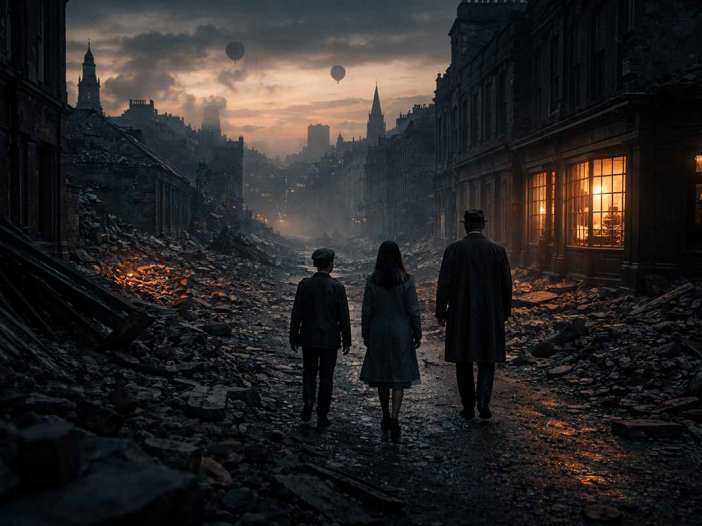
|
Getting your Trinity Audio player ready...
|
What if David Baldacci rewrote the ending with a WWII historian and a top screenwriter in the room?
Introduction by Doris Kearns Goodwin
Picture a table—not grand, not glamorous—just a practical table with papers spread across it like evidence. On one side sits the novelist, trained to move a reader’s heartbeat with the turn of a page. On another sits the historian, trained to distrust easy answers and to ask what the record refuses to let us forget. And beside them, a screenwriter, trained to take a life’s worth of complexity and translate it into a handful of scenes that an audience will carry home in their bones.
If such a room existed for Strangers in Time, the conversation would not begin with explosions or spies or even the mechanics of a plot. It would begin with people. Because the real power of stories set in wartime has never been the war alone—it is the way war intensifies the moral choices ordinary people must make, and then forces those choices to echo through the rest of their lives.
A historian would remind the group that London in those years was not merely a setting. It was an ordeal shared by millions: darkness under blackout curtains, streets wet with rain and worry, the constant sense that fate could fall from the sky without warning. But a historian would also insist on something else: that danger was not always foreign, not always uniformed, not always obvious. Sometimes the most devastating harm came from what people could not safely say, from the quiet arrangements of power that decided whose suffering counted and whose could be hidden for the sake of “order.”
A screenwriter would bring the discussion back to what film does best: compress meaning into moments. A warm-lit bookshop window in the rain becomes more than atmosphere—it becomes the first promise of sanctuary. A pencil hovering over a blank notebook becomes a moral decision: will this boy record what he sees, or will he learn to survive by forgetting? A sealed packet tucked into a hollowed book becomes the story’s central symbol: truth carried in secret because speaking it aloud might end lives.
And David Baldacci—whose instincts are built for pace and pressure—would likely defend the story’s forward motion. He would argue that suspense is not simply the chase; it is the weight of consequence. It is the feeling that each step your characters take narrows the world behind them. Under that pressure, Charlie, Molly, and Ignatius don’t just move through events—they are shaped by them. They begin as strangers passing one another in a city that barely notices children. They become, through necessity and choice, a small family formed in the shadow of secrets.
In a rewrite room, then, the question becomes less “How do we end this?” and more “What must the ending prove?” A satisfying ending in a wartime story cannot only settle a plot. It must settle a reckoning. It must show what the characters have learned, what they have lost, and what they refuse to become—even when the world has every reason to make them cynical.
That is why your film structure works so well in five-scene blocks. It mirrors the way history itself is experienced: not in neat chapters, but in punctuating moments—an encounter, a threat, a document, an irreversible loss, and then the long, quiet aftermath where a person decides what to do with what they now know. The strongest ending will not be the one that ties every thread in a bow. It will be the one that honors the cost of truth—and still insists that truth is worth carrying.
(Note: This is an imaginary conversation, a creative exploration of an idea, and not a real speech or event.)
When Fate Stops at a Bookshop Window (Scenes 1–5)

1. EXT. EAST END STREET — NIGHT
Blackout curtains. Dim lamps. A city holding its breath.
A distant THUD rolls through the streets like a far-off door slammed by God. Windows tremble. Dust drifts from cracked brick.
CHARLIE MATTERS (14) moves fast and quiet through rubble, a boy-shaped shadow. His coat is too thin for the season. His eyes do the job of a whole army: scanning, calculating, surviving.
He kneels beside a collapsed wall, fingers prying at broken timber.
A RAT darts. Charlie doesn’t flinch.
He pulls out a dented tin—half crushed, still sealed. He shakes it. Something inside.
A small victory flashes across his face, gone as quickly as it arrives.
A WHISTLE cuts the air.
Charlie freezes.
Across the street, a POLICEMAN stands under a weak streetlamp. Not close enough to see clearly—close enough to ruin your night.
Charlie slides the tin under his coat and backs into darkness.
The policeman squints, listening. Another distant BOOM. The policeman glances toward the sound, distracted for a beat—
Charlie is gone.
He moves through an alley, past a wall plastered with peeling posters:
“KEEP CALM” fragments. “VICTORY” missing letters. A smiling soldier half torn away.
Charlie stops at a puddle, catches his reflection: a boy trying to look like a man. He wipes grime from his cheek with the back of his hand.
He hears something—voices—up ahead.
Charlie ducks behind a shattered doorway, peeks out.
Two OLDER TEEN BOYS, LONZO ROSSI (16) and EDDIE GRAY (15), loom in the alley. They smoke like they’ve done it for years.
Lonzo’s eyes flick the darkness like he owns it.
LONZO
(quiet, to Eddie)
Told you he’d be out. Little rat’s always out.
Charlie pulls back, heart thumping. He knows them. Or knows of them. Either way—it’s trouble.
He slips away the opposite direction, soundless.
As he disappears into the maze of night, another explosion rumbles—closer.
The city shivers.
Cut.
2. INT. CHARLIE + GRAN’S ROOM — DAWN
A single room. Thin walls. A small stove that looks more decorative than useful.
GRAN (late 60s) sits at a table with a ration book and a knife. Her hands are careful, practiced. She cuts a small piece of bread into smaller pieces like she’s dividing time.
Charlie enters. He tries to hide his limp from the cold.
Gran doesn’t look up. She doesn’t need to.
GRAN
You out all night?
Charlie shrugs like it’s nothing. Like he wasn’t out playing chicken with hunger and the law.
CHARLIE
Couldn’t sleep.
Gran slides a sliver of bread toward him.
Charlie stares at it. His stomach growls—loud enough to betray him.
He tries to play it off with a grin.
CHARLIE
That’s for you.
Gran finally looks up. Her eyes are sharp, tired, loving, and annoyed—all at once.
GRAN
Don’t you start that. You eat.
Charlie takes it. He chews too fast, then slows, embarrassed, trying to pretend he has manners.
Gran eyes his coat.
GRAN
Where’s your scarf?
CHARLIE
Lost it.
Gran reaches under the table and produces a fraying scarf—mended so many times it’s basically a story.
GRAN
You didn’t lose it. You traded it.
Charlie doesn’t answer.
Gran gently presses the scarf into his hands anyway.
GRAN (CONT’D)
You can’t feed the world with your throat, Charlie.
Charlie looks away. He hates when she sees him.
A KNOCK at the door. Not friendly. Not neighborly.
Gran stiffens.
Charlie stiffens more.
Another KNOCK. Harder.
Gran stands, straightening her dress like armor.
GRAN
Stay there.
She crosses to the door, opens it a crack.
A LANDLORD’S MAN stands outside, face pinched by paperwork.
LANDLORD’S MAN
Mrs. Matters. Rent’s behind.
Gran’s chin lifts.
GRAN
War’s on.
LANDLORD’S MAN
War don’t stop rent.
Charlie stands now, behind Gran, small but trying to be big.
The man’s eyes slide past Gran, clock Charlie.
LANDLORD’S MAN (CONT’D)
One week.
Gran says nothing.
The man smirks, satisfied, and leaves.
Gran closes the door slowly. Her hand lingers on the latch as if it might be taken too.
Charlie’s voice comes out thin.
CHARLIE
I’ll get it.
Gran doesn’t turn around.
GRAN
From where.
Charlie doesn’t have an answer. The room holds the silence like smoke.
Then Charlie reaches inside his coat and pulls out the dented tin from last night.
He sets it on the table carefully like it’s treasure.
Gran’s eyes soften, then harden.
GRAN (CONT’D)
Don’t steal, Charlie.
Charlie meets her gaze—hurt and stubborn.
CHARLIE
I didn’t steal that.
Gran taps the tin lightly.
GRAN
No. But you were thinking it.
Charlie looks away.
Gran sits. Slowly resumes cutting the bread. Her hands shake, just a little.
GRAN (softly)
Promise me.
Charlie swallows.
CHARLIE
I promise.
It’s not a lie. It’s a wish.
Cut.
3. EXT. EAST END MARKET — MORNING
A market that looks like it’s held together by willpower and string.
Stalls with wilted vegetables. Fish that smells like yesterday. Women in coats too thin, men with hollow eyes.
Charlie moves through the crowd like water. Quick glances. Quick hands.
He stops by a stall where a VENDOR barks half-heartedly.
VENDOR
Two carrots for a penny! Two carrots for—
Charlie watches a distracted CUSTOMER fumble coins. A single coin drops, spins near Charlie’s foot.
Charlie’s shoe covers it.
A beat.
Charlie bends—pretending to tie his lace—palms the coin.
He looks up, innocent.
The customer doesn’t notice. Life keeps moving.
Charlie heads to another stall. He eyes a loaf—too expensive, too golden.
Then he feels it.
A presence.
Charlie turns slightly.
Lonzo stands near a butcher’s stall, pretending to examine meat that barely exists. His gaze is locked on Charlie like a hook.
Charlie tries to keep walking.
Lonzo steps in his path.
LONZO
Morning, Charlie.
Charlie forces a smile like it’s friendly.
CHARLIE
Didn’t know you cared what time it was.
Lonzo’s grin is thin.
LONZO
I care about opportunities. You’ve got a good nose for ’em.
Charlie tries to sidestep. Lonzo slides with him, casual, blocking again.
LONZO (CONT’D)
Heard there’s a place west of here… proper place. Books and all that. People with coins in their pockets.
Charlie’s throat tightens. He doesn’t confirm or deny.
CHARLIE
I don’t read.
Lonzo leans in, voice low.
LONZO
You don’t have to read to take.
Charlie’s eyes flick around. People everywhere—no one looking.
Eddie appears behind Lonzo, chewing something like it’s gum. Could be bread. Could be nothing.
EDDIE
Lonzo just wants a word.
Charlie keeps his face blank.
CHARLIE
Give him a dictionary then.
Lonzo’s smile fades.
LONZO
You owe me.
Charlie’s eyes sharpen.
CHARLIE
For what.
Lonzo steps closer, close enough that Charlie smells smoke and cheap soap.
LONZO
For not telling people what you did last month at the docks.
Charlie goes still. A flash of something—fear, anger, shame.
Lonzo pats Charlie’s coat like a friendly uncle.
LONZO (CONT’D)
One little job. That’s all. Then we’re square.
Charlie swats Lonzo’s hand away.
CHARLIE
I don’t do jobs.
Lonzo’s voice stays calm. That’s what makes it worse.
LONZO
Everybody does jobs. War’s full of jobs.
Charlie pushes past him, forcing his way through the crowd.
Lonzo doesn’t chase. He doesn’t need to.
He calls after him, easy as breathing:
LONZO (CONT’D)
Tonight. Don’t make me come see your gran.
Charlie doesn’t turn around.
But his jaw clenches so hard it hurts.
Cut.
4. EXT. TRAIN STATION — DAY
Steam. Soot. Commuters moving like tired ghosts.
A train exhales, and MOLLY WAKEFIELD (15) steps down with a suitcase and a small bundle.
She wears a coat that once fit perfectly but now seems slightly too small—like she grew while she was away.
She looks around, eager… then her expression shifts.
London is not what she remembers.
Scaffolding. Sandbags. Windows taped in X’s. A soldier with an empty sleeve. People who don’t smile because smiling costs energy.
Molly moves forward anyway.
She passes a RED CROSS poster: “DO YOUR BIT.”
She grips her suitcase tighter.
A STATION ATTENDANT glances at her evacuee tag and softens just a little.
STATION ATTENDANT
You on your own, love?
Molly lifts her chin—practiced confidence.
MOLLY
My family’s here.
The attendant nods, but his eyes say: Good luck with that.
Molly steps outside.
The air is cold and metallic. Somewhere, a church bell rings, half-hearted.
She pauses, taking it in.
Then she pulls a folded address from her pocket.
“WAKEFIELD” written in careful ink.
She starts walking.
Cut.
5. INT. WAKEFIELD HOUSE — DAY
A well-to-do house that’s trying to pretend the war is only outside.
The hallway is tidy—but too tidy. Like someone packed emotion away in drawers.
Molly enters with her suitcase. The door closes behind her with a soft, final sound.
MRS. PRITCHARD (50s), the housekeeper/nanny type, appears from the corridor. She’s composed. Her eyes flick to Molly’s face as if checking whether this is the same child who left.
MRS. PRITCHARD
Molly.
Molly’s face brightens—relief.
MOLLY
Mrs. Pritchard. Where’s Mother? Where’s Father?
Mrs. Pritchard moves forward and takes Molly’s coat with a care that feels rehearsed.
MRS. PRITCHARD
You’ve grown.
Molly laughs once, small and tense.
MOLLY
Yes, well—people do that. Where are they?
Mrs. Pritchard hesitates. Just a fraction. But Molly sees it.
MRS. PRITCHARD
Your mother’s… not well. Resting.
Molly’s stomach drops.
MOLLY
And Father?
Mrs. Pritchard sets the coat down too neatly.
MRS. PRITCHARD
Your father is away on business.
Molly stares at her.
MOLLY
During bombing and rationing and… everything?
Mrs. Pritchard avoids her eyes for the first time.
MRS. PRITCHARD
He… had to.
Molly steps forward, suddenly not a child at all.
MOLLY
I want to see Mother.
Mrs. Pritchard’s voice is gentle but firm, like she’s trying to keep a lid on boiling water.
MRS. PRITCHARD
Not today.
Molly’s eyes flick around the room. The absence is loud. No laughter. No familiar footsteps. No scent of perfume.
MOLLY
Where’s her things.
Mrs. Pritchard swallows.
MRS. PRITCHARD
Upstairs.
Molly starts toward the stairs.
Mrs. Pritchard reaches out—stops herself from grabbing Molly, settles for words.
MRS. PRITCHARD (CONT’D)
Molly… please. You’ve only just arrived.
Molly turns back, voice trembling with fury she doesn’t fully understand yet.
MOLLY
I didn’t come back to be spoken to like a guest.
Mrs. Pritchard’s eyes shine—fear, sadness, loyalty to secrets.
MRS. PRITCHARD
I’m trying to protect you.
Molly holds her gaze.
MOLLY
From what.
Mrs. Pritchard has no answer she can legally give.
Molly walks upstairs anyway, suitcase thumping each step like a heartbeat.
Mrs. Pritchard stands alone in the hallway—listening to that sound, dreading what Molly will find.
Cut.
Secrets in Lamplight: Trust Begins to Form (Scenes 6–10)
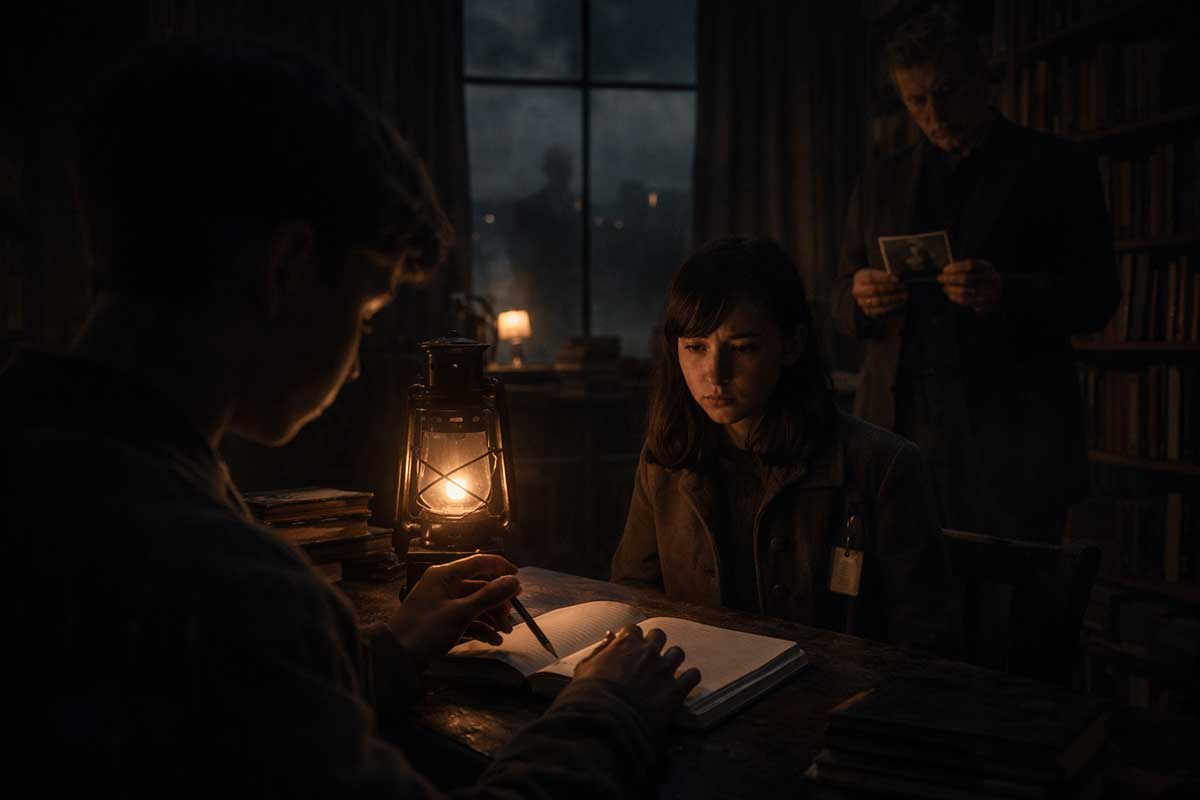
6. INT. THE BOOK KEEP — DAY
A bell TINKLES as the door opens.
Inside: warmth without wealth. Shelves crowded with worn spines. Dust motes floating in a pale shaft of winter light. It smells like paper, glue, and something faintly sweet—tea that’s been reheated too many times.
IGNATIUS OLIVER (40s) stands behind the counter, repairing a torn page with precise hands. He wears a sweater patched at the elbow. His face is kind in a quiet way—like kindness costs him something.
On the counter: a small handwritten sign.
“THE BOOK KEEP — PLEASE HANDLE WITH CARE.”
Ignatius looks up at the door.
A WOMAN enters, nervous, clutching a small stack of books with their edges wrapped in twine.
WOMAN
Mr. Oliver… I wasn’t sure you were still—
IGNATIUS
Still standing?
He smiles gently. The woman laughs once, embarrassed.
WOMAN
Yes.
Ignatius takes the books like they’re living things.
IGNATIUS
We’re all still standing. Just at different angles.
He unties the twine. One of the books has water damage.
The woman watches, shameful.
WOMAN
They got wet in the shelter. I tried to—
IGNATIUS
It’s a book.
He says it like a blessing, not a correction.
IGNATIUS (CONT’D)
Books survive worse than we do.
He opens the cover, checks the binding.
Then—his eyes flick, almost imperceptibly, toward the window.
Outside, across the street, a MAN in a cap lingers by a lamppost. Not buying. Not waiting. Just… present.
Ignatius’s hands don’t stop moving. But something in his posture tightens.
The woman follows his gaze. Sees nothing.
Ignatius returns to the task, softening again.
IGNATIUS (CONT’D)
No charge.
WOMAN
I can’t—
IGNATIUS
You can. Consider it… a repayment plan. You promise me you’ll read.
The woman’s eyes brim.
WOMAN
Thank you.
Ignatius nods, as if accepting gratitude is harder than giving.
The bell TINKLES again as she leaves.
Ignatius watches the street through the glass.
The man in the cap remains.
Ignatius exhales slowly, then reaches beneath the counter and opens a small drawer. Inside: a folded paper, sealed, and a worn photograph of a woman—IMOGEN—smiling with a brightness that feels like another lifetime.
Ignatius closes the drawer carefully.
He turns the sign on the door from OPEN to CLOSED.
Not because the day is done.
Because something has begun.
Cut.
7. EXT. LONDON STREET — TWILIGHT
Charlie moves through a neighborhood that isn’t his. The buildings are cleaner here, less bomb-gnawed. The streetlamps feel more confident.
He keeps his hands in his pockets, chin tucked, walking like he belongs. Like he isn’t counting windows and doors.
A car passes—quietly expensive. Charlie watches it go with a mix of hunger and contempt.
He stops at a corner, eyes scanning: doors, locks, shadows.
Then he sees it.
A narrow shopfront with a soft glow in the window.
THE BOOK KEEP.
Books displayed like jewels. A small stack near the glass. A faint smell of tea even out here, as if comfort is leaking onto the street.
Charlie steps closer.
In the window reflection, he sees himself—thin, sharp, out of place.
He leans in, squints at a book title, not really reading it.
Inside, Ignatius moves between shelves, slow and careful.
Charlie’s gaze drops to the counter.
He spots a biscuit tin near the back—partially hidden, as if someone tried to pretend it wasn’t there.
Charlie’s throat tightens. His stomach answers first.
He looks down the street.
No Lonzo. No Eddie.
He looks up.
A policeman farther off, walking away.
Charlie’s eyes narrow, calculating.
He circles the block once, casual.
Then again—slower, memorizing.
A side alley. A rear door. A window with a latch that looks older than the war.
Charlie touches the wall as he passes, feeling the brick like it’s a map.
A distant rumble.
He pauses, listening.
Nothing.
He slips away into the dimming light.
The Book Keep remains behind him, glowing softly—an island that doesn’t know it’s about to be stormed.
Cut.
8. INT. THE BOOK KEEP — NIGHT
Dark.
The shop is closed. The street outside is hushed under blackout discipline.
A faint moonlight makes the bookshelves look like rows of sleeping bodies.
A SOFT SCRAPE at the rear window.
A small hand pries at the latch with something thin—wire, maybe a bent nail.
The latch gives with a tiny CLICK.
A beat.
Charlie’s face appears in the gap.
He slips in like smoke.
Inside, his breath is loud in his own ears. He pauses, letting his eyes adjust.
He moves carefully down the aisle, shoes avoiding the creaky board by instinct.
His gaze locks on the counter—on the biscuit tin.
He crosses, fast now, unable to help it.
He opens the tin.
Inside: a few biscuits. Hard, plain, perfect.
Charlie stares like he’s looking at a miracle.
He takes two. Hesitates.
Then takes more. Greed and fear tangled together.
His hand brushes a small cash box.
He pops it open, sees coins.
He scoops a handful into his pocket.
A tiny METAL CLINK betrays him.
Charlie freezes.
He listens.
Silence.
He exhales, shaky.
Then his eyes catch something on the counter: a blank, unmarked notebook. Newer than most things here. Clean pages.
Charlie runs his fingers over the cover.
It doesn’t look like food.
It looks like… a life that could be different.
He hesitates, then tucks it under his coat.
He turns to leave.
A VOICE from the darkness—quiet, not angry.
IGNATIUS (O.S.)
You’re quick.
Charlie spins.
Ignatius stands near the back aisle, half in shadow. Not holding a weapon. Not charging. Just… present. As if he’s been waiting and didn’t want to scare a wounded animal.
Charlie’s hand darts to his pocket, closes around coins like a fist around guilt.
CHARLIE
I— I’m leaving.
Ignatius takes a single step forward, then stops. Gives space.
IGNATIUS
I can see that.
Charlie’s eyes flick to the door, then back.
CHARLIE
Don’t shout.
Ignatius’s voice stays even.
IGNATIUS
I’m not shouting.
Charlie swallows, breathing too fast.
Ignatius looks at Charlie’s coat—bulging slightly. He understands immediately: biscuits, money, and that blank book.
His face doesn’t harden.
That confuses Charlie more than anything.
IGNATIUS (CONT’D)
How old are you.
Charlie lifts his chin like a challenge.
CHARLIE
Old enough.
Ignatius nods, accepting the lie as a defense.
IGNATIUS
You hungry?
Charlie doesn’t answer. His eyes burn with the humiliation of being seen.
Ignatius gestures lightly toward the counter.
IGNATIUS (CONT’D)
Take the biscuits. Put the money back.
Charlie’s mouth opens—closes—opens again.
CHARLIE
Why.
Ignatius’s gaze flickers, as if the real answer is too tender to say.
IGNATIUS
Because I’d like you to leave as a boy who stole biscuits.
Charlie stiffens.
IGNATIUS (CONT’D)
Not as a boy who becomes something worse.
Charlie’s hand tightens around the coins. His face hard.
CHARLIE
You don’t know me.
Ignatius’s voice drops.
IGNATIUS
I know what hunger turns people into.
Charlie backs toward the window, still watching Ignatius like he expects the trap to snap.
Ignatius doesn’t move.
Charlie hesitates one fraction of a second—then bolts, scrambling through the rear window and vanishing into the night.
Ignatius stands alone in the shop’s dim quiet.
He looks at the open tin.
Then at the empty space where the blank notebook was.
He doesn’t look angry.
He looks… worried.
Cut.
9. EXT. ALLEY BEHIND THE BOOK KEEP — NIGHT
Charlie runs hard, breath tearing at his throat.
He clutches his coat with one arm to keep the loot from spilling.
His feet slap wet pavement.
He turns a corner, nearly slips, catches himself on a wall.
He stops under a broken gutter, chest heaving.
He pulls out a biscuit and bites.
Too fast.
It’s dry and crumbly and perfect.
His eyes close for a second—pure relief.
Then the shame hits.
He swallows, throat tight.
Charlie glances back toward the direction of the shop.
No one follows.
No shouts.
No whistle.
Nothing.
That’s wrong. That’s not how this goes.
He presses his forehead to the brick.
His breath fogs the wall.
He reaches into his pocket, pulls out the coins. They gleam faintly in the low light.
He opens his other hand.
The blank notebook is there.
He stares at it like it’s accusing him.
A distant explosion rolls across the city.
Charlie flinches—then laughs once, short and bitter.
CHARLIE
(under his breath)
Course.
He stuffs the coins back into his pocket, the notebook tighter under his arm, and moves off—slower now, thoughts louder than footsteps.
Cut.
10. INT. CHARLIE + GRAN’S ROOM — NIGHT
The room is darker than usual. A single candle flickers.
Gran sits at the table, mending something with thread that’s nearly gone.
She doesn’t look up when Charlie enters.
But she knows.
Charlie tries to act casual—fails.
He sets the biscuit tin on the table like he’s placing evidence.
Gran’s needle stops.
She looks at the tin. Then at Charlie.
Her eyes search his face like she’s checking for bruises.
GRAN
Where.
Charlie shrugs, defensive.
CHARLIE
Found it.
Gran waits. The silence says: Try again.
Charlie’s voice drops.
CHARLIE (CONT’D)
A shop.
Gran’s jaw tightens. She opens the tin, sees what’s left.
A beat.
She closes it gently, like closing a casket.
GRAN
Did you take money.
Charlie hesitates.
Gran’s eyes harden—not with anger. With fear.
GRAN (CONT’D)
Charlie.
Charlie pulls out the handful of coins and places them on the table.
Gran stares at the pile.
The candlelight makes the metal look almost pretty, which somehow makes it worse.
Gran’s voice becomes very quiet.
GRAN
You’ll bring the police to this door.
Charlie flares, ashamed and furious at being rightfully seen.
CHARLIE
We’re already starving. We’re already— They already gave us a week. What do you want me to do.
Gran stands, slow but steady.
She reaches out, not for the coins—she grips Charlie’s wrist.
Her hands are small, but there’s a lifetime in them.
GRAN
I want you to stay you. That’s what I want.
Charlie looks away, blinking hard.
Gran releases him.
GRAN (CONT’D)
Where’s the money from.
Charlie doesn’t answer.
Gran picks up the coins and pushes them back toward him.
GRAN (CONT’D)
Then you take it back.
Charlie’s head snaps up.
CHARLIE
I can’t.
Gran’s eyes sharpen.
GRAN
You can. Or you’ll spend the rest of your life running.
Charlie’s breath shakes.
He reaches into his coat and pulls out the blank notebook.
Gran’s gaze lands on it, confused.
Charlie holds it like he doesn’t know why he took it.
CHARLIE
I didn’t mean to—
Gran’s expression softens at the sight of it, as if she understands something Charlie can’t name.
GRAN
A book.
Charlie nods, swallowed by emotion he refuses to show.
Gran sets the notebook on the table, next to the candle.
GRAN (CONT’D)
Then maybe… you bring back the money, and you keep the book.
Charlie stares at her.
CHARLIE
Why would they let me.
Gran’s voice is barely above a whisper.
GRAN
Because sometimes… people surprise you.
Charlie looks down at the blank pages.
For the first time in a long time, his face is not just hunger.
It’s possibility—scaring him more than bombs.
Cut.
Fog, Footsteps, and the First True Threat (Scenes 11–15)

11. EXT. EAST END STREET / OUTSIDE CHARLIE’S BUILDING — MORNING
A thin winter sun. The kind that shows you everything and warms nothing.
Charlie steps out, scarf wrapped tight, coins heavy in his pocket like stones. The blank notebook is tucked under his arm.
He pauses at the top of the steps, looking down the street as if expecting Lonzo to appear out of the fog.
No Lonzo.
Just neighbors moving like ghosts: a woman carrying coal; a man with a bandaged hand; a child pulling a broken toy with a string.
Charlie starts walking.
Halfway down the block, he stops. Turns back.
Gran is at the window, watching him through a gap in the curtain. Her face is stern, worried, proud, all at once.
Charlie lifts the notebook slightly—like a promise.
Gran doesn’t wave. She just nods once: Go on. Do the right thing.
Charlie forces his feet to move again.
As he turns the corner, a POSTER flaps on a wall: “CARELESS TALK COSTS LIVES.”
Charlie mutters under his breath.
CHARLIE
Yeah. And so does hunger.
He keeps walking.
Cut.
12. INT. THE BOOK KEEP — DAY
The bell TINKLES.
Warmth hits Charlie like a slap—tea, paper, quiet. He stands in the doorway, suddenly aware of how dirty his shoes are, how thin his coat is, how much he doesn’t belong.
Ignatius is behind the counter, sorting a stack of books. He looks up, and for a split second his eyes sharpen—guarded.
Then he sees Charlie’s face.
Not cocky. Not running. Not defiant.
Just… trying.
Ignatius doesn’t say “I told you so.”
He simply gestures, calm.
IGNATIUS
Morning.
Charlie swallows.
He walks to the counter slowly, like he’s approaching a judge.
He pulls the coins from his pocket and sets them down in a small pile.
A few roll. The sound is loud in the quiet shop.
Charlie doesn’t look up.
CHARLIE
I brought it back.
Ignatius watches him for a long beat. He doesn’t touch the money yet.
IGNATIUS
All of it?
Charlie hesitates. Then nods.
CHARLIE
Yes.
Ignatius looks at the pile again, then at Charlie’s coat.
IGNATIUS
And the biscuits?
Charlie’s face flushes.
CHARLIE
Gone.
Ignatius nods as if that’s the most normal thing in the world.
IGNATIUS
Good.
Charlie looks up, startled.
CHARLIE
Good?
Ignatius finally gathers the coins, places them back in the cash box with deliberate care—no clinking, no scolding.
IGNATIUS
You needed them.
Charlie’s throat tightens, but he fights it with attitude.
CHARLIE
Don’t make it… soft.
Ignatius almost smiles.
IGNATIUS
I won’t.
A beat.
Charlie reaches under his coat and pulls out the blank notebook. He sets it on the counter like he’s returning stolen property.
CHARLIE
This too.
Ignatius places a hand on the notebook—not taking it back, just claiming its presence.
IGNATIUS
Why did you take it.
Charlie shrugs, angry at himself for not having an answer.
CHARLIE
I don’t know.
Ignatius studies him with that quiet precision.
IGNATIUS
That’s the only honest answer you’ve given me.
Charlie bristles.
Ignatius slides the notebook back toward him.
Charlie’s eyes widen.
CHARLIE
No. I— I’m returning it.
IGNATIUS
I’m giving it.
Charlie stares, suspicion flaring.
CHARLIE
Why.
Ignatius’s gaze flicks, briefly, to the photograph drawer beneath the counter—something private behind his eyes.
Then he looks back at Charlie.
IGNATIUS
Because you came back.
Charlie can’t speak. That kind of mercy doesn’t fit in his mouth.
Ignatius picks up a pencil, sets it atop the notebook.
IGNATIUS (CONT’D)
Write your name in it.
Charlie doesn’t move.
Ignatius waits, patient.
Charlie finally takes the pencil. His hand shakes with cold and something else.
He opens the book to the first page.
Blank. Clean. Terrifying.
He presses the pencil down and writes, slowly:
CHARLIE MATTERS
He stares at it, as if it might vanish.
Ignatius’s voice is gentle but firm.
IGNATIUS (CONT’D)
Now it’s yours. That means you protect it.
Charlie nods once, barely.
Ignatius leans a little closer.
IGNATIUS (CONT’D)
And you protect yourself.
Charlie closes the book quickly, like closing a wound.
CHARLIE
I’ve got to go.
Ignatius nods.
Charlie turns to leave, then stops.
He looks back.
CHARLIE (CONT’D)
You’re not… telling anyone?
Ignatius shakes his head.
IGNATIUS
No.
Charlie’s eyes narrow.
CHARLIE
You should.
Ignatius meets his gaze.
IGNATIUS
Perhaps. But I’m tired of turning people into criminals.
Charlie doesn’t know what to do with that.
He grips the notebook tighter and leaves.
The bell TINKLES again.
Ignatius watches the door after it closes—concerned, as if mercy might not be enough to keep a boy alive.
Cut.
13. EXT. STREET OUTSIDE THE BOOK KEEP — DAY
Charlie steps out, blinking in the daylight. The notebook under his arm feels heavier than the coins ever did.
He walks a few steps, then stops beside the shop window.
He looks at the reflection again. Same boy. But the boy is holding something that isn’t food.
For one brief moment, Charlie’s face softens—like he can imagine a different ending.
Then the city interrupts:
A distant SIREN. A military lorry rumbles by. A woman arguing with a ration clerk on the corner.
Charlie’s jaw tightens again. Survival reclaims its place.
He turns away from the shop and heads back toward the East End.
As he disappears into the crowd, a MAN IN A CAP stands across the street near the lamppost, watching The Book Keep—watching the door Charlie just left.
The man lights a cigarette.
He doesn’t follow Charlie.
He watches the shop.
Cut.
14. INT. WAKEFIELD HOUSE — LATE AFTERNOON
Molly is upstairs now, in her old room.
It’s been “kept,” but not truly lived in. Everything is dusted, and nothing is warm.
She opens a drawer. Finds old ribbons, a childhood book, pressed flowers.
She digs deeper—searching for the thing adults hide when they say everything is fine.
In the bottom: a folded letter.
The paper is creased like it’s been read too many times, then shoved away.
Molly unfolds it.
We don’t see the full text—just enough:
A header. A date. A location: CORNWALL.
Molly’s breath catches.
She hears footsteps in the hallway—Mrs. Pritchard.
Molly quickly refolds the letter, slips it into her pocket.
The door opens. Mrs. Pritchard stands there with a tray: weak tea, two thin slices of bread.
Her politeness is armor.
MRS. PRITCHARD
You must eat.
Molly looks at the tray like it’s an insult.
MOLLY
I want the truth.
Mrs. Pritchard’s eyes flick—fear.
MRS. PRITCHARD
You want a cup of tea.
Molly stands.
MOLLY
I want my mother.
Mrs. Pritchard sets the tray down, hands trembling slightly.
MRS. PRITCHARD
Your mother is unwell.
MOLLY
Where.
A beat.
Mrs. Pritchard’s voice is soft, pleading.
MRS. PRITCHARD
Don’t do this, Molly.
Molly steps closer.
MOLLY
Where is she.
Mrs. Pritchard’s mouth opens. Closes. She looks like someone trying not to drown.
MRS. PRITCHARD
I can’t.
Molly watches her.
Then she nods—cold clarity.
MOLLY
Then I’ll find out without you.
Mrs. Pritchard reaches out, almost touches Molly’s arm, stops.
Molly turns and heads for the wardrobe.
She pulls out a coat. Her hands are steady now.
Mrs. Pritchard’s voice cracks.
MRS. PRITCHARD
It’s not safe out.
Molly looks back, eyes bright with fury and fear.
MOLLY
Neither is in here.
Cut.
15. INT. THE BOOK KEEP — EARLY EVENING
The bell TINKLES.
Molly enters.
She pauses—this isn’t like the rest of London. It feels like a place where people used to be whole.
Ignatius looks up from behind the counter.
He’s surprised to see her—then carefully neutral.
IGNATIUS
Good evening.
Molly steps forward, almost shy despite herself.
MOLLY
I… didn’t know where else to go.
Ignatius nods, as if “nowhere else” is a common address.
IGNATIUS
You’re welcome here.
Molly walks along a shelf, fingers brushing spines. Titles blur—she’s not really reading; she’s breathing.
She stops at a book with a cracked cover.
MOLLY
My father used to read to me.
The words slip out before she can stop them.
Ignatius’s expression shifts—recognition of a wound.
IGNATIUS
And now?
Molly swallows.
MOLLY
Now people tell me things like “resting” and “away,” as if those are answers.
Ignatius studies her with the same quiet precision he used on Charlie, but with different tenderness.
IGNATIUS
Sometimes adults think silence is kindness.
Molly’s eyes sting.
MOLLY
Is it.
Ignatius doesn’t answer right away.
He pours tea from a kettle that looks like it has survived three wars.
IGNATIUS
It can be. Often it’s cowardice.
He sets a cup on the counter, slides it toward her.
Molly takes it—hands trembling slightly.
She sips. Too hot. She doesn’t care.
Ignatius watches her with a kind of careful distance, like he’s afraid of being needed.
Then Molly’s gaze shifts—toward the door, toward the fading light outside.
She sees, through the window, a boy across the street—Charlie—half-hidden by a doorway as he passes, looking back at the shop for one last second.
Molly’s eyes narrow.
Not suspicion. Curiosity.
A sense that her story just brushed up against someone else’s.
She looks back at Ignatius.
MOLLY (CONT’D)
Who was that.
Ignatius follows her gaze—but Charlie is already gone.
Ignatius’s face tightens just slightly.
IGNATIUS
No one you need to worry about.
Molly, stubborn even in her politeness, holds her cup with both hands.
MOLLY
That’s what everyone keeps saying.
Ignatius meets her eyes. A beat.
For the first time, he looks like a man considering whether to open a door he’s kept shut.
Cut.
Two Worlds Collide: Molly’s Hunt Meets Bryant’s Pressure (Scenes 16–20)

16. EXT. STREET NEAR THE BOOK KEEP — EVENING
Molly steps out of the shop into the cold, tea warmth still in her hands.
The bell TINKLES behind her and the door shuts. London rushes back in: lorries, footsteps, a far-off siren like a thin thread pulling the sky.
Molly pauses on the pavement and looks across the street.
Nothing now. Just shadowy doorways, shuttered windows, blackout curtains.
She turns as if to go home—then stops.
She looks back at The Book Keep’s window. Not at the books—at the feeling of truth she got inside.
Molly walks a few steps, then turns down a side street, scanning faces.
A GROUP OF BOYS loiter near a wall, trading jokes too loud for the time of day.
Molly approaches them anyway.
MOLLY
Excuse me… I’m looking for a boy.
The boys smirk like it’s Christmas.
BOY #1
A boy, is it?
Molly’s glare could crack glass.
MOLLY
Fourteen. Dark hair. Thin. Looks like he’s always thinking of running.
The smirks fade slightly. That description is too real.
A smaller boy points without meeting her eyes.
BOY #2
Matters. Charlie. He lives… that way. Upstairs. With his gran.
Molly nods once, grateful.
She pulls a coin from her pocket and offers it. The boy shakes his head, startled.
BOY #2 (CONT’D)
Keep it. Not everyone’s got one.
Molly pockets it, thoughtful.
She walks in the direction indicated, the city narrowing into poorer streets with every step.
As she goes, she passes a poster: “MAKE DO AND MEND.”
Molly whispers, almost to herself:
MOLLY
Alright then.
Cut.
17. EXT. CHARLIE’S BUILDING — NIGHT
A bomb-scarred block where the staircase seems to climb out of necessity rather than design.
Molly stands at the entrance, hesitating. She’s dressed better than this place expects. She knows it.
The hallway smells of damp, coal smoke, cabbage.
A WOMAN carrying a bucket passes, looks Molly up and down, says nothing, but the judgment is clear.
Molly climbs the stairs anyway.
At the top landing, she finds the right door—thin wood, chipped paint, a latch that’s seen too much.
She knocks.
Nothing.
She knocks again, firmer.
Inside, movement—quiet, suspicious.
The door opens a fraction. A chain holds it.
Charlie’s eye appears.
CHARLIE
What.
Molly tries not to smile at the bluntness.
MOLLY
Hello. I’m Molly Wakefield.
Charlie stares like she just introduced herself as the Queen.
CHARLIE
So.
Molly holds her ground.
MOLLY
I was at The Book Keep.
Charlie’s gaze sharpens. A flicker of fear.
CHARLIE
You shouldn’t be saying that name out loud.
MOLLY
Why not?
Charlie’s eye darts down the hall, then back.
CHARLIE
Because walls have ears. And so do people with nothing better to do.
Molly leans closer, voice low.
MOLLY
I’m not here to report you.
Charlie’s laugh is bitter, quiet.
CHARLIE
That makes one of us.
Molly reaches into her pocket and pulls out a small paper parcel. Bread. A bit of cheese. Not much, but enough to matter.
Charlie’s eye locks on it. His throat moves as he swallows.
He hates that she saw that.
CHARLIE (CONT’D)
We don’t take charity.
MOLLY
It isn’t charity.
Charlie’s eye narrows.
MOLLY (CONT’D)
It’s… repayment. For showing me where the truth lives.
Charlie scoffs.
CHARLIE
Truth doesn’t live anywhere. It just hides.
Molly holds the parcel up gently, not pushing.
MOLLY
Please. Just—take it. For your gran. If not for you.
Charlie’s face tightens at the mention of Gran.
He opens the door a little wider. The chain still on.
A voice from inside—dry, sharp:
GRAN (O.S.)
Who’s that, Charlie?
Charlie doesn’t answer fast enough.
Gran steps into view behind him. Small, fierce, eyes that miss nothing.
She sees Molly and the parcel in her hands.
Gran’s posture shifts, not hostile—careful.
GRAN
Evening.
Molly dips her head politely.
MOLLY
Good evening, ma’am.
Gran looks Molly over, then looks at Charlie.
She knows exactly what’s happening: pride fighting hunger.
Gran reaches forward and flips the chain off the door with quick fingers.
Charlie’s head snaps around.
CHARLIE
Gran—
GRAN
Hush.
The door opens fully.
Molly stands there, suddenly nervous, like she’s crossed a border without papers.
Gran nods at the parcel.
GRAN (CONT’D)
Well? You going to stand freezing in the hall all night?
Molly steps inside.
Charlie’s eyes burn with humiliation.
Gran’s eyes burn with practicality.
Cut.
18. INT. CHARLIE + GRAN’S ROOM — NIGHT
The tiny room feels even smaller with Molly inside.
Molly tries to hide her shock. The thin blanket. The mended clothes. The stove that barely qualifies.
Gran gestures to a chair that wobbles.
GRAN
Sit.
Molly sits. Charlie stays standing, arms crossed, guarding the whole room with his body.
Gran takes the parcel from Molly and opens it.
The bread is modest, but Gran handles it like it’s silver.
She looks at Molly.
GRAN (CONT’D)
Where’d you get this.
Molly’s instinct is to lie politely, but something in Gran’s face demands honesty.
MOLLY
From our kitchen. Before I left.
Gran nods like she expected it.
She breaks the bread in half and hands a piece to Molly.
Molly’s eyes widen.
MOLLY (CONT’D)
Oh—no, I didn’t bring it for—
GRAN
You brought it into the room. That makes you part of the eating.
Molly hesitates, then accepts. She takes a small bite.
Charlie watches, tense.
CHARLIE
We didn’t ask for you.
Molly looks at him, calm.
MOLLY
I know.
Charlie’s jaw clenches.
CHARLIE
Then why are you here?
Molly holds the bread in both hands, as if it’s keeping her steady.
MOLLY
Because you looked back at the shop like it mattered to you.
Charlie scoffs, but his eyes betray him—she’s not wrong.
Gran studies Molly carefully.
GRAN
You a friend of Mr. Oliver’s?
Molly shakes her head.
MOLLY
Not yet. But he was kind to me.
Gran’s mouth tightens slightly—she doesn’t trust kindness; she respects it.
Charlie shifts, uncomfortable.
CHARLIE
He’s not your business.
Molly turns to Charlie.
MOLLY
Neither is my mother. But everyone seems determined to keep her from me.
A beat.
Charlie’s expression changes—just a fraction. He recognizes that tone. It’s the tone of someone being lied to by the world.
Gran puts the rest of the bread away carefully, like saving a future.
GRAN
What’s wrong with your mother.
Molly swallows.
MOLLY
They say she’s “resting.” Somewhere in Cornwall.
Charlie’s eyes flick up.
Gran’s eyes narrow.
GRAN
Cornwall.
Molly nods.
Charlie takes a step forward despite himself.
CHARLIE
Why are you telling us that.
Molly looks down at her hands.
MOLLY
Because I don’t know what I’m walking into. And… because I think Mr. Oliver knows something he’s not saying.
Gran’s gaze shifts to Charlie now—warning him without words.
Charlie opens his mouth—closes it.
Then, quietly, almost against his will:
CHARLIE
He doesn’t talk much.
Molly gives a small, sad smile.
MOLLY
Neither do people who are afraid.
Charlie stiffens.
CHARLIE
You don’t know what he’s afraid of.
Molly meets his eyes.
MOLLY
Neither do you.
Silence. In the silence, the war breathes outside.
Gran breaks it, brisk.
GRAN
Alright. You’ve eaten. Both of you. Now, you— (to Molly) —you get home before the sky decides to fall again.
Molly stands reluctantly.
Charlie, still proud, walks her to the door anyway. Not kindness—instinct.
At the threshold, Molly turns.
MOLLY
Thank you… for letting me in.
Gran nods.
Charlie says nothing.
But as Molly steps into the hall, Charlie’s hand catches her sleeve—not hard.
Molly looks back.
Charlie’s voice is barely audible.
CHARLIE
Don’t go alone.
Molly blinks.
MOLLY
I have to.
Charlie swallows, hating himself for caring.
CHARLIE
Then… be careful.
Molly holds his gaze a second longer than necessary.
MOLLY
You too.
She leaves.
Charlie watches her go, face torn between suspicion and something softer.
Cut.
19. EXT. STREET OUTSIDE CHARLIE’S BUILDING — NIGHT
Molly steps out into the cold air again.
The city is darker here—poorer streets, fewer lamps, more corners that swallow sound.
She walks quickly, hugging her coat around her.
Behind her, footsteps.
Molly turns—heart snapping.
It’s Charlie, following at a distance like he doesn’t want to be seen doing it.
Molly slows so he can catch up. Charlie keeps his distance anyway.
MOLLY
You didn’t have to.
Charlie shrugs, defensive.
CHARLIE
Didn’t want Gran worrying.
Molly smiles slightly.
MOLLY
How noble.
Charlie glowers.
They walk in silence for a few steps. Then Molly speaks, carefully.
MOLLY (CONT’D)
Do you think… Mr. Oliver is in danger?
Charlie’s eyes flick to the shadows, then back.
CHARLIE
Everyone’s in danger.
Molly waits. She’s learning: with Charlie, you wait.
Charlie exhales.
CHARLIE (CONT’D)
But… there’s a man who watches his shop sometimes. Like he’s counting the door.
Molly’s face tightens.
MOLLY
A man in a cap?
Charlie nods once.
Molly stops walking.
Charlie keeps going two steps, realizes, turns back.
CHARLIE
What.
Molly’s voice is sharp now.
MOLLY
That man watched me too. I thought I imagined it.
Charlie’s jaw tightens.
CHARLIE
Don’t imagine it. That’s how you get hurt.
Molly starts walking again, faster.
Charlie matches her pace, still pretending he isn’t escorting her.
At the corner near a better street, Molly stops.
MOLLY
This is fine.
Charlie looks past her toward the brighter neighborhood, then back at her.
CHARLIE
People disappear in bright places too.
Molly studies him, then nods.
MOLLY
Then what do we do.
Charlie thinks like a boy who’s had to solve problems without adults.
CHARLIE
We don’t tell people things they can use. And we keep our eyes open.
Molly’s voice softens.
MOLLY
That’s not much of a plan.
Charlie gives her a look.
CHARLIE
It’s London.
A beat.
Molly reaches into her pocket and pulls out the folded Cornwall letter—not showing it fully, just enough.
MOLLY
I’m going to find her.
Charlie stares at the letter, then at Molly.
CHARLIE
When.
MOLLY
Soon.
Charlie nods once—like he’s storing it in that blank notebook he doesn’t show anyone.
CHARLIE
Then you tell me before you go.
Molly’s eyes widen.
MOLLY
Why.
Charlie’s answer is gruff.
CHARLIE
So you’re not alone.
Molly holds his gaze, surprised by the blunt loyalty.
Then, very quietly:
MOLLY
Alright.
Charlie turns away before the moment can make him feel anything.
He disappears back into the darker streets.
Molly watches him go, shaken—because she came looking for answers and found a friend shaped like a warning.
Cut.
20. INT. THE BOOK KEEP — NEXT DAY
The bell TINKLES.
Ignatius looks up, expecting a customer.
Instead: MAJOR SCOTT BRYANT (40s) steps in—civilian coat, military posture. The shop’s warmth doesn’t touch him.
Ignatius’s face stills. Not fear—recognition.
Bryant walks slowly, hands behind his back, as if inspecting a museum.
BRYANT
Mr. Oliver.
Ignatius keeps his voice steady.
IGNATIUS
Major.
Bryant’s eyes travel the shop: shelves, counter, back window—taking inventory without writing anything down.
BRYANT
You’ve been quiet.
Ignatius doesn’t answer. Silence is his habit, his shield.
Bryant stops at the counter, places a small object down: a worn book, plain cover.
Ignatius doesn’t touch it.
BRYANT (CONT’D)
You know what that is.
Ignatius’s jaw tightens.
IGNATIUS
A book.
Bryant’s gaze sharpens—almost amused.
BRYANT
Everything’s a book to you.
Ignatius finally looks up.
IGNATIUS
Everything’s a message to you.
A beat. The air between them is old.
Bryant lowers his voice.
BRYANT
We have a problem.
Ignatius remains still.
BRYANT (CONT’D)
Someone’s asking questions. And someone’s watching your shop.
Ignatius’s eyes flick to the front window.
The man in a cap across the street is there, faint through the glass.
Ignatius’s hands clench, then relax.
IGNATIUS
I’ve noticed.
Bryant leans in slightly.
BRYANT
Then you understand: you don’t get to be a grieving bookseller forever.
Ignatius’s expression flashes—pain behind his calm.
IGNATIUS
I never asked to be anything else.
Bryant’s voice softens just enough to be dangerous.
BRYANT
None of us asked.
A beat.
Ignatius looks down at the plain book Bryant brought.
IGNATIUS
What do you want.
Bryant’s eyes hold his.
BRYANT
I want you to do what you used to do.
Ignatius’s fingers hover over the book, trembling slightly.
He whispers, almost to himself:
IGNATIUS
No more.
Bryant doesn’t move.
BRYANT
It’s already started, Mr. Oliver. Whether you like it or not.
Ignatius finally touches the book—like touching a live wire.
He doesn’t open it.
He just accepts its weight.
And outside, through the window, the watcher doesn’t blink.
Cut.
Paper Walls: Bureaucracy, Coercion, and the Back Alley (Scenes 21–25)

21. INT. GOVERNMENT OFFICE / ENQUIRY DESK — DAY
A narrow room that smells like wet wool and paperwork.
A line of PEOPLE waits under a sign that reads “ENQUIRIES” as if answers are something you hand out by the pound.
Molly stands near the counter, clutching a slip of paper with her father’s name. She’s trying to look older than fifteen. It almost works.
Behind the desk, a CLERK (50s) stamps forms with the mechanical patience of someone who has watched hope die in a hundred different handwritings.
Molly steps up.
MOLLY
Hello. I’m trying to locate my father. Herbert Wakefield.
The clerk doesn’t look up.
CLERK
Full name. Date of birth.
Molly provides it quickly.
The clerk finally looks at her, then down at the file index, then back.
He pulls a card from a drawer, scans it.
A flicker crosses his face—recognition of a category, not a person.
He clears his throat.
CLERK (CONT’D)
Your father’s file is not available for public enquiry.
Molly blinks.
MOLLY
Not available? Why?
The clerk’s voice becomes softer, not kinder.
CLERK
Because it isn’t.
Molly leans closer, lowering her voice.
MOLLY
Is he dead?
The clerk hesitates. He does not answer the question.
That is the answer.
Molly’s breath catches. She forces herself to stay upright.
MOLLY (CONT’D)
Then—can you tell me where my mother is? Eloise Wakefield.
The clerk flips to a different index, then stops.
Same flicker.
He slides the paper back toward Molly as if the desk is suddenly hot.
CLERK
Your mother’s affairs are being handled privately.
Molly’s eyes sharpen with anger.
MOLLY
Privately by whom?
The clerk glances at the people in line behind her. He wants her gone.
CLERK
Miss, we’re at war. Half the city is asking where someone is. If I answer all of them, I’ll be here until Germany wins.
Molly’s voice trembles, but she holds it steady.
MOLLY
I’m not asking for “all of them.” I’m asking for my parents.
The clerk stares at her a long beat, then lowers his voice—just enough to feel like a warning.
CLERK
Stop asking questions in rooms with thin walls.
Molly’s chest tightens.
MOLLY
So you do know something.
The clerk stamps a form—LOUD.
CLERK
Next.
Molly stands there for one more second, refusing to be erased.
Then she backs away, clutching her paper like a torn flag, and walks out.
As she reaches the doorway, she looks back.
The clerk doesn’t look up again.
Because he can’t.
Or because he won’t.
Cut.
22. INT. THE BOOK KEEP — LATE AFTERNOON
The bell TINKLES.
Molly enters with her coat buttoned wrong—she didn’t notice. Her cheeks are pink from cold and frustration.
Ignatius looks up, immediately clocking something off.
IGNATIUS
You’ve been running.
Molly forces a smile that doesn’t land.
MOLLY
I’ve been… learning.
Ignatius gestures toward the counter where a kettle sits, faint steam curling.
Molly doesn’t move toward it. Tea won’t fix this.
MOLLY (CONT’D)
They refused to tell me anything.
Ignatius’s hands still on a book he’s holding. Not dramatic—just… paused.
IGNATIUS
That’s what offices do best.
Molly steps closer, voice lower.
MOLLY
They told me to stop asking questions.
Ignatius’s eyes flick, sharp.
IGNATIUS
Did they.
Molly nods.
She watches him carefully now.
MOLLY
You knew that would happen.
Ignatius sets the book down very gently.
IGNATIUS
I suspected.
Molly’s voice tightens.
MOLLY
And you know why.
A beat. A long one.
The quiet in the shop feels suddenly like a person listening.
Ignatius walks to the front window, looks out without making it obvious.
Across the street, the MAN IN A CAP stands by the lamppost, cigarette ember glowing.
Ignatius speaks without turning around.
IGNATIUS
Not everything you want to know will help you.
Molly steps closer, almost pleading now.
MOLLY
Not knowing is killing me.
Ignatius turns back, gaze steady and sad.
IGNATIUS
Knowing can do worse.
Molly’s eyes burn.
MOLLY
Cornwall.
Ignatius flinches—tiny, but real.
Molly sees it and presses.
MOLLY (CONT’D)
My mother is in Cornwall, isn’t she?
Ignatius’s jaw tightens.
IGNATIUS
Where did you hear that.
Molly’s voice is sharp.
MOLLY
From a letter in my own house. From adults who lie like it’s breathing.
Ignatius looks at her as if weighing whether to open a door that can’t be shut again.
IGNATIUS
Molly—
MOLLY
Tell me the truth.
Ignatius doesn’t answer. He can’t. Or he won’t. Either way, it’s a wall.
Molly takes a breath, steadying herself.
MOLLY (CONT’D)
Fine. If you won’t tell me… I’ll find it myself.
Ignatius’s voice softens, urgent.
IGNATIUS
If you go digging, you may uncover things you can’t put back.
Molly meets his eyes.
MOLLY
Then maybe the people who buried them should have thought of that.
Ignatius looks away—toward the drawer beneath the counter, toward the memory of Imogen, toward things unsaid.
Molly turns to leave.
At the door, she stops.
MOLLY (CONT’D)
Is Charlie in danger?
Ignatius looks up, caught.
IGNATIUS
Why would he be?
Molly’s voice is quiet.
MOLLY
Because someone is watching you. And boys like Charlie get crushed when grown men play games.
Ignatius’s face hardens for the first time—less anger, more decision.
IGNATIUS
Go home, Molly.
Molly leaves.
The bell TINKLES.
Ignatius stands very still in the empty shop, listening to the street.
Then, slowly, he turns the sign to CLOSED even though daylight remains.
Cut.
23. EXT. EAST END ALLEY / BY A RATION QUEUE — NIGHT
A line of women stands near a battered wall, ration books open, faces resigned.
Charlie walks past with his messenger bag—new job, new uniform, same hunger.
Lonzo steps out from behind a corner like he’s been waiting for a train.
Eddie is with him, hands in his pockets, eyes too restless.
Charlie stops, instantly tense.
CHARLIE
I’m working.
Lonzo smiles.
LONZO
Good. Then you can pay what you owe.
Charlie keeps walking.
Lonzo matches him easily.
LONZO (CONT’D)
You think that accident makes you clean?
Charlie’s face tightens.
CHARLIE
Don’t talk about it.
Lonzo leans closer, voice like a blade.
LONZO
A constable dead. Eddie nearly dead. You running around with a little bag like you’re respectable now.
Eddie snaps.
EDDIE
He don’t care about us.
Charlie spins on Eddie.
CHARLIE
I didn’t kill him!
Lonzo’s smile disappears. That’s worse.
LONZO
You’re going to do what I say, Charlie. Because you don’t get to choose what kind of boy you are anymore.
Charlie’s eyes flick to the ration line—people who won’t help, can’t help.
CHARLIE
Leave Gran out of it.
Lonzo’s grin returns—because he found the lever.
LONZO
Then don’t make me visit her.
Charlie’s breath shakes.
Lonzo gestures with his chin toward the darker end of the street.
LONZO (CONT’D)
Tonight. We go back to that bookshop. Proper job this time. In and out.
Charlie’s voice cracks through clenched teeth.
CHARLIE
No.
Lonzo’s hand suddenly grips Charlie’s messenger strap and yanks him close.
LONZO
Yes.
A beat.
Lonzo’s eyes are hungry too—just for different things.
LONZO (CONT’D)
You know the back. You know the boards that creak. You’re the key.
Charlie’s jaw trembles, rage and fear tangled.
CHARLIE
He was kind to me.
Lonzo scoffs, disgusted by kindness.
LONZO
Kind don’t pay rent. Kind don’t buy food. Kind gets you killed.
Eddie nods like it’s scripture.
Lonzo releases Charlie’s strap but steps in close, murmuring.
LONZO (CONT’D)
Be at the corner by the butcher’s when the lamps go low. If you’re not… I’ll make sure your gran’s week becomes her last.
Charlie’s eyes burn.
Lonzo steps back, casual again.
LONZO (CONT’D)
Now run along, messenger boy.
Lonzo and Eddie melt into the night.
Charlie stands there, frozen—then forces his feet to move, fast, like he can outrun what he just agreed to without saying yes.
Cut.
24. INT. THE BOOK KEEP — NIGHT (AFTER HOURS)
The shop is closed. The street outside is dim.
Ignatius sits at the counter with the plain book Bryant delivered earlier. He hasn’t opened it yet.
A KNOCK at the door. Soft. Quick. Not a customer knock.
Ignatius stills.
Another knock—more urgent.
Ignatius stands, moves to the door cautiously, peers through a gap in the curtain.
Charlie’s face is there—white with panic.
Ignatius unlocks the door and pulls him in fast, then locks it again.
IGNATIUS
Charlie—what happened?
Charlie can’t catch his breath. He clutches his bag like it might save him.
CHARLIE
They’re coming.
Ignatius goes still.
IGNATIUS
Who.
Charlie looks around the shop like it’s a church about to be robbed.
CHARLIE
Lonzo. Eddie. Tonight.
Ignatius’s face tightens—not surprise. Confirmation.
IGNATIUS
Why are you telling me.
Charlie’s eyes flash with shame.
CHARLIE
Because I didn’t want to. And because—because you… you didn’t shout.
Ignatius studies him—sees the trap in his bones.
IGNATIUS
Are they forcing you?
Charlie’s silence is a yes.
Ignatius moves behind the counter, opens the drawer, touches the photograph of Imogen without looking at it. A habit. A prayer.
He looks back at Charlie.
IGNATIUS
We call the police.
Charlie flinches as if struck.
CHARLIE
No!
Ignatius doesn’t react—just watches.
Charlie’s voice tumbles out, messy.
CHARLIE (CONT’D)
They’ll blame me. They already… they already think boys like me are born guilty. And Lonzo—he’ll tell them anything. He’ll say it was me. He’ll—
Ignatius holds up a hand, gentle but firm.
IGNATIUS
Charlie. Listen to me.
Charlie tries. Fails. Tries again.
Ignatius steps closer, lowering his voice.
IGNATIUS (CONT’D)
If you don’t let me stop them, someone will die.
Charlie stares at him, breath ragged.
A beat.
Charlie whispers, almost childlike:
CHARLIE
Then what do I do.
Ignatius looks toward the window, where the man in the cap is still out there, a shape in the dark.
Ignatius makes a decision that scares him.
IGNATIUS
You go home. You stay with your gran. You do not come near this shop tonight.
Charlie shakes his head.
CHARLIE
They’ll come to my door if I don’t show.
Ignatius’s face tightens.
IGNATIUS
Then you tell them you’re sick.
Charlie laughs—broken.
CHARLIE
They don’t believe in sick.
Ignatius thinks fast, then opens his cash box and pulls out a few coins—enough to matter.
He presses them into Charlie’s hand.
Charlie recoils.
CHARLIE (CONT’D)
I can’t take that.
IGNATIUS
You can. It’s not charity. It’s a bargain.
Charlie stares at the coins.
CHARLIE
For what.
Ignatius’s voice is low.
IGNATIUS
For you not becoming Lonzo.
Charlie swallows hard.
Ignatius squeezes Charlie’s fist closed over the coins.
IGNATIUS (CONT’D)
Go.
Charlie hesitates, then nods—quick, fierce.
He turns to leave—then looks back, terrified.
CHARLIE
Are you… are you going to be here?
Ignatius holds his gaze.
IGNATIUS
I’ll be here.
Charlie slips out.
Ignatius locks the door, breath shaking.
He turns back to the counter.
The plain book Bryant left sits there like a loaded gun.
Ignatius opens it.
Inside: a hollowed compartment.
A message.
Ignatius closes it slowly, eyes darkening with old memories.
Cut.
25. EXT. STREET BEHIND THE BOOK KEEP — LATE NIGHT
Blackout hour.
The city is quieter now, but not safe—just hidden.
Lonzo and Eddie move down the alley, crouched, purposeful. Lonzo carries a small bag with tools. Eddie carries a sack.
Lonzo pauses near the back window.
He looks around, annoyed.
LONZO
Where is he.
Eddie shrugs.
EDDIE
Maybe he’s scared.
Lonzo’s mouth twists.
LONZO
He should be.
Lonzo pulls out a thin tool, works the latch with practiced fingers.
The window gives with a soft CLICK.
Lonzo grins—victory.
He whispers:
LONZO (CONT’D)
In and out. Quiet.
Eddie nods, breath visible in the cold.
Lonzo slips through first. Eddie follows.
The window closes behind them, leaving only darkness and the faint sound of their shoes landing on old wooden floors.
A beat.
Across the street, the MAN IN A CAP watches the back alley—still, patient—like he’s been waiting for this exact moment.
He flicks his cigarette away and steps into motion.
Cut.
Aftermath on Wet Cobblestones: Innocence Breaks (Scenes 26–30)
26. INT. THE BOOK KEEP — NIGHT
Lonzo lands inside the shop like he owns it.
Eddie follows, clumsy, breathing too loud.
The bookshop is dark, but not dead. Moonlight stripes the aisles. The shelves feel like witnesses.
Lonzo pauses, listening.
Nothing.
He grins—then signals Eddie forward.
They move toward the counter.
Eddie’s shoe hits a soft CREAK.
Eddie freezes.
Lonzo shoots him a look that could kill without noise.
They continue.
Lonzo opens the cash box—empty except for a few coins.
His grin collapses into fury.
LONZO
(low, vicious)
Where is it.
He yanks open drawers—papers, twine, old receipts.
Eddie finds the biscuit tin—nearly empty. He shakes it anyway like it might produce food by miracle.
EDDIE
This is rubbish.
Lonzo’s eyes dart around, scanning the shop like it’s insulting him.
He spots the plain book on the counter—the one Bryant brought. It looks ordinary. That’s why it draws him.
Lonzo flips it open.
It’s hollowed. A compartment.
He snatches it up, whispering sharply:
LONZO
This. This is it.
Eddie leans closer.
EDDIE
What’s in it.
Lonzo reaches inside—fingers probing.
Before he can pull anything out—
A soft sound from the back aisle.
Not a floorboard. Not the wind.
A controlled breath.
Lonzo goes still.
Eddie’s eyes widen.
From the shadows, Ignatius steps into faint light—no weapon, just a man who decided not to run.
IGNATIUS
Put it down.
Lonzo laughs once, almost delighted.
LONZO
Look at you. Brave.
Ignatius’s voice stays calm.
IGNATIUS
This doesn’t end the way you think.
Lonzo’s grin turns mean.
LONZO
It ends with me eating tomorrow.
Ignatius takes a step forward.
Lonzo’s hand jerks, producing a small knife—more for threat than skill.
Eddie panics, whispering:
EDDIE
Lonzo—
Ignatius stops. He doesn’t flinch. He looks at Eddie like he’s still a boy.
IGNATIUS
Eddie. Go home.
Eddie’s face crumples with confusion. No adult talks to him like that.
Lonzo snaps:
LONZO
Shut up. Both of you.
Lonzo backs toward the rear window, book in hand. Eddie follows, shaking.
Ignatius moves—not rushing, just blocking the clean path.
Lonzo lunges sideways.
His elbow smacks the counter—
A METAL CLINK echoes.
Too loud.
Too sharp.
Outside, a faint WHISTLE answers—close.
Lonzo’s eyes flash.
LONZO (CONT’D)
Move!
Ignatius doesn’t.
Lonzo shoves Eddie through the window first.
Ignatius grabs Lonzo’s wrist—not violent, desperate.
The hollowed book slips—
Hits the floor—
THUD.
Lonzo wrenches free and dives through the window.
Ignatius doesn’t follow.
He stares at the book on the floor as if it’s a thing that should never be seen in this light.
Then the WHISTLE comes again—right outside.
Ignatius turns toward the front.
Cut.
27. EXT. STREET / ALLEY BEHIND THE BOOK KEEP — NIGHT
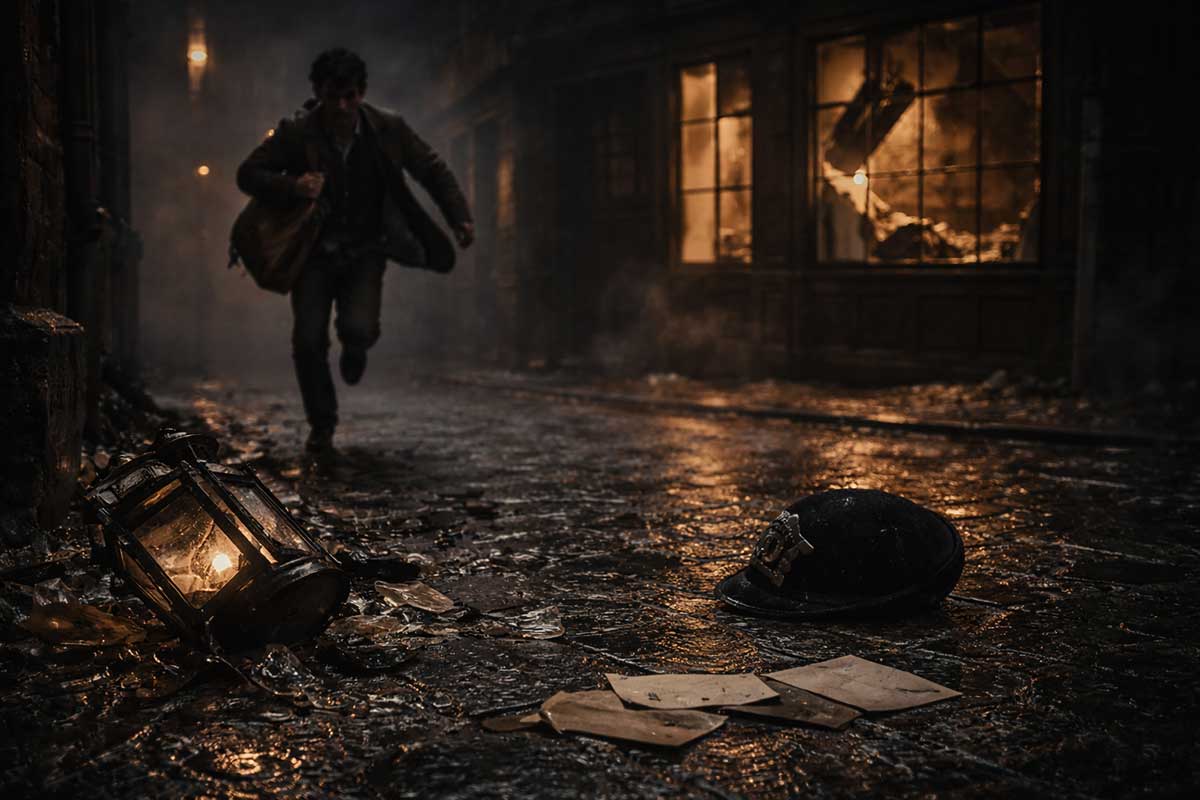
Lonzo and Eddie sprint down the alley, breath exploding into the cold.
A CONSTABLE appears at the mouth of the alley, lantern swinging, silhouette sharp.
CONSTABLE
Oi! Stop!
Lonzo bolts left. Eddie follows.
The constable gives chase—boots pounding, whistle screaming.
They burst onto the street.
A blackout truck lumbers in the distance. A car—rare—turns the corner too fast, lights hooded.
Lonzo throws himself across the road, barely making it.
Eddie panics, tries to follow—
The constable is right behind him, reaching—
Everything happens at once:
Eddie slips on wet cobblestone.
The constable lunges.
The car’s tires SCREAM.
A sickening IMPACT—metal, bone, and the sound of something ending.
The car skids, clips a curb, and stops hard.
Silence drops like ash.
Lonzo has already vanished into darkness, not looking back.
A neighbor opens a window. A gasp.
Eddie lies twisted, not moving.
The constable lies near him, face turned to the pavement, lantern shattered.
From the shadows across the street, the MAN IN A CAP watches for a beat—calculating.
Then he turns and walks away, calm as if he’s just witnessed the weather.
Cut.
28. EXT. EAST END STREET / OUTSIDE CHARLIE’S BUILDING — PRE-DAWN
Charlie is halfway up the stairs when he hears boots—running.
He freezes.
A NEIGHBOR WOMAN leans out of a doorway, whispering like it’s a sin.
NEIGHBOR WOMAN
Charlie. You heard? There’s a constable dead. Near the posh bookshop.
Charlie’s blood drains.
CHARLIE
I don’t know nothing.
The woman stares at him—half pity, half accusation.
NEIGHBOR WOMAN
They’ll be out looking for boys.
Charlie swallows, nods once, and pushes inside.
29. INT. CHARLIE + GRAN’S ROOM — DAWN
Gran is awake, sitting upright, as if sleep is no longer allowed.
Charlie shuts the door quietly, breath shaking.
Gran watches him. She can read terror the way other people read newspapers.
GRAN
What happened.
Charlie tries to shake his head, but the lie won’t form.
CHARLIE
I didn’t go. I swear.
Gran’s eyes search him—then soften, just a fraction.
GRAN
But it happened anyway.
Charlie’s knees go weak. He sits hard on the bed.
CHARLIE
A constable’s dead.
Gran’s face tightens. She looks toward the window, as if the law might be standing outside already.
Charlie’s voice cracks.
CHARLIE (CONT’D)
Lonzo said— he said someone would die.
Gran crosses herself without thinking, even if she doesn’t believe anymore.
Then she coughs—deep, rattling. She covers her mouth with a cloth.
When she lowers it, there’s a faint smear of red.
Charlie’s eyes widen.
CHARLIE (CONT’D)
Gran—
Gran folds the cloth quickly.
GRAN
It’s nothing.
Charlie’s voice rises, panicked.
CHARLIE
That’s not nothing.
Gran stands too fast—sways—catches herself on the table.
She forces steadiness.
GRAN
Listen to me. You keep your head down. You don’t go near that shop. You don’t say names. You hear me?
Charlie nods, but he’s not listening. He’s watching her breathing like it might stop any second.
Gran takes his face in her hands—sharp fingers, warm palms.
GRAN (CONT’D)
You stay you. Promise me again.
Charlie’s eyes fill. He hates it.
CHARLIE
I promise.
Gran holds his gaze.
GRAN
And if someone knocks, you don’t open. You don’t be brave. You be smart.
Charlie nods, swallowing panic like it’s bread.
Gran releases him and sits slowly, exhausted by a conversation.
Charlie looks at his blank notebook on the table—still blank.
He picks up the pencil.
For the first time, he writes something real:
CONSTABLE DEAD.
His hand shakes as he underlines it.
Cut.
30. EXT. TELEGRAPH OFFICE / LONDON STREETS — DAY (MONTAGE)
A sign: TELEGRAMS.
Charlie stands in line with older boys and men who look like they’ve already delivered too much bad news.
A SUPERVISOR hands him a worn messenger bag and a stack of envelopes.
SUPERVISOR
Don’t read them. Don’t lose them. Don’t stop moving.
Charlie nods like he understands adulthood.
MONTAGE — CHARLIE DELIVERING TELEGRAMS:
— Charlie runs through narrow streets, bag thumping his hip.
— He hands a telegram to a WOMAN. She reads it. Her face collapses. Charlie looks away, helpless.
— He delivers another to a MAN in work clothes. The man doesn’t cry—just sits down hard on the step like his bones gave up.
— Charlie delivers one to a YOUNG GIRL. The girl smiles while opening it—then drops it, screaming for her mother.
— Charlie backs away each time, smaller with every delivery.
Between deliveries, he stops in a doorway, pulls out the blank notebook, and scribbles quick lines:
Names.
Streets.
Faces.
Sounds people make when the world ends.
He looks up.
London keeps moving.
So he moves too.
Cut.
The Clinic Door at Dusk: Shared Burden, Deeper Bond (Scenes 31–35)
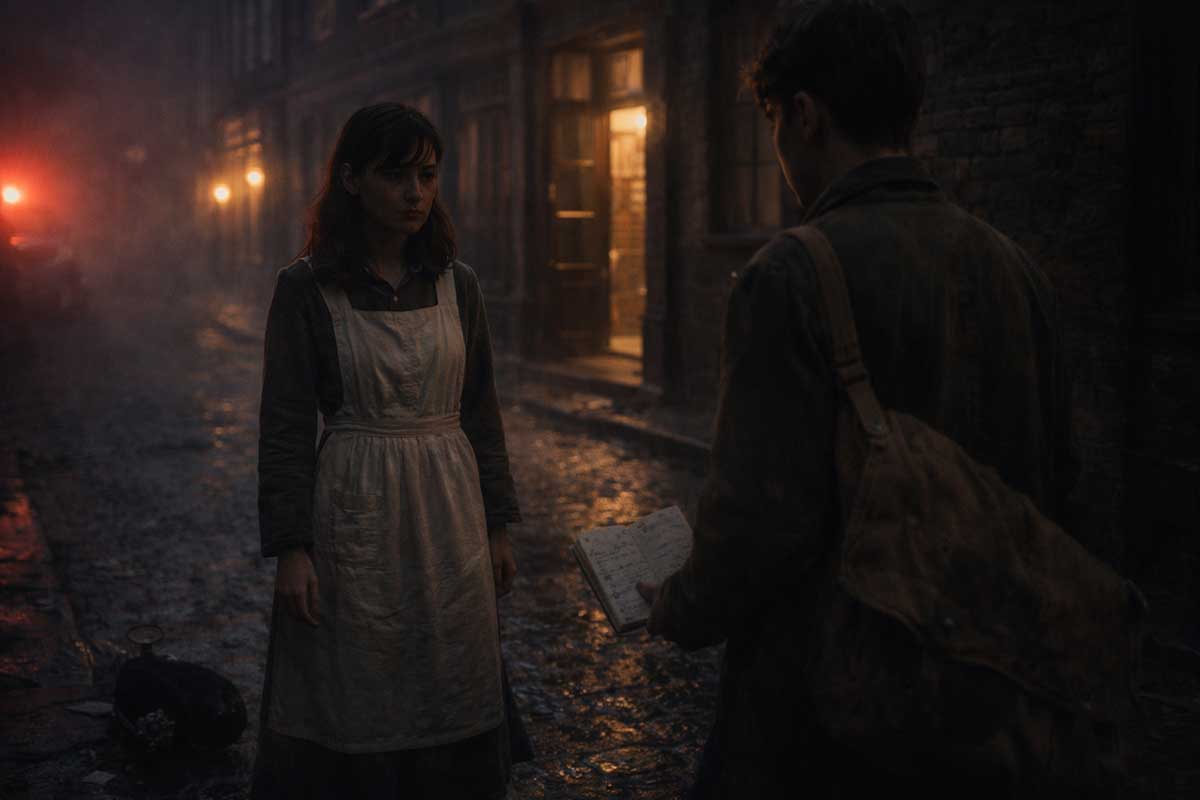
31. INT. COVENT GARDEN CLINIC — DAY
A cramped clinic carved out of necessity: folding screens, metal trays, bandages, iodine, steam from a kettle that’s never clean enough.
The waiting area is full—too full. Men with burned hands. Women with hollow eyes. A child holding a rag to his forehead.
Molly stands at the edge, coat buttoned properly now, hair pinned back with determination.
A MATRON (50s), brisk as a slap, moves down the line calling names. She sees Molly and stops.
MATRON
You lost?
Molly holds up a slip of paper—her evacuee medical placement note, worn from being folded and unfolded.
MOLLY
I’m not trained. Not properly. But I worked with a nurse in the countryside. Dressings. Fever. Basic care.
The matron studies Molly’s hands—clean, but not soft. There’s a steadiness there.
MATRON
This isn’t a hobby. People die here.
Molly meets her eyes.
MOLLY
I know.
The matron looks away, annoyed by her own sympathy.
MATRON
Name.
MOLLY
Molly Wakefield.
The matron’s expression flickers at the surname—just a fraction. She hides it quickly.
MATRON
Wakefield.
Molly stiffens.
MOLLY
Do you know my parents?
The matron’s voice stays clipped.
MATRON
I know too many people’s parents.
She hands Molly an apron.
MATRON (CONT’D)
Put that on. Start with bandages. Don’t faint. Don’t cry in front of patients.
Molly takes the apron.
MOLLY
And if I have questions?
The matron points to a moaning man behind a screen.
MATRON
Ask him. He’ll tell you what questions matter.
Molly ties the apron on, jaw tight.
She moves behind the screen.
A SOLDIER with a stitched brow looks up at her, startled by how young she is.
Molly’s voice is gentle, controlled.
MOLLY
Hello. I’m going to clean this, alright?
The soldier nods, wary.
Molly begins working—hands steady, eyes focused.
Outside, the clinic hums with pain and survival.
Molly doesn’t shrink from it.
She leans in.
Cut.
32. INT. THE BOOK KEEP — LATE AFTERNOON
Ignatius stands at the counter, staring at nothing.
The hollowed book sits open, its secret compartment visible like a wound that won’t close.
The bell TINKLES.
Charlie enters, messenger bag slung over his shoulder. He looks older than yesterday. Not because of time—because of what he’s delivered.
Ignatius’s eyes soften with relief, then tighten with fear.
IGNATIUS
Charlie.
Charlie nods once. His voice is flat, controlled.
CHARLIE
I didn’t go near it. Like you said.
Ignatius exhales.
IGNATIUS
Good.
Charlie’s gaze flicks to the hollowed book.
CHARLIE
Is that what they wanted?
Ignatius closes it quickly, too quickly.
IGNATIUS
It’s not for boys.
Charlie’s eyes flash.
CHARLIE
It’s for men that get boys killed, then.
Ignatius flinches. Not at the accusation—at its accuracy.
Charlie pulls his blank notebook from his coat. It’s no longer pristine. The corner is bent. The pages have marks now.
He opens it to a page and pushes it toward Ignatius.
On it: CONSTABLE DEAD.
Ignatius stares.
Charlie’s voice cracks, just slightly.
CHARLIE (CONT’D)
I keep seeing it.
Ignatius reaches for the notebook but stops himself, careful not to cross a line.
IGNATIUS
You didn’t cause that.
Charlie’s jaw tightens.
CHARLIE
That’s what people say when they want you quiet.
Ignatius studies him—the boy who came back, the boy who’s trying not to turn into the world.
IGNATIUS
What do you want from me, Charlie.
Charlie swallows.
He almost can’t say it.
CHARLIE
I want… it to stop.
Ignatius nods slowly, the weight of it settling in his shoulders.
IGNATIUS
So do I.
A beat.
Charlie’s eyes flick toward the window.
Across the street, the man in the cap lingers, patient.
Charlie’s face tightens.
CHARLIE
He’s still there.
Ignatius doesn’t look. He already knows.
Charlie’s voice drops.
CHARLIE (CONT’D)
Do you know who he is?
Ignatius hesitates—a fraction too long.
Charlie sees that too.
CHARLIE (CONT’D)
You do.
Ignatius’s voice is quiet.
IGNATIUS
It’s complicated.
Charlie gives a short, bitter laugh.
CHARLIE
Everything is, with you.
Ignatius’s eyes harden—not at Charlie, at himself.
IGNATIUS
Go home. Keep your head down.
Charlie doesn’t move.
CHARLIE
And you?
Ignatius meets his gaze.
IGNATIUS
I will do what I must do.
Charlie hates that answer because it sounds like goodbye.
He closes the notebook and tucks it away.
At the door, he pauses.
CHARLIE (CONT’D)
Molly came by again. To the clinic. She’s… doing things.
Ignatius’s eyes lift sharply.
IGNATIUS
What clinic.
Charlie nods toward the city.
CHARLIE
Covent Garden way. Helping bandage people like she’s been doing it her whole life.
Ignatius goes very still.
A name. A place. A network.
He whispers, almost to himself:
IGNATIUS
No.
Charlie watches him, confused.
CHARLIE
What.
Ignatius forces his voice steady.
IGNATIUS
Nothing. Go home, Charlie.
Charlie leaves, uneasy.
Ignatius turns the sign to CLOSED, hands trembling slightly as he locks the door.
Outside, the watcher doesn’t move.
Cut.
33. EXT. COVENT GARDEN STREET / OUTSIDE CLINIC — DUSK
The day is bruised purple.
Molly steps out of the clinic, apron folded under her arm, hands smelling faintly of antiseptic no matter how much she rubs them on her coat.
She walks a few steps and leans against a wall, catching her breath.
A voice behind her—familiar, blunt.
CHARLIE
You’re mad.
Molly turns.
Charlie stands there with his messenger bag, cheeks red from running.
Molly’s face softens with relief she tries to hide.
MOLLY
Hello to you too.
Charlie nods toward the clinic door.
CHARLIE
They’ll eat you alive in there.
Molly’s eyes flicker toward the street—bombed buildings, limping men, women pushing prams with no babies in them.
MOLLY
They’re already being eaten alive out here.
Charlie’s jaw tightens. He hates that she’s right.
Molly studies Charlie’s face.
MOLLY (CONT’D)
You look… different.
Charlie shrugs.
CHARLIE
I deliver telegrams now.
Molly’s breath catches.
MOLLY
Oh.
Charlie avoids her eyes.
CHARLIE
I don’t read them. But you can tell. People’s faces tell you before paper does.
Molly reaches out, touches his sleeve—gentle, brief.
Charlie stiffens, then allows it.
MOLLY
I’m sorry.
Charlie pulls away as if apologies might stain him.
CHARLIE
Don’t be sorry. Doesn’t fix anything.
Molly takes a breath, then speaks carefully.
MOLLY
I found another clue.
Charlie’s eyes sharpen.
CHARLIE
Cornwall.
Molly nods. Her voice is low.
MOLLY
A letter. An address. And… the clerk warned me to stop asking questions.
Charlie’s gaze flicks around the street.
CHARLIE
Don’t say that so loud.
Molly watches him.
MOLLY
You’re afraid for me.
Charlie scoffs.
CHARLIE
I’m afraid for everyone. That’s London.
Molly’s voice tightens.
MOLLY
I’m going to Cornwall soon. I have to see her. I have to hear the truth from her mouth.
Charlie stares at her like she’s announcing she’s going to the moon.
CHARLIE
You can’t just go.
MOLLY
Why not?
Charlie’s voice drops.
CHARLIE
Because when people say “stop asking questions,” they don’t mean it nicely.
Molly’s eyes burn.
MOLLY
Then I’ll ask them louder.
Charlie shakes his head, frustrated.
CHARLIE
That’s not bravery. That’s… that’s getting killed.
Molly’s voice softens.
MOLLY
Then come with me.
Charlie freezes.
CHARLIE
What.
Molly steps closer, steady.
MOLLY
Not to Cornwall. I know you can’t. But… at least to the station. Or to Mr. Oliver’s. I don’t want to keep doing this alone.
Charlie swallows. The word alone hits him like it knows his name.
He looks away, jaw working.
CHARLIE
You’ve got money. A house. People.
Molly’s voice is almost a whisper.
MOLLY
I have walls. Not people.
Charlie glances toward the sky.
A distant siren begins its slow climb.
Charlie’s face tightens.
CHARLIE
Come on.
Molly blinks.
MOLLY
Where.
Charlie gestures with his head.
CHARLIE
To the shop. Before the sky starts shouting.
They move off together, two small figures swallowed by the city.
Cut.
34. INT. THE BOOK KEEP — NIGHT
The bell TINKLES.
Ignatius looks up sharply as Molly and Charlie enter together.
For a split second, something like alarm crosses his face.
Then he masks it.
IGNATIUS
You’re both out late.
Charlie shrugs.
CHARLIE
Sky’s about to fall, probably.
Molly steps forward, determined.
MOLLY
I need to speak with you. Properly.
Ignatius’s eyes flick to the window—darkening street, watcher presence implied even when unseen.
IGNATIUS
It’s not safe to—
Molly cuts in, steady.
MOLLY
It’s not safe to breathe in this city. Yet we do it anyway.
Ignatius holds her gaze, weary.
Charlie shifts, uncomfortable with the intensity.
CHARLIE
I’ll… go look at the books.
Ignatius almost smiles.
IGNATIUS
Please do.
Charlie moves into the aisles, half pretending not to listen.
Molly lowers her voice.
MOLLY
Cornwall. My mother is there. I have an address. I’m going.
Ignatius’s jaw tightens.
IGNATIUS
You shouldn’t.
MOLLY
That isn’t an answer.
Ignatius’s voice is controlled.
IGNATIUS
Molly, there are things connected to Cornwall that are not… family matters.
Molly’s eyes narrow.
MOLLY
What kind of things.
Ignatius hesitates.
Molly leans in.
MOLLY (CONT’D)
Is my father connected to whatever is happening to you?
Ignatius looks away—toward the drawer, toward Imogen, toward the quiet grave of choices.
He speaks carefully.
IGNATIUS
Your father is… difficult to speak about in public.
Molly’s voice trembles, anger and fear mixed.
MOLLY
So he’s alive.
Ignatius doesn’t answer. Molly’s face hardens.
MOLLY (CONT’D)
You’re doing it again. You’re using silence like it’s kindness.
Ignatius meets her eyes.
IGNATIUS
I’m using silence to keep you alive.
Molly’s eyes shine, furious.
MOLLY
I don’t want to be alive in a world where everyone lies to me.
Ignatius flinches as if she struck something true.
From the aisles, Charlie’s voice drifts—too casual.
CHARLIE
There’s a book here about angels.
Ignatius answers without breaking eye contact with Molly.
IGNATIUS
Angels are overrated.
Charlie snorts softly, but stays in the aisle.
Molly’s voice drops.
MOLLY
What happened to your wife.
Ignatius goes very still.
He swallows.
IGNATIUS
Why are you asking that.
Molly’s voice is gentle now.
MOLLY
Because when people won’t talk, it’s usually because they’re protecting a wound.
Ignatius’s eyes flicker with pain.
He whispers.
IGNATIUS
Imogen is dead.
Molly nods slowly.
MOLLY
How.
Ignatius’s voice tightens.
IGNATIUS
In Cornwall.
Molly’s breath catches. The air between them changes.
Charlie’s head lifts slightly in the aisle, listening now for real.
Molly’s voice is barely audible.
MOLLY
Was she… my mother’s doctor?
Ignatius’s eyes close for a fraction of a second.
When he opens them, the answer is already there.
IGNATIUS
No.
But the lie is fragile.
Molly’s face hardens into certainty.
MOLLY
You do know something. And it’s bigger than you.
Ignatius’s voice is quiet, broken.
IGNATIUS
Yes.
A distant SIREN wails louder, closer.
Ignatius looks toward the back of the shop.
IGNATIUS (CONT’D)
You can’t go home right now. Both of you. Stay here until the all-clear.
Molly doesn’t argue. Charlie doesn’t either.
They move deeper into the shop.
Ignatius turns the sign to CLOSED and locks the door.
Then he stands in the dim, listening to the world outside—like a man waiting for a knock he deserves.
Cut.
35. INT. THE BOOK KEEP — BASEMENT SHELTER — NIGHT
A small basement room beneath the shop. Shelves of old stock. A few blankets. A lantern.
The air smells of damp paper and coal dust.
Molly and Charlie sit on a crate, shoulder to shoulder but not touching. The closeness is accidental—like the war arranged their bodies for comfort.
Above them, the distant thump of anti-aircraft guns. The long, low groan of London holding itself together.
Charlie pulls out his notebook and pencil, writes in the lantern light.
Molly watches him.
MOLLY
What do you write.
Charlie shrugs.
CHARLIE
Things that happen.
Molly’s voice is soft.
MOLLY
So they don’t disappear.
Charlie doesn’t answer. The answer is yes.
Molly looks toward the stairs where Ignatius stands, half in shadow, listening to the street above as if he can hear the future.
MOLLY (CONT’D)
He’s terrified.
Charlie’s eyes flick up.
CHARLIE
He’s always terrified. He just wears it different.
Molly leans closer, voice lower.
MOLLY
Do you think he’s protecting us… or using us.
Charlie’s pencil stops.
He thinks, the way he always does—fast, grim.
CHARLIE
He’s protecting you.
Molly’s brows lift.
MOLLY
What about you.
Charlie’s mouth twists.
CHARLIE
I don’t know what I am to anyone.
Molly’s eyes soften.
MOLLY
You’re not nothing.
Charlie looks away, embarrassed by kindness.
Above, a blast shakes dust from the ceiling.
Molly flinches. Charlie doesn’t.
He’s used to the sky threatening him.
Molly steadies herself.
MOLLY (CONT’D)
When the all-clear comes… I’m going to Cornwall.
Charlie looks at her now, full on.
CHARLIE
I know.
Molly’s voice shakes.
MOLLY
I’m scared.
Charlie swallows, then does the most un-Charlie thing possible:
He reaches into his bag, pulls out a telegram envelope—blank, unused—and hands it to Molly.
Molly frowns.
MOLLY (CONT’D)
What’s this.
Charlie’s voice is rough.
CHARLIE
My supervisor said: if you get lost, write the address big. Don’t trust your head when you’re frightened.
Molly looks at the envelope, then at him.
Charlie points with his pencil.
CHARLIE (CONT’D)
Write it. The Cornwall address. Here. Big. So if something happens, someone can still get you home.
Molly’s throat tightens.
She takes the pencil and writes the address carefully, large letters.
Charlie watches, jaw clenched like it hurts to care.
On the stairs, Ignatius turns slightly—sees them.
For a second, his face softens in the lantern light—love, guilt, longing all at once.
Then he looks away again, listening for the knock.
The siren continues.
And beneath it, something else—something quieter:
The sound of three lives trying to build a small safe place inside a city designed to break them.
Cut.
Cornwall Writes the Truth: A Letter That Can’t Be Spoken (Scenes 36–40)

36. EXT. LONDON TRAIN STATION — EARLY MORNING
A pale dawn. Steam from the engines hangs low like breath in a sickroom.
Molly stands on the platform with a small case and the telegram envelope folded in her pocket like a talisman. She looks determined—until she hears a voice behind her.
CHARLIE
You’re doing it, then.
Molly turns. Charlie stands there with his messenger bag, cheeks wind-burned.
Molly’s surprise softens into relief.
MOLLY
I didn’t tell you what train.
Charlie shrugs.
CHARLIE
London tells on people. You just have to listen.
Molly tries to smile.
MOLLY
You shouldn’t be here.
Charlie looks away, embarrassed by how much he is here.
CHARLIE
I’m not going with you. I’m not stupid.
A beat.
He reaches into his pocket and hands her a small object—a coin wrapped in cloth, tied with thread.
Molly unwraps it. It’s not a coin.
It’s a button. Plain. Worn. A soldier’s button.
MOLLY
Charlie—
CHARLIE
Gran’s.
Molly’s breath catches.
Charlie forces the words out like they cost him.
CHARLIE (CONT’D)
She said if you ever have to go somewhere you don’t want to go… take something that reminds you you’re not alone.
Molly closes her fingers around the button.
MOLLY
Is she—?
Charlie’s jaw tightens. He doesn’t answer, which is an answer.
A WHISTLE blows. Boarding begins.
Molly steps closer, voice low.
MOLLY (CONT’D)
If you need me, you send a telegram. Any time.
Charlie nods once, hard.
CHARLIE
And you—don’t be brave for show. Be brave for getting back.
Molly’s eyes sting. She squeezes his hand—quick, fierce.
MOLLY
I’ll come back.
Charlie lets go first, because he has to.
Molly climbs onto the train.
From the window, she watches Charlie step back into the steam and become smaller.
Charlie stands still as the train pulls away—until it’s gone.
Then he turns and runs.
Cut.
37. EXT. CORNWALL SANATORIUM — DAY
Sea wind. Pine. The smell of salt and damp stone.
A large country house has been turned into a place where people are stored when they break.
Molly walks up the path, suitcase in hand, coat flapping. The building looks peaceful in a way that feels like a lie.
A NURSE at the entrance stops her—polite, firm.
NURSE
Can I help you?
Molly lifts her chin.
MOLLY
I’m here to see Eloise Wakefield.
The nurse’s expression flickers. Another surname that’s heavier than it should be.
NURSE
Are you family?
Molly swallows.
MOLLY
I’m her daughter.
The nurse hesitates, then nods once, careful.
NURSE
Wait here.
Molly stands in the entry hall where everything is too clean and too quiet.
A clock ticks like a verdict.
After a moment, the nurse returns.
NURSE (CONT’D)
She’s… delicate. If she becomes distressed, you must step back.
Molly nods, heart hammering.
MOLLY
I understand.
The nurse leads her down a corridor lined with doors—some open, some locked.
Molly catches glimpses: a woman staring at a wall; a man rocking gently; a pair of hands twisting a handkerchief until it’s a rope.
They stop at a door.
The nurse opens it.
NURSE (CONT’D)
Eloise. You have a visitor.
Molly steps inside.
38. INT. SANATORIUM ROOM — DAY
A bright room that feels like it was designed to convince you nothing bad ever happened.
A woman sits by the window, hair pinned neatly, hands folded in her lap with too much discipline.
ELOISE WAKEFIELD (40s) looks up.
For a beat, she doesn’t recognize Molly.
Then something in her face fractures—memory pushing through medication and fear.
ELOISE
Molly…?
Molly takes one step, then another, as if approaching might scare her mother into disappearing.
MOLLY
It’s me.
Eloise stands abruptly, then falters—unsteady. Molly rushes forward and catches her.
For a moment Eloise clings to her like a drowning person.
Then Eloise pulls back, eyes wide with terror.
ELOISE
No—no, you can’t be here.
Molly’s voice breaks.
MOLLY
I came to find you.
Eloise grips Molly’s shoulders tightly, almost painful.
ELOISE
Did anyone see you? Did anyone follow you?
Molly shakes her head, confused.
MOLLY
Mother, what are you talking about?
Eloise’s eyes dart to the door, to the hallway beyond, as if listening for boots.
She lowers her voice to a whisper.
ELOISE
You mustn’t say your father’s name here.
Molly freezes.
MOLLY
Father is alive.
Eloise’s face twists—love and dread in the same breath.
ELOISE
I don’t know. I don’t know what he is anymore.
Molly’s throat tightens.
MOLLY
Why didn’t you come home?
Eloise turns away, moving toward the window, palms pressed to the sill like it’s the only solid thing.
ELOISE
Because home is where it happened.
Molly’s breath catches.
MOLLY
What happened.
Eloise’s voice becomes thin.
ELOISE
There was a night. An alert. The shelter was crowded. People pressed together like—like cattle.
Molly steps closer, carefully.
MOLLY
Mother…
Eloise’s hands tremble.
ELOISE
They were British. Not German. Not enemy uniforms. Men who were meant to protect. They smelled of smoke and gin and victory.
Molly goes still, stomach dropping through the floor.
Eloise’s eyes fill, but her voice is flat—like she’s reading someone else’s story.
ELOISE (CONT’D)
They took what they wanted in the dark and told me if I screamed I’d bring the roof down on everyone. And I— I believed them, because I wanted to be good.
Molly covers her mouth, horrified.
Eloise finally turns back to her, eyes pleading.
ELOISE (CONT’D)
Don’t look at me like that. I’m not— I’m not broken because I’m weak. I’m broken because the world is.
Molly crosses the space and wraps her mother in her arms—tight, shaking.
Eloise clings back, then whispers into Molly’s hair:
ELOISE (CONT’D)
And after… your father started asking questions.
Molly stiffens.
MOLLY
What kind of questions.
Eloise pulls back, fear rising again.
ELOISE
Questions that get people erased.
A beat.
Molly’s voice is trembling, but steady.
MOLLY
Who erased him.
Eloise’s eyes squeeze shut.
ELOISE
I can’t say it out loud.
Molly nods—accepting the boundary, but not the silence.
MOLLY
Then write it.
Eloise looks at her, startled.
Molly reaches for paper on the desk—blank stationery.
She sets it down, slides a pencil toward her mother.
MOLLY (CONT’D)
Write it, and I’ll carry it. You don’t have to say a word.
Eloise stares at the pencil like it’s a weapon.
Her hand hovers.
Then—slowly—she takes it.
Cut.
39. INT. THE BOOK KEEP — NIGHT (LONDON)
The shop is closed. The city outside is tense, quiet, listening.
Ignatius stands behind the counter with Major Bryant. The hollowed book lies open between them like a body.
Bryant’s voice is controlled—professional urgency.
BRYANT
Axmann is in London. We have a narrow window.
Ignatius doesn’t react outwardly, but something inside him tightens.
IGNATIUS
So you use someone else.
Bryant’s eyes are steady.
BRYANT
You’re the only one he’ll meet.
Ignatius’s voice lowers.
IGNATIUS
Because he thinks I’m still the man I used to be.
Bryant leans in slightly.
BRYANT
Are you?
Ignatius’s jaw clenches.
IGNATIUS
No.
Bryant taps the hollowed book.
BRYANT
Then prove it.
Ignatius closes his eyes for a beat—Imogen in his mind, smiling in a life that no longer exists.
He opens them again.
IGNATIUS
How does this end.
Bryant’s answer is too smooth.
BRYANT
With Axmann caught. With the leak sealed. With the war shorter.
Ignatius laughs once—quiet, humorless.
IGNATIUS
And with me?
Bryant doesn’t pretend.
BRYANT
With you… useful.
Ignatius’s hands tremble slightly as he steadies them on the counter.
IGNATIUS
I have two children in my shop now. Not mine by blood, but—
BRYANT
Then keep them out of it.
Ignatius meets his eyes.
IGNATIUS
I’m trying.
Bryant steps closer, voice dropping.
BRYANT
The watcher in the cap? He’s not a watcher. He’s a hook. He’s there to drag you toward Axmann. If we don’t set the trap first, you’ll be dragged anyway.
Ignatius’s face tightens with a decision forming.
IGNATIUS
What trap.
Bryant slides a folded paper across the counter—a plan, minimal words, brutal clarity.
Ignatius reads. His eyes move slowly, then stop.
IGNATIUS (CONT’D)
You want me to die.
Bryant’s voice is calm.
BRYANT
I want Axmann to believe you died.
Ignatius looks up sharply.
IGNATIUS
No.
Bryant holds his gaze.
BRYANT
It’s the only way he comes out into the open. He has to be convinced the “book man” is gone. Otherwise he vanishes and takes the network with him.
Ignatius’s voice turns raw.
IGNATIUS
You’re asking me to become a ghost.
Bryant’s face softens just enough to be almost human.
BRYANT
You already are, Mr. Oliver. This just makes it official.
Ignatius stares at the paper.
Then, very quietly:
IGNATIUS
Not in front of the children.
Bryant nods.
BRYANT
Agreed.
Ignatius’s eyes lift to the shelves, the doorway, the basement stairs—places where two young lives have begun to trust him.
He swallows.
IGNATIUS
Then we do it… clean. Fast. No spectacle.
Bryant’s relief is invisible, but present.
BRYANT
Good.
Ignatius folds the paper and slips it into the hollowed book, closing it like a coffin.
Cut.
40. INT. SANATORIUM ROOM — NIGHT (CORNWALL)
Rain taps the window softly.
Eloise sits at the desk, pencil in hand, shaking so hard the letters come out jagged.
Molly sits across from her, silent, eyes locked on the paper like it might save them.
Eloise writes one word… pauses… then another.
She pushes the paper toward Molly with a trembling hand.
Molly looks down.
We don’t fully see it—only fragments as Molly’s eyes track:
A name.
A unit.
A reference that smells like official power.
Molly’s face pales.
MOLLY
(whispering)
This is… British.
Eloise nods, tears spilling now.
ELOISE
That’s why no one speaks.
Molly folds the paper carefully and slips it into her coat lining, close to her heart.
Eloise reaches for Molly’s hand.
ELOISE (CONT’D)
If anything happens to you—
Molly squeezes back, fierce.
MOLLY
Nothing happens to me. I go back. I find answers. I bring you home.
Eloise shakes her head, terrified.
ELOISE
Home isn’t safe.
Molly’s voice hardens—not cruel, determined.
MOLLY
Then we make a new home.
Eloise looks at her daughter as if seeing a stranger—someone made of steel she didn’t know she forged.
Molly stands.
MOLLY (CONT’D)
I’m leaving at first light.
Eloise grabs her sleeve.
ELOISE
Molly… if your father is alive, they’ll be watching everyone who loves him.
Molly holds her mother’s gaze.
MOLLY
Then let them watch.
Eloise’s grip loosens, defeated by courage.
Molly leans down and kisses her mother’s forehead.
MOLLY (CONT’D)
I’ll be back. And next time, I’m not asking permission.
She turns toward the door.
Eloise calls after her, voice breaking:
ELOISE
Be careful of the quiet men.
Molly pauses—then nods without turning around.
MOLLY
I already am.
Molly exits.
Eloise sits alone, staring at the empty doorway, rain ticking time away.
Cut.
A pale dawn. Steam from the engines hangs low like breath in a sickroom.
Molly stands on the platform with a small case and the telegram envelope folded in her pocket like a talisman. She looks determined—until she hears a voice behind her.
CHARLIE
You’re doing it, then.
Molly turns. Charlie stands there with his messenger bag, cheeks wind-burned.
Molly’s surprise softens into relief.
MOLLY
I didn’t tell you what train.
Charlie shrugs.
CHARLIE
London tells on people. You just have to listen.
Molly tries to smile.
MOLLY
You shouldn’t be here.
Charlie looks away, embarrassed by how much he is here.
CHARLIE
I’m not going with you. I’m not stupid.
A beat.
He reaches into his pocket and hands her a small object—a coin wrapped in cloth, tied with thread.
Molly unwraps it. It’s not a coin.
It’s a button. Plain. Worn. A soldier’s button.
MOLLY
Charlie—
CHARLIE
Gran’s.
Molly’s breath catches.
Charlie forces the words out like they cost him.
CHARLIE (CONT’D)
She said if you ever have to go somewhere you don’t want to go… take something that reminds you you’re not alone.
Molly closes her fingers around the button.
MOLLY
Is she—?
Charlie’s jaw tightens. He doesn’t answer, which is an answer.
A WHISTLE blows. Boarding begins.
Molly steps closer, voice low.
MOLLY (CONT’D)
If you need me, you send a telegram. Any time.
Charlie nods once, hard.
CHARLIE
And you—don’t be brave for show. Be brave for getting back.
Molly’s eyes sting. She squeezes his hand—quick, fierce.
MOLLY
I’ll come back.
Charlie lets go first, because he has to.
Molly climbs onto the train.
From the window, she watches Charlie step back into the steam and become smaller.
Charlie stands still as the train pulls away—until it’s gone.
Then he turns and runs.
Cut.
The Book Keep Falls: Sacrifice in the Dust (Scenes 41–45)
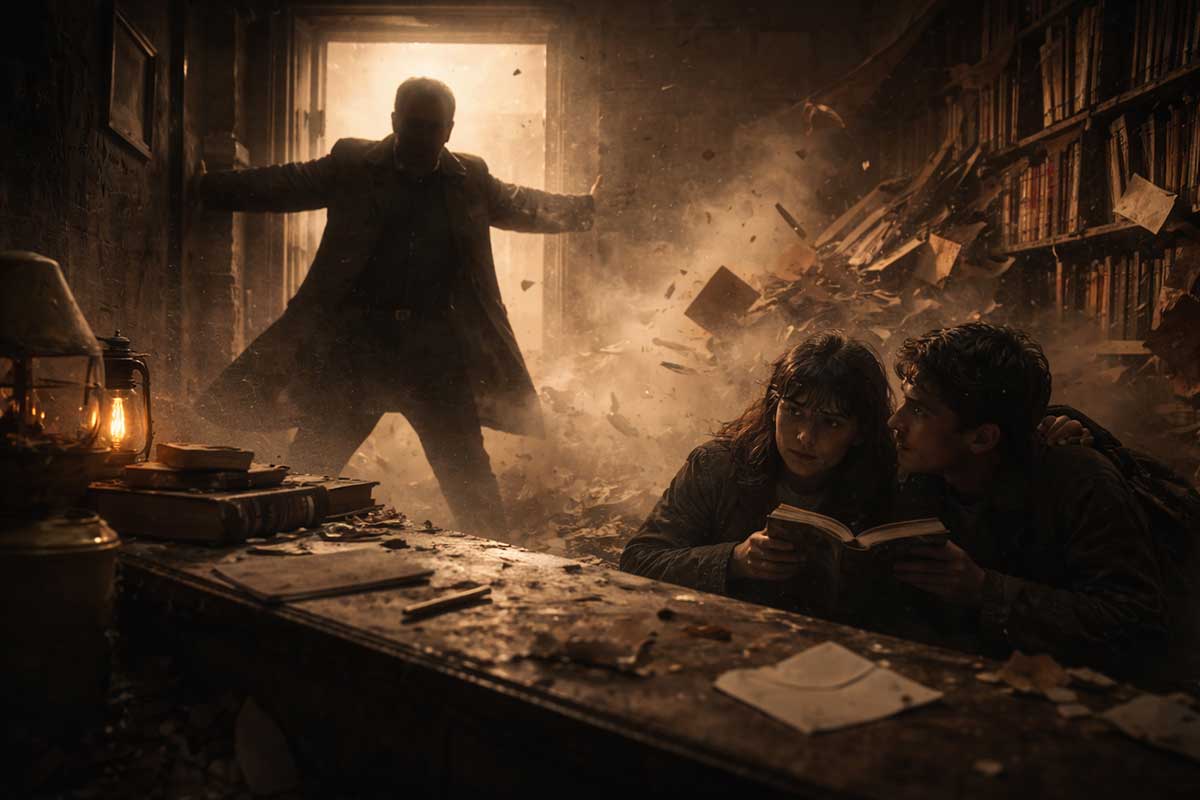
41. INT. THE BOOK KEEP — NIGHT (OPERATION SETUP)
The shop is closed. The air feels wired.
Ignatius moves with deliberate calm, but his hands betray him—slight tremor as he straightens a stack of books that don’t need straightening.
Major Bryant stands near the back, coat collar up, eyes scanning the shelves like they’re corridors.
BRYANT
Axmann believes you’re meeting tonight.
Ignatius doesn’t look up.
IGNATIUS
He believes what you’ve taught him to believe.
Bryant’s jaw tightens—no argument.
Ignatius reaches under the counter and removes the hollowed book. Inside: a thin packet, sealed.
He doesn’t open it. He just stares at it like it’s radioactive.
IGNATIUS (CONT’D)
This is the bait.
BRYANT
And you’re the hook.
Ignatius finally looks at him.
IGNATIUS
No spectacle. You promised.
Bryant nods once.
BRYANT
You walk out the back at precisely nine. You cross the alley. You turn right. My men take you into the lorry. A body goes in your place. A coat like yours. A fire. A narrative.
Ignatius’s face hardens.
IGNATIUS
A body.
Bryant’s voice stays flat.
BRYANT
A dead German courier. Found on the riverbank yesterday. No family to complain.
Ignatius swallows something bitter.
IGNATIUS
And Charlie. Molly.
Bryant’s gaze sharpens.
BRYANT
They won’t be here.
Ignatius turns toward the basement door, listening—like he’s hearing their breathing even when they’re not present.
IGNATIUS
If they come—
BRYANT
Then you send them away.
Ignatius’s mouth twists into something like a smile, except it isn’t.
IGNATIUS
They don’t obey.
Bryant checks his watch.
BRYANT
Nine minutes.
Ignatius steps to the front window.
Across the street, the MAN IN A CAP stands by the lamppost, cigarette ember pulsing. He doesn’t move. He’s not watching the shop as much as he’s measuring time.
Ignatius speaks without turning.
IGNATIUS
That man isn’t just a hook.
Bryant joins him, keeps his face angled away from the glass.
BRYANT
No. He’s Axmann’s leash.
Ignatius closes his eyes.
IGNATIUS
Imogen died because I pulled on the wrong leash.
Bryant’s voice lowers.
BRYANT
Tonight you pull on the right one.
Ignatius opens his eyes, steady now.
He reaches for his coat.
IGNATIUS
Then let’s finish it.
Cut.
42. EXT. BACK ALLEY BEHIND THE BOOK KEEP — NIGHT (THE SWITCH)
Fog rolls low. The alley is a narrow throat.
Ignatius steps out the back door at 9:00 exactly, coat collar up, hat low. He carries the hollowed book close to his body.
At the far end, a LORRY sits in shadow.
A figure emerges near the lorry—Bryant’s man—subtle hand signal: Come.
Ignatius walks. Not fast. Not slow. The pace of a man who refuses to look hunted.
Halfway down the alley, a SOUND—soft shoes behind him.
Ignatius stops.
He doesn’t turn immediately, hoping it’s nothing.
A whisper:
MOLLY (O.S.)
Mr. Oliver.
Ignatius turns—heart dropping.
Molly stands at the back door, coat buttoned wrong again, hair pinned but wind-stung. Charlie is with her, half in shadow, messenger bag at his side.
Ignatius’s face tightens—anger and fear braided together.
IGNATIUS
What are you doing here.
Molly steps forward.
MOLLY
I came back from Cornwall. I have something—something you need to see.
Charlie’s eyes flick down the alley—sees the lorry, senses the trap.
CHARLIE
This isn’t a good night for visits.
Ignatius’s voice is urgent, controlled.
IGNATIUS
Go inside. Lock the door. Do not come out.
Molly doesn’t move.
MOLLY
They’re watching me. On the train back—two men. Quiet men.
Ignatius’s gaze snaps to the street mouth.
The MAN IN A CAP is no longer by the lamppost.
Which is worse.
Charlie shifts, panic rising.
CHARLIE
He’s close.
Ignatius takes one step toward them, pushing the hollowed book toward Molly.
IGNATIUS
Listen to me. If anything happens—take this. Keep it closed. Give it to no one except—
A SHADOW moves at the alley mouth.
A man steps in—tall, neat, too calm.
AXMANN (30s), German accent disguised but imperfect, a smile like a razor.
AXMANN
Mr. Oliver.
Bryant’s lorry remains still. Too still.
Ignatius’s eyes flick to the lorry—no movement. No response.
A sick realization: they’ve been pinned.
Axmann’s gaze slides to Molly and Charlie—interest, not surprise.
AXMANN (CONT’D)
Ah. Children. I adore how you British pretend they are invisible.
Charlie instinctively moves in front of Molly.
Ignatius’s voice is ice.
IGNATIUS
Leave them out of this.
Axmann smiles wider.
AXMANN
That depends on you.
Axmann lifts his hand slightly.
From the shadows behind Ignatius, the MAN IN A CAP appears—close now—holding a pistol low at his side as if it’s nothing more than a pocket watch.
Bryant’s “clean” plan collapses in an instant.
Ignatius inhales once—steadying.
Then he does the only thing he can:
He SHOVES the hollowed book into_attach Molly’s hands and steps forward into Axmann’s space, pulling the danger toward himself.
IGNATIUS
Run.
Molly freezes.
Charlie grabs her sleeve.
CHARLIE
Move!
They bolt back toward the shop door—
And then—
A SOUND like the sky ripping open.
Not a siren. Not a plane.
Just a sudden, monstrous WHUMP.
Cut.
43. EXT./INT. THE BOOK KEEP — CONTINUOUS (V-2 STRIKE)
The world jolts sideways.
A V-2 impact—no warning—just violence.
Windows shatter outward like a flock of knives. The alley erupts in dust and brick.
Ignatius is thrown hard against the shop wall.
Axmann stumbles, caught off balance.
The man in the cap fires instinctively—one shot—wild into smoke.
Charlie tackles Molly through the back door as the building SHUDDERS.
Inside the shop: shelves collapse, books raining like heavy birds.
The lantern in the basement swings, then falls.
Ignatius tries to stand.
His ears ring. His vision swims.
He sees Charlie and Molly inside the doorway—half buried in dust.
He tries to reach them.
Then the front section of the shop GROANS—structural failure.
A beam drops.
Ignatius moves without thought—dives toward the doorway, shoving his body into the gap like a doorstop.
IGNATIUS
Get down!
Charlie yanks Molly to the floor behind the counter.
The beam crashes.
A wall buckles.
Ignatius is pinned—half in the alley, half inside, crushed by timber and brick.
For a beat, there is only the sound of settling rubble and distant screams.
Molly crawls toward Ignatius, sobbing.
Charlie grabs her wrist.
CHARLIE
No—!
Molly rips free.
She reaches Ignatius’s face—dusty, blood at the corner of his mouth, eyes still clear.
Ignatius’s hand finds Molly’s—weak but deliberate.
IGNATIUS
(whisper)
The book.
Molly clutches it to her chest.
MOLLY
I have it. I have it.
Ignatius exhales—relief and grief together.
Charlie crouches beside them, shaking.
CHARLIE
You said it would be clean.
Ignatius tries to smile. It doesn’t fully form.
IGNATIUS
London doesn’t do clean.
Molly’s tears streak through dust on her cheeks.
MOLLY
Stay with us. Please.
Ignatius’s eyes flick to Charlie.
IGNATIUS
Your notebook… keep writing.
Charlie swallows hard, nods.
Ignatius’s gaze shifts past them—toward the alley.
Through smoke, Axmann staggers to his feet, furious, disoriented. The man in the cap is down—hit by falling debris, motionless.
Axmann sees the hollowed book is gone.
His face changes—cold calculation.
He turns to leave.
Ignatius’s fingers tighten around Molly’s once—urgent.
IGNATIUS (CONT’D)
Don’t let him vanish.
Molly shakes her head, desperate.
MOLLY
I can’t— I’m just—
Ignatius’s eyes hold hers.
IGNATIUS
You are not just.
His hand slips.
Charlie’s voice breaks.
CHARLIE
Mr. Oliver—
Ignatius’s gaze softens—Imogen, books, children, everything he couldn’t save.
Then the life leaves his eyes like a candle blown out.
Molly makes a sound that isn’t words.
Charlie pulls her back as more rubble shifts.
Outside, Axmann disappears into smoke.
Cut.
44. EXT. RIVER EMBANKMENT — NIGHT (LONZO’S END)
Rain. Black water. Sirens far away. London on fire somewhere out of sight.
Lonzo runs along the embankment, coat flapping, breath ragged. He clutches a small satchel—whatever he grabbed in the chaos.
He thinks he’s gotten away.
Then a voice behind him—quiet, close.
BRYANT (O.S.)
Lonzo Rossi.
Lonzo spins.
Major Bryant stands with two plainclothes men. Calm. Efficient. No drama.
Lonzo’s eyes dart—escape routes, angles, the river.
LONZO
I don’t know what you’re talking about.
Bryant steps forward slowly.
BRYANT
You broke into a bookshop. A constable is dead. A boy was forced into it. A man is dead now too.
Lonzo’s face twitches—guilt trying to become rage.
LONZO
War killed them. Not me.
Bryant’s gaze is flat.
BRYANT
War reveals people. It doesn’t invent them.
Lonzo backs toward the river.
One of Bryant’s men shifts position—blocking the stairs.
Lonzo’s eyes flare with panic.
LONZO
I didn’t mean for the constable—
Bryant’s voice hardens.
BRYANT
You meant for a boy to carry it.
Lonzo glances toward the water—then bolts.
Bryant doesn’t chase. He nods once.
A sharp WHISTLE. Another man appears at the far end—closing the net.
Lonzo skids, trapped between river and men.
He looks at Bryant, hatred blazing.
LONZO
You think you’re better?
Bryant steps closer.
BRYANT
No. I think I’m older. And I’m tired.
Lonzo makes a sudden move—lunges for Bryant’s sidearm.
A struggle. A slip on wet stone.
Lonzo loses footing—
He falls backward—
Over the edge—
Into the river with a hollow SPLASH.
For a beat, only water.
Lonzo surfaces once, choking, thrashing.
The current pulls him sideways.
His hand claws at the embankment stones—almost catches—
Then slips.
He disappears under.
Bryant watches without triumph.
Just grim closure.
One of the men speaks softly:
PLAINCLOTHES MAN
Should we—
Bryant shakes his head.
BRYANT
No.
He turns away from the river, face set.
BRYANT (CONT’D)
Find the German. And find the children.
Cut.
45. EXT. RUINS OF THE BOOK KEEP — DAWN (EPILOGUE BEAT)
Morning light reveals what night tried to hide.
The Book Keep is broken open—front wall collapsed, shelves spilled into the street like bones. Books lie everywhere, soaked, torn, scattered.
Rescue workers move through debris.
Molly stands wrapped in a blanket, face gray with dust, eyes too old. Charlie stands beside her, jaw clenched so hard it shakes.
In Molly’s arms: the hollowed book—held like a baby.
A RESCUE WORKER approaches gently.
RESCUE WORKER
Family?
Molly looks down at the rubble. Swallows.
MOLLY
No.
Charlie answers without thinking—voice rough.
CHARLIE
Yes.
Molly turns to him.
Charlie doesn’t look away.
CHARLIE (CONT’D)
He was.
A beat.
Major Bryant steps through the ruin, coat dusted with ash. His face registers the loss—real, not tactical.
He stops in front of Molly and Charlie.
His eyes go to the hollowed book.
BRYANT
You have it.
Molly tightens her grip.
MOLLY
I have it.
Bryant nods once—respect.
He lowers his voice.
BRYANT
Mr. Oliver saved you.
Charlie’s eyes flash.
CHARLIE
Then don’t use him after he’s dead.
Bryant absorbs it—doesn’t argue.
He looks at Molly.
BRYANT
I can take you somewhere safe.
Molly’s voice is quiet and steel-edged.
MOLLY
Safe is a word people use when they want you silent.
Bryant exhales—he’s met his match.
Charlie pulls his notebook from his coat.
He flips to a clean page.
With a shaking pencil, he writes a title:
THE BOOK KEEP
Molly watches him, tears threatening again.
Charlie’s voice is barely above a whisper.
CHARLIE (CONT’D)
We can’t let it disappear.
Molly nods. She opens the hollowed book—carefully—and removes the sealed packet, looks at it like it’s the weight of a nation.
She slides it into the lining of her coat, beside the Cornwall note.
Then she takes Charlie’s pencil and writes beneath his title:
“FOR IMOGEN. FOR IGNATIUS.”
Molly looks up at the shattered street, the scattered books, the waking city.
MOLLY
We finish what he started.
Charlie nods once—fierce.
CHARLIE
And we don’t do it quiet.
They stand together in the rubble as sunlight crawls across broken pages.
Not healed.
But moving.
Cut to black.
The shop is closed. The air feels wired.
Ignatius moves with deliberate calm, but his hands betray him—slight tremor as he straightens a stack of books that don’t need straightening.
Major Bryant stands near the back, coat collar up, eyes scanning the shelves like they’re corridors.
BRYANT
Axmann believes you’re meeting tonight.
Ignatius doesn’t look up.
IGNATIUS
He believes what you’ve taught him to believe.
Bryant’s jaw tightens—no argument.
Ignatius reaches under the counter and removes the hollowed book. Inside: a thin packet, sealed.
He doesn’t open it. He just stares at it like it’s radioactive.
IGNATIUS (CONT’D)
This is the bait.
BRYANT
And you’re the hook.
Ignatius finally looks at him.
IGNATIUS
No spectacle. You promised.
Bryant nods once.
BRYANT
You walk out the back at precisely nine. You cross the alley. You turn right. My men take you into the lorry. A body goes in your place. A coat like yours. A fire. A narrative.
Ignatius’s face hardens.
IGNATIUS
A body.
Bryant’s voice stays flat.
BRYANT
A dead German courier. Found on the riverbank yesterday. No family to complain.
Ignatius swallows something bitter.
IGNATIUS
And Charlie. Molly.
Bryant’s gaze sharpens.
BRYANT
They won’t be here.
Ignatius turns toward the basement door, listening—like he’s hearing their breathing even when they’re not present.
IGNATIUS
If they come—
BRYANT
Then you send them away.
Ignatius’s mouth twists into something like a smile, except it isn’t.
IGNATIUS
They don’t obey.
Bryant checks his watch.
BRYANT
Nine minutes.
Ignatius steps to the front window.
Across the street, the MAN IN A CAP stands by the lamppost, cigarette ember pulsing. He doesn’t move. He’s not watching the shop as much as he’s measuring time.
Ignatius speaks without turning.
IGNATIUS
That man isn’t just a hook.
Bryant joins him, keeps his face angled away from the glass.
BRYANT
No. He’s Axmann’s leash.
Ignatius closes his eyes.
IGNATIUS
Imogen died because I pulled on the wrong leash.
Bryant’s voice lowers.
BRYANT
Tonight you pull on the right one.
Ignatius opens his eyes, steady now.
He reaches for his coat.
IGNATIUS
Then let’s finish it.
Cut.
Proof We Were Here: Carrying the Truth Forward (Scenes 46–50)
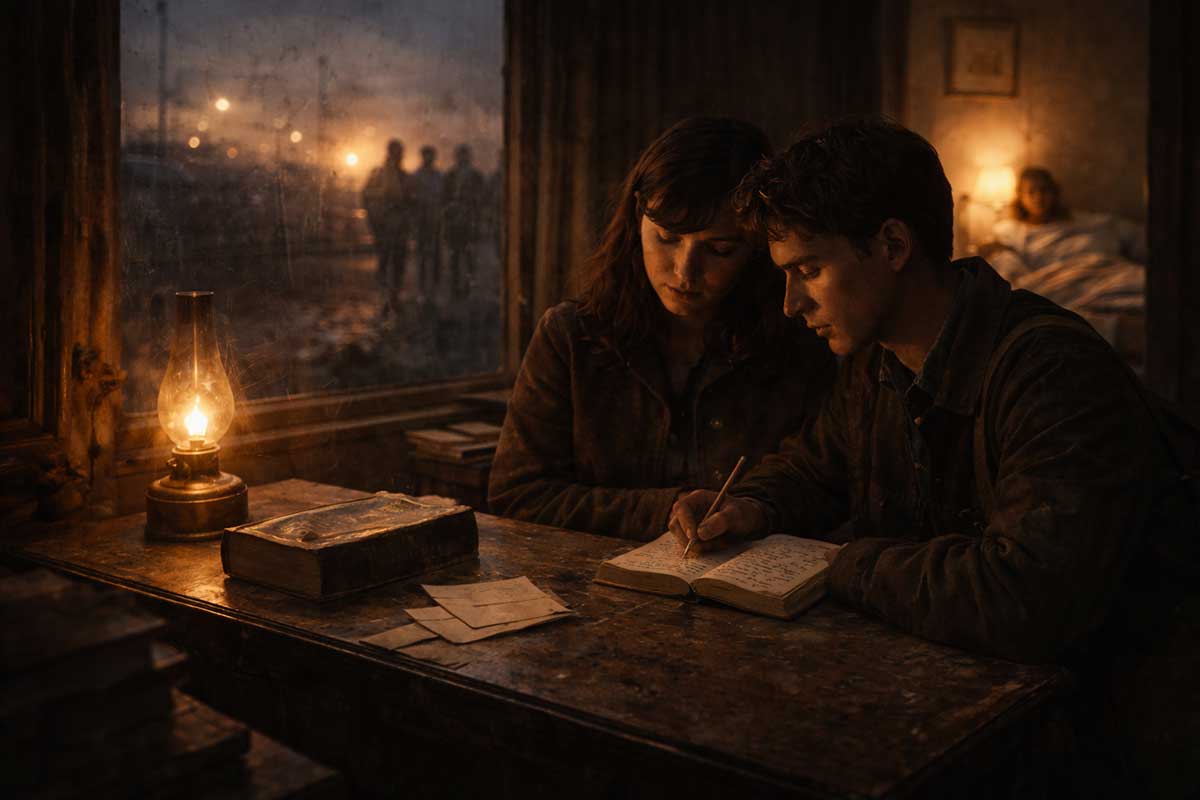
46. INT. SAFE HOUSE FLAT — NIGHT (BRYANT’S DEAL)
A cramped upstairs flat with blackout curtains and a single lamp turned low.
Molly sits at a small table, blanket still around her shoulders. Charlie stands near the window, peeking through a slit in the curtain like he’s guarding the world.
Major Bryant places a folder on the table. Not an official folder—too plain. Too careful.
BRYANT
You’re not going back to Wakefield House.
Molly doesn’t look up.
MOLLY
Says who.
Bryant holds her gaze.
BRYANT
Says the people who’d like you to vanish quietly.
Molly’s hand tightens around the hollowed book.
Charlie’s voice cuts in, blunt.
CHARLIE
We’re not vanishing.
Bryant nods, almost approving.
BRYANT
Good. Because I need you visible in one very specific way.
Molly’s eyes sharpen.
MOLLY
You’re going to use us.
Bryant doesn’t flinch.
BRYANT
I’m going to protect you by giving you something to do that matters.
Charlie scoffs.
CHARLIE
That’s the same thing.
A beat.
Bryant opens the folder. Inside: a single photograph—grainy—of Axmann in a crowd near a rail yard. Another paper: a map with two circles.
Bryant taps the map.
BRYANT
Axmann has to retrieve the packet. He won’t risk it himself. He’ll send someone.
Molly’s voice is cold.
MOLLY
And you want me to be the bait.
Bryant looks at the hollowed book.
BRYANT
He already believes you have it.
Molly stiffens—fear flashes, then becomes anger.
MOLLY
How would he know that.
Bryant’s jaw tightens. He doesn’t answer quickly enough.
Charlie steps forward, voice sharp.
CHARLIE
You let him see. Didn’t you.
Bryant meets Charlie’s eyes.
BRYANT
I didn’t “let” anything. I lost control for ten seconds and a V-2 landed on your lives.
Molly’s hands shake. She forces them still.
MOLLY
What do you want.
Bryant slides a small metal object across the table: a plain whistle.
BRYANT
Tomorrow. Noon. St. Katharine Docks. You walk there with the book in your bag. You sit on the bench by the water. You do nothing else.
Charlie barks a laugh.
CHARLIE
That’s your plan? Sit on a bench?
Bryant’s expression stays steady.
BRYANT
The simplest trap is the hardest to spot.
Molly’s voice trembles, but she holds it.
MOLLY
And if I don’t go.
Bryant’s eyes soften, briefly.
BRYANT
Then Axmann disappears. And the people who erased your father keep erasing whoever they like.
Molly freezes at “your father.”
Bryant looks down.
BRYANT (CONT’D)
Your mother wrote something, didn’t she.
Molly’s face tightens. She doesn’t deny it.
Charlie watches Molly, realizing the Cornwall paper wasn’t just grief—it was a fuse.
Molly speaks quietly.
MOLLY
If we do this… my mother comes home.
Bryant nods once.
BRYANT
I can arrange it. Under a different name. A different file.
Charlie’s eyes narrow.
CHARLIE
And Mr. Oliver?
Bryant’s gaze dips—shame flickering.
BRYANT
He’ll have justice if I can still spell the word.
Silence.
Molly looks at the whistle, then the book, then Charlie.
Charlie nods once, fierce and terrified.
Molly pockets the whistle.
MOLLY
Noon.
Bryant exhales—relief that looks like a burden shifting.
BRYANT
No heroics. No speeches. You see a man approach, you blow once. My men close in.
Charlie mutters.
CHARLIE
London loves plans.
Bryant’s mouth tightens.
BRYANT
London hates them. That’s why we keep trying.
Cut.
47. EXT. ST. KATHARINE DOCKS — NOON (THE BAIT)
Cold daylight on gray water. The docks are busy with workers, crates, and the hum of a city pretending it’s normal.
Molly sits on a bench exactly where Bryant said. Coat buttoned, chin up, hands in pockets to hide the shaking.
Charlie stands across the walkway near a stack of crates, trying to look like a messenger boy waiting for an errand.
He keeps his eyes moving—always moving.
Molly’s bag sits beside her. Inside: the hollowed book.
A gull cries overhead like it’s mocking everyone.
A MAN approaches—ordinary coat, ordinary hat. Too ordinary.
He slows near Molly, glances around as if admiring the water.
MAN
Miss Wakefield.
Molly’s breath catches. She doesn’t turn her head—just tightens.
MOLLY
I don’t know you.
The man sits on the bench beside her like they’re old friends.
MAN
You do. You just haven’t met me yet.
Molly’s hand slips into her pocket around the whistle.
The man smiles politely.
MAN (CONT’D)
Give me the book. Then you can go back to your mother. That’s how this works.
Molly’s throat tightens.
MOLLY
You’re not British.
The man’s smile stays.
MAN
Nationality is a costume these days.
Charlie takes one step forward, ready to run—then stops. Wait. Wait. Wait.
Molly’s fingers close on the whistle.
The man’s voice drops—dangerously calm.
MAN (CONT’D)
Don’t do that.
Molly freezes.
He saw her hand move.
The man’s gaze flicks toward Charlie’s hiding place without turning his head.
MAN (CONT’D)
Your friend in the crates is very brave. Very foolish.
Charlie’s blood goes cold. How did he—
Molly whispers, shaking.
MOLLY
Leave him alone.
The man shrugs.
MAN
Then give me what I came for.
Molly forces herself to look at him now—truly look.
His eyes are blank in the way trained men’s eyes are blank.
Molly’s hand comes out of her pocket slowly—not with the whistle, but with nothing, open palm.
MOLLY
Show me your hands.
The man blinks—annoyed, surprised.
MAN
Why.
Molly’s voice steadies.
MOLLY
Because Mr. Oliver taught me to notice what people hide.
The man’s smile twitches. A crack.
He lifts his hands slightly—revealing a faint scar on one finger, like a signal.
Charlie sees it too from across the way. Something in his memory snaps.
He remembers the cap-man’s hand. The same scar.
Charlie’s jaw tightens.
Molly takes the chance.
She blows the whistle—ONE sharp blast.
For half a second, nothing.
Then the docks erupt.
Two MEN in work coats move like wolves—fast, coordinated. A third steps out from behind a cart. A fourth comes from the waterside stairs.
The courier-man bolts.
Charlie runs—pure instinct—cutting across the walkway to block him.
The man shoves Charlie hard. Charlie hits the ground.
Molly stands, starts toward Charlie—then stops as Bryant’s men close in.
A struggle. A tackle. The courier-man fights like a cornered animal.
He reaches into his coat—
A pistol flashes—
A shot cracks—
A worker screams—
Bryant himself appears, moving in, grabbing the man’s wrist—
The gun clatters to the dock boards.
The courier-man is pinned, panting, eyes cold.
Bryant leans close, voice low, lethal.
BRYANT
Where is Axmann.
The courier-man smiles through blood.
COURIER
Everywhere.
Bryant slams his head into the boards once—controlled brutality.
BRYANT
Try again.
The smile fades. Fear flickers.
COURIER
Rail yard. Tonight. He’ll want to see the packet with his own eyes.
Bryant’s gaze lifts—decision made.
He signals his men.
The courier is hauled away.
Molly rushes to Charlie, helping him sit up.
Charlie’s lip is split. He spits blood and grins anyway—sharp and proud.
CHARLIE
Told you London loves plans.
Molly’s eyes brim—relief and terror together.
MOLLY
Are you alright?
Charlie nods, then looks at the bag.
CHARLIE
Don’t let go of it.
Molly tightens her grip.
MOLLY
I won’t.
Cut.
48. EXT. RAIL YARD — NIGHT (AXMANN CAUGHT)
A wasteland of tracks and steel. Fog. The kind of dark that makes every shadow feel alive.
Bryant’s men are positioned in silence—between boxcars, behind a signal tower, near the switching shed.
Molly and Charlie wait in a small office near the yard entrance, guarded by a young SOLDIER who tries not to stare at them like they’re ghosts.
Charlie flips his notebook open. His hand shakes as he writes:
Docks. Whistle. Gun. Blood. Still alive.
Molly sits opposite him, holding the hollowed book on her lap like it’s a bomb.
Outside—footsteps.
Measured. Confident.
The guard stiffens, ready to call out.
But Bryant appears first, stepping into the office.
BRYANT
He’s here.
Molly’s stomach drops.
Bryant’s eyes lock on the book.
BRYANT (CONT’D)
We show him the packet. We do not give it. You understand?
Molly nods, breath shallow.
Charlie stands, furious and scared.
CHARLIE
You promised no spectacle.
Bryant holds Charlie’s gaze.
BRYANT
This is the last one.
He opens the door.
They step into the yard’s edge, sheltered by a boxcar.
Across the tracks, a single figure stands under a dim signal light—AXMANN. Calm. Waiting.
He is not alone. Two men nearby, shadows with guns.
Axmann’s voice carries softly across the fog.
AXMANN
Mr. Oliver was an inconvenience. But children… children are always negotiable.
Molly’s skin crawls.
Bryant steps forward, just enough to be seen.
BRYANT
You want the packet, Axmann? Come closer.
Axmann smiles.
AXMANN
You’ve grown bold, Major.
Bryant’s jaw tightens. So he knows Bryant too.
Axmann’s gaze slides past Bryant—lands on Molly and Charlie.
AXMANN (CONT’D)
Ah. The inheritors.
Charlie bristles.
Molly’s voice is steady, surprising even herself.
MOLLY
You killed Mr. Oliver.
Axmann tilts his head as if amused by morality.
AXMANN
Your rockets killed him. I simply profited.
Molly opens the hollowed book with trembling hands and pulls the sealed packet up—just enough to show it exists.
Axmann takes one step forward. Then another.
Bryant subtly lifts his hand—signal to his men.
Axmann notices nothing—his focus is on the packet.
He comes closer, into the invisible circle.
Then a shout:
BRYANT’S MAN
Now!
Floodlights SNAP on.
Men pour out of fog. Guns raised.
Axmann freezes—then laughs once, genuine.
AXMANN
You finally learned.
He reaches into his coat—
Bryant fires first—warning shot near Axmann’s feet.
Axmann’s hand stops.
He lifts both hands slowly, smiling like he’s still in control.
AXMANN (CONT’D)
You think this ends a war?
Bryant steps forward, gun trained.
BRYANT
It ends you.
Axmann’s eyes flick to Molly.
AXMANN
And what will you do with the truth, girl? Print it? Whisper it? Cry it into the sea?
Molly’s voice is ice.
MOLLY
I’ll give it a name.
Bryant nods to his men.
Axmann is seized, cuffed, dragged away—still smiling, but the smile is thinner now.
As he’s pulled past Charlie, Axmann leans in just enough to hiss:
AXMANN (soft)
The quiet men will still come.
Charlie’s eyes blaze.
CHARLIE
Then we’ll be loud.
Axmann is hauled into the dark.
Molly’s hands shake violently now. She closes the book like closing a coffin.
Bryant approaches her.
For once, he looks tired—human.
BRYANT
It’s done.
Molly stares at him, hollow.
MOLLY
Is it.
Cut.
49. EXT. CORNWALL SANATORIUM / ARRIVAL — DAY (ELOISE COMES HOME)
A calm morning. Sea wind again, but this time it feels less like exile and more like a doorway.
A car pulls up—government plain, unmarked.
Molly steps out first.
Then Bryant.
The nurse at the entrance stiffens at the sight of him.
NURSE
You can’t—
Bryant shows a paper. No flourish. No argument.
The nurse’s face drains. She steps aside.
Inside, Eloise is brought down the corridor—smaller than Molly remembers, but her eyes sharper now, frightened but present.
Eloise sees Molly and stops.
ELOISE
Molly…
Molly crosses the space and takes her mother’s hands.
MOLLY
I’m here. I’m taking you.
Eloise looks past her—sees Bryant.
Her face tightens with terror.
ELOISE
No.
Bryant lifts both hands slightly—empty.
BRYANT
Mrs. Wakefield. I’m not here to hurt you. I’m here to correct an error.
Eloise laughs once—broken.
ELOISE
Errors don’t have boots.
Bryant absorbs it.
Molly steps between them, voice steady.
MOLLY
Mother, we have leverage now. We have names. We have proof.
Eloise clutches Molly’s hands.
ELOISE
Your father—
Molly nods, eyes burning.
MOLLY
I know.
Bryant speaks carefully.
BRYANT
Herbert Wakefield isn’t dead.
Eloise’s breath catches like she’s been punched.
ELOISE
Don’t—don’t do that to me.
Bryant’s gaze doesn’t waver.
BRYANT
He was removed. Buried in paperwork. Kept in a place where inconvenient men go quiet.
Eloise shakes, tears spilling.
Molly turns to Bryant, fierce.
MOLLY
Where.
Bryant hesitates—then hands Molly a sealed envelope.
BRYANT
The address is inside. You’ll need… discretion.
Charlie’s voice comes from behind—he’s there, cap in hand, cheeks red, trying to look tough for Eloise.
CHARLIE
We’re not discreet.
Eloise looks at Charlie, confused.
Molly’s voice softens.
MOLLY
This is Charlie. He’s family.
Eloise’s eyes fill with new tears—something like gratitude, something like grief for all she missed.
Eloise touches Charlie’s cheek gently, maternal instinct surviving everything.
Charlie stiffens—then, slowly, allows it.
ELOISE
Thank you… for keeping her alive.
Charlie’s throat tightens.
CHARLIE
She kept me alive too.
Bryant watches this—quietly wrecked by it.
Eloise turns back to Molly, voice trembling with fear and resolve.
ELOISE (CONT’D)
Take me home.
Molly nods.
MOLLY
We make a new one.
They walk out together into the sea wind.
Cut.
50. INT. SMALL FLAT / NIGHT (CHARLIE’S FINAL ENTRY)
A modest flat—temporary, but clean. A kettle whistles. A blanket on a sofa that’s actually soft.
Molly sits at the table, the hollowed book open. The sealed packet is gone now—turned into evidence. The compartment is empty, which feels like a strange peace.
Eloise sleeps in the next room, breathing quietly for the first time in years.
Charlie sits at the table with his notebook.
He turns to a fresh page.
Molly watches him, eyes tired but steady.
MOLLY
What are you writing now.
Charlie taps the pencil against the paper.
CHARLIE
The ending.
Molly’s voice is small.
MOLLY
Is it an ending.
Charlie thinks. Then shakes his head.
CHARLIE
No. It’s… proof we were here.
He writes slowly, careful with each word.
We see fragments as he writes, not full sentences—like a boy trying to build meaning out of rubble:
Mr. Oliver. Imogen. Bookshop. Whistle. Train. Cornwall. Truth.
He pauses, chews his lip.
Then he writes one last line, bigger than the rest:
“WE DON’T KEEP QUIET.”
Molly exhales, eyes shining.
She reaches across the table and slides something toward Charlie: the soldier’s button, still wrapped in cloth.
MOLLY
Gran’s.
Charlie stares at it like it’s holy.
He closes his fingers around it.
CHARLIE
She’d want us to eat first.
Molly almost laughs, almost cries.
A beat.
The front door knocks—soft.
Charlie freezes.
Molly tenses.
Then a familiar, gentle voice from outside:
BRYANT (O.S.)
It’s me.
Molly opens the door a crack. Bryant stands there, hat in hand, looking older.
BRYANT
They moved Wakefield tonight. Before dawn. If you want him, you leave now.
Molly’s breath catches.
Eloise stirs in the other room as if her soul heard it before her ears did.
Molly turns back to Charlie.
Charlie stands, notebook in hand.
He tucks it into his coat like armor.
Molly closes the hollowed book and places it carefully into her bag—no longer a weapon, now a relic.
Molly looks at Bryant, steady.
MOLLY
If we find him… we don’t disappear after.
Bryant nods—no argument.
BRYANT
Then be loud. Just… live long enough to do it.
They step out into the night.
Charlie pauses at the threshold, looks back at the table, at the quiet flat, at the little safety they built.
Then he follows Molly into the dark—toward the next truth.
Cut to black.
END.
Final Thoughts by Doris Kearns Goodwin
If we return, at the end, to that imagined table—the novelist, the historian, the screenwriter—we can imagine the final decision they would make together. The historian would likely insist that the ending must respect the texture of real wartime life: abrupt loss, partial answers, and the constant tension between public necessity and private grief. The screenwriter would insist that the audience needs a last image that is not merely beautiful, but meaningful—an image that tells us who these people have become. And the novelist would insist that the ending must still turn, still land, still leave the reader—or viewer—with a feeling that something has been decided.
In that spirit, the ending is best understood as two movements: the ending of innocence, and the beginning of responsibility.
When the Book Keep falls, it is not merely a building collapsing; it is a moral shelter collapsing. The loss is not only physical—it is personal, and therefore unforgettable. Yet it is precisely in that moment that the story makes its most important claim: that human beings can still choose decency when the world rewards cruelty. Ignatius’s final act is not a grand gesture meant to be recorded by history. It is the kind of act that history often misses—the kind performed in a doorway, in dust and chaos, simply because someone had to stand between danger and children.
Then comes the quieter movement, the one that matters just as much. In the aftermath, Molly and Charlie are not celebrated. They are not suddenly safe. They are simply awake. And that awakening—so often the true product of crisis—becomes the story’s real conclusion. They understand that truth is not self-executing. Evidence does not speak on its own. Names written on paper can still be buried, discredited, or made to vanish. The burden falls, as it so often does in democratic societies, on ordinary individuals to insist that the record be kept.
This is why the final image—the hollowed book, the notebook, the fragile figure resting in a doorway, and the faint reflection of trains and distant movement—feels historically honest. History rarely ends cleanly. More often it passes the responsibility forward. We inherit not only the triumphs of the past but its unfinished work. The most realistic hope is not the hope that everything will be resolved. It is the hope that someone will continue.
So if a historian were asked what this story ultimately means, she might say it is about the difference between silence and peace. Silence can be manufactured. Silence can be coerced. Silence can protect reputations. Peace, by contrast, requires truth. Peace demands that suffering be acknowledged, that wrongdoing be named, that the vulnerable be believed, and that those who benefit from secrecy no longer be allowed to call secrecy “stability.”
And if a screenwriter were asked what the audience should carry out of the theater, he might say this: the story does not end with the defeat of a single enemy. It ends with two young people deciding that they will not be shaped into liars. They will not be made small. They will not help the world forget.
That is, in the deepest sense, what a worthy ending proves. Not that the world has become safe, but that the characters have become brave in the only way that finally matters: brave enough to remember, and brave enough to speak.
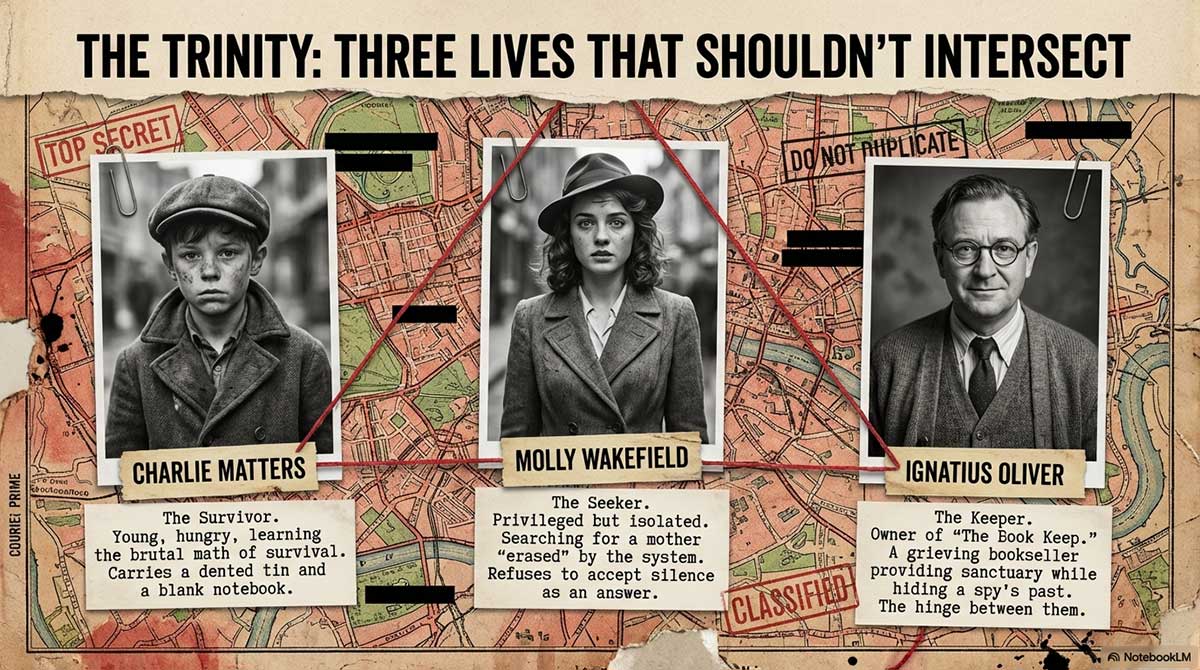
Short Bios:
David Baldacci — An American bestselling novelist known for fast-paced thrillers and high-stakes conspiracies, Baldacci blends page-turning suspense with moral questions about power, corruption, and ordinary people caught in extraordinary danger. He’s written across multiple popular series (including characters like Amos Decker, John Puller, Will Robie, and Atlee Pine) while also publishing standalone novels that lean into history, justice, and survival.
Doris Kearns Goodwin — An American historian and bestselling author known for vivid, character-driven narratives about U.S. presidents and the people around them. Her books often focus on leadership under pressure, moral choices in crisis, and how private lives shape public history—most notably in works like Team of Rivals and No Ordinary Time.
Molly Wakefield — A determined teen from a powerful family, Molly refuses to accept half-truths about her past. Brave, stubborn, and compassionate, she follows clues from London to Cornwall and back, carrying evidence that could upend dangerous secrets.
Charlie Matters — A street-smart London boy surviving on grit and instinct, Charlie becomes a telegram messenger and accidental witness to how tragedy travels. He writes to stay human, and his loyalty turns him into the story’s moral compass.
Ignatius Oliver — A guarded bookshop owner with a private history and a deep vein of grief, Ignatius quietly protects the young people drawn into his orbit. He’s the kind of man who knows the cost of secrets—and still chooses sacrifice.
Eloise Wakefield — Molly’s fragile but lucid mother, living in enforced quiet at a coastal sanatorium. Her truth is the turning key of the story: not just what happened, but who made it happen—and who benefited from silence.
Major Bryant — A hard-edged intelligence operative who speaks in plans and pressures, Bryant believes ends justify means—until the human cost becomes unavoidable. He’s both ally and threat, a man trying to control chaos without being consumed by it.
Lonzo Rossi — A predatory older teen shaped by desperation and hunger, Lonzo uses fear as currency and drags others into his schemes. He’s a reminder that war doesn’t only destroy buildings—it warps people.
Eddie — Lonzo’s anxious sidekick, Eddie follows louder cruelty to avoid being its target. His panic and vulnerability reveal the thin line between accomplice and victim when survival is the only rule.
Axmann — A calm, calculating enemy agent who moves through the city like a rumor with a face. He doesn’t need violence to be terrifying—his weapon is leverage, and his talent is making people disappear.
The Man in the Cap — A quiet fixer who watches, signals, and closes nets. More presence than personality, he represents the faceless machinery behind intimidation—proof that the most dangerous men rarely announce themselves.
Leave a Reply