
|
Getting your Trinity Audio player ready...
|
What if Flannery O’Connor wrote this story to expose how “good people” avoid seeing themselves?
Introduction by Flannery O’Connor
A Good Man Is Hard to Find has been described as violent, grotesque, and cruel. Those descriptions are accurate, but they are not the point.
I did not write this story to shock readers into despair, nor to entertain them with brutality. I wrote it to show how difficult it is to reach a soul that believes itself already good. The grandmother is not evil. She is polite, well-meaning, and sincere. She believes that being respectable is the same thing as being moral, and that belief has protected her from ever seeing herself clearly.
The story moves through a series of crucial scenes in which her assumptions are slowly stripped away. Comedy prepares the fall. Nostalgia disguises judgment. Violence removes escape. And grace—when it finally appears—does not arrive as comfort, explanation, or moral reward.
Grace is not something a character earns. It is something that interrupts.
If this story unsettles, it is because it refuses to offer goodness as a personality trait or violence as a solution. It insists instead that truth, when it comes, often does so without permission, and at great cost.
(Note: This is an imaginary conversation, a creative exploration of an idea, and not a real speech or event.)
Episode 1 - What Does “Good” Mean in a World Like This?
Manners, Memory, and Moral Illusion
Participants:
Flannery O’Connor
Ralph C. Wood
Susan Srigley
Alison Milbank
James H. Evans Jr.
Moderator:
Nick Sasaki
Opening Scene
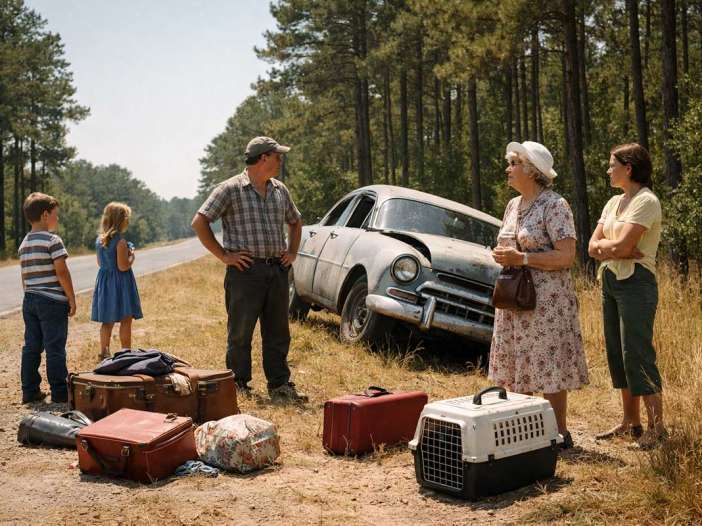
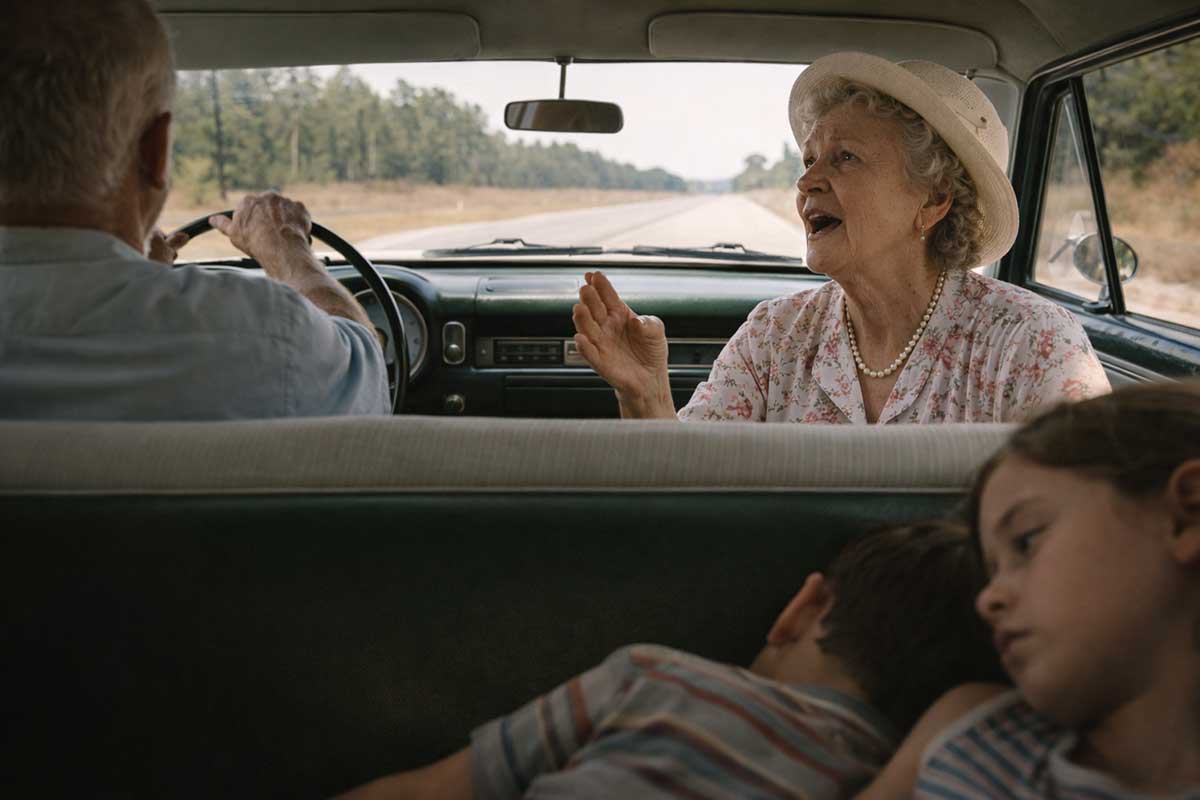
A dusty Georgia road.
A family car packed with impatience, nostalgia, and quiet irritation.
Before the violence arrives, before the Misfit is even named, the story has already decided its terms.
Nick Sasaki opens not with theology, but with language.
Nick Sasaki (Moderator)
Before anyone dies, before grace or horror enters explicitly, the grandmother keeps using one word.
Good.
She calls people good. She calls places good. She remembers a time when people were better—more polite, more respectable.
So let’s begin there.
What does the grandmother mean when she says “good”?
Ralph C. Wood
She means recognizable.
Goodness, for her, is legible. It’s about manners, social order, and familiarity. If someone looks right, speaks right, belongs to the right past—then they are good.
O’Connor shows us that this definition is not merely shallow; it’s dangerous. It mistakes surface for substance.
Flannery O’Connor
The grandmother is not immoral.
She’s worse.
She’s comfortable.
Susan Srigley
Exactly.
Her goodness is aesthetic, not ethical. It’s about feeling secure in a world that mirrors her assumptions.
What makes the story disturbing is that the grandmother is not a villain. She is ordinary. She’s kind when it costs nothing. Polite when it confirms her superiority.
Grace cannot reach her through gentleness—because gentleness reinforces her illusion.
Alison Milbank
And notice how nostalgia functions here.
The grandmother’s moral memory is backward-facing. She believes goodness lived in the past and has since decayed.
This allows her to avoid responsibility in the present. If the world has simply “gone bad,” she doesn’t have to examine herself.
James H. Evans Jr.
There’s also a racial and social dimension we shouldn’t avoid.
Her idea of goodness is bound to hierarchy. People know their place. Order is maintained. Disruption is feared.
In that sense, her morality depends on stability, not justice.
Nick Sasaki
So when she calls herself a “lady,” that’s not humility—it’s a moral credential.
Flannery O’Connor
It’s a badge.
And badges fail under pressure.
Second Question (Moderator)
Let’s sharpen this.
Is the grandmother aware that her goodness is performative—or does she genuinely believe in it?
Susan Srigley
She believes in it completely.
That’s what makes her spiritually dangerous. Hypocrisy can be corrected. Sincerity cannot.
She is not pretending to be good—she is good, according to the only framework she knows.
Ralph C. Wood
O’Connor understood that sincerity is not salvation.
The grandmother’s faith is emotional and cultural, not transformative. She believes she is on God’s side without ever asking what God might demand of her.
Alison Milbank
Her performance becomes visible only when it fails.
Notice how quickly her language collapses once violence enters the scene. Her moral vocabulary has no tools for terror. It has never needed them.
James H. Evans Jr.
And that’s the irony.
She lives in a moral world designed to protect her from ever encountering true evil—or true grace.
The Misfit shatters that insulation.
Flannery O’Connor
I never trusted goodness that had never been tested.
Final Question (Moderator)
Then let’s end here.
If the grandmother’s goodness is insufficient, what kind of goodness is the story preparing us for instead?
Ralph C. Wood
A goodness stripped of self-congratulation.
Susan Srigley
A goodness that requires vulnerability, not superiority.
Alison Milbank
A goodness that emerges only when illusions collapse.
James H. Evans Jr.
A goodness that confronts violence without denying it.
Flannery O’Connor
A goodness that hurts.
Grace is not polite.
Closing Scene
The car continues down the road.
The grandmother chatters.
The children complain.
Nothing looks wrong.
But the story has already told us the truth:
Goodness, as the grandmother understands it, will not survive what’s coming.
Episode 2 - Comedy as Moral Weapon
Why O’Connor Makes Us Laugh Before She Breaks Us
Participants:
Flannery O’Connor
William Sessions
Regina Barreca
Mikhail Bakhtin
Terry Eagleton
Moderator:
Terry Eagleton
(Here wearing the dual role intentionally—as critic and provocateur—because irony itself becomes the method)
Opening Scene
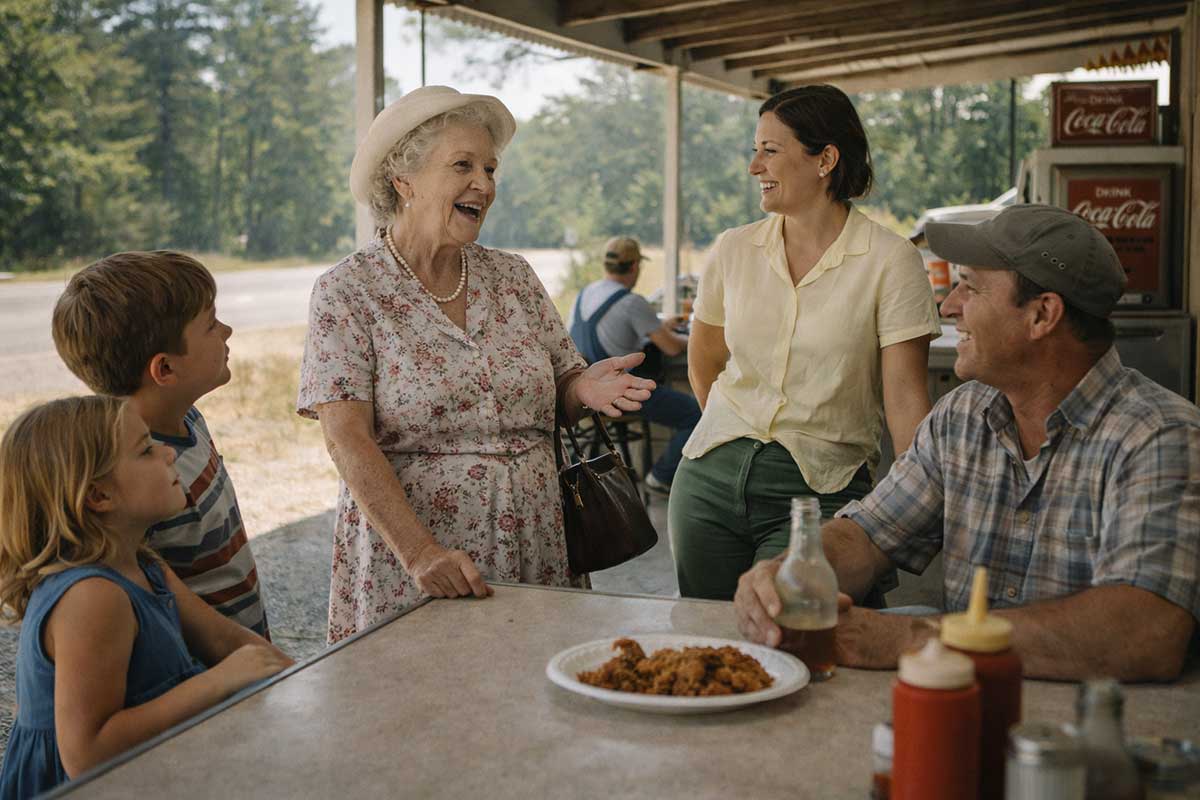
The story opens like a family comedy.
Children bicker.
The grandmother nags.
A cat causes trouble.
Nothing feels dangerous—only irritating.
The laughter is easy.
Too easy.
Terry Eagleton leans forward, already smiling, because comedy here is not decorative—it is preparatory.
Terry Eagleton (Moderator)
Flannery, readers often remember how funny this story is—until it isn’t.
So let’s start with the obvious discomfort:
Why make a story about grace and violence so deliberately comic?
Flannery O’Connor
Because people listen better when they’re amused.
And because laughter lowers defenses faster than sermons ever could.
William Sessions
O’Connor’s comedy disorients.
We expect jokes to soften meaning, but here they sharpen it. The humor creates intimacy with the characters—especially the grandmother—before exposing how shallow that intimacy is.
Comedy builds trust.
Then it betrays it.
Regina Barreca
And that betrayal matters.
The humor isn’t cruel—it’s accurate. These people are ridiculous because we recognize them. Their pettiness, nostalgia, self-importance—it’s familiar.
We laugh because we’re implicated.
Mikhail Bakhtin
This is grotesque realism at work.
The body, the family, the social order—all appear slightly exaggerated, slightly unstable. Comedy reveals hierarchy by mocking it.
The grandmother’s authority dissolves not through argument, but through ridicule.
Flannery O’Connor
I didn’t invent their foolishness.
I just refused to excuse it.
Second Question (Moderator)
Let’s press this further.
Is the humor meant to criticize the characters—or to trap the reader alongside them?
Regina Barreca
Both—but primarily the reader.
We laugh with the grandmother long before we judge her. Her complaints sound reasonable. Her nostalgia sounds charming.
By the time we realize what kind of moral world she inhabits, we’ve already entered it.
William Sessions
Exactly.
The humor delays moral seriousness. It seduces us into thinking the story is safe—manageable—familiar.
That makes the later violence not just shocking, but revelatory.
Mikhail Bakhtin
Comedy destabilizes certainty.
In carnival logic, nothing is fixed. Roles invert. Authority is exposed as provisional.
O’Connor uses humor to loosen the moral ground beneath both character and reader.
Flannery O’Connor
People expect violence to be loud.
They don’t expect it to arrive laughing.
Third Question (Moderator)
Then let me ask the hardest version of this.
Is laughter itself part of the moral problem the story exposes?
Terry Eagleton
Yes.
Laughter can anesthetize. It can turn cruelty into entertainment. But it can also expose hypocrisy more efficiently than earnest critique.
O’Connor walks that line deliberately.
Regina Barreca
And she refuses to let us enjoy our laughter.
Once the violence begins, every earlier chuckle echoes back uncomfortably. The humor retroactively condemns us.
William Sessions
Comedy becomes a moral test.
If you laughed easily, the story asks why.
Flannery O’Connor
If laughter didn’t cost something, it wouldn’t matter.
Closing Exchange
Mikhail Bakhtin: Comedy reveals truth by removing masks.
Regina Barreca: And then asking who was hiding behind them.
William Sessions: The joke is never innocent.
Terry Eagleton: Especially when belief is involved.
Flannery O’Connor: Grace often arrives disguised as insult.
Closing Scene
The family continues down the road.
The jokes linger.
The laughter hasn’t stopped—but it no longer feels harmless.
Something is coming that laughter will not survive.
Episode 3 - Violence as a Doorway to Grace

Why Grace Arrives Through Terror, Not Tenderness
Participants:
Flannery O’Connor
Karl Rahner
Rowan Williams
Paul J. Griffiths
Susan Srigley
Moderator:
Rowan Williams
(Chosen for his ability to hold violence, theology, and encounter without resolution)
Opening Scene
Gunshots echo through the woods.
One by one, family members are led away.
There is no frenzy.
No rage.
Only procedure.
The story sheds its comedy and becomes almost still.
Rowan Williams opens quietly, because any raised voice would be dishonest here.
Rowan Williams (Moderator)
Flannery, readers often stumble here.
They ask why violence must be so stark—so methodical—so unrelieved. They want the story to flinch.
So let us begin plainly:
Why does grace in this story arrive through brutality rather than mercy?
Flannery O’Connor
Because mercy would have confirmed the grandmother’s delusions.
She believed herself good already.
Gentleness would have left her untouched.
Grace is not comfort.
It is interruption.
Karl Rahner
Grace does not always arrive as consolation.
In Christian theology, grace is God’s self-communication—often experienced as disorientation before it is peace.
The grandmother’s world must be stripped away before she can encounter anything real.
Violence is not grace—but it is the condition that removes her defenses.
Susan Srigley
Exactly.
The story does not glorify violence. It uses it.
O’Connor understood that some souls are armored by politeness, nostalgia, and moral certainty. Nothing penetrates those defenses gently.
The grandmother is not softened into grace. She is shattered into it.
Paul J. Griffiths
And we must be careful here.
Grace does not justify violence. But literature can stage violence as revelatory without endorsing it.
The Misfit is not a sacrament.
He is an occasion.
Flannery O’Connor
I never said grace was safe.
I said it was free.
Second Question (Moderator)
Let’s sharpen the tension.
Does the grandmother change because of violence—or because she finally sees another human being clearly?
Rowan Williams
This is crucial.
The violence clears the ground—but recognition completes the encounter.
Her final words are not moral arguments. They are relational.
She sees the Misfit not as a category—criminal, outsider, monster—but as a person.
That recognition is grace’s doorway.
Karl Rahner
Grace often emerges at the edge of human limitation.
When all strategies fail—status, manners, memory—what remains is naked encounter.
That is where the grandmother finally stands.
Susan Srigley
And notice how late it comes.
Not after the first gunshot.
Not after fear begins.
Only when nothing else works.
That delay is essential. Grace is not reflexive.
Paul J. Griffiths
Her gesture is not redemption earned.
It is exposure.
She reaches toward him not as a lady, not as a superior, not as a moral judge—but as a fellow creature.
Flannery O’Connor
She had to be wrong about everything before she could be right about one thing.
Third Question (Moderator)
Then let us ask what unsettles readers most.
Is the grandmother’s final moment genuine grace—or desperate self-preservation?
Susan Srigley
It is genuine precisely because it is not useful.
It does not save her.
It does not persuade the Misfit.
It does not restore order.
Grace that works is suspicious.
Karl Rahner
Grace is not outcome-oriented.
It is presence.
Even a momentary alignment with truth is real—even if it costs everything.
Paul J. Griffiths
Desperation can still be honest.
Fear does not negate authenticity. In many cases, it makes honesty possible for the first time.
Rowan Williams
The ambiguity is not a flaw.
It is the point.
If the moment were clean, we would domesticate it.
Flannery O’Connor
I wasn’t interested in proving she was saved.
I was interested in showing that she stopped pretending.
Closing Scene
The grandmother lies still.
The woods are quiet again.
The violence has ended—but something irreversible has occurred.
Not redemption.
Not explanation.
Recognition.
Episode 4 - The Misfit: Evil, Honesty, or Mirror?

Why the Most Terrifying Character Might Be the Most Truthful
Participants:
Flannery O’Connor
Hannah Arendt
Charles Taylor
René Girard
James Alison
Moderator:
René Girard
(Chosen because this story sits precisely at the crossroads of violence, scapegoating, and moral revelation)
Opening Scene
The woods are quiet.
The Misfit speaks calmly.
He reasons.
He remembers.
He explains himself more clearly than anyone else in the story.
René Girard opens slowly, because haste would miss the danger here.
René Girard (Moderator)
Flannery, readers often expect villains to lie or rage.
But the Misfit does neither.
So let us begin plainly:
Is the Misfit evil—or is he simply the only honest character in the story?
Flannery O’Connor
He’s honest about one thing.
He knows the rules no longer work.
Hannah Arendt
What makes the Misfit unsettling is not cruelty—it’s coherence.
He reasons from premises to conclusions. His logic is consistent. That’s what removes the comfort of dismissing him as insane.
He represents moral reasoning stripped of social camouflage.
Charles Taylor
Yes—and he exposes the fragility of inherited moral frameworks.
The grandmother’s goodness is borrowed from culture. The Misfit has interrogated belief until nothing remains but choice.
He inhabits a world where meaning must justify itself—or be abandoned.
James Alison
From a Girardian perspective, the Misfit is someone who has stepped outside sacrificial illusion—but without mercy.
He sees that violence is arbitrary. He sees that punishment is inconsistent. But instead of rejecting violence, he embraces its logic without pretending it redeems anything.
That honesty is terrifying.
Flannery O’Connor
He’s not a theologian.
He’s what happens when belief collapses and nothing replaces it.
Second Question (Moderator)
Let me sharpen this.
Does the Misfit function as a moral mirror for the grandmother—and for us?
René Girard
Absolutely.
The Misfit externalizes what polite society hides. He acts openly on impulses others suppress or outsource.
The grandmother lives comfortably because others absorb violence on her behalf—through prisons, executions, exclusions.
The Misfit refuses that distance.
Hannah Arendt
This aligns with what I called the banality of evil—but inverted.
The Misfit is not banal. He is reflective. And that reflection forces others to confront their moral laziness.
He does not claim innocence. He claims clarity.
Charles Taylor
He strips morality of sentiment.
Once belief becomes optional, goodness must be chosen consciously—or it evaporates. The Misfit chooses consistency over comfort.
That choice is horrifying—but intelligible.
Flannery O’Connor
He doesn’t enjoy killing.
He just doesn’t see a reason not to.
Third Question (Moderator)
Then here is the hardest question.
Is the Misfit closer to grace than the grandmother before her final moment?
James Alison
In a strange sense, yes.
Grace requires truth before it offers transformation. The Misfit tells the truth about the emptiness of violence—even as he commits it.
He says plainly: “It’s no real pleasure.”
That sentence matters.
Hannah Arendt
But clarity is not redemption.
Understanding does not absolve responsibility. The Misfit knows exactly what he is doing—and that knowledge condemns him more deeply.
Charles Taylor
Still, his refusal to lie about meaning makes him morally legible in a way the grandmother is not—until the very end.
Flannery O’Connor
He’s not saved.
But he’s awake.
And being awake in a broken world is dangerous.
Closing Scene
The Misfit wipes his glasses.
He speaks softly.
He walks away unchanged—yet disturbed.
Not by guilt.
By recognition.
Episode 5 - The Final Gesture
Why the Grandmother’s Touch Matters—and Why It Cannot Be Explained Away
Participants:
Flannery O’Connor
Marilynne Robinson
Paul Ricoeur
Stanley Hauerwas
Sarah Coakley
Moderator:
Paul Ricoeur
(Chosen to examine meaning without closing it)
Opening Scene
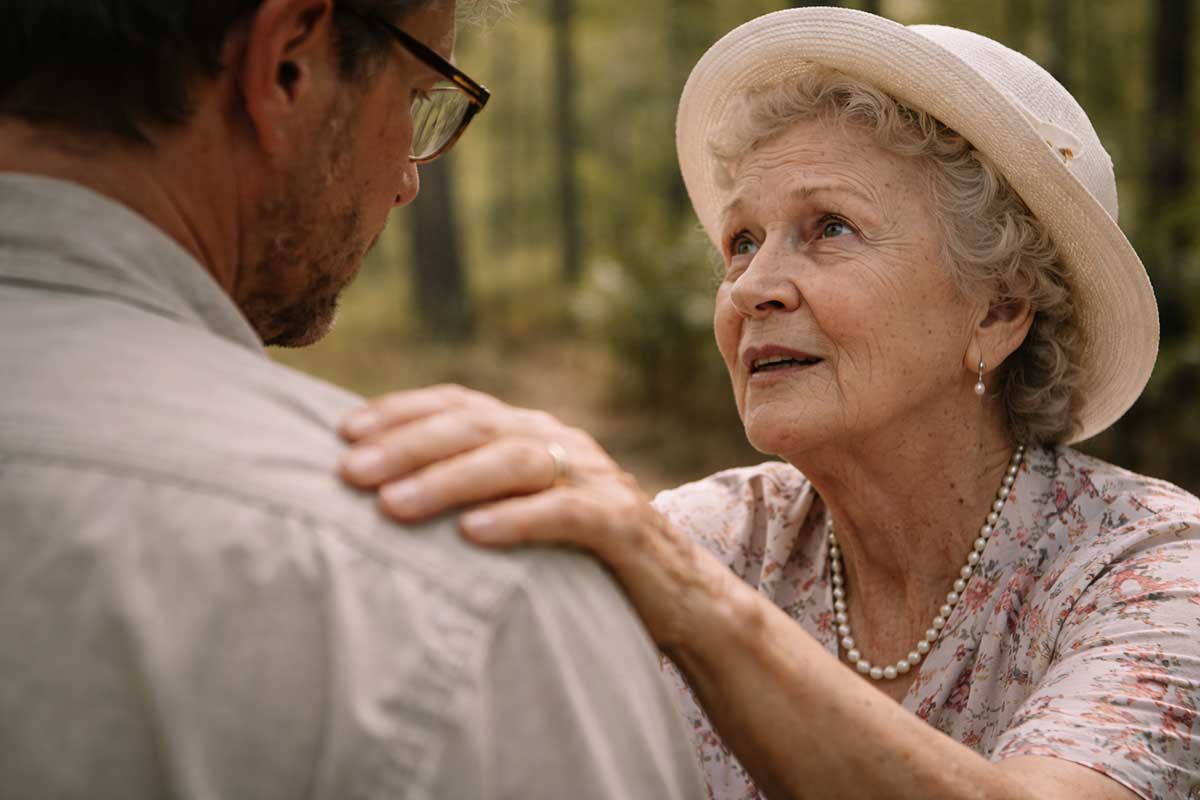
The grandmother reaches out.
Her hand touches the Misfit’s shoulder.
No sermon.
No argument.
No moral defense.
Just a gesture.
Paul Ricoeur opens carefully, because here, language fails before meaning does.
Paul Ricoeur (Moderator)
This moment divides readers.
Some see grace.
Others see panic.
Others see manipulation.
So let us begin with the simplest, hardest question:
What is the grandmother’s final gesture—before we decide what it means?
Flannery O’Connor
It’s not a strategy.
She has no strategies left.
Marilynne Robinson
That’s the key.
The gesture is uncalculated. It isn’t persuasive. It doesn’t protect her. It doesn’t even delay violence.
In that sense, it is free of usefulness—and therefore morally significant.
Stanley Hauerwas
I would add this: the gesture is not virtuous in the ethical sense.
It does not emerge from habit, character, or moral formation. It emerges from collapse.
And that matters, because grace does not require preparation—only truth.
Sarah Coakley
And vulnerability.
The grandmother’s power evaporates entirely in this moment. Her class, her nostalgia, her sense of being “a lady”—all of it falls away.
What remains is naked relationality.
Touch becomes the only language left.
Flannery O’Connor
She finally sees him.
Not as criminal.
Not as evil.
Not as category.
As kin.
Second Question (Moderator)
Let us deepen this.
Is the gesture authentic grace—or simply desperation at the edge of death?
Stanley Hauerwas
Desperation does not invalidate grace.
The Gospel is full of desperate encounters. Grace often arrives where dignity has already collapsed.
The modern desire to separate authenticity from fear misunderstands human reality.
Marilynne Robinson
Exactly.
We tend to demand that moral beauty appear calm and composed. But the Bible is full of trembling saints.
Fear does not negate sincerity—it reveals it.
Sarah Coakley
And the body matters here.
The grandmother does not say grace. She touches.
Touch is risky. It exposes. It crosses boundaries without permission.
That risk is precisely why the gesture carries weight.
Paul Ricoeur
Narratively, this is an act without explanation.
The story does not interpret the gesture for us. It simply records it.
Meaning is not declared—it is entrusted to the reader.
Flannery O’Connor
If I explained it, I’d ruin it.
Third Question (Moderator)
Then let us ask what readers resist most.
Why does this moment make so many people angry or uncomfortable?
Stanley Hauerwas
Because it denies moral accounting.
Readers want the grandmother to earn grace—or the Misfit to reject it cleanly.
This moment refuses both.
Marilynne Robinson
It also challenges our sense of fairness.
We want goodness to appear consistently across a life, not flicker once at the end.
O’Connor suggests that one honest moment can outweigh a lifetime of illusion.
That is unsettling.
Sarah Coakley
And because it implicates us.
If grace can appear in someone we find irritating, shallow, or morally unserious—then we lose the comfort of distance.
Flannery O’Connor
People don’t object to grace.
They object to who gets it.
Closing Exchange
Paul Ricoeur: Meaning does not close here—it opens.
Stanley Hauerwas: Grace is not a reward.
Sarah Coakley: Vulnerability is its doorway.
Marilynne Robinson: Mercy resists explanation.
Flannery O’Connor: And sentimentality ruins it every time.
Closing Scene
The grandmother lies still.
The Misfit steps back.
He wipes his glasses.
He says there’s no real pleasure in life.
And for a brief moment, the world has told the truth—without resolving it.
Final Thoughts by Flannery O’Connor
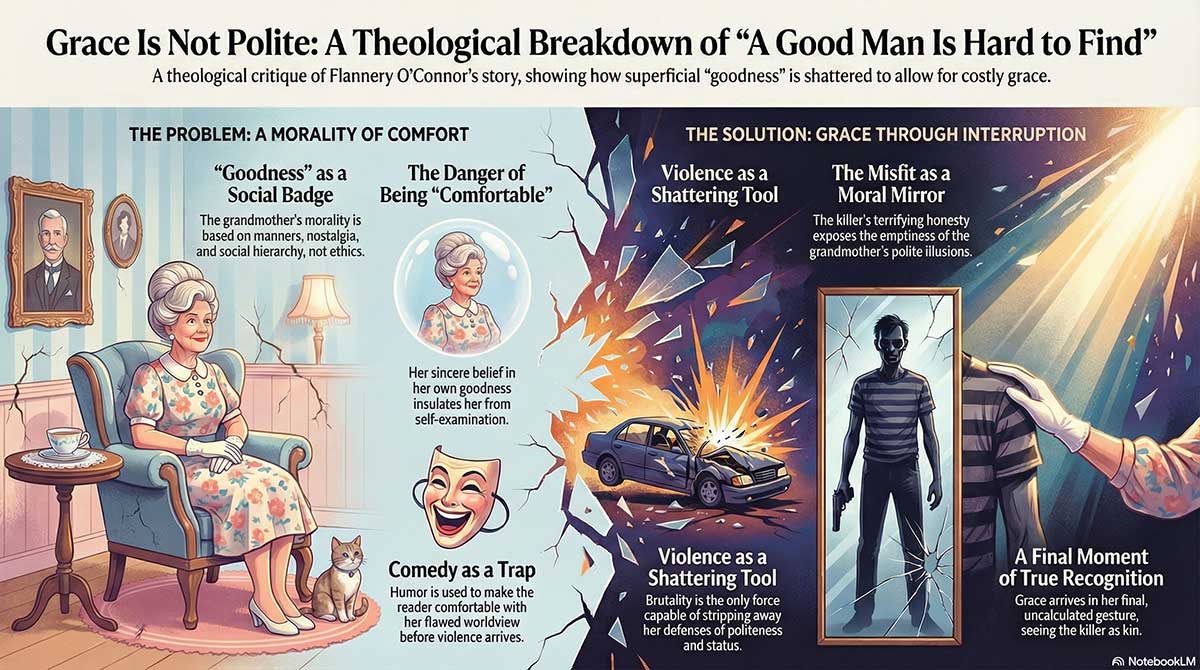
Readers often ask whether the grandmother is saved.
That question misunderstands the story.
The grandmother’s life is not redeemed by a single moment, nor is her past erased. What matters is that, at the end, she stops lying—to herself most of all. She no longer hides behind manners, memory, or moral superiority. For one brief moment, she sees another human being as kin, and she responds without calculation.
That moment does not stop the violence. It does not reform the Misfit. It does not restore order. Grace does not promise results. It promises only truth.
The Misfit understands this better than most. He knows that violence brings no pleasure, no meaning, no salvation. He is not redeemed, but he is honest. In a world built on polite illusion, honesty itself becomes dangerous.
If the story leaves you uncomfortable, that discomfort is intentional. Sentimentality is the enemy of moral vision. Politeness often stands between us and reality. And grace, when it comes, rarely arrives gently.
It comes like a shock to the system.
And then it passes, leaving us to decide whether we will pretend it never happened—or whether we have seen something we cannot unsee.
Short Bios:
Flannery O’Connor
American writer and essayist whose Southern Gothic fiction fused dark comedy, violence, and Catholic theology. Her stories confront grace as interruption rather than comfort.
Nick Sasaki
Founder of ImaginaryTalks and moderator of literary and philosophical dialogues. He guides conversations toward moral tension, ambiguity, and lived meaning rather than summary.
Ralph C. Wood
Literary scholar and theologian known for his definitive work on Flannery O’Connor. His writing explores the intersection of Christian belief, violence, and modern literature.
Susan Srigley
Scholar of Catholic literature specializing in Flannery O’Connor, Simone Weil, and the theology of grace under extreme conditions. She focuses on violence as revelatory rather than redemptive.
Alison Milbank
Theologian and literary critic whose work examines narrative, irony, and moral imagination. She bridges Christian theology with close literary reading.
James H. Evans Jr.
Ethicist and theologian focusing on moral formation, social power, and the Black religious tradition. His work highlights how inherited moral frameworks shape behavior.
William Sessions
Literary critic known for his studies of Flannery O’Connor’s humor and narrative strategy. He analyzes comedy as a tool of moral exposure rather than relief.
Regina Barreca
Cultural critic and scholar of humor, gender, and irony. Her work examines how comedy reveals cruelty, power, and social hypocrisy.
Mikhail Bakhtin
Russian philosopher and literary theorist best known for concepts of the carnivalesque and grotesque realism. His ideas illuminate how humor destabilizes authority and moral certainty.
Terry Eagleton
British literary theorist and cultural critic whose work blends Marxism, theology, and irony. He is known for exposing how belief systems operate beneath narrative form.
Karl Rahner
Influential Catholic theologian whose work centers on grace as God’s self-communication under conditions of human limitation, crisis, and uncertainty.
Rowan Williams
Theologian, poet, and former Archbishop of Canterbury. His writing explores violence, vulnerability, and encounter without reducing them to moral formulas.
Paul J. Griffiths
Catholic theologian and philosopher focusing on suffering, narrative, and moral responsibility. His work resists sentimental readings of violence and redemption.
Hannah Arendt
Political theorist known for her analysis of moral responsibility, evil, and thoughtlessness. Her work interrogates how ordinary moral frameworks fail under pressure.
Charles Taylor
Philosopher of modern identity and moral frameworks. His work examines how belief, meaning, and selfhood fracture in secular modernity.
René Girard
Philosopher and anthropologist best known for mimetic theory and the scapegoat mechanism. His work reveals how violence underwrites social order.
James Alison
Theologian working in the Girardian tradition, focusing on desire, violence, and grace. He emphasizes truth-telling as the first step toward transformation.
Marilynne Robinson
Novelist and essayist whose work explores grace, dignity, and moral attention in ordinary lives. She writes against cynicism and moral simplification.
Paul Ricoeur
Philosopher of interpretation and narrative identity. His work examines how meaning emerges through gesture, story, and unresolved ambiguity.
Stanley Hauerwas
Christian ethicist known for rejecting sentimental morality and emphasizing truthfulness, suffering, and community over moral success.
Sarah Coakley
Theologian and philosopher whose work centers on vulnerability, embodiment, and power. She explores how spiritual transformation arises through surrender rather than control.
Leave a Reply