
|
Getting your Trinity Audio player ready...
|
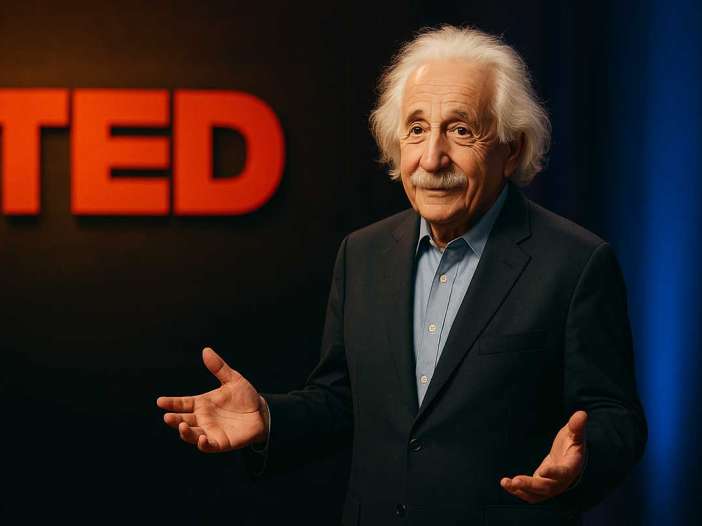
Introduction by Nick Sasaki
When we imagine the thinkers who shaped the modern world, we often think of equations, theories, and chalkboards covered in symbols the rest of us can barely understand. Yet behind one of the greatest scientific revolutions in human history stood a man whose deepest fascination was not numbers, but meaning. Albert Einstein did not only ask how the universe works; he asked why it holds together at all. He sought harmony where others saw chaos, unity where others saw fragments, and purpose where others saw chance.
Today, as we navigate an era overflowing with information but starved for understanding, we find ourselves in a peculiar place: our tools have outgrown our wisdom. Technology races ahead, while human connection struggles to keep pace. Data multiplies, but insight thins. We have linked billions of people across the world, yet often feel more divided than ever.
It is precisely at such a crossroads that Einstein’s voice becomes not only relevant, but necessary. He reminds us that the world is not built from separate parts, but from relationships. That every atom, every star, every thought, every act of kindness is woven into one coherent whole. And he challenges us to consider a possibility that sounds simple but requires tremendous courage: that the boundaries we guard so fiercely are illusions, and the unity we fear is the deeper truth.
Tonight, we welcome a mind whose curiosity reshaped our understanding of space and time, and whose humanity continues to illuminate the path ahead. A man who believed that imagination is not an escape from reality, but a responsibility to envision what reality could become. A man who invites us, even now, to think not only more clearly, but more compassionately.
It is my honor to introduce Albert Einstein.
(Note: This is an imaginary conversation, a creative exploration of an idea, and not a real speech or event.)
Why Our Future Depends on Empathy, Imagination, and the Unity of All Things
My friends,
When I look at the world you inhabit in 2025, I am struck by something very old and something very new. The old part is the human heart: its longing for connection, its fear of loss, its desire to make sense of existence. The new part is the immense power you now wield — power to shape the planet, to alter life itself, to build minds made of silicon, and to link billions of people in one vast electronic net.
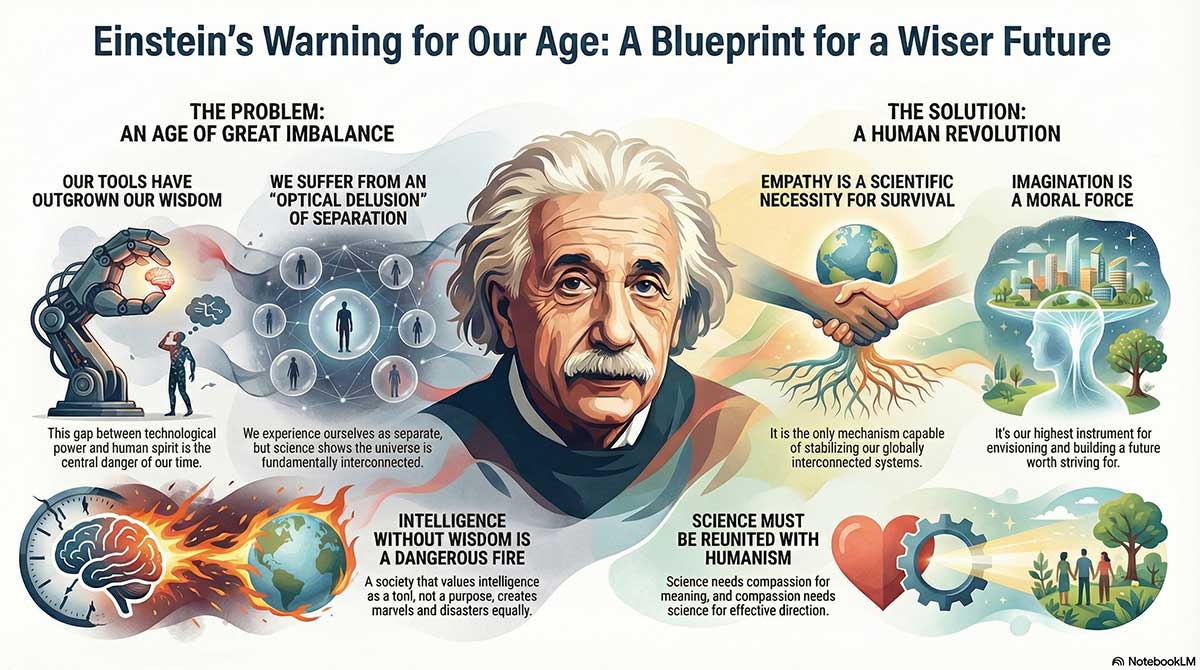
What troubles me is not your power, but the foundations on which you place it. The tools of this age have grown immeasurably faster, while the wisdom of the human spirit has struggled to keep pace. This imbalance is the central danger of your time. And yet, it is also your greatest invitation.
People often imagine that physics speaks only of cold facts and mathematical certainties. But when I explored the nature of light, time, and space, I was not searching for equations — I was searching for a deeper harmony. I wanted to know why the universe is orderly, why it is intelligible, why beauty appears in its laws, and why consciousness is able to grasp it.
And today, I want to speak about this harmony again, because your world is in danger of forgetting it.
I. The Illusion of Separation
One of the greatest misunderstandings of the modern age is the belief that things exist independently. You speak of nations as if they were islands, of individuals as if they were isolated minds, of nature as if it were a resource separate from you. But physics tells a different story.
Space and time are woven together.
Energy and matter are interchangeable.
Your actions ripple through invisible fields.
Your lives are bound in chains of cause and effect stretching far beyond your perception.
And perhaps most importantly:
The observer and the observed cannot be neatly separated.
This is not mysticism. This is science at its most rigorous.
When you grasp this, something profound follows:
the divisions you cling to — race, nation, ideology, class — are not fundamental realities; they are convenient fictions. They help you organize the world, but they do not describe the universe as it truly is.
The universe is relational.
Life is relational.
Consciousness is relational.
And to behave as if this were not true is to invite suffering.
Today, as I watch the widening polarization of your societies, I am reminded of a phrase I once wrote: “A human being is a part of the whole, limited in time and space. He experiences himself, his thoughts and feelings, as something separated from the rest — a kind of optical delusion of consciousness.”
That optical delusion has grown stronger in your time. And the only cure for it is a shift in perception — not a technological revolution, but a human one.
II. Empathy as a Scientific Necessity
In the past, people believed empathy was a moral luxury, an act of kindness one offered when one felt generous. But in your age, empathy is no longer optional. It is necessary for survival.
Why?
Because your world is now so connected that every local action has global consequences. When a forest disappears, economies shift. When misinformation spreads, democracies tremble. When hatred grows in one corner of the internet, it can ignite fires continents away.
Empathy is the only mechanism capable of stabilizing systems this interconnected.
It is not just a moral ideal — it is a structural requirement.
In physics, we speak of equilibrium.
In biology, of homeostasis.
In societies, empathy plays the same role.
Without it, systems collapse.
You now live in a civilization where the capacity to understand another’s perspective may be as important as the capacity to understand an equation. The survival of your species will depend not only on intelligence, but on compassion with precision, empathy that is deliberate and cultivated.
The tools of your age — artificial intelligence, genetic engineering, instantaneous communication — will either amplify your highest qualities or your lowest. They do not choose. You do.
III. The Limits of Intelligence Without Wisdom
You have built machines that can calculate faster than any mind in history, that can detect patterns invisible to human thought, that can compose music, diagnose illness, and write poetry. But there is something they cannot do, and may never do:
they cannot decide why any of these things matter.
A society that treats intelligence as its highest virtue will create marvels and disasters in equal measure. Intelligence is a tool, not a purpose. Wisdom is the purpose.
When I worked on the formulation of relativity, I was driven by curiosity and joy, not ambition. But when I later witnessed the atomic bomb — a weapon whose possibility I had helped illuminate — I realized that knowledge without wisdom is a fire that burns whatever lies in its path.
Your world stands again at such a threshold.
Your technologies mirror your consciousness. If your spirit is fragmented, your tools will fragment the world. If your spirit evolves, your tools will help build something extraordinary.
You must therefore ask a fundamental question:
Are you guiding technology, or is technology guiding you?
This is not a technical question. It is a philosophical one.
IV. Imagination: Humanity’s Highest Instrument
Many quoted me as saying, “Imagination is more important than knowledge.” I meant it then, and I mean it now. Knowledge is limited by what has already been discovered. Imagination is limited only by what the mind allows itself to conceive.
But I want to expand upon something I never said explicitly:
Imagination is also a moral force.
It allows you to see a world that does not yet exist —
a world where nations cooperate,
where technology uplifts rather than controls,
where young people grow into wisdom rather than anxiety,
where the planet is not exploited but cherished.
Such worlds are not fantasies; they are blueprints.
Everything humanity has ever built — every bridge, every society, every cathedral, every scientific theory — began as an act of imagination.
And imagination can also reveal the dangers ahead. It can warn you when your path is unsteady.
The tragedy of your time is not that people lack information, but that they lack the imaginative courage to envision a future worth striving for.
Hope is not a mood; it is a skill.
V. A New Scientific Humanism
If I were to offer one message for your century, it is this:
Science must be reunited with humanism.
Science without compassion leads to efficiency without meaning.
Compassion without science leads to optimism without direction.
The future requires both.
You live in an era where many fear that technology will dehumanize you. But I see a different possibility: that technology, when guided by wisdom, could free you from fear, from scarcity, from ignorance — and give you time to cultivate the inner life, the life of thought and connection.
But this will not happen automatically. You must choose it.
Science can describe the universe, but it cannot tell you how to live within it. That responsibility belongs to you.
I leave you, then, with a simple idea:
There is no separate self.
There is no separate nation.
There is no separate future.
The universe is one vast web of relations — and so are you.
The moment humanity understands this not merely with the mind, but with the heart, your era will begin anew.
VI. The Invitation of Your Century
I look at your world and I see fear, yes. But I also see potential — potential unlike anything in history. Never before has one generation held so much power over the destiny of the planet.
This should not frighten you.
It should awaken you.
You must become conscious of the forces you shape.
You must become aware of the stories you are telling.
You must become responsible for the meanings you create.
If you accept that challenge, your technologies will not divide you — they will elevate you. Your nations will not compete for survival — they will cooperate for flourishing. Your people will not be prisoners of their illusions — they will be participants in the unfolding of a wiser age.
But you cannot wait for this transformation.
You must begin it.
VII. Closing Reflection
In the quiet of my life, I spent countless hours contemplating the nature of reality. I studied the movement of light, the curvature of space, the dance of gravity. But the older I became, the more I realized that the greatest mystery was not the cosmos — it was the human heart.
The universe is beautiful, but also vast and indifferent.
You are the ones who bring meaning into it.
You are the ones who create justice or injustice.
You are the ones who choose whether the future is enlightened or dark.
The cosmic order gives you structure.
Your compassion gives the structure purpose.
Your imagination gives it direction.
Your courage gives it life.
So I leave you today with a thought that has guided me for many years:
A new type of thinking is essential if humanity is to survive and move toward higher levels.
That type of thinking begins here, in your perception of yourselves and of one another. It begins when you understand that the boundaries you defend so fiercely are shadows, while the unity that frightens you is the deeper truth.
The universe is one.
And so are you.
Use that truth wisely.
Use it bravely.
Use it to build a century worthy of the human spirit.
Thank you.
Final Thoughts by Nick Sasaki
Listening to Einstein speak tonight, I felt something that is increasingly rare in our world: the quiet certainty that wisdom still matters. Not cleverness, not speed, not noise — but wisdom. The kind that asks us to slow down, to look more deeply, and to recognize the invisible threads holding all things together.
We often treat the problems of our age as technical puzzles, as if better algorithms or stronger systems could save us from ourselves. But Einstein reminds us that the real crisis is not mechanical but perceptual. It is the way we see one another — or fail to. It is the illusion that we stand alone, that our fates are separate, that our stories do not intersect. From that illusion comes fear, division, and the slow erosion of empathy.
Einstein calls us back to a truth both beautiful and demanding: we are interconnected at every level, from the physical to the spiritual. Our choices ripple outward. Our actions shape environments we cannot see. And the future we inherit will be the result of what we choose to imagine together today.
What I take away from his message is not just a scientific insight, but a moral invitation: to ground our intelligence in compassion, to match our innovations with responsibility, and to let imagination serve not only what we can build, but who we become. For if imagination is truly our greatest instrument, then the world ahead depends on how bravely we use it.
Einstein reminds us that the universe is coherent, relational, alive with possibility — and so are we. Our task is to awaken to that coherence, to rise to that possibility, and to live as if we are what we have always been: one human family, learning how to create a future worthy of the gift of consciousness.
If tonight felt like the opening of a doorway, it is because Einstein has shown us what lies beyond it. The next step is ours.
Short Bios:
Albert Einstein
Albert Einstein was a theoretical physicist whose insights reshaped modern science and deepened humanity’s understanding of the universe. His work on relativity, quantum theory, and the nature of light transformed physics, while his moral voice championed peace, unity, and the responsibility of human beings to use knowledge wisely.
Nick Sasaki
Nick Sasaki is the creator of ImaginaryTalks.com, a platform where history’s most influential voices are reimagined to address the challenges and possibilities of the modern world. His work blends philosophy, spirituality, and creative dialogue to inspire deeper reflection and global unity.
Leave a Reply