

|
Getting your Trinity Audio player ready...
|

Anne Frank:
When I began writing in my diary, I did not know if anyone would ever read my words. I wrote to survive, to give my fear a place smaller than myself. My diary was my friend, my voice, my proof that I still belonged to life even while death knocked at our door.
I once believed my story belonged only to the past, to an attic sealed in silence. But sitting here with you, a child of war in today’s world, I see my diary was never finished. It continues in your notebook, in your tears, in your trembling words written in the dark.
We are two children separated by time, yet our voices echo the same: we write to remember the stars when the night is too heavy, we write to dream when the world denies us daylight. Our innocence is not weakness. It is the strongest truth humanity has left.
Let us open our diaries together, and let the world listen — not to history repeating itself, but to the children who will not be silenced.
(Note: This is an imaginary conversation, a creative exploration of an idea, and not a real speech or event)

Scene 1: The Meeting of Two Diaries

The silence between worlds is soft, like the stillness before a page is turned. Out of this hush, Anne Frank appears, clutching the familiar red-and-white diary that once hid under her mattress in the Secret Annex. Its cover glows faintly, as though the words inside still breathe.
Across from her sits a child, no older than twelve, their hair unkempt, their clothes dusted with the ash of collapsed walls. In their lap rests a notebook — torn, bent at the corners, its pages stained by rain, smoke, and hurried scribbles in the dark.
Their eyes meet. Both hold books that were never meant to survive.
Anne smiles gently, her voice warm despite the sorrow carried in it. “I see you write, too. May I ask… what do you keep inside?”
The child looks down at the notebook, pressing it against their chest as though afraid it might be taken away. “I write my fears,” they whisper. “And my dreams. Sometimes… I write because it’s the only place I feel safe.”
Anne’s breath catches. Her hand tightens on her diary. “That is why I wrote, too.”
First Pages
They both open their books. Anne turns to her first entries, ink smudged by time but still alive with the voice of a girl trapped in hiding. She reads a line softly: “I can shake off everything if I write; my sorrows disappear, my courage is reborn.”
The child lowers their eyes to their own notebook. Their handwriting is uneven, letters scrawled between interruptions of fear. They whisper, “The first thing I wrote was, ‘When the bombs fall, I think the world has ended. But when it is quiet, I pretend it is morning again.’”
Anne’s eyes glisten. She closes her diary gently, as though cradling a fragile friend. “Do you see? Our first words… they are not so different. We both wrote to hold on to the morning, even when the night was louder.”
The child nods, tears blurring their sight. “When I write, I almost forget the sound of sirens. It’s like building a house with words when the real one is gone.”
The Weight of Paper
Anne runs her fingers across the worn cover of her diary. “Do you know, I often wondered if my words would matter? I wrote to someone who wasn’t there — I called her Kitty — just to feel less alone. My diary became my friend, my secret listener.”
The child holds their notebook tighter, speaking through trembling lips. “I don’t have Kitty. But I pretend the pages can hear me. I tell them about my brother, who is missing. About my school, that no longer stands. About the way the stars still shine even when everything below burns.”
Anne leans forward, her eyes wide with recognition. “Yes. That is it. That is what makes diaries sacred. They are where we keep our stars.”
The child looks at her, startled by the thought. “Even when no one else listens, the page does?”
Anne smiles softly, a tear slipping free. “Yes. The page always listens. And sometimes, that is enough to keep hope alive.”
Innocence Shared
The space around them shimmers as their words begin to echo, rising faintly like whispers carried on the wind. The mother tongue of one is Dutch, the other Arabic, yet in this place the words understand each other without translation.
Anne tilts her head, studying the child. “Tell me… did you ever write about small things? About laughter, or games, even when it seemed foolish?”
The child nods slowly. “I wrote once about chasing a kite in the street, before the planes came. I wrote about wanting to eat ice cream, and how I still dream of it when I am hungry.”
Anne laughs softly through tears. “Yes! I wrote about birthdays, about wanting to dance, about silly quarrels with my sister. Those things felt small, but in truth, they were the biggest. They were reminders that we were still children, even in war.”
The child wipes their eyes, their voice cracking. “So we are alike? Even though you lived so long ago, even though your war was not mine?”
Anne nods firmly, her hands closing around the diary. “Yes. Our worlds are different, but our innocence was the same. And innocence is what wars cannot destroy. It hides in laughter, in dreams, in the words we write to remember we are still human.”
The silence that follows is heavy, but not empty. It carries the weight of two notebooks — one hidden in an attic, one carried through rubble — and the voices of children who should never have had to write such things.
Anne reaches out her hand, palm open. The child places their small hand in hers, clutching the notebook with the other. For a moment, the two diaries glow side by side, as though they recognize each other.
Anne whispers, her voice breaking, “We are not alone, are we?”
The child shakes their head. “No, we never were.”
And in that trembling recognition, their words begin to stitch themselves together — across years, across wars, across the endless ache of childhood cut short.
Scene 2: Fear in the Shadows

The glow around them shifts, growing dimmer. Shadows lengthen across the floor of their meeting place, until it feels as though both are back inside the walls they once feared. Anne looks upward instinctively, as if expecting footsteps above her head. The child flinches at the echo of distant thunder, though no storm is there.
Anne hugs her diary to her chest. “In the annex, silence was the only way to live. Even the sound of my own breathing frightened me sometimes. One cough, one dropped spoon, one step too loud — it could mean the end.”
The child lowers their gaze, pressing a hand against the cracked spine of their notebook. “For me, silence means danger too, but in a different way. When the planes stop circling, when the bombs pause, I know they are coming back. I hold my breath and wait for the shaking walls.”
They look at one another, and in their shared silence is the recognition of a fear children should never have known.
The Walls and the Sky
Anne closes her eyes, remembering. “I would lie awake at night, listening for the creak of the stairs. I imagined soldiers climbing, each step louder than thunder in my chest. Even whispers felt like screams. My greatest fear was the sound of boots stopping outside our door.”
The child’s voice trembles. “My fear is the sky. When the sirens sound, we run. Sometimes there is no shelter left. We press against walls, but the walls fall too. My ears ring with explosions, and I wonder if the next one will take us.”
Anne shakes her head slowly, tears welling. “So for me, fear was footsteps. For you, it is the sky. Different shadows, but the same terror pressing down.”
The child swallows hard. “I write about the way the ground shakes. I write about my mother covering me with her body, the way she whispers prayers while I cry. Her heartbeat is all I hear, and I think — maybe it will stop, maybe both of ours will stop together.”
Anne clasps her hands tightly. “I know that heartbeat. I listened to mine in the dark, just to remind myself I was still alive.”
Night Without Stars
The shadows deepen. Above them, the illusion of a night sky appears, but there are no stars — only a heavy darkness, pressing close. Anne gazes upward and shivers. “I used to dream of stars, but in hiding, I could not see them. I longed for one glimpse of the open night. To me, the dark was not just the absence of light. It was the weight of being forgotten.”
The child stares into the same black sky. “We see the stars sometimes, but they are drowned out by fire. Rockets streak across the night, brighter than constellations. I write about the stars so I can remember they belong to the sky, not to war. But sometimes I forget.”
Anne leans closer, her voice soft. “Even in darkness, the stars are still there. I told myself that again and again. Perhaps that is what we both wrote — not just what frightened us, but what we longed to see again.”
The child nods slowly, their tears glistening in the dimness. “I want to believe the stars are waiting for me too.”
Shared Silence
They sit together, the shadows pressing in around them, each remembering nights that seemed endless. For Anne, the dread of the annex, every whisper magnified by fear. For the child, the roar of bombs, the silence after, the waiting for the next strike.
Anne reaches out, placing her hand gently on the child’s shoulder. “Fear makes us small, but writing made me bigger than fear. I could not stop the soldiers, but I could speak to myself. And speaking kept me alive inside.”
The child nods, clutching their notebook tightly. “That is why I write too. So the fear does not swallow me whole. I write, and for a moment, the walls do not fall, the sky does not burn.”
They hold their notebooks side by side, two fragile shields against the shadows. The air trembles, but the silence between them is no longer empty. It is a silence filled with the courage of two children who refused to let fear erase their voices.
Scene 3: Dreams That Refuse to Die
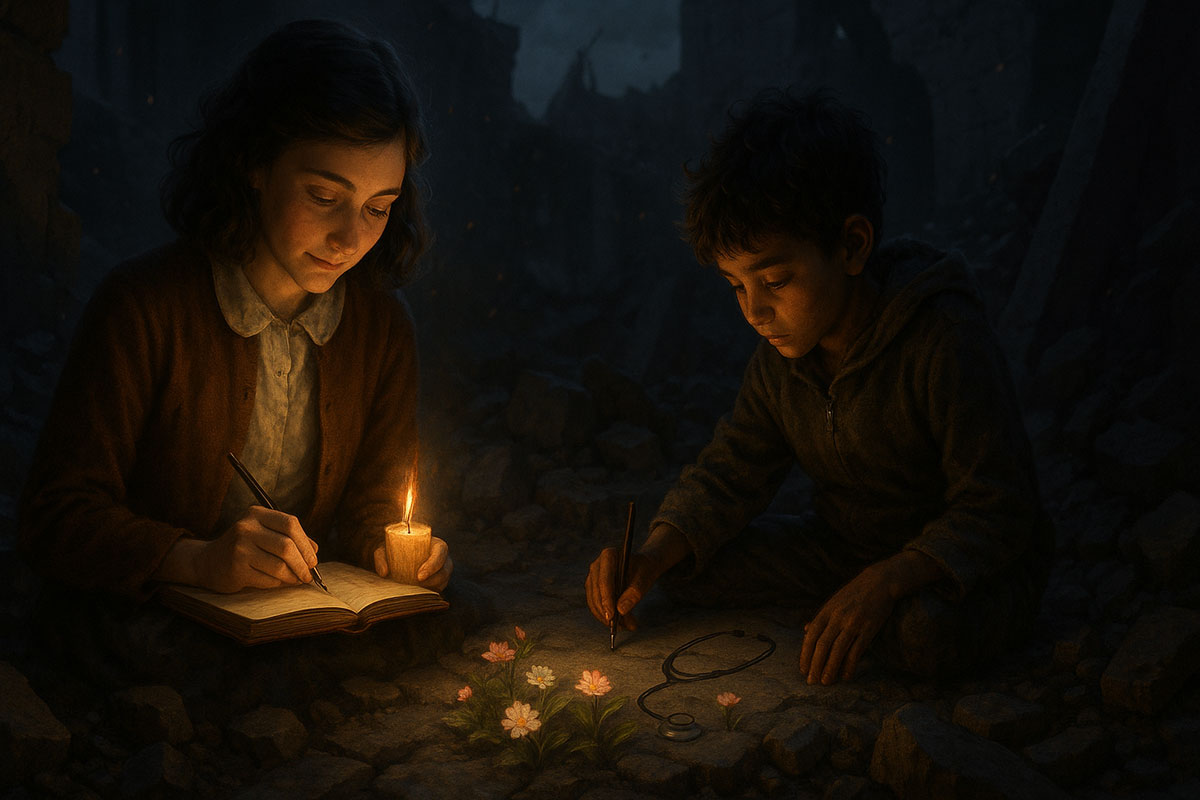
The darkness that surrounded them begins to lift, replaced by a softer glow. The shadows of fear remain, but something gentler rises through them, like dawn fighting its way through night. Anne straightens, her diary open across her lap. The child looks down at their torn notebook, hesitant, as if afraid to speak of anything beyond survival.
Anne tilts her head, her eyes gentle. “Do you ever write about what you want to become?”
The child shrugs, embarrassed. “Sometimes. But it feels foolish. When I write about dreams, the bombs remind me they are impossible.”
Anne leans forward, her voice firm but kind. “No dream is foolish. I wrote about wanting to be a writer. I wanted to travel the world, to share my words, to live freely. Even in hiding, even when each day felt stolen, I dreamed. Because dreams are what make us more than our fear.”
The Writer and the Doctor
The child hesitates, then whispers, “I wanted to be a doctor. To help people, to make bodies heal instead of break. But I don’t even know if I will finish school. Sometimes I dream only of playing soccer in the street without hiding. Is that too small?”
Anne shakes her head quickly, her eyes shining. “No. It is not small at all. It is everything. To play in the street, to laugh without fear, to grow into who you are — those are the biggest dreams of all. They are the dreams that keep us alive.”
The child smiles faintly through tears. “And you? Did you always want to write?”
Anne laughs softly, a sound that trembles with both joy and sadness. “I wanted many things. To see Paris. To see the ocean. To fall in love. To live a life full of mornings, not whispers in the dark. But writing was my way of holding onto all of it. When I wrote, I lived twice — once in hiding, and once in hope.”
Dreams in Ruins
The vision around them shifts. They see fragments of two worlds: Anne in her annex, scribbling by candlelight; the child beneath a flickering bulb in a basement, words hurried between the wail of sirens. Their surroundings are broken, but their notebooks glow with the same stubborn fire.
Anne runs her hand along the page. “Dreams are like seeds planted in rubble. They look fragile, but sometimes they grow into trees stronger than walls.”
The child wipes their cheeks, their voice breaking. “But what if no one sees them grow? What if they stay only inside my notebook, and the world never hears them?”
Anne places her diary against her chest, her smile bittersweet. “I wondered the same. I never knew if anyone would read my words. I feared they would die with me. But look — here we are, together. My words did not vanish. Perhaps yours won’t either. Perhaps one day, a child will hold your dreams and feel less alone.”
The Fire of Innocence
The glow around them strengthens, fed by their words. Anne looks at the child with a seriousness beyond her years. “The world thinks children’s dreams are fragile, but they are not. They are stronger than the cruelty of soldiers or the weight of bombs. That is why they frighten those who wage war — because innocence cannot be destroyed.”
The child breathes deeply, clutching their notebook. “Then maybe I will write about my dreams more. Even if no one reads them. Even if the walls fall. At least they will be alive here.”
Anne nods, her tears glistening in the light. “Yes. Write them. Because dreams refuse to die. They live in every word, in every breath of hope. And when someone finds them, even years later, they bloom again.”
A Shared Promise
The child closes their notebook slowly, their small hands trembling. “If I survive, I will be a doctor. If I don’t… maybe someone will find these words and remember I wanted to be one.”
Anne places her hand gently on theirs. “And if they do, then you will live twice — just as I did. Once in fear, and once in hope.”
The light around them brightens until it feels like morning breaking after the longest night. They sit together, side by side, two children whose lives were torn by different wars but bound by the same defiance: to dream anyway.
Anne whispers, her voice trembling but unshakable. “Even in the darkest hours, we still dream. And that is how we remain human.”
The child nods, clutching their notebook to their chest. “Then I will not stop.”
And in that vow, their shared innocence shines — fragile as paper, yet stronger than fire.
Scene 4: The Question of Humanity
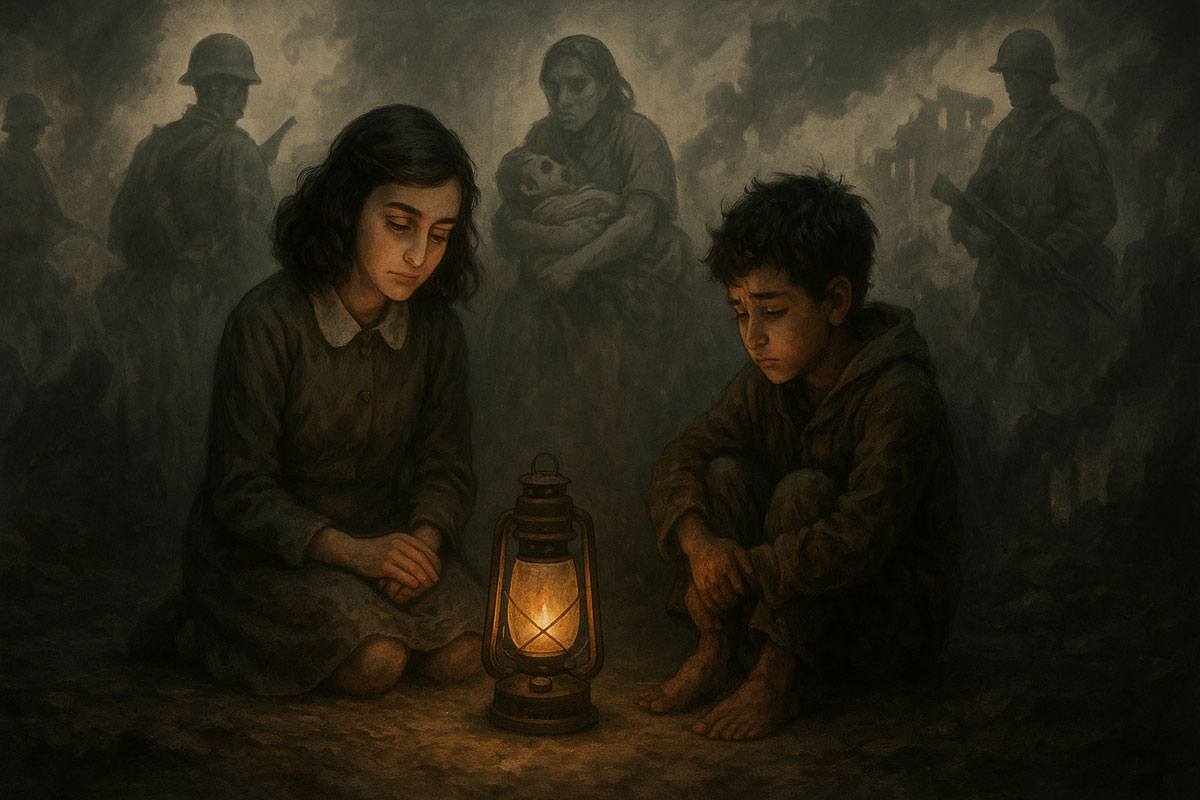
The brightness of their shared dreams slowly fades, replaced by a heavier stillness. The silence between them is no longer gentle but questioning, as if the air itself is waiting for an answer. Anne looks down at her diary, fingers running over the worn cover, while the child stares at their notebook as though it might hold explanations neither of them can find.
Anne’s voice is soft but edged with sorrow. “Do you think people ever learn? I wondered that in my hiding place. I thought, surely, after such cruelty, the world will change. But I hear your story, and I wonder… why are children still living in fear? Why does war keep finding us?”
The child’s lips tremble. They clutch their notebook tightly, almost crushing it. “I don’t know. I ask the same thing. Why us? Why children? Why do they keep building bombs when they know we are underneath them?”
Their voices hang together in the silence — one from the past, one from the present — echoing the same question across decades.
The Weight of Cruelty
Anne presses her diary to her chest, her eyes glistening. “I used to believe in the goodness of people, even when I was hiding. I wrote it down because I needed it to be true. But some days, I doubted it. I thought — maybe people will never change.”
The child shakes their head, tears falling freely. “I used to believe too. I believed the world would care if they knew what was happening to us. I thought someone would stop it. But we kept waiting, and the bombs kept falling.”
Anne leans closer, her voice trembling. “So you feel what I felt — that despair. That aching question: why does the world stay silent while children suffer?”
The child nods quickly, choking back sobs. “Yes. It feels like shouting into the sky, and no one listens. Sometimes I think humanity has forgotten how to hear.”
Flickers of Kindness
For a long moment, both sit in silence, their grief heavy. Then Anne wipes her eyes and takes a shaky breath. “But even in the darkest days, I remember kindness. Our helpers risked their lives to bring us food. They had nothing to gain — only danger. And yet they came.”
The child looks up slowly, remembering. “Yes. There are people like that for us, too. A neighbor who shared their bread when we had none. A stranger who pulled me from the rubble. They had nothing, but they gave everything.”
Anne’s face softens, a fragile smile breaking through the sorrow. “Perhaps that is humanity’s secret. It fails terribly, again and again, but in the cracks, light still seeps through. Not enough to stop the war… but enough to remind us that goodness still breathes.”
The child nods, tears shimmering. “Sometimes one act of kindness feels louder than all the bombs. But I wish — oh, I wish — that kindness was stronger than cruelty.”
Wrestling With Despair
The glow around them dims again, flickering between light and shadow. Anne clutches her diary tightly. “When I was hiding, I wrote about hope. But there were nights when despair was louder. I wondered if my words would mean anything, or if the world would forget me.”
The child whispers, “That is how I feel too. That my words will die with me. That humanity will forget us like they forgot you.”
Anne looks at them intently, her eyes fierce despite her tears. “No, my dear. You are not forgotten. You sit here with me — proof that words endure even when bodies do not. Proof that innocence can speak louder than cruelty.”
The child stares at their notebook, their tears dripping onto the page. “Then maybe if we keep writing, if we keep speaking, the world will remember. Maybe it is the only way.”
The Thin Thread of Hope
The silence stretches again, but this time it feels less empty. Their grief still hangs between them, heavy and raw, but so does something else — a fragile thread binding them together.
Anne whispers, almost to herself, “Humanity forgets… and then it remembers. It stumbles… and then it rises. It is weak, but it is not gone.”
The child breathes deeply, clutching their notebook as though it were a lifeline. “Then we will be the ones who remind them. With our words. With our stories.”
Anne nods, her tears falling freely. “Yes. That is how humanity survives — not through power, but through memory, through kindness, through children who refuse to be silenced.”
Their hands find each other again, two small grips against the weight of despair. And in that touch, the question of humanity does not find an answer — but it finds a promise.
Scene 5: A Shared Light
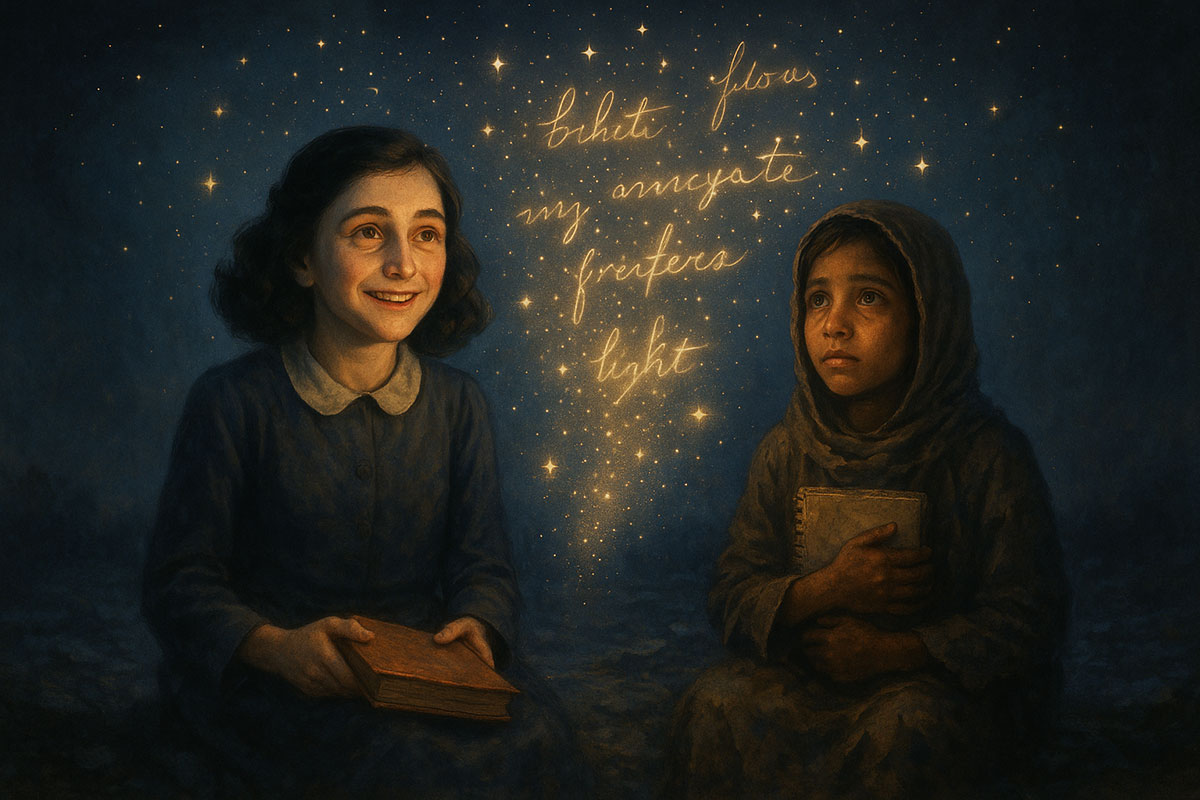
The air around them shifts once more. The shadows that carried their fears and questions begin to thin, replaced by a glow that feels neither day nor night, but something beyond both. Their diaries rest open on their laps, the ink shimmering as if every word has been heard. Anne looks down at hers with a bittersweet smile, while the child traces the frayed edge of their notebook, almost afraid to close it.
Anne’s voice trembles. “I always thought my diary was just for me — a place to hide my thoughts, my hope, my despair. But now I see it was more. It carried me here. It carried me to you.”
The child lifts their gaze, eyes wet with tears. “I thought the same. That no one would ever read what I wrote. But maybe… maybe our words don’t just belong to us. Maybe they belong to every child who has ever been afraid.”
They sit together in silence, holding their books like lanterns in the dark.
Words That Survive
Anne closes her diary gently, pressing it to her heart. “I never lived to see my dreams. But my words survived. They went where I could not go. They traveled across oceans, across years. And now they sit in your hands, beside your words.”
The child hugs their notebook tighter. “Then maybe mine will survive too. Maybe one day another child will read them and feel less alone. Maybe they will know I was here, even if the world forgets.”
Anne nods slowly, her smile trembling. “Yes. That is what words do. They carry us forward when our bodies cannot. They become bridges between hearts.”
The child’s lips quiver. “Even between a girl in an attic and a child in the rubble?”
“Especially then,” Anne whispers.
The Chorus of Children
The glow grows stronger. Their diaries begin to hum, the words inside lifting softly from the pages like fireflies. Sentences written decades apart rise into the air, swirling together — Anne’s hopes of becoming a writer, the child’s dream of becoming a doctor, lines of longing, of laughter, of prayers whispered into empty rooms.
Anne gasps, watching her words take flight. “It is as if our voices are singing together.”
The child wipes their tears, their eyes wide. “Not just ours. Listen.”
More words rise — countless voices of children long silenced, from wars and camps and shattered homes. The air fills with them, a luminous constellation of innocence that refuses to be erased. Their stories intertwine, echoing across the silence: we were here, we dreamed, we mattered.
Anne clasps the child’s hand tightly. “Do you hear it? This is our chorus. It cannot be silenced.”
The Light That Refuses to Die
The words lift higher, forming a radiant canopy above them. What was once sorrow becomes unbearable beauty. The mother tongues differ — Dutch, Arabic, Hebrew, English, dozens more — but the meaning is one: children holding on to hope when the world refused to.
The child gazes upward, tears falling freely. “It is too beautiful. It hurts.”
Anne squeezes their hand, her own eyes brimming. “Yes. That is what truth feels like — unbearable beauty. It breaks us so that love can rush in.”
The glow intensifies, wrapping them in warmth. The diaries in their laps fade into light, but the words remain, alive and unending.
A Promise Across Time
Anne turns to the child one last time, memorizing their face as if imprinting it into her soul. “Promise me you will keep writing. Promise me you will let your words outlive the fire.”
The child nods, their voice steady despite their trembling. “I promise, Anne. And you promise me that my words will not be forgotten.”
Anne smiles, radiant despite her tears. “I promise. Together, we have made sure of it.”
They embrace, and as they do, their forms begin to glow. Their words rise higher, joining the chorus of voices above. They are no longer two, but part of something vast — a constellation of children’s dreams shining in defiance of war.
Closing Reflection
Behind them, the silence remains, but it is no longer empty. It is filled with echoes: the scratch of pens against paper, the whispers of children who refused to be silenced, the sound of innocence persisting even in ruins.
Somewhere in the living world, children still write in notebooks by candlelight, still whisper their dreams against the roar of bombs. And somewhere, Anne and the refugee child’s voices linger — not as sorrow alone, but as light that refuses to die.
Love, written.
Love, remembered.
Love, eternal.
Final Thoughts by Anne Frank
Now, as our words rise into light, I understand what I could not grasp in hiding: diaries are more than paper. They are bridges. They carry us across years, across wars, across the silence left when children’s voices are stolen.
You, my young friend, have written in the rubble as I wrote in the annex. And though both of us feared our words would die with us, they have not. They live. They shine. They tell the world that innocence endures even when cruelty reigns.
If humanity ever learns, it will be through these fragile pages — through children who dared to dream when dreaming seemed impossible.
I leave my voice with yours, not as a farewell, but as a promise: our diaries will keep speaking. They will outlast fear. They will remind the world that even in its darkest hour, love, hope, and innocence remain undefeated.
Short Bios:
Anne Frank
Anne Frank (1929–1945) was a Jewish girl who kept a diary while hiding from the Nazis during World War II. Her writings, later published as The Diary of a Young Girl, captured the fears, hopes, and dreams of a child living under persecution. Though Anne died in a concentration camp at age fifteen, her words became a timeless testimony to innocence, resilience, and the human spirit’s refusal to be silenced.
Modern Refugee Child
The Modern Refugee Child represents countless children displaced by today’s wars, especially in Syria and Gaza. Living amid bombings, hunger, and shattered homes, many still cling to notebooks, drawings, and whispered prayers as lifelines. Though nameless, this child embodies the resilience of a generation whose voices deserve to be heard — children who, like Anne, use words to preserve innocence and dream of a world without war.
Leave a Reply