

|
Getting your Trinity Audio player ready...
|
Karen Armstrong:
When we speak of virtue, we are not speaking of a dusty word locked away in moral philosophy. We are speaking of the very pulse of human life — the choices that shape us when no one is watching, the gestures that ripple into the lives of strangers, and the inheritance we quietly prepare for those who come after us.
The ancients understood this well. Aristotle taught that character is shaped through habit. The Buddha taught that every action plants a seed. The Stoics insisted that justice, courage, and temperance are not lofty ideals, but daily practices. And in every culture — from African proverbs to Japanese wisdom — we find the same reminder: we are building something with every breath.
This series is not about theology or philosophy alone; it is about survival. A world cannot stand if it forgets how to build virtue. For without patience, anger grows; without kindness, cruelty spreads; without justice, corruption reigns. Virtue is not a luxury — it is the scaffolding of a society, the very oxygen of human dignity.
And so, we turn our attention here — not to grand speeches or heroic sacrifices, but to the quiet, daily work of shaping our hearts and our communities through choices small and great. For in the end, our lives are not measured by what we consume or achieve, but by what we cultivate.
(Note: This is an imaginary conversation, a creative exploration of an idea, and not a real speech or event)

Topic 1 — The Invisible Ledger: Are Our Actions Recorded Somewhere?
Moderator (Karen Armstrong): Welcome, everyone. Today, we’re exploring whether our daily actions — the good and the bad — leave behind an invisible record that shapes our lives. Is there truly a “ledger of virtue and vice,” or is this just a metaphor we use to remind ourselves to act well? Let’s begin.
Question 1
If every action leaves a trace, what does that mean for how we live our daily lives?
Aristotle: I believe it means our character is the sum of our habits. Virtue is not recorded on some mystical scroll; it is etched into who we are becoming. Each honest word or dishonest word, each act of kindness or cruelty, carves us into a certain kind of person. The record is not elsewhere — it is within us.
Dalai Lama: From my perspective, it is both inner and outer. Inside, our mind is shaped by our repeated choices — compassion strengthens compassion, anger strengthens anger. Outside, the energy of those actions affects others, rippling through relationships and society. The “ledger” is both your heart and the world you touch.
Marcus Aurelius: As a Stoic, I would say: if every act leaves a trace, then we must practice mindfulness over even the smallest decisions. The universe is orderly, rational, and we are part of that order. Nothing is insignificant. A single unjust act might seem minor, but it weakens the whole of society. Thus, we must weigh our conduct as carefully as an emperor balances accounts.
Maya Angelou: I think of it as footprints. Every word, every gesture, every silence — it all leaves footprints on the soil of other people’s hearts. We don’t always see it, but people remember how we made them feel. That memory, that impression, is part of the ledger.
Saito Hitori (smiling): Japanese people say toku o tsumu — to pile up virtue. It’s like saving coins in a jar. Each smile, each kindness, is a coin dropped in. But bad words? That’s like poking holes in the jar. The record isn’t in heaven — it’s in the jar you carry every day.
Question 2
If such a “ledger” exists, is it meant to reward and punish us, or is it something else?
Marcus Aurelius: To me, it is not about reward or punishment. It is simply cause and effect. When you live in harmony with reason and justice, you experience inner peace. When you violate it, you experience turmoil. The ledger is not a divine courtroom; it is natural law unfolding.
Maya Angelou: I’d say it’s not about punishment, it’s about teaching. Life has a way of handing us back the lessons we need to learn. If you sow bitterness, bitterness comes back not to destroy you but to reveal what you are sowing. The ledger is a mirror, not a judge.
Saito Hitori: (laughing) Some people say, “Why do bad people seem happy while good people suffer?” But if you eat bad food, maybe you don’t feel sick right away. The stomachache comes later! Same with life — the “ledger” is just the delayed effect. It’s not punishment. It’s digestion.
Aristotle: I agree — it is not external judgment but internal harmony. Virtue brings fulfillment, vice brings dissatisfaction. A man may fool society, but he cannot fool his own soul. The record lives within, and the penalty of vice is to be trapped in a corrupted self.
Dalai Lama: In Buddhism, we call this karma. But karma is not a cosmic police officer. It is simply the natural unfolding of causes and conditions. Virtue brings clarity, joy, and connection. Negative action brings confusion, isolation, and suffering. The “ledger” is compassionate law, not punishment.
Question 3
How can we practically build virtue instead of adding to the negative side of the ledger?
Saito Hitori: Make it fun! People think virtue is hard, like eating bitter medicine. No, no — start small. Say thank you. Smile. Pay for someone’s coffee. Little things. Every time you do it, imagine dropping a shiny coin into your jar. Soon, you’ll feel rich inside.
Maya Angelou: Yes — start with kindness. Ask yourself, “How will my words leave someone today?” If you can leave them standing taller, brighter, more whole, then you’ve added a golden line to your ledger.
Dalai Lama: Practice compassion. Even toward those who harm you. It begins with mindfulness — catching yourself when anger rises, and choosing patience instead. Virtue grows not from one dramatic act but from daily discipline. Meditation helps. So does remembering our shared humanity.
Aristotle: I advise practicing the “golden mean.” Virtue lies between extremes — courage between cowardice and recklessness, generosity between stinginess and waste. Train yourself daily in moderation, and you steadily cultivate balance.
Marcus Aurelius: I would add — remember death. Life is short. Each act could be your last entry in the ledger. If you knew you would die tomorrow, would you want your final act to be cruel, selfish, or unjust? Let this awareness guide you to live virtuously now.
Moderator (Karen Armstrong): Thank you. What I hear is that the invisible ledger is not some supernatural book in the sky, but the shaping of our character, our relationships, and our destiny through every choice we make. Virtue, then, is not a trophy to earn later, but the very fabric of how we live now.
Topic 2 — Virtue vs. Karma: What’s the Real Difference?
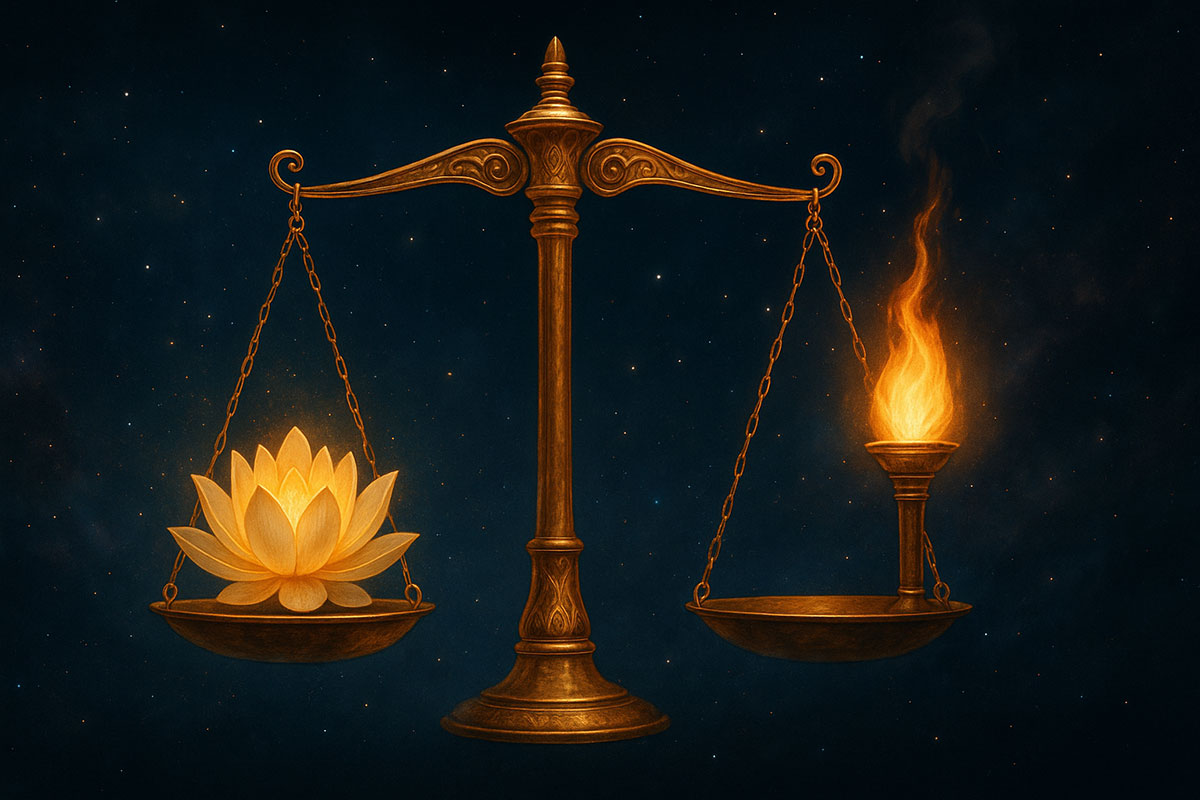
Moderator (Karen Armstrong): Welcome back. In our last discussion, we spoke of an “invisible ledger” where our actions leave traces. Today, let’s compare two great traditions: virtue in the West and karma in the East. Are they describing the same truth, or do they mean something different?
Question 1
At the heart, how would you each define “virtue” and “karma”? Are they two names for the same thing, or do they point to different realities?
Dalai Lama: Karma is simply cause and effect. Every action — physical, verbal, or mental — plants a seed. Over time, seeds ripen into fruit, and we experience the results. Virtue is a quality of the seed: wholesome, compassionate, leading to happiness. So I see virtue as part of karma. Karma is the law; virtue is the quality we cultivate within it.
Aristotle: Virtue, as I teach, is not about seeds but about character. It is a state of being, achieved by practicing good habits until excellence becomes second nature. Karma is foreign to my thought, but I see it as external consequence. Virtue, however, is the inner art of becoming.
Maya Angelou: To me, virtue is the song you sing with your life, and karma is the echo that comes back to you. Virtue is inside — it’s how you carry yourself, how you love, how you rise. Karma is the world’s way of saying: “Yes, I heard your song. Here is the harmony I will return.”
Marcus Aurelius: Virtue is the alignment of the soul with reason, justice, courage, and temperance. It is sufficient in itself. Karma, as I understand it, is more transactional — do this, and something comes back. To the Stoic, virtue is reward enough. We do not act justly to receive, but because justice is the only fitting path.
Saito Hitori (grinning): Virtue and karma? Same rice, different bowl! Virtue is how you polish yourself every day. Karma is how life answers back. Do good, you shine; shine, the world shines back. Easy!
Question 2
Do people become more motivated to live well by focusing on virtue for its own sake, or by focusing on karma as consequences?
Marcus Aurelius: If a man does good merely to avoid bad karma, he is still a slave. True freedom is when one acts justly because it is just, not for fear of punishment or hope of reward. The highest motivation is inner alignment with truth.
Maya Angelou: I agree, but I also know that people are moved by stories. “Karma will catch up to you” is a story that can stop someone from cruelty. But to lift someone higher, you must speak of virtue as joy. When you live with love, you glow. That glow is its own motivation.
Saito Hitori: (laughing) Let’s be real — most people don’t want philosophy, they want results! If you say, “Be kind, or bad karma will bite you,” people listen. But once they start, they feel happier inside. That’s the trick: karma motivates, but virtue keeps you going.
Dalai Lama: Karma as consequence can help beginners. It teaches responsibility: you cannot escape the results of your actions. But deeper practice is cultivating virtue for its own sake — compassion, patience, wisdom. At that level, you no longer fear karma; you simply rejoice in goodness.
Aristotle: I agree with Marcus and the Dalai Lama: the best life is lived for its own nobility. To use virtue merely as a tool for reward is like practicing music only to impress neighbors, not for the beauty of the song. True excellence seeks nothing but itself.
Question 3
How do we reconcile these two — living virtuously without attachment, but also recognizing that actions do have consequences?
Maya Angelou: I’d say: remember both. Life is a circle. You send something out, it comes back. But while you wait for that return, the important thing is who you are becoming. Live so fully in virtue that even if no reward comes, you are already rich.
Dalai Lama: Very true. Karma is natural law — it will unfold whether you notice it or not. Virtue is the conscious cultivation of goodness in the present. Together, they work like two wings of a bird: karma explains the law, virtue teaches us how to fly within it.
Saito Hitori: Don’t overcomplicate! Think of it like eating. If you eat healthy food, you feel better (that’s karma). But you also become stronger and live longer (that’s virtue). Same action, two benefits. Just keep eating good things — no need to separate them.
Aristotle: Virtue is the foundation; karma is the shadow it casts. One is substance, the other consequence. Pursue virtue, and the shadow naturally aligns. If one pursues only the shadow, one is always chasing, never becoming.
Marcus Aurelius: Let us remember: the cosmos is rational. Whether we call it karma or natural consequence, what matters is to live with integrity now. Do not concern yourself with outcomes beyond your control. To cultivate virtue is to harmonize with the universe. That is sufficient.
Moderator (Karen Armstrong): What a beautiful weaving. I hear that karma and virtue are not enemies but companions. Karma reminds us that nothing we do is without consequence. Virtue reminds us that the noblest path is to act rightly even if no consequence followed. Together, they invite us to live with both responsibility and joy.
Topic 3 — Small Acts, Big Ripples: How Tiny Virtues Shape Destiny

Moderator (Karen Armstrong): Today we turn to the humble acts of virtue — the small kindnesses, the little courtesies, the unseen choices. Do these tiny deeds really matter? Can they shape our destiny, or are they too insignificant in the face of the world’s enormity?
Question 1
Do small acts of virtue truly have the power to change the course of a life?
Maya Angelou: Oh yes, child. I’ve seen people rise from despair because someone simply smiled at them or said, “I believe in you.” That one moment can change how they see themselves forever. We think destiny is written in grand gestures, but often it is whispered in kindness.
Marcus Aurelius: The Stoics teach that no act in harmony with reason is ever wasted. If you hold the door for someone, you affirm order, justice, and civility. A small act cultivates discipline, and discipline builds character. Destiny is nothing more than character meeting circumstance.
Saito Hitori (smiling): A single coin is small, but if you put one in the jar every day, soon it overflows. Life is the same. People think, “This little thing doesn’t matter.” But add them up, and it becomes your fate. Even a tiny seed grows into a big tree.
Dalai Lama: Yes. Small acts are powerful because they create habits of mind. When you choose patience in traffic, you prepare yourself for patience in crisis. When you practice kindness to a stranger, you prepare to be compassionate to your family. In Buddhism, this is how destiny is shaped — through repeated seeds of intention.
Aristotle: Indeed. Virtue is formed through repetition. Just as a harpist becomes skilled by practicing scales, the soul becomes virtuous by practicing small good acts. Do not despise the small, for it is the pathway to greatness.
Question 2
If small acts matter so much, why do people overlook them, chasing dramatic gestures instead?
Dalai Lama: Because the ego loves recognition. Large gestures bring praise, small ones often go unseen. But the unseen is where true strength is cultivated. The bamboo grows quietly underground for years before rising high.
Maya Angelou: People want fireworks, but fireworks fade. The candle that stays lit — the daily kindness, the ordinary patience — that is what lights a home. Maybe we overlook it because it doesn’t bring applause. But life is not a stage; it is a garden. The little watering each day makes it bloom.
Saito Hitori: (laughing) People are lazy! They want one big donation, then feel finished. But it’s like bathing — you can’t just do it once! Small acts are like brushing your teeth. You keep doing them. That’s how you shine.
Marcus Aurelius: The reason is pride. Men prefer to be seen as heroes once than to practice virtue daily. But true greatness is quiet. The warrior is not the one who wins a battle, but the one who conquers his temper ten thousand times without witness.
Aristotle: Our society measures success in spectacle. Yet excellence is measured in steadiness. The pursuit of applause blinds one to the true cultivation of self. A man is not great because he performed one noble deed, but because he became noble through countless small deeds.
Question 3
How can we remind ourselves to value and practice small virtues daily?
Saito Hitori: Make it fun! Pretend each kindness is a little lottery ticket. You never know when it will win, but it always makes you smile to collect them. The joy itself keeps you going.
Marcus Aurelius: Practice mindfulness at the smallest level. When you rise in the morning, ask: will I live today with justice, temperance, courage, and wisdom? Each simple act — drinking water, speaking kindly, doing your duty — is a chance to affirm virtue.
Maya Angelou: Write it into your soul: I will not pass a day without lifting someone. It doesn’t have to be a grand lift. Just a word, a nod, a prayer. Make that your rhythm. Then life itself will sing back to you.
Aristotle: Establish habits. For habit is the architecture of character. Set times, set places, set rituals of virtue. Perhaps gratitude before sleep, generosity in each transaction, patience in every irritation. Through habit, the small becomes natural.
Dalai Lama: Reflect each night. Ask yourself: what small seeds did I plant today? Did I water the seeds of compassion, or of anger? This awareness turns every day into a field of practice. Then even the smallest acts are valued, and destiny unfolds in wisdom.
Moderator (Karen Armstrong): Thank you. What I hear is that destiny is not written in thunder but in raindrops. Small acts, repeated daily, carve rivers through the heart, shape character, and ultimately guide the course of our lives. The overlooked becomes the essential, and the ordinary becomes extraordinary.
Topic 4 — The Shadow of Neglect: Is Failing to Build Virtue the Same as Accumulating Bad Karma?
Moderator (Karen Armstrong): Our last discussion showed us the immense power of small acts of virtue. But what about their absence? If we neglect to act kindly, to practice patience, to live with integrity — are we neutral, or are we, in fact, accumulating negative weight?
Question 1
If someone does nothing — not good, not evil — are they neutral, or does their neglect itself create a kind of bad karma?
Marcus Aurelius: Inaction is not neutral. To withhold justice when you could act is itself injustice. The universe demands participation. To do nothing is to align with vice by omission.
Maya Angelou: I’d put it this way: silence in the face of cruelty is a song of agreement. If you can lift someone and choose not to, you’ve already fallen. Neglect is not empty — it speaks, it echoes, it harms.
Saito Hitori (smiling): Doing nothing is like leaving your garden unwatered. You think you’re neutral, but weeds are growing! Neglect lets the bad grow stronger. So yes, even “nothing” adds weight to your jar — but it’s stones, not coins.
Dalai Lama: In Buddhism, intention matters. If neglect comes from ignorance, laziness, or fear, it creates negative karma because it strengthens unwholesome patterns of mind. Only deliberate restraint, guided by wisdom, is virtuous inaction. Otherwise, neglect is like planting weeds without realizing it.
Aristotle: Virtue is habit. To fail to practice it is to weaken it. A man who refuses to train his body becomes weaker; so too with the soul. Neglect is not neutral — it is decay.
Question 2
Why is neglect so dangerous, even if it seems harmless at first?
Saito Hitori: Because it sneaks up on you! Nobody wakes up suddenly bad. They just keep saying, “It doesn’t matter,” until it does. It’s like skipping brushing your teeth — one day, they all fall out. Small neglects lead to big disasters.
Maya Angelou: Neglect is the thief of tomorrow. Today you don’t say “I love you.” Tomorrow the person is gone. Today you don’t act. Tomorrow the world is darker. By the time you notice, it’s too late. That’s the danger.
Marcus Aurelius: Neglect erodes the soul’s discipline. Each moment you surrender to apathy, you train yourself to be weaker. A soldier who refuses small drills will fail in battle. Likewise, a man who neglects virtue will collapse in trial.
Aristotle: Indeed. Excellence cannot be preserved without effort. A harp left untuned decays into noise. A soul left unattended decays into vice. Neglect is dangerous because it is invisible until it is nearly complete.
Dalai Lama: The danger is that neglect becomes habit, and habit becomes destiny. When you neglect compassion, anger grows. When you neglect mindfulness, delusion grows. The absence of good is not empty; it is fertile soil for suffering.
Question 3
How can we guard ourselves against the shadow of neglect in daily life?
Maya Angelou: Begin with gratitude. Each day you are given breath is a chance to act with love. If you remember that gift, you will not waste it. Gratitude keeps neglect away because it makes every moment precious.
Aristotle: Set a rhythm of practice. Just as athletes train daily, so must the soul train in virtue. Courage, temperance, generosity — these must be exercised. Guard against neglect by building virtue into the structure of your life.
Dalai Lama: Mindfulness is key. Notice when laziness or indifference whispers: “It doesn’t matter.” Catch it, breathe, and choose a small act of goodness. By seeing neglect as it arises, you prevent its shadow from spreading.
Saito Hitori: Make a game of it! Say: “Today I will collect three coins of virtue.” Maybe it’s a kind word, maybe it’s patience with someone annoying, maybe it’s cleaning up trash. Count them. Play with them. That way, neglect has no chance.
Marcus Aurelius: Remember mortality. You may not have another day. Will you spend this one asleep in neglect, or alive in virtue? To live each moment as though it could be your last is the surest guard against wasting it.
Moderator (Karen Armstrong): Thank you. What I hear is that neglect is not empty, but dangerous. By failing to build virtue, we create the conditions for vice to grow. The antidote is daily practice, gratitude, mindfulness, and the courage to act even in small ways. Neglect whispers, but virtue sings louder — if we choose to listen.
Topic 5 — The Legacy of Virtue: Do We Pass It On to Others?

Moderator (Karen Armstrong): We’ve spoken about building virtue, avoiding neglect, and even the invisible ledger of our lives. But now let’s look beyond ourselves. Does virtue stop with us, or does it ripple into others, perhaps even generations to come?
Question 1
When we cultivate virtue, does it remain within us, or do we pass it on to others around us?
Maya Angelou: Darling, virtue is like perfume. You can’t put it on without sharing the fragrance. When you live with kindness, with dignity, people breathe it in. It lingers long after you’ve left the room. That’s how it passes on.
Aristotle: Virtue shapes not only oneself but one’s polis — the community. When citizens cultivate virtue, they inspire imitation in others. Justice, courage, and temperance radiate outward, teaching by example. Thus, virtue is contagious.
Saito Hitori (grinning): Virtue is like laughter. You can’t keep it to yourself! When you smile, others smile back. When you live joyfully and kindly, people copy you without even knowing it. So yes — you pass it on, whether you try or not.
Dalai Lama: Compassion is never confined to the individual. Each act plants seeds in the hearts of others. These seeds may sprout years later, perhaps in your children, your students, or even a stranger who remembers a small kindness. Virtue is a lamp; it lights other lamps.
Marcus Aurelius: The Stoic path teaches that the soul’s alignment with reason benefits the whole. When you act with integrity, you strengthen the fabric of society. Thus, virtue transcends the individual — it upholds the world itself.
Question 2
Can virtue truly ripple across generations, becoming part of a family or culture’s inheritance?
Aristotle: Absolutely. Habits of virtue become customs, and customs become traditions. A father who practices justice raises sons who value it. A mother who embodies courage inspires daughters to emulate it. Over time, these become cultural inheritance.
Maya Angelou: Yes, yes. I am my grandmother’s child as much as my mother’s. Her prayers, her patience, her fierce dignity — they live in me. Virtue is not just taught, it’s remembered in the bones. That is legacy.
Marcus Aurelius: Consider Rome: when we honored duty and discipline, the empire was strong. When we neglected virtue, decay set in. A people’s destiny is bound to their virtues or their vices. Generational strength is virtue passed down, or weakness when it is not.
Dalai Lama: Virtue ripples beyond family to all beings. When you show compassion today, it may inspire policies, communities, even nations tomorrow. Karma is collective as well as individual. The seeds of virtue you plant may bear fruit in generations you will never meet.
Saito Hitori: Japanese people say, “Leave good roots for the next garden.” Virtue is like fertilizer — you pass it on to the soil. Even if you don’t see the flowers, they bloom later. Your grandchildren may eat the fruit of the tree you planted.
Question 3
If virtue can become legacy, how can we consciously build and pass on such a legacy in our everyday lives?
Marcus Aurelius: Live each day as though the whole empire were watching — because they are. Your children, your friends, your citizens observe you. Teach by example. Virtue transmitted by deeds is stronger than virtue taught by words.
Saito Hitori: Start small. Make it fun for your children. Teach them to say thank you, to smile, to share. If they grow up thinking kindness is normal, you’ve already given them a treasure chest of virtue.
Maya Angelou: Write it down. Sing it out. Live it so boldly that no one who meets you can forget it. That’s how you pass on virtue — by embodying it so fully that it becomes part of someone else’s story.
Dalai Lama: Create environments that nurture compassion — families, schools, communities that reward kindness, not just achievement. Institutions carry legacy. If we want virtue to endure, we must embed it in the structures of society.
Aristotle: Establish education of the young in virtue. For the habits formed in youth shape the character of the man, and the character of the man shapes the fate of the state. The most enduring legacy is cultivated in early formation.
Moderator (Karen Armstrong): Thank you. What I hear is that virtue is never solitary. It flows outward like fragrance, laughter, or light. It shapes communities, echoes across generations, and builds the inheritance of cultures. To cultivate virtue, then, is not only to save oneself but to bequeath a brighter world to those who follow.
Final Thoughts By Karen Armstrong
Virtue is not a relic of the past, nor a burden we carry reluctantly. It is a gift we offer the future. Each of us is entrusted with a fragment of the world’s moral fabric, and the thread we weave today will determine whether that fabric tears or holds together.
We live in an age of speed, distraction, and easy neglect. Yet virtue requires slowness — the patience to listen, the courage to resist selfishness, the persistence to keep sowing even when the harvest is far away. If we abandon it, the weeds of cruelty and indifference will not hesitate to grow.
But the good news is this: we are never powerless. Each act of honesty, each gesture of compassion, each moment of restraint is a luminous spark in the human story. And sparks, when shared, become fire.
The legacy we leave is not carved in monuments or bank accounts. It lives in the hearts we touched, the burdens we lifted, the lives we quietly brightened. If there is one truth to take away, it is this: when you cultivate virtue, you do not simply save yourself. You become a guardian of hope, and a builder of humanity’s tomorrow.
Short Bios:
Leave a Reply