

|
Getting your Trinity Audio player ready...
|
What if Charlie Munger sat you down and showed you how he avoids stupidity first?
Introduction by Charlie Munger
Charlie Munger mental models are my attempt to do something unfashionable: reduce the odds of being a damn fool. I’ve never believed wisdom is a mystery—most of it is a set of usable ideas, borrowed from multiple disciplines, applied with a little humility and a lot of discipline. That’s the purpose behind the title Poor Charlie’s Almanack. It’s deliberately plain and a little self-mocking, because an “almanack” isn’t a sacred text—it’s a practical companion. Something you keep nearby, return to often, and use when the weather changes. And in the world of investing, business, and human behavior, the weather always changes.
As for the “Poor Charlie” part—well, I’ve always thought it’s healthy to remember you’re not as smart as you’d like to be, and that you’re certainly not as smart as your ego keeps whispering. The phrase is a reminder: I’m a fallible man collecting the best tools I can find to avoid predictable error. What I’m excited about here is the chance to test those tools in front of people I truly respect—minds that built the very beams of the latticework I’ve relied on. When you put your ideas on a table with thinkers you look up to, you either learn—or you get exposed. Either outcome is useful.
So let’s have the discussion the way it should be had: not to sound clever, but to become harder to fool.
(Note: This is an imaginary conversation, a creative exploration of an idea, and not a real speech or event.)
Topic 1 — The Latticework Mind
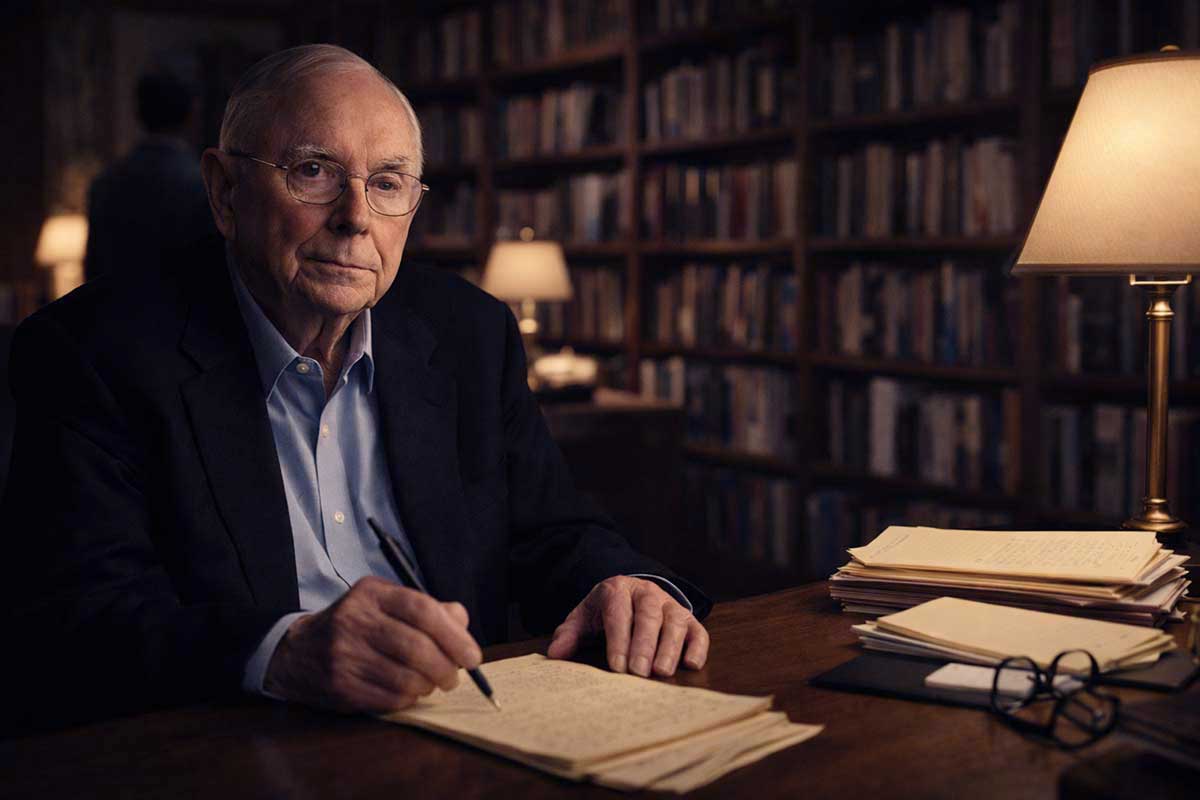
A quiet room that feels like it was built for thinking: shelves of biographies and physics texts, old legal volumes, psychology papers, and a chessboard that hasn’t been touched in months. A long table. No microphones. No applause. Just minds.
Charles T. Munger: If you’re going to be useful in the real world, you can’t be one of those fellows who knows one discipline and tries to explain the universe with it. That’s a fast track to folly. So let me start simply. If a young person asked you, “How do I build a mind that sees what others miss?” what would you tell them?
Benjamin Franklin: I’d begin with habits, not brilliance. Curiosity is a muscle. Read widely, yes, but also keep a ledger of your errors. A man improves faster by noticing his own patterns than by collecting new opinions. When you learn something useful, apply it the same week. Knowledge that never meets life becomes decoration.
Richard Feynman: I’d tell them to keep the explanations honest. If you can’t explain it plainly, you don’t understand it. A latticework isn’t a scrapbook of fancy ideas—it’s a set of tools you can actually use. And here’s the trick: you don’t learn tools by admiring them. You learn them by trying to fix things and failing until the tool fits your hand.
Daniel Kahneman: I’d warn them that their mind will insist it is already clear. The confidence you feel is not evidence of correctness. A strong thinking system builds in friction: slow down at the moments you most want to speed up. Learn the predictable ways people misread probability, causality, and their own competence. Your models are only as good as your ability to distrust your first impression.
Charles Darwin: I would advise them to cultivate patience with ambiguity. For years, I carried questions without forcing a tidy conclusion. Observe, collect, compare, and do not become too attached to one hypothesis. When evidence contradicts you, treat it as a gift. The mind that sees what others miss is often the mind that can tolerate being uncertain longer than others can bear.
Peter Drucker: I’d focus them on outcomes. A mind that “sees” is worthless if it doesn’t translate into decisions, priorities, and action. Ask: What is the essential problem? What must be true for this to work? What would I do if I were wrong? A disciplined mind turns insight into a schedule and a budget. Otherwise, it’s just cleverness.
Munger: Good. Now let’s go a layer deeper. A lot of people hear “multiple mental models” and they start collecting them like stamps. They memorize terms, they quote smart people, and they still make dumb decisions. What makes a latticework real instead of performative?
Richard Feynman: You have to pay the price of real contact with reality. That means doing problems, running experiments, putting your reputation on the line with predictions. The stamp-collector looks smart until the moment something breaks. The builder knows which model applies because they’ve used it, not because they’ve heard of it.
Peter Drucker: And it must be tied to responsibility. When you are accountable for results, you become allergic to decorative thinking. The latticework becomes a method: define the objective, identify constraints, choose trade-offs, execute, measure. If your “models” don’t change what you do Monday morning, they aren’t models. They’re entertainment.
Charles Darwin: There is also humility. The performative mind argues; the real mind studies. One seeks victory; the other seeks correction. In my own work, I learned to note objections immediately, even when they wounded my pride. A latticework becomes real when it contains not only supporting beams, but also the counterweights—reasons you might be mistaken.
Daniel Kahneman: I agree. Real latticework has safeguards. It anticipates biases, especially the flattering ones. Ask yourself: What story am I telling? What evidence would disconfirm it? Am I confusing coherence with truth? A performative latticework increases confidence. A real latticework often reduces confidence—and that reduction is healthy.
Benjamin Franklin: Let me add: it becomes real when it improves your character. A man who learns broadly but becomes vain has learned poorly. The goal is not to win arguments. The goal is to make fewer foolish moves, keep promises, build useful things, and contribute to the world around you. Wisdom that makes you unbearable is a strange kind of failure.
Munger: That’s close to my heart. Now here’s the third question, and it’s the one that matters when money and reputation are involved. When you’re facing a high-stakes decision—an investment, a lawsuit, a partnership—what are the few mental moves you’d insist on before committing?
Daniel Kahneman: First: base rates. Ask what typically happens in similar situations, not what your story claims will happen this time. Second: separate inside view from outside view—your detailed narrative from the statistical reality. Third: consider the cost of being wrong, not just the chance. Many disasters come from ignoring tail risks.
Benjamin Franklin: I would insist on a plain list: What are the incentives of everyone involved? What are the hidden motives? Where might I be flattering myself? And I’d ask one practical question: If this goes badly, will I still be able to sleep at night? Some profits are too expensive.
Peter Drucker: Define the decision. Many people decide the wrong question. Ask: What problem are we actually solving? What would success look like in measurable terms? Then identify the “one constraint” that dominates. Most failures are not caused by many small things, but by one ignored constraint that later becomes fatal.
Charles Darwin: Look for disconfirming evidence and invite it. If possible, place your idea in the hands of someone who wants to break it. Nature does not forgive confident error. Neither does the world of business. Before commitment, test your hypothesis against the strongest objections available.
Richard Feynman: And keep it simple. In complicated deals, complexity is often a smoke screen—sometimes intentional. I’d try to reduce it to first principles: What are the assumptions? Which ones matter? What happens if each is false? If you can’t state the core in clear terms, you’re not ready. Confusion is a signal—listen to it.
Munger: You’ve all said it in your own way, but the punchline is the same: reality doesn’t care how smart you sound. A latticework mind is built for not being stupid. It’s built for seeing incentives, probabilities, and human folly—especially your own.
He pauses, not for drama—just to let the room settle.
Munger: If you had to leave one sentence on the table for the reader, what would it be?
Charles Darwin: Protect your mind from certainty.
Richard Feynman: Don’t fool yourself—and you are the easiest person to fool.
Daniel Kahneman: Trust the process, not the feeling.
Benjamin Franklin: Improve by practice, and by honesty with your faults.
Peter Drucker: Insight is only real when it changes your actions.
Munger: That’ll do.
Topic 2 — Inversion and Clear Thinking Under Uncertainty
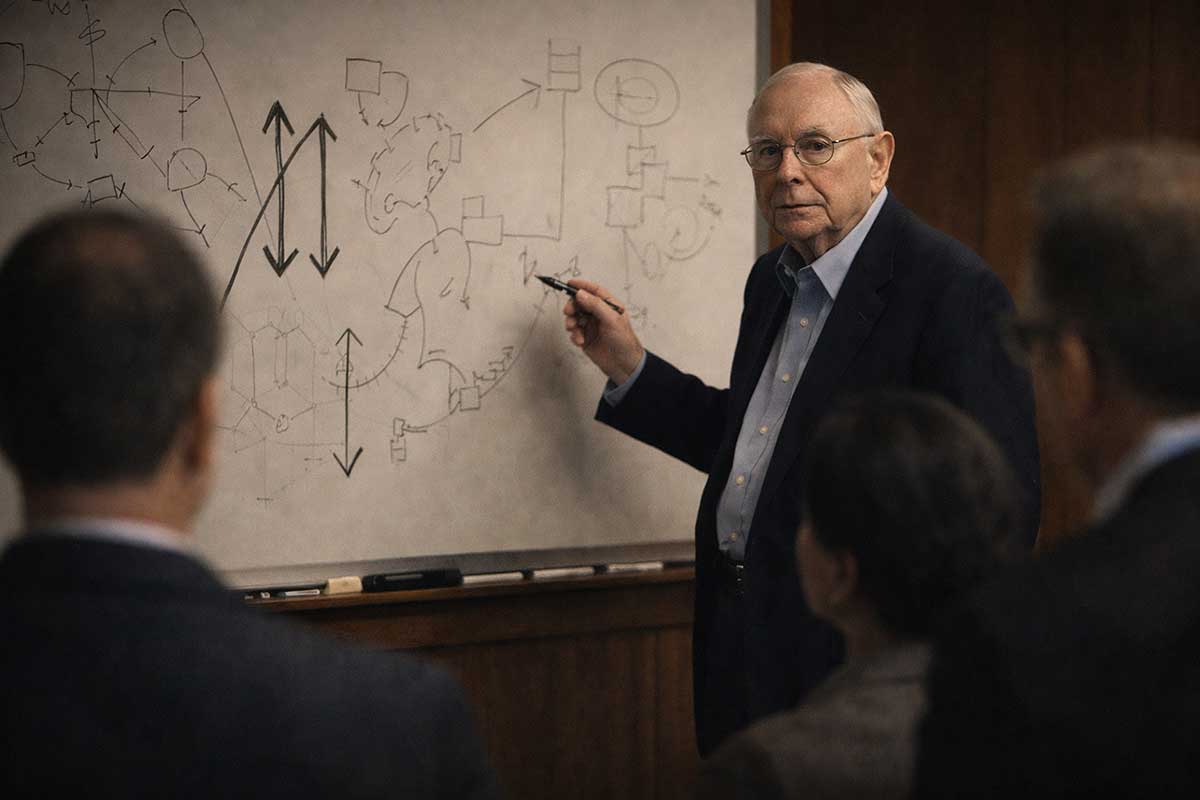
Guests: Nassim Nicholas Taleb, John Maynard Keynes, George Pólya, Claude Shannon, Annie Duke
A different room now—less library, more workshop. A chalkboard filled with half-erased probability notes. A deck of cards on the table. A small metal box with wires—someone’s old communications toy. The air feels like wagers and weather.
Charles T. Munger: If you want to be useful, you learn to avoid stupidity before you chase brilliance. I call it inversion—turning the problem upside down. Instead of asking, “How do I succeed?” ask, “How do I guarantee failure?” So let’s start there. In your worlds—markets, math, information, decision-making—what does inversion look like when it’s done properly?
George Pólya: In mathematics, inversion is simply changing your point of view until the path becomes visible. If you cannot solve the problem as stated, ask what would make it impossible. Ask what you would need in order to prove the opposite. Often the obstacle reveals the structure. The good solver is not a magician; he is a person who asks better questions.
Claude Shannon: In my world, you invert by focusing on noise. People want the clean signal, but the system fails because of interference. So you begin by asking: what can corrupt the message? Where can information be lost? You build redundancy, error correction, and you assume the channel is hostile. That’s not pessimism—it’s engineering.
Annie Duke: In decision-making, inversion is separating outcome from decision quality. People ask, “Did I win?” instead of “Did I make a good bet given what I knew?” If you want to guarantee failure, chase certainty, punish yourself for bad outcomes even when the process was sound, and reward yourself for lucky wins. That trains you into worse decisions over time.
John Maynard Keynes: In markets, inversion means respecting what you cannot know. Investors fail by believing their forecasts are precise. They forget that the future is not a simple extension of the past. If you want to guarantee ruin, you leverage yourself to the hilt on a single view of tomorrow and then act surprised when tomorrow refuses to obey.
Nassim Nicholas Taleb: Inversion is the only honest approach because it starts with fragility. Don’t tell me your plan; show me what breaks it. People build narratives and then call them knowledge. To invert is to ask: where is the tail risk? Where is the hidden exposure? How can this blow up beyond my imagination? The world punishes the fragile and rewards the robust—sometimes with a long delay, then all at once.
Munger: Good. Now the second question. A lot of people misunderstand uncertainty. They think it’s a fog you push through until you “get clarity.” But uncertainty is permanent. So: how do you make decisions when you can’t know the probabilities—when the situation is novel, the information is incomplete, and the stakes are real?
Annie Duke: First, stop demanding certainty. Then build a decision process that acknowledges error. Use ranges, not point predictions. Get clear about your objectives, your time horizon, and your tolerance for being wrong. And always ask: what’s the cost of learning? If you can make a small bet to gain information, do it. Treat decisions as repeated games, not one-shot verdicts on your worth.
Claude Shannon: When probabilities are unclear, you can still think in terms of information. What would reduce uncertainty the most? Which measurement would change your action? Sometimes the right move is to invest in the channel—improving how you get feedback—rather than investing in the decision itself. Even in a noisy environment, you can design systems that surface errors quickly.
George Pólya: In such cases, I would advise “working backward” from what you desire to prove. If you cannot quantify probabilities, you can still reason: If this decision is good, what must be true? If those conditions fail, what then? You turn uncertainty into a set of conditional statements. It is not perfect—but it forces structure where emotion wants to rule.
Keynes: I would emphasize humility and liquidity—intellectual and financial. In uncertain times, one must preserve the ability to change one’s mind. Keep reserves. Do not structure your affairs so that a single surprise forces liquidation. There is a reason prudent institutions survive: they can endure the period when the world makes no sense.
Taleb: Here is the brutal truth: when you can’t know probabilities, stop playing the “prediction game.” Instead, build exposure that benefits from volatility or at least does not die from it. Favor optionality. Avoid ruin at all costs. The first rule is survival. People optimize for returns and forget to optimize for staying alive. That’s not intelligence; it’s suicide with spreadsheets.
Munger: “Avoid ruin” is one of the best ideas ever invented. Now the third question—the practical one. People love clever frameworks and ignore the boring disciplines that actually prevent disaster. If you had to give a short checklist—what must someone do to avoid catastrophic mistakes in investing, business, or life—what would it include?
Taleb: Number one: never take risks that can wipe you out. If ruin is possible, it eventually happens. Number two: beware debt. Debt turns small errors into death. Number three: don’t be fooled by the absence of evidence—silent risks accumulate. And please, stop trying to look smart. Looking smart is how you die.
Keynes: I’ll echo the danger of leverage. I would add: do not confuse a good environment with personal skill. In a rising market, many become geniuses. Then the tide turns. Also: diversify not because you are timid, but because you are ignorant. Diversification is a confession of uncertainty—which is appropriate.
Annie Duke: I’d include: (1) Separate process from outcome. (2) Pre-mortem: imagine it failed—why? (3) Decide in advance what evidence would make you change course. (4) Keep decision journals; your memory will lie to protect your ego. And (5) surround yourself with people who disagree with you but want you to win.
Claude Shannon: Design for error. Assume mistakes will happen and build systems that detect them early—feedback loops, redundancy, cross-checks. In information theory, we expect noise, so we code for it. In life and business, people pretend noise won’t happen. That’s foolish. Add “error correction” to your habits: checklists, reviews, and independent verification.
George Pólya: I will add a simple rule: do not skip the step where you restate the problem in your own words. Many catastrophes come from solving the wrong problem with great confidence. And remember: the obvious method is often the best. In difficult situations, people overcomplicate. Simplicity is not naïveté; it is clarity.
Munger: That’s a good table. If you force yourself to invert, you stop being hypnotized by your own hopes. You focus on what can kill you—then you design around it.
He looks at the cards on the table and smiles slightly, as if at a private joke about humans and their certainty.
Munger: One last thing. Give me one sentence for someone who thinks they’re “too smart” to need this.
Taleb: Smart people have the most elaborate ways of going broke.
Keynes: The market can stay irrational longer than you can stay solvent.
Annie Duke: Confidence is not a substitute for calibration.
Shannon: The message fails where you didn’t plan for noise.
Pólya: If you cannot solve it, you have not understood it.
Munger: Good. Now we can talk about moats, price, and patience—where people get religious.
Topic 3 — Investing: Moats, Price, and Patience
Guests: Warren Buffett, Benjamin Graham, Philip Fisher, Jack Bogle, Seth Klarman
The room feels less like a salon and more like a shareholders’ meeting that never needed a stage. A legal pad in front of Munger. A simple pitcher of water. No screens. No tickers. Just five men who, in different ways, built entire philosophies out of one stubborn question: “What is this really worth—and what are the odds I’m fooling myself?”
Charles T. Munger: Investing attracts two kinds of people: the ones who want to get rich, and the ones who hate being wrong. The best investors are usually the second kind. So let’s begin where most people get hypnotized. Everyone talks about “moats.” If you had to explain what a moat really is—and how to recognize it without romantic stories—what would you say?
Warren Buffett: A moat is a durable advantage that protects a business’s economics from competition. Not a slogan—durable. You see it in pricing power, customer captivity, distribution strength, network effects, low-cost advantage, or a brand that truly changes behavior. And you test it by asking: if a very smart competitor had unlimited money, could they take this business away? If the answer is “yes, pretty easily,” the moat is wishful thinking.
Seth Klarman: I’d add that moats are often overstated because investors confuse good times with good business. A real moat shows up in downside resilience: the ability to hold margins, defend market share, and maintain returns on capital through adversity. If the moat disappears the moment the cycle turns, it wasn’t a moat. It was the tide.
Philip Fisher: Many moats are not visible in a single ratio. They live in people, culture, research pipelines, customer relationships, and a company’s capacity to adapt. You identify them by talking to customers, competitors, former employees—by doing scuttlebutt. The best moats are dynamic: management keeps widening them through innovation and service, not by guarding a castle that’s already crumbling.
Jack Bogle: The average investor makes “moats” into an excuse to speculate. They hear a story about a great company and they forget price and valuation entirely. Also, most investors cannot truly assess moat durability. That’s why broad diversification and low costs win over time. For most people, the best moat is owning the whole market at minimal expense.
Benjamin Graham: A moat can exist, certainly. But investors must remember: even a wonderful business can be a poor investment if bought at an excessive price. The investor’s margin of safety does not come from admiration. It comes from the relationship between price and value, and from refusing to depend on optimistic assumptions.
Munger: Good. Now—second question. People argue as if there are two religions: “buy quality at any price” versus “buy cheap no matter what.” Both approaches can go wrong. How do you think about the relationship between price and value in a way that keeps you sane?
Benjamin Graham: Value is what you get; price is what you pay. The gap between them is where your safety lives. Since we cannot foresee the future with precision, we demand a discount to compensate for our ignorance. When you pay too much, you erase the margin of safety and invite permanent loss. The intelligent investor is not one who predicts perfectly—he is one who structures his decisions so that errors do not become fatal.
Philip Fisher: I agree with the need for discipline, but I’d caution against thinking value is only what can be captured by today’s balance sheet. Some companies can reinvest at high rates for a very long time, compounding intrinsic value. Paying a fair price for a truly superior growth company can be far better than paying a low price for a mediocre business that never improves. The key is depth of understanding: you must know what you own and why it can grow.
Warren Buffett: Ben taught me the arithmetic of value, and Charlie helped teach me the economics of great businesses. The synthesis is: buy a wonderful business at a fair price rather than a fair business at a wonderful price—when the business has durable advantages and honest management. But “fair” still matters. You can’t suspend valuation. Even the best business can be a terrible investment if you pay a price that assumes perfection forever.
Seth Klarman: I’d put it bluntly: valuation is not optional, it’s the whole game. Quality is not a substitute for price. The market periodically creates pockets of neglect, fear, or forced selling—that’s where value investing earns its keep. But you must also accept that the market can stay irrational longer than you want it to, so your position size, liquidity, and patience matter. Paying too much is the most common unforced error.
Jack Bogle: Most people don’t have the temperament or the analytical skill to do any of this consistently. They buy high, sell low, chase performance, and pay heavy fees to do it. So the best price-value discipline for them is to own the market through a low-cost index fund and let capitalism do the compounding. The miracle of compounding is powerful—but costs and taxes are relentless.
Munger: Now for the third question—the one that separates philosophy from temperament. Everyone loves “patience” as a word. Very few can live it. What does patience actually look like in practice? And when do you sell?
Jack Bogle: Patience looks like staying the course when the headlines scream that you must do something. It’s accepting that markets will fluctuate and that your job is not to outguess them. For most investors, selling should be rare and usually tied to life needs, rebalancing, or a change in long-term allocation. The constant trading culture is a machine designed to transfer wealth from the investor to the intermediary.
Seth Klarman: Patience looks like waiting with cash when nothing is cheap, and not forcing action to avoid feeling left out. It also means the humility to admit you may be early. Selling is appropriate when the price fully reflects value, when your thesis breaks, or when you find a better risk-adjusted opportunity. But the biggest discipline is knowing the difference between temporary pain and permanent impairment.
Warren Buffett: Patience is the willingness to do nothing—sometimes for years—until the right pitch comes. We don’t get paid for activity; we get paid for being right at the right scale. As for selling: if the business deteriorates, if management changes the character of the company, or if we made a mistake in our understanding, we’ll sell. But we prefer to own great businesses for a long time. The taxes and friction of constant selling are real, and the compounding of a good business is powerful.
Philip Fisher: Patience also means staying through the period when the company is investing heavily and the market doubts it—if your research suggests the competitive position is strengthening. Many of the greatest gains come from long-term holding of exceptional companies as they grow into their potential. Selling is warranted when the company no longer meets your original standards—especially if management integrity or innovative capacity declines.
Benjamin Graham: I would emphasize discipline over romance. Patience is not stubbornness; it is adherence to a sound principle. If a security is bought with a margin of safety, you wait for the market to recognize value—or you revise your appraisal if facts change. Selling should be guided by valuation and by fundamental deterioration, not by mood or market gossip.
Munger: That’s the heart of it: temperament, discipline, and an allergy to self-deception. People want a formula that removes discomfort. Investing is largely the management of discomfort—waiting, watching, and not being swept away by the crowd.
He taps his pen once, like a judge ending testimony.
Munger: Give the reader one sentence they can use as a guardrail—something simple enough to remember when their emotions start negotiating.
Klarman: Avoid permanent loss before chasing profit.
Fisher: Know the business deeply—or don’t pretend you own it.
Graham: Margin of safety is the investor’s best friend.
Bogle: In investing, you get what you don’t pay for.
Buffett: It’s better to be approximately right than precisely wrong.
Topic 4 — Incentives: The Hidden Engine of Human Behavior
Guests: Adam Smith, B.F. Skinner, Robert Cialdini, Elinor Ostrom, Milton Friedman
This room feels like a courtroom and a laboratory at the same time. One side of the table holds ledgers and contracts. The other holds notebooks, experiments, and observations of human habit. Munger likes this topic because it explains almost everything people refuse to admit: we are not moved by what we say—we are moved by what we’re rewarded for.
Charles T. Munger: I’ve said for years: show me the incentives and I’ll show you the outcome. People think that’s cynical. I think it’s practical. So first: if you had to explain the single most common way incentives quietly destroy good intentions—in business, government, even families—what would you highlight?
B.F. Skinner: People reward what they claim to dislike and punish what they claim to want. That’s the pattern. Behavior follows consequences. If you praise results without regard to method, you create cheating. If you punish honest error, you create lying. If you reward short-term output, you destroy long-term learning. The tragedy is that most incentive systems are designed by people who do not study behavior.
Robert Cialdini: And they’re exploited by people who do. Incentives don’t only come in money. They come in status, belonging, reputation, consistency, and social proof. The quiet destruction often happens when a culture rewards appearance—looking successful—more than it rewards substance. Then the whole group becomes a theater of signaling. And once that happens, rationality becomes unpopular.
Adam Smith: I would emphasize that incentives are not merely personal; they are structural. When rules and institutions reward narrow self-interest without aligning it to the public good, you may end with outcomes that are prosperous for a few and corrosive for many. The issue is not that people have self-interest—that is a constant. The issue is whether the system channels it toward productive ends or predatory ones.
Milton Friedman: The fastest way to corrupt a system is to remove accountability. If decision-makers spend other people’s money, or face no consequences for poor performance, incentives will be misaligned. And when you allow rewards without risk—private gain and socialized loss—you produce moral hazard. You don’t need to assume bad character. The incentives will do the work.
Elinor Ostrom: I’d add that top-down incentive schemes often fail because they ignore local knowledge and norms. You can’t simply impose rewards and punishments and expect cooperation to emerge. People sustain cooperation when they have shared rules, monitoring, and fair conflict resolution. When incentives feel illegitimate—when they’re seen as extraction—people stop participating honestly.
Munger: Good. Second question. Many people talk about “fixing incentives,” but they do it like amateurs. They change a bonus plan or rewrite a mission statement and call it reform. How do you design incentives that actually work over time—without producing perverse outcomes?
Elinor Ostrom: Start with the reality of the community you’re designing for. Durable systems are built with participation. Rules need clarity, fairness, and legitimacy. Monitoring must be present—but not humiliating. Sanctions should be graduated, not extreme. And there must be an easy way to resolve disputes. People cooperate longer when they trust the process and feel their voice matters.
Milton Friedman: Incentives work when outcomes are measurable and responsibility is clear. If you want better performance, measure performance. If you want less waste, ensure the person making the decision bears the cost of poor decisions. Complexity can hide failure. Simplicity reveals it. The more your incentives rely on vague ideals, the easier it becomes to game them.
B.F. Skinner: And you must reinforce the behavior you want at the moment it occurs. Long delays between action and reward weaken learning. If you want ethics, reward ethical behavior immediately and visibly. If you want innovation, reward experimentation and intelligent risk-taking—not only the occasional success. Systems that only reward the winner teach everyone else to avoid trying.
Robert Cialdini: Don’t ignore social incentives. If the group praises integrity, people will protect their identity as “the kind of person who does the right thing.” But if the culture worships results at any cost, then the person who cheats and wins becomes the hero. Identity is an incentive. Norms are incentives. The quickest way to shape behavior is to shape what the group admires.
Adam Smith: I would caution that incentives should not reduce human beings to mere machines of gain. We have moral sentiments. People desire to be worthy of respect, not merely to be praised. A healthy incentive system cultivates prudence, justice, and trust. Without trust, transaction costs rise, deception becomes common, and the system decays even if it appears profitable in the short term.
Munger: Third question—this is where people get uncomfortable. In your view, what are the most dangerous “incentive-caused biases” that smart people fall for? The ones that make them rationalize nonsense and call it strategy?
Cialdini: Commitment and consistency is a big one. Once people publicly commit, they will defend the position to protect identity. Add incentives like status or career advancement, and they become blind. Another is social proof: if everyone else is doing it, smart people conclude it must be safe. Herds don’t feel like herds from the inside—they feel like “consensus.”
Skinner: People are shaped by reinforcement histories they don’t understand. Give someone intermittent rewards—occasional big wins—and you create compulsive behavior. That’s gambling. You can build entire corporate cultures on that: unpredictable rewards for dramatic performance. It produces frenzy and burnout. And the people involved call it “high standards.”
Friedman: Moral hazard is the classic. If you can take upside and push downside onto others, you will take more risk than is socially optimal. It’s not a personality flaw. It’s arithmetic. In finance and politics, this bias becomes catastrophic because it can scale.
Ostrom: I’d mention extraction disguised as efficiency. When external actors create incentives that allow them to harvest a resource—attention, labor, land—without paying the true cost, the system becomes unstable. People then respond with their own informal incentives: evasion, resistance, sabotage. The tragedy is that the designers interpret this as “people are irrational,” instead of recognizing that people are defending fairness.
Smith: The desire for admiration can become a deforming incentive. People will trade long-term virtue for short-term applause. They will mistake wealth for worth. And when society rewards vanity, it produces an economy of spectacle rather than of true productivity. This is not merely personal; it shapes markets, politics, and culture.
Munger: That’s the unpleasant truth: incentives don’t just guide behavior—they create the stories people tell themselves to justify behavior. You can watch an intelligent man become a fool in real time when his incentives demand it.
He leans back, almost satisfied—not because the world is fixed, but because the mechanism is visible.
Munger: One sentence each—something the reader can use tomorrow.
Smith: Align self-interest with the common good, or expect corrosion.
Skinner: Reward the behavior you want—or you will train the opposite.
Cialdini: Watch what the group praises; that’s the real incentive plan.
Ostrom: Systems endure when rules feel fair and locally owned.
Friedman: If you separate reward from responsibility, you invite disaster.
Munger: Excellent. Now we go to temperament—because even with perfect incentives, the mind still has to live with itself.
Topic 5 — Temperament: Character, Suffering, and the Long Game

Guests: Marcus Aurelius, Seneca, Viktor Frankl, William James, Bertrand Russell
This room is quieter than the others. Less debate, more gravity. The kind of quiet you get when everyone at the table has met suffering without theatrics—and learned that character isn’t a philosophy you recite, but a posture you hold when life refuses to cooperate.
Charles T. Munger: Investing is easy compared to enduring your own mind. Most people don’t fail because they can’t understand a balance sheet. They fail because they can’t handle envy, fear, boredom, resentment, or pride. So I’ll start simply: what is “temperament” in your language—and how does a person actually build it?
Marcus Aurelius: Temperament is governance. The mind is a city; you are its ruler. External events are not under your command, but your judgments are. One builds temperament by practicing, daily, the distinction between what depends on you and what does not. When your inner ruler grows steady, fortune loses some of its tyranny.
Seneca: Temperament is the ability to endure without becoming smaller. It is strength with civility. You build it by rehearsing adversity before it arrives, and by refusing to be surprised by human nature—yours included. People suffer twice: once from the event, and again from their outrage that the event occurred. Temperament removes the second suffering.
Viktor Frankl: Temperament is meaning under pressure. Between stimulus and response there is a space. In that space is our power to choose our attitude. This is not sentimental. It is discipline. A person builds temperament by remembering what they serve—love, responsibility, a task worth suffering for. If you have a “why,” you can survive many “hows.”
William James: Temperament is habit at the level of the soul. It is the trained capacity to choose a better response even when the nervous system demands the familiar one. People imagine character as a single heroic act. In reality, it is built by small repeated decisions—what you attend to, what you indulge, what you resist. The will is strengthened by use, like a muscle.
Bertrand Russell: Temperament is a kind of intellectual and emotional hygiene. Much misery comes from self-absorption and from taking one’s thoughts too seriously. The person with good temperament can step back, see the absurdity, and continue. They cultivate interests beyond themselves, and they keep a sense of proportion. Without proportion, everything feels like catastrophe.
Munger: Second question. Everyone at this table has lived through pain—personal, historical, philosophical. Modern life teaches people to treat discomfort as an emergency. But the long game requires the ability to endure unpleasantness without panic. So: how should a person relate to suffering so it becomes instruction, not damage?
Frankl: Suffering is not automatically meaningful. But it can become meaningful if it is met with dignity and oriented toward purpose. The danger is when suffering becomes nothing but bitterness. When you suffer, ask: what is being asked of me now? What responsibility remains? What love remains? Meaning does not erase pain, but it prevents pain from turning you into someone you do not respect.
Seneca: I would say: do not add the poison of interpretation. Pain visits everyone. But people attach labels—humiliation, injustice, doom—and then they drown in their own commentary. The wise man allows pain to be what it is: a sensation, a circumstance, a passing storm. He then asks what virtue is demanded: patience, courage, restraint, or humility.
Marcus Aurelius: You do not control the first blow. You control whether you turn it into a wound of the soul. When you face hardship, say: this is part of the human condition. Nothing unusual is happening. Then ask: what is the honorable action? What is the useful action? The mind becomes resilient not by avoiding hardship, but by meeting it without surrendering its integrity.
William James: And remember that suffering trains attention. A crisis forces you to notice what matters. The lesson is not merely philosophical—it is practical: restructure your habits. Change what you consume, who you listen to, how you spend your hours. Many people “learn” from suffering and then return to the same patterns. Instruction that doesn’t change habit is just a story.
Russell: I’d add: suffering becomes damage when it turns you inward until you can’t see anything else. The cure is outwardness—work, curiosity, friendship, and an interest in the world. The person who clings to their wounds as identity will suffer indefinitely. The person who keeps building a life will find that pain becomes a smaller part of the whole.
Munger: Third question—the money question and the life question. The long game demands patience, but patience is often confused with passivity. How do you know when to endure and when to act? When to hold steady, and when to change course?
Marcus Aurelius: Endure when the matter is outside your control; act when virtue requires action. Many confuse impulse with necessity. If your action is driven by anger, fear, or vanity, wait. If your action is driven by duty, clarity, and service, proceed. The disciplined mind does not rush, but it also does not hide.
Seneca: Endure what cannot be changed today, but do not endure what corrupts your character. If an environment makes you dishonest, cruel, or cowardly, leave it. If a habit makes you weak, break it. Patience is not tolerating the intolerable. Patience is refusing to become frantic.
Frankl: Ask: does this suffering have a purpose, or is it merely destroying me? Endure what serves a meaningful end. Change what can be changed. But even when you cannot change circumstances, you can change your stance. That is action of a different kind—inner action. It is often the most decisive.
William James: I’d phrase it pragmatically: are you learning, or are you repeating? Endurance is justified when it produces growth, skill, wisdom. But if you are merely stuck, then action is required. Change your environment, your method, your commitments. The will must be used. A man becomes what he repeatedly does.
Russell: And don’t dramatize it. People waste years waiting for certainty that never comes. Life offers probabilities, not guarantees. Choose the course that seems best with the information available, keep your mind open, and adjust. The long game is not a single perfect decision; it is a sequence of reasonably good decisions corrected over time.
Munger: That’s a good ending for a book about mental models and practical wisdom. You can have the finest ideas in the world and still lose if your temperament is rotten. Temperament is what keeps you from acting like an idiot at the exact moment the world is trying to provoke you.
He pauses, then gives the kind of final line he’s always loved—plain, almost dry, but deadly accurate.
Munger: If you can keep your head while other people are losing theirs, you’ll win more than you deserve.
Marcus Aurelius: Master the judgment, and you master the day.
Seneca: A calm mind is a fortress no fortune can breach.
Frankl: Meaning is the last human freedom.
William James: The great thing is to create yourself through habit.
Russell: Keep perspective; most alarms are false.
Final Thoughts by Charlie Munger
This conversation did what good conversations always do: it shaved off my sentimental nonsense and left the durable parts standing.
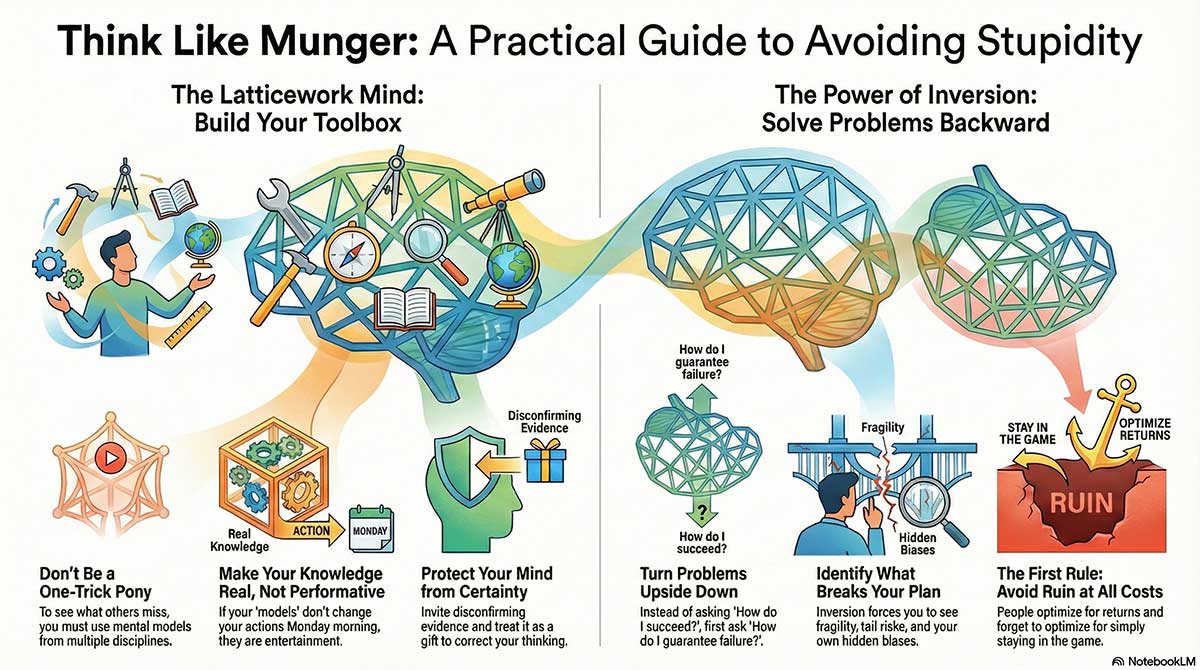
First, the “latticework” isn’t a trophy case—it’s a working toolbox. Hearing it from people who actually built the underlying ideas reinforced the obvious: you don’t collect models to feel smart; you use them to behave less stupidly under pressure. If your models don’t change what you do, you’re just decorating your mind.
Second, inversion remains the closest thing to a cheat code I’ve ever found. When you ask, “How do I fail?” you stop bargaining with yourself. You see fragility, leverage, hidden tail risks, and the soft little lies that optimism tells. And once you see them, you can design around them. The first job is survival. Everything else is secondary.
Third, investing still comes down to a short list that people refuse to respect: quality matters, price matters, and temperament matters most. You can have a wonderful business and pay too much. You can have a cheap asset and misunderstand what you own. And you can be right on the facts and still lose because you can’t control your emotions. The market doesn’t just test intelligence—it tests character.
Fourth, incentives are a master switch. If you don’t understand incentives, you’ll be perpetually surprised by outcomes that were completely predictable. And worse, you’ll create systems that reward the behavior you claim to hate. I’ve learned to treat incentive design as a high moral duty, not a footnote.
Finally, this table reminded me that the long game is largely an inner game. Suffering, boredom, envy, and ego aren’t side issues—they are the main issues. The people who endure, keep learning, and stay rational will usually beat the people who are merely brilliant.
If this discussion leaves you with anything useful, let it be this: build a mind that is hard to bribe—by money, applause, ideology, or fear. That’s the closest thing to an unfair advantage I know.
Short Bios:
Charles T. Munger — Vice Chairman of Berkshire Hathaway and Warren Buffett’s longtime partner, famous for “latticework” thinking, inversion, and incentive-based realism. Known for blunt, rational decision-making built to avoid big mistakes.
Richard Feynman — Nobel Prize–winning physicist celebrated for crystal-clear explanations and fearless curiosity. A model of first-principles thinking and intellectual honesty.
Charles Darwin — Naturalist who reshaped modern science with evolution by natural selection. Known for patient observation, rigorous evidence-gathering, and willingness to revise beliefs.
Benjamin Franklin — Founding-era polymath, inventor, diplomat, and master of practical self-improvement. A lifelong student of habit, systems, and everyday wisdom.
Daniel Kahneman — Nobel laureate whose work founded modern behavioral economics. Best known for explaining cognitive biases, judgment errors, and how people misread risk.
Peter Drucker — Influential management thinker who defined much of modern business practice. Focused on effectiveness, outcomes, and turning ideas into disciplined execution.
Nassim Nicholas Taleb — Former trader and author known for antifragility, tail-risk thinking, and skepticism of overconfident forecasting. Emphasizes robustness, optionality, and avoiding ruin.
John Maynard Keynes — Economist who transformed macroeconomics and public policy. Known for sharp insights about uncertainty, markets, and the psychology of investors.
George Pólya — Mathematician famous for teaching practical problem-solving methods. Known for heuristic thinking: how to ask the right questions when the path isn’t obvious.
Claude Shannon — Founder of information theory, shaping how modern communication and computing work. Known for clarity about signal vs. noise, redundancy, and system design.
Annie Duke — Former professional poker champion and decision strategist. Known for teaching probabilistic thinking, decision journals, and separating process quality from outcomes.
Warren Buffett — Berkshire Hathaway’s chairman and one of history’s most successful long-term investors. Known for patience, business quality, and calm rationality under market pressure.
Benjamin Graham — “Father of value investing” and author of The Intelligent Investor. Famous for margin of safety, disciplined valuation, and emotional control.
Philip Fisher — Investing pioneer who emphasized business quality, long-term growth, and deep research through “scuttlebutt.” Known for focusing on management, innovation, and durability.
Jack Bogle — Founder of Vanguard and champion of low-cost index investing. Known for preaching simplicity, long horizons, and the power of minimizing fees.
Seth Klarman — Value investor and author of Margin of Safety. Known for risk control, patience, contrarian discipline, and focusing on permanent loss avoidance.
Adam Smith — Moral philosopher and economist whose ideas shaped modern capitalism. Known for explaining incentives, self-interest, and the institutional conditions for prosperity.
B.F. Skinner — Psychologist who pioneered behaviorism and the study of reinforcement. Known for showing how rewards and punishments shape human behavior predictably.
Robert Cialdini — Social psychologist known for the science of persuasion and influence. Famous for identifying principles like social proof, reciprocity, and commitment-consistency.
Elinor Ostrom — Nobel Prize–winning political economist who studied how communities manage shared resources. Known for real-world governance principles that sustain cooperation.
Milton Friedman — Economist and public intellectual known for free-market arguments and incentive-based analysis. Focused on accountability, trade-offs, and unintended consequences.
Marcus Aurelius — Roman emperor and Stoic philosopher, author of Meditations. Known for inner discipline, clear judgment, and calm strength under pressure.
Seneca — Stoic philosopher and statesman known for practical wisdom on adversity and character. Emphasized restraint, preparation for hardship, and clarity of mind.
Viktor Frankl — Psychiatrist and author of Man’s Search for Meaning. Known for logotherapy and the idea that meaning and responsibility can sustain people through suffering.
William James — Foundational psychologist and philosopher who explored habit, attention, and the will. Known for pragmatic thinking and the power of repeated choices.
Bertrand Russell — Philosopher and public thinker known for clarity, skepticism, and social commentary. Emphasized perspective, intellectual humility, and freeing the mind from needless misery.
Leave a Reply