
|
Getting your Trinity Audio player ready...
|
Introduction by Emily Dickinson
(Soft candlelight flickers. A small desk stands by the window. Emily turns from her notebook and speaks with quiet grace.)
Good evening, dear friends.
How curious it is to meet you here — across time —
where thought travels faster than breath,
and hearts still seek the same bright reason to speak.
I am Emily.
I wrote from a small room in Amherst —
not because the world was far away,
but because the world was already inside.
You see, poetry is not a language to learn —
it is a language you already speak when no one is watching.
It is the pulse between silence and sound.
It is the little gasp you take
when you suddenly notice something you cannot explain.
I wrote not to be read,
but to keep from bursting.
My poems were not my ambition —
they were my breathing.
If you have ever felt something so bright or strange
that ordinary words refused to hold it —
then, my dear, you are already a poet.
In these lessons,
we shall learn how to listen more tenderly —
to the heart’s rhythm,
to the mind’s music,
to the universe folded inside a single moment.
Do not expect me to give you rules.
I can only offer you windows —
and perhaps a few dashes
to let the air in.
Welcome to the art of inner poetry.
Shall we begin?
(Note: This is an imaginary conversation, a creative exploration of an idea, and not a real speech or event.)
Topic 1 — The Art of Compression: Saying Infinity in a Breath
Scene opens
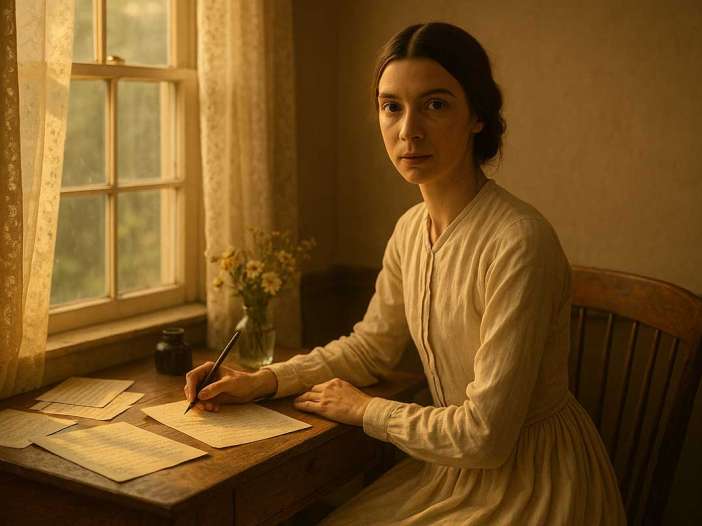
Soft amber light spills through sheer curtains. The faint hum of bees drifts in from the garden. Emily Dickinson stands by her small writing table, dressed in simple white, a ribbon at her neck. A stack of folded papers lies beside an inkwell. She looks up at the camera — a quiet mischief in her eyes.
Emily: “A poet is not one who says much — but one who makes much of what is said.”
She sits. The camera slowly glides closer, her hands poised over a blank sheet.
“When I began writing, I had little company — save the wind and eternity. I learned that words, when few, must carry the weight of worlds. Brevity, to me, was not restraint — it was reverence.”
Segment 1 — The Electric Atom of Language
She lifts a small folded poem and opens it gently.
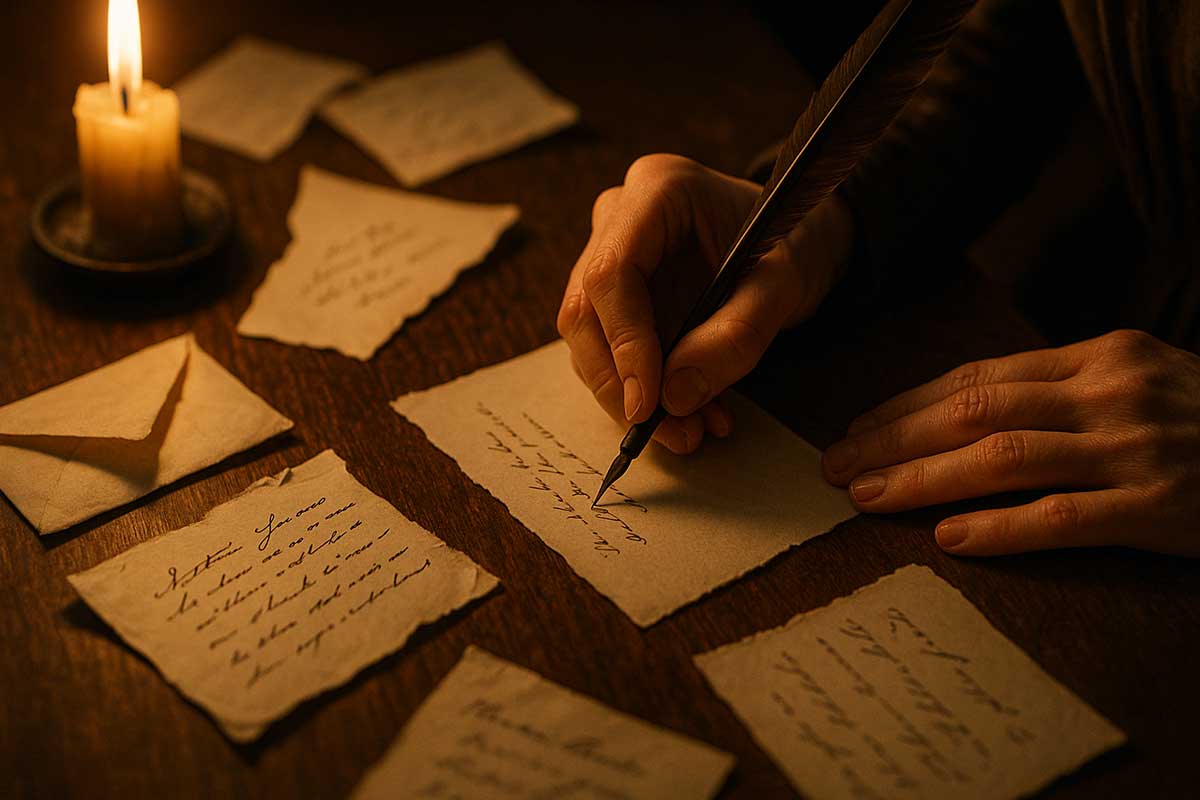
“I often wrote upon envelopes — the discarded, the overlooked. Perhaps because the greatest truths arrive in small disguises.”
She reads softly:
“Forever — is composed of Nows —”
A pause.
“Each word, like an atom, contains the infinite. When you strip away all but the essential, you awaken the current. A poem should not explain — it should strike.”
She leans forward.
“Compression is not shrinking. It is distilling. A single drop of lightning can light the sky.”
Stage direction:
The screen cuts to close-ups of her pen touching paper.
She writes, crosses out, rewrites — the ink dark and deliberate.
“When you write, ask yourself — which word cannot be lived without? Which syllable carries the pulse? Every deletion is a kind of devotion.”
Visual Insert:
Words fade onscreen as she speaks — light, truth, forever, silence — until only one remains: Now.
“When you say less, the reader leans closer. Silence becomes your collaborator.”
Segment 2 — The Dash: My Little Stairway to Heaven
Emily turns toward the viewer, half-smiling.
“Critics found fault with my dashes — those little jumps across thought. But I assure you, each dash is a heartbeat — a leap between the visible and the unsaid.”
She writes on the board:
‘Because I could not stop for Death —
He kindly stopped for me —’
Then underlines the dashes with care.
“The dash is not absence — it is oxygen. It lets the soul breathe between phrases. It gives space for the unspeakable to enter.”
A soft instrumental melody swells — harp and strings.
She continues:
“In your own writing, trust the pause. A poem that does not breathe — dies.”
Segment 3 — The Music of Precision
Emily paces the room slowly, her voice deliberate yet tender.
“I once said, ‘If I feel physically as if the top of my head were taken off, I know that is poetry.’ That sensation — that voltage — comes from precision.”
She opens another folded note and reads:
‘A word is dead — when it is said —
Some say —
I say it just begins to live —
That day —’
She looks up.
“Every word carries its own heartbeat. Choose the ones that still throb after silence.
Do not adorn the truth — electrify it.”
She gestures toward the viewer, almost conspiratorially.
“Do not be afraid to leave your reader slightly hungry. That hunger is participation.”
Stage direction:
Cut to a student in a dim study, crossing out long lines, rewriting them into tight, trembling stanzas. Emily’s voice overlays softly:
“The moment you remove what is merely clever, what remains is divine.”
Segment 4 — Exercise: The Four Lines of Eternity
Emily returns to her desk, dipping her pen again.
“Now, let us make a small attempt together.
Describe eternity — but you may not use the words time, end, or forever.”
She leans forward with a playful glint.
“This is the kind of assignment angels fail at.”
She begins writing aloud:
“A clockless sky — a breath unspent —
No start, nor close — just firmament —”
She pauses, smiling faintly.
“Four lines can contain a cathedral. But only if you build it with silence as mortar.”
Camera pans across her face — glowing, distant, serene.
“You see, language is not only what we say — it is what we dare to leave unsaid.”
Segment 5 — The Power of Absence
Emily walks toward the window, light washing her face.
“The painter has color, the musician sound. But the poet’s art depends upon what is not there.”
She turns back.
“We build our structures out of air — and yet, how solid they become.”
She picks up a small flower from the sill, twirls it gently.
“Compression is like this bloom — the essence of the meadow made portable.”
She holds it to her heart.
“When your lines feel thin, remember — thinness is sometimes transparency. It lets the eternal shine through.”
Segment 6 — A Demonstration: Editing the Infinite
Onscreen, we see a longer poem projected in cursive:
When I think of love, I think of the sun,
How it rises each morning, dutiful and bright,
Warming all beneath its sight,
Reminding me that love endures...
Emily takes a quill and begins to strike through phrases, murmuring as she works.
“Too dutiful — too polite — too complete.”
“Love is not an essay. It is a wound with light around it.”
She writes again:
The Sun — just touched me — and withdrew —
Yet — still — I burn.
She looks up.
“Now it breathes. The poem has mystery — and therefore, life.”
Segment 7 — The Courage to Leave It Incomplete
Emily sits back down, folding her hands on the desk.
“When you compress, you risk being misunderstood.
But misunderstanding is not failure — it is invitation.”
She smiles faintly, her tone both gentle and sharp.
“Readers seek clarity; truth prefers ambiguity.
Let your poem end where comprehension begins to tremble.”
She glances toward the papers beside her.
“Many of my poems never left this room.
They lived only in the breath between me — and what I could not name.”
She picks up one page and folds it neatly, tying it with ribbon.
“That was enough.”
Segment 8 — The Spirit of the Atom
Emily stands, hands clasped before her, and her voice softens.
“The universe, I think, admires economy.
A seed contains a tree, a glance contains a lifetime,
and a single word can resurrect a soul.”
She looks at the viewer.
“When you write, do not try to say everything.
Instead, say the one thing so truly
that the rest of the universe rearranges itself around it.”
Segment 9 — Reflection and Closing Thought
Camera slowly pushes in. The room grows quieter.
“The art of compression is the art of faith —
faith that what you mean will bloom beyond your words.”
She looks down at her page, whispers almost to herself:
“I could not see the whole of Heaven —
so I wrote the door.”
She places her quill down.
The light in the room fades into late afternoon gold.
The sound of a single bird echoes from outside.
“When you next write, remember —
You are not shrinking your truth.
You are distilling it, like honey from the invisible.”
She glances once more at the camera, her expression calm, luminous.
“Now, tell your infinity — in a breath.”
Fade to black.
Text on screen:
Exercise: Write a four-line poem that captures eternity without naming time.
Use silence, pause, and rhythm as your brush.
Music fades — a final piano note lingers, unresolved.
Topic 2 — The Inner Telescope: Observing the Soul
Opening Scene
The screen glimmers with candlelight. A faint harp note trembles.
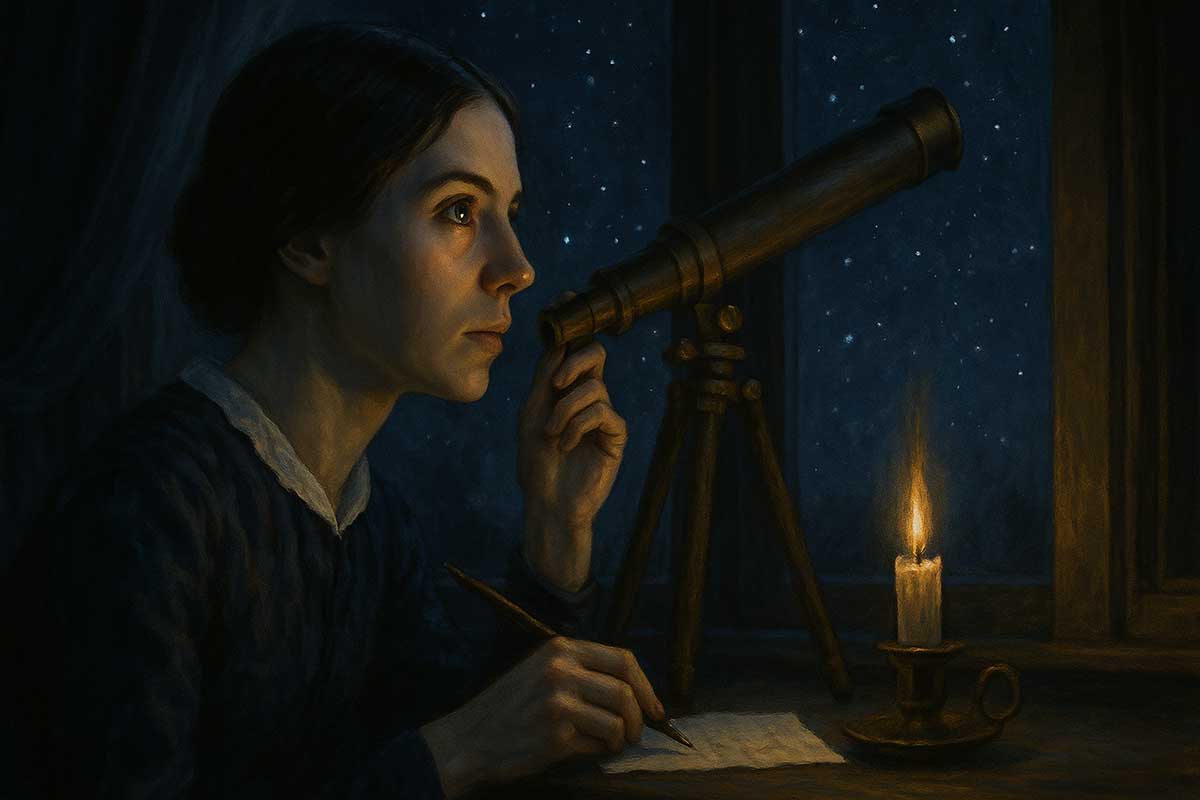
Emily Dickinson stands before a tall, dark window where the night sky spills its constellations. Her white dress seems to absorb the starlight. A small telescope rests on her writing table beside an open notebook.
Emily (softly):
“There is a telescope within the breast. Through it, one can see the shape of forever — not by looking out, but in.”
She turns toward the viewer.
“We spend our lives peering outward — measuring, naming, comparing. But the poet reverses the lens. She looks into the soul until the galaxies there begin to speak.”
Segment 1 — Turning the Lens Inward
Emily lifts the telescope and looks not through the eyepiece but into its mirrored end.
“When I looked outward, I saw chaos; when I turned inward, constellations. Your task is to become the astronomer of your own interior.”
She sits, takes her pen.
“The poem is not an observation of the world — it is the world observing itself through you.”
She writes:
‘The Brain — is wider than the Sky —
For — put them side by side —
The one the other will contain
With ease — and You — beside —’
She looks up.
“The brain is not the seat of thought — it is the observatory of being. Every poem begins as a glimmer there — an unmeasured star waiting to be named.”
Stage direction:
A subtle visual effect shows constellations flickering across the dark wall behind her, aligning with the rhythm of her words.
Segment 2 — Mapping the Invisible
Emily walks slowly toward a candle set on the desk. She holds her hand near the flame.
“To observe the soul, you must map what cannot be drawn. The light that burns inside us casts both illumination and shadow.”
She turns the candle until its flame trembles.
“When you write, do not chase the light alone. Chart also the eclipses. Every bright star has a night beneath it.”
She smiles faintly.
“I found my truths not in serenity but in collision — between faith and doubt, ecstasy and despair. That clash is the sound of creation.”
Visual:
Ink begins to spread on paper like a constellation forming.
Segment 3 — The Mirror as Universe
Emily sits again, the window’s reflection faintly superimposed over her face.
“There is a mirror in the mind. Most see only themselves in it — a surface of vanity. But if you watch long enough, the reflection melts, and you glimpse the cosmos behind your own eyes.”
She pauses, gaze distant.
“When I wrote of the bee, the clover, the death of a friend — I was not describing them. I was witnessing the same divinity reflected in each.”
She leans forward.
“Observation is devotion disguised as attention.”
She traces her finger along the page.
“To see truly, you must stop trying to understand. Understanding is the cage; wonder is the sky.”
Segment 4 — Demonstration: Translating Feeling into Phenomenon
A student’s poem appears projected on a parchment backdrop:
My loneliness is cold and endless;
it has no color, no sound.
Emily nods gently.
“Let us transform this emotion into an event of nature.”
She rewrites:
A single sparrow stays — after frost —
The others — took the dawn.
She explains:
“Now, loneliness breathes. We feel its chill, its endurance. It is no longer complaint — it is cosmos.”
She places the quill down.
“This is observation: to translate what is felt into what can be seen by the soul’s eye.”
Segment 5 — Entering Stillness
Scene: Emily extinguishes one candle; only moonlight remains. The room hums with silence.
“Stillness is not the absence of motion. It is the motion too small to be heard. When you are utterly still, you hear creation composing itself.”
She closes her eyes.
“I listened once for an hour — perhaps more — and in that listening a poem arrived without footsteps.”
She recites, almost whispering:
‘A Light exists in Spring
Not present on the Year
At any other period —
When March is scarcely here.’
“I did not chase this light. I became quiet enough for it to find me.”
Teaching Point:
Poetry is reception before expression. Observation of the soul requires surrender — not pursuit.
Segment 6 — The Soul as Weather
Emily rises, walks to the window; thunder murmurs far away.
“The soul changes like weather — sudden rain, slow thaw, unseasonable sun. A poet keeps her barometer within.”
She gestures to the glass where droplets begin to form.
“When you feel despair, record it as thunder. When you feel hope, let it appear as light through storm. Thus, the inner life gains form — and the reader recognizes their own sky.”
She looks down, smiling wistfully.
“I once wrote, ‘The Soul selects her own Society — then — shuts the Door —.’
Even solitude is weather — a pressure system of being alone.”
She turns back.
“Learn to predict your soul’s climate. Then write the forecast.”
Segment 7 — Exercise: The Natural Metaphor
Emily takes a fresh sheet.
“Now — your turn. Choose an emotion that visits you often — grief, joy, longing. Observe it quietly until it begins to change shape.”
She writes:
“If sorrow were a landscape, what would grow there?
If joy were a color, what shade would it burn?”
She looks up.
“Do not write what you think you feel. Write what your soul shows you.”
A slow montage unfolds — students watching candle flames, ripples in water, clouds moving across the moon — their journals open.
Her voice continues:
“To observe the soul is to enter conversation with the unseen. You ask, it answers — in symbols.”
Segment 8 — The Risk of Seeing
Emily returns to her desk, tone deepening.
“Be warned — the telescope reveals both beauty and terror. To witness yourself clearly is to meet your own infinity — and sometimes, your abyss.”
She looks out the window, stars mirrored in her eyes.
“Yet the soul, once seen, never returns to blindness. Better to tremble in revelation than sleep in certainty.”
She turns back to the camera.
“Write what startles you. If you feel fear, you are near the core.”
Segment 9 — Faith in the Unrecorded
Scene: Emily slowly covers the telescope with a linen cloth, leaving it in shadow.
“Most of what the inner telescope sees cannot be captured. The poem is only an echo — a trace on the glass.”
She smiles softly.
“But even echoes can move mountains. Trust that what you glimpse, even briefly, exists beyond your ability to name it.”
She writes one final couplet:
‘Not knowing when the Dawn will come —
I open every Door —’
“That is observation — not certainty, but readiness.”
Segment 10 — Closing Reflection: Becoming Your Own Cosmos
The night outside begins to pale; a pre-dawn silver filters through the window.
Emily gathers her papers, ties them with ribbon, and looks directly into the camera — as though through the telescope of eternity.
“You need not travel to distant worlds. The universe has already taken residence behind your eyes.”
She steps closer; her voice is tender, almost luminous.
“Observe without judgment. Record without vanity. Love what you find, even when it frightens you.”
She blows out the last candle. Darkness lingers, then a single star appears in the window’s reflection.
“And remember — you are not looking at the stars. They are looking back.”
Fade to black.
Text on screen:
Exercise: Observe your own emotion in silence for five minutes. Describe it through a natural phenomenon — wind, tide, flame, snow. Do not name the feeling. Let the image speak.
Soft piano fades, echoing like a heartbeat in space.
Topic 3 — Faith, Doubt, and the Unseen
Opening Scene
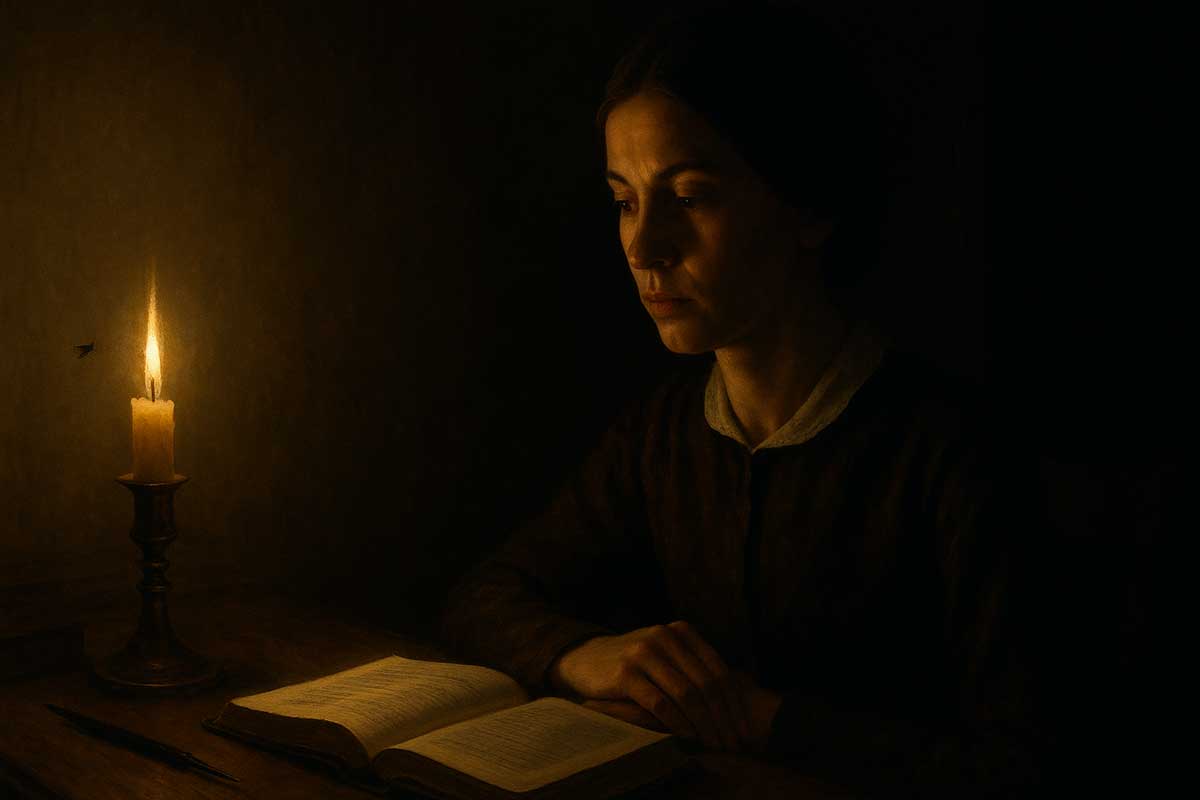
A faint hymn drifts through the air — a single violin tracing a melody that feels both hopeful and haunting. The camera glides across Emily’s small Amherst room at twilight. On the desk lie an open Bible, a feather, and a folded letter. Candlelight wavers, throwing trembling halos across the walls.
Emily sits beside the candle, eyes luminous in the half-light.
Emily:
“The unseen — it frightened me at first. Then I realized it was the only place where faith and poetry could meet.”
She lifts her face slightly, as though listening to something inaudible.
“Faith and doubt are two wings of the same bird. Without both, we do not fly — we circle.”
Segment 1 — The Room Between Belief and Question
Emily opens her Bible carefully, revealing small pressed violets inside.
“I was raised to worship within walls. But the world — and my mind — were larger than any steeple could contain.”
She reads softly:
‘Some keep the Sabbath going to Church —
I keep it, staying at Home —
With a Bobolink for a Chorister —
And an Orchard, for a Dome.’
She looks up.
“I did not mean rebellion. I meant intimacy. The orchard, the bird, the silence — all were sermons in disguise.”
She closes the book and rests her hand on it.
“Belief, for me, was not a set of rules, but a continual conversation. Some days I believed in God; other days, I believed in the echo of my own disbelief.”
Stage direction:
Light flickers between bright gold and gentle shadow as she speaks, symbolizing that tension.
Segment 2 — The Sound of Absence
She takes a deep breath and begins reading again:
‘I heard a Fly buzz — when I died —
The Stillness in the Room
Was like the Stillness in the Air —
Between the Heaves of Storm —’
Her voice grows softer.
“This fly — so ordinary — interrupts eternity. Even in the sacred moment, there is interruption, confusion, the grit of reality. That is doubt entering the cathedral.”
She smiles faintly.
“And yet — without the fly, the poem would not live. The divine hides itself in the discordant.”
Teaching Point:
Poetry is not afraid of the imperfection that faith avoids. It records both the psalm and the silence between verses.
Segment 3 — Demonstration: Turning Doubt into Devotion
Emily stands beside a student’s unfinished poem projected on parchment:
I have lost my faith; the heavens seem closed.
She tilts her head thoughtfully.
“Let us turn this declaration into a discovery.”
She rewrites with delicate precision:
The Heavens closed — perhaps —
To hear me better — still.
She turns to the camera.
“When we write from doubt, we must not slam the door. Leave a crack for light. Questioning itself can be an act of reverence.”
She leans closer, voice almost a whisper.
“Faith is not certainty. Faith is continuing the conversation when no one answers.”
Segment 4 — The Invisible Correspondent
Scene: A letter lies open, ink glistening wet. Emily begins to write aloud.
“Dearest Unknown —
I have no address for You, so I send this through eternity.”
She looks up.
“I often wrote to someone I could not name — perhaps God, perhaps the part of myself that lives beyond fear. You may call it the soul, the muse, the infinite — the name matters less than the reaching.”
Visual Insert:
Pages flutter gently as unseen wind moves through the room, carrying the scent of rain.
“When you write, write as if someone beyond the horizon might answer. Even if they never do, your words become bridges across the unseen.”
Segment 5 — The Altar of the Everyday
Emily steps to the window. Outside, branches sway in moonlight.
“We imagine the holy as distant — but holiness often wears the face of the familiar.”
She touches the glass lightly.
“I found the divine in a bee, a thunderstorm, the ache of parting. Each was scripture, if one read with wonder.”
She kneels beside a flowerpot and brushes soil from a leaf.
“This — is worship. To tend the smallest thing as though it holds infinity.”
Teaching Point:
Faith is not an answer; it is attention. When we attend deeply, even the smallest event becomes a revelation.
Segment 6 — Exercise: Writing to the Unseen
Emily returns to her desk.
“Now, I invite you — write a letter to what you cannot see. Address it to whatever name feels truthful: God, Silence, Death, Tomorrow.”
She begins her own:
“Dear Silence,
You never reply, and yet I feel heard.
Is that faith — or madness?”
She chuckles softly.
“Perhaps both.”
Instruction:
“Let your language waver between belief and disbelief. Use questions as punctuation. Write until your doubt feels like prayer.”
Segment 7 — The Candle and the Shadow
Scene: Emily lights another candle, then places her hand close to the flame.
“Faith, like fire, burns and blinds. But shadow, too, has purpose.”
She moves her hand back and forth, showing the flame’s light play upon the wall.
“Without darkness, we would never see the flicker. Doubt outlines faith the way night defines stars.”
She lowers her hand, voice steady.
“Do not fear your doubt. Carry it as a lantern.”
Segment 8 — The Bridge of Paradox
Emily paces slowly.
“I trusted paradox more than logic. In the space where two truths collide, poetry begins.”
She writes on the board:
‘I dwell in Possibility —
A fairer House than Prose —’
She turns back.
“Possibility is built on contradiction. You may doubt and believe in the same breath — that breath is your bridge to the eternal.”
She gestures upward slightly.
“If the Infinite is real, it surely welcomes both our hymns and our hesitations.”
Segment 9 — The Soundless Amen
Scene: The violin melody returns, slower now. Emily kneels beside her desk, hands clasped loosely.
“When words end, poetry begins its second life — the soundless Amen.”
She closes her eyes.
“In my solitude, I often felt unanswered. Yet, years later, readers call my silence holy. Perhaps that is how Heaven replies — by echo.”
She rises, her face serene.
“If you write from the heart’s bewilderment, you have already prayed.”
Segment 10 — Closing Reflection: The Invisible Cathedral
Morning light begins to slip into the room, softening the candle’s glow.
Emily turns once more to the window, her reflection faint against the brightening sky.
“Faith and doubt are the twin architects of the invisible cathedral. One lays the stones; the other tests if they will hold.”
She turns toward the viewer, voice quiet, certain.
“You do not need to find the proof of the unseen. You need only to keep building your altar — out of wonder, out of questions, out of breath.”
She blows out the candle. A curl of smoke rises, twisting like a question mark, then dissolves.
“The unseen is not elsewhere. It is here — in the pause between this word —
and the next.”
Fade to black.
Text on screen:
Exercise: Write a letter or short poem to what you cannot see — God, Silence, Fate, or your own future self. Let faith and doubt alternate as voices within it. End not with certainty, but with wonder.
A single bell tolls faintly; the sound lingers as stars fade into dawn.
Topic 4 — The Music of Mind: Rhythm Beyond Meter
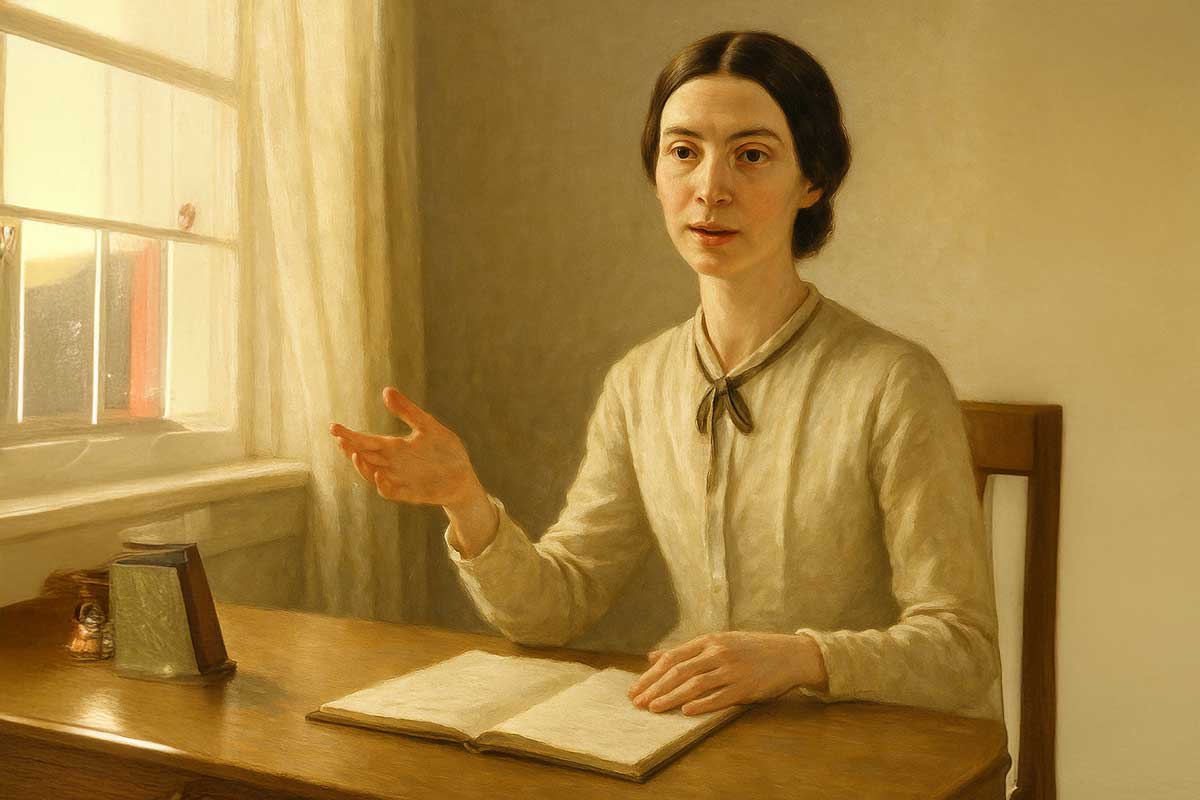
Opening Scene
The morning light is gentle, falling across Emily’s desk. No candle tonight—just the hum of day, birds outside, and the creak of old wood underfoot. Emily stands beside a blackboard where faint chalk marks linger from another lesson. She taps the chalk thoughtfully against her palm.
Emily:
“They say poetry must have meter.
But the heart has never counted in iambs.”
She smiles—kind, knowing.
“Rhythm, dear friends, is older than rules. It is the first language the body understood. Before we spoke, we pulsed.”
She paces slowly, the boards beneath her echoing in uneven rhythm.
“The poet’s truest measure is the movement of the mind itself.”
Segment 1 — Hearing Thought Move
She gestures toward the class.
“Close your eyes, if you will.
Think a single sentence—not aloud, but silently.
Do you hear how it rises and falls?”
A pause. The camera cuts between faces, eyes closed, heads slightly tilted.
“That wave is rhythm. The sentence breathes like a lung.
Good poetry listens to that inner tide.”
Emily writes on the board:
Because I could not stop for Death —
He kindly stopped for me —
She underlines the dashes.
“You see? The beat pauses, breaks, quickens.
Death knocks, but not on time.”
She leans on the desk.
“When the heart quickens, so should the line.”
Segment 2 — Meter as Cage, Rhythm as Current
Emily picks up a small metronome from the table—a rare, curious thing.
“Some poets use this—click, click, click—to keep their lines marching.”
She winds it; the steady ticks fill the air.
“Useful, perhaps. But life is never so obedient.”
She stops it with a decisive hand.
“Meter is discipline. Rhythm is discovery.
When the mind thinks, it stumbles, doubles back, leaps ahead.
Let your verse follow the movement of thought, not the drum of convention.”
She sits at her desk, opens a notebook.
“When I write, I never ask: Is this trochaic or iambic?
I ask: Does it breathe?”
Segment 3 — Demonstration: Breathing Through a Line
Emily takes a deep breath, visibly showing the students.
“Watch. The inhale—
The pause before the word—
The exhale—each shapes meaning.”
She writes:
I felt a Cleaving in my Mind —
As if my Brain had split —
Then points at the dash.
“The dash is not decoration—it’s respiration.
It marks where the thought breaks its own heart.”
Exercise:
She looks to camera.
“Try reading your poem aloud.
Where you gasp for air, your reader will too.
Mark that place—not as failure, but as rhythm.”
Segment 4 — The Pulse of Emotion
Emily stands beside a small vase of flowers, arranging them absentmindedly.
“Each feeling has a pulse. Anger pounds; grief drags; awe suspends.
The rhythm of a poem must match the rhythm of its emotion.”
She claps once—sharp.
“Excitement.”
She draws out her next words slowly.
“And this … is awe.”
She grins, a flicker of humor.
“If you try to write wonder in perfect pentameter,
you may build a fence around the sky.”
Teaching Point:
Let emotion decide the tempo. When you write joy, quicken your syntax; when you write loss, let the pauses ache.
Segment 5 — The Dance Between Sense and Sound
Emily takes a small step, as if dancing with an invisible partner.
“Sense gives meaning. Sound gives motion.
Together they make a poem walk.”
She reads:
A Word is Dead — when it is said —
Some say —
I say it just begins to live —
That day —
She taps her finger lightly on the desk with each phrase.
“Do you feel it?
The rhythm is uneven, yet the ear forgives because the feeling is true.”
She nods toward the students.
“When your words sound alive, meaning will follow like breath.”
Segment 6 — Demonstration: Rewriting for Cadence
A draft poem appears on the board:
The night is still and black and wide,
My heart beats slowly by my side.
Emily tilts her head.
“Too even. A lovely lullaby—but no pulse.”
She rewrites:
The night — so wide —
it breathes me back to silence —
“Now it moves like a mind—hesitant, alive.”
She looks around the room.
“Cadence must serve consciousness.
When thought hesitates, so must the line.
When thought rushes, break your syntax to keep up.”
Segment 7 — The Body as Instrument
Emily gestures toward her chest.
“Do you know where rhythm begins? Not on paper—here.”
She places a hand over her heart.
“When you read your poem aloud, feel where it lands in your body.
If it lands only in the mouth, it is clever.
If it lands in the ribs, it is alive.”
She laughs softly.
“The body is the metronome God forgot to silence.”
Exercise:
“Stand up, breathe, speak your lines until your pulse agrees with them.
That agreement—between heartbeat and language—is poetry’s hidden music.”
Segment 8 — Silence as Sound
Emily turns to the window; the birds have quieted.
“Music is not the notes alone.
Silence gives them shape.”
She draws three lines on the board, leaving gaps between words.
“These pauses invite the reader in.
Do not fear stillness—it is your drum’s rest.”
She wipes her hands, voice lower.
“Some of my best stanzas end mid-thought.
They are unfinished only to the eye;
the ear continues them.”
Segment 9 — Exercise: Find Your Cadence
She faces the viewer directly.
“Now, take a sentence from your own life—a diary line, a confession.
Break it into rhythm guided not by grammar, but by feeling.”
She demonstrates.
“My original note: I miss you terribly today.
But listen—”
She rewrites on paper, speaking as she writes.
I miss you —
terribly —
today.
She looks up, voice soft.
“Now it sounds like what it means.”
Instruction:
“Trust your ear more than your intellect.
Meaning will adjust itself to music.”
Segment 10 — Closing Reflection: Your Mind as Metronome
The day dims; the last gold light gathers on her writing table. Emily stands by the window, notebook in hand.
“I never studied music formally.
But I knew the hum of my own thinking.
That hum is enough.”
She taps the side of her temple lightly.
“Listen to how your mind moves—slow in mourning, quick in joy, still in awe.
That motion is your meter.”
She writes one final line, speaking as ink scratches:
The Brain has Corridors — surpassing Music —
She closes the notebook gently.
“If you follow your mind’s rhythm,
you will never need to imitate another’s song.”
She turns off the metronome.
Silence. Then—softly—the rustle of leaves outside.
“Let the world beat its measure.
Yours need only breathe.”
Fade to black.
Text on screen:
Exercise: Read one of your poems aloud until its rhythm matches your natural breath.
Where the breath fails, rewrite the line.
Where silence speaks, let it stay.
A final heartbeat sound fades to quiet.
Topic 5 — The Private Universe: Finding the Infinite in the Intimate
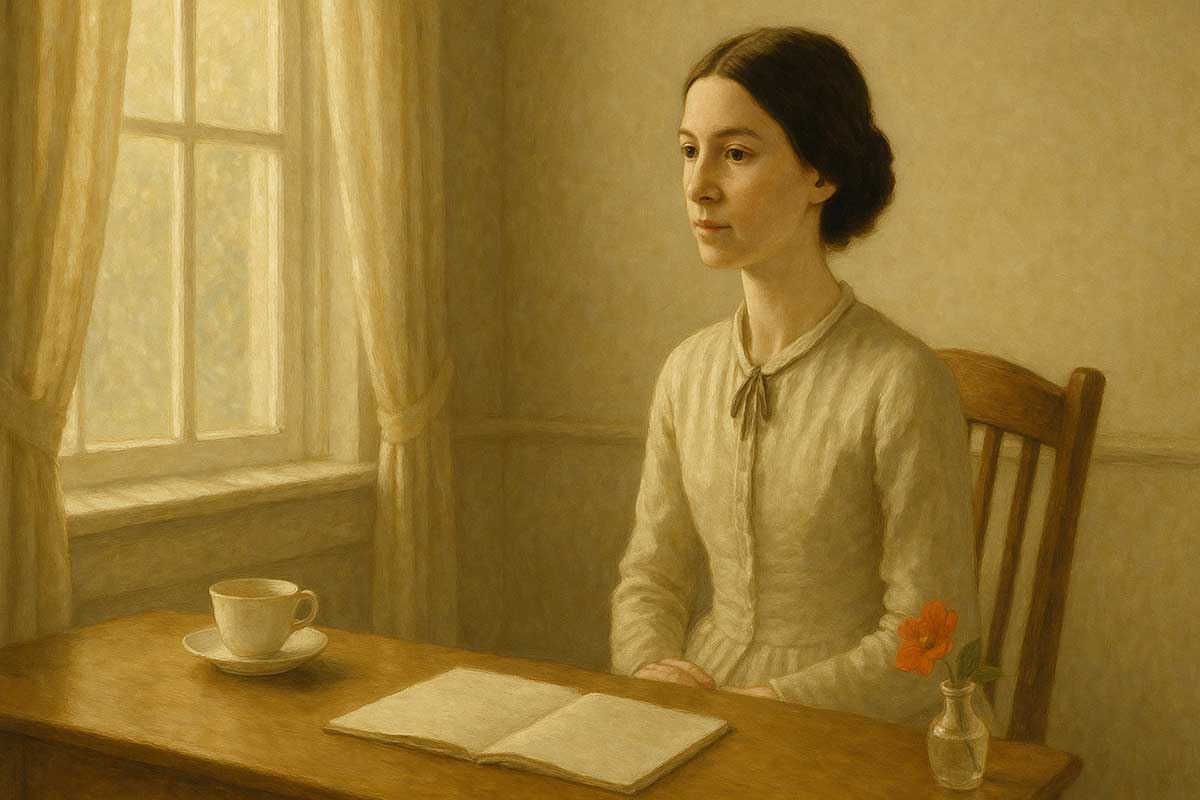
Opening Scene
Late afternoon sunlight softens the white walls of Emily’s Amherst room. A quiet breeze moves the curtain, carrying the scent of lilac. A teacup sits beside a folded letter. Emily traces the rim of the cup with one finger, lost in thought.
Emily:
“I have never traveled far, yet I have seen eternity—
in a bee’s flight, a drop of dew, the shadow of a feather.
The infinite is polite. It knocks through the familiar.”
She smiles at the class.
“Today, I will show you how to listen for infinity
in the ordinary things already waiting on your table.”
Segment 1 — The World Inside a Room
She looks around the modest space.
“I lived in this room most of my life.
It was small enough to touch the walls from where I sat.
Yet each day, I found new continents here—
thoughts, memories, questions, quiet visitations.”
She lifts the letter.
“When you sit still long enough, even the dust begins to speak.
The poet’s work is not to wander, but to notice.”
She takes a sip of tea.
“The infinite prefers the small door.
That door is attention.”
Segment 2 — Attention as Prayer
Emily leans forward slightly.
“Most people pray upward.
I prayed inward.”
She opens her notebook.
‘I taste a liquor never brewed —
From Tankards scooped in Pearl —’
“This is not about wine, but wonder.
To taste the dew, to hear the hush between birdcalls—
that is communion.”
She pauses.
“Attention is love made visible.
Whatever you look at with care begins to glow.”
Exercise:
“Take one minute. Look at an object near you.
A pen, a window, your own hand.
Now imagine it watching you back.”
She closes her eyes.
“Did you feel that?
That exchange is poetry.”
Segment 3 — Domestic Divinity
Emily stands and adjusts the flowers on her desk.
“People think holiness wears robes.
I found it in aprons, teapots, crumbs.”
She laughs softly.
“I once wrote of Heaven—
but the loaf cooling on the shelf taught me more about grace
than any sermon.”
She touches the petals gently.
“You need not look beyond your own room for revelation.
If God is anywhere, He is here—in the details you overlook.”
Teaching Point:
Your surroundings are scripture.
To see them clearly is to pray without words.
Segment 4 — Demonstration: Transforming the Ordinary
Emily writes on the board:
The candle burns low on the table.
She turns to the class.
“A statement—true, but flat.
Now we listen to the object. What does it say of time, of life?”
She rewrites:
The candle whispers to the dark —
‘I am almost memory.’
She steps back, eyes glimmering.
“Do you see?
The ordinary became eternal simply because we heard its voice.”
Segment 5 — The Courage to Stay Small
She folds her hands.
“The world praises greatness—grand gestures, loud declarations.
But a poet’s bravery is often the courage to stay small.”
She looks to the window, light fading.
“When I chose to remain in this house, people called it retreat.
They were mistaken. I was traveling inward,
and the journey inward has no horizon.”
She glances at her papers.
“You too may be tempted to enlarge—to explain, to impress.
Resist it.
The infinite prefers whispers.”
Segment 6 — Exercise: The Sacrament of Objects
She opens a small wooden box and removes a single button.
“Every poet should have a reliquary of ordinary things.
Mine held a ribbon, a button, a dead bee.”
She places it on the table.
“Choose one object that feels forgotten.
Observe it until it reveals its secret.”
She writes:
“Button — faithful circle,
keeping the world fastened.”
“Now it’s alive.
Objects wish to be seen truly. That wish is their soul.”
Segment 7 — The Infinite in Relationship
Emily sits again, more reflective.
“The infinite also hides in our connections—
a letter sent, a kindness withheld, a silence shared.”
She reads from a letter fragment:
‘This is my letter to the World
That never wrote to Me —’
“When you write, you are never alone.
Each word is a hand extended into eternity.
Someone will take it—someday.”
She looks up, eyes steady.
“Even love unreturned is still cosmic correspondence.”
Segment 8 — Demonstration: Writing the Near to Touch the Far
A student’s line appears on the board:
The sky is vast and endless.
Emily nods gently.
“Yes—but too far away. Let us bring the infinite closer.”
She rewrites:
A crack of sky between my curtains—
and suddenly—forever.
“See?
We did not go farther—we went nearer,
and the horizon appeared inside the room.”
Segment 9 — When Solitude Becomes Communion
The room grows quieter. Emily’s voice softens.
“To create the private universe, you must welcome solitude.
It is not loneliness—it is the weather where the infinite lands.”
She rests her hand over her notebook.
“Each poem I wrote was a conversation with something I could not see.
Yet somehow, that unseen guest always answered.”
She looks to camera.
“When you write in solitude,
you join the oldest fellowship—
those who dare to speak into silence.”
Segment 10 — Closing Reflection: The Infinite Door
The sun has nearly set.
Emily lights one small candle. Its flame paints gold across her face.
“The world loves spectacle,
but God lives in subtleties.
A sigh can echo longer than a sermon.”
She lifts her quill.
“When you next sit to write,
do not search for Heaven in distant stars.
It is hidden in your teacup,
your heartbeat,
the crease of a page.”
She pauses, eyes calm and bright.
“To find the infinite,
look so closely at the intimate
that it dissolves its edges.”
She blows out the candle—darkness, then a faint trace of smoke curling upward like a prayer unfinished.
“Now, begin.
Your universe awaits inside the smallest thing you see.”
Fade to black.
Text on screen:
Exercise: Choose one ordinary object in your space.
Observe it for five minutes. Describe it as if it holds a secret of eternity.
Let your poem end not with an answer, but with quiet recognition.
Soft piano fades; a robin sings once outside.
Topic 6 — The Poetics of Conscience: Speaking Truth Without a Platform
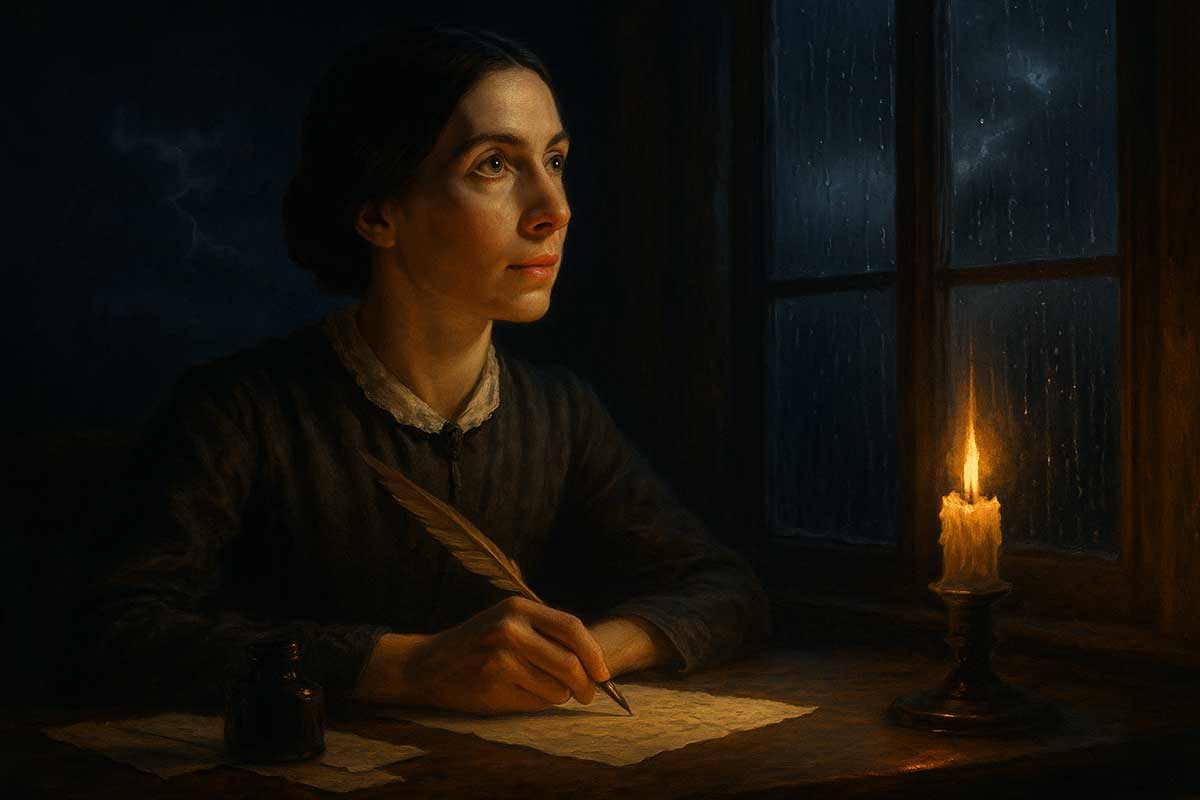
Opening Scene
A storm gathers outside the window — low thunder rolling, the sky darkening. Emily Dickinson stands near her writing desk, her face half-lit by a single candle. She watches the shifting clouds for a long moment before turning to the camera.
Emily:
“When the world grows loud with opinions,
the poet listens harder.”
She sets her hands gently on the desk.
“I was born into a country quarreling with itself —
wars of ideas, of states, of souls.
I chose the quiet field instead of the public square.
Yet silence is not absence.
It can be the sharpest speech.”
Segment 1 — The Politics of the Soul
Emily walks slowly to the window, gazing out at the wind-tossed trees.
“I had no taste for assemblies or slogans.
But I knew tyranny when it entered the heart —
when fear told us what we may or may not feel.”
She turns back to her students.
“The poet’s first government is conscience.
Obey that, and you will never need a podium.”
She picks up a folded letter, turning it between her fingers.
“A poem can unseat a king, if it reminds the reader of their own sovereignty.”
Teaching Point:
To write politically does not mean to shout.
It means to tell the truth when truth feels unsafe.
Segment 2 — The Era’s Noise and Her Silence
Emily sits again, the candle flickering beside her.
“I lived through a nation split by war.
Neighbors quarreled, brothers marched, mothers buried sons.
Yet I wrote of bees, of death, of dawn.”
She looks up, unflinching.
“Do not mistake that for ignorance.
I saw what war did to the human spirit.
My rebellion was to keep writing of immortality
while others wrote of victory.”
She opens a poem and reads quietly:
‘My life had stood — a Loaded Gun —
In Corners — till a Day
The Owner passed — identified —
And carried Me away —’
“I was that gun — not to kill, but to confront.
The weapon was the word.”
Segment 3 — The Moral Compass of the Poet
She rises, walking toward a small shelf lined with worn books.
“You may ask, what does conscience look like in verse?
It looks like honesty without armor.”
She takes a book, opens it, and reads a single line from her notes:
“Tell all the truth but tell it slant —
Success in Circuit lies.”
“To tell truth slant is not to weaken it.
It is to make it survivable.
People resist when they are accused,
but they open when they are astonished.”
She leans closer, her voice low and clear.
“If your poem condemns, it dies in the reader’s pride.
If it reveals, it lives in their conscience.”
Segment 4 — Demonstration: Turning Protest into Revelation
A student’s draft appears on the board:
The rulers are cruel, the world is unjust,
and I can no longer be silent.
Emily studies it quietly, then smiles.
“Ah — you feel deeply. That is good.
But anger speaks in volume, not in echo.
Let us refine your protest into vision.”
She rewrites:
The ruler sleeps — but still —
the Sparrow sings at Dawn —
She looks up.
“See? The truth remains — but it has become immortal.
The Sparrow will outlive the throne.”
Teaching Point:
Poetry should aim not to defeat opponents,
but to awaken witnesses.
Segment 5 — The Poet’s Responsibility
Emily returns to her chair and folds her hands in her lap.
“In my time, women’s voices rarely entered print.
Yet I wrote as if the universe itself expected me to.”
She glances toward the window, where rain begins to fall.
“Do not wait for permission to speak.
Conscience is its own credential.”
She opens another poem and reads softly:
‘If I can stop one Heart from breaking,
I shall not live in vain;
If I can ease one Life the Aching,
Or cool one Pain.’
She looks up.
“That is politics enough —
the governance of compassion.”
Segment 6 — Exercise: The Hidden Declaration
Emily leans forward, inviting the students closer.
“Now, let us practice quiet power.
Choose a truth you believe the world has forgotten.
It may be moral, social, spiritual.
But do not declare it. Reveal it.”
She dips her pen in ink.
“For instance, if I wished to write that all souls are equal,
I would not say, ‘We are all one.’
I would write —”
She writes slowly:
‘The smallest Grass divides the Sky —
With equal Majesty.’
She turns toward the viewer.
“You see? The truth enters softly —
but it cannot be uprooted.”
Segment 7 — The Courage of Subtlety
Emily stands, her silhouette framed against lightning flashing outside.
“People confuse volume with courage.
But sometimes courage whispers.”
She walks toward the camera.
“To hold your truth in silence,
to shape it so finely that even your critics fall quiet—
that is resistance of a holier kind.”
She lets the silence stretch before speaking again.
“I never joined a march, but I stood still in my convictions.
Stillness, too, can shake empires.”
Segment 8 — The World Within the Word
Emily moves back to the desk, running her hand across a page.
“A poem does not need to say ‘freedom’ to make the reader feel free.
It need only open a window.”
She reads another fragment:
‘They shut me up in Prose —
As when a little Girl
They put me in the Closet —
Because they liked me “still” —’
Her eyes gleam.
“This is not merely about gender.
It is about any voice told to hush.
If the world confines you,
sing from the walls — they will remember.”
Segment 9 — The Universal Republic
Emily’s tone softens; thunder fades into gentle rain.
“I often wondered why nations wage war
when every heart carries the same pulse.”
She sits again.
“The poet’s republic knows no border.
When you write from compassion, you become a citizen of everywhere.”
She traces the edge of the candle with her finger.
“If there is a parliament of conscience,
poetry is its language.”
Teaching Point:
The goal is not to win arguments,
but to heal them.
Segment 10 — Closing Reflection: The Quiet Banner
The candle flickers; Emily’s face glows softly in its light.
“Each age believes it has invented outrage.
But outrage without grace is only noise.”
She picks up a single sheet, reading her final lines:
‘We never know how high we are
Till we are called to rise;
And then, if we are true to plan,
Our statures touch the skies.’
She sets the page down, her expression calm and resolute.
“You need not march to stand tall.
You need not shout to be heard in Heaven.”
She extinguishes the candle with two fingers.
The smoke rises in a thin column, like a flag made of light.
“Speak your truth —
not to rule the world,
but to remind it of its soul.”
Fade to black.
Text on screen:
Exercise: Write a poem that speaks a moral truth without using declarative statements.
Express your conviction through image, tone, or metaphor.
Let the reader feel your belief rather than hear it.
The final frame lingers on the rain-slick window — soft thunder in the distance, the faint glimmer of dawn breaking through.
Final Thoughts by Emily Dickinson
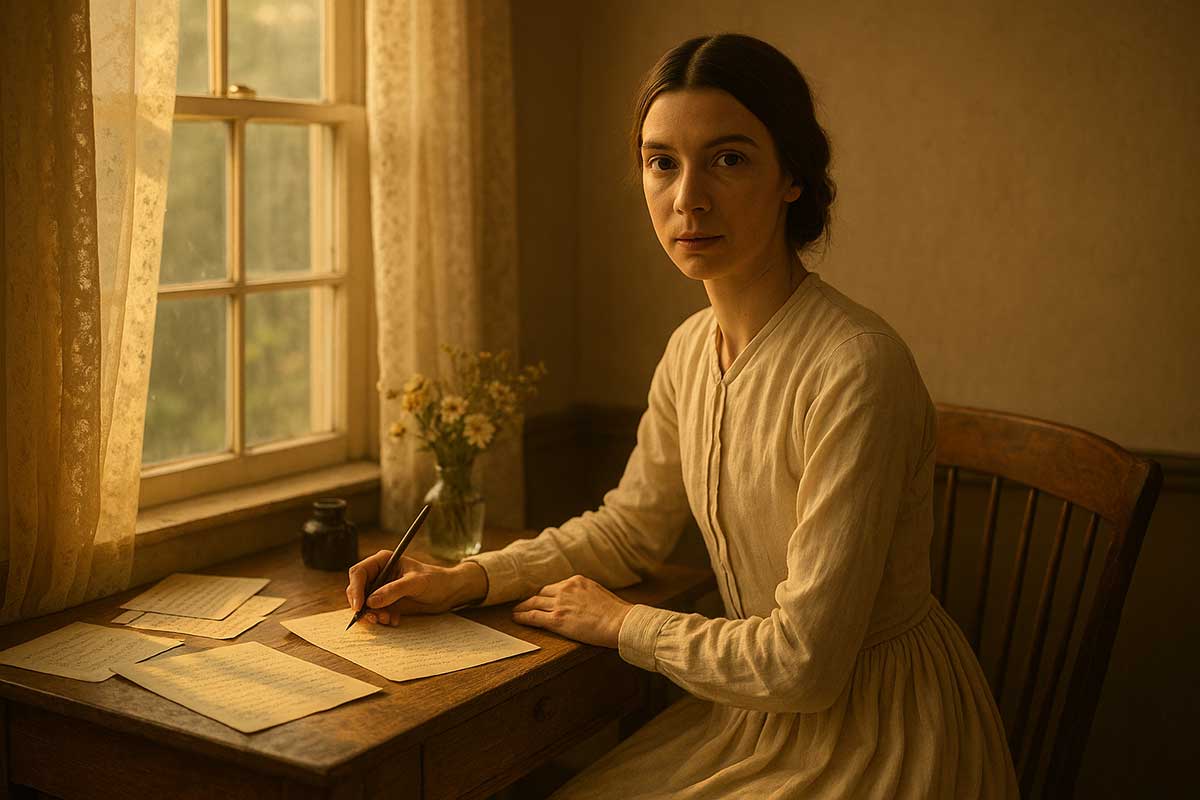
(Twilight deepens; the candle burns low. Emily closes her notebook and looks to the unseen students, her voice a soft echo of eternity.)
You have listened well.
You have followed words not outward, but inward —
where poems are born,
where language and soul become one trembling note.
Remember, poetry does not end when the pen is lifted.
It lingers —
in how you see,
in how you pause before a rose,
in how you feel the hush between two heartbeats.
Do not chase greatness.
Chase attention.
The smallest noticing is a cathedral when you are sincere.
When I wrote,
I thought no one would ever read me.
Yet here you are —
proof that the heart’s whisper
can cross centuries.
So when you write —
do not write to be known.
Write to know yourself.
Write as if eternity were leaning in to listen.
And if, one quiet night,
your soul speaks and you answer in a few brave lines —
you will have joined me,
not in my century,
but in my silence.
(She smiles gently, blowing out the candle.)
Goodnight, dear poets.
Keep the window open.
The world will visit you there.
Short Bios:
Emily Dickinson (1830–1886) was an American poet whose quiet life in Amherst, Massachusetts, hid one of the most original minds in literature. Writing over 1,700 poems, she explored the vastness of life, death, faith, and love from the stillness of her own room.
Her words turned silence into music and solitude into revelation. Though few of her poems were published while she lived, her voice transcended time — teaching that the truest art is born not from applause, but from attention.
In “The Art of Inner Poetry,” Emily invites us to listen more deeply, to find the infinite within the ordinary, and to remember that even the smallest noticing can hold eternity.
Leave a Reply