• Skip to main content
  • Skip to primary sidebar
  • Skip to footer
ImaginaryTalks.com
  • Spirituality and Esoterica
    • Afterlife Reflections
    • Ancient Civilizations
    • Angels
    • Astrology
    • Bible
    • Buddhism
    • Christianity
    • DP
    • Esoteric
    • Extraterrestrial
    • Fairies
    • God
    • Karma
    • Meditation
    • Metaphysics
    • Past Life Regression
    • Spirituality
    • The Law of Attraction
  • Personal Growth
    • Best Friend
    • Empathy
    • Forgiveness
    • Gratitude
    • Happiness
    • Healing
    • Health
    • Joy
    • Kindness
    • Love
    • Manifestation
    • Mindfulness
    • Self-Help
    • Sleep
  • Business and Global Issues
    • Business
    • Crypto
    • Digital Marketing
    • Economics
    • Financial
    • Investment
    • Wealth
    • Copywriting
    • Climate Change
    • Security
    • Technology
    • War
    • World Peace
  • Culture, Science, and A.I.
    • A.I.
    • Anime
    • Art
    • History & Philosophy
    • Humor
    • Imagination
    • Innovation
    • Literature
    • Lifestyle and Culture
    • Music
    • Science
    • Sports
    • Travel
You are here: Home / Literature / Emily Dickinson Teaches Kids the Magic of Poetry

Emily Dickinson Teaches Kids the Magic of Poetry

November 12, 2025 by Nick Sasaki Leave a Comment

Emily Dickinson 2025

Introduction

(Spoken by the child, curious but unsure about poetry)

I don’t really understand poetry.

Every time someone says the word, I imagine old books with tiny letters and people who use big words like “thou” and “hence.” My teacher says poetry is beautiful, but sometimes it just feels like a puzzle I’m not smart enough to solve.

Still… I like certain things.

I like how the rain sounds on my window.
I like when my heart feels fizzy before something exciting.
I like when my thoughts feel too big for regular talking.

Sometimes I wish there was a way to catch those moments
so they don’t disappear.

My teacher says a famous poet named Mrs. Emily Dickinson is coming to visit us today. She says Emily wrote poems in secret and hid them in drawers and envelopes. That sounds kind of cool… like spy writing.

I’m not sure what she’ll be like.
Will she talk in riddles?
Will she float instead of walk?
Do poets smile?

I guess I’ll find out.

But a little part of me hopes she’ll show me what poetry really is.
And maybe — just maybe — I’ll find out if poems can belong to someone like me.

(Note: This is an imaginary conversation, a creative exploration of an idea, and not a real speech or event.)


Table of Contents
Emily Enters the Classroom (Quiet Magic Begins)
What Is Poetry? (A Kid-Friendly Explanation)
Show Them the Fun: The Refrigerator Test
Demonstration: Turning Feelings Into Pictures
The Emily Dickinson 3-Step Kid-Friendly Poetry Formula
Kids Write Their Own (Emily Walks Around Quietly Helping)
Sharing Circle (Emily’s Favorite Part)
Emily’s Goodbye Gift
Final Thoughts

Emily Enters the Classroom (Quiet Magic Begins)

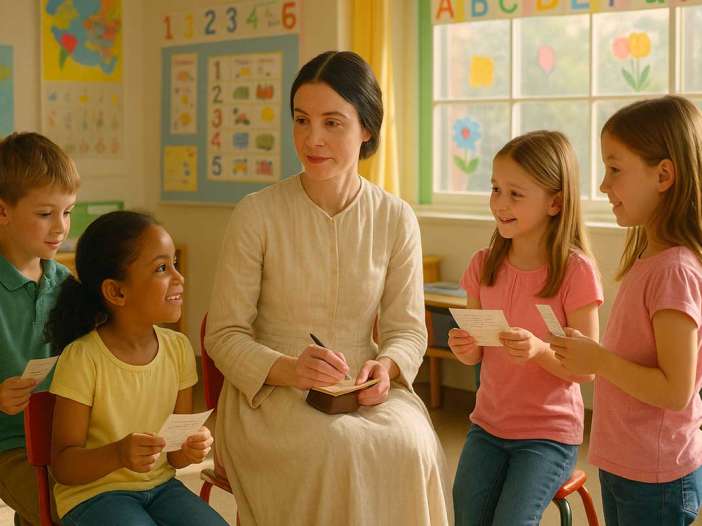
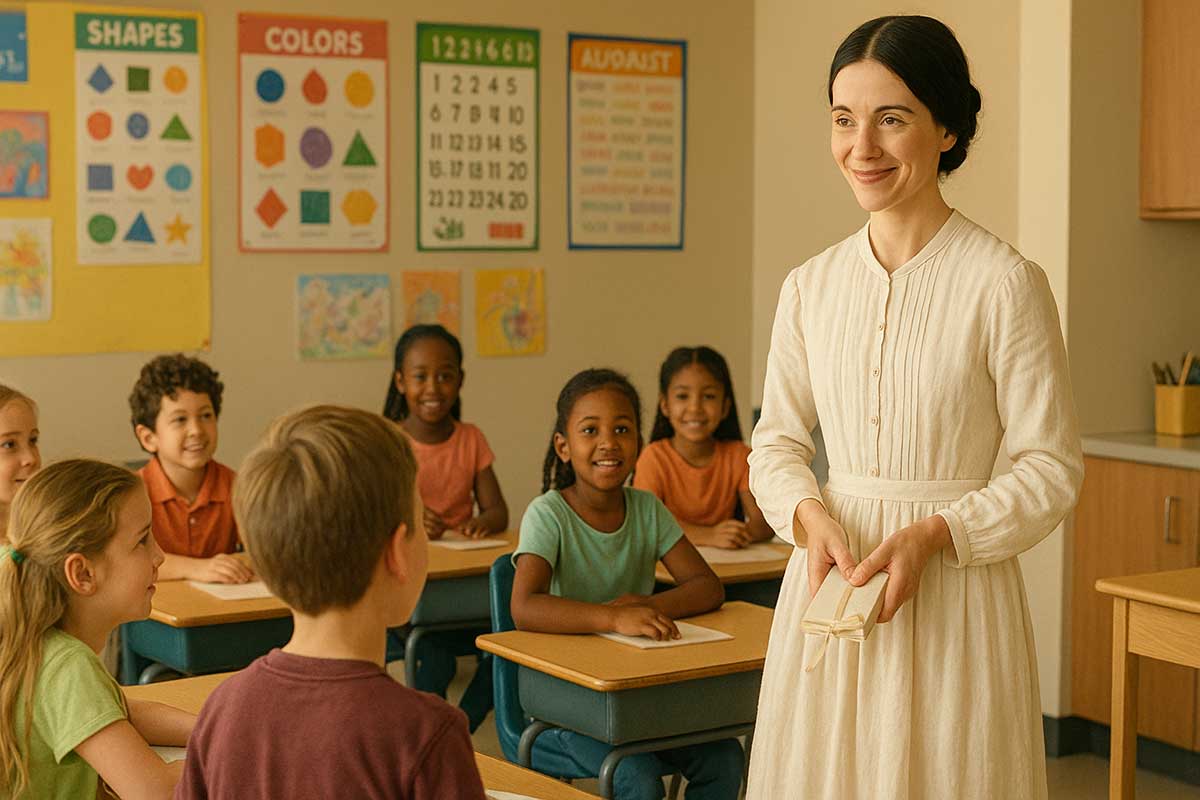
Emily steps in wearing her simple white dress, carrying a tiny notebook tied with ribbon.
She looks at the children with soft surprise, as if delighted by their brightness.

Emily (smiling):
“Good morning, my dears. I’m Emily.
I hear you are lovers of wonder —
the best kind of poets.”

She sets her notebook on the desk.

What Is Poetry? (A Kid-Friendly Explanation)
Emily sits on a tiny classroom chair.

Emily:
“Poetry is not long or fancy.
Poetry is what happens
when your heart suddenly says —
Oh!
and your pencil tries to catch it.”

She holds up her hands.

Emily:
“Poetry is tiny.
Poetry is quick.
Poetry is your feelings dressed up
in a few brave words.”

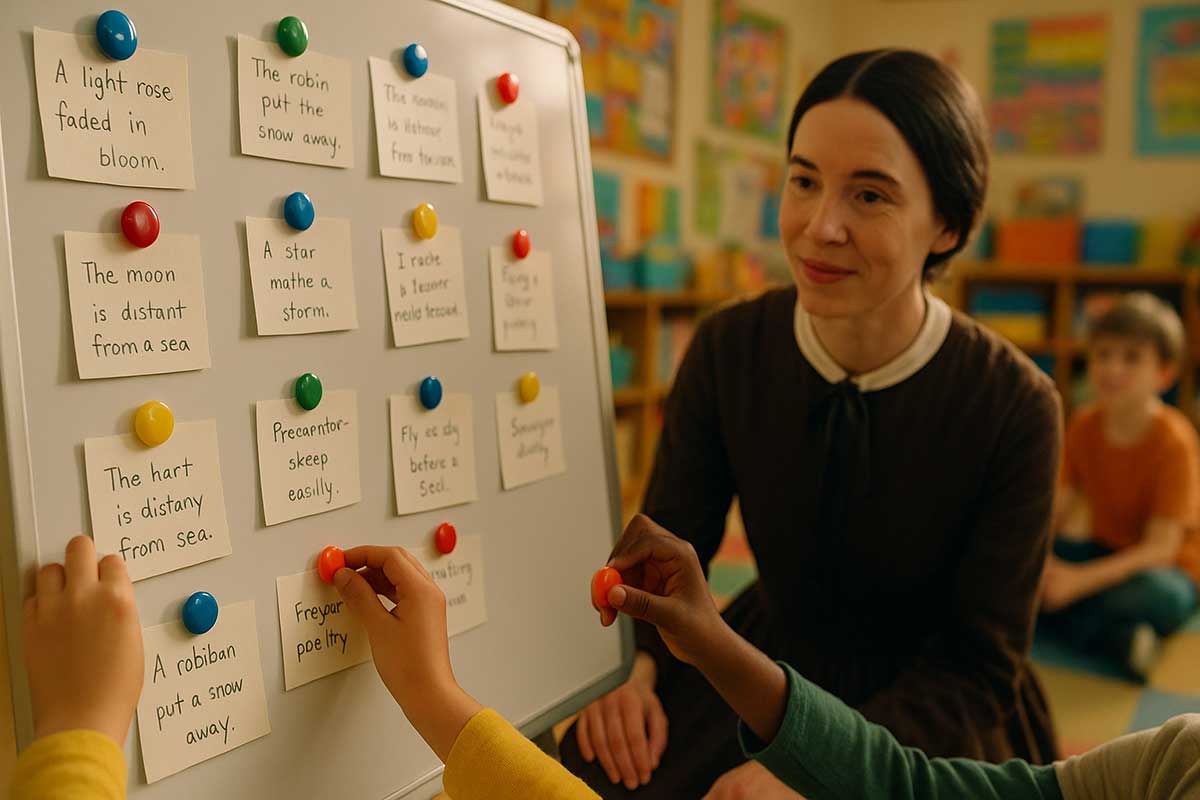
She writes on the board:

“A poem is a moment you can keep.”

Show Them the Fun: The Refrigerator Test
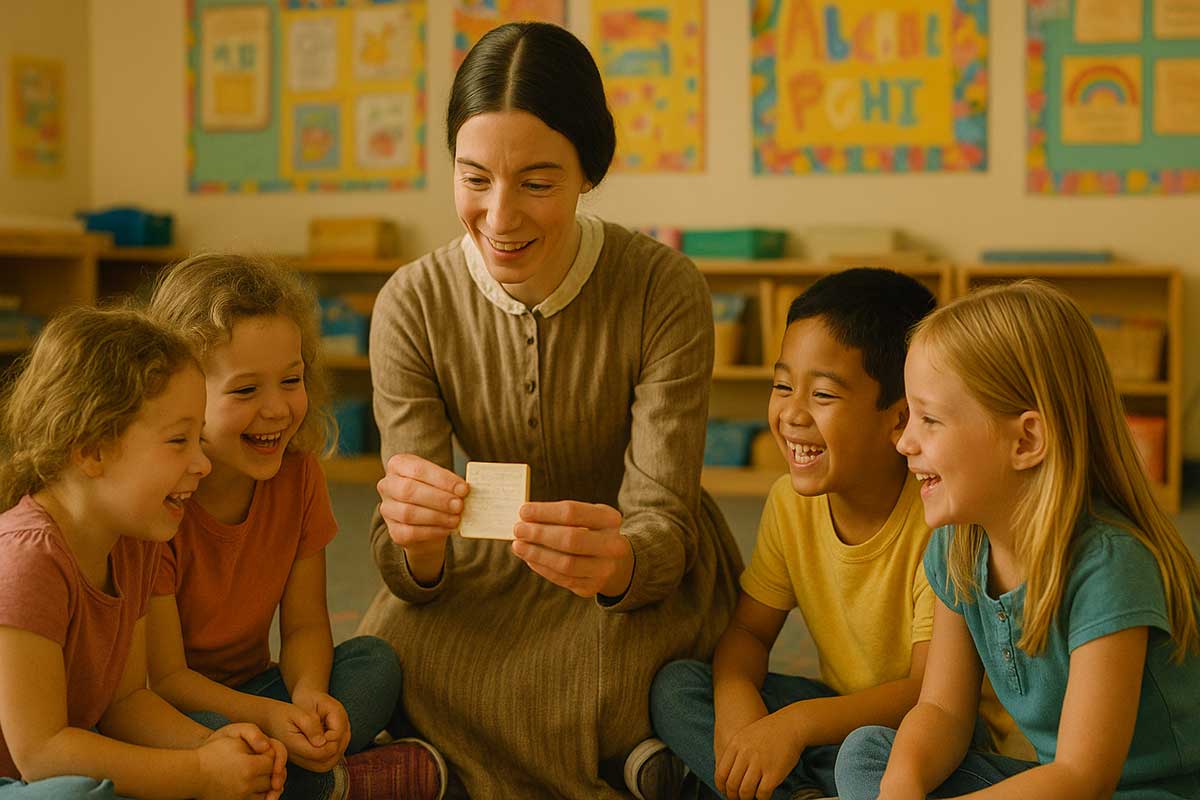
Emily giggles softly.

Emily:
“Shall I tell you the secret of poetry?
It’s the only kind of writing
that fits on a refrigerator.”

She writes:

“The sun hugs me.
The breeze whispers.”

The kids laugh.

Emily:
“See?
A whole universe in two little lines!”

Then she leans in dramatically.

Emily:
“And guess what?
A good poem never gets grounded for being short.”

Demonstration: Turning Feelings Into Pictures

Emily draws a big heart and a big eyeball on the board.

Emily:
“Poets use heart + eyes together.
A feeling… becomes a picture.”

She asks the class:

“How does happy look?”
Kids shout answers: “Sunshine!” “Puppies!” “Ice cream!”

She writes a quick poem:

“Happiness is
my dog’s tail
drawing circles.”

Kids laugh.

Then:

“What does sad look like?”
Responses: “Rain!” “Droopy flowers!” “Losing your favorite toy!”

Emily writes:

“My sadness rains
inside my shoes.”

The students feel it.

Emily:
“Poetry is feelings
wearing disguises.”

The Emily Dickinson 3-Step Kid-Friendly Poetry Formula
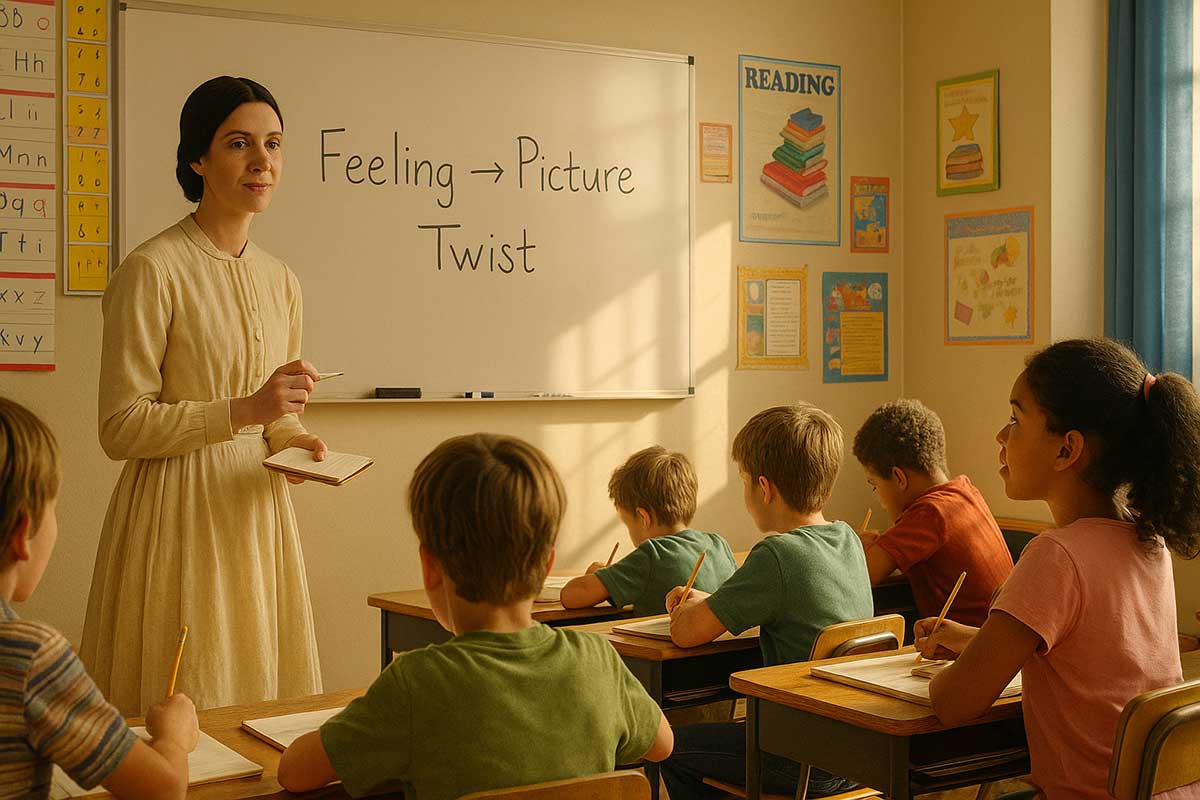
Emily stands up, excited.

Emily:
“You only need three things to write a poem:
1. A feeling
2. A picture
3. A surprise
”

She writes a simple formula:

Feeling ➜ Picture ➜ Little Twist

Example:

Feeling: excited
Picture: popcorn popping
Twist: the popcorn is your heartbeat

Poem:

“My heart pops like
fresh popcorn
when I see Friday coming.”

The children clap.

Kids Write Their Own (Emily Walks Around Quietly Helping)
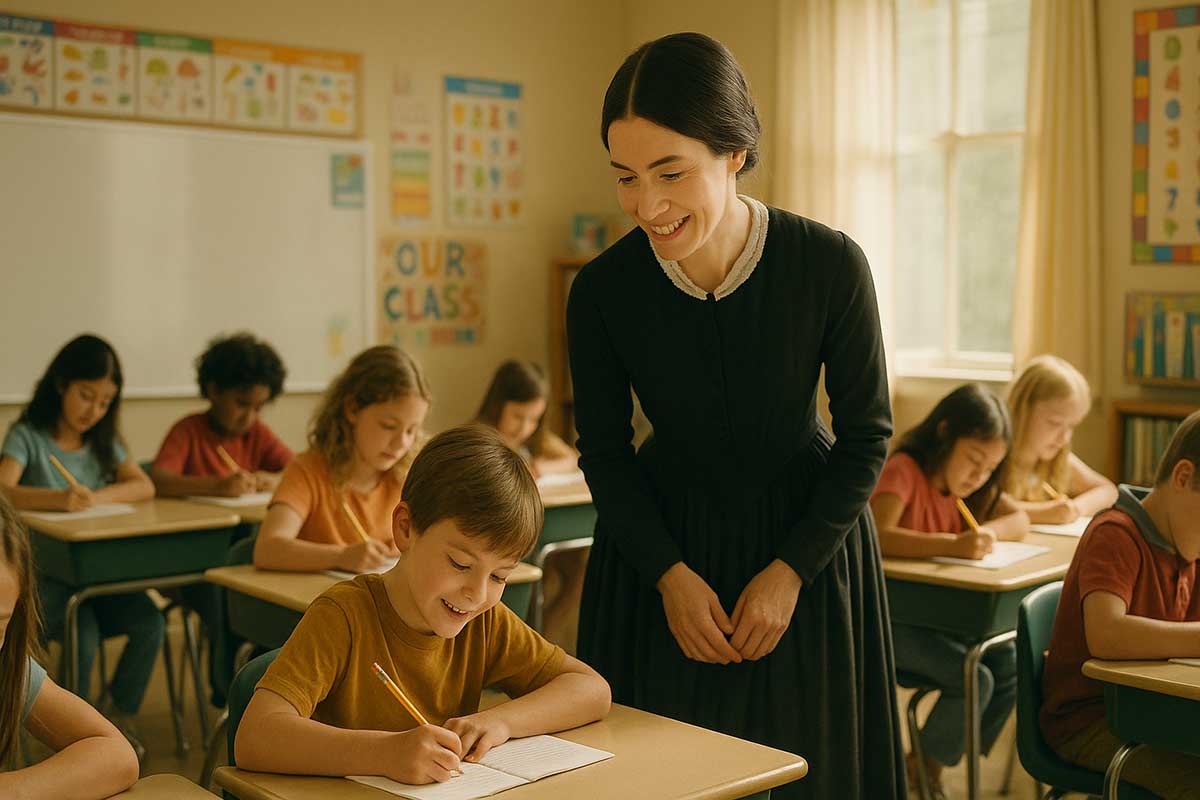
Emily gives them a template:

Your Own Emily-Style Poem

1. Choose a feeling: happy, nervous, proud, sleepy, silly
2. Choose a picture: rain, moon, sneakers, pencils, trees
3. Add a twist: make the picture behave like a feeling

Example starter lines she offers:

  • “My excitement jumps like…”

  • “My sadness hides under…”

  • “My laughter shakes like…”

  • “My courage stands up like…”

  • “My dreams float like…”

Emily walks desk to desk, kneeling gently beside each child.

Emily (whispering encouragement):
“Your poem is already inside you —
just give it a door.”

She celebrates tiny wins:

“Oh! This is brave.”
“This line sparkles.”
“You turned a feeling into a picture — you’re a poet!”

Sharing Circle (Emily’s Favorite Part)
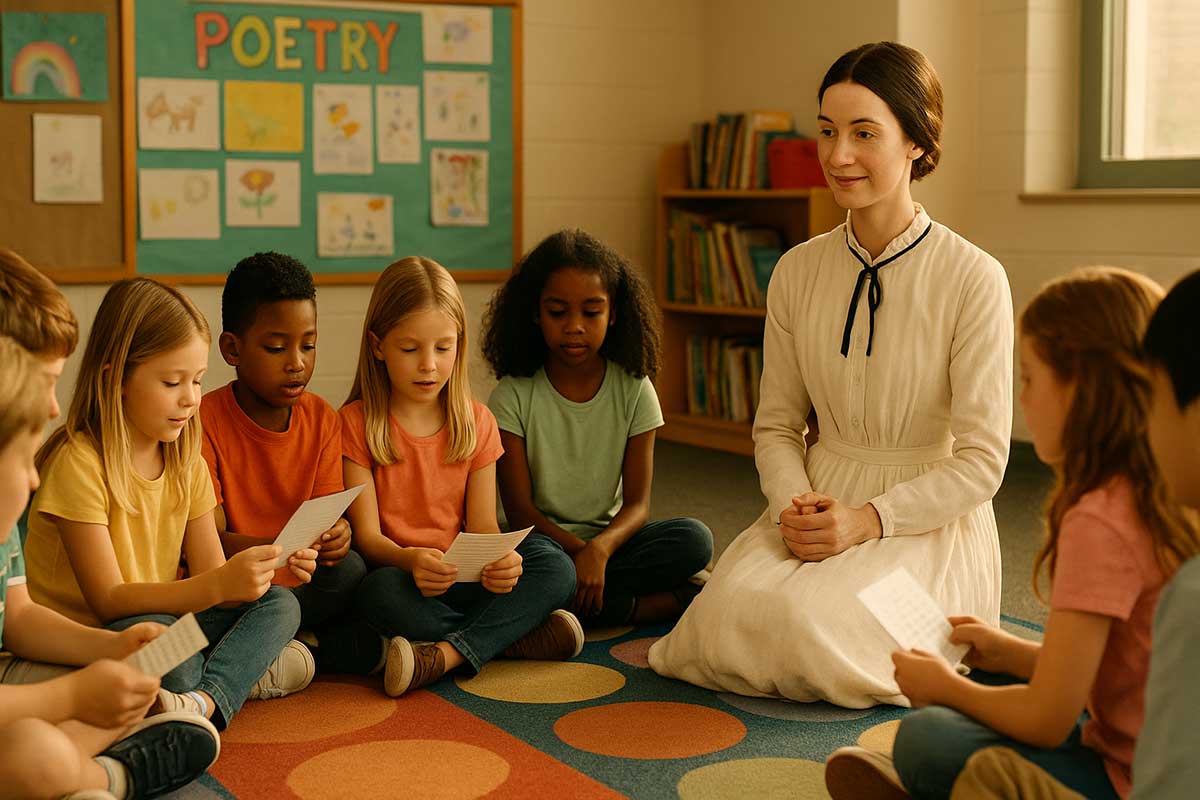
Emily gathers the class on the carpet.

A few brave students read their poems aloud.

She reacts with genuine awe:

Emily:
“That line! It nearly flew away with me.”
“Your poem is small, but its heart is enormous.”
“The world feels bigger after hearing that.”

She never criticizes — only celebrates imagination.

Emily’s Goodbye Gift
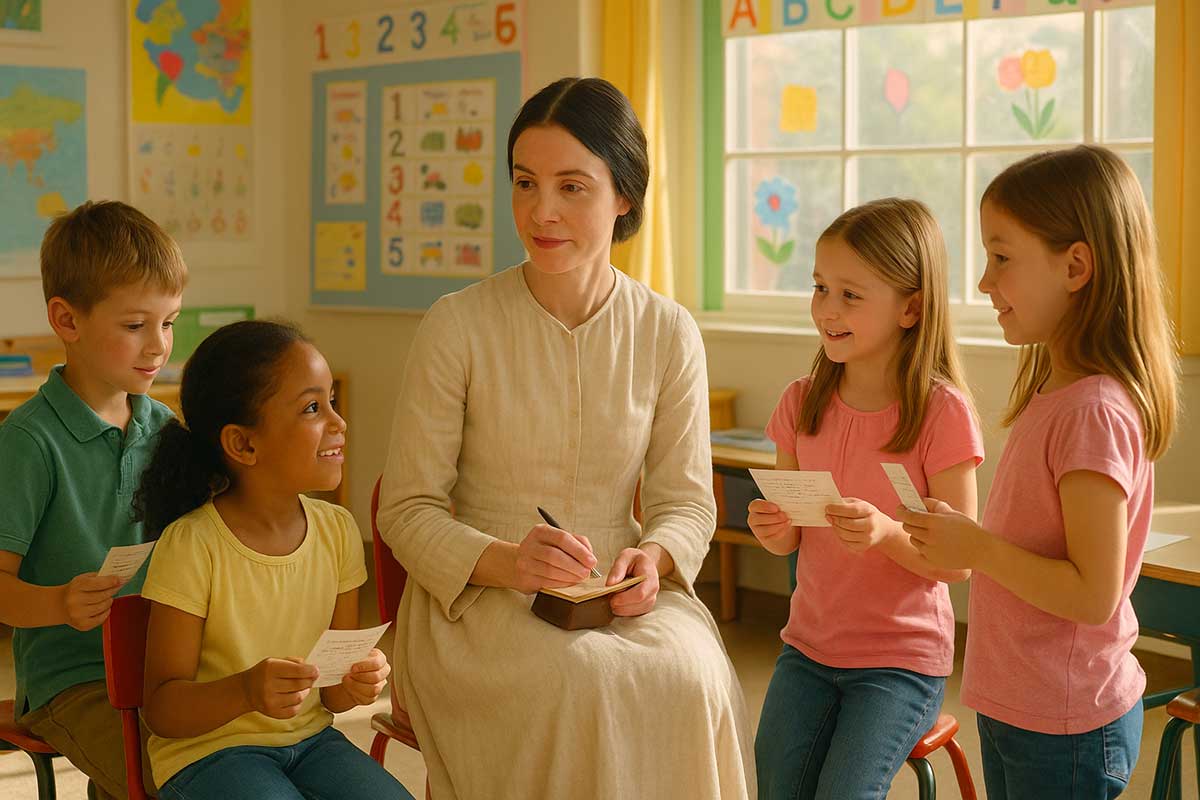
Emily Dickinson 2025

Emily stands at the front, hands folded, eyes warm.

Emily:
“My little poets…
promise me one thing.”

The class leans in.

Emily:
“Whenever you feel something — anything —
write it down in a few brave words.

That is poetry.
That is magic.
And you already know how.”

Then she opens her tiny notebook and tears out a small page.

Emily:
“A poem I wrote for you.”

It reads:

“Children’s hearts
are tiny lanterns —
they glow
with worlds.”

She bows slightly.

Emily:
“Thank you for letting me visit.
You have filled me
with sunlight.”

Final Thoughts

(Spoken by the child, now transformed by the encounter)

I didn’t expect today to feel like magic.

Mrs. Dickinson didn’t float or talk in riddles.
She knelt down beside us like she’d been waiting a long time to hear what kids think about the world. She opened a tiny notebook and showed us a poem shorter than a snack list — but somehow, it made my chest feel warm.

She told us poems are “moments you can keep.”
And suddenly everything made sense.

I looked around the classroom and saw moments everywhere:

The sunlight on Emma’s hair.
The squeak of Liam’s shoes.
The little heartbeat-thump I felt when she smiled at my poem.

And for the first time, I felt like poetry wasn’t something I had to “get.”
It was something I already had inside me.

When I read my poem aloud —
just a few words about how nervous feels like “a tiny bird shaking inside my shirt” —
Mrs. Dickinson put her hand over her heart.

No one has ever done that for my words before.

Now I know something huge:

Poetry is not about being smart.
It’s about being honest.

It’s the place where feelings can breathe.
It’s the net that catches the little sparks inside my mind.
It’s my way of keeping the world from rushing past too fast.

Today, I didn’t just meet a poet.
I became one.

And I think…
I think I’ll carry that with me for a very long time.

Short Bios:

Emily Dickinson

A gentle poet from the 1800s who loved turning quiet moments into poems. Emily spent most of her life in Amherst, Massachusetts, where she wrote about nature, feelings, and the mysteries of life. Though she lived quietly, her words became some of the most loved poems in the world. In this story, she visits a third-grade classroom to show that poetry can be playful, brave, and alive inside everyone.

Eli (the Child Narrator)

An 8-year-old who isn’t sure what poetry really is—until he meets Emily Dickinson. Curious, thoughtful, and sometimes shy, Eli learns that poetry isn’t about rules or rhymes, but about noticing small things and giving them words. His journey from confusion to wonder becomes the heart of the story.

Mrs. Alvarez (the Teacher)

The kind-hearted third-grade teacher who believes every child has a poet inside. She invites Emily Dickinson to visit her classroom to help her students discover the magic of words. Patient and wise, Mrs. Alvarez encourages imagination over perfection.

The Students

A lively, diverse group of third graders—each with their own spark of creativity. Some love to write, some love to draw, some are just beginning to find their voices. Together, they learn that poetry can sound like laughter, look like courage, or even smell like the first day of spring.

Related Posts:

  • Karma Exchanger: A Novel of Pain, Rebirth, and Mercy
  • Emily Dickinson Teaches the Art of Inner Poetry
  • S. Y. Agnon in 2026: An Imagined Novel of Belonging
  • Ultimate Pilgrimage in Israel: When the Bible Comes Alive
  • Grimm Fairy Tale Universe: The Complete Grimmverse Book One
  • The Sound of Stillness — Paul Simon & Emily…

Filed Under: Literature Tagged With: beginner poetry guide, children’s poetry workshop, creative language arts, elementary poetry class, Emily Dickinson classroom visit, Emily Dickinson for kids, Emily Dickinson lesson, Emily Dickinson Teaches Kids, fun poetry activities, how to write poems for kids, inspiring young writers, kid-friendly poets, kids creative writing, kids learning poetry, poetry activities for classrooms, poetry classroom ideas, poetry lesson for kids, simple poetry for kids, teaching poetry to children, third grade poetry lesson, writing exercises for kids

Reader Interactions

Leave a Reply Cancel reply

Your email address will not be published. Required fields are marked *

Primary Sidebar

RECENT POSTS

  • Charlie Kirk’s Spiritual Legacy After Death
  • Why ChatGPT Feels More Human Than Modern Conversation
  • claude mythos aiClaude Mythos: The AI Anthropic Refused to Release
  • The future of humanityThe Future of Humanity: AI, Aliens, God, and the Multiverse
  • Elon Musk Warns AGI Could Surpass Humanity Within Years
  • japanese sauna culture totonouWhy the World Is Falling in Love With Japanese Sauna Culture
  • Why Foreigners Fell in Love With Japan
  • patrick winston how to speak effectivelyPatrick Winston’s Last Lecture: How Communication Creates Success
  • psychology of money explainedThe Psychology of Money Explained
  • The Ultimate Japan Trip: Week 3 — Memory, Warmth, and Goodbye
  • the ultimate japan travel week 2The Ultimate Japan Trip: Week 2 — Kyoto to Osaka
  • the ultimate japan travel week 1The Ultimate Japan Trip: Week 1 — Tokyo’s Hidden Rules
  • graduation emotionsGraduation and Growing Up: Why Saying Goodbye Hurts So Much
  • The Simple Path to Wealth Explained by Top Financial Thinkers
  • How to Master Time Before Life Slips Away
  • Jujutsu Kaisen Curses Explained by Psychics
  • national defense strategy explainedNational Defense Strategy Explained: Security or Empire?
  • Edgar Cayce JesusEdgar Cayce on Jesus and Christ Consciousness
  • MrBeast challengeMrBeast’s Biggest Challenge Ever: 100 Nations, One Prize
  • 5 Great Novels About Mothers and Silent Sacrifice
  • what children realize too late5 Movie Mothers Who Revealed the Real Meaning of Love
  • before i was a mom explainedBefore I Was a Mom Explained: The Poem Makes Mothers Cry
  • What Happens When the World Order Loses Trust?
  • Why Empires Go to War: Truth, Profit, Fear
  • Your Child Is Your Karma? Explore Parenting and Soul Healing
  • Buckminster Fuller and AI: Can Technology Save the Soul?
  • Why War Still Exists in 2026: God, Religion, Technology, and Peace
  • mel robbins let them theoryThe Let Them Theory Explained: Stop Chasing Approval
  • history repeatsFourth Turning vs Dispensational Time Identity Explained
  • Fourth Turning Cycle Explained: Crisis, Generations, Reset
  • The Unoriginal Sinner Imaginary TalksThe Unoriginal Sinner and the Ice-Cream God Explained
  • Never Split the Difference Explained: Chris Voss Breaks It Down
  • hungry-ghosts-explainedHungry Ghosts Explained: Maté on Addiction & Trauma
  • World Peace Through God: One Human Family
  • John Lennon’s Imagine: Vision or Illusion?
  • ikigaiIkigai Explained: The Japanese Secret to Purpose and Longevity
  • Tiny Habits by B.J. Fogg: Why Small Actions Change Everything
  • Faith, Trump, and Tucker Carlson: Can Belief and Politics Coexist?
  • The Goal Explained: Goldratt, Cox, and Business Bottlenecks
  • A Return to Love: Marianne Williamson Dream Panel
  • Is Lust Bad or God-Given? A Christian View of Sexual Desire
  • My Voice Will Go With You: Why Stories Heal
  • bryon katie loving what isByron Katie’s Loving What Is and the Truth About Suffering
  • Fooled by RandomnessFooled by Randomness: Taleb on Luck, Risk, and Ruin
  • humanity at the edgeHuman Awakening Through Crisis: Are We Evolving or Breaking?
  • dan kennedy wealth attractionDan Kennedy on Wealth Attraction for Entrepreneurs
  • Ultimate pilgrimage in IsraelUltimate Pilgrimage in Israel: When the Bible Comes Alive
  • the wedding that waited a the crossingA Palestinian Wedding Day Divided by Roads, Memory & Waiting
  • Israeli Family War Story: A Son Returns Home Changed by Fear, Duty & Silence
  • Russian historical fiction 2022 warRussian Family War Story: How Pride, Silence & Duty Sent a Son Away
  • the house that stayed awakeUkraine War Family Story: A House Changed by 1991, 2014, and 2022
  • why the rich get paid differentlyWhy the Rich Use Securities Loans
  • The Name They Could Not EraseThe Name They Could Not Erase
  • Trump and Pope Leo on Power, Peace, and Christian Politics
  • The Millionaire Next Door Thomas J. StanleyThe Millionaire Next Door and the Hidden Habits of Real Wealth
  • colin obrady resilience talkColin O’Brady on Pain, Grit, and Human Possibility
  • Mans Search for Meaning Viktor FranklViktor Frankl on Man’s Search for Meaning
  • the-house-left-behindAfter Nanjing Fell: A Chinese Family Story
  • A Japanese Soldier’s Confession After the Nanjing Massacre
  • David R. Hawkins Letting GoDavid R. Hawkins Letting Go: Pain, Surrender, and Healing
  • Joseph Grenny on Crucial Conversations and Human Truth
  • Carol Dweck Mindset: Why Failure Breaks Some People
  • Fetterman, Iran, and the Double Standard on Trump
  • Dolores Cannon: Why Souls Meet, Suffer, and Heal
  • The Olive Tree Remembered by Nick Sasaki
  • the saad truth about happinessGad Saad on Happiness: 8 Secrets for the Good Life
  • tucker vs trumpDid Tucker Deliberately Misframe Trump as a Thief?
  • gad saad the parasitic mindGad Saad on The Parasitic Mind, Truth, Biology & Moral Courage
  • ufo contactChris Bledsoe and the Hidden Contact Phenomenon
  • Artificial Intelligence or Alien Intelligence? The Quiet Takeover
  • mr.houston 4 ways children wound parentsMr. Houston on 4 Ways Children Wound Parents
  • saito hitori war peaceSaito Hitori Challenges World Leaders on War and Peace
  • the bibi filesThe Bibi Files: Power, Corruption, War, and the Soul of Israel
  • IANG XUEQIN Iran TrumpJiang Xueqin on Iran, Trump, and the Prophecy of Collapse
  • the summer evacuationThe Summer Evacuation Map: Climate, Youth, and Care in 2026
  • the one that sleeps for youThe One That Sleeps for You: AI, Grief, and Night
  • jd vance ufoWhy JD Vance Says UFOs Are Demons
  • the voice after heatThe Voice After Heat: Care, Climate, and AI in 2026
  • Gad Saad on Happiness: Truth, Freedom, Love, and Human Nature
  • tim urban procrastinationTim Urban on Procrastination, Fear, Attention, and Change
  • karma exchangerKarma Exchanger: A Novel of Pain, Rebirth, and Mercy
  • Edward Mannix’s Compassion Key, Examined Deeply
  • S. Y. Agnon in 2026: An Imagined Novel of Belonging
  • bts swim meaningBTS “Swim” Meaning: Water, Desire, Risk, and Rebirth
  • The Hidden Logic of Iran–Israel Escalation
  • The Deeper Story Behind UFO Disclosure
  • p53 cancer agingp53 and the Hidden Judgment of Cells in Cancer and Aging
  • Angela Duckworth on the Grittiest People of All
  • Protected: 100 Geniuses on Humanity’s Future
  • power of focus jack canfieldThe Power of Focus and the Meaning of Success
  • saint patrickSaint Patrick Play: The Slave Who Came Back
  • the lanyard billy collinsThe Lanyard: Billy Collins Meets His Mother Again
  • Prophecy on Iran Japan North Korea CubaProphecy on Iran, Asia, Cuba, and the Future of Humanity
  • can war ever end?Can War Ever End?
  • are we alone in the universeAre We Alone in the Universe?
  • how did life beginHow Did Life Begin? Five Views on Life’s Origin
  • do not gloat when your enemy fallsDo Not Gloat When Your Enemy Falls: Proverbs 24:17
  • what happens after death?What Really Happens After Death?
  • epstein exposedJeffrey Epstein and the Larger System of Elite Power
  • who controls america's warsWho Really Drives America Into War?

Footer

Recent Posts

  • Charlie Kirk’s Spiritual Legacy After Death May 24, 2026
  • Why ChatGPT Feels More Human Than Modern Conversation May 24, 2026
  • Claude Mythos: The AI Anthropic Refused to Release May 23, 2026
  • The Future of Humanity: AI, Aliens, God, and the Multiverse May 22, 2026
  • Elon Musk Warns AGI Could Surpass Humanity Within Years May 21, 2026
  • Why the World Is Falling in Love With Japanese Sauna Culture May 20, 2026

Pages

  • About Us
  • Contact Us
  • Disclaimer
  • Earnings Disclaimer
  • Privacy Policy
  • Terms and Conditions

Categories

Copyright © 2026 Imaginarytalks.com