
|
Getting your Trinity Audio player ready...
|
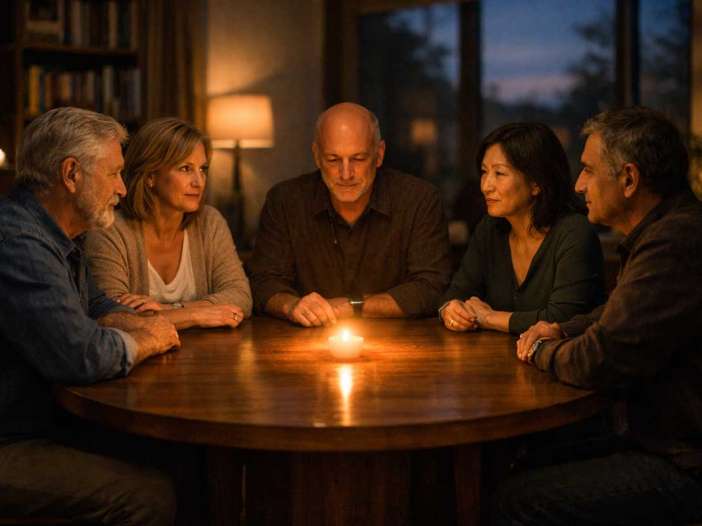
What if Brené Brown, Viktor Frankl, and Thich Nhat Hanh reflected on your year with you?
Introduction by Nick Sasaki
End of year reflection is often treated like an accounting exercise—what worked, what failed, what should change. But the truth is, the year doesn’t live in spreadsheets. It lives in the body, in unresolved emotions, in the quiet moments we avoided, and in the stories we kept telling ourselves to get through.
This series was created because I wanted a different kind of reflection. Not louder goals. Not harsher discipline. Not another list of promises we secretly know we won’t keep.
Instead, I imagined five conversations—each one asking a question most of us feel but rarely articulate at year’s end:
What am I still carrying?
Can I be grateful without lying to myself?
Is simplicity stronger than strategy?
Why do small rituals change us more than big plans?
And what if beginning gently is not weakness, but wisdom?
These are not motivational talks. They are pauses. Invitations. Spaces where psychology, spirituality, philosophy, and lived experience meet—without forcing answers.
If this reflection does anything, I hope it gives you permission to end the year honestly… and begin again without violence toward yourself.
(Note: This is an imaginary conversation, a creative exploration of an idea, and not a real speech or event.)
Topic 1 — Closing the Year Emotionally: What Are We Still Carrying?

Introduction — Karen Armstrong
The end of a year has always carried a quiet spiritual gravity. Across cultures, people pause—not only to count what happened, but to sense what remains unresolved. Yet modern life rarely invites us to examine emotional residue. We tally accomplishments, failures, and milestones, but we rarely ask what weight we are still holding in the body, the heart, or the stories we repeat to ourselves.
Tonight, I want us to look not at the calendar, but inward. Not at what changed, but at what followed us quietly from month to month. Because what we carry forward—unexamined—often shapes the year ahead more powerfully than any plan.
Let me begin with this.
Karen Armstrong
When we look back on this year, how do we recognize the emotional weight we’re still carrying—especially the parts we’ve normalized and stopped noticing?
Brené Brown
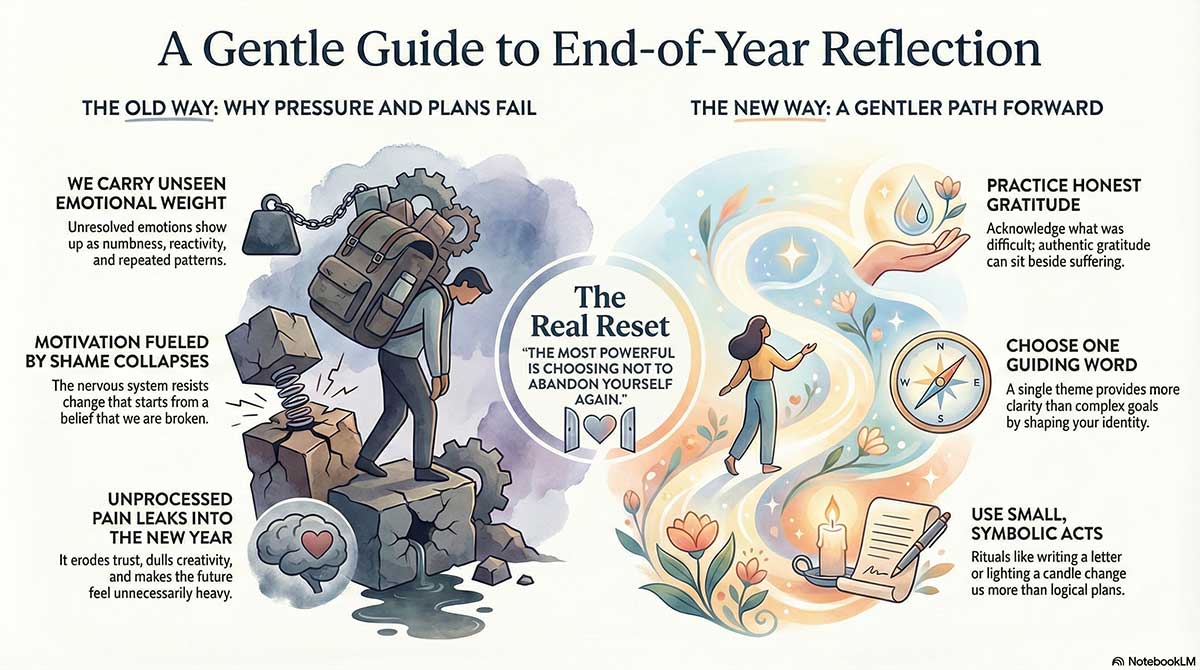
We recognize it by paying attention to where we’re numb. Emotional weight doesn’t always announce itself as pain. Often, it shows up as disconnection—less laughter, less curiosity, more reactivity. When something that once moved us no longer does, that’s usually a signal. Normalizing exhaustion, resentment, or self-doubt is one of the most socially rewarded forms of emotional avoidance. We call it “being strong.” But strength without awareness becomes armor, and armor is heavy.
Pema Chödrön
What we carry is often revealed in our resistance. Notice where the body tightens, where the mind loops. We stop noticing because familiarity feels safer than uncertainty. Suffering becomes predictable, and predictability feels like control. The practice is not to judge what we find, but to stay present with it. Awareness itself begins the unburdening.
Alain de Botton
We tend to carry silent disappointments—expectations we never articulated because doing so would have exposed our vulnerability. Society trains us to rationalize emotional discomfort rather than name it. We say, “Others have it worse,” or “This is just how life is.” But the cost of that stoicism is cumulative. Emotional weight becomes visible when irritation appears disproportionate, when small frustrations provoke large reactions.
Ocean Vuong
What we carry often speaks in the language of the unsaid. The email never sent. The goodbye that was rushed. The apology that felt too late. I think emotional weight lives in verbs that never reached completion. We stop noticing because noticing would mean feeling again—and feeling again risks reopening something we barely survived.
Nick Sasaki
For me, I notice it in repetition. When the same emotional pattern keeps resurfacing—different faces, same feeling—it tells me something hasn’t been integrated. The year becomes a loop instead of a line. That’s when I know I’m carrying something forward, whether I want to or not.
Karen Armstrong
Is it actually necessary to fully heal or resolve something before moving on, or can closure happen even when the wound isn’t finished speaking?
Pema Chödrön
Healing is not a prerequisite for movement. That belief often traps people in waiting. Closure doesn’t mean silence; it means relationship. You can walk forward while still listening. In Buddhist practice, we don’t aim to erase suffering—we aim to relate to it without fear. Sometimes the wound remains, but it no longer governs our steps.
Brené Brown
The idea that we must be “fully healed” before living is deeply unrealistic. What matters is whether we’ve turned toward the pain instead of away from it. Closure can look like honesty. Saying, “This still hurts, and I’m allowed to live anyway.” That’s not avoidance—that’s courage.
Alain de Botton
We often confuse closure with neatness. Life rarely provides tidy endings. Many emotional chapters close without clarity, justice, or apology. Psychological maturity involves accepting unfinished stories without allowing them to define our identity. Moving on is less about resolution and more about rebalancing attention.
Nick Sasaki
I’ve found that closure happens when responsibility shifts. Not blame—but responsibility. When I stop waiting for the other person, the past, or circumstances to deliver peace, something loosens. The wound may remain, but it no longer holds authority over my future.
Ocean Vuong
Some wounds don’t want closure. They want witness. When we rush them toward resolution, we silence a part of ourselves that learned something essential about love, loss, or survival. Moving on doesn’t mean forgetting—it means carrying the story differently, with less self-punishment.
Karen Armstrong
What happens if we enter a new year without releasing old emotional burdens—not philosophically, but psychologically and relationally?
Alain de Botton
Psychologically, the past leaks into the present as misinterpretation. We respond not to what is happening, but to what resembles what once hurt us. Relationally, this creates distance. We ask new people to pay debts they never incurred. Over time, this erodes intimacy.
Brené Brown
Unreleased emotional weight doesn’t disappear—it mutates. It shows up as control, perfectionism, or withdrawal. Relationships suffer because unprocessed pain narrows our capacity for trust. We may still show up, but we show up armored.
Nick Sasaki
For me, the cost is subtle but profound. Creativity dulls. Curiosity shrinks. The future feels heavier than it should. Carrying emotional baggage into a new year is like trying to walk forward while constantly checking what’s dragging behind you.
Pema Chödrön
The mind becomes rigid. When we don’t release, we cling—to identities, to narratives, to defenses. This rigidity prevents fresh experience. Each moment becomes filtered through yesterday’s fear. Compassion—for self and others—becomes harder.
Ocean Vuong
Relationally, we begin to ask love to compensate for grief it did not cause. We seek reassurance where presence would have been enough. The new year becomes haunted—not by the past itself, but by our refusal to grieve it fully.
Final Thoughts — Ocean Vuong
A year does not end when the calendar turns. It ends when we decide what we will no longer punish ourselves for carrying.
Some emotions are not meant to be discarded; they are meant to be laid down gently, acknowledged, and left where they belong—in time. To close a year emotionally is not to become lighter overnight, but to stop pretending that weight is invisible.
If the coming year asks anything of us, it may simply ask this:
to enter it more honestly than we left the last one.
And sometimes, that honesty is the truest form of release.
Topic 2 — Gratitude for the Unwanted: Can We Thank the Year Honestly?

Introduction — Karen Armstrong
Gratitude has become one of the most celebrated virtues of modern spirituality. We are encouraged to practice it daily, to journal it, to count it, to cultivate it as if it were a muscle. Yet this raises an uncomfortable question: what happens when a year delivers not clarity, but loss; not growth, but rupture?
Can gratitude survive disappointment without becoming dishonest? And if gratitude cannot be forced, what remains when the year ends without answers?
Tonight, I’d like us to explore gratitude not as obligation, but as truth.
Karen Armstrong
Is gratitude still authentic when the year included loss, disappointment, or injustice — or does it risk becoming a form of emotional denial?
Viktor Frankl
Gratitude loses its moral force when it is demanded. Suffering does not obligate thankfulness. What remains possible, however, is meaning. Meaning does not negate pain; it coexists with it. Authentic gratitude, when it arises, is quiet and unforced. It is not gratitude for suffering, but gratitude within suffering—for dignity preserved, for values lived, for the freedom to choose one’s attitude.
Marianne Williamson
Spiritual denial happens when we use light to avoid looking at shadow. Gratitude is not meant to erase grief or outrage. If injustice occurred, pretending it was “a blessing” can actually deepen harm. True gratitude tells the truth first. Only after truth is honored can grace enter. Gratitude that skips honesty becomes a performance.
Ryan Holiday
From a Stoic perspective, gratitude is not approval. It’s acknowledgment. Life delivers events; we respond. Loss does not need to be celebrated to be accepted. Gratitude here means recognizing that even difficulty can be metabolized into strength or wisdom—but only if we resist the temptation to romanticize it.
Elizabeth Gilbert
There are years I would never thank — and I think that’s okay. Some seasons are about survival, not appreciation. What I’ve learned is that gratitude doesn’t always arrive as warmth. Sometimes it arrives later, as distance. And sometimes it never arrives at all, and we must let that be enough.
Thich Nhat Hanh
Gratitude without awareness becomes hollow. When pain is present, we first bow to the pain. Only then can gratitude appear naturally, perhaps for small things—a breath, a moment of safety, the presence of another human being. Gratitude does not cancel suffering; it sits beside it.
Karen Armstrong
How do we distinguish between meaningful acceptance and spiritual bypassing when we say, “This happened for a reason”?
Ryan Holiday
Spiritual bypassing avoids responsibility. Acceptance does not. Saying “this happened for a reason” too quickly can be a way to avoid grief, anger, or necessary action. Acceptance means engaging reality as it is, without illusion, and then choosing a response aligned with our values.
Viktor Frankl
Meaning is not imposed retroactively like a stamp of approval. It is discovered through engagement. To claim reason prematurely is to close inquiry. Meaning arises when a person asks, “What is being asked of me now?” not “Why did this happen to me?”
Marianne Williamson
When “for a reason” becomes a slogan, it silences pain. But when it becomes a question—“What is life inviting me to learn or express now?”—it opens transformation. The difference lies in whether the phrase is used to shut down feeling or to deepen responsibility.
Thich Nhat Hanh
True acceptance is spacious. It allows sorrow to breathe. Spiritual bypassing is tight; it rushes. If the phrase “this happened for a reason” brings constriction, it is not wisdom. If it brings openness and compassion, it may be insight.
Elizabeth Gilbert
I’ve seen people use that phrase to sound enlightened while still bleeding internally. The body knows the truth. If a belief doesn’t bring relief, it might be a story we’re telling ourselves to avoid sitting in uncertainty.
Karen Armstrong
What kind of gratitude, if any, is possible when answers never arrive — and does meaning require explanation?
Viktor Frankl
Meaning does not require explanation; it requires engagement. Some experiences resist narrative closure. In those moments, gratitude may take the form of endurance—the quiet pride of having lived through what could not be understood.
Thich Nhat Hanh
When answers do not come, presence becomes the answer. Gratitude may arise simply from being alive, from touching the earth, from breathing. This is not resignation; it is intimacy with life as it is.
Elizabeth Gilbert
Sometimes the only honest gratitude is this: “I survived.” And that is not small. We often underestimate how much courage it takes to keep living when meaning remains opaque.
Ryan Holiday
Unanswered questions test character. Gratitude, here, becomes respect for reality’s complexity. We can be thankful for the chance to practice resilience, patience, and humility—even when clarity is withheld.
Marianne Williamson
There is a gratitude that exists beyond understanding. It’s the gratitude of trust. Trust that life is not hostile, even when it is painful. Trust that love is larger than explanation. This form of gratitude doesn’t explain suffering—it refuses to let suffering define the soul.
Final Thoughts — Thich Nhat Hanh
Gratitude is not a commandment. It is a flower that blooms when the ground is ready.
If this year brought sorrow, do not rush to thank it. Sit with it. Breathe with it. Let the pain teach you how deeply you are capable of caring.
One day, perhaps, gratitude will arise—not because the year was kind, but because you learned how to remain kind within it.
That, too, is a form of wisdom.
Topic 3 — One Word for a Year: Can a Single Theme Shape a Life?

Introduction — Naval Ravikant
We live in an age of optimization. Annual plans grow longer, tools multiply, and goals fragment attention. Yet many people quietly notice something counterintuitive: the more complex the plan, the easier it is to abandon.
Tonight, I want us to examine simplicity—not as reduction for its own sake, but as leverage. Specifically, whether a single word or guiding theme can shape decisions more reliably than elaborate systems.
Let’s begin with the tension at the heart of this idea.
Naval Ravikant
Why do complex plans so often fail while simple guiding principles seem to quietly succeed?
James Clear
Complex plans ask us to rely on motivation. Simple principles shape identity. When behavior is anchored to who we believe we are, it requires less cognitive effort. A single word works because it becomes a filter. You don’t have to remember ten goals when one identity-based direction governs your choices.
Cal Newport
Complexity collapses under pressure. When life accelerates, we default to what’s clear and deeply held. Simple principles survive chaos because they reduce decision friction. Depth requires subtraction. The more rules you have, the easier it is to rationalize breaking them.
Simon Sinek
Clarity is energizing. Complexity creates anxiety because it fragments purpose. A single guiding idea gives people a sense of coherence. They know why they’re saying yes or no. That emotional clarity is often more sustainable than tactical precision.
Saito Hitori
People think success comes from doing more, but happiness comes from choosing lightly. One word is like tuning your heart to one frequency. When the heart is aligned, actions follow naturally. Complicated plans exhaust the spirit before the year even begins.
Naval Ravikant
Simple principles are scalable. They work when life is calm and when it’s turbulent. Complexity requires constant maintenance; simplicity compounds.
Naval Ravikant
Can a single word or theme genuinely guide behavior under stress—or does clarity only matter when life is calm?
Cal Newport
Stress reveals design flaws. If a principle disappears under pressure, it was never integrated. A single word can guide behavior precisely because it’s memorable. When attention is scarce, memory wins.
James Clear
Stress tests identity. If the word is aspirational but not internalized, it fails. But when it’s chosen honestly, it becomes automatic. Under pressure, we don’t rise to goals—we fall to systems.
Simon Sinek
Clarity matters most in uncertainty. In calm periods, anyone can follow a plan. In stress, people look for meaning. A guiding word provides emotional orientation when logic alone is insufficient.
Naval Ravikant
Under stress, complexity creates paralysis. A single word reduces decision-making to alignment. The question becomes simple: does this move me closer to or farther from my principle?
Saito Hitori
When life is hard, the heart listens more than the mind. A single word reaches the heart quickly. That’s why it works when reasoning fails.
Naval Ravikant
What does choosing one word require us to say no to—and why is that often the hardest part?
Simon Sinek
It requires saying no to external validation. One word prioritizes internal alignment over approval. That can feel risky because belonging is a powerful motivator.
James Clear
It forces trade-offs. You can’t optimize for everything. One word exposes the cost of distraction. Saying no means letting some good opportunities pass, which challenges our fear of missing out.
Cal Newport
It demands depth over breadth. Choosing one theme means abandoning shallow engagement. The hardest no is often to busyness itself.
Saito Hitori
People fear saying no because they confuse it with loss. But no is protection. When you protect your joy, life responds more kindly.
Naval Ravikant
Saying no is leverage. It’s how you reclaim time, attention, and energy. The difficulty isn’t the no—it’s trusting that what remains will be enough.
Final Reflections — Ocean Vuong
A single word is not a rule.
It is a promise whispered to oneself.
It does not shout directions. It listens.
It waits for moments of doubt and asks, quietly,
“Who are you choosing to be right now?”
In a year that will inevitably grow noisy,
one word can become a place to return to—
not to simplify life,
but to remember what matters when simplicity feels impossible.
And sometimes, that remembering is the most faithful form of guidance we have.
Topic 4 — Symbolic Acts: Why the Smallest Gestures Change Us

Introduction — Joseph Campbell
Across cultures and centuries, human beings have marked transition not with explanation, but with ritual. We light fires, cross thresholds, wash our hands, bury objects, speak words aloud. These gestures are often small, yet they carry disproportionate power.
Modern life has largely replaced ritual with information. We plan, analyze, optimize—but something essential is lost when meaning is reduced to logic alone. Tonight, we explore why symbolic acts move us more deeply than plans, and why transformation so often begins with something deceptively simple.
Joseph Campbell
Why does the human nervous system respond more powerfully to symbolic acts than to logical resolutions or detailed plans?
Carl Jung
Because symbols speak the language of the unconscious. Logic addresses the conscious mind, but transformation requires participation from deeper psychic layers. A symbolic act bypasses resistance. It communicates change not as instruction, but as experience. The psyche responds to what is enacted, not merely understood.
Bruce Lipton
The subconscious mind runs most of our behavior, and it does not respond to words alone. It responds to emotion, repetition, and imagery. A symbolic act creates a felt experience that signals safety or change. That experience rewires expectation at a biological level.
Deborah Rozman
The heart processes information differently than the intellect. Symbolic acts often engage emotion and coherence simultaneously. When heart and mind align, the nervous system relaxes. That state allows new patterns to emerge without force.
Malcolm Gladwell
Small acts matter because they lower the threshold for change. A symbolic gesture doesn’t overwhelm; it invites participation. Once someone takes even a tiny step, identity begins to shift. And identity change drives behavior far more effectively than instruction.
Joseph Campbell
Rituals work because they place the individual inside a story. Logic explains; symbols initiate. One informs the mind, the other transforms the self.
Joseph Campbell
What separates a meaningful ritual from a hollow habit — and how do we know when a gesture has real psychological impact?
Deborah Rozman
Intention and presence. A ritual performed mechanically becomes empty. But when attention is engaged—when the heart participates—the act becomes alive. Impact is felt as calm, clarity, or emotional release rather than excitement.
Carl Jung
Meaning arises from personal resonance. A ritual imposed externally has limited power. A symbol chosen intuitively often reveals what the conscious mind has not yet articulated. The psyche recognizes authenticity immediately.
Malcolm Gladwell
Context matters. A gesture gains power when it marks transition—before and after. Without that boundary, habits blur into routine. Rituals signal change because they interrupt normal patterns.
Bruce Lipton
Physiologically, real impact shows up as relaxation rather than tension. If a gesture increases anxiety, it’s not integrating. Effective rituals soothe the nervous system while signaling new possibility.
Joseph Campbell
A meaningful ritual does not demand belief. It invites participation. When the act feels like crossing a threshold rather than completing a task, transformation has begun.
Joseph Campbell
Are symbolic acts effective because they change reality, or because they change how we perceive ourselves within it?
Bruce Lipton
They change perception first, and perception shapes biology. When belief shifts, behavior follows. Over time, behavior reshapes environment. So the change is indirect, but real.
Carl Jung
Symbols alter the relationship between ego and unconscious. Reality remains, but the individual’s position within it changes. That shift is often enough to produce new outcomes.
Malcolm Gladwell
People act in alignment with who they believe they are. Symbolic acts accelerate identity change. Once identity shifts, reality tends to follow through accumulation of small choices.
Deborah Rozman
Symbolic acts restore agency. They remind the nervous system that choice is possible. From that sense of agency, perception widens—and so does possibility.
Joseph Campbell
The world may not change immediately, but the story does. And it is the story that determines how courage, meaning, and movement arise.
Final Reflections — Ocean Vuong
We often mistake transformation for something loud.
But the deepest changes whisper.
A hand washed slowly.
A letter burned.
A drawer emptied.
These acts do not announce themselves to the world.
They announce themselves to the body.
And when the body believes a chapter has ended,
the soul begins to walk forward—
not because the future is clear,
but because the threshold has been crossed.
Topic 5 — Beginning Gently: Why Pressure Breaks Change

Introduction — James Hollis
At the beginning of every year, we hear the same language: discipline, willpower, reinvention. Beneath it lies an unspoken assumption—that we are fundamentally inadequate as we are, and must be corrected through effort.
But the psyche does not respond well to coercion. When change is driven by self-rejection, it often fractures rather than integrates. Tonight, I want us to explore a quieter question: why gentleness may not be the opposite of change, but its precondition.
James Hollis
Why does intense motivation at the start of a new year so often collapse into guilt, avoidance, or self-criticism?
Gabor Maté
Because the motivation is frequently fueled by shame. When change begins with the belief that we are broken, the nervous system interprets effort as threat. Over time, the body resists—not out of laziness, but out of self-protection.
Kristin Neff
Self-criticism may feel motivating, but research shows it undermines resilience. Guilt creates fear of failure, which leads to avoidance. Compassion, on the other hand, creates emotional safety—the foundation for sustained effort.
Anthony de Mello
We fail because we are trying to become someone else. Effort born of comparison is exhausting. Awareness, not force, is what produces real change. When we see clearly, behavior shifts naturally.
Eckhart Tolle
Motivation that depends on the future cannot sustain itself. It creates psychological time pressure. When the present moment is rejected, resistance arises. Change that emerges from presence does not collapse—it unfolds.
James Hollis
The psyche rebels against tyranny, even self-imposed tyranny. When motivation lacks meaning, the soul withdraws cooperation.
James Hollis
Is gentleness a form of strength in transformation — or does it risk becoming an excuse for stagnation?
Kristin Neff
Gentleness is not indulgence. It is honesty without cruelty. Self-compassion actually increases accountability because failure becomes survivable. When people aren’t afraid of themselves, they try again.
Gabor Maté
True gentleness requires courage. It means staying with discomfort without self-attack. Stagnation comes not from kindness, but from disconnection—from ignoring unmet needs beneath behavior.
Eckhart Tolle
Gentleness is strength when it is rooted in awareness. Passivity arises when awareness is absent. Presence is active; it dissolves unconscious patterns without aggression.
Anthony de Mello
The ego confuses harshness with seriousness. But seriousness is not sincerity. When awareness is present, effort becomes light. The illusion that force is required disappears.
James Hollis
Growth requires tension, but not violence. The task is to hold discomfort without turning it into self-condemnation. That holding is a mature strength.
James Hollis
What actually sustains long-term change — discipline, compassion, presence — or something else we rarely name?
Eckhart Tolle
Presence sustains change because it removes resistance. When the now is accepted, action flows without inner conflict. Discipline then becomes alignment, not struggle.
Kristin Neff
Compassion sustains change because it allows recovery. Progress is not linear. The ability to begin again without shame is what carries transformation forward.
Gabor Maté
Connection sustains change. When behavior is understood within context—trauma, environment, unmet needs—self-blame dissolves. Healing becomes relational, not heroic.
Anthony de Mello
Truth sustains change. When illusion falls away, effort is no longer required. One does not struggle to stop touching fire once its nature is known.
James Hollis
Meaning sustains change. When transformation serves the soul’s deeper calling, energy appears naturally. Without meaning, discipline becomes hollow.
Final Reflections — Ocean Vuong
We are taught to begin loudly.
To announce change as a declaration of war against who we were.
But the soul does not respond to ultimatums.
It responds to listening.
To patience.
To the quiet courage of staying present when nothing dramatic happens.
To begin gently is not to lower ambition.
It is to refuse violence—especially toward oneself.
And perhaps the truest beginning is not the moment we decide to change,
but the moment we stop believing we must be cruel in order to grow.
Final Thoughts by Nick Sasaki
If there’s one quiet truth that emerged across these conversations, it’s this:
Most people don’t fail to change because they lack discipline.
They fail because they never felt safe enough to begin honestly.
An end of year reflection isn’t meant to judge the past or threaten the future. It’s meant to tell the nervous system that something has completed—and that it’s okay to move forward without dragging everything behind you.
You don’t need to fix your life tonight.
You don’t need a perfect plan.
You don’t even need certainty.
Sometimes, the most powerful beginning is simply choosing not to abandon yourself again.
And that choice—made quietly, gently—may be the real reset.
Short Bios:
Brené Brown
Research professor and bestselling author known for her work on vulnerability, courage, shame, and wholehearted living.
Pema Chödrön
American Buddhist nun and teacher whose writings focus on compassion, mindfulness, and working gently with suffering.
Alain de Botton
Philosopher and writer who explores modern emotional life, relationships, and meaning through accessible philosophy.
Ocean Vuong
Award-winning poet and novelist whose work blends emotional honesty, memory, loss, and lyrical reflection.
Nick Sasaki
Writer and founder of ImaginaryTalks, known for creating reflective dialogues that bridge psychology, spirituality, and lived experience.
Viktor Frankl
Psychiatrist and Holocaust survivor, founder of logotherapy, emphasizing meaning as the core of human resilience.
Marianne Williamson
Spiritual teacher and author focused on love, forgiveness, and inner transformation.
Ryan Holiday
Author and modern Stoic thinker known for applying ancient philosophy to contemporary life and decision-making.
Elizabeth Gilbert
Writer and storyteller exploring creativity, resilience, and the emotional complexity of being human.
Thich Nhat Hanh
Zen master and peace activist whose teachings emphasize mindfulness, compassion, and presence.
James Clear
Author of Atomic Habits, specializing in behavior change, identity-based growth, and long-term consistency.
Simon Sinek
Leadership thinker best known for articulating purpose-driven living and the concept of “starting with why.”
Cal Newport
Author and computer science professor focusing on deep work, focus, and intentional living in a distracted age.
Saito Hitori
Japanese spiritual teacher and entrepreneur known for joyful wisdom, simple language, and heart-centered thinking.
Naval Ravikant
Entrepreneur and philosopher offering insights on clarity, leverage, wealth, and inner freedom.
Carl Jung
Psychiatrist and founder of analytical psychology, emphasizing symbols, the unconscious, and individuation.
Joseph Campbell
Mythologist who explored universal patterns of meaning through stories, ritual, and the hero’s journey.
Bruce Lipton
Cell biologist known for connecting belief, biology, and subconscious conditioning.
Deborah Rozman
Psychologist and co-founder of HeartMath, focusing on emotional coherence and heart-based intelligence.
Malcolm Gladwell
Writer and thinker examining how small factors create large cultural and behavioral shifts.
Gabor Maté
Physician and author exploring trauma, addiction, compassion, and the mind-body connection.
Kristin Neff
Psychologist and pioneer in self-compassion research, emphasizing kindness as a foundation for resilience.
Eckhart Tolle
Spiritual teacher known for teachings on presence, awareness, and freedom from ego-driven suffering.
Anthony de Mello
Jesuit priest and spiritual teacher whose work centers on awareness, truth, and inner liberation.
James Hollis
Jungian analyst and author focused on midlife, meaning, and soul-centered psychological growth.
Leave a Reply