

What if Byron Katie sat with today’s greatest thinkers to question reality itself?
Introduction by Byron Katie
When people come to me, they usually want relief.
They want peace.
They want something to stop hurting.
And almost always, they believe the pain is caused by something out there—a person who betrayed them, a situation that shouldn’t have happened, a world that didn’t behave the way it was supposed to.
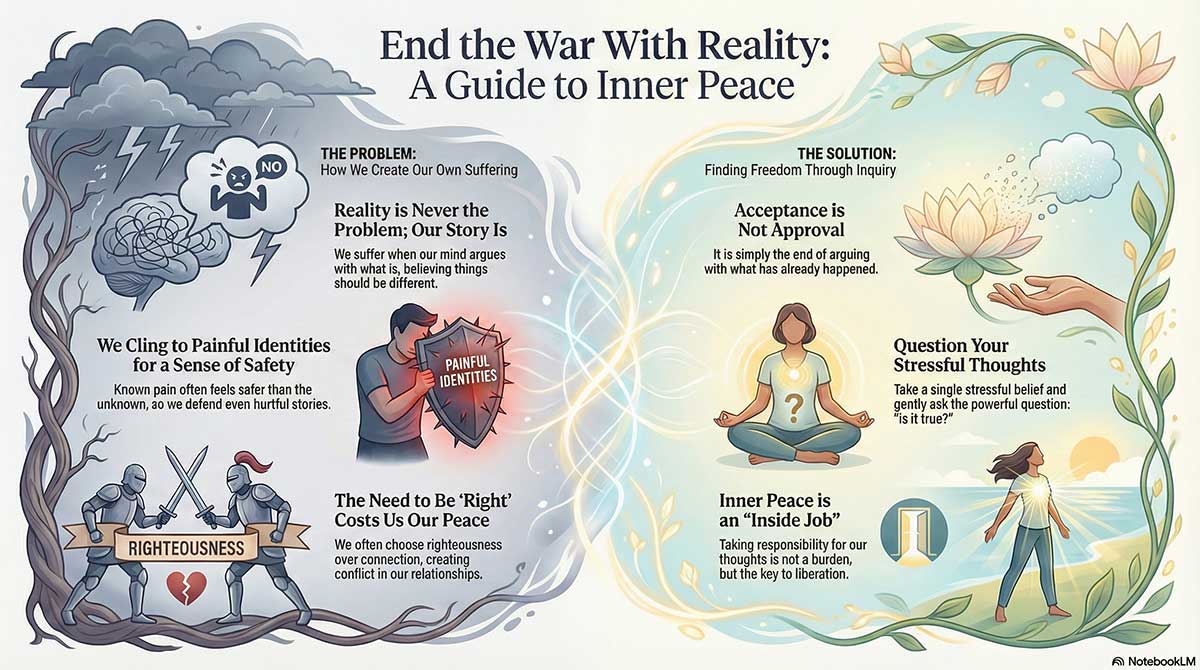
What I’ve discovered, again and again, is that reality is never the problem.
Reality is innocent.
What hurts us is the unquestioned story we tell about reality.
This series is not about changing your life.
It’s not about becoming better, calmer, wiser, or more spiritual.
It’s about noticing what happens when you pause—and question the thoughts you’ve been living inside.
Across these five conversations, we explore something very simple and very radical:
What happens when the mind stops arguing with what is?
We look at suffering and discover it doesn’t live where we thought it did.
We examine identity and find that the self we defend may not be as solid as it feels.
We question the need to be right and notice how much it costs us.
We explore acceptance and realize it doesn’t weaken us—it frees us.
And finally, we come home to responsibility—not as blame, but as liberation.
Nothing here asks you to believe anything new.
There is no doctrine.
No system to join.
There is only an invitation:
Take one stressful thought.
Hold it gently.
And ask yourself—is it true?
If you’re willing to look, reality will meet you with kindness.
(Note: This is an imaginary conversation, a creative exploration of an idea, and not a real speech or event.)
Topic 1 — Reality vs. the Mind: Who Is Actually Causing the Pain?

Moderator: Byron Katie
Participants:
Eckhart Tolle, Sam Harris, Jiddu Krishnamurti, Donald Hoffman, Alan Watts
Opening — Byron Katie
We’re here to look at something very simple, but not easy.
Most people believe their pain is caused by something outside themselves—a person, an event, a memory, a situation.
What I’m interested in is this: Is that really true?
Or is it possible that what hurts us is not reality itself, but the story we’re telling about it?
Let’s start there.
First Question —
If reality is exactly as it is, where does suffering actually come from?
Jiddu Krishnamurti
Suffering begins the moment thought separates itself from what is. When there is an observer who says, “This should not be happening,” conflict is born. Reality itself has no contradiction. The contradiction is psychological. When the mind resists what is, it fragments itself, and that fragmentation is pain.
Eckhart Tolle
Suffering is resistance. Very simply. The present moment is always as it is. Pain arises when the mind argues with the Now. Even emotional pain is a form of resistance to what already exists—either in the present or as a memory carried forward. When resistance ends, suffering ends, even if the situation remains.
Sam Harris
From a neuroscientific perspective, suffering arises when thoughts are believed without examination. The brain generates narratives automatically. When those narratives are fused with identity—this is happening to me, this shouldn’t be happening—the experience intensifies into suffering. The raw sensations themselves are often far less painful than the story layered on top.
Donald Hoffman
If we take perception seriously as an interface rather than a window onto reality, then suffering is not a reaction to reality itself but to a user interface symbol. We’re reacting to icons, not truth. Pain comes from mistaking the interface for the thing itself and then emotionally defending that mistake.
Alan Watts
Suffering comes from pretending that life is not a game while insisting on playing it very seriously. The universe isn’t making a mistake, but the ego thinks it knows better. When you insist that the river flow differently, you drown. When you float, you discover there was never an enemy.
Second Question —
What happens to the self when its story about reality is questioned or removed?
Sam Harris
When the story dissolves, the sense of a separate self weakens. What remains is experience without ownership. Thoughts still arise, sensations still occur, but there is less psychological contraction around them. This can feel liberating—or frightening—because the ego depends on narrative continuity to feel real.
Alan Watts
When the story drops, you don’t disappear—you reappear. The fictional character called “me” relaxes, and what’s left is the happening itself. Life living life. The fear is that we’ll lose control, but the joke is that we never had it to begin with.
Eckhart Tolle
When the story is questioned, presence emerges. The egoic self—built from past and future—loses its grip. What remains is awareness itself, which is peaceful, alert, and deeply alive. Many people fear this because they confuse the loss of story with the loss of meaning.
Jiddu Krishnamurti
The self is the story. When the story ends, the psychological self ends. This is not annihilation; it is freedom. But freedom cannot be approached gradually. It appears when illusion is seen as illusion—not modified, not improved, but seen.
Donald Hoffman
If the self is an interface icon rather than an objective entity, then questioning the story doesn’t destroy anything real. It simply updates the interface. The fear we feel is like a cursor panicking when it realizes it isn’t the computer.
Third Question —
If the mind is not a reliable narrator of reality, how can we live without collapsing into passivity or confusion?
Eckhart Tolle
Presence is not passivity. When the mind stops compulsively narrating, intelligence acts more clearly. Action arising from presence is often more effective because it is not distorted by fear, resentment, or resistance. Acceptance comes first; right action follows.
Donald Hoffman
Recognizing that perception is an interface doesn’t mean abandoning it. You still use the interface—you just don’t worship it. You click the icon without believing it’s the truth. That creates flexibility rather than paralysis.
Alan Watts
Confusion comes from trying to stand outside the dance while dancing. Once you accept that you’re in it, movement becomes natural again. Life doesn’t require certainty; it requires participation. The universe improvises quite well without our anxious supervision.
Sam Harris
You don’t need belief in a story to function. You need clarity about experience. Ethics, compassion, and action can arise from awareness itself. In fact, dropping false certainty often leads to more humane behavior, not less.
Jiddu Krishnamurti
Order is not imposed by thought; it arises when thought is quiet. Action without psychological motive is precise. Confusion belongs to the mind that insists on control. Freedom is not chaos—it is intelligence unburdened by illusion.
Closing — Byron Katie
What I hear again and again is this:
Reality isn’t attacking us.
The mind is arguing with what already happened.
When we question the story, life becomes kinder—not because it changed, but because we stopped fighting it.
And the most radical discovery is this:
When reality is left alone, it turns out to be surprisingly friendly.
Topic 2 — Identity Under Examination: Who Am I Without My Story?

Moderator: Byron Katie
Participants:
Carl Jung, Brené Brown, Alan Watts, Naval Ravikant, Sam Harris
Opening — Byron Katie
Most of us don’t just believe our thoughts—we become them.
We carry stories about who we are, what we’ve survived, what we deserve, and what we lack.
Today, I’d like to question something very intimate:
If the story falls away, what’s left?
Is there loss—or is there freedom?
Let’s look.
First Question —
What is the psychological function of identity, and why do we cling to it even when it hurts?
Carl Jung
Identity provides orientation. Without it, the psyche feels unmoored. The ego organizes experience and protects us from chaos. However, when identity becomes rigid—when a persona is mistaken for the totality of the self—it becomes a prison. People cling to painful identities because the known pain feels safer than the unknown.
Brené Brown
Identity helps us belong. Stories about ourselves—especially stories shaped by shame or resilience—become survival strategies. Even painful identities can feel protective because they explain why we hurt. Letting go of them can feel like stepping into exposure without armor.
Sam Harris
From a contemplative perspective, identity is a narrative overlay on experience. It persists because it feels continuous and personal. The problem is not that identity exists, but that we fail to see it as a process. When identity is believed to be who we are, suffering becomes personal and sticky.
Alan Watts
We cling to identity the way a whirlpool clings to its shape. It’s movement pretending to be a thing. The fear is that without the story, there will be nothing—but what disappears is only the illusion of solidity. The dance goes on.
Naval Ravikant
Identity is a role you forgot you chose. Most suffering comes from over-identifying with labels—success, failure, victim, hero. The more identities you drop, the lighter you move through life. But the ego resists because identity feels like control.
Second Question —
What fears arise when the personal story is questioned, and what do those fears protect?
Brené Brown
The biggest fear is disconnection. If I’m not the story I tell, will I still be loved? Will I still matter? Shame tells us that without our narrative—especially our struggle—we’ll disappear or be dismissed. The fear protects our sense of worth.
Carl Jung
The fear is psychic death. The ego experiences the questioning of identity as annihilation. But what it protects is not the Self—it protects familiarity. Individuation requires enduring this fear and discovering that something deeper than the ego survives.
Alan Watts
The fear is that life will lose meaning. But meaning was never in the story—it was in the living. The story merely narrates after the fact. The fear protects the illusion that we are the author, rather than the expression, of life.
Sam Harris
There is fear of groundlessness. Without a narrative self, people worry they won’t function, won’t care, won’t act ethically. But this fear protects a misunderstanding. Awareness doesn’t collapse without identity—it clarifies.
Naval Ravikant
Identity protects pride. If I drop the story, I can’t take credit—or blame. That feels dangerous to the ego. But what’s protected is not truth; it’s self-importance.
Third Question —
If identity is loosened or dissolved, how do we live, relate, and choose without losing coherence?
Sam Harris
You live from awareness rather than narrative. Decisions still happen. Preferences still exist. But they’re not filtered through constant self-reference. This often leads to more compassion, because suffering is no longer seen as “mine versus yours.”
Alan Watts
You don’t lose coherence—you lose rigidity. A jazz musician doesn’t lose the song by improvising. Life becomes responsive rather than scripted. Relationships feel lighter because you’re no longer defending a character.
Naval Ravikant
You choose values instead of identities. Principles are flexible; identities are brittle. When you drop the story, you can still act decisively—but without unnecessary emotional weight.
Brené Brown
You live more vulnerably. Without the story, you relate from presence rather than performance. This doesn’t mean oversharing or losing boundaries—it means authenticity without armor.
Carl Jung
True coherence emerges when the ego aligns with the Self rather than masquerading as it. When identity loosens, symbols, meaning, and purpose arise organically. One does not become fragmented—one becomes whole.
Closing — Byron Katie
What I notice is this:
The story promises safety, but it delivers stress.
When we question it, what remains isn’t emptiness—it’s peace.
You don’t lose yourself when the story falls away.
You lose what was never you.
And what’s left is something much kinder.
Topic 3 — The Seduction of Being Right

Moderator: Byron Katie
Participants:
Jonathan Haidt, Jordan Peterson, Esther Perel, Daniel Kahneman, Alan Watts
Opening — Byron Katie
Many people believe that being right will bring them peace.
But what I’ve noticed is that being right often costs us our relationships, our sleep, and sometimes our joy.
So today, I want to look at something gently but honestly:
What is the price of being right—and are we willing to pay it?
First Question —
Why does being right feel so necessary, even when it creates suffering?
Jonathan Haidt
Being right is deeply tied to group belonging. Our moral intuitions evolved to protect tribes, not truth. When we’re right, we feel safe inside our group. The emotional reward comes before the reasoning. Disagreement triggers a threat response, not a search for understanding.
Daniel Kahneman
Certainty reduces cognitive load. Doubt is mentally expensive. Being right allows the brain to rest by closing inquiry. Unfortunately, this efficiency comes at the cost of accuracy. Once a belief is held with confidence, the mind stops checking for error.
Esther Perel
In relationships, being right often replaces being connected. People use righteousness as a defense against vulnerability. If I’m right, I don’t have to feel hurt, rejected, or afraid. The cost is intimacy.
Jordan Peterson
Being right gives structure. It provides order in a chaotic world. But when correctness becomes ideological possession, it turns dangerous. The belief starts thinking for the person. At that point, being right matters more than being honest.
Alan Watts
The ego loves being right because it confirms its existence. To be right is to say, “I am solid, I am correct, I am separate.” But life isn’t a courtroom—it’s a dance. The moment you insist on winning, you stop listening to the music.
Second Question —
What inner need is actually being met by righteousness, and what is it hiding?
Esther Perel
Righteousness often hides vulnerability. Underneath “I’m right” is usually “I’m hurt” or “I’m afraid.” Certainty becomes armor. It keeps us from asking for care in a direct way.
Jonathan Haidt
It meets the need for moral identity. People don’t just want to be correct—they want to be good. Righteousness signals virtue to ourselves and others. What it hides is uncertainty about our own moral worth.
Alan Watts
It hides the fear of emptiness. If you’re wrong, who are you? The ego fears falling into nothingness. But nothingness is just openness wearing a scary mask.
Daniel Kahneman
It hides ignorance. The mind dislikes admitting it doesn’t know. Being right creates a story of competence. What’s hidden is the fragility of human judgment.
Jordan Peterson
It hides responsibility. If I’m right, someone else is wrong—and therefore responsible. Righteousness can become an excuse to avoid examining one’s own shadow.
Third Question —
What becomes possible when the need to be right is questioned or released?
Daniel Kahneman
Curiosity returns. When certainty loosens, the mind becomes receptive to evidence. Error correction becomes possible. This is not weakness—it’s intellectual strength.
Esther Perel
Repair becomes possible. When people let go of righteousness, they can say, “I care more about us than about winning.” That’s when trust begins to rebuild.
Jonathan Haidt
Moral humility emerges. You can still hold values, but you recognize that others may be operating from different moral foundations. This reduces polarization and opens dialogue.
Alan Watts
You rediscover play. Life stops being a debate and starts being an exploration. When you’re no longer defending a position, you’re free to move.
Jordan Peterson
Truth replaces ideology. When the compulsion to be right loosens, responsibility shifts inward. One can act ethically without needing to dominate the narrative.
Closing — Byron Katie
What I notice is this:
Being right feels powerful—but it’s exhausting.
Peace doesn’t require certainty. It requires honesty.
When I question the need to be right, I don’t lose clarity.
I lose the war.
And that’s a very good trade.
Topic 4 — Love Without Conditions: Is Acceptance the Same as Approval?

Moderator: Byron Katie
Participants:
Thich Nhat Hanh, Marshall Rosenberg, Gabor Maté, Viktor Frankl, Alan Watts
Opening — Byron Katie
One of the most common fears people have about loving what is goes like this:
“If I accept this, I’m saying it’s okay.”
But acceptance isn’t approval.
It’s simply the end of arguing with reality.
So let’s look at what acceptance really means—and what it doesn’t.
First Question —
Why do people equate acceptance with weakness, passivity, or moral compromise?
Viktor Frankl
Because people confuse acceptance with resignation. Acceptance acknowledges reality; resignation surrenders meaning. Even in the most inhuman conditions, I observed that those who accepted what was could still choose how to respond. Moral dignity was never lost through acceptance—only through despair.
Gabor Maté
Trauma teaches us that if we accept pain, it will never stop. Many people learned early that acceptance meant helplessness. So the nervous system equates acceptance with danger. What’s needed is safety, not resistance.
Thich Nhat Hanh
We have not been taught the language of compassion. Acceptance is misunderstood because people believe love must judge in order to protect. But judgment often deepens suffering. True acceptance creates the calm space from which wise action can arise.
Marshall Rosenberg
In conflict, people think that if they accept another’s behavior, they abandon their own needs. But acceptance is simply seeing what is present. It doesn’t prevent you from saying no. It allows you to say no without violence.
Alan Watts
The ego believes resistance proves strength. But resistance is often fear wearing armor. Acceptance feels like falling backward into the unknown—but the floor is already there.
Second Question —
How does acceptance actually change our capacity to respond, set boundaries, or act?
Marshall Rosenberg
Acceptance clarifies needs. When we stop judging, we can identify what matters. Boundaries become cleaner because they’re not fueled by blame. You can say, “This doesn’t work for me,” without needing the other person to be wrong.
Gabor Maté
Acceptance regulates the nervous system. When the body feels safe, choice returns. Trauma responses soften. From that place, people can act decisively—sometimes more decisively than before.
Viktor Frankl
Acceptance restores freedom. When suffering is acknowledged without denial, a person can choose meaning. Action becomes purposeful rather than reactive.
Thich Nhat Hanh
Acceptance is the soil in which compassion grows. From compassion, right action emerges naturally—not as duty, but as care. Without acceptance, action is fueled by anger.
Alan Watts
When you stop pushing the river, you discover you can steer the boat. Acceptance doesn’t stop movement—it removes unnecessary friction.
Third Question —
Can we love reality as it is while still working to change injustice, harm, or suffering?
Thich Nhat Hanh
Yes—this is engaged compassion. We accept the suffering fully, and because of that acceptance, we act with clarity rather than hatred. Love does not paralyze action; it purifies it.
Viktor Frankl
Acceptance is the foundation of responsibility. One cannot respond to reality without first recognizing it. Change rooted in denial is unstable; change rooted in acceptance endures.
Gabor Maté
When we accept what is, we stop projecting unresolved pain onto others. That makes our actions less violent—even when they are firm. Healing and justice are not opposites.
Marshall Rosenberg
Nonviolence is not inaction. It is action without enemy images. Acceptance removes the illusion that someone must be bad for a problem to exist.
Alan Watts
You can improve the play without forgetting it’s a play. Seriousness doesn’t require hostility. Love and change are not enemies—they’re partners.
Closing — Byron Katie
Acceptance doesn’t say, “This is fine.”
It says, “This is here.”
From that clarity, we can move—not against reality, but with it.
When I love what is, I don’t become passive.
I become effective.
And that’s a kindness—to myself and to the world.
Topic 5 — Freedom and Responsibility: Is Inner Peace an Inside Job?

Moderator: Byron Katie
Participants:
Epictetus, Viktor Frankl, David Goggins, James Clear, Sam Harris
Opening — Byron Katie
Many people want peace, but not responsibility.
They want the world to change so they can be free.
Today, I want to question that gently:
What if peace doesn’t come from controlling life—but from understanding where control actually ends?
First Question —
What does it truly mean to take responsibility for one’s inner experience?
Epictetus
It means knowing what is in your control and what is not. Your judgments, intentions, and actions are yours. Events are not. Suffering arises when we confuse the two. Responsibility begins with discernment.
Viktor Frankl
Responsibility is the space between stimulus and response. Even when circumstances cannot be changed, one retains the freedom to choose one’s attitude. This choice is not abstract—it is lived, moment by moment.
Sam Harris
It means recognizing that thoughts arise without conscious authorship, yet we are responsible for whether we identify with them. Responsibility does not require free will in the traditional sense; it requires clarity.
David Goggins
Responsibility means no excuses. You don’t wait for conditions to improve—you improve yourself. Inner peace comes from knowing you didn’t quit on yourself, regardless of the situation.
James Clear
Responsibility is built through systems. You don’t rise to intentions; you fall to habits. Inner peace is supported by daily behaviors that align with your values.
Second Question —
Why do people resist taking inner responsibility, and what do they fear losing?
Sam Harris
They fear blame. If suffering is internal, people worry it means they’re at fault. But responsibility isn’t blame—it’s empowerment. The fear is misunderstanding.
Viktor Frankl
They fear meaninglessness. If no one else is responsible for my pain, then I must confront it directly. That demands courage.
David Goggins
They fear discomfort. Responsibility removes excuses, and excuses protect comfort. Growth requires friction.
Epictetus
They fear losing the story of victimhood. But victimhood offers false comfort. Freedom requires relinquishing it.
James Clear
They fear inconsistency. Responsibility exposes gaps between values and behavior. That gap can feel uncomfortable—but it’s also where change happens.
Third Question —
If inner peace is an inside job, how do we live responsibly without becoming isolated or self-absorbed?
Viktor Frankl
Responsibility naturally turns outward. When one is grounded internally, one becomes more capable of love and service. Inner freedom expands connection.
James Clear
Healthy responsibility supports community. When individuals regulate themselves, trust grows. Systems work better when people show up consistently.
Epictetus
Self-mastery does not separate us—it harmonizes us with nature and others. A person who governs themselves creates peace around them.
David Goggins
Discipline builds respect—for yourself and for others. When you carry your weight, relationships become cleaner.
Sam Harris
Recognizing the impersonal nature of thought softens judgment of others. Inner responsibility increases compassion, not isolation.
Closing — Byron Katie
What I’ve noticed is this:
When I wait for the world to change, I suffer.
When I question my thinking, peace appears.
Inner responsibility isn’t heavy.
Blame is heavy.
When we take responsibility for our minds, life stops feeling like an enemy—and starts feeling like a teacher.
Final Thoughts by Byron Katie
As these conversations come to a close, I want to leave you with something very simple.
You don’t need to fix your life.
You don’t need to forgive anyone.
You don’t need to let go of anything.
All that’s required is honesty.
When you believe a stressful thought, the world feels hostile, unfair, or frightening.
When that thought is questioned, something opens.
Not because life changed—but because the war with life ended.
Loving what is doesn’t mean liking everything that happens.
It means recognizing that reality has already happened—and arguing with it only hurts.
What I’ve noticed is that when people stop fighting reality, they become more effective, not less.
More compassionate, not weaker.
More alive, not passive.
Responsibility stops feeling heavy.
Freedom stops feeling distant.
And peace—real peace—doesn’t arrive as a reward for getting life right.
It’s what remains when the mind stops insisting that life should be different.
If something in this series stirred you, stay with it.
Don’t rush to understand it.
Just notice the next stressful thought that appears…
and meet it with curiosity instead of belief.
Reality will do the rest.
Short Bios:
Byron Katie is the creator of The Work, a method of self-inquiry that questions stressful thoughts to reveal clarity and inner peace. Her teachings focus on ending suffering by aligning the mind with reality rather than resisting it.
Eckhart Tolle is a spiritual teacher and author of The Power of Now, known for emphasizing presence, awareness, and freedom from ego-based thinking as the foundation of peace.
Sam Harris is a neuroscientist, philosopher, and author who explores consciousness, meditation, and the nature of the self through both scientific inquiry and contemplative practice.
Jiddu Krishnamurti was a philosopher and teacher who rejected spiritual authority and emphasized direct perception, freedom from conditioning, and truth discovered through self-observation.
Donald Hoffman is a cognitive scientist whose research challenges the idea that human perception reflects objective reality, proposing instead that perception is an evolutionary interface.
Carl Jung was a psychiatrist and founder of analytical psychology, known for his work on the unconscious, archetypes, the shadow, and the process of individuation.
Brené Brown is a researcher and author whose work focuses on vulnerability, shame, courage, and the emotional dynamics that shape identity and belonging.
Alan Watts was a philosopher and interpreter of Eastern philosophy, celebrated for making complex ideas about self, reality, and consciousness accessible to Western audiences.
Naval Ravikant is an entrepreneur and thinker known for insights on happiness, wealth, and identity, often emphasizing detachment from ego and clarity of values.
Jonathan Haidt is a social psychologist whose research explores moral psychology, group identity, and the emotional roots of political and cultural division.
Jordan Peterson is a psychologist and author known for his work on responsibility, meaning, mythology, and the psychological dangers of ideological rigidity.
Esther Perel is a psychotherapist and author specializing in relationships, intimacy, and the tension between connection, desire, and personal truth.
Daniel Kahneman was a psychologist and Nobel laureate whose research on cognitive bias and decision-making revealed how human thinking often departs from rationality.
Thich Nhat Hanh was a Buddhist monk, poet, and peace activist who taught mindfulness, compassion, and engaged action rooted in deep acceptance of the present moment.
Marshall Rosenberg was the founder of Nonviolent Communication, a framework for expressing needs and resolving conflict without blame or coercion.
Gabor Maté is a physician and author whose work explores trauma, addiction, and the connection between emotional life, the nervous system, and health.
Viktor Frankl was a psychiatrist and Holocaust survivor who founded logotherapy, emphasizing meaning, responsibility, and inner freedom even in extreme suffering.
Epictetus was a Stoic philosopher who taught that peace comes from focusing on what is within one’s control and accepting what is not.
David Goggins is a former Navy SEAL and endurance athlete known for his uncompromising emphasis on discipline, responsibility, and mental resilience.
James Clear is the author of Atomic Habits, focusing on how small behavioral systems and consistent responsibility shape long-term freedom and success.
Leave a Reply