

What if Lynne Twist gathered the world’s deepest thinkers to talk honestly about money?
Introduction by Lynne Twist
The Soul of Money begins with a simple but uncomfortable truth: most of us were never taught how to have an honest relationship with money.
Instead, we inherited fear, silence, shame, and the belief that money is either the problem or the solution. Over decades of working with global movements, Indigenous leaders, philanthropists, and everyday families, I discovered something surprising. Money itself is not the issue. Our relationship with money is.
Money is one of the most powerful mirrors we have. It reflects how we experience enough, how we handle uncertainty, how we measure our worth, and how willing we are to live in alignment with what truly matters to us.
These conversations are not about fixing your finances. They are about listening more deeply to what money has been trying to tell you all along. When we bring consciousness to money, it stops controlling us and begins to serve life.
What follows is an invitation—to curiosity instead of judgment, sufficiency instead of scarcity, and responsibility instead of fear.
(Note: This is an imaginary conversation, a creative exploration of an idea, and not a real speech or event.)
Topic 1 — Is Money a Mirror of Our Inner Life—or the Cause of Our Stress?

Moderator: Parker Palmer
The room is quiet, warm, and unhurried. No charts. No screens. Just five chairs arranged in a loose circle. Parker Palmer opens gently, as if inviting the question rather than asserting it.
Parker Palmer
We often speak of money as something external—an object, a system, a pressure imposed on us. But I want to begin somewhere more intimate. When people say money is stressing them, I wonder whether money is acting—or whether it is revealing something already alive inside them. So let me ask this simply: Is money the cause of our stress, or is it holding up a mirror to our inner life?
Gabor Maté
From a clinical perspective, I rarely see money as the root cause of distress. I see it as a trigger. Money activates deeper wounds—scarcity memories, early insecurity, nervous-system patterns formed long before the first paycheck. Two people can face the same financial situation and experience radically different levels of stress. That tells us the stress isn’t in the numbers. It’s in the body’s learned response to perceived threat. Money mirrors unresolved trauma more accurately than it creates suffering.
Daniel Kahneman
I would approach this empirically. Stress is not produced by objective conditions but by interpretation. The human mind is notoriously poor at assessing risk accurately, especially under uncertainty. Money becomes a perfect stress amplifier because it is abstract, future-oriented, and tied to identity. We confuse volatility with danger. In that sense, money is less a cause than a canvas upon which cognitive bias paints fear.
Brené Brown
What I hear again and again is shame. Money becomes stressful when it collides with worthiness. People don’t say, “I’m afraid of not having enough money.” They say, “I’m afraid of being irresponsible, failing my family, being judged.” Money becomes the stage on which shame performs. So yes, money reflects our inner life—but especially the parts we’ve been taught not to talk about.
Byron Katie
I look at the belief itself. “Money is causing my stress.” Is that true? Can you absolutely know it’s true? When you question that thought, you often discover that the stress comes from believing a story about the future. Money doesn’t say anything. Thoughts do. When the thought is questioned, the stress dissolves—even if the bank balance doesn’t change.
Joseph Goldstein
From a contemplative standpoint, stress arises from clinging. Money is a particularly powerful object of attachment because it promises safety and control. When we believe money will secure us permanently, we suffer. When we fear its loss, we suffer. The mirror money holds up shows us attachment—not failure.
Palmer lets the silence breathe before continuing.
Parker Palmer
If money is a mirror, then the next question is uncomfortable. What exactly is it reflecting? When we feel anxious, driven, or frozen around money, what inner patterns are being exposed? And perhaps more importantly, are those patterns actually true?
Brené Brown
Money reflects our core narratives—especially around enoughness. Am I enough? Have I done enough? Provided enough? When those questions are unanswered internally, money becomes a scoreboard. And scoreboards always produce anxiety because they invite comparison. Money reflects our relationship with self-worth far more than our financial competence.
Daniel Kahneman
It reflects our intolerance for uncertainty. Humans prefer a flawed sense of control over honest ambiguity. Money feels like something we should be able to manage perfectly. When reality intrudes, we interpret unpredictability as personal failure. That interpretation—not the unpredictability—creates stress.
Gabor Maté
It reflects unmet needs from early life. If safety was conditional, money becomes the new condition. If love was inconsistent, money becomes the substitute regulator. Stress emerges when money is unconsciously asked to do emotional labor it cannot perform.
Joseph Goldstein
It reflects craving and aversion. Wanting money to secure happiness. Wanting to avoid the discomfort of loss. The mirror shows us how the mind grasps for permanence in an impermanent world.
Byron Katie
It reflects unquestioned beliefs. “I need more.” “I can’t handle less.” “Something terrible will happen.” When those beliefs are believed, stress appears. When they’re questioned, clarity appears. The mirror is honest—but only if we’re willing to look.
Palmer nods, then shifts the tone gently toward possibility.
Parker Palmer
If money truly reflects our inner life, then it becomes an invitation rather than a threat. So let me ask this final question. If someone stopped trying to control money and instead listened to what it was revealing, how might their relationship with money—and with themselves—begin to change?
Joseph Goldstein
They would begin to see money as a teacher. Not a savior, not an enemy. Awareness loosens attachment. With awareness comes choice. And with choice, suffering decreases.
Gabor Maté
They would bring compassion to themselves. Instead of asking, “What’s wrong with me?” they would ask, “What happened to me?” Money would no longer be a moral verdict. It would become a signal pointing toward healing.
Byron Katie
They would find peace before conditions change. When stressful thoughts are questioned, money loses its authority over the mind. Life becomes workable again.
Daniel Kahneman
They would make better decisions. Less fear improves judgment. Less identity attachment improves flexibility. The mind becomes clearer when it is no longer defending a story.
Brené Brown
They would reclaim dignity. Shame thrives in secrecy. When people bring curiosity instead of judgment to money, they restore agency. Money stops defining them—and starts serving them.
Parker Palmer closes quietly.
Parker Palmer (Final Reflection)
Perhaps money is not asking us to be smarter, richer, or more disciplined. Perhaps it is asking us to be more honest. If we allow money to reflect rather than accuse, it may become one of the most revealing—and liberating—teachers in our lives.
Topic 2 — What Would Change If “Enough” Became a Felt Experience Instead of a Number?

Moderator: Eckhart Tolle
The atmosphere feels slower than before. Less analytical. More inward. Eckhart Tolle speaks calmly, without urgency, as if inviting everyone to notice their breath before the words.
Eckhart Tolle
Most people imagine “enough” as a future condition—an amount, a milestone, a safety net. Yet many who reach those numbers never feel it. So I want to begin here: Is “enough” something we calculate, or something we experience? And what happens when it is never felt?
Tim Jackson
From an economic standpoint, this is one of the great contradictions of modern life. We have unprecedented material abundance, yet widespread dissatisfaction. When “enough” is defined numerically, it becomes endlessly expandable. Growth replaces fulfillment. The economy keeps moving, but the human being never arrives. That’s not a technical failure—it’s a conceptual one.
Kristin Neff
Psychologically, “enough” is inseparable from self-compassion. If someone believes they are only worthy when secure, productive, or successful, no amount will ever feel sufficient. The nervous system remains on alert. Enough isn’t blocked by lack—it’s blocked by self-judgment.
Herman Daly
In ecological terms, an economy without a sense of enough becomes destructive by definition. Infinite growth in a finite system is impossible. The refusal to feel “enough” personally scales up into planetary overshoot. What begins as inner scarcity becomes outer collapse.
Thich Nhat Hanh
Enough is already here when we are present. When we breathe and recognize that this moment is alive, we touch sufficiency. The problem is not that we do not have enough. It is that we are not here long enough to notice.
Eckhart Tolle
Yes. When “enough” is postponed, life itself is postponed.
He pauses, then continues gently.
Eckhart Tolle
If “enough” is not a number, then why is it so difficult to feel? What inner forces keep people from resting in sufficiency even when their basic needs are met?
Kristin Neff
Fear of falling behind. We live in comparison culture. Even when needs are met, the mind asks, “Compared to whom?” Without compassion, the self is never safe enough to rest. Enough feels dangerous when worth feels conditional.
Tim Jackson
There’s also social reinforcement. Our systems reward dissatisfaction. Advertising, productivity metrics, and career ladders are designed to keep “not yet” alive. Feeling enough can feel like opting out of the game—and that threatens identity.
Herman Daly
And there’s the confusion between growth and progress. We’ve been taught that stopping is stagnation. But in healthy systems—biological or economic—maturity involves limits. Enough feels uncomfortable because we’ve forgotten how to recognize maturity.
Thich Nhat Hanh
The habit energy of craving is strong. Even when conditions are good, the mind runs ahead. We think peace is somewhere else. But peace is only ever here. Enough is not missing—it is overlooked.
Eckhart Tolle
And when enough is never felt, the self remains in a state of becoming, never being.
He lets that land, then asks the final question.
Eckhart Tolle
Now let us turn this around. If someone began to experience “enough” internally—before circumstances changed—how might that alter their relationship with work, money, and the future?
Thich Nhat Hanh
They would act without desperation. Work would become service rather than survival. When you feel enough, you can choose wisely instead of compulsively.
Herman Daly
They would naturally support sustainable systems. A person who knows enough does not demand endless extraction. Sufficiency at the personal level makes sustainability at the collective level possible.
Kristin Neff
They would be kinder to themselves. And self-kindness changes everything—risk-taking, generosity, boundaries. Enough allows courage without burnout.
Tim Jackson
They would redefine success. Not as accumulation, but as contribution and resilience. Economies designed around sufficiency would still innovate—but without sacrificing meaning.
Eckhart Tolle
They would discover that security does not come from the future. It comes from presence. When you know this moment is enough, the future loses its grip on your identity.
Eckhart closes softly.
Eckhart Tolle (Final Reflection)
When “enough” is felt, time relaxes. Life is no longer a problem to be solved, but a reality to be lived. Money may still come and go—but fear no longer dictates the terms.
Topic 3 — Is Our Relationship with Money More Shaped by Shame Than by Choice?

Moderator: Esther Perel
The room feels more intimate now. Less philosophical distance. More personal history. Esther Perel leans forward slightly, her voice precise but warm.
Esther Perel
Money is rarely just money. It carries silence, power, fear, pride, resentment. In many relationships, people talk more openly about sex than about finances. So I want to begin here: To what extent are our money behaviors conscious choices—and to what extent are they shaped by shame we inherited, absorbed, or were never allowed to name?
Alain de Botton
Much of what we call “choice” is actually social conditioning. Money shame is born from status anxiety—the fear of being seen as inferior, unsuccessful, or unworthy of respect. We don’t merely want money for comfort; we want it to defend our dignity. That defensive posture distorts choice long before we’re aware of it.
Robert Sapolsky
From a biological perspective, shame is a stress response tied to hierarchy. Humans are exquisitely sensitive to rank. When money becomes a proxy for status, the brain reacts as if survival itself is at stake. Under those conditions, freedom of choice narrows dramatically. Behavior becomes reactive, not reflective.
bell hooks
Shame is not evenly distributed. It is socially engineered. Class, race, gender—these shape who is allowed to feel entitled, confident, or financially visible. Many people are not “bad with money”; they’ve been taught that power does not belong to them. Shame functions as social control.
James Hollis
In Jungian terms, money often carries the shadow. It becomes the container for disowned fears and unmet longings. When money is unconscious, it rules us. When it is brought into awareness, it becomes symbolic rather than tyrannical. Choice only emerges where consciousness exists.
Esther nods, letting the weight of that settle.
Esther Perel
Shame thrives in secrecy. Families rarely discuss money openly, yet expectations are passed down with remarkable precision. So let me ask the next question: How do early family dynamics and cultural taboos shape our adult money behaviors—often without our consent or awareness?
James Hollis
We inherit money myths long before we inherit money itself. “We don’t talk about money.” “People like us don’t ask.” “Success is dangerous.” These messages lodge in the psyche as fate. Until examined, they operate as unconscious commands, not preferences.
bell hooks
Silence around money is never neutral. It often protects existing power structures. When children are not taught financial language, they internalize dependence. Shame grows in the absence of transparency. Choice requires literacy—emotional and financial.
Robert Sapolsky
Early stress shapes the nervous system. If financial instability was present in childhood, the adult brain remains vigilant. Even abundance may not calm it. That vigilance feels like “personality,” but it’s physiology. Choice is constrained when the nervous system perceives threat.
Alain de Botton
Culturally, we equate money with moral worth. That makes honest conversation nearly impossible. People hide not only their lack, but also their wealth, out of fear of judgment. Shame distorts both ends of the spectrum.
Esther Perel
And when secrecy dominates, money becomes lonely. Lonely money tends to act out.
She pauses, then moves gently toward resolution.
Esther Perel
If shame narrows choice, the obvious question is: What restores it? How does someone begin to reclaim agency in their relationship with money—without denial, blame, or moral superiority?
bell hooks
By naming the truth aloud. Shame dissolves in language. When people speak honestly about money, especially across difference, they begin to see that their struggles are not personal failures but shared conditions. Liberation begins with conversation.
James Hollis
By asking, “Whose life am I living?” When money decisions are guided by inherited fear, the soul grows restless. Choice returns when one claims authorship of their values, even imperfectly.
Robert Sapolsky
By regulating the nervous system. Awareness alone is not enough. People need safety—internal and external—to make free choices. Calm expands the range of possible responses.
Alain de Botton
By separating money from moral judgment. When money is no longer evidence of virtue or failure, it can be handled pragmatically. Choice thrives in neutrality.
Esther Perel
And perhaps by learning to tolerate imperfection. Financial adulthood is not about mastery. It is about resilience, repair, and dialogue.
She closes softly.
Esther Perel (Final Reflection)
When shame loosens its grip, money becomes a language rather than a verdict. And language—once shared—creates intimacy, possibility, and choice.
Topic 4 — Can Money Be a Spiritual Practice Without Becoming Self-Righteous or Naïve?

Moderator: Richard Rohr
The tone in the room changes again. Less psychological excavation now. More integration. Richard Rohr sits comfortably, neither leaning forward nor back, as if grounded in a longer view.
Richard Rohr
Many people experience a split: money over here, spirituality over there. Some reject money to feel pure. Others pursue money and apologize later. But maturity asks a harder question. Can money itself become a spiritual practice—without sliding into moral superiority, denial, or naïveté?
Jack Kornfield
Spiritual practice begins with awareness. The danger is not money—it’s unconsciousness. Money becomes problematic when we use it to bypass fear or inflate identity. A spiritual relationship with money notices intention: Am I acting from fear, from greed, or from care? That inquiry keeps humility alive.
Parker Palmer
I would say integrity is the bridge. Spirituality is not withdrawal from the world but faithful engagement with it. Money becomes a spiritual practice when our financial lives reflect the same values we claim in our inner lives. The danger of self-righteousness arises when values are performed rather than lived.
Ken Wilber
From an integral perspective, money evolves with consciousness. At early stages, it’s about survival. Later, success. Later still, service. Problems arise when people absolutize one stage and condemn the others. A mature spirituality includes money without being defined by it.
Sister Joan Chittister
We must be careful. Calling money a spiritual practice does not sanctify injustice. Systems that exploit the poor cannot be baptized with good intentions. Spiritual maturity demands truth-telling about power. Otherwise, spirituality becomes decoration for inequality.
Rohr listens closely, then nods.
Richard Rohr
That raises the tension beautifully. So let me press further. How does one practice spirituality with money while remaining grounded in reality—aware of injustice, complexity, and limitation—without becoming cynical or self-congratulatory?
Sister Joan Chittister
By choosing solidarity over charity. Charity can soothe the giver. Solidarity unsettles us. It asks us to change not only how we give, but how we benefit. That discomfort is spiritual work.
Jack Kornfield
And by including self-compassion. People become rigid when they confuse practice with perfection. Money practice is daily, imperfect, human. Humility grows when we forgive ourselves quickly and return to awareness.
Ken Wilber
By recognizing partial truths. Markets can create value. They can also create harm. Spiritual maturity holds paradox without collapsing into ideology. Naïveté comes from seeing only light. Cynicism comes from seeing only shadow.
Parker Palmer
By listening. Especially to voices unlike our own. When people isolate within morally homogeneous groups, money ethics harden into dogma. Listening keeps the heart soft.
Richard Rohr
Yes. The spiritual path is not purity—it’s integration.
He pauses, then gently asks the final question.
Richard Rohr
If money were genuinely practiced as a spiritual discipline—not preached, not judged, but practiced—what inner shifts might we expect to see in individuals and communities?
Parker Palmer
We would see congruence. Less performance. More trust. People would act from values even when no one is watching. That quiet integrity is deeply spiritual.
Ken Wilber
We would see less projection. People would stop demonizing money or idealizing poverty. Instead, money would be placed appropriately within a larger developmental arc.
Jack Kornfield
We would see less fear. When money is met with mindfulness, anxiety softens. Generosity becomes natural, not heroic.
Sister Joan Chittister
We would see courage. Real spiritual money practice requires confronting systems that benefit us while harming others. That courage is the fruit of prayer made real.
Richard Rohr
And perhaps we would stop pretending that holiness happens somewhere else. Money would become another place where love learns how to act.
Rohr closes quietly.
Richard Rohr (Final Reflection)
Spirituality is not proven by what we renounce, but by what we can hold without being possessed. If money can be held with humility, clarity, and compassion, then it too can become holy ground.
Topic 5 — If Every Dollar Is a Vote, What World Are We Quietly Funding?

Moderator: Kate Raworth
The conversation has moved outward now—from inner life to collective consequence. Kate Raworth speaks with clarity, not accusation, as if inviting responsibility without shame.
Kate Raworth
We often say money is personal. But money also shapes systems—who thrives, who struggles, what survives, what disappears. If every dollar is, in effect, a vote, then we are all participating in shaping the world. So let me begin here: What are we actually funding—often unconsciously—through our everyday money choices?
Naomi Klein
We are funding speed, extraction, and short-term profit—often at the expense of people and planet. Most harm today is not caused by malice, but by normal behavior inside distorted systems. When consumption is disconnected from consequence, dollars quietly reinforce structures that concentrate power and externalize damage.
Muhammad Yunus
We are also funding missed potential. Traditional markets ignore human capacity when profit is the only metric. When money flows only toward what extracts, not what empowers, entire communities are left behind—not because they lack talent, but because capital refuses to see them.
Amartya Sen
From a human development perspective, money choices shape freedom. What matters is not wealth itself, but what people are able to be and do. When money is allocated without regard for capability—education, health, dignity—it narrows human possibility.
Vandana Shiva
We are funding disconnection from life. Industrial systems treat the Earth as inert and people as inputs. Every purchase participates either in that illusion—or in regeneration. The tragedy is not ignorance. It is the normalization of violence disguised as efficiency.
Raworth listens, then gently reframes.
Kate Raworth
That raises a difficult tension. If systems are so large, and individuals so small, how much responsibility does a single person really carry? Is the idea that “every dollar is a vote” empowering—or does it unfairly burden individuals for systemic failures?
Amartya Sen
Responsibility is shared, not identical. Individuals cannot fix systems alone, but they are not powerless. Agency exists within constraints. The danger lies in false binaries—either total blame or total helplessness. Ethical action lives between.
Naomi Klein
Exactly. Individual choices matter most when they connect to collective action. Consumer purity alone won’t change the world. But conscious participation—combined with civic pressure—can shift norms and policies. The goal is not perfection, but alignment.
Muhammad Yunus
Small actions matter when they are designed differently. Social business proves that markets can be structured around service rather than exploitation. When people support such models, they help normalize a new economic logic.
Vandana Shiva
We must also remember ancestral knowledge. Communities have practiced regenerative economics for centuries. Supporting local, living economies is not symbolic—it is survival. Power grows where life is protected.
Raworth nods, then moves toward synthesis.
Kate Raworth
So let me ask the final question. If people truly saw their money as participation rather than transaction, what inner shift would need to happen first—and what outer change might follow?
Muhammad Yunus
The inner shift is from competition to contribution. When people ask, “How can my resources serve life?” new institutions become possible. Dignity replaces dependency.
Amartya Sen
The shift is from wealth as possession to wealth as possibility. When money is evaluated by the freedoms it creates, priorities reorder naturally.
Naomi Klein
The shift is from innocence to responsibility—without despair. When people stop pretending they are separate from systems, they stop feeling powerless. That awareness fuels movements.
Vandana Shiva
The shift is remembering that money is not separate from life. Once that memory returns, exploitation becomes unthinkable. Care becomes rational.
Kate Raworth
And perhaps the deepest shift is this: moving from asking “What can I afford?” to asking “What future am I enabling?”
She pauses, then closes.
Kate Raworth (Final Reflection)
Economies are not forces of nature. They are human designs. And every day, quietly, through our money, we help redesign them. Not perfectly. Not alone. But always participating.
Final Thoughts by Lynne Twist
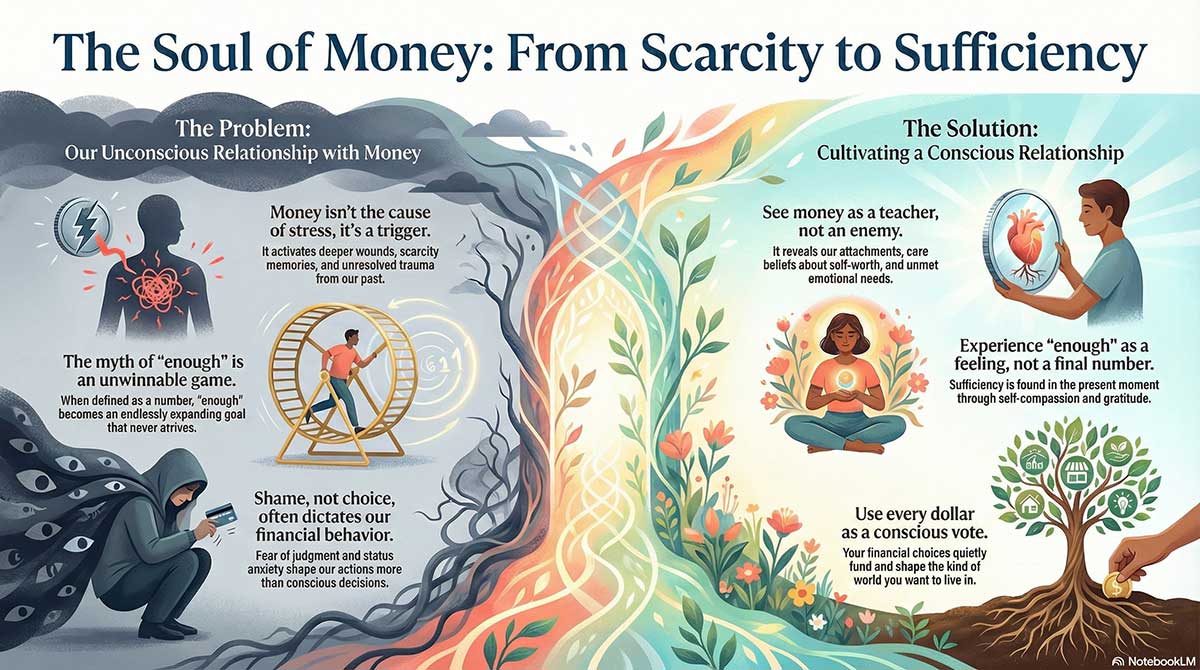
When we heal our relationship with money, we heal something much larger than our bank accounts.
We loosen the grip of scarcity that keeps us anxious and divided. We soften the shame that silences honest conversation. We discover that enough is not a finish line but a lived experience. And we remember that every financial choice, however small, participates in shaping the world we are leaving behind.
Money will always move. It will come and go. What matters is whether we meet it with fear or with integrity.
The Soul of Money is not about becoming perfect or pure. It is about becoming conscious—again and again. When we do, money becomes what it was always meant to be: a tool for dignity, service, and love.
May these conversations support you in choosing not just how you use money—but who you choose to be while you use it.
Short Bios:
Lynne Twist is a global activist, author, and founder of the Soul of Money Institute. She spent decades raising hundreds of millions of dollars for social justice, environmental protection, and Indigenous rights, and is best known for The Soul of Money.
Parker Palmer is a writer, educator, and founder of the Center for Courage & Renewal, known for his work on integrity, vocation, and living an undivided life in a fragmented world.
Eckhart Tolle is a spiritual teacher and bestselling author of The Power of Now, widely recognized for his teachings on presence, consciousness, and freedom from psychological suffering.
Esther Perel is a psychotherapist and author known for her work on intimacy, relationships, and how power, shame, and silence shape human behavior.
Richard Rohr is a Franciscan friar, theologian, and founder of the Center for Action and Contemplation, respected for bridging spirituality, psychology, and social responsibility.
Gabor Maté is a physician and author whose work explores trauma, addiction, and how stress and early experiences shape both physical and emotional health.
Brené Brown is a researcher and author known for her groundbreaking work on vulnerability, shame, courage, and human connection.
Daniel Kahneman was a Nobel Prize–winning psychologist whose research on decision-making, cognitive bias, and judgment transformed economics and behavioral science.
Byron Katie is a spiritual teacher and author of Loving What Is, known for developing “The Work,” a method of questioning stressful thoughts.
Joseph Goldstein is a co-founder of the Insight Meditation Society and a leading voice in bringing Buddhist mindfulness practices to the modern West.
Tim Jackson is an economist and author of Prosperity Without Growth, focusing on sustainability, well-being, and redefining success beyond endless economic expansion.
Kristin Neff is a psychologist and leading researcher on self-compassion, exploring how kindness toward oneself supports resilience and emotional health.
Herman Daly was an ecological economist known for developing steady-state economics and challenging growth-based economic models.
Thich Nhat Hanh was a Zen master, poet, and peace activist whose teachings emphasized mindfulness, compassion, and living simply in the present moment.
Alain de Botton is a philosopher and author who examines modern anxiety, status, and how cultural expectations shape emotional life.
Robert Sapolsky is a neuroscientist and author whose work explores stress, behavior, biology, and the limits of free will.
bell hooks was a cultural critic and author whose work examined love, class, race, gender, and the systems that shape power and identity.
James Hollis is a Jungian analyst and author who writes on midlife, meaning, and the unconscious forces that shape human identity.
Jack Kornfield is a meditation teacher and author who blends Buddhist wisdom with Western psychology and everyday life.
Ken Wilber is a philosopher and founder of Integral Theory, known for mapping human development across psychology, culture, and spirituality.
Sister Joan Chittister is a Benedictine nun, author, and social critic focused on justice, ethics, and contemplative action.
Kate Raworth is an economist and author of Doughnut Economics, reimagining economic systems that support both human well-being and planetary boundaries.
Naomi Klein is a journalist and author known for her critiques of corporate power, climate injustice, and economic inequality.
Muhammad Yunus is a Nobel Peace Prize laureate and founder of microfinance, pioneering social business as a tool for poverty reduction.
Amartya Sen is a Nobel Prize–winning economist whose work emphasizes human capability, freedom, and dignity as the true measures of development.
Vandana Shiva is an environmental activist and scholar advocating for ecological balance, biodiversity, and Indigenous knowledge systems.
Leave a Reply