

What if the Fire Horse Year 2026 was speaking directly to you?
Introduction — Nick Sasaki
Every new year arrives with promises.
New habits.
New goals.
New versions of ourselves.
But some years don’t ask us to add anything. They ask us to confront what’s already in motion.
As 2026 approaches, many people sense a strange mixture of anticipation and unease. Not fear exactly—more like the awareness that something long postponed is no longer willing to wait. Decisions feel closer. Patterns feel louder. Even silence feels charged.
This series isn’t about predicting events or offering instructions. It’s about listening to a deeper rhythm beneath the calendar—the kind of rhythm that moves through identity, courage, action, and release.
The Fire Horse has always symbolized momentum, independence, and truth that prefers motion over comfort. Rather than treating that symbolism as abstract astrology, I wanted to explore what it feels like inside real human lives.
So I invited thinkers who don’t agree with each other, who approach change from psychology, philosophy, astrology, and lived experience. Together, they explore questions many of us are already asking quietly:
Why does staying still suddenly feel harder than moving?
Why does clarity seem to follow action instead of precede it?
Why does freedom, at this stage of life, feel less like expansion and more like letting go?
What follows isn’t a roadmap. It’s a conversation meant to meet you at the edge of a new year—not to push you forward, but to help you recognize where you already are.
(Note: This is an imaginary conversation, a creative exploration of an idea, and not a real speech or event.)
Topic 1 — Why Does 2026 Refuse to Let Us Stay the Same?

Moderator: Nick Sasaki
Introduction — Nick Sasaki
There are years that pass quietly, and then there are years that won’t let you pass unnoticed.
As we approach 2026, many people are sensing something difficult to name. It’s not panic exactly. It’s more like restlessness mixed with inevitability. Plans that once felt stable now feel provisional. Identities that used to fit feel tight around the edges. Even those who prefer calm are feeling a subtle internal pressure, as if life itself is asking for movement.
The Fire Horse year has a reputation for intensity, but I want to begin more gently than that. Instead of asking what 2026 will do to us, I want to ask something more unsettling.
Is this year actually bringing disruption into our lives — or is it simply refusing to let us avoid what has already been waiting?
With that, let me open our first inquiry.
First Question
Is the Fire Horse year actually creating change, or simply exposing what has been avoided for too long?
Raymond Lo
From a Chinese astrology perspective, the Horse itself does not create events. It creates movement. When combined with the Fire element, that movement becomes accelerated and uncompromising. What people experience as “sudden change” is often the result of long-standing imbalance finally losing its ability to stay hidden.
In Fire Horse years, avoidance becomes energetically expensive. Systems, relationships, and identities that relied on delay begin to destabilize, not because something new attacks them, but because the energy supporting stagnation runs out.
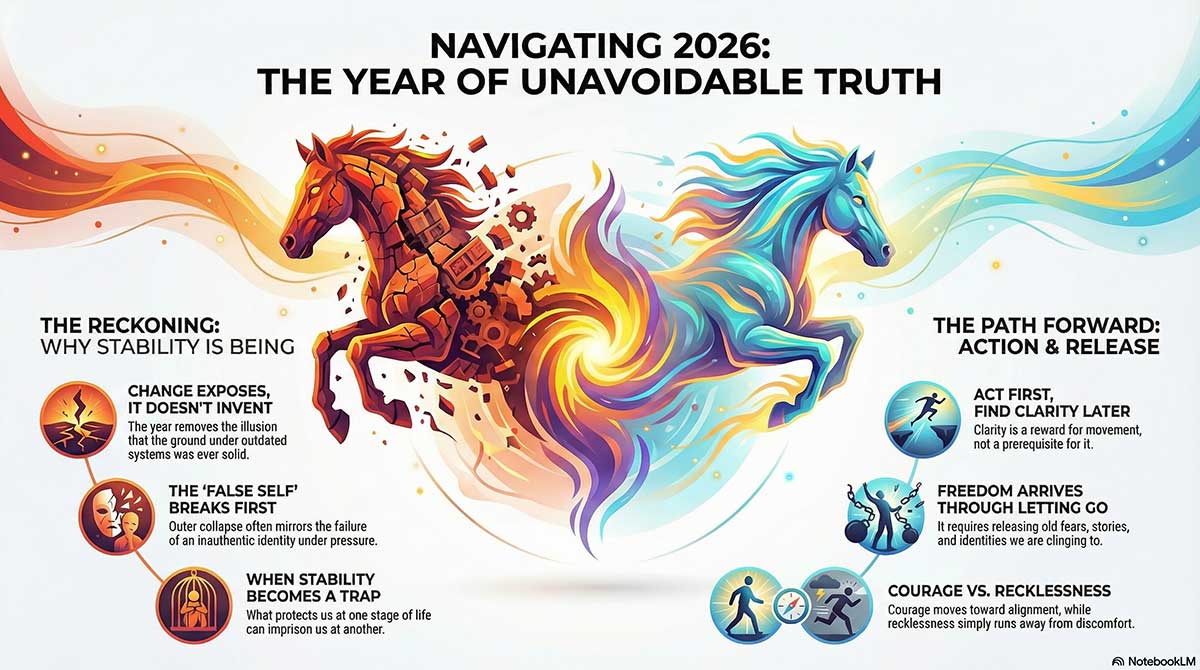
So I would say the year exposes rather than invents. The Fire Horse does not push people off the cliff — it removes the illusion that the ground was ever solid.
Chani Nicholas
I see this as a values reckoning. Many of us have been living versions of our lives that made sense in a different emotional economy — one where safety was prioritized over truth, and continuity over alignment.
The Fire Horse doesn’t tolerate misalignment quietly. It doesn’t punish people for being wrong; it confronts people with the cost of being out of integrity with themselves. What feels like chaos is often the moment when our internal values finally demand to be lived, not just acknowledged.
So yes, it exposes. And what it exposes is not failure — it’s postponed honesty.
Richard Tarnas
Historically, periods associated with accelerated archetypal fire coincide with moments when collective narratives lose credibility. What people call instability is frequently a loss of faith in outdated stories — about progress, success, or identity.
In that sense, the Fire Horse year doesn’t disrupt reality; it disrupts the explanations we’ve been using to justify it. When those explanations collapse, people experience anxiety, but also a strange clarity.
Exposure is the correct word. The archetypal field intensifies until contradiction can no longer be ignored.
Susan Miller
From a Western astrological lens, fire-dominant periods don’t wait for emotional readiness. They demand engagement. Many people will feel like life is speeding up, but what’s really happening is that the margin for denial shrinks.
I’ve noticed that during these cycles, people often say, “I didn’t plan this,” but when you look closely, the desire was there for years. The Fire Horse simply removes the buffering.
So no, the year isn’t cruel. It’s honest.
Joey Yap
In Chinese metaphysics, resistance during a Horse year tends to backfire. The more one tries to preserve appearances, the more pressure builds internally.
Exposure is not punishment. It’s a recalibration. Destiny doesn’t suddenly change — timing does. And timing determines whether something feels voluntary or forced.
Second Question
Why do periods of acceleration often feel like crisis rather than initiation?
Richard Tarnas
Initiations require the death of a former identity, and modern culture lacks rituals that frame this as meaningful. Without symbolic containers, initiation feels like loss instead of transformation.
Acceleration destabilizes our sense of continuity. When continuity breaks, the psyche interprets it as danger, even if growth is occurring. Crisis language fills the gap where mythic language once lived.
Susan Miller
People associate speed with loss of control. In astrology, accelerated transits don’t remove choice — they reduce procrastination. That’s deeply uncomfortable for cultures trained to equate readiness with safety.
An initiation asks, “Who are you now?” A crisis asks, “What’s wrong?” The difference is framing, not outcome.
Caroline—
(Nick gently gestures)
Nick Sasaki
Let’s stay with the panel we’ve introduced here — I want to hear how each of you sees that emotional experience.
Chani Nicholas
Acceleration exposes attachment. When life moves slowly, we can negotiate with ourselves. When it speeds up, we have to respond honestly.
Initiation requires consent, but consent is scary when we don’t know who we’ll be on the other side. So the nervous system calls it crisis, even when the soul recognizes it as a threshold.
Raymond Lo
In classical Chinese thought, rapid change is neutral. Human discomfort arises from the expectation that stability is the natural state. It is not.
Initiation feels dangerous because it removes predictability. But stagnation is far more dangerous in the long arc.
Joey Yap
Crisis appears when timing is ignored too long. Initiation appears when timing is recognized early. The difference is not fate — it’s responsiveness.
Third Question
How do we tell the difference between necessary disruption and unnecessary chaos?
Nick Sasaki
This feels like the most personal question of all.
Raymond Lo
Necessary disruption restores balance. Chaos scatters energy without direction. The key difference is whether action leads toward coherence, even if uncomfortable.
Susan Miller
If movement leads to clarity — even painful clarity — it’s necessary. If it leads to confusion without insight, it’s likely avoidance masquerading as freedom.
Chani Nicholas
Necessary disruption expands self-respect. Chaos often feels performative, reactive, or driven by fear of being left behind.
The body knows the difference long before the mind admits it.
Richard Tarnas
Archetypally, necessary disruption aligns personal action with collective evolution. Chaos isolates. Initiation connects.
Joey Yap
If the disruption reduces inner conflict over time, it is necessary. If it multiplies it, something is being resisted or misunderstood.
Closing Reflection — Nick Sasaki
Listening to this, one thing stands out to me.
2026 doesn’t feel like a year that asks us to become someone new. It feels like a year that refuses to let us keep pretending we’re someone we’re not.
The Fire Horse doesn’t arrive to destroy stability. It arrives to test whether stability was real or simply familiar.
And perhaps the most unsettling truth of all is this:
what feels like pressure from the outside may be life asking us — quietly but firmly — to stop postponing ourselves.
Topic 2 — What Breaks First: The World or the False Self?

Moderator: James Hillman
Introduction — James Hillman
When people speak of collapse, they usually point outward.
They speak of institutions failing, systems cracking, values eroding. But depth psychology has always suggested something more troubling — that outer breakdowns often mirror inner ones. The psyche does not wait politely. It breaks symbols when they can no longer carry truth.
So today I want to approach this question without blame and without reassurance.
When we experience rupture, are we witnessing the world falling apart — or are we finally seeing the structures of the false self fail under pressure?
Let us begin there.
First Question
When structures collapse, how much of that collapse is internal rather than external?
Caroline Myss
Most people underestimate how much energy it takes to maintain a false identity. We think collapse happens because something external attacks us, but in reality, the body and psyche eventually refuse to subsidize a life built on misalignment.
When the external structure falls — a role, a belief, a relationship — what’s often collapsing is the energetic scaffolding that kept the false self intact. The symptoms show up outside, but the exhaustion began inside long ago.
From that perspective, collapse is not punishment. It is conservation.
James Hillman
In depth psychology, we say the soul sabotages what the ego refuses to release. This is not pathology; it is intelligence.
External collapse frequently arrives when the soul has been ignored for too long. The false self depends on consensus, productivity, and approval. The soul depends on meaning. When meaning is starved, the soul destabilizes the ego’s architecture.
So yes — much of what we call “world collapse” is the psyche demanding representation.
Liz Greene
Astrologically, collapse often coincides with periods where unconscious material can no longer remain unconscious. Shadow content presses upward, not to destroy, but to be acknowledged.
When people say, “Everything is falling apart,” what they often mean is, “The version of myself that functioned by avoidance no longer works.”
The external mirrors the internal almost perfectly — but we are trained to see only one side.
Mark Jones
From an evolutionary astrology standpoint, collapse signals a karmic completion. Something has finished its developmental arc.
The false self isn’t evil — it was once adaptive. But when it outlives its purpose, the psyche initiates endings. These endings feel abrupt only because the ego resists closure.
The world doesn’t break randomly. It breaks where growth has stalled.
Eckhart Tolle
The false self — the egoic identity — cannot survive prolonged presence. When awareness deepens, the ego experiences this as threat.
Collapse, then, is not destruction but exposure. What is unreal cannot remain intact under conscious observation. When identification loosens, structures dissolve naturally.
The world appears to break because perception changes.
Second Question
Is the “false self” something to be destroyed — or something to be understood and outgrown?
James Hillman
The language of destruction is misleading. The false self is not an enemy; it is a strategy that has lost relevance.
In mythology, the monster is rarely killed without first being understood. The false self holds history — fears, adaptations, wounds. To destroy it prematurely is to lose the wisdom it carries.
Outgrowing requires dialogue, not violence.
Caroline Myss
People often try to “kill” the false self through spiritual bypassing. That only creates a more sophisticated mask.
The work is discernment. Which parts of the identity are protective, and which are performative? Which serve survival, and which drain vitality?
Understanding creates release. Force creates fragmentation.
Liz Greene
Psychologically, repression creates pathology. Integration creates transformation.
The false self dissolves when it no longer needs to defend. That happens through insight, not attack. When shadow material is welcomed into awareness, it loses its compulsive power.
The ego does not die. It reorganizes.
Mark Jones
From a karmic view, the false self represents unfinished lessons. You don’t graduate by burning your textbooks — you graduate by mastering the material.
Outgrowing the false self means completing its curriculum.
Eckhart Tolle
When identification ends, the false self simply falls away. There is no battle.
Awareness does not destroy; it reveals. What remains is what is real.
Third Question
Why does the psyche often require crisis before truth can surface?
Caroline Myss
Because comfort protects illusion.
As long as life works “well enough,” people postpone honesty. Crisis removes the luxury of delay. It strips away distraction and demands alignment.
Truth surfaces when survival strategies fail.
Liz Greene
The psyche speaks softly first. Dreams, intuitions, discomfort. When ignored, it speaks louder.
Crisis is not the first language — it is the last.
James Hillman
Truth is not interested in convenience. It is interested in depth.
Crisis cracks the shell of literalism. It forces symbolic thinking back into consciousness. Without rupture, soul remains unheard.
Mark Jones
Evolution requires friction. Crisis generates the heat necessary for transformation.
Without pressure, potential remains dormant.
Eckhart Tolle
Crisis interrupts identification. In that interruption, presence appears.
Truth does not need crisis — but the ego does.
Closing Reflection — James Hillman
We fear collapse because we confuse structure with meaning.
What breaks in times like these is not the world itself, but the arrangements we mistook for truth. The false self does not shatter because it is weak — it shatters because it has completed its task.
If there is grace in crisis, it is this:
that something more essential finally gains a voice.
And when that voice is heard, what collapses no longer feels like loss —
but like release.
Topic 3 — When Stability Becomes a Trap, What Does Courage Look Like?

Moderator: Joseph Campbell
Introduction — Joseph Campbell
In every hero’s journey, there is a moment rarely celebrated.
It is not the leap.
It is not the victory.
It is the quiet realization that the familiar world has become too small.
Most people do not resist change because they lack courage. They resist it because what they are leaving behind once saved them. Stability, after all, is not a villain. It is often a reward for endurance.
But mythology teaches us something unsettling:
what protects us at one stage of life can imprison us at another.
So today I want to ask not about recklessness, but about discernment.
When stability becomes a trap, what does real courage actually look like?
First Question
At what point does responsibility turn into self-betrayal?
Brené Brown
Self-betrayal usually doesn’t announce itself dramatically. It shows up quietly, through small acts of silence.
We tell ourselves we’re being responsible — to our families, our jobs, our roles — but over time, that responsibility becomes a way to avoid vulnerability. Courage isn’t about abandoning responsibility; it’s about refusing to disappear inside it.
When responsibility consistently requires you to deny your values, your voice, or your emotional truth, it has crossed the line into self-betrayal.
Joseph Campbell
In myth, this moment is known as the Refusal of the Call. The hero clings to duty, obligation, or fear, mistaking them for virtue.
But the call does not disappear. It returns — often as depression, resentment, or a sense of meaninglessness. Responsibility becomes betrayal when it prevents the next stage of becoming.
Richard Tarnas
Culturally, many societies reward endurance more than authenticity. This creates generations of people who are praised for surviving lives that no longer fit them.
Astrologically and archetypally, these moments arise when identity structures outlive their relevance. Responsibility then becomes maintenance of an obsolete form.
Self-betrayal is not failure. It is delay.
Chani Nicholas
I often see people confuse loyalty with self-erasure.
They say, “I can’t leave — people depend on me,” without asking whether those people are depending on a version of them that no longer exists. Responsibility becomes betrayal when it is no longer reciprocal with self-respect.
Courage begins when we renegotiate those contracts — internally first.
Marie Forleo
In modern life, stability is often marketed as success. So people stay in situations that look good but feel wrong.
Self-betrayal shows up as chronic numbness. You’re functioning, but you’re not alive. Responsibility becomes a trap when it costs you your vitality.
Second Question
Why do people mistake endurance for virtue and fear for loyalty?
Joseph Campbell
Because endurance looks noble from the outside.
Myths remind us that staying too long is as dangerous as leaving too early. Fear dresses itself as loyalty when the unknown feels more threatening than the familiar pain.
The dragon guarding the threshold is rarely evil — it is familiar.
Brené Brown
Fear loves moral language. It says, “You’re a good person if you stay,” or “Leaving means you failed.”
Endurance becomes virtue when vulnerability is misunderstood as weakness. People would rather suffer visibly than risk being misunderstood.
Chani Nicholas
There’s a collective trauma around abandonment — of being abandoned or of being seen as the one who leaves. That fear keeps people tethered to identities that no longer align.
Fear becomes loyalty when we confuse consistency with integrity.
Richard Tarnas
Historically, eras of rapid change produce guilt around departure. People feel disloyal to the past.
But evolution requires rupture. Endurance is not always wisdom; sometimes it is inertia sanctified by tradition.
Marie Forleo
Fear says, “At least this pain is predictable.”
Endurance gets praised because it looks disciplined. Courage, by contrast, looks messy in the beginning. So people stay where they are applauded rather than risk becoming awkward beginners again.
Third Question
What separates reckless change from authentic courage?
Joseph Campbell
Authentic courage is oriented toward meaning, not escape.
Reckless change runs away from discomfort. Courage moves toward a deeper alignment, even when fear remains present.
The hero does not flee the village out of anger — he leaves because the horizon calls.
Brené Brown
Recklessness avoids accountability. Courage embraces it.
Authentic courage includes boundaries, grief, and responsibility for impact. Recklessness demands applause; courage accepts misunderstanding.
Richard Tarnas
Archetypally, authentic courage aligns personal risk with collective necessity. Recklessness isolates the individual; courage connects them to something larger than ego.
Chani Nicholas
If the change expands your capacity for honesty, compassion, and self-respect, it’s courage. If it contracts you into defensiveness or superiority, it’s likely escape.
The body often knows before the mind does.
Marie Forleo
Reckless change burns bridges impulsively. Courage builds new ones slowly.
Authentic courage is sustainable. It doesn’t require destroying your life to prove you’re brave.
Closing Reflection — Joseph Campbell
The tragedy of many lives is not that they lacked courage, but that they spent it in the wrong place.
Stability is not the enemy. But when it demands the sacrifice of your becoming, it must be questioned.
The hero’s journey does not ask us to abandon responsibility — it asks us to expand it. To include responsibility to the soul, to meaning, to the life that wants to be lived next.
And courage, in its truest form, is not loud.
It is the quiet decision to stop living a life that no longer calls your name.
Topic 4 — Why Does Action Now Matter More Than Certainty?

Moderator: Naval Ravikant
Introduction — Naval Ravikant
Most people believe clarity precedes action.
But in my experience, the opposite is usually true. Clarity is a reward for movement, not a prerequisite for it. Waiting for certainty often feels responsible, even intelligent — yet it quietly becomes a sophisticated form of delay.
In periods like 2026, when momentum accelerates, the cost of waiting increases. Not because the world is cruel, but because opportunity has timing.
So I want to explore something uncomfortable today.
Why does action, taken without full certainty, suddenly matter more than perfect understanding?
First Question
Has the modern obsession with certainty quietly become a form of paralysis?
Jiddu Krishnamurti
The demand for certainty is the demand for psychological security.
When the mind seeks certainty, it is not seeking truth — it is seeking continuity of the known. This pursuit becomes paralysis because truth is alive, and what is alive cannot be fixed.
Action born from certainty is repetition. Action born from observation is intelligence. When you wait for certainty, you wait for the past to approve the present.
Joe Dispenza
From a neurological standpoint, waiting for certainty keeps people trapped in familiar neural loops.
The brain looks for evidence based on past experience, but transformation requires stepping into the unknown before proof appears. If you wait to feel certain, you reinforce the same identity.
Action disrupts the pattern. Certainty follows the rewiring, not the other way around.
Tony Robbins
People confuse certainty with safety.
In reality, certainty is emotional comfort, not strategic advantage. Momentum changes your emotional state, and state determines perception. Once you move, you see options you couldn’t see while standing still.
Paralysis often isn’t about lack of information — it’s about fear of feeling discomfort.
Sally Kirkman
Astrologically, there are moments when waiting actually closes doors.
Timing windows don’t last forever. Certainty culture teaches people to delay, but cycles reward responsiveness. When you miss the window, no amount of clarity can bring it back.
Paralysis happens when people mistake infinite preparation for wisdom.
Naval Ravikant
In leverage-driven systems, waiting is expensive.
Information is abundant; judgment is rare. Most people don’t need more certainty — they need fewer distractions. Action clarifies priorities by eliminating noise.
Second Question
Why does action so often create clarity rather than follow it?
Joe Dispenza
Because action introduces new feedback.
When you act, you expose yourself to new emotional states, new data, new experiences. The nervous system updates itself through experience, not imagination.
Clarity is the nervous system saying, “Now I understand what this feels like.”
Jiddu Krishnamurti
Clarity comes from attention, not conclusion.
When you act with awareness, you observe the consequences directly. That observation is clarity. Thought cannot simulate truth — it can only speculate.
Tony Robbins
Motion changes meaning.
You don’t think your way into a new life; you behave your way into one. Once behavior shifts, beliefs follow. Action collapses mental complexity into usable insight.
Sally Kirkman
Astrology shows that movement aligns us with time.
When you act at the right moment, resistance decreases. Clarity appears because you are cooperating with timing instead of fighting it.
Naval Ravikant
Action is a filter.
It separates what matters from what doesn’t. Most confusion is excess possibility. Action removes options and forces learning.
Third Question
What do we lose — personally and collectively — when we wait too long to move?
Jiddu Krishnamurti
We lose sensitivity.
Delay dulls perception. When fear dominates decision-making, the mind becomes rigid. Life moves, but we do not.
This rigidity is the true loss.
Joe Dispenza
Biologically, delay reinforces stress patterns.
People become addicted to familiar discomfort. Over time, the body memorizes hesitation. The cost is vitality.
Tony Robbins
You lose momentum — and momentum is destiny.
Missed action compounds quietly. Regret is rarely about failure; it’s about inaction.
Sally Kirkman
Cycles do not wait.
When timing passes, effort increases. What could have been graceful becomes forced. That’s the collective cost of hesitation.
Naval Ravikant
Opportunity cost is invisible but devastating.
In fast-moving environments, the biggest risk is standing still. Those who move imperfectly often outperform those who wait perfectly.
Closing Reflection — Naval Ravikant
Certainty feels responsible, but it is often a luxury of slower times.
In years like 2026, action is not recklessness — it is alignment with reality. The world rewards those who can learn in motion.
You don’t need confidence to begin. You need direction — and direction often appears only after the first step.
Clarity is not the starting point.
It’s the consequence.
Topic 5 — If Freedom Is the Lesson of 2026, What Must We Release?

Moderator: Thich Nhat Hanh
Introduction — Thich Nhat Hanh
Freedom is often imagined as gaining something.
More choice.
More space.
More power.
But in practice, freedom arrives through letting go.
We suffer not because life is too demanding, but because we carry too much — old fears, old identities, old stories about who we must be. The Fire Horse year brings heat, not to burn us, but to show us what we are still holding tightly.
So today, I would like us to look gently at this question.
If freedom is the lesson of 2026, what must we release?
First Question
What do we cling to that no longer protects us, but still feels “safe”?
Esther Perel
We cling to familiar narratives — even painful ones — because they give us a sense of predictability.
People stay attached to roles, relationships, and identities that once offered safety, even after they stop nourishing them. The pain becomes known, and the unknown feels threatening.
What feels safe is often simply what we’ve rehearsed the longest.
Gabor Maté
From a trauma perspective, safety is often confused with familiarity.
Many attachments are not about love or truth, but about regulation of the nervous system. We cling to what keeps anxiety at bay, even if it limits us.
The body learns safety early — sometimes inaccurately — and keeps repeating that lesson until awareness intervenes.
Alain de Botton
Modern society romanticizes attachment while rarely teaching emotional literacy.
We cling to identities that grant us social coherence — the good parent, the successful professional, the dependable one — even when these roles silence parts of us. Safety becomes performance.
Letting go threatens not just comfort, but social legibility.
Dandapani
People cling to unconscious habits of attention.
Where attention goes, energy flows. Many habits feel safe because they are automatic. Releasing them requires discipline — not force, but training.
Safety without awareness becomes stagnation.
Thich Nhat Hanh
We cling to ideas of permanence.
We forget that safety does not come from holding tightly, but from trusting impermanence. When we understand that nothing is meant to be held forever, the fear softens.
Second Question
Can freedom exist without discipline, or does it require conscious release?
Dandapani
Freedom without discipline is chaos.
True freedom comes from directing attention deliberately. Without training the mind, release becomes impulsive rather than liberating.
Discipline is not restriction — it is the structure that makes freedom sustainable.
Esther Perel
Relational freedom also requires discipline.
Honesty without care becomes cruelty. Independence without responsibility becomes abandonment. Conscious release asks us to stay engaged even as we let go of control.
Gabor Maté
Freedom requires nervous system regulation.
Without awareness of trauma responses, people mistake release for escape. Conscious release means staying present with discomfort instead of numbing it.
That presence is a form of discipline.
Alain de Botton
We underestimate how much effort emotional maturity requires.
Freedom demands learning how to tolerate ambiguity, loneliness, and uncertainty without panicking. That tolerance is trained, not automatic.
Thich Nhat Hanh
Mindfulness is discipline infused with kindness.
We practice letting go each day — of anger, of certainty, of urgency. Freedom grows through daily acts of awareness.
Third Question
How do we let go without turning detachment into indifference?
Esther Perel
Detachment becomes indifference when it avoids intimacy.
Healthy release maintains care without possession. You can love deeply without gripping tightly. Indifference appears when boundaries replace connection.
Gabor Maté
Indifference is often dissociation.
Letting go does not mean shutting down feeling. It means allowing feeling without being controlled by it. Compassion must remain active.
Alain de Botton
True detachment increases responsibility.
When you let go of illusions, you become more available for reality — for people as they are, not as you wish them to be. Indifference avoids that responsibility.
Dandapani
Awareness prevents indifference.
When attention is present, detachment becomes clarity. Without awareness, detachment becomes avoidance.
Thich Nhat Hanh
Letting go is an act of love.
When we release attachment, we create space — for ourselves and for others to breathe. Indifference closes the heart. True release opens it.
Closing Reflection — Thich Nhat Hanh
Freedom does not ask us to abandon our lives.
It asks us to stop carrying what no longer belongs to the present moment.
In a year of fire and movement, release is not loss. It is relief. When we put down what we have been gripping out of fear, our hands become free to receive what is real.
Perhaps the deepest freedom of 2026 is not becoming someone new, but finally allowing ourselves to live without the weight of what we no longer need.
Final Thoughts by Nick Sasaki
If there’s one thing that became clear as these conversations unfolded, it’s this:
2026 isn’t asking us to become fearless.
It’s asking us to become honest.
Honest about what no longer fits.
Honest about where we’re hesitating out of habit, not wisdom.
Honest about what we’re carrying simply because we always have.
Across these five topics, different voices spoke in different languages—myth, psychology, consciousness, timing—but they kept circling the same truth: momentum doesn’t begin when certainty arrives. It begins when resistance loosens.
The Fire Horse doesn’t demand dramatic change. It responds to alignment. Sometimes that alignment looks like action. Sometimes it looks like release. Often, it looks like doing less—but doing it with clarity.
If this series has done its job, it hasn’t given you answers. It has sharpened your questions. And maybe helped you notice that the pressure you feel isn’t coming from the future—it’s coming from a part of you that’s ready to move, or finally ready to rest.
As the year turns, you don’t need to run toward anything.
Just pay attention to what no longer needs to be held.
That, in itself, is a beginning.
Short Bios:
Nick Sasaki
Founder of ImaginaryTalks, Nick Sasaki curates deep, cross-disciplinary conversations that explore meaning, consciousness, and human transformation through dialogue rather than doctrine.
Raymond Lo
A leading authority in Chinese astrology and Feng Shui, Raymond Lo is known for translating traditional zodiac cycles into practical insight for modern life and leadership.
Susan Miller
One of the world’s most widely read astrologers, Susan Miller specializes in planetary cycles and how timing influences personal and collective decision-making.
Richard Tarnas
Cultural historian and archetypal astrologer, Richard Tarnas explores how cosmic cycles mirror shifts in history, identity, and human consciousness.
Chani Nicholas
Astrologer and writer focused on values-based living, Chani Nicholas connects astrology with social awareness, identity, and emotional integrity.
Joey Yap
An expert in Chinese metaphysics, Joey Yap teaches how destiny, timing, and choice interact within traditional Eastern systems of wisdom.
James Hillman
Founder of archetypal psychology, James Hillman reframed psychology through myth, imagination, and the soul’s need for meaning rather than mere adjustment.
Caroline Myss
A pioneer in energy medicine and archetypal psychology, Caroline Myss examines how belief systems shape health, identity, and personal power.
Liz Greene
Renowned psychological astrologer, Liz Greene integrates Jungian psychology with astrology to illuminate shadow, projection, and inner development.
Mark Jones
An evolutionary astrologer, Mark Jones focuses on karmic patterns, soul growth, and the completion of unfinished psychological cycles.
Eckhart Tolle
Spiritual teacher and author, Eckhart Tolle emphasizes presence and awareness as the doorway beyond ego-based identity.
Joseph Campbell
Mythologist and scholar, Joseph Campbell articulated the Hero’s Journey as a universal pattern of transformation across cultures and eras.
Brené Brown
Researcher and author, Brené Brown studies vulnerability, courage, and the emotional skills required for authentic living.
Marie Forleo
Entrepreneur and teacher, Marie Forleo helps people redefine success by aligning purpose, creativity, and practical action.
Naval Ravikant
Entrepreneur and philosopher, Naval Ravikant is known for his insights on leverage, decision-making, and long-term thinking.
Joe Dispenza
Neuroscientist and author, Joe Dispenza explores how intentional thought and action can rewire the brain and reshape identity.
Tony Robbins
Performance strategist and author, Tony Robbins focuses on momentum, emotional mastery, and decisive action as drivers of change.
Sally Kirkman
Astrologer and writer, Sally Kirkman specializes in planetary timing and how astrological cycles shape opportunity and choice.
Jiddu Krishnamurti
Philosopher and teacher, Jiddu Krishnamurti challenged authority, belief systems, and the human pursuit of psychological certainty.
Thich Nhat Hanh
Zen monk and peace activist, Thich Nhat Hanh taught mindfulness, compassion, and conscious release as foundations for inner freedom.
Esther Perel
Psychotherapist and author, Esther Perel examines relationships, desire, and the balance between connection and autonomy.
Gabor Maté
Physician and writer, Gabor Maté focuses on trauma, attachment, and the link between emotional truth and well-being.
Alain de Botton
Philosopher and writer, Alain de Botton brings emotional intelligence and philosophical reflection into everyday modern life.
Dandapani
Teacher of Hindu philosophy, Dandapani emphasizes disciplined use of attention as the key to clarity, purpose, and freedom.
Leave a Reply