

What if Malcolm Gladwell sat down with the people who understand tipping points better than anyone else?
What if Malcolm Gladwell didn’t just revisit The Tipping Point, but convened the thinkers who helped shape it, challenge it, and warn us about where it has gone wrong?
Imagine him in a quiet room—not giving a talk, not defending a thesis—but listening. Across from him sit Everett Rogers, whose work on diffusion quietly inspired the original idea. Nearby are Shoshana Zuboff and Tristan Harris, describing how influence became infrastructure. Jonathan Haidt and Steven Pinker wrestle with whether human nature is failing—or whether our systems are simply misfiring. Hannah Arendt and Václav Havel hover as moral echoes, reminding everyone that speed without conscience has consequences.
This is not a debate about whether tipping points exist. That question was settled long ago.
This is a conversation about responsibility.
About what happens when societies learn how to trigger rapid change—and then pretend they didn’t mean to.
In this imagined gathering, Gladwell does not arrive as an authority delivering answers. He arrives as a thinker returning to his own idea, now older, wiser, and more troubled by how easily elegant theories can be turned into instruments of power.
What follows is not optimism or despair, but something rarer: clarity.
(Note: This is an imaginary conversation, a creative exploration of an idea, and not a real speech or event.)
Topic 1 — When Do Small Things Become Dangerous?

Setting: A quiet, neutral room. No stage. No audience. Five chairs in a loose circle. Malcolm sits slightly apart—not above them, but listening with intent.
Malcolm Gladwell (opening)
When I first wrote The Tipping Point, I was fascinated by how little it took to make something spread. A rumor. A habit. A behavior. I thought of that moment as almost magical. But years later, watching the world change faster—and sometimes darker—than I expected, I began to wonder whether there’s a line we don’t notice crossing. A moment when influence stops being helpful and starts becoming something else entirely.
So let me begin here—not with optimism or fear—but with curiosity.
At what point does a small intervention stop being benign and start becoming dangerous?
Everett Rogers
From the very beginning, diffusion was never neutral. Even in my early work, I saw that the spread of an idea depends on who controls the channels and why they are motivated to use them. The danger begins when diffusion is no longer organic—when the intent shifts from helping people adopt something useful to steering behavior without consent. That threshold is subtle, because the mechanism looks the same. Only the purpose has changed.
Cass Sunstein
I’d put it slightly differently. Influence becomes dangerous when people no longer retain a meaningful ability to opt out. Nudges are meant to preserve freedom while improving outcomes, but once the architecture of choice becomes opaque—or emotionally coercive—we’re no longer nudging. We’re shaping behavior in ways people cannot see or resist. The size of the intervention doesn’t matter as much as the invisibility of it.
Zeynep Tufekci
I think the danger emerges when systems amplify without accountability. A single post, a small group, or a minor tweak in an algorithm can suddenly move millions of people—not because the idea is good or true, but because the system rewards speed and outrage. When influence detaches from responsibility, tipping points don’t just happen; they run away.
Nate Silver
From a probabilistic perspective, danger shows up when variance explodes. Small inputs normally produce small effects. But in tightly coupled systems—social media, financial markets, political movements—the distribution becomes fat-tailed. Rare events dominate outcomes. When that happens, prediction fails, and confidence becomes dangerous. People think they’re nudging when they’re actually rolling dice with society.
Angela Duckworth
I see the danger most clearly at the human level. When small signals repeatedly tell people, “This is normal now,” behavior adapts quickly. People don’t experience manipulation as force—they experience it as social reality. Over time, what once felt wrong starts to feel expected. That’s when influence reshapes character, not just choices.
There is a pause. Malcolm leans forward, not pressing—but redirecting.
Malcolm Gladwell
What I’m hearing is that danger doesn’t come from size, but from structure. So let me ask this differently.
Is there a moment when influence crosses from persuasion into manipulation—or is that line only visible after the damage is done?
Cass Sunstein
The line exists, but we’re bad at noticing it in real time. Persuasion respects agency; manipulation bypasses it. The tragedy is that manipulation often feels like persuasion while it’s happening. The test, I think, is reversibility. If people can easily change their minds once the influence is removed, persuasion was at work. If they can’t, something deeper has been altered.
Everett Rogers
I agree, and I’d add that manipulation often hides behind success. When an idea spreads quickly, we praise its effectiveness without asking whether adopters truly benefited. Diffusion research taught me that adoption rates can mask harm. Just because something spreads doesn’t mean it serves the adopter’s interest—or society’s.
Zeynep Tufekci
We also need to stop pretending that scale doesn’t change ethics. What feels acceptable in a small group becomes dangerous at scale. A rumor among friends is gossip; the same rumor amplified to millions is destabilization. Platforms pretend they’re neutral, but neutrality disappears once amplification becomes automatic.
Nate Silver
There’s also hindsight bias. After a tipping point, everyone claims the outcome was obvious. But before it happens, uncertainty is enormous. That’s why manipulation is so tempting—because the people engineering it convince themselves they’re just increasing the odds, not flipping the system. They underestimate tail risk.
Angela Duckworth
And the people on the receiving end don’t experience a single moment of crossing the line. It’s gradual. The environment changes, norms shift, and suddenly resisting feels lonely or exhausting. Manipulation works best when it never announces itself.
Malcolm nods slowly, then sits back.
Malcolm Gladwell
That leads to the question that unsettles me the most.
If these thresholds are hard to see, who is actually responsible for stopping a dangerous tipping point—individuals, institutions, or the system designers themselves?
Zeynep Tufekci
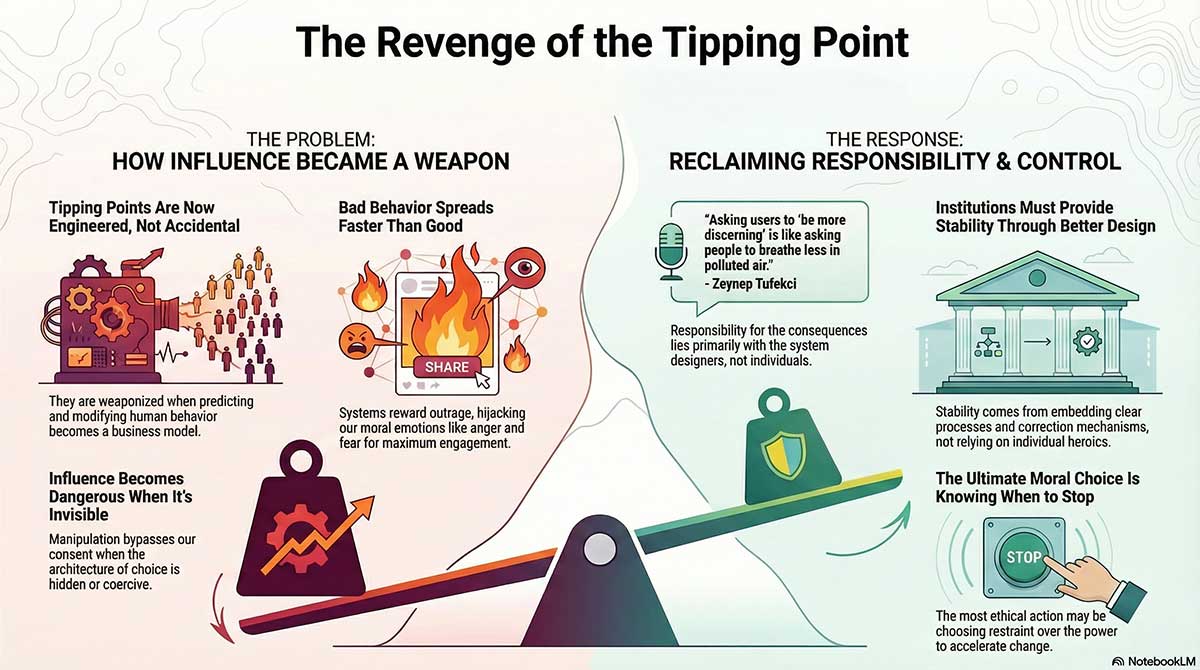
System designers, without question. Individuals can’t fight architectures built to exploit attention and emotion. Asking users to “be more discerning” is like asking people to breathe less in polluted air. Responsibility scales upward.
Cass Sunstein
Institutions share that burden. Governments, schools, platforms—they all design environments. Freedom doesn’t mean absence of structure. It means good structure. If we refuse to design guardrails, we’re still designing outcomes—just badly.
Everett Rogers
I would say responsibility also lies with those who study influence. Researchers, consultants, strategists—we must acknowledge that knowledge of diffusion confers power. Pretending otherwise is irresponsible. Insight creates obligation.
Nate Silver
I’m more cautious. Centralized responsibility can backfire. Systems fail when decision-makers become overconfident in their models. I’d argue for distributed responsibility, paired with humility—constant monitoring, feedback, and correction.
Angela Duckworth
Ultimately, though, responsibility shows up in culture. Systems follow values. If a society rewards speed over care, virality over truth, then dangerous tipping points will keep happening. The deepest intervention is moral, not technical.
The room grows quiet. Malcolm looks around the circle, then speaks—not as the author of an idea, but as someone revisiting it.
Malcolm Gladwell (closing)
Listening to all of you, I realize that what I once celebrated—the elegance of small causes producing big effects—now feels morally unfinished. Tipping points are not just moments of change. They’re moments of exposure. They reveal who designed the system, what the system rewards, and how quickly humans adapt to whatever becomes normal.
Perhaps the real danger isn’t that small things can change the world.
It’s that we learned how to do it—and forgot to ask whether we should.
Topic 2 — The Revenge: How Tipping Points Were Weaponized

Setting: The same quiet room, but the tone has shifted. Less curiosity now. More reckoning. Malcolm waits a moment longer before speaking.
Malcolm Gladwell (opening)
When I look back, I realize something uncomfortable. The mechanics I once described were treated as neutral. Even benevolent. But mechanisms don’t stay innocent once people learn how they work.
At some point, someone always asks a different question—not why does this spread? but how do I make it spread faster?
So let’s go there.
When did tipping points stop being accidental—and start being engineered?
Shoshana Zuboff
They were engineered the moment human behavior became a raw material. Once prediction and modification of behavior turned into a business model, tipping points were no longer emergent phenomena. They became targets. Surveillance capitalism doesn’t wait for thresholds—it manufactures them. What looks like spontaneous mass behavior is often the result of silent, continuous conditioning.
Tristan Harris
I’d say the turning point came when engagement became the metric that mattered more than human well-being. Engineers didn’t sit around plotting social collapse, but they optimized relentlessly. Once you optimize for attention, outrage wins. Fear wins. Extremes win. Weaponization doesn’t always begin with malice—it often begins with indifference.
Yuval Noah Harari
Historically, power always belonged to those who controlled stories. What’s new is speed and scale. Myths once took generations to spread. Now they take hours. When algorithms amplify narratives without regard for truth, they don’t just spread ideas—they rewrite shared reality. That’s when tipping points become tools of domination.
Jaron Lanier
I’ve watched this from the inside. Platforms discovered that behavior modification works best when it’s invisible. You don’t need to convince people of anything. You just need to slightly reward certain actions and punish others. Over time, culture bends. That’s weaponization—not with guns, but with feedback loops.
Tim Wu
Every attention industry eventually crosses this line. Newspapers did it. Radio did it. Television did it. But digital platforms perfected it. When attention becomes the commodity, the goal is no longer informing the public—it’s triggering them. Tipping points are simply the moments when extraction becomes visible.
Malcolm nods, letting the weight settle.
Malcolm Gladwell
What troubles me is that none of this required a conspiracy. No secret meeting. No single villain.
So let me ask the harder question.
Who actually benefits when tipping points are weaponized—and who pays the price?
Tim Wu
The beneficiaries are always concentrated. Platforms, political operatives, extremist groups, advertisers. The costs, however, are distributed. Social trust erodes. Institutions weaken. Citizens become cynical. It’s a classic asymmetry—private profit, public damage.
Shoshana Zuboff
Exactly. Behavioral surplus flows upward, while social consequences flow outward. Democracy, mental health, childhood development—these absorb the costs. The people shaping the system remain insulated from its effects. That separation makes reform difficult.
Tristan Harris
What’s striking is how few people truly benefit. Even users who “win” the attention game often feel emptier, angrier, more anxious. The system consumes everyone eventually. Weaponization doesn’t create victors—it creates acceleration.
Yuval Noah Harari
From a historical perspective, this resembles earlier moments when new technologies disrupted meaning—printing presses, mass literacy, nationalism. The difference is that today, identity itself becomes programmable. When meaning fragments, people cling to simple stories. Those stories empower some, but destabilize many.
Jaron Lanier
And the price is paid in dignity. When humans are treated as nodes to be nudged rather than individuals to be respected, society loses something intangible but essential. Weaponized tipping points hollow out the self.
The room grows tense. Malcolm leans forward again.
Malcolm Gladwell
There’s something implicit here that I want to make explicit.
If tipping points can be engineered, does that mean neutrality is no longer possible? Or was neutrality always an illusion?
Tristan Harris
Neutrality was always a story we told ourselves. Design choices encode values. Defaults matter. Ranking systems matter. Pretending otherwise only protects those with power.
Tim Wu
I agree. There’s no neutral attention market. The question isn’t whether influence exists—it’s who governs it and to what end. Every medium shapes behavior. The danger arises when shaping happens without accountability.
Shoshana Zuboff
Neutrality collapses the moment surveillance becomes foundational. Observation creates power. Power demands responsibility. When responsibility is denied, harm becomes systemic.
Yuval Noah Harari
Philosophically, neutrality disappears when information determines survival—political, economic, even biological. In such conditions, control over narratives becomes existential. Claiming neutrality then becomes a moral failure.
Jaron Lanier
The illusion of neutrality also comforts creators. It allows engineers to say, “I just built the tool.” But tools reshape societies. Refusing to acknowledge that is itself a form of participation.
Malcolm sits back, absorbing the collective answer.
Malcolm Gladwell (closing)
Listening to this, I realize something unsettling.
The revenge of the tipping point isn’t that small things have big effects. It’s that we learned how to trigger those effects—and kept pretending we hadn’t.
Weaponization doesn’t announce itself. It arrives disguised as optimization, efficiency, growth. By the time society notices the shift, the threshold has already been crossed.
Perhaps the most dangerous tipping point of all is the moment when we stop asking who benefits—and start assuming no one is responsible.
Topic 3 — Why Bad Behavior Spreads Faster Than Good

Setting: The room feels quieter now, more inward. The earlier discussion about systems and power has given way to something more personal—almost uncomfortable. Malcolm speaks more slowly.
Malcolm Gladwell (opening)
There’s a pattern I can’t ignore anymore. Disorder spreads faster than order. Cruelty travels quicker than kindness. A single act of bad behavior seems to outweigh dozens of good ones.
We often explain this by blaming people—human nature, moral weakness, tribal instincts. But I’m no longer convinced that explanation goes deep enough.
So let me begin here.
Why does bad behavior seem to tip so much more easily than good behavior?
Jonathan Haidt
Because bad behavior hijacks our moral emotions. Anger, disgust, and fear evolved to protect us from threats. They mobilize attention instantly. Good behavior often requires trust, patience, and shared norms—things that take time to build. The moral foundations system is asymmetrical. Threat signals get priority.
Steven Pinker
I’d caution against assuming this is a permanent condition. Historically, violence and cruelty have declined over the long term. What we’re seeing now is a visibility problem. Media environments amplify rare but emotionally charged events. That makes regression feel dominant even when progress continues underneath.
Robert Cialdini
Both of those points are true, but there’s a crucial mechanism at work: social proof. People look to others to decide what’s normal. Unfortunately, negative behavior sends a clearer signal. One broken window communicates disorder more loudly than ten intact ones communicate order. Bad behavior is more legible.
Esther Perel
I’d add that bad behavior spreads faster because it ruptures trust. Trust is slow. It’s built through repetition and safety. But betrayal, humiliation, or cruelty collapse trust instantly. In relationships—and in societies—once trust erodes, people move into self-protection mode. That accelerates disconnection.
Malcolm Gladwell (as participant)
What unsettles me is how little it takes. In my earlier work, I emphasized the power of positive contagion. But the same mechanics apply more brutally in reverse. Once a norm cracks, people don’t wait to see if it will heal. They adjust immediately—often defensively.
Malcolm pauses, then continues, shifting the focus.
Malcolm Gladwell
If bad behavior spreads because it’s emotionally efficient, that raises a harder question.
Are people becoming worse—or are systems rewarding the wrong signals?
Steven Pinker
I firmly believe it’s systems. Human psychology hasn’t changed dramatically in decades. What’s changed is the incentive structure. Platforms reward outrage because it drives engagement. That doesn’t mean people want to be cruel—it means cruelty is being subsidized.
Jonathan Haidt
I agree, with one caveat. Systems don’t just amplify behavior—they reshape identity. When people are repeatedly rewarded for moral outrage, they start to see it as virtue. Over time, this polarizes communities and creates moral monocultures. The system trains people in how to feel righteous.
Robert Cialdini
Exactly. Norms follow incentives. If institutions fail to clearly signal that good behavior is expected and enforced, people infer that bad behavior is acceptable. Silence from authority figures is itself a form of social proof.
Esther Perel
And when people feel unseen or unsafe, they externalize pain. Bad behavior often begins as unprocessed hurt. Systems that ignore emotional reality inadvertently cultivate resentment. That resentment spreads relationally, not ideologically.
Malcolm Gladwell (participant)
This makes me rethink something fundamental. We often praise resilience and grit, but maybe what societies need more is reassurance—clear signals that cooperation still matters and will be protected.
The conversation grows more reflective. Malcolm asks the final question, almost reluctantly.
Malcolm Gladwell
If bad behavior tips more easily, does that mean goodness is fragile? Or does it simply require different kinds of protection?
Esther Perel
Goodness isn’t fragile—but it is relational. It survives when people feel held by something larger than themselves. Communities that invest in repair, not punishment alone, keep goodness alive even after rupture.
Robert Cialdini
Good behavior needs visibility. Institutions must make norms explicit and enforce them consistently. When people see cooperation rewarded and cruelty corrected, behavior shifts quickly—in a positive direction.
Jonathan Haidt
I’d say goodness requires moral diversity. Societies that allow only one moral narrative become brittle. Tolerance for disagreement actually strengthens norms by preventing polarization.
Steven Pinker
And perspective matters. If we convince ourselves that decline is inevitable, we stop reinforcing progress. Optimism isn’t denial—it’s a strategic choice. Belief in improvement sustains the systems that make improvement possible.
Malcolm Gladwell (participant)
What I’m realizing is that goodness doesn’t spread by accident anymore. It needs scaffolding. Without structure, bad behavior fills the vacuum—not because people are evil, but because uncertainty is unbearable.
Malcolm looks around the circle, then speaks softly.
Malcolm Gladwell (closing)
Perhaps the most misleading assumption we’ve made is that goodness is the default and cruelty the exception. In reality, behavior follows signals. When systems reward outrage, outrage spreads. When norms go unenforced, disorder feels rational.
The real question isn’t why bad behavior spreads faster.
It’s why we’ve stopped protecting the conditions that allow good behavior to survive.
Topic 4 — Can Institutions Reclaim the Tipping Point?

Setting: The room feels steadier now. The urgency of collapse has given way to a quieter, more difficult question—whether anything built by humans can still hold human behavior in place. Malcolm speaks with measured resolve.
Malcolm Gladwell (opening)
We’ve talked about thresholds, weaponization, and contagion. All of it points toward one uncomfortable truth: systems shape behavior far more than we like to admit.
But that leads to a necessary question—one that feels almost unfashionable right now.
Can institutions still stabilize society? Or have we passed the point where formal structures can meaningfully guide behavior?
Atul Gawande
Institutions absolutely can stabilize behavior—but only when they focus on process, not heroics. In medicine, aviation, even surgery, we learned that outcomes improve when systems reduce reliance on individual virtue. Checklists work not because people are bad, but because they’re human. The same principle applies socially. Stability comes from humility embedded into design.
Anne-Marie Slaughter
I agree, but I’d widen the lens. Many institutions are failing because they were designed for a slower, more hierarchical world. Power has moved sideways—into networks—while governance remains vertical. Until institutions learn to operate across boundaries and collaborate rather than command, they’ll continue to lag behind tipping dynamics.
Michael Sandel
There’s also a moral vacuum. Institutions once carried ethical weight—they told us not just what works, but what is right. Today, many institutions outsource moral judgment to markets or metrics. When efficiency replaces ethics, stability erodes. People withdraw loyalty from systems that feel procedurally correct but morally empty.
Ray Dalio
From a systems perspective, breakdowns follow patterns. When gaps widen—economic, informational, cultural—trust declines. Institutions lose legitimacy, not because they disappear, but because they stop adapting. Renewal is possible, but it requires acknowledging cycles rather than denying them. Every stable system reinvents itself or collapses.
Elinor Ostrom (through her work)
My research showed that centralized control isn’t the only answer. Communities can govern themselves successfully when rules are clear, enforcement is fair, and participants feel ownership. Stability emerges from participation, not authority alone. Institutions succeed when they empower people rather than override them.
Malcolm lets the ideas settle before continuing.
Malcolm Gladwell
What strikes me is that you’re all describing structure—but not rigidity.
So let me ask this.
What do effective institutions do differently when facing volatile tipping points?
Anne-Marie Slaughter
They move faster—but not blindly. Effective institutions listen continuously. They treat feedback as intelligence, not criticism. Most failures today come from institutions that mistake control for competence.
Atul Gawande
They also normalize correction. In healthcare, the most dangerous environments are the ones where errors can’t be discussed. Institutions that reclaim tipping points create cultures where small problems are addressed early—before they cascade.
Ray Dalio
Transparency matters enormously. When people understand how decisions are made and why, trust stabilizes even during stress. Hidden processes breed suspicion. Open systems absorb shocks better.
Michael Sandel
And they articulate purpose. Rules without meaning feel arbitrary. When institutions reconnect policies to shared values—fairness, dignity, responsibility—compliance becomes voluntary rather than coerced.
Elinor Ostrom (work)
They match rules to local realities. One-size-fits-all governance fails because it ignores context. Successful institutions adapt principles to place. That flexibility is what prevents tipping points from becoming collapses.
Malcolm nods, then asks the final question—less theoretical now, more urgent.
Malcolm Gladwell
If institutions can still reclaim tipping points, why does it feel as though so many are retreating instead?
What’s stopping renewal?
Michael Sandel
Fear of moral judgment. Leaders avoid value-based decisions because they’re controversial. But neutrality isn’t safer—it’s corrosive. Avoiding moral language leaves a vacuum that extremists gladly fill.
Ray Dalio
Incentives. Short-term rewards discourage long-term repair. Systems optimize for quarterly results, not generational stability. Until incentives change, behavior won’t.
Anne-Marie Slaughter
Fragmentation. Institutions operate in silos while problems cross borders—digital, cultural, economic. Coordination failure looks like incompetence, but it’s often structural isolation.
Atul Gawande
Ego. Institutions resist admitting failure. But repair requires confession. Without it, small cracks widen into structural breaks.
Elinor Ostrom (work)
And disengagement. When people feel institutions don’t belong to them, they stop protecting them. Participation isn’t optional—it’s foundational.
Malcolm sits quietly for a moment before offering his closing thought.
Malcolm Gladwell (closing)
What I’m hearing is not that institutions are obsolete—but that they’ve forgotten their original purpose.
Institutions exist to absorb human weakness, not deny it. To stabilize behavior when emotions run hot. To intervene early, before thresholds are crossed.
Perhaps reclaiming the tipping point doesn’t require new tools or grand reforms.
It requires remembering that stability is not passive—it is designed, defended, and renewed.
Topic 5 — The Moral Line: Should We Ever Trigger a Tipping Point on Purpose?

Setting: The room is still. Not heavy—resolved. This feels less like analysis and more like judgment. Malcolm doesn’t rush. He lets the silence do some of the work.
Malcolm Gladwell (opening)
Everything we’ve discussed leads here.
We’ve acknowledged that tipping points can be engineered.
That they’ve been weaponized.
That institutions can, in theory, reclaim them.
So the final question isn’t technical. It’s moral.
If we can deliberately trigger a tipping point—if we know how to move societies quickly—should we ever do it?
Hannah Arendt (legacy voice)
Power reveals itself most clearly at moments of acceleration. When change happens slowly, responsibility diffuses. When change happens suddenly, responsibility concentrates. The danger is not action itself, but the belief that necessity absolves judgment. History shows that moral shortcuts taken in moments of urgency often become permanent justifications for harm.
Václav Havel (legacy voice)
I lived under systems that justified coercion as historical necessity. They always claimed the future demanded it. But truth does not require force to prevail. When power accelerates change faster than conscience can follow, something human is lost. The question is not whether a tipping point works, but whether it leaves room for responsibility afterward.
David Brooks
I’m torn here. Some moral awakenings only happen after rupture. Civil rights did not advance politely. But the difference lies in intention. Are we trying to awaken conscience—or bypass it? Tipping points guided by humility look very different from tipping points driven by certainty.
Rebecca Solnit
I’d argue that many tipping points aren’t imposed—they’re invited. Hope spreads not because it’s forced, but because people recognize themselves in it. The danger comes when elites believe they can engineer moral clarity from above. Real transformation still depends on consent, even when it’s messy.
Isaiah Berlin (legacy voice)
This is where pluralism matters. No single vision of the good is sufficient to justify overwhelming others. When tipping points erase alternatives too quickly, they violate negative liberty—the freedom from being coerced by someone else’s certainty. Moral urgency must never eliminate moral doubt.
Malcolm listens carefully, then shifts the question.
Malcolm Gladwell
What I’m hearing is caution—but not paralysis.
So let me ask this differently.
What distinguishes a justified tipping point from a dangerous one?
David Brooks
A justified tipping point enlarges moral agency. A dangerous one replaces it. If people emerge more capable of judgment afterward, the change was constructive. If they emerge dependent, fearful, or silenced, something went wrong.
Rebecca Solnit
Also, who bears the risk matters. When those triggering change are insulated from its consequences, morality collapses. Ethical tipping points distribute risk downward only when participants willingly accept it.
Hannah Arendt (legacy voice)
I would say accountability over time is the test. A justified action remains defensible years later, not just in the heat of crisis. Dangerous tipping points rely on emergency language that never expires.
Václav Havel (legacy voice)
Truth must precede speed. When speed comes first, truth becomes expendable. That is always the beginning of decay.
Isaiah Berlin (legacy voice)
And restraint. The refusal to use every available tool is itself a moral act. Power that limits itself preserves freedom.
The air feels thinner now. Malcolm asks the final question, quietly.
Malcolm Gladwell
Then here is the last thing I want to ask—perhaps the hardest.
In a world already primed for sudden shifts, what is our responsibility not to do?
Rebecca Solnit
Not to confuse urgency with virtue. Not every crisis demands acceleration. Some demand care, patience, and listening.
David Brooks
Not to moralize our own certainty. When we believe we are unquestionably right, we stop seeing people as people.
Isaiah Berlin (legacy voice)
Not to collapse plurality into unity. Human dignity depends on the coexistence of conflicting values.
Hannah Arendt (legacy voice)
Not to surrender judgment to systems, trends, or inevitability. Responsibility cannot be automated.
Václav Havel (legacy voice)
And not to abandon conscience in the name of progress. History remembers that failure most clearly.
Malcolm sits back. He doesn’t look satisfied—only honest.
Malcolm Gladwell (closing)
When I first became fascinated with tipping points, I was drawn to their elegance—the idea that the world could change through small, precise actions.
What I understand now is that the real power of a tipping point isn’t technical.
It’s moral.
To move a society quickly is easy.
To move it wisely is rare.
And to know when not to move it at all—that may be the hardest responsibility we face.
Perhaps the most ethical tipping point is the one we choose not to trigger.
Final Thoughts by Malcolm Gladwell
For a long time, I believed the most interesting thing about tipping points was their efficiency—the way small actions could produce dramatic results. It felt hopeful. Almost democratic. Anyone, in theory, could change the world.
What I understand now is that efficiency without ethics is incomplete.
Listening to these voices—some of whom shaped my thinking, others who have challenged it—I’m struck by how little has changed about human nature, and how much has changed about the systems surrounding it. We did not become more volatile overnight. We became more amplified. More exposed to feedback loops that reward speed, outrage, and certainty.
Tipping points are not good or bad. They are mirrors. They reveal what a society has been quietly preparing for.
If our institutions weaken, disorder spreads.
If our incentives reward cruelty, cruelty becomes normal.
If our systems abdicate responsibility, someone else will gladly assume it.
The question, then, is not whether we can trigger change quickly. We can.
The question is whether we can slow down long enough to decide which changes deserve to happen at all.
Perhaps the real lesson is this:
The most powerful tipping point is not the moment a system flips—but the moment a society chooses restraint over acceleration, wisdom over certainty, and responsibility over convenience.
That choice rarely goes viral.
But it may be the only one that lasts.
Short Bios:
Malcolm Gladwell
Journalist, author, and staff writer at The New Yorker, known for exploring how small forces create large social change through books like The Tipping Point, Outliers, and Talking to Strangers.
Everett Rogers
Sociologist and communication scholar who developed the foundational theory of Diffusion of Innovations, shaping how researchers understand the spread of ideas, behaviors, and technologies.
Cass Sunstein
Legal scholar and co-author of Nudge, specializing in behavioral economics, choice architecture, and how policy design subtly influences human decision-making.
Zeynep Tufekci
Sociologist and writer focused on social movements, digital platforms, and networked power, examining how technology amplifies protest, polarization, and collective action.
Nate Silver
Statistician and founder of FiveThirtyEight, known for applying probability and data modeling to politics, sports, and social forecasting.
Angela Duckworth
Psychologist and author of Grit, researching motivation, self-control, and how character traits shape long-term success under pressure.
Shoshana Zuboff
Harvard scholar and author of The Age of Surveillance Capitalism, analyzing how digital systems extract behavioral data to predict and shape human behavior.
Tristan Harris
Former Google design ethicist and co-founder of the Center for Humane Technology, advocating for ethical design in attention-driven digital platforms.
Yuval Noah Harari
Historian and author of Sapiens and Homo Deus, exploring how stories, power, and technology shape human civilization and collective belief.
Jaron Lanier
Computer scientist, pioneer of virtual reality, and cultural critic who examines how social media business models distort human behavior and identity.
Tim Wu
Legal scholar and author of The Attention Merchants, known for analyzing how industries compete for and monetize human attention.
Jonathan Haidt
Social psychologist and author of The Righteous Mind, researching moral emotions, political polarization, and the psychological roots of division.
Steven Pinker
Cognitive scientist and author of The Better Angels of Our Nature, arguing that long-term trends show declines in violence despite short-term turbulence.
Robert Cialdini
Psychologist and author of Influence, known for identifying core principles of persuasion, social proof, and behavioral compliance.
Esther Perel
Psychotherapist and author specializing in relationships, trust, intimacy, and how emotional dynamics shape personal and collective behavior.
Atul Gawande
Physician, writer, and public health leader focused on systems design, institutional improvement, and reducing human error through structural solutions.
Anne-Marie Slaughter
Political scientist and former policy leader, specializing in global governance, networked power, and institutional reform in a connected world.
Michael Sandel
Political philosopher and author of What Money Can’t Buy, examining the moral limits of markets and the ethical foundations of public life.
Ray Dalio
Investor and founder of Bridgewater Associates, known for systems-level thinking about economic cycles, institutional breakdowns, and long-term stability.
Elinor Ostrom
Nobel Prize–winning political economist whose research demonstrated how communities successfully govern shared resources without centralized control.
Hannah Arendt
Political philosopher known for her analysis of power, responsibility, and the moral dangers of unexamined systems, including the concept of the “banality of evil.”
Václav Havel
Playwright, dissident, and former president of Czechoslovakia, known for moral leadership grounded in truth, conscience, and civic responsibility.
David Brooks
Columnist and author focused on culture, character, and moral repair, exploring how societies rebuild trust and shared meaning.
Rebecca Solnit
Writer and activist whose work examines hope, social change, and how grassroots movements emerge without centralized control.
Isaiah Berlin
Political philosopher best known for his defense of pluralism and the distinction between negative and positive liberty, warning against moral absolutism.
Leave a Reply