
|
Getting your Trinity Audio player ready...
|
Introduction by Tyrion Lannister
They used to say the world was shaped by swords, crowns, and the men and women bold enough to reach for them. I believed that too, once — or at least I pretended to, because believing it gave meaning to all the blood spilled in its name.
But after death, after watching one’s life laid bare without excuses or applause, something becomes painfully clear: the loudest moments were rarely the most important ones. Battles fade quickly. Victories even faster. What lingers are the quiet choices — the words we never said, the people we failed to protect, the love we misunderstood until it was already gone.
This is not a gathering of rulers or heroes. No one here comes to defend themselves. We have already seen the truth of who we were. What remains is something simpler and far more difficult: to sit together without fear, without titles, and without the need to be right.
If you are listening, do not ask who deserved what. Ask instead what it cost us all to believe that power was the answer.
(Note: This is an imaginary conversation, a creative exploration of an idea, and not a real speech or event.)
Topic 1 — The Moment I Lost You
After life review, in a quiet place beyond memory
The place where they meet has no walls.
No banners.
No sound of wind or war.
It feels like the pause between breaths.
They recognize one another instantly — not by faces, but by what they once carried.
Catelyn Stark stands first, hands folded as if she is still waiting for someone to return.
Robb is beside her, no crown, no blood on his clothes — only the boy he once was.
Eddard Stark watches them both, his expression calm, heavy with understanding rather than regret.
Jon Snow lingers slightly apart, uncertain even here.
Theon Greyjoy stands last, unsure whether he is allowed to remain.
For a long moment, no one speaks.
Then Catelyn breaks the silence.
She says she thought death would quiet the ache — that after seeing her whole life laid bare, she believed grief would finally loosen its grip. But even now, she feels the instant it happened: the room, the betrayal, the sound of Robb’s breath stopping. She admits that losing her children did not feel like fate — it felt like failure. And she wonders aloud which part of herself died first: the mother, or the woman who still believed the world was fair.
Robb listens without interrupting. When he speaks, his voice is steady but younger than it ever sounded in life. He says the moment he lost her was not at the Red Wedding — it was earlier, when he realized his choices were no longer his own. He tells her he carried the weight of being a symbol, not a son, and that when death came, his final sorrow was not fear, but knowing he would never again be held as just her child. He asks quietly whether love can become a kind of pressure, even when it is pure.
Eddard steps forward then, not as a lord, but as a father who has already watched this moment many times during his life review. He says the moment he lost them all was when he chose truth knowing it would cost him his family. He does not regret telling the truth — but he admits, for the first time, that he underestimated the pain it would cause those he loved. He asks whether honor should have bent, just once, for the sake of staying longer.
Jon speaks next, hesitantly. He says he lived most of his life believing loss was something to endure in silence. He tells them the moment he lost each of them came at different times — and that with every loss, he learned how to survive, but not how to stay. He wonders whether choosing duty again and again slowly erased his ability to hold on. He asks if love that is never chosen freely can still be called love.
All eyes turn to Theon.
He does not speak at first.
When he finally does, he says the moment he lost them was the moment he wanted to belong more than he wanted to be good. He admits that even after life review, shame still burns — not because of punishment, but because he understands now how deeply he wanted to be loved, and how poorly he went about asking for it. He asks them — not for forgiveness — but whether being seen now is enough.
The silence that follows is not empty.
Catelyn steps toward him.
Not as judgment.
Not as absolution.
Just recognition.
She says loss is not a ledger.
Robb nods.
Eddard lowers his gaze.
Jon breathes out, as if for the first time.
In this place beyond life, they begin to understand that the moment they lost one another was not the end — but the moment love stopped having a voice.
And now, finally, it does.
Topic 2 — What I Never Said While Alive
Where silence finally loosens its grip
This place feels closer than the last.
Not closer in distance —
closer in breath.
Sansa Stark stands with her hands folded, composed in a way she learned the hard way.
Arya leans against nothing, alert even here.
Jaime Lannister’s armor is gone, and without it he looks younger, almost uncertain.
Brienne of Tarth stands straight, as if duty still requires posture.
Sandor Clegane sits apart, arms crossed, eyes lowered — but he has not left.
Sansa is the first to speak.
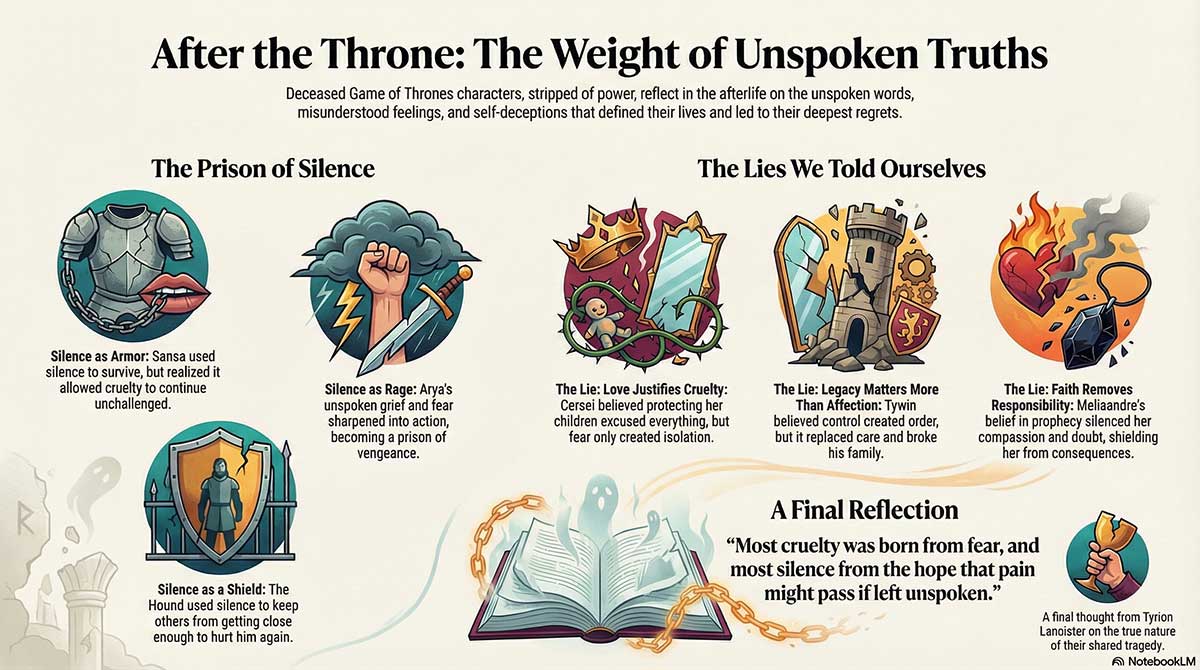
She says there were many words she never said, but most of them were spoken inward, over and over, until they became rules. She says she learned early that silence could be armor — that speaking truth too soon invited punishment. She admits she protected herself by becoming agreeable, then clever, then unreadable. Only now does she see how often her quiet allowed cruelty to continue. She wonders aloud whether survival justified the cost — and who might have been spared if she had spoken sooner.
Arya shifts at that. She says her silence was different. Hers came from rage that felt safer when sharpened into action. She never said goodbye properly, never said “I’m afraid,” never said “I miss you.” She lists names instead. She admits that by the time she realized words could have changed something, she no longer knew how to use them without a blade attached. She asks whether silence chosen as protection can become a prison.
Jaime exhales slowly, as if something tight has finally loosened. He says the words he never said were not heroic — they were simple. He never explained why he killed the king. He never said he wanted to be more than what people named him. He never told Brienne how deeply her faith unsettled him — not because he didn’t value it, but because he feared he could not live up to it. He wonders if withholding truth can be as selfish as lying.
Brienne listens, hands still at her sides. When she speaks, it is careful, almost reverent. She says she believed words were less important than actions — that if she lived correctly, nothing would need to be explained. She admits now that her silence cost her connection. She never said when she was hurt. Never said when she hoped. Never said when loyalty became love. She asks whether dignity sometimes hides fear rather than courage.
Sandor snorts softly, but there is no bite in it. He says everyone thinks silence means strength. For him, it meant no one could get close enough to burn him again. He never said he cared. Never said he was afraid. Never said he wanted gentleness without being mocked for it. He says the cruelest thing he ever learned was that unspoken kindness still hurts when it’s lost. He asks, quietly, if it’s possible to be forgiven for the words you never gave someone the chance to hear.
No one answers right away.
Then Sansa turns slightly toward him — not to confront, not to console — just to be present.
Arya’s shoulders soften.
Jaime lowers his eyes.
Brienne breathes out, steady and slow.
In this place, they begin to understand that silence once kept them alive — but it also kept them alone.
And now, with nothing left to protect, the words they carried for so long finally find their way into the open.
Not loudly.
Not all at once.
But honestly.
Topic 3 — The Love I Misunderstood
When devotion slowly became something else
This place feels warmer.
Not bright —
but forgiving.
Daenerys Targaryen stands at the center, no crown, no fire, no followers calling her name.
Jorah Mormont stands a short distance away, hands relaxed for the first time in his life.
Missandei is beside him, calm and luminous, her presence gentle rather than fragile.
Jon Snow watches quietly, as if still learning how to stand without choosing a side.
Ygritte leans against an unseen current of air, smiling faintly, as though the past no longer aches the way it once did.
Daenerys speaks first.
She says love always felt like something she had to earn. Not through softness, but through survival. She learned early that tenderness invited harm, so she mistook intensity for loyalty and obedience for devotion. She admits that somewhere along the way, love became proof — proof that her destiny was real, that her suffering meant something. Only after life review did she understand how often she asked others to carry her certainty when she herself was afraid. She wonders when love stopped being shared and became something she demanded.
Jorah lowers his head slightly before answering. He says he believed loving her meant standing behind her no matter the cost. That his loyalty was a way to redeem his failures, to become honorable by proximity. He admits he rarely asked whether his devotion helped her — or simply protected his need to belong. He wonders now if love that asks for nothing can still quietly take too much.
Missandei speaks next, her voice steady and clear. She says she loved Daenerys not as a symbol, but as a person trying to survive unbearable weight. Yet even she admits there were moments when love required silence — moments when speaking might have changed the path, but loyalty felt safer. She asks whether love that avoids conflict can unintentionally feed destruction.
Jon shifts, troubled. He says he grew up believing love was something to be sacrificed for duty. That choosing love felt like betrayal — of vows, of purpose, of identity. When he finally allowed himself to love freely, it terrified him. He admits he did not know how to love without holding something back. He wonders whether love misunderstood as obligation slowly teaches the heart to disappear.
Ygritte laughs softly — not unkindly. She says love was never complicated to her until it was measured. She loved Jon for who he was when he forgot rules and names. But she saw how easily love could be replaced by duty once fear returned. She asks whether love can survive when one person believes it must be earned through suffering.
The space between them grows quiet.
Daenerys looks at Jon — not with longing, not with accusation — but with clarity. She says now she sees how often she called love what was really certainty. How dangerous it was to believe that being right was the same as being good. She says understanding came too late — but perhaps not without purpose.
Missandei steps closer, not to comfort, but to witness.
Jorah breathes out, lighter than he ever did in life.
Ygritte’s smile fades into something gentler.
Jon lowers his head, not in shame, but in recognition.
Here, beyond life, love is no longer something to prove.
It is simply something to understand.
Topic 4 — The Lie I Told Myself
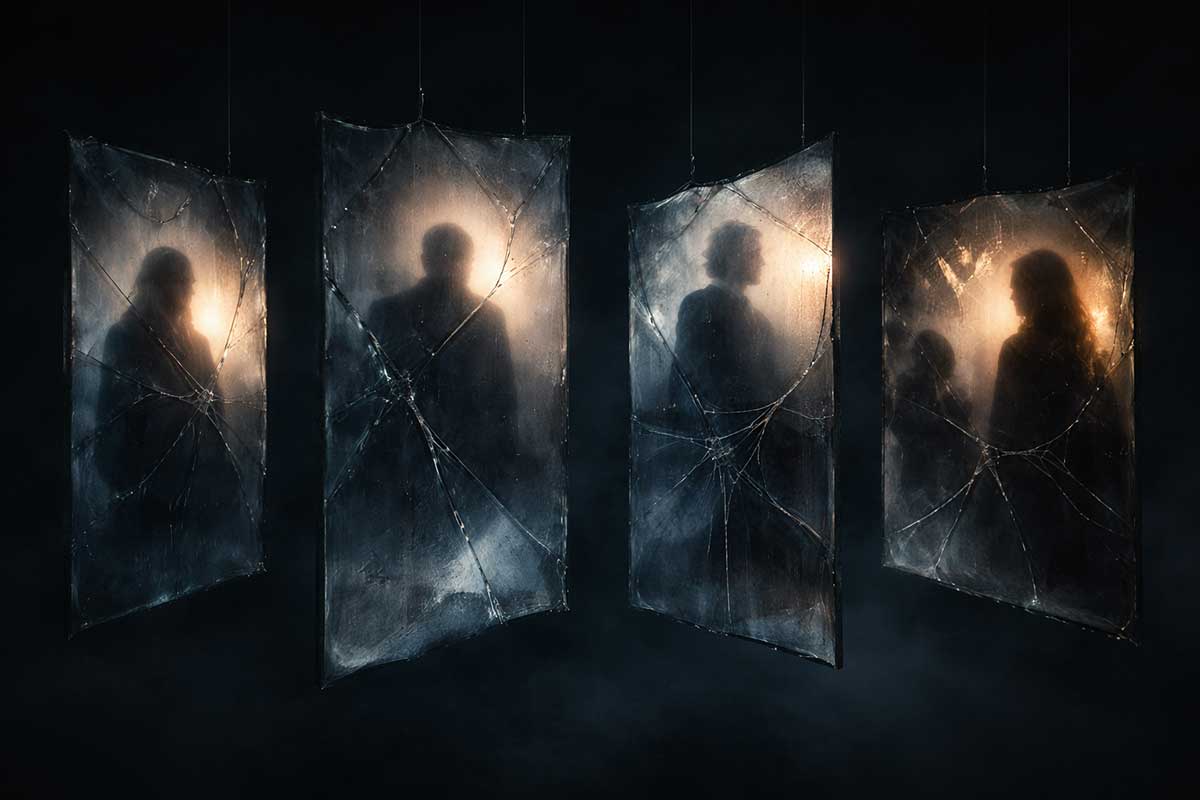
The stories we needed in order to keep going
This place feels quieter than before.
Not because there is less to say —
but because what must be said no longer needs an audience.
Cersei Lannister stands alone at first, arms folded not in defiance, but habit.
Tywin Lannister appears beside her, posture unchanged even without power to command.
Stannis Baratheon stands rigid, as if law itself still holds him upright.
Theon Greyjoy lingers at the edge, eyes lowered, shoulders drawn inward.
Melisandre watches them all, her expression unreadable, as though she has already seen this moment coming.
Cersei speaks before anyone can look away.
She says the lie she told herself was that love excused everything. That protecting her children justified cruelty, manipulation, and revenge. She believed fear was strength because it worked — because people obeyed. Only after seeing her life without excuses did she understand how often fear isolated her from the very people she wanted to protect. She asks whether survival built on terror can ever truly be called love.
Tywin does not look at her when he speaks. He says his lie was simpler: that order mattered more than tenderness. That legacy could replace affection. He believed discipline would prevent weakness and that weakness was the root of collapse. Watching his life again, stripped of authority, he sees how often control replaced care. He wonders if the world he feared falling apart was already breaking because of him.
Stannis steps forward, jaw tight. He says he told himself righteousness demanded sacrifice — that justice required obedience, even when the cost was unbearable. He clung to law because law did not ask him to feel. Only after life review did he understand how easily certainty becomes refuge for cruelty. He asks whether believing oneself “chosen” can become a way to avoid listening.
Theon’s voice is small, but steady. He says his lie was that belonging could be taken. That if he acted boldly enough, cruelly enough, someone would finally claim him. He mistook recognition for worth. He admits he became someone he despised just to avoid being invisible. He asks whether identity built from desperation ever truly holds.
Melisandre finally speaks.
She says her lie was that faith removed responsibility. That visions excused interpretation. That believing she served something greater absolved her from doubt. Seeing her life again, she understands how easily belief can silence compassion. She asks whether faith without humility becomes just another form of power.
No one responds right away.
The lies hang between them — not as accusations, but as shared wounds.
Cersei’s posture softens.
Tywin’s eyes lower.
Stannis exhales, as if something iron finally loosens.
Theon lifts his head slightly.
Melisandre closes her eyes, not in prayer, but in release.
Here, beyond judgment, they see the truth clearly:
The lies they told themselves were not born from evil —
they were born from fear.
And now that fear no longer governs them, the lies no longer need to survive.
Topic 5 — If I Could Sit With You One Last Time
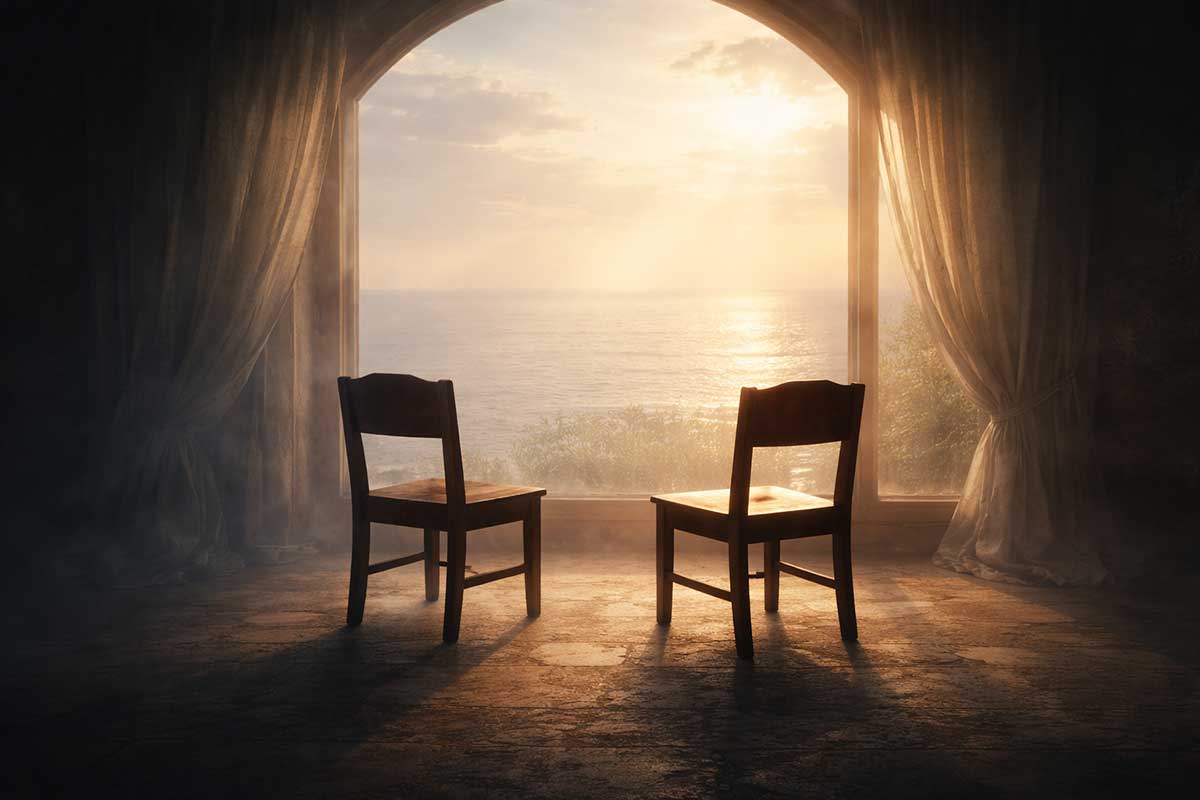
Not to explain. Not to warn. Just to be there.
This place feels almost familiar.
Like a room left untouched after everyone has gone —
still holding warmth in the air.
Tyrion Lannister sits first, legs crossed, hands resting idly, without his usual armor of wit.
Bran Stark stands nearby, not elevated, not distant — simply present.
Varys appears without secrecy, no whispers trailing behind him.
Petyr Baelish watches from the side, thoughtful, stripped of calculation.
Jaime Lannister arrives last, quieter than any version of himself ever was in life.
No one rushes to speak.
Tyrion breaks the silence gently. He says that if he could sit with someone one last time, he would choose his father — not to argue, not to defend himself, but to sit without trying to be clever. He admits he spent his life translating pain into words so sharp no one could get close enough to wound him again. He wonders whether being understood would have mattered more than being right. And he asks whether silence, shared willingly, might have healed what language never could.
Bran listens — really listens — before speaking. He says if he could sit with someone again, it would be the boy he once was, before the fall. Not to change the future, but to remind him that losing one path does not mean losing meaning. He reflects that memory is not about control — it is about compassion. He wonders whether presence alone can soften suffering, even when nothing is fixed.
Varys folds his hands calmly. He says he would sit with the people he never met — the ones he claimed to serve. Not as an idea, not as justification, but as individuals with faces and fears. He admits he hid behind the word “realm” because it allowed distance. He asks whether devotion to an abstract good can quietly erase the humanity it claims to protect.
Littlefinger smiles faintly, without triumph. He says if he could sit with someone one last time, it would be himself — not the boy dreaming of ascent, but the man who mistook longing for strategy. He admits he believed closeness was weakness and control was safety. He wonders whether a life built on never being vulnerable is already a kind of exile.
Jaime speaks last.
He says he would sit with the version of himself before the labels hardened — before “Kingslayer” became a cage he never fully escaped. He would sit without defending his choices, without explaining why he failed to stay. He wonders whether redemption requires distance from love — or courage to remain when leaving feels easier.
The space between them feels full now.
Not of answers —
but of understanding.
Bran looks at them all and says nothing. He does not need to.
Tyrion exhales, lighter than he has ever been.
Varys inclines his head.
Littlefinger’s smile fades into something truer.
Jaime closes his eyes, not in regret, but in rest.
Here, at the end of remembering, they realize something simple:
The last thing they want is not forgiveness.
Not legacy.
Not meaning.
It is presence.
To sit.
To be seen.
To be human — without consequence.
And in that quiet, the story finally lets them go.
Final Thoughts by Tyrion Lannister
At the end of everything — after the wars have quieted and the stories have been told too many times — I find myself thinking less about who ruled, and more about who was lonely.
We spent our lives chasing certainty. Some of us called it honor. Some called it destiny. Others dressed it up as love or duty or law. But certainty is a greedy companion. It asks for sacrifice and never admits when it’s wrong.
Here, beyond consequence, we finally understand something the living rarely do: that most cruelty was born from fear, and most silence from the hope that pain might pass if left unspoken. We were not monsters. We were human — painfully so.
If there is any wisdom left to offer, it is not a warning or a lesson. It is this: sit longer when you can. Speak sooner than feels safe. And remember that being present for someone is often the bravest thing you will ever do.
The rest — crowns, thrones, legacies — they all turn to dust eventually.
But the moments you shared with another soul?
Those endure.
Short Bios:
Tyrion Lannister — A sharp-minded survivor who learned that stories outlast power, and that understanding often arrives only after loss.
Eddard Stark — A man of honor whose commitment to truth shaped his family’s fate and revealed the cost of integrity in a ruthless world.
Catelyn Stark — A mother defined by love and grief, whose choices were driven by fierce devotion and the pain of unbearable loss.
Robb Stark — A young king caught between duty and desire, whose idealism collided tragically with the realities of power.
Jon Snow — A reluctant leader shaped by sacrifice, torn between love and duty, forever searching for where he truly belonged.
Theon Greyjoy — A soul divided between homes, whose hunger for belonging led to betrayal, suffering, and hard-won self-awareness.
Sansa Stark — A survivor who learned silence, patience, and perception as tools of endurance in a world that punished innocence.
Arya Stark — A restless spirit forged by loss, whose pursuit of justice blurred into vengeance before returning her to humanity.
Jaime Lannister — A knight defined by contradiction, struggling to reconcile honor with love and the weight of a single infamous act.
Brienne of Tarth — A warrior guided by loyalty and quiet courage, holding fast to honor even when the world mocked it.
Sandor Clegane (The Hound) — A hardened fighter whose cruelty masked deep fear and a buried longing for gentleness.
Daenerys Targaryen — A liberator turned conqueror, driven by destiny and certainty, whose vision of justice ultimately consumed her.
Jorah Mormont — A disgraced knight whose unwavering devotion became both his redemption and his quiet tragedy.
Missandei — A voice of compassion and clarity, offering loyalty grounded in empathy rather than fear or ambition.
Ygritte — A free spirit who valued honesty and presence, challenging rigid beliefs through love unbound by rules.
Cersei Lannister — A ruler driven by fear and fierce love, who equated control with safety and power with survival.
Tywin Lannister — A patriarch obsessed with legacy and order, believing strength and discipline could outlast affection.
Stannis Baratheon — A man bound to law and righteousness, whose certainty demanded sacrifice beyond forgiveness.
Melisandre — A priestess guided by prophecy and belief, struggling to distinguish faith from responsibility.
Bran Stark — A keeper of memory who sees the whole story, understanding that meaning lies not in control, but in remembrance.
Varys — A master of secrets devoted to the idea of the realm, often at the cost of individual lives.
Petyr Baelish (Littlefinger) — An architect of chaos who mistook manipulation for safety and ambition for belonging.
Leave a Reply