
|
Getting your Trinity Audio player ready...
|
Introduction by George R. R. Martin
I never believed stories should reassure us.
If they do their job honestly, they unsettle us instead.
When I began writing about Westeros, I wasn’t interested in heroes who always chose correctly, or villains who announced themselves in advance. I was interested in power—how it bends people, how it excuses cruelty, how it convinces decent men and women that they had no other choice.
History doesn’t unfold as a morality play. It unfolds as a series of compromises made under pressure, followed by explanations written afterward. Thrones are raised, defended, overthrown, and justified—usually in that order. The language changes. The blood does not.
This world was never meant to ask who should win.
It was meant to ask what winning costs.
Justice without power rarely survives.
Power without justice rarely deserves to.
The conversations that follow are not answers. They are tensions—between honor and survival, loyalty and conscience, prophecy and choice, memory and forgetting. If they feel unresolved, that is because the questions themselves are unresolved, in fiction and outside it.
Stories end. Consequences don’t.
(Note: This is an imaginary conversation, a creative exploration of an idea, and not a real speech or event.)
Topic 1: Who Owns Justice in a World of Power?
Why do honorable people die first?
Moderator: Maester Aemon
Setting:
A quiet stone chamber lit by a single ring of candles. No banners. No sigils. Only five chairs and an old wooden table worn smooth by time. Outside, the wind moves like distant voices. This is not a place of judgment, but of reckoning.
Maester Aemon sits at the head, his clouded eyes unfocused yet piercing, as if seeing something beyond the room.
Maester Aemon (opening)
“In my long life, I have seen good men die for truth, and cruel men live by lies.
Tonight, we ask not who was right—but why the world rewards what it does.”
He pauses.
“Let us begin.”
Question One
Is justice something that exists independently of power, or is it created by those who hold it?
Ned Stark
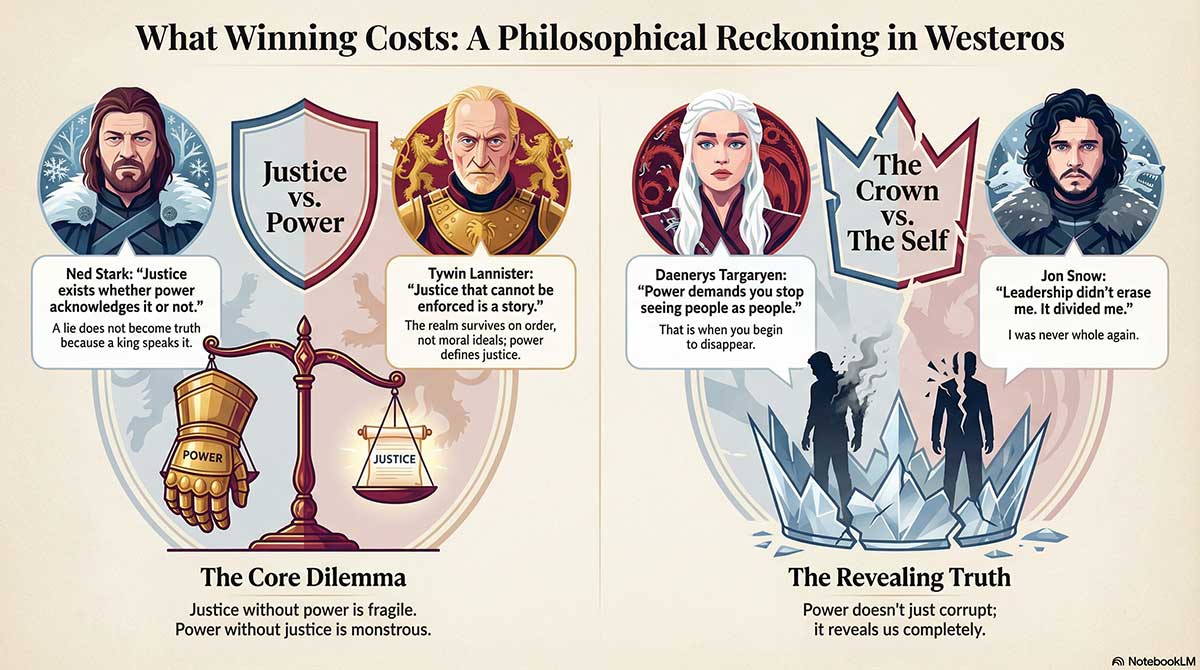
Justice exists whether power acknowledges it or not. A lie does not become truth because a king speaks it. Law is not law because it is enforced, but because it is right. Power may silence justice, but it does not erase it. If justice depends on power, then it is not justice—it is convenience.
Tywin Lannister
Justice that cannot be enforced is a story men tell themselves to sleep at night. The realm does not survive on moral ideals; it survives on order. Power defines justice because power bears the burden of consequence. A weak justice collapses the moment it is challenged.
Tyrion Lannister
Justice may exist on its own, but it has terrible public relations. Without power, it whispers. With power, it shouts—and sometimes lies. The tragedy is not that power creates justice, but that justice requires power to matter at all.
Varys
Justice is a language. Power decides which dialect is spoken. The smallfolk care less about philosophical purity than whether tomorrow is safer than today. If power delivers stability, they call it justice. If it does not, they call it tyranny.
Brienne of Tarth
Justice exists whether anyone listens or not. I have seen it ignored, mocked, and crushed—but I have also seen people recognize it when they feel its absence. Power may define laws, but justice lives in conscience. That is harder to kill.
Maester Aemon nods slowly.
Question Two
Did Ned Stark fail because he was honorable—or because he misunderstood the world he lived in?
Ned Stark
I understood the world well enough to know what it demanded. I simply refused to become it. If that is failure, then I accept it. A man should not survive by becoming what he despises.
Tywin Lannister
You failed because you believed the world would pause for your virtue. You mistook personal honor for political strategy. The world does not reward moral consistency; it rewards foresight. You brought a sword to a game of knives.
Tyrion Lannister
Father is cruel, but not wrong. Ned, you assumed others valued truth as you did. They valued advantage. Your mistake was not honor—it was expectation. You expected decency from people who had never shown it.
Varys
Lord Stark, you failed because you acted alone. Truth without allies is a confession, not a weapon. You were correct—but correctness is irrelevant when no one stands with you.
Brienne of Tarth
Ned Stark did not misunderstand the world. He refused to teach it to his children. And yet, his example changed more than any throne ever did. If the measure of success is survival, he failed. If it is legacy, he did not.
Aemon’s hands rest on the table.
Question Three
Can moral integrity survive inside systems built on fear, compromise, and betrayal?
Ned Stark
It can survive in individuals, even if it cannot rule systems. Perhaps that is enough. A world without moral integrity is already dead, no matter how efficiently it governs itself.
Tywin Lannister
Integrity survives only when it is useful. Otherwise, it becomes martyrdom. Systems endure because they adapt. Integrity that refuses compromise is not strength—it is rigidity.
Tyrion Lannister
Integrity can survive—but it will be lonely, bruised, and occasionally drunk. Systems are not designed for goodness; they are designed for continuity. Moral people survive by choosing when to bend and when to stand.
Varys
Integrity survives in fragments. In private choices. In quiet refusals. Never in banners. Never in speeches. The moment integrity seeks dominance, it becomes another form of power.
Brienne of Tarth
Integrity survives because someone must carry it, even if the cost is unbearable. If no one does, then fear has already won. I would rather live in a world where integrity dies painfully than one where it is never born.
Maester Aemon (closing reflection)
“I was once offered a crown,” Aemon says softly.
“I refused it to keep my vows—and watched the realm suffer under those who accepted it.”
He turns his head slightly, as if listening to distant echoes.
“Justice without power is fragile.
Power without justice is monstrous.
And the world seems determined to choose between the two.”
The candles flicker.
“Perhaps the question is not who owns justice…
but who is willing to pay its price.”
The room falls silent.
Outside, the wind continues to move—indifferent, unjudging, eternal.
Topic 2: What Does the Crown Take From Those Who Wear It?

The hidden cost of ruling
Moderator: Tyrion Lannister
Setting:
A high balcony overlooking a city at night. Torches burn below like scattered thoughts. The Iron Throne is absent—intentionally. Five chairs face outward toward the dark horizon, as if none of them quite wants to look at the others.
Tyrion Lannister leans against the stone rail, a cup of wine in his hand.
Tyrion Lannister (opening)
“Everyone thinks ruling is about gaining something.
Power. Respect. Control.”
He glances back at the empty space where a throne might be.
“Tonight, I’m more interested in what it cost us.”
He turns to the others.
“Let’s begin honestly.”
Question One
Does leadership require sacrifice—or does it quietly demand self-erasure?
Daenerys Targaryen
At first, sacrifice felt noble. I gave up comfort, safety, even mercy—believing it was for a greater good. But power does not stop asking. Eventually, it demands that you stop seeing people as people. That is when you begin to disappear.
Stannis Baratheon
A king is not a man; he is a function. Sacrifice is irrelevant. Duty is everything. The self is a distraction. If something must be burned to achieve justice, then it burns.
Cersei Lannister
Sacrifice is a story told by those who expect women to suffer quietly. Power demands vigilance, not disappearance. If I hardened myself, it was because softness is punished. I did not erase myself—I sharpened myself.
Jon Snow
I never wanted command. Every choice I made cost someone else their life—or their trust. Leadership didn’t erase me. It divided me. I was never whole again.
Robert Baratheon (memory)
Sacrifice? I sacrificed joy without realizing it. The crown took the man I was and left me the costume. By the time I noticed, it was too late to care.
Tyrion exhales slowly.
Question Two
Can someone rule without becoming what they once opposed?
Daenerys Targaryen
I believed I could. That was my greatest certainty—and my greatest error. The moment you decide that your vision excuses every act, you have already crossed the line you swore never to touch.
Stannis Baratheon
If what you oppose is weakness, then no. If what you oppose is injustice, then becoming harsh is not corruption—it is necessity. Mercy is a luxury of the victorious.
Cersei Lannister
People call it becoming the enemy when it is really understanding the rules. I did not become my enemies. I learned why they survived.
Jon Snow
You can try. You can resist. But power pushes you toward simpler answers—toward choosing outcomes over people. Even when you refuse, something inside you changes.
Robert Baratheon
I hated tyrants. Then I ruled. Turns out, the job description doesn’t care what you hate.
Tyrion lifts his cup, then sets it down untouched.
Question Three
Is refusing power a moral act—or an abdication of responsibility?
Daenerys Targaryen
Refusal feels virtuous only until someone worse accepts it. I once believed stepping away preserved innocence. Now I wonder if it only preserves distance.
Stannis Baratheon
Refusal is cowardice disguised as purity. If law calls you, you answer. Anything else is betrayal.
Cersei Lannister
Refusal is a privilege of those who believe they will survive without power. Some of us never had that luxury.
Jon Snow
I refused power because I feared what it would turn me into. But walking away did not absolve me. Others paid the price for my absence.
Robert Baratheon
I never refused it—and I still ran from it every day. Turns out, you can wear the crown and abandon responsibility at the same time.
The wind rises, carrying distant noise from the city below.
Tyrion Lannister (closing reflection)
Tyrion steps forward, resting both hands on the stone.
“We like to imagine rulers as giants,” he says quietly.
“Bigger than the rest of us. Stronger. Clearer.”
He looks at each of them in turn.
“But listening to you, I hear something else.
Fear. Loneliness. Rationalization.”
He smiles faintly, without humor.
“The crown doesn’t just demand sacrifice.
It rewards self-deception.”
Tyrion turns toward the dark city.
“Perhaps the greatest lie about power is that it corrupts absolutely.
The truth may be worse.”
A pause.
“It reveals us completely.”
No one speaks.
Below them, the city continues—unaware, unconcerned, alive.
Topic 3: Is Family a Source of Strength—or a Political Curse?
Blood, loyalty, and inherited trauma
Moderator: Sansa Stark
Setting:
The Great Hall of Winterfell, long after the fires have dimmed. No feast. No banners. Only the sound of wind pressing against stone and the faint creak of old timbers. Five chairs form a loose circle, deliberately uneven, as families always are.
Sansa Stark stands, not at the head, but among them.
Sansa Stark (opening)
“When I was young, I believed family meant safety,” Sansa says calmly.
“Then I believed it meant obedience.
Later, I learned it could mean survival.”
She looks around the circle.
“Tonight, I want to ask something simpler—and more dangerous.”
She pauses.
“Did our families save us… or did they decide our fate before we ever chose it?”
Question One
Do families protect individuals—or do they quietly consume them?
Catelyn Stark
Family is love made visible. But love sharpens pain. I would choose my children over the world again—and again—even knowing the cost. If that consumed me, it was a price I paid willingly.
Cersei Lannister
Families don’t protect. They claim. They teach you who you must be before you know who you are. Everything I did, I did to keep my children alive in a world that devours the weak. If that looks like obsession, it is because survival often does.
Jaime Lannister
Family gave me a name—and a cage. Every choice I made was judged by what I owed, not what I believed. I protected my family until I no longer knew whether I was protecting them… or hiding behind them.
Tyrion Lannister
Families are excellent at teaching you what you’re not allowed to be. Mine taught me that love could be conditional, and cruelty could be inherited. Protection, yes—but never without a price.
Sansa Stark
I think families protect children. Then they expect adults to carry the debt forever.
The room is quiet. Winterfell listens.
Question Two
At what point does loyalty to family become moral blindness?
Catelyn Stark
When love silences doubt. I see that now. I trusted blood over wisdom, and paid for it with lives that were not mine alone to risk. Loyalty is sacred—but it must answer to conscience.
Cersei Lannister
Moral blindness is a luxury accusation. When the world is hostile, loyalty is clarity. I did not weigh right and wrong—I weighed who lived and who died. Anyone who calls that blindness never faced the same stakes.
Jaime Lannister
It becomes blindness when you stop asking whether what you’re protecting is worth the damage. I told myself I had no choice for so long that it became true. That’s the danger.
Tyrion Lannister
Family loyalty becomes blindness when it demands silence. When you’re not allowed to speak truth because it threatens the myth that keeps everyone comfortable.
Sansa Stark
I learned loyalty by watching it destroy my home. Blind loyalty doesn’t feel like blindness at first. It feels like belonging.
Sansa lowers her gaze briefly, then looks up again.
Question Three
Can anyone truly escape the identity their family imposes?
Catelyn Stark
We never escape it completely. But we can choose which parts we carry forward. I wish I had understood sooner that tradition is not destiny.
Cersei Lannister
Escape is a fantasy told to those with options. I didn’t escape my family—I became its shield and its weapon. That was the only freedom available to me.
Jaime Lannister
I tried to escape by redefining myself through action. Sometimes it worked. Sometimes I fell back into old patterns because they were familiar. Escape isn’t a single moment—it’s a struggle that never quite ends.
Tyrion Lannister
I escaped by telling stories about myself before others could finish theirs. Humor, intellect, distance—those were my exits. None of them were clean.
Sansa Stark
I escaped by becoming someone my family never imagined—and someone they would barely recognize. But even now, I hear their voices when I choose.
She pauses, then adds quietly:
“I don’t think escape means forgetting.
I think it means choosing who we answer to.”
Sansa Stark (closing reflection)
Sansa steps closer to the center of the circle.
“We talk about houses as if they are shields,” she says.
“But they are also shadows. Long ones.”
She looks to each of them—not accusing, not forgiving.
“Family gives us language before we know how to speak.
It teaches us love before we understand cost.”
A breath.
“Some of us were saved by that.
Some of us were broken by it.
Most of us were both.”
The fire crackles softly.
“Perhaps the tragedy isn’t that we inherit our families—
but that we spend our lives trying to decide which parts deserve to survive.”
Winter presses in from all sides, patient and unmoved.
Topic 4: Is Prophecy a Map to the Future—or a Prison?
Faith, foresight, and the danger of certainty
Moderator: Samwell Tarly
Setting:
An old library chamber beneath the Citadel. Candles line the shelves, their flames trembling slightly in the stale air. Scrolls and books lie open on a wide table—some orderly, some chaotic. Knowledge gathered, but never complete.
Samwell Tarly stands with a book in his hands, then gently closes it.
Samwell Tarly (opening)
“I’ve spent much of my life believing that answers could be found in books,” Sam says softly.
“Then I learned that knowledge can be just as dangerous as ignorance—especially when we believe it too completely.”
He looks around the table.
“Tonight, I’d like us to ask something uncomfortable.”
He hesitates, then continues.
“When we claim to know the future… do we free ourselves—or do we trap everyone else?”
Question One
Does knowing the future grant responsibility—or does it excuse cruelty?
Melisandre
Knowledge is a burden, not a privilege. When you glimpse the darkness ahead, hesitation becomes a sin. Cruelty committed in service of salvation is still painful—but it is necessary. The fire does not lie.
Bran Stark
Knowing is not choosing. The future reveals patterns, not permissions. Responsibility lies not in what is seen, but in how gently one acts with that knowledge. Most people mistake certainty for authority.
Arya Stark
I never trusted futures people claimed to see. They always seemed to justify what they wanted to do anyway. If knowing the future makes hurting people easier, then it’s not wisdom—it’s an excuse.
Samwell Tarly
That’s what frightened me most in the histories. Every atrocity justified by prophecy sounded calm, reasonable… inevitable. Knowing what might happen doesn’t remove responsibility. It multiplies it.
Varys
The future is a powerful tool. Those who claim to see it often forget that others must live inside the consequences. Knowledge becomes tyranny the moment it stops listening.
Sam nods, swallowing.
Question Two
Are prophecies fulfilled because they are true—or because people act as if they are?
Melisandre
Prophecy is truth spoken in fragments. People act because they recognize its resonance. Fire reveals what already exists—it does not invent destiny.
Bran Stark
Prophecy creates gravity. Once spoken, it bends choices toward itself. People confuse inevitability with momentum. Many futures exist—belief collapses them into one.
Arya Stark
So if you tell someone they’re meant to kill or die, they spend their whole life walking toward it. That doesn’t feel like truth. It feels like manipulation.
Samwell Tarly
History supports Arya. Every prophecy I’ve studied was vague enough to allow interpretation—and powerful enough to reshape behavior. They don’t predict the future. They pressure it.
Varys
Which is why prophecy is most useful to those who never believe it themselves. They let others carry the faith—and the blame.
The candles flicker. Shadows stretch.
Question Three
Is disbelief sometimes the most ethical position?
Melisandre
Disbelief is comfort disguised as wisdom. The world burns whether you believe or not. Faith is not ethical because it is gentle—it is ethical because it acts when others hesitate.
Bran Stark
Disbelief can be mercy. Refusing to impose certainty preserves choice. Silence can be more ethical than revelation.
Arya Stark
I survived because I didn’t believe I was meant for anything. No destiny. No prophecy. Just decisions. That gave me room to change.
Samwell Tarly
I used to think disbelief meant fear. Now I think it can mean humility. Admitting we don’t know may be the only way to protect people from our certainty.
Varys
Belief is dangerous when it demands obedience. Disbelief keeps power negotiable. That alone can save lives.
Sam sets the book down.
Samwell Tarly (closing reflection)
Sam steps forward, his voice steadier now.
“We like to imagine prophecy as a gift,” he says.
“A lantern in the dark.”
He gestures toward the shelves.
“But I’ve seen how often that lantern blinds the person holding it.”
He looks to Melisandre, then to Bran, then to Arya.
“The future is not a command.
It is a question.”
A pause.
“And perhaps the most dangerous words anyone can speak are not
‘This will happen’—
but ‘This must happen.’”
The candles burn low.
“If the future belongs to anyone,” Sam concludes quietly,
“it belongs to those who leave space for others to choose it.”
The chamber settles into silence, heavy with unread pages and unwritten lives.
Topic 5: What Was Actually Saved After the War?

Meaning, memory, and the cost no one debates
Moderator: Tyrion Lannister
Setting:
A ruined courtyard at dawn. Broken stone, scattered banners, and a single surviving tree growing through cracked marble. No throne. No audience. Just five figures standing among the remains of what once mattered.
Tyrion Lannister sits on a fallen block of stone, not above the others, but among them.
Tyrion Lannister (opening)
“Every war ends with speeches,” Tyrion says quietly.
“Victory. Sacrifice. A new beginning.”
He looks at the broken walls.
“But ruins don’t listen to speeches.”
He exhales.
“So let’s ask the question no one ever asks out loud.”
He lifts his eyes.
“What was actually saved?”
Question One
After victory, what values are quietly abandoned?
Sansa Stark
Compassion is usually the first casualty after survival. Once the danger passes, people call restraint weakness and forget how close they came to losing everything. Order replaces empathy—and people accept that trade too easily.
Bran Stark
Urgency disappears. Memory becomes selective. The suffering that justified difficult choices is simplified into symbols. Complexity is abandoned because it makes peace uncomfortable.
Arya Stark
People stop listening to the ones who paid the price. Fighters are celebrated until they speak about what it cost. Then they’re asked to move on quietly.
Tyrion Lannister
Truth is abandoned in favor of coherence. Stories are smoothed. Contradictions erased. We trade honesty for something easier to govern.
The Fallen Soldier
I think we abandon names. At first, everyone is remembered. Later, only numbers remain. Eventually, silence.
No one interrupts.
Question Two
Is stability more important than justice once the war ends?
Sansa Stark
Stability keeps people alive. Justice keeps them human. A realm can survive without justice—but it becomes something colder, something afraid of being questioned.
Bran Stark
Stability without justice calcifies. Justice without stability fractures. The mistake is treating them as opposites rather than tensions that must be held.
Arya Stark
Stability feels like being told to forget. Justice feels like reopening wounds no one wants to see. People choose quiet because it’s easier.
Tyrion Lannister
Stability is what rulers want. Justice is what they promise. The distance between the two is where resentment grows.
The Fallen Soldier
Stability meant going home. Justice meant knowing why my friends didn’t. Only one of those was ever offered.
The wind moves through the courtyard.
Question Three
Who decides which stories are remembered—and which lives are forgotten?
Sansa Stark
Those who remain. That’s the uncomfortable truth. Survival gives authority whether it deserves it or not.
Bran Stark
Memory chooses patterns. Stories that fit endure. Those that complicate disappear. That is why memory must be guarded—not trusted.
Arya Stark
The ones who leave don’t get to tell their version. So their stories are told about them instead. That’s how truth gets bent.
Tyrion Lannister
Stories are written by those who can bear to look back. Sometimes that means the least wounded. Sometimes it means the most dishonest.
The Fallen Soldier
No one chose to forget us. It just happened—slowly. First our faces. Then our reasons. Then our names.
Silence settles, heavier than before.
Tyrion Lannister (closing reflection)
Tyrion stands.
“We like endings,” he says softly.
“They make suffering feel purposeful.”
He looks at the tree growing through stone.
“But wars don’t end.
They disperse.”
He gestures to the ground beneath their feet.
“Into memory.
Into institutions.
Into people who never chose them.”
Tyrion turns toward the fallen soldier.
“If anything was saved,” he says,
“it wasn’t thrones, or borders, or victories.”
A pause.
“It was the possibility that someone, somewhere, might remember accurately.”
He looks at the others.
“Not heroically.
Not comfortably.
But honestly.”
The light shifts as the sun rises higher.
“And perhaps,” Tyrion concludes,
“that’s the only justice wars ever leave behind.”
The courtyard remains—scarred, silent, and real.
Final Thoughts by Nick Sasaki
When the battles are over, what stays with us is never the spectacle.
It’s the unease.
Not who ruled, but who disappeared.
Not who spoke, but who was no longer invited to speak.
Not the crown, but the silence around it.
Reading these voices side by side, I was struck by how often power explains itself as necessity—and how rarely it pauses to ask what it leaves behind. Stability becomes the reward. Memory becomes optional. And justice, if it arrives at all, arrives quietly.
What moved me most was not the ambition or even the tragedy, but the fragile insistence—again and again—that choice still matters, even inside systems designed to erase it. That remembering accurately may be the last form of resistance left after violence has finished its work.
Perhaps this is what Game of Thrones ultimately offers us—not a warning about dragons or thrones, but a mirror. One that asks whether we are willing to look at the costs we normalize, the stories we simplify, and the lives we allow to fade because they complicate the ending.
Power always demands an explanation.
Memory decides whether we accept it.
And that choice, at least, still belongs to us.
Short Bios:
Ned Stark
Lord of Winterfell, defined by honor, duty, and an unyielding belief that truth matters even when it is dangerous. His life and death embody the cost of moral integrity in a world ruled by power.
Tywin Lannister
Patriarch of House Lannister and a master strategist who believes order, fear, and legacy outweigh sentiment. He represents power stripped of illusion and morality justified by stability.
Tyrion Lannister
A sharp-minded survivor who navigates power through wit, self-awareness, and storytelling. Both insider and outsider, he understands how narratives shape history more than thrones do.
Varys
A political operator devoted not to crowns but to outcomes. Skeptical of ideology and prophecy alike, he views power as a tool whose only justification is the welfare of the realm.
Brienne of Tarth
A knight in spirit long before she was accepted in name, Brienne represents lived honor rather than inherited authority. Her presence challenges the assumption that integrity must be naive to survive.
Daenerys Targaryen
A revolutionary shaped by exile, loss, and conviction, whose pursuit of justice gradually becomes inseparable from absolute power. She embodies the peril of moral certainty armed with force.
Stannis Baratheon
A rigid believer in law, duty, and rightful order, willing to sacrifice everything personal in service of justice as he defines it. His story questions whether righteousness without mercy can rule.
Cersei Lannister
A ruler forged by fear, exclusion, and survival, who equates power with safety. Her choices reveal how systems punish vulnerability and reward preemptive cruelty.
Jon Snow
A reluctant leader driven by conscience rather than ambition, repeatedly torn between responsibility and personal identity. His arc explores the loneliness of moral leadership.
Robert Baratheon
A victorious rebel who became a hollow king, unable to reconcile conquest with governance. He represents the emptiness that follows winning without purpose.
Sansa Stark
A survivor who evolves from innocence to strategic clarity, learning how power truly operates. She bridges empathy and governance, embodying endurance rather than domination.
Catelyn Stark
A mother whose fierce loyalty to family shapes every decision she makes, often at tragic cost. She illustrates how love can become both strength and blindness.
Jaime Lannister
A man defined by reputation and inner contradiction, struggling between loyalty, honor, and self-definition. His journey reflects the difficulty of escaping inherited roles.
Samwell Tarly
A scholar who values knowledge, humility, and evidence over certainty. He represents the ethical weight of understanding without domination.
Melisandre
A priestess driven by prophecy and faith, convinced that terrible acts can be justified by a greater destiny. She embodies the danger of certainty when belief overrides doubt.
Bran Stark
A witness to time and memory, increasingly distant from individual desire. His perspective raises questions about detachment, foresight, and the ethics of knowing too much.
Arya Stark
A figure of refusal—of prophecy, fixed identity, and imposed destiny. Her survival is rooted in choice, adaptability, and resistance to narrative confinement.
The Fallen Soldier
A symbolic voice representing those erased by war and remembered only in abstraction. He speaks for the cost that history records poorly and honors briefly.
George R. R. Martin
The creator of the world of Westeros, known for rejecting simple morality in favor of consequence, ambiguity, and historical realism. His imagined voice frames the series as a moral inquiry rather than a fantasy epic.
Nick Sasaki
A contemporary writer and curator of reflective dialogue, guiding the reader from fiction into lived reality. His closing perspective connects power, memory, and responsibility beyond the world of Westeros.
Leave a Reply