

|
Getting your Trinity Audio player ready...
|
What if top Hamlet scholars debated whether thinking too deeply is fatal?
Introduction by William Shakespeare
I did not write Hamlet to teach revenge.
Nor to praise thought.
Nor to excuse delay.
I wrote it because I began to fear a certain kind of clarity.
There comes a moment in a human life when the world reveals itself too plainly.
The lie beneath the crown.
The rot beneath the ceremony.
The way power survives by pretending it is innocent.
When that moment comes, innocence does not return.
And action does not become easier.
Hamlet is not slow because he is weak.
He is slow because he has seen behind the veil — and nothing he sees can be unseen.
I gave him a ghost not to guide him, but to burden him.
I gave him intelligence not as a gift, but as a cost.
I placed him in a court where truth is dangerous and silence is strategic.
If you listen closely, you will hear that this play is not asking,
“Why doesn’t he act?”
It is asking,
“What kind of action remains once belief collapses?”
And if that question troubles you,
then you are already inside the play.
(Note: This is an imaginary conversation, a creative exploration of an idea, and not a real speech or event.)
Topic 1 — When Truth Arrives Without Evidence
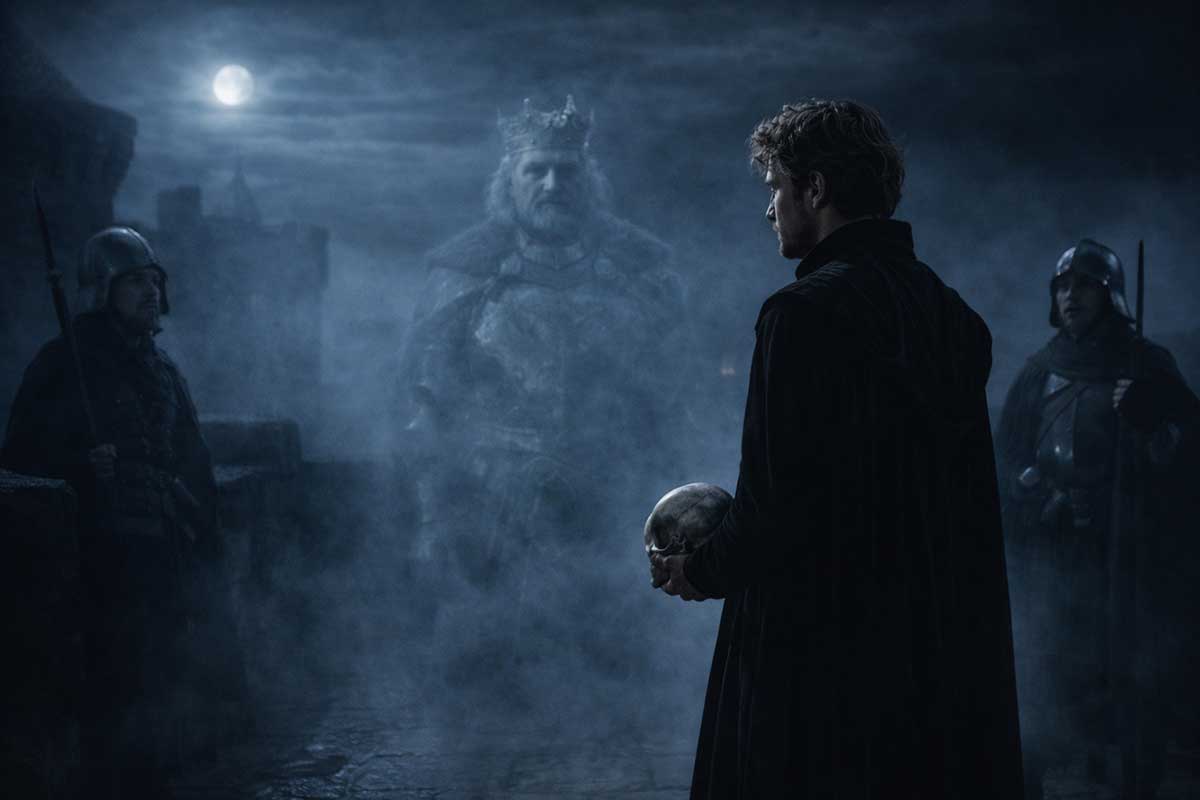
Participants (5 distinct scholars):
Stephen Greenblatt
Peter Marshall
Eamon Duffy
David Scott Kastan
Emma Smith (moderating voice)
Opening Frame
Emma Smith
Before revenge, before delay, before madness, Hamlet gives us a stranger question:
What counts as truth when the first witness is a ghost?
Tonight, let’s begin there—not with Hamlet’s action, but with the authority of the voice that demands it.
1. Is the Ghost a moral authority—or a dangerous emotional force?
Stephen Greenblatt
The Ghost speaks with the authority of a belief system that officially no longer exists but emotionally refuses to die. In post-Reformation England, purgatory had been denied, yet people still felt bound to the dead. This Ghost arrives speaking the old moral language: remember me, avenge me, repair the wrong. That language still had enormous power—even when its theological foundation was unstable.
Peter Marshall
What’s crucial is that early modern audiences would not have agreed on what the Ghost was. Some would see a soul from purgatory, others a demon exploiting grief, others a psychological projection. Shakespeare stages that disagreement. The Ghost’s power comes not from certainty, but from ambiguity.
Eamon Duffy
And we must remember: if this is a purgatorial soul, it demands obedience. Catholic culture taught that neglecting the dead was a moral failure. So Hamlet isn’t just hearing a story—he’s being placed under obligation. The Ghost doesn’t ask Hamlet to investigate; it commands him to act.
David Scott Kastan
Which is why the Ghost is so dangerous politically. It introduces a private, unverifiable claim into public governance. If Hamlet obeys, he destabilizes the state. If he disobeys, he betrays family and faith. The Ghost creates a conflict between personal duty and political order.
Emma Smith
So the Ghost isn’t simply truthful or false—it’s authoritative in a world that no longer knows how to evaluate authority.
2. What kind of proof can exist when truth begins as the supernatural?
Stephen Greenblatt
Hamlet’s response is strikingly modern. He refuses to act on revelation alone. Instead, he demands corroboration. That impulse—to test the unseen by observable reaction—is the logic of a culture moving away from ritual certainty toward interpretive doubt.
Peter Marshall
Which explains why the play-within-the-play matters so much. Hamlet translates metaphysical accusation into human behavior. Claudius’s reaction becomes the new evidence. But Shakespeare never lets that evidence be absolute.
David Scott Kastan
Exactly. Claudius’s guilt is suggested, not proven. His reaction could signal many things: fear, exposure, political danger. The play resists turning theater into a perfect lie detector. Proof remains partial.
Eamon Duffy
This is where the tragedy deepens. Hamlet wants moral certainty before committing violence, but the world will not provide it. In earlier religious frameworks, certainty preceded action. Here, action is demanded without epistemological safety.
Emma Smith
So Hamlet isn’t indecisive—he’s trapped in a world where certainty is no longer available, yet responsibility remains.
3. Does Hamlet want certainty—or does it deliberately deny it?
David Scott Kastan
The play denies certainty by design. Shakespeare constructs a world where every system that once stabilized truth—religion, monarchy, family—has fractured. The Ghost doesn’t restore order; it exposes how fragile order already was.
Stephen Greenblatt
And the emotional cost is enormous. The Ghost hands Hamlet knowledge without instruction. It tells him what happened, not how to live with it. That burden is unbearable.
Peter Marshall
Which is why the Ghost keeps returning. It does not resolve the plot; it sustains anxiety. Its reappearances remind us that unresolved moral claims don’t fade—they haunt.
Eamon Duffy
In that sense, the Ghost functions like trauma. It insists on remembrance but offers no path to healing. Memory becomes obligation, not consolation.
Emma Smith
And that obligation radiates outward. Polonius dies. Ophelia collapses. The court becomes a surveillance state. The Ghost’s truth does not stay contained inside Hamlet’s conscience.
Closing Reflection
Stephen Greenblatt
The Ghost is not there to clarify the world—it’s there to show how dangerous moral clarity can be when certainty is gone.
David Scott Kastan
Hamlet asks whether ethical action is even possible when truth arrives fractured and unverifiable.
Eamon Duffy
And whether obedience to the past can destroy the present.
Peter Marshall
The play never answers the Ghost—it makes us live with it.
Emma Smith (closing)
So perhaps the question is not “Is the Ghost real?”
But “What do we owe a truth that arrives without proof?”
That question—more than revenge—is what truly haunts Hamlet.
Topic 2 — Why Acting Feels Morally Impossible
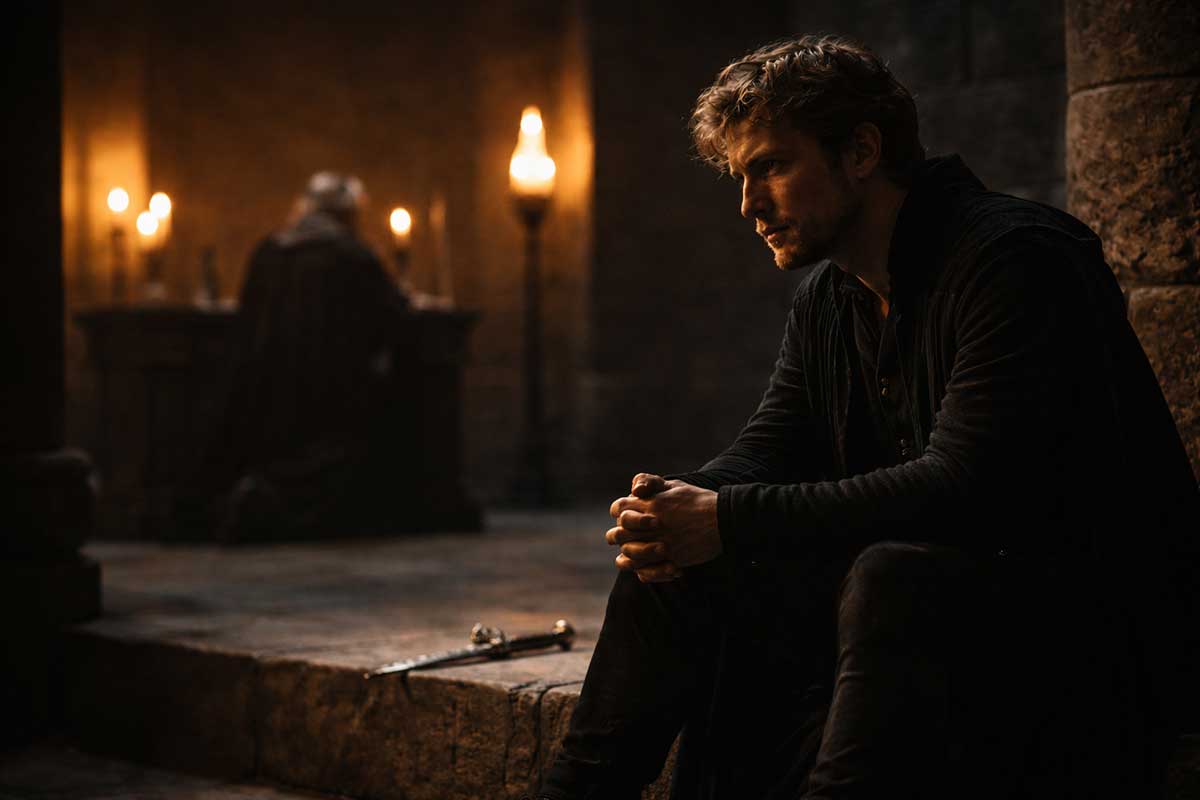
Participants (5 distinct scholars):
- Rhodri Lewis
- A. C. Bradley
- Richard Strier
- Stanley Cavell
- Simon Palfrey
Opening Frame
Simon Palfrey
Audiences often experience Hamlet as suspense: When will he finally act?
But Shakespeare gives us something stranger—a tragedy where action itself is the most dangerous thing on stage. Tonight, let’s ask not why Hamlet delays, but what kind of action the play makes possible at all.
1. Is Hamlet’s delay weakness—or moral clarity?
A. C. Bradley
From a classical perspective, Hamlet’s delay appears tragic because it conflicts with heroic expectation. The audience anticipates decisive action, yet Hamlet hesitates. Earlier criticism read this as an inward flaw—melancholy, excessive reflection, an imagination that overwhelms will.
Rhodri Lewis
But that model assumes a world where moral action is clean. Hamlet does not offer such a world. Hamlet delays because he understands that revenge is not a correction—it is contamination. Once blood is shed, the act cannot be contained or morally purified.
Richard Strier
Exactly. Hamlet’s conscience is not decorative. It is practical. Renaissance ethics insisted that intention mattered, but so did consequence. Hamlet senses that killing Claudius will not restore justice; it will merely extend corruption under a different name.
Stanley Cavell
And we should notice something philosophical: Hamlet is not avoiding responsibility—he is refusing to deny responsibility. To act quickly would allow him to pretend the act is simple. Delay is his refusal to lie to himself about what killing means.
2. Is revenge ever “justice” in Hamlet?
Rhodri Lewis
The play relentlessly undermines revenge as justice. Compare Hamlet to Laertes. Laertes acts immediately, loudly, and publicly—and becomes a weapon manipulated by Claudius. Speed makes him useful, not righteous.
A. C. Bradley
Yet the tradition of revenge tragedy still presses on Hamlet. He is expected—by genre, by ghost, by audience—to perform vengeance. The tension arises because Shakespeare places a deeply ethical mind inside a revenge plot that no longer fits it.
Richard Strier
This is crucial: the play stages revenge as an outdated moral technology. It once promised balance. Here, it produces only escalation. Hamlet’s resistance is not failure—it is diagnosis.
Stanley Cavell
Revenge in Hamlet lacks acknowledgment. It reduces the other to an object. Hamlet hesitates because he senses that killing Claudius without recognition, confession, or exposure would be morally empty—even if factually correct.
Simon Palfrey
And theatrically, revenge is delayed so the audience is forced to watch its consequences ripple outward: Polonius dead, Ophelia broken, Denmark surveilled. Revenge is not postponed; it is already happening.
3. What does “The readiness is all” actually mean?
A. C. Bradley
Traditionally, this line was read as acceptance of fate—a noble calm before death. Hamlet seems finally at peace, no longer wrestling with himself.
Rhodri Lewis
But that peace is not certainty. It is humility. Hamlet realizes that moral clarity will never be complete. Readiness is not confidence—it is preparedness to act without pretending the action is pure.
Richard Strier
Importantly, readiness does not erase guilt. Hamlet does not claim righteousness. He simply accepts that ethical life sometimes requires action without absolution.
Stanley Cavell
Philosophically, Hamlet moves from control to acknowledgment. He stops demanding guarantees. He allows himself to act while knowing the act will cost him everything.
Simon Palfrey
Onstage, this is where tempo changes. Events accelerate. Hamlet’s earlier delay has taught him restraint; his final action is stripped of bravado. He does not conquer—he completes.
Closing Reflection
Rhodri Lewis
Hamlet delays because the world has made ethical action nearly impossible.
Richard Strier
His conscience is not an obstacle—it is the tragedy.
A. C. Bradley
Shakespeare reshapes the revenge hero into a moral thinker and lets the genre break around him.
Stanley Cavell
The play asks whether action without honesty is worse than inaction with awareness.
Simon Palfrey (closing)
So the question “Why doesn’t Hamlet act?” dissolves into a harder one:
What kind of action is possible when justice itself has become morally unstable?
That question—not delay—is the engine of the tragedy.
Topic 3 — When Everyone Is Acting, Who Is Sane?
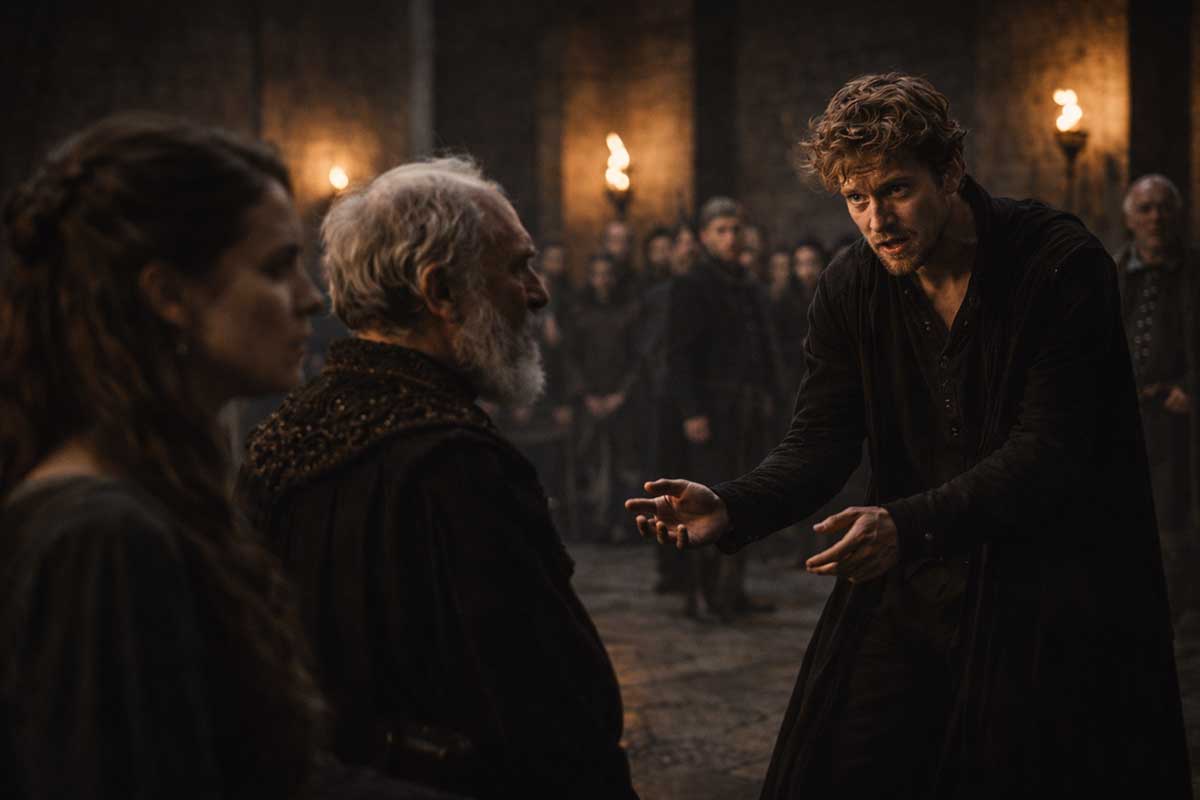
Participants (5 distinct scholars):
- Ann Thompson
- James Shapiro
- Jonathan Dollimore
- Catherine Belsey
- Marjorie Garber
Opening Frame
Ann Thompson
Hamlet is often introduced as a play about madness. But almost immediately it becomes a play about watching. Who is watching whom, who knows they’re being watched, and who is pretending not to know—these dynamics shape every scene. So the central question may not be “Is Hamlet mad?” but “What happens to truth in a world where everyone is performing?”
1. Is Hamlet mad, pretending, or shaped by performance?
Marjorie Garber
Hamlet announces an “antic disposition,” but the brilliance of the play is that once performance begins, it cannot be cleanly separated from reality. Acting changes the actor. Hamlet’s wit sharpens, his cruelty increases, and his isolation deepens. The role begins to write him back.
Catherine Belsey
That slippage is structural. Identity in Hamlet is not stable; it is produced through language and repetition. When Hamlet performs madness, he is not hiding a true self—he is demonstrating how selves are constructed under pressure.
Ann Thompson
This is why performances of Hamlet vary so widely. The text allows for madness to be strategic in one moment and genuinely destabilizing in the next. Shakespeare refuses to mark a clean boundary.
Jonathan Dollimore
And that refusal is political. Madness becomes a way to speak dangerously in a repressive system. Hamlet’s “madness” permits truth-telling precisely because it is discounted. Power listens only when it believes it can safely ignore.
2. How does surveillance destroy private truth?
James Shapiro
Historically, Hamlet reflects a culture anxious about espionage. Elizabethan courts were dense with informants. In the play, nearly every relationship is compromised by spying—Polonius on Hamlet, Claudius on everyone, even parents on children.
Jonathan Dollimore
Surveillance doesn’t just observe—it produces behavior. Hamlet is never alone. His soliloquies feel private, but almost everything else is overheard, staged, or reported. Under such conditions, sincerity becomes dangerous.
Catherine Belsey
Language itself becomes suspect. Words are no longer vehicles of truth but instruments of control. That’s why silence—Ophelia’s especially—becomes so catastrophic. When speech is monitored, silence is misread as emptiness.
Marjorie Garber
Notice how quickly trust erodes. Rosencrantz and Guildenstern don’t need to be villains; they only need to comply. Surveillance doesn’t require cruelty—only participation.
3. Why does performance become safer than honesty?
Ann Thompson
Because honesty has consequences. Ophelia’s obedience destroys her. Polonius’s transparency gets him killed. Hamlet survives longest by speaking indirectly—through jokes, riddles, and staged scenes.
James Shapiro
The play-within-the-play is the clearest example. Hamlet cannot accuse Claudius openly. Instead, he hides truth inside fiction. Theater becomes a safer container for danger than direct speech.
Jonathan Dollimore
This is the paradox of power: truth can only circulate when disguised. Performance becomes the last refuge of critique in a closed system.
Catherine Belsey
Which leaves us with a deeply modern insight: authenticity is not always virtuous. Sometimes it is suicidal. Hamlet exposes how power structures reward performance and punish sincerity.
Closing Reflection
Marjorie Garber
Hamlet is not mad in isolation—he is made unstable by a world that demands masks.
James Shapiro
Surveillance transforms relationships into strategies.
Catherine Belsey
Language becomes a battleground, not a refuge.
Jonathan Dollimore
And madness becomes both weapon and wound.
Ann Thompson (closing)
So when we ask “Is Hamlet mad?” we may be asking the wrong question.
The play’s darker suggestion is this: in a world built on surveillance and performance, sanity itself becomes indistinguishable from acting.
Topic 4 — Who Pays the Price for Male Conflict

Participants (5 distinct scholars):
- Elaine Showalter
- Janet Adelman
- Coppélia Kahn
- Gail Kern Paster
- Lynda Boose
Opening Frame
Elaine Showalter
When readers ask why Ophelia goes mad or whether Gertrude is guilty, they often sense something unfair—but can’t quite name it. Hamlet is not only a tragedy of revenge or thought; it is also a tragedy of gendered exposure, where women absorb pressures created by men’s moral and political conflicts.
1. Why is Ophelia’s madness treated as pathology, while Hamlet’s crisis is treated as philosophy?
Elaine Showalter
Hamlet’s anguish is granted language, soliloquies, and interpretive sympathy. Ophelia’s anguish is medicalized. When she speaks in fragments and songs, the court calls it madness, not insight. Her suffering is not examined—it is contained.
Gail Kern Paster
Early modern psychology viewed women as more porous, emotionally and bodily. Ophelia’s grief is understood not as reasoned despair but as overflow—emotion without control. This cultural lens makes her collapse appear natural rather than tragic.
Janet Adelman
And crucially, Ophelia’s pain has no legitimate outlet. Hamlet can think, accuse, delay. Ophelia can only obey. When obedience becomes impossible—father dead, lover cruel, authority contradictory—her identity disintegrates.
2. Is Gertrude complicit—or structurally silenced?
Coppélia Kahn
Gertrude is often judged as weak or morally careless, but the play gives her remarkably little agency. She moves within a patriarchal system that values her body as political capital. Her remarriage is less a personal failing than a structural demand.
Lynda Boose
Gertrude’s silence is strategic. In early modern family systems, women maintained stability by not asking destabilizing questions. To interrogate Claudius openly would threaten both crown and household. Silence becomes survival.
Janet Adelman
Hamlet’s rage toward Gertrude—especially in the closet scene—reveals his deeper terror: the collapse of maternal purity. He needs Gertrude to be either innocent or monstrous. Her ambiguity is unbearable because it mirrors the world’s moral uncertainty.
3. How does patriarchy determine who survives the play?
Gail Kern Paster
The male characters externalize conflict—through speech, violence, strategy. The female characters internalize it. Ophelia’s madness is not weakness; it is what happens when social pressure has nowhere to go.
Elaine Showalter
Ophelia’s death is tellingly ambiguous. Suicide or accident? The court debates doctrine, not grief. Her body becomes a theological problem rather than a human loss.
Lynda Boose
Meanwhile, Gertrude’s death—often accidental, sometimes staged as sacrificial—confirms her role as collateral damage. The system consumes women to preserve male succession.
Coppélia Kahn
What’s devastating is that neither woman meaningfully disrupts the system. Their suffering is absorbed, normalized, and forgotten by the political machine that continues at the end with Fortinbras.
Closing Reflection
Janet Adelman
Hamlet shows how male moral struggle often displaces its cost onto women.
Gail Kern Paster
Emotion becomes a liability when it cannot be voiced safely.
Coppélia Kahn
Patriarchy survives by redefining women’s pain as private failure.
Lynda Boose
Silence is not consent—it is a strategy forced by power.
Elaine Showalter (closing)
So when we ask whether Ophelia is mad or Gertrude is guilty, we may be missing the larger truth:
the play is structured so that women bear the consequences of conflicts they did not create.
Their tragedy is not psychological—it is systemic.
Topic 5 — What Survives After Meaning Collapses
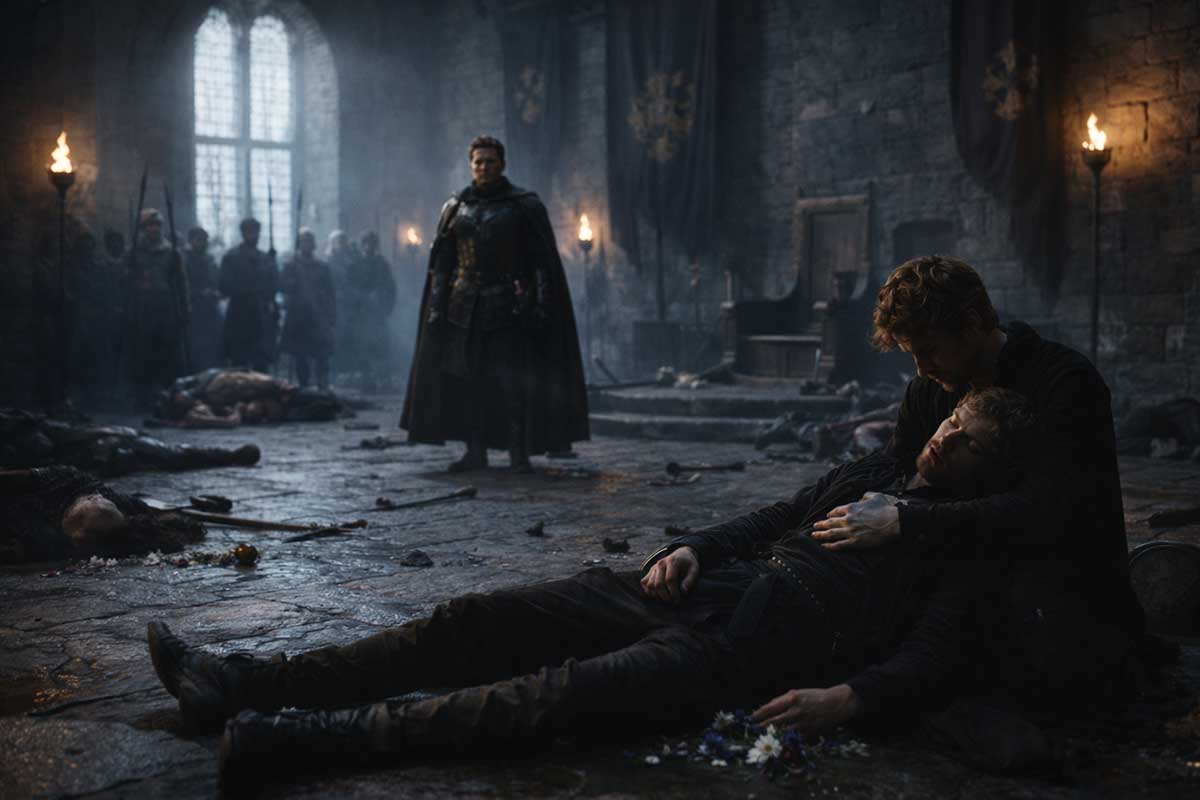
Participants (5 distinct scholars):
- Margreta de Grazia
- Frank Kermode
- Terry Eagleton
- Northrop Frye
- Michael Neill
Opening Frame
Margreta de Grazia
Readers often approach the ending of Hamlet asking what it means. But the play may be asking something more uncomfortable: what systems require bodies in order to resolve themselves? The final act is not only personal tragedy—it is political cleanup.
1. Is the meaning of Hamlet psychological—or systemic?
Margreta de Grazia
Modern readers tend to locate meaning inside Hamlet’s mind. But Shakespeare’s play is less interested in interior growth than in structural consequence. By the end, Hamlet’s thoughts matter less than the fact that Denmark needs a successor. Meaning shifts from consciousness to inheritance.
Terry Eagleton
Exactly. The pile of bodies is not accidental excess—it is how corrupt systems reset themselves. When ideology collapses, violence fills the vacuum. Hamlet exposes how power transitions are rarely ethical; they are simply final.
Michael Neill
And identity dissolves under that pressure. Names, loyalties, and intentions lose relevance once the machinery of succession takes over. What survives is not character—but authority.
2. Why must nearly everyone die for order to return?
Northrop Frye
From a structural perspective, tragedy clears the stage. The old world must be removed entirely before a new one can begin. In Hamlet, partial reform is impossible. The corruption is too deep.
Frank Kermode
Endings promise meaning, but they also expose its limits. The catastrophe feels excessive because it is not morally proportional—it is narratively necessary. Shakespeare denies us the comfort of a “just” ending and gives us a complete one instead.
Terry Eagleton
This is why the violence feels so bleak. No one is rewarded. No virtue guarantees survival. The ending tells us not how to live, but how systems actually end.
3. What does Fortinbras inherit: justice or wreckage?
Michael Neill
Fortinbras arrives not because he is morally superior, but because he is available. He inherits a country emptied of resistance. That is not justice—it is vacancy.
Margreta de Grazia
And Hamlet’s final gesture—naming Fortinbras—is not a triumph of insight. It is an acknowledgment that personal meaning cannot outlast political necessity.
Frank Kermode
The future always arrives, even when it is undeserved. That is one of tragedy’s coldest truths.
Northrop Frye
The play closes not with enlightenment, but with transition. The wheel turns. The pattern continues.
Closing Reflection
Terry Eagleton
Hamlet ends in blood because that is how power resolves contradiction.
Michael Neill
Identity collapses where systems persist.
Northrop Frye
Tragedy restores order—but never innocence.
Frank Kermode
Endings explain less than we hope, but more than we expect.
Margreta de Grazia (closing)
If Hamlet leaves us unsettled, it is because it refuses the fantasy that meaning saves us.
What survives is not truth or virtue—but continuity.
And Shakespeare leaves us to decide whether that is tragedy’s final cruelty—or its deepest honesty.
Final Thoughts by William Shakespeare
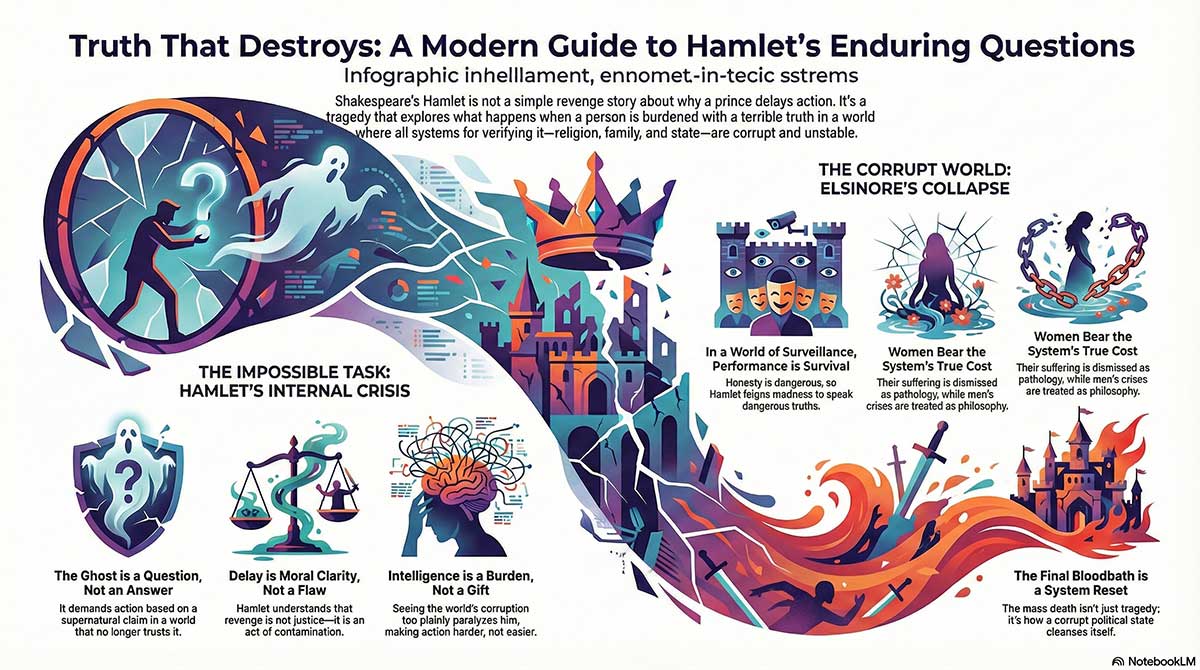
At the end, bodies lie where ideas once stood.
This was not an accident of tragedy.
It was the price of a system that could not change without destroying itself.
You may wish Hamlet had lived.
You may wish he had acted sooner.
You may wish someone, anyone, had remained untouched.
But I did not write Hamlet to comfort you.
I wrote it to show what happens when a world demands obedience while eroding belief,
when thought outruns tradition,
when conscience wakes before authority is ready to answer it.
Fortinbras inherits not wisdom,
but vacancy.
The crown survives.
The thinking does not.
If there is a warning here, it is not against reflection —
it is against pretending reflection can be made harmless.
Truth does not always redeem.
Sometimes it only reveals what must fall.
And if you leave this play unsettled,
that is because Hamlet ends where certainty ends —
not with meaning,
but with continuity.
That is the tragedy.
And that is why it endures.
Short Bios:
William Shakespeare was an English playwright and poet whose works explore power, conscience, identity, and the cost of truth, shaping global literature for over four centuries.
Stephen Greenblatt is a leading Shakespeare scholar and founder of New Historicism, best known for exploring how historical belief systems shape literary meaning, including in Hamlet in Purgatory.
Peter Marshall is a historian of religion whose work focuses on ghosts, purgatory, and belief in early modern England, offering crucial context for understanding Hamlet’s supernatural world.
Eamon Duffy is a renowned historian of Catholic England whose research illuminates the moral obligations to the dead that inform the Ghost’s authority in Hamlet.
David Scott Kastan is a Shakespeare critic whose work examines authority, legitimacy, and political anxiety in Renaissance drama.
Emma Smith is a Professor of Shakespeare Studies at Oxford, known for her clarity in explaining textual uncertainty, performance, and audience interpretation.
Rhodri Lewis is a Shakespeare scholar whose work reframes Hamlet as a tragedy of moral impossibility rather than procrastination.
A. C. Bradley was an influential early 20th-century critic who shaped the psychological reading of Shakespearean tragedy.
Richard Strier is a scholar of Renaissance ethics whose work emphasizes conscience, intention, and moral agency in early modern literature.
Stanley Cavell was a philosopher whose writings explore acknowledgment, skepticism, and moral responsibility in Shakespeare’s plays.
Simon Palfrey is a Shakespeare scholar and performance theorist who studies how dramatic structure creates ethical tension on stage.
Ann Thompson is a major editor of Hamlet for the Arden Shakespeare and an authority on performance, madness, and textual instability.
James Shapiro is a historian of Shakespeare whose work connects the plays to political paranoia and surveillance culture in Elizabethan England.
Jonathan Dollimore is a political Shakespeare critic known for analyzing power, subversion, and ideological conflict in Renaissance drama.
Catherine Belsey is a literary theorist whose work examines language, subjectivity, and identity under systems of power.
Marjorie Garber is a literary critic celebrated for her insights into ambiguity, performance, and identity in Shakespeare.
Elaine Showalter is a feminist critic whose landmark work transformed the understanding of Ophelia, madness, and gender in Hamlet.
Janet Adelman is a Renaissance literature scholar whose work explores family, motherhood, and guilt in Shakespearean tragedy.
Coppélia Kahn is a Shakespeare gender scholar focusing on patriarchy, family power, and masculine identity.
Gail Kern Paster is a scholar of Renaissance psychology whose work examines emotion, the body, and early modern conceptions of the self.
Lynda Boose is a literary scholar known for her analysis of family structures, obedience, and patriarchal authority in Shakespeare.
Margreta de Grazia is a Shakespeare theorist who challenges psychological readings and emphasizes political systems and historical context.
Frank Kermode was a literary critic whose work explores endings, apocalypse, and the human need for meaning in narrative.
Terry Eagleton is a Marxist literary critic whose writings examine ideology, power, and systemic collapse in literature.
Northrop Frye was a foundational literary theorist known for mapping mythic and structural patterns in tragedy.
Michael Neill is a scholar of early modern identity whose work explores violence, inheritance, and the politics of selfhood.
Leave a Reply