

|
Getting your Trinity Audio player ready...
|

Alan Watts:
Ladies and gentlemen—or should I say, fellow manifestations of the cosmic giggle—
You think you’re sitting here, watching some grand metaphysical mash-up. Helena Blavatsky? Comedians? Afterlife? Karma? Cosmic therapy?
How delightfully strange.
But you see, that’s the point.
Life isn’t a problem to be solved—it’s a performance.
The universe, in all its elegance and chaos, has no final destination. It’s not going anywhere. It’s dancing. And in its dance, sometimes it tiptoes… sometimes it trips.
And sometimes—it slips on a banana peel and calls it enlightenment.
Tonight, our dear mystic Helena Blavatsky doesn’t descend to preach from a mountaintop, but rather to pull up a chair in the cosmic comedy club.
She is joined by our planet’s finest jesters—not to make light of truth, but to reveal that truth is light.
These conversations are not about getting it right.
They’re about remembering that we were never wrong to begin with.
So laugh. Not because the world is meaningless.
But because it is too meaningful to ever fully explain.
And that… is why the gods invented stand-up.
(Note: This is an imaginary conversation, a creative exploration of an idea, and not a real speech or event.)

Topic 1: Is the Material World Just One Big Prank?

Moderator: George Carlin
Participants: Helena Blavatsky, Bo Burnham, Mitch Hedberg, Stephen Wright
 Introduction – George Carlin (Moderator)
You ever get the feeling this whole thing is a setup? Like we got born into a game show we didn’t audition for, playing by rules no one remembers writing, judged by people who forgot they're contestants too?
Let’s break it down tonight—this so-called “real” world. Is it real? Or is it a cosmic prank pulled by the universe? A hoax of form and function? A stage play where we forgot we’re the actors?
I’ve got with me four of the weirdest minds to unravel it:
- Helena Blavatsky, the metaphysical maverick who says reality is just Maya.
- Bo Burnham, who makes existential dread rhyme on a piano.
- Mitch Hedberg, a one-liner Buddha who never took this place seriously.
- Stephen Wright, who probably lives in a dimension five inches to the left of ours.
Let’s begin.
 Question 1
If reality is an illusion, why do we still suffer so much?
Bo Burnham
Because illusions still sting when you believe in them. It's like being dumped in a dream—you wake up and it still sucks. We suffer because we treat the illusion like it’s a documentary instead of a dark comedy. I tried turning it into a musical, but even then—pain harmonizes beautifully.
Helena Blavatsky
Suffering is the soul's wake-up call, Bo. Even illusions can be meaningful if they teach detachment. In Theosophy, we see pain not as punishment, but as a misalignment—a reminder that the spirit must not identify with passing shadows. But oh, how attached we are to our shadows.
Mitch Hedberg
I don’t trust stairs. They're always up to something. Same with life. It promises things—happiness, success, sandwiches—but then gives you bills and bunions. I suffer mostly from overly enthusiastic salad. Is it real? No. But I still eat it. And get gas.
Stephen Wright
I bought a map of reality. Folded it up, and suddenly I wasn’t here anymore. Pain? It’s like gravity—only noticeable when you fall. Maybe we suffer because we expect life to behave logically. That was our first mistake.
Question 2
If life is a joke, what’s the punchline?
Mitch Hedberg
The punchline is: you waited your whole life to be serious, and then you died laughing at a cat video. I think the universe is like my uncle—it makes weird noises and nobody understands it, but it means well.
Stephen Wright
The punchline is timing. We think we’re building something eternal. But then—boom—banana peel. Death laughs, life coughs, and you’re reincarnated as a pigeon with anxiety. That’s comedic timing on a cosmic scale.
Bo Burnham
I used to think the punchline was "none of this matters." Now I think it’s “All of this mattered—and then it didn’t.” We think it’s nihilism, but maybe it’s divine absurdity. Laughing at the chaos is the most honest prayer I know.
Helena Blavatsky
The joke is not on us. We are the joke...and the jester, and the audience. The punchline is realizing you were never the ego—you were always the actor playing many roles, and now you can bow, laugh, and move to the next act.
Question 3
If God exists, do they have a sense of humor—and if so, what kind?
Stephen Wright
God must have a dry sense of humor. I mean—platypus. Pineapples. People who believe the Earth is flat but use GPS. That’s not punishment. That’s comedy.
Helena Blavatsky
God is joy, but not superficial joy. A cosmic intelligence beyond duality. Humor is one of the highest vibrations because it disarms the ego. If God laughs, it is at the arrogance of humans thinking they understood everything after reading a pamphlet.
Bo Burnham
God probably invented irony. Like, “Let’s give humans intelligence but make them self-conscious about using it.” If God didn’t have a sense of humor, the internet would’ve been smited long ago.
Mitch Hedberg
God has to be funny. I prayed once, and instead of a sign, a squirrel ran across my foot with a peanut butter jar stuck on its head. I call that divine slapstick.
Closing Thoughts – George Carlin
So what have we learned?
That life’s probably not a documentary—it’s a sketch show run by a divine improv group. That suffering might just be the price of not getting the joke. And that God—if They exist—might be the quiet kid in the back row writing all the best punchlines while we trip over our own expectations.
So loosen up. Laugh at the illusion. You’re not stuck in reality. You’re just playing it straight... in a cosmic comedy club where everyone forgets they’re on stage.
And remember: the laugh track is inside you.
Topic 2: Reincarnation Roulette – Who Were You Last Time?
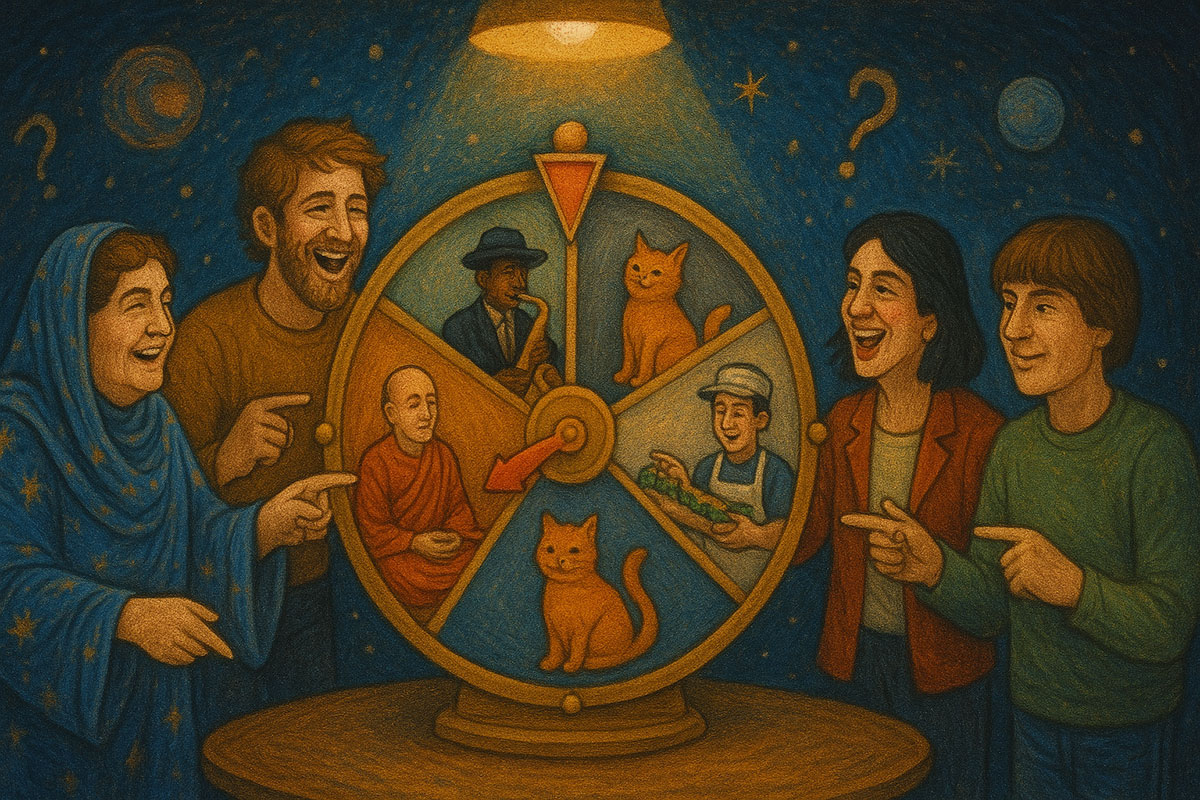
Past Lives, Karma, and Coming Back with Better Material
Moderator: Robin Williams
Participants: Helena Blavatsky, Maria Bamford, Pete Holmes, Eddie Murphy
Introduction – Robin Williams (Moderator)
Ladies and gentlemen—souls, spirits, and recycled stardust—welcome to the wheel of cosmic fortune we call… Reincarnation Roulette! Ding ding ding! You spin the karmic wheel, and BAM! You’re back as a llama. Or a lizard. Or your ex-husband’s dentist. Who knows?
Tonight, we're asking: who were you last time? And why did you have to come back again just to learn patience in traffic?
With me are four hilarious metaphysical travelers:
- Helena Blavatsky, the original mystic who turned reincarnation into a philosophical roadmap.
- Maria Bamford, who may have been a nervous nun in 1300s France.
- Pete Holmes, the eternal golden retriever of spiritual stand-up.
- Eddie Murphy, who probably ruled Egypt, ran a jazz club in Harlem, and played every role in between.
Let’s go around this cosmic carousel.
 Question 1
If you had to guess, who were you in your last life—and what lesson did you not learn?
Maria Bamford
I’m pretty sure I was a deeply anxious monk who rang the temple bell too early and worried about it for three centuries. My lesson? Chill. Also, maybe... let people finish talking before lighting incense?
Eddie Murphy
I must’ve been a spoiled prince. Like, I expected grapes peeled, fan service, the whole nine. But I didn't learn humility. So now? I raise kids who yell at Alexa. Karma, baby.
Helena Blavatsky
In my last incarnation, I was likely a seeker who mistook knowledge for wisdom. I collected sacred texts but forgot to live the teachings. So I came back... still reading, still questioning, still laughing at myself.
Pete Holmes
I think I was a Roman bathhouse attendant. I was too into relaxing. Didn’t question anything—just oils and grapes. Now I ask, “Who am I?” between therapy and podcast tapings. Karma said, “Now think, buddy.”
Question 2
Why do we keep coming back? Is reincarnation a blessing—or cosmic detention?
Helena Blavatsky
We return to refine the soul—to polish the mirror of consciousness. Each life is an opportunity to align more closely with divine will. It may feel like detention, but it is actually curriculum for awakening.
Eddie Murphy
Sounds like summer school to me. Earth is the class where you keep forgetting your locker combination. “Love everyone,” they say. Yeah, tell that to the guy who just cut me off in traffic. But I guess it’s worth retaking.
Pete Holmes
It’s divine comedy! We keep coming back ‘cause God is like, “One more take, let’s try that again—but this time, with a little more compassion.” Life is a blooper reel until we learn how to be present during the punchline.
Maria Bamford
I think Earth is like an escape room with emotional puzzles. You solve one, another door opens. You eat too many jellybeans, and boom—you’re a squirrel next round. It’s... humbling. And very noisy.
Question 3
If you could choose your next incarnation, what would you be—and what would you want to master?
Pete Holmes
I wanna come back as a deeply chill forest monk with a soup ladle. All I do is serve broth, say wise things, and nap. Mastery goal: joy without a Wi-Fi signal.
Maria Bamford
Maybe a calm otter in a protected reserve. I’d master floating... and boundaries. No coaching turtles. Just me, water, and deep inner “no’s.”
Eddie Murphy
I’m coming back as a jazz saxophonist in 1950s New Orleans. No phones, no filters—just rhythm, style, and soul. Mastery goal? Sincerity. I wanna feel every note like it’s my first heartbreak.
Helena Blavatsky
I would choose to return as a child with full memory of my past lives, able to teach without fear, and love without condition. I would seek to master silence—the final teacher of all truths.
Closing Thoughts – Robin Williams
You know what I love about this? Every one of us wants to come back softer, funnier, freer. Not richer, not louder. That tells me something’s working.
Maybe we don’t return because we’re broken—but because we’re unfinished. Like a good joke that just needs a better setup in the next life.
So when you're reincarnated—try not to be a mosquito, okay? Aim higher. Like an enlightened cat. Or an old tree that tells jokes with its roots.
Because the wheel keeps spinning… and the audience? They’re eternal.
Thank you, goodnight, and remember—your soul’s just in costume.
Topic 3: God, Gurus, and Holy Nonsense

Sacred Symbols, Ridiculous Rituals, and the Enlightened Fool
Moderator: Eddie Izzard
Participants: Helena Blavatsky, Hannah Gadsby, Sacha Baron Cohen, Bill Maher
Introduction – Eddie Izzard (Moderator)
Hello, seekers of the sacred, skeptics of the script, and spiritual improv artists. Tonight’s sermon comes in the form of comedy.
You see, religion gave us robes and incense... but also guilt and a deeply suspicious relationship with dancing. Gurus offer enlightenment—but also book deals and private jets. And God? God may or may not be doing stand-up through all of us.
So, tonight, we ask: what is holy, what is hilarious, and what happens when the two collide?
Joining me are:
- Helena Blavatsky, who’s been accused of inventing modern spirituality and astral projection (sometimes in the same afternoon).
- Hannah Gadsby, who deconstructs trauma and transcendence one pause at a time.
- Sacha Baron Cohen, who turns the mirror on our sacred cows—and sometimes milks them for absurdity.
- Bill Maher, who’s more skeptical than a cat at a séance.
Let’s get irreverently reverent.
 Question 1
Why do humans take spirituality so seriously—and should they?
Bill Maher
Because fear sells better than faith. Organized religion realized early on: “Laughter makes people think. Thinking makes people question. Let’s nip that in the bud.” So now we kneel more than we laugh—and that’s a red flag for me.
Helena Blavatsky
Spirituality, when divorced from joy, becomes oppression. But seriousness is the costume ego wears to look enlightened. In truth, the cosmos is a symphony—sometimes grand, sometimes absurd. Laughter can be reverence.
Sacha Baron Cohen
People take spirituality seriously because it’s tied to identity—and once that happens, it's dangerous to laugh. Which is why I make people laugh at themselves. That’s when they wake up… or try to sue me.
Hannah Gadsby
I think we fear being seen as irreverent when we laugh at the sacred. But maybe the divine isn't that fragile. Maybe a chuckle is closer to surrender than a chant. Maybe reverence and irreverence are kissing cousins.
Question 2
What’s the most ridiculous thing we’ve ever declared as ‘sacred’?
Sacha Baron Cohen
One time, I got a politician to bless a bowl of jellybeans while calling for military action. So, yeah—anything can be sacred if the lighting is good and the camera’s rolling.
Hannah Gadsby
I'd say ego. Especially when it's wrapped in a guru beard and selling miracle teas. If your enlightenment needs a marketing team, I’m skeptical.
Helena Blavatsky
Sacredness is not in the object, but the awareness brought to it. However, yes—rituals can devolve into nonsense when their essence is forgotten. Holy water sold in plastic bottles? That’s not sanctity. That’s capitalism in a monk’s robe.
Bill Maher
Organized dogma. Period. The idea that a book, edited by kings, is infallible while comedy gets banned? That’s the joke. Religion asks for tithes—comedy just asks for your time and your willingness to be wrong.
Question 3
If God does exist, what kind of sense of humor do they have—and how should we relate to it?
Helena Blavatsky
God’s humor is cosmic irony: You seek the light, and trip over your own shadow. You desire truth, and life hands you riddles. It’s divine hide-and-seek. Those who laugh at the paradox are already closer to God.
Hannah Gadsby
I think if God exists, She might be non-binary, allergic to dogma, and deeply into satire. Like, “Oh, you thought gender would explain the soul? How quaint.”
Bill Maher
If God exists, He probably weeps laughing at televangelists. And honestly? I’d get along with that version. Any deity who appreciates irony is okay in my book. Well—not that book.
Sacha Baron Cohen
God has to be funny. We cry when we’re born and wear tuxedos to funerals. You can’t script that without being a cosmic comedian. God created free will… then watched us invent cargo shorts. That's punchline enough.
Closing Thoughts – Eddie Izzard
And so, my sacred scallywags, we’ve wandered through incense smoke and infomercials, robes and ridiculousness, gurus and giggles.
We’ve learned that maybe laughter is a form of prayer. That God, if They’re watching, probably isn’t offended—they’re entertained. And that the line between sacred and silly? It's thinner than a monk’s sandals.
So go forth and meditate. Or mock. Or mix both.
But remember—if you meet the Buddha on the road... tickle him.
Topic 4: Death Is Not the End—So Why Are We All So Awkward About It?

The Afterlife, Astral Bodies, and Gallows Humor
Moderator: Bill Hicks
Participants: Helena Blavatsky, Tig Notaro, Norm Macdonald, Phyllis Diller
Introduction – Bill Hicks (Moderator)
Death. The original punchline. The big blackout. The ticket out—or maybe the ticket in.
People say it’s the end, but what if it’s just intermission before your next act? Maybe death isn’t the enemy—maybe it’s the friend that finally shuts you up.
Joining me tonight are four brave souls who dance with the reaper and wink at eternity:
- Helena Blavatsky, who practically commuted between planes of existence.
- Tig Notaro, who turned near-death into a mic-drop.
- Norm Macdonald, whose favorite joke topic was death.
- Phyllis Diller, who made aging, dying, and looking ridiculous into an art form.
Let’s crack open the coffin of awkwardness and see what’s inside.
 Question 1
Why are we so uncomfortable talking about death—when it's the one guarantee?
Norm Macdonald
Because the moment you bring it up, everyone gets nervous—like death is listening and might schedule you sooner. We avoid it like kale. But the truth is, death is just the closing bit. The scary part is realizing how few people applaud.
Phyllis Diller
Because people still think they can Botox their way out of it. I wore wigs, smoked like a chimney, and laughed my way through 60 surgeries—but guess what? I still booked a date with death. Might as well joke about it.
Tig Notaro
People avoid it because it makes things real. But you don’t get realer than hearing “You might die” and then having to feed your cat. The awkwardness comes from pretending we’re not temporary when all of life is basically a lease.
Helena Blavatsky
It is only the personality that fears death. The soul remembers. But modern life divorces us from that remembrance—death becomes a taboo rather than a transition. Awkwardness is born from forgetting our immortality.
Question 2
What do you personally believe happens when we die—and how does that belief change the way you live?
Tig Notaro
I don’t know for sure. But having been that close, I live like someone who’s already used a bonus life. It makes me say “yes” to weird things—like doing stand-up topless after a double mastectomy. I’m not wasting time pretending things aren’t hard or funny.
Helena Blavatsky
We shed the physical garment and return to the astral, then to the causal, reviewing each life like a dream. We are not punished or rewarded—we simply see clearly. Knowing this, I strive to live awake, not just busy.
Phyllis Diller
Honey, if I come back, I want better legs and fewer husbands. But seriously—I believe if there is a place we go, it better have martinis and better lighting. Until then, I laugh at everything. Even death looks better in a punchline.
Norm Macdonald
I think it’s a return to something we forgot. Or maybe we just sleep and dream ourselves into something new. Either way—I tell the jokes now because I won't get the mic later.
Question 3
If the afterlife exists, what’s one thing you’d hope to find there?
Phyllis Diller
A comedy club where every night is ladies’ night and the spotlight makes you look 30 again. Oh, and all your pets are waiting backstage, wagging their tails. If that’s heaven, I’ll take it.
Helena Blavatsky
A library of lives. Where I can sit beside my past selves, sip from the cup of memory, and laugh at how seriously I took the play. I’d like to reunite with those I loved—and those I misunderstood.
Norm Macdonald
A green room with everyone who died before they got to finish their set. I wanna hear the jokes Heaven banned. And maybe get one more laugh from my dad.
Tig Notaro
Peace. Stillness. And maybe... a quiet room with no cancer, no beeping machines, just a gentle breeze and someone who laughs at weird pauses.
Closing Thoughts – Bill Hicks
So what did we learn?
That death is less scary when you look it in the eye—and crack a joke. That our fear of endings keeps us from living now. And that maybe, just maybe, the afterlife is not pearly gates or fiery pits… but an open mic in the sky, where every soul gets to try again—with better lighting.
Laugh, my friends. Because when the lights go out, your laughter echoes where words can’t go.
And that? That’s eternal.
Topic 5: The Universe Is Weird—So Why Aren’t We Laughing More?

Aliens, Dimensions, and Cosmic Laugh Therapy
Moderator: Russell Brand
Participants: Helena Blavatsky, Jim Carrey, Sarah Silverman, Demetri Martin
Introduction – Russell Brand (Moderator)
Welcome, cosmic voyagers and interdimensional jesters! Tonight, we dive into the quivering, undulating weirdness of the universe—a place where stars explode in silence, where time bends like taffy, and where people seriously believe they’re just their LinkedIn profiles.
The universe is weird. Wild. Wonderfully unpredictable. So why are we trying to control it with schedules, spreadsheets, and self-help hashtags?
Tonight’s guests are properly eccentric:
- Helena Blavatsky, who thought outside the box before quantum physics invented the box.
- Jim Carrey, actor turned mystic mime of the multiverse.
- Sarah Silverman, a master of using irreverence to poke at cosmic confusion.
- Demetri Martin, whose one-liners read like sacred geometry translated by a comedian.
Let’s laugh our way through the fabric of space-time.
 Question 1
Why is the universe so strange—and what do we miss when we try to make it normal?
Jim Carrey
The universe is strange because it’s alive. It’s not a machine—it’s an improvisation. We miss everything when we try to cage it with expectations. I once tried to control my life with vision boards... now I meditate and let the void design my day.
Helena Blavatsky
The mystery is not an error—it is the message. Modern man fears what he cannot quantify, so he makes the infinite mundane. But theosophy reminds us: the stranger the universe appears, the closer we are to truth.
Sarah Silverman
People try to normalize the universe because uncertainty makes them gassy. But weirdness is where wonder lives. If you need everything to make sense, you’re gonna hate both the universe and family dinners.
Demetri Martin
Trying to make the universe normal is like drawing a square with spaghetti. It’s never going to look the way you think. So I just assume weird is the default setting—and proceed accordingly.
Question 2
If we could hear the universe laugh, what would it sound like?
Helena Blavatsky
Like the wind through ten thousand dimensions—gentle, ancient, and amused. A laugh that echoes in atoms and in stars. The kind that makes you stop mid-thought and realize you never had control anyway.
Demetri Martin
I think it would sound like a drum machine tripping over itself while reciting a knock-knock joke in Morse code. A cosmic chuckle that's both offbeat... and oddly reassuring.
Jim Carrey
It would sound like every baby’s laugh you’ve ever heard—layered with whalesong, wind chimes, and a coyote who just realized it’s a cartoon. That laugh would free your soul and your taxes.
Sarah Silverman
Like someone who finally farted during meditation. It’s the relief laugh. The “Oh right, I’m not enlightened yet, but I’m trying” kind of laugh.
Question 3
How can we use laughter as a form of cosmic therapy or awakening?
Jim Carrey
Laughter is the sound of the ego cracking. When we laugh deeply, we momentarily forget we’re pretending to be somebody. In that space, awareness rushes in. It’s not a joke—it’s a doorway.
Sarah Silverman
Laughter bypasses all your brain’s bouncers. It’s pure, unfiltered presence. When you laugh, your trauma gets a coffee break. That’s spiritual in a way even yoga pants can’t fake.
Helena Blavatsky
To laugh is to transcend duality, if only for a moment. It harmonizes the mind, body, and soul into a vibration closer to the divine. It is the song of liberation disguised as silliness.
Demetri Martin
I think of laughter as a universal reset button. Like a sneeze for the soul. It clears the mind, refocuses the heart, and reminds you that existence... is a little bit ridiculous.
Closing Thoughts – Russell Brand
So we’ve gathered here like stardust in stand-up form, asking the most sacred question of all: Why so serious?
The universe—this wildly improbable, holographic symphony of space and story—isn’t asking us to understand it. It’s asking us to dance with it, laugh with it, cry with it, then maybe do some cosmic karaoke.
Because humor isn’t trivial—it’s transformational. It's what happens when the soul forgets to pretend.
So let’s laugh—not just because life is hard...
But because life is cosmic jazz, and we’re all improvising.
Namaste—and also… ba-da-bing.
Final Thoughts – Alan Watts
And so, what have we done here?
We’ve spoken of death, karma, sacred nonsense, and alien punchlines.
We’ve wandered into graveyards with teacups and floated in comedy clubs above Saturn.
We’ve seen reincarnation as a roulette wheel and God as a very cheeky playwright.
But what we’ve really done is this:
We’ve remembered that behind the mask of seriousness...
Behind the veil of fear...
Behind the suit-and-tie illusion of “having it together”...
There is a child.
There is a soul.
There is a laugh.
And that laugh is not mocking the world.
It is waking up inside it.
Helena Blavatsky, bless her paradoxical soul, once said:
“There is no religion higher than truth.”
I would only add:
And no truth higher than laughter.
So go now—not in solemn silence, but in joyful absurdity.
The universe is your stage. The spotlight is already on.
Take your bow.
And please... don’t forget to laugh.
Short Bios:
Helena Blavatsky: Russian mystic, co-founder of the Theosophical Society, and pioneer of modern esotericism. Known for exploring reincarnation, karma, and the unity of all spiritual traditions.
Alan Watts: British philosopher and speaker who popularized Eastern philosophy in the West, blending Zen, Taoism, and humor in poetic, accessible talks about life’s mystery and joy.
Bo Burnham: American comedian, musician, and filmmaker known for blending meta-humor with existential themes and emotional depth in performances like Inside.
Mitch Hedberg: Cult-favorite stand-up comedian known for his surreal one-liners and stoner-philosopher stage presence. Celebrated for his wit and unconventional delivery.
Stephen Wright: Deadpan comedian and master of absurdist logic. His dry, monotone delivery reveals profound truths through bizarre, brain-twisting jokes.
Maria Bamford: Acclaimed comedian who channels personal struggles and mental health into quirky, vulnerable comedy. Known for her wide vocal range and honesty.
Pete Holmes: Stand-up comic and podcast host of You Made It Weird, exploring spirituality, religion, and joy with a comedic, seeker’s heart.
Eddie Murphy: Legendary comedian and actor whose vibrant characters and satirical genius shaped modern comedy, with a spiritual curiosity emerging in later years.
Hannah Gadsby: Australian comedian and writer whose groundbreaking show Nanette challenged the boundaries of stand-up, weaving trauma and social critique with razor wit.
Sacha Baron Cohen: Provocative satirist and creator of characters like Borat and Ali G, known for using comedy to expose cultural and political absurdities.
Bill Maher: Political comedian and host of Real Time, known for his sharp critiques of religion, dogma, and modern hypocrisy, with a biting but intellectual style.
Tig Notaro: Comedian celebrated for her calm delivery and courageous vulnerability, often turning life’s darkest moments—like illness and loss—into quiet comedic gold.
Norm Macdonald: Revered for his philosophical deadpan and fearless comedy, often revolving around death, truth, and awkward silences. A comic’s comic with deep soul.
Phyllis Diller: Trailblazing female comedian known for her self-deprecating humor, outrageous outfits, and witty takes on aging, death, and womanhood.
Russell Brand: British comedian and spiritual author known for his transformation from wild provocateur to mystic commentator on awakening, addiction, and cosmic love.
Jim Carrey: Iconic actor and comedian who turned toward art, metaphysics, and consciousness in later life, exploring the illusion of ego and the freedom of presence.
Sarah Silverman: Stand-up comedian and actress who mixes controversial satire with emotional honesty, often exploring religion, identity, and mortality.
Demetri Martin: Visual and verbal comic known for clever one-liners, diagrams, and musings that blend math, philosophy, and minimalist absurdism.
Bill Hicks: Countercultural comedy icon who merged sharp political critique with psychedelic spirituality, urging audiences to wake up to the illusion of society.
Leave a Reply