

|
Getting your Trinity Audio player ready...
|
What if Ernest Hemingway Discussed with Scholars the Choice That Ends Love?
Introduction — by Ernest Hemingway
I wrote “Hills Like White Elephants” because there are things people talk around instead of through. Life is full of them. The most important moments often arrive quietly, without speeches or explanations, and they reveal themselves not in what is said, but in what is carefully avoided.
This story is short because the moment it captures is narrow, but the weight inside it is heavy. Two people sit at a table. They drink beer. They talk. Nothing happens—and everything happens. The man believes he is being reasonable. The woman understands that reason is not the same thing as truth. Between them stands a decision that will shape who they become, whether they admit it or not.
I did not name the operation because naming it would have made it easier. Life rarely gives us that courtesy. People often hide behind pleasant language when they are afraid to face what they are asking of someone else. In this story, the man speaks in reassurance, logic, and repetition. The woman speaks in images, pauses, and silences. They are not having the same conversation, even when they are speaking to each other.
The hills matter because they show us how differently people see the same world. One sees inconvenience. The other sees possibility. The land on one side of the tracks is dry and barren; on the other, it is green and alive. The choice is never stated, because the story is not about the choice itself—it is about what happens when love is tested by comfort, fear, and the desire to keep life simple.
If this story unsettles you, it should. It is meant to.
(Note: This is an imaginary conversation, a creative exploration of an idea, and not a real speech or event.)
Topic 1 — The Operation That Cannot Be Named

Setting: A quiet train station in the Ebro Valley. Heat hangs in the air. The rails divide the land. Drinks sit untouched longer than they should.
First question is raised
Nick Sasaki
Why does Hemingway refuse to name the operation, and what would be lost if the word were spoken aloud?
Ernest Hemingway
Because the moment you say the word, the story becomes an argument instead of a moment. I wasn’t interested in telling readers what to think. I wanted them to sit where the characters sit, inside the discomfort. Naming the operation would let the reader step back and judge. Silence keeps them trapped in the conversation. What would be lost is tension—the kind that exists when something matters too much to say cleanly.
Elaine Showalter
What would be lost is the man’s advantage. Silence allows him to frame the situation as abstract and manageable. The girl lives in the physical reality of it, but without language that gives her ground to stand on. Naming the operation would force the man to confront the material consequences he’s trying to smooth over. The silence protects him far more than it protects her.
Harold Bloom
Naming collapses ambiguity, and ambiguity is the soul of this story. The operation exists in the same space as fate in classical tragedy—everyone knows it’s there, but no one wants to summon it directly. Once spoken, the word would demand recognition of loss. Hemingway understands that avoidance is a form of prophecy. What’s unsaid is already deciding the future.
Sandra Gilbert
Silence here is not neutral. It is gendered. Historically, women have been forced to carry bodily realities without language while men negotiate outcomes abstractly. By refusing to name the operation, the man converts a bodily risk into a philosophical inconvenience. That conversion is power. Naming would re-anchor the conversation in the woman’s body—and that’s exactly what the man resists.
Second question follows
Nick Sasaki
Is the silence around the operation an act of discretion—or a way of shifting responsibility away from the man?
Ernest Hemingway
It’s both, and that’s why it works. People rarely speak directly when they’re afraid of consequences. The man talks the way people do when they want to appear generous without surrendering control. Silence allows him to say, “It’s your choice,” while never stepping back emotionally. Responsibility drifts, and drifting feels safer than standing still with it.
Elaine Showalter
This is classic displacement. He presents himself as supportive, but the structure of the conversation keeps pressure on the girl. Discretion would require mutual protection. What’s happening instead is a quiet transfer of burden. The man gets emotional cleanliness; the woman absorbs ambiguity, fear, and consequence. Silence becomes a moral laundering system.
Harold Bloom
Responsibility in this story behaves like gravity—it pulls toward the woman no matter how the language is arranged. The man’s calm repetition is not cruelty; it’s self-preservation. He senses that if responsibility settles fully on him, something irreparable will be acknowledged. Silence delays that reckoning.
Sandra Gilbert
We should be very clear: discretion protects privacy; this silence protects comfort. The girl is repeatedly asked to reassure the man emotionally while making a decision that will permanently alter her life. Silence lets him feel benevolent without being accountable. That asymmetry is the real violence of the scene.
Third question closes the topic
Nick Sasaki
When language avoids reality, who benefits from that avoidance?
Ernest Hemingway
The one who can live with uncertainty more easily. In this case, the man. He doesn’t have to change his life in the same way. Avoidance gives him room to keep imagining things going back to “normal.” The girl doesn’t have that luxury.
Elaine Showalter
The person least affected by the outcome always benefits from vagueness. Avoidance preserves freedom for one side while narrowing it for the other. The man benefits because his future remains open no matter what happens. The girl’s does not.
Harold Bloom
Avoidance benefits illusion. And illusion, in literature, is always temporary. Hemingway allows the reader to feel that fragility. The silence isn’t sustainable; it merely postpones collapse. That postponement is the emotional heart of the story.
Sandra Gilbert
Avoidance benefits systems that already privilege male desire and mobility. The girl’s metaphors—the hills, the landscape—are her attempt to speak truth without permission. The man’s refusal to engage those metaphors shows who benefits from keeping language narrow.
Nick Sasaki
What strikes me is how contemporary this feels. We still avoid naming things when naming them would force us to choose differently. Silence feels polite, but it often carries more pressure than words ever could. In this story, avoidance doesn’t prevent harm—it organizes it.
The drinks are finished.
The train will arrive soon.
Nothing has been decided out loud.
Topic 2 — Who Is Really Choosing?

Setting: The same station. The same table. The same heat.
What has changed is not the situation—but the pressure inside it.
The next question enters the space
Nick Sasaki
When the man says, “I don’t want you to do anything you don’t want to do,” is he offering freedom—or applying pressure disguised as care?
Ernest Hemingway
People often say the right words when they’re afraid of saying the honest ones. The man believes he’s being generous because he isn’t issuing a command. But freedom isn’t just about permission—it’s about conditions. When someone knows what you want them to choose, saying “it’s up to you” doesn’t erase that gravity. It just hides it behind politeness.
bell hooks
This is a textbook example of emotional coercion framed as love. Care without accountability is not care—it’s control with a softer voice. The man’s statement sounds respectful, but it’s spoken inside a relationship where the consequences fall unevenly. Freedom offered under unequal conditions is not freedom; it’s pressure that pretends to be kindness.
Judith Butler
Choice here is performative. The man repeats the language of autonomy while structuring the conversation so that only one outcome preserves the relationship as it exists. The girl’s “choice” must align with his desire for continuity. When consent is shaped by fear of loss, it becomes deeply compromised.
Leo Bersani
What’s striking is how desire operates defensively. The man isn’t trying to dominate; he’s trying to preserve a version of himself unburdened by consequence. His care is sincere—but sincerity does not neutralize asymmetry. The pressure comes from his need for things to stay light, simple, and unchanged.
The conversation deepens
Nick Sasaki
How does repetition function in the man’s language—reassurance, persuasion, or quiet coercion?
Ernest Hemingway
Repetition is nervousness pretending to be certainty. The man repeats himself because he doesn’t trust the situation to hold together on its own. Each repetition is a way of steadying himself. But repetition also wears down resistance. That’s where reassurance turns into pressure, even if unintentionally.
bell hooks
Repetition is how power normalizes itself. The more something is said calmly, the more it begins to sound inevitable. This is not shouting. This is erosion. The girl is being asked to absorb the man’s anxiety so he doesn’t have to sit with it alone.
Judith Butler
Language shapes reality through repetition. By constantly framing the operation as “simple” and “nothing,” the man is attempting to produce that reality through speech. But language cannot erase embodied consequence. The gap between words and reality is where the girl’s distress lives.
Leo Bersani
Repetition also reveals fragility. The man’s identity depends on the story he’s telling—that life will return to ease. The more he repeats it, the more we sense it’s untrue. Coercion doesn’t always come from strength. Sometimes it comes from desperation.
The final question of the topic lands quietly
Nick Sasaki
Can a choice still be free when one person’s future depends on preserving the other’s comfort?
Ernest Hemingway
No. Not entirely. Freedom requires the ability to imagine loss. The girl understands that something will be lost no matter what. The man is trying to avoid loss altogether. That difference alone makes the choice uneven.
bell hooks
Love that demands one person absorb all the risk is not love—it’s convenience. A choice made under threat of emotional abandonment is already constrained. Freedom without safety is not freedom.
Judith Butler
Agency is relational. When the relationship itself is the cost of refusal, the choice is structurally coerced. The girl’s silence is not passivity—it is the sound of limited options.
Leo Bersani
What’s tragic is that neither of them is entirely wrong. The man wants a future without rupture. The girl wants recognition of what rupture means. Their desires are incompatible, and the language of “choice” cannot reconcile that.
Nick Sasaki
This is where the story quietly breaks the illusion that choice exists in a vacuum. Decisions are never made alone—they’re made inside relationships, power dynamics, and fear of loss. By the end of this exchange, it’s already clear: whatever happens next, the balance between them will not survive unchanged.
The train is closer now.
The silence between them is heavier than before.
Topic 3 — The Landscape That Knows More Than the Characters

Setting: The table remains. The drinks are refreshed.
Beyond the station, the land stretches in two directions—green and dry, fertile and barren—without asking anyone to choose.
The first question rises naturally
Susan Sontag (moderator)
Why does the girl see the hills as white elephants, while the man dismisses the image almost immediately?
Ernest Hemingway
Because metaphor comes from feeling before it comes from logic. The girl sees the hills and feels something—weight, rarity, consequence. The man hears the metaphor and moves to shut it down because metaphors complicate things. They invite meanings he doesn’t want to face. For him, clarity means control. For her, metaphor is the only honest language left.
Joseph Campbell
White elephants have always symbolized something precious, burdensome, and impossible to ignore. The girl intuits this without naming it. She’s recognizing the mythic dimension of her situation—a gift that cannot be returned, a responsibility that cannot be undone. The man rejects the metaphor because myth demands reckoning, not management.
Northrop Frye
This is a classic symbolic polarity. The girl’s metaphor opens the story outward, toward archetype and consequence. The man’s dismissal pulls it back toward realism and utility. Literature often stages conflict this way: one character speaks in symbols because they sense meaning; the other resists because symbols destabilize control.
Edward Said
The metaphor also exposes positional difference. The man is a traveler, comfortable moving through landscapes without belonging to them. The girl responds to place emotionally. She is already imagining permanence. The hills become a projection of futures—one acknowledged, one denied.
The second question deepens the terrain
Susan Sontag
How does the divided landscape reflect two incompatible futures standing side by side?
Ernest Hemingway
I wanted the land to say what the characters couldn’t. One side is dry, lifeless. The other is fertile, with a river. Neither side is labeled good or bad. They simply exist. The tragedy is that both futures cannot be lived at once. The station is the pause between them.
Joseph Campbell
This is the crossroads motif found in countless myths. Once you move forward, the other path becomes imaginary. The girl feels this instinctively. The man wants to believe paths can be revisited. But myths are clear about one thing: choosing always means leaving something behind.
Northrop Frye
The landscape externalizes the story’s structure. Hemingway strips away internal monologue and lets geography do the work. The division isn’t symbolic decoration—it’s narrative architecture. The story could not exist without this split world.
Edward Said
There’s also an imperial logic here. The man treats place as temporary, interchangeable. The girl treats it as meaningful. That difference mirrors their emotional positions. One is oriented toward continuity; the other toward consequence.
The final question settles slowly
Susan Sontag
Why does the natural world in this story seem more honest than the dialogue?
Ernest Hemingway
Because nature doesn’t negotiate. It doesn’t reassure. It doesn’t soften its meaning. The land simply is. The characters talk around the truth; the landscape holds it plainly. Readers feel that contrast even if they can’t articulate it.
Joseph Campbell
Nature often carries what humans refuse to name. When speech becomes evasive, the world itself becomes the storyteller. That’s why the hills linger in readers’ minds long after the conversation fades.
Northrop Frye
Dialogue here is defensive. Landscape is declarative. Hemingway uses the oldest literary strategy: when people cannot speak truthfully, the setting will do it for them.
Edward Said
The landscape is honest because it cannot be persuaded. It does not need agreement. It presents reality without asking permission. That makes it threatening—and necessary.
Susan Sontag
What’s striking is that the girl’s metaphor is never corrected by the story. The man dismisses it, but the narrative does not. The hills remain. The division remains. The world keeps its meaning even when the characters refuse to face it.
The train has not arrived yet.
But the land has already spoken.
Topic 4 — The Sentence That Ends the Relationship
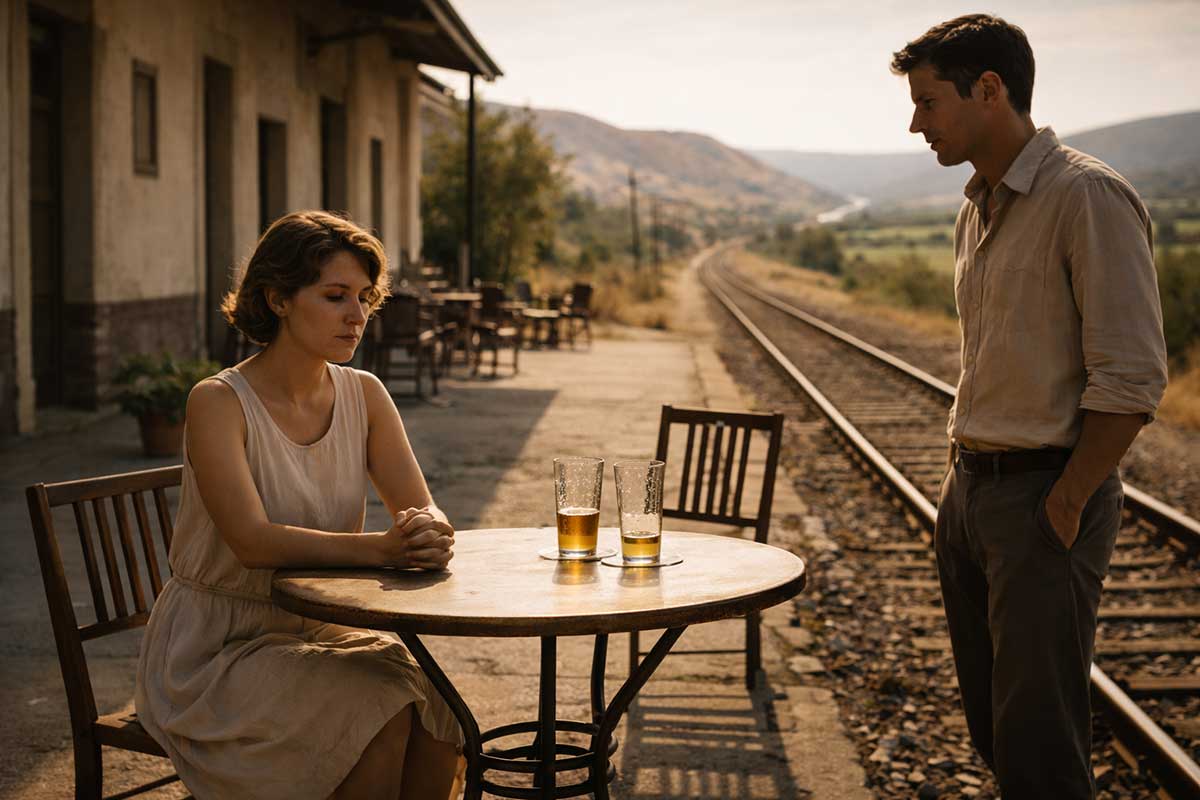
Setting: The same table. The same station.
But something irreversible has already happened—without either of them agreeing to it.
The next question enters quietly
James Wood (moderator)
When the girl says, “I feel fine,” is she lying to the man, protecting herself, or ending the conversation entirely?
Ernest Hemingway
She’s doing all three at once. That sentence isn’t about truth or falsehood—it’s about control. She has been talked at for most of the story. This is the first time she closes the door. “I feel fine” isn’t reassurance; it’s a refusal to continue. That’s why it lands so hard.
Wayne C. Booth
Narratively, it’s a terminal sentence. It shuts down interpretation within the story while opening it for the reader. Reliability isn’t the issue here. Finality is. The girl isn’t asking to be believed; she’s ending participation. That distinction matters.
Roland Barthes
This is language withdrawing from meaning. When speech no longer seeks understanding, it becomes a wall. “I feel fine” functions as a blank signifier—it says nothing, and therefore everything. The conversation dies because language itself has stepped away.
Martha Nussbaum
Emotionally, this is a survival move. The girl has exhausted her attempts to be heard. At some point, continued vulnerability becomes self-harm. This sentence is not peace—it’s retreat. And retreat is sometimes the only ethical option left.
The pressure sharpens
James Wood
What does that final sentence do to the relationship that words earlier in the story could not?
Ernest Hemingway
Earlier words were negotiations. This sentence is a boundary. Once spoken, the relationship can’t return to its previous rhythm. Something essential—trust, intimacy, openness—has already been sealed off. Nothing dramatic happens, but something decisive does.
Wayne C. Booth
Structurally, this is the story’s climax. There is no action afterward because no action is needed. The emotional arc has completed itself. The reader senses that whatever decision follows, the relationship as it existed is over.
Roland Barthes
This is the death of dialogue. Not argument, not anger—absence. The most violent rupture in relationships is often silence that arrives after speech has failed. Hemingway understood this precisely.
Martha Nussbaum
Ethically, this moment forces us to acknowledge emotional cost. A relationship that cannot hold honest speech cannot hold shared futures. The sentence doesn’t announce loss—it confirms it.
The final question settles like dust
James Wood
Is emotional withdrawal here a form of survival—or a quiet form of loss?
Ernest Hemingway
Both. Survival always costs something. The girl survives by withdrawing, but what’s lost is the possibility that she could be met honestly. That loss isn’t loud. It’s final.
Wayne C. Booth
From a narrative perspective, withdrawal preserves the self at the expense of connection. The story doesn’t judge her for this. It simply shows what happens when language fails repeatedly.
Roland Barthes
Withdrawal is meaning refusing circulation. It protects the speaker, but it leaves the relationship empty. That emptiness is the true ending of the story.
Martha Nussbaum
I would say it’s an ethically understandable loss. Sometimes the most humane choice is to stop offering oneself where one is not truly seen. The tragedy is not the withdrawal—it’s that it became necessary.
James Wood
The story ends without movement because the emotional movement has already occurred. The sentence “I feel fine” does not resolve anything—but it ends everything.
The train will arrive.
But the relationship has already departed.
Topic 5 — Love Without a Future
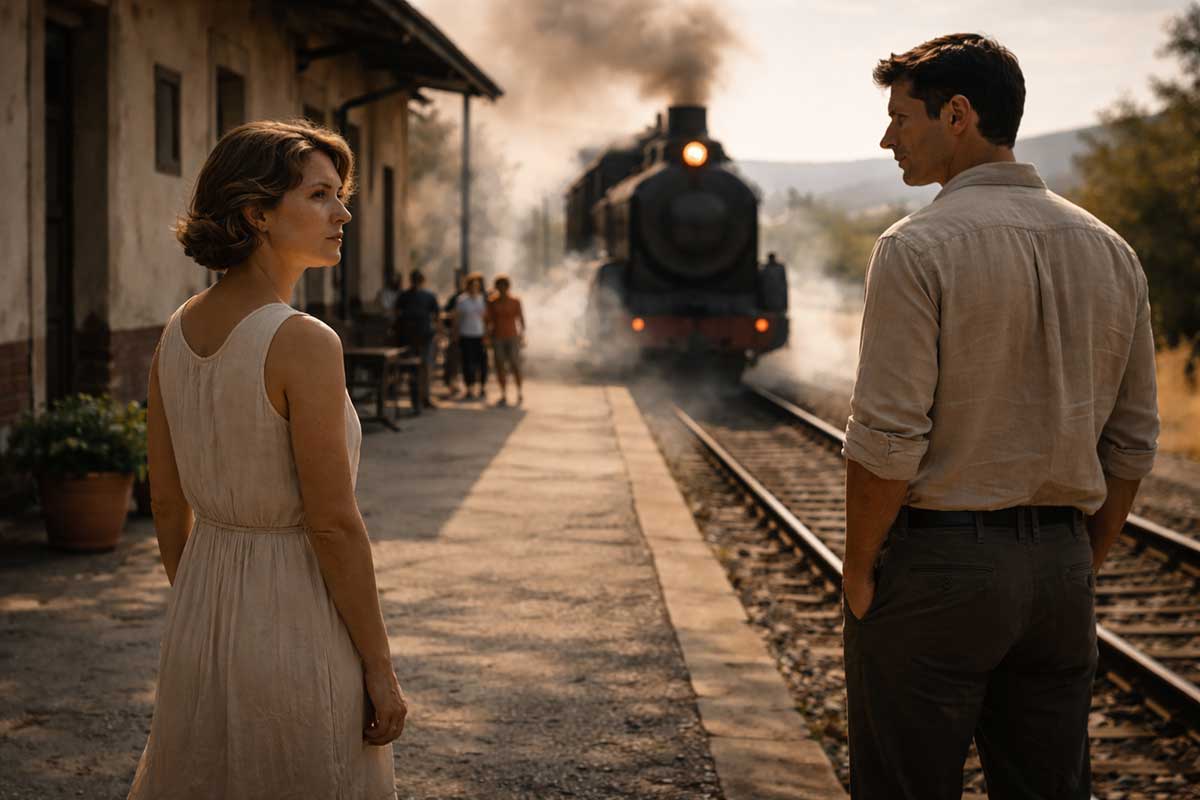
Setting: The station just before departure.
The air feels lighter, but only because something heavy has already been set down.
The final question opens the space
Nick Sasaki (moderator)
Is this story ultimately about abortion—or about what happens when love is asked to exist without consequence?
Ernest Hemingway
It’s not about the operation. That’s just the pressure point. The story is about what happens when two people want incompatible futures and pretend they don’t. Love can survive many things, but it cannot survive the refusal to acknowledge consequence. The man wants love without weight. The girl knows weight is unavoidable.
Simone de Beauvoir
This is a story about freedom misunderstood. The man equates freedom with the absence of responsibility. But real freedom requires acknowledging how one’s choices bind others. Love without consequence is not love—it’s avoidance dressed up as intimacy.
Zygmunt Bauman
This is a perfectly modern relationship. Flexible, mobile, non-committal. What collapses here is not affection, but durability. The man wants a relationship that can be paused, reversed, and resumed. The girl senses that some choices cannot be liquidated without loss.
Albert Camus
The tragedy is not moral failure; it’s existential mismatch. One character accepts that life involves irreversible decisions. The other resists that truth. When two people disagree about the nature of reality itself, love becomes unsustainable.
The conversation moves toward synthesis
Nick Sasaki
If love requires choosing a future together, what does it mean when one person insists on keeping all futures open?
Ernest Hemingway
It means the future is already divided. You can’t stand forever at the station pretending trains aren’t leaving. The man wants the option to step back into ease. The girl understands that ease has already passed.
Simone de Beauvoir
Keeping all futures open often means keeping oneself uncommitted to another’s vulnerability. That asymmetry erodes love quietly. The girl’s suffering comes from realizing that she is already more invested in consequence than he is.
Zygmunt Bauman
Modern love often collapses at this point—when openness becomes a refusal to choose. Commitment is frightening because it closes doors. But love without closure becomes shallow, fragile, and easily abandoned.
Albert Camus
This is the absurd condition of love: wanting permanence in a world that demands decision. The girl accepts absurdity by facing consequence. The man denies it by chasing comfort. That divergence ends them.
The final question lands, gently but firmly
Nick Sasaki
By the end of the story, has a decision been made—or has the relationship already ended regardless of the outcome?
Ernest Hemingway
The decision doesn’t matter anymore. The relationship has already changed shape. Even if the operation happens—or doesn’t—the trust that held them together has been compromised. That’s the real ending.
Simone de Beauvoir
The relationship ends when recognition ends. Once one partner no longer feels seen as an equal subject, love becomes untenable. That moment has already passed.
Zygmunt Bauman
This is not a dramatic breakup. It’s a quiet expiration. Many modern relationships end this way—not with conflict, but with emotional thinning.
Albert Camus
Nothing dramatic needs to happen for something to be over. Sometimes awareness alone is enough. The girl’s final calm is not peace—it’s clarity.
Nick Sasaki
What’s haunting is that the story ends without telling us what choice was made—because the deeper choice has already occurred. The future they shared has quietly disappeared. And Hemingway leaves us at the station, knowing exactly when it happened, even if we can’t point to the moment.
The train arrives.
The story ends.
But the silence stays with us.
Final Thoughts by Ernest Hemingway

People often ask what decision is made at the end of this story. That question misses the point. The story ends before certainty arrives, because certainty is not what defines human relationships. What defines them is how people speak when something important is at stake—and whether they truly listen.
The man believes that saying “I only want what you want” absolves him of responsibility. The woman understands that wanting the same thing does not mean wanting it for the same reasons. She learns, quietly, that being agreeable can cost more than being honest. When she says she feels fine, it is not a victory or a surrender. It is a boundary.
The train arrives because life does not wait for clarity. Decisions are often made in motion, not reflection. The sound of the train drowns out conversation the way time drowns out hesitation. Whatever happens next will happen quickly, and it will not feel dramatic in the moment—only later, when the consequences settle in.
I wrote this story to show how people negotiate power without admitting it, how love can become persuasion, and how silence can be both protection and loss. There are no villains here, only people trying to avoid pain—and discovering that avoidance has a cost of its own.
If you understand this story, it is because you have stood at a table like this one before. And if you haven’t yet, you will.
Short Bios:
Topic 1 — Silence as Power
Ernest Hemingway
American modernist writer whose iceberg theory shaped Hills Like White Elephants, using omission and restraint to force readers into moral participation.
Carlos Baker
Foundational Hemingway biographer who clarified how Hemingway’s minimalism conceals ethical struggle beneath conversational surface.
Paul Smith
Literary theorist specializing in power dynamics in dialogue, especially how persuasion operates through apparent calm and reasonableness.
Lisa Tyler
Hemingway scholar known for close readings of gender, silence, and emotional leverage in modernist short fiction.
Mark Cirino
Editor and Hemingway specialist focusing on textual nuance, structure, and how small linguistic choices carry disproportionate moral weight.
Topic 2 — Gender, Choice, and Asymmetry
Ernest Hemingway
Explores relational imbalance by refusing interior monologue, exposing how power operates through what is not said.
Linda Wagner-Martin
Leading feminist critic whose work reframes Hemingway’s women as emotionally perceptive figures constrained by male narrative dominance.
Debra Moddelmog
Scholar of gender and sexuality in modernism, examining how choice and bodily autonomy are negotiated in constrained conversations.
Susan F. Beegel
Hemingway scholar emphasizing empathy and ethical listening, particularly in stories where women’s silence carries moral authority.
Nancy R. Comley
Literary critic focused on female agency and the cost of accommodation in early 20th-century fiction.
Topic 3 — Language as Evasion
Ernest Hemingway
Uses euphemism deliberately, forcing readers to confront how language can anesthetize moral consequence.
Kenneth S. Lynn
Biographer and critic who examined Hemingway’s fear of emotional exposure and reliance on verbal control.
Stanley Renner
Modernist scholar known for analyzing evasive speech and rhetorical deflection in minimalist prose.
Scott Donaldson
Hemingway biographer who explored how emotional avoidance shapes character psychology and narrative tension.
Verna Kale
Critic focusing on indirect discourse and how conversational normalcy disguises coercion.
Topic 4 — The Female Interior World
Ernest Hemingway
Constructs the woman’s inner life through gesture, metaphor, and silence rather than explanation.
Judith Fetterley
Feminist literary theorist whose work challenges male-centered readings and restores female interpretive authority.
Mary Allen
Early critic of modernist gender roles, emphasizing how women’s restraint often signals deeper awareness.
Hilary K. Justice
Scholar examining how women’s emotional labor sustains male equilibrium in modern fiction.
Susan Gubar
Literary critic known for uncovering suppressed female consciousness beneath minimalist male narratives.
Topic 5 — Endings Without Closure
Ernest Hemingway
Rejects resolution to mirror lived experience, where decisions occur without narrative confirmation.
Philip Young
Hemingway critic who identified the “code hero” ethic and its moral limits in intimate relationships.
Michael Reynolds
Biographer connecting Hemingway’s life patterns to his resistance to emotional finality.
David Lodge
Novelist and critic who analyzed open endings as reader-activating devices in modernist fiction.
James Phelan
Narrative theorist focusing on ethical responsibility created by unresolved conclusions.
Leave a Reply