

|
Getting your Trinity Audio player ready...
|
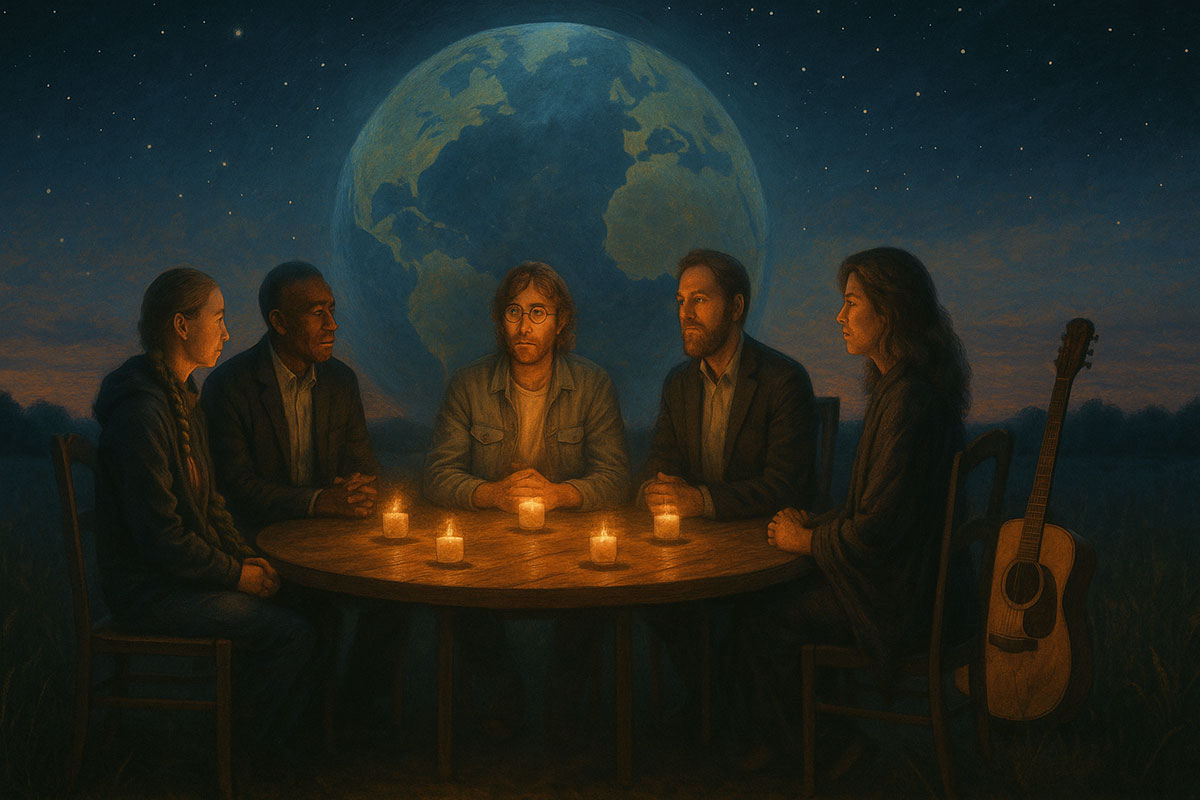
John Lennon:
You know, when I wrote Imagine, I wasn’t trying to start a religion. I was just having a go at shaking up the ones already mucking things up. I wrote it in my pyjamas, on a white piano, with a heart full of anger and a soul full of hope.
People thought it was utopian. But to me, it was dead simple: what if we just stopped pretending we were so different?
In 2025, you’ve got machines that talk like prophets, billionaires trying to move to Mars, and kids marching for a livable planet. Still feels like the dream’s hanging in the air, doesn’t it?
So tonight, we gather—not to argue, but to wonder.
What if there were no heaven or hell to bribe or burn us?
What if lines on a map stopped deciding who we care about?
What if we stopped owning everything, and started cherishing what can't be bought?
What if we loved each other not because we had to, but because it’s the only thing that ever really worked?
What if… we shared?
Not just food. Or land. Or money. But time. Attention. Grace.
You may say I’m a dreamer.
But maybe you are too.
And maybe that’s the point.
(Note: This is an imaginary conversation, a creative exploration of an idea, and not a real speech or event.)

Topic 1: No Heaven, No Hell — Can We Live Without Fear of Judgment?
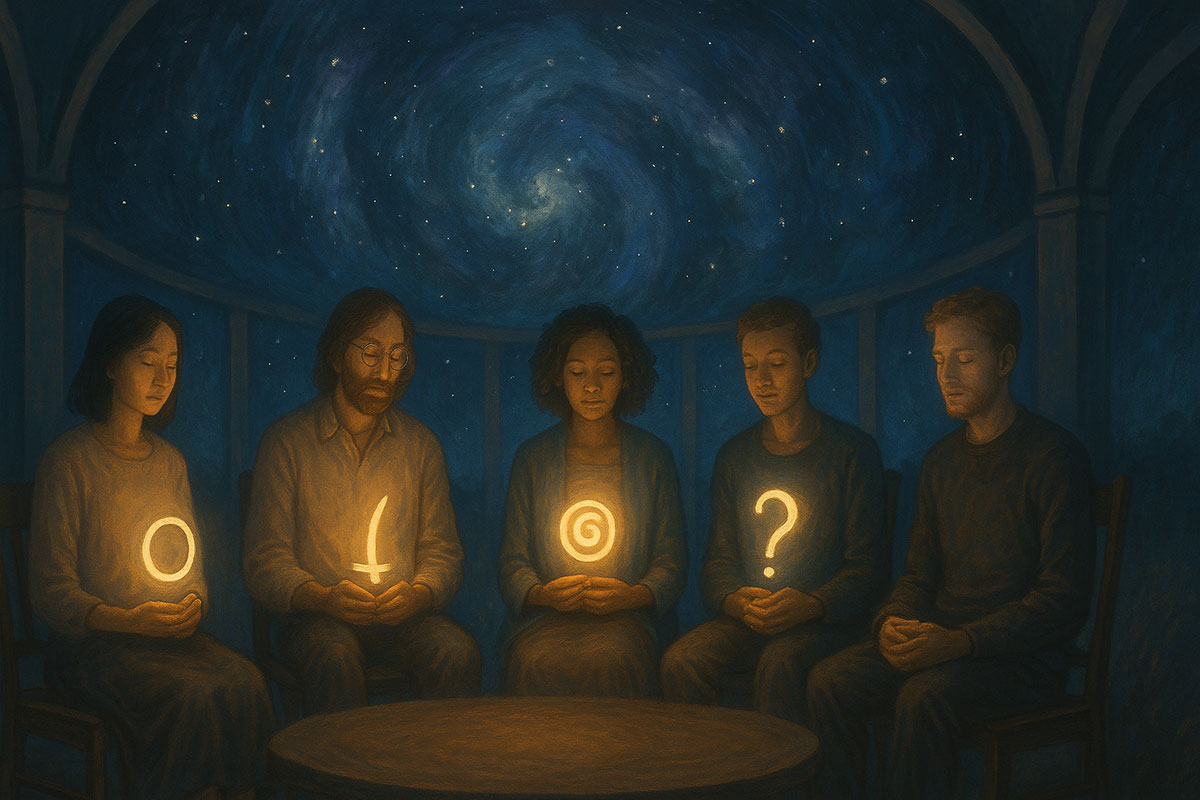
Setting: A roundtable in a quiet glass dome under the stars. Each participant is illuminated softly as if from within, seated in a circle with a lit candle at the center. No religious symbols, only sky and reflection.
Moderator: Karen Armstrong
Participants:
John Lennon
Sam Harris
The Dalai Lama
Richard Rohr
Karen Armstrong (moderator)
 Opening by Karen Armstrong
Karen Armstrong:
The lyric "Imagine there’s no heaven... no hell below us..." has unsettled, inspired, and challenged generations. Tonight, I ask not whether it's realistic—but whether it’s necessary to transcend fear-based belief. Can we cultivate a moral, meaningful life without imagining judgment after death?
Let’s begin here...
 “What do we lose—and what might we gain—if we let go of the idea of heaven and hell?”
Dalai Lama:
We do not need hell to live ethically. In Buddhism, karma is not punishment—it’s causality. If you plant an apple seed, an apple tree grows. Simple. Suffering is not retribution; it's a mirror. We gain peace when we stop fearing and start observing the results of our actions.
John Lennon:
I always thought—what if heaven and hell are just power tools? Religion sometimes felt like a leash disguised as love. But if you drop the carrot and the stick… you might just walk out of love for its own sake. That’s the gain. Freedom. The risk? You might have to grow up.
Sam Harris:
Heaven and hell are imaginary incentives. If we need them to behave, we’ve already failed. Real morality arises from empathy, not surveillance. If we shed superstition, we may actually deepen our humanity—because we’ll be choosing kindness with no prize expected.
Richard Rohr:
There is a mystical richness in heaven, and a deep compassion in the idea of purgation. But the problem begins when heaven and hell become externalized, transactional. Letting go doesn’t mean nihilism—it can mean surrender. And from that surrender, love blooms.
Karen Armstrong:
When I stepped away from religious dogma, I feared moral collapse. But instead, I discovered something softer and fiercer: compassion born not from fear of damnation, but from the ache of shared humanity. That’s what we gain. We lose certainty, but gain intimacy.
 “Can people be good—truly good—without the threat of divine punishment or the reward of paradise?”
Sam Harris:
Absolutely. Morality predates religion. Cooperation, fairness, empathy—these are evolutionary traits. We help others because we feel their suffering, not because we're watched. If we only behave under threat, are we moral—or just obedient?
Richard Rohr:
The greatest saints did not act out of fear of hell or hope for heaven. They loved because love burned in them like fire. True goodness is gratuitous. It’s gift, not bargain. Fear might create compliance, but only love transforms.
John Lennon:
Right, Rich. You can’t love if you’re scared all the time. I think the church got that backwards too often. If your goodness depends on a reward, you’re not really free, are you? I say—imagine loving just because it feels good. Isn’t that heaven already?
Dalai Lama:
In my tradition, ethics is based on interdependence. If I hurt you, I hurt me. That is enough reason to act with care. No God needs to watch me. My heart knows. Your suffering is mine. That’s the root of compassion.
Karen Armstrong:
History proves it—we’ve had saints in every tradition, and also outside of religion. The capacity for goodness exists in us. The fear-based systems might keep the chaos down, but the deepest good? It arises from connection, not control.
 “So if there’s no heaven above and no hell below, where do we find meaning? What now becomes sacred?”
John Lennon:
Now becomes sacred. This breath. This laugh. This kiss. We’ve been outsourcing holiness for too long. Maybe God is in your child’s eyes. Or in forgiving your dad. Or in a guitar chord that makes you cry. That’s where I found my meaning.
Richard Rohr:
Yes, yes. The ordinary is the hiding place of the divine. Washing dishes can be sacred. Making soup for a neighbor. Silence. Nature. The false binary between sacred and secular—perhaps that's the real hell we need to dissolve.
Dalai Lama:
What becomes sacred is this life. This moment. And the commitment to reduce suffering. Meaning does not need eternity—it needs presence. When we cherish others, when we serve with open hands, life becomes holy.
Sam Harris:
Meaning is a story we tell ourselves—but it can be a beautiful story. Meditation, awe, love, truth-seeking—none require belief in magic. They require honesty. If we stop seeking meaning “out there,” we may finally touch the beauty of what’s right here.
Karen Armstrong:
Meaning arises when we face suffering with courage, and joy with humility. The sacred is what breaks us open. It could be a stranger’s kindness, a tree in bloom, a truth spoken at the right moment. That’s enough. Maybe that’s everything.
 Final Reflections (Karen Armstrong)
Karen Armstrong:
We came tonight to imagine a world without heaven or hell—but we ended up imagining something braver: a world where we choose love without being bribed. A world where meaning is not given from above but created below, in every act of compassion.
Perhaps that was always the real invitation behind John's song—not to destroy faith, but to purify it. Not to erase hope, but to relocate it… into this very breath, this table, this shared moment of listening.
Let us stay here a little longer.
Topic 2: No Countries — What Would It Take to End Borders?
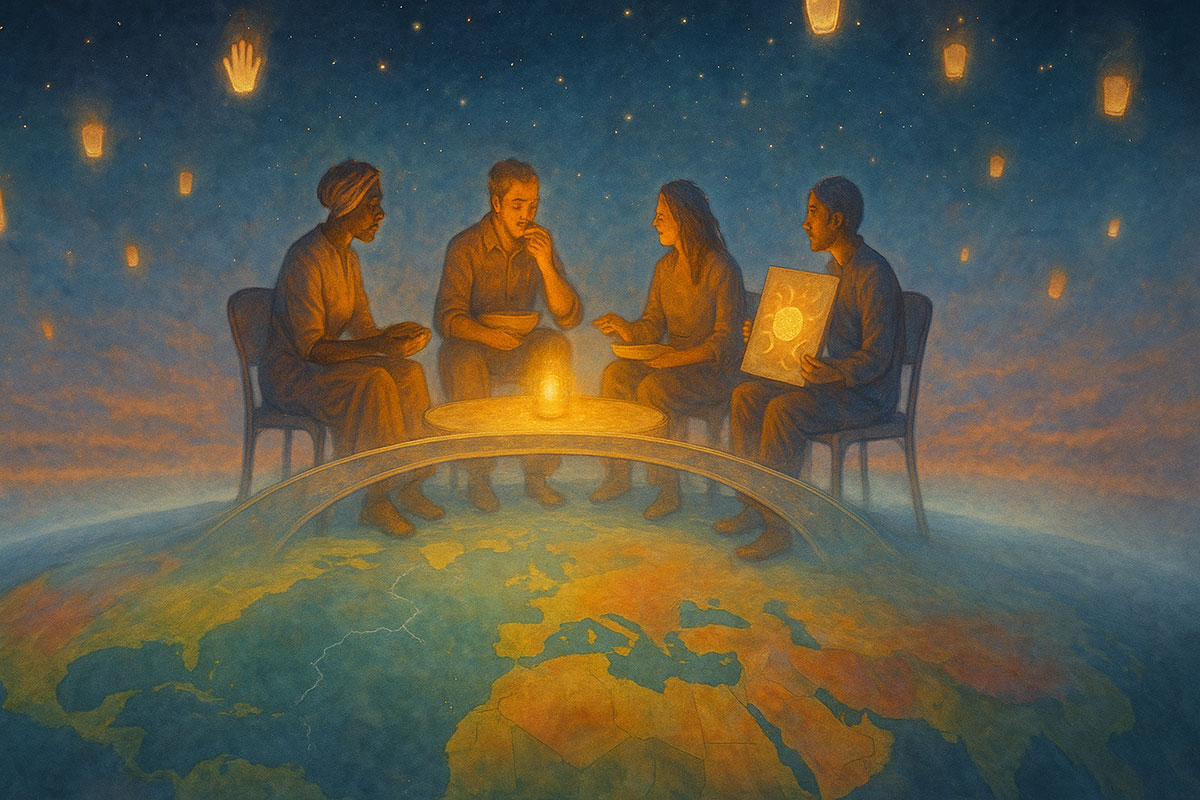
Lyric Focus: “Imagine there’s no countries… nothing to kill or die for…”
Setting: A table set on a transparent skybridge between nations, suspended above a shimmering map of the Earth. The borders below flicker faintly, fading in and out like ghosts. Overhead, stars shine equally on all.
Moderator: Ban Ki-moon (Former UN Secretary-General)
Participants:
John Lennon
Yuval Noah Harari
Rev. Sun Myung Moon
Pope Francis
Shakira
 Opening by Ban Ki-moon
Ban Ki-moon:
When John Lennon sang, “Imagine there’s no countries,” it was not a call for chaos—but a vision of cooperation beyond lines on a map. In 2025, with rising nationalism and fractured global systems, I ask: Is such a vision naïve… or urgent?
 “Are nations helping or hurting our path to peace in this era?”
Shakira:
Borders protect, but they also exclude. I’ve seen refugee children denied medicine because of papers. When the body hurts, does it matter which nation it belongs to? We’ve confused safety with separation. That’s not peace—it’s paralysis.
Yuval Noah Harari:
Nations are fictional stories we’ve agreed to believe. Useful, once—but today, global problems like climate change or pandemics laugh at borders. Nationalism may feel comforting, but it blinds us to shared destiny. The path to peace demands a wider “we.”
Rev. Sun Myung Moon:
God did not create nations. God created one family. Borders were born from fallen history, war, and division. I have called for a United Nations of peace ambassadors, not politicians. The only nation that matters now is the Kingdom of Heaven on Earth.
John Lennon:
Yeah, I was never against people—I was against us vs them. You don’t need tanks to create a nation. Just draw a line and say, “You’re not us.” We were born into these divisions, but we don’t have to keep them. Peace starts when we stop buying the story.
Pope Francis:
Nations have a duty to serve, not dominate. But too often, patriotism mutates into tribalism. When borders become walls around our hearts, they betray the human spirit. Christ crossed all borders. Love knows no passport.
 “If borders were to dissolve tomorrow, what must rise in their place to prevent chaos?”
Yuval Noah Harari:
We must replace the myth of “my nation first” with a shared global identity. That requires education. Technology gives us the means—can we give ourselves the maturity? Governance must evolve faster than catastrophe.
Rev. Sun Myung Moon:
What must rise is a universal ethic—a parent’s heart for all people. Not just law, but love. I have proposed the Peace UN, guided by spiritual values and family ideals. We need global institutions that uplift, not just regulate.
Pope Francis:
We must center the poor and the displaced in all policy. Economic justice, food security, ecological care—these are the structures that prevent collapse. And we must walk together as brothers and sisters, not as rulers and rivals.
John Lennon:
If we dropped the idea of “us” and “them,” maybe we’d stop needing armies and flags. Replace control with cooperation. I’m not saying it’s easy—but why not start with art, music, stories that show what “one world” looks like?
Shakira:
What must rise is radical empathy. When I sing to someone I’ve never met, in a language I barely know, and they cry—that's proof. Our hearts already know how to connect. Let’s build systems that follow that truth, not fight it.
 “So what does patriotism look like when the world is your country?”
John Lennon:
It’s pride in being human. In choosing peace when hate is easy. Imagine being proud not of your flag, but of how kind your people are to strangers. That’s real patriotism, mate.
Pope Francis:
True patriotism does not close its eyes to others’ pain. It celebrates heritage, yes—but never at the cost of compassion. A global citizen honors their roots and reaches beyond them, like branches of the same tree.
Shakira:
It’s loving where you’re from while loving the world more. I’ll never stop being proud of Colombia—but I fight for every child, not just Colombian children. Music taught me that patriotism can sing in many languages.
Rev. Sun Myung Moon:
A patriot of God’s kingdom heals the wounds of nations. The heavenly homeland is not on any map. It lives where people forgive, serve, and love beyond tribe or tongue. That is the patriotism of the future.
Yuval Noah Harari:
Patriotism must evolve. Not into global uniformity—but into global responsibility. Be proud of your story—but do not let it become a prison. In the 21st century, our survival depends on the size of our empathy.
 Final Reflections (Ban Ki-moon)
Ban Ki-moon:
In the past, borders offered safety. Today, they often offer excuses. Our speakers have shown us that “no countries” does not mean anarchy—it means accountability to one another, without the illusion of separation.
If the 20th century taught us to defend our nations, perhaps the 21st must teach us to defend our shared humanity. And if we dare to imagine a world beyond borders, then we must also dare to build the bridges to get there.
Let us become those bridge builders.
Topic 3: No Possessions — Is It Time to Rethink Ownership?

Lyric Focus: “Imagine no possessions... I wonder if you can...”
Setting: A candlelit studio with no logos, no brands. Around the table, each seat is different—one handmade, one borrowed, one worn. A small table in the center holds a single object from each guest: a photo, a child’s shoe, a guitar pick, a rice bowl, a stitched heart. The atmosphere is warm but reflective, with the quiet echo of value redefined.
Moderator: Oprah Winfrey
Participants:
John Lennon
Muhammad Yunus
Peter Singer
Marina Abramović
Oprah Winfrey
Opening by Oprah Winfrey
Oprah Winfrey:
We live in a time where success is often measured by accumulation. But John once asked us to imagine no possessions—not as a loss, but as a liberation. In this age of consumption and inequality, what might it mean to share not just our wealth, but our lives?
 “Why do possessions define us so deeply—and what happens when they don’t?”
Peter Singer:
Possessions once signaled survival. Now they signal status. We wrap identity in ownership—of homes, clothes, even other people’s time. But when we peel that away, we may find we are more free… and also more responsible.
John Lennon:
Right. It’s not about living in a cave. I had a white piano. I had mansions. But I always felt… trapped by them. When we stop needing things to say who we are, we might finally hear our real voice. Possessions are loud—they drown out soul.
Marina Abramović:
In my work, I’ve given everything away—even my name at times. When you let go of your things, you enter a space of raw presence. It’s terrifying. And also holy. The fewer things you have, the more real each gesture becomes.
Muhammad Yunus:
Poverty isn’t the lack of money—it’s the lack of dignity. Possessions should serve life, not replace it. When we create systems where people share resources instead of hoard them, dignity returns. That’s the beginning of peace.
Oprah Winfrey:
I’ve had everything. And still, it was the small moments—the tea shared, the story told—that fed my spirit. Letting go doesn’t mean you have nothing. It means nothing has you.
 “If we let go of materialism, how do we redefine success and security?”
Muhammad Yunus:
Success should be measured by how many people benefit from your presence. Not how much you own, but how much you uplift. We can create businesses for good—where profit feeds purpose. That’s real wealth.
John Lennon:
Security’s a funny thing. We buy alarms and locks but forget to lock our minds. When I let go of needing more, I felt safer—not poorer. Success, to me, became: Can I look my son in the eye and say I lived honestly?
Peter Singer:
Security can’t come from scarcity-based thinking. If you define success by “enough,” you find balance. If you define it by “more,” you’re always afraid. Real security is interdependence—community, health, resilience.
Marina Abramović:
Art without money is fragile, yes. But also, art without greed is powerful. My success has been when I sit in silence with a stranger, and they cry—not because I owned anything, but because I gave everything.
Oprah Winfrey:
I’ve redefined success as alignment. Does what I do match who I am? That’s wealth. Security isn’t a vault—it’s a circle. People who hold you when you fall. That’s the new metric.
 “So what can we still ‘own’—and what must we learn to let go of?”
John Lennon:
You can own your story. Your truth. That’s worth more than a thousand mansions. What must we let go of? Ego. Scarcity. This belief that someone must lose for me to win. Peace starts when we quit playing that game.
Peter Singer:
We must let go of the illusion that we are separate. Our actions ripple. Our wealth affects others. What we can own—our choices. Our ethics. And the courage to say: I have enough.
Marina Abramović:
Let go of permanence. Everything dissolves. Your body. Your fame. Even love. But presence—that’s real. Own your moment. Own your breath. That’s the only stage that matters.
Muhammad Yunus:
We must release the idea that poor people are problems. They are entrepreneurs waiting for access. What we can still own? Hope. Solutions. Systems that work for all.
Oprah Winfrey:
We own our attention. Where we put it, we build meaning. We let go of trying to be seen—and instead, see each other. When we release control, we gain community.
Final Reflections (Oprah Winfrey)
Oprah Winfrey:
Tonight we reimagined ownership—not as a vault, but as a river. The more it flows, the more life it brings. Our guests reminded us that letting go doesn’t mean having less—it means holding what matters.
The new possession is presence. The new wealth is shared. The new success? Being whole, and helping others feel the same.
So the next time we reach to buy, may we also ask: What am I truly trying to hold? And could I instead… let it go?
Topic 4: A Brotherhood of Man — Can Love Truly Replace Competition?
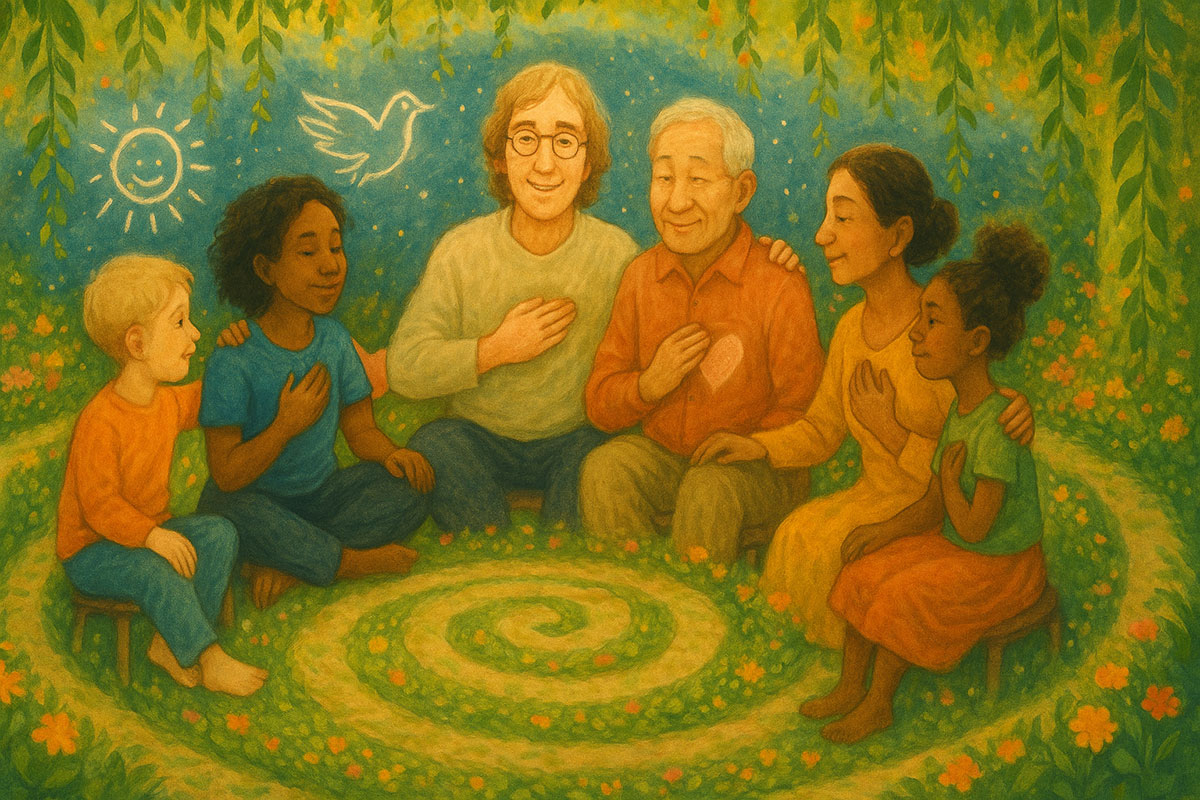
Lyric Focus: “Imagine all the people… living life in peace… a brotherhood of man…”
Setting: A sunlit garden courtyard with no walls—just growing vines, open sky, and soft chairs arranged in a spiral. In the center, a circle of child-drawn pictures flutter gently in the breeze—stick figures holding hands, rainbows, and hearts. There is no stage. Everyone is on the same level.
Moderator: Fred Rogers
Participants:
John Lennon
Oprah Winfrey
Malala Yousafzai
Nelson Mandela (spirit)
Fred Rogers
 Opening by Fred Rogers
Fred Rogers:
I’ve always believed that love is the most important thing in this life. And John’s words—a brotherhood of man—speak to a world where we stop trying to win against each other, and instead begin to belong to each other.
So I’d like to start by asking…
 “What makes it so difficult for us to treat each other like family—like true brothers and sisters?”
Malala Yousafzai:
When I was shot, it wasn’t because someone knew me—it was because they didn’t see me. Fear grows in the absence of understanding. We’re not taught to see strangers as siblings. We’re taught to survive. But when you teach a girl to read, you teach a world to care.
John Lennon:
Yeah. You’re born free, then someone teaches you borders, religions, competitions. It’s like—we're taught not to love each other. It’s no accident. If you see someone as family, you can’t drop bombs on them, can you?
Nelson Mandela:
The root is fear. The branches are pride and pain. In South Africa, we built walls because we believed we were safer apart. But peace came only when we looked into the eyes of the other and said, “You are my brother. Even after everything.”
Oprah Winfrey:
Shame and scarcity. Those are the twins that keep us apart. When people don’t feel loved, they start competing for worth. When they believe there’s not enough—attention, success, dignity—they fight. True belonging heals that.
Fred Rogers:
Sometimes, it’s because no one ever showed them how. If you were never treated like family, how would you know how to treat others that way? That’s why it’s never too late to become someone’s safe place.
 “If love is stronger than competition, why does competition still rule our systems?”
John Lennon:
Because it sells records, mate. Competition fuels profit. The world’s been built like a race—you win, I lose. But love? Love’s quiet. Doesn’t wear a suit. Doesn’t shout. It’s not the game. It’s the exit.
Nelson Mandela:
Competition serves progress—but without compassion, it devours justice. We must reimagine systems where excellence uplifts others, not replaces them. The world doesn’t need fewer winners—it needs fewer losers.
Malala Yousafzai:
In school, they say “be the best,” but never teach us how to help each other rise. What if success was defined not by how high you climbed, but by how many you pulled up with you? That would be true education.
Oprah Winfrey:
The system is designed to keep us looking sideways—who has more? Who’s ahead? It’s addiction. But love looks inward and outward. It asks: How are you today? And: How can I use what I have to lift the tide?
Fred Rogers:
There’s something sacred in doing things not to win, but to care. Imagine a system where kindness is rewarded—not with medals, but with trust. That’s the neighborhood I dream of.
“So how do we begin building this ‘brotherhood of man’—not just as dreamers, but as doers?”
Malala Yousafzai:
Start with education. Teach children that kindness is strength. Teach boys to cry, and girls to lead. Teach that we all have stories—and those stories connect us. That’s how a brotherhood begins: through listening.
John Lennon:
Music, man. Art. Story. That’s how you reach hearts that logic can’t touch. You want peace? Sing it into the bones of the next generation. Write poems. Paint walls. Make people feel what love sounds like.
Oprah Winfrey:
We need spiritual leadership in all spaces. Not just churches—but boardrooms, schools, media. People willing to say: love isn’t soft. It’s revolutionary. Start small. Your home. Your team. Your platform. Let it ripple.
Nelson Mandela:
Forgive. That’s the first brick. Without it, we cannot build. Then serve. Not with pity—but with partnership. When you serve someone as equal, you say, “You matter to me.” That is the new politics.
Fred Rogers:
A neighbor is someone who sees you, knows your name, and wants good for you. If we can do that for one person, and teach them to do the same… well, then maybe we are already building it.
 Final Reflections (Fred Rogers)
Fred Rogers:
John invited us to imagine a brotherhood of man—but tonight, we did more. We began to remember it. Because I believe—deep down—we’ve always known it’s possible. And not just possible… but necessary.
This is the new revolution: not guns or power, but gentleness. Not fear, but fierce compassion. Not winning, but welcoming.
So before we part, let me ask you, dear reader: Who have you not yet treated as family?
And what might happen… if you did?
Topic 5: Sharing All the World — What If We Actually Did?

Lyric Focus: “You may say I’m a dreamer… I hope someday you’ll join us… and the world will live as one.”
Setting: A large round table outdoors under the stars, in a remote field lit by lanterns from every continent. Each guest brings a small gift from their home—an olive branch, a woven cloth, a piece of music, a handwritten promise. No flags. No hierarchy. Just shared breath in cool night air.
Moderator: Jon Favreau (speechwriter & dreamer)
Participants:
John Lennon
Greta Thunberg
Elon Musk
Marianne Williamson
Brené Brown
Opening by Jon Favreau
Jon Favreau:
John once said, “You may say I’m a dreamer…” but in 2025, the world’s not just watching the dream—it’s deciding whether to join it. Tonight, we ask: If we truly shared the world—its wealth, care, ideas—what would that require of us?
 “What does it really mean to share the world—and why haven’t we done it yet?”
Greta Thunberg:
Because the world isn’t shared—it’s stolen. The richest 1% own more than half of everything. Climate justice begins with truth: the earth is not a playground for profit. Sharing starts with listening to those least heard.
John Lennon:
We haven’t shared it because we still think in mine. My land. My god. My truth. But the dream was always ours. We’re scared of losing control—but what if we gain love instead?
Elon Musk:
Sharing is hardcoded inefficient in the current system. That doesn’t mean it’s wrong—just that the system needs to evolve. Tech can help us decentralize power. But first, we have to stop assuming Earth is infinite.
Marianne Williamson:
The world reflects our inner scarcity. We hoard outside because we feel empty inside. Healing begins not with redistribution—but with remembrance: that every child born deserves safety, creativity, dignity. That’s spiritual economics.
Brené Brown:
We’re afraid. Sharing feels like losing when you’ve tied your worth to ownership. Vulnerability is the first step to unity. To share the world, we have to be willing to need one another again.
 “If we did start sharing resources, power, and care… what would the first signs of success look like?”
Elon Musk:
Energy becomes free or nearly so. Internet becomes universal. Education is available to every child via AI tutoring. When information and power decentralize, innovation explodes—everywhere, not just in Silicon Valley.
John Lennon:
Success would look like a kid in Brazil and a kid in Bangladesh playing the same song on different guitars, bought with love—not luck. It would look like less loneliness. More music.
Greta Thunberg:
Clean air. Safe water. Forests regrowing. Islands not drowning. And children not striking every Friday because adults are finally doing their job.
Brené Brown:
You’d see fewer masks. People showing up honestly. Leaders saying, “I was wrong.” Neighbors showing up when it’s awkward. That’s emotional redistribution—and it’s the foundation of social trust.
Marianne Williamson:
The sacred would return to politics. Decisions would be made not for donors, but for descendants. The soul would matter again—not just the stock price. And we would remember that miracles are often just justice fulfilled.
 “So, if this is possible—what is the very next step for each of us to make the dream real?”
Greta Thunberg:
Speak the truth. Even when your voice shakes. Especially then. Pressure leaders. Support science. And stop saying it’s too late. It’s not. But it will be—if we wait.
Marianne Williamson:
Ask yourself daily: “What am I withholding that could be healing?” It could be time, forgiveness, money, advocacy. The world changes when we stop waiting to be asked—and start offering ourselves.
Elon Musk:
Build better tools. More transparency. Decentralization. But also, rethink the narrative. Are you solving a problem—or feeding an old illusion? Ask bigger questions. Use tech to amplify human dignity, not distract from it.
Brené Brown:
Lean into discomfort. Share your story. Apologize. Risk being misunderstood. The dream dies in silence—so speak. And listen. Hard. Share your power. That’s how we earn trust.
John Lennon:
Imagine it. For real. Sit down and see it. A world where no one’s hungry, or hated, or owned. And then live like it’s already started. Because once enough of us do… it has.
Final Reflections (Jon Favreau)
Jon Favreau:
We began tonight asking if the dream of sharing the world was still alive. What we’ve learned is—it never died. It just got buried under fear, division, and forgetfulness.
But dreams are persistent things. They whisper. They wait.
And sometimes, they sing.
So tonight, may we not just admire the dreamers—but become them. Because if we all lean just a little toward “us”… the world will move. And it will move toward one.
Final Thoughts by John Lennon
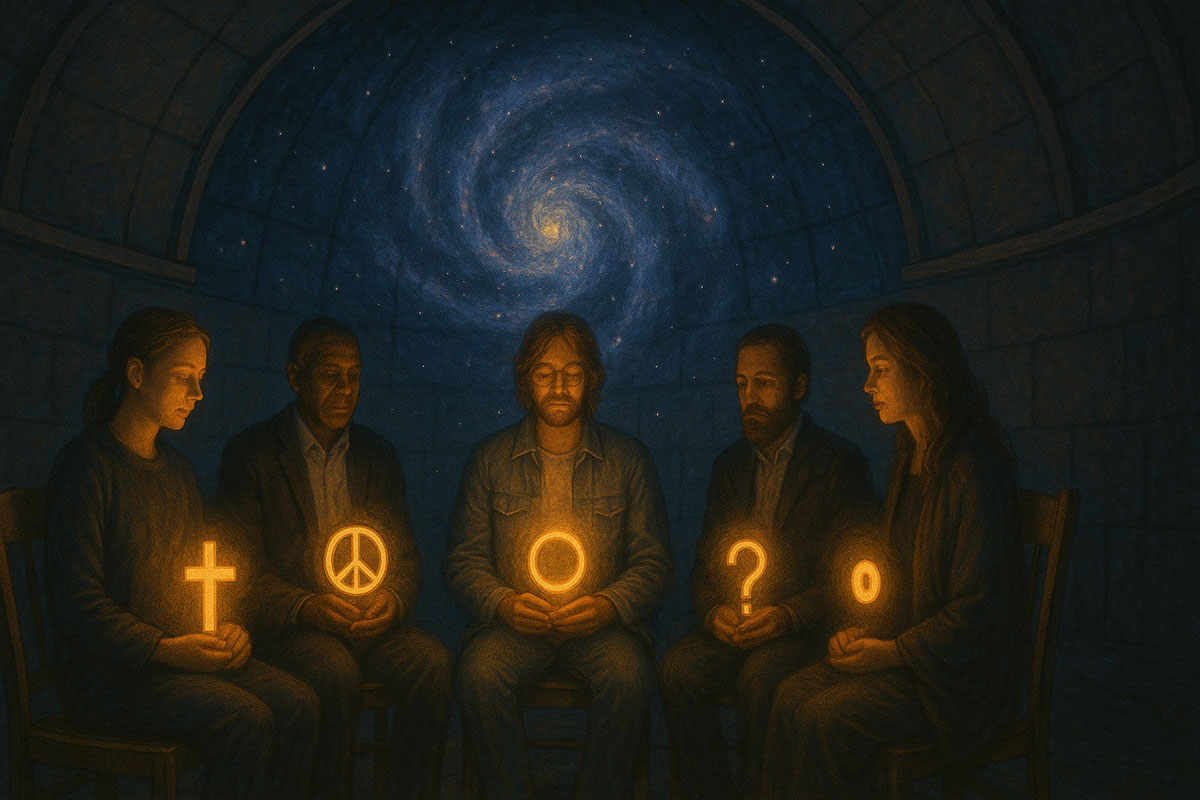
Well… we’ve had our say.
Some argued. Some sang. Some wept.
And still, the question hangs there, quiet and stubborn:
What if we actually tried?
Not imagined, not hoped, not wrote a bloody song about it—but tried.
To live without punishing each other for where we were born.
To build bridges where we’ve built borders.
To give without keeping score.
To be kind without needing applause.
To look each other in the eyes—really look—and say: “You matter to me. Even if I don’t know your name.”
That’s not utopia. That’s just… being human.
So if you ever feel silly dreaming big, remember—dreams are the blueprints of everything real.
You don’t have to be famous.
You just have to begin.
Start with a neighbor.
Start with yourself.
Start with a whisper.
Imagine the rest.
I’ll be humming along.
Always.
— John
Short Bios:
John Lennon
British musician, peace activist, and founding member of The Beatles, known for his visionary lyrics and commitment to nonviolence and global unity.
Karen Armstrong
British author and former nun, renowned for her works on comparative religion and her advocacy for compassion as a universal ethical principle.
Sam Harris
Neuroscientist and philosopher, author of “The Moral Landscape,” known for his secular humanist views and exploration of ethics beyond religion.
The Dalai Lama
Spiritual leader of Tibetan Buddhism and Nobel Peace Prize laureate, widely respected for his teachings on compassion, nonviolence, and global responsibility.
Richard Rohr
Franciscan priest and founder of the Center for Action and Contemplation, celebrated for bridging Christian mysticism with modern spiritual practice.
Yuval Noah Harari
Israeli historian and best-selling author of “Sapiens,” “Homo Deus,” and “21 Lessons for the 21st Century,” known for his insights on civilization and the future.
Rev. Sun Myung Moon
Korean spiritual leader and founder of the Unification Movement, who promoted the vision of a unified human family under God.
Pope Francis
Head of the Catholic Church and global voice for compassion, environmental stewardship, and solidarity with the poor and marginalized.
Shakira
Colombian singer-songwriter and humanitarian, recognized for her global influence and advocacy for children’s education and refugee support.
Oprah Winfrey
American media icon and philanthropist, known for her deep empathy, spiritual insight, and influence on personal growth and emotional well-being.
Muhammad Yunus
Bangladeshi social entrepreneur and Nobel Peace Prize winner, pioneer of microcredit and advocate for an inclusive global economy.
Peter Singer
Australian moral philosopher, known for his work in effective altruism, animal rights, and ethical decision-making in the modern world.
Marina Abramović
Serbian conceptual and performance artist, known for exploring vulnerability, endurance, and the intersection of art and spirituality.
Malala Yousafzai
Pakistani education activist and Nobel Peace Prize laureate, survivor of a Taliban attack, and global advocate for girls’ rights and education.
Nelson Mandela
South African anti-apartheid revolutionary, first Black president of South Africa, and symbol of reconciliation and forgiveness.
Fred Rogers
American television host and creator of Mister Rogers’ Neighborhood, beloved for his gentle advocacy of emotional intelligence and kindness.
Jon Favreau
American political speechwriter and podcast host, best known for shaping the message of hope in Barack Obama’s presidency and promoting civic dialogue.
Greta Thunberg
Swedish climate activist, known globally for catalyzing a youth movement demanding urgent climate action and intergenerational justice.
Elon Musk
Entrepreneur and innovator behind Tesla and SpaceX, often at the center of debates on technology, futurism, and ethics.
Marianne Williamson
American author, spiritual teacher, and activist who brings a moral and spiritual lens to politics and cultural transformation.
Brené Brown
Researcher, storyteller, and bestselling author known for her work on vulnerability, shame, and the courage to lead with authenticity.
Leave a Reply