
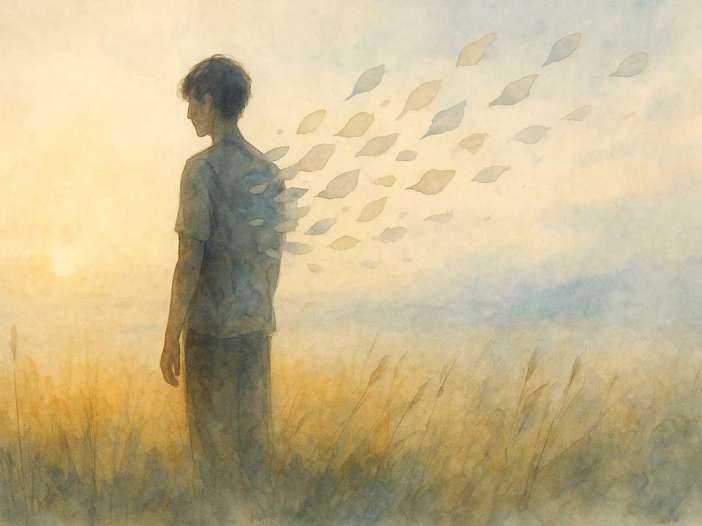
Introduction by Haruki Murakami
When I wrote Norwegian Wood, I wasn’t trying to explain anything. I was simply listening—to a certain tone of sadness, to the faint echo of memory brushing against the present, to a time in my life that felt both unbearably distant and strangely close. Memory, after all, is not a fixed photograph. It expands and contracts, changes its temperature, and sometimes tells us things we didn’t realize we were ready to hear.
Now, many years later, I find myself stepping back into that world—not alone, but accompanied by writers whose voices have traveled with me for much of my life. Some are people I never met. Others shaped me without ever knowing my name. Together, we gather around this simple wooden table, not to solve the questions of the heart but to sit with them, the way we sit with an evening breeze or the sound of a distant train.
If this conversation feels unusual, that’s because it is. But literature has always been a form of quiet impossibility. We cross time, languages, and realities, and somehow, we still manage to understand one another. In this roundtable, we do not debate. We explore. We circle around themes—memory, love, loneliness, the path between pain and choosing life—and we let them breathe.
Readers often ask me what Norwegian Wood truly means. I never give a definitive answer. The novel belongs, now, to each person who has carried it inside them. My hope is simply that this dialogue opens another small doorway—one you may step through at your own pace, in your own way, into the landscape of your private memories.
Please, come in. Sit with us. Listen quietly. Something might speak to you.
(Note: This is an imaginary conversation, a creative exploration of an idea, and not a real speech or event.)
Topic 1: Memory as a Living Thing
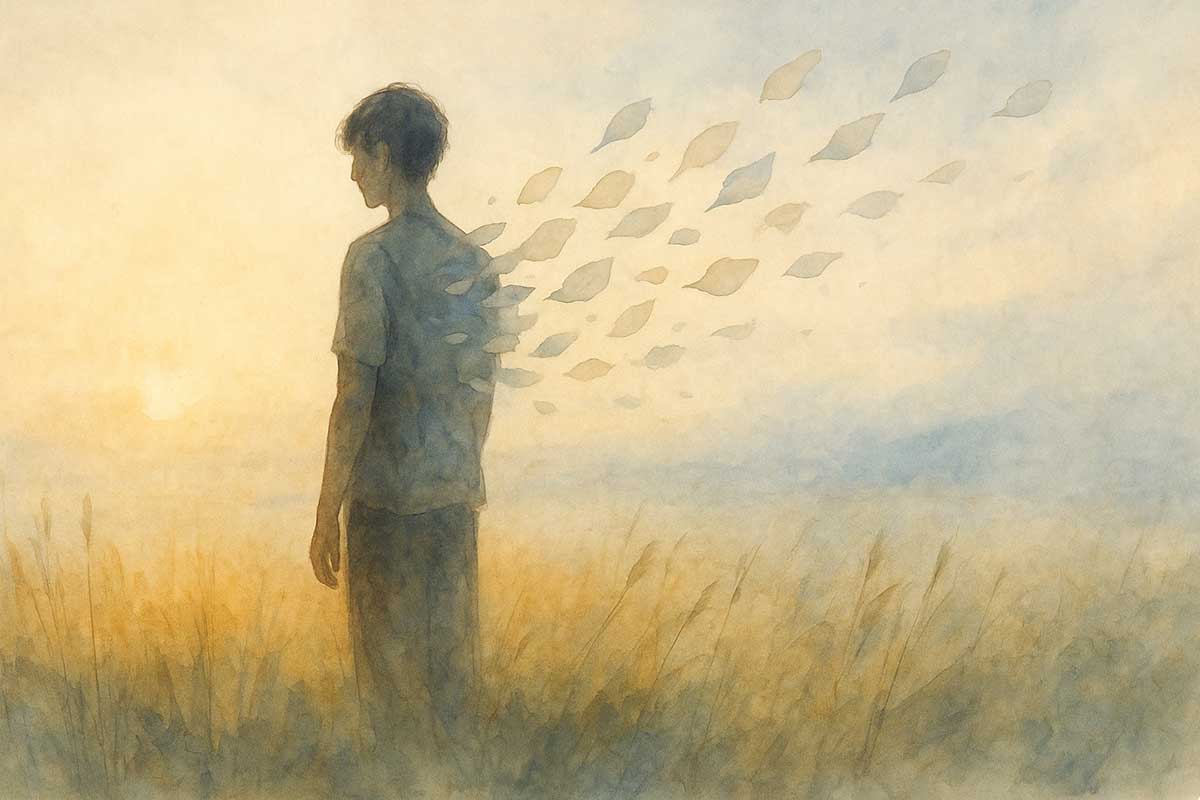
The meadow looks different depending on when I arrive. Today it is pale, washed with a soft morning haze, as if the world has just finished remembering a dream. The grass bends lightly in the wind, whispering in long strokes. Somewhere in the distance I can almost hear the opening chords of “Norwegian Wood,” faint as breath.
It is here — in this space between memory and imagination — that I invite the five guests who will join me to explore the first theme. They emerge one by one from different paths: Proust with his thoughtful slowness; Ishiguro with quiet eyes; Woolf like a ripple of consciousness; Ocean Vuong drawing invisible shapes in the air; and Joan Didion, small notebook in hand, as if she’s already writing the world down.
The meadow accepts their presence the way memory accepts a returning thought: without question, without ceremony, simply by making room.
I bow lightly.
Murakami:
There is a moment in Norwegian Wood when Toru Watanabe hears the song — and in an instant, he is not on a plane to Germany, not a middle-aged man anymore, but a boy of nineteen walking through the campus with Naoko. Memory has that power: it can pull us backward with such force that the present dissolves.
I’ve always wondered why.
Why do certain memories return sharper, brighter, more vivid than the moment right in front of us?
Proust:
Because memory is not the past.
It is a pulse — something alive, walking with us.
He kneels and touches the grass, as if reading its scent.
When Toru remembers Naoko, he is not remembering an event. He is remembering emotion.
Some emotions attach themselves to us so deeply they refuse to fade. They return sharper than the present because they still believe they have something to say.
Ishiguro:
I think it’s also because the present is… slippery.
Toru’s everyday life as an adult is indistinct. There is no clean narrative. No structure. No certainty.
But memory — especially memory tied to loss — offers coherence.
Clarity.
Edges.
He pauses.
Toru returns to the time with Naoko because it’s one of the few times he felt something deeply enough to be certain it mattered.
Woolf:
Memory keeps what shimmers. The rest sinks.
She lifts her face toward the trembling sky.
Toru’s days in 1969 were not extraordinary in fact, but extraordinary in feeling.
The walk with Naoko, the quiet evenings in her room, even her silences — they glow because they were moments in which he felt his own existence.
Memory returns not for accuracy, but for intensity.
Ocean Vuong:
Pain has a way of sharpening the world.
And first love, especially when it’s tangled with loss, is its own kind of wound.
He presses his fingers lightly against his sternum.
When Toru remembers Naoko, he’s not just remembering her.
He’s remembering the boy he was — fragile, breakable, trying to hold onto someone who was already drifting away.
Some memories cut us so cleanly we become the shape of the cut.
Didion:
And we return to them because we need a story that explains who we are.
She taps her notebook but does not open it.
Toru remembers Naoko not out of nostalgia — but out of necessity.
Her absence shaped him more than her presence ever could.
We revisit the moments that changed us, even if they hurt, because they are the coordinates of our identity.
A breeze passes over us, bending the entire meadow in a single long breath. Memory, too, bends us like that — a force that moves without asking permission.
I glance toward the place where Naoko might have stood, silent and luminous, her hair moving with the wind, and I ask the next question.
Murakami:
Do these memories protect us from pain… or do they preserve the pain so we never escape it?
Didion:
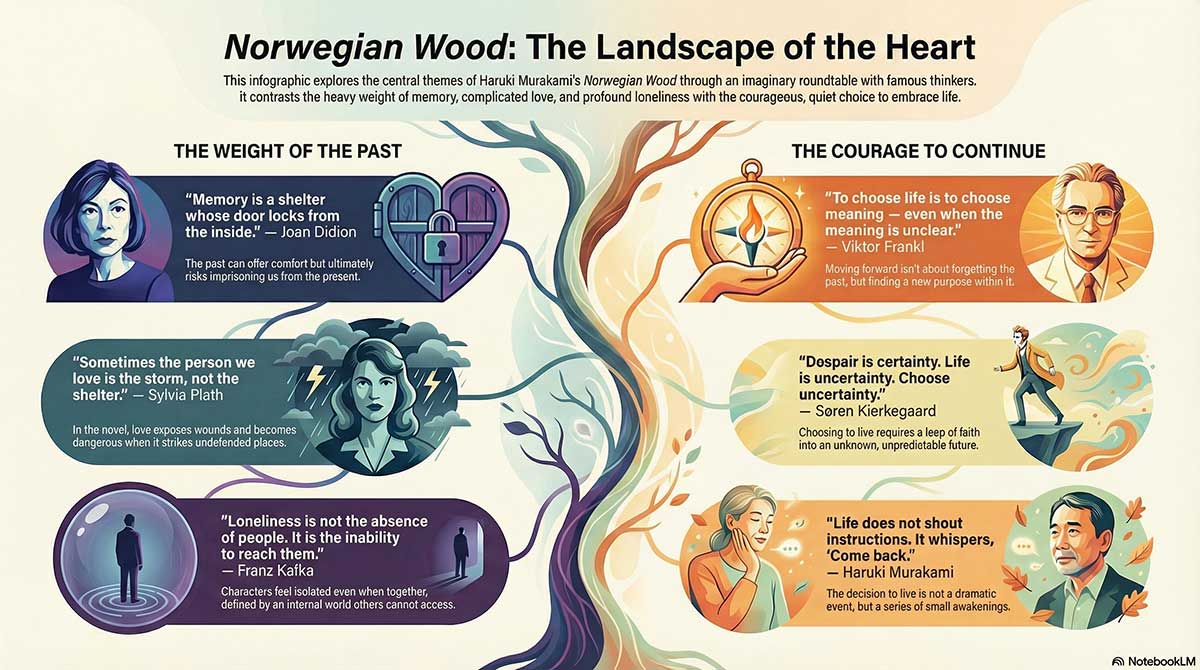
Memory is a shelter whose door locks from the inside.
She lets the words settle.
Toru clings to the memory of Naoko because it gives structure to a grief that otherwise might swallow him.
But it also keeps him from fully entering the life in front of him — from choosing Midori without hesitation, from growing into the man he wants to be.
Memory protects until it imprisons.
Vuong:
Pain doesn’t disappear. It migrates.
He draws a faint circle in the air.
It moves from the wound… into the memory… into the rhythm of your breathing… until you don’t know where it lives anymore.
Toru’s memory of Naoko is a way of carrying her.
But it’s also the way the pain chooses to stay.
Woolf:
Memory holds the bruise and the blossom together.
She looks out across the meadow.
For Toru, remembering Naoko is not simply grief. It is tenderness. It is longing. It is guilt.
Memory preserves all these layers because it refuses to flatten experience into something simpler.
Pain remains because it is part of love’s shape.
Ishiguro:
We often prefer the pain we know to the uncertainty we don’t.
That’s why Toru returns to the past — because the future, especially with Midori, is unpredictable.
Memory is safe, even when it hurts.
Proust:
Pain in memory is not a punishment.
It is an unfinished task.
He closes his eyes, listening inward.
Toru must remember Naoko because he has not fully understood what she meant to him — or what her loss left inside him.
Memory preserves pain until the heart is ready to transform it.
The grass rustles like pages shifting in a book. I feel time tighten around us — past and present folding softly together.
One last question lingers.
Murakami:
What happens to a person when memory becomes more vivid — more alive — than the present?
When a man begins to live inside what has already passed?
Woolf:
He becomes translucent.
Not dead — but not fully alive.
A ghost in daylight.
This, too, was Toru — caught between Naoko’s world and the one Midori tried to offer him.
Ishiguro:
He drifts.
Life continues, but he cannot inhabit it.
He becomes a witness to his own days.
Toru often seemed like he was watching himself from a few steps behind.
Didion:
He loses his footing in reality.
She looks down at the grass.
In Toru’s case, memory becomes the only place where Naoko is still reachable.
But that also means the present becomes a place where she is not — and so he withdraws.
Vuong:
When you live inside memory, the present becomes a rumor.
He speaks softly.
But sometimes, the rumor is kinder than the truth.
Proust:
To live in memory is to wander a beautiful room with no doors.
He breathes out slowly.
Toru must choose whether he will remain inside that room with Naoko’s silence…
or step into the imperfect, unpredictable light of the world where Midori waits.
The wind softens.
The meadow settles into stillness, as if all of time has paused to listen.
Toru’s footsteps, Naoko’s quiet voice, the faint scent of rain from long ago — all of it seems to hover in the air between us.
I rise.
 Murakami’s Closing Reflection
Memory is alive.
It follows us, reshapes us, comforts us, wounds us.
For Toru, memory is both a sanctuary and a labyrinth — a place where Naoko still breathes, and where he must decide whether to stay or to leave.
Perhaps that is the true nature of memory:
It invites us in…
but eventually asks us to go.
The meadow fades.
The day moves on.
But the feeling — the quiet ache of something once cherished — remains.
Topic 2: Love, Loss, and the Fragile Mind
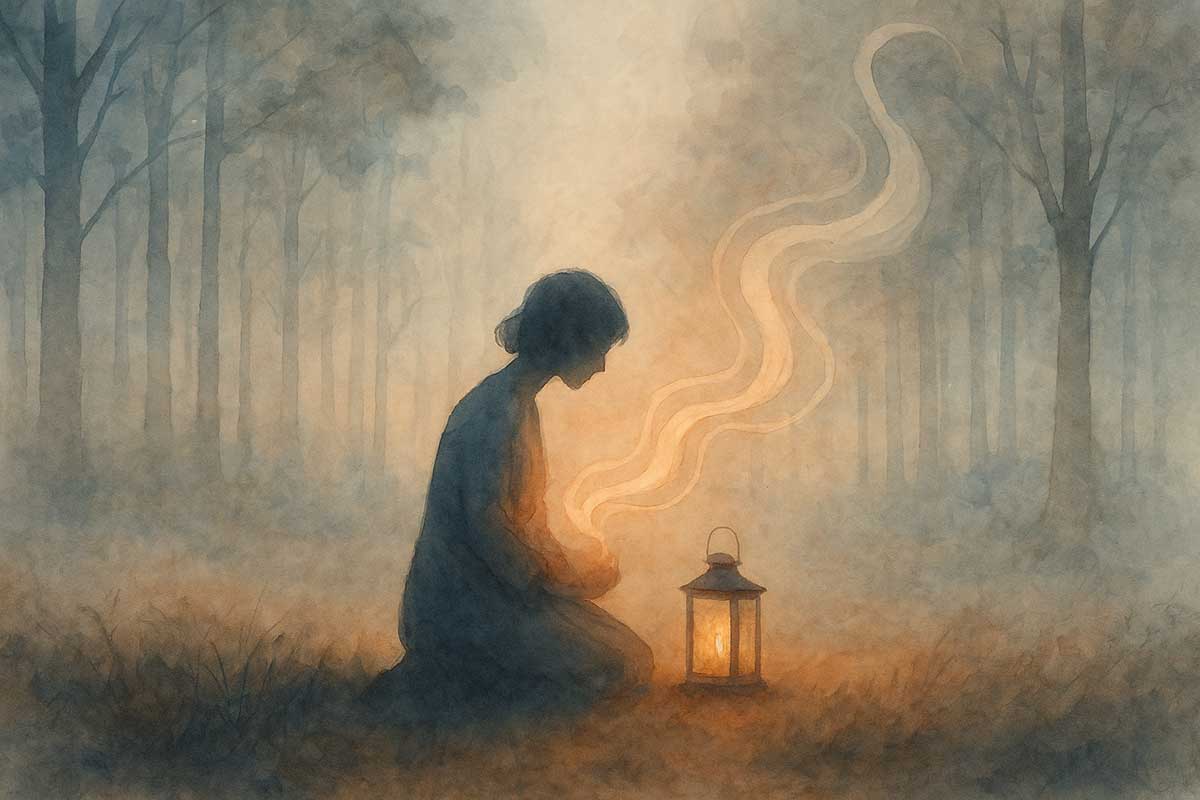
The meadow changes when love enters the conversation. The air feels heavier, the wind sharper, as if carrying the memory of a voice that once trembled. Love does that — it alters the landscape, even long after it’s gone. Especially when loss is braided into it.
The five guests gather near a low hill. Freud stands with hands clasped behind him, Jung observing the horizon, Rilke soft-eyed and listening, Sylvia Plath with a fragile stillness, and Elena Ferrante holding her own gaze like a knife turned inward.
The grass flutters as if recalling its own heartbreaks.
I step forward.
Murakami:
In Norwegian Wood, love is never simple. Toru’s love for Naoko is tied to grief; his tenderness for Midori is tangled with guilt; Naoko’s love is bound to a wound that never healed; Kizuki’s absence becomes a third presence in every relationship.
I want to begin with the most difficult question:
Why do the people we love most often become the ones who pull us closest to the edge?
Rilke
Because love is not gentle by nature.
It asks us to open the doors we’ve kept locked. It invites another heart into our most vulnerable rooms.
He watches a leaf drift across the grass.
Toru loved Naoko because she was part of his youth’s first tremor — fragile, luminous, already breaking. In loving her, he entered the fracture.
Rilke:
Love is apprenticeship to the beautiful and the terrible at once.
Jung
And because we project our shadows onto those we love.
Toru saw in Naoko not only her softness, but also his own fear of abandonment, his guilt over Kizuki, his quiet longing for meaning.
Naoko’s fragility awakened his own.
Jung:
When two wounded souls meet, they amplify each other.
Plath
Love becomes dangerous when it strikes the places we have no defenses.
Naoko was undone by grief, and Toru stepped into that unraveling.
Love for her meant walking the edge of her sorrow — the path she herself could not survive.
She closes her eyes briefly.
Plath:
Sometimes the person we love is the storm, not the shelter.
Ferrante
Or the wound we cannot stop touching.
Toru kept returning to Naoko because her silence filled the space where his own loneliness lived.
Midori, lively and unpredictable, terrified him because she demanded presence — life — not memory.
Ferrante:
He chose the edge because the edge felt familiar.
Freud
Love pulls us toward what is unresolved within us.
Toru was bound to Naoko through the trauma they both shared in Kizuki’s death.
Their connection was not purely affection — it was mourning.
He lifts a finger for emphasis.
Freud:
Unconsciously, we return to the scene of the wound.
The wind grows cooler. I can almost feel Naoko walking through the tall grass, her quiet steps leaving no trace. Toru follows her in memory the way one follows the echo of a song already fading.
I let the silence settle, then ask:
Murakami:
Love in this story doesn’t just comfort — it exposes.
Is love something that heals us, or does it reveal wounds we never wanted to see?
Plath
It exposes. Always.
When Toru lies beside Naoko, he feels both tenderness and despair — the awareness of her distance, her sorrow, her fragile grip on life.
Love did not heal her.
Love made the cracks visible.
Rilke
But in seeing the wound, one begins the long process of understanding.
Love is not a cure.
Love is illumination.
He folds his hands gently.
Rilke:
It shines a soft light on our inner rooms so we might finally see what shadows live there.
Freud
Love reopens childhood grief, reveals unhealed trauma, exposes the fractures of the psyche.
Naoko’s breakdown was not caused by love — but love forced her to confront the abyss she carried.
Freud:
Healing begins only after the unconscious is made seen.
Love is the force that makes such seeing unavoidable.
Jung
And Toru was not strong enough to carry Naoko’s darkness without losing himself.
His care for her was genuine, but he underestimated the depth of her shadow.
Love reveals the wounds, but the revelation itself can be overwhelming.
Jung:
The psyche resists healing if the wound is tied to identity.
Ferrante
Love shows us the truths we try to hide.
For Toru, Naoko revealed his guilt; Midori revealed his fear of choosing life.
Neither truth is comfortable.
Both are necessary.
She looks at me, steady.
Ferrante:
Love does not heal.
It burns away the illusions that keep us from healing.
A cloud passes over the sun, dimming the meadow. The shadows stretch, then soften again. In Norwegian Wood, love is a threshold between life and death — one that Naoko could not cross.
Her love froze in time the night Kizuki died.
Toru’s love grew, faltered, broke, reopened.
Midori’s love pulled him toward something messier but alive.
I take a breath.
Murakami:
I want to ask something I’ve never quite found an answer to:
What does it mean to care for someone whose pain is deeper than your ability to reach them?
Jung
It means confronting your own limits.
Toru could walk beside Naoko, but he could not follow her into the darkness she carried.
To love someone with a broken mind is to love with humility — the acceptance that you cannot save them.
Plath
It means drowning with open eyes.
Naoko was already fading; Toru held her hand but could not hold her here.
And that helplessness became part of his grief.
Plath:
Sometimes love is witnessing someone disappear.
Freud
To care for Naoko meant encountering the death drive — the pull toward self-obliteration.
Toru felt it, sensed it, feared it.
He could offer affection, companionship, desire — but not restoration.
Freud:
No one can rescue a psyche determined to retreat inward.
Ferrante
It means loving someone without the illusion of reciprocity.
Toru loved Naoko, but her pain made her incapable of fully returning that love.
And yet he stayed — because leaving her felt like betrayal.
Ferrante:
To care for someone broken is to bleed with them.
Rilke
It means loving with no promise of arrival.
Naoko was a country Toru could visit, but never inhabit.
Her soul was in winter; his was in early spring.
The roads between them were beautiful… and impassable.
He closes his eyes.
Rilke:
To love the wounded is to practice a holy kind of patience —
and to accept that patience may not be enough.
The wind drops.
The meadow falls still, holding its breath for Naoko.
I think of Toru at Ami Hostel, walking with her under the moonlight, her voice fragile as frost.
I think of Midori calling him back to life with her laughter.
Two worlds pulling at him — one asking him to remember, the other asking him to live.
I look at the five thinkers who have given their voices to this conversation, and I offer a final reflection.
Murakami’s Closing Reflection
Love, in Norwegian Wood, is both a lantern and a mirror.
It shows us the path forward… and the face we’ve hidden.
Toru loved Naoko because she carried the purity of something unfinished.
He loved Midori because she carried the messiness of the world as it is.
To care for someone like Naoko is to live on the border between tenderness and helplessness.
To love someone like Midori is to risk stepping into the chaos of a life that continues.
Perhaps that is what love truly asks of us:
not certainty, not salvation —
but the courage to choose the world that hurts…
because it is alive.
Topic 3: The Loneliness We Carry
By the time we gather for the third topic, the meadow has changed again. The colors are darker now — moss green, slate blue, lilac fading into gray. It is the hour when solitude becomes most visible. The air feels thinner, like something unspoken is drifting through it.
Loneliness has a shape in this place.
It leans into the tall grass.
It hums a note only the heart can hear.
Tonight I’m joined by five voices who have written — or lived — loneliness with a kind of painful clarity: Franz Kafka, Hannah Arendt, Albert Camus, Anne Carson, and Mary Oliver.
They take their places in a loose circle around me, as if each needs a little distance — a buffer of silence they brought with them.
Murakami:
In Norwegian Wood, every character carries a loneliness they can’t quite name. Toru’s quiet drifting, Naoko’s fragile retreat inward, Midori’s loudness that disguises ache, Reiko’s haunted memory — it all forms a landscape of private solitude.
I’d like to begin with something simple but difficult:
Why is loneliness so persistent — even in the presence of love, friendship, or community?
Kafka
Because loneliness is not the absence of people.
It is the inability to reach them.
He folds his hands awkwardly, as if apologizing to the air.
Toru sat beside Naoko, held her hand, slept in the same room — yet her inner world remained locked.
Toru himself often felt like a man watching his own life through a window.
Kafka:
Loneliness is the failure of doors to open.
Arendt
Loneliness emerges when we lose our sense of belonging to the world.
It is not merely emotional — it is existential.
Naoko lost her place when Kizuki died.
Reiko lost hers when her life collapsed under accusation.
Toru loses his each time he becomes untethered from meaning.
Arendt:
We are lonely when the world stops making sense to us.
Camus
And because the world is indifferent.
We search for understanding, but the universe offers silence.
Toru wanders Tokyo with a sense of exile — not from people, but from purpose.
He smirks with a kind of weary compassion.
Camus:
Loneliness is the human condition recognizing itself.
Anne Carson
Loneliness is the echo left after desire has spoken.
She writes a line in the air with her finger.
Naoko desired peace but could not grasp it.
Toru desired clarity but found ambiguity.
Midori desired to be seen — truly seen — and kept colliding with Toru’s distance.
Carson:
Loneliness is not emptiness.
It is the ache of what does not arrive.
Mary Oliver
And yet — loneliness can also be a companion.
A quiet creature that walks beside us until we learn its language.
She looks toward a patch of darkening sky.
Toru listens to the world in the way lonely people do — with attention, with tenderness.
He walks, reads, thinks, works — alone but not defeated.
Oliver:
Loneliness, when befriended, can open the heart.
The wind sweeps low across the meadow, bending the grass like a wave made of shadows. It feels like Naoko is here again — not visible, but present in the silence that follows.
I let the quiet deepen before asking the next question.
Murakami:
For Toru, loneliness is not just a feeling — it becomes a space he inhabits.
Why do some people become attached to their loneliness, even when it hurts?
Camus
Because suffering is familiar.
And the familiar is comforting.
Toru’s solitude is steady, predictable.
Midori’s affection — chaotic, alive — is frightening.
To choose life is to choose uncertainty.
Camus:
It is easier to sit in the shade of despair than to step into the blinding light of possibility.
Kafka
Loneliness becomes a room we learn to arrange.
We know where everything is.
We know how it feels.
He looks down at his shoes.
Toru did not seek isolation, but it fit him.
It demanded nothing.
It judged nothing.
It matched the rhythm of his quietness.
Kafka:
One becomes loyal to one’s loneliness — because it never lies.
Arendt
Loneliness also offers control.
Toru could not control Naoko’s mind, Midori’s wildness, or the world’s chaos —
but he could control the terms of his isolation.
Arendt:
Some people hold onto loneliness because it is the only sanctuary that cannot betray them.
Carson
And because loneliness is often mistaken for identity.
She tilts her head slightly.
Toru believes — quietly, unconsciously — that he is someone who stands apart.
To abandon loneliness feels like abandoning the self he has always known.
Carson:
The wound becomes the signature.
Oliver
But loneliness can also be where we hear the world most clearly.
Toru’s gentleness, his attention, his ability to listen — they come from solitude.
She smiles gently.
Oliver:
Sometimes we cling to loneliness because it is where our spirit grows.
The meadow darkens further, dipping into twilight. I sense the heaviness of Toru’s nights — walking alone through Tokyo, lying in the small dorm room, listening to the silence after Naoko’s letters.
I ask the last question, one I rarely speak aloud.
Murakami:
Some loneliness we choose… and some loneliness chooses us.
How does a person begin to live fully again when loneliness has become their home?
Mary Oliver
By noticing small beauties.
A bird landing on a railing.
A warm bowl of food.
A friend’s unexpected laugh.
She looks at me, soft-eyed.
Oliver:
Joy enters through the smallest doors.
Camus
By rebelling against despair.
By choosing, each day, not to surrender.
He steps forward slightly.
Toru chooses life when he finally calls out for Midori at the end —
even though the moment is ambiguous, painful, unclear.
Camus:
Hope is not comfort.
Hope is resistance.
Arendt
By rejoining the world — even imperfectly.
Toru must risk belonging again.
He must risk disappointment, risk loss, risk love.
Arendt:
We heal when we accept the world despite its contradictions.
Kafka
By opening even one door.
By speaking a single truth aloud.
By allowing oneself to be seen — just a little.
His voice trembles, almost whispers.
Kafka:
Loneliness loosens its grip the moment another person hears us.
Anne Carson
By allowing desire to return.
Desire is the opposite of loneliness — not romance, but the quiet yearning toward life.
Toru’s longing for connection with Midori is not betrayal —
it is awakening.
Carson:
The heart begins again whenever it allows itself to want.
The meadow now lies in near-darkness. Fireflies flicker faintly, like memories with wings. I imagine Toru standing somewhere in this dimness — unsure, quiet, waiting for a voice he cannot quite hear.
I draw breath for the closing.
Murakami’s Closing Reflection
Loneliness is not a punishment; it is a landscape.
Some walk through it.
Some live in it.
Some drown there.
Toru’s solitude was shaped by grief, by Naoko, by youth, by the soft uncertainty of growing into oneself.
But loneliness is not the end of the road —
only a long stretch of it.
To leave loneliness, one must learn to open a door inside the heart:
toward desire, toward imperfection,
toward someone calling your name from a distance you can still cross.
Perhaps that is why Toru reaches out to Midori in the final pages —
not because he stops loving Naoko,
but because he chooses the world that continues.
Loneliness teaches us many things.
But eventually, it asks us to let it go.
Topic 4: Memory’s Mirror — Who Are We Without the Past?
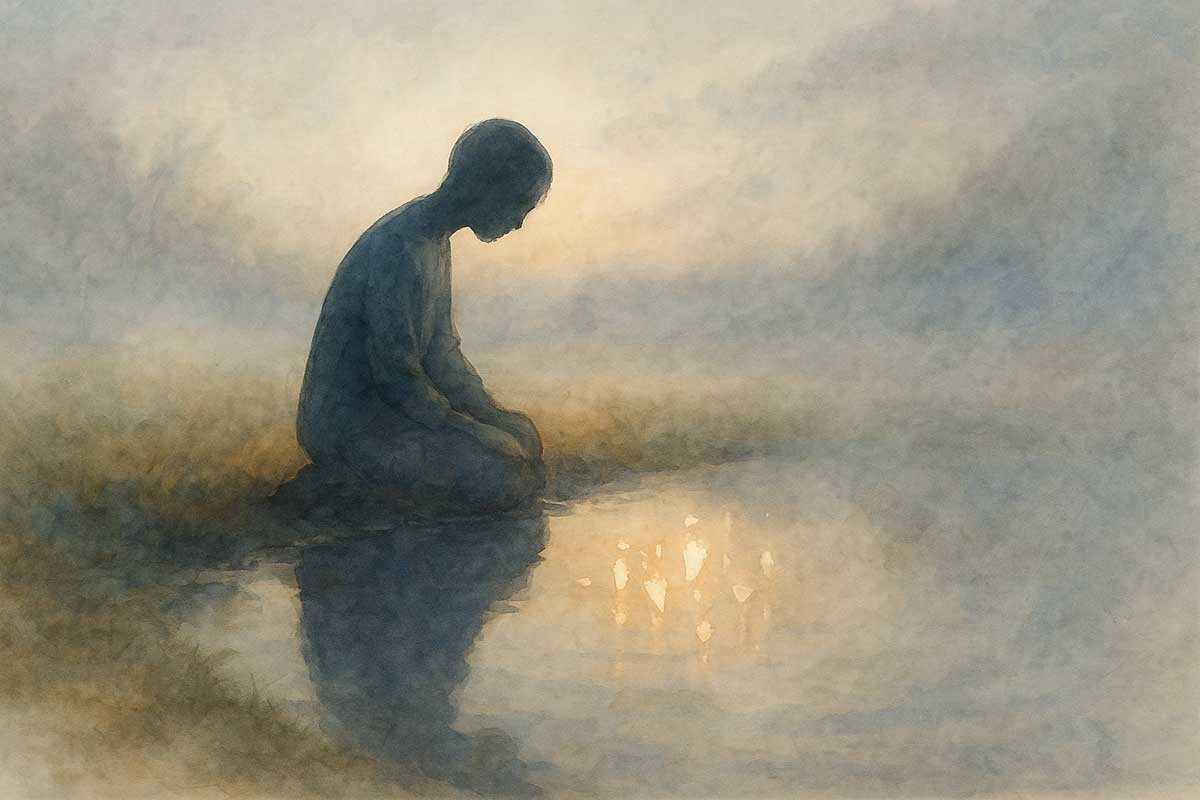
By the time we gather for the fourth topic, the meadow has fallen into a deep blue dusk. The moon hangs low, a sliver of white like a cut in the sky. In the darkness, memory feels closer — as if it prefers night over day, shadow over light.
This time I’m joined by Simone de Beauvoir, James Baldwin, Harold Bloom, Clarice Lispector, and Nietzsche — five thinkers for whom identity is a living, shifting question.
They arrange themselves near a small stone circle that seems to have appeared from nowhere. Memory often works like that — suddenly, a shape that wasn’t there before.
The air cools.
I begin.
Murakami:
In Norwegian Wood, the past doesn’t simply linger — it actively shapes the present. Toru is defined by Kizuki’s absence. Naoko is trapped inside a memory she cannot escape. Reiko lives in the aftermath of her own broken story. Even Midori tries to outrun a past filled with caregiving and loss.
So I want to start with a question that seems simple but isn’t:
How much of who we are is actually just memory wearing our face?
Simone de Beauvoir
A great deal — perhaps more than we want to admit.
We imagine ourselves as free beings, choosing our paths. But much of our identity is inherited from experience, shaped before we can resist it.
She folds her hands, measured.
Naoko believed herself fragile because her past told her so.
Toru believed himself quiet, resigned, because grief taught him that shape.
De Beauvoir:
We perform the self that memory hands us.
James Baldwin
But identity is also negotiation — a constant conversation between what happened and what we decide it means.
He looks around the meadow as if seeing the ghosts each of us brought.
Toru is not simply “the boy who lost his friend.”
He is the man trying to understand how that loss shaped his capacity for love.
He wrestles with memory — and in the wrestling, becomes someone new.
Baldwin:
We are not what happened to us.
We are what we do with what happened.
Harold Bloom
Memory is the canon of the self.
A collection of stories we interpret, misinterpret, revise.
He gestures as if browsing invisible bookshelves.
Toru revises Naoko in his mind — not out of dishonesty, but out of necessity.
We all curate our pasts.
Identity is the ongoing act of reading ourselves.
Bloom:
The self is a reader forever haunted by earlier drafts.
Clarice Lispector
But the self is also unspeakable. It slips away from any definition.
Memory tries to frame us, but something always escapes.
She touches the air as if feeling its texture.
Naoko could not articulate who she was without Kizuki.
Toru could not define himself without remembering her.
But beneath that — beneath story — lies a raw existence memory cannot hold.
Lispector:
Who we are without the past is simply this:
a pulse, a breath, a sensation of being alive.
Nietzsche
And yet — we overestimate memory’s power.
What matters is not who we were, but who we will become.
He speaks with brisk clarity that cuts through the night.
Toru clings to memory like a man afraid of freedom.
Naoko is crushed by the weight of what she cannot forget.
But Midori represents something different — the will to live forward.
Nietzsche:
To outgrow the past is the highest form of strength.
The meadow darkens further, though the moon provides just enough light to see the shapes of my guests. I think of Toru wandering the nighttime streets of Tokyo, memory hanging from him like a shadow stitched to his back.
I ask the next question softly.
Murakami:
Characters in my novel struggle because they don’t know how to separate “who they are” from “who they were.”
How does memory distort identity, and why do we cling to those distortions even when they hurt us?
Bloom
Because memory is edited, not preserved.
Selective, symbolic, aesthetic.
He raises a finger.
Toru remembers Naoko not as she was — a complicated, suffering, beautiful young woman — but as the emblem of a period in his life when meaning felt fragile.
Bloom:
We cling to distortions because they are emotionally truer than the facts.
Baldwin
And because facing the truth requires courage many of us don’t yet have.
Naoko was not only gentle — she was breaking.
Toru was not only loyal — he was terrified of choosing life.
Midori was not only wild — she was lonely.
Baldwin:
We cling to distorted memories because the real story would require us to change.
De Beauvoir
Memory simplifies what was complex.
It gives straight lines to feelings that were chaotic.
Naoko’s memory of Kizuki froze him in perfection, making any life afterward impossible.
Toru’s memory of Naoko idealizes a love that was never whole.
De Beauvoir:
We hold onto distortions because the truth is too fluid to stand on.
Lispector
Memory hurt us because it is alive.
It grows teeth.
She tilts her head slightly.
We believe we are remembering the past.
But it is the memory that remembers us —
the memory that uses us, that shapes us, that whispers its versions of the story.
Lispector:
We cling to pain because it has become our language.
Nietzsche
Because suffering gives us identity when we have none other.
His voice is firm.
Toru wears melancholy like a badge of meaning.
Naoko’s fragility becomes her entire self.
Reiko’s trauma becomes her worldview.
Nietzsche:
Pain is persuasive.
It convinces us that we are deep.
The moon brightens, cutting thin silver lines across the meadow. The grass shimmers like memory itself — fragmented, luminous, trembling.
We are nearing the heart of this topic.
I take a breath.
Murakami:
Then let me ask the final question:
Who are we without our memories — without the stories we tell ourselves about who we must be?
Lispector
We are light.
We are breath.
We are unformed possibility.
She smiles faintly.
Without memory, Naoko might have found a new name for herself.
Without memory, Toru might have walked toward Midori much earlier.
The self beneath memory is soft, pliable, waiting.
Baldwin
We are free.
Not unmarked — but free to choose how the marks shape us.
Toru is not condemned to be the boy who lost two people he loved.
He can become the man who loves deeply because he understands loss.
Baldwin:
Without memory’s chains, we begin.
De Beauvoir
We are responsible.
Once memory stops dictating identity, we must create ourselves.
This is liberating — and frightening.
Naoko could not make that leap.
Toru hesitates at its edge.
Midori is halfway across already.
Bloom
We are authors of the self, rather than characters trapped in earlier drafts.
He closes his eyes as if editing an inner manuscript.
Identity without memory is revision —
a blank page, a dangerous freedom.
Nietzsche
We are the future.
Not the past.
He steps forward into the moonlight.
To live without memory is impossible —
but to live against memory,
to live beyond it,
that is strength.
Nietzsche:
We become ourselves only when we refuse to be who we were.
The meadow is silent except for a faint wind that feels like the breath of someone remembering something painful and beautiful at once. I think of Toru in the novel’s final lines — calling Midori’s name into a world where everything feels lost and possible at the same time.
I gather my thoughts.
Murakami’s Closing Reflection
Memory is a mirror —
but a mirror that distorts, illuminates, wounds, and guides.
Naoko was held captive by her memories.
Midori rebelled against hers.
Reiko tried to reinterpret hers.
Toru wavered between honoring the past and escaping it.
Who are we without memory?
Perhaps only this:
a person standing in the dark, listening for a voice that might lead us forward.
At the end of Norwegian Wood, Toru stands suspended —
between the life that shaped him
and the life he might yet choose.
Memory cannot answer for him.
It can only reflect.
The rest is up to the living.
Topic 5: Choosing Life — The Courage to Continue
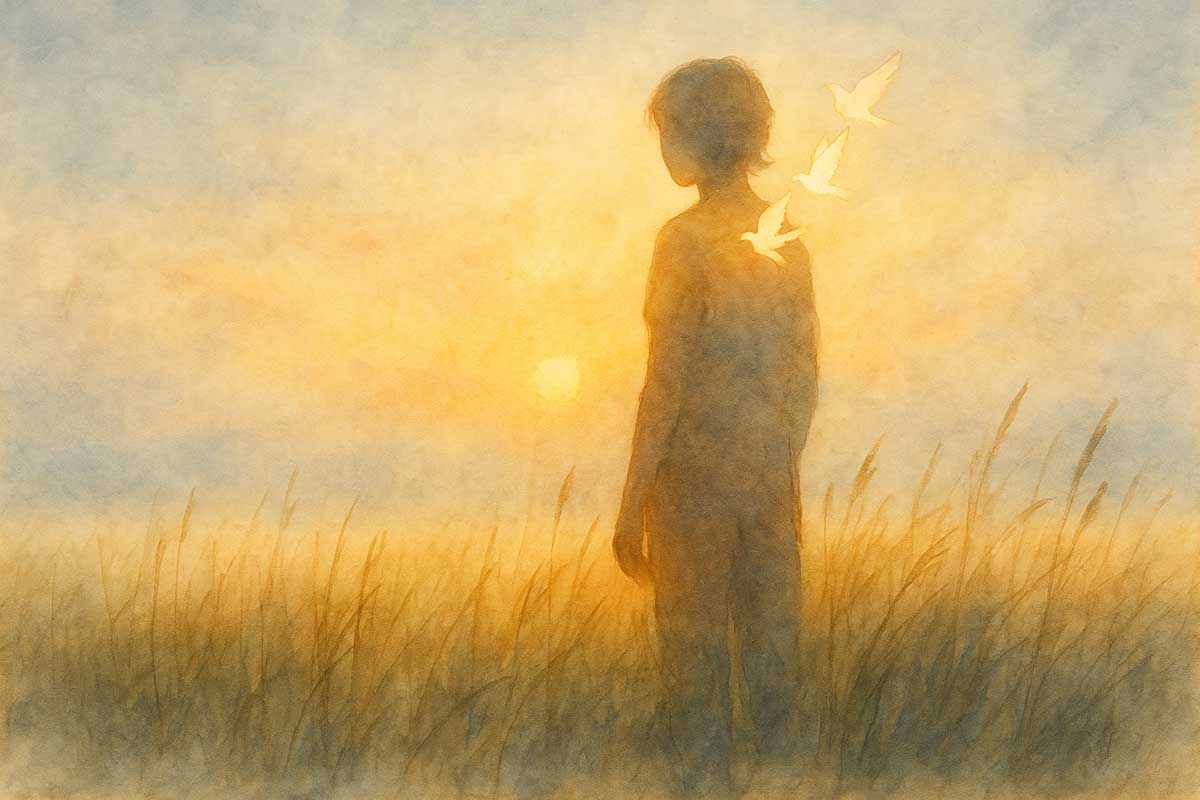
By the time the last topic begins, the meadow is no longer dark. A faint, pearly light spreads across the horizon — the kind of quiet dawn that doesn’t announce itself but simply appears, gentle and persistent. The air is cold, a little damp, as if the night has been carrying its own sorrow.
It feels right.
Choosing life happens in mornings like this — silent, uncertain, the world fragile and new.
Five thinkers arrive one by one: Viktor Frankl, Carl Rogers, Louise Glück, Søren Kierkegaard, and Brené Brown.
Each, in their own way, understands the courage it takes to keep going when the heart is heavy.
They gather in a semi-circle facing the rising sun.
I stand at the center.
Murakami:
In Norwegian Wood, choosing life is not simple. Toru’s path is shaped by loss — Kizuki’s suicide, Naoko’s breakdown and death, the loneliness that shadows every step he takes. Even his love for Midori is complicated by guilt, by hesitation, by the feeling that living fully means leaving part of himself behind.
Let me ask the first question:
What does it mean to choose life when grief has become part of your identity?
Viktor Frankl
To choose life is to choose meaning — even when the meaning is unclear.
He gazes at the horizon as if searching for something.
Toru carries grief not as a wound, but as a map.
Naoko’s life and death shape him, but they do not dictate his future.
He must decide what his suffering will demand of him — despair or responsibility.
Frankl:
The moment Toru reaches toward Midori, he is not betraying Naoko.
He is affirming the human capacity to begin again.
Carl Rogers
Choosing life also means accepting oneself —
all the conflicting feelings, all the doubts, all the imperfections.
Rogers’s voice is warm, steady.
Toru does not need to be whole before he chooses love.
He only needs to be honest — with Midori, with Naoko’s memory, with himself.
Rogers:
The fully alive person is not the unbroken one,
but the one willing to feel everything that being alive requires.
Louise Glück
Grief becomes a landscape —
but even landscapes have seasons.
She touches the grass lightly.
Naoko will never leave Toru.
Some losses carve themselves into the body in ways time cannot erase.
But new life grows around the wound.
Glück:
To choose life is to let the wound bloom.
Kierkegaard
And it requires a leap —
not of faith in God alone,
but of faith in existence.
His voice is slow and deliberate.
Toru cannot know what will happen if he chooses Midori.
He cannot know whether love will save him or wound him again.
But life demands that he leap anyway.
Kierkegaard:
Despair is certainty.
Life is uncertainty.
Choose uncertainty.
Brené Brown
Because choosing life means choosing vulnerability.
She steps closer, soft but unwavering.
Toru retreats into memory because memory feels safer than the messy world Midori offers — a world of need, laughter, anger, unpredictability.
But if he wants connection, he must risk being seen.
Brown:
Love requires courage —
and courage feels terrifying when you’ve been broken.
A warm breeze rises from the east, brushing the frost off the grass. I imagine Toru sitting by the phone after Naoko’s funeral, feeling like a ghost, unsure if stepping into the future is even allowed.
This leads me to the next question.
Murakami:
Often we do not choose life because we fear betraying the ones we lost.
How does one honor the past while still moving forward?
Glück
By carrying memory,
but not kneeling before it.
Her voice is firm.
Naoko’s death must matter —
but it cannot become the border of Toru’s life.
The living must continue living.
Glück:
Grief asks for devotion.
Life asks for return.
Frankl
We honor the dead through our choices.
Through the meaning we create from their absence.
He nods gently.
If Toru withdraws from the world, Naoko’s death becomes only tragedy.
If he chooses life, her memory transforms into purpose —
a reminder of the fragility of the human mind,
the importance of gentleness,
the miracle of connection.
Rogers
Honoring the past means integrating it into a broader story.
Toru does not need to “get over” Naoko.
He needs to realize that grief and love can coexist.
Rogers:
Healing is not forgetting.
Healing is allowing.
Kierkegaard
We betray the past only when we refuse the possibility of the future.
His eyes shine in the new light.
Existence demands forward motion.
To remain still is to freeze oneself in time —
a form of living death.
Naoko could not move forward.
Toru must.
Brown
And honoring the past means telling the truth.
She speaks with raw softness.
Naoko was loved.
She was broken.
She tried.
She suffered.
But her story does not require Toru to remain in suffering.
What she needed was peace.
What Toru needs is life.
Brown:
Love doesn’t ask us to die with the people we lose.
The sun lifts higher. A pale gold spreads across the meadow, touching each face, each blade of grass. The world looks different now — clearer, though still uncertain.
I turn to the final question, the one Toru must answer in the last pages of the novel.
Murakami:
When someone has lived in sorrow for so long,
how do they recognize the moment when life is asking them to return?
Carl Rogers
By listening to the quietest voice inside.
The one that whispers rather than shouts.
He smiles softly.
Toru’s longing for Midori is not loud or dramatic.
It is gentle.
It is persistent.
It is real.
Rogers:
Growth begins the moment we hear ourselves wanting something again.
Frankl
By noticing meaning re-entering the world.
In small things:
a friend’s laughter,
a letter,
a shared meal.
He pauses.
Toru feels this with Midori —
moments where life becomes bearable, even beautiful.
Frankl:
Meaning is the doorway through which life reclaims us.
Glück
By realizing that suffering is not the only honest emotion.
She looks toward the sunrise.
People sometimes cling to sorrow because it feels more profound than joy.
But joy can be profound too —
and terrifying in its simplicity.
Glück:
Life returns through tenderness, not triumph.
Kierkegaard
By accepting that uncertainty is unavoidable.
He steps into the sunlight.
Toru cannot know what choosing Midori will bring.
But he knows what remaining in despair will bring —
nothing.
Kierkegaard:
When the heart is ready to leap, the path appears.
Brené Brown
By letting someone in.
She speaks as if directly to Toru.
Midori shows up.
She asks, demands, teases, cries.
She is messy.
She is vivid.
She is alive.
And when Toru finally calls her name — truly calls —
he is choosing connection over isolation.
Brown:
Life returns when we risk love again.
The sun has now risen fully, casting long shadows behind us. The meadow glows — not with perfection, but with possibility. This is the hour when decisions are made quietly, in the heart.
It feels right to close.
Murakami’s Closing Reflection
Choosing life is not a sudden moment.
It is a series of small awakenings.
The sound of Midori’s laughter.
The warmth of sunlight on a lonely morning.
The memory of Naoko that softens rather than breaks.
The realization that living does not betray anyone who has died.
Toru stands at the end of Norwegian Wood suspended between past and future —
but he calls out to Midori,
and in that call is courage.
Life is not loud.
Life does not shout instructions.
It whispers,
“Come back.”
And if we listen closely enough,
we might hear it calling us home.
Final Thoughts by Haruki Murakami
When a story ends, it doesn’t really end. It leaves behind a trace—like the warmth of a hand that has just been lifted from your shoulder. Long after the pages close, the characters continue their quiet walk somewhere inside you. Toru, Naoko, Midori… they are still looking for the places where their lives might open again. Maybe you are, too.
Speaking with these writers—some living only in the realm of imagination—reminded me of the simple truth that literature is a communal act. A novel is written alone, but it is understood together. We compare our silences. We offer our different ways of naming sorrow. We learn that loneliness, when shared with honesty, becomes something else—something almost like connection.
If this conversation has brought you even a small moment of recognition, then it has done its work. You don’t need to agree with any of us. Just carry whatever stayed with you—an image, a question, a soft tug of emotion—and let it accompany you a while longer. Like a favorite song drifting across a dark room, it may light the path for just a few steps. Sometimes that is enough.
Thank you for joining us here, in this quiet space where memory breathes and stories continue to unfold. I hope you leave with a lighter heart, or perhaps with a deeper understanding of your own.
And if not—just wait a little. Meaning often arrives the way dawn does: slowly, then all at once.
Short Bios:
Haruki Murakami
A leading contemporary Japanese novelist, Haruki Murakami blends the everyday with the surreal to explore memory, loneliness, music, and the unconscious. As the author of Norwegian Wood, he serves as the quiet, introspective guide for this entire imaginary roundtable.
Marcel Proust
A French novelist best known for In Search of Lost Time, Proust explored involuntary memory and emotional recollection with unmatched depth, showing how small sensory details reopen entire worlds of feeling.
Kazuo Ishiguro
A British novelist and Nobel laureate, Ishiguro writes understated, haunting stories about memory, repression, and self-deception, often through narrators who only slowly realize what they have forgotten or concealed from themselves.
Virginia Woolf
A central figure in literary modernism, Woolf examined the fluidity of consciousness, time, and identity through lyrical interior monologues, revealing how memory shapes our sense of being alive.
Ocean Vuong
A Vietnamese American poet and novelist, Vuong writes with luminous vulnerability about grief, migration, queerness, and inherited trauma, weaving memory and language into tender, fragmentary meditations on love and loss.
Joan Didion
An American essayist and novelist, Didion is known for her precise, coolly observant prose and her explorations of grief, disorientation, and the fragile stories we tell ourselves to make sense of reality.
Sigmund Freud
An Austrian neurologist and founder of psychoanalysis, Freud developed influential theories about the unconscious, repression, trauma, and desire, framing how hidden conflicts shape behavior and emotional life.
Carl Jung
A Swiss psychiatrist and psychoanalyst, Jung expanded the study of the psyche with concepts like archetypes, the collective unconscious, and individuation, focusing on how inner shadows and symbols shape the self.
Rainer Maria Rilke
An Austrian poet whose work meditates on love, solitude, transformation, and the inner life, Rilke’s contemplative voice encourages facing beauty and terror as inseparable parts of existence.
Sylvia Plath
An American poet and novelist, Plath wrote with searing intensity about mental illness, femininity, and despair, giving an unflinching voice to psychic pain and the fragile border between life and death.
Elena Ferrante
An Italian novelist known for her Neapolitan series, Ferrante explores female friendship, rage, class, and inner fracture with raw honesty, often revealing how love and violence intertwine in intimate relationships.
Franz Kafka
A Bohemian writer whose surreal, nightmarish stories of alienation, guilt, and faceless authority have become synonymous with modern anxiety, Kafka captured the feeling of being estranged from oneself and the world.
Hannah Arendt
A German-born political theorist, Arendt examined totalitarianism, evil, and the conditions of human freedom, as well as the loneliness and rootlessness that arise when people lose their place in a shared world.
Albert Camus
A French-Algerian novelist and philosopher, Camus wrote about the absurdity of existence, moral responsibility, and quiet rebellion, insisting that we must create meaning in a universe that offers none by default.
Anne Carson
A Canadian poet and essayist, Carson blends classical scholarship with experimental forms to explore desire, loss, myth, and the fractures of language, often turning emotional states into sharp, luminous meditations.
Mary Oliver
An American poet who used close observation of the natural world to explore mortality, attention, and the choice to live fully, Oliver’s work invites readers into a gentle, courageous intimacy with life.
Simone de Beauvoir
A French philosopher and writer, de Beauvoir examined freedom, gender, and the ways we become shaped by social roles and lived experience, arguing that we are called to create ourselves beyond what has been imposed.
James Baldwin
An American novelist and essayist, Baldwin wrote with fierce clarity about race, sexuality, faith, and exile, illuminating how personal and historical pain intertwine and how confronting truth can become a path to freedom.
Harold Bloom
An American literary critic, Bloom focused on influence, canon, and the agon of originality, seeing reading and interpretation as acts in which writers and readers are haunted by earlier texts and selves.
Clarice Lispector
A Ukrainian-born Brazilian writer, Lispector crafted intense, introspective prose that delves into the mystery of consciousness, identity, and the unsayable inner life, often dissolving conventional plot in favor of raw perception.
Friedrich Nietzsche
A German philosopher who challenged traditional morality, religion, and notions of truth, Nietzsche emphasized self-overcoming, the creative will, and the courage to live beyond inherited meanings and resentments.
Viktor Frankl
An Austrian psychiatrist and Holocaust survivor, Frankl founded logotherapy, arguing that the primary drive in human beings is the search for meaning, even in conditions of extreme suffering and loss.
Carl Rogers
An American psychologist and founder of person-centered therapy, Rogers emphasized empathy, authenticity, and unconditional positive regard as the conditions that allow people to grow toward wholeness.
Louise Glück
An American poet and Nobel laureate, Glück wrote spare, powerful poems about grief, family, myth, and self-estrangement, often using stark landscapes and intimate voices to explore survival and transformation.
Søren Kierkegaard
A Danish philosopher considered a father of existentialism, Kierkegaard focused on anxiety, faith, subjectivity, and the “leap” required to live authentically despite doubt and uncertainty.
Brené Brown
An American researcher and writer, Brown studies vulnerability, shame, and courage, showing how embracing emotional risk and imperfection is essential to connection, resilience, and a wholehearted life.
Leave a Reply