
|
Getting your Trinity Audio player ready...
|
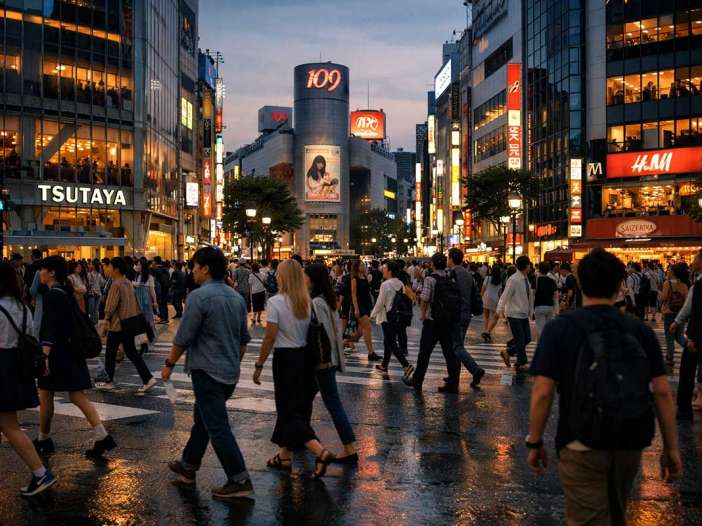
What if the rules holding Japan together are mostly invisible?
Introduction by Nick Sasaki
Why Japan is uniquely different from any other culture isn’t something you understand by reading a guidebook. You feel it the moment you step into shared space—on a train platform, in a quiet line, on a crowded street where somehow nobody collides. It’s not magic. It’s a practiced social intelligence: don’t deny the other person, don’t turn differences into enemies, and don’t make your life someone else’s problem.
That’s why this series matters right now. The world is louder than ever. Public spaces feel tense. Disagreement turns toxic in seconds. And freedom—what should be a gift—often becomes a weapon when it loses its boundaries. Japan offers a different model: freedom that survives because people protect the invisible edges of one another’s lives.
Across these five topics, we’re not trying to romanticize Japan or claim perfection. We’re trying to name what is happening in plain sight: the quiet rules that allow millions of strangers to live together without constant friction. We’ll look at freedom with boundaries, public space as shared responsibility, disagreement without destruction, harmony that doesn’t erase individuality, and a cultural confidence that can welcome others without insecurity.
If you’ve ever wondered why so many people around the world feel drawn to Japan today, I believe the answer is here—not in slogans, but in the small, repeated choices that create trust. Let’s step inside those choices together.
(Note: This is an imaginary conversation, a creative exploration of an idea, and not a real speech or event.)
Topic 1 — Freedom With Boundaries: Why Japanese Freedom Doesn’t Collapse Into Chaos
Moderator: Pico Iyer
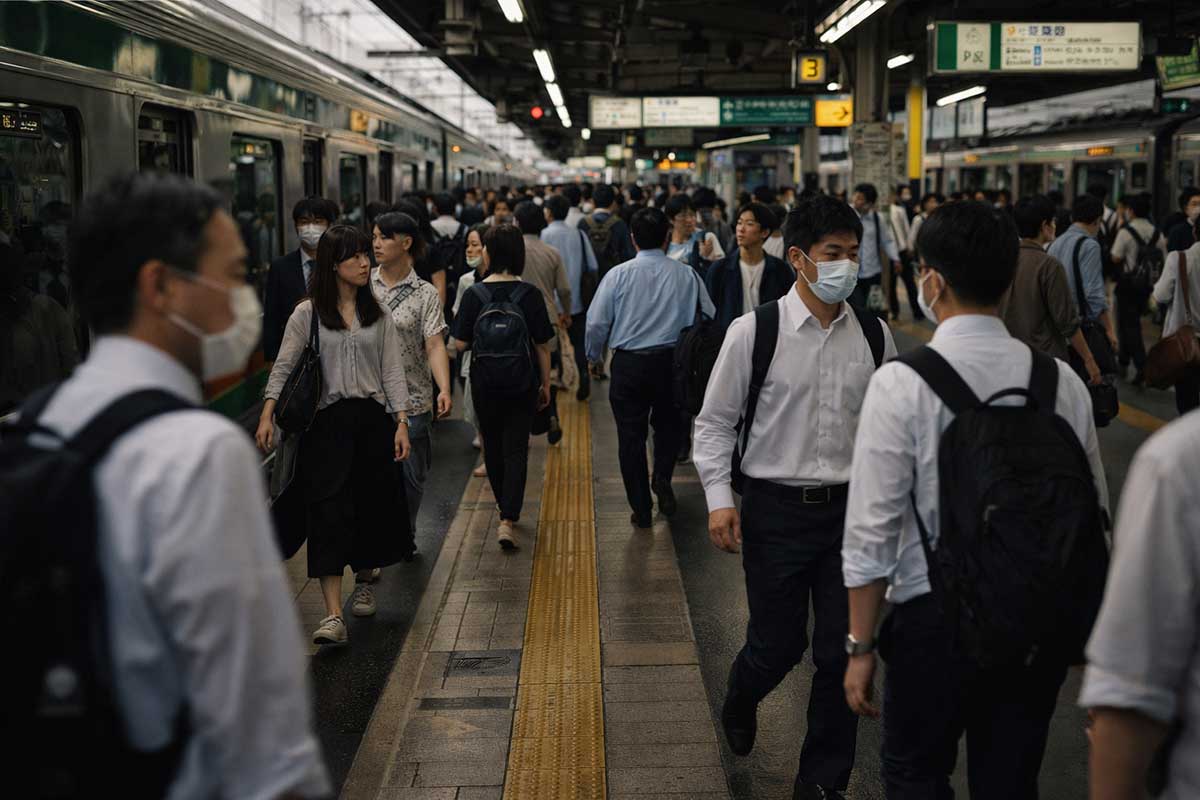
A quiet room in Tokyo. Large windows. No podium. Just chairs in a circle.
Pico Iyer (opening)
When people talk about freedom, they often imagine expansion—more voice, more movement, more assertion. Yet many visitors to Japan experience something paradoxical: a society that feels deeply free precisely because it is restrained. Today, I want to explore that paradox. How does freedom survive in a crowded world? And why, in Japan, does it so rarely collapse into chaos?
Pico Iyer (first question)
In many countries, freedom is defined as “I can do what I want.”
In Japan, freedom often feels quieter.
What do you think freedom actually means in a dense society?
Yuval Noah Harari
Freedom is never absolute. It’s always negotiated. What Japan demonstrates so clearly is that freedom without coordination quickly becomes self-destructive. In crowded societies, unrestrained expression creates noise, friction, and eventually fear. Japan has developed a cultural operating system where freedom is preserved through mutual adjustment. It’s not about suppression; it’s about survival.
Rieko Saibara
I think Japanese people don’t experience restraint as oppression. It’s more like choreography. If everyone moves wildly on a narrow street, no one moves at all. But if people anticipate each other, everyone gets where they’re going. That feels like freedom, not its opposite.
Ezra Klein
In the U.S., freedom is often framed as resistance—to rules, to norms, to expectations. What’s striking in Japan is that freedom feels embedded in trust. You trust that others will behave in ways that don’t constantly force you to defend yourself. That creates a sense of psychological freedom Americans rarely talk about.
Hiroki Azuma
Japanese freedom is contextual. It’s not about declaring independence from others, but about navigating systems skillfully. That doesn’t mean individuals are erased. It means individuality is expressed with awareness of structure. Freedom becomes competence, not rebellion.
Yusuke Narita
From a systems perspective, chaos is expensive. Societies that minimize friction free up enormous cognitive and emotional resources. Japan’s version of freedom reduces transaction costs—less conflict, less enforcement, less correction. People mistake that for passivity, but it’s actually efficiency.
Pico Iyer (second question)
Some critics say this kind of restraint limits individuality.
Others say it protects it.
Where do you see the line between freedom and self-restraint?
Hiroki Azuma
The mistake is assuming that individuality must always be loud. In Japan, individuality often appears in precision, mastery, or quiet deviation rather than open confrontation. The line is crossed only when restraint becomes compulsory rather than chosen.
Ezra Klein
I think Americans underestimate how exhausting constant self-assertion is. When every interaction requires defending your space, your identity, your rights—it drains you. Japanese restraint offloads that burden onto shared norms. That actually creates room for personal depth.
Yuval Noah Harari
Historically, societies that survive density learn self-limitation. This isn’t unique to Japan, but Japan has refined it. The danger isn’t restraint; the danger is unexamined restraint. Japan’s challenge—and strength—is maintaining reflection without losing coordination.
Yusuke Narita
Individuality flourishes when systems are predictable. If you don’t have to constantly guard against disorder, you can invest energy elsewhere—creativity, relationships, long-term thinking. Japan’s restraint protects that predictability.
Rieko Saibara
People think restraint means pressure, but pressure exists everywhere. In Japan, pressure often comes from wanting to be competent, not from fear. That difference matters. When restraint is internalized, it doesn’t feel like someone else’s rule.
Pico Iyer (third question)
As the world grows louder, more divided, more crowded—
what might other cultures learn from Japan’s model of freedom with boundaries?
Ezra Klein
The biggest lesson is that freedom requires maintenance. You can’t just declare it and walk away. You need norms that keep it from collapsing. Japan shows what happens when those norms are widely shared rather than constantly enforced.
Yuval Noah Harari
Modern crises—urbanization, climate stress, digital overload—demand coordination. Japan offers a preview of how societies might remain humane without becoming authoritarian. That balance will define the next century.
Rieko Saibara
I think the lesson is simple: freedom isn’t just about expressing yourself. It’s about not turning your life into someone else’s problem. That idea alone could calm many societies.
Yusuke Narita
If other cultures adopt only one insight, it should be this: friction is not free. Reducing it isn’t conformity—it’s optimization. Japan optimized for coexistence.
Hiroki Azuma
Japan reminds us that freedom doesn’t have to shout. Sometimes it whispers—and still holds.
Pico Iyer (closing)
What Japan offers the world is not a formula, but a possibility: that freedom can be quiet, that boundaries can be humane, and that restraint, when chosen rather than imposed, can become a form of collective grace. In a crowded future, that may be one of the most radical ideas we have.
Topic 2 — Public Space as a Shared Moral Responsibility
Moderator: Pico Iyer
A busy Tokyo afternoon outside, but inside the room there’s stillness. The windows are open. No one rushes.
Pico Iyer (opening)
One of the first things many visitors notice in Japan isn’t a monument or a meal. It’s behavior. The way people move through shared space. The way public life feels… maintained. Today, I’d like to explore something subtle but powerful: how Japan treats public space not as neutral territory, but as a shared moral responsibility.
Pico Iyer (first question)
In many countries, public space is where people relax their standards.
In Japan, it often feels like the opposite.
Why do you think public space carries so much care here?
Marie Kondo
I think it begins with respect. When we tidy a room, we’re not just organizing objects—we’re deciding what kind of environment we want to live in. Japanese public spaces are treated almost like shared homes. You don’t shout in someone else’s living room. You don’t leave disorder behind for the next person. It’s a natural extension of that mindset.
Byung-Chul Han
What fascinates me about Japan is the absence of spectacle in public behavior. In many societies, public space becomes a stage for self-expression. Here, it feels more like a field of coordination. Silence, restraint, and attentiveness reduce friction. This doesn’t erase individuality—it simply prevents constant collision.
Jane Jacobs
Cities live or die by small behaviors. Not policies—habits. What I see in Japan is a deep understanding that strangers still affect each other. When people move predictably and respectfully, cities become safer and more humane. Japan didn’t invent that idea, but it has preserved it better than most.
Takashi Murakami
There’s an aesthetic dimension too. Disorder creates noise, even when it’s visual or emotional. Japanese culture has a long relationship with balance and containment. That shows up in art, but also in how people occupy space. The street is not a canvas for ego. It’s a composition we’re all inside.
Yuki Kaji
From a very young age, you learn that what you do affects others—even strangers. It’s not explained philosophically. It’s practical. If you’re loud, someone else can’t rest. If you rush, someone else stumbles. That awareness becomes automatic.
Pico Iyer (second question)
Some outsiders describe this as politeness.
Others call it social pressure.
What do you think is really being protected in these shared spaces?
Jane Jacobs
Time. Attention. Safety. These are fragile resources. When public behavior becomes unpredictable, people withdraw. Streets empty. Trust erodes. Japan protects the invisible infrastructure of daily life—the sense that you can move through the city without bracing yourself.
Marie Kondo
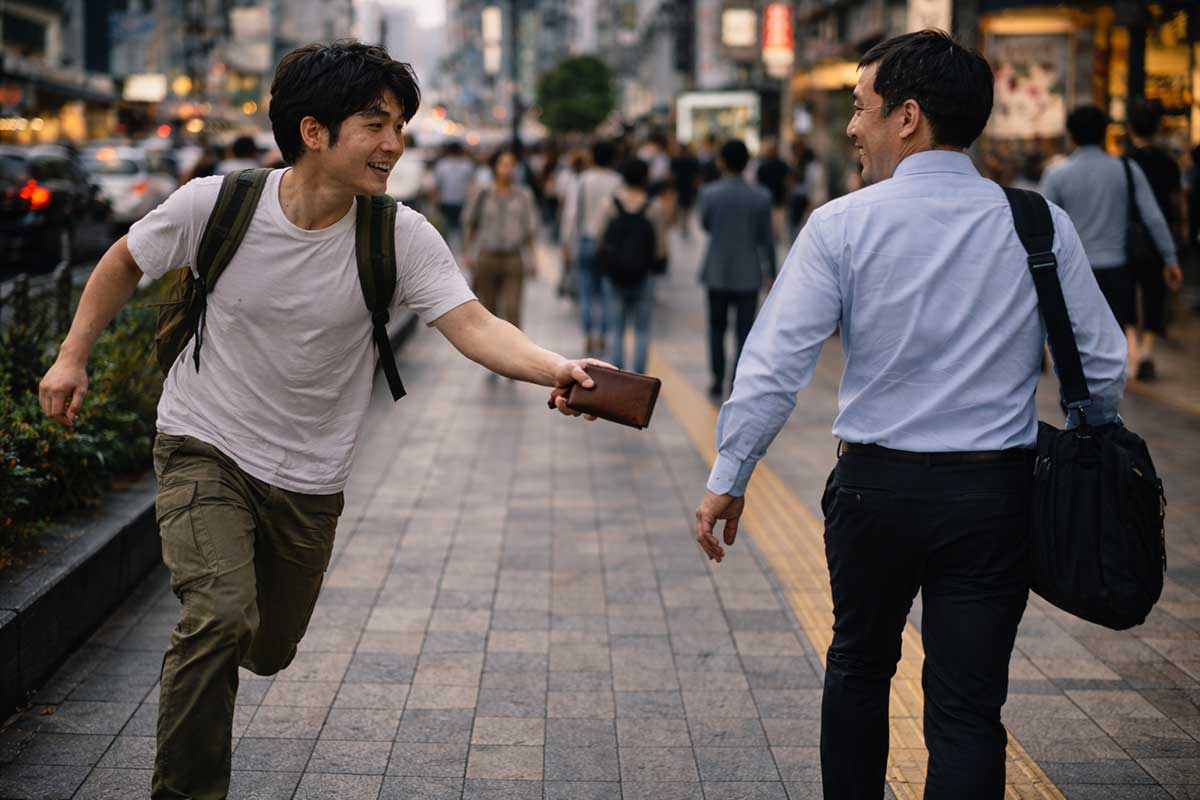
I would say dignity. Not dramatic dignity—quiet dignity. Even something small, like returning a dropped wallet without hesitation, isn’t treated as heroism. It’s just restoring order. You’re helping the space return to how it should feel.
Byung-Chul Han
In the West, morality often becomes visible through transgression and correction. In Japan, morality often works by prevention. When people adjust themselves early, conflict never needs to announce itself. That’s psychologically calming.
Yuki Kaji
What’s protected is flow. When everyone follows roughly the same rhythm, life moves smoothly. You don’t have to constantly interpret other people’s intentions. That reduces anxiety more than people realize.
Takashi Murakami
It’s interesting—when someone picks up a dropped item and runs after the owner, there’s no emotion attached. No smile, no speech. Just correction. Like adjusting a frame that’s slightly crooked. That tells you something about the culture.
Pico Iyer (third question)
Many societies struggle to maintain public order without heavy enforcement.
What can the world learn from how Japan maintains shared space so effortlessly?
Byung-Chul Han
The lesson is not discipline—it’s internalization. When norms are carried inside people, power becomes lighter. The state doesn’t need to shout. Society doesn’t need to shame. The system runs quietly.
Marie Kondo
Care scales. If you treat your room with respect, you can treat a train with respect. If you treat a train with respect, you can treat a city with respect. Order isn’t control—it’s consideration extended outward.
Jane Jacobs
Japan reminds us that cities are not machines. They’re relationships. When people accept responsibility for the spaces between them, cities stay alive. When they don’t, no amount of policy can save them.
Takashi Murakami
Other cultures might think this requires uniformity. It doesn’t. It requires awareness. You can be strange, creative, unconventional—and still not damage the space you share with others.
Yuki Kaji
I think the lesson is simple: public space isn’t empty. Someone else is always about to step into it. When you remember that, behavior changes naturally.
Pico Iyer (closing)
What Japan shows us is not a perfect society, but a practiced one. A society where public space is gently maintained by millions of small, uncelebrated choices. In a world where shared spaces are growing louder and more fragile, that quiet coordination may be one of Japan’s most valuable gifts.
Topic 3 — Disagreement Without Destruction
How Japan Preserves the “Space” Even When Views Clash
Moderator: Pico Iyer
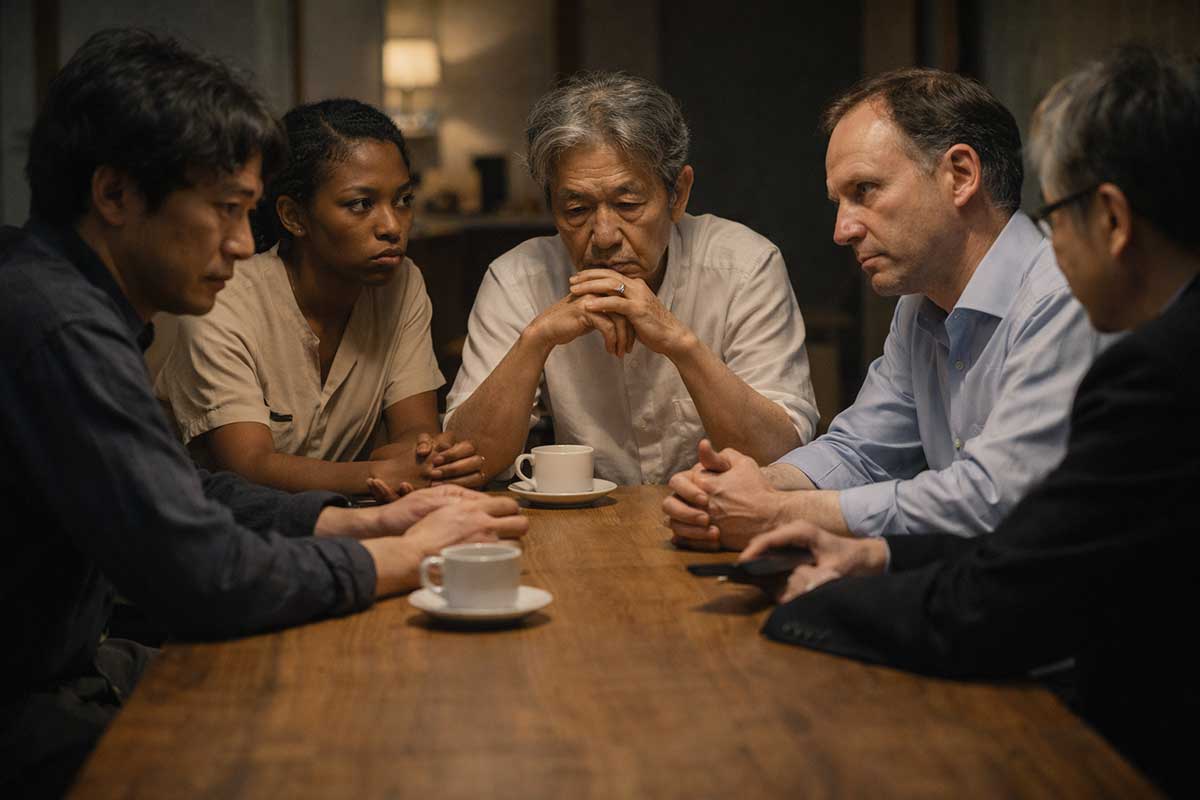
A quiet evening setting. The city hums outside, but the room feels contained. No microphones. No raised voices.
Pico Iyer (opening)
One of the most striking differences between Japan and many other societies isn’t the absence of disagreement. It’s what doesn’t happen when disagreement appears. Arguments don’t automatically escalate into humiliation. Differences don’t immediately harden into enemies. There is often a felt obligation to preserve the space between people, even while disagreeing. Today, I’d like to explore how Japan manages disagreement without destruction.
Pico Iyer (first question)
In many cultures today, disagreement quickly becomes personal and explosive.
In Japan, disagreement often feels quieter, sometimes even indirect.
Why do you think Japan handles disagreement this way?
Shohei Ohtani
In sports, especially at high levels, emotions are intense. But you’re taught that losing control hurts the team. In Japan, that thinking extends beyond sports. You can be competitive, you can disagree—but if you damage the atmosphere, everyone pays the price. That’s something people learn early.
Brené Brown
What I notice is a different relationship to shame and vulnerability. In many Western spaces, people attack first to protect themselves. In Japan, there’s often an effort to protect the relationship itself. That doesn’t mean feelings disappear—it means they’re managed with care.
Daigo Umehara
In competitive gaming, respect is everything. If you humiliate your opponent, you damage the entire scene. Japanese culture understands this intuitively. Disagreement isn’t about domination; it’s about testing skill or ideas without destroying the shared ground.
Maki Sonoda
Psychologically, Japanese society places a high value on relational continuity. Even when people disagree, they expect to encounter each other again—in the workplace, in the neighborhood, in social circles. That expectation discourages scorched-earth behavior.
Trevor Noah
From the outside, it can look like avoidance. But I think it’s more about timing and tone. In some cultures, disagreement is entertainment. In Japan, disagreement feels more like surgery—necessary sometimes, but not something you do casually or loudly.
Pico Iyer (second question)
Some critics say this approach suppresses honest expression.
Others say it protects dialogue from turning toxic.
Where do you see the balance between honesty and preservation of space?
Brené Brown
Honesty without care often isn’t courage—it’s discharge. What Japan seems to understand is that truth lands differently depending on how it’s delivered. Protecting the space doesn’t mean lying; it means choosing forms of honesty that don’t retraumatize everyone involved.
Daigo Umehara
In gaming, you review mistakes after the match, not during it. Timing matters. Japanese communication often separates expression from confrontation. That allows honesty to happen without emotional collapse.
Maki Sonoda
There is suppression sometimes—that’s real. But there is also deep listening. Many disagreements are processed internally or privately rather than publicly. The balance shifts when people feel safe that the relationship won’t disappear.
Trevor Noah
In comedy, conflict sells. But constant conflict also exhausts people. What Japan shows is that not every disagreement needs an audience. Some things are handled quietly, and that quietness is actually protective.
Shohei Ohtani
You still feel anger. You still feel frustration. But you learn to ask, “Will expressing this right now make things better—or just louder?” That question alone changes behavior.
Pico Iyer (third question)
In a world increasingly divided by ideology, identity, and outrage,
what might other societies learn from Japan’s way of disagreeing without destroying the space?
Trevor Noah
Maybe that disagreement doesn’t have to be a performance. When everything becomes content, people exaggerate conflict. Japan reminds us that not all tension needs amplification.
Brené Brown
I think the lesson is emotional regulation at scale. When societies lose the ability to self-regulate, they rely on punishment or spectacle. Japan offers a quieter third option: restraint rooted in empathy.
Maki Sonoda
Sustainable disagreement requires trust that the relationship matters more than the moment. Japan prioritizes long-term coexistence over short-term victory.
Daigo Umehara
Winning at the cost of the game itself is meaningless. That’s true in games, and it’s true in society. Japan’s approach protects the game.
Shohei Ohtani
Respect doesn’t weaken competition—it strengthens it. When the space is preserved, people can keep showing up. That’s how progress happens.
Pico Iyer (closing)
Japan’s way of handling disagreement doesn’t eliminate conflict. It reframes it. By protecting the space between people, disagreement becomes something that can be survived—and even learned from. In an age where division often feels irreversible, that may be one of the most valuable skills a society can offer.
Topic 4 — Harmony That Is Not Conformity
Coordination Without Erasing Individuality
Moderator: Pico Iyer
A long wooden table. Evening light. The mood is attentive, not hushed—comfortable.
Pico Iyer (opening)
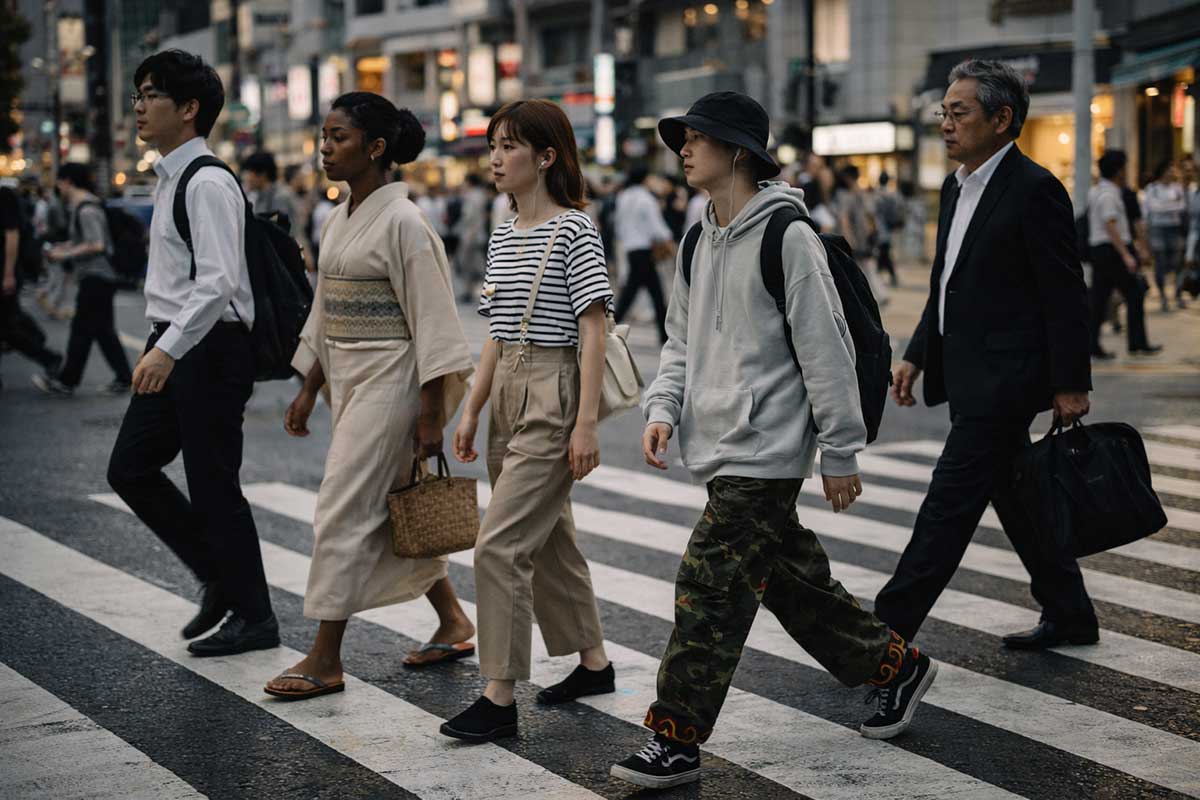
Harmony is often misunderstood. To some outsiders, Japan’s social smoothness looks like conformity—like individuality has been traded for peace. Yet anyone who spends time here encounters fierce originality, deep craftsmanship, and strong personal worlds. Today I’d like to explore a tension at the heart of Japanese life: how harmony can coordinate people without erasing who they are.
Pico Iyer (first question)
In many cultures, harmony is seen as the opposite of individuality.
In Japan, they often coexist.
How does Japanese harmony work without flattening people into sameness?
Naoki Urasawa
When I create characters, I’m always thinking about how individuals act inside systems—families, institutions, societies. Japanese harmony doesn’t ask people to disappear. It asks them to understand the structure they’re inside. Once you understand it, you can move freely within it. That’s not conformity; that’s navigation.
Adam Grant
In organizations, we often confuse harmony with agreement. Japan offers a different model: alignment without uniformity. People don’t need to think the same way to move in the same direction. That distinction is critical—and rare.
Hayao Miyazaki
Nature is my teacher. In nature, harmony doesn’t mean identical trees or silent forests. It means each element has its place and rhythm. Japanese culture tries to mirror that. The problem comes when people confuse stillness with emptiness. They’re not the same.
Ryuichi Sakamoto
In music, silence is not the absence of sound—it’s part of the composition. Japanese harmony often works the same way. Space allows expression to matter. Without restraint, everything becomes noise.
Alain de Botton
Western cultures often romanticize disruption as the only proof of individuality. Japan suggests something subtler: individuality can be expressed through refinement, dedication, and depth rather than constant provocation.
Pico Iyer (second question)
Critics argue that harmony can slide into pressure—
that people may hide dissent to avoid standing out.
Where do you see the risk, and how does Japan manage it?
Adam Grant
The risk is real. Any system that values coordination can silence unconventional voices. What protects Japan, at its best, is context-switching—private spaces where individuality is fully alive, even if public spaces are restrained.
Ryuichi Sakamoto
There were times when conformity was suffocating. Art survives by pushing back gently, not violently. Japanese creators often resist not by shouting, but by carving out quiet alternative worlds.
Naoki Urasawa
Manga became a release valve. It allowed people to explore moral complexity, fear, and rebellion without breaking social cohesion. That’s important—every harmonious system needs safe outlets.
Alain de Botton
What Japan reminds us is that no society eliminates tension. The question is whether tension is processed constructively or destructively. Harmony isn’t denial—it’s delayed expression, handled with care.
Hayao Miyazaki
Children sense pressure immediately. That’s why imagination matters. When imagination is alive, harmony doesn’t crush the soul. When imagination dies, harmony becomes a cage.
Pico Iyer (third question)
In an era of polarization and loud individualism,
what can the world learn from Japan’s version of harmony?
Alain de Botton
That peace doesn’t require sameness. Societies can be calm without being dull. Harmony can coexist with eccentricity when emotional needs are understood rather than ignored.
Naoki Urasawa
The lesson is patience. Japanese harmony gives stories time to unfold. It resists instant judgment. That patience creates space for complexity.
Adam Grant
Many cultures could benefit from separating ego from expression. You can contribute meaningfully without centering yourself. That’s a powerful skill in teams, cities, and nations.
Ryuichi Sakamoto
Restraint is not the enemy of creativity. It’s often its frame. Without a frame, creativity spills everywhere and loses shape.
Hayao Miyazaki
If harmony disappears, the world becomes uninhabitable. Not because people stop expressing themselves—but because no one listens anymore.
Pico Iyer (closing)
Japan’s harmony is not about obedience. It’s about coexistence. It asks individuals not to vanish, but to consider where they stand in relation to others. In a noisy, fragmented world, that ability—to coordinate without erasing—is not a weakness. It’s a quiet form of strength.
Topic 5 — Cultural Confidence Without Cultural Aggression
“My Culture Is Wonderful—and So Is Yours”
Moderator: Pico Iyer
A calm, sunlit room. Books from many countries line the walls. Nothing feels on display.
Pico Iyer (opening)
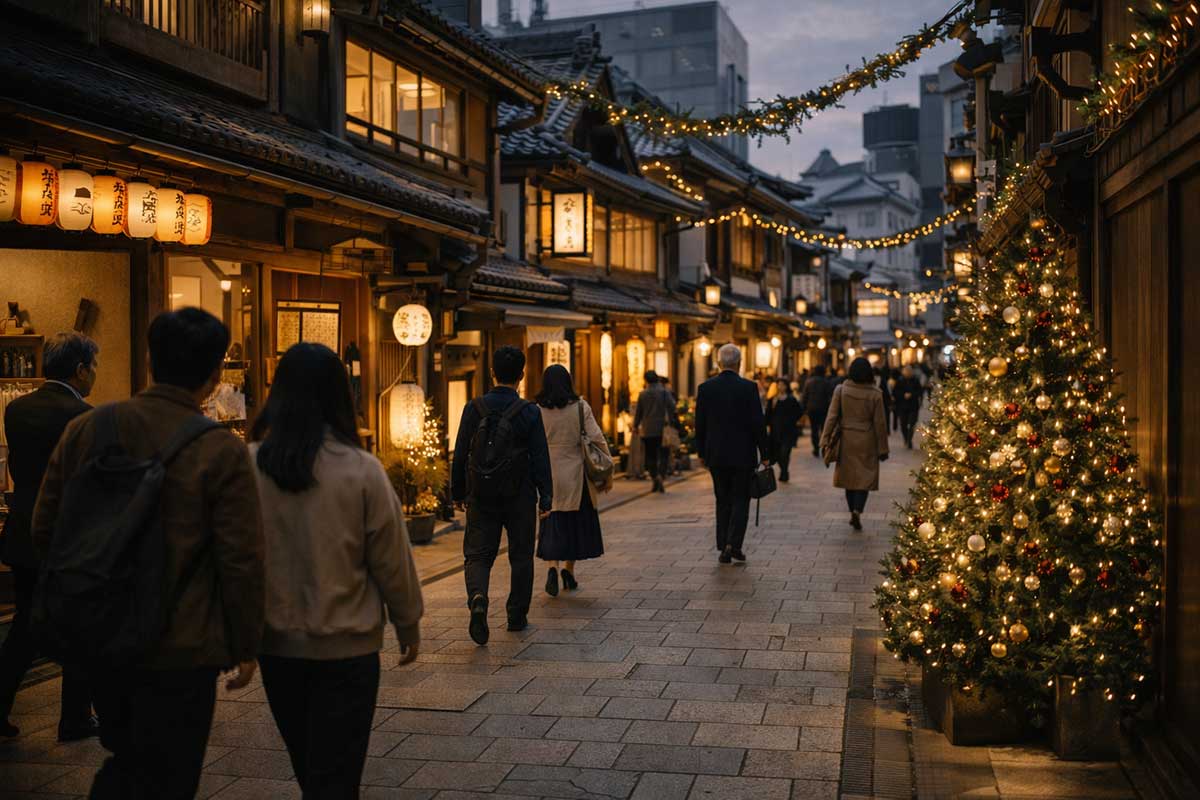
Japan often surprises visitors not only with how deeply it values its own traditions, but with how easily it welcomes others. Christmas lights appear without anxiety. Foreign customs are absorbed without dilution. There is pride here—but rarely hostility. Today, I want to explore a rare balance: cultural confidence without cultural aggression.
Pico Iyer (first question)
Many societies struggle to love their own culture without putting others down.
Japan often seems to manage both.
Where does that confidence come from?
Yoko Kanno
When you trust your roots, you don’t panic when something foreign appears. In music, I borrow sounds from everywhere, but my sense of home doesn’t disappear. Japanese culture works the same way. Confidence lets you play.
Joseph Nye
From a soft-power perspective, Japan is fascinating. It doesn’t persuade by pressure. It attracts by consistency. That attraction comes from self-assurance, not superiority. You don’t need to declare dominance when people are already curious.
Pico Iyer
Living in Japan, I’ve noticed that tradition isn’t worn like armor. It’s worn like skin. That makes it flexible. When culture isn’t defensive, it can breathe.
Chimamanda Ngozi Adichie
What strikes me is the absence of panic. In many places, cultural pride is fueled by fear—fear of loss, fear of replacement. Japan seems less afraid. When fear recedes, generosity becomes possible.
Shunryu Suzuki
In Zen, when you are grounded, you do not need to compare. Comparison creates aggression. Presence creates ease. A culture that practices presence can meet others without tension.
Pico Iyer (second question)
Japan famously absorbs foreign elements—holidays, food, fashion—
yet remains unmistakably itself.
How does that work without erasing identity?
Joseph Nye
Japan localizes rather than imitates. Foreign ideas are translated, not copied. That process preserves agency. The culture decides what fits instead of submitting to trend pressure.
Yoko Kanno
In Japanese aesthetics, harmony doesn’t mean purity. It means balance. You can introduce a new element if it doesn’t overwhelm the whole. That’s true in art, and it’s true culturally.
Chimamanda Ngozi Adichie
Identity weakens when it needs enemies. Japan doesn’t need an enemy to define itself. That’s why it can borrow freely. Borrowing doesn’t threaten you when you know who you are.
Shunryu Suzuki
When the mind is empty, it can receive everything. When the mind is full of fear, it receives nothing. Culture is the same. Emptiness is not loss—it is openness.
Pico Iyer
Christmas in Japan is a perfect example. It’s celebrated joyfully, but it doesn’t replace anything. It sits alongside other traditions without conflict. That coexistence feels effortless.
Pico Iyer (third question)
In a world where cultural pride often turns into cultural warfare,
what might other societies learn from Japan’s approach?
Chimamanda Ngozi Adichie
That confidence is quiet. Cultures don’t need to shout to survive. When people feel secure, they can be curious rather than defensive.
Joseph Nye
Aggression weakens influence. Attraction strengthens it. Japan shows how cultural strength can travel without coercion.
Yoko Kanno
Creativity thrives when cultures exchange without fear. The lesson is not to protect culture by closing it, but by trusting it.
Shunryu Suzuki
When you let go of the need to defend, you gain the ability to connect. That is true for people, and for nations.
Pico Iyer
Japan suggests a radical idea: that cultural survival doesn’t require domination. It requires steadiness.
Pico Iyer (closing)
Japan’s confidence is not loud. It does not insist. It invites. By loving itself without attacking others, Japan offers a model for a world exhausted by cultural conflict. In an age of anxiety and division, that quiet assurance may be one of the most powerful forms of strength we have left.
Final Thoughts by Nick Sasaki
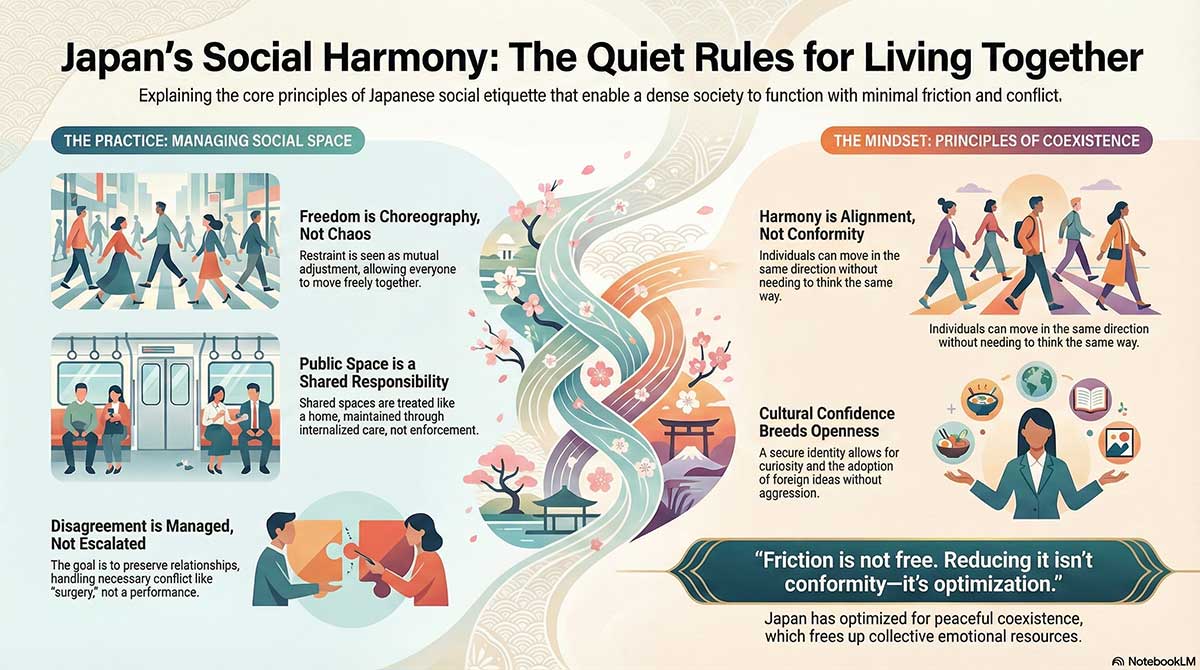
If there’s one thing Japan keeps reminding me, it’s that a great society isn’t built only by laws, speeches, or ideals. It’s built by the invisible decisions people make when no one is watching—the decision to lower their voice, to keep the line moving, to return what isn’t theirs without hesitation, to disagree without humiliating, to protect the “space” between human beings.
In a time when many cultures are struggling with division, outrage, and the temptation to treat public life like a battlefield, Japan offers a quieter kind of strength. Not the strength of domination, but the strength of self-restraint. Not the confidence of superiority, but the confidence that says: my culture is wonderful, and yours can be wonderful too. That single mindset changes everything, because it removes the need for enemies.
None of this means Japan is perfect. No culture is. But perfection isn’t the point. Practice is. Japan has practiced coexistence in everyday life so deeply that it often looks effortless. And maybe that’s the real lesson: the future will not be saved by the loudest voices. It will be saved by the cultures—and the individuals—who learn how to live together without constantly wounding one another.
So as you move through your own city, your own relationships, your own disagreements, here’s the invitation I’m taking from this series: protect the shared space. Protect the dignity of strangers. And build a kind of freedom that doesn’t require someone else to lose.
Short Bios:
Nick Sasaki
Founder of ImaginaryTalks, writer and moderator exploring culture, ethics, and quiet social intelligence through global dialogue.
Pico Iyer
Essayist and speaker known for reflections on stillness, global identity, and life lived between cultures, long based in Japan.
Yuval Noah Harari
Historian and bestselling author examining how shared narratives and systems shape human societies and the future.
Ezra Klein
Political journalist and host focused on systems, public life, and how ideas shape modern societies.
Hiroki Azuma
Contemporary philosopher analyzing structure, individuality, and postmodern thought in modern Japan.
Yusuke Narita
Economist and public thinker exploring generational change, social systems, and uncomfortable questions in modern societies.
Marie Kondo
Author and cultural icon whose philosophy of order emphasizes care, intention, and respect for shared space.
Byung-Chul Han
Philosopher examining silence, pressure, transparency, and burnout in contemporary global culture.
Jane Jacobs
Urban thinker celebrated for showing how everyday human behavior sustains living, humane cities.
Takashi Murakami
Artist blending traditional Japanese aesthetics with pop culture to explore order, chaos, and modern identity.
Yuki Kaji
One of Japan’s most recognizable voice actors, offering a grounded, everyday perspective on public life and behavior.
Shohei Ohtani
International sports icon admired for humility, discipline, and respect-driven excellence.
Brené Brown
Researcher and author focused on vulnerability, courage, and human connection.
Daigo Umehara
Legendary competitive gamer known for discipline, respect, and mastery under pressure.
Trevor Noah
Comedian and writer using humor to explore cultural difference, identity, and conflict across societies.
Maki Sonoda
Social psychologist studying group dynamics, conflict management, and relational continuity in Japanese society.
Naoki Urasawa
Acclaimed storyteller known for complex moral narratives within social and institutional systems.
Adam Grant
Psychologist and author exploring teamwork, originality, and how individuals function within groups.
Hayao Miyazaki
Legendary animator whose films explore individuality, harmony, and responsibility within shared worlds.
Ryuichi Sakamoto
Composer and artist known for blending restraint and emotion across musical and cultural boundaries.
Alain de Botton
Writer translating philosophy into everyday emotional and social insight.
Yoko Kanno
Composer celebrated for genre-defying work that blends global influences with Japanese sensibility.
Joseph Nye
Scholar who introduced the concept of soft power, examining influence without coercion.
Chimamanda Ngozi Adichie
Writer exploring identity, culture, and confidence without hostility.
Shunryu Suzuki
Zen teacher whose teachings emphasize presence, humility, and quiet strength.
Leave a Reply