

|
Getting your Trinity Audio player ready...
|
What if Jordan Peterson challenged modern seekers to wrestle with God and meaning instead of running from it
Introduction by Jordan Peterson’s style
Alright. Let’s begin with something that is both obvious and easy to ignore.
Life is difficult. Not in a melodramatic sense, but in the most concrete way. People suffer. They lose what they love. They get sick. They betray each other. They become resentful. They fall into habits that destroy them. And then they wonder why everything feels pointless.
So the question is not, “How do I stay comfortable?” The question is, “How do I live so that the inevitable tragedy of life does not turn me into something bitter, cruel, or demoralized?”
That’s what it means to wrestle with God.
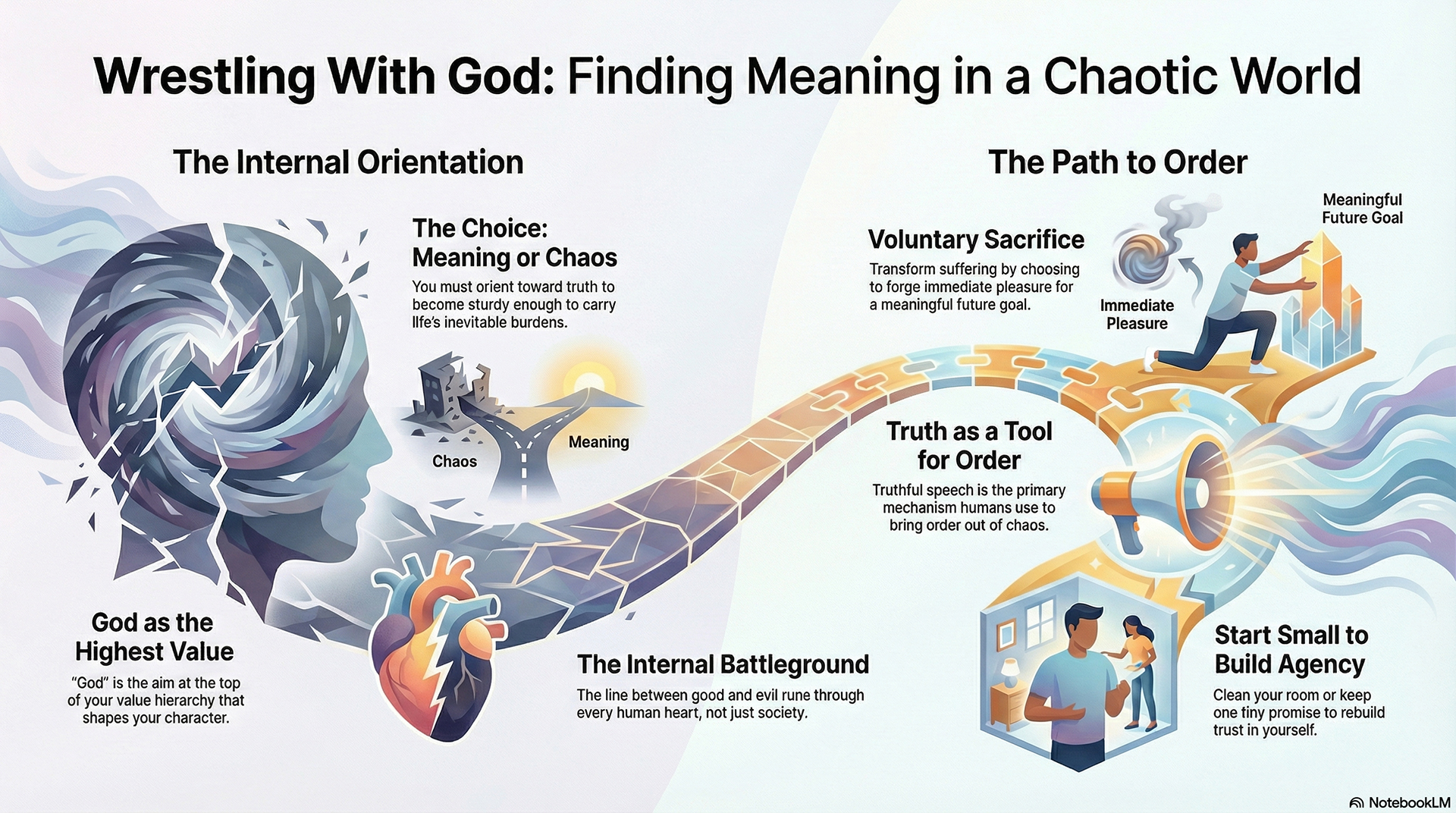
You can call it God, you can call it the highest good, you can call it truth, you can call it the moral law written into the structure of reality. But you cannot escape the fact that you will orient yourself toward something. And whatever you put at the top of your hierarchy of values will shape your character, your relationships, and your society.
If you orient yourself toward resentment, you will become dangerous. If you orient yourself toward impulsive pleasure, you will become weak. If you orient yourself toward power, you will become tyrannical or terrified. But if you orient yourself toward truth and responsibility, something remarkable happens: you become sturdier. You become someone who can carry a load. You become the kind of person who can keep a promise. And once you become that, your life begins to matter.
The biblical stories endure because they are not naive. They don’t portray human beings as basically good and society as merely corrupt. They portray the terrifying reality that the line between good and evil runs through every human heart. They show you what happens when you lie, when you envy, when you betray, when you refuse sacrifice. And they show you what happens when you speak truth, when you accept responsibility, and when you voluntarily take on the suffering that is necessary to become something better.
In this series, we’re going to treat these stories not as dead artifacts, and not as simplistic rules, but as living dramas. We’re going to ask what it means to confront your shadow, to make peace with the chaos in your own life, to repair what can be repaired, and to stand firm when the crowd demands that you become dishonest.
Because that is the choice, in the end.
Meaning or chaos.
And that choice is made, not once, but every day.
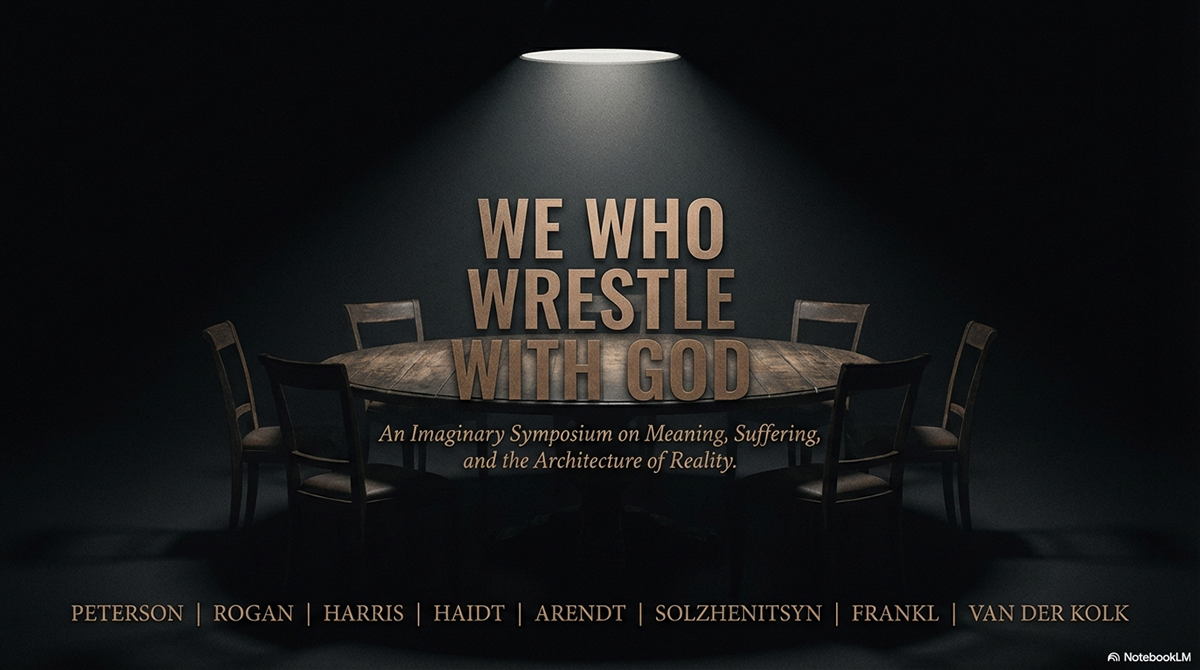
(Note: This is an imaginary conversation, a creative exploration of an idea, and not a real speech or event.)
Topic 1: Wrestling With God as Psychological Reality
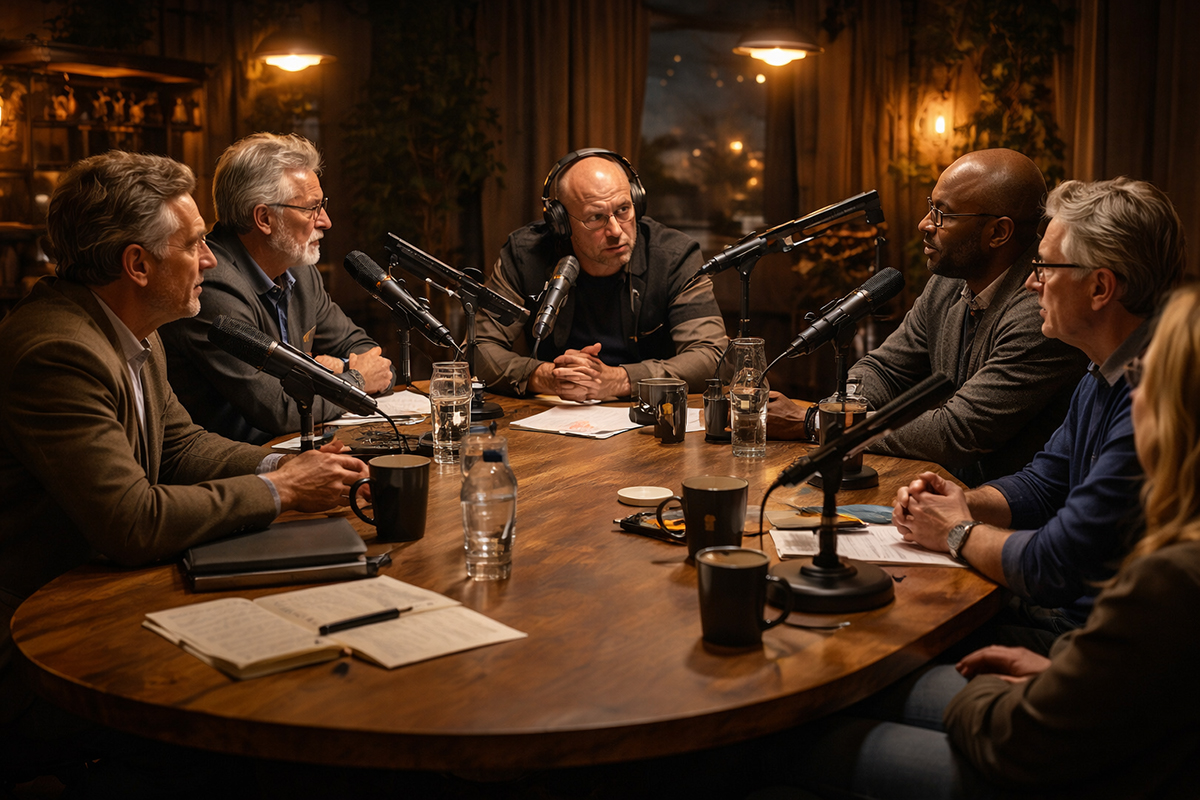
Hosted by Joe Rogan
Guests: Jordan Peterson, Jonathan Pageau, Bishop Robert Barron, Ian McGilchrist, Lisa Miller
The studio is the usual Rogan cave, warm wood, soft orange light, mics close, coffee in hand. Joe leans forward like he is about to start a story, not a debate.
Joe Rogan: Alright. So. Topic one. When you say “We who wrestle with God”… what do you actually mean by “God” when you are not trying to win a debate? Like, if you are talking to a normal person who is not online arguing. What do you mean?
Jordan Peterson: The simplest answer is that “God” is what you place at the top of your value hierarchy. That is the thing you serve, consciously or unconsciously. The thing you orient your life around. People act that out whether they have a theology or not. If you put pleasure there, you become a slave to impulse. If you put power there, you become a tyrant or you become possessed by resentment. If you put truth there, it burns, because it demands sacrifice, but it also aligns you with reality.
And the “wrestling” is not decoration. It is the unwillingness to reduce that demand to something trivial. You wrestle because you are finite, because you suffer, because you do not know what you should do, because your motives are mixed. Wrestling is the refusal to lie about that.
Joe Rogan: So it is not like, “God is definitely this bearded dude in the sky.” It is more like the highest thing in your life, the thing you serve.
Jordan Peterson: That is one psychologically accurate way to say it, yes. And it is not merely subjective, because if you orient yourself poorly, reality will punish you. Your relationships break. Your character breaks. Your society breaks. It is not “whatever you feel like.” It is more like, you are going to serve something. Better know what you are serving.
Jonathan Pageau: The way I would put it is, people get nervous because they think symbol means “not real.” But symbol is how reality presents itself to human beings. A king is a symbol, but the king is real. A flag is a symbol, but it organizes an entire people. So when you say “God is the highest,” you are saying something true about how reality is structured. God is not just a concept you hold in your head. God is the pattern of meaning that holds everything together.
And wrestling is exactly right because the biblical stories never tell you “easy faith.” They show Jacob literally wrestling. They show Job screaming. They show people failing and coming back. That is the pattern.
Bishop Robert Barron: I appreciate the psychological insight. It can be very helpful. But I would add something. In the biblical tradition, God is not merely the top of a human value pyramid. God is the ground of being, the creator, the one from whom all exists. Now, psychologically, of course, we experience God as “ultimate,” as the highest good. But the danger is that we reduce God into a projection of ourselves.
Wrestling is not just the struggle with meaning. It is also the struggle with a reality that exceeds you, that judges you, that calls you beyond yourself.
Joe Rogan: That is where people get stuck, right? Because a lot of people are like, “I can accept the meaning thing.” But then they go, “Wait, are we saying there is an actual God?” And then it turns into a war.
Ian McGilchrist: The war happens because modern minds tend to treat reality as a set of objects to be pinned down and controlled. That is a very narrow kind of knowing. But meaning is not an “object.” It is a relationship. The biblical language is operating in that relational register.
When you ask “Is God real,” we often mean “Can I measure God.” But the deepest realities in human life, love, beauty, moral obligation, are not reducible to measurement. They are not therefore unreal. They are more real. Wrestling with God is wrestling with that dimension of reality that demands participation, not control.
Lisa Miller: I study this from the psychological side. What is interesting is that people can have what we might call a lived spiritual awareness, a sense of relationship to something larger than the self, and it can be protective. It can increase resilience, reduce despair, help people recover from trauma. But it has to be authentic. If it is performative, or if it is used as a weapon, it can become harmful.
The “wrestling” part, in mental health terms, can be seen as the development of an integrated self. You tolerate uncertainty, you tolerate pain, you tolerate paradox, and you still move toward value.
Joe Rogan: Okay, so that leads into my second question. Have you seen people actually change their lives through this biblical framing, or is it mostly an intellectual game? Like, Jordan, when you wrote this, were you thinking, “I want people to become different,” or were you mostly mapping ideas?
Jordan Peterson: I have seen it. Not abstractly. I have seen people pulled out of catastrophe by orienting toward something like truth. They stop lying to themselves. They tell the truth to their wife, to their husband, to their boss, to themselves. They take responsibility for what they can actually fix. That is not theory. That is transformation.
But you are right to ask if it is just an intellectual game. That is always the danger. That is why the biblical stories do not present mere doctrine. They present embodied drama. The truth is not “what you think.” It is what you live.
Bishop Robert Barron: It is also why the tradition insists on practice, not only interpretation. Worship, confession, service, sacrifice. Those are not accessories. They are the way the truth becomes flesh.
Jonathan Pageau: You can tell when it is a game because the person becomes proud. They use the story as a weapon. They want to be seen as right. But when it is real, it humbles you. The story becomes a mirror. You see your own betrayal, your own cowardice, your own envy. Then you can repent. That is the beginning of change.
Joe Rogan: So “real” means it costs you something.
Jordan Peterson: Exactly. If it costs you nothing, it is not transforming you.
Ian McGilchrist: Another sign it is real is that it makes you more capable of love. A person who has moved toward truth becomes less brittle, less reactive. They gain the capacity to bear ambiguity and still remain humane. That is the opposite of ideology.
Lisa Miller: And from the psychological lens, that cost can look like grief. People often have to grieve the identity they built around resentment or victimhood. That is hard. But then, on the other side, they have more agency.
Joe Rogan: Alright. Third question. If a person has zero faith background, what is the first story or idea that still hits them in the gut? Like, what is the entry point?
Jordan Peterson: Cain and Abel is a brutal entry point. Because it is not about theology in the abstract. It is about envy. It is about resentment. It is about the voice that says, “If I cannot have what I want, I will destroy what is good.” That is in everyone.
And then God’s warning to Cain is psychologically exact: resentment is a predatory force. It crouches at the door. It wants you. But you can rule it. That is the first moral drama of civilization. What do you do when life is unfair? Do you improve your offering, or do you take revenge on innocence?
Bishop Robert Barron: I would add the Prodigal Son, although that is later in scripture. The reason it hits is because it shows both sides. The reckless son who wastes his inheritance, and the dutiful son who becomes resentful and self-righteous. Many people find themselves in one of those two forms of lostness.
Jonathan Pageau: Genesis is the gateway. The pattern of order and chaos, the garden, the exile. Everyone knows what it is to feel they have fallen out of harmony with their own life. That is not religious. That is human.
Ian McGilchrist: The story of Job also hits, though it is demanding. The reason it hits is that it refuses simplistic answers. It says, “You will suffer. You will not always get an explanation. And yet your response matters.” That is a mature story for a mature pain.
Lisa Miller: And for many people now, the entry point is not a “story” but a moment. A crisis, a loss, a rupture. Then they ask, “What is this for?” In those moments, these stories can offer language and containment. Not a cheap explanation, but a structure that keeps someone from falling apart.
Joe Rogan: I like that Cain and Abel thing because it is so human. It is like, you are mad, and you are blaming the world, and then you go after the person who did nothing to you.
Jordan Peterson: Yes. And that is why the book matters right now. Because resentment is contagious. And it is dressed up as moral purity. People tell themselves they are righteous while they are destroying what is good.
Joe Rogan: Okay, but let me push a little. Bishop, when Jordan says “God is what you put at the top of your values,” does that annoy you? Or do you see it as a doorway?
Bishop Robert Barron: I see it as a doorway. But I also see the risk. The doorway can become a room people never leave. If God is only a human construction, then God is ultimately subject to human will. And then, paradoxically, you do not escape the self. You enthrone the self.
The biblical God is not just the apex of our psychology. God is the one who calls us out of ourselves. And when you feel that call, you often experience it as wrestling.
Jordan Peterson: I do not disagree with that. I would say: if you take seriously the idea that the highest good is not simply your opinion, you are already moving in the direction of a transcendent reality. The debate is often about language. But the experience is real.
Ian McGilchrist: If I may, it is also about modes of knowing. One can know God the way one knows a chemical compound, or one can know God the way one knows a person. The second is not irrational. It is simply different. And it is closer to what human beings actually do when they orient their lives.
Joe Rogan: So the wrestle is like… you are trying to align with something bigger than you, but your ego, your fear, your trauma, your habits, all fight back.
Lisa Miller: Yes. And if you avoid the wrestle entirely, you do not become free. You become fragile. Because then your meaning depends on comfort. And comfort is not stable.
Joe looks at Peterson for a beat, like he is checking whether the whole thing is going to turn into a sermon or stay grounded. Peterson’s face is serious, but he looks oddly relieved, as if the framing has finally landed the way he wanted it to.
Joe Rogan: Alright. That is topic one. Next time we go into suffering and sacrifice, because that is where people either get religion or get bitter.
The room goes quiet for a moment. Nobody rushes to fill it. It feels like the right kind of silence, the kind that means something is still turning over in the mind.
Topic 2: Suffering, Sacrifice, and the Price of Meaning

Hosted by Joe Rogan
Guests: Jordan Peterson, Viktor Frankl, Edith Eger, Bessel van der Kolk, Arthur Brooks
The mics are hot again. Joe has that look like he has been thinking about this topic on a drive, and now he wants answers that actually work in real life, not just in a book.
Joe Rogan: Alright, topic two. Suffering and sacrifice. Here’s the first question. What’s the difference between suffering that builds you and suffering that just breaks you? Because people hear “suffering gives meaning” and they think you’re romanticizing pain.
Jordan Peterson: That’s exactly the danger. Unnecessary suffering is not ennobling. It’s just unnecessary suffering. The distinction is partly voluntary. Sacrifice is suffering you accept voluntarily in pursuit of something good. It’s the willingness to forgo the immediate for the sake of the future, for the sake of your family, for the sake of truth, for the sake of what you could become.
But when suffering is imposed, when it’s involuntary, it can still be transformed. The question becomes: can you extract meaning from it, or does it turn into resentment? And resentment is not just an emotion. It’s a narrative. It’s a justification for malevolence.
Viktor Frankl: If I may add, suffering in itself is not meaning. Meaning is possible in spite of suffering. The human being has the freedom to choose an attitude, even under terrible conditions. That does not mean the suffering is good. It means the person can still be good.
Suffering becomes destructive when it is experienced as pointless and isolating. It becomes bearable when it is connected to purpose, love, responsibility, or a task that calls you beyond yourself.
Edith Eger: People misunderstand this all the time. I didn’t “benefit” from Auschwitz. That was horror. But I can choose what I do with what happened. That’s the key. When you say “suffering makes you stronger,” that can be cruel if you say it to someone who is still bleeding.
The difference between building and breaking often comes down to whether you have a choice, whether you have support, and whether you are allowed to feel what you feel. If you are forced to be strong, you break. If you’re allowed to be human, you heal.
Bessel van der Kolk: And there’s a body piece here. Trauma is not just a story you tell yourself. It changes how your nervous system reacts. A person can want meaning and still be hijacked by panic, rage, shutdown. So the question “builds or breaks” isn’t only moral or spiritual. It is physiological.
You can’t simply talk your way out of trauma. You have to restore regulation. When the body feels safe again, meaning becomes possible. Without that, people will reach for anything that numbs the pain, addiction, rage, distraction.
Arthur Brooks: I like that you’re separating the moral narrative from the reality of pain. I think the “builds you” part often comes when suffering becomes oriented toward service or love. People who remain focused only on their own pain tend to spiral inward. People who can keep some connection to love, to faith, to duty, to helping others, often recover faster.
Not because they deny pain, but because pain isn’t the only thing in the room.
Joe nods. He looks at Peterson like, okay, that’s the setup, now give me the weekly plan.
Joe Rogan: Second question. What do you do when life feels unfair and you can’t think your way out of it? Like you’re in it. You lost someone, you’re sick, your marriage is falling apart, and someone says “find meaning.” Cool. How.
Jordan Peterson: You start small. You do what you can do today. You clean up one corner of your world. You stop doing the things you know make it worse. Alcohol, bitterness, pornography, endless doom scrolling, whatever your particular poison is. You make one promise and keep it. That’s how you rebuild trust in yourself.
And you tell the truth, at least to yourself, about what is happening. “I am suffering.” “I am angry.” “I am afraid.” That naming is not trivial. It’s the beginning of putting chaos into order. In the biblical stories, naming is a sacred act. The first step out of hell is to describe it accurately.
Edith Eger: I would say: stop waiting to feel better before you live. When people are in pain, they often put their life on hold. “When I heal, then I’ll…” But healing is not a destination you arrive at first. It’s a practice you do while you’re still hurting.
Sometimes the first step is permission. Permission to grieve. Permission to be angry. Permission to ask for help. And then you choose one act of freedom. It can be tiny. But it’s yours.
Bessel van der Kolk: I agree with “start small,” but I want to add: if your body is in survival mode, “start small” might be breathing, movement, sleep, routine, safe connection. Trauma can make people feel like they are insane. They are not insane. Their bodies learned to survive. So the first steps might be about creating safety in the nervous system.
Then you can do therapy, community, exercise, breathwork, EMDR, yoga, whatever fits. But the point is: don’t shame yourself for not being able to “think” your way out. That’s the wrong tool for that stage.
Viktor Frankl: In the darkest moments, meaning often appears as responsibility. Responsibility to someone, to a task, to a future person you might become. When my patients felt despair, I would ask not “What do you expect from life,” but “What does life expect from you now?”
It shifts the frame from victimhood to vocation. Again, not to deny suffering, but to find a stance in the face of it.
Arthur Brooks: And to make it practical: there’s evidence that certain practices help under chronic stress. Gratitude rituals, community, prayer or contemplation, exercise, and especially reducing rumination. Also, love. Not as sentimentality, but as action. Being kind when you don’t feel like it is a strange form of freedom.
Joe leans back, then leans forward again.
Joe Rogan: Third question. Give me the real-world playbook. What should someone actually do this week if they feel like they’re drowning? Like they’re not suicidal necessarily, but they’re losing it.
Jordan Peterson: Three things. First, eliminate one obvious source of unnecessary suffering. Stop one destructive habit you know is dragging you down, even partially. Second, put one meaningful routine into your day, even fifteen minutes. A walk. A journal. A conversation with someone you trust. Third, do one act of responsibility that makes tomorrow better than today. Pay a bill. Apologize. Clean your room. Finish the thing you’ve been avoiding.
These are not glamorous, but they are effective. Hell is chaotic. Order is built from the ground up.
Bessel van der Kolk: Sleep. Connection. Movement. If you’re drowning, your nervous system is overwhelmed. Sleep and movement are medicine. And connection, real connection, not scrolling. Call someone. Sit with someone. Even if you say almost nothing. Your body needs co-regulation.
Edith Eger: I would add: stop asking “What’s wrong with me” and start asking “What happened to me” and “What do I need.” When people drown, they shame themselves. Shame makes you sink faster.
Pick one person you can be honest with. Not the person who will judge you. The person who can hold you. And if you don’t have that person, find a professional who can be that container.
Viktor Frankl: If you are drowning, look for a small responsibility that connects you to the future. A promise. A letter you need to write. A person you need to care for. A project you need to finish. Meaning is often discovered in the act, not before it.
Arthur Brooks: And schedule joy on purpose. People think joy must “arrive.” It doesn’t. You cultivate it. One meal with someone you like. One hour outdoors. One act of service. Joy is not denial of suffering; it is the antidote to despair.
Joe sits there quietly for a second, like he’s letting the whole thing land. Then he looks at Peterson with the tone he uses when he’s about to challenge but also genuinely curious.
Joe Rogan: Jordan, in your book you talk about sacrifice like it’s the price of meaning. But what do you say to someone who hears that and goes, “Dude, I have already suffered enough.” Like, “I’m tapped out.”
Jordan Peterson: Then the task is to stop adding unnecessary suffering. Most people are suffering from tragedy, yes, but also from chaos they could reduce. They’re surrounded by lies, disorder, bitterness, unmade decisions. They’re in relationships they won’t speak truth in. They’re living in ways that corrode their own soul.
So the question isn’t “suffer more.” It’s “stop suffering stupidly,” stop suffering for nothing, and then accept the suffering you cannot avoid in a manner that makes you stronger instead of cruel.
Edith Eger: Exactly. There is a big difference between carrying your cross and dragging chains you could unlock.
Bessel van der Kolk: And when someone is tapped out, they may need safety, rest, and help before meaning language will work. The body must be brought back from the edge.
Viktor Frankl: But even there, a small choice can be made. A small dignity. A small “no” to despair. That is the beginning of freedom.
Joe nods slowly.
Joe Rogan: That’s a good place to stop. Next topic we’re doing truth. Because this whole thing feels like it hinges on whether you can actually be honest with yourself.
The mics stay on for a moment longer. Nobody rushes. The room is full of the kind of silence that usually comes after someone says something too real to laugh off.
Topic 3: Truth, Speech, and Moral Courage

Hosted by Joe Rogan
Guests: Jordan Peterson, Sam Harris, Daniel Kahneman, Brené Brown, Maryanne Wolf
The energy is a little different today. Less grief, more tension. This topic always brings a kind of electricity because everyone knows truth is not just a principle. It is a weapon, a shield, a confession, and sometimes a grenade.
Joe taps the table lightly like he is warming up a fight but trying not to start one.
Joe Rogan: Topic three. Truth. Everyone says they like truth until it costs them. First question. When do people start lying to themselves? Like what is the first rationalization that hooks them?
Jordan Peterson: It begins with avoidance. You see something you do not want to admit, and you look away. The first lie is not usually spoken aloud. It is a decision not to see. And then the mind produces justification, because it cannot tolerate the tension between what it knows and what it wants.
The most common rationalization is: “It doesn’t matter.” “It’s just this once.” “I deserve it.” That is the gateway. Once you let your words detach from reality, your personality fragments. You become someone who cannot trust yourself.
Daniel Kahneman: From a cognitive standpoint, rationalization is not an occasional event. It is a constant. We are story-making machines. We generate coherent narratives to preserve our sense of being competent and good. When evidence threatens that self-image, the mind often protects the story rather than updates it.
The first rationalization is often very subtle. It is the moment you feel discomfort and decide the discomfort means the other person is wrong, rather than that you might need to reconsider. We are far more biased than we think we are, especially about ourselves.
Brené Brown: Shame plays a huge role. People don’t just lie because they are bad. People lie because they are afraid of being unlovable if the truth is known.
So the first rationalization is usually protective. “If they knew this about me, I’d be rejected.” That is why truth requires courage and belonging. If you have no safe connection, honesty can feel like social death.
Sam Harris: I would add that self-deception often hides behind tribal loyalty. You lie to yourself because you want to stay inside your group’s story. The rationalization becomes, “I’m on the right side.” Once you feel morally certain, you can excuse almost any distortion, because the end seems righteous.
That is why I’m always suspicious of moral certainty. It is not evidence of virtue. It is often evidence that someone has stopped thinking.
Maryanne Wolf: And we have to talk about attention. The modern environment trains us to skim, react, and reward quick certainty. Deep reading cultivates the ability to hold complexity and contradiction without panic. When we lose that capacity, we default to simplistic narratives and we become easy to manipulate, including by our own impulses.
So the first rationalization can be very practical: “I don’t have time.” “I’m too busy.” That becomes a life built on shallow processing, and shallow processing invites self-deception.
Joe nods. He looks like he is about to say, “yeah, I’ve seen that,” but he pushes into the second question.
Joe Rogan: Second question. Is radical honesty always good, or can it wreck families and friendships? Because some people are like, “I’m just being honest,” and they’re basically a jerk.
Brené Brown: That’s not honesty. That’s cruelty wearing honesty as a costume. Real honesty is paired with responsibility. You ask, “Why am I saying this. Is it true. Is it necessary. Is it kind. Is it mine to say.” You can be truthful without being violent.
What people call radical honesty is often unprocessed emotion. It’s a discharge. And it usually comes from fear, shame, or control.
Jordan Peterson: If you tell the truth as a weapon, you are not oriented toward truth. You are oriented toward dominance. The truth should be offered as a path to repair, not as a method of humiliation.
But the alternative is worse. The real wrecking ball in families is the slow accumulation of unspoken lies. Everyone knows, but nobody says. The relationship becomes a theater. Then resentment builds. That’s when explosions happen.
Sam Harris: I think honesty is almost always better than deception, but the context matters. The goal should be alignment with reality and the minimization of unnecessary suffering. There are cases where telling someone something bluntly without preparation is simply reckless.
What’s non-negotiable is not lying to yourself. Because self-deception will reliably metastasize into harm for others.
Daniel Kahneman: There’s also the issue that we often misread our own motives. People say “I’m being honest,” but what they may be doing is venting. Our confidence in our moral intent is not a reliable guide.
A useful practice is to delay. When you feel the urge to deliver “truth,” wait. Ask whether you are trying to fix the relationship or win the moment.
Maryanne Wolf: And there is a literacy angle here too. If our communication is reduced to fragments, tweets, clips, slogans, we lose nuance. Nuance is how we deliver truth without destroying the person receiving it. Deep reading trains nuance. It trains empathy. Without those, “truth” becomes blunt force.
Joe smiles. He loves the idea that reading books makes you less crazy, but he also wants it grounded.
Joe Rogan: Third question. What’s your best example of someone who changed by telling the truth, and what did it cost them? Because I think that’s the real thing. People hear “tell the truth” and they want inspiration. But the real stories are messy.
Jordan Peterson: I’ve seen people tell the truth about addiction. That is a very concrete example. A person admits, “I am destroying my family.” That confession is humiliating. It costs them their pride. It may cost them friends. It may cost them their job. But it gives them their life back.
And often it begins with a single sentence spoken to one person: “I need help.” That is truth as salvation, not abstraction.
Brené Brown: I’ve seen it in marriages. A partner says, “I’m lonely,” or “I’m scared,” instead of “You never…” That costs them their armor. It costs them the illusion of being the strong one. But it opens the door to intimacy again.
Truth costs you your performance. It costs you the persona you used to survive. But it gives you real connection.
Sam Harris: I’ve seen it in people leaving extremist ideologies. A person realizes, “My certainty is not virtue.” They start reading outside their bubble. They admit they were wrong, publicly. That can cost them their community. It can cost them status. But it restores their mind.
That is one of the hardest forms of truth because it is social. It requires losing the comfort of the tribe.
Daniel Kahneman: From a decision-making perspective, “truth” often looks like updating your model. A leader admits a plan is failing and changes course. That admission can feel like weakness. It can cost reputation. But it prevents catastrophe.
The tragedy is that people frequently double down because they fear the cost of admitting error. Truth is often cheaper than the lie, but the bill comes later.
Maryanne Wolf: I’ve seen it in students. A young person says, “I can’t focus. I’m addicted to my phone. I’m losing my mind.” That truth costs them the fantasy that they can multitask forever. But it gives them back their attention, and attention is the doorway to a meaningful life.
Joe sits back and looks at Peterson like he is about to ask the question that always comes up when Peterson is around.
Joe Rogan: Jordan, you connect truth to something almost sacred. Like it is not just ethics, it’s like spiritual physics. Why.
Jordan Peterson: Because speech is how we bring order out of chaos. Human beings inhabit meaning the way fish inhabit water. If your speech is corrupted, your world is corrupted. And it starts with your inner speech, your self-talk, your justification.
If you lie, you are not merely avoiding a fact. You are constructing a false world. Then you act in it. Then you collide with reality. That collision is suffering, and it spreads to others.
The biblical idea is that the world is spoken into being. Psychologically, that’s true. The world you live in is shaped by what you say is real, what you aim at, what you refuse to name.
Sam Harris: I agree with most of that, though I don’t need the metaphysics. But I will say, once you see how fragile civilization is, you realize that honesty is not a personal virtue only. It is the foundation of trust, science, law, relationships. The moment truth becomes optional, everything becomes negotiable, including cruelty.
Brené Brown: And if we make truth sacred but make people unsafe, we will get more lies, not fewer. You need courage and you need compassion. You need truth and you need belonging, otherwise people hide.
Daniel Kahneman: And you need humility. The mind is unreliable. So our devotion to truth must include devotion to being corrected.
Maryanne Wolf: And we need the kind of attention that can actually perceive truth. Without attention, we just react. Reaction is not truth.
Joe nods, and it looks like he is building a bridge to the next topic.
Joe Rogan: Alright. Next topic is order and chaos, because everything you guys just said is basically, if you can’t see clearly and speak clearly, your life turns into chaos. Let’s get into the practical side of building a life that works.
The room settles. The conversation doesn’t end. It just shifts, like a hand moving to the next page in the same book.
Topic 4: Order, Chaos, and the Architecture of a Good Life
Hosted by Joe Rogan
Guests: Jordan Peterson, John Vervaeke, Angela Duckworth, Esther Perel, Roy Baumeister
The mood is more constructive now, like everyone is tired of diagnosing the disease and wants the actual protocol. Joe has a notebook out. That alone changes the vibe. He looks at Peterson and grins.
Joe Rogan: Alright, topic four. Order and chaos. First question. What’s the simplest way to get your life together if you’re a mess right now? Like you’re not trying to be a saint. You’re just trying to not be drowning.
Jordan Peterson: Start with what you can actually fix, immediately. Your room, your schedule, your diet, your sleep, your hygiene, your finances in the smallest manageable way. The point is not that your room is morally significant by itself. The point is that order is contagious. When you produce order in a small domain, you strengthen your capacity to produce order in larger domains.
And you stop doing the obvious things that make it worse. You stop lying. You stop making promises you don’t keep. You stop surrounding yourself with people who drag you into chaos. Those are moral decisions, but they have practical consequences.
Roy Baumeister: I’ll translate that into psychology. When someone is a mess, they have depleted self-control and fragmented attention. So “simplest” means reduce decisions. Create routines so you don’t have to negotiate with yourself all day. The more choices you face, the more you fatigue, and then you default to short-term comfort.
So the first step is an environment that makes the right choice easier. Put the phone away. Put the snacks out of sight. Set a bedtime alarm. Make your life less dependent on willpower.
Angela Duckworth: And I’ll add: don’t start by trying to become a new person. Start by being the same person who does one small thing consistently. Consistency is what changes identity.
People think grit means suffering endlessly. It doesn’t. It means commitment over time. You pick something small enough that you’ll actually do it on bad days, because that’s when the identity is formed.
John Vervaeke: There’s also a meaning component. A mess is often not just disorder. It’s disorientation. You don’t know what matters, so everything feels equally urgent and equally pointless.
So the simplest way to begin is to reconnect to what is real and what is relevant. You ask: what is the next right action that reduces suffering and increases agency. Then you do it. That is how you start building a worldview that works. It is not abstract. It is enacted.
Esther Perel: And let’s not ignore relationships. People can’t “get their life together” in a vacuum. Chaos is often relational. Conflict, loneliness, unspoken resentment. If your home is emotionally chaotic, your nervous system never settles.
So a practical first step is one honest conversation. It can be small. “I’m overwhelmed.” “I need help.” “I miss you.” Order isn’t only about tidy rooms, it’s also about emotional clarity.
Joe nods. He likes the practicality. Then he moves into the second question, a little sharper.
Joe Rogan: Second question. How do you build discipline without hating yourself? Because a lot of people try to get organized and they just become this angry drill sergeant.
Angela Duckworth: Discipline fails when it is powered only by shame. Shame creates a spike of motivation, but it’s brittle. You need self-respect, not self-contempt.
A better approach is: build systems that assume you’ll have bad days. Discipline is not “never failing.” It’s returning quickly. You’re kind to yourself, but you’re not indulgent. You treat yourself like a person you’re responsible for helping.
Jordan Peterson: Exactly. If you are cruel to yourself, you will eventually rebel against your own tyranny. That’s a psychological law. The self is not an object. It’s a community. If the “tyrant part” dominates, the “rebellious part” will sabotage you.
So you build discipline by making meaningful bargains with yourself. You set a target you can actually hit. You keep your word. Then you aim slightly higher. This is why the biblical idea of covenant matters. A covenant is a promise with weight. If you can’t keep promises, you cannot build a stable personality.
Roy Baumeister: Also, discipline is often misframed as a mood. People wait to feel disciplined. That’s backwards. Discipline is a set of default actions triggered by cues. You wake up, you do the thing. The less you rely on emotion, the less you hate yourself for not “feeling it.”
And self-hatred often comes from repeated self-betrayal. So the fastest way to reduce self-hatred is to start keeping tiny promises.
John Vervaeke: There’s another element: we confuse self-control with self-understanding. If you don’t understand why you do what you do, you’ll try to control it through force. That’s exhausting.
When people build discipline with wisdom, they cultivate insight. They see the patterns. They see what triggers them. They start transforming the relationship they have with themselves, not just tightening the screws.
Esther Perel: And I’ll say something slightly provocative. Some people hate themselves because they confuse discipline with worthiness. “If I’m disciplined, I deserve love.” That’s a trap.
You need love and belonging first, otherwise discipline becomes a desperate audition. Healthy discipline comes from a secure sense of self, not from fear that you’ll be abandoned if you fail.
Joe leans in again. The third question is the one he always comes back to, because he knows modern life is basically an attention war.
Joe Rogan: Third question. What do you do when the world is chaotic and you feel like your mind is being hijacked by news and social media? Like, you’re trying to build a good life, but your brain is getting pulled into nonsense all day.
Roy Baumeister: Attention is a limited resource. If you spend it all on outrage, you have none left for your life. So the practical solution is strict boundaries. Limit exposure. Time-box it. Remove the apps. Don’t pretend you can casually dip into chaos and remain stable.
It’s like saying you’ll take “just a little” poison. People underestimate how costly it is.
Angela Duckworth: Replace, don’t just remove. If you delete something, you need a default behavior ready. A walk. A book. A workout. A call. Something frictionless. Otherwise you’ll reinstall the habit because your brain hates a vacuum.
And make it visible. Put your phone in another room. Put a book where the phone used to be. Make the good choice easy.
John Vervaeke: I’d frame it as a meaning crisis. Social media offers pseudo-meaning. It gives you a sense of being involved, righteous, informed, but it often disconnects you from real participation in your actual world.
So the antidote is real practices of relevance realization. Meditation, contemplation, deep conversation, skilled craft, community service. Anything that re-trains your attention toward what actually matters and what you can actually affect.
Esther Perel: And relationally, the hijack happens when people stop having real conversations. They only have commentary. They talk about the world, not about their lives.
So one practice is to create “protected islands.” Dinner with no phones. Walks where you don’t talk about politics. Bedtime rituals where you ask, “What are you afraid of. What are you hoping for.” That is how you return to the human scale.
Jordan Peterson: The deepest answer is: aim at something higher than the chaos. If you do not have a compelling aim, you will be captured by whatever is loudest. Your psyche needs a star to navigate by.
So you decide what you are willing to sacrifice for. Your family. Your craft. Your health. Your integrity. Then you structure your day around that. And you tell the truth about what the hijack is doing to you.
Because the person who says “My mind is being pulled apart” and then does nothing is still lying, at least partially. The truth has to become action.
Joe sits with that. He looks like he wants to make it personal.
Joe Rogan: Jordan, you talk about order and chaos like they’re not just feelings but forces.
Jordan Peterson: They are. Chaos is what you don’t understand, what you can’t predict, what overwhelms you. Order is what you understand, what stabilizes you, what you can rely on. Life requires both. Too much order and you become rigid, tyrannical, dead. Too much chaos and you drown.
The good life is a dynamic balance. You build enough order to stand, and you voluntarily enter enough chaos to grow. That’s the adventure. That’s why people need responsibility. Responsibility is the bridge between order and chaos.
John Vervaeke: And wisdom is knowing which is which. Knowing when you need stability, and when you need to open yourself to transformation. That discernment is rare, but it can be cultivated.
Joe nods and smiles like he’s ready to bring it home to society next.
Joe Rogan: Alright. Topic five is society and tyranny. Because it feels like when people lose order inside themselves, they try to impose order on the world in the worst way. Let’s do that next.
The room stays warm, but the direction is clear. They’re headed toward the big, dangerous question now, how personal chaos turns into collective madness.
Topic 5: Society, Tyranny, and the Spiritual Roots of Politics

Hosted by Joe Rogan
Guests: Jordan Peterson, Hannah Arendt, Jonathan Haidt, Thomas Sowell, Aleksandr Solzhenitsyn
The room feels heavier today. Same microphones, same casual setup, but the subject drags the air down a little. Joe is calm, but you can tell he knows this is where ideas stop being abstract and start turning into history.
Joe Rogan: Alright. Topic five. This is the big one. First question. Why do normal people fall for crazy ideas, and how does it happen so fast?
Jonathan Haidt: The speed comes from moral emotion. People think persuasion happens through facts, but most of the time it happens through belonging and moral signaling. When a group decides something is sacred, dissent feels like betrayal. Then you get what looks like “mass hypnosis,” but it’s actually a very human instinct to stay connected to the tribe.
And the “crazy idea” rarely arrives as crazy. It arrives as a moral story. It says, “We are the good people. They are the threat. If we don’t act now, something terrible will happen.” That story lights up fear and righteousness at the same time. It spreads quickly because it gives meaning.
Hannah Arendt: Totalitarian movements do not begin by announcing themselves as monstrous. They begin by offering coherence to a world that feels incoherent. People who feel isolated, powerless, and humiliated are vulnerable to any system that promises a clean explanation.
And it happens fast when reality becomes unstable. When institutions lose credibility, when public truth collapses into propaganda, people retreat into a narrative that makes them feel anchored. Then the movement supplies not only beliefs but identity.
Jordan Peterson: It’s also a temptation toward simplification. Reality is complex and tragic. People suffer, they fail, they feel unseen. A “crazy idea” offers a way to reduce that complexity into a single villain, a single solution, and a sense of moral superiority.
And there’s a dark psychological payoff. If you can locate evil entirely outside yourself, you don’t have to wrestle with your own capacity for malevolence. That’s the real danger. The refusal of self-examination.
Thomas Sowell: Many “crazy ideas” survive because they are emotionally satisfying, not because they work. They often remove responsibility from the individual and place it on some broad villain. That produces comfort and anger at the same time.
And speed is helped by incentives. If repeating the slogan gains you approval and protection, people repeat it. If questioning it costs you your job or your friends, people stop questioning it. You don’t need a conspiracy for that. You just need human nature and social pressure.
Aleksandr Solzhenitsyn: In a society where truth is weakened, people become hungry for certainty. The first lie is accepted because it seems to solve an unbearable anxiety. Then the lie demands loyalty. Then loyalty demands participation.
It happens fast when fear is present, and when people believe they can become “pure” by joining the righteous cause. The human heart loves the idea of being on the side of angels. That is why it is so easy to recruit ordinary people into cruelty.
Joe Rogan: That’s terrifying, because you’re basically saying it can happen anywhere. It’s not just “those people back then.”
Hannah Arendt: Precisely. That is why the task is vigilance, not arrogance.
Joe leans forward a little. His voice gets tighter, like he’s trying to pin down the moment where a person crosses a line.
Joe Rogan: Second question. What’s the real path from “I’m right” to “I’m allowed to hurt you”? How does that switch flip?
Jordan Peterson: It flips when moral certainty merges with resentment. When you believe your suffering is caused by the evil of others, then punishment feels like justice. And when you identify as a victim, you can justify almost any retaliation as “self-defense.”
Then the story becomes: “If we don’t stop them, they will destroy us.” At that point, cruelty is recast as virtue. That’s the gateway to hell.
Jonathan Haidt: One mechanism is dehumanization, even mild forms. You stop seeing the other side as mistaken humans and start seeing them as a threat category. “They are evil.” “They are disgusting.” “They are dangerous.” Once you feel disgust, not just disagreement, harm becomes easier.
Another mechanism is group polarization. People in like-minded groups become more extreme over time. Each person tries to prove they are loyal. The most outraged person sets the tone. Then violence becomes thinkable.
Hannah Arendt: The crucial step is the destruction of judgment. Individuals stop thinking in the basic sense, not intelligence, but the inner dialogue that says, “Is this right? Is this true? What am I becoming?” They substitute slogans for conscience.
Another step is bureaucracy. When evil is distributed through roles, people say, “I’m just doing my job.” That is why banal evil is so dangerous. The harm becomes ordinary. The conscience goes to sleep.
Thomas Sowell: You also see it when people are convinced that the end is so noble that any means are acceptable. The most dangerous words in politics often sound compassionate: “for the greater good,” “for justice,” “for equality,” “for safety.” If you don’t ask “at what cost” and “who pays,” you will eventually rationalize coercion.
And once coercion becomes normal, it expands. Power rarely stays limited by intention.
Aleksandr Solzhenitsyn: The line between good and evil runs through every human heart. The switch flips when a person refuses to see that line in themselves. If you believe you are purely good, you will treat others as purely evil.
Then you will commit evil with a clean conscience. That is the most dangerous form of evil because it feels holy.
Joe sits back, nodding slowly, like he’s letting that land. Then he goes to the third question, more practical, more urgent.
Joe Rogan: Third question. If we wanted to de-escalate the culture war today, what would actually work in the real world? Not a fantasy. What actually works.
Jonathan Haidt: You reduce the incentives for outrage. That means changing environments, especially online environments, that reward moral grandstanding. People become different when the system stops paying them to be extreme.
Second, you rebuild cross-cutting relationships. When your friends include people who disagree with you, you’re less likely to dehumanize. Community organizations, local clubs, shared projects, those are not fluffy. They are anti-civil-war technology.
Thomas Sowell: Make tradeoffs explicit. Many conflicts persist because people argue about intentions and ignore consequences. Start asking: What are the incentives? What are the costs? What happens next? If you force that discipline, many slogans collapse.
And decentralize power where you can. The more centralized the stakes, the more violent the politics becomes. When everything is controlled from one place, every election feels like survival.
Hannah Arendt: Restore public truth. Not “my truth” and “your truth,” but the shared world of facts. Without that, politics becomes pure performance, pure propaganda.
And cultivate judgment. Teach people how to think, meaning how to stop and test their own claims, how to resist slogans, how to keep the inner dialogue alive. The refusal to think is not neutral. It is an invitation to manipulation.
Aleksandr Solzhenitsyn: Begin with personal courage. A society is repaired one conscience at a time. When lies dominate, the first step is small but decisive: do not participate in the lie. Do not repeat what you know is false. Do not pretend you believe what you do not believe.
That is how tyranny loses its oxygen. It needs your cooperation, even your quiet cooperation.
Jordan Peterson: I would add: clean your own room before you try to fix the world, but don’t stop there. The point is to become the kind of person who can speak truth without hatred.
De-escalation requires humility, and it requires responsibility. If you think the problem is entirely “them,” you are already possessed. The right stance is: I will confront what is wrong, but I will also confront what is wrong in me. That’s what “wrestling with God” looks like at the level of society.
Joe Rogan: So it’s like, stop feeding the machine, stop lying, build real community, and admit you might be wrong.
Jonathan Haidt: That would already be a revolution.
Joe glances around the table, like he wants to pull a thread that has been sitting there the whole time.
Joe Rogan: Jordan, last thing. Your whole book vibe is, you have to wrestle with the highest thing, not just politics. So what’s the spiritual root here? Like what’s underneath all this mess?
Jordan Peterson: The spiritual root is the loss of a shared highest value. If the highest value becomes power, you get tyranny. If the highest value becomes comfort, you get decadence and then panic when comfort fails. If the highest value becomes resentment, you get revolution fueled by envy.
A stable society requires people to aim at something higher than winning. Something like truth, responsibility, and the dignity of the person in front of you. Without that, politics becomes a substitute religion, and that religion demands sacrifices. Usually human sacrifices.
Hannah Arendt: When politics becomes religion, it becomes total. And when it becomes total, it becomes murderous.
Aleksandr Solzhenitsyn: And the antidote is not cynicism. The antidote is moral and spiritual seriousness. Not as a performance, but as a daily practice.
Joe nods and exhales through his nose, like he’s relieved and unsettled at the same time.
Joe Rogan: Alright. That’s the series. Five topics. But it doesn’t feel finished, it feels like it just set the table for the real work.
The microphones keep humming for a moment. Nobody rushes to make a joke. The silence is the closest thing to agreement you can get on a topic like this.
Final Thoughts by Jordan Peterson
So where does that leave us.
It leaves us with a responsibility that is both terrifying and liberating.
The terrifying part is this: you don’t get to blame the world for everything. You don’t get to pretend that the problem is always out there, in the corrupt system, in the evil enemy, in the ignorant other tribe. Because as long as you do that, you remain blind to your own capacity for deception and cruelty. And then you become exactly what you claim to oppose.
The liberating part is this: if the line between good and evil runs through your own heart, then you can do something about it.
You can stop lying. You can stop saying what is convenient instead of what is true. You can stop making excuses for the habits that you know are destroying you. You can tell the truth to your spouse, to your children, to your friends, and perhaps most importantly, to yourself.
You can clean up your room. Not because the room is the point, but because the act is the point. It is the smallest possible proof that you are not helpless. It is a declaration that order is possible, that meaning can be built, that chaos can be confronted.
You can make a sacrifice. You can give up what is immediately gratifying for what is genuinely good. You can choose the better over the easier. And if you do that consistently, your life begins to organize itself around something that can withstand tragedy.
And then, if you have done that work, you can turn outward.
You can resist the temptation to join the crowd in its rage. You can refuse to participate in lies that everyone repeats because they are fashionable or politically useful. You can treat the person in front of you as a person, even when the culture tells you to reduce them to a category. You can aim at peace, not by being weak, but by being honest, courageous, and precise.
That is what it means to wrestle with God: to contend with the highest demand you can conceive of, and to allow that demand to transform you.
Because the alternative is not neutral.
The alternative is chaos, resentment, and eventually tyranny.
So choose carefully.
Tell the truth.
Accept responsibility.
Make the sacrifice.
And walk forward, one step at a time, into the unknown, with your eyes open and your conscience intact.
Short Bios:
Joe Rogan: Long-form podcast host known for wide-ranging, curiosity-driven conversations that mix humor, skepticism, and real-world practicality.
Jordan Peterson: Canadian psychologist and author who interprets biblical narratives through meaning, responsibility, and archetypal psychology.
Jonathan Pageau: Orthodox icon carver and public thinker who explains biblical symbolism and how images and stories shape lived reality.
Bishop Robert Barron: Catholic bishop and theologian who communicates classical Christian doctrine in modern language through media and public teaching.
Ian McGilchrist: Psychiatrist and philosopher best known for work on how different modes of attention shape culture, meaning, and mental health.
Lisa Miller: Psychologist and researcher focused on the science of spirituality, showing how spiritual awareness can support resilience and wellbeing.
Viktor Frankl: Psychiatrist and Holocaust survivor who founded logotherapy and argued that meaning is the primary human drive even in suffering.
Edith Eger: Psychologist and Holocaust survivor whose work emphasizes choice, healing, and reclaiming freedom after trauma.
Bessel van der Kolk: Psychiatrist and trauma expert known for explaining how trauma lives in the body and how regulation enables recovery.
Arthur Brooks: Social scientist and writer who studies happiness, purpose, and building a life oriented toward meaning and service.
Sam Harris: Philosopher and neuroscientist who focuses on ethics, belief, and the consequences of truth-telling and intellectual honesty.
Daniel Kahneman: Psychologist and Nobel Prize–winning economist known for research on cognitive biases, judgment, and decision-making.
Brené Brown: Researcher and author known for work on vulnerability, shame, courage, and building trust through honest connection.
Maryanne Wolf: Cognitive neuroscientist who studies how reading shapes the brain, empathy, attention, and our capacity for deep thought.
John Vervaeke: Cognitive scientist focused on the “meaning crisis,” sense-making, and practical wisdom traditions for modern life.
Angela Duckworth: Psychologist known for research on grit, perseverance, and how small consistent habits shape long-term success.
Esther Perel: Psychotherapist known for insights on modern relationships, desire, trust, and the balance between intimacy and freedom.
Roy Baumeister: Social psychologist known for research on self-control, willpower, and how habits and environment shape behavior.
Hannah Arendt: Political theorist who analyzed totalitarianism, propaganda, and the “banality of evil” in modern mass societies.
Jonathan Haidt: Social psychologist who studies moral foundations, polarization, and how social media incentives intensify tribal conflict.
Thomas Sowell: Economist and social theorist known for emphasizing incentives, tradeoffs, and unintended consequences in policy debates.
Aleksandr Solzhenitsyn: Russian writer and dissident whose work exposed Soviet tyranny and emphasized personal conscience and truth.
Leave a Reply