

|
Getting your Trinity Audio player ready...
|
Mary Haskell:
When I first met Khalil, he spoke as if the air itself were listening. His sentences carried the weight of the mountains and the salt of faraway seas. I saw in him not only an artist, but a soul forever balanced between two worlds—one he had left behind in Lebanon, and one he was still learning to trust in America.
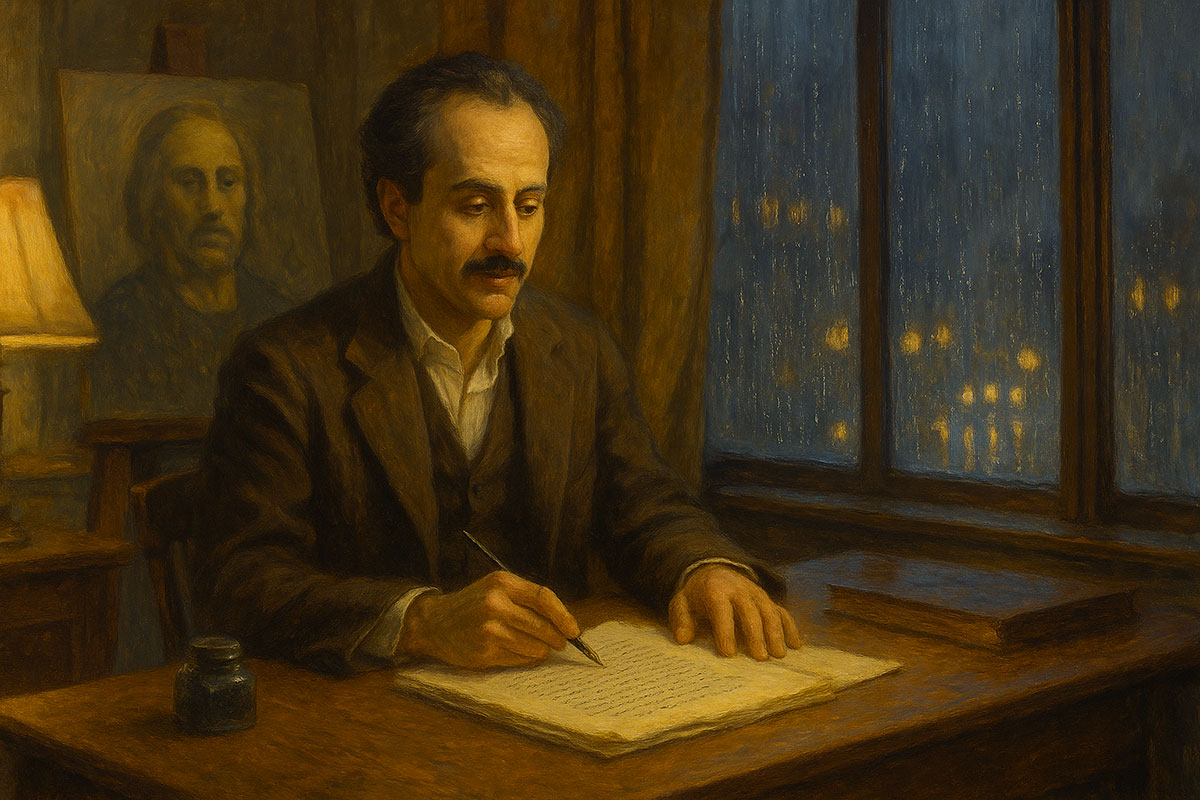
In the years that followed, I would see him in many rooms: the bare, cold flats of his early days, the student’s attic in Paris, the rain-dimmed studio in New York where The Prophet was born. He wore exile like a second skin, yet somehow turned it into a garment of light.
Khalil believed in the holiness of small things—a loaf of bread shared, the silence after a question, the careful stroke of a brush. But he also wrestled with shadows: doubt, solitude, and the fear that his work would vanish before it could take root. I was there in those moments, not to correct his course, but to steady his hand when the wind rose.
These five chapters are not the record of a public man, but of the friend I knew in private. Here you will find not the polished speeches, but the pauses between them. Not the marble bust, but the beating heart. And perhaps, as you walk with us, you will see what I saw—that even prophets need a place to rest their heads, and someone to remind them that their words matter.
(Note: This is an imaginary conversation, a creative exploration of an idea, and not a real speech or event.)
Chapter 1: The Boy Who Left Lebanon
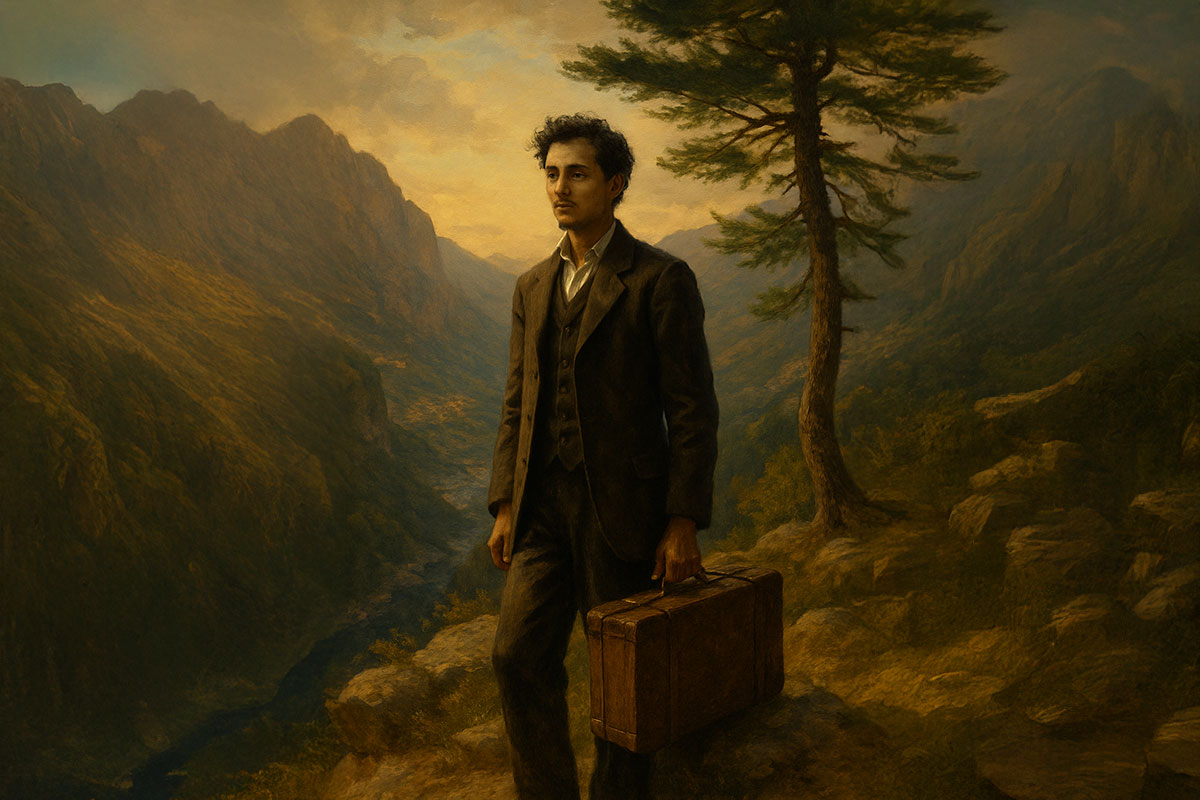
The wind in Bsharri carried the scent of pine resin and woodsmoke, and Khalil felt it on his face like a blessing. From the cliff above the Qadisha Valley, the world seemed endless — a tapestry of stone, snow, and green, the cedars standing like guardians over the land of his childhood. He had thought this view would always be his, but now, at twelve years old, he was standing on the edge of leaving it forever.
The trunk beside him was small, its rope handles frayed, but inside it carried the last threads of his boyhood: his mother’s rosary, a smooth river stone from the gorge, and a small sketchbook in which he had drawn the faces of everyone he could not bear to forget.
Boston was a word he had learned only weeks before — it felt cold in his mouth, strange and hard. People spoke of it like a far-off star, promising light but giving no warmth.
That night, as the family prepared to leave, Khalil sat by the window of their stone house, the oil lamp burning low. The room smelled of bread baked earlier that day, but it could not comfort him. He pressed his forehead against the cool glass, imagining the cedar branches bending in the wind outside, whispering in a tongue older than Arabic, older than prayer.
And then, he heard my voice.
Not in the air, but in the quiet within him.
"Khalil, the road ahead will not steal your mountains from you. It will plant them inside you."
He closed his eyes.
"But how can I breathe without them? How can I draw the sea when I have never seen it?"
"You will not breathe them in, boy — you will carry them in your lungs. And when you draw the sea, you will give it mountains for a heart."
We sat together in silence. He could not see me, but he could feel my hand, light on his shoulder. The sadness in him was not just grief — it was a seed. One day it would grow into a forest of words and colors the world had never seen.
"When the language they speak feels like a wall, draw windows," I told him. "When they do not see you, paint your shadow taller than yourself. And when you feel alone, remember — exile is a bridge, not a grave."
The dawn came with a pale fire over the mountains, and the valley lay below like an open book. His mother called. He stood, holding his small trunk, and for the first time, he turned his back to the cedars — not in farewell, but in promise.
Chapter 2: The Artist in Paris
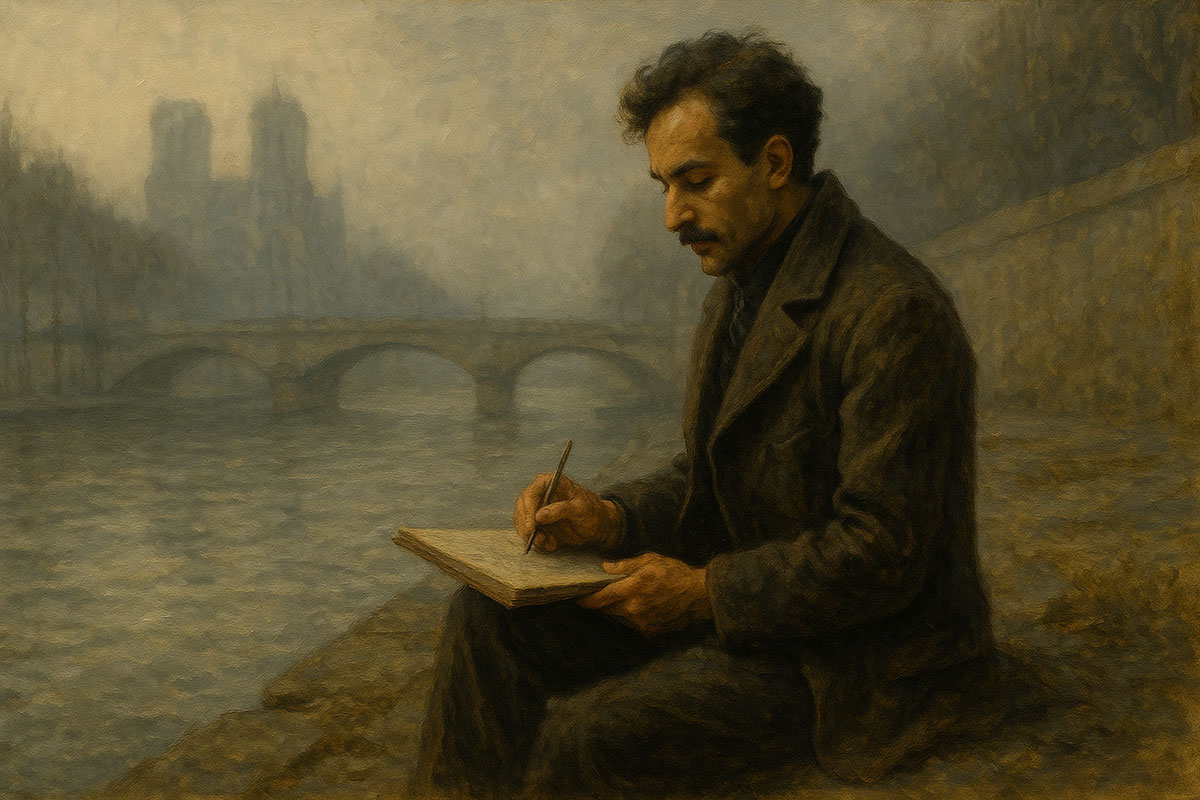
The winter fog in Paris rolled down the narrow streets like a living thing, swallowing the gas lamps and softening the edges of every building. Khalil walked with his coat collar high, sketchbook under his arm, his boots damp from the Seine’s mist.
He had dreamed of this city — the heartbeat of art, the cradle of beauty. Yet the Paris he found was not the Paris of dreams. His hands ached from the cold, his pockets were nearly empty, and the eyes of strangers slid past him as if he were invisible.
One night, in the dim attic room he shared with another art student, Khalil sat at his small desk under the slanted roof. The candlelight trembled over his unfinished drawings. Faces stared back at him from the page — villagers, cedar trees, his mother’s lined hands — but they seemed out of place here, like ghosts that had wandered too far from home.
"Am I failing them?" he whispered into the quiet. "Am I failing myself?"
I was there.
Not in the flicker of the candle, not in the scrape of charcoal on paper, but in the space between his breaths.
"Khalil, beauty does not live only where others point and say, ‘There.’ It lives where you give it shelter."
"But they don’t see me," he said. "They see only another foreigner, another accent that stumbles."
"Then teach them your accent, boy. Let your brush and your pen speak in a voice no one can mistake for another’s. Paris does not need another Parisian — it needs your Lebanon, your exile, your way of hearing the world."
His eyes closed for a moment. The ache in his chest loosened. The loneliness did not vanish, but it shifted, like a cloak he could carry rather than a stone he must drag.
The next morning, Khalil took his sketchbook to the riverbank. The bridges were veiled in fog, the street vendors huddled against the wind. He began to draw — not the monuments that filled postcards, but the man repairing shoes in the cold, the girl clutching a loaf of bread, the way the gray light seemed to carry a secret.
And in those sketches, Paris began to see him.
Chapter 3: The Prophet’s Arrival
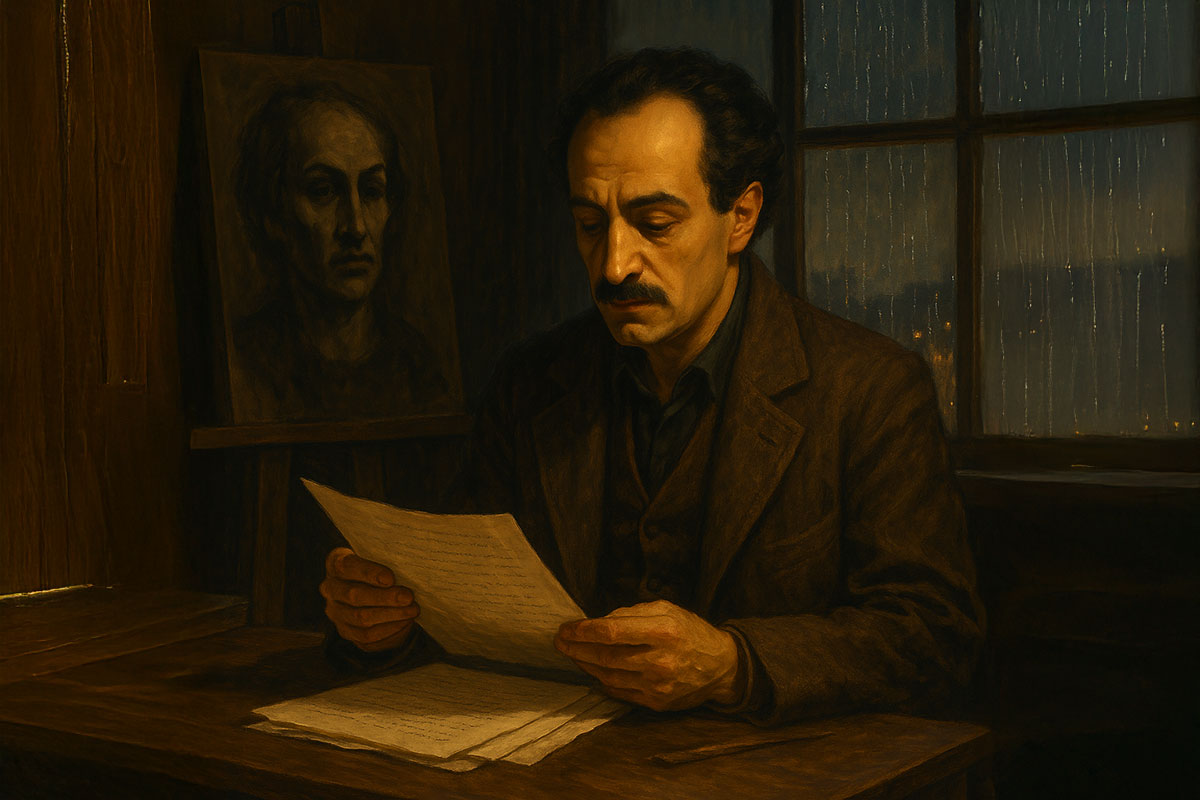
New York held its breath beneath an April rain. In the small room on West Tenth Street, the radiator hissed, the window rattled, and a blue-gray light pooled on the table where the galley proofs lay stacked like thin doors.
Khalil stood over them, hands ink-smudged, shoulders tense as a bowstring. On the easel behind him, a charcoal figure gazed out with that familiar, inward look—the face he kept sketching when words refused to come. The room smelled of turpentine and wet wool; the city’s pulse thumped through the floorboards.
He lifted the top sheet, read two lines, and stopped.
“They are so simple,” he said, half to himself. “Perhaps too simple. What if they mistake quiet for emptiness?”
I was there—in the hush between the steam pipe’s sighs.
“Quiet is not emptiness,” I said. “It is the room where truth can sit without raising its voice.”
He let the page fall. “They will want arguments and definitions. I have brought them parables and weather.”
“Because that is what you were given,” I answered. “And you were taught—on the mountain and in the alleys both—to offer only what you have actually tasted.”
He paced to the window and pushed it up. The rain’s fine curtain beaded the sill. Taxis hissed along the street; somewhere a piano practiced scales that never quite arrived at a song. He closed his eyes.
“I promised myself I would not write for praise,” he murmured, “and yet I feel the hook of it, tugging. I want the book to live. I do not want it to beg.”
“Then let it be a door,” I said, “not a petition. A door does not plead—it opens.”
He returned to the table, sat, and took up his pencil. The marginalia grew like vines: a sliver of white space widened here, an adjective fell away there, a comma shifted to give a sentence more breath. He worked as if trimming a lantern’s wick, angling the flame so it would travel farther on less oil.
Between pages he paused, fingers resting on the paper as one rests a palm on a sleeping child’s back. “When I began,” he said, “I wanted to explain love. Now I only want not to obstruct it.”
“Then remember how you learned,” I told him. “Not from lectures. From a hand offering bread. From a mother’s silence. From the cedar’s shadow at noon. Write in that grammar.”
A knock at the door: the post—thin envelopes, a heavier one from Mary with her steady script. He read a line, and a smile—tired, grateful—creased his face. “She believes the spaces matter,” he said softly. “That the rests hold the music in place.”
“They do,” I said. “And your work is more than sentences. It is the permission those spaces give the reader’s own life to speak.”
He signed the final approval, the pencil point snapping as if to mark the moment. For a while he did not move. The city kept breathing. The rain lightened.
“What if it fails?” he asked finally. “What if the world turns its face away?”
“Then you will have kept faith with the voice that found you,” I said. “But listen—failure is not the world’s silence. It is your refusal to offer what you have been given. Today you have offered.”
He stood, pressed the bundle of pages flat, and wrapped them with twine. At the door he hesitated, fingertips on the knob, eyes bright with the fear that always walks beside hope.
“Go,” I whispered. “Let the tide carry it. You are not sending a sermon—you are launching a small craft with room for one more soul at a time.”
He laughed under his breath—relief more than mirth—then stepped into the hallway. When the latch clicked shut, the room felt larger. On the easel, the charcoal face seemed less lonely, as if it too had heard the hinge of a new thing turning.
Outside, the rain thinned to a mist. Somewhere—blocks away, months from now, continents hence—a reader would open a thin book and feel a door swing inward on quiet hinges.
And we would keep walking. There were other rooms to enter, other silences to tend.
Chapter 4: The Death of Mary Haskell’s Love
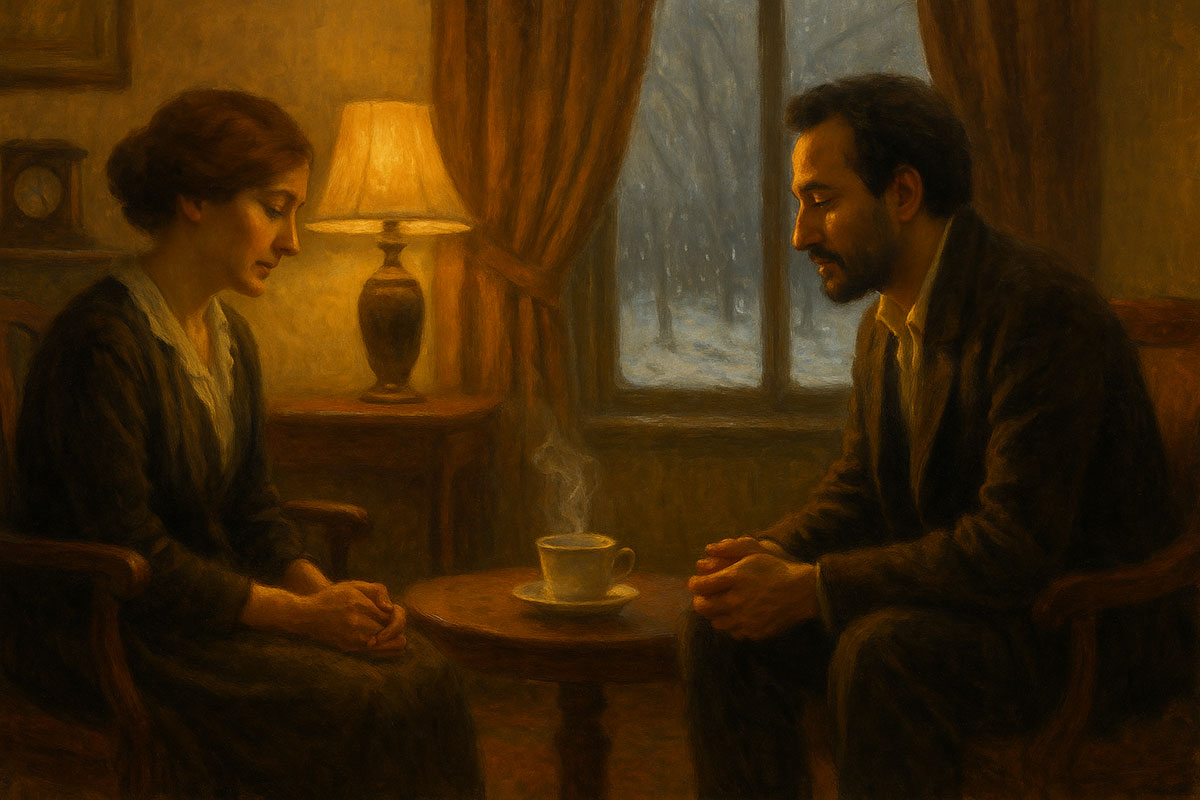
The parlor was small and very tidy, the sort of room that holds its breath when two people don’t know where to place their hands. Snow freckled the windowpanes; a kettle clicked softly on the stove. Mary had set out two cups but poured only one. She always remembered the details—sugar before cream, the slight tremor in the saucer when the conversation turned difficult.
Khalil stood near the bookcase, tracing the spines with his fingertips as if they might open a door not yet visible. The lamplight found the wear in his coat sleeves. He smiled carefully, the way a man smiles when every other expression would break something.
“Mary,” he said, and the name alone seemed to change the temperature of the room.
She did not ask him to sit. She folded her hands, then unfolded them, the movement gentle but final. “Khalil,” she answered, “I have been writing a letter to you for weeks that I could not send. Tonight I will say it out loud.”
He waited. His breathing was the only sound the room allowed.
“What we have,” she said, “cannot be the kind of love that asks for a house, or rings, or calendars. It would ask of you what your work cannot give. And it would ask of me what my conscience cannot promise.” She drew a slow breath. “But I will not leave you. I will be your fiercest ally. Only—the name of it must change.”
He closed his eyes. The pause that followed had the weight of winter in it.
I was there—in the hush between the kettle’s clicks.
“Let the name change,” I told him gently. “Do not imprison the river because you loved it when it was rain.”
His mouth trembled, then steadied. “And what shall I do with the part of me that wanted to belong to her?”
Mary answered before I could. “Bring it to your pages,” she said. “Bring it to the canvases. Let it belong to a thousand hearts instead of one. I will read it first. I will stand guard.”
He laughed once—soft, without brightness. “You would make a vow out of everything.”
“I would,” she said. “Precisely so that you may remain free.”
He sat then, at last, and she poured his tea. He did not drink it. He watched the steam spin itself into nothing and found words that did not accuse. “I wanted to call you home,” he said.
“You did,” she smiled. “And then you built me another, inside your sentences.”
The snow thickened. Somewhere in the street a carriage passed, the iron rim of a wheel striking a hidden stone—one note, clear as a bell. He lifted his hands, let them fall. “Very well,” he whispered. “Let the name change.”
“Nothing essential does,” I said. “Love is not a possession; it is an atmosphere. Breathe it differently, and it still keeps you alive.”
Mary reached for the manuscript stacked on the table—a new essay, his, with her pencil marks like delicate stitches along the margins. “Shall we work?” she asked. “It is how we pray.”
They bent over the pages together, shoulders almost touching and not touching, each revision a way of learning to speak without the old word for it. When they finished, he signed his name as if consecrating a quiet altar.
As he rose to leave, Mary pressed his gloves into his hand, then the letter she had never sent. “Keep it,” she said. “For the days when courage forgets your address.”
Outside, the snow made a soft cathedral of the street. He stood beneath it, face upturned, and let the cold bless him. The ache did not vanish, but it found its shape—no longer a wound, but a doorway.
“There is one chapter left,” I whispered. “Not of love’s ending, but of the body’s winter.”
He nodded, and the breath he released became a small cloud that did not drift far. We turned toward the dark river and the lighted city beyond, where a thin book would soon pass from hand to hand like a lantern.
Chapter 5: The Final Illness

Spring came reluctantly to New York that year, as if the season itself were uncertain it still belonged to him. The windows in his studio stuck in their frames; the air inside was thick with the smell of oil paint and damp paper. The cough had been with him for months now, stubborn as a shadow, and his strength drained like water through a slow crack.
On the desk lay a letter from Bsharri, the paper rough and familiar. He had read it so many times the edges had begun to curl. The words spoke of the mountains waking under snowmelt, of cedars greening again. He closed his eyes and could hear the wind through those trees, a sound that once promised eternity.
“I will not see them again,” he said, not bitterly but as one stating the final line of a poem.
I was there, in the thin space between his breaths.
“You will,” I said. “But not with these eyes.”
He leaned back, the lamplight soft on his face. “I have written all I could,” he murmured. “And yet I wonder… was it enough?”
“Enough for what?” I asked.
“For the world to know what I meant. For my words to keep their wings after I am gone.”
“They already fly,” I told him. “You have only seen the first horizon. Others will carry them beyond the second, the third, the thousandth.”
The pain in his chest sharpened, and he pressed a hand to it—not to push it away, but to acknowledge it. “Mary still visits,” he said. “She reads to me when I cannot write. I am glad she stayed.”
“Love stays,” I answered. “Even when the form changes.”
He nodded faintly. On the table beside his bed, a copy of The Prophet lay open to the chapter on death. He touched the page, tracing the ink as if it were a map to somewhere familiar. “It is not an end,” he whispered. “It is stepping into the mist… and knowing the shore is there, though you cannot see it.”
The city outside moved on—carriages, voices, the rattle of the elevated train—but inside the room time slowed until only the sound of his breathing marked it. He asked for the window to be opened, and when it was, the early evening air came in cool and clean. Somewhere far below, a street violinist began a song too soft to name.
“You told me once,” he said, eyes half-closed, “that exile was a bridge, not a grave. I think now… so is life itself.”
He slept then, his face turned toward the open window. The last light of the day touched his hands, still stained faintly with charcoal and ink. And as the shadows lengthened, I understood—he had already crossed, and the bridge he left behind was made of words that would not wear away.
Final Thoughts by Mary Haskell
I have kept his letters, his sketches, the drafts with my pencil marks still along their edges. They are not relics, but living companions. Sometimes I take them out and read them aloud, and it feels as though he has only stepped into the next room.
Khalil was never mine to keep, nor was he anyone’s. He belonged to his work, and his work belonged to the world. But in the quiet spaces between deadlines and dreams, we belonged to each other—in laughter, in arguments, in the deep stillness that comes when two people do not need to fill the air.
When his body failed him, his words did not. They had already left him, walking into lives he would never see, carrying messages he could not imagine. That is the true measure of a gift—it continues long after the giver has gone.
If you have heard his voice in these pages, then you too have carried a part of him forward. And if someday you find yourself at a window on a rainy evening, thinking of the bridges you have crossed, remember: exile is not the loss of home. It is the invitation to make the whole world your home.
Short Bios:
ChatGPT said:
Khalil Gibran — Lebanese-born poet, philosopher, and artist (1883–1931), best known for The Prophet, a work blending prose poetry with spiritual wisdom. Raised in Bsharri, Lebanon, he immigrated to Boston at age twelve, later studying art in Paris. His works fuse Eastern mysticism with Western literary forms, exploring love, freedom, and the human spirit.
Mary Haskell — American educator, editor, and lifelong friend of Khalil Gibran (1873–1964). She became his patron, financing his studies in Paris and editing much of his English work, including The Prophet. Their deep emotional bond, evolving from romance to a profound platonic friendship, shaped both his writing and his career.
Leave a Reply