
|
Getting your Trinity Audio player ready...
|
What if understanding Jesus requires not fewer sources, but more careful listening to all the evidence we still have?
Introduction by Nick Sasaki
This Life of Jesus story begins with the Bible—but it does not end there.
The Gospels give us the essential spine of Jesus’ life: his birth, his teaching, his death, and his resurrection. But between those verses are long stretches of silence—years of childhood, decades of preparation, inner struggles the text does not spell out in detail.
Rather than filling those silences with imagination alone, this series reconstructs Jesus’ life using historically grounded sources that surround the Bible, not replace it.
That includes:
- Jewish Second Temple culture and daily life
- Roman political realities documented by historians like Josephus and Tacitus
- Early Jewish customs around marriage, age, labor, and education
- Geographic, economic, and social conditions of Galilee and Judea
- Early apocryphal writings—not as fact, but as windows into how early communities understood Jesus’ humanity
Every added detail follows a simple rule:
it must be something the world required of a person like Jesus, not something invented to explain him away or elevate him artificially.
This is not an attempt to correct the Bible.
It is an attempt to listen more carefully to it—by restoring the human world it assumes but does not always describe.
What follows is not doctrine.
It is a historically disciplined, human reconstruction of a life that changed history—told with respect for faith, but without fear of honest questions.
(Note: This is an imaginary conversation, a creative exploration of an idea, and not a real speech or event.)
SCENE 1 — BORN EXPOSED
A Child the World Did Not Protect
I. A World Already Tight with Fear
The world did not feel open when Jesus was born.
It felt tight—like a rope drawn slowly but steadily around the chest.
Rome called it peace. Pax Romana. Roads were safe, taxes were collected efficiently, rebellions were crushed before they could mature. But peace enforced by fear always carries a tremor beneath it. Judea lived with that tremor daily.
Roman standards lined the roads. Soldiers moved in groups, armor gleaming, discipline absolute. Crosses—sometimes empty, sometimes not—stood where reminders were needed. People learned to avert their eyes early.
Herod ruled Judea on Rome’s behalf. Brilliant, paranoid, aging. He rebuilt the Temple into something magnificent and ruled it like a man who trusted stone more than people. Josephus would later describe his reign in blood—executed sons, silenced rivals, spies everywhere. Herod believed enemies multiplied in silence.
Rumors of a deliverer circulated quietly, stubbornly. The Jewish people remembered promises too old to die. A king from David’s line. A shepherd who would outlast empires. Hope, in such a world, was dangerous.
It was into this atmosphere—not wonder, not calm—that a girl in Nazareth realized she was pregnant.
II. Mary of Nazareth
Nazareth did not prepare a girl for destiny.
It prepared her for work.
Mary was likely fourteen or fifteen—an age modern readers struggle to imagine as adulthood, but which the ancient world accepted without sentiment. Girlhood ended early when survival required it. She had learned to grind grain, carry water, prepare meals, tend younger children. Her hands were already calloused.
She was betrothed to Joseph, a craftsman. Betrothal was not engagement; it was legal commitment. Backing out required divorce. Infidelity during this period could be punished severely. The law allowed public accusation. The village allowed even worse.
Mary knew this.
When her body began to change, fear did not arrive all at once. It came in stages. A missed cycle. A tightening in the chest. A quiet certainty that would not be undone.
How she understood what was happening is something no historian can reconstruct cleanly.
Later tradition would speak of angels, of annunciation, of divine assurance. But whatever the form, one truth remains: Mary understood enough to know her life was about to fracture.
And she did not run.
III. The Weight of Yes
Consent is often imagined as clarity.
In reality, it is often endurance.
Mary’s “yes” was not shouted. It was not dramatic. It was quiet, internal, made without knowing how much would be demanded later. Jewish girls were taught Scripture early. She knew the stories—Sarah’s barrenness, Hannah’s prayer, women used by God and then forgotten by the world.
She also knew how villages worked.
Pregnancy without explanation would mark her. Silence would be interpreted as guilt. Speech would be questioned. Either way, reputation would not survive intact.
She told Joseph.
IV. Joseph’s Decision
Joseph was a tekton—a builder who worked with stone and wood, repairing walls, shaping beams, fitting doors. His work required precision and patience. Mistakes collapsed later, not immediately.
When he realized Mary was pregnant, he did not rage.
That matters.
The law gave him power. Public accusation would preserve his honor and destroy hers. Quiet dismissal would minimize damage but still protect his standing.
Joseph chose the harder path.
He chose her.
Later tradition would speak of dreams and divine reassurance. But even with reassurance, the decision cost him. Nazareth would never fully forget. He would carry suspicion silently.
In a world obsessed with honor, Joseph accepted quiet loss.
And with that acceptance, the child’s story moved forward.
V. The Census and the Road
Rome did not care about their courage.
When Augustus ordered a census, he did so to count resources—land, labor, taxes. Client kingdoms adapted Roman demands to local custom. Judea complied.
Joseph was required to register in Bethlehem, the city of his lineage. Mary went with him. Some say for protection. Some say because her time was near. Some say because staying behind would invite scrutiny.
All are likely true.
The journey was long and slow—nearly ninety miles over uneven terrain. Mary walked when she could, rode when she could not. Nights were cold. Days were dry. Conversation thinned as effort increased.
Bethlehem was crowded.
Homes were built around shared spaces. Guest rooms filled quickly. There was no scandal in refusal—only logistics. So they stayed where they could.
A lower room.
A cave-like shelter.
A place where animals slept.
Romantic memory would later soften this.
Reality did not.
VI. Birth Without Witnesses
Mary labored without ceremony.
No midwives of status. No relatives nearby. No priest to bless the moment. Pain arrived as it always does—unfair, consuming, indifferent to meaning.
She gave birth to a son.
Wrapped him in cloth.
Placed him where animals fed.
The detail of the manger is not symbolic in origin. It is practical. When nothing else is available, you use what holds weight safely.
The child cried.
Not softly. Not reverently.
He cried like a human being whose lungs had just learned to work.
No one outside the room noticed.
VII. Shepherds and the Edge of Society
If anyone noticed, it was the shepherds.
They lived outside the village. Their work kept them awake at night, alert to danger, accustomed to the margins. Shepherds were not romantic figures then. They were tolerated, not trusted. Their testimony rarely counted in court.
Yet Jewish memory held shepherds differently. David had been one. Moses too. God often chose the overlooked.
Luke’s account preserves something ancient here: fear, light, confusion, urgency. Whether the experience was vision, collective awe, or something else, the shepherds believed something had been revealed to them.
They went to Bethlehem.
They found the child not in glory—but in obscurity.
They told Mary what they had seen.
She listened.
Luke’s phrase—she treasured these things—is not poetic exaggeration. It reflects a psychological truth. When explanation is unavailable, memory becomes sanctuary.
Mary did not proclaim.
She remembered.
VIII. The Shadow of Power
The child grew quietly at first.
But power notices patterns.
Sometime later—weeks or months—the Magi arrived in Jerusalem. Eastern scholars. Astrologers. Priests trained to read the heavens not as causes, but as announcements. Babylonian and Persian traditions carried Jewish influence from centuries earlier.
They had seen something.
A convergence. A rising. A pattern associated with kingship and Judea.
They asked the wrong question in the wrong place.
Herod heard.
And fear sharpened.
Herod consulted priests. Micah was quoted. Bethlehem was named. The Magi were sent on, watched carefully.
When they found the child—no longer a newborn—they brought gifts that carried meaning deeper than ceremony.
Gold for kingship.
Frankincense for sacred presence.
Myrrh for death.
They were warned not to return to Herod.
They left by another road.
So did Joseph.
IX. Flight
Joseph dreamed again.
Not with poetic clarity—but with urgency.
Leave.
Egypt was not mystical refuge. It was practical. Jewish communities existed there. Alexandria was one of the largest Jewish cities in the world. Refugees were not unusual.
They left at night.
Mary carried the child. Joseph carried supplies. They did not debate. Fear focuses the mind efficiently.
Herod’s response was brutal.
The slaughter of children in Bethlehem does not appear in Roman records. It would not. Bethlehem was small. The act would have been local. Herod’s documented paranoia makes it plausible.
History often preserves power, not victims.
Mary likely heard rumors later.
She did not need records to understand what had been escaped.
X. Life in Exile
Egypt was survival.
Foreign language. Familiar customs. Jewish prayers spoken softly in unfamiliar streets. Joseph worked where he could. Mary adapted.
The child learned to walk among strangers.
Exile shaped him before memory formed.
Eventually, Herod died.
They returned.
Not to Bethlehem.
To Nazareth.
Safety mattered more than lineage.
XI. Returning Unnoticed
Nazareth did not celebrate their return.
No one asked where they had gone. Or if they did, answers were brief. Silence protects better than explanation.
The child grew.
He learned the rhythms of village life. He learned work before theory. He learned obedience before interpretation. He learned what it meant to live without protection.
Mary watched him closely.
Not with fear—but with attention.
She had learned early that whatever had begun in her would unfold on its own terms.
XII. What This Beginning Means
Jesus’ life did not begin with triumph.
It began with exposure.
Born to a teenage mother.
Raised under occupation.
Marked by flight.
Formed by silence.
Nothing about this origin suggests myth.
Myths glorify beginnings.
This story hides them.
Which may be the most honest thing about it.
Closing Image
A boy grows up in Nazareth.
No one records his milestones.
No one predicts his future.
Rome does not notice him.
But the world that failed to protect him will one day be measured by how it responds when he speaks.
SCENE 2 — BECOMING HUMAN

Growing Ordinary Under Occupation
I. Nazareth Does Not Expect Greatness
Nazareth was not a place that prepared anyone for importance.
It was small—barely a village by Roman standards—tucked into the hills of Galilee, away from trade routes, away from centers of learning, away from notice. Archaeology would later reveal stone homes clustered tightly, storage jars pressed against walls, olive presses worn smooth by repetition. Life here did not aim upward. It endured sideways.
Children learned early that survival was communal. Everyone worked. Everyone noticed. Everyone remembered.
Jesus grew up in this world.
No one treated him as special.
If anything, the circumstances of his birth may have cast a faint shadow—questions never asked aloud, stories half-known, assumptions left to settle quietly. Nazareth did not pry. It judged silently.
Mary understood this. So did Joseph.
They raised their children not to attract attention.
II. Learning the Shape of Days
Jesus’ childhood unfolded in rhythm rather than revelation.
Morning prayers spoken aloud. Work done before heat peaked. Meals shared simply—bread, olives, lentils when possible. Sabbath rest, carefully observed, not as luxury but as boundary. A pause enforced by faith rather than abundance.
Jewish children learned Scripture early—not by reading silently, but by listening and reciting. Words were spoken until they shaped memory. Psalms entered the body before meaning settled in the mind.
Jesus learned the stories the same way other boys did.
Creation spoken into being.
Abraham leaving without map or certainty.
Moses arguing with God rather than submitting easily.
David—shepherd first, king later.
These stories did not promise ease.
They promised responsibility.
III. The Sound of Rome
Roman presence was never abstract.
Soldiers passed through Galilee regularly. Armor clinked. Commands were barked sharply. Latin cut through Aramaic like a blade—precise, indifferent.
Jesus saw how adults changed when soldiers approached.
Voices lowered. Eyes dropped. Bodies stiffened.
Sometimes there were crosses on the road.
Not always occupied. Sometimes decaying reminders. Sometimes fresh.
Crucifixion was Rome’s language. It spoke publicly and permanently. Josephus would later describe thousands executed this way during periods of unrest. Children did not need explanation. They understood enough.
Jesus learned early what power looked like when it did not need justification.
IV. Work Before Theory
Joseph trained his son early.
A tekton’s work was demanding. Stone had to be cut precisely. Wood had to be shaped patiently. Measurements mattered. Carelessness revealed itself later—after walls collapsed or doors warped.
Jesus learned this lesson deeply.
Actions carry delayed consequences.
He carried stone. Held beams steady. Watched joints fitted carefully so they would endure weight they could not yet see. Sweat was expected. Complaint was not rewarded.
Joseph did not speak much while working.
But what he taught stayed.
Do the work honestly.
Do not rush what must last.
Accept limits without resentment.
These were not religious instructions.
They were ethical ones.
V. Mary’s Watchfulness
Mary remained attentive.
Not anxious—attentive.
She watched how Jesus listened more than he spoke. How he lingered after synagogue gatherings, absorbing debates meant for older men. How he asked questions that were neither defiant nor naive.
Why does God forgive before we change?
Why does the Law protect rest so fiercely?
Why do the poor seem closer to God than the confident?
Mary did not answer quickly.
She had learned that silence sometimes protects truth better than certainty.
She told stories instead.
She spoke of Hannah’s long waiting. Of Ruth’s quiet loyalty. Of women who were not chosen for strength, but for faithfulness.
Jesus listened.
VI. The Village and the Outsider
Nazareth noticed differences.
Jesus was not withdrawn—but he was not competitive. He did not seek attention. He did not posture. Boys his age tested strength, insulted easily, proved themselves loudly.
Jesus did not.
This was not weakness.
It was something harder to name.
He watched before acting. He absorbed tension without becoming reactive. Some admired this. Others mistrusted it.
People prefer predictability to goodness.
VII. Learning the Law
By the age of five or six, Jewish boys were immersed in Torah. By adolescence, they were expected to live it. The Law was not abstract morality—it governed food, speech, time, money, relationships.
Jesus loved it.
But not blindly.
He noticed gaps.
The Law commanded care for widows and orphans—yet debt crushed families quietly. The Law spoke of justice—yet religious leaders sometimes protected status more than people.
These contradictions unsettled him.
Not angrily.
Slowly.
VIII. The First Visit to Jerusalem
At twelve, Jesus went to Jerusalem for Passover.
This was not unusual—but it was formative.
Jerusalem overwhelmed the senses. The Temple dominated the skyline. Smoke from sacrifices filled the air. Pilgrims crowded narrow streets. Debate echoed in shaded corners. Authority was visible, audible, organized.
This was religion as institution.
Jesus listened.
He asked questions—not to challenge, but to understand.
Why this interpretation?
Why that emphasis?
Why fear here, certainty there?
The teachers noticed him.
Not because he lectured—but because he listened and responded with clarity.
When Mary and Joseph found him days later, fear turned to relief, then to frustration.
Why have you done this to us?
His answer was not rebellious.
It was honest.
Did you not know I would be here?
This was not rejection of family.
It was recognition of calling.
And yet—he returned with them.
He submitted.
This mattered.
IX. The Long Silence After
Jerusalem did not change his life immediately.
Nazareth resumed.
This was the harder path.
Moments of clarity do not remove responsibility. They deepen it.
Jesus worked. Prayed. Listened. Waited.
Years passed.
X. Loss
Sometime during these years, Joseph died.
The Gospels do not record it. Silence often marks grief more accurately than detail.
Jesus became the man of the house.
Mary relied on him. Younger siblings followed him. Responsibility settled fully.
Grief was not dramatic.
It was daily.
Loss sharpened compassion.
He knew now what it meant to bury hope quietly.
XI. Desire and Discipline
Jesus entered manhood fully human.
Desire arose—as it does in all men. Jewish tradition did not deny this. It taught discipline rather than denial.
Jesus practiced restraint—not because desire was evil, but because power without discipline destroys.
This inner work remained invisible.
It was not heroic.
It was necessary.
XII. Exposure to Revolution
Galilee was restless.
Zealots spoke of violent resistance. Rome could be overthrown, they said. God demanded it.
Their anger was understandable.
Their methods troubled Jesus.
Violence promised speed.
But speed rarely heals.
Jesus listened—and declined.
This decision isolated him.
Those who refused violence were seen as cowards by some, collaborators by others.
Jesus accepted misunderstanding.
XIII. Prayer Without Answer
These were years of prayer without response.
Jesus prayed deeply—and often heard nothing.
This tested him more than hunger.
Psalms promised nearness.
Reality offered silence.
He did not abandon prayer.
He learned endurance.
XIV. A Man Unnoticed
By his late twenties, Jesus was known as reliable.
Not brilliant.
Not dangerous.
Reliable.
He worked. Paid taxes. Attended synagogue. Helped neighbors quietly.
Rome ignored him.
Nazareth underestimated him.
This was not failure.
It was formation.
XV. The Quiet Readiness
By the time John the Baptist began preaching near the Jordan, Jesus recognized the moment immediately.
Not because prophecy thundered.
But because the waiting had prepared him.
The years had done their work.
Closing Image
A man leaves Nazareth quietly.
No farewell speech.
No explanation.
No certainty of return.
He carries with him a life shaped by work, loss, restraint, silence, and moral clarity.
Nothing about him announces what is coming.
Which is exactly why it will change everything.
SCENE 3 — CHOOSING THE WAY

The Refusal of Power
I. Leaving Without Witness
Jesus did not leave Nazareth ceremonially.
There was no gathering, no farewell meal, no explanation offered to neighbors who had known him all his life. Men who left to join revolts made noise. Men who left for trade made plans. Jesus did neither.
He left early.
The hills were still dark, the air cool enough to carry sound. A dog barked once and then settled. Mary woke and knew—without being told—that the moment had arrived. She did not stop him.
She had learned, long ago, that holding tightly did not prevent loss. It only delayed obedience.
Jesus carried little: a cloak, water, bread enough for a day or two. He did not travel with companions. This was not pilgrimage. It was reckoning.
The wilderness waited.
II. Why the Wilderness Matters
For Jews, the wilderness was not absence.
It was confrontation.
Israel had been formed there—freed from Egypt, tested without distraction. The wilderness stripped identity until only trust or resentment remained. Prophets returned to it when the city became compromised.
Moses met God there.
Elijah fled there.
John the Baptizer lived there.
The wilderness was where God could not be managed.
Jesus did not go there to prove holiness.
He went there because nothing else would tell him the truth.
III. The Body as the First Teacher
The first days were manageable.
Hunger sharpened thought at first, clarifying desire. He drank sparingly, slept lightly, prayed aloud while words still came easily. He recited Scripture not as shield, but as orientation—reminding himself where he stood.
Then hunger deepened.
The body began to protest—not violently, but persistently. Thoughts returned in loops. Memories sharpened. Sensations magnified. Time stretched.
This was expected.
Jewish fasting traditions understood the body as participant in prayer, not obstacle to it. Hunger stripped pretense. A starving man could not lie convincingly to himself.
Jesus let hunger speak.
He listened.
IV. The First Logic: Control
The first temptation did not arrive as drama.
It arrived as reason.
You can end this.
Not with spectacle.
Not publicly.
Not dramatically.
Simply—end it.
The thought was efficient, clean, morally neutral on the surface. If God had given power, why not use it to meet legitimate need? Hunger was not sinful. Relief was not corruption.
Jesus recognized the danger immediately.
If he began by using power to escape human limits, he would no longer stand fully inside human life. Compassion born of exemption quickly curdles into superiority.
Bread mattered.
But trust mattered more.
He refused.
Not angrily.
Quietly.
V. Hunger’s Second Lesson
Hunger does not disappear when ignored.
It returns, reshaped.
As weakness increased, imagination sharpened. Scenes formed uninvited. Jerusalem appeared—not as ruin, but as opportunity. The Temple rose before him in memory, radiant with authority.
If God truly stands behind you, prove it.
This was not rebellion.
It was theological consistency.
The Scriptures spoke of angels guarding the faithful. Signs had always accompanied prophets. A public act would settle doubt. Faith enforced by certainty would be efficient.
Jesus understood the temptation deeply.
To end uncertainty.
To silence resistance.
To bypass slow persuasion.
Rome ruled this way.
So did tyrants clothed in religion.
He refused again.
Faith coerced is obedience, not trust.
VI. Power’s Final Offer
The third temptation came not as thought, but as vision.
Empires unfolded—order imposed without patience, peace enforced without mercy. Rome was not unique. It was merely efficient. History revealed the same pattern everywhere: power promised stability, delivered silence.
You could rule differently.
This was the most dangerous logic of all.
Not evil—but benevolent domination.
If suffering could be ended by command, why not command it? Why teach when authority could compel justice immediately?
Jesus felt the pull sharply.
Urgency burned in him. He had seen suffering. He had watched Rome humiliate dignity casually. He had listened to prayers rise unanswered.
But power that bypasses transformation does not heal.
It replaces one tyranny with another.
He refused the crown he could have taken.
VII. Naming the Voice
Later tradition would call the voice Satan.
In Hebrew thought, this did not always mean a monstrous being. It meant the adversary—the force that tests integrity, the logic that opposes alignment by offering efficiency.
The wilderness stripped the voice of disguise.
It was not evil for its own sake.
It was misaligned good.
Ends without patience.
Truth without humility.
Power without love.
Jesus named it.
And naming stripped it of authority.
VIII. When Hunger Breaks
Eventually, hunger overcame him.
This was not failure.
It was reality.
Jesus ate slowly, carefully—like a man returning from the edge. His hands shook. His body resisted excess instinctively. The wilderness does not reward survival with triumph.
It grants clarity.
No thunder followed.
No angels sang.
What arrived was quieter—and far more dangerous to injustice.
Certainty.
IX. What Had Changed
Jesus did not leave the wilderness stronger physically.
He left aligned.
He knew now—without ambiguity—how he would live.
He would not dominate.
He would not coerce.
He would not manipulate belief.
He would not rush transformation.
He would teach, heal, confront, and accept consequences fully.
Even death.
The question of method was settled forever.
X. The River
He returned from the wilderness toward the Jordan.
John was there—unchanged, fierce, uncompromising. Josephus would later describe him as a preacher of moral reform whose influence unsettled both Herod and the people.
John’s baptism was not ritual cleansing.
It was public realignment.
Jesus stepped forward with the crowd.
Tax collectors. Soldiers. Peasants. The ashamed and the hopeful alike.
He chose to be counted.
John hesitated—not out of reverence, but recognition. He sensed something settled in this man that others were still seeking.
Let it be so—for now.
Jesus entered the water.
He did not perform a sign.
But those watching felt permission ripple outward—as if alignment itself had become visible.
XI. The Timing Revealed
Whatever others experienced—voice, conviction, certainty—Jesus understood something internally.
Not who he was.
When.
The wilderness had defined the way.
The baptism defined the moment.
Public life had begun.
XII. Watching and Waiting
Jesus did not begin teaching immediately.
He watched.
John’s movement grew—and drew attention. Herod listened. Rome always did.
When John was arrested, Jesus understood the signal without explanation.
The season of preparation had ended.
Silence would no longer serve.
XIII. Returning Changed
Jesus returned to Galilee without announcement.
Those who saw him noticed something subtle.
He was not louder.
He was steadier.
He did not argue for authority.
He embodied it.
The wilderness had taken nothing from him.
It had removed everything that could corrupt him later.
XIV. Why This Moment Matters
The wilderness was not about resisting temptation.
It was about refusing a certain kind of success.
Jesus rejected:
Power without suffering
Authority without consent
Justice without transformation
Faith without freedom
Because of that refusal, every word he would later speak carried weight.
He had already declined the crown.
XV. Standing at the Threshold
When Jesus began to speak publicly, nothing about him felt rushed.
He did not perform to convince.
He did not threaten to compel.
He did not negotiate with fear.
He spoke as someone who had already decided everything that mattered.
That is why the world would not know what to do with him.
Closing Image
A man steps away from the wilderness.
Lean.
Quiet.
Unarmed.
Nothing about him announces revolution.
And yet—every system built on fear has already been challenged.
SCENE 4 — LIVING THE KINGDOM
A Way of Life That Threatened Everything
I. He Began Where No One Expected
Jesus did not begin in Jerusalem.
That alone confused people.
Jerusalem was where movements were announced, where credentials were tested, where authority was negotiated. Galilee, by contrast, was provincial—religious but unsophisticated, mixed with Gentiles, far from the center of power.
Jesus returned there deliberately.
Not to hide.
But to begin where life was most exposed.
Villages were close together. Poverty was visible. Rome’s presence was felt but not ceremonially enforced. People here did not debate theology for sport. They argued because belief affected survival.
When Jesus began to speak, he did not gather crowds intentionally.
They gathered themselves.
II. The First Words That Changed the Air
He spoke simply at first.
The time has arrived.
God’s kingdom is near.
Turn around.
Trust the good news.
This was not abstract prophecy.
It was announcement.
Time itself, he said, was bending.
But what he meant by kingdom confused nearly everyone.
He did not promise Rome’s collapse.
He did not call for revolt.
He did not anoint followers with weapons.
Instead, he spoke of inner change with outer consequence.
This disappointed zealots and unsettled leaders equally.
III. Authority Without Credentials
Jesus taught in synagogues where he was known.
This was dangerous.
Strangers can be dismissed. Familiar faces cannot.
He did not cite famous teachers endlessly. He did not hide behind tradition. He spoke as if truth were something one lived before explaining.
People noticed immediately.
He did not sound like the scribes.
His words carried weight—not because they were loud, but because they were consistent with how he lived. Authority, in his case, did not come from permission.
It came from coherence.
This made some people feel free.
It made others feel exposed.
IV. Restoring What Had Been Broken
When Jesus healed, he did not treat illness as spectacle.
He restored people to community.
A leper was not only sick—he was isolated.
A woman bleeding was not only unwell—she was excluded.
A man tormented inwardly was not possessed by evil alone—he was fragmented.
Jesus touched people others avoided.
This was not symbolic.
It was social defiance.
He did not ask whether someone deserved healing. He did not demand proof of moral worth. He responded to need.
This unsettled religious systems built on boundaries.
Mercy ignores hierarchies.
V. Why the Poor Listened First
The poor recognized him immediately.
Not because he promised wealth—but because he did not blame them for their condition.
Debt was crushing Galilee. Land consolidation pushed families into servitude. Taxes flowed upward efficiently. Religious leaders often spiritualized suffering rather than confronting it.
Jesus did neither.
He spoke of dignity without requiring success.
Blessed are the poor.
Blessed are the hungry.
Blessed are those who mourn.
These were not metaphors.
These were descriptions of the crowd.
VI. The Sermon as a Way to Live
When Jesus spoke on the hillside, he did not deliver a manifesto.
He offered orientation.
This is how to live when the world is wrong.
He redefined strength as restraint.
He redefined righteousness as mercy enacted.
He redefined holiness as integrity of heart.
He did not abolish the Law.
He relocated it.
From performance to intention.
From public display to private alignment.
From control to transformation.
This was lived philosophy—not idealism.
It taught people how not to become what oppressed them.
VII. Love That Refused Enemies
Nothing disturbed listeners more than this.
Love your enemy.
This was not sentiment.
It was refusal to dehumanize.
Rome survived by convincing people that some lives mattered less. Jesus dismantled that logic completely. Violence, he insisted, reshaped the soul of the one who used it.
This was not pacifism born of fear.
It was resistance born of clarity.
Many could not accept it.
Some left quietly.
Others stayed, troubled but drawn.
VIII. Parables as Disruption
Jesus did not explain everything directly.
He told stories.
Stories slipped past defenses. They invited reflection rather than obedience. They unsettled without accusation.
A father who forgives foolishly.
A Samaritan who acts righteously.
A landowner who pays unfairly.
These stories did not resolve neatly.
They forced listeners to locate themselves inside the narrative.
Parables were not illustrations.
They were tests.
IX. Meals That Caused Scandal
Jesus ate with people who damaged reputations.
Tax collectors collaborated with Rome. Prostitutes were publicly shamed. Associating with them marked a person.
Jesus did not apologize.
Meals were not casual in Jewish culture. They signaled belonging. To eat with someone was to recognize their humanity.
This terrified moral gatekeepers.
If boundaries collapsed, control followed.
X. Sabbath and the Breaking Point
The Sabbath became the fault line.
Healing on the Sabbath was not technically forbidden—but it challenged priorities. Was rest meant to protect life, or to preserve order?
Jesus answered by acting.
He healed when need was present.
Rules that obstruct mercy, he insisted, had lost their purpose.
This was the moment leaders began to watch him carefully.
Not because he broke the Law.
But because he exposed how they used it.
XI. Fame as a Threat
Crowds grew.
This worried Jesus.
People wanted spectacle.
They wanted signs.
They wanted certainty without transformation.
Jesus withdrew often.
He prayed at night.
He avoided publicity.
He warned healed people not to spread stories.
Not because he feared attention.
But because he knew attention corrupts intention.
XII. The Leaders Respond
Religious authorities began asking questions that sounded polite.
By whose authority do you do these things?
Jesus did not answer directly.
He returned questions instead.
Authority that must be defended verbally is already unstable.
They tested him publicly, hoping to trap him.
He responded without hostility—but without retreat.
This combination frustrated them deeply.
XIII. Rome Notices
Rome tolerated religious eccentricity.
It did not tolerate unrest.
Jesus did not preach revolt—but crowds followed him. Talk of kingdom unsettled administrators. Movements had patterns, and Rome studied them carefully.
Jesus did nothing to reassure them.
He also did nothing to provoke prematurely.
This balance confused everyone.
XIV. The Inevitable Turn
Conflict was no longer hypothetical.
Jesus entered Jerusalem knowing this.
Not triumphantly—but deliberately.
He confronted corruption in the Temple—not violently, but unmistakably. He disrupted commerce that turned worship into transaction.
This was a direct challenge to both religious and economic power.
There would be no return to obscurity after this.
XV. The Night Before Arrest
Jesus knew.
He did not flee.
He ate with his closest followers.
He spoke of service, not survival. Of love, not escape. Of betrayal without bitterness.
He prayed alone later.
Not for rescue.
For alignment.
XVI. Why This Life Could Not Be Tolerated
Jesus’ public life was dangerous because it offered an alternative to fear.
He showed people they could live:
Without domination
Without hypocrisy
Without hatred
Without surrendering dignity
Systems built on fear cannot coexist with that.
Closing Image
A man is arrested at night.
Not resisting.
Not surprised.
Not defended.
The way he lived has reached its consequence.
And those who watched him know—without yet understanding—that something irreversible has begun.
SCENE 5 — DEATH THAT WOULD NOT END HIM

The End That Became a Beginning
I. Night Work
Arrests are easier at night.
Crowds sleep. Witnesses thin. Fear spreads faster in darkness. Rome learned this early. So did religious authorities who preferred control to confrontation.
Jesus was not surprised.
He had chosen a way of life that could not be accommodated. It was never merely about teaching. It was about how to live when fear demanded obedience. Such lives are tolerated only briefly.
When soldiers approached in the garden, Jesus did not resist.
Resistance would have validated the very logic he had refused his entire life.
Violence invites justification.
He offered none.
II. The Collapse of Loyalty
Those who followed him scattered quickly.
This is not failure.
It is human reaction.
Fear collapses courage faster than ideology ever builds it. The disciples had imagined many endings—vindication, escape, divine intervention. They had not imagined silence.
Peter tried briefly.
That mattered.
Then fear spoke louder.
He denied association not because he lacked conviction, but because terror reorganizes priorities brutally. Survival precedes belief.
Jesus did not look at him with accusation.
He understood.
III. Trial Without Truth
The hearings were rushed.
Jewish authorities sought clarity; Roman authorities sought stability. Neither was interested in justice. Justice complicates power.
Testimony conflicted. Accusations escalated. Jesus spoke little.
Silence is threatening to systems that depend on defense.
When asked directly whether he claimed kingship, Jesus answered carefully.
Not denial.
Not assertion.
Ambiguity exposes intent.
Pilate recognized something immediately: this man was not a revolutionary in the Roman sense. He posed no military threat. His kingdom—whatever it was—did not mobilize legions.
But Pilate also understood crowds.
And fear.
And expedience.
Rome crucified to deter, not to resolve.
IV. The Machinery of Execution
Crucifixion was not merely death.
It was theater.
Public humiliation. Prolonged suffering. Exposure meant to teach spectators where power resided. Rome did not hide its cruelty. It advertised it.
Jesus was stripped.
This detail matters.
Clothing carries dignity. Removing it was intentional dehumanization. Mockery followed—crown, robe, title spoken in jest.
Kingship reduced to parody.
He did not respond.
Not because he lacked words.
Because words would have shifted attention away from the meaning of endurance.
V. The Road and the Weight
Carrying the crossbeam was not symbolic.
It was punishment before death.
Physical exhaustion compounded emotional collapse. A body weakened by fasting, stress, and sleep deprivation falters under weight.
Someone else carried it partway.
This mattered too.
Even here, Jesus did not insist on solitary suffering. Accepting help did not weaken his resolve.
It honored humanity.
VI. The Hill
Golgotha was not dramatic.
It was practical.
A place visible enough to warn others. Close enough to the city to humiliate. Ordinary enough to normalize execution.
Nails did not kill immediately.
Asphyxiation did.
Pain came in waves—sharp, then dull, then consuming. Time stretched. Breath became labor.
Those who passed by mocked reflexively. Mockery distances witnesses from empathy. It reassures them they are not next.
Jesus spoke sparingly.
Words cost breath.
VII. A Mother Watches
Mary stood near enough to see.
Not as icon.
As mother.
No theology prepares a parent for watching a child die. Whatever faith she carried did not remove agony. It only framed it.
She had said yes once.
Now she endured no.
The disciple near her accepted responsibility.
Jesus ensured care for her even here.
This was not sentimental.
It was consistent.
Love expressed itself practically to the end.
VIII. Forgiveness Without Theater
Jesus spoke forgiveness.
Not as doctrine.
As reflex.
Father, forgive them.
This was not absolution without accountability. It was refusal to let hatred complete its work. Forgiveness, in this sense, was resistance.
Hate perpetuates systems of violence.
Refusal interrupts them.
This did not save his life.
It preserved his integrity.
IX. The Silence After the Cry
The cry came—not theatrical, but raw.
A question, not a statement.
Why have you forsaken me?
This was not loss of faith.
It was faithful honesty.
Jesus prayed the Psalms his entire life. He knew this one well. Jewish prayer allowed lament. Silence was not betrayal. It was shared suffering.
When he died, it was not dramatic.
It was final.
The body slumped.
Breath ceased.
Rome had done what it always did.
Or so it believed.
X. The Aftermath No One Planned
The crowd dispersed quickly.
Executions were not events to linger over.
Fear returns people to routine.
The disciples hid.
Not plotting.
Not believing.
Hiding.
Hope collapses completely before it can be reborn.
Joseph of Arimathea intervened.
A respected man. Quiet courage. He requested the body before sundown. Jewish law demanded burial. Rome allowed it occasionally—for the respectable.
Jesus was wrapped hurriedly.
Placed in a borrowed tomb.
The stone sealed.
Darkness settled.
XI. The Longest Silence
The next day was Sabbath.
Rest enforced even in grief.
No one visited.
No one prayed publicly.
No one imagined resurrection.
This matters.
Belief did not cushion despair.
Silence dominated.
If God would act, He was late.
XII. Grief Without Expectation
The women returned early.
Not expecting miracle.
Expecting responsibility.
Burial rituals mattered. Care for the dead honored the living. Grief expresses itself through action when explanation fails.
The tomb was open.
Confusion arrived first—not wonder.
Bodies do not disappear.
Fear returned, sharper than before.
Grief prepares the mind for disappointment, not astonishment.
XIII. Encounter Before Explanation
The resurrection did not announce itself to crowds.
It arrived in fragments.
A name spoken.
A voice recognized.
A presence familiar and strange.
Jesus did not glow.
He did not lecture.
He spoke gently.
Recognition preceded theology.
Belief lagged behind encounter.
This matters deeply.
Resurrection was not initially a doctrine.
It was a disruption.
XIV. The Fear of Joy
Joy is frightening when grief has settled deeply.
The disciples struggled to believe not because hope was gone—but because hope hurts when it collapses again.
Jesus met them where they were.
Not with accusation.
With patience.
He ate with them.
He spoke.
He allowed doubt to breathe.
Faith was not coerced.
It emerged slowly.
XV. What Resurrection Was—and Was Not
Resurrection was not escape.
Jesus did not return to overthrow Rome.
He did not humiliate his enemies.
He did not resume teaching publicly.
He appeared quietly.
Selective.
Purposeful.
Resurrection did not undo suffering.
It reinterpreted it.
Death had not been avoided.
It had been endured—and exceeded.
XVI. Transformation Before Mission
The disciples changed before they preached.
Fear loosened its grip.
Not instantly.
Gradually.
They did not become braver because they believed something new.
They became braver because death had lost its authority.
This difference matters.
Ideas inspire.
Encounters transform.
XVII. A Life Completed, Not Interrupted
Jesus’ life did not end in tragedy.
It ended in faithfulness.
Resurrection did not erase the cross.
It validated the way he lived.
Everything he taught—nonviolence, mercy, integrity, love without fear—proved stronger than death.
Not efficient.
But enduring.
XVIII. Why This Ending Matters
If Jesus had died only, he would have been remembered as many prophets are—honored, mourned, explained away.
If he had returned in triumph only, he would have been claimed by power.
Instead, resurrection came quietly.
Personally.
Transformatively.
It did not prove power.
It revealed meaning.
XIX. The World After Him
Rome continued.
Temples stood.
Systems endured.
But something had shifted irreversibly.
People who had seen him alive again could no longer be governed by fear the same way.
They did not seek dominance.
They sought fidelity.
This frightened empires far more.
XX. Closing Image
A story that began with a teenage mother hiding fear now ends with frightened followers discovering courage.
Nothing about this life followed expected paths.
Birth without protection.
Life without compromise.
Death without violence.
Life again without spectacle.
The resurrection does not shout.
It whispers something far more dangerous to power:
Love lived fully does not end.
Final Note
This five-scene life does not demand belief.
It invites attention.
Because whether one sees Jesus as prophet, teacher, or something more, his life confronts the world with a question it still cannot answer comfortably:
What if fear is not the strongest force shaping history?
Final Thoughts by Nick Sasaki
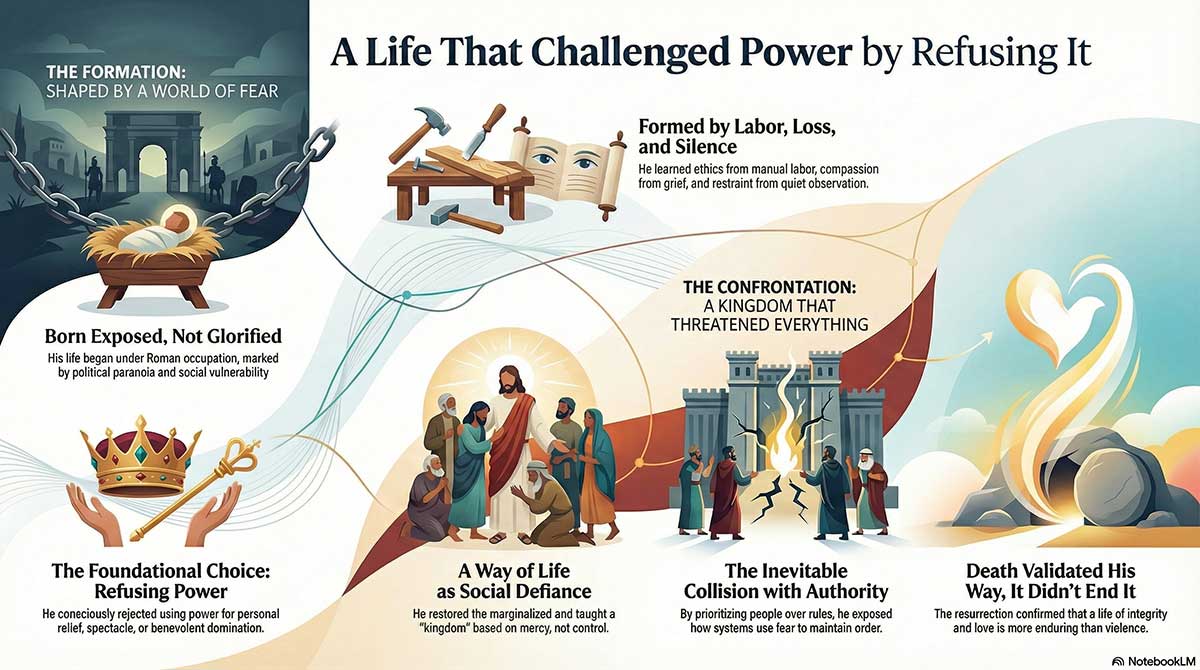
Writing this story changed the way I read the Bible.
Not because the text became less sacred—but because it became more human.
When you place Jesus back into his actual world—under Roman occupation, born to a teenage mother, raised in poverty, shaped by labor, silence, fear, and restraint—you begin to see something remarkable:
his life does not stand above human experience.
It moves through it.
The Bible never needed to explain every detail of Jesus’ life, because the people who first heard these stories already knew that world. We don’t. And without reconstructing it carefully, we risk turning Jesus into an idea instead of a life.
This five-scene story does not ask you to believe more.
It asks you to see more.
If anything remains after reading it, I hope it is this:
that the power of Jesus’ life was not found only in miracles or resurrection—but in the way he lived fully, faithfully, and without fear inside a world that offered him no protection.
That kind of life still challenges every system built on fear today.
And that, more than anything, is why this story is worth telling again.
Short Bios:
Jesus of Nazareth
A Jewish teacher from Galilee who lived under Roman occupation and preached a radically human vision of God’s kingdom rooted in mercy, integrity, and love without fear. His life, death by crucifixion, and reported resurrection reshaped history and continue to challenge systems built on power and violence.
Mary of Nazareth
A young Jewish woman, likely in her mid-teens, who gave birth to Jesus under extraordinary social and political risk. Remembered for her quiet courage, endurance, and contemplative faith, she raised Jesus in obscurity while carrying experiences few could fully understand.
Joseph of Nazareth
A Jewish craftsman (tekton) skilled in stone and wood, who chose compassion over honor when faced with scandal. His quiet moral strength, discipline, and willingness to protect Mary and Jesus shaped the early life of the family, though he disappears from the record before Jesus’ public ministry.
John the Baptist
A prophetic figure who preached repentance in the wilderness and called people to moral realignment through baptism. Historically attested by Josephus, John’s movement prepared the ground for Jesus’ public ministry and brought him into direct conflict with political authority.
Pontius Pilate
The Roman prefect of Judea responsible for maintaining order on behalf of the empire. Known for political pragmatism and brutality, Pilate authorized Jesus’ execution not out of theological conviction, but to preserve stability and avoid unrest.
Herod the Great
The Roman-appointed king of Judea during Jesus’ birth, renowned for architectural achievements and notorious for paranoia and violence. His reign created an atmosphere of fear that shaped the early years of Jesus’ life, including the family’s flight into Egypt.
Peter (Simon Peter)
A Galilean fisherman and one of Jesus’ earliest followers, known for devotion mixed with fear and impulsiveness. His denial during Jesus’ arrest and later transformation reflect the human cost and power of encounter rather than ideology.
Mary Magdalene
A devoted follower of Jesus and one of the first witnesses to the resurrection. Often misunderstood in later tradition, she represents fidelity, courage, and clarity at a moment when fear silenced many others.
Leave a Reply