

|
Getting your Trinity Audio player ready...
|

Introduction by Václav Havel
When we speak of courage, it is often imagined as a dramatic act, a clash of wills or armies. Yet true courage, the kind that shifts history, is quieter, subtler, and infinitely more difficult. It is the courage of individuals who stand alone against entire systems of lies, who refuse to surrender their dignity when everything conspires to humiliate them. Civil courage is not about overthrowing an enemy in one decisive moment; it is about resisting the corrosion of truth day after day, in silence as much as in protest.
Venezuela’s struggle is part of this universal story. The forces of repression may appear immovable, yet every lie they tell, every act of violence they commit, becomes weaker when confronted by the persistence of truth. María Corina Machado, and those like her across the world, show us that civil courage is contagious—it passes from one generation to another, across borders, across cultures. To begin this conversation, let us see Venezuela not as an isolated case but as one chapter in humanity’s long fight to live with dignity.
(Note: This is an imaginary conversation, a creative exploration of an idea, and not a real speech or event)
Topic 1: Civil Courage in Authoritarian Times
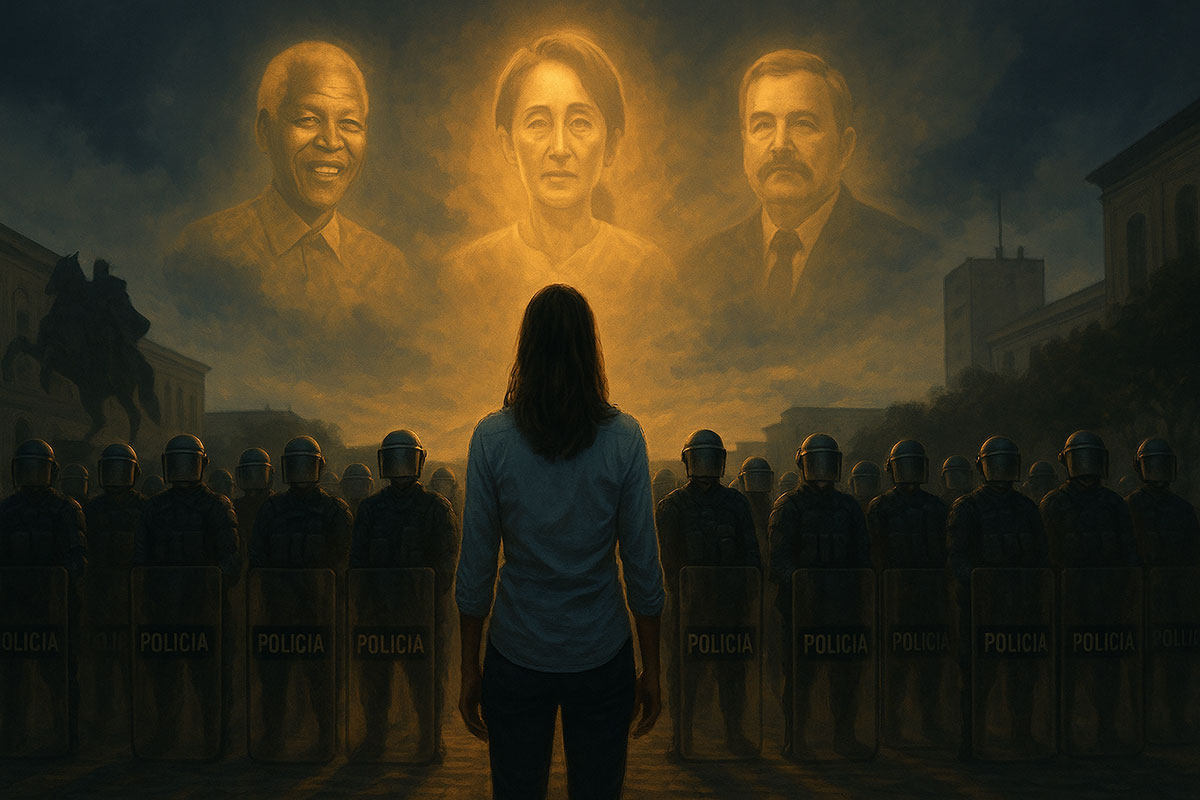
Germán Carrera Damas:
Courage, I have often said, is not the absence of fear but the decision to honor history by facing it. In Venezuela, in Poland, in South Africa, in Myanmar, we see the pattern of repression repeating. But we also see how individuals become symbols, carrying forward the torch when others falter. Tonight, we reflect on what it means to practice civil courage when freedom feels most fragile.
Question 1: What does “civil courage” mean to you personally, when fear and danger are constant companions?
María Corina Machado:
For me, civil courage is not heroic in the sense of grand gestures. It is waking up every day and choosing not to leave my country, though it would be easier. It is walking into public squares where government forces monitor every step, and still raising my voice. It is the decision to stay visible, so Venezuelans know they are not abandoned.
Nelson Mandela:
Courage, as I learned in prison, is not the roar of defiance but the quiet resolve not to break. They tried to silence us in Robben Island, yet we sang, we taught one another, we dreamed. Civil courage is a chain reaction. When one refuses to bend, others find their own strength.
Lech Wałęsa:
In Gdańsk, courage meant organizing strikes under the eyes of the militia. Fear was natural, but we transformed fear into solidarity. When you act not for yourself but for your neighbor, courage multiplies. Civil courage is communal, not solitary.
Aung San Suu Kyi:
House arrest taught me patience. My courage was tested not in open defiance, but in enduring silence and isolation without surrendering the core belief: that Myanmar’s people deserved freedom. To persist in the face of invisibility—that is also civil courage.
Germán Carrera Damas:
From my vantage as a historian, civil courage is the act of rewriting destiny. Authoritarians demand passivity. To resist, even in small acts—teaching truth, protecting memory, refusing to endorse lies—is to stand against the erasure of history.
Question 2: How do you sustain courage when threats to life, liberty, and family intensify?
Nelson Mandela:
We sustained ourselves by remembering that struggle was never about one man’s safety but about millions yearning for dignity. When I grew tired, I thought of the children in Soweto. Their courage refueled my own.
María Corina Machado:
There are nights when fear is overwhelming. Yet I think of the mothers searching for food, the young people emigrating by the millions, the elderly abandoned. Their suffering dwarfs my own risk. Knowing that, I cannot retreat.
Lech Wałęsa:
Faith helped us. And humor. Even in secret meetings, we laughed at the absurdity of our rulers. Dictators fear laughter as much as protests, because it reminds us we are human. Humor sustained courage.
Aung San Suu Kyi:
Meditation sustained me. In stillness, I found resilience. Courage is often quiet: the decision not to let bitterness corrode the spirit.
Germán Carrera Damas:
I would add: memory sustains courage. To know one belongs to a lineage of patriots who resisted tyranny before us gives strength. History whispers, others endured—so can you.
Question 3: What advice would you give to the next generation of activists who face authoritarian regimes today?
Lech Wałęsa:
Do not fight alone. Build networks, create solidarity, protect one another. A movement is harder to crush than an individual.
Aung San Suu Kyi:
Guard your inner freedom, even if your outer freedom is stolen. Do not allow hatred to dictate your struggle.
María Corina Machado:
Believe that change is possible, even when all evidence says otherwise. Authoritarians rely on despair. Do not gift them your despair.
Nelson Mandela:
Patience is as vital as passion. Change is a long road; prepare to walk it with endurance. Victory often comes later than we wish—but it comes.
Germán Carrera Damas:
Learn history. Tyranny thrives when people forget the past. Remember, record, and teach. By carrying memory forward, you arm yourselves against the lies of tomorrow.
Closing Reflection by Nelson Mandela
Civil courage is not the property of the mighty, but the duty of every citizen. It may be as small as saying “no” when pressured to repeat a lie, or as large as leading a nation through oppression. But always, it is the seed from which freedom grows.
Topic 2 — The Historical Lessons of Venezuela’s Democratic Struggles
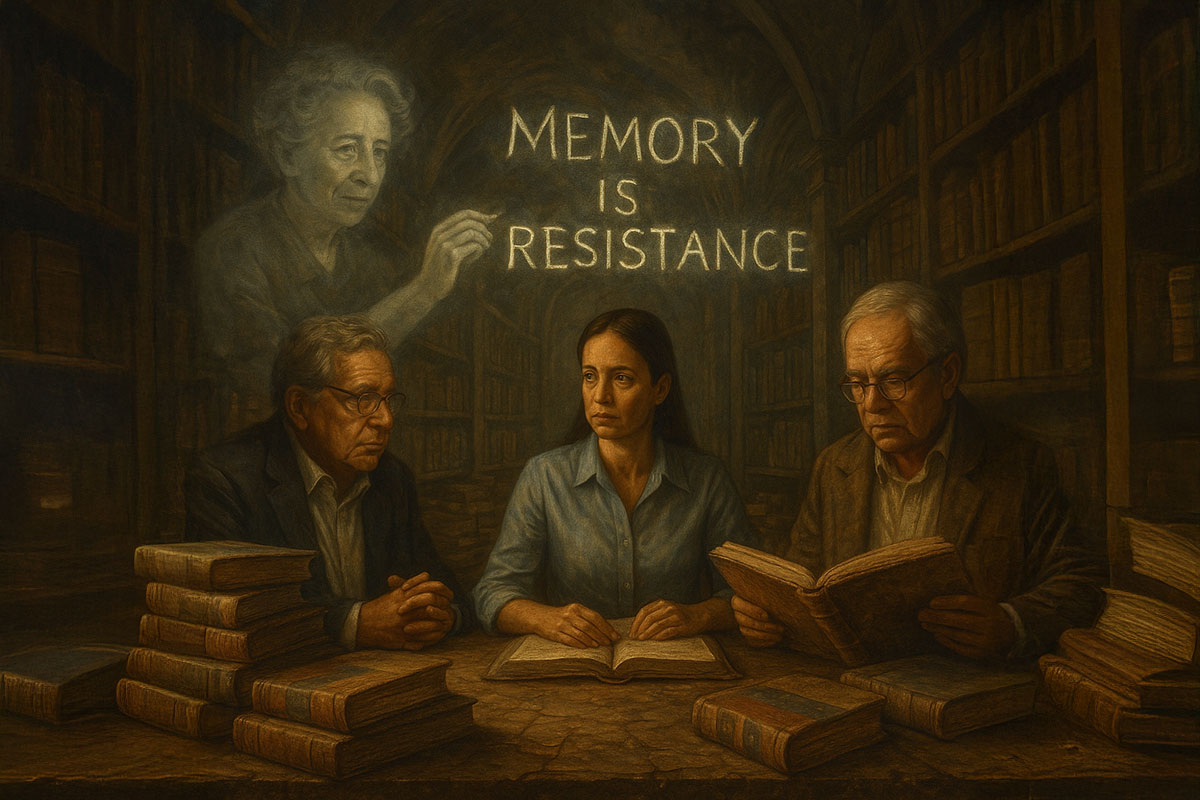
Fernando Henrique Cardoso:
Transitions from authoritarianism are fragile, uncertain processes. I witnessed this in Brazil when we moved from dictatorship to democracy. Each country has its own history, but certain lessons repeat: institutions matter, culture matters, and the courage of individuals matters. Venezuela is not isolated; it is part of a longer story of democracy’s rise, collapse, and renewal in Latin America. Tonight, we consider what Venezuela’s struggles can teach us—and what the future demands.
Question 1: What lessons from Venezuela’s democratic history should guide us today in resisting authoritarianism?
María Corina Machado:
Our history is full of warnings. Venezuela had moments of strong democracy, especially after 1958, when civilian leaders promised never again to allow military dictatorship. But complacency set in. Oil wealth masked institutional weakness. Citizens trusted too much in charisma and too little in checks and balances. The lesson is clear: democracy must be defended every day, not only at moments of crisis.
Hannah Arendt:
History teaches us that authoritarianism thrives on forgetfulness. The danger is not only the loss of freedom but the erosion of memory. When people forget the price paid for liberty, they more easily surrender it again. Venezuela’s lesson must be the insistence on remembrance. Memory is a weapon against repetition.
Carlos Blanco:
For Venezuela, one key lesson is that strong institutions cannot be substituted by leaders, no matter how virtuous. Our political parties grew weak, clientelism took over, and the vacuum allowed Chávez to rise. If we are to resist authoritarianism, we must rebuild institutional trust, not seek a savior.
Germán Carrera Damas:
As a historian, I would remind us that Venezuelans once chose democracy consciously, after the dictatorship of Pérez Jiménez. They knew its value. The tragedy is that later generations forgot. The lesson is that democracy is not inherited—it must be taught, renewed, and cherished anew in every era.
Fernando Henrique Cardoso:
I agree. In Brazil, too, we saw how quickly hard-won freedoms can weaken when institutions rot. The lesson is vigilance. Democracy is not self-sustaining; it requires citizens who participate, who demand accountability, who resist the seductions of easy answers.
Question 2: Why do democracies so often falter in Latin America, and what structural changes are needed to make them last?
Carlos Blanco:
Democracy falters in Latin America because our states are fragile and societies deeply unequal. When poverty and exclusion persist, people lose faith in democratic institutions and look to strongmen who promise quick fixes. Structural reform must mean economic inclusion, transparent governance, and serious decentralization of power.
Fernando Henrique Cardoso:
I witnessed this in Brazil. Inequality corrodes democracy. Without a middle class that feels invested in institutions, democracy is vulnerable to populism. Structural change means education, land reform, economic modernization—policies that spread dignity, not just rhetoric.
María Corina Machado:
I would add: authoritarianism exploits despair. In Venezuela, when oil wealth collapsed, promises of redistribution gained traction. But redistribution without rule of law leads to kleptocracy. Structural change must mean property rights, judicial independence, and a clear separation of powers. Only then can citizens trust democracy to deliver.
Hannah Arendt:
The weakness lies in confusing democracy with the will of a single leader. True democracy is about institutions, law, and collective responsibility. In Latin America, too often charisma replaces institutions. Structural reform must mean cultivating civic virtue—teaching citizens not only their rights but their obligations.
Germán Carrera Damas:
Yes, the fragility of democracy is linked to cultural habits. Too many Venezuelans grew accustomed to dependency on the state, expecting handouts rather than participation. We must cultivate what Simón Bolívar dreamed of but did not achieve: citizens who are free because they are responsible. That is the structural change most needed.
Question 3: How can Venezuela rebuild its institutions and collective memory after years of repression and economic collapse?
Hannah Arendt:
Rebuilding begins with truth. Without reckoning, without acknowledging the wounds inflicted, institutions will be hollow. Venezuela must resist the temptation of amnesia. Truth commissions, historical archives, public education—these are instruments to restore collective memory and ensure “never again.”
María Corina Machado:
I believe we must start by restoring confidence in elections. If Venezuelans cannot trust the ballot, no other institution will matter. That means independent oversight, transparency, and rebuilding the electoral system from scratch. But beyond institutions, we need a national narrative of dignity—so that Venezuelans see themselves not as victims, but as citizens capable of renewal.
Fernando Henrique Cardoso:
Rebuilding requires alliances. In Brazil, democratization succeeded because intellectuals, workers, students, and even reform-minded elites joined forces. In Venezuela, institutions cannot be rebuilt by one party or faction. They must be rebuilt by a broad coalition committed to common principles.
Carlos Blanco:
Economic recovery and institutional recovery are inseparable. A country in hunger cannot rebuild courts or legislatures. We need urgent policies that stabilize the economy, restore basic services, and reintegrate Venezuela into global markets. This material base will allow institutional reforms to endure.
Germán Carrera Damas:
And above all, we must rescue our historical memory. Venezuela must teach its children the lessons of both triumph and failure, so they understand how fragile freedom is. A nation without memory is condemned to repeat tragedy. Rebuilding is not only about laws and courts, but about conscience.
Closing Reflection by Hannah Arendt
Democracy is always fragile, always unfinished. But that fragility is also its strength, for it reminds us that freedom is not given—it is practiced. Venezuela’s struggle is not unique; it is part of humanity’s recurring story of forgetting and remembering, of losing freedom and fighting to regain it. If Venezuelans can transform memory into vigilance, suffering into solidarity, then democracy will not only return—it will endure.
Topic 3 — The Role of International Solidarity in Local Liberation

Václav Havel:
When I was a dissident playwright in Czechoslovakia, what sustained me was not only the courage of my compatriots, but also the voices of solidarity from abroad. Dictatorships thrive in darkness; solidarity is light. It does not replace local struggle, but it affirms it. Tonight, we ask: how can the world stand with those who resist tyranny, without drowning out their own voice?
Question 1: How has international solidarity shaped your own struggle, or your country’s path to freedom?
María Corina Machado:
When I was disqualified from running for president, many thought that would end my fight. But international recognition—the Sakharov Prize, the Nobel Peace Prize—reminded Venezuelans that their suffering is seen. Solidarity sustains morale. It does not solve our problems, but it tells our people: “You are not alone.”
José Ramos-Horta:
In East Timor, our occupation lasted for decades. Without international solidarity—journalists, human rights organizations, the voices of Nobel laureates—our cause would have been silenced. Solidarity gave legitimacy, and legitimacy gave us endurance.
Juan Guaidó:
For Venezuela, solidarity has been a double-edged sword. International support emboldened us, but when promises of help did not materialize, some Venezuelans felt abandoned. Solidarity is vital, but it must be consistent and realistic. Empty gestures do harm.
Madeleine Albright:
As a diplomat, I saw how international solidarity can empower dissidents, but also how easily it can be manipulated by regimes claiming “foreign interference.” The key is solidarity that listens. It must amplify local voices, not impose outside agendas.
Václav Havel:
In my time, solidarity from abroad meant that our jailers knew the world was watching. That awareness restrained them, if only a little. Solidarity is the moral witness that turns oppression into scandal.
Question 2: What are the risks when international solidarity crosses into intervention, and how should this be avoided?
Madeleine Albright:
The risk is that solidarity becomes paternalism. When foreign governments speak for oppressed peoples instead of with them, the legitimacy of the local struggle weakens. Intervention without partnership can turn liberation into dependency.
Juan Guaidó:
Exactly. In Venezuela, some foreign actors promised “all options on the table.” That raised hopes for intervention that never came. When the people’s fate depends on external rescue, their own agency weakens. The line between solidarity and false salvation must be clear.
José Ramos-Horta:
In East Timor, we needed both: international solidarity and eventual intervention by the United Nations. But intervention was legitimate because it followed years of local resistance and overwhelming popular demand. The lesson: intervention must never replace internal struggle—it must only reinforce it when the time is right.
María Corina Machado:
We Venezuelans must lead our own liberation. International solidarity is valuable when it strengthens our voice, not when it substitutes for it. We welcome pressure on the regime, but the real change must be Venezuelan-driven, or it will not endure.
Václav Havel:
The risk is also that solidarity becomes selective—applied where geopolitics favors it, ignored where it does not. True solidarity is principled, not opportunistic.
Question 3: What does authentic solidarity look like for Venezuela today, and how can it help build a peaceful transition?
José Ramos-Horta:
Authentic solidarity for Venezuela means humanitarian aid delivered without manipulation, and international institutions pressing for credible elections. It also means giving shelter to Venezuelan refugees while supporting their right to return home.
María Corina Machado:
We need solidarity that insists on truth. Do not normalize a dictatorship by treating it as just another government. Call things by their name: repression, censorship, political prisoners. Authentic solidarity means moral clarity.
Madeleine Albright:
For a peaceful transition, solidarity must support institution-building, not just opposition figures. Help create electoral guarantees, rebuild the judiciary, and strengthen civil society. Solidarity should not only oppose tyranny; it must prepare the ground for democracy.
Juan Guaidó:
Authentic solidarity means consistency. Don’t turn away once headlines fade. Venezuelans need the world to remain engaged for the long haul. A peaceful transition will require international guarantors who can hold the regime accountable to its promises.
Václav Havel:
I will say this: authentic solidarity does not dictate outcomes. It stands beside the oppressed, offering moral and practical support, while trusting them to shape their own destiny. That is the solidarity that liberates.
Closing Reflection by José Ramos-Horta
International solidarity is not a gift—it is a responsibility. Oppressed peoples fight their own battles, but when the world bears witness and offers support, the burden is lighter, the path less lonely. Venezuela’s liberation will be Venezuelan-led, but it will succeed more surely if the world refuses to look away.
Topic 4 — Mentorship, Leadership, and the Next Generation

Malala Yousafzai:
Leadership is never born in isolation. It is passed like a flame from one hand to another, shaped by those who guide us and those we guide in turn. I know my voice was amplified by mentors who believed in me, and by the courage of young girls who became my teachers. Tonight, we explore how mentorship shapes leadership—and how leaders can nurture the next generation, even in times of darkness.
Question 1: How did mentorship shape your vision of leadership, and who influenced you most?
María Corina Machado:
I was fortunate to learn from Venezuelan intellectuals like Germán Carrera Damas and Carlos Blanco. They taught me that leadership is not about commanding but about preserving memory, demanding truth, and building institutions that outlive personalities. From them I learned that courage must be guided by knowledge.
Carlos Blanco:
As a mentor, I see leadership as teaching younger generations that ideas matter as much as tactics. For me, mentoring María Corina meant reminding her that political battles are not only against opponents but against despair. Leadership means keeping hope alive even when conditions crush it.
Venezuelan Youth Activist (composite voice):
For my generation, mentorship means knowing we are not starting from zero. Leaders like María Corina remind us that sacrifice has a lineage. It comforts us to know that others have walked this road before, and that our steps continue their path.
Malala Yousafzai:
I was mentored by my father, who gave me courage to speak when silence felt safer. Mentorship gave me my voice. It also taught me that leadership must empower others to speak, not only the leader herself.
Germán Carrera Damas:
Mentorship is not about producing disciples, but free thinkers. My role with María Corina was to encourage independence, not obedience. Leadership must be cultivated as responsibility, not inheritance.
Question 2: What kind of leadership does Venezuela need after authoritarian rule—unifying figure, coalition builder, or institutional reformer?
Venezuelan Youth Activist:
We need all three, but especially coalition builders. My generation is tired of divisions. Venezuela’s future must be built by many hands, not a single leader. We crave institutions that guarantee participation, not just personalities that inspire.
María Corina Machado:
I agree—our country has suffered from the cult of charisma. We cannot replace one caudillo with another. Leadership must mean institutions first, personalities second. If I can contribute, it is as a unifier, someone who can help restore faith in democratic process rather than embodying power alone.
Germán Carrera Damas:
History warns us that Venezuela cannot endure another cycle of personalist leadership. What we need is a new republican spirit: leaders who dissolve themselves into institutions so that democracy survives beyond them.
Malala Yousafzai:
Leadership after authoritarianism must begin with listening. The oppressed want dignity, not just promises. The next leaders of Venezuela must show humility and openness, especially to the young and marginalized.
Carlos Blanco:
I would add: leadership must embrace pragmatism. We cannot afford purity tests that divide the opposition. Venezuela needs leaders who can negotiate, compromise, and still preserve principles. Only then will institutions hold.
Question 3: What virtues must today’s leaders model to inspire and mentor the next generation?
Malala Yousafzai:
Humility, above all. A leader who cannot admit mistakes cannot teach others. And resilience—the ability to keep going after defeats. Young people need to see not perfection but perseverance.
María Corina Machado:
Integrity. Too often in Venezuela, leaders compromised values for short-term gain. If we are to inspire the next generation, they must see leaders who do not sell truth for convenience.
Carlos Blanco:
Wisdom. In times of crisis, impulsiveness destroys movements. Leaders must show patience and depth of thought, so the next generation learns to value reflection as much as action.
Venezuelan Youth Activist:
Empathy. My generation has grown up amid exile, hunger, and trauma. Leaders who cannot feel our wounds cannot guide us. We want mentors who understand our pain, not just our potential.
Germán Carrera Damas:
Responsibility. Leadership is not glory, it is burden. To model this truth for young Venezuelans is perhaps the greatest virtue we can pass on.
Closing Reflection by Germán Carrera Damas
History will judge leaders not by their charisma but by the generations they raise. If we, the elders, can transmit responsibility, integrity, and memory, then Venezuela’s youth will carry forward the republic with greater strength than we could muster. That is the true measure of leadership: not how brightly one burns, but how many flames one kindles.
Topic 5 — The Philosophy of Nonviolent Resistance and the Future of Peace
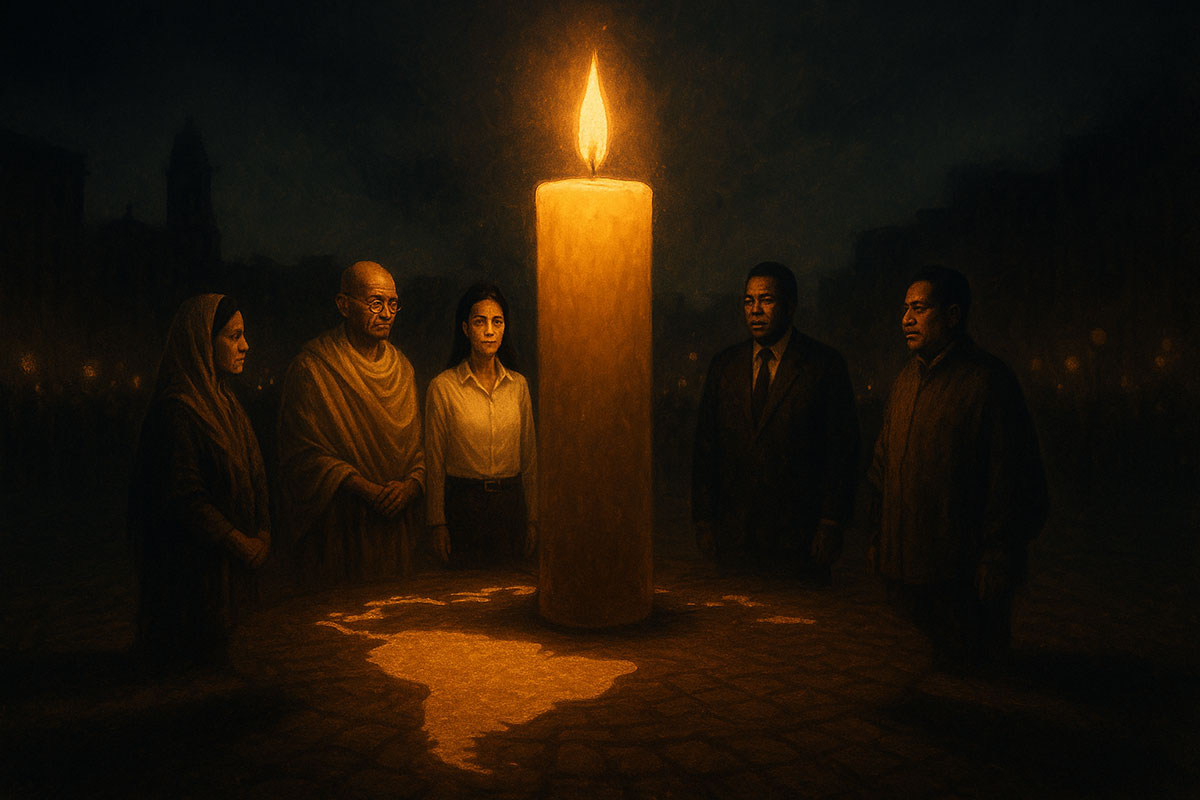
Mahatma Gandhi:
Nonviolence is not passivity; it is the most active form of resistance. It requires greater strength to resist without hatred than to strike with violence. In every age, people ask: can nonviolent struggle prevail against regimes that use weapons and fear? I believe it can, if the spirit of truth is stronger than the sword. Tonight, we bring voices from different struggles to reflect on how nonviolent resistance shapes the future of peace.
Question 1: Can nonviolent resistance truly triumph against regimes that wield violence and repression?
María Corina Machado:
In Venezuela, our people have faced bullets with empty hands. Many ask, “Why not fight fire with fire?” But violence only justifies more repression. What sustains us is knowing that nonviolent resistance exposes the regime’s illegitimacy. Every protester jailed, every election stolen, makes the world see the truth. Violence might win battles, but nonviolence wins legitimacy.
Martin Luther King Jr.:
I have always said, hate cannot drive out hate—only love can do that. Violence may defeat an oppressor for a day, but it corrodes the soul of the oppressed. Nonviolent resistance is slow, but it transforms both the protester and the world watching. Its triumph lies not only in victory but in the creation of beloved community.
Rigoberta Menchú:
In Guatemala, we indigenous peoples endured unspeakable violence. Nonviolent resistance was often our only weapon—preserving culture, memory, language when everything else was forbidden. Victory was not immediate. But to endure without becoming like the oppressor—that is triumph.
César Chávez:
When we organized farmworkers in California, we could not fight with fists; we fought with boycotts, with fasting, with the refusal to cooperate with injustice. The growers had power, but they could not force people to buy grapes. Nonviolent resistance works when it transforms moral conscience into economic and political pressure.
Mahatma Gandhi:
Yes, it can triumph, because power without legitimacy is fragile. Violence can coerce bodies, but it cannot command hearts. Nonviolence speaks to conscience, which is stronger.
Question 2: What role do faith, philosophy, and moral conviction play in sustaining nonviolent resistance?
Martin Luther King Jr.:
Faith was the anchor of our movement. Without faith, fatigue would have broken us. Moral conviction gave us the patience to march, to sit in jail, to endure humiliation. Faith makes nonviolence more than a tactic; it makes it a way of life.
María Corina Machado:
For me, moral conviction is what keeps me in Venezuela. Every day, I could choose exile and safety. But I believe my place is among my people. Without conviction, resistance becomes theater. With conviction, it becomes destiny.
Rigoberta Menchú:
Philosophy and spirituality are inseparable for my people. Resistance was not just political—it was sacred. We prayed while resisting, we preserved rituals, we carried ancestors in our struggle. That spiritual dimension sustained us through decades of violence.
César Chávez:
I drew strength from my Catholic faith. Fasting was not only protest but purification, reminding us that sacrifice dignifies struggle. Without moral conviction, movements fracture when the first victories come. With it, they endure beyond leaders.
Mahatma Gandhi:
Nonviolence without faith is empty technique. True nonviolence springs from a recognition of the divine in every human being, even the oppressor. That philosophy turns resistance into transformation, not revenge.
Question 3: Looking to the future, what vision of peace do you hope nonviolent resistance can achieve for Venezuela and for the world?
María Corina Machado:
For Venezuela, peace must mean more than the end of repression. It must mean rebuilding dignity—free elections, justice for victims, food on the table, children in school. Nonviolent resistance prepares us for this future because it rejects vengeance. Peace must be reconciliation, not merely survival.
César Chávez:
My vision is simple: that workers are treated with dignity, that no man or woman goes hungry while others grow rich from their labor. Nonviolent struggle leads us to a peace rooted in justice, not charity.
Rigoberta Menchú:
I hope for a peace that honors diversity. For indigenous peoples, peace is not imposed from above; it grows from respect for our cultures and our land. Nonviolent resistance can protect that plural vision of peace.
Martin Luther King Jr.:
My dream remains alive: that children of all colors, all nations, sit at the table together. Peace is not the absence of conflict; it is the presence of justice. Nonviolent resistance prepares the soil where that justice can grow.
Mahatma Gandhi:
Peace, to me, is the harmony of truth. Nonviolent resistance does not destroy the enemy; it seeks to turn him into a friend. My vision for the world is that nations may one day practice what individuals have struggled for—that truth and love are the final arbiters of human destiny.
Closing Reflection by María Corina Machado
For Venezuela, and for all who suffer under tyranny, nonviolence is not weakness. It is the most courageous choice we can make. Our vision of peace must not only replace one regime with another—it must build a society where fear no longer rules, where children grow free, and where history remembers us not for the violence we endured, but for the peace we created.
Final Thoughts by Rigoberta Menchú
For those of us who have lived through violence, displacement, and loss, peace is never a distant abstraction—it is the most urgent need of every child, every mother, every community. Nonviolent resistance is not a weakness; it is the discipline of believing that life, dignity, and memory can endure even when weapons and fear surround us. I see in Venezuela echoes of Guatemala, of so many places where silence was imposed, yet the people’s spirit refused to die. That refusal, that resilience, is itself a seed of peace.
As we close this dialogue, I want to remind us that peace is not only about rebuilding institutions—it is about healing memory. Without memory, peace is fragile; with memory, peace is sacred. Venezuela’s struggle belongs to all of us, because every victory for justice anywhere strengthens humanity everywhere. May the courage we have discussed here become the light that guides not only Venezuela, but all peoples still searching for freedom.
Short Bios:
María Corina Machado
María Corina Machado (1967– ) is a Venezuelan opposition leader, activist, and 2025 Nobel Peace Prize laureate. Known for her unwavering stance against authoritarianism, she has become a symbol of civil courage and the struggle for democracy in Latin America.
Germán Carrera Damas
Germán Carrera Damas (1930–2021) was a Venezuelan historian and intellectual. A mentor to María Corina Machado, he emphasized the importance of historical memory, republican values, and civic responsibility in preserving democracy.
Carlos Blanco
Carlos Blanco (1946– ) is a Venezuelan economist, professor, and political thinker. A former government minister, he has been a key opposition voice and mentor, advocating for institutional reform and democratic renewal.
Nelson Mandela
Nelson Mandela (1918–2013) was a South African anti-apartheid leader, political prisoner, and Nobel Peace Prize laureate. As the first democratically elected president of South Africa, he became a global symbol of reconciliation, dignity, and civil courage.
Aung San Suu Kyi
Aung San Suu Kyi (1945– ) is a Burmese politician and former Nobel Peace Prize laureate. Once a symbol of peaceful resistance under house arrest, her reputation was later tarnished by her role in Myanmar’s government, though her earlier struggle remains a historic example of endurance.
Lech Wałęsa
Lech Wałęsa (1943– ) is a Polish labor leader, co-founder of the Solidarity movement, and Nobel Peace Prize laureate. As president of Poland, he guided the country’s transition from communist rule, embodying the power of grassroots nonviolent resistance.
Fernando Henrique Cardoso
Fernando Henrique Cardoso (1931– ) is a Brazilian sociologist and statesman who served as president of Brazil (1995–2003). A leading intellectual in Latin America, he helped steer Brazil’s transition to democracy and is respected for his work on inequality and governance.
Hannah Arendt
Hannah Arendt (1906–1975) was a German-American political theorist and philosopher. Her works on totalitarianism, authority, and civic responsibility remain influential in understanding the fragility of democracy and the power of memory.
Václav Havel
Václav Havel (1936–2011) was a Czech playwright, dissident, and president. A leader of the Velvet Revolution, he embodied moral resistance to authoritarianism and became a voice for democracy, truth, and human dignity worldwide.
José Ramos-Horta
José Ramos-Horta (1949– ) is a Nobel Peace Prize laureate and current president of East Timor. He played a pivotal role in securing his country’s independence through diplomacy, international solidarity, and nonviolent resistance.
Juan Guaidó
Juan Guaidó (1983– ) is a Venezuelan opposition leader and former president of the National Assembly. He became internationally recognized for his efforts to challenge Nicolás Maduro’s rule and advocate for democratic transition.
Madeleine Albright
Madeleine Albright (1937–2022) was the first female U.S. Secretary of State. A refugee from war-torn Europe, she became a leading diplomat and voice for democracy, multilateralism, and human rights.
Malala Yousafzai
Malala Yousafzai (1997– ) is a Pakistani education activist and the youngest Nobel Peace Prize laureate. After surviving an assassination attempt by the Taliban, she became a global advocate for girls’ education and youth empowerment.
Venezuelan Youth Activist (composite)
This composite figure represents the new generation of Venezuelan activists—young men and women who have grown up amid repression and economic collapse, carrying forward the hope of democratic renewal through courage, empathy, and persistence.
Mahatma Gandhi
Mahatma Gandhi (1869–1948) was an Indian lawyer, philosopher, and leader of India’s independence movement. His philosophy of nonviolent resistance, or satyagraha, inspired global movements for justice and freedom.
Martin Luther King Jr.
Martin Luther King Jr. (1929–1968) was an American minister, civil rights leader, and Nobel Peace Prize laureate. His advocacy for racial equality through nonviolent protest made him a defining voice for justice in the 20th century.
César Chávez
César Chávez (1927–1993) was an American labor leader and civil rights activist. As co-founder of the United Farm Workers, he organized boycotts and strikes that improved conditions for farmworkers, using nonviolence as a guiding principle.
Rigoberta Menchú
Rigoberta Menchú (1959– ) is a K’iche’ Maya activist from Guatemala and Nobel Peace Prize laureate. She has dedicated her life to Indigenous rights, social justice, and peace, serving as a bridge between ancestral traditions and modern human rights advocacy.
Leave a Reply