

|
Getting your Trinity Audio player ready...
|
Isabel Allende:
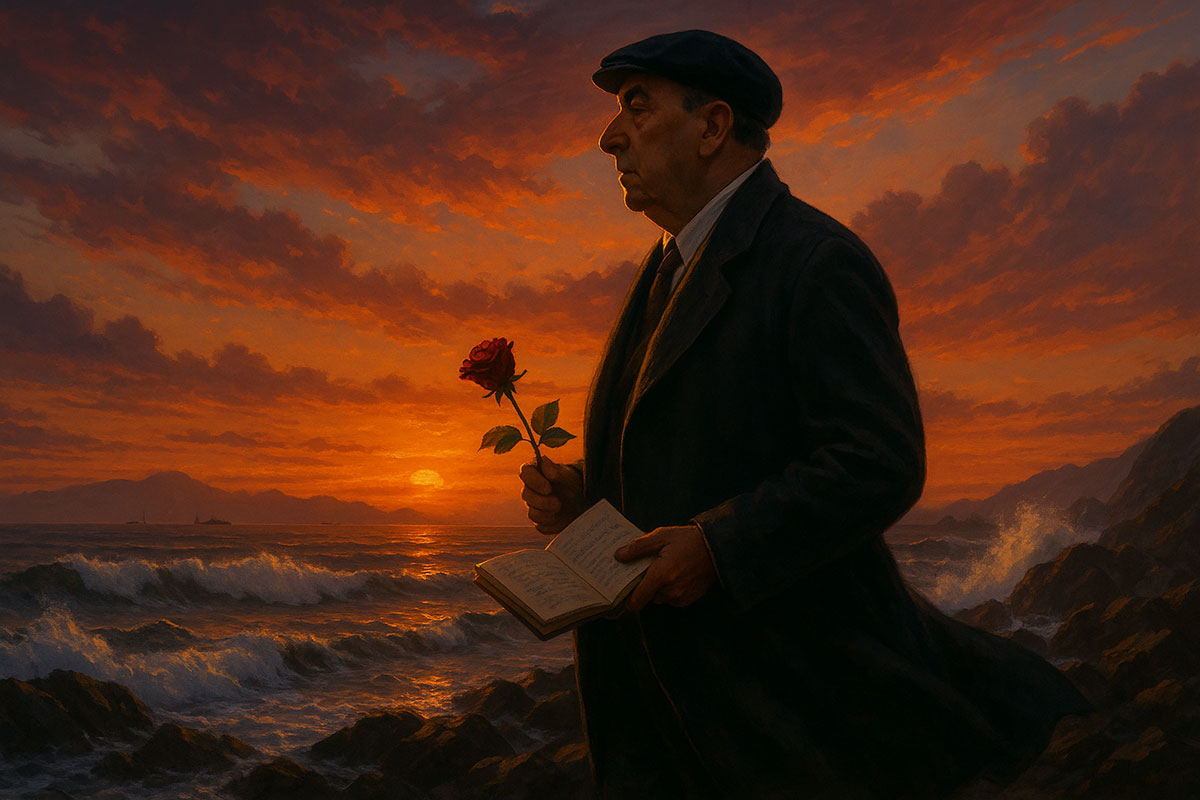
I stand before you today, carrying the bittersweet duty of honoring a man whose voice could summon oceans, ignite revolutions, and cradle the most intimate of human emotions. Pablo Neruda was not merely a poet—he was a cartographer of the soul, mapping both the ecstasies and the griefs of our shared existence. He was a lover of his homeland’s wild coasts, a champion for the oppressed, and a witness to the tumult of the 20th century. His words spilled beyond the page, becoming banners in the streets, whispers in lovers’ ears, and weapons against tyranny.
As I think of him at the threshold of his final days, I remember not just the Nobel laureate, but the man who kept his desk facing the Pacific, as if needing the horizon to remind him of the infinite. Even when his body grew frail, his spirit remained restless, eager to finish a verse that could outlive the noise of politics and the cruelty of regimes. The world often remembers his public battles, but I believe his most profound victories were won in the quiet resilience of his pen, the moments when illness and persecution could not silence his song.
Today, we revisit the chapter of his life where recognition and resistance met in the same breath—the time of the Nobel Prize and his final battles. It is here that the poet’s legacy becomes inseparable from the man: defiant yet tender, politically fierce yet endlessly humane. This is not merely the story of a writer—it is the story of a life lived in full, even as the shadows lengthened.
(Note: This is an imaginary conversation, a creative exploration of an idea, and not a real speech or event.)
Chapter 1: The Loneliness of Rangoon
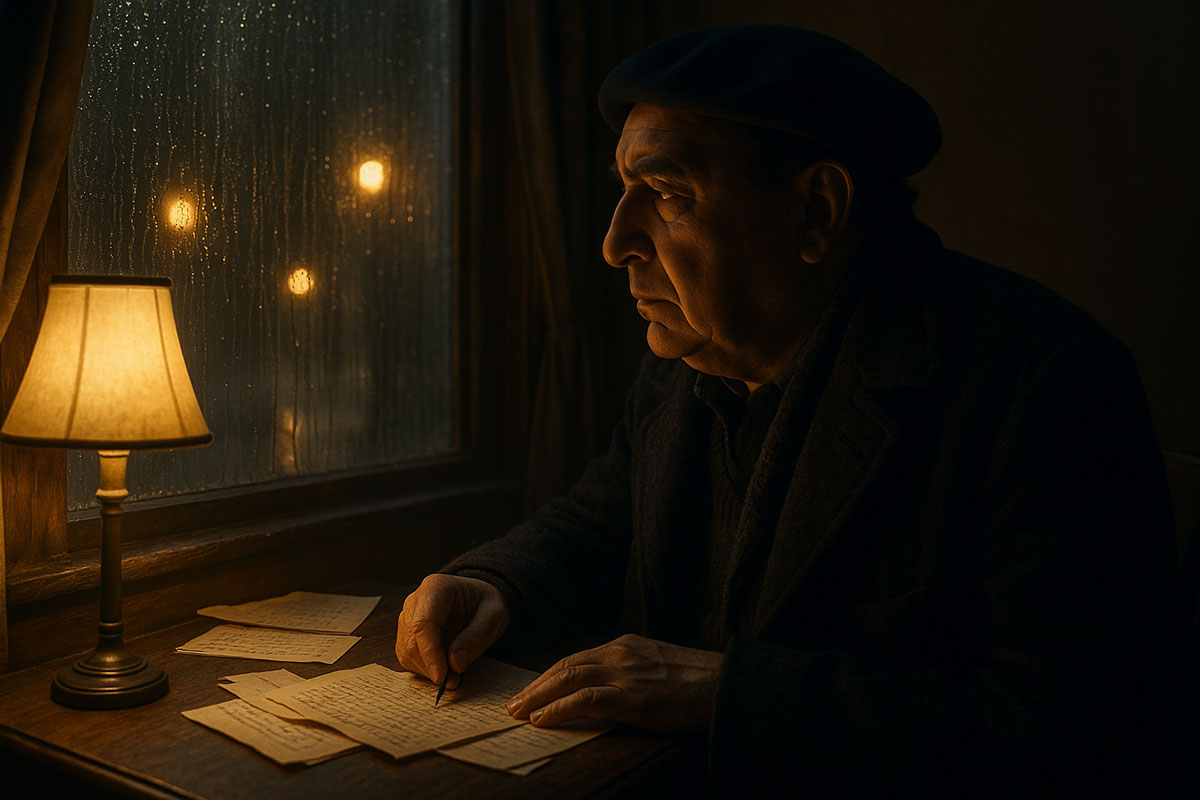
The rain had been falling since morning, soft at first, then swelling into a ceaseless percussion on the corrugated tin roof. In Rangoon, the air was thick enough to press against the lungs, heavy with the scent of wet earth and frangipani. The streets were slick and shadowed, narrow canals of silence interrupted only by the passing bell of a rickshaw or the distant call of a street vendor.
Pablo Neruda sat at his desk, the single window before him warped with beads of water, so the outside world appeared like a half-forgotten painting. The room smelled of mildew and ink. His fingers were smudged black from the day’s futile attempts at writing a letter to someone — anyone — back home. Each word felt like a pebble dropped into a well too deep for sound to return.
When I entered, I saw the tired curve of his shoulders, the way his pen hovered without conviction above the paper. “You haven’t been out today,” I said gently, setting a cup of weak tea beside him.
He glanced up with a slow smile, one that tried for warmth but never reached his eyes. “Out to where? This city is a map I cannot read. Its streets lead me back here.”
I pulled a chair beside him. “You once told me that every poet needs exile, even if it is only from the familiar. That distance makes the heart strain for the music of home.”
His gaze fell to the tea, steam curling like a phantom of warmth. “Exile is one thing. But here…” He gestured to the dim room, the unyielding rain. “Here I am not simply far away. I am… erased.”
The word lingered. Erased — not absent, but as if he had been written out of the world’s book.
“You’re still writing,” I reminded him.
“Yes. But my words feel like orphans. They have no street to walk, no sea to sail.” He paused, looking past me as though the monsoon outside carried a message only he could almost hear. “Do you know what it is to speak into a void?”
I thought of his solitary dinners, of how he marked the days not by sunrise and sunset, but by the rare arrival of a letter from Chile, sometimes months late. “I think you mistake the void for an echo. It will answer you — just not yet.”
Something in his expression shifted, a shadow lifting slightly. “An echo,” he murmured, as though tasting the word for the first time. “Yes… perhaps that is what poetry is — the echo of a voice that refuses to die.”
We sat for a while, letting the rain fill the silence between us. Then he reached for his pen, almost cautiously, like approaching a half-wild animal. The first line he wrote was slow, deliberate, a thread cast into darkness:
"I have gone far, farther than my own shadow,
and in the distance, I still hear my name.”
He exhaled, the tension in his shoulders easing fractionally. “Maybe,” he said, “the streets of Rangoon do not lead me home. But perhaps they lead somewhere even the map cannot show.”
I smiled. “And that is where your readers will follow.”
The rain continued its steady percussion, but now it seemed less like a wall and more like a curtain — one that might lift at any moment. In the dim light, Pablo bent over the page, his pen scratching a rhythm to match the falling water, a rhythm that would one day cross oceans.
For the first time in weeks, he looked less like a man stranded in a foreign city and more like a poet standing at the threshold of his own voice.
Chapter 2: Love and the Spanish Civil War
Madrid in 1936 was a city where every breath felt stolen from the mouth of danger. The streets echoed with the shuffle of boots and the whisper of fear, yet also with the urgent laughter of those who refused to let war steal the light from their eyes. Barricades rose from cobblestones, rifles rested against café walls, and newspapers were read like lifelines, fingers blackened with both ink and gunpowder dust.
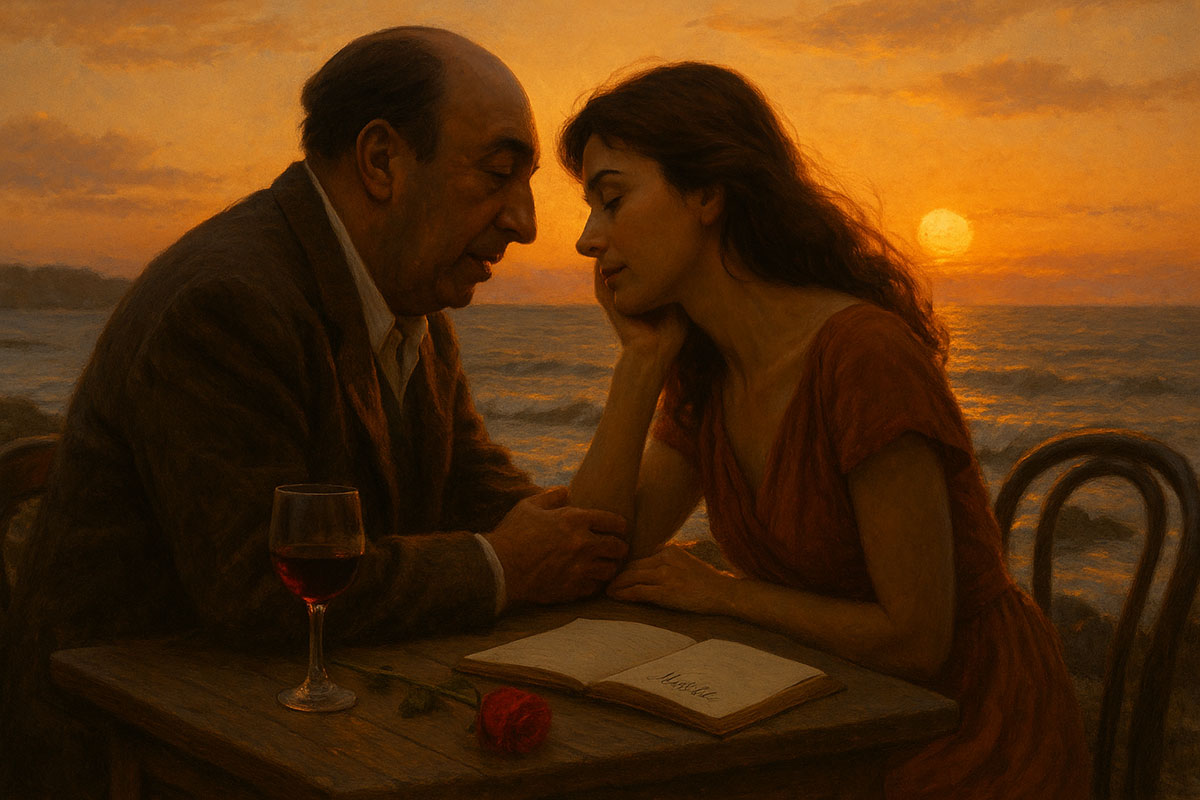
Pablo Neruda arrived not only as a poet but as a man in love — not with a single person at first, but with the collective soul of Spain. Yet soon, that love took a human face: Delia del Carril, her eyes as sharp as the ideals she defended, her voice warm enough to melt the frost of disillusionment that war tried to spread.
When I found him one evening, he was seated in the corner of a candlelit kitchen, Delia across from him, the air thick with the smell of bread and gun oil. The window rattled faintly with distant artillery.
“She says poetry can’t stop bullets,” Pablo told me as I entered, his voice half in jest, half in ache.
Delia, without looking up from slicing bread, answered for herself: “But it can keep the heart from surrendering.”
He watched her hands, the surety of her movements. “I used to think words were enough. That if I wrote the right poem, the right cry, something in the world would shift.”
“They do shift,” she replied, placing a slice before him. “But the world is not only made of ears. It’s made of hands. And sometimes the hands holding the guns do not read.”
Outside, a burst of shouting broke the fragile stillness, but neither of them moved. Neruda’s eyes burned — not with the glow of romantic love alone, but with the fire of a man whose heart had been claimed by two battles: one for a woman, and one for a country’s soul.
Later, walking with him through a narrow alley lit by the trembling glow of oil lamps, he spoke in the low voice he used when words felt too heavy to lift.
“I came here thinking I could be a witness. But love does not let you stand still. Love pushes you into the fire.”
I asked, “Do you mean Delia, or Spain?”
He stopped, the night air cold against our breath. “Both. And perhaps they are the same thing. You cannot love halfway when the world is breaking. You give all — or you are not truly in love at all.”
His hand brushed the wall, feeling its rough stone, as if to remember the texture of the place, the grit of its fight. “The poems I am writing now,” he continued, “are not for literary journals. They are for the wounded. They are for the dead. They are for those who have not yet chosen which side they will stand on.”
In the flicker of lamp light, his face was neither the solitary figure from Rangoon nor the romantic diplomat of quieter days. He was something else entirely — a poet turned into a weapon, not by choice, but by the inexorable demands of love.
As we reached the end of the street, the faint strains of a guitar rose from a nearby tavern, stubbornly playing against the growl of distant gunfire. Neruda paused, listening, a faint smile playing at the edge of his mouth.
“That,” he said softly, “is why we fight. So the song can go on.”
And with that, he stepped forward into the night, carrying in his chest both the weight of a lover and the burden of a witness, knowing neither could be set down.
Chapter 3: The Shadow of Political Persecution

It was winter in Santiago, the kind of winter that pressed its hand over the city’s mouth, muting the streets in a hush of cold suspicion. The air smelled of damp wool and ink, and somewhere beyond the walls of Neruda’s home, the slow machinery of the state was grinding its teeth.
By then, his voice had become too loud for those in power. His speeches in defense of workers and peasants had carried far beyond the comfort of the salons, reaching the doorsteps of the very people the government preferred to keep silent. He was no longer just Pablo the poet — he was Pablo the enemy.
I remember finding him at his desk, pen still in hand though the ink had gone dry from disuse. A stack of papers lay before him, each line a seed of rebellion. He was not writing verses for lovers anymore; these words had teeth.
“They say I must keep quiet,” he told me without looking up. “They say the poet’s duty is to beauty, not to truth. But what is beauty if it cannot bear the weight of justice?”
The shutters rattled with the wind, but in them I heard another sound — boots in the street, the echo of watchful eyes.
“Pablo,” I asked, “are you afraid?”
He set the pen down, slowly, as if it had become heavier in his hand. “Of prison? No. Of exile? Less. What I fear is to become a coward and still call myself a poet.”
Delia moved in the doorway then, a coat in her hands, her expression caught between love and worry. “The walls have ears,” she warned. “And they have begun to lean closer.”
He rose, taking the coat, and together we stepped out into the sharp air. The night wrapped around us like a co-conspirator. Somewhere, the mountains watched silently, indifferent to the affairs of men, their snow peaks glinting in the moonlight.
We walked to a small café where the curtains were always drawn and the talk was always careful. His friends were already there — workers, fellow writers, a teacher whose classroom had been shuttered for speaking the wrong truths. In the dim light, they leaned in close, their whispers pooling like ink in the space between us.
“They will come for me soon,” Neruda said plainly, as if announcing the weather. “But until they do, every breath I take will be another line against them.”
There was no applause, only the solemn nods of those who understood that survival was an act of resistance, but so too was refusing to hide.
Later, as we left, I saw his eyes lift toward the hills beyond the city. “The earth does not forget,” he murmured. “It remembers the footsteps of those who walk for truth.”
That night, the wind carried more than just cold — it carried the certainty that Pablo Neruda’s war with silence had only just begun.
Chapter 4: Exile and the Long Road Home
The train pulled away from Santiago before dawn, its steel wheels singing the lonely hymn of departure. The city dissolved behind us — first the lamps, then the rooftops, then the faces I could no longer hold onto. Neruda sat across from me, wrapped in a worn coat, his breath clouding the air between us like ghostly punctuation.
He did not look back.
To look back would be to give the city permission to break him.
“I thought exile would be a corridor,” he said after a long silence, “a narrow passage I’d walk through quickly, back into the light. But already, I feel the corridor stretching into a continent.”
Outside, the Chilean countryside swept past, raw and infinite. Snow was falling in the distant Andes, the same mountains that had once been the backdrop to his youth. They seemed farther away now, as if they too were conspiring with distance.
Our first refuge was not a home but a borrowed room above a bakery in Buenos Aires. The smell of bread rose through the floorboards each morning, mingling with the bitter coffee he sipped as he wrote. His verses here were leaner, stripped of ornament, as if exile had pared away everything but the bone of truth.
One evening, the news came — warrants issued, assets seized, names read aloud in the chambers of Parliament. Neruda’s name had rolled off the tongue of his accusers like an oath.
“They think distance is silence,” he told me that night, the lamplight sharpening the lines on his face. “They forget that a poem can cross borders without papers.”
And so, the journey stretched on — through Uruguay, Brazil, then across the ocean to Europe. Each stop was a temporary harbor, each departure a new wound. In Paris, the streets smelled of rain and smoke, and for a time, the city gave him back the taste of freedom. But Chile was never far; it hummed in the marrow of his bones.
I remember one night in Mexico City, after a reading that drew exiles from every corner of Latin America. He sat alone on the balcony, the warm air carrying the scent of jacaranda blossoms. “They will let me return one day,” he said, his voice almost a whisper. “Not because they forgive me, but because the people will not forgive them if they do not.”
Years later, the call came — the gates opened, the charges dissolved like mist. The road home was not paved in celebration but in the quiet relief of return. When we crossed the Chilean border, the air felt different, as if the land itself had leaned forward to welcome him.
And yet, exile had left its mark. His eyes, once fixed only on the horizon, now carried the weight of everywhere he had been — the railway dust of Argentina, the salt of the Atlantic, the streets of Paris under rain.
In Santiago, standing once more before the crowd, he began to read. His voice was steady, but there was an undertow to it, a rhythm born of distance and return.
“I have come home,” he said, “but I carry with me every road that brought me here.”
The applause rose like surf against the shore, and for a moment, I thought I saw him close his eyes — not to block the sight, but to hold it inside.
Chapter 5: The Nobel Prize and the Final Battles
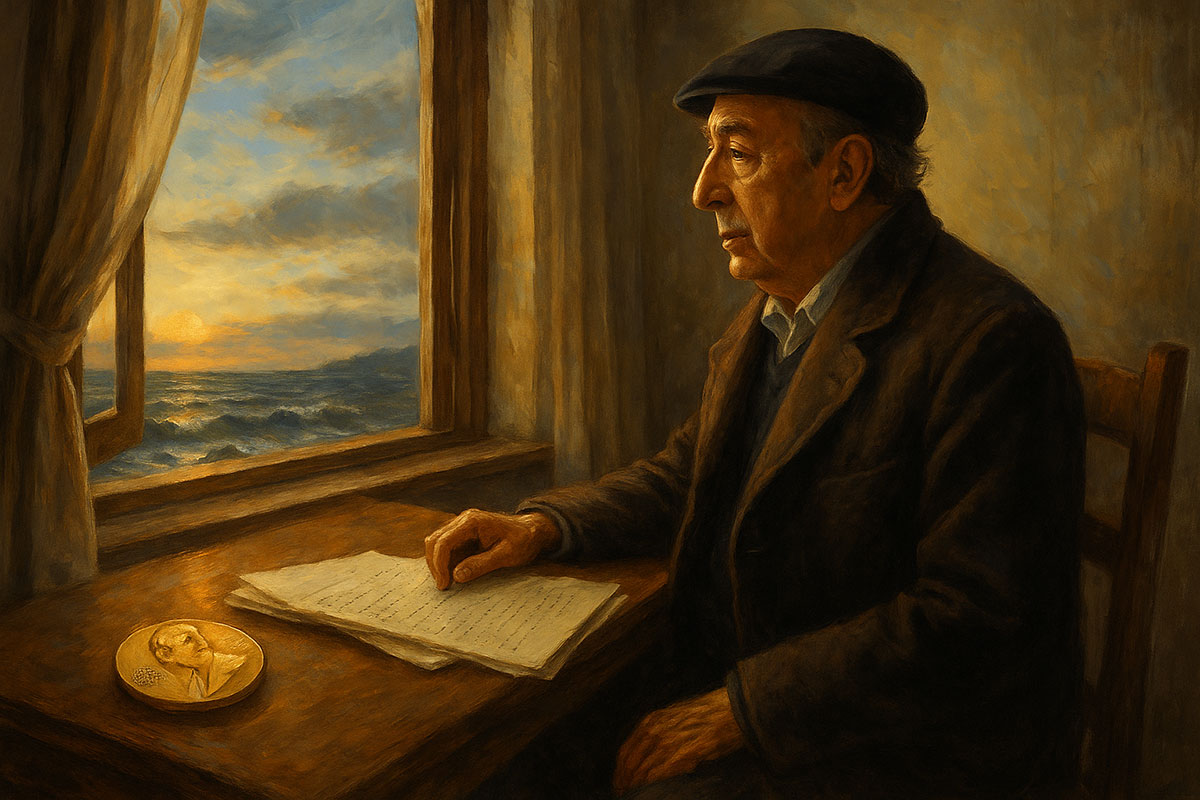
The news came not with a trumpet but with a knock at the door.
A messenger, rain dripping from his hat, handed over the telegram as if it were an ordinary delivery — yet inside, the words shone like fire on the page:
“Pablo Neruda awarded the Nobel Prize in Literature.”
He read it twice, then looked at me with the quiet, stunned expression of a man who has spent a lifetime speaking into the wind, only to realize the world had been listening all along.
“It is not a crown,” he said at last, “but a bell. And now they will expect me to keep ringing.”
In Stockholm, the winter light fell like pale silk over the city. Neruda stood before the academy in a black coat, his notes folded in his pocket, though he barely looked at them. He spoke of poetry as bread, as water, as the simple fuel of human dignity. He spoke of the miner in the dark, the fisherman in the dawn, the lovers whose whispers shaped the language itself.
When the applause came, it was not the thunder of strangers but the warm, sustained sound of people recognizing one of their own.
And yet, even as the world celebrated him, Chile’s wounds were deepening. In the months that followed, the air at home grew taut with fear. The military coup struck like a lightning bolt, shattering the fragile hope that had begun to take root. Friends vanished overnight. The streets filled with boots and silence.
By then, Neruda’s health was failing. The illness moved through him like a slow tide, pulling his strength away piece by piece. But his voice — on the page and in conversation — still carried the same fierce timbre.
“They can silence the squares, the radios, the newspapers,” he told me, “but they cannot silence the mountains, the rivers, the wind over the desert. And I will place my words there.”
In the last months, he wrote from a bed overlooking the Pacific. The sea was restless, as if carrying messages between this world and the next. Each day he would ask for the window to be opened, even when the wind blew hard, so the salt air could pass over him like a benediction.
His final poems were stripped bare, each line an unadorned truth. There were no grand farewells — only a deep insistence on life, even in the shadow of its ending.
When the end came, the city trembled. His funeral became a defiance; thousands gathered, their grief braided with rage, chanting his name in the face of armed soldiers.
I remember the way the coffin seemed to carry not only the man but the coastline, the forests, the salt wind of Chile itself.
And I remember thinking — here was a poet who had written of love and of bread, of exiles and of oceans, and in doing so had woven himself into the very fabric of his country.
Even now, when the wind rises along the Chilean shore, it feels as if the sea is still carrying his voice, returning it over and over, so that no one can forget.
Final Thoughts by Isabel Allende
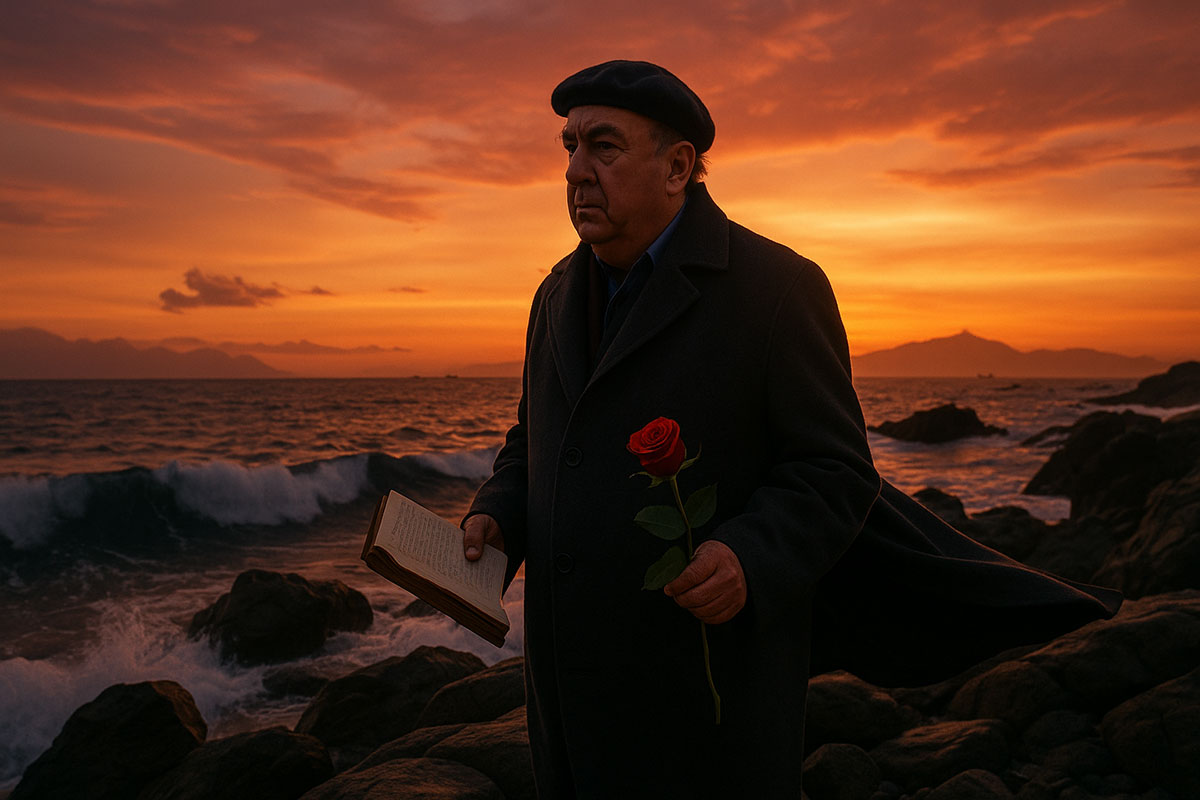
As I close this reflection, I cannot help but think that Pablo Neruda’s final years were an act of poetic defiance in themselves. The Nobel Prize was more than an accolade; it was a signal to the world that beauty and truth could triumph, even under the watch of those who sought to extinguish them. In his acceptance, Neruda did not retreat into personal glory—he used the platform to speak of the collective struggle, to remind us that poetry belongs to the people, and that art without courage is only decoration.
Yet, it is the image of him at his desk in Isla Negra that lingers in my mind—the salt air weaving into his papers, the Pacific stretching endlessly before him, and his hand still moving across the page despite the weight of illness. This was the Neruda who could hold the world’s pain in one hand and a seashell in the other, finding equal value in both. His was a voice that refused to yield, not even to the inevitability of his own ending.
In honoring him now, we are reminded of our own responsibility to live and write, to speak and to love, with that same unwavering clarity. Pablo Neruda’s life was a testament to the belief that the poet’s task is not to escape the world’s troubles, but to meet them head-on with an open heart and a sharpened pen. And so, his legacy endures—not just in the volumes he left behind, but in the courage he calls forth in each of us.
Short Bios:
Pablo Neruda — Renowned Chilean poet and diplomat, Pablo Neruda received the Nobel Prize in Literature in 1971. His works, ranging from passionate love poems to powerful political verse, have cemented his place as one of the most influential literary voices of the 20th century.
Gabriel García Márquez — Colombian novelist, short-story writer, and journalist, García Márquez was awarded the Nobel Prize in Literature in 1982. His masterpiece, One Hundred Years of Solitude, brought the magic realist style to global prominence.
Mario Vargas Llosa — Peruvian writer, politician, and Nobel laureate (2010), Vargas Llosa is known for his novels exploring power, corruption, and social change in Latin America, including Conversation in the Cathedral and The Feast of the Goat.
Octavio Paz — Mexican poet, essayist, and diplomat who won the Nobel Prize in Literature in 1990. Paz’s works delve into identity, solitude, and cultural synthesis, and he is celebrated for his lyrical mastery and intellectual depth.
Isabel Allende — Chilean novelist and memoirist whose works blend magical realism with historical themes, Isabel Allende is best known for The House of the Spirits and Of Love and Shadows. Her writing often intertwines personal stories with the political and cultural history of Latin America.
Leave a Reply