
|
Getting your Trinity Audio player ready...
|
What if Bill Gates debated today’s public health leaders about preparedness?
Introduction by Bill Gates
Pandemic preparedness starts long before anyone hears the word outbreak.
Most of human history treats epidemics as bad luck, something unpredictable that simply arrives and forces us to react. But the lesson from modern science is the opposite. A global outbreak is one of the most predictable large-scale disasters we face. We know pathogens will emerge. We know they spread exponentially. And we know the first weeks decide whether thousands die or millions.
In this conversation we are not asking how to cure a disease after it spreads. We are asking how to build a system that moves faster than the disease itself. Detection, logistics, research platforms, and global cooperation are not separate ideas. They are layers of the same defense. If one layer fails, the others struggle to compensate.
Preparedness is not fear of the future.
It is responsibility toward it.
(Note: This is an imaginary conversation, a creative exploration of an idea, and not a real speech or event.)
Topic 1: The Warning Shot and the System Failure

Bill Gates:
When I gave this talk, I was trying to name something uncomfortable. We tend to treat outbreaks like rare, tragic surprises. But Ebola was not just a tragedy. It was a stress test. And the most important thing it revealed was not about the virus. It was about us. We had courage, we had generosity, we had heroic individuals. But we did not have a system that could scale fast enough.
So let me start with a blunt question that decides everything.
What was the real failure in Ebola and other outbreaks: science, logistics, leadership, or coordination?
Laurie Garrett:
Coordination. The science was not perfect, but it was not the bottleneck. The bottleneck was that nobody owned the full picture. Agencies guarded turf. Governments worried about optics. Messaging fractured. When you have multiple centers of authority with no single operational command, the pathogen gets the advantage.
Michael Osterholm:
It was the gap between what we know and what we can do at speed. We have scientific expertise, sure, but translating it into action requires logistics and preparedness. The virus does not wait for meetings. The world acted like we could improvise. You cannot improvise exponential growth.
Atul Gawande:
I’ll say logistics and execution. In crisis medicine, we learn that having knowledge is not enough. You need delivery. You need the ability to move people, equipment, and information into the right places, and you need routines that can scale. Ebola exposed how thin our operational muscle really was.
Sally Davies:
Leadership, but not in the charismatic sense. Governance leadership. The ability to make decisions early, communicate clearly, and coordinate across borders. Too many leaders treated it as a local problem until it became a global threat. Delay is a decision, even when nobody admits they decided.
Jeremy Farrar:
All four were involved, but I’ll emphasize speed. Speed of detection, speed of response, speed of shared data. The scientific community can move quickly when the system allows it. But when data is delayed, when samples cannot move, when teams cannot deploy, science becomes trapped behind bureaucracy.
Bill Gates:
So what I’m hearing is this. The failure was not the absence of good people. It was the absence of a machine that could turn good intentions into fast coordinated action.
Let’s make it concrete.
What are the first 72 hours of a serious outbreak supposed to look like in an ideal system?
Atul Gawande:
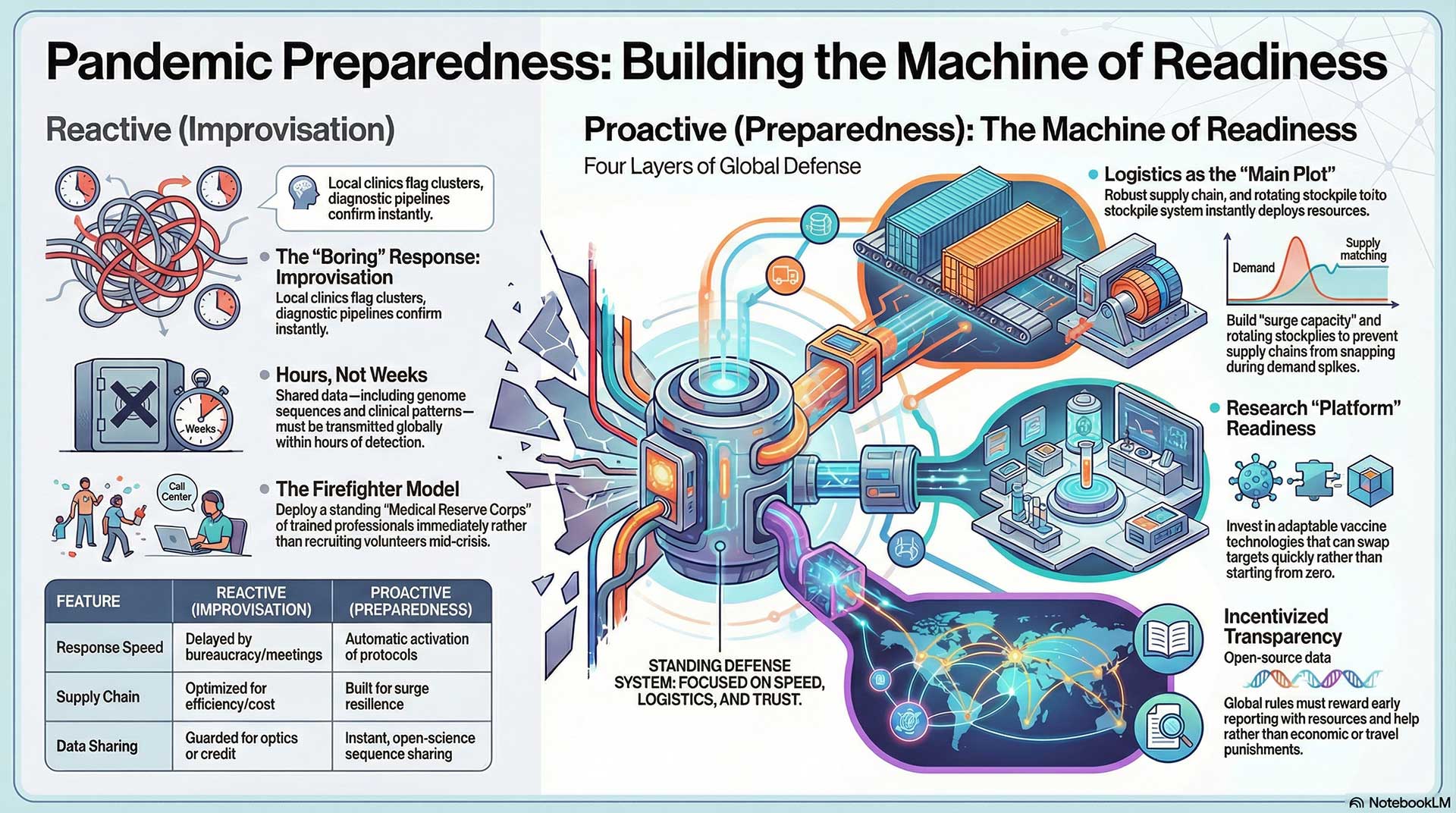
First 72 hours should look boring in the best way. A protocol kicks in. A local clinic flags an unusual cluster. A diagnostic pipeline confirms it fast. A response team arrives with infection control expertise, protective equipment, and the authority to set up safe care sites. You immediately protect healthcare workers, because if they fall, the system collapses.
Jeremy Farrar:
And you share data instantly. Genome sequence, clinical patterns, transmission information. Not in weeks, in days, sometimes hours. You also establish a single trusted channel for communication. The public needs clarity. Confusion spreads almost as quickly as the pathogen.
Michael Osterholm:
I want to see surge capacity, right away. You need trained people ready to deploy like firefighters. Epidemiologists, lab staff, logisticians, clinicians. If you wait to recruit volunteers, you’ve already lost time you cannot buy back. The first 72 hours are about containment posture, not debate.
Sally Davies:
You also need international connectivity from day one, not day twenty. If it is serious, you’re coordinating resources and travel guidance early. In an ideal system, countries have pre-agreed frameworks for how help is requested and delivered. Otherwise politics slows everything down.
Laurie Garrett:
And you control the narrative ethically. You communicate truth without panic. You do not pretend it is fine. You also do not stigmatize. In the first 72 hours, credibility is your currency. If you spend it on false reassurance, you cannot buy it back later.
Bill Gates:
That picture has a theme. Preparedness makes the early days structured. Without preparedness, the early days become improvisation, and improvisation becomes spread.
Now the hardest question, because it forces prioritization.
What must be built before the crisis so we are not improvising under panic?
Michael Osterholm:
A standing global capability that trains year-round. Not a committee. A deployable workforce with authority, equipment, and funding. And it needs exercises. We drill militaries constantly. We barely drill pandemics. Preparedness is a skill, and skills atrophy without practice.
Sally Davies:
I want national systems that connect seamlessly to international systems. Public health cannot be the neglected basement of government. You need surveillance, labs, and a data infrastructure that can scale. You also need legal and ethical frameworks ready in advance, so you are not writing rules mid-crisis.
Atul Gawande:
Build the delivery stack. Stockpiles that rotate, not expire. Supply chains that can surge. Training in infection prevention, not just at the elite level but across healthcare. Create modular care models, so you can set up safe units quickly. Most importantly, build muscle memory through drills that include hospitals, not just agencies.
Laurie Garrett:
Build credibility and communication capacity. Misinformation thrives in a vacuum. If people do not trust institutions before the emergency, they will not trust them during it. That means transparency, humility, and consistent truth-telling in normal times. Preparedness is social as much as technical.
Jeremy Farrar:
And build research readiness that is connected to response. Diagnostics platforms that can be adapted quickly. Data sharing agreements. Ethical approvals that can activate fast without cutting corners. Also, equitable partnerships with low-resource regions. If the system only works in wealthy countries, it will fail globally.
Bill Gates:
Let me reflect what you’ve all said in plain language.
We do not need to become afraid. We need to become ready.
Ready means there is a plan that has been practiced.
Ready means there are people trained and funded before the headlines.
Ready means logistics, data, and trust are treated as essential infrastructure.
Ready means the world can move at the speed the virus moves.
Ebola was a warning shot. Not because it was the worst possible outbreak, but because it showed how quickly the world can fall behind when it is building the parachute after stepping off the plane.
In the next topic, we’ll go directly into early detection. Because in outbreaks, time is not money. Time is lives.
Topic 2: Early Detection and Surveillance

Bill Gates:
If there’s one lesson that repeats across outbreaks, it’s this. By the time the world is paying attention, the outbreak is already ahead. So preparedness is not only about treatment. It’s about seeing the fire when it’s still smoke.
Let’s start with the foundation.
What is the minimum global surveillance and reporting system that would actually work?
Tom Frieden:
Minimum means three things. Local detection, fast verification, and immediate reporting. Local detection requires clinics and hospitals that can flag unusual clusters. Fast verification requires labs and diagnostics that can confirm quickly. Immediate reporting requires a system that does not punish honesty. If reporting leads to economic punishment, countries will delay.
Maria Van Kerkhove:
I would add standardization and interoperability. Minimum does not mean simplistic. It means reliable. You need agreed-upon definitions for what constitutes an alert, shared data formats, and a trusted pathway to escalate. Also, community-based surveillance matters. Many outbreaks are first seen by people, not systems.
Carter Mecher:
You need sentinel networks that act like smoke detectors. Strategic sites in high-risk regions, with routine sampling and rapid escalation. You also need real-time analytics. The minimum system is one that can recognize abnormal patterns quickly and trigger action without waiting for perfect certainty.
Anthony Fauci:
And you need strong national public health institutions. Global systems fail if local systems are weak. The minimum working system is built from the bottom up. Strong local epidemiology, trained workforce, functional labs, and a culture of reporting. Without that, a global dashboard is just decoration.
Raina MacIntyre:
I’ll emphasize the human element. Surveillance depends on trust and compliance. If communities fear authorities, they will hide illness. If healthcare workers fear stigma or reprisal, they may not report. A minimum system must include community engagement, privacy protection, and clear benefit to those who participate.
Bill Gates:
So the minimum is not one giant global computer. It’s a network of honest reporting, real capability, and incentives that reward transparency rather than punish it.
Now the second question.
How do we balance speed, privacy, and public trust when tracing and reporting spread?
Maria Van Kerkhove:
You start by being clear about purpose and limits. People accept data use when they believe it is necessary, proportionate, and temporary. Transparent governance matters. Also, privacy-preserving tools can help. The balance is possible, but only if communication is honest and people have a reason to trust.
Tom Frieden:
Speed is essential early, but privacy and trust are essential always. If you violate trust, you lose compliance, and then you lose speed anyway. The balance is achieved by strong legal frameworks defined before the crisis, clear oversight, and clear sunset clauses. No improvising with civil liberties under panic.
Carter Mecher:
The practical approach is tiered response. In early signals, you use aggregated data and voluntary tracing to get directional clarity. If things escalate, you move to stronger measures with strong accountability and clear endpoints. The public can tolerate more intervention if leaders explain the why, the how, and the time limit.
Anthony Fauci:
Trust comes from consistency. If officials change rules without explaining why, they look incompetent or deceptive. The scientific reality will evolve, but communication must be steady. You can say, “This is what we know now, and this is what may change.” That honesty builds trust even when recommendations shift.
Raina MacIntyre:
I would push harder on privacy and equity. Surveillance tools can be weaponized socially. If certain communities are targeted or blamed, participation collapses. So balance means safeguards against discrimination, clear protections, and messaging that avoids scapegoating. Trust is not neutral. It must be earned with fairness.
Bill Gates:
So speed cannot come from coercion alone. It has to come from trust, clear rules, and fairness, or the system fractures.
Now the third question.
What is the most realistic way to detect outbreaks early in low-resource settings?
Tom Frieden:
Strengthen primary healthcare and basic lab capacity. You don’t need the most advanced technology everywhere. You need reliable testing and trained people who can recognize unusual patterns. Also, invest in rapid transport of samples and data. A strong chain connecting clinics to labs is critical.
Maria Van Kerkhove:
Use a layered approach. Community health workers, sentinel sites, and targeted sampling in hotspots like markets, animal-human interfaces, and high-density urban areas. Integrate human and animal health surveillance. Many threats begin at that boundary. Also, support local leadership. External teams cannot replace local trust.
Carter Mecher:
Build regional hubs. Not every location needs everything, but every region needs access. Hub-and-spoke systems for diagnostics, sequencing, and training can work. The realistic path is to reduce time-to-knowledge. Even a few days faster can be the difference between containment and catastrophe.
Anthony Fauci:
Invest in portable diagnostics and flexible platforms. Technologies that can be deployed quickly and used widely. But the tech has to be supported by workforce training. Tools alone don’t solve the problem. People do.
Raina MacIntyre:
Make early detection beneficial to the community. If reporting means your town gets punished or isolated without support, people hide. If reporting brings supplies, staffing, and help, people participate. So realism is not only technical. It’s political and human. We must build systems that reward honesty with resources, not punishment.
Bill Gates:
Let me summarize what this topic teaches. Early detection is the cheapest, most life-saving intervention we have. But it only works if the incentives are right. If transparency triggers blame, surveillance fails. If transparency triggers support, surveillance becomes normal.
Next, we move from detection to the gritty part that decides outcomes. Logistics. Because knowing the outbreak is there is not enough. You have to move faster than it spreads.
Topic 3: Logistics Wins Wars and Outbreaks

Atul Gawande:
In medicine, we talk a lot about discovery, new treatments, brilliant science. But when systems fail, it’s often not because we didn’t know what to do. It’s because we couldn’t deliver what we knew, at the speed and scale required. In outbreaks, logistics is not a supporting character. Logistics is the main plot.
Let’s start with the uncomfortable truth.
Why do supply chains and staffing break first, and what fixes have the highest leverage?
Bill Gates:
They break because outbreaks create sudden demand spikes, and most systems are built for normal times. Hospitals operate near capacity. Supply chains are optimized for efficiency, not resilience. The highest leverage fix is to design surge capability, stockpiles that rotate, and manufacturing that can ramp quickly. But it also means planning contracts and logistics routes before the crisis.
Paul Farmer:
They break because inequality is built into the baseline. In many places, the system is already fragile. When stress hits, it snaps. High leverage fixes are boring but powerful: reliable oxygen, protective equipment, staffing support, and infrastructure that keeps clinics functioning. If the baseline is weak, surge planning becomes fantasy.
Devi Sridhar:
They break because public health systems are chronically underfunded and politically invisible until catastrophe. The highest leverage fix is sustained investment and governance. Logistics requires coordination across agencies. It needs legal authority, budgets, and accountability. Otherwise everyone scrambles and nobody leads.
Peter Piot:
They break because outbreaks are nonlinear. The first phase looks manageable, so leaders delay. Then the curve steepens and the system gets overwhelmed. High leverage fixes include early activation triggers, pre-positioned supplies, and trained teams ready to deploy immediately. The earlier you surge, the smaller the surge needs to be.
Raj Panjabi:
They break because the last mile is neglected. You can have supplies in a warehouse and still fail if they don’t reach clinics. The highest leverage fixes are strong community health systems, real-time inventory tracking, and delivery networks that can function in rural and urban slums alike. Execution is everything.
Atul Gawande:
So fragility is designed into the system. It’s not a surprise. Outbreaks just reveal it.
Now the second question.
What should a standing medical reserve corps look like, and who funds it?
Bill Gates:
It should look like a trained, deployable workforce with clear command structure, regular drills, and the ability to move internationally. Clinicians, epidemiologists, logisticians, lab techs. It must be funded by governments with predictable budgets, and coordinated globally so we don’t reinvent teams every time.
Paul Farmer:
A reserve corps must not be parachute medicine. It must work with local systems and strengthen them. Funding must prioritize capacity building, not just emergency optics. Wealthy countries should fund it because global health security protects everyone, but also because it’s a moral obligation. Preparedness should not be charity. It should be justice.
Devi Sridhar:
I’d structure it in layers. National reserves that can deploy domestically, plus a global layer for cross-border surges. Funding should be shared among countries, with clear commitments, not voluntary donations that disappear when headlines fade. We fund militaries annually. We should fund outbreak response the same way.
Peter Piot:
And it must include rapid training and credentialing. In emergencies, paperwork kills time. The corps should have pre-approved protocols, insurance, logistics support, and a system for rotating people so they don’t burn out. Funding must include mental health support too, because sustained response is psychologically brutal.
Raj Panjabi:
I would integrate community health workers. If your reserve corps only includes elite specialists, you miss the core. Community-based systems are the real reserve capacity. Funding must include local workforce development, technology support, and compensation. People won’t sustain response if they’re treated as expendable.
Atul Gawande:
So a real corps is not just a list of names. It’s an operating system with training, deployment pathways, and partnerships.
Now the third question.
How do we prevent hospitals from becoming amplifiers of infection during surges?
Bill Gates:
You need infection control protocols practiced in advance. Stockpiles of protective equipment. Rapid diagnostics so you separate infected from non-infected quickly. And improved ventilation. These are investments that pay off repeatedly.
Paul Farmer:
And you must protect healthcare workers first. If staff get infected, hospitals collapse. That means PPE, training, and safe workflows. Also, surge staffing so people can rest. Exhaustion creates mistakes, and mistakes spread infection.
Devi Sridhar:
You also need clear national guidance and stable messaging. Hospitals struggle when policy changes unpredictably. If leaders treat the outbreak like politics, hospitals become battlefields. Hospitals require coordinated public health support, not shifting narratives.
Peter Piot:
Separate pathways. Separate entrances, triage zones, isolation units. This should be designed into surge plans. Also, hospitals need rapid communication lines with public health authorities. The hospital cannot fight alone. It must be part of a system.
Raj Panjabi:
Shift care away from hospitals when possible. Community clinics, telemedicine, home-based monitoring, and safe step-down facilities can prevent hospitals from drowning. Hospitals become amplifiers when they are overloaded. Decompression is infection control.
Atul Gawande:
Let me close this topic with a hard truth. Outbreaks are logistics exams. The virus tests whether you can move supplies, information, and people faster than it spreads. If you can, the outbreak shrinks. If you can’t, it grows.
In the next topic, we move to vaccines and research readiness. Because logistics buys time. Science ends the crisis. And without readiness, science arrives too late to save the most lives.
Topic 4: Vaccines, Platforms, and the Research Gap

Bill Gates:
When an outbreak begins, the clock starts immediately. The virus evolves, spreads, and adapts while the world is still learning its name. The question is not whether science can eventually respond. The question is whether science can respond fast enough to matter. That depends on what we build before the crisis, not during it.
Let’s begin with priorities.
What research investments pay off most before an outbreak: vaccines, antivirals, diagnostics, or manufacturing?
Kizzmekia Corbett:
Vaccines provide the most durable population protection, but only if the platform already exists. The payoff comes from investing in adaptable vaccine technologies that can swap targets quickly. Without platform readiness, even brilliant vaccine design arrives too late to prevent early devastation.
Anthony Fauci:
I see them as inseparable. Diagnostics give early awareness, antivirals reduce severity, vaccines provide prevention, and manufacturing determines impact. But if forced to prioritize, flexible platform technologies combined with scalable manufacturing deliver the greatest return, because they convert discovery into real protection.
Jeremy Farrar:
Diagnostics are often underestimated. Rapid identification shapes everything. If you cannot detect cases quickly, you cannot isolate, treat, or test interventions effectively. Early detection shrinks the problem that vaccines must solve later.
Peter Hotez:
We must also invest in prototype pathogen research. Study viral families before outbreaks occur. If you understand a family, you are not starting from zero. Preparedness science means anticipating categories of threats rather than chasing individual ones.
Barney Graham:
Manufacturing readiness is the multiplier. A vaccine in a lab saves nobody. A vaccine in billions of doses changes history. Investments in flexible production capacity and regulatory pathways determine whether science is theoretical or practical.
Bill Gates:
So preparedness is not one technology. It is a chain, and the chain breaks where we least invest.
Now the second question.
How do we shorten the time from sequence to safe mass deployment without losing trust?
Kizzmekia Corbett:
Transparency and consistency. Speed alone can scare people. Explain the process, share data openly, and communicate uncertainties honestly. Trust grows when people see the rigor, not just the result.
Anthony Fauci:
Regulatory frameworks should be prepared in advance. Adaptive trial designs, overlapping phases where appropriate, and independent oversight maintain safety while accelerating timelines. Preparation allows speed without recklessness.
Jeremy Farrar:
Global collaboration is essential. Sharing sequences and data early allows multiple teams to work simultaneously. Secrecy slows progress. Coordination accelerates it.
Peter Hotez:
Engage communities early. Vaccine hesitancy often reflects historical distrust. If engagement starts only after deployment, skepticism fills the gap. Trust must be built before the syringe appears.
Barney Graham:
Standardized platforms help. If a platform has already proven safe, adapting it for a new pathogen is faster and more understandable to the public. Familiarity supports acceptance.
Bill Gates:
So speed depends as much on trust and communication as on laboratory work.
Now the third question.
Who should own and govern vaccine platform readiness so it is not reinvented every time?
Kizzmekia Corbett:
It should be shared stewardship. Governments fund foundational research, private industry scales production, and international organizations coordinate access. No single sector can manage the full lifecycle alone.
Anthony Fauci:
Public-private partnerships with clear accountability. Governments ensure long-term investment, industry ensures efficiency, and global institutions ensure equitable distribution. Governance must be structured before crisis negotiations begin.
Jeremy Farrar:
International collaboration mechanisms are essential. Preparedness is global. Governance should include global representation to prevent fragmentation and duplication.
Peter Hotez:
We also need nonprofit and academic participation to ensure open science. Proprietary silos slow preparedness. Shared knowledge accelerates it.
Barney Graham:
Finally, governance must include manufacturing commitments and equitable access rules in advance. If agreements are negotiated during crisis, competition replaces cooperation.
Bill Gates:
Let me summarize. Scientific breakthroughs save lives only when systems exist to deliver them quickly, safely, and fairly. Preparedness research is not about predicting the exact pathogen. It is about building tools flexible enough to face any pathogen.
Next, we turn to the hardest challenge of all: global cooperation. Because even perfect science fails if nations work against each other instead of together.
Topic 5: Global Cooperation vs National Self-Interest

Devi Sridhar:
Pandemics are global problems that require global solutions, yet our incentives are often national. Countries protect themselves first, compete for supplies, and sometimes delay transparency out of fear. The virus benefits from every fracture. Cooperation is not idealism. It is strategy.
Let’s begin with the first question.
What global rules and incentives would reduce hoarding and increase transparency?
Bill Gates:
We need pre-agreed frameworks that trigger automatic sharing. If countries fear that reporting an outbreak will lead to isolation and economic punishment, they will delay. Incentives should reward early reporting with resources, teams, and funding. If transparency brings help instead of punishment, honesty becomes rational.
Tedros Adhanom Ghebreyesus:
Strong international agreements matter. Countries must commit to timely reporting, data sharing, and cooperation on response. But rules alone are not enough. There must also be capacity support. You cannot demand transparency from a country that lacks laboratories, health workforce, or surveillance.
Samantha Power:
We need a system where assistance is fast and visible. When countries report early, they should receive immediate surge support. That creates a norm. Also, we need mechanisms to prevent export bans and to allocate scarce supplies fairly. Without governance, supply chains become warfare.
Ngozi Okonjo-Iweala:
Trade rules matter because supply chains are global. We should establish agreements that keep critical medical goods moving, even in crisis. Hoarding is often driven by fear. Rules that guarantee access reduce the fear that triggers hoarding.
Francis Collins:
Data sharing is a major piece. If samples and sequences are shared rapidly, scientific progress accelerates everywhere. That requires trust and agreements that protect researchers and countries from exploitation. If sharing leads to losing credit or control, people will hesitate.
Devi Sridhar:
So the goal is to make transparency rational and to make cooperation predictable, not dependent on goodwill alone.
Now the second question.
How do we coordinate a response when politics, misinformation, and blame games spike?
Bill Gates:
You establish a single trusted technical voice and keep it consistent. Politics will always exist, but the operational response must be insulated from partisan swings. Communication should be clear about what is known, what is unknown, and what is being done next.
Tedros Adhanom Ghebreyesus:
We must focus on solidarity and shared responsibility. Blame divides, and division costs lives. Also, we need rapid communication systems that counter misinformation with transparent facts. But the best antidote to misinformation is trust, and trust comes from consistency and honesty.
Samantha Power:
Coordination requires diplomacy and logistics. We need standing global response capacity that can deploy regardless of politics. Also, we must engage local leaders and civil society. If messaging ignores communities, misinformation fills the gap.
Ngozi Okonjo-Iweala:
Misinformation also affects markets and supply chains. Transparency and cooperation reduce panic behaviors. Coordination must include economic policies that stabilize access to essentials. Otherwise fear spreads across systems, not just people.
Francis Collins:
The scientific community must communicate with humility. When science over-promises, it loses credibility. Admitting uncertainty is not weakness. It is how trust is maintained while evidence evolves. That is critical in politicized environments.
Devi Sridhar:
So coordination must be technical, diplomatic, and social. If any one of those collapses, the whole response weakens.
Now the third question.
What does success look like 10 years from now, and what must be built starting this year?
Bill Gates:
Success is that when an outbreak appears anywhere, the world detects it quickly, deploys response teams within days, produces diagnostics rapidly, and begins vaccine development on prebuilt platforms immediately. And we run simulations regularly, like military drills. Starting this year means funding preparedness consistently, not episodically.
Tedros Adhanom Ghebreyesus:
Success means stronger health systems everywhere. Preparedness is not separate from healthcare. Universal health coverage, trained workforce, laboratories, and surveillance are the foundation. Starting this year means investing in those basics, especially in the most vulnerable regions.
Samantha Power:
Success means predictable financing and rapid response capacity. Not emergency fundraising. Starting this year means creating permanent funding mechanisms and deployable teams. Also, success means equity. If some countries are always last in line, the world remains vulnerable.
Ngozi Okonjo-Iweala:
Success means resilient global supply chains and fair access to medical countermeasures. Starting this year means agreements that prevent export bans, strengthen regional manufacturing, and keep trade flowing for essential goods.
Francis Collins:
Success means research readiness that is continuous. Platforms, trials, regulatory pathways, and global collaboration built in peacetime. Starting this year means funding basic science, clinical networks, and data sharing frameworks that can pivot quickly.
Devi Sridhar:
Let me close this final topic with a simple truth. Viruses exploit division. Cooperation is not charity. It is self-protection at the global level.
If we want a future where outbreaks do not become catastrophes, we must build systems that work before panic arrives. Preparedness is not the absence of fear. It is the presence of structure.
And structure, once built, saves lives quietly for decades.
Final Thoughts by Bill Gates
The world does not lack compassion or intelligence. What it often lacks is sustained attention before a crisis. After every emergency we promise improvement, and over time urgency fades while vulnerability remains.
A pandemic does not defeat humanity because the pathogen is unstoppable. It defeats us when systems are temporary, fragmented, and reactive. When preparedness becomes permanent, outbreaks become manageable events instead of global catastrophes.
The investment required is modest compared to the cost of failure. More importantly, the benefit is measured not only in money saved, but in stability preserved and lives quietly protected.
If we choose to build readiness now, the next outbreak will still come.
But it will meet a world that is expecting it — and ready.
Short Bios:
Bill Gates — Technologist, philanthropist, and global health advocate focused on vaccine development, disease eradication, and long-term pandemic preparedness systems.
Michael Osterholm — Epidemiologist and director of the Center for Infectious Disease Research and Policy, specializing in outbreak risk assessment and preparedness planning.
Atul Gawande — Surgeon, public health leader, and writer known for improving healthcare delivery systems and large-scale medical implementation.
Sally Davies — Former UK Chief Medical Officer and international voice for antimicrobial resistance policy and national health preparedness strategy.
Laurie Garrett — Pulitzer Prize-winning science journalist covering global health, pandemics, and public health policy failures.
Jeremy Farrar — Infectious disease specialist and global health leader focusing on emerging pathogens and international scientific collaboration.
Tom Frieden — Former CDC Director and epidemiologist known for strengthening public health infrastructure and prevention strategies.
Maria Van Kerkhove — WHO epidemiologist specializing in outbreak detection, global surveillance systems, and pandemic response coordination.
Carter Mecher — Public health physician and pandemic planning expert known for modeling early containment and response strategies.
Anthony Fauci — Immunologist and long-time director of the U.S. National Institute of Allergy and Infectious Diseases, central figure in infectious disease research and policy.
Raina MacIntyre — Epidemiologist specializing in biosecurity, disease transmission modeling, and outbreak mitigation policies.
Paul Farmer — Physician and medical anthropologist known for building healthcare systems in resource-limited settings and advancing global health equity.
Devi Sridhar — Public health policy expert focused on international health governance and global pandemic coordination.
Peter Piot — Microbiologist and co-discoverer of Ebola, influential leader in global infectious disease response and preparedness.
Raj Panjabi — Physician and global health innovator working on community health systems and last-mile healthcare delivery.
Kizzmekia Corbett — Viral immunologist and vaccine scientist known for work on rapid vaccine platform development.
Peter Hotez — Vaccine researcher and advocate for preventive medicine and global immunization programs.
Barney Graham — Immunologist and pioneer of modern vaccine design platforms enabling faster development.
Tedros Adhanom Ghebreyesus — Director-General of the World Health Organization focused on international cooperation in health emergencies.
Samantha Power — Diplomat and humanitarian leader working on global response coordination and international crisis support.
Ngozi Okonjo-Iweala — Economist and international trade leader emphasizing supply chains and equitable access to medical resources.
Francis Collins — Physician-geneticist and former NIH Director supporting large-scale biomedical research collaboration and data sharing.
Leave a Reply