

|
Getting your Trinity Audio player ready...
|
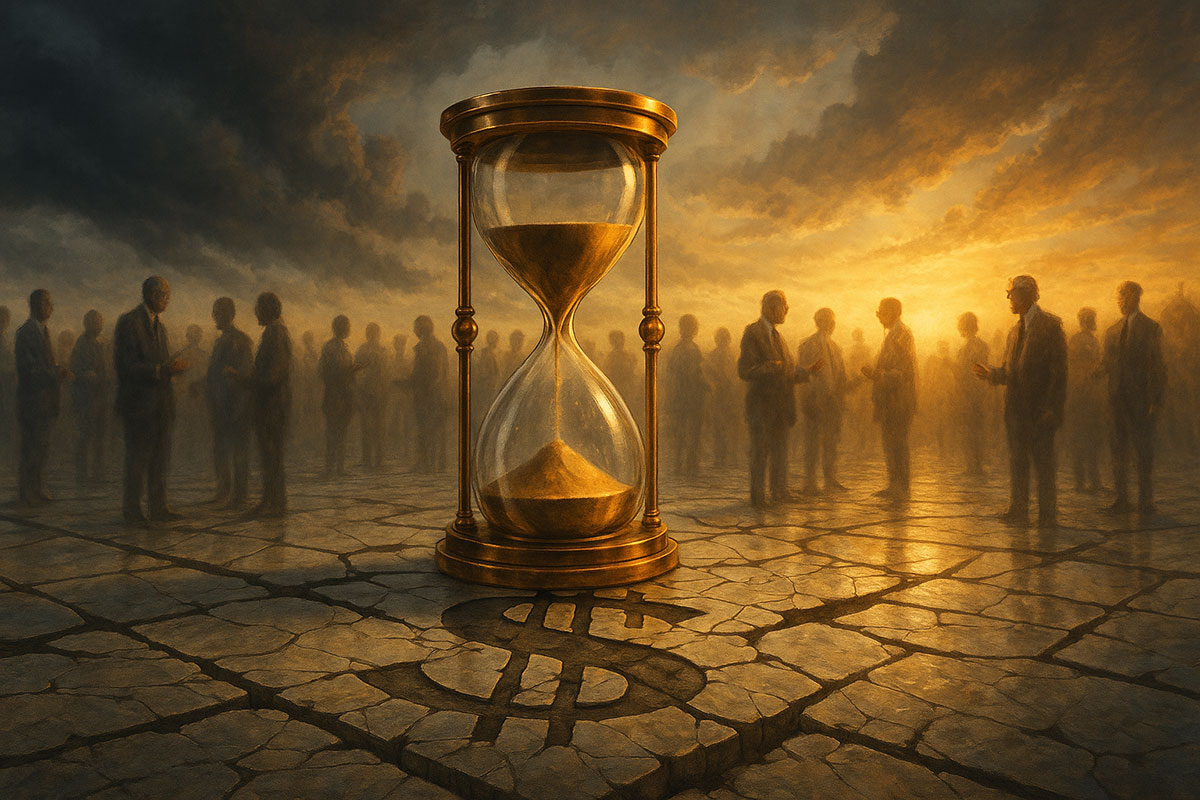
Ray Dalio:
History doesn’t repeat itself exactly, but it rhymes in patterns—especially when it comes to the rise and fall of nations.
I wrote How Countries Go Broke not to predict doom, but to sound a well-evidenced alarm. What I’ve learned from studying empires like the Dutch, the British, and now the American is that great nations collapse not because of external enemies first, but because of internal erosion—debt explosions, widening wealth gaps, political extremism, and a loss of shared values.
We are living through the late phase of a cycle that has played out many times before. My goal is to equip people with the tools to recognize where we are, understand what comes next, and—most importantly—act wisely before it's too late.
This book is not just about governments. It’s about how you, your family, your investments, and your community will be affected by the forces already in motion.
(Note: This is an imaginary conversation, a creative exploration of an idea, and not a real speech or event.)

Topic 1: The Rise and Fall of Empires — Are We Nearing America's Final Chapter?
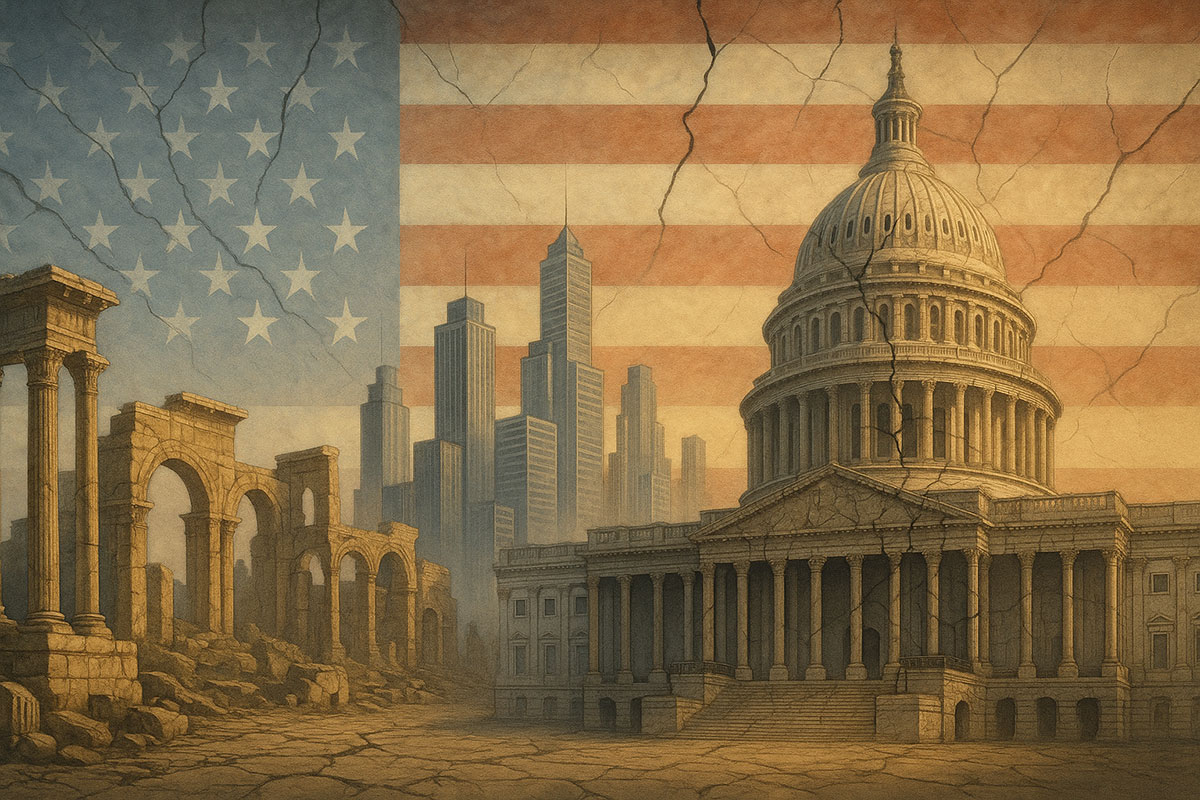
Moderator: Fareed Zakaria
Panel: Ray Dalio, Peter Zeihan, Trevor Noah, Lynn Alden, John Oliver
🎙️ Fareed Zakaria (Moderator):
Ray, your new book outlines the repeating pattern of empire rise and collapse. But let's get specific. How do you know we’re in the late stage of America’s cycle—and not just going through another rough patch like the 1970s?
Ray Dalio:
We’re beyond a rough patch. Historically, late-stage empires show three signs: (1) enormous debt relative to income, (2) internal conflict among classes and ideologies, and (3) a weakening of the global currency. We’ve hit all three. What concerns me most is that we’re printing money not to invest in the future, but to cover past promises. That’s a classic late-stage move—and it always leads to decline or disorder if not corrected.
Trevor Noah:
It’s like watching a sitcom where the main character keeps maxing out credit cards and yelling about freedom while the house is literally on fire. America isn’t just aging—it’s refusing to grow up. If the empire collapses, it won’t be because of China. It’ll be because the people in power can’t tell the difference between patriotism and denial.
Lynn Alden:
From a macro perspective, the dollar’s dominance is still intact—but it's slowly eroding. We’ve never seen such fiscal recklessness during peacetime. Trillions in deficit spending with no productivity gains is a red flag. If bondholders lose trust, that’s the tipping point. So yes, it feels late-stage, and the math supports that feeling.
Peter Zeihan:
I’ll challenge this a bit. Empires don't collapse because of bad vibes or fiscal imbalance alone. Geography still matters. The U.S. has food security, energy independence, and military reach. Compared to other powers, it’s actually in a better position. But our internal division? That’s the real threat—not an external rival like China.
John Oliver:
The empire isn’t dying with a bang. It’s slipping into a coma while Congress debates the price of insulin. If decline were a Netflix series, we’re already in Season 5, and the writers are out of ideas. And yet… Americans still believe they’re the main character. That’s both tragic and very on brand.
🎙️ Fareed:
If the U.S. is truly in decline, what role does the average citizen play in either accelerating or reversing the fall?
Lynn Alden:
Citizens need financial literacy. Most people don’t understand how debt-based economies work or how inflation silently robs them. If they did, they’d vote differently and save differently. Financial ignorance accelerates decline.
Peter Zeihan:
We’re past the point where the average voter can fix this through the ballot box. The system is too jammed. What they can do is focus on resilience—invest in local economies, pressure for infrastructure, and support decentralization. Macro trends are hard to reverse, but you can shore up your micro reality.
Ray Dalio:
Historically, citizens matter most when they act collectively—but peacefully. If a society becomes too tribal, it loses the trust that holds everything together. That’s when you get revolutions, coups, or authoritarianism. So the citizen’s biggest task now is to fight for truth and bridge divides. That sounds abstract, but it's life or death for a republic.
Trevor Noah:
Average people are doing what they can—working two jobs, raising families. They’re not the problem. The issue is the elite pretending nothing’s wrong while sipping cocktails on a burning yacht. If America’s average citizen collapses, the empire goes with them. But until the system rewards honesty over optics, we’re stuck.
John Oliver:
Honestly, people still trust the system more than they should. They think voting for the “right” candidate will fix structural rot. It won’t. What they can do is support local journalism, run for school boards, or maybe just Google what fiat money is before buying another NFT.
🎙️ Fareed:
Final question: If the U.S. is in decline, what should we be doing right now to avoid collapse—or is it already too late?
Peter Zeihan:
It’s not too late. But we need a generational reset—invest in education, upgrade infrastructure, and stop pretending the Cold War framework still applies. America’s collapse is not guaranteed. It’s more like a heart attack that can be prevented if we put down the cheeseburger now.
John Oliver:
Let’s start by admitting we have a problem. Until then, it’s just reruns of fiscal delusion. Honestly, the best we can hope for is a comedy of errors that doesn’t turn into a tragedy.
Ray Dalio:
We need leadership that puts long-term health above short-term politics. That means honest conversations about debt, innovation, and unity. If we don’t act now, the downward slope steepens, and history won’t care about our excuses.
Lynn Alden:
We should be diversifying our economy and energy, re-shoring production, and restoring trust in institutions. Collapse is not destiny—but ignoring signals is.
Trevor Noah:
What we really need is cultural therapy. Americans don’t believe collapse can happen here—until it does. And then we’ll all be shocked, like we didn’t have front-row seats the whole time. So yes, we still have time. But not much.
Topic 2: The Inflation Game — How Printing Money Buys Time and Destroys Trust

Moderator: Ray Dalio
Panel: Stephanie Kelton, Michael Burry, Cathie Wood, John Oliver, Lynn Alden
🎙️ Ray Dalio (Moderator):
We’ve seen governments print trillions to “solve” crises—from 2008 to COVID to today’s debt ceiling. But I believe we’re now witnessing the late-stage consequences of this. Is printing money still a tool for prosperity, or has it become a threat to stability?
Michael Burry:
It’s a trap. The moment we made it politically acceptable to print unlimited money, we crossed a line. Asset bubbles, zombie companies, inflation that won’t die—all symptoms of a system in denial. Money printing used to be a panic button. Now it’s the business model. And when trust dies, currencies die.
Cathie Wood:
I see it differently. Many of today’s deflationary forces—AI, automation, open-source innovation—are countering inflation. The danger isn’t just printing money; it’s not investing in the future. If we don’t stimulate innovation, we’ll fall behind technologically and economically.
John Oliver:
Let’s be honest—nobody actually understands what money printing is. To most people, it’s just a headline or a meme. And politicians treat it like Monopoly cash. But if you walk into a grocery store in 2025 and eggs cost $9, it’s not funny anymore. It’s not just about stability—it’s about dignity.
Lynn Alden:
Printing money isn’t inherently evil—it’s about how it’s used. When paired with productivity and investment, it can be sustainable. But we’ve moved into a cycle of using it to paper over debt, not grow the base economy. That’s when inflation becomes sticky—and trust becomes fragile.
Stephanie Kelton:
From the Modern Monetary Theory (MMT) view: printing money isn’t the problem—inflation is. Governments can issue currency freely as long as inflation is contained. The issue today isn’t that we printed money, but that we failed to manage inflation well afterward. The solution isn’t austerity—it’s smarter spending.
🎙️ Dalio:
Let me ask something deeper: If inflation persists or worsens, what could be the long-term consequences for societal trust, markets, and government credibility?
Lynn Alden:
Inflation erodes everything it touches—especially trust. If people don’t believe in the value of their money, they stop saving, stop investing, and eventually stop believing in the system. That leads to capital flight, political extremes, and social unrest. We’re already seeing early signs.
Stephanie Kelton:
That’s why communication and policy coherence are key. If governments signal panic or act inconsistently, trust dies. But if they show clarity—"Here’s how we’ll manage inflation and keep services running"—then inflation can be managed without collapse. MMT isn’t about chaos. It’s about responsibility.
Michael Burry:
Long-term? You get stagflation, capital destruction, a collapse in savings. In Weimar Germany, kids used wheelbarrows to carry cash. In Argentina, people turn to dollars. When trust dies, markets die. You don’t want to see what comes next.
John Oliver:
Trust is the last thing standing between a democracy and dysfunction. Once you can’t trust the dollar in your pocket or the leader on your screen, what’s left? A tweet? A crypto coin? A bunker? Inflation breaks more than budgets—it breaks belief.
Cathie Wood:
If we focus purely on inflation, we miss the bigger opportunity. Innovation is the only way out. AI, DNA sequencing, battery tech—these are productivity engines. If we let fear stop us from funding them, we’ll stagnate. But if we support them wisely, inflation becomes background noise to transformation.
🎙️ Dalio:
Final question: Is there still time to regain control—or have we passed the point where monetary policy can restore long-term stability?
John Oliver:
There’s always time to pretend we have time. That’s what we do best. But seriously—stability won’t come from more money printers or interest rate drama. It’ll come from transparency, responsibility, and maybe someone explaining this stuff in plain English.
Cathie Wood:
Yes, we still have time. But the window is narrow. Governments need to stop fearing innovation and start partnering with it. We can rebuild trust—but only if we pivot from reactive to visionary thinking.
Michael Burry:
No, we’re past the tipping point. The system is too addicted. You can’t rehab a currency while still injecting it with free capital. The next step isn’t recovery—it’s reset. Maybe even replacement.
Stephanie Kelton:
We’ve barely scratched the surface of what smart fiscal-monetary policy could do. Yes, we can regain control—but not by turning off the faucet overnight. A thoughtful approach, driven by data—not ideology—can stabilize things without triggering collapse.
Lynn Alden:
Control is possible, but only with political will and structural reforms. We need real investment in infrastructure, incentives for savings, and a hard conversation about the role of debt. It’s not too late—but it soon could be.
Topic 3: The Wealth Gap Explosion — When Does Inequality Spark Revolt?
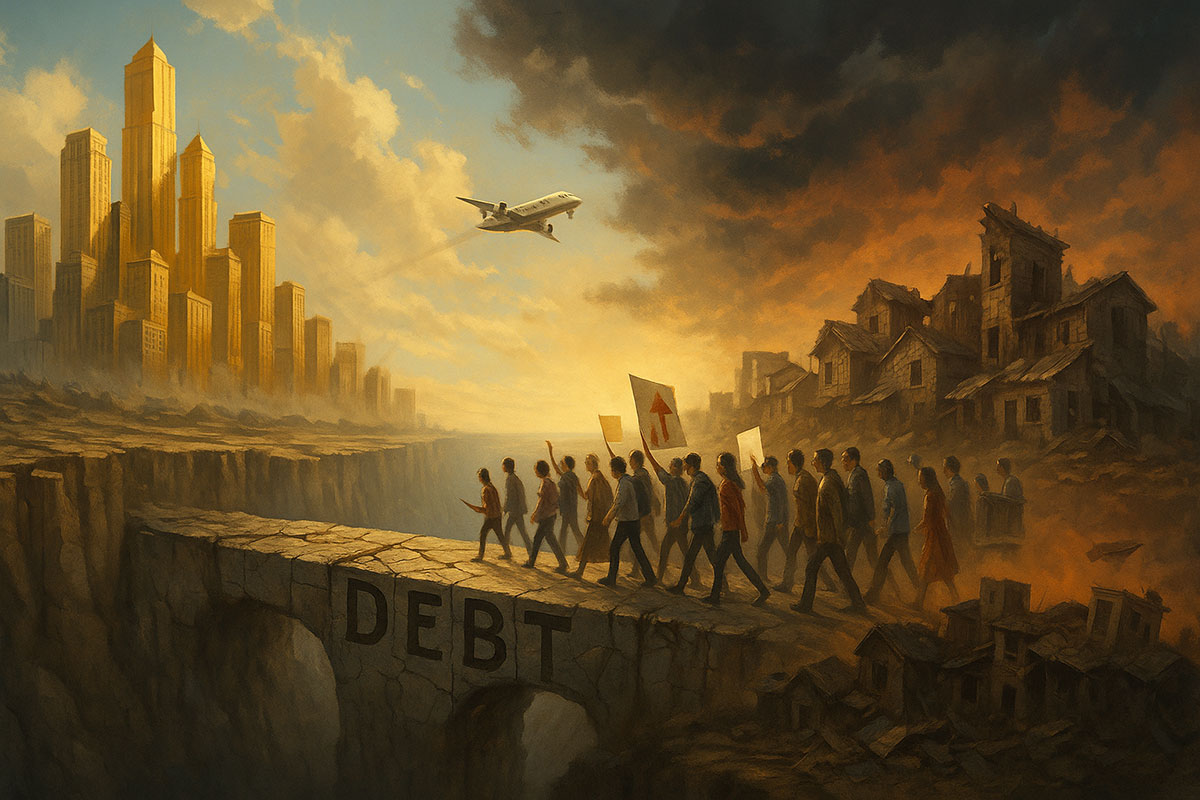
Moderator: Ray Dalio
Panel: Nick Hanauer, Robert Reich, Trevor Noah, Kanye West, Lynn Alden
🎙️ Ray Dalio (Moderator):
In my view, internal conflict driven by extreme inequality is one of the final stages of an empire’s collapse. How serious is the wealth gap in America right now, and what danger does it pose to national stability?
Nick Hanauer:
It’s an existential threat. We’re living through a “trickle-up” economy where wealth pools at the top, and the bottom 90% are fighting over scraps. If we don’t change course, it’s not a matter of if unrest comes—it’s when. This isn’t about envy. It’s about unsustainable imbalance that always ends in collapse or revolution.
Kanye West:
I made it out of poverty, but I see what's going on. You can’t keep telling people to grind while billionaires go to space. This ain’t capitalism—it’s a rigged stage. We got kids growing up thinking they’ll never make it unless they go viral. That’s how you build a broken society.
Lynn Alden:
From a macro standpoint, inequality distorts everything—spending, saving, even monetary policy. When the top 1% holds most of the assets, interest rate cuts benefit them disproportionately. Meanwhile, regular people face higher living costs and stagnant wages. Eventually, that resentment breaks containment.
Trevor Noah:
Let’s be real—people will tolerate inequality if they believe in upward mobility. But that belief is cracking. When your rent goes up 40%, your student debt is endless, and your boss is on vacation in Ibiza? That’s when people stop trusting the system. And when trust dies, chaos walks in.
Robert Reich:
I’ve been sounding this alarm for 30 years. CEOs used to make 20 times the average worker. Now it’s over 300. The danger isn’t just economic—it’s moral. A society this unequal cannot hold. It breeds populism, conspiracy, and authoritarianism. We are playing with fire.
🎙️ Dalio:
So if inequality is this destabilizing, why do democratic systems keep failing to solve it? What’s blocking reform?
Robert Reich:
Simple: money in politics. The wealthy fund campaigns, write legislation, and control the media narrative. Every time reform is proposed—tax hikes, universal healthcare, living wages—it gets labeled “socialist” and crushed. The system protects itself.
Lynn Alden:
Also, complexity. The economy is so financialized now that even well-meaning reforms can have unintended consequences. Raise taxes on the wealthy? Sure. But unless you fix loopholes, offshore shelters, and asset inflation, the rich just get richer through new channels.
Nick Hanauer:
There’s a psychological issue too. Many elites think they deserve their wealth. They confuse luck with virtue. Until the wealthy understand that their future is tied to the health of the middle class, nothing will change. You cannot build a spaceship high enough to escape social collapse.
Trevor Noah:
Honestly? A lot of people don’t believe in change anymore. They’re numb. When every headline says billionaires made $1 billion today while you’re skipping meals, it doesn’t inspire action—it inspires apathy. Or rage.
Kanye West:
The system sells you the dream, then punishes you for waking up. Reform doesn’t happen ‘cause power don’t wanna give itself up. You ever seen a billionaire give up a dollar voluntarily? That’s the problem. They'd rather sell hope than share equity.
🎙️ Dalio:
Last question: If we don’t fix this growing divide, what comes next—and what’s the one solution each of you would push for right now?
Trevor Noah:
If nothing changes? Civil unrest. People won’t just protest—they’ll unplug from the system entirely. One solution? Universal basic dignity—affordable housing, healthcare, and education that aren’t luxuries but rights. Otherwise, this gets dark.
Nick Hanauer:
You’ll see pitchforks—figuratively, maybe literally. My solution: Progressive tax reform and worker power. Make the wealthy pay a share that reflects the society that made them rich. Give workers seats at the table, not crumbs under it.
Kanye West:
People gonna stop believing in anything—church, school, even family. That’s collapse. What I’d do? Ownership education. Teach every kid how money works. Make it illegal for school to skip that. We need minds—not just followers.
Robert Reich:
What comes next? Political extremism—on both sides. My fix? Rebuild the middle class with aggressive wage policy, public investment, and campaign finance reform. Democracy needs a strong economic foundation to survive.
Lynn Alden:
If inequality worsens, capital will flee, currencies will devalue, and polarization will explode. My fix? Inflation-adjusted tax policy and real asset democratization—give people access to the wealth-creating tools of the rich. Level the playing field before it tilts too far.
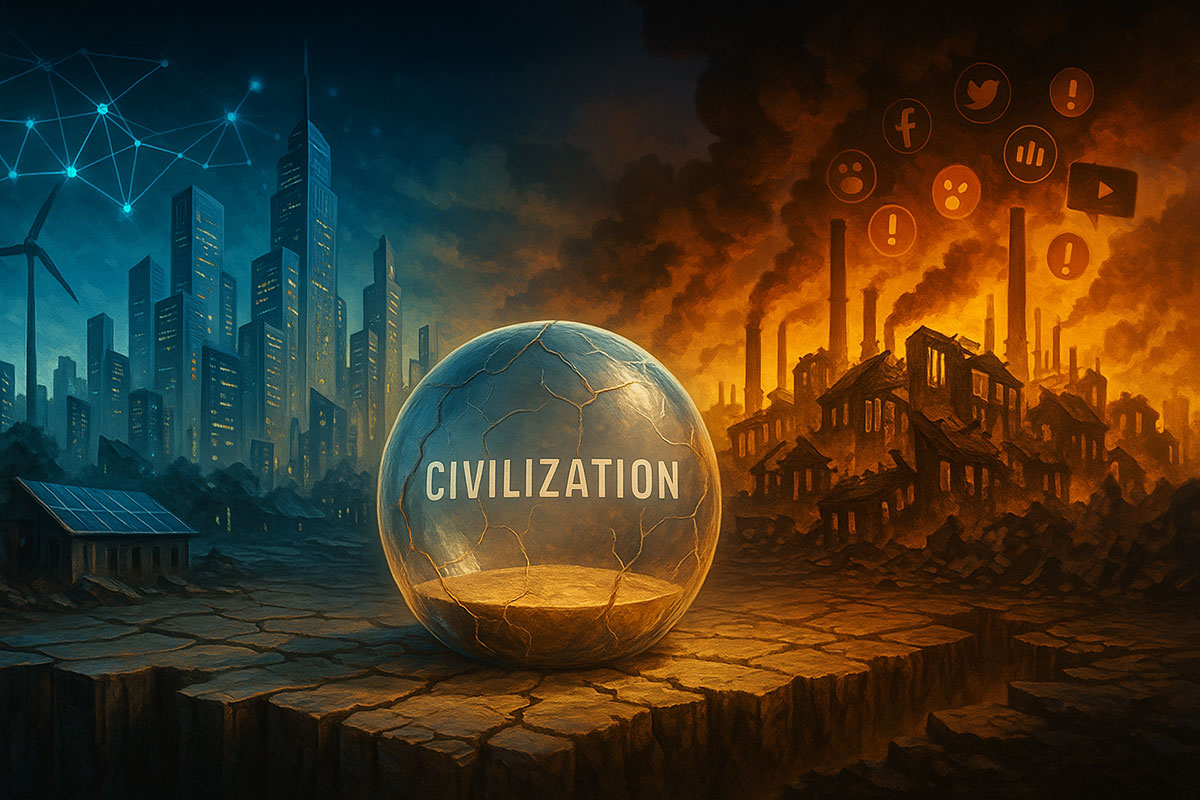
Topic 4: Innovation vs. Implosion — Can Disruption Save a Dying System?
Moderator: Ray Dalio
Panel: Cathie Wood, Sam Altman, Elon Musk, Bo Burnham, Peter Zeihan
🎙️ Ray Dalio (Moderator):
History shows empires collapse from within—through debt, division, and decay. But some argue technology can leap us out of decline. Can innovation truly reverse a dying empire’s trajectory—or is that just Silicon Valley optimism?
Cathie Wood:
Absolutely, innovation can save us. We’re on the cusp of deflationary growth from AI, robotics, energy storage, and genome editing. These are productivity multipliers. They don’t just create wealth—they distribute it better. If we fund these technologies right, they’ll lift the whole economy.
Peter Zeihan:
Tech can’t save you if your institutions collapse. Rome had engineering brilliance when it fell. Innovation without political and demographic stability is like installing solar panels on a sinking ship. Yes, disruption helps—but it's not a substitute for structure.
Sam Altman:
Technology is neutral—it accelerates whatever system it’s embedded in. If we keep innovating within broken institutions, we’ll just get faster collapse. But if we align AI and biotech with new governance models? Then yes—radical positive change is possible.
Bo Burnham:
Here’s the irony: tech was supposed to free us, but now we’re more anxious, addicted, and divided than ever. Innovation without introspection is just noise. If we don’t stop and ask, “What are we even building this for?”, we’re just automating collapse.
Elon Musk:
The biggest risk isn’t collapse—it’s stagnation. Civilization advances by pushing boundaries. Colonizing Mars, building AGI, rewiring the grid—that’s how we escape decline. We don’t need to preserve a dying system. We need to outgrow it.
🎙️ Dalio:
Interesting views. Let’s press further. Is technology accelerating inequality and instability—or can it genuinely create a more equitable, resilient world?
Bo Burnham:
Right now? It’s making things worse. Social media monetizes outrage, algorithms deepen bubbles, and nobody feels heard. We’ve made everything faster—except empathy. And until we fix that, no amount of tech will heal the divide.
Cathie Wood:
That’s valid, but incomplete. Yes, tech creates short-term dislocations. But long-term, it levels the field. Think: mobile banking in Africa, AI-assisted education, decentralized energy. It’s about how we deploy it. With vision, not greed.
Elon Musk:
Tech doesn’t cause inequality—bad policy does. You can blame the tools or fix the rules. I’ve said it before: universal basic income will be necessary. As automation replaces labor, we’ll need new models for value and purpose.
Peter Zeihan:
We have to stop thinking tech is destiny. It’s not. China’s using AI for surveillance. The U.S. uses it to sell ads. Innovation reflects values. If the underlying society is broken, technology just magnifies the cracks.
Sam Altman:
The key is access. If only elites get the tools, inequality worsens. But if AI tutors every child and biotech extends life for all, we win. The challenge is not building the future—it’s making it inclusive.
🎙️ Dalio:
Final question: If we had to choose one breakthrough to bet America’s future on—what should it be, and why?
Cathie Wood:
AI-guided precision medicine. Healthcare is the biggest cost driver and inequality marker. Imagine a system that predicts disease, personalizes treatment, and lowers costs by 90%. That’s not sci-fi—it’s near-term and scalable.
Peter Zeihan:
Energy independence. Resilient nations are powered nations. Solar, battery storage, nuclear microgrids—those will outlast any fiscal regime. Innovation must start where the lights are.
Sam Altman:
Aligned AGI. If we get artificial general intelligence right—and safe—it could solve everything from climate to education. But that’s a big if. We must approach it with humility, governance, and broad input.
Elon Musk:
Mars. Not a vanity project—a backup. If we stay on Earth forever, we’re a single-point failure. Multi-planetary life is the ultimate hedge against civilizational collapse.
Bo Burnham:
Mental health. All the breakthroughs mean nothing if people are too broken to enjoy them. We need innovation in how we treat, talk about, and fund mental health. It’s not sexy, but it’s the foundation of everything else.
Topic 5: Escaping the Collapse — Can We Still Rewrite the Future?
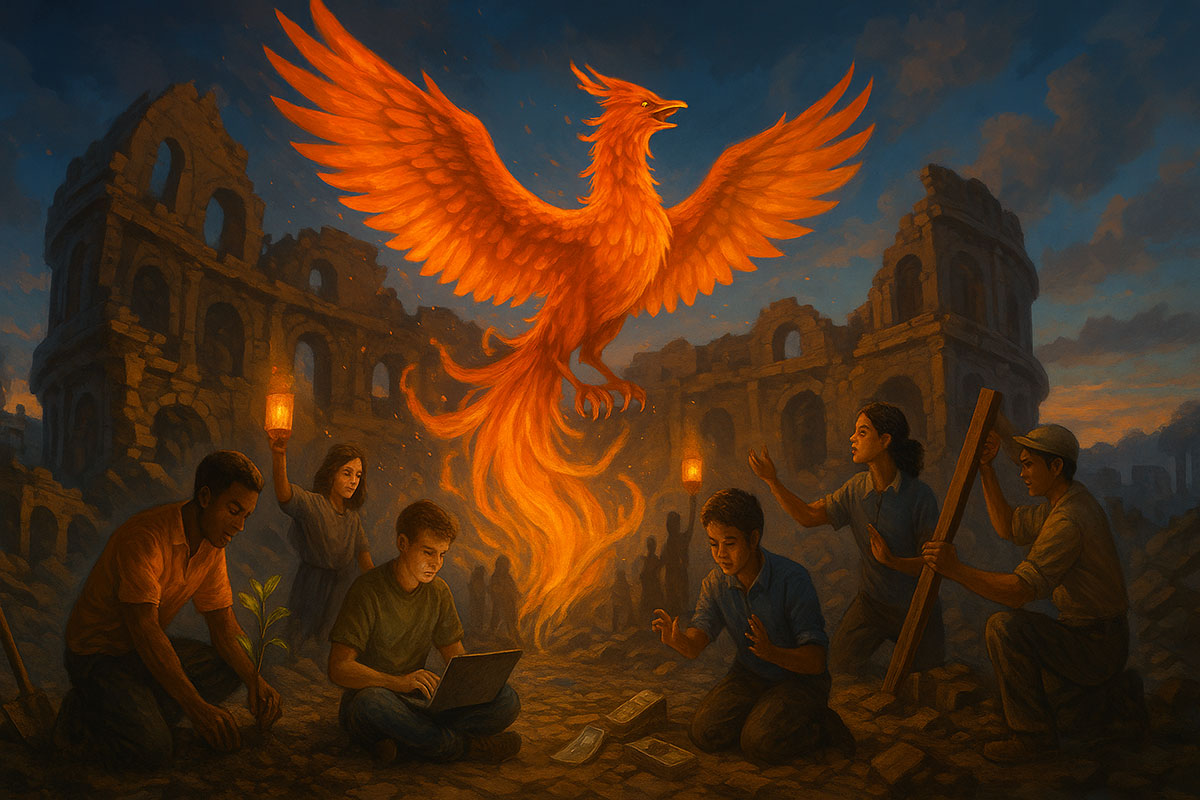
Moderator: Ray Dalio
Panel: Mariana Mazzucato, Andrew Yang, Dr. Cornel West, Zendaya, Robert Reich
🎙️ Ray Dalio (Moderator):
If history is any guide, most empires don’t recover once the late-stage cycle begins. But I believe it’s still possible—if we act. Is there a realistic path forward for America, or are we too far gone?
Mariana Mazzucato:
There’s always a path forward—if we change how we define value. Right now, we reward speculation over contribution. We need a mission-driven economy where government and industry partner not to profit off crises, but to solve them. Think moonshot-level ambition, not austerity.
Zendaya:
I don’t think people want miracles—they just want fairness. And honestly, young people are starved for hope. We’re tired of being told the system is broken but “too complicated to fix.” So no, it’s not too late—but if we don’t include everyone in the rebuild, we’ll repeat the past.
Andrew Yang:
I still believe in America’s comeback. But we need systemic rewiring—Universal Basic Income, ranked-choice voting, and 21st-century education. The problems we face aren’t accidental—they’re structural. If we address them at the root, we unlock a renaissance.
Dr. Cornel West:
We need a moral reckoning before we can even talk about recovery. Greed has become the religion of the ruling class. We need love, justice, and truth-tellers willing to risk it all. Otherwise, we’re just putting gold trim on a crumbling house.
Robert Reich:
America’s resilience lies in its people—not its politics. We’ve survived depressions, world wars, and assassinations. But resilience requires reform. We need bold labor policy, strong public goods, and democratic accountability. It’s not too late—but the clock is ticking.
🎙️ Dalio:
What’s the single biggest shift—political, cultural, or economic—we need to make if we truly want to avoid collapse?
Andrew Yang:
We need to redefine work. Automation is displacing millions, but we still tie identity and survival to traditional jobs. The solution? Decouple survival from employment. Basic income, lifelong learning, and AI-integrated education can help us evolve.
Zendaya:
We have to learn how to listen again. Across generations, across races, across classes. Everything’s become a performance or a war. The real revolution? Humility and curiosity. And yes—more young people in power.
Dr. Cornel West:
The shift must be spiritual and democratic. Not religious dogma—but deep concern for the least of these. Until the voiceless are heard and the poor are dignified, there is no real progress. Empires fall when they forget the humanity of the marginalized.
Mariana Mazzucato:
We must stop treating government as a fixer of market failures—and start treating it as a co-creator of value. We need a bold public sector that funds green tech, cures, education—real missions. We’ve done it before. It’s time again.
Robert Reich:
End corporate capture of democracy. Right now, policy is written by lobbyists, not citizens. Until we limit money in politics, every other reform is a bandage. Reclaim democracy, and everything else becomes possible.
🎙️ Dalio:
If each of you could implement one practical policy or idea tomorrow to begin rewriting the future, what would it be?
Zendaya:
Civic mentorship. Pair every teen with an adult mentor to talk about power, justice, and change. Not just school—but meaning. We don’t need more lectures—we need more guidance.
Andrew Yang:
Universal Basic Income—$1,000/month for every adult. It’s not a handout. It’s a floor for freedom. When people can breathe, they can build.
Dr. Cornel West:
Massive investment in the arts, humanities, and public beauty. Not just STEM—soul. Rebuild libraries, theaters, public parks. Dignity doesn’t grow in malls. It grows in meaning.
Mariana Mazzucato:
A public wealth fund that owns stakes in national innovation—AI, green energy, vaccines—and redistributes those returns to citizens. Innovation should be a public dividend, not a private jackpot.
Robert Reich:
Automatic voter registration, ranked-choice voting, and term limits for Congress. That’s the foundation of true democratic renewal. Without that, reform is just rhetoric.
Final Thoughts by Ray Dalio
If there’s one thing I want readers to walk away with, it’s this: decline is not inevitable—but denial guarantees it.
We still have time to rebalance. To invest in real productivity instead of financial engineering. To restore trust in institutions. To bridge divides. But it will take courage—political, cultural, and personal.
Most of all, I want to emphasize that understanding the Big Cycle is power. It’s not just a historical curiosity—it’s a life-saving, wealth-preserving, peace-making framework. If we ignore it, we do so at our peril.
The future isn’t written yet. But if we want to change its direction, we must first see where we truly stand—and stop pretending the old rules still apply. That’s what this book is really about.
Short Bios:
Ray Dalio is the founder of Bridgewater Associates and author of Principles. He is known for his macroeconomic frameworks and studies on the rise and fall of empires, especially through his “Big Cycle” thesis.
Fareed Zakaria is a journalist and political commentator, host of Fareed Zakaria GPS on CNN, with expertise in international relations and global power dynamics.
Peter Zeihan is a geopolitical strategist and author specializing in demographic and geographic trends that shape the rise and fall of nations.
Trevor Noah is a comedian and former host of The Daily Show, known for his incisive, human-centered political commentary and global perspective.
Lynn Alden is a respected investment strategist known for her clear macroeconomic analyses and insights on fiscal policy, inflation, and asset allocation.
Stephanie Kelton is an economist and leading advocate of Modern Monetary Theory (MMT), author of The Deficit Myth, and former advisor to Bernie Sanders.
Michael Burry is a hedge fund manager best known for predicting the 2008 housing crash, featured in The Big Short, and known for his contrarian investment views.
Cathie Wood is the founder and CEO of ARK Invest, known for her bullish stance on disruptive innovation in areas like AI, genomics, and energy storage.
John Oliver is a comedian and host of Last Week Tonight, recognized for his deep-dive satire on political and economic issues.
Nick Hanauer is a venture capitalist and civic activist who advocates for addressing income inequality and reforming capitalism from within.
Robert Reich is a political economist and former U.S. Secretary of Labor. He focuses on wealth inequality, labor rights, and democratic reform.
Kanye West is a globally recognized artist and entrepreneur whose controversial public persona intersects with themes of wealth, culture, and social tension.
Sam Altman is CEO of OpenAI and a prominent voice on artificial intelligence, future governance, and the risks and promises of exponential technology.
Elon Musk is the CEO of Tesla and SpaceX, known for his mission-driven approach to technology, from space exploration to sustainable energy and artificial intelligence.
Bo Burnham is a writer, filmmaker, and performer whose work critiques modern technology, fame, and the psychological impact of internet culture.
Mariana Mazzucato is an economist and professor who advocates for mission-oriented innovation policy and rethinking the public sector’s role in driving progress.
Andrew Yang is an entrepreneur and former U.S. presidential candidate, known for promoting Universal Basic Income and systemic political reform.
Dr. Cornel West is a philosopher, theologian, and public intellectual whose work focuses on race, justice, democracy, and moral renewal.
Zendaya is an actress and cultural icon who represents a younger generation’s voice on justice, creativity, and optimism for rebuilding the future.
Leave a Reply