
|
Getting your Trinity Audio player ready...
|
Prologue
(Lights low. A single gas lamp glows at center stage. The faint sound of ticking clocks fills the silence. A Narrator’s voice emerges, calm but threaded with unease.)
NARRATOR
In every city there are houses the world forgets.
Their curtains are always drawn just so, their lamps always lit,
and yet no one recalls the names of those who pass through the doors.
Some houses feed on laughter, some on sorrow.
And some—on the fragile balance between warmth and silence.
This story begins on a foggy street in Bath,
where a young man paused before a sign,
drawn not by reason, but by a whisper older than his own memory.
The sign read: Bed and Breakfast.
And the house was waiting.
(The glow intensifies. The ticking quickens, merging with the rising hush of a kettle. As the words fade, the parlor set is revealed, preparing for Scene 1.)
(Note: This is an imaginary conversation, a creative exploration of an idea, and not a real speech or event.)

Scene 1 — The Arrival in Bath
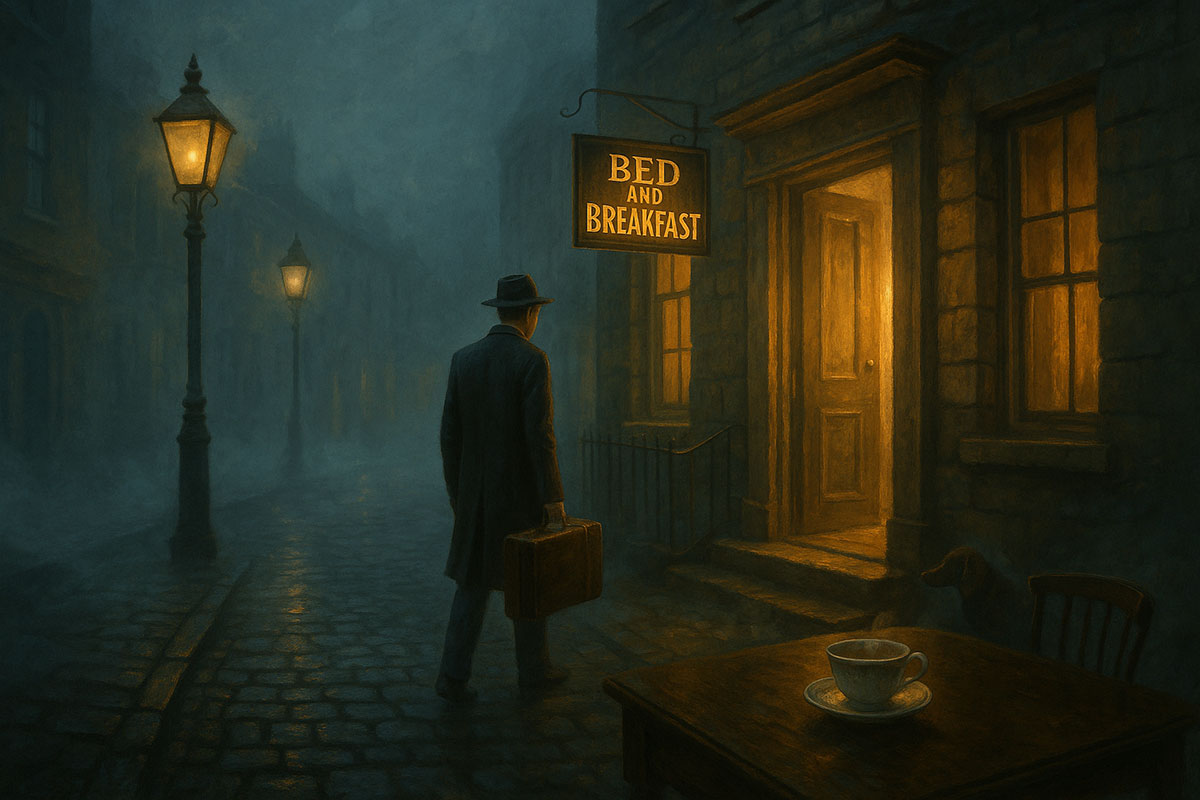
Setting: A fog-soaked street in Bath, 1950s. Gas lamps simmer in halos. The stones sweat with evening mist. Downstage right: a narrow townhouse with a brass knocker, lace curtains, and a hand-painted window card: BED AND BREAKFAST. A faint glow seeps around the edges of the door like a warm breath.
Lights: Cold, pearl-gray wash on the street; warm amber spilling from the house. As the scene progresses, the amber draws the eye, coaxing the audience inward.
Sound: Clocks somewhere—everywhere—marking time in mismatched ticks. A kettle, far off, sighs. Shoes on wet stone.
BILLY enters upstage left, a tidy young man with a small suitcase and a bigger ambition. He glances at a paper folded in his coat pocket—an address for a pub someone at the office recommended—then slows at the window card.
BILLY
(half to himself, half to the fog)
They did say the Bell and Dragon… cheap, cheerful, nothing fussy. Sensible.
He studies the house. The window curtains don’t flutter. No shadow crosses them. Yet the warmth seems personal, like a whisper directed only at him.
BILLY
It’s only one night.
He steps to the door, hand raised to knock—
The door opens before he touches it.
The landlady stands framed in amber: silver hair pinned perfectly, eyes the color of teacups, a smile already arranged as if his arrival completes the room.
LANDLADY
Oh, my dear boy. You must be chilled. Do come inside—quickly, quickly—before the damp makes a home of your bones.
She does not ask his name. She steps back just enough for him to pass. He glances at the street—a life he could still choose—then crosses the threshold.
The street light cools; the parlor warmth swells.
BILLY
I was headed to a pub. But your sign—
(he laughs at himself)
—well, it seemed friendlier than ale.
LANDLADY
Pubs are full of noise and strangers’ elbows. Here we keep only what is pleasant. Your coat? Your case? There now—hands free again.
She takes his coat deftly; his suitcase vanishes to a hall chair with a practiced movement. The house smells of lemon polish, crushed leaves, and something bitter with a faint sugar edge.
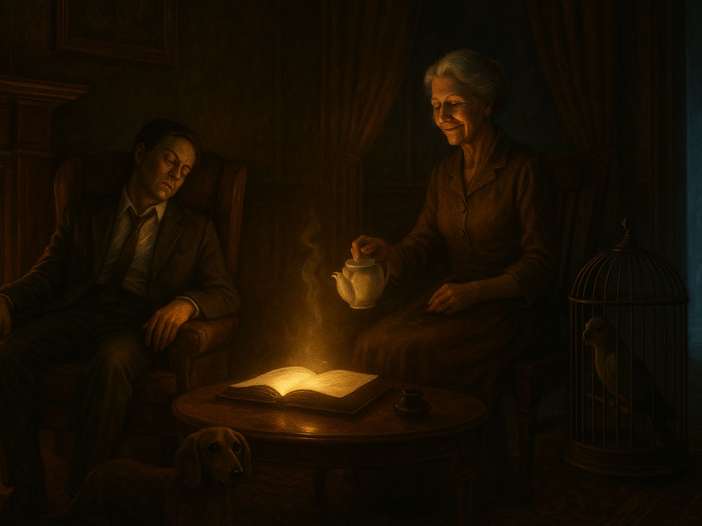
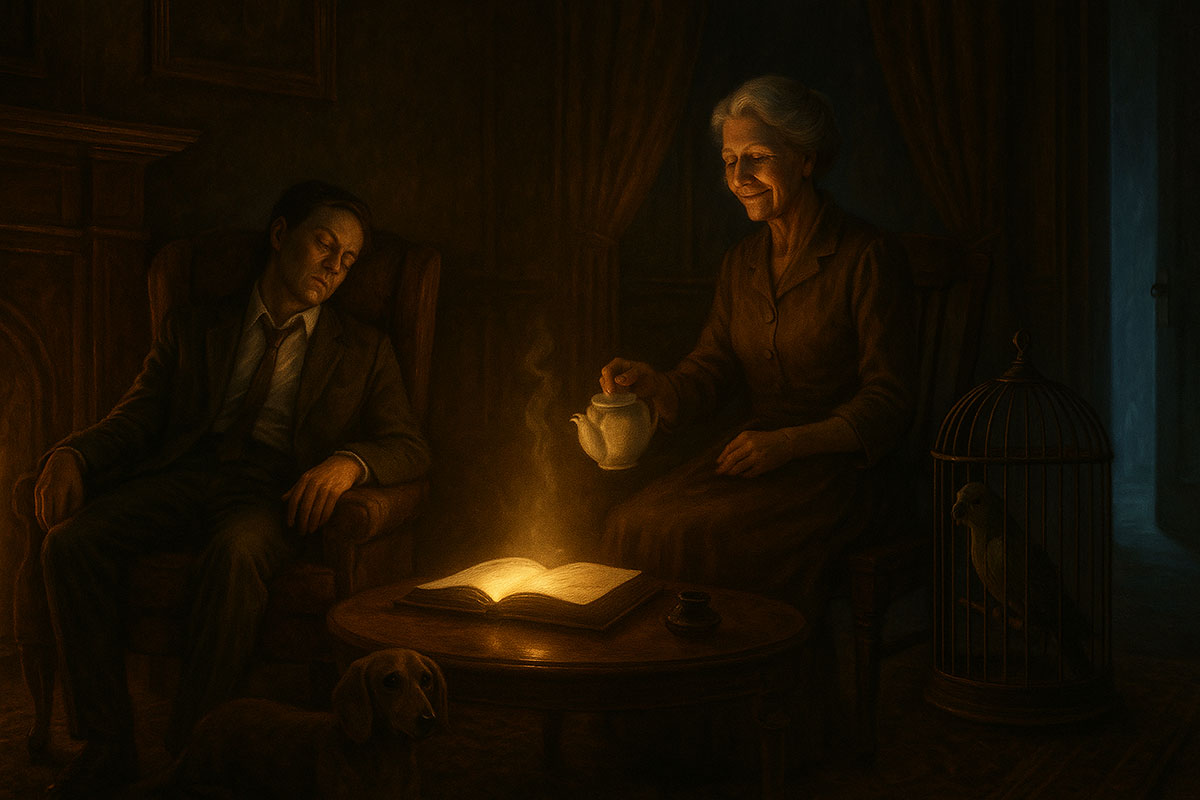
Parlor revealed downstage: a small fireplace with a determined flame; two chairs angled toward it; a round table with a lamp and a leather-bound book; a low rug where a dachshund lies perfectly at peace; a brass cage with a green parrot perched in permanent patience. Nothing moves but the fire.
LANDLADY
Sit by the hearth. The journey must have stretched you thin.
BILLY
Thank you, ma’am. It’s very… tidy.
LANDLADY
I detest untidiness. It introduces decay. And we don’t have any decay here.
She pats the arm of the chair. Billy sits; the chair seems to know his shape. The landlady glides to the doorway.
LANDLADY
(calling softly, as if to someone upstairs)
The kettle, dear. One for him. One for me.
A kettle answers from the unseen kitchen with a polite, obedient rise.
BILLY
(to the dachshund)
Hullo there. Aren’t you a gentle fellow?
The dog does not startle. Does not blink. His glass-bright eyes hold the firelight like a secret.
BILLY
Good as gold.
He reaches a hand, pauses—something about the fur’s flawless lay, the way not a single hair errs against its neighbor, suggests a room arranged for a photograph. He withdraws his hand and turns toward the table, to the book.
LANDLADY
(appearing with a tray, musical clink of china)
A guest book. It is a habit of mine—order is a form of affection. Your name will make the page look complete.
She sets down the tray, steam threading upward like silk, and opens the book to a page already half-filled with careful script. A fountain pen lies ready, nib glossy as a pupil.
BILLY
Of course.
He leans in. Freshly ironed paper scent mingles with the tea. He reads: Christopher… the surname is struck by a tremor in his memory. The next name—Gregory W. Temple—tugs harder.
BILLY
(soft)
Funny. These—these names. I know them from somewhere.
LANDLADY
(pleasantly)
Newspapers are such dreadful gossips, aren’t they?
He looks up. She smiles as if she has said only, “What nice weather.”
BILLY
I suppose they are.
He writes: Billy Weaver. The pen skates neatly; the blackness seems too black, like a depth that keeps going. He underlines the W without knowing why.
LANDLADY
What a handsome hand. I love an elegant line. It shows discipline. May I?
She lifts the book for the briefest glance—not reading the name so much as feeling it—and gently returns it to the table, open, as if to keep the page breathing. She pours tea. The fragrance is floral, almond-edged, with a soft medicinal ghost and the memory of cherries left too long in the sun.
LANDLADY
(offering a cup)
Sip before you speak. Warmth tells the truth better than chatter does.
He takes the cup. The porcelain trembles slightly between his fingers—no more than a breeze in a glass.
BILLY
Thank you.
He sips. The heat blooms along his tongue and down his chest. Sweetness shelters bitterness; something numbs a little and then brightens, like rain on a matched set of bells.
LANDLADY
There. That’s a color coming back into you. You arrived all gray. But you do have color. Such lovely color.
BILLY
Do I? Travel always scrapes mine off.
He glances again at the parrot. Its plume is a miracle of green. Not a single feather is wrong. The tiny claws curve around the perch with a jeweler’s precision. He waits for a blink he is almost certain he will see.
LANDLADY
You must be here on business.
BILLY
Yes. Only overnight. I’ll be off in the morning.
LANDLADY
Mmm.
A clock answers somewhere: two deliberate ticks, then a pause, then two more, as if the house takes its time from a private code.
BILLY
You’ve had other young men through lately? The book—was it Christopher and… Gregory?
The steam from their cups drifts between them like handwriting rubbed with a thumb.
LANDLADY
Such charming boys. One was tall with a poet’s lashes; the other had a way of holding a cup as if it were porcelain and not clay. They appreciated quiet. Quiet is the most expensive luxury in England, don’t you think?
BILLY
I suppose it is.
(beat)
I think I read—
(he stops himself, embarrassed at the impropriety of turning a stranger’s parlor into a newspaper column)
LANDLADY
(tilting her head, motherly and amused)
People vanish from the busy world all the time. Here we mislay nothing.
She lifts her own cup; her hands are steady as if cast in place.
BILLY
(trying to laugh)
I’ll try not to mislay myself then.
LANDLADY
Don’t try too hard.
The fire settles with a velvet sigh. Billy sets his cup down and rubs his fingertips together. A lemony slickness. Something else beneath it—like the memory of medicine cabinets.
BILLY
Do you keep many pets?
LANDLADY
Only the kind that behave.
She regards the dachshund with a love that does not move her features. He follows her gaze and sees only perfection—perfect coat, perfect pose, perfect patience. His eyes wander to the parrot again. The beak’s edge gleams in the lamplight.
BILLY
They’re… very good.
LANDLADY
They are exactly as they should be. That’s the secret: make things exactly as they should be, and they stay.
The words hang with a gentle weight. Billy smiles because that seems to be the correct response. He reaches for his cup again, if only to give his hands an occupation, and notices his name in the book has dried to a shine like lacquer.
BILLY
Do you—
(he gropes for a safe question)
—do you get many rooms to let?
LANDLADY
Only the ones that fit. One mustn’t crowd. Crowding encourages… untidiness.
BILLY
I’ll keep to myself. I don’t make a mess.
LANDLADY
No, you won’t.
(beat, kind)
You’ll rest. You’ll find it very easy to rest here.
The kettle in the unseen kitchen gives a final little tap as though nodding along. The clocks resume their disparate agreement. Billy takes another mouthful. The warmth now is not only in his chest; it is in the joints of his fingers, the hinges of his knees, a velvet he hadn’t asked for but cannot reject without insulting the host.
BILLY
I may turn in early. Train soot and figures all day makes a man old before his time.
LANDLADY
No need to hurry. The night is ours. And the morning, if we choose it.
She stands with a motion that suggests no effort at all.
LANDLADY
(light, conversational)
I’ve put you on the second floor. The others like the third, but you’ll be happier a little nearer to the fire. Besides—
(she smiles, almost conspiratorially)
—you’re new. I wouldn’t send you so far from me just yet.
He blinks.
BILLY
The others?
She gestures, not quite upward, more like inward, to the deeper house that the audience cannot see.
LANDLADY
They never give me trouble. Not anymore. You’ll find them… very quiet.
A draft slides through, stirring nothing: not the curtains, not a feather, not a single hair on the dog’s back. Only the flame bends a fraction and returns to its posture, dutiful.
BILLY
(softly, as if humoring a sweet eccentric)
I hope I shan’t be trouble either.
LANDLADY
(pleased)
No, dear. You shall be perfect.
She collects his empty cup and his gaze goes to the guest book once more: his name seated beneath the others like a well-mannered third in a tidy row. The page seems almost warm. He can feel it from here. He rubs his fingertips again and finds that same faint slick, like a glove he didn’t put on.
LANDLADY
Would you like a biscuit?
BILLY
I… think I’ve had enough.
LANDLADY
As you wish.
(then, with the softness of a lullaby)
We keep only what we need.
She crosses to the doorway and listens. The house holds its breath. Somewhere above, the clocks borrow each other’s seconds.
Billy stands, a little slower than he expects, and smiles as men do when they refuse to admit their legs are tired.
BILLY
Thank you for your kindness. You’ve made a stranger feel—
(looking for the word)
—chosen.
LANDLADY
(quiet delight)
Yes.
Blackout on the parlor’s perfect tableau: the dog stubbornly serene, the parrot a jewel in a brass crown, the guest book open like a mouth that has just taken a name and will not give it back. The landlady’s silhouette remains in the doorway, listening upward, as if for a signal only the house can send. One last, off-kilter tock. Then silence.
Scene 2 — The House of Whispers
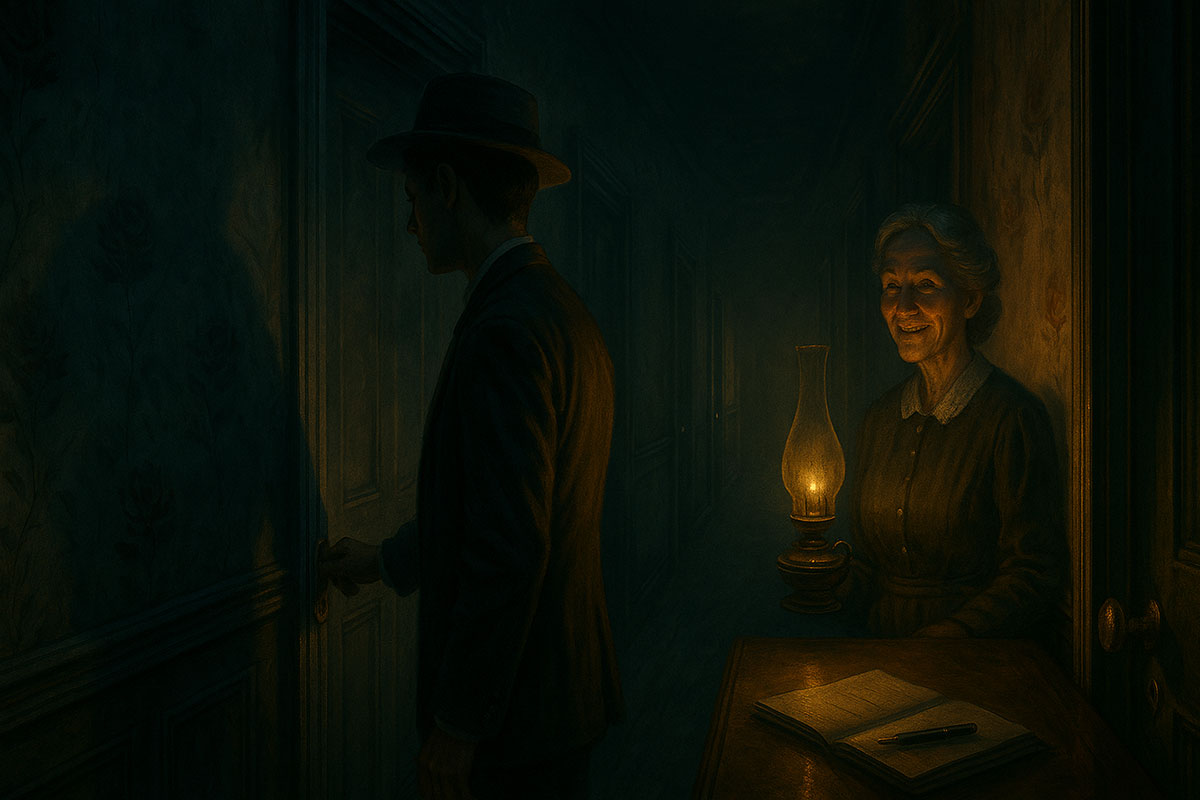
Setting: The upstairs corridor of the Bed and Breakfast. The ceiling hangs low, the wallpaper a faded garden of roses that have lost their bloom. Doors line the hallway, each with brass knobs that gleam faintly in the half-light. At the far end, a window frames the fog outside. The sound of ticking clocks is louder here, overlapping into a confusing orchestra. The audience cannot see the rooms beyond the doors, only the suggestion of shadowed space.
Lights: Dim, cool light spilling from the window at the end of the hall; a single lamp with a green shade pools gold downstage, creating small islands of comfort against a sea of gloom. Shadows fall long, stretching as though trying to touch Billy’s feet.
Sound: The layered ticking of many clocks. From behind one of the doors, the faintest murmur of voices, soft as breath, impossible to pin to any single tongue.
BILLY enters cautiously from the stairwell, still in his day suit but slightly disheveled. His steps are measured; his body seems heavier than when he first arrived. He glances behind him toward the parlor glow, then slowly forward into the corridor.
BILLY
(to himself, quiet)
Second floor, she said. Just the second.
He pauses, listening. The whispers rise faintly behind the nearest door. He turns toward it, his hand lifting to the knob. The whispers stop instantly. The silence is sudden, too sudden.
BILLY
(half-laugh, uneasy)
Old houses. Drafts. Pipes.
He touches the brass knob. It is warm, almost pulsing, as though someone has just held it from the other side. He lets go quickly.
From the shadows, the LANDLADY emerges, carrying a small oil lamp. Her smile is exactly the same as in the parlor, unchanged, as though her face were a photograph reinserted into a new frame.
LANDLADY
(cheerfully)
There you are. Exploring already. Boys are always curious on the first night.
BILLY
(startled, embarrassed)
I— I wasn’t meaning to pry. Just wanted to see the landing.
LANDLADY
Of course. You mustn’t feel unwelcome in your own house.
(beat, softer)
But upstairs is private, dear boy. You wouldn’t like it there.
She steps closer, holding up the lamp. The shadows lean back.
BILLY
I thought I heard—well—something. Voices.
LANDLADY
Voices? My, your imagination is lively. That’s good. Liveliness fades so fast if it isn’t encouraged.
BILLY
Perhaps it was nothing. Trains leave a noise in the head, I suppose.
LANDLADY
(tilting her head)
The house has a way of speaking to new guests. You’ll grow used to it. The others did.
BILLY
(uneasy)
The others.
She studies him with a look that hovers between motherly concern and clinical appraisal.
LANDLADY
You’ve such healthy skin. A strong pulse, I’d wager. Youth written in every line of your hand.
(she reaches, almost touches his wrist, then withdraws with a smile)
Yes, you’ll be perfect.
Billy stiffens slightly. He tries to laugh it off.
BILLY
Perfect for what, ma’am?
LANDLADY
For rest. For peace. Isn’t that what every young man really wants, no matter the rushing about?
She gestures toward a door at the near end of the hall.
LANDLADY
Your room is here. Just so. I’ve prepared it specially. The bed warmed, the sheets smoothed thrice. I detest wrinkles. Wrinkles mean wear.
Billy hesitates at the threshold.
BILLY
Thank you, truly. You’ve gone to a lot of trouble.
LANDLADY
It’s never trouble, dear boy. It is a pleasure to have the right guest. The right one is rare.
A faint creak echoes from the farthest door, the one nearest the window. Billy turns sharply. The landlady follows his gaze but does not move her head, only her eyes, which gleam in the lamplight.
BILLY
Is someone else staying here tonight?
LANDLADY
(soft, almost a lullaby)
Only the ones who belong.
Billy shifts uneasily. The whispering begins again—barely audible, like a seashell held to the ear. He takes a step toward the sound.
The landlady’s smile sharpens by the smallest fraction.
LANDLADY
(voice like velvet but firm)
Not tonight.
BILLY
(trying to laugh)
I’m not likely to sleep with all these clocks talking at once.
LANDLADY
They’ll sing you to sleep. They sing everyone to sleep.
She opens the door to his room. A soft golden light spills out. The bed is neatly turned down, the pillows plumped like clouds, a single flower in a vase by the window. The air smells faintly of lavender and something sharper beneath it.
LANDLADY
There now. See? Safe, simple, perfect.
BILLY
(quiet, to himself)
Safe.
LANDLADY
Would you like another cup of tea before you rest? It helps the nerves quiet down.
BILLY
I think I’ve had enough. It was very strong.
LANDLADY
Strong things are the best at making the body forget its little resistances.
She lingers in the doorway, lamp glowing. For a moment, the shadows on the wall behind her seem to stretch unnaturally, like long fingers reaching toward him.
BILLY
Goodnight, ma’am.
LANDLADY
Goodnight, my dear. Sleep exactly as you should.
She closes the door with a slow, deliberate finality.
Stage directions: Billy sits on the edge of the bed. He rubs his temples. The ticking of clocks is louder here, filling every pocket of silence. He pulls off his shoes, sets them neatly by the bed, and lies down.
The whispers resume, now clearer, though still indistinct—syllables without language. He sits up, eyes wide.
BILLY
(whispering back)
Who’s there?
No answer. Only a low creak from above. He stares at the ceiling.
Lights dim gradually, leaving Billy’s uneasy silhouette on the bed. The whispers fade, replaced by the rhythmic ticking, now like a thousand heartbeats out of sync. The stage goes black.
Scene 3 — The Hidden Workshop
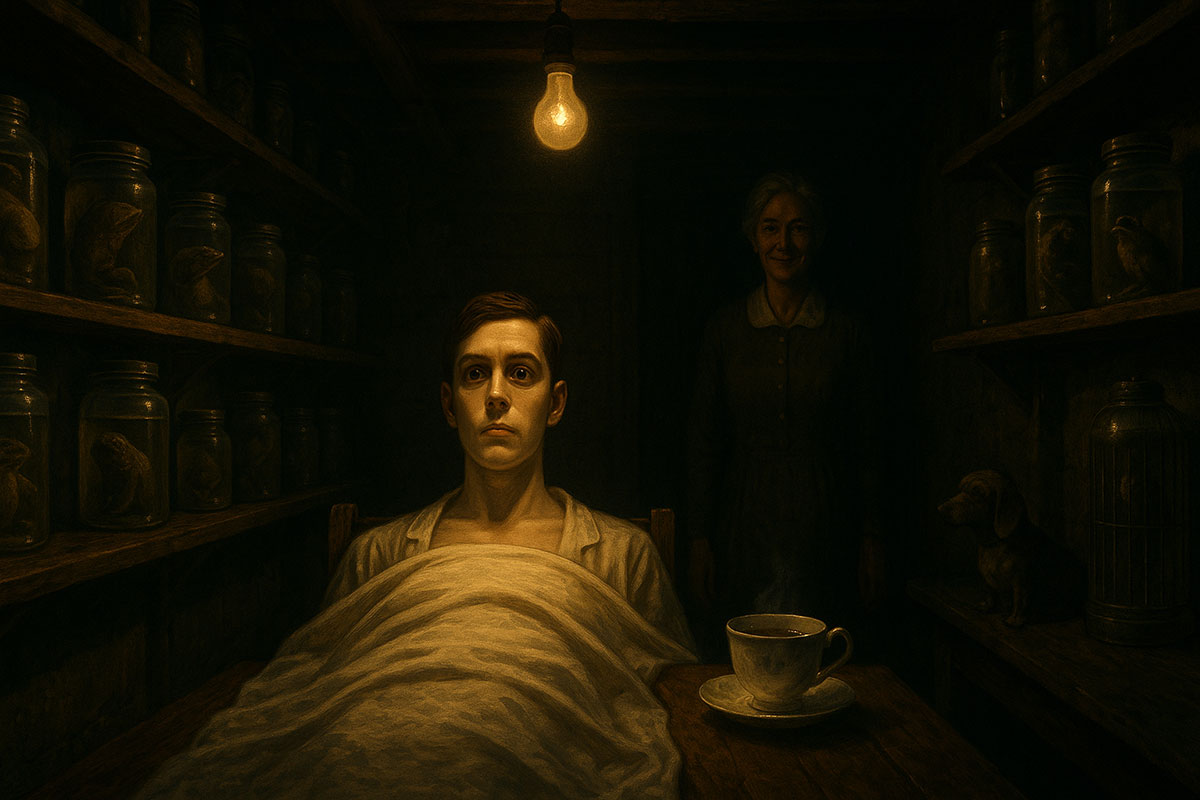
Setting: The basement of the Bed and Breakfast. The stage is dim, stone-walled, with a low ceiling. A single dangling bulb buzzes faintly, casting shadows that seem to shift when no one moves. Shelves line the walls, stacked with jars, bottles, and old newspapers. A wooden worktable sits center stage, covered with tools: scalpels, brushes, needles, and glass eyes. To one side, a tall sheeted form stands draped in linen. The smell of chemicals and dust lingers in the air.
Lights: A cold, clinical white above the table; shadows around the edges of the stage are deep, almost swallowing. The parlor glow from upstairs flickers faintly through the stairwell at stage left.
Sound: Dripping water, the hum of the bulb, the faint clink of glass shifting in jars. Occasionally, something faint and scuttling echoes in the dark.
BILLY enters from the stairwell, holding a small candle he has stolen from his room. His jacket is buttoned tight; he breathes shallowly.
BILLY
(whispering)
Just a house. Just a house.
He steps carefully, the boards creaking underfoot. His candlelight flickers across jars on the shelves. He pauses, peering closer.
Stage direction: He lifts one jar—inside floats the curled remains of a fox cub, eyes closed, fur suspended like smoke. He sets it down quickly, trying not to drop it.
BILLY
(half-choking laugh)
A collector. That’s all. A collector.
He edges toward the worktable. The tools gleam faintly in the candlelight—needles arranged in size order, spools of fine thread, brushes stiff with old resin. A row of glass eyes stares outward, catching the glow like marbles of trapped fire.
The whispers from upstairs seem to echo faintly down the stairwell, warped and stretched, like voices speaking underwater.
Billy’s gaze catches on the tall draped figure by the wall. He stares, frozen. Slowly, against his better judgment, he reaches out and pulls the linen down.
Stage direction: A young man is revealed—Christopher Mulholland—preserved with eerie perfection. His posture is relaxed, as though seated in invisible air, his hair combed neatly, his skin waxen but intact. His eyes are glass, set to mimic life but unblinking.
BILLY
(whisper, horrified)
God… oh God…
He stumbles backward, bumping into the worktable, sending a jar toppling. It crashes to the ground, spilling preservative liquid across the floor. The smell intensifies—sharp, chemical, suffocating.
From the shadows, the LANDLADY emerges. She carries no lamp, yet her face seems lit, serene as always.
LANDLADY
(softly, almost tender)
Careful, dear boy. Those are delicate things.
Billy whirls, his candle shaking.
BILLY
(voice breaking)
What have you—what have you done?
LANDLADY
Preserved them. Isn’t he beautiful? Not a blemish, not a wrinkle. He’ll never suffer, never fade. I keep only the best.
She steps closer to the preserved figure, smoothing its sleeve with maternal pride.
LANDLADY
(continuing)
You see, life is unkind. Decay is cruel. But here—here, perfection stays.
BILLY
(backs away)
They’re dead. You—you killed them.
LANDLADY
(dead calm)
Killed? No, dear. I saved them. They were already slipping away, like all of us. I caught them before the world ruined them.
Billy looks toward the stairs, gauging the distance.
BILLY
I’m leaving. I’m leaving this place right now.
LANDLADY
(soft laugh)
Leave? You already belong here. You wrote your name. The house remembers names. The ink sinks deeper than paper.
She moves closer, her steps unhurried, her smile never faltering.
BILLY
(shouting now)
Help! Somebody!
His voice echoes in the stone walls, thin and pitiful. From upstairs, the whispers swell, louder, as though answering him.
LANDLADY
(soothing, like a mother to a frightened child)
There, there. No one will come. No one ever does. The street forgets who enters. Even you are forgetting already, aren’t you?
Billy clutches the candle tighter, his hand trembling.
BILLY
You won’t have me.
He dashes toward the stairs. The landlady doesn’t move quickly; she only tilts her head and watches. As he reaches the first step, a loose board creaks and he slips, dropping the candle. It extinguishes instantly, plunging the basement into near-darkness. Only the bulb above the table buzzes weakly.
LANDLADY
(voice floating through the dark)
The others said that too.
Billy scrambles up the stairs, breathing hard. At the top, he slams the door behind him. The stage holds on the landlady below, who turns to the preserved Christopher Mulholland, smoothing his hair.
LANDLADY
(whisper, affectionate)
He’ll join you soon. They always do.
She turns her gaze up the stairwell, her smile unchanged.
Lights fade, leaving only the pale figure of Mulholland and the faint buzz of the bulb.
Scene 4 — The Escape Attempt
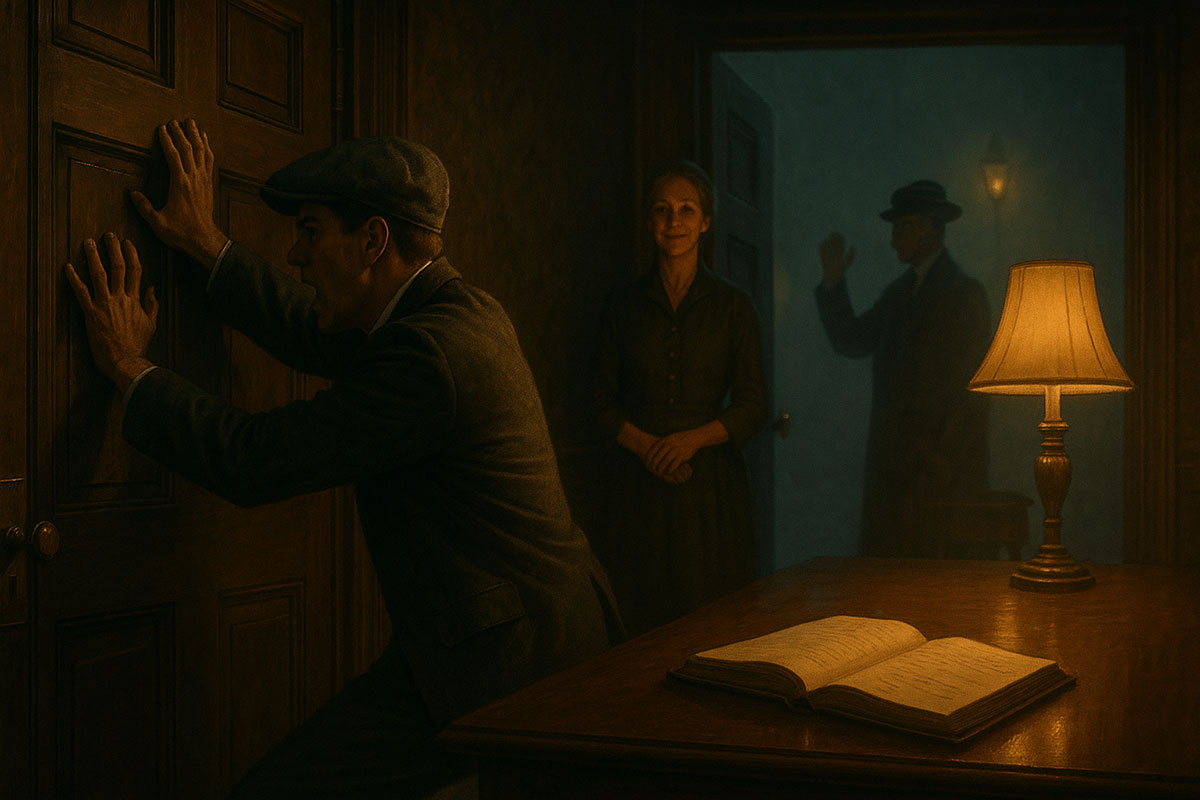
Setting: The front parlor again, late evening. The fire burns lower, casting restless shadows that lick across the wallpaper. The guest book rests open on the table where Billy signed it earlier; its pages catch the firelight, shimmering faintly as though the ink itself glows. The dachshund lies unmoving on the rug, the parrot eternally poised in its cage. Upstage, the front door looms—a heavy wooden structure with a brass handle that gleams like a lure.
Lights: Amber from the fire, stark moonlight through the curtained windows, and a narrow shaft of cold light spilling under the door. As the scene escalates, the fire dims, leaving the door’s glow more pronounced.
Sound: The incessant ticking of clocks, louder than before, overlapping into a jagged rhythm. Occasionally, a faint whisper filters in from the upstairs rooms—indistinct words, like a dream retold.
BILLY bursts in from stage left (the stairwell), breathing hard, hair disheveled, his candle gone. His shirt is damp with sweat, his eyes wild. He stumbles toward the front door, seizing the brass handle.
BILLY
(hoarse, panicked)
Open—please, God, open!
He wrenches at the door, but it does not give. The handle twists, the bolt rattles, but it feels as though the wood itself resists him.
He pounds on the door with both fists.
BILLY
(shouting)
Help! Somebody help me!
Stage direction: Outside, faint footsteps pass on the cobblestones. A man in a hat crosses the window, glances in. Billy waves desperately.
BILLY
Here! Please, I’m trapped—!
The man tips his hat politely… not to Billy, but to someone behind him.
Billy freezes, turning slowly.
The LANDLADY stands in the parlor’s archway, hands folded, smile calm and unwavering.
LANDLADY
(pleasantly)
Shouting makes such a dreadful impression, dear boy. You’ll frighten the neighbors.
BILLY
(voice cracking)
He saw me—he must have seen me!
LANDLADY
Of course he did. And he saw me too. Why should he worry? You’re my guest. Guests are meant to stay.
Billy stumbles backward, knocking into the table. The guest book slides slightly, its pages riffling though no draft blows. His name glows faintly, the black ink catching firelight like oil.
BILLY
(terrified, pointing)
What is this? Why does it—why does it look alive?
LANDLADY
Because it is. Names are seeds. Once planted, they take root.
She glides closer, her footsteps soundless.
LANDLADY
The house remembers every guest. That is why they never leave.
BILLY
(angrily, desperate)
You’re mad. You stuffed them, like your pets. Like trophies.
LANDLADY
No, dear. I perfected them. The world bruises, corrupts, ruins. I simply paused them at their loveliest.
She gestures toward the dachshund.
LANDLADY
Look at him. Still gentle, still obedient. He has never disobeyed me since.
Billy stares at the dog, horror dawning deeper. He backs into the firelight, the glow making his face pale.
BILLY
I won’t let you—
(stops, voice breaking)
I won’t become one of them.
LANDLADY
(soft, almost amused)
That’s what they all said.
Stage direction: The whispers upstairs swell suddenly, distinct enough to chill: voices repeating, overlapping, “Don’t fight. Don’t fight. Don’t fight.”
Billy bolts toward the staircase, compelled by the sound. He dashes upward two steps at a time, ignoring the landlady’s serene gaze.
Lights shift: A harsh white glow spills from the landing above, as if a door has swung open. Billy vanishes into it.
Scene shifts briefly to the upstairs landing.
BILLY enters from stage right, trembling. The whispers surround him. He pushes open the farthest door.
Stage direction: Inside the room, a table set for tea. Two figures—Christopher Mulholland and Gregory Temple—sit stiffly at the table, posed with cups in their hands. Their faces are smooth, pale, waxen. Their glass eyes stare forward. Their lips are almost smiling.
BILLY
(horrified, stumbling back)
No… oh God, no.
The landlady’s voice drifts from below, calm as ever.
LANDLADY (offstage)
They never grow old. They never quarrel. They never leave me. Isn’t that what you want, dear boy? To stay as you are—forever?
Billy stumbles backward, nearly tripping. He slams the door shut, his breathing ragged.
Scene shifts back to the parlor.
BILLY descends the stairs, nearly falling. He clutches the banister, his eyes darting like a trapped animal.
BILLY
(screaming now)
Let me out! Let me out!
He seizes the guest book, tearing at the page with his name. But the paper resists. The ink spreads instead, bleeding outward until it stains the edges of his hand.
BILLY
(panicked)
It won’t tear—it won’t—
LANDLADY
(approaching, serene)
Why would it? The page isn’t paper anymore. It’s you.
She takes the book gently from him, smoothing the page as though soothing a fevered child.
LANDLADY
Now, hush. You’ll exhaust yourself.
Billy slams his fists on the table, then stumbles back toward the fire. His chest heaves. He looks toward the door again, desperate.
BILLY
(pleading)
Please. Please let me go. I’ll tell no one. I swear it.
The landlady kneels beside him, her hand almost tender as it brushes a lock of hair from his forehead.
LANDLADY
(soft, final)
Oh, my dear boy. I never let anything go.
Stage direction: She stands, crossing calmly toward the teapot on the tray. She pours another cup, the liquid steaming faintly with a strange, bitter aroma.
Billy’s knees buckle. He collapses to the rug, the firelight flickering against his pale face.
The whispers upstairs fall silent all at once.
Lights dim gradually, leaving the landlady standing tall in the parlor, the steaming cup in her hand, the guest book glowing faintly on the table. Billy lies sprawled, unmoving, in the fire’s glow.
Scene 5 — The Final Capture and the Cycle Revealed
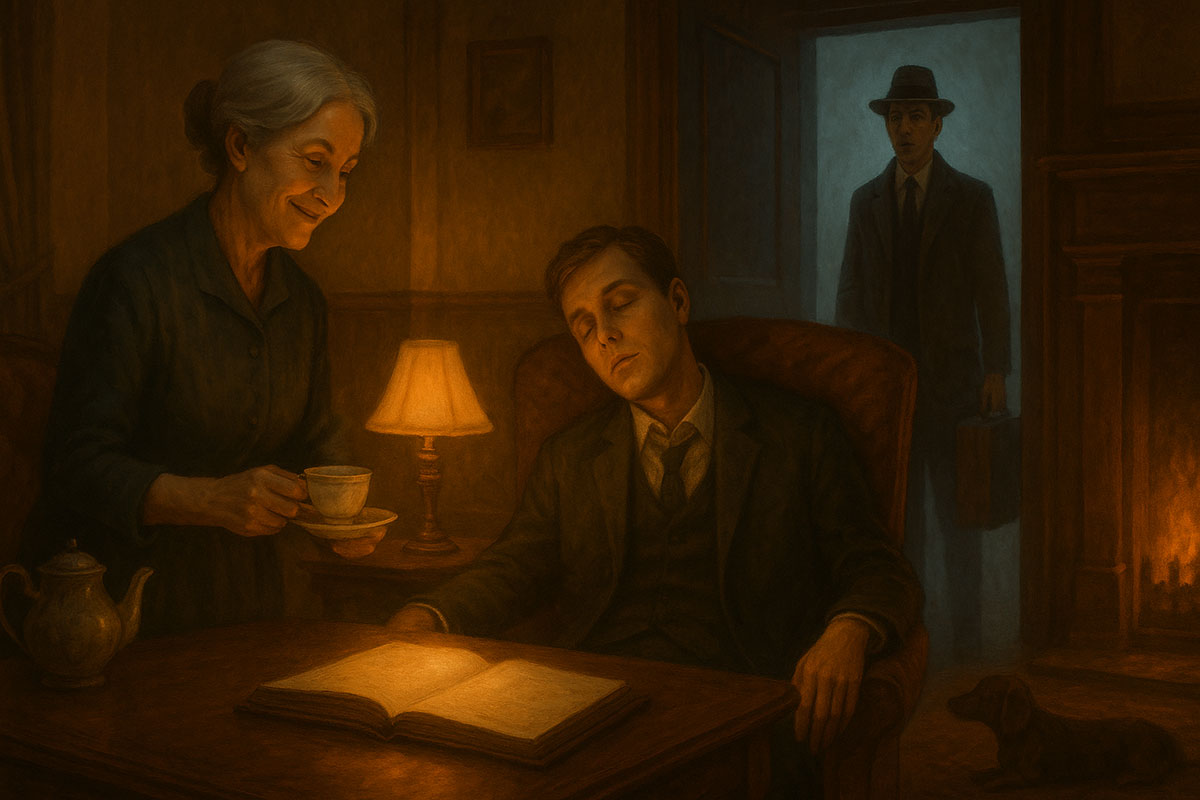
Setting: The parlor again, deep night. The fire is a low red eye. The guest book lies open on the table; the page with Billy Weaver glows like a coal under thin paper. The dachshund keeps his perfect vigil. The parrot is a green punctuation mark in the dark. Beyond the curtained window, the fog is a patient wall.
Lights: Firelight guttering in rust tones; a colder, moon-pale spill at the front door threshold; a sickle of lamplight from the hall. As the scene tightens, the room’s warmth thins and the door’s cold brightens.
Sound: Tickings resolved now into a single, slow heartbeat of the house. Far above, not voices but their impression—as if breath fogs a pane no one can see. The kettle in the unseen kitchen gives a soft, regular sigh, like a sleeper.
BILLY lies where he fell in Scene 4, half-curled on the rug, breath shallow. He stirs. His hand finds the floor, pushes; he lifts himself to an elbow. The room swims and rights itself. He blinks at the guest book, at his name pulsing faintly as if written with something that still remembers warm blood.
From the archway, the LANDLADY enters with a tray: teacup, saucer, a small glass vial tucked into a napkin fold. Her smile is as composed as ever; only her eyes shine brighter, like a cat’s that has come close at last.
LANDLADY
There, there. The worst of it’s passed. The body resists a change of habit. After the second cup, it learns to be agreeable.
BILLY
(hoarse)
No more.
He drags himself toward the chair, using the table leg to haul up to sitting. The guest book rustles—the page lifts a fraction, as if to meet his hand. He jerks back.
LANDLADY
(soothing)
Names are shy at first. Then they cling. You’ll see.
She sets the tray on the table, removes the vial with a practiced thumb and pours the slightest measure into the cup. The steam turns opaline; it smells of burnt almond and clean linen; it smells of a doctor’s room scrubbed of everything but decision.
BILLY
(eyes on the guest book)
Let me take it back.
LANDLADY
Take what back, dear?
BILLY
My name.
LANDLADY
Ah. But now it’s yours twice. Once in your mouth, once on my page. You’d only be half a person without either.
He lurches, snatches at the book. It gives—but not to him. The spine slides under his palm like muscle; the page with his name flips itself shut, tucking the glow inside. He staggers to the hearth, thrusts the book toward the embered eye.
Stage direction: The fire, which has fed on every ordinary log and ash of the day, draws back from the leather as though the book were iron and the flame a beast with sense.
BILLY
Please—
LANDLADY
(quietly pleased)
I told you: we don’t keep decay. Not even fire is permitted untidiness here.
She takes the book gently. It opens obediently to his page again, the ink now the deep satin of a bruise healed the wrong way. She smooths the corner, then lays it down, square, a sacred thing.
BILLY
What are you?
A simple question, placed on the table between them like a poor man’s gift.
LANDLADY
A housekeeper. A keeper of houses.
(eyes twinkling)
And a house, if you look at it properly, is only a big body waiting to be well-kept.
BILLY
(through his teeth)
You keep people.
LANDLADY
Only the ones the house asks for.
He stares at the door. The cold light there has a direction now, as though it points in, not out. The clocks tick in long intervals, patient as winter.
BILLY
(soft)
Someone will miss me.
LANDLADY
Yes. For a while. Then they’ll misremember you pleasantly. They always do. It’s kinder.
He swallows. His breath comes thin. He looks to the stairs—black beyond the arch. He hears not whispers but a tender pressure in the air, the way the sea holds a swimmer.
BILLY
(trying a different lever)
And them?
(he nods upward)
Do they… do they know what you’ve done to them?
LANDLADY
(considering)
They knew other things once. The world requires so many tiresome updates. Here, they keep only what suits them. I’ve given them the perfect edit.
BILLY
(anger stirs—last little coal)
You’ve stolen their endings.
LANDLADY
(cheerfully)
On the contrary. I made sure they had one.
She lifts the cup, brings it to him. He knocks her wrist. The tea lips the edge, then steadies, obedient. Not a drop dares fall.
BILLY
I’ll fight you.
LANDLADY
Of course. It makes a nice picture when the will is vivid at the last.
(leaning, intimate)
But the ink has you, dear. It already knows your hands and the hot of your name. I am only arranging what you began.
He summons the strength of outrage. He surges up—just enough to overturn the tray. The saucer rings and spins, spins, and dies with a tasteful kiss on the rug. The vial rolls to the baseboard, winks, and sleeps.
They look at one another. The landlady’s smile changes—not larger, not smaller. Truer. Something like relief.
LANDLADY
Yes, I like you very much.
Stage direction: She slips one hand behind his neck—not a grip, a cradle—and with the other, she offers the cup again. Her face is the close face you remember from childhood illnesses, from departures at dim stations, from anyone who ever said “there now” and meant it as an absolute.
BILLY
(eyes wet, from fury or fear)
Please.
LANDLADY
Hush.
He drinks because the body betrays the mind, and because some part of him longs at last to be told what to do.
The house takes a long, shared breath. The clocks align. The fire’s red eye relaxes.
LANDLADY
There we are.
His head tips to her shoulder for a moment—almost an embrace. Then she guides him back, to the armchair angled to the hearth. He settles as if the chair had been carved around him years ago and waited for this returning.
Stage direction: She steps back, appraising like a seamstress about to set the final stitch. She smooths his hair once, the way she smoothed Christopher’s sleeve. She adjusts the angle of his chin—the better to take the light. She nods, satisfied.
LANDLADY
Perfect.
She turns to the guest book, dips the pen, and writes nothing new—only traces, lightly, over Billy Weaver as one might go over an already-golden leaf with clear varnish, to keep it from air.
Silence, held like a note.
Then—
A knock at the door.
Not timid, not bold. Certain.
The landlady’s head turns. Her hands are already composing themselves as she crosses the room: smoothing skirt; shelving smile; closing whatever part of herself the audience has just seen open.
LANDLADY
(to the room, not expecting an answer)
We are never lonely for long, are we?
She slides the bolt—though no one saw her set it—and opens to the fog.
In the doorway stands another young man, suitcase in hand, hat damp with the night. The same posture, the same neatness: a cousin to Billy or else the echo the house prefers. His eyes lift and find the warmth. His mouth shapes the same half-apology Billy made in Scene 1.
NEW BOY
Evening—sorry to trouble you—saw your sign—
LANDLADY
(her first line, restored like ritual)
Oh, my dear boy. You must be chilled. Do come inside—quickly, quickly—before the damp makes a home of your bones.
She steps back the exact measure required for him to pass. He hesitates—glances once down the street, where the fog allows no alternatives—and enters.
Stage direction: As the door closes, the parlor tidies itself by degrees: the fallen saucer rights onto the tray; the fire lifts a little; the guest book’s page flutters, offering its margin. The dachshund’s glassy eyes receive a new reflection. The parrot becomes a comma awaiting the sentence to begin again.
The landlady takes the new guest’s coat. The house inhales. A kettle answers in the kitchen with punctual affection.
NEW BOY
They told me to try the pub, but—
(he smiles, sheepish)
—your sign seemed friendlier than ale.
LANDLADY
Pubs are full of elbows. Here we keep only what is pleasant.
She guides him toward the fire. The new boy glances at the armchair where Billy sits angled to the glow.
Stage direction: Billy’s face is very calm, beautifully arranged in rest, his eyes downcast like a saint’s in a painting. If the audience looks too long, they will see what the new boy cannot.
NEW BOY
(pleasant, oblivious)
Cozy here.
LANDLADY
Yes. We do cozy very well.
She lays the guest book open and offers the pen. Somewhere above, the clocks consent to the same minute for a moment.
LANDLADY
Just here, dear. Your name will make the page look complete.
He bends. The audience will not see exactly what he writes; they will only see the way the ink takes to the paper as if the page were thirsty for precisely this shape.
Stage direction: As he writes, the lights dilate—warmth gathering around the table, the rest of the room slipping into the kind of darkness that is not empty but attentive. The house’s heartbeat resumes its patient, confident tempo.
The landlady watches the line of the name form, her smile settling into its favorite place. When he straightens, she looks up at him as if seeing him for the first time and for the hundredth.
LANDLADY
(soft, delighted)
What a handsome hand.
She pours the tea. The steam curls exactly as it did before. The door’s cold wedge of light narrows to nothing.
She lifts the cup, offers it, and with the same tender authority as a lullaby—
LANDLADY
Sip before you speak.
Blackout. The last thing visible is the faint sheen on a fresh line of ink, not yet dry.
Epilogue
(The stage is dark except for the faint glow of the guest book on the table. The landlady stands still, her smile frozen. The new guest is half-shadowed in the doorway, suitcase in hand. The Narrator steps forward into a narrow spotlight, addressing the audience directly.)
NARRATOR
You’ve watched the tea poured.
You’ve seen the names inscribed.
You’ve heard the whispers that live between the walls.
And perhaps, sitting safely there in your seat,
you think yourself untouched by it all.
That it was only a play.
A story borrowed from another time.
But remember—
The house did not trap Billy Weaver alone.
It waited for him. It chose him.
And if a house can choose once,
why should it not choose again?
(leans closer, voice lowering)
Perhaps tonight.
On your way home.
Down a street you’ve walked a hundred times.
A light glowing where you’ve never seen one before.
A sign in a window, painted neat and tidy:
Bed and Breakfast.
You’ll tell yourself you’re only curious.
That it’s warm inside. That it’s friendly.
That it’s safer than the noisy pub at the corner.
And when the door opens—
before you even knock—
you may just hear a voice say,
“Oh, my dear. You must be chilled. Do come inside.”
(The narrator smiles faintly, mimicking the landlady’s calmness. Then the spotlight snaps out, leaving only the glow of the guest book for a breath before total blackout.)
Short Bios:
Roald Dahl
British author (1916–1990), known for his darkly imaginative short stories and children’s classics. The Landlady is among his most unsettling tales, first published in 1959 in The New Yorker.
The Landlady
A seemingly kind, middle-aged woman who runs a Bath Bed and Breakfast. Warm on the surface but chilling beneath, she “preserves” her guests—both pets and young men—ensuring they remain forever perfect and never leave her.
Billy Weaver
A 17-year-old businessman sent to Bath on assignment. Naïve, polite, and eager to appear proper, he becomes the Landlady’s latest guest, gradually realizing too late the fate awaiting him.
Christopher Mulholland
A charming young man who vanished years before Billy’s arrival. He now sits preserved upstairs in the Landlady’s house, frozen in lifelike stillness, a silent warning of what awaits newcomers.
Gregory W. Temple
Another of the Landlady’s past “guests.” Preserved alongside Mulholland at a tea table, he embodies the quiet, endless company the Landlady desires, and the inevitability of Billy’s fate.
The Narrator
A framing presence who guides the audience in the prologue and epilogue. Sometimes distant and atmospheric, sometimes breaking the fourth wall, the Narrator reminds us that the Landlady’s house may not be confined to the stage—it could be waiting for us, too.
Leave a Reply