
|
Getting your Trinity Audio player ready...
|
Prologue
(As if the curtain rises, Konya at dawn)
This being human is no ordinary dwelling.
It is a house of many doors,
a courtyard where voices arrive each morning,
knocking, whispering, breaking in.
Some come laughing like spring rain,
others dragging sorrow like chains through dust.
One slams the door, another weeps in the corner,
another scatters your furniture in rage.
Yet still—open the door.
Do not fear their faces.
They are not strangers but messengers,
each carrying a sealed letter
from the Beloved’s hand.
Tonight, the house will fill.
Tonight, the play begins.
Scene 1 — The Arrival (Konya, Dawn)

The first light of dawn spills into the courtyard of Rumi’s home in Konya. The sky is pale rose and amber, the kind that feels hushed, as though creation itself is pausing to listen. A baker’s oven nearby breathes the smell of warm bread into the air, mixing with the perfume of roses that climb the walls. From the distant mosque, the call to prayer rises, weaving into the morning breeze.
The wooden door of the courtyard creaks open. Rumi, draped in a simple robe, steps out, his breath fogging slightly in the cool morning air. He pauses, placing a hand on the doorframe as though feeling the heartbeat of his own house.
Rumi (inner monologue)
This being human… it is no ordinary house. Each day, a new visitor comes. Some I long for, some I dread. Yet all knock at this same door.
He lifts his gaze. Across the courtyard, shadows stir — and then, figures begin to appear, one by one, as if stepping out of the air itself.
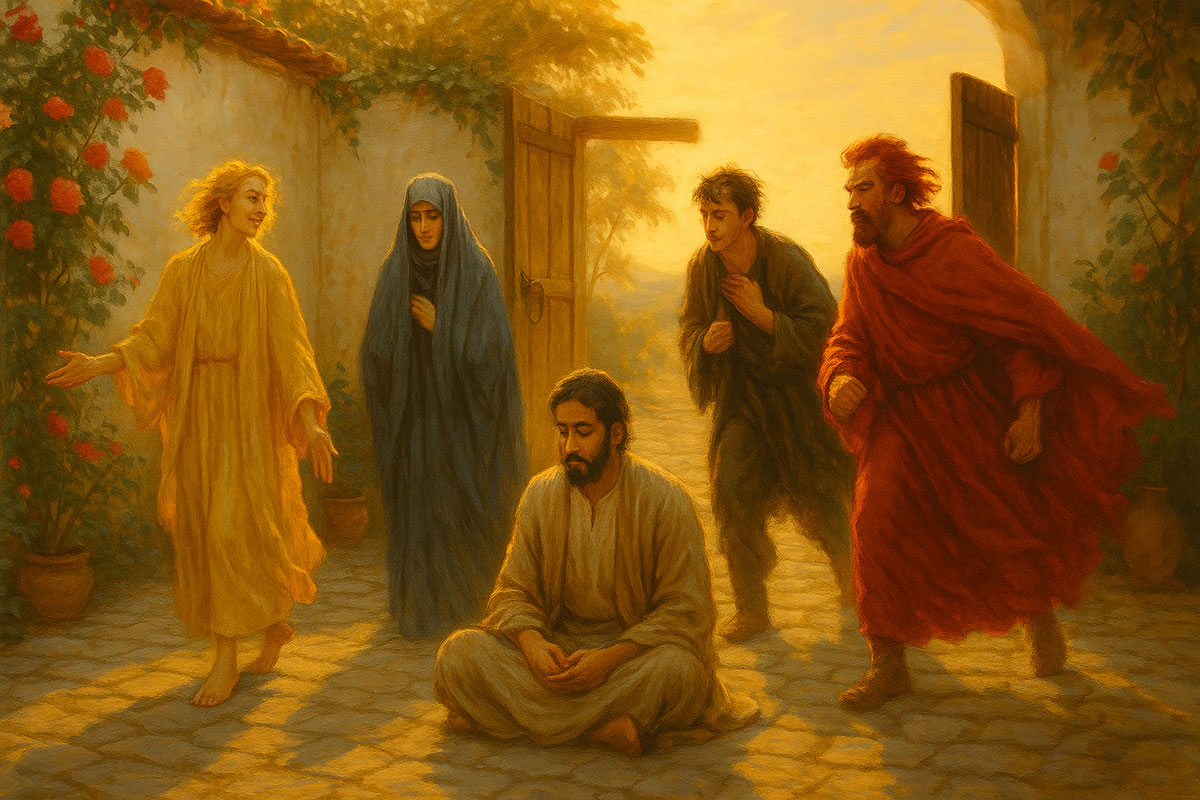
The first is Joy, radiant, golden like the dawn. She enters barefoot, her laughter like bells, carrying the scent of honey and figs. She runs her hand across the stone walls, leaving a faint shimmer wherever she touches.
Joy: “I bring warmth for your morning, Rumi. Will you welcome me?”
Rumi smiles faintly, inclining his head.
Rumi: “Always. Your presence turns walls into windows.”
Joy sits by the fountain, trailing her fingers through the water, humming softly.
Soon after, Sorrow enters. Draped in gray, her face pale and beautiful like the moon waning. Her footsteps are slow, heavy, like rain on clay. She carries the smell of wet earth, and when she exhales, the air feels colder.
Sorrow: “I come uninvited, as I always do.”
Rumi hesitates. His shoulders tense. Then, gently, he bows.
Rumi: “You are welcome, too. Without you, Joy’s song would lose its depth.”
Sorrow lowers her eyes and sits opposite Joy, the shimmer of laughter now laced with the echo of tears.
A sudden gust of wind shakes the shutters, and Anxiety arrives. His robes are restless, constantly shifting as if woven of smoke. He smells of iron and sweat, his eyes darting everywhere, unable to rest.
Anxiety: “I will pace your rooms, overturn your cushions, rattle your sleep. I cannot be still.”
Rumi frowns, then breathes slowly, steadying himself.
Rumi: “So be it. Disturb my order, remind me that peace is not something kept — it is something learned.”
Anxiety prowls along the courtyard walls, muttering to himself.
Finally, Delight bursts in. She is wild, fragrant like fresh oranges, her laughter reckless. She tosses a handful of rose petals into the air, and they land on Rumi’s shoulders.
Delight: “I don’t knock! I arrive like a festival!”
Rumi laughs despite himself, brushing petals from his robe.
Rumi: “Then you shall be treated as a guest, too — though your visit will scatter me for days.”
Delight spins across the courtyard, her footsteps leaving faint echoes of tambourines.
Rumi stands in the center of them all: Joy by the fountain, Sorrow by the wall, Anxiety pacing, Delight spinning. He looks up at the pale sky, his voice quiet but resolute.
Rumi: “This house is not mine alone. Each day a guest arrives — noble or wild, gentle or breaking. And my duty is not to judge, but to welcome.”
Rumi (inner monologue)
O heart, be wide as the sky. Do not close your doors. For each guest carries a secret, a lesson hidden in their cloak. Even the cruel visitor is a messenger of God.
He bows slightly toward the gathering.
Rumi: “Come, all of you. The table is set. Bread is warm, the fountain flows. Let my soul be your lodging.”
The scene stills. The smell of bread drifts stronger. The call to prayer fades into silence. And in the courtyard of dawn, Rumi’s house — his soul — fills with its first guests of the day.
Scene 2 — The Difficult Visitors (Konya, Afternoon)

The sun climbs high above Konya, flooding the courtyard with sharp light. The air grows thick, almost heavy, carrying the scent of dust and distant spices. The roses, so fragrant at dawn, now hang slightly limp, their petals edged with heat. Cicadas sing from hidden branches, their drone rising and falling like restless breath.
Rumi sits cross-legged by the fountain, a plate of bread beside him, the crust hardened by the noon sun. Joy hums softly still, though her voice is fainter now. Sorrow leans in the shade, silent, her presence a weight but not unkind. Anxiety circles ceaselessly, his footsteps echoing. Delight has vanished, leaving only petals scattered on the stone.
The stillness begins to shift. A shadow darkens the courtyard gate.
The first figure to enter is Anger. He storms in, his robes red and torn, his footsteps shaking the ground. The air around him smells of smoke and hot metal, as though a forge has been dragged into the garden. His voice rumbles, low and sharp.
Anger: “I do not knock. I do not wait. I enter when I please.”
Rumi rises slowly, his heartbeat quickening. For a moment, he wants to bar the gate, to shout, Leave me in peace! But he remembers his vow.
Rumi: “You, too, are a guest. Welcome.”
Anger narrows his eyes, circling the fountain. He strikes a clay pot with his fist, shattering it. Water spills across the stone.
Anger: “I will break your stillness. I will turn your quiet into fire.”
Rumi bows his head.
Rumi: “Then I will sit in your fire, until it teaches me its heat.”
The door creaks again. Shame enters next. Unlike Anger, she does not storm. She slinks, veiled in heavy cloth, her face hidden, her shoulders bent inward. The smell of damp stone follows her, and wherever she walks, the air grows colder.
Shame (whispering): “I am the one you do not speak of. The one you hide. But I come regardless.”
Rumi feels a chill crawl across his skin. He looks at his hands, suddenly aware of every flaw, every failure. For a moment, he wants to turn away, to say nothing.
Rumi (after a pause): “You, too, are welcome. Sit in the corner if you must. But know, this house does not close its doors to you.”
Shame curls into the shadow of the wall, her silence heavier than words.
As the sun leans westward, the final figure comes. Grief. He is tall, cloaked in black, carrying the smell of rain-soaked soil. His eyes are hollow but endless, like caverns filled with echoes. Each of his steps feels like a tolling bell.
Grief: “I stay the longest. Longer than Joy, longer than Delight. I linger until you believe I am you.”
Rumi’s chest tightens. Memories rise unbidden: friends buried, losses unnamed, the ache of separation that feels like eternity. Tears burn behind his eyes.
Rumi (quietly): “I know you. You have slept in my bed many nights. And though I feared you, still I learned to breathe through your weight. Welcome.”
Grief nods slightly and sits by the fountain, where the broken pot still leaks water. He touches it gently, as though it is his own reflection.
Now the courtyard is full: Joy humming faintly, Sorrow quiet, Anxiety restless, Anger raging, Shame shivering, Grief looming. Rumi stands in the center, his robe damp with sweat, his pulse unsteady.
Rumi (inner monologue)
This is unbearable. A house should be peaceful, ordered. Yet mine is full of fire, silence, cold, and ache. How can I endure these guests? How can I let them stay without collapsing?
The cicadas grow louder. The scent of dust thickens. For a moment, Rumi staggers under the weight of them all.
Then, slowly, he closes his eyes.
Rumi (inner monologue)
These visitors are not punishments. They are teachers. Anger shows me where I am bound. Shame shows me where I must forgive. Grief shows me the depth of love itself. Even Anxiety, pacing, keeps me awake. I must not turn them away.
He opens his eyes again, clearer now.
Rumi (aloud): “This house is wide enough for all of you. Break what you must, silence what you will. I will not resist your visit. For each of you is a messenger of God, even if you come clothed in darkness.”
The sun finally lowers, easing its grip. A faint wind stirs the air, carrying the fragrance of jasmine beginning to bloom. Anger lowers his fists. Shame exhales, a sound like a sob. Grief bows his head.
The guests remain, but something has shifted: their weight no longer crushes, but deepens the space.
Rumi lowers himself again by the fountain, his robe damp where the water spilled. He breathes deeply, as if the courtyard has grown larger, as if his soul has stretched.
Rumi (inner monologue)
This being human is no small task. It is to play host to storms and sunlight alike. It is to make room for ruin and renewal. I will not bar the door. Let them all come. I am the guest house, and every guest is divine.
Scene 3 — The Secret Gift (Konya, Evening)

The sun has dipped below the horizon, leaving the courtyard veiled in indigo. A cool breeze sweeps through, carrying the sweet fragrance of jasmine blossoms and the ripe tang of figs from a nearby orchard. Lanterns are lit one by one, their flames flickering, painting soft halos against the whitewashed walls.
The guests are still here. Anger sits, his shoulders hunched but quieter now, the smoke around him thinning. Shame lingers in the shadows, her veil hiding most of her face. Grief rests by the fountain, his hand trailing through the broken water jar’s slow trickle. Anxiety continues to pace, though his steps have softened. Joy and Sorrow sit side by side, a strange pair, humming the same low tune.
Rumi rises, the light of the lantern catching his face, making his eyes glow like coals. He surveys the courtyard and speaks softly, as if to the night itself.
Rumi: “You all arrived with such force, as though you wished to destroy me. Yet now, I see more. You are not intruders. You are teachers disguised as guests.”
The breeze stirs, carrying his words into every corner of the courtyard. One by one, the guests begin to reveal themselves.
Anger lifts his gaze. His red robes flicker like embers, but his voice has steadied.
Anger: “I came to shatter your peace, yes. To show you what lies hidden beneath calm waters. But in my fire is courage. Without me, you would let injustice pass untouched.”
Rumi closes his eyes, feeling the heat, and nods.
Rumi: “Then you are the flame that shapes the sword of truth.”
From the shadows, Shame whispers, her voice breaking like glass.
Shame: “I pressed your face into the dust. I made you bow your head. But I do not come to destroy you. I remind you of your limits. I keep you humble when pride tempts you to forget.”
Her veil slips slightly, and her eyes glimmer with something not cruel but tender.
Rumi: “Then you are the mirror that shows me my humanity. Without you, I would mistake myself for more than a servant of God.”
Shame bows her head and retreats again into silence, but softer now.
Grief rises slowly from the fountain. His cloak shifts like heavy clouds, and his voice is deep, echoing.
Grief: “I sit longest because I carry the deepest gift. I carve hollows within you, Rumi. Hollows where love may dwell more fully. My weight makes your soul vast enough to hold eternity.”
Rumi’s tears glisten in the lamplight, but his smile is gentle.
Rumi: “Yes… you are the depth in which joy finds its echo. Without you, love would remain shallow.”
Grief sits again, but now his presence feels like a cathedral—solemn yet sacred.
Anxiety stops pacing, his eyes darting less wildly. His voice quivers but holds.
Anxiety: “I scattered your thoughts, kept you from rest. Yet I sharpen your awareness. I keep you awake to dangers, to possibilities. I remind you that the future is uncertain, and so the present is precious.”
Rumi approaches him, placing a hand on his trembling arm.
Rumi: “Then you are the watchman on the tower. You sound the alarm, not to destroy me, but to keep me vigilant.”
Anxiety breathes deeply, his restlessness dimming, like wind finally settling into breeze.
From the fountain, Sorrow lifts her eyes, dark and luminous.
Sorrow: “I made your heart heavy, but in that weight is tenderness. You love more deeply because of me.”
Beside her, Joy smiles softly.
Joy: “And I, too, am shaped by her. Without Sorrow, I am shallow laughter. With her, I am gratitude.”
Rumi looks at both, his voice reverent.
Rumi: “You are twins. One gives depth, the other brightness. Together you weave the fabric of my soul.”
The courtyard seems larger now, as if the very walls have stretched to contain the revelation. The guests no longer feel like burdens but like bearers of hidden gifts, each one essential.
Rumi turns toward the night sky, where stars have begun to appear, bright against the velvet dark. The sound of a ney flute drifts faintly from the streets beyond, mournful and sweet.
Rumi (inner monologue)
Every guest is a messenger. Every emotion a divine envoy. The task is not to resist, but to welcome, to listen, to learn. This house of mine is not fragile—it is endless.
He bows deeply, first to the guests, then to the heavens.
Rumi: “You have shown me your true faces. Anger, Shame, Grief, Anxiety, Joy, Sorrow—each of you has carried a gift I once feared. Forgive me for closing my heart. From this night forward, my doors remain open.”
The lanterns flicker brighter, as if in agreement. The scent of jasmine thickens, mingling with the faint sweetness of figs. The air feels lighter, the courtyard alive.
Rumi (inner monologue)
The house of being is eternal. Each day a guest arrives, each carrying a hidden blessing. I will meet them all with a smile, even when they come cloaked in pain. For I see now: all are sent by the same hand.
Scene 4 — The Eternal Guest House (Konya, Night)

The courtyard glows in hushed radiance. The lanterns, now dim, flicker like watchful eyes. Beyond the walls, Konya has fallen into silence, broken only by the far-off call of a night watchman and the faint bray of a donkey in the streets. The stars arch above like an endless dome, their light dusting the garden with silver.
The air is cool, carrying the fragrance of night jasmine and warm bread cooling in a neighbor’s oven. The sound of the ney flute drifts again, mournful, tender, the reed’s lament for being cut from its source.
Rumi stands at the heart of his courtyard. His robe stirs in the breeze, his face calm yet illuminated from within. Around him sit the guests: Anger quieter now, like embers after flame; Shame hidden but still present in the shadows; Grief solemn by the fountain, his hand trailing the water; Anxiety pacing with softer steps; Joy humming faintly; Sorrow keeping her quiet watch.
They are no longer strangers. They are part of the house.
Rumi (to the guests, to the night, to the unseen):
“This being human is a guest house.
Each day, a new arrival.
Some carry laughter, some bring grief,
others break your furniture or empty your cupboards—
yet all are messengers sent from beyond.”
He pauses, lifting his face to the sky. The stars seem to pulse brighter, as though leaning closer.
Rumi:
“So welcome them.
Honor their lessons.
Give even the dark ones a seat at your table.
For within their cloaks lies the gift you prayed for,
though you do not recognize it yet.”
The guests shift. Anger lowers his head, his fists unclenched. Shame allows a sliver of her veil to fall, revealing eyes glistening like wet stone. Grief closes his eyes, his stillness no longer suffocating but vast, like the ocean. Anxiety stops pacing, taking one long breath. Joy and Sorrow share a glance, their hum becoming a harmony.
Rumi walks among them slowly, his bare feet brushing the cool stone.
Rumi (inner monologue)
I once feared them, cursed them, wished them gone. Now I see: my fear was the locked door. The moment I opened it, each guest became not a curse, but a guide. This house of mine is endless. The more I welcome, the larger it grows.
He stops by the fountain, gazing into the broken water jar that Grief touched. The dripping echoes like a heartbeat in the quiet night.
Rumi:
“Do not turn away those who break you.
They clear the space for something new.
Do not curse the sorrow that empties your chest—
it hollows you to hold joy more fully.
Even the thief, even the destroyer—
welcome them, for they too are part of the divine script.”
The ney flute swells, carried on the breeze, as if the very air responds to his words. The courtyard seems to expand, the walls melting away until the night sky feels like the true roof of the house.
Rumi lowers himself to the ground, sitting cross-legged in stillness. The guests gather around him in a circle. Their faces, once so fierce or heavy, now glow with a strange unity, like fragments of the same jewel.
Rumi (inner monologue)
This house is eternal. It was here before I was born. It will stand long after I am gone. It does not belong to me, nor to my guests, but to the One who sends them. I am only the doorkeeper, called to bow as each arrives.
He bows his head, palms open.
Rumi:
“So be grateful for whoever comes,
for each has been sent
as a guide from beyond.”
The ney fades into silence. The lanterns flicker one last time, then steady. The guests remain seated in calmness, as though they too have been transformed.
Above, the stars gleam, patient and infinite. The courtyard exhales, alive with stillness.
And Rumi whispers, almost to himself, almost to God:
Rumi:
“This guest house is not mine.
It belongs to Love alone.
And Love will never cease
to send me company.”
 Curtain falls.
Epilogue
(As if the curtain falls, Konya beneath the stars)
The lanterns are dim now,
the courtyard empty,
the guests departed or sleeping.
But the house is not silent.
It breathes.
It waits.
It knows another knock is coming.
Do not close the doors.
Do not curse the visitor who brings grief
or the one who leaves laughter in his wake.
For each guest is a guide,
and each guide is God in disguise.
This being human is a guest house.
Its walls stretch wider than the sky.
And Love will never stop
sending company.
Short Bios:
Rumi
Mystic poet, scholar, and Sufi teacher of 13th-century Konya. His words bridge heaven and earth, reminding us that every human experience is a doorway to the Divine. Here, he is not only poet but host, opening the house of his soul to all who arrive.
Joy
Radiant and golden, she enters with the scent of figs and honey, laughter ringing like bells. She is the light that makes the soul dance, though fleeting in her visits.
Sorrow
Pale and moonlit, her footsteps are slow and heavy, carrying the cool scent of rain. She teaches depth, tenderness, and the kind of love that does not vanish.
Anxiety
Restless, cloaked in smoke, his eyes dart and his steps never cease. Though unsettling, he sharpens awareness and reminds us that the present moment is precious.
Delight
Wild and fragrant as fresh oranges, she arrives like a festival, scattering petals with reckless laughter. She disrupts, dazzles, and leaves the house echoing with her energy.
Anger
Fiery, red-robed, and storming, he smells of smoke and iron. He shatters stillness and breaks what seems solid, yet carries the hidden gift of courage.
Shame
Veiled and quiet, she slips into shadows, her presence cold as damp stone. Yet she bears humility, the mirror that reveals the soul’s limits and keeps pride in check.
Grief
Tall and solemn, cloaked in black, he lingers longest, smelling of rain-soaked soil. Though heavy, he hollows the heart so it may hold more love, and sanctifies life with depth.
Leave a Reply