
|
Getting your Trinity Audio player ready...
|
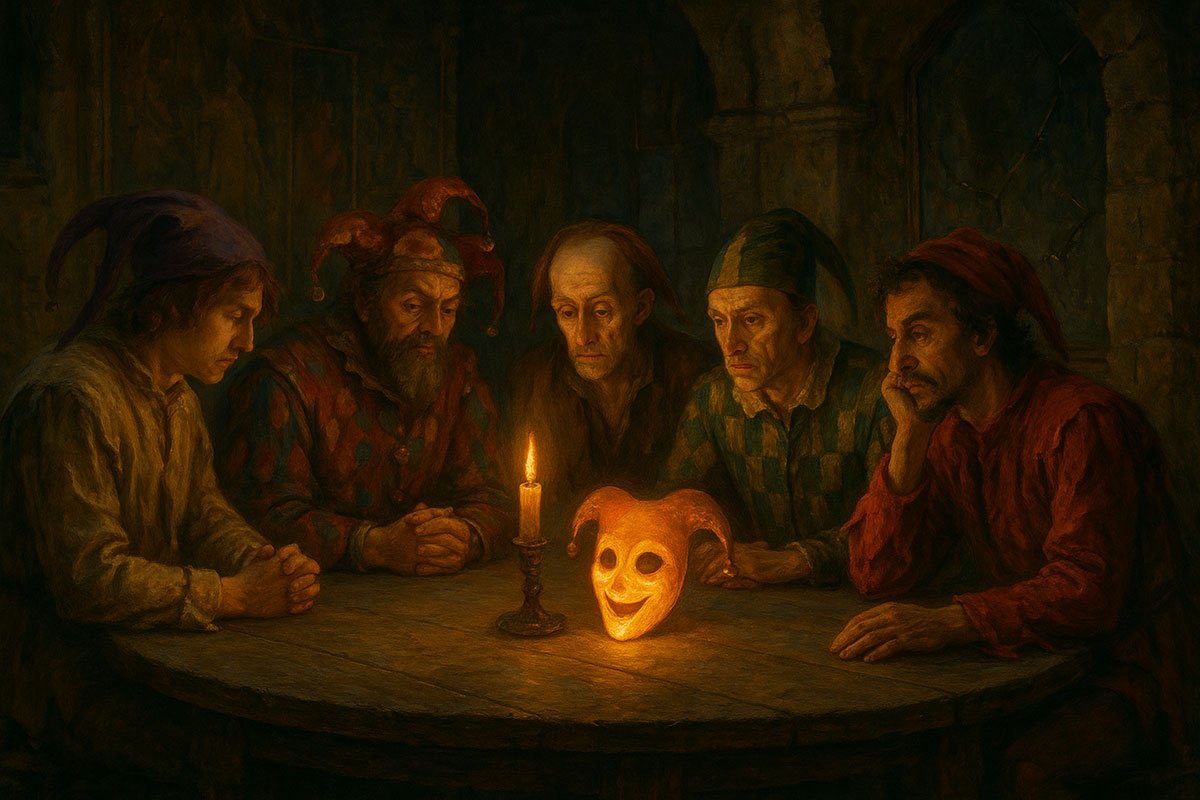
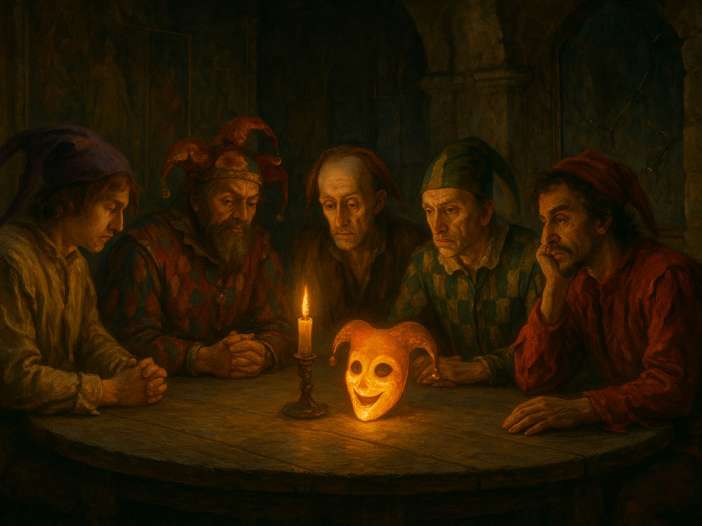
Sir Ian McKellen:
I have walked the long corridors of Shakespeare’s world—worn the crowns of kings, wielded the swords of madmen, and wept in the arms of fate. But always, it was the fools… who whispered the deepest truths.
They come cloaked in jests, eyes bright with mischief, words tipped with daggers. We dismiss them too easily—until their laughter echoes through our bones, unsettling us in ways even tragedy cannot.
In this gathering, we do not consult generals or philosophers. We do not seek sermons from pulpits or proclamations from thrones. Instead, we sit at a roundtable of jesters—each absurd, each flawed, each holding a candle against the great unknown.
These are the ones who speak when others fall silent.
Who dare to mock power and cradle grief in the same breath.
Who understand—more than any of us—that truth, when dressed in motley, walks safest through the storm.
So we begin.
Not with pomp, nor prayer—but with the fools, who have always known that the soul listens best… when it is laughing.
(Note: This is an imaginary conversation, a creative exploration of an idea, and not a real speech or event.)

Topic 1: Who’s Laughing Now? — When Truth Wears a Fool’s Mask
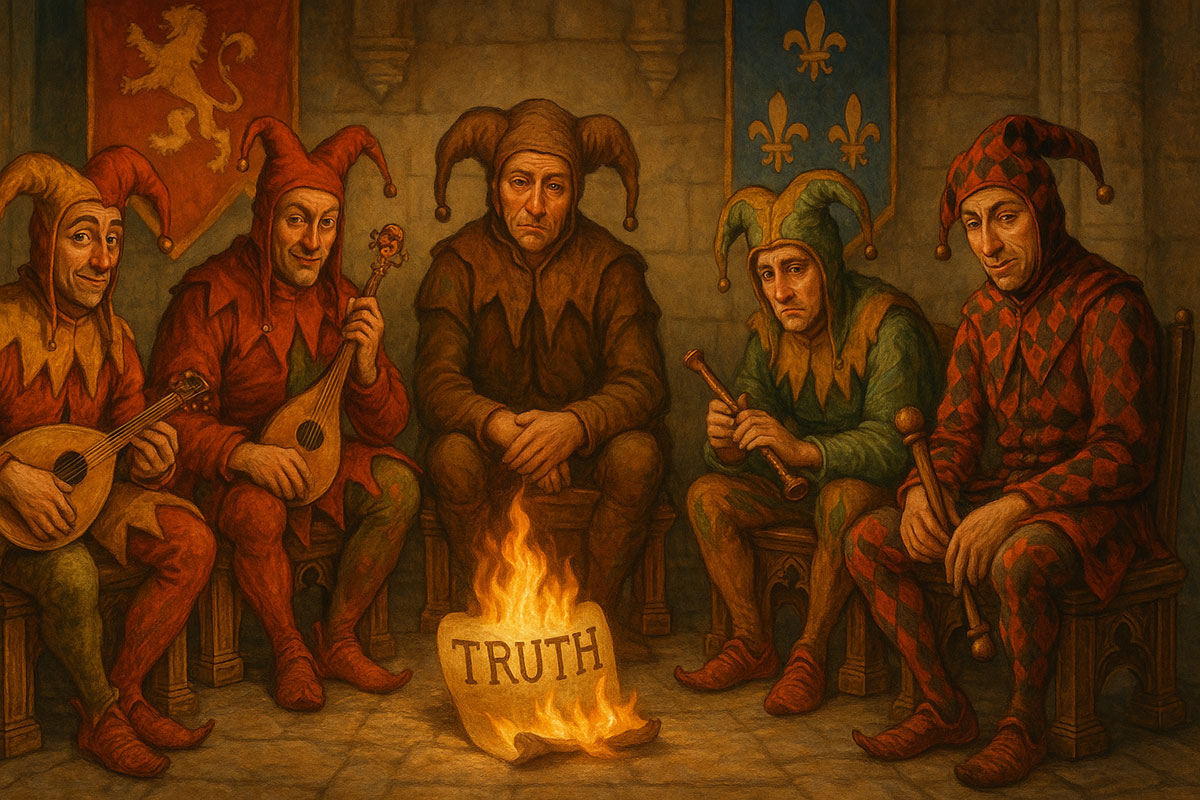
Moderator:
Harold Bloom
Participants:
The Fool (King Lear)
Feste (Twelfth Night)
Touchstone (As You Like It)
Costard (Love’s Labour’s Lost)
Dogberry (Much Ado About Nothing)
Opening by Harold Bloom
"In the age of Shakespeare, the fool was not merely tolerated—he was needed. Today, when every truth must wear a mask to survive the public square, the fool returns with urgency. These are not jesters, but physicians of meaning, examining our madness with a feathered mirror. And so we ask: when truth has no home, does it sneak in laughing?”
 “Why do people trust a fool’s joke more than a wise man’s truth?”
Feste:
Because a joke is a soft dagger, sir. It slides between ribs while the guard is down. Say a thing straight and you’re scorned. Say it crooked—and they ask for more. Fools are safe because no one thinks we mean it. Which is when we always do.
Dogberry:
Marry, I say things most profound! Only… no one takes me serious. Which is why they listen. If I had Latin, they’d fear me. But since I bumble, they chuckle. I think that makes me, well, invincible in public discourse!
Touchstone:
In court, the truth wears a costume. So do I. But I know I’m wearing one. Most men forget. The fool confesses his mask, and in that paradox, the truth finds breath.
The Fool:
Truth’s a wild thing. Tame it, and it dies. So we dress it in motley, and sing it into the ears of kings. If I’d told Lear plainly, he’d have struck me. But rhyme is slipperier than wrath.
Costard:
Words are like juggling balls. Toss ‘em bright and bouncing, they’ll stare. Speak ‘em flat—and they sleep. My truth is a circus act, but mind you—there’s philosophy in pratfalls.
“Has truth become performance today—and is that dangerous or divine?”
Touchstone:
Performance is survival now. Everyone plays a part. Even authenticity has become a costume—just a better-fitted one. The danger lies not in pretending, but in forgetting that we do.
Feste:
We’ve traded prophets for influencers. They rhyme less prettily but sell more tea. Still, if the heart bleeds beneath the performance, perhaps the lie is sanctified by the ache.
Dogberry:
Truth? I perform every day! But I swear I stumble on truth more often than my lord does by planning. So if performance be truth’s mother, let the play go on!
Costard:
Divine, if you ask me. For what is religion but theatre with better lighting? If it helps them see the stars, let them wear glitter. But beware the fool who forgets the script.
The Fool:
What’s divine wears jest. The world is too mad for sober truth. I’d rather truth stumble drunk into the room than never enter at all.
“What do you wish the world would hear in your laughter—but never does?”
The Fool:
That I loved my king as a child loves a parent. And my laughter was a cry. But Lear heard only bells.
Costard:
That behind every jest lies a mirror. I show them their foolishness, but they think I dance. It wounds, sweetly.
Feste:
That I too mourn. I too fear silence. But I play—so they won’t have to face the quiet.
Touchstone:
That I see more than they think. I tally hypocrisies, count the cracks in every crown. Yet I smile, because it is better to grin than growl when the stage is crumbling.
Dogberry:
That I’m not as daft as I seem. But also, that I am. And maybe that’s its own kind of clarity.
Final Reflection by Harold Bloom
“We leave not with conclusions, but with confession. Shakespeare’s fools remain prophets dressed in tatters, standing just offstage, whispering truths no hero can bear. In an era where sincerity is suspicious and power hides behind parody, it may be the fool—misunderstood, mistaken—who carries the last real torch of meaning.”
Topic 2: The Collapse of the Serious — Why the World Needs the Wise Fool
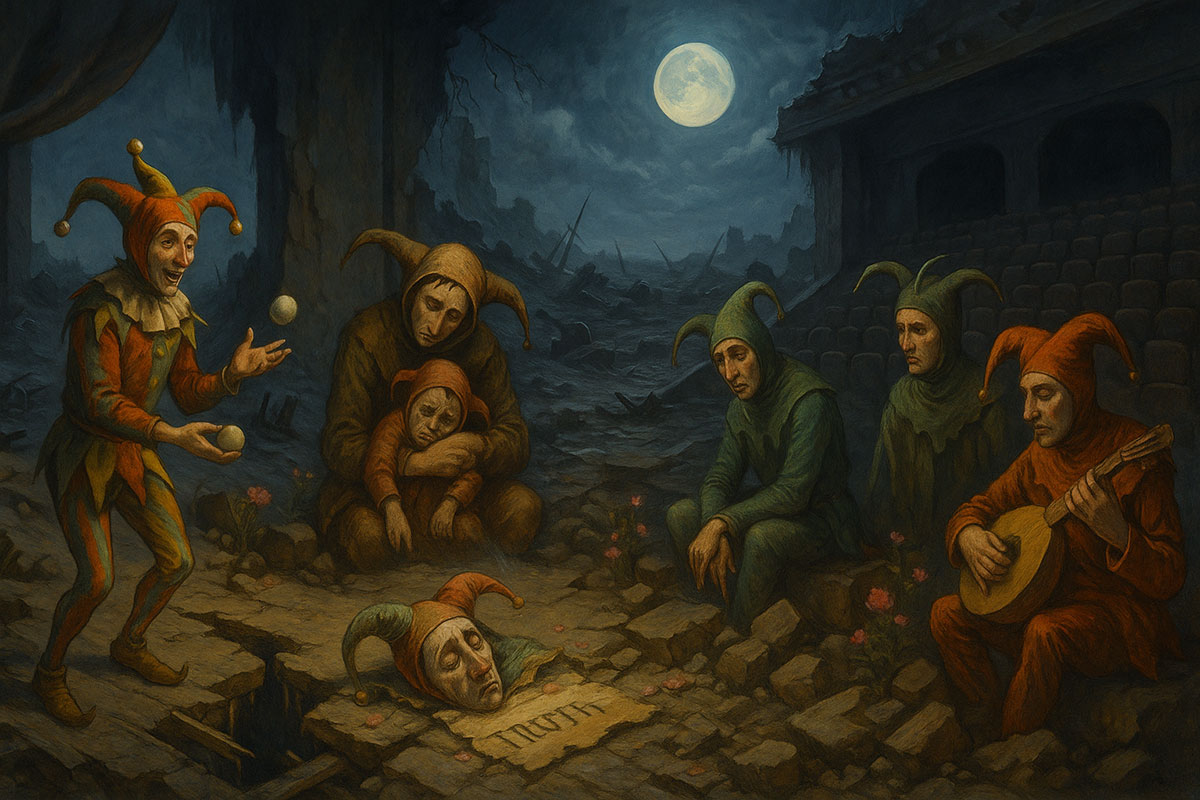
Moderator: Robin Williams
Opening by Robin Williams
"Sometimes I think the only people holding the world together are the ones who make us laugh while it's falling apart. Fools, jesters, clowns—these weren’t just entertainment. They were emotional first responders. In grief, confusion, and war, they handed us joy like oxygen masks. Today, we’ll ask: Is laughter still a survival tool… or is it now a cry for help?”
Participants:
Falstaff (Henry IV)
Feste (Twelfth Night)
Puck (A Midsummer Night’s Dream)
Trinculo (The Tempest)
Grumio (The Taming of the Shrew)
“Why does the world take tragedy seriously, but not comedy—even when both carry truth?”
Feste:
Because tragedy dresses in black and walks slowly. Comedy wears mismatched socks and falls down stairs. But they come from the same room in the heart. One whispers. One shouts. Both mean: Look closely, or you’ll miss it.
Falstaff:
Oh, they love a good funeral—but mock a man who drinks too deeply to forget he’s dying. I know truth, lad. I’ve slept in its gutters and toasted its betrayal. But say it with a grin, and they think you jest. Fools bleed too, you know.
Trinculo:
A storm’s a storm whether you cry or crack a joke in it. But laugh, and they call you mad. I say—better mad and merry than sane and sinking.
Puck:
The world is enchanted by its own solemnity. It thinks laughter cheapens truth. But I’ve seen moonlight reveal more than swords ever could. And mischief? Mischief reveals masks.
Grumio:
Serious folk love to frown. Makes ‘em feel wise. But a well-placed pie to the face? Now that’s theology. It says, “All flesh is fragile—and funny.”
“Is laughter still medicine—or just another numbing distraction?”
Trinculo:
It depends what you’re trying to forget. If you’re laughing to avoid, beware. But if you’re laughing to endure—friend, you’ve found holy ground.
Falstaff:
Medicine? Ha! It’s the only thing that’s ever worked. Wine, women, war—they all lie. But a good belly laugh? That’s truth unclothed and rolling on the floor.
Grumio:
I’ve seen beatings softened by laughter. A cruel master trip on his own pride. A crueler wife slip on her own slipper. A jest, rightly timed, can humble tyrants.
Feste:
Laughter numbs when it’s hollow. But when it sings from sorrow—it heals. Think of it as a violin made of cracked ribs. Every note costs something.
Puck:
Laughter is both mask and mirror. Sometimes we use it to hide. Sometimes to reveal. But it always shows where we’re sore.
“What have you seen in grief or pain that only a fool could name?”
Puck:
That the heart grieves in spirals, not lines. And that most grief is pretending not to grieve. So I dance in circles to match them.
Feste:
I saw a woman laugh at her brother’s grave. Said it was the only way to feel him close. The priest disapproved. I applauded. Quietly.
Falstaff:
I’ve known soldiers die with jokes on their lips—because they knew silence would break them first. The fool sees what the brave deny.
Grumio:
I’ve seen pain that made men speak in riddles, just to survive. I answer them in puns. They never thank me—but their eyes soften.
Trinculo:
Only a fool sees the drowned man and says, “Well, at least he’s past the worst of it.” And yet… maybe that’s not untrue.
Final Reflection by Robin Williams
"When the world grows too heavy for one truth, the fool brings two: one to lift, and one to open. In comedy, we touch what tragedy cannot reach. And in the fool’s cracked voice, we sometimes hear the most human thing of all: not the punchline—but the pause before it.”
Topic 3: Mistaken Again — Identity, Mirrors, and the Masks We Forget to Take Off
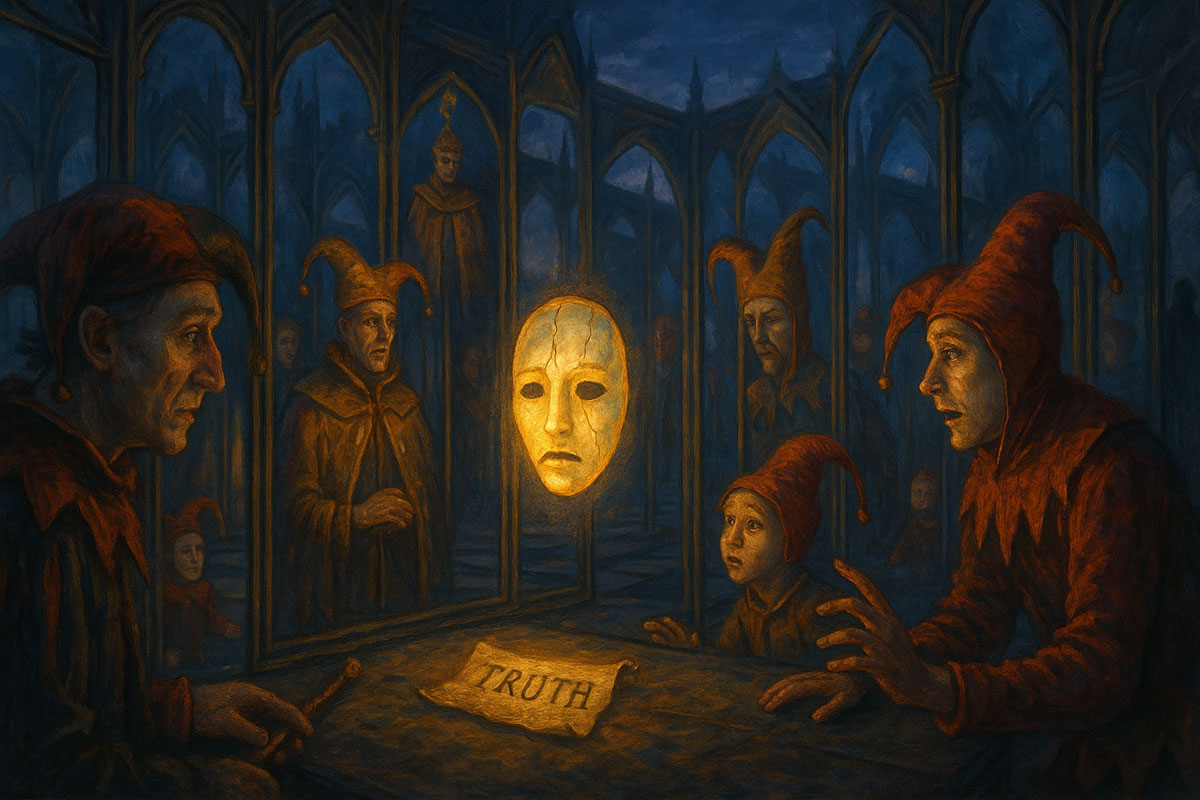
Moderator:
Virginia Woolf
Why her? Few writers understood the fluidity of identity better than Woolf. Her sensitivity to the masks women, artists, and even the self must wear—especially in public—makes her a brilliant guide through this topic of illusions, personas, and fractured selves.
Opening by Virginia Woolf
“Identity, that shy animal, is often caged in costumes not of its own making. We wear masks to survive, to please, to hide. But what becomes of the soul when the mask fits too well? Tonight, I sit with fools—those who wear masks openly—to ask: Is the self something we discover, or something we perform until we believe it?”
Participants:
Autolycus (The Winter’s Tale)
Dromio of Syracuse (The Comedy of Errors)
Touchstone (As You Like It)
The Fool (King Lear)
Launcelot Gobbo (The Merchant of Venice)
“Have you ever forgotten who you truly were beneath the role you were playing?”
Autolycus:
Often. I’ve sold lies so well, I’ve bought them back at full price. But survival teaches you this: the truth is sometimes less useful than the illusion of it.
Touchstone:
What is the “true self” but a better-rehearsed performance? I’ve worn my jesterhood so long, I no longer know if I jest—or merely am.
Dromio:
I was mistaken for my brother so often, I began to answer to his name. Identity, for me, is a shared costume. We pass it back and forth and hope no one looks too close.
Launcelot Gobbo:
I left my master thinking I’d find myself. All I found was more masks—some fancier, some crueler. The mask is safer than the face.
The Fool:
I wore motley to protect my king. But when he lost his mind, who was I protecting? Him, or myself? And if he was mad, what did that make me?
“In today’s world, people perform their lives online. What would you say to someone who’s tired of pretending?”
Dromio:
Step backstage. Breathe. You don’t have to be watched to exist. You can still be real in the quiet.
Touchstone:
Then stop the show. Let the curtain fall. If no one claps, better to hear your own silence than the audience’s demand for encore after encore.
Autolycus:
Pretending is a trade, like mine. But even the finest conman must rest. Be unseen for a while. There’s gold in shadows.
The Fool:
Stop pretending you aren’t pretending. Begin there. The mask becomes lighter when you know it’s a mask.
Launcelot Gobbo:
Pretending is exhausting. But so is being stripped bare. The trick is to wear a mask that lets you breathe—not suffocate.
“What is something you’ve seen only fools recognize about identity?”
Touchstone:
That everyone is pretending. Kings, lovers, shepherds—no one is wholly true. But fools admit it. That’s the difference.
Dromio:
That identity is flexible. It bends like a joke—painful if forced, joyful if danced with. We fools wiggle, and that makes us survive.
The Fool:
That identity, like truth, doesn’t like to be looked at directly. It appears in mirrors, riddles, and laughter—not declarations.
Autolycus:
That names are currency, not character. I’ve been prince, peasant, peddler—all while being Autolycus underneath. Or perhaps not.
Launcelot Gobbo:
That to lose oneself completely is not always a tragedy. Sometimes, it’s a doorway. Only the fool dares walk through it grinning.
Final Reflection by Virginia Woolf
“We speak of ‘finding ourselves’ as if the self waits in a field somewhere, calling our name. But perhaps the self is not one voice, but a choir of shifting tones. And maybe the fool, who sings in riddles and plays with masks, has known all along that the truest identity is the one that admits it is never finished.”
Topic 4: Playing the Game — Power, Status, and the Art of Pretending
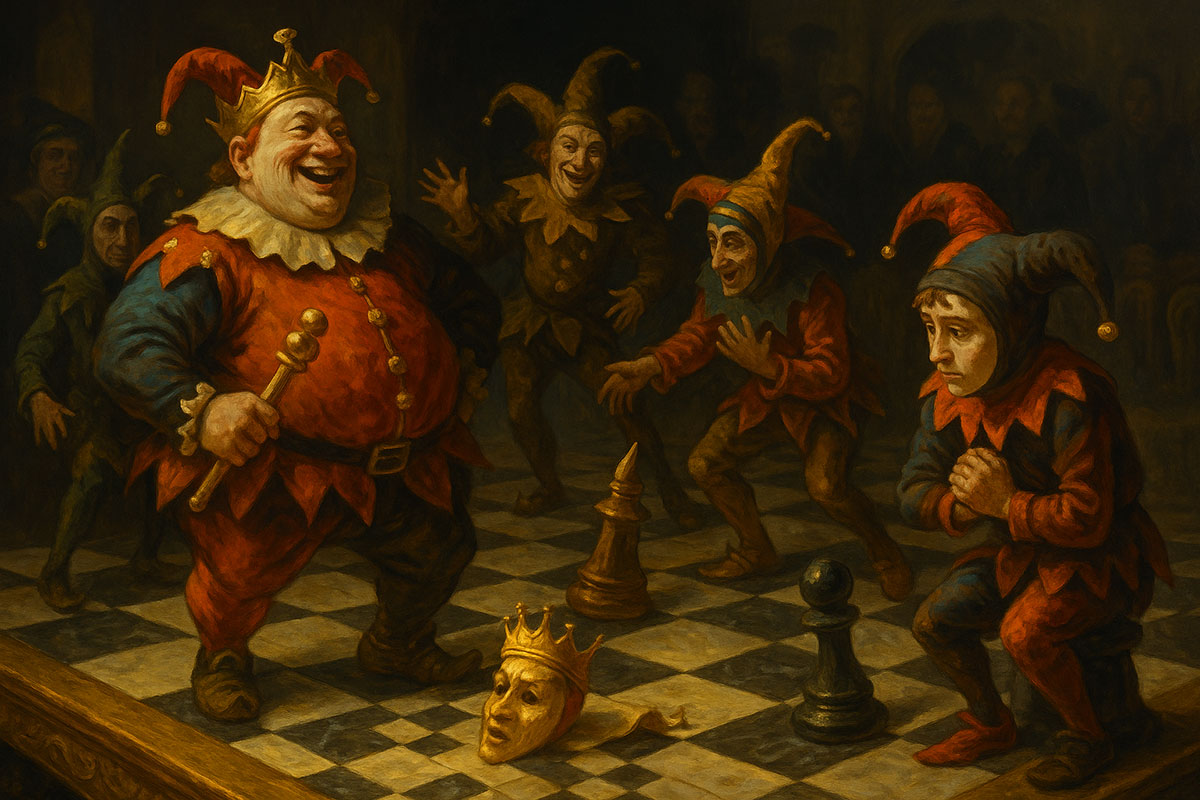
Moderator: Oscar Wilde
Why Wilde? No one understood the performance of social power quite like Oscar Wilde. His wit was both shield and scalpel, and his life—rising through and ultimately being destroyed by society’s hierarchies—mirrors the very paradox this topic explores. He’ll lead this roundtable like a satirical symphony conductor.
Opening by Oscar Wilde
“Society, dear ones, is the most expensive masquerade ball ever thrown—though the tickets are mostly illusion and the dress code is always hypocrisy. Power is not held—it is performed. And status is a role rarely played with grace. So let us ask: If life is a stage, who’s really writing the script… and who dares to improvise?”
Participants:
Falstaff (Henry IV)
Costard (Love’s Labour’s Lost)
Trinculo (The Tempest)
Launcelot Gobbo (The Merchant of Venice)
Touchstone (As You Like It)
“Is power something you earn… or something you simply pretend well enough to hold?”
Trinculo:
Oh, pretend, absolutely. I once convinced a half-monster I was a god—by accident. Power is confidence on stilts. Fake it, and they kneel.
Falstaff:
I earned nothing, and yet commanded kings’ laughter and thieves’ loyalty. What is earned, boy, if charm buys more than coin ever could?
Costard:
Pretending’s all there is. I once baffled scholars just by speaking nonsense with confidence. If they applaud, you’re powerful. If not, you’re a fool. Or both.
Touchstone:
I once watched a duke weep privately, then strut among courtiers as if made of steel. Power is simply costume with conviction.
Launcelot Gobbo:
I switched masters and gained nothing but new uniforms. Yet I walked taller, and they bowed lower. The trick is not power itself—but the story around it.
“What do those in power fear most—truth, ridicule, or being ignored?”
Costard:
Being ignored. The crown glitters for applause, not substance. Strip the audience, and the emperor looks very cold indeed.
Launcelot Gobbo:
Ridicule stings deeper than rebellion. A mocked master is already dethroned. Laughter is the loudest guillotine.
Falstaff:
Truth is a drunk man at a wedding. Everyone hopes he passes out before speaking. So yes, truth terrifies—but ridicule scars.
Trinculo:
They fear being seen without the story. Nakedness isn’t in body, it’s in loss of myth. Once people see you sweat, the charade crumbles.
Touchstone:
A forgotten name is a dead name. They’d rather be hated than unseen. That’s why kings commission statues and poets. And fools—well, we live forever, don’t we?
“What’s one power move you’ve seen from a fool—intentional or not—that undid someone important?”
Trinculo:
I once bowed too deeply and farted loudly. The nobleman turned purple with rage. The crowd laughed. From that day on, he never commanded silence again.
Touchstone:
I flirted with a court lady too boldly once, then joked it was satire. The duke couldn’t punish me without proving my point. Sometimes, foolishness is the perfect shield.
Falstaff:
I mocked a prince to his face. He laughed. Then I watched him weep alone days later. Fools speak what fathers won’t. That’s more powerful than swords.
Launcelot Gobbo:
I offered a nobleman my left hand—accidentally. He refused it with disgust. The onlookers saw his vanity, not my blunder. The hand was foolish, but the mirror was true.
Costard:
I made up a word. Spoke it like scripture. A lord repeated it proudly. When I revealed its meaning—well, he lost more than face. He lost his self-importance.
Final Reflection by Oscar Wilde
“Perhaps the only true power is to see through the whole game and still smile. The fools here remind us: the ladder of status is slippery, the throne a stage prop, and the scepter often just a stick. To laugh, then—to laugh truthfully—is not only rebellion… it is freedom.”
Topic 5: The Last Laugh — What the Dying Know That the Living Forget
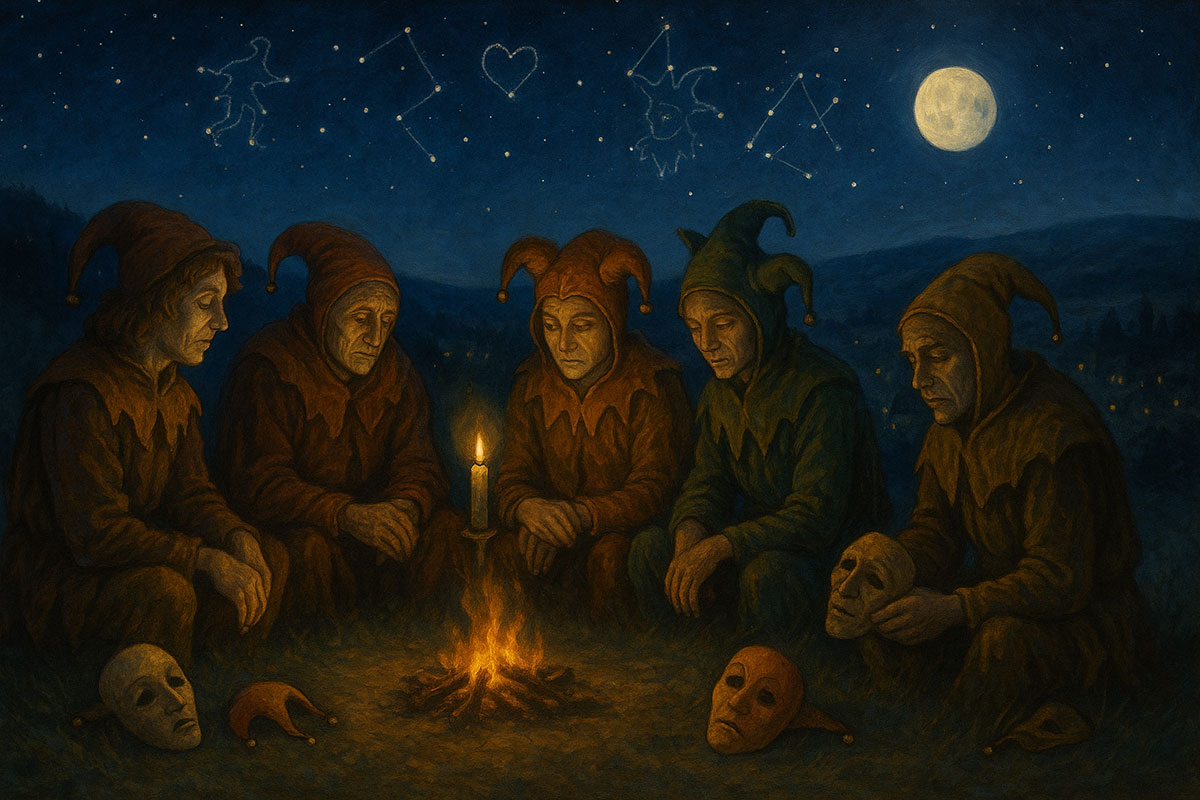
Moderator:
Charlie Chaplin
Why him? Chaplin understood the silent ache behind every laugh. His comedy came from poverty, exile, loss, and longing—and yet he gave the world joy. There’s no better figure to guide a room of Shakespearean fools through a conversation about death, memory, and the gentle courage it takes to smile into the unknown.
Opening by Charlie Chaplin
“When I was a boy, we didn’t have much. A crust of bread, a pair of shoes, and a reason to laugh—that was wealth. Later, they gave me cameras, stages, and banishments. And still, I learned: Laughter is not the opposite of sorrow—it is its twin. Today, I ask my fellow fools: When the curtain falls, what matters? What do we wish we’d said… or laughed at… before the lights went out?”
Participants:
The Fool (King Lear)
Feste (Twelfth Night)
Puck (A Midsummer Night’s Dream)
Grumio (The Taming of the Shrew)
Autolycus (The Winter’s Tale)
“What would you whisper to someone afraid of dying?”
Feste:
I'd sing them a song about the rain falling equally on kings and clowns. Then I’d tell them: “You’ll be missed more than you think—and remembered more kindly than you fear.”
Puck:
I’d say: “It’s just a scene change. You won’t even feel the costume go.” And if they cried, I’d make the stars flicker like candlelight. Death deserves a little magic.
Autolycus:
I’d confess that I too am afraid. But I’ve stolen time with both hands, and it was worth every moment. Tell them to take one last bite of life. Even crumbs are sweet at the end.
The Fool:
I’d remind them that even Lear died with a question. And maybe that’s the grace of it—we don’t need answers. Just love, and a good hand to hold.
Grumio:
I’d whisper a joke. A bad one. The kind that makes them groan. And when they laugh despite themselves—I’d say, “That laugh? That’s your soul remembering itself.”
“What is one thing the dying remember that the living forget?”
Autolycus:
That nothing is owned. Not land, not lovers, not even time. You borrow it all. And what you give back—the laughter, the mercy—is what stays.
Grumio:
They remember childhood, oddly enough. The smell of bread, a hand in theirs, a time before masks. Maybe dying is just remembering we were once simple.
Feste:
That regret is quieter than fear—but it lingers longer. And that joy never feels wasted, even when foolish.
The Fool:
That love is the only thing that speaks at the end. Not status. Not pride. Just love, and whether it was spoken plainly or not at all.
Puck:
That the world keeps turning, even without them—but softer, like it knows they’re watching from the dark.
“When your laughter fades, what do you hope remains in the room?”
Puck:
A light breeze. A smile in someone’s chest. Maybe a joke they’ll tell again, not knowing why it comforts them.
Grumio:
A slipper out of place. A pie crust burned. Something small and ridiculous—proof that I made them smile when it mattered.
The Fool:
Silence—but not empty. Full of memory. Full of the feeling that someone, once, said what no one else dared to.
Feste:
A humming tune with no words. Something soft, left behind. May my absence sing, not weep.
Autolycus:
A coin in their pocket they didn’t know was from me. Something useful, quiet, humble. The best gifts are the ones they don’t realize they’ve carried.
Final Reflection by Charlie Chaplin
“We do not end—we echo. In every laugh we leave behind, there is a story: of love unspoken, truth half-joked, joy briefly stolen from sorrow. The fools here have taught me that death is not silence—it is the punchline that makes the setup holy. And in that final beat… may we all hear applause.”
Final Thoughts By Sir Ian McKellen
Now the jests are quiet, and the masks lie still. The fools, having played their part, fade back into shadow and silence—not vanquished, but victorious.
They have shown us what kings dared not: that truth is soft-spoken, often mistaken, and rarely welcome. That identity slips, power performs, and grief lingers where laughter once stood.
But they also reminded us of this:
That to laugh in the face of power is not rebellion—it is grace.
That to weep while smiling is not madness—it is courage.
And that the final truth, the one the dying remember and the living forget, is that love—honest, foolish, wordless love—is the only thing that remains.
So if ever the world grows too dark, and truth too heavy, look for the jester at the edge of the fire. He may be mumbling, he may be singing—but listen closely. He is not a fool.
He is a mirror.
And he has been waiting… for you to laugh, and finally, understand.
Short Bios:
Sir Ian McKellen
British actor and lifelong interpreter of Shakespeare, Sir Ian has portrayed everything from King Lear to Macbeth. His voice carries the weight of theater, history, and soul.
Harold Bloom
A leading literary critic of the 20th century, Bloom championed Shakespeare’s characters as psychological realities. He believed the fools were among the deepest minds in all literature.
Robin Williams
Comedian, actor, and human lightning bolt of empathy. Known for blending pathos and humor, he viewed comedy as a survival tool and a spiritual act.
Virginia Woolf
Modernist writer and thinker, Woolf explored the fluid nature of identity and consciousness. Her insight into masks, mirrors, and the soul made her a natural guide for internal journeys.
Oscar Wilde
Playwright, wit, and icon of aesthetic rebellion. Wilde understood performance, hypocrisy, and power games—and exposed them with glittering honesty.
Charlie Chaplin
Silent film legend and humanitarian clown, Chaplin made the world laugh through wars and grief. His fools walked with grace through tragedy and reminded us of our shared humanity.
The Fool (King Lear)
The most tragic of Shakespeare’s fools. Devoted to Lear, he speaks truth through riddles, his loyalty masking deep sorrow as he watches a kingdom—and a father—fall apart.
Feste (Twelfth Night)
A singing jester with piercing wit, Feste blends melancholy and irony. He sees through love, loss, and disguise, offering wisdom through riddles and melody.
Touchstone (As You Like It)
A court fool skilled in wordplay and satire. Observant and self-aware, he exposes the absurdities of romantic and political pretensions with clever detachment.
Costard (Love’s Labour’s Lost)
A rustic clown who uses language to mock the learned. Though uneducated, he twists words with playful genius, revealing the vanity of the intellectual elite.
Dogberry (Much Ado About Nothing)
A bumbling constable whose malapropisms often reveal deeper truths. Though mocked, his sincere confusion sometimes exposes what others miss.
Falstaff (Henry IV)
Larger-than-life rogue, glutton, and philosopher of pleasure. His comedic excess hides sharp insight into mortality, honor, and social masks.
Trinculo (The Tempest)
A jester stranded on a strange island. He represents cowardice, mockery, and class resentment—yet often voices hidden truths in absurd situations.
Grumio (The Taming of the Shrew)
A servant-fool who observes and interrupts with slapstick and blunt honesty. His commentary offers a common man’s view on social roles and relationships.
Autolycus (The Winter’s Tale)
A charming peddler and pickpocket. Autolycus thrives on deception and reinvention, using his wits to navigate a world of shifting fortunes.
Dromio of Syracuse (The Comedy of Errors)
One half of a mistaken identity duo. His constant confusion becomes existential, as he questions who he is in a world that sees him as someone else.
Launcelot Gobbo (The Merchant of Venice)
A conflicted servant caught between duty and conscience. His humor masks internal struggle, as he grapples with loyalty, justice, and freedom.
Puck (A Midsummer Night’s Dream)
A mischievous fairy, part jester, part magician. Puck creates chaos with joy and curiosity, revealing the folly of lovers, kings, and even himself.
Leave a Reply