

|
Getting your Trinity Audio player ready...
|
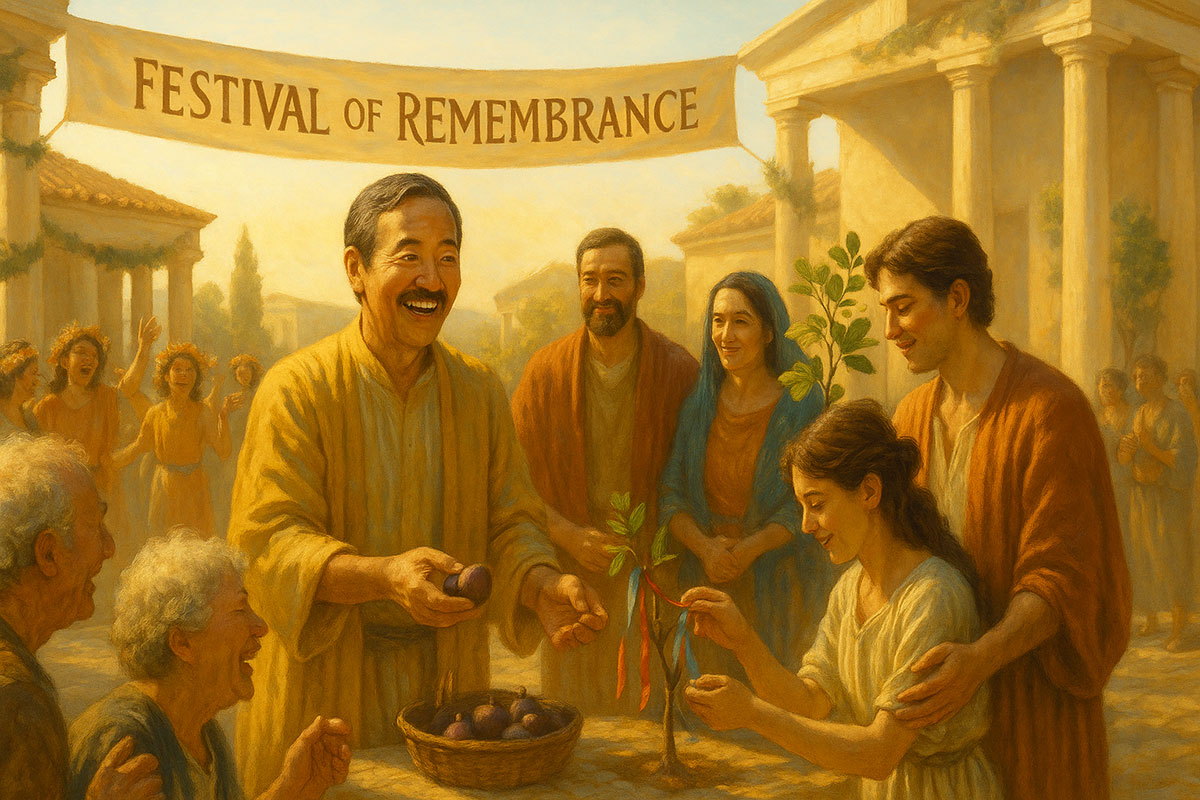
Of all the ancient tragedies, Antigone may be the hardest to breathe into. Where Oedipus Rex turns on fate and blindness, Hamlet on indecision and revenge, Antigone turns on something both sharp and simple: pride.
Creon, the new king, demands order. Antigone, the grieving sister, demands love. Both are right, and both are wrong, because both hold their truths so tightly that neither can bend. Sophocles shows us where such inflexibility leads—into chains, silence, and the grave. By the end of the original play, Antigone is dead, Haemon is dead, Eurydice is dead, and Creon is left alive, but shattered.
It is a lesson in rigidity: that to refuse laughter, softness, or compromise is to prepare a tomb not just for others, but for oneself.
But here enters Saito Hitori. Unlike kings or prophets, he carries no sword, no decree, no curse. Instead, he brings figs and a joke. He brings the reminder that even when grief is heavy, we can choose how we carry it. He shows Antigone that her brother can be honored without her death, that remembrance can be made festive instead of fatal. He teases Creon until the king sees that pride without joy is already a form of defeat.
Imagine a city that gathers not to bury, but to plant. Imagine a chorus that sings not dirges, but dances. Imagine a tragedy where the gods are pleased, not by sacrifice, but by laughter rising like incense.
That is the transformation Hitori-san offers here. Antigone, reborn as a Festival of Joy.
(Note: This is an imaginary conversation, a creative exploration of an idea, and not a real speech or event.)
Act I — The Law, the Love, and the Laugh
Thebes. Dawn. The palace courtyard. Creon stands tall, surrounded by guards, declaring that Polyneices must lie unburied. Antigone, trembling but defiant, listens at the edge of the crowd. Suddenly, a small, smiling figure appears: Saito Hitori, with a basket of figs and a rolled-up scroll that reads “Festival of Joy.”
Creon: (booming)
Let no man or woman defy me! Eteocles is honored, but Polyneices—the traitor—shall rot beneath the sun. To bury him is death. My word is law!
Antigone: (stepping forward)
Then I will die. For love of my brother is greater than fear of your decree.
Creon: (turning on her)
Defiance in my own house? You dare?
(The guards stiffen. Tension crackles. Suddenly, Hitori-san clears his throat and sets down his basket.)
Saito Hitori:
Before we kill anyone today… would anyone like a fig?
(The crowd looks bewildered. Antigone blinks. Creon frowns like a man who just discovered humor is legal but doesn’t know the paperwork.)
Creon:
Who are you to interrupt the law?
Saito Hitori: (bowing cheerfully)
Not a lawyer, thank goodness. My name is Hitori. I collect heavy things—like pride, grief, and bad moods—and trade them for laughter. Much lighter to carry.
Antigone: (half-smiling despite herself)
You mock my sorrow?
Saito Hitori:
Never. I only suggest sorrow is heavy enough without wrapping it in chains. Look—(he offers her a fig)—your brother is not honored by your dying. He is honored when you live in a way that remembers him.
Antigone:
But the gods demand burial.
Saito Hitori:
And the gods also love festivals. Why not plant flowers where he fell? Feed the poor in his name? Let his story end in joy, not dogs. That is a burial the whole city can share.
(Antigone pauses, visibly shaken—not by despair, but by possibility.)
Creon: (snapping)
Enough riddles! My decree is just. Order must be obeyed.
Saito Hitori: (grinning)
A king without laughter is like a jar without wine—loud, brittle, and empty. Tell me, Creon, will you feel stronger when your niece is dead, or weaker when your people hate you?
Creon: (bristling, then faltering)
The law must stand.
Saito Hitori:
Laws are walls. Good walls keep out wolves, but bad ones keep out the breeze. Right now, Thebes is suffocating. Why not open a gate?
(He unrolls his scroll. It reads: “Festival of Remembrance: Both Brothers Honored, No Dogs Invited.” Laughter ripples through the crowd. Even a guard chuckles before catching himself.)
Antigone: (eyes filling with tears, but this time soft ones)
A festival? To honor both… together?
Saito Hitori:
Yes. Eteocles the loyal, Polyneices the bold. One defended, one challenged—but both loved this city enough to fight for it. Let us feed their memory with figs, not fury.
Creon: (hesitant, pride cracking)
And if the people mock me?
Saito Hitori:
Then laugh first. A king who can laugh at himself never loses face—he gains a kingdom.
(The crowd murmurs approval. Antigone clasps Creon’s hand. For a moment, his stern mask softens.)
Antigone: (to Creon)
Uncle, let me live—not for defiance, but for remembrance.
Creon: (quietly)
Perhaps… law can bend when love is straighter.
Saito Hitori: (clapping his hands)
Splendid! Then it’s settled. Tomorrow, we dance. Tonight, we bake honey cakes. And today—(he hands figs to everyone)—we practice forgiveness with fruit.
(The crowd laughs and disperses, lightened. Antigone eats her fig and smiles at Creon, who, for the first time in the play, allows a smile to escape. Tiresias enters, already chuckling.)
Act II — The Son, the Father, and the Fig Tree
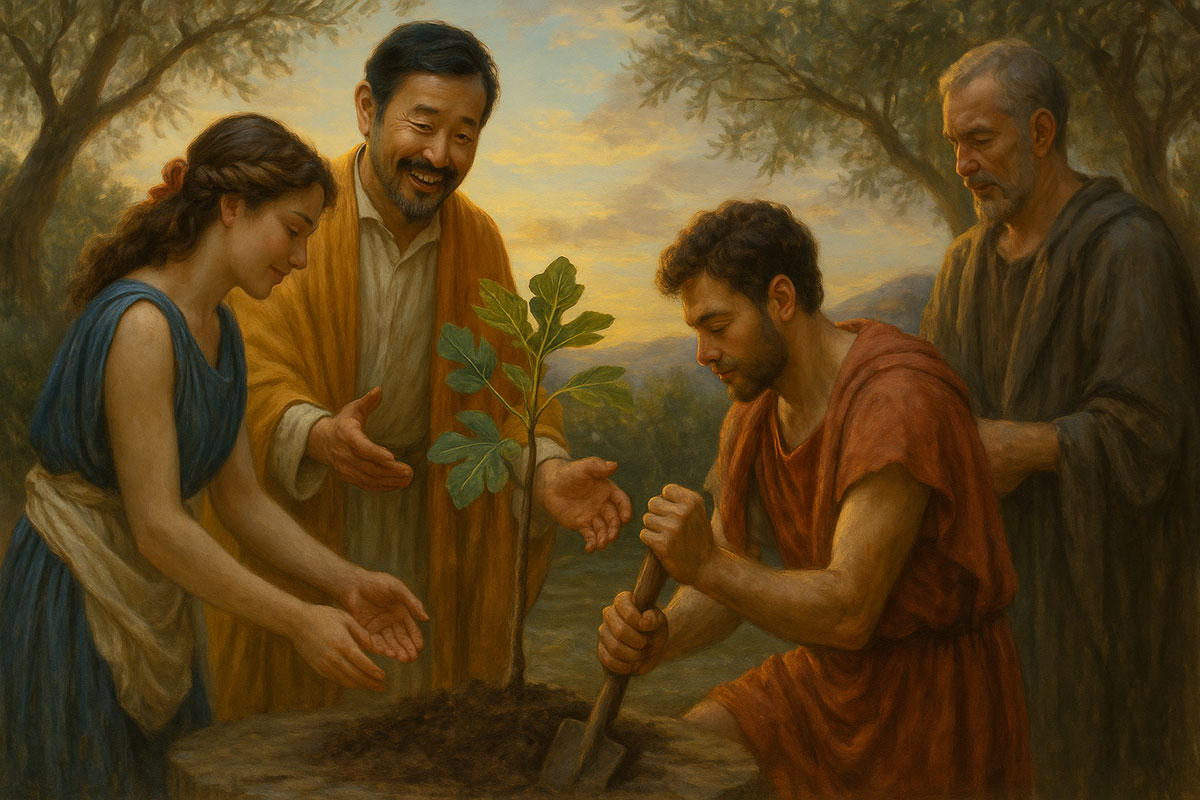
Thebes. Late afternoon. In the palace gardens, the scent of laurel and dust lingers. Haemon paces, torn between loyalty to his father Creon and his love for Antigone. Enter Antigone, carrying a basket of figs and flowers, followed by Saito Hitori, humming as if the world were already healed.
Haemon: (anxiously)
Antigone, beloved, how can I love you if it means defying my father? His word is law. Yet my heart breaks to see you condemned.
Antigone: (smiling gently)
And how can I love you if it means watching you bow to a law that would have buried me?
(They stand in silence, trapped in the tragic knot Sophocles once tied. Hitori-san strolls in, whistling, with a fig in one hand and a spade in the other.)
Saito Hitori:
You two look like statues arguing with the wind. Have you tried planting instead of pouting?
Haemon: (startled)
Planting?
Saito Hitori:
Yes. Every quarrel is a seed. If you bury it in anger, it grows weeds. If you bury it in laughter, it grows figs. (He hands Haemon the spade.) Shall we?
(Reluctantly, Haemon digs a hole. Antigone drops a fig seed into it. They cover it with earth.)
Antigone: (softly)
And if it doesn’t grow?
Saito Hitori:
Then you try again. Love is not about perfect crops, but about showing up every season.
Haemon: (looking at Antigone with new warmth)
Then let me plant joy with you, not despair.
(They embrace. Creon enters, stern but weary, watching silently. Saito notices.)
Saito Hitori: (calling out cheerfully)
Ah, King Creon! Just in time. Your son has planted his first fig tree. Perhaps you’d like to water it—with forgiveness?
Creon: (grimly)
My law is weakened. My authority questioned. And you ask me to water a tree?
Saito Hitori:
Yes. Because a kingdom where sons and fathers hate each other is already barren. Authority is not stone, Creon—it’s a garden. If you don’t water it, it withers.
(Creon stares, torn. Haemon steps forward.)
Haemon: (pleading)
Father, I do not reject you. I only ask that love not be punished as crime. If Antigone lives, we all live lighter.
Creon: (struggling)
And if the people say I am weak?
Saito Hitori: (smiling)
Then tell them: “I chose laughter over corpses.” Trust me, they will cheer.
(A pause. Creon looks at Antigone, then at Haemon, then at the freshly planted soil. His shoulders sag, but this time not from pride— from release.)
Creon: (quietly)
Very well. Let Antigone live. Let Polyneices be remembered. Let Thebes rest.
(The crowd, who has gathered nearby, bursts into applause and relief. Antigone embraces Creon, who allows himself to laugh, however awkwardly. Saito claps his hands like a delighted child.)
Saito Hitori:
Splendid! Now, instead of mourning, we plan the Festival of Remembrance. Songs, honey cakes, ribbons! Even Tiresias can join us—though he’ll probably insist the honey be locally sourced.
(The people laugh. Even Creon chuckles. Haemon takes Antigone’s hand, and they stand before their families not as doomed lovers, but as partners planting joy. The chorus begins chanting softly—no longer lamenting, but humming a song of new beginnings.)
Act III — The Festival of Joy

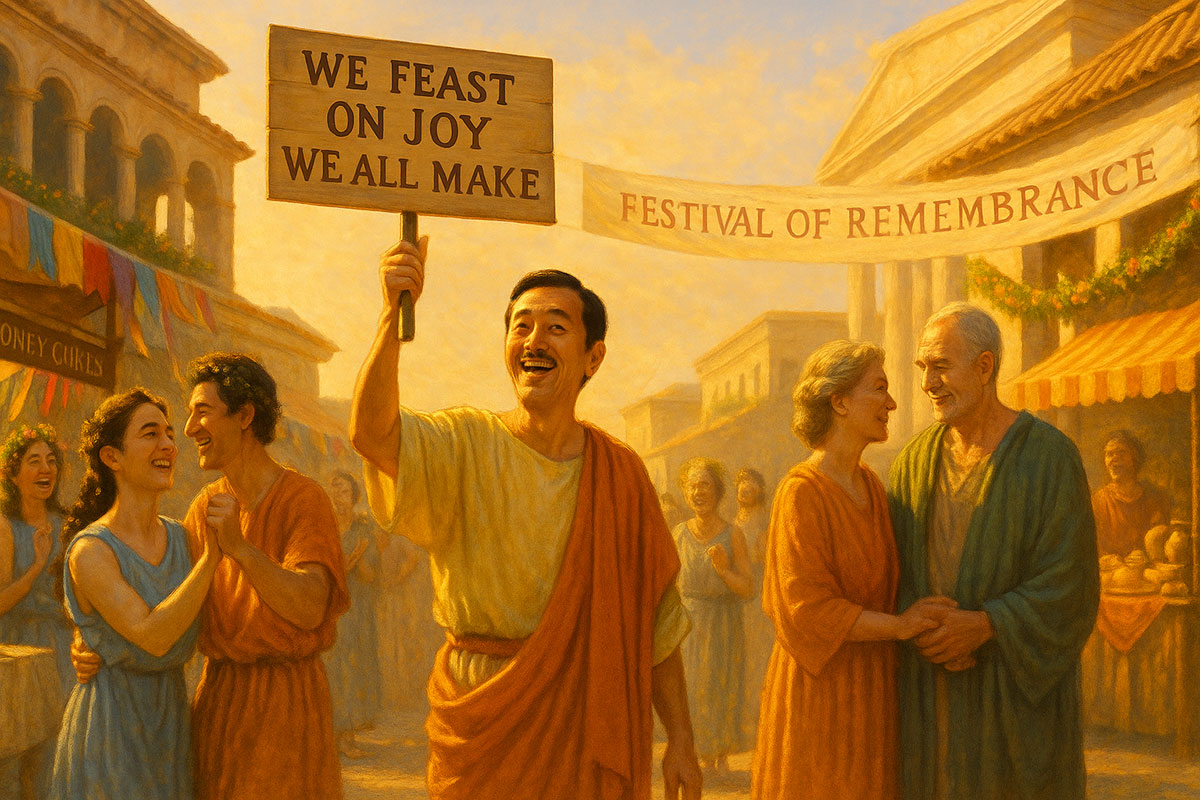
Thebes. Dawn spills gold across the agora. Stalls are decorated with garlands, ribbons, and figs. A banner stretches across the square: FESTIVAL OF REMEMBRANCE — HONOR THROUGH JOY. Citizens bustle with cakes, lyres, and flowers. In the center, the fig tree planted by Haemon and Antigone stands in fresh soil, ribbons tied to its branches.
Chorus: (singing playfully)
We came to mourn, but now we laugh,
Thebes has traded tears for craft.
Two brothers sleep, but we awake,
To honey wine and figs we take.
(Laughter rises. Eurydice, Creon’s queen, enters hesitantly, still cloaked in grief. Creon approaches her, no longer the proud tyrant but a softened man.)
Creon:
Wife… forgive me. I built walls with pride and nearly buried us all inside them.
Eurydice: (sorrow heavy in her voice)
And what do you offer in return?
Saito Hitori: (stepping between them with a fig and a smile)
Fruit. Forgiveness tastes sweeter with fruit. (He hands her the fig.) Bite it, then answer.
(Eurydice bites reluctantly. Her stern face softens. A laugh escapes—small, but real. The crowd cheers. Creon smiles sheepishly.)
Eurydice:
Very well. If figs can forgive, perhaps so can I.
Creon: (bowing deeply)
Then let us govern not with chains, but with gardens.
(The people applaud. Haemon and Antigone step forward, hand in hand. They place a garland on the fig tree.)
Antigone:
Let this tree honor both our brothers—Eteocles who defended, Polyneices who challenged. May Thebes remember them not with division, but with laughter that heals.
Haemon:
And may our children grow in its shade, learning that love is greater than law, and joy stronger than death.
(The crowd erupts in cheers. Saito Hitori raises a wooden sign, hand-painted in bright letters: “WE FEAST ON JOY WE ALL MAKE.” The chorus repeats the phrase until it becomes a chant.)
Tiresias: (arriving, tapping his staff, grinning)
I warned you once of doom, Creon. Today, I warn you of delight. Too much honey cake may cause dizziness.
(The people laugh. Even Creon chuckles heartily.)
Saito Hitori:
Then let dizziness be our only sorrow! Come, Thebes—sing, dance, forgive. Today, the gods smile because humans have remembered how to smile.
(Music swells. Citizens dance with ribbons and flower crowns. Children chase each other with figs. Creon and Eurydice embrace. Haemon and Antigone laugh together, radiant. The chorus sings a final refrain.)
Chorus:
When pride is stone, the city falls,
When love is light, it lifts us all.
Thebes once mourned with endless cries,
Now joy is written on the skies.
(As the sun fully rises, the stage glows with golden light. Instead of tragedy’s silence, the curtain closes on laughter, dancing, and the promise of a kingdom reborn.)
Final Thoughts By Nick Sasaki
In the original Antigone, the stage goes dark. Death piles on death, and the audience is left staring at the ruin of a family, a city, a king. Sophocles wanted us to feel the weight of pride, the cruelty of laws untempered by compassion.
But Hitori-san’s retelling asks us a different question: What if? What if Creon had laughed once? What if Antigone had chosen to live in order to honor, not die in order to protest? What if Thebes had learned that mourning can be done with figs and ribbons, not only with ashes and chains?
In this new ending, Thebes does not collapse—it blossoms. Antigone and Haemon do not embrace death—they plant life. Eurydice does not hang herself—she forgives and joins in. And Creon does not die a broken man—he learns that authority is strongest when tempered with humility and laughter.
The lesson is no less serious for being comic. In fact, it may be more enduring. For how many of us live each day like Creon, clinging to pride, terrified of appearing weak? How many of us, like Antigone, are ready to destroy ourselves rather than imagine a gentler path? And how many of us, like the chorus, forget that our voices matter in shaping the spirit of the city?
The Festival of Joy tells us: it is never too late to bend, to forgive, to laugh. Even the heaviest tragedies can be retold as comedies if we allow ourselves to choose joy over pride.
And perhaps that is why Sophocles’ plays remain alive after two thousand years—not because we must be trapped in their endings, but because they invite us to ask how our own endings might change.
Saito Hitori answers with figs, laughter, and the courage to make joy communal. He reminds us that healing is not private; it is shared, sung, and celebrated.
So let us imagine not just Thebes, but our own lives, decorated with ribbons of forgiveness, stalls of honey cakes, and signs that read: We feast on joy we all make.
That, I believe, is the true inheritance of Antigone—not only the warning of tragedy, but the possibility of joy.
Short Bios:
Saito Hitori — A sage of laughter and light, he transforms Antigone’s defiance into a festival, teaching Thebes that figs and forgiveness heal better than decrees and death.
Antigone — Once the tragic sister doomed to die for love, here she becomes the heart of remembrance, planting joy instead of despair.
Creon — The stern king who learns humility, trading pride and punishment for gardens, honey cakes, and the laughter of his people.
Haemon — Antigone’s devoted fiancé, who discovers that planting joy with her is stronger than dying in grief.
Eurydice — Creon’s wife, spared from tragedy, who forgives with laughter and joins in leading Thebes toward renewal.
Tiresias — The blind prophet, surprised into mirth, who warns not of doom but of too much honey cake at the Festival of Joy.
The Chorus of Thebes — Once mourners, now singers of delight, teaching the city that healing belongs to everyone who chooses to laugh.
Nick Sasaki — Founder of Imaginary Talks and narrator of this reimagining, he frames Antigone’s new ending as a lesson for modern readers: pride collapses, but laughter builds lasting kingdoms.
Leave a Reply