

|
Getting your Trinity Audio player ready...
|

Introduction by Hayao Miyazaki
When I hear people from so many places—philosophers, writers, activists, even spirits themselves—gathering to speak about Spirited Away, I feel both humbled and curious. I never set out to make a film that could be dissected endlessly. I wanted only to give children, especially girls on the edge of growing up, a story that would carry them like a small lantern in the dark.
The bathhouse, the stolen names, the river spirits—all of these came from memories, from things I saw in Japan: polluted rivers, overworked adults, greedy companies, children forced into roles before they knew themselves. And yet, when I drew Chihiro, I thought always of resilience—not in grand battles, but in the ordinary courage of taking one more step, remembering who you are, helping another being even when you are afraid.
So I welcome this gathering of voices, each finding in the story something new: myth, psychology, ecology, girlhood, society. That is what stories are for—not to give one answer, but to open many doors.
(Note: This is an imaginary conversation, a creative exploration of an idea, and not a real speech or event)
Topic 1: The Power of Names and Identity
Joseph Campbell (Moderator):
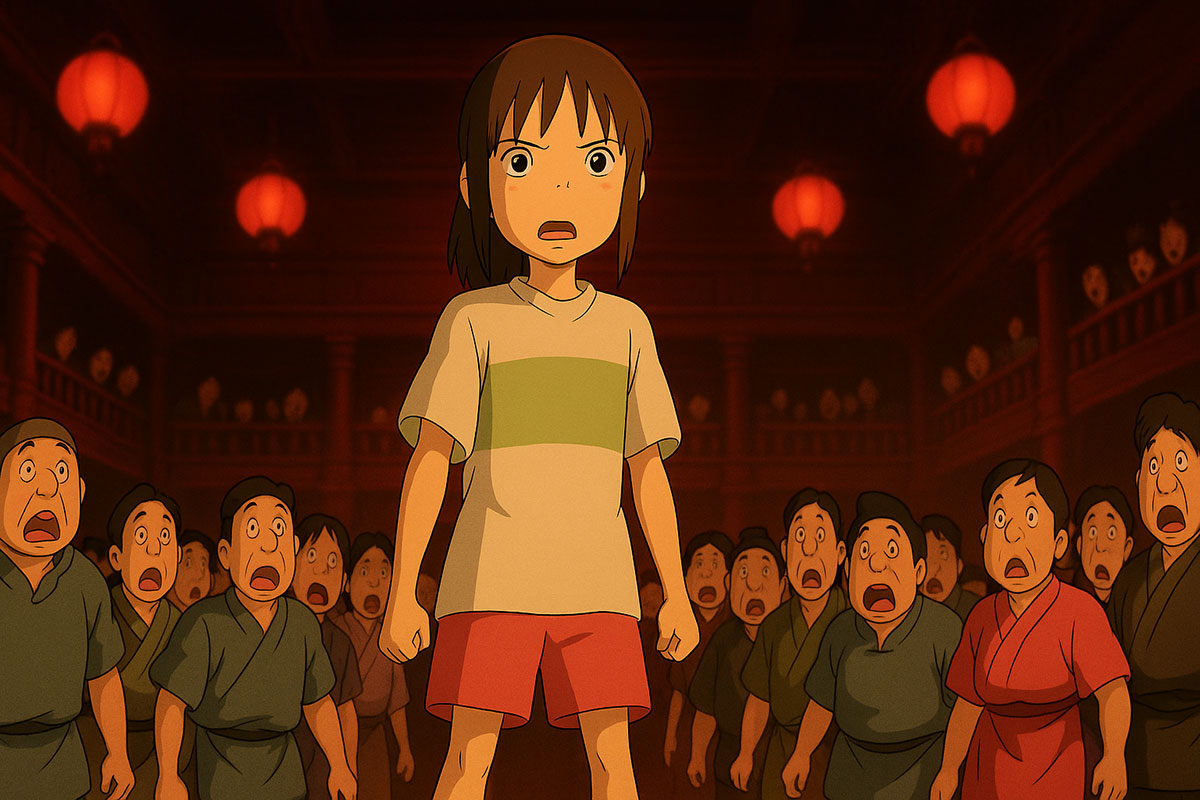
When I studied world myths, I found again and again that names carry enormous power. In myths, knowing a name means knowing the essence. In Spirited Away, we see names stolen, forgotten, and reclaimed. I’d like to begin with this: What happens to a person when they lose their name?
Haruki Murakami:
When someone loses their name, they drift into silence. In my novels, characters sometimes forget themselves, wander through cities or wells as if they’re half-asleep. A name is like an anchor—without it, you float without direction. Chihiro nearly drifts into that same emptiness.
Hayao Miyazaki:
I wasn’t thinking of psychology or literature when I made this choice. I thought of children—real children—overwhelmed by school, rules, and society. They are always being renamed, given labels: student, worker, obedient child. To lose your true name is to surrender to those labels. That is what Yubaba represents.
Carl Jung:
Yes, exactly. In psychological terms, the name is a symbol of the Self, the wholeness within. If the ego loses its tether to the Self, it is absorbed by the collective unconscious, by archetypal forces it cannot control. Chihiro risks being consumed by the Mother archetype, Yubaba, if she forgets her name.
Greta Gerwig:
I think of girlhood. You’re always being told who you are: pretty, smart, difficult, quiet. Your name gets lost beneath those adjectives. Chihiro’s journey is radical because she insists—sometimes shakily, sometimes fiercely—on keeping her name alive inside her. That’s what girlhood feels like: holding onto your name in a chorus of other voices.
Joseph Campbell:
Thank you. Let’s move deeper. In myth, the reclaiming of one’s name is a rite of passage. Why do you think Chihiro’s act of remembering her name is so central to her growth?
Carl Jung:
Because individuation depends on memory of the Self. The unconscious is vast, full of spirits, temptations, archetypes. If Chihiro simply survived the bathhouse, she would remain incomplete. By reclaiming her name, she integrates the fragmented parts of herself—fear, courage, compassion—into a whole.
Haruki Murakami:
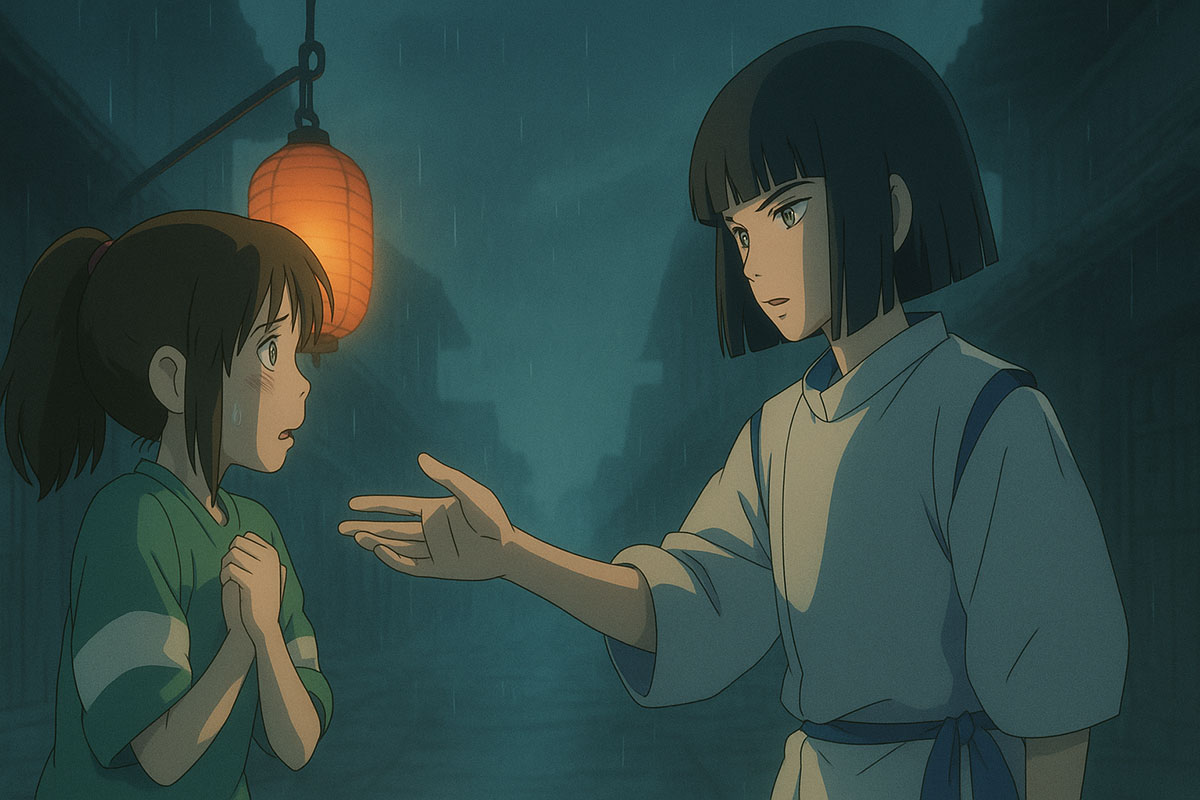
Names return like dreams. Chihiro remembers hers at the moment of connection with Haku. That is important. Identity is not only solitary; it is relational. In my writing, people often rediscover themselves when they meet someone who sees them clearly. Chihiro remembers her name because Haku mirrors it back to her.
Hayao Miyazaki:
For me, it was simple. Children grow up when they insist: This is me. It is not about destiny. It is about saying no to forgetting, to erasure. When Chihiro says her name, she is not only freeing Haku—she is freeing herself from becoming just another worker, another faceless servant.
Greta Gerwig:
That’s what struck me most: it’s not a grand victory. She doesn’t slay a dragon. She whispers her own name. That’s the quiet heroism of being a girl, or anyone overlooked. You don’t need a sword—you need memory, stubbornness, the ability to say, “I am still here.” That’s what makes it powerful.
Joseph Campbell:
Beautifully said. Now, a final question for each of you. If names hold such power, what lesson does this give us in our own modern lives? How should we treat our names, and the names of others?
Greta Gerwig:
For me, it means we should treat each other’s names as sacred. To misname someone, to refuse their chosen name, is to deny their identity. Chihiro’s story reminds me that a name isn’t just a word—it’s a claim on existence.
Haruki Murakami:
Yes. And also, we should allow for silence. Sometimes names must be rediscovered. In modern life, we are given so many identities—worker, citizen, consumer. To find our true name again requires listening to the stillness beneath all that noise.
Hayao Miyazaki:
Children must be reminded that their names are theirs. Society tries to turn them into numbers, consumers, obedient adults. But a child who remembers her name will not be swallowed. That is my message. I made Spirited Away to say: your name is not theirs to take.
Carl Jung:
I agree. And I would add—when you remember your name, you not only free yourself, but you make possible the individuation of others. Chihiro gives Haku his true name back. To affirm your own Self is to liberate the hidden selves in others. That is the alchemy of naming.
Joseph Campbell (closing):
You have all spoken to something I discovered again and again in world myths: the name is the soul. To forget it is to wander in darkness; to reclaim it is to be reborn. Chihiro’s whisper of her name is the most mythic act of all: it is the hero’s return to herself. And perhaps that is the deepest truth of this story—that each of us must hold our names in the face of forgetting, and in doing so, give courage to others to remember theirs.
Topic 2: Spirits, Consumerism, and Greed
Naomi Klein (Moderator):
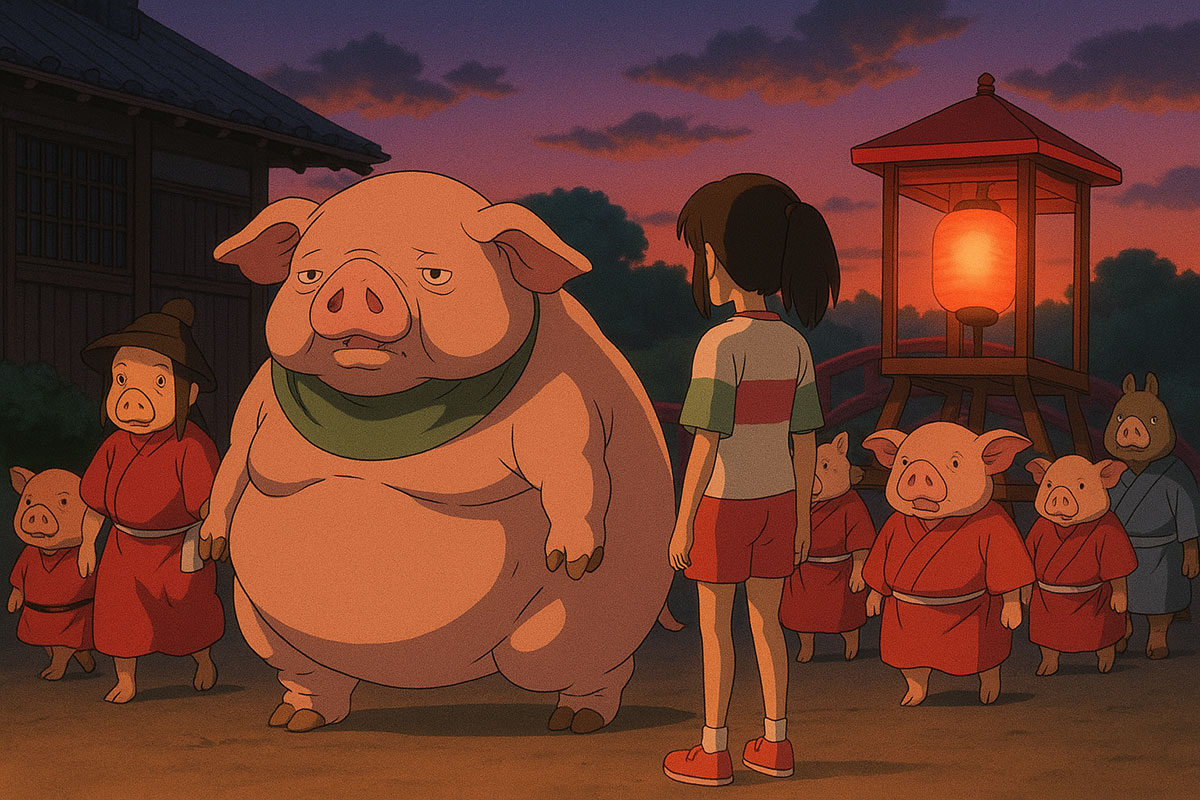
When I first saw Spirited Away, the image that stayed with me was Chihiro’s parents at the food stall—eating until they turned into pigs. For me, it was an allegory of consumerism at its most grotesque. I’d like to begin with this question: What does the transformation of Chihiro’s parents really symbolize?
Toshio Suzuki:
From our side at Studio Ghibli, it was about Japan in the 1980s and 1990s. We lived through the bubble economy—people bought things endlessly, believing the party would never end. Then it crashed, and we were left with the wreckage. The parents becoming pigs isn’t just a metaphor; it was what we saw around us.
Shigeru Mizuki:
In folklore, humans and spirits often blur when desire overtakes them. To become a pig is not strange; it is the natural face of greed. I drew yōkai who fed on human excess, but in truth, the humans were the monsters. Miyazaki used the spirit world to show what was already happening in ours.
Hayao Miyazaki:
I wanted it to be very clear: children must see what greed does. When I was making the scene, I thought of how easily adults say, “It’s fine, we’ll pay later.” That casual entitlement. And then they wonder why the world collapses. The transformation shows children: don’t become like us.
Jordan Peterson:
From a symbolic perspective, this is about devouring without gratitude or discipline. In myth, the pig often represents the unrestrained appetites of the Id. To consume without restraint is to regress—to sink into chaos. Chihiro’s parents embody the collapse of boundaries that hold society together.
George Monbiot:
And from an ecological standpoint, pigs are not only symbolic—they devour landscapes, consume resources endlessly. Humans have become pigs in their relationship with the Earth: clearing forests, choking rivers, overgrazing. The transformation isn’t only personal, it’s planetary.
Naomi Klein:
Thank you. Let’s turn to the bathhouse itself, because it’s not only a place of spirits, it’s also a marketplace. What does the bathhouse reveal about the intersection of greed, labor, and society?
Hayao Miyazaki:
The bathhouse is a place of purification, yes, but also of exploitation. Workers are trapped by contracts, stripped of their names. This is not only fantasy—it is a mirror of Japanese corporate life, where people sacrifice their souls to keep the system running.
George Monbiot:
It’s a metaphor for industrial capitalism itself. Nature—spirits, rivers, forests—must be cleaned, purified, made consumable for the powerful. Workers are expendable, invisible, yet essential. The bathhouse is a factory dressed in lanterns.
Jordan Peterson:
Yet it is also order. The bathhouse is the structure within which chaos is managed. In mythic terms, you cannot banish hierarchy—it always exists. The question is: will that order consume you, or will you learn to act freely within it, as Chihiro does?
Toshio Suzuki:
Behind the scenes, we thought of the bathhouse as Ghibli itself. Work, deadlines, hierarchy—it was playful, but also self-critical. Miyazaki-san was aware of the pressures he placed on people. He poured his critique of society back onto himself.
Shigeru Mizuki:
To me, the bathhouse is simply a place where spirits come with their dirt and leave it behind. That is what humans do too. But when purification becomes business, it loses its sacredness. Spirits become customers, and workers become slaves. That is what greed does: it turns ritual into transaction.
Naomi Klein:
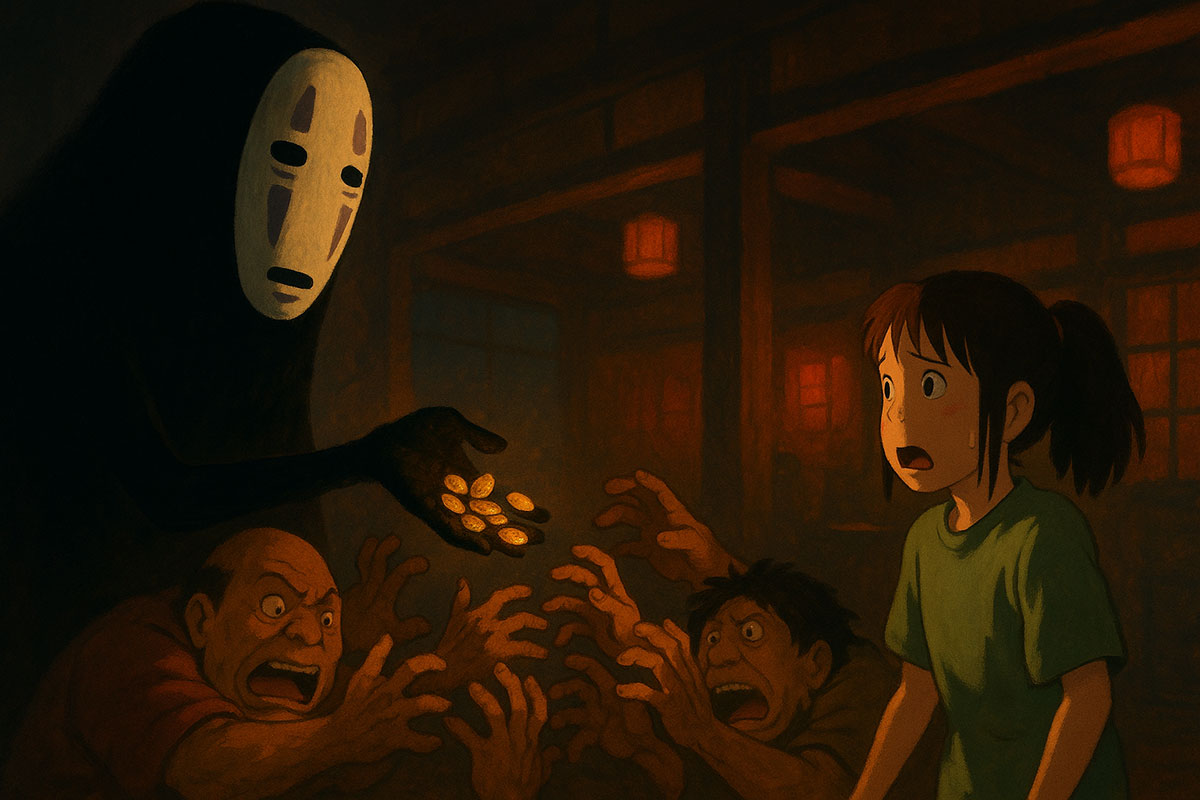
That’s powerful. Now for the final question. No-Face is one of the most unsettling characters in the story—absorbing greed, becoming monstrous. What do you think No-Face teaches us about our relationship to consumerism and desire?
Shigeru Mizuki:
No-Face is a hungry ghost. In Buddhist tradition, such beings wander with insatiable hunger. They take the shape of what others project. In the bathhouse, surrounded by greed, he becomes greed itself.
George Monbiot:
Exactly—he is a mirror. When placed among the greedy, he devours endlessly. When placed with Chihiro, who refuses, he quiets. This is how consumer capitalism works: it feeds on the desires around it. If we stop feeding it, it collapses.
Hayao Miyazaki:
I drew No-Face from people I’ve met—lonely, shapeless, desperate to belong. They become what the environment demands. In a greedy world, they are greedy. But when they are accepted with compassion, they become gentle. He is not evil; he is lost.
Jordan Peterson:
No-Face is the archetype of the unintegrated shadow. If you do not confront your own appetite, your own greed, you project it outward. He shows us: unchecked desire turns into tyranny. Chihiro disciplines him not by force, but by boundary—she says no. That is the lesson.
Toshio Suzuki:
Inside the studio, we thought of him as an audience member too. He absorbs what he sees, reflects it back. If the world gives him greed, he gives back monstrosity. If the world gives him kindness, he gives back peace. He is us, sitting in the theater.
Naomi Klein (closing):
What strikes me, listening to all of you, is that the story of greed in Spirited Away is not one-dimensional. It’s about society, ecology, psychology, and even ritual. Greed is not just consumption—it is forgetting our place in the world, forgetting our limits. And No-Face reminds us that systems of greed are not immutable: they depend on what we feed them. If we refuse, if we hold boundaries, if we remember who we are—then maybe, like Chihiro, we can walk through a world of spirits and come out whole.
Topic 3: Environmental Storytelling
David Attenborough (Moderator):
In my life’s work, I’ve tried to remind people that nature is not separate from us—it is us. In Spirited Away, rivers become spirits, pollution becomes visible, and a child is asked to care. I’d like to begin with this: What does the River Spirit’s cleansing tell us about our relationship with the natural world?
Hayao Miyazaki:
It came from my childhood. I once helped clean a river near my home, and we pulled out bicycles, garbage, things people had forgotten. I never forgot the weight of it. The River Spirit was not a fantasy; it was what I saw with my own eyes. Pollution hides the spirit of nature, but it does not destroy it. Children should know this: even a poisoned river remembers it was once pure.
Rachel Carson:
That’s beautifully said. When I wrote Silent Spring, I wanted people to see what pesticides were doing to rivers, birds, to the web of life. The River Spirit embodies that same message: nature appears monstrous only because we have burdened it with our waste. If we remove the burden, the beauty re-emerges.
San (from Princess Mononoke):
Humans think nature can always forgive them. It cannot. My wolves and I fought because humans forget rivers are alive. Chihiro was brave because she listened. She touched the filth and still saw the spirit beneath. Few humans would dare to touch what they ruined.
Arne Naess:
In Deep Ecology, we say all beings have intrinsic value. The River Spirit is not a symbol—it is a being. To cleanse it is not an act of utility, but of reverence. Chihiro’s act is the Deep Ecological act: to see worth beyond usefulness, to bow before what we once degraded.
David Attenborough:
Yes, reverence. Now, another question: Haku is revealed as a river spirit who has been forgotten because his river was built over. What does it mean when we forget nature’s names and erase its places?
San:
It means death. When the forest dies, the gods vanish. When a river is filled with concrete, its spirit loses its home. Haku forgot his name because humans forgot his river. Forgetting names is how humans kill the gods.
Rachel Carson:
In my time, entire species vanished because we forgot their names—or never bothered to learn them. To know the name of a river, a bird, an insect, is to be responsible for it. To forget is to absolve ourselves of care. That is the most dangerous thing of all.
Hayao Miyazaki:
This is why the film is about names. When children forget rivers, forests, insects—they lose part of themselves. Haku is the story of every river we bury under highways. The tragedy is not only ecological but spiritual. A society that forgets rivers forgets compassion.
Arne Naess:
Indeed. Language binds us to the living world. To name is to recognize. When names are lost, exploitation becomes easier. If Haku is just “land,” then paving him is simple. But if Haku is a spirit, a person, then to bury him is murder.
David Attenborough:
Well said. My final question, then: If storytelling can reveal nature’s spirit, how should we tell stories today to inspire care for the Earth?
Rachel Carson:
We must tell stories that awaken wonder. People protect what they love, and they love what has touched them. When I described the song of birds, the silence after pesticides, it was to make people feel, not just think. Stories must rekindle awe.
Hayao Miyazaki:
Children need worlds where rivers have faces, forests have voices. If we tell stories only with data, they will not listen. I made Spirited Away so children would carry images inside them: a river spirit cleansed, a dragon remembering his name. These images may stay when statistics do not.
San:
And stories must be fierce. Do not tell children that nature always forgives. Tell them it fights back. Tell them wolves bite, rivers flood, forests burn. They will respect what they fear as much as what they love.
Arne Naess:
Stories must speak of intrinsic value. Not “save the forest because it gives you oxygen,” but “save the forest because it is alive.” Chihiro did not cleanse the river to gain reward—she did it because it was right. That is the story the world must hear.
David Attenborough (closing):
Yes. I have spent a lifetime telling stories of the living world. What I learned is what Miyazaki shows: that nature is not an object but a character. The River Spirit, Haku, San, all remind us—every stream, every creature has a story. If we forget their names, we lose our own. If we remember, there is still hope.
Topic 4: Coming of Age Beyond Romance
Greta Gerwig (Moderator):
When I was making Lady Bird, I wanted to show girlhood without centering it on romance, because I felt there was more to becoming yourself than falling in love. Miyazaki did something similar with Chihiro—her growth is about resilience, responsibility, and identity. So I want to begin with this: What does it mean to come of age without romance?
Simone de Beauvoir:
Coming of age without romance means a woman becomes a subject, not an object. Too often, society teaches girls that their worth begins when they are chosen by a man. Chihiro does not wait to be chosen—she acts, resists, remembers. She grows into her freedom without depending on another’s desire.
Neil Gaiman:
In stories, romance is often a shortcut: a way to signal transformation. But I’ve always been more interested in children who step into strangeness and find courage within themselves. Chihiro’s love for Haku is not romance—it is recognition, a kind of kinship. That’s far more interesting than a kiss at the end.
Hiromasa Yonebayashi:
At Studio Ghibli, we often wanted to show children simply being children. When Marnie Was There was similar: the bond between Anna and Marnie was about friendship, memory, healing—not romance. Growing up is not only about who you fall in love with, but about who you choose to be when faced with fear.
Anne of Green Gables:
Oh, I understand that well! When I was younger, people were always eager to marry me off in their imaginations. But for me, the world was full of wonder—words, trees, rivers, imagination! Love came later, but my girlhood was about claiming the world as my own. That’s what Chihiro does too.
Greta Gerwig:
Yes! I love that—claiming the world. Let’s go deeper. What challenges or possibilities open up in stories when we remove romance from the center of coming-of-age?
Neil Gaiman:
You can focus on the labyrinth instead of the ballroom. When romance is not the end point, the journey matters more—the trials, the uncanny moments, the monsters you face within yourself. Chihiro’s challenge is not “who will love me?” but “will I remember who I am?” That is a deeper question.
Simone de Beauvoir:
It also resists commodification. In popular media, romance is often packaged, predictable, easy to consume. By removing it, you resist turning the girl into a product of desire. You leave her as a subject of her own freedom, which is much harder to digest—but much more liberating.
Anne of Green Gables:
And it allows more friendships! So often, stories say boys and girls cannot simply be friends, or that a girl’s greatest bond must be romantic. But what of the bonds with friends, mentors, spirits, even imagination itself? Those shaped me more than any suitor ever could.
Hiromasa Yonebayashi:
Yes. And visually, it opens the world too. Instead of focusing on close-ups of intimacy, we can frame landscapes, work, play, fear. Chihiro is dwarfed by the bathhouse, the forest, the river—her coming-of-age is not inward only, but outward. That scale would be lost if romance narrowed the story.
Greta Gerwig:
That’s exactly right. Now for my last question. If we want to tell more stories of coming-of-age without romance, what lessons can we take from Chihiro—and how should we shape those stories for today’s children?
Anne of Green Gables:
We must never underestimate children’s imaginations. Give them wonder, give them fear, give them rivers to cross and wolves to face. Children want to see themselves not as small, but as capable. Show them courage in ordinary acts, like Chihiro carrying water or refusing greed.
Simone de Beauvoir:
We must also refuse to define girls only in relation to others. Let them have solitude, let them have struggles. A girl’s subjectivity is not born in romance but in resistance, in choice. If we show this, we teach girls that they are not waiting—they are already becoming.
Hiromasa Yonebayashi:
And we should show work. Chihiro works, sweats, struggles. In Japan, children understand responsibility early. They resonate with stories where a child contributes. We should not hide this. A child grows through work as much as through play.
Neil Gaiman:
And let’s not forget the shadows. Childhood has monsters. Let children face them. Not everything must be sanitized. Chihiro confronts terror and filth, and she grows because of it. We do children a disservice if we hide the shadows and give them only light.
Greta Gerwig (closing):
I love what you’ve all said. Chihiro reminds us that growing up is not about romance, not about waiting for a kiss, but about carrying water, facing fear, remembering your name, and choosing kindness in a world that forgets it. That is a story we need now more than ever—for girls, for boys, for everyone.
Topic 5: The Bathhouse as a Mirror of Society
Hayao Miyazaki (Moderator):
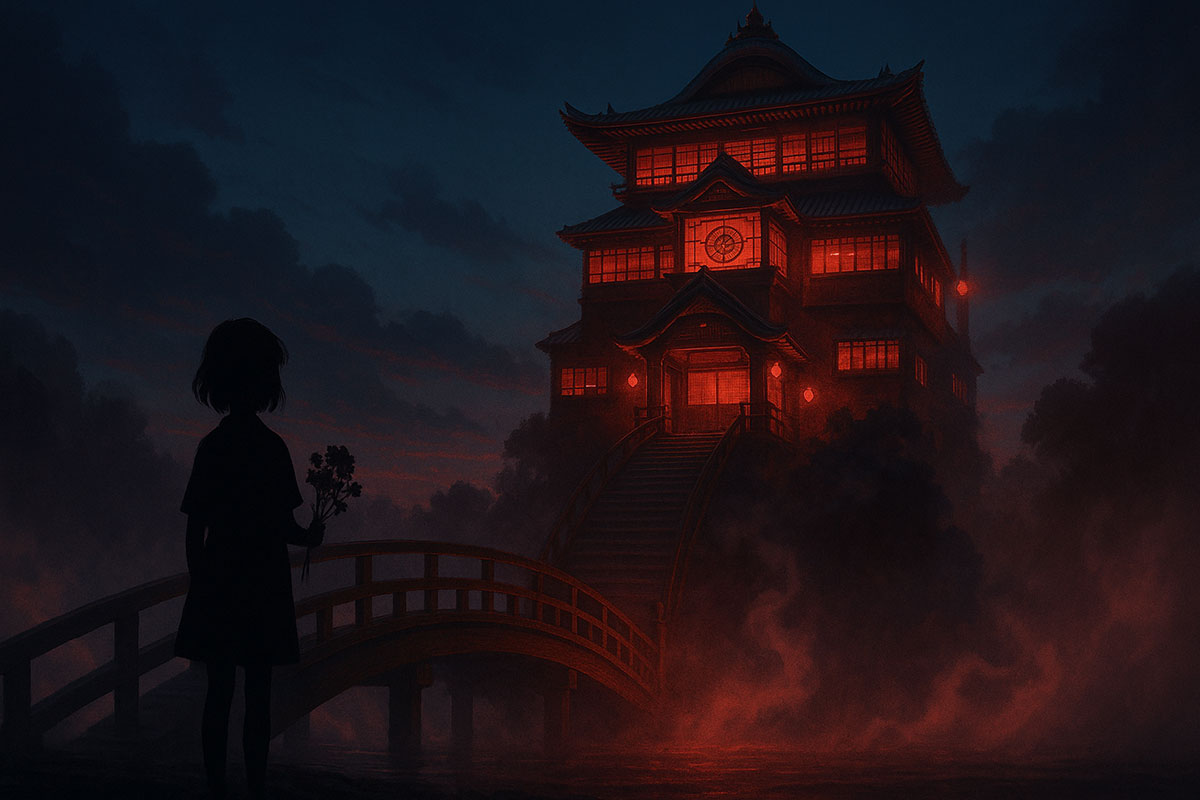
When I created the bathhouse, I wanted it to be both alluring and frightening. I thought of Japanese companies, old hot springs, even Ghibli itself. It was a place of beauty, greed, and ritual. Let’s begin here: What does the bathhouse tell us about the world we live in?
Toshio Suzuki:
It tells us that work consumes everything. In Japan, we live for the company. People surrender names, families, lives. The bathhouse is not fantasy—it is a reflection of how adults sacrifice themselves to keep the machine running.
Shinto Priest:
For me, the bathhouse reveals how the sacred is never far from the profane. Bathing was once ritual—purifying the spirit. In the film, this ancient act has become business. That is our world: the kami are still there, but they are hidden beneath transactions.
Margaret Atwood:
I see it as a microcosm of society. People come to cleanse, but who does the cleansing? The workers, invisible, nameless. The guests enjoy the ritual, but the laborers live in the shadow. It mirrors the way luxury in our world rests on unseen toil.
Haku:
To me, the bathhouse was a prison. I was bound by Yubaba, stripped of my name. It is not only about work, but about forgetting. The danger is not that you labor—it’s that you stop remembering who you are while you labor.
Max Weber:
Yes. This is bureaucracy’s triumph. Each spirit has a role, each worker a task. It is efficient, ordered, rational. But in the process, individuals vanish. The bathhouse shows both the necessity and the danger of structured society.
Hayao Miyazaki:
Yes, I wanted it to feel both beautiful and oppressive. Now, let’s move deeper: What dangers does the bathhouse reveal about how we treat ritual, work, and each other?
Margaret Atwood:
The danger is complacency. The lanterns glow, the gold flows, and everyone believes this is normal. No one questions why their names are gone. That is how societies trap us: not through cruelty, but through comfort.
Shinto Priest:
The danger is spiritual. Ritual is emptied of meaning. Purification becomes spectacle, reverence becomes transaction. When kami are reduced to customers, the world grows sick.
Haku:
The danger is forgetting your name. I lost mine, and with it my freedom. Chihiro nearly lost hers too. When we stop holding onto who we are, we are devoured by the system.
Toshio Suzuki:
The danger is also self-deception. Miyazaki-san drew the bathhouse partly as a reflection of our own studio. We worked tirelessly, sometimes too much. He knew he was Yubaba as well as Chihiro. The bathhouse shows us that we are complicit in the very structures we critique.
Max Weber:
The danger is the “iron cage” of rationality. Once systems are built, they persist. The bathhouse is orderly, yes—but order without soul becomes suffocation.
Hayao Miyazaki:
I agree. When order is hollow, it devours. Now, for the last question: What lessons does the bathhouse give us today? How should we live differently?
Haku:
We must remember our names. Even if the system takes everything, if we whisper who we are, we remain free. That is what Chihiro taught me.
Shinto Priest:
We must restore reverence. A river is not a commodity, a bath not just hot water. Every act of cleansing should be gratitude. If we treat the world with reverence, the kami will remain.
Margaret Atwood:
We must notice the hidden workers. Every bathhouse, every society, rests on invisible hands. If we see them, honor them, perhaps we can soften the cruelty of the system.
Toshio Suzuki:
We must laugh at ourselves too. Miyazaki-san knew he was Yubaba. That honesty is essential. If we admit we are both master and servant, perhaps we can live more gently.
Max Weber:
We must remain vigilant. Bureaucracy is inevitable, order is necessary, but we must balance it with humanity. Without spirit, the bathhouse becomes a cage. With spirit, it can be a sanctuary.
Hayao Miyazaki (closing):
That is why I made it both frightening and beautiful. The bathhouse is our world. It is greedy, busy, suffocating—and yet full of light, laughter, and possibility. If we remember our names, if we honor the sacred, if we see the invisible—we can walk through it, as Chihiro did, and come out whole.
Final Thoughts by Hayao Miyazaki
Listening to these conversations, I am reminded that a story belongs to those who carry it. Spirited Away is no longer only mine—it lives in your questions, your interpretations, your dreams. Each of you has seen something in the bathhouse, in No-Face, in the rivers, that even I did not know I had drawn. That is the true power of storytelling: it grows beyond the storyteller.
What I hope remains is not analysis but feeling. That you remember what it means to hold onto your name in a world that tries to take it. That you see rivers as living, not forgotten. That you believe a child can walk into a frightening place and come out whole, not by violence, but by kindness and perseverance.
If this story has given you courage, even a little, then it has done its work. And perhaps, like Chihiro, you too can walk through the tunnel of uncertainty and emerge into the light—still yourself, still carrying your flowers, ready for the world.
Short Bios:
Hayao Miyazaki
Japanese animator, director, and co-founder of Studio Ghibli, Miyazaki is renowned for masterpieces like Spirited Away, Princess Mononoke, and My Neighbor Totoro. His films blend fantasy, ecology, and humanism, capturing the spirit of childhood and the fragility of nature.
Greta Gerwig
American filmmaker, writer, and actress. Gerwig is celebrated for her films Lady Bird, Little Women, and Barbie, where she explores girlhood, identity, and resilience with warmth and insight.
Joseph Campbell
American mythologist and writer, best known for The Hero with a Thousand Faces. Campbell’s concept of the Hero’s Journey has influenced countless storytellers worldwide.
Haruki Murakami
Acclaimed Japanese novelist known for works like Norwegian Wood, Kafka on the Shore, and The Wind-Up Bird Chronicle. His fiction often blends dreamlike surrealism with explorations of loneliness and identity.
Carl Jung
Swiss psychiatrist and psychoanalyst, founder of analytical psychology. His concepts of archetypes, the collective unconscious, and individuation deeply shaped modern thought.
Naomi Klein
Canadian author and activist, Klein is best known for No Logo and This Changes Everything. Her work critiques capitalism, consumerism, and their social and environmental impacts.
Toshio Suzuki
Longtime producer at Studio Ghibli and one of its founding figures. He worked closely with Miyazaki and Isao Takahata to bring Ghibli’s films to life.
George Monbiot
British writer, journalist, and environmental activist. He is a prominent voice on climate change, rewilding, and critiques of consumer culture.
Shigeru Mizuki
Legendary Japanese manga artist, best known for GeGeGe no Kitarō. His work reintroduced traditional yōkai folklore to modern Japan.
Jordan Peterson
Canadian psychologist, professor, and author of Maps of Meaning and 12 Rules for Life. He interprets myths and archetypes through psychology and cultural critique.
David Attenborough
British natural historian and broadcaster, known worldwide for Life on Earth and Planet Earth. His documentaries have inspired generations to care for the natural world.
Rachel Carson
American marine biologist and author of Silent Spring, which sparked the modern environmental movement.
San
The fierce wolf-girl from Miyazaki’s Princess Mononoke. She symbolizes the wild spirit of nature and the struggle against human exploitation of the environment.
Arne Naess
Norwegian philosopher, founder of Deep Ecology. His work emphasizes the intrinsic value of all living beings and the interconnectedness of ecosystems.
Hiromasa Yonebayashi
Animator and director at Studio Ghibli, known for The Secret World of Arrietty and When Marnie Was There. His films explore childhood, memory, and identity.
Anne of Green Gables
The beloved fictional heroine of Lucy Maud Montgomery’s novels. Anne represents imagination, resilience, and the spirited independence of girlhood.
Simone de Beauvoir
French philosopher and author of The Second Sex, a foundational text of feminist thought. She examined the construction of womanhood and the path to freedom.
Neil Gaiman
British author of fantasy and graphic novels, including Coraline, American Gods, and The Sandman. His works explore myth, magic, and the uncanny.
Max Weber
German sociologist and political economist, best known for his analysis of bureaucracy, rationalization, and modern capitalism.
Margaret Atwood
Canadian novelist, poet, and critic. Author of The Handmaid’s Tale and Oryx and Crake, she explores themes of power, gender, and dystopian futures.
Shinto Priest (Representative)
Voice for Japan’s indigenous spiritual tradition, emphasizing purification, reverence for kami (spirits), and the continuity between natural and human worlds.
Haku
The mysterious river spirit from Spirited Away, who guides Chihiro. His forgotten name symbolizes the loss of nature in modern society.
Leave a Reply