
|
Getting your Trinity Audio player ready...
|
What if Chimamanda Ngozi Adichie debated top historians and psychologists about narrative power today?
Introduction by Chimamanda Ngozi Adichie
The danger of a single story begins the moment we stop noticing that we are hearing only one voice, one angle, one version of a human being. It can sound harmless, even kind, because it offers simplicity. It gives us a shortcut. But the shortcut always costs something.
A single story reduces people into symbols. It takes a country and turns it into a headline. It takes a neighbor and turns them into a stereotype. And once you accept that simplified version, you start to treat it as common sense. You stop asking questions. You stop listening. You stop being surprised by other people’s complexity, which is another way of saying you stop seeing them fully.
What makes the single story dangerous is not only that it is inaccurate. It is that it is powerful. It decides who is believed, who is doubted, who is feared, who is pitied, and who is permitted to be complicated. It decides who gets to be the narrator and who must remain the character in someone else’s plot.
In this ImaginaryTalks roundtable, we take the single story apart from the inside. We look at how it is created, how it spreads through media and algorithms, how it hides inside “good intentions” like charity and travel, and how it becomes an internal script that shapes identity and belonging. Most importantly, we explore how to replace the single story with many stories, without losing the idea that truth matters.
Because the goal is not confusion. The goal is dignity. And dignity requires complexity.
(Note: This is an imaginary conversation, a creative exploration of an idea, and not a real speech or event.)
Topic 1: The Single Story Mechanism

Moderator:
Chimamanda Ngozi Adichie
Panel:
Chimamanda Ngozi Adichie, Edward Said, Toni Morrison, Ibram X. Kendi, Hannah Arendt
The room feels like a small library that refuses to be decorative. Real books. Real wear on the table. A window open just enough to let in city sound and air. A circle of chairs placed close, not for intimacy, but for accountability. If stories can shrink people, this room is built to expand them.
Chimamanda Ngozi Adichie sits slightly forward, hands relaxed, eyes bright with clarity rather than heat. Around her sit Edward Said, Toni Morrison, Ibram X. Kendi, and Hannah Arendt. Everyone here understands that the most dangerous weapon is not always a gun. Sometimes it’s a sentence that gets repeated until it becomes reality.
Chimamanda Ngozi Adichie: Let’s begin where the harm begins. A single story rarely appears by accident. It’s created, repeated, and then it starts to feel like common sense. How does a single story get made and made believable?
Toni Morrison: It begins with selection. Someone decides what is worth noticing, and what isn’t. Then that selection is repeated until it becomes a framework. If you only show one kind of image, one kind of character, one kind of ending, people don’t call it selection anymore. They call it truth. And once it is called truth, it becomes hard to dislodge because it’s no longer perceived as a story. It’s perceived as the natural order.
Edward Said: It is also sustained by institutions. The single story is not only a prejudice. It is an organized narrative with cultural authority. In colonial contexts, the West produced knowledge about the “East” in ways that served power. What is called expertise becomes a tool. The single story becomes believable because it’s delivered through education, media, travel writing, policy, and even art. Repetition is important, yes. But repetition backed by authority is what makes it durable.
Ibram X. Kendi: And it’s made believable by the fact that it benefits someone. The single story is not neutral. It justifies hierarchy. It creates an “us” that is complex and individual, and a “them” that is simple and predictable. Once that happens, discrimination becomes easier to defend. People don’t feel they are harming real individuals. They feel they are responding to a category.
Hannah Arendt: I would add that it becomes believable when people stop thinking. Not because they are stupid, but because they are tired, fearful, and seeking stability. Totalizing stories offer certainty. They simplify reality. The danger is that once you accept a single story, you begin to interpret everything through it. You stop encountering the world. You only encounter confirmation.
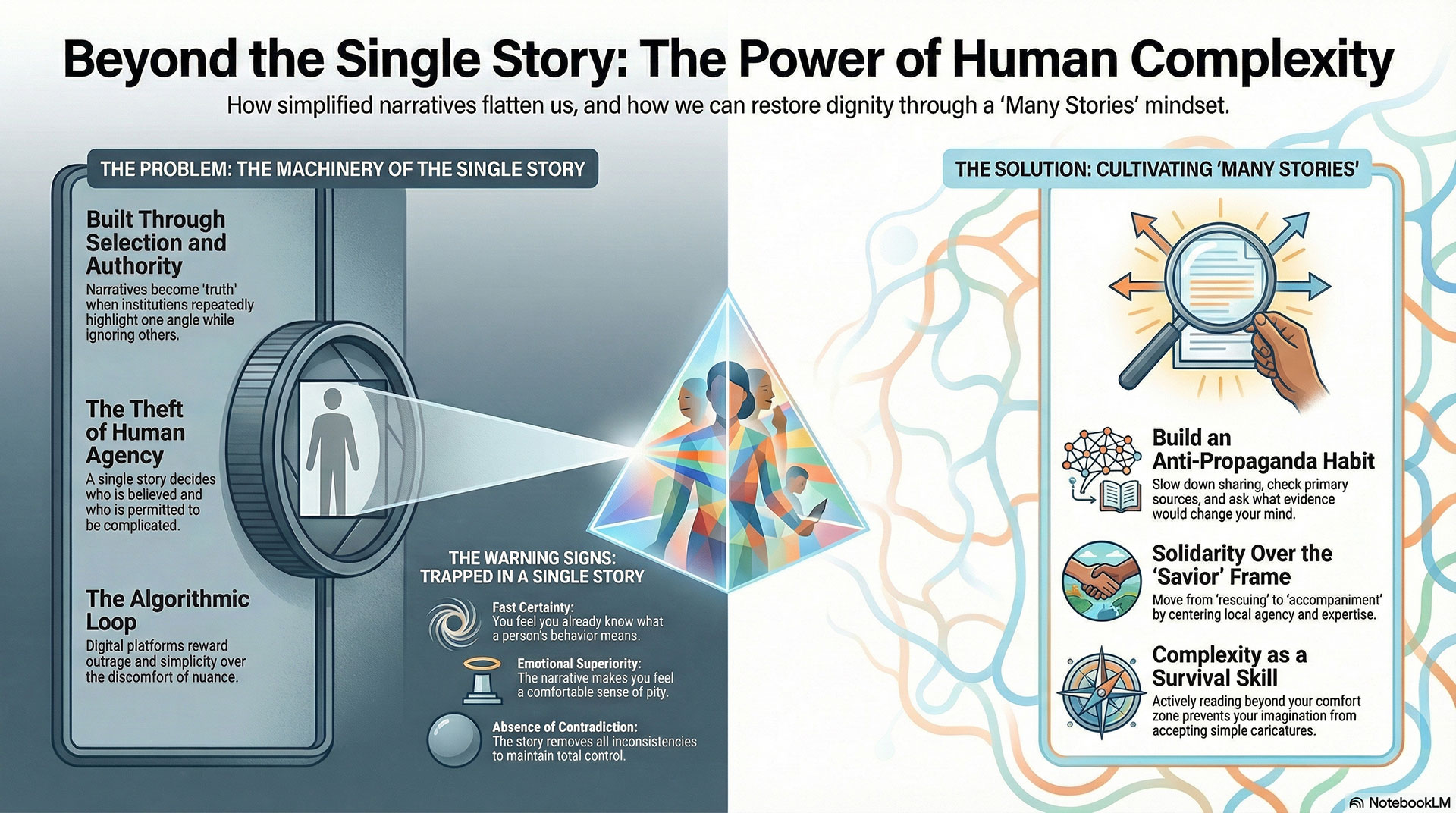
Chimamanda Ngozi Adichie: Selection, authority, benefit, and the human hunger for certainty. That’s the machinery. The single story is not simply a misunderstanding. It’s a structure.
She lets the silence sit a moment. Not dramatic silence. The kind that forces everyone to notice their own mind reaching for shortcuts.
Chimamanda Ngozi Adichie: Now I want to ask about what gets stolen. When a single story takes hold, what does it take first? Dignity, complexity, or agency?
Edward Said: It begins with agency. The single story denies people the right to define themselves. It tells them who they are before they speak. Once that happens, dignity becomes conditional, because dignity is linked to being seen as fully human. Complexity is then treated as suspicious or irrelevant. But the first theft is always the power to narrate oneself.
Toni Morrison: I think it steals complexity first, and dignity follows. Because dignity relies on being perceived as whole. When you reduce a person to a single trait, you reduce their humanity. You can love them sentimentally and still deny them dignity, because sentiment is not respect. Complexity is respect. Complexity is the acknowledgement that a person is not a symbol for your lesson.
Ibram X. Kendi: Dignity is the first casualty because the single story makes inequality feel normal. It creates a moral distance. Once dignity is removed, policies can be justified that would otherwise be unthinkable. Then agency is removed, because people are treated as objects to be managed rather than subjects who choose. Complexity is removed to keep the system stable. It’s a chain reaction, but the first break is dignity.
Hannah Arendt: I see it as the theft of plurality. Human beings exist among other human beings, each different. The single story turns plurality into sameness. In doing so, it steals political reality itself, because politics depends on the recognition of difference. When plurality is denied, agency becomes impossible, dignity becomes fragile, and complexity becomes inconvenient. The first theft is the collapse of plurality into a single category.
Chimamanda Ngozi Adichie: That’s beautifully said. The theft is not one thing. It’s the whole human shape. But you’re right that it begins where power begins: who gets to speak, who gets to be seen, who gets to be many things at once.
Her voice stays calm, but there is an edge now. Not anger. Precision.
Chimamanda Ngozi Adichie: Let’s make this personal and practical. What is the fastest way to detect when you are inside a single story without realizing it?
Ibram X. Kendi: Notice when your mind reaches certainty too quickly. When you think you already know what someone’s behavior means, or what a group is like, or what a country must be, that’s a signal. Ask, what information am I ignoring? Who benefits from my certainty? And what story would I tell if I had to explain this person as an individual rather than as a category?
Toni Morrison: Pay attention to the emotional tone. A single story often comes with a comfortable feeling of superiority or pity. Those are both warnings. If you feel above someone, or you feel you are rescuing them, you may be inside a story that flatters you. The antidote is curiosity that risks being changed. If your curiosity cannot be changed, it’s not curiosity. It’s consumption.
Edward Said: Look for the absence of contradiction. Real life is full of it. People are inconsistent. Nations are plural. Histories are layered. The single story removes contradiction because contradiction disrupts control. If you find yourself thinking in a way that leaves no room for contradiction, you are likely inside a narrative that is serving an agenda.
Hannah Arendt: Observe whether you are using clichés. Clichés are ready-made thoughts. They allow you to speak without thinking. When your language becomes automatic, your thinking becomes automatic. The single story loves automatic language. So pause when you hear yourself using phrases that flatten reality. Then return to the particular. The specific person. The specific fact. The specific moment. Thinking begins there.
Chimamanda Ngozi Adichie: I love that. Certainty too quickly. Comforting superiority or pity. Lack of contradiction. Clichés. These are the symptoms.
She sits back slightly, letting the group breathe again.
Chimamanda Ngozi Adichie: I want to add one more. The single story often feels like kindness. It can sound like concern. It can sound like solidarity. But if it erases the person’s ability to be complicated, then it is still a form of violence. A soft violence.
Toni Morrison: Yes. It can be affectionate and still be oppressive.
Edward Said: It can be cultured and still be colonial.
Ibram X. Kendi: It can be polite and still be racist.
Hannah Arendt: It can be ordinary and still be dangerous.
Chimamanda Ngozi Adichie: That’s our close for Topic 1. A single story is made through selection and repetition backed by authority, sustained because it benefits power and because human beings crave certainty. It steals the human shape by flattening plurality. And we detect it by watching for fast certainty, emotional superiority, contradiction removed, and language that thinks for us.
Her gaze moves gently around the circle, like an invitation to keep widening.
Chimamanda Ngozi Adichie: Next, we turn to the machines that deliver stories at scale. Media, incentives, and algorithms.
Topic 2: Media, Algorithms, and Narrative Power

Moderator:
Maria Ressa
Panel:
Chimamanda Ngozi Adichie, Maria Ressa, Neil Postman, Zeynep Tufekci, Ta-Nehisi Coates
The room changes in a subtle way. The books are still there, but now there are phones on the table, face down. Not as props. As a reminder. The single story is no longer only passed down by textbooks and movies. It is fed to people all day, personalized, optimized, repeated.
Maria Ressa moderates with the calm intensity of someone who has paid a personal price for truth. Chimamanda Ngozi Adichie sits beside her, listening closely. Neil Postman looks like he’s studying the room as if it were a television set. Zeynep Tufekci has the sharpness of someone who can see systems. Ta-Nehisi Coates brings a grounded moral clarity, the kind that refuses to flatten history into slogans.
Maria Ressa: Let’s start with the machinery. Platforms and news incentives reward speed, outrage, and simplicity. How do these systems turn nuance into a single story machine?
Ta-Nehisi Coates: They reward the most emotionally clean narrative. The one with a villain you can point at and a hero you can join. Nuance asks you to sit with discomfort, and discomfort does not go viral as fast. The system chooses what spreads, and what spreads becomes what people think is real. Over time, the public loses patience for complexity, because complexity stops being familiar.
Zeynep Tufekci: The algorithm is a distributor, not a neutral mirror. It measures what keeps you engaged, and engagement often means strong emotion. So the system learns to push content that triggers anger, fear, or tribal belonging. It also creates micro realities. Two people in the same city can receive totally different versions of the world. That makes a single story more powerful, because it feels personal, like it found you.
Neil Postman: I would put it in older language. The medium shapes the epistemology of a culture. A platform that privileges short, punchy content will privilege short, punchy thinking. You can’t ask a society to think deeply using a medium that rewards amusement and speed. Even the news begins to resemble entertainment, and when that happens, serious matters are forced into simple forms, because simple forms are easier to sell.
Chimamanda Ngozi Adichie: And there is also the human desire to belong. The single story becomes a social password. You repeat it to signal you are part of the right group. You learn which story gets applause, which story gets punishment. Eventually you stop asking, is this true, and start asking, will this protect me socially. That is how nuance dies quietly, even among intelligent people.
Maria Ressa: That social layer is essential. The algorithm rewards the content, and the crowd rewards the identity that goes with it. The single story becomes a shortcut for belonging.
She pauses, then tightens the focus.
Maria Ressa: Now the hard part. People say they want truth, but outrage performs better. What does responsible storytelling look like when attention is monetized and anger is the easiest fuel?
Neil Postman: Responsible storytelling begins with refusing to treat every topic as spectacle. It means context over immediacy. It means accepting that some truths cannot be compressed without distortion. It also means humility, admitting what you do not know and what cannot be known quickly. A culture addicted to certainty will punish that humility, but humility is the beginning of responsibility.
Chimamanda Ngozi Adichie: Responsible storytelling also includes letting people be fully human. That means refusing the single angle. If you write about a place, you must show more than its tragedy. If you write about a person, you must show more than their worst moment. You can tell a story about suffering, but you must not make suffering the only identity. Responsibility is not softness. It is accuracy. It is refusing to simplify humans into symbols.
Zeynep Tufekci: I think responsibility is partly structural. Journalists can do their best, but platforms must also change incentives. Friction can be good. Slowing down sharing, adding context, prioritizing sources with transparency. Also, media literacy is not optional now. If you have a society where everyone is a publisher, everyone needs basic skills to evaluate claims. Otherwise a single story becomes a swarm.
Ta-Nehisi Coates: And responsibility means refusing false balance. Some stories are not two equal sides. The pursuit of nuance cannot become a performance where every harm is framed as a misunderstanding. If a system produces harm, the story must say so. But it must also resist the urge to make the harm into a cartoon. The challenge is to keep moral clarity without collapsing complexity.
Maria Ressa: Moral clarity without cartoons. That’s it. Responsibility is not neutrality. It is discipline. It is context. It is humanity.
Her voice stays steady, but the next question lands with more personal weight.
Maria Ressa: People listening will ask, what can I do? I’m not running a newsroom. I’m just a person scrolling. How can ordinary people build an anti propaganda habit without becoming cynical?
Zeynep Tufekci: Build a three step pause. First, slow down the impulse to share. Second, ask what would change my mind, meaning what evidence would I accept that contradicts this. Third, check one primary source or credible outlet before you pass it on. The habit is small but it changes your relationship to attention. You stop being a distribution node for manipulation.
Neil Postman: My advice is to protect your mind from constant exposure. If you feed on a steady stream of fragmented information, you will begin to think in fragments. Choose fewer sources. Choose longer forms sometimes. Read a full argument, not only reactions to it. This is not nostalgia. It’s cognitive hygiene.
Ta-Nehisi Coates: I would add, interrogate your satisfaction. If a story makes you feel instantly righteous, instantly certain, instantly superior, that’s the moment to pause. Not because it must be false, but because you are being rewarded emotionally. And emotional rewards are how manipulation works. The habit is to ask, am I learning, or am I being soothed.
Chimamanda Ngozi Adichie: And I would say, diversify your stories on purpose. Not as a performance, but as nourishment. Read writers from places you think you already understand. Listen to voices that complicate your favorite narrative. If you only consume stories that flatter your worldview, you will become fragile. Many stories make you stronger.
Maria Ressa: That word matters. Fragile. The single story makes people fragile because it cannot survive reality. Then reality arrives, and people panic, and the panic demands another simple story.
She looks around the table, then speaks like she’s giving something to the listener rather than winning an argument.
Maria Ressa: A healthy anti propaganda habit is not suspicion. It’s dignity for your own mind. Slow down. Check. Ask what would change you. Notice emotional rewards. Choose longer forms. Seek many stories.
Neil Postman: And treat your attention as sacred, not as an endless resource to be harvested.
Zeynep Tufekci: Because if you don’t choose what you see, the system will choose it for you.
Ta-Nehisi Coates: And the system will choose what keeps you consuming, not what makes you wiser.
Chimamanda Ngozi Adichie: Many stories are not a luxury. They are a defense of humanity.
Maria Ressa: That’s our close for Topic 2. Platforms and incentives compress nuance into viral simplicity. Responsible storytelling requires context, human fullness, and structural change. And ordinary people can build small habits that protect their attention without turning into cynics.
She nods gently, like the next room is already waiting.
Maria Ressa: Next, we move into the story that often hides behind good intentions. Travel, aid, and the savior frame.
Topic 3: Travel, Aid, and the Savior Frame

Moderator:
Teju Cole
Panel:
Chimamanda Ngozi Adichie, Teju Cole, Ngozi Okonjo-Iweala, Paul Farmer, Wangechi Mutu
The room changes again, but not into something exotic. It becomes practical. A plain meeting space with maps on the wall, stacks of reports, and a few photographs placed face down, as if everyone agreed not to turn human beings into decoration. The air carries the feeling of people who have seen good intentions do harm, and who refuse to stop at guilt.
Teju Cole moderates with a quiet sharpness. His presence says: we are not here to perform compassion. We are here to tell the truth about it. Chimamanda Ngozi Adichie sits nearby, attentive. Ngozi Okonjo-Iweala brings policy realism and institutional experience. Paul Farmer brings moral intensity and humility. Wangechi Mutu brings the artist’s eye, the ability to see what images do to power.
Teju Cole: Let’s begin with what I’ve called the savior story. It’s emotionally satisfying, often wrapped in kindness, and it spreads quickly. Why does the savior story feel so good to outsiders?
Paul Farmer: Because it offers simple meaning. It takes a complex situation and turns it into a narrative with a clear role for the outsider. You can feel useful immediately. You can feel morally clean. And you can feel like a protagonist. But real solidarity is slow. It requires listening, partnership, and humility. The savior story avoids that. It trades complexity for emotional reward.
Chimamanda Ngozi Adichie: It also flatters the outsider. The savior story says: you are the one who sees, you are the one who cares, you are the one who brings light. It centers the outsider’s identity, not the insider’s life. And it often reduces the people being helped into a single story: helpless, poor, voiceless. It creates a stage where the savior performs goodness. That is why it is satisfying. It is a story about the savior.
Ngozi Okonjo-Iweala: I agree. In policy terms, the savior story simplifies responsibility. It makes it seem like the problem can be solved by individual acts of charity rather than by systems, governance, local leadership, and accountability. Outsiders love it because it feels immediate and personal. But development is not a photo opportunity. It’s years of institutions and hard tradeoffs. The savior story is an emotional shortcut.
Wangechi Mutu: The savior story is also visual. Images do much of the work. A single photograph can flatten a whole country into one emotion. Pity. Shock. Gratitude. The outsider becomes the viewer who is safe, the one who looks, the one who decides what the image means. That is power. The savior story feels good because it confirms power while pretending to dissolve it.
Teju Cole: Yes. It gives you identity, clarity, and a comforting moral position. It feels like compassion, but it often behaves like consumption.
He pauses, then moves toward the practical harm.
Teju Cole: How can aid, charity, and volunteering avoid turning people into props in someone else’s identity story?
Ngozi Okonjo-Iweala: Begin with local agency and local priorities. Who defines the problem? Who defines success? Who owns the project and the data? If outsiders control the story, outsiders will control the decisions. The best aid strengthens local institutions, builds capacity, and supports accountability. Also, stop measuring success by visibility. Many effective interventions look boring. That’s a good sign.
Paul Farmer: I would say: accompaniment. Walk with people rather than rushing ahead of them. Partnership is not a slogan. It is a discipline. It means long-term commitment. It means showing up after the cameras leave. And it means treating the people you serve as colleagues, not as beneficiaries. The minute you talk about people as if they are your lesson, you have already reduced them.
Chimamanda Ngozi Adichie: It also requires story ethics. If you tell a story about someone, you must ask: does this story allow them dignity? Does it allow them complexity? Do they have a voice in how they are represented? The single story is not only in the policies. It’s in the narratives we tell to justify our presence. And sometimes the most ethical thing is not to tell the story at all, especially if telling it will center you.
Wangechi Mutu: Artists have wrestled with this for a long time. Representation is not neutral. If you photograph suffering, you risk turning suffering into aesthetic material. One ethical principle is to refuse the “poverty pose” as default. Show people as whole. Show joy, work, humor, dignity, contradiction. And question the gaze. Who is looking? Why? Who benefits from the looking?
Teju Cole: And also question the emotional reward. If your volunteering makes you feel wonderful, ask what you are buying with that feeling.
There’s a slight tension in the room, because the truth is uncomfortable. But it’s not hostile. It’s adult.
Teju Cole: Now I want a practical rule. A lot of harm comes from outsiders telling stories about places they do not belong to. What is one rule for telling a story about a place you don’t belong to, without creating a single story?
Chimamanda Ngozi Adichie: My rule is: do not tell one story as if it is the story. If you must tell a story, situate it as one angle, one moment, one person. And add context. Make clear what you do not know. Also, remember that your story will travel. It may become someone else’s only reference. That responsibility should make you cautious. If the story flatters your virtue and flattens their humanity, do not tell it.
Paul Farmer: My rule is: earn the right to narrate. If you’ve been there for two weeks, you have not earned it. If you’ve listened, built relationships, learned the language of the place, worked under local leadership, then maybe you can speak, but still with humility. And always be accountable to the people you are describing. If you would not say it in front of them, don’t publish it.
Ngozi Okonjo-Iweala: My rule is: follow local expertise. Before you narrate, ask what local journalists, scholars, and community leaders are already saying. Too often outsiders act as if they discovered a reality that has been lived by others for generations. That’s arrogance. It also causes duplication and distortion. Your story should amplify local knowledge, not replace it.
Wangechi Mutu: My rule is: interrogate your gaze. Ask what you are looking for. Are you seeking tragedy to confirm your worldview? Are you selecting images that make you the hero? Try to show what resists your categories. And never reduce a person to a symbol. A person is not your evidence.
Teju Cole: Those rules share a spine: humility, context, accountability, and plurality.
He leans back slightly, then offers something that feels like a warning and a gift.
Teju Cole: The savior story thrives because it is emotionally easy. Many stories require emotional maturity.
Chimamanda Ngozi Adichie: And many stories require that you decenter yourself.
Paul Farmer: But decentering is not self-hatred. It’s solidarity.
Ngozi Okonjo-Iweala: It’s also effectiveness. Aid that centers outsiders often fails.
Wangechi Mutu: And it’s beauty. Because the full human story is always more beautiful than the stereotype.
Teju Cole: That’s our close for Topic 3. The savior story feels satisfying because it centers the outsider and simplifies complex realities into moral theater. Ethical aid requires local agency, long-term partnership, and story responsibility. And if you tell stories about places you don’t belong to, you need humility, accountability, context, and many stories, not one.
He looks toward Chimamanda, as if handing the room back to her.
Teju Cole: Next, we turn inward. The single story doesn’t only live in media and charity. It lives inside identities, inside stereotypes, inside the way people see themselves.
Topic 4: Identity, Stereotypes, and Inner Narratives

Moderator:
Brené Brown
Panel:
Chimamanda Ngozi Adichie, Brené Brown, Claude Steele, bell hooks, James Baldwin
The room shifts into something that feels like both a classroom and a sanctuary. A circle of chairs. A small table in the middle with a pitcher of water. The lighting is warm but not soft in a sentimental way. More like honest light. The kind that makes it possible to speak without performing.
Brené Brown moderates with steady compassion and sharp boundaries. She does not let people hide behind theory, but she also does not let pain become spectacle. Chimamanda Ngozi Adichie sits nearby, attentive and clear. Claude Steele has the calm precision of a researcher who has watched stereotypes become self-fulfilling prophecies. bell hooks brings fierce tenderness and a refusal to separate love from justice. James Baldwin sits with that unmistakable intensity, as if he is listening for what is not being said.
Brené Brown: We’ve talked about how single stories get imposed from the outside. Now I want to talk about the inside. How do stereotypes become internal scripts that shape behavior, confidence, and belonging?
Claude Steele: Stereotypes become scripts when people anticipate judgment. If you know there is a stereotype about your group, you may worry that your performance will confirm it. That pressure can change how you think, how you speak, even how your body behaves. It can reduce working memory and disrupt focus. Over time, people adapt by self-censoring, avoiding certain environments, or trying to overperform. That’s not a character flaw. It’s a response to threat.
James Baldwin: And the threat is not theoretical. The stereotype is not just an idea. It is a cage. It is a story used to justify why you should have less. Less safety. Less innocence. Less tenderness. When you live inside a society that tells you who you are, you begin to fight yourself. You begin to wonder whether you deserve your own freedom. That is how the story enters the bloodstream.
bell hooks: Stereotypes become internal scripts because domination is taught as normal. Patriarchy, white supremacy, class hierarchy. They train people to accept roles. When you grow up hearing the same story about your worth, you may start to believe it even when you reject it intellectually. The internal script often appears as shame. The voice that says, you are too much, or not enough. And shame thrives in silence.
Chimamanda Ngozi Adichie: Yes. The single story does not only flatten groups. It flattens the self. If you are told, repeatedly, that your people are one thing, then you start to monitor yourself. You start to ask, am I being that thing right now? You either perform against the stereotype or you disappear into it. Either way, you are no longer free. You are acting in a script you did not write.
Brené Brown: That’s so important. Shame is a single story about the self. It says, you are not worthy of love and belonging. And when stereotypes latch onto shame, they become very difficult to uproot.
She takes a breath, as if she wants the next question to be a bridge rather than a weapon.
Brené Brown: Now here’s the tricky part. People want to speak about identity honestly. But sometimes identity talk collapses people into categories again. How do we speak about identity with truth, without reducing people to labels?
Chimamanda Ngozi Adichie: We begin by refusing the idea that identity is singular. A person is not one thing. We are made of many stories. Nationality, gender, class, religion, family, memory, language. When identity becomes a single story, it becomes a prison. So we must speak about identity as a context, not as a verdict. Identity explains experiences, but it does not exhaust the person.
Claude Steele: Also, we should differentiate between describing patterns and defining individuals. Research can show that stereotypes affect performance in certain settings. But that doesn’t mean every individual will respond the same way. We need a language of probability, not destiny. And we need to create conditions that reduce stereotype threat, such as belonging cues, fair evaluation, and role models.
bell hooks: I want to say this plainly. Talking about identity without love is dangerous. Because when love is absent, identity becomes a weapon. Love here does not mean softness. It means the will to see fully. The will to refuse dehumanization. If we speak about identity without seeing each other’s humanity, we will reproduce domination even while claiming liberation.
James Baldwin: The problem is that people want innocence. They want to talk about identity in a way that keeps them innocent, that keeps them untouched. But truth touches you. Truth changes you. If your identity talk is designed to protect you from discomfort, it is not truth. It is performance. And performance will always seek a simple story, because simple stories are easier to act.
Brené Brown: That lands. If we are protecting ourselves from discomfort, we are probably not learning. And if we are not learning, we tend to default to scripts.
She softens slightly, but not into sentiment. More into courage.
Brené Brown: Let’s go to the final question. Hard conversations often collapse into defensiveness and shame. What does it look like to replace shame and defensiveness with curiosity, especially when the topic is identity?
Claude Steele: Curiosity begins with reducing threat. If someone believes they will be punished for making a mistake, they will become defensive. So we create contexts where people can acknowledge ignorance without humiliation. We also separate intention from impact. You can mean well and still cause harm. If we can talk about impact without turning it into moral annihilation, people are more willing to stay present.
Chimamanda Ngozi Adichie: Curiosity also requires listening for the full story. If someone tells you they were harmed by a stereotype, don’t rush to defend your innocence. Ask, what have you lived that I haven’t lived? What am I missing? Curiosity is not self-flagellation. It is humility. It is accepting that the world is larger than your experience.
bell hooks: Curiosity must be paired with accountability. Otherwise it becomes a hobby. Curiosity says, I want to understand. Accountability says, and I will act differently once I understand. Love asks for both. You cannot claim love and refuse accountability. And you cannot claim curiosity if you refuse to be changed.
James Baldwin: And you must tell the truth about fear. Much defensiveness is fear. Fear of losing status. Fear of losing belonging. Fear of being seen clearly. Curiosity comes when you can admit, I am afraid. Once you admit fear, you can stop pretending. And once you stop pretending, you can begin to see.
Brené Brown: That’s a powerful sequence. Reduce threat. Separate intention from impact. Listen beyond your experience. Pair curiosity with accountability. Name fear.
She looks around the circle like she’s making a promise to the listener.
Brené Brown: Shame loves the single story. Curiosity breaks it. Because curiosity demands more than one angle. It demands more than one truth at a time.
Chimamanda Ngozi Adichie: And it returns people to their full humanity.
Claude Steele: And it creates environments where people can belong without erasing themselves.
bell hooks: And it makes love possible, because love requires seeing.
James Baldwin: And it makes freedom possible, because freedom requires truth.
Brené Brown: That’s our close for Topic 4. Stereotypes become internal scripts through shame, fear, and threat. We speak about identity honestly by refusing singular definitions and holding both pattern and person. And we replace defensiveness with curiosity when we reduce threat, separate intention and impact, accept humility, and allow ourselves to be changed.
The room holds for a moment in the kind of quiet that feels like respect.
Brené Brown: Next, we widen again. How do we build a culture of many stories, without losing the idea that truth matters?
Topic 5: Building a Culture of Many Stories

Moderator:
Chimamanda Ngozi Adichie
Panel:
Chimamanda Ngozi Adichie, Kwame Anthony Appiah, Yuval Noah Harari, Chinua Achebe, Trevor Noah
The room feels brighter. Not because the topic is lighter, but because it’s moving toward construction instead of diagnosis. A small community hall with tall windows. Morning light. A circle of chairs. A table in the corner with tea and simple food, as if everyone agreed that serious conversations should still feel human.
Chimamanda Ngozi Adichie moderates again, steady and awake, as if she is holding a lantern rather than a microphone. Around her sit Kwame Anthony Appiah, Yuval Noah Harari, Chinua Achebe, and Trevor Noah. The group feels like a bridge between philosophy, history, literature, and lived social reality.
Chimamanda Ngozi Adichie: We have been naming the harm. Now I want to ask about building. What would schools and workplaces do differently if complexity was treated as a skill, not as an inconvenience?
Kwame Anthony Appiah: They would teach interpretation as a civic practice. Complexity is not only information. It’s the ability to hold competing descriptions without collapsing into cynicism. Schools would teach students how narratives are formed, how identity is shaped by story, how moral judgment can be both firm and nuanced. Workplaces would reward people who can see multiple stakeholders, multiple causes, multiple futures. Complexity would be treated like literacy, not like indecision.
Chinua Achebe: They would teach story from the inside, not only from outside. They would include local voices, local histories, local languages, not as decoration but as structure. Complexity is often what emerges when you finally hear the people who were previously spoken about but not heard. If schools and workplaces valued complexity, they would make room for voices that disturb the comfortable narrative.
Yuval Noah Harari: Institutions would also change their relationship to information. Complexity is a skill because we live in a world flooded with narratives, and many of them are engineered. Schools would train students to ask, who benefits from this story. Workplaces would teach employees to resist manipulation, to slow down, to verify. Complexity would become a defense against propaganda. In that sense, complexity is not indulgence. It is survival.
Trevor Noah: And practically, they’d stop rewarding the person who sounds confident while being wrong. That alone would change everything. Schools would stop treating fast answers as the best answers. Workplaces would stop confusing loudness with leadership. Complexity would be treated like maturity. The person who says, hold on, we need more context, would be respected, not mocked.
Chimamanda Ngozi Adichie: Yes. The ability to say, I need more context, would become a sign of competence.
She pauses, then turns to the dangerous edge of the topic.
Chimamanda Ngozi Adichie: Now the question people often raise when we talk about many stories is this. How do we celebrate many stories without sliding into relativism, without this idea that anything goes, that truth doesn’t matter?
Yuval Noah Harari: We must distinguish between many perspectives and many facts. Facts are about evidence. Perspectives are about meaning. You can have many interpretations of the same event, but you cannot have infinite freedom with the evidence. A culture of many stories should strengthen our commitment to reality, not weaken it. Otherwise the space of stories becomes a playground for manipulation.
Kwame Anthony Appiah: I would say that moral seriousness requires both openness and standards. We can acknowledge that people experience the world differently and still say some claims are false, some harms are real. Many stories does not mean no judgment. It means you judge with more information. You become better at distinguishing between your perspective and the whole. The enemy is not truth. The enemy is arrogance.
Chinua Achebe: The danger is when powerful people use relativism to escape responsibility. They say, it is just one perspective, when in fact they are hiding violence behind ambiguity. A culture of many stories must include the ability to name injustice clearly. Complexity must not become an excuse. It must become a fuller understanding of what must be changed.
Trevor Noah: Also, people misunderstand this. You can acknowledge multiple stories while still knowing that some people are lying. Not every story is equal. Some stories are propaganda. Some stories are trauma. Some stories are truth. The point is to stop letting one story become the only story. It doesn’t mean you put every story on a pedestal. It means you stop being lazy about your beliefs.
Chimamanda Ngozi Adichie: That’s exactly it. Many stories is not moral confusion. It’s moral effort. It asks you to do more work, not less.
She lets the room settle, then brings it down to daily life.
Chimamanda Ngozi Adichie: If we want to become keepers of many stories, not collectors of stereotypes, what is one daily practice that makes that real?
Chinua Achebe: Read beyond your comfort. Not occasionally, but as a discipline. Read writers who live where you do not. Read voices that disagree with your worldview. And read with humility. The practice is not collecting exotic opinions. The practice is letting your imagination expand until you can no longer accept simple pictures of people.
Kwame Anthony Appiah: Practice charitable interpretation. When you encounter a person or a claim that irritates you, ask, what is the strongest version of this that could be true. That does not mean you accept it. It means you refuse to reduce others into caricatures. Caricature is the beginning of the single story.
Yuval Noah Harari: Build an evidence habit. Once a day, when you feel certain about a claim you saw online, check the underlying source. Train your mind to separate confidence from proof. This is a daily exercise in humility. Without such habits, we become prey to the most emotionally satisfying narratives.
Trevor Noah: I’ll make it simple. Have real conversations with people you would normally avoid. Not debate. Conversation. If you only know people through headlines, you will end up with headline-level beliefs. But if you share a table with someone, even briefly, it becomes harder to keep them in a box. Also, humor helps. Humor punctures the inflated certainty that single stories depend on.
Chimamanda Ngozi Adichie: I love that. Read widely. Interpret charitably. Check evidence. Talk to real people. And use humor to puncture certainty, not to humiliate.
She looks around the circle, and her voice becomes quieter, more intimate, like she’s speaking to a single listener.
Chimamanda Ngozi Adichie: The single story is tempting because it is easy. It offers speed. It offers identity. It offers the comfort of a simple enemy. But the cost is always the same: you lose the human being.
Many stories do not make life messier. Life is already messy. Many stories make you more honest.
And in that honesty, something changes. You stop treating people as symbols. You stop treating places as lessons. You stop treating yourself as a fixed category.
You become capable of seeing.
Chinua Achebe: And seeing is the beginning of dignity.
Kwame Anthony Appiah: And dignity is the beginning of ethics.
Yuval Noah Harari: And ethics is the beginning of a stable society.
Trevor Noah: And a stable society needs people who can laugh and still tell the truth.
Chimamanda Ngozi Adichie: That’s our close for Topic 5. Complexity is a skill that schools and workplaces can teach and reward. Many stories can coexist with truth when we distinguish evidence from interpretation and refuse to use nuance as an excuse. And daily practices, reading widely, charitable interpretation, evidence checks, real conversations, keep us from slipping back into stereotypes.
The morning light stays on the table like a promise that the conversation can keep widening.
Final Thoughts by Ngozi Adichie
If you take only one thing from this conversation, let it be this: a single story is not simply a mistake. It is a habit. It is the habit of choosing the easiest narrative instead of the truest one.
And you can break that habit, but you cannot break it with guilt. You break it with curiosity, with discipline, and with the courage to let new stories rearrange your certainty.
You will feel the single story in your body when it arrives. It will feel like instant clarity, instant judgment, instant certainty. It will tell you, “I already know what this is.” That is the moment to pause. That is the moment to ask, “What am I not seeing?” “Whose voice is missing?” “What context would make this person more human to me?”
Many stories do not mean that everything is equally true. Many stories mean you refuse to let one story do the work of an entire reality. You refuse to let stereotypes stand in for people. You refuse to let a headline become a whole country. You refuse to let the most repeated narrative become the most accurate one.
And when you practice that refusal, something quietly changes. You become harder to manipulate. You become harder to recruit into cruelty. You become more capable of love that is not sentimental, because it is rooted in seeing.
The world will always try to hand you a single story. It is efficient. It is profitable. It is easy to sell.
But you do not have to buy it.
Choose many stories. Choose complexity. Choose the dignity of being fully human, and of allowing others the same.
Short Bios:
Chimamanda Ngozi Adichie
Nigerian novelist and essayist known for Half of a Yellow Sun, Americanah, and her TED Talk “The Danger of a Single Story,” exploring identity, power, and narrative.
Edward Said
Literary scholar and public intellectual, author of Orientalism, influential in postcolonial studies and critique of how cultures are represented through power.
Toni Morrison
Nobel Prize winning novelist and editor, author of Beloved, renowned for portraying Black life with moral depth, historical truth, and psychological complexity.
Ibram X. Kendi
Historian and author of How to Be an Antiracist, focused on the history of racism and how ideas shape policy, culture, and identity.
Hannah Arendt
Political theorist known for The Origins of Totalitarianism and Eichmann in Jerusalem, examining propaganda, conformity, and moral responsibility.
Maria Ressa
Filipino journalist and co-founder of Rappler, Nobel Peace Prize laureate, known for work on disinformation, press freedom, and digital authoritarianism.
Neil Postman
Media theorist and author of Amusing Ourselves to Death, analyzing how media formats shape public discourse and what societies can know.
Zeynep Tufekci
Sociologist and writer focused on technology, social movements, and platform incentives, examining how algorithms shape information and attention.
Ta-Nehisi Coates
Writer and journalist known for Between the World and Me, exploring history, race, and narrative framing in American life.
Teju Cole
Nigerian American writer and essayist whose work critiques “savior” narratives and examines art, power, travel, and moral imagination.
Ngozi Okonjo-Iweala
Economist and Director-General of the WTO, known for leadership in global development, governance, and policy reform.
Paul Farmer
Physician and anthropologist, co-founder of Partners In Health, known for long-term solidarity based healthcare and ethical global health practice.
Wangechi Mutu
Kenyan American artist whose work interrogates representation, colonial gaze, and how images shape identity and power.
Brené Brown
Researcher and author focused on vulnerability, shame resilience, and brave conversations, emphasizing empathy with accountability.
Claude Steele
Social psychologist known for research on stereotype threat and belonging, showing how context and identity cues affect performance.
bell hooks
Cultural critic and writer focused on love, race, gender, and education, advocating for liberation through truth-telling and care.
James Baldwin
Essayist and novelist known for moral clarity on race, identity, and power, exploring how stories shape both oppression and freedom.
Kwame Anthony Appiah
Philosopher and ethicist known for work on cosmopolitanism and identity, emphasizing moral reasoning across difference.
Yuval Noah Harari
Historian and author of Sapiens, exploring how shared stories, information systems, and myths shape societies.
Chinua Achebe
Nigerian novelist and author of Things Fall Apart, a foundational voice in African literature and critique of colonial narratives.
Trevor Noah
Comedian and author of Born a Crime, known for using humor to examine identity, politics, and cultural misunderstanding.
Leave a Reply