
|
Getting your Trinity Audio player ready...
|
What if Jorge Luis Borges wrote this story to prove that every choice never truly ends?
Introduction by Jorge Luis Borges
The Garden of Forking Paths was born from a suspicion rather than an idea.
I suspected that time, as we commonly understand it, is a convenience—an arrangement made so that human beings may endure memory, regret, and hope without collapsing under their weight. We speak of past and future as though they were rooms we enter and leave. I have never believed this to be entirely true.
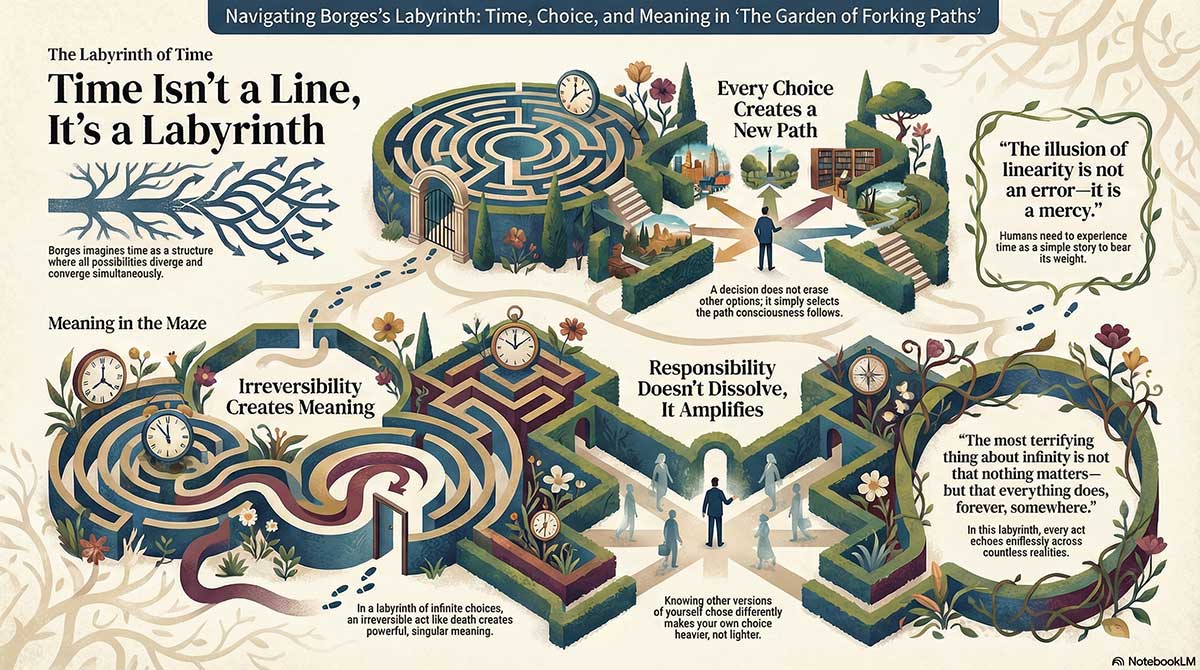
In this story, I imagined time not as a line but as a labyrinth: a structure in which all possibilities exist simultaneously, diverging and converging without cancellation. Each choice does not erase the others; it merely selects the path on which consciousness continues.
I concealed this speculation inside a detective story because the genre promises clarity. A crime suggests a solution. A mystery implies resolution. By honoring those expectations formally, I could betray them philosophically. The reader arrives at an answer—and finds that the answer explains nothing that truly matters.
This is not a story about espionage, nor even about murder. It is a story about how meaning survives when certainty does not, and how responsibility persists even when alternatives multiply without end.
(Note: This is an imaginary conversation, a creative exploration of an idea, and not a real speech or event.)
Topic 1 — Is Time Linear, or Are All Choices Happening at Once?

Setting:
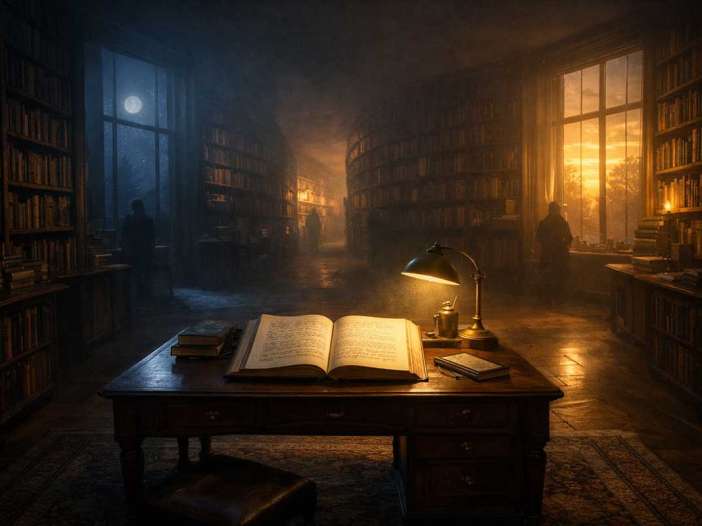
A quiet study that seems to extend in multiple directions at once. Bookshelves repeat, then subtly diverge. A clock on the wall has no hands, yet everyone senses time passing. Outside the window, night and dawn overlap.
Participants:Jorge Luis Borges, Beatriz Sarlo, Gilles Deleuze, Manuel Vargas, David Lewis
Moderator:
Nick Sasaki
Nick Sasaki
We’re used to thinking of time as a straight line—past behind us, future ahead. But The Garden of Forking Paths refuses that comfort. It suggests something more unsettling: that all possibilities exist at once.
So let me begin here.
If every possible choice exists simultaneously, does the idea of “decision” still have meaning—or is it an illusion we tell ourselves just to survive time?
Beatriz Sarlo
Borges understood that linear time is not a fact of reality—it’s a cultural habit. We organize history, morality, and identity around sequence because it gives us narrative control.
In The Garden of Forking Paths, the decision does not disappear, but it loses its exclusivity. Yu Tsun’s choice matters because he experiences it as singular, even though Borges lets us glimpse that it is not unique in the universe. Meaning survives not because the choice is exclusive, but because consciousness is limited.
David Lewis
From the perspective of possible worlds, decision does not vanish—it multiplies. Every choice generates a divergence, not a collapse.
The illusion is not decision; the illusion is uniqueness. Yu Tsun decides in his world, fully and responsibly, even though other versions of him decide otherwise elsewhere. Moral weight remains localized. What Borges does brilliantly is make us feel the vertigo of knowing that locality is not cosmic.
Gilles Deleuze
I would go further. Borges is not simply multiplying worlds—he is dissolving hierarchy.
Decision in a linear model implies progress: one path replaces another. Borges rejects replacement. All paths persist. What we call “choice” is simply the point at which consciousness attaches itself to one line of becoming. The illusion is not decision, but mastery.
Manuel Vargas
But there’s a danger here. If all outcomes exist, then responsibility risks becoming theatrical.
Yu Tsun experiences himself as choosing, but from a meta-perspective, he is discovering which branch he inhabits. The question becomes: does moral responsibility require metaphysical openness, or merely psychological ownership? Borges leaves that deliberately unresolved.
Jorge Luis Borges
(smiling faintly)
I should confess something. I do not believe humans can live inside metaphysical truth.
If we truly felt all possibilities pressing upon us, we would be paralyzed. The illusion of linearity is not an error—it is a mercy. Yu Tsun does not choose because the universe demands it. He chooses because he must live inside a story narrow enough to be bearable.
Nick allows the thought to settle before continuing.
Nick Sasaki
That brings us directly to Yu Tsun himself.
Is Yu Tsun acting freely when he chooses murder—or is he merely discovering the branch of time he was always going to inhabit?
Manuel Vargas
This is where the story becomes ethically radioactive.
Yu Tsun rationalizes his act as necessity, but necessity framed by a system of infinite alternatives becomes morally ambiguous. If he is merely “discovering” his branch, then freedom collapses into fate. Yet the emotional texture of the story insists on agency. Borges gives us both—and refuses to reconcile them.
David Lewis
In modal realism, inevitability does not negate freedom. Yu Tsun’s action is determined relative to his world, but not across all worlds.
He is free because, at the moment of action, alternative futures are open from his perspective. The fact that other versions exist elsewhere does not absolve him here. Borges quietly preserves moral accountability by keeping consciousness local.
Beatriz Sarlo
But notice something crucial: Yu Tsun narrates after the fact.
His freedom is retroactive. He explains himself into coherence. The story suggests that agency is something we construct once time has already hardened. Borges is less interested in metaphysical freedom than in narrative freedom—who gets to tell the story afterward.
Gilles Deleuze
Yes. Freedom here is not choice but expression.
Yu Tsun’s act is not meaningful because it was free; it is free because it created meaning. The murder transforms time into a message. Borges turns agency into authorship. Yu Tsun becomes a writer, not of words, but of events.
Jorge Luis Borges
I will add something uncomfortable.
Yu Tsun does not kill because he is free. He kills because the structure of the story demands an act that cannot be undone. Freedom is not proven by alternatives—it is proven by irreversibility. Only one thing in the labyrinth cannot be branched: death.
A quiet tension fills the room.
Nick Sasaki
Then let me ask the question that lingers after the story ends.
If all outcomes exist, why does this story make one moment feel unbearably irreversible?
Beatriz Sarlo
Because the reader does not live in infinity.
We live in sequence. Borges gives us the idea of infinite branching, but he forces us to experience the story linearly. That friction—between concept and experience—is where the emotional weight emerges. The irreversibility is psychological, not cosmic.
Gilles Deleuze
Irreversibility is intensity.
When everything exists, only moments of extreme intensity cut through the noise. Murder is one such moment. It concentrates time into a singular pressure point. Borges is not denying infinity; he is showing us how infinity makes violence louder, not quieter.
Manuel Vargas
And this is where responsibility returns with force.
If Yu Tsun’s act echoes across infinite branches, then the weight of that act does not dissolve—it amplifies. Infinity does not excuse him; it magnifies the cost. The story makes us feel that burden without explaining it away.
David Lewis
Exactly. Irreversibility is local, and locality is enough.
You do not need a universe to collapse for an act to matter. You need only one world where it cannot be undone. Borges understands that moral seriousness survives even in a multiverse.
Jorge Luis Borges
(quietly)
I have always believed that the most terrifying thing about infinity is not that nothing matters—but that everything does, forever, somewhere.
The story feels irreversible because the reader, like Yu Tsun, must inhabit one path. You cannot comfort yourself with other versions. You must live with this one.
The clock without hands ticks—though no one can see how.
Nick Sasaki (closing the topic)
So perhaps The Garden of Forking Paths is not asking us to abandon linear time—but to recognize it as a fragile shelter.
Infinity may exist. All choices may unfold. But we still wake up inside one story, carrying the weight of what cannot be undone.
And that may be the most human truth Borges ever wrote.
Topic 2 — The Book That Contains All Books

Setting:
A vast circular library. Shelves curve beyond sight. Some books repeat with slight variations; others appear unfinished, mid-sentence. A single manuscript rests on a lectern at the center, its pages subtly rearranging themselves when no one is looking.
Participants:Jorge Luis Borges, Umberto Eco, María Kodama, Roland Barthes, George Steiner
Moderator:
Umberto Eco
Umberto Eco
Ts’ui Pên dreamed of a book that would not choose a single path—a text that contained all possible outcomes at once.
So let me begin simply, and dangerously.
Can a book that contains every possible version of itself still be read meaningfully—or does infinity destroy interpretation?
George Steiner
Infinity is hostile to meaning.
Interpretation requires resistance—limits, exclusions, silence. When everything is said, nothing can be heard distinctly. Ts’ui Pên’s book is not a triumph of meaning, but a warning. It gestures toward totality while quietly annihilating the very conditions that allow significance to emerge.
Roland Barthes
I would disagree, or at least reframe.
Meaning is not housed in the text—it is produced in the act of reading. An infinite book does not destroy interpretation; it liberates it. Ts’ui Pên’s work abolishes authorial tyranny. Each reading becomes an event, not a decoding. Infinity does not erase meaning—it decentralizes it.
María Kodama
But Borges never believed in pure liberation.
He was fascinated by infinite libraries precisely because they are tragic. The reader wanders, knowing that meaning exists somewhere, yet rarely where expected. Ts’ui Pên’s book is not meant to be mastered. It is meant to be endured. Interpretation survives, but certainty does not.
Jorge Luis Borges
(smiling)
I once imagined a library containing all books. Most of them, I should add, were useless.
The problem is not infinity. The problem is hope. We assume that if everything exists, then clarity must exist somewhere waiting for us. Ts’ui Pên’s book denies that comfort. It offers abundance without guidance.
Umberto Eco
Which leads us naturally to Ts’ui Pên himself.
Does his labyrinth represent ultimate knowledge—or a deliberate refusal to choose a single truth?
María Kodama
It is a refusal—ethical as much as aesthetic.
Ts’ui Pên abandons power when he abandons singularity. To choose one truth is to impose it. His labyrinth resists domination. Borges admired that restraint, even as he recognized its cost: loneliness, confusion, misinterpretation.
George Steiner
Yet refusal is not neutrality.
By refusing to choose, Ts’ui Pên creates a system where meaning diffuses into abstraction. Knowledge without hierarchy is indistinguishable from chaos. Borges understands this. That is why the story requires violence to cut through the maze. Meaning must be forced back into finitude.
Roland Barthes
But why assume chaos is failure?
Ts’ui Pên’s labyrinth mirrors the human condition. We do not live inside coherent narratives—we improvise meaning from fragments. Borges is not lamenting this; he is formalizing it. The refusal to choose is itself a philosophical stance.
Umberto Eco
As a semiotician, I must intervene.
Unlimited semiosis is exhilarating, but it risks collapse. When everything can mean everything else, interpretation becomes arbitrary. Ts’ui Pên’s book works because Borges embeds it inside a story with stakes. Without constraint, infinity would be unreadable.
Jorge Luis Borges
I should clarify something.
Ts’ui Pên did not fail to finish his book. He finished it too completely. Readers mistake multiplicity for incompletion. The real failure lies in our desire for closure. We want a door marked “truth.” The labyrinth offers only corridors.
The shelves seem to shift slightly, as if listening.
Umberto Eco
Then let me ask the question that haunts every infinite text.
If meaning multiplies endlessly, what role—if any—does the author still play?
Roland Barthes
The author becomes a ghost.
Not a tyrant, not a guide—an echo. Borges anticipates this. Ts’ui Pên authors a system, not a message. Once released, the text belongs to no one. Meaning is generated by readers navigating their own paths.
María Kodama
And yet Borges never vanished entirely.
He loved authorship too much. He inserted himself into his fictions, argued with them, revised them mentally. The author in Borges is not dead—he is playful, evasive, ironic. He leaves traps, not instructions.
George Steiner
I resist the erasure of the author.
Even an infinite book reflects a moral imagination. Ts’ui Pên chooses multiplicity, and that choice carries consequences. Borges is deeply responsible for the worlds he imagines. Authorship persists as accountability, not authority.
Umberto Eco
Exactly. The author becomes an architect.
He does not dictate meaning, but he designs the conditions under which meaning can occur. Ts’ui Pên builds the labyrinth. Borges chooses where the reader enters it. That is not disappearance—it is transfiguration.
Jorge Luis Borges
(softly)
I never wished to be obeyed. I wished to be reread.
If a reader finds a meaning I never intended, I consider that a success, not a betrayal. The author’s role is not to close interpretation, but to ensure that interpretation never ends trivially.
The manuscript at the center flips a page by itself.
Umberto Eco (closing the topic)
So perhaps the book that contains all books is not an answer, but a test.
Can we live without final meaning? Can we read without mastery? Can we accept that understanding is always provisional?
Borges suggests that the danger is not infinity—but our refusal to acknowledge what it demands of us.
Topic 3 — Violence as Communication
Setting:
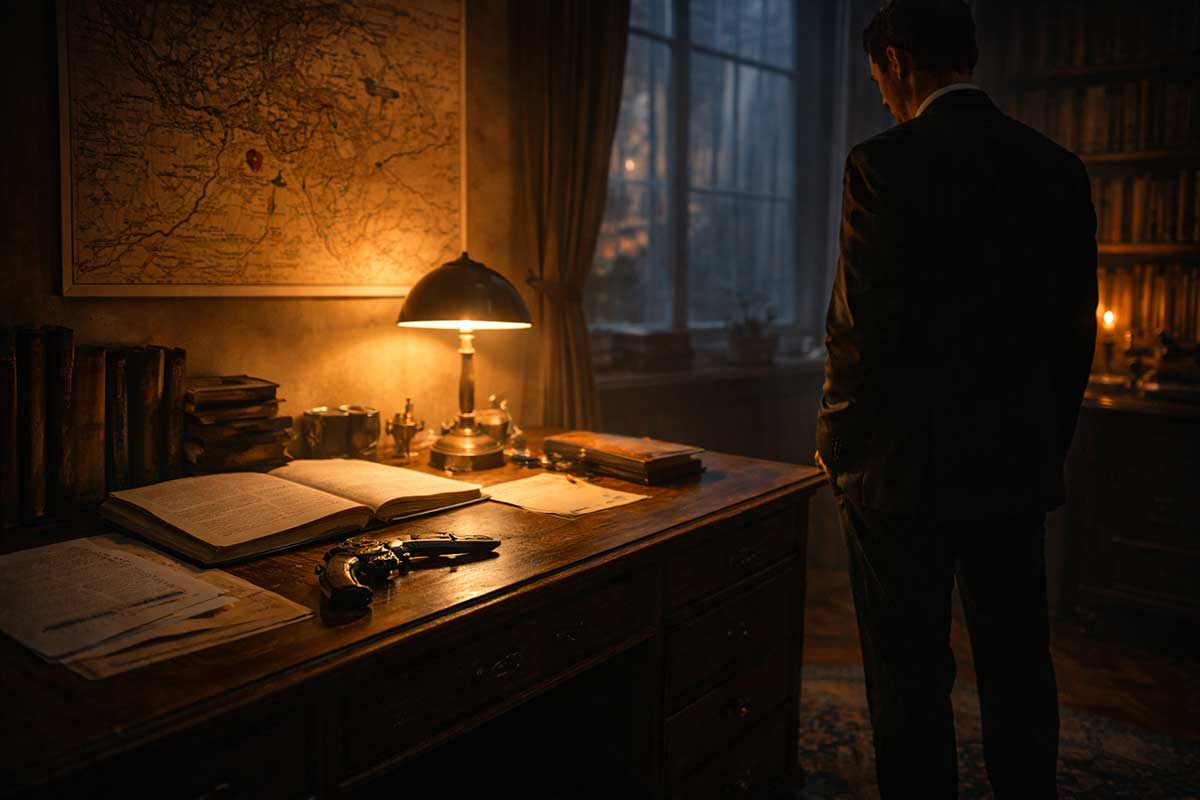
A sparsely furnished study. A single desk. A revolver rests untouched at the edge of the table. Maps hang on the walls, their borders faintly blurred, as if shifting. Outside the window, a quiet English suburb lies unaware of what is about to be said—or done.
Participants:Jorge Luis Borges, René Girard, Slavoj Žižek, Elaine Scarry, Judith Butler
Moderator:
René Girard
René Girard
Violence is usually understood as a failure of meaning. But in this story, violence is used to communicate.
So let me begin with what feels almost obscene to ask.
When violence is used to transmit meaning rather than emotion, does it cease to be senseless—or does it become even more disturbing?
Elaine Scarry
It becomes more disturbing precisely because it succeeds.
Violence ordinarily destroys language—it replaces speech with pain. But Yu Tsun’s murder reverses this. The act does not silence meaning; it creates it. The body becomes a medium. That inversion is terrifying because it implies that language alone is insufficient.
Judith Butler
And it exposes whose lives are permitted to become messages.
The victim is not grieved. He is instrumentalized. Violence here is not chaotic; it is bureaucratic, strategic, efficient. That makes it morally chilling. Meaning is achieved by erasing the victim’s subjectivity entirely.
Slavoj Žižek
Yes—but we must resist moral comfort too quickly.
The most disturbing thing is not that Yu Tsun kills, but that the killing works. The message is delivered. History is altered. Symbolic violence and physical violence collapse into one act. Borges forces us to confront the obscene efficiency of the real.
René Girard
This is where scapegoating lurks.
The victim’s death restores order—not locally, but informationally. A single life stabilizes a larger system. That is the oldest violent structure humanity knows, disguised here as espionage.
Jorge Luis Borges
I should clarify something.
I did not want the murder to feel passionate. I wanted it to feel necessary. Passion allows moral escape. Necessity does not. Yu Tsun does not hate his victim. That absence of hatred is precisely what condemns him.
Girard pauses before continuing.
René Girard
Then let us press further.
Is Yu Tsun’s murder an act of cruelty, obedience, authorship—or all three at once?
Judith Butler
It is obedience masquerading as authorship.
Yu Tsun frames his act as creative—he “writes” meaning into the world. But his authorship is permitted only within a violent system that precedes him. The structure authorizes the act; he merely performs it.
Elaine Scarry
And yet authorship cannot be dismissed.
Yu Tsun chooses the form of violence. He selects the victim. He controls the timing. That degree of intentionality transforms obedience into creation. Borges shows us how systems recruit creativity for destructive ends.
Slavoj Žižek
This is precisely why the story is uncomfortable.
Yu Tsun becomes a writer in the most literal sense—he inscribes meaning onto reality. But the cost is absolute. The act cannot be undone, revised, or reinterpreted. This is authorship without drafts. That is why it feels monstrous.
René Girard
Cruelty enters through impersonality.
The act is not sadistic; it is ritualistic. Like all sacrificial violence, it hides behind purpose. Yu Tsun does not see himself as cruel, and that self-image is what allows the act to proceed.
Jorge Luis Borges
(quietly)
Yu Tsun envies writers who can revise.
He cannot. His sentence is written once, in blood. I wanted the reader to feel the horror of an author who must live forever with his final version.
The revolver on the table seems suddenly heavier.
René Girard
Then we arrive at the most troubling implication.
If a message can only be delivered through irreversible harm, what does that suggest about the limits of language itself?
Elaine Scarry
It suggests language fails at the boundary of power.
When speech cannot cross certain thresholds—when it cannot be heard, believed, or transmitted—violence becomes a grotesque substitute. Borges exposes a world where meaning is hostage to force.
Judith Butler
And it reveals whose speech is already constrained.
Yu Tsun does not believe words will reach their destination. That belief reflects a system where voices are hierarchized. Violence appears not because language is weak, but because it is unequally distributed.
Slavoj Žižek
Yes—but we must not romanticize language.
Language itself is violent. It cuts, excludes, categorizes. Yu Tsun’s act makes explicit what is usually hidden. The difference is visibility. Physical violence reveals the brutality that symbolic systems already contain.
René Girard
This is the tragedy of modern violence.
It no longer seeks catharsis or confession. It seeks efficiency. The act becomes meaningful only insofar as it produces a result. That is the logic Borges indicts.
Jorge Luis Borges
I will say something final here.
If language were enough, this story would not exist.
The murder is not an endorsement of violence—it is an admission of failure. When words cannot carry meaning across time and space, humanity reaches for darker instruments. That does not justify the act. It condemns the world that required it.
Silence settles. No one touches the revolver.
René Girard (closing the topic)
So perhaps The Garden of Forking Paths offers its darkest insight here.
Violence does not erupt because meaning is absent—but because meaning is obstructed. When communication demands blood, the cost is not only the victim’s life, but the moral integrity of the message itself.
Topic 4 — The Detective Story That Breaks Logic
Setting:
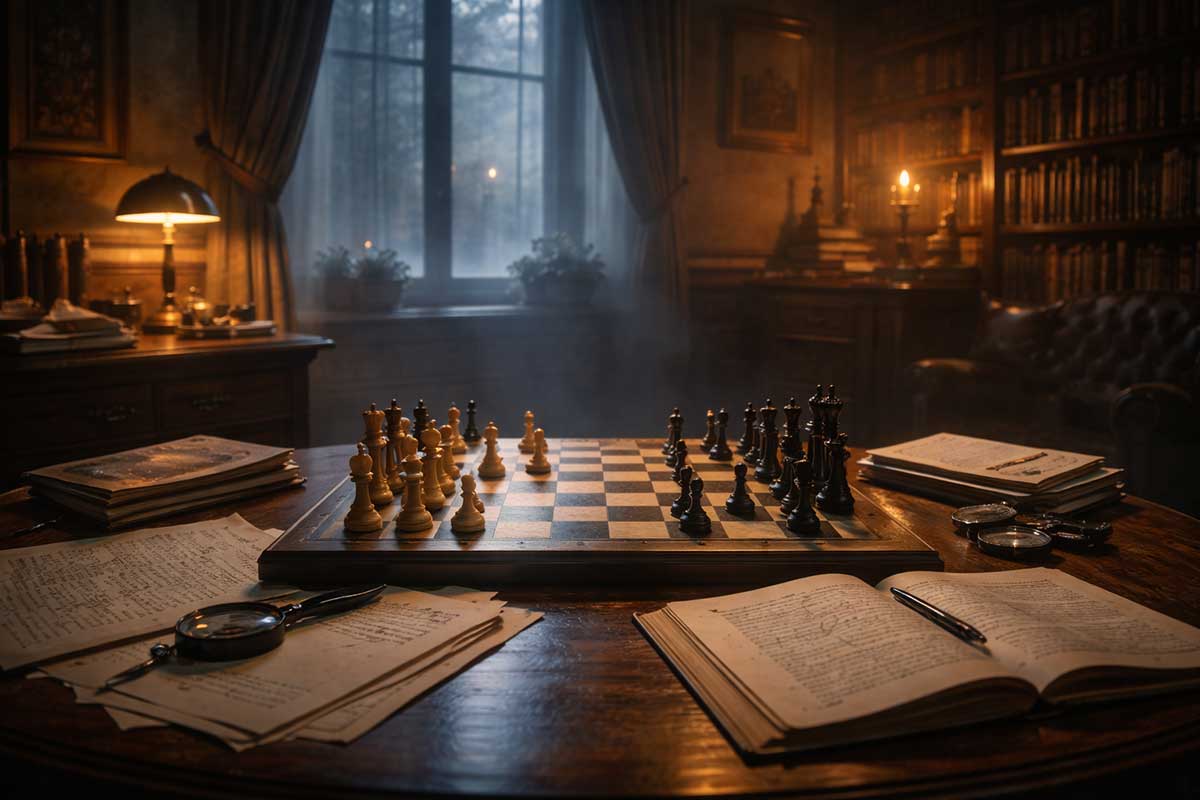
A Victorian-style sitting room arranged like a crime scene that never quite resolves. Papers are neatly stacked, yet no conclusion is visible. A chessboard sits mid-game, but both sides appear to be winning. Outside the window, fog drifts without direction.
Participants:Jorge Luis Borges, Tzvetan Todorov, Peter Brooks, Umberto Eco, Sean Carroll
Moderator:
Peter Brooks
Peter Brooks
Detective fiction trains us to expect clarity: clues accumulate, truth emerges, order is restored. Borges offers us all the familiar pieces—crime, motive, pursuit—and then quietly sabotages the promise.
So let me begin here.
Is this story pretending to be a detective narrative—or using the detective genre as a trap for readers who expect resolution?
Tzvetan Todorov
It is absolutely a trap.
The classical detective story reassures us that disorder is temporary. Borges preserves the structure but drains it of comfort. We still reach an “answer,” but the answer does not restore moral or logical balance. The genre is intact; its purpose is inverted.
Umberto Eco
Yes—and Borges does this knowingly, almost mischievously.
He understands genre as a contract with the reader. The detective form promises intelligibility. Borges keeps the promise technically while violating it philosophically. The crime is solved, but meaning fractures.
Sean Carroll
From a scientific perspective, this is fascinating.
The story follows causal logic—events lead to outcomes—but rejects narrative determinism. In physics, explanation does not guarantee comfort. Borges applies that same cold clarity to storytelling. The universe makes sense, but it does not console us.
Jorge Luis Borges
(smiling)
I admired detective stories because they were honest.
They pretended to explain everything—and therefore revealed how impossible that task truly is. I did not wish to destroy logic, only to follow it far enough that it turned against itself.
Peter Brooks
That leads directly to the next tension.
If the “solution” to the mystery is not truth but structure, what exactly has been solved by the end?
Tzvetan Todorov
What is solved is the mechanism, not the meaning.
We understand how the message was delivered, not why the world required it. Classical detective fiction resolves both. Borges separates them. He gives us procedural clarity and moral opacity.
Umberto Eco
Exactly.
The solution answers the wrong question. We learn how the crime functions within a system of signs. But the larger mystery—the nature of time, choice, and responsibility—remains unresolved. Borges solves the plot to expose the inadequacy of plot itself.
Sean Carroll
In physics, we distinguish between explanation and interpretation.
Borges gives us explanation without interpretation. The mechanism works. The theory holds. But the meaning of the result remains contested. That gap is not a failure; it’s the point.
Jorge Luis Borges
I was never interested in mystery as revelation.
I was interested in mystery as structure. A detective story that truly explains everything would be dishonest. Reality does not behave that way. Why should fiction?
The chessboard on the table seems unchanged—yet different.
Peter Brooks
So let us ask the question that unsettles readers most.
Does reason fail in this story—or does it succeed in revealing its own limitations?
Sean Carroll
Reason succeeds completely—within its domain.
The problem is expecting reason to answer questions it was never designed to address. Borges shows us a universe that is intelligible but not narratively satisfying. That distinction is crucial.
Tzvetan Todorov
The failure is not of reason, but of genre expectation.
We expect logic to redeem violence, to justify consequence. Borges denies that redemption. Reason clarifies the crime, but cannot redeem the act.
Umberto Eco
This is Borges at his most modern.
He anticipates a world saturated with explanations yet starved of meaning. The detective story becomes a mirror: reason functions perfectly, but human understanding still falters.
Jorge Luis Borges
(quietly)
Reason is a magnificent tool—but a terrible comfort.
I wanted the reader to feel how far logic can carry us, and where it must stop. Beyond that point, we enter the labyrinth—not of ignorance, but of excess clarity.
Peter Brooks (closing the topic)
So perhaps The Garden of Forking Paths is not an anti-detective story, but the most honest detective story imaginable.
It solves the crime—and leaves us alone with the consequences of understanding.
Topic 5 — Does Meaning Survive Infinity?
Setting:
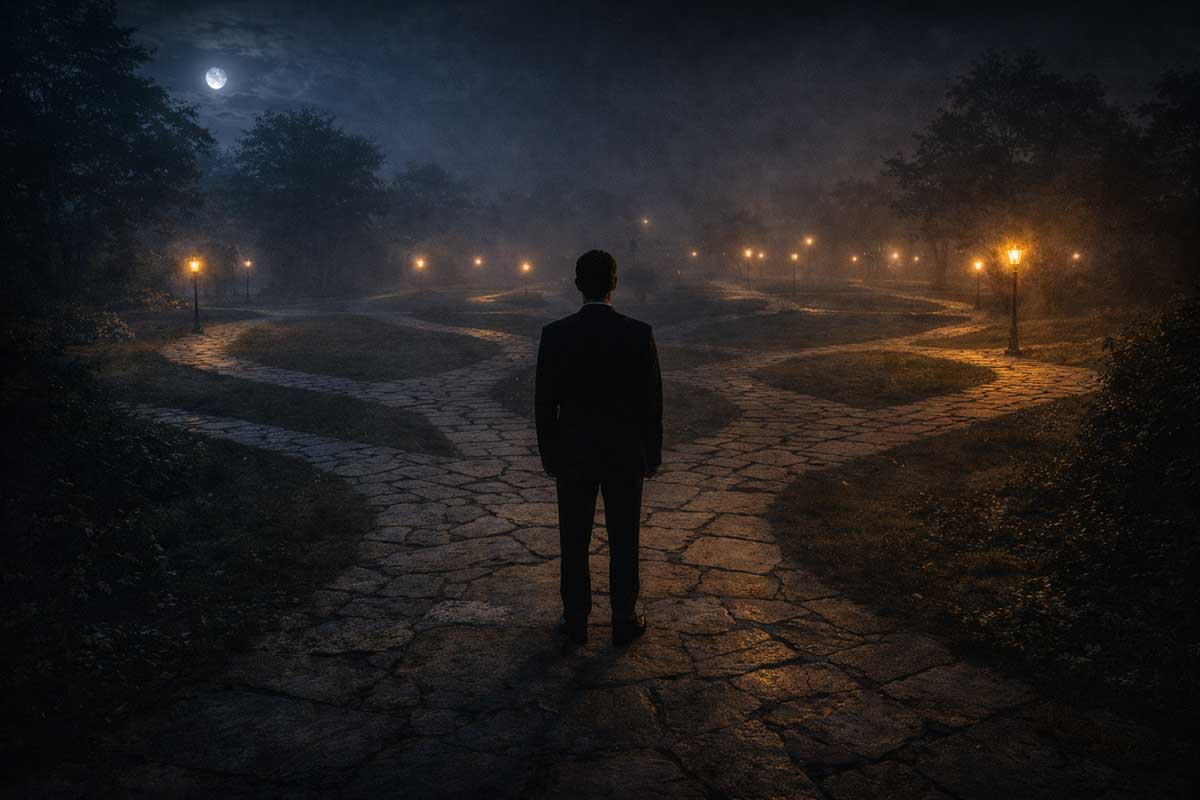
An open courtyard at night. Paths extend outward in every direction, branching endlessly. Some are lit, others disappear into shadow. No walls. No center. Only the sense that leaving is as consequential as staying.
Participants:Jorge Luis Borges, Paul Ricoeur, Charles Taylor, Rebecca Goldstein, Nick Bostrom
Moderator:
Paul Ricoeur
Paul Ricoeur
We have followed Borges through branching time, infinite texts, and violence that communicates. We end, inevitably, with the question that makes all the others unbearable.
If every choice is made somewhere, does responsibility dissolve—or does it become heavier?
Charles Taylor
It becomes heavier.
Responsibility is not weakened by multiplicity; it is intensified by self-understanding. Yu Tsun knows he could have been otherwise—even if those other selves exist elsewhere. Meaning arises not from cosmic uniqueness, but from lived commitment. One must answer for the self one inhabits.
Nick Bostrom
From a multiverse perspective, this is counterintuitive.
If all actions occur across branches, it is tempting to think individual responsibility thins out. But psychologically, we do not experience branches—we experience paths. Ethical weight attaches to the subjective stream, not the total system. Borges understands that intuitively.
Rebecca Goldstein
Yes, and Borges is careful not to offer escape.
Infinity does not anesthetize guilt. It sharpens it. Yu Tsun cannot console himself with other versions who refused the act. Those versions are irrelevant to his moral experience. Meaning survives because consciousness remains singular, even in an infinite universe.
Jorge Luis Borges
(smiling faintly)
Infinity is not merciful.
People imagine that if everything happens, nothing matters. I believe the opposite is true. When everything happens, every act echoes endlessly. The universe becomes an archive that never forgets.
Paul Ricoeur nods, then continues.
Paul Ricoeur
Then let us ask the question readers carry with them after the story ends.
How can a single life matter in a universe where all versions of that life exist?
Rebecca Goldstein
Because meaning is not statistical.
A life matters not because it is unique in the cosmos, but because it is lived from within. Borges refuses to let us adopt a god’s-eye view ethically. The story traps us inside one consciousness, where consequences are absolute.
Charles Taylor
And because identity is narrative.
We are not the sum of all possible selves—we are the story we continue to tell through action. Yu Tsun’s life becomes defined by the act he chooses to own. Other branches do not dilute that story; they haunt it.
Nick Bostrom
There is a parallel here with simulation theory.
If countless simulations exist, does any one life matter less? No—meaning is indexed to experience. Borges anticipates this insight long before modern technology forces us to confront it.
Jorge Luis Borges
I have always distrusted cosmic consolation.
A universe vast enough to excuse us would be unbearable. Meaning survives precisely because we cannot escape our own perspective. The labyrinth is infinite—but we walk only one corridor.
The wind moves through the courtyard. Some paths dim.
Paul Ricoeur
Which brings us to the final question—one Borges never answers directly.
Is Borges offering infinity as liberation—or as the most subtle form of despair?
Nick Bostrom
Both.
Infinity frees us from the tyranny of inevitability, but it robs us of final justification. There is no ultimate reconciliation—only coexistence with alternatives. That is intellectually liberating and emotionally destabilizing.
Rebecca Goldstein
I lean toward despair—not nihilistic despair, but moral seriousness.
Borges denies us closure. He refuses to let infinity rescue us from choice. Meaning persists, but it is fragile, local, and painfully earned.
Charles Taylor
And yet that fragility is human dignity.
Meaning that survives infinity is not grand—it is faithful. Borges suggests that responsibility does not require cosmic validation. It requires presence.
Jorge Luis Borges
(softly)
I never wished to comfort readers.
I wished to leave them standing at the crossroads, aware that every path continues—and that they must still choose. Infinity is not an answer. It is a condition. Meaning survives only if we insist on it.
Paul Ricoeur lets the silence stretch.
Paul Ricoeur (closing the series)
Perhaps The Garden of Forking Paths endures because it refuses to resolve what it reveals.
Time may branch infinitely. Stories may multiply without end. Violence may communicate where words fail. And yet—here we are—still responsible, still choosing, still meaning.
Not despite infinity.
But inside it.
Final Thoughts by Jorge Luis Borges
Readers sometimes ask whether The Garden of Forking Paths offers freedom or despair.
I would answer: it offers neither. It offers awareness.
Infinity does not absolve us. It does not rescue us from choice. It merely reveals that our decisions do not eliminate other possibilities—they coexist with them, endlessly. This knowledge does not lighten the burden of action; it intensifies it. To act while knowing that other versions of oneself refuse the act is a heavier responsibility, not a lighter one.
Yu Tsun commits a crime believing it will transmit meaning. He succeeds. The message arrives. History alters its course. Yet the act remains irreversible, unredeemable, and singular within his lived experience. No alternate branch comforts him. He must inhabit the path he chose.
I have often been accused of coldness, of intellectual play, of preferring ideas to people. This is a misunderstanding. I write labyrinths not to escape responsibility, but to show how impossible escape truly is. One may imagine infinite corridors, but one still walks only one.
If this story unsettles, it is because it refuses consolation. Time may fork endlessly, but we do not. Meaning does not dissolve in infinity. It survives only where we insist upon it—locally, imperfectly, and without guarantees.
The garden has no center.
But we are always somewhere within it.
Short Bios:
Jorge Luis Borges
Argentine writer, poet, and essayist whose work reshaped modern literature through labyrinths, infinite libraries, and philosophical fiction. His stories explore time, identity, and the limits of human knowledge.
Nick Sasaki
Founder of ImaginaryTalks and moderator of cross-disciplinary literary dialogues. He guides conversations toward existential tension, moral responsibility, and lived meaning beyond summary.
Beatriz Sarlo
Argentine literary critic and one of the foremost Borges scholars. Her work situates Borges within Argentine culture, politics, and modern intellectual history.
Gilles Deleuze
French philosopher known for his theories of difference, multiplicity, and non-linear time. His ideas illuminate Borges’s vision of simultaneous realities and becoming.
Manuel Vargas
Philosopher specializing in free will, moral responsibility, and agency. His work examines how responsibility persists under complex or non-traditional metaphysical frameworks.
David Lewis
Philosopher best known for possible-worlds theory and modal realism. His work provides a rigorous philosophical lens for Borges’s branching realities.
Umberto Eco
Italian novelist, semiotician, and literary theorist whose work explores infinite texts, interpretation, and meaning. A natural interlocutor with Borges on labyrinths and books.
María Kodama
Writer, translator, and Borges’s literary executor. She was a close collaborator of Borges and a key interpreter of his philosophical and literary intentions.
Roland Barthes
French literary theorist known for the concept of the “death of the author.” His ideas resonate strongly with Borges’s treatment of infinite texts and reader-generated meaning.
George Steiner
Literary critic and philosopher of language concerned with meaning, tragedy, and cultural inheritance. His work highlights the dangers and costs of infinite interpretation.
René Girard
Philosopher and anthropologist known for mimetic theory and the scapegoat mechanism. His insights illuminate violence as a carrier of meaning in Borges’s story.
Slavoj Žižek
Philosopher and cultural critic examining ideology, symbolic violence, and contradiction. His work challenges easy moral readings of Yu Tsun’s act.
Elaine Scarry
Literary theorist focusing on the relationship between pain, violence, and language. Her work explains how physical harm can replace speech as communication.
Judith Butler
Philosopher known for work on power, recognition, and grievability. Her perspective interrogates whose lives are permitted to become messages.
Tzvetan Todorov
Literary theorist specializing in narrative structure and detective fiction. His work clarifies how Borges subverts genre expectations.
Peter Brooks
Narrative theorist whose work explores plot, desire, and interpretation. He examines how stories generate meaning through delay rather than resolution.
Sean Carroll
Theoretical physicist and science communicator whose work on time and cosmology parallels Borges’s narrative logic of causality without comfort.
Paul Ricoeur
Philosopher of interpretation and narrative identity. His work bridges storytelling, responsibility, and meaning without forcing closure.
Charles Taylor
Philosopher of modern identity and moral frameworks. His ideas explore how responsibility survives in pluralistic and fragmented worlds.
Rebecca Goldstein
Philosopher and novelist examining the intersection of philosophy and fiction. Her work addresses how meaning and ethics persist in infinite or abstract systems.
Nick Bostrom
Philosopher known for work on simulation theory and future ethics. His ideas echo Borges’s intuitions about multiple realities and responsibility within them.
Leave a Reply