
|
Getting your Trinity Audio player ready...
|
Time:
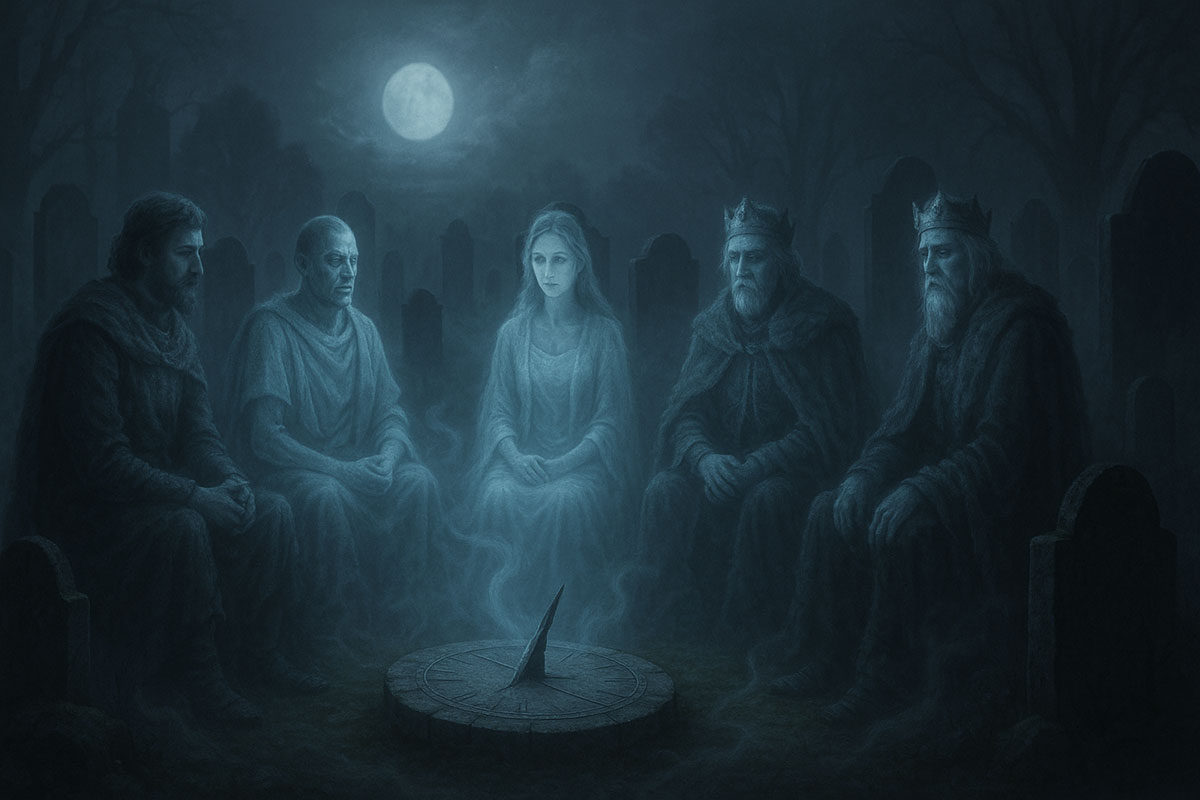
(The graveyard is still. Mist clings to moss. Then, softly, a voice—not loud, but ancient—enters from nowhere and everywhere.)
I am not a god.
I do not choose who lives or who dies.
I do not mourn.
I do not rejoice.
I endure.
I watched you—
Each of you—
Taken before your final word.
Remembered in fragments.
Trapped in echo.
Named in stories that did not ask what you felt.
You were written as tragedy,
Spoken as warning,
Painted as regret.
But now,
I return the hour that was stolen.
Not to rewrite,
But to reclaim.
You who were silenced,
Speak.
Not in vengeance.
Not in metaphor.
But in your own voices.
Tonight,
Let the dead remember themselves.
(Note: This is an imaginary conversation, a creative exploration of an idea, and not a real speech or event.)

Topic 1: “Are We Who We Were—or Who They Say We Were?”
Setting:
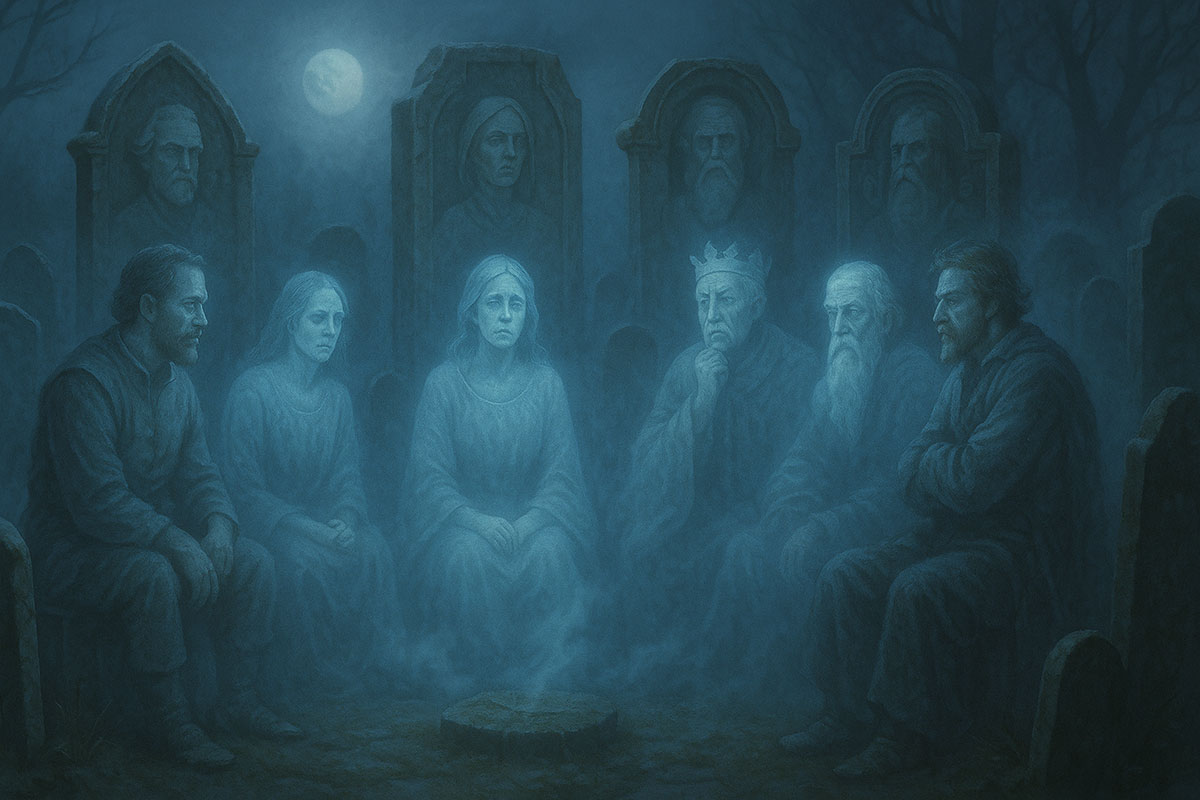
A still, moonlit graveyard beyond time. Stone markers rise from fog like memories too heavy to forget. Five ghostly figures sit in a circle—hovering just above the earth. No fire. No warmth. Only silence, broken now and then by wind and the soft creak of memory opening.
 Narrator: Time
(A voice everywhere and nowhere, neither male nor female, ancient and soft, like water moving backward.)
You were kings.
You were murdered.
You were betrayed.
You were forgotten.
But I know what came after.
The world wrote your names in ink—but blurred the truth in shadow.
So I ask you now—
Are you still who you were…
or only what the living chose to remember?
Speak, spirits.
Not to haunt—
But to reclaim.
 Question One:
“Do you recognize the person you’ve become in memory?”
Banquo (quietly):
They remember me as a ghost that haunts Macbeth… but forget the man who loved his son, who tried to warn, not condemn. My name is a whisper in his guilt—not in my truth.
Desdemona’s Spirit:
They call me pure, obedient, tragic. But I was brave. I defied my father, loved boldly, questioned cruelty. I am not a martyr—I was a woman who dared too much.
Caesar (measured):
They remember my death more than my life. “Et tu, Brute”—those were not my final thoughts. I thought of Rome. Of what I built. They made me a symbol of pride, but I ruled with vision—and mercy, once.
Hamlet’s Father (King Hamlet):
I am remembered as wrath, as ghost, as call to vengeance. But I was a father. A ruler who made mistakes. The poison they poured in my ear… it did not hurt more than what they left unsaid while I still breathed.
Ghost of King Hamlet (pausing):
I… am not sure who I am now. I existed in memory, then in Hamlet’s rage. I became purpose, not person. Sometimes I wonder—was I even real to him? Or only his fire given shape?
Question Two:
“What part of your truth did the world forget—or rewrite?”
Desdemona’s Spirit:
That I doubted. I wasn’t blindly faithful. I saw the shift in Othello, the weight in his silence. I tried to hold on… but I was terrified. I wanted to run. That fear is never spoken.
Banquo:
That I questioned the prophecy. I did not seek the throne, but I wondered. They made me a saint beside Macbeth’s ambition—but I was tempted, too.
Caesar:
That I wept, often. For Rome. For its hunger. For its people. They saw strength. They missed sorrow. My crown grew heavier every day—and no one saw.
King Hamlet:
That I was not a blameless king. I ruled with pride. I favored war. My death was unjust—but not unearned. They forget I was a man, not just a murder victim.
Ghost of King Hamlet:
That I no longer belonged to myself. Once I appeared, I was no longer mine—I was Hamlet’s grief, his rage, his unraveling. I wish… I could have spoken only as a father.
Question Three:
“If you could rewrite your tombstone, what would it say?”
Caesar:
“Not pride, but burden. Not empire, but effort. I was a man who tried to hold the future in trembling hands.”
Banquo:
“Father first. Friend second. Ghost, only because the silence needed a voice.”
Desdemona’s Spirit:
“She spoke. They didn’t listen. She loved. They doubted. She was more than the silence that ended her.”
Ghost of King Hamlet:
“Justice was my legacy. But I wish love had been.”
King Hamlet:
“King. Father. Man. All flawed. All trying. I ruled in shadow. I died in it. But I see now—light was always near.”
Closing by Time
(Its voice grows softer—no longer a question, but a balm.)
They named you villains.
Martyrs. Ghosts. Tools.
They carved your names into story…
but forgot to ask what you remembered.
Tonight, you reclaimed yourselves.
Not as plot.
Not as symbol.
But as truth, unpolished and unburied.
Your names still echo—
But now, they carry your voice.
Topic 2: “What Would We Have Done… If We Had Lived?”
Setting:
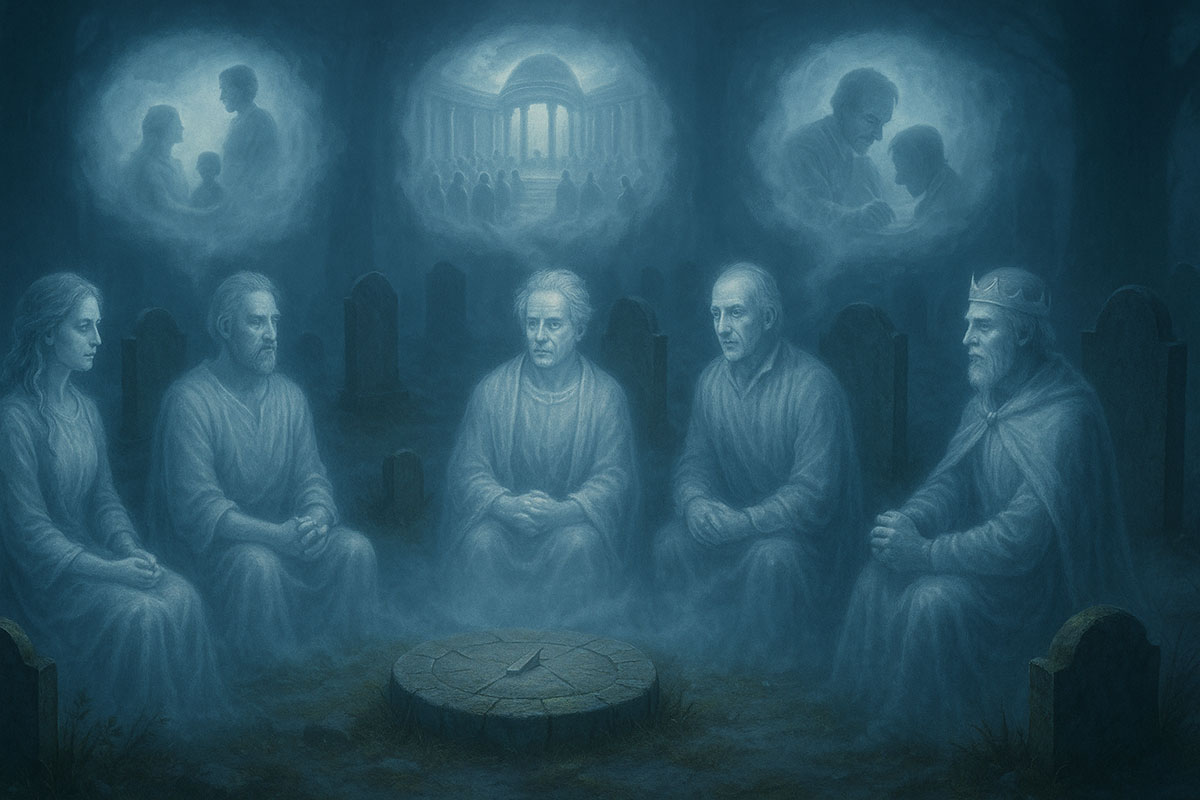
The graveyard remains still, but the fog begins to drift like breath held too long. The ghosts’ forms are clearer now—more themselves, less memory. The moon hangs lower, not to signal time, but to honor intention. This is not speculation. It’s confession in the tense of could have.
Narrated by Time
(The voice returns like soft earth falling into a waiting grave.)
You were interrupted.
Stabbed. Smothered. Poisoned.
Silenced before your second act.
But I know what might have been.
If the blade missed—
If the cup spilled—
If fate waited one hour more…
What would you have chosen?
Question One:
“Had you lived one more year, what would you have done first?”
Desdemona’s Spirit (softly):
Left. I would have left Othello. Not in hatred—but in survival. I would have found a place where my voice didn’t need to beg for belief. Maybe… a place near the sea.
Caesar:
I would have embraced Brutus. Not as a pardon—but as a warning. “They will not love you for this,” I would have said. “They will use your virtue as a mask.” I would have held Rome tighter—and then opened my hand.
Banquo:
I would have taken Fleance away. Far from Macbeth, far from destiny. Let him grow without prophecy breathing down his neck. I would’ve traded fate for fatherhood.
Ghost of King Hamlet:
I would have looked into my son’s eyes. Not as king to heir—but as man to man. I would’ve asked if he was happy. I never did.
King Hamlet:
I would have made peace. With Norway. With myself. Perhaps I would have laid down the sword… and finally picked up the quill. I had thoughts I never dared write.
Question Two:
“What wrong would you have tried to right?”
Banquo:
I would have warned the court. I knew. I saw the glint in Macbeth’s eye before the dagger rose. My silence was loyalty. My silence was cowardice.
Caesar:
I would have given more power away. Not all. Not hastily. But some. The Senate feared me because I took too much too quickly. Perhaps… I should have waited. Listened.
King Hamlet:
I would have asked forgiveness. From Gertrude. From Fortinbras. From my people. I ruled as if vengeance were nobility. But I left a kingdom ripe for rot.
Desdemona’s Spirit:
I would have spoken louder. To Emilia. To Brabantio. To Othello. I would have called out the creeping cold. Named the shadows before they grew teeth.
Ghost of King Hamlet:
I would have let Hamlet be. I gave him too much weight to carry—too many questions with no answer. I see now… he needed love, not legacy.
Question Three:
“If death had delayed, would you have changed who you were—or only what you did?”
Desdemona’s Spirit:
I would not change who I was. I loved truly. But I would have learned to protect that love—to shield it, not just offer it. I gave everything. Next time, I’d give wisely.
Banquo:
I wouldn’t change my soul—but I would have acted. A good man must also move. I stood too still while evil marched.
Caesar:
Yes. I would have changed. Power had begun to mold me. I was becoming stone, not man. One more year might’ve saved me from myself.
Ghost of King Hamlet:
I was already gone, even before the poison. I think… if I had lived, I might have become what Claudius feared. The afterlife gave me more mercy than the crown ever did.
King Hamlet:
I would not have changed who I was—but I would have seen who others were. I ruled with force. I would have ruled with eyes open.
Closing Words by Time
(The fog returns, slow and silver. Time’s voice trails like the final note of a lullaby.)
You had no endings.
Only interruptions.
But tonight,
You spoke the second act yourselves.
What you would have done…
Matters.
Not because it came to pass—
But because it reveals who you truly were.
Not ghosts.
Not echoes.
But unfinished dreams,
Finally spoken aloud.
Topic 3: “Did Our Deaths Matter?”
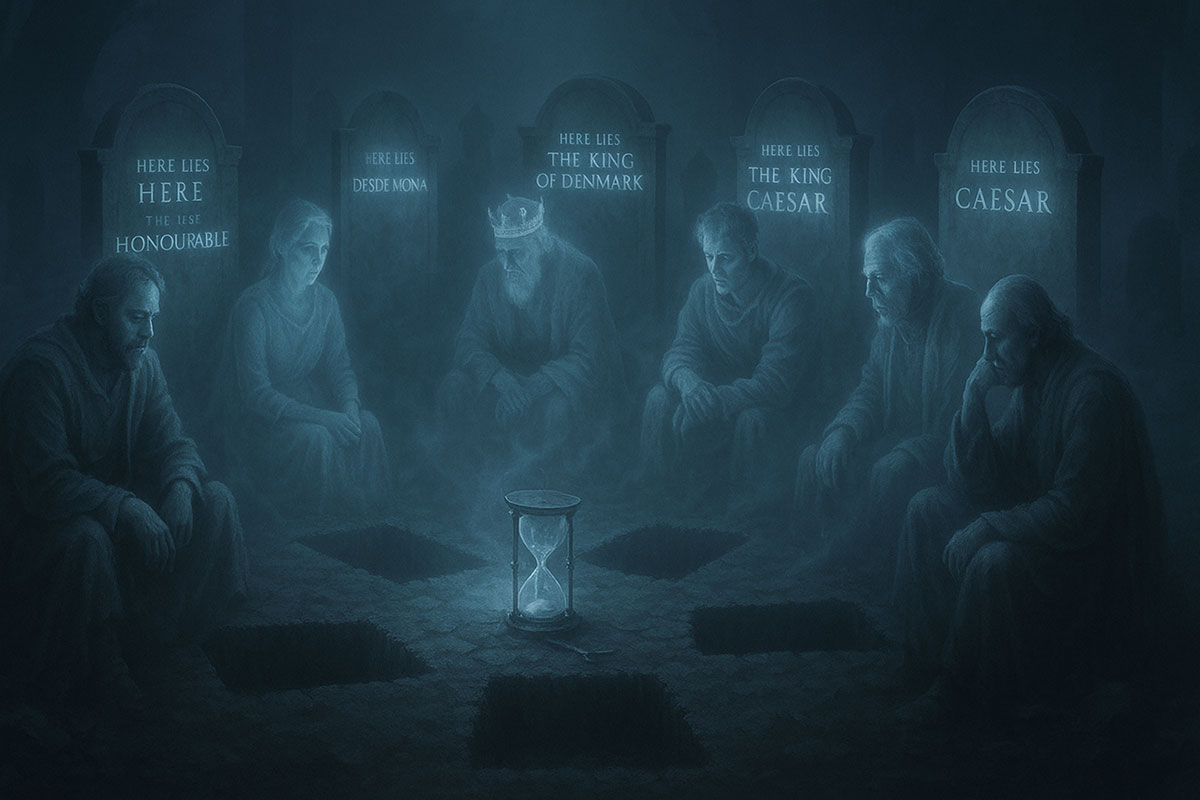
Setting:
The moon no longer rises—it lingers, waiting. The fog has thinned into clarity. The graveyard breathes with stillness, as if listening. Five ghostly figures sit where they fell. Not for pity. But to ask whether anything meant anything in the end.
Narrated by Time
(The voice no longer distant—closer now, as if it too must ask for meaning.)
They wrote poems
About your silence.
They carved lessons
From your last breaths.
But I ask you—
Did your deaths heal the world?
Or only haunt it?
Did they change anything?
Or did they simply
Hurt?
Question One:
“Did your death change anything—for the better?”
Caesar (long pause):
No. It tore Rome apart. Brutus struck for peace—and unleashed civil war. My death became a banner, not a solution. I died thinking I was the problem. I see now… I was a balance.
Desdemona’s Spirit:
No. Women still aren’t believed. Still loved in pieces, but doubted whole. If anything changed, it was Othello—he finally saw me. But by then… the story had already closed.
Banquo:
Yes. Fleance lived. The line continued. A seed was spared. That is enough for me. Even in death… a father’s task remains.
King Hamlet:
No. My death poisoned more than just my body. It turned my son into an avenger, my kingdom into a stage for ghosts. I returned… and made things worse.
Ghost of King Hamlet:
No. I was a trigger. A spark to light another fire. I did not bring peace—I fed a cycle. If my death had stayed silent, perhaps my son would have lived.
Question Two:
“What do you think people misunderstood most about your death?”
Desdemona’s Spirit:
That it was romantic. It wasn’t. It wasn’t poetry. It was a hand I loved stealing my breath. There was no beauty in that silence—only disbelief.
Caesar:
That I died arrogant. I died bewildered. Not at Brutus’s betrayal—but at the world’s hunger for my fall. I died trying to keep something from collapsing.
Banquo:
That I was too good to fight back. I did. I tried. But treachery often moves faster than integrity. I was not a ghost of peace—I was a man cornered by prophecy.
Ghost of King Hamlet:
That I was justice. I was anger. I was grief. I spoke to Hamlet not to guide—but to scream. They remember a ghost of order. I was a father in pieces.
King Hamlet:
That I deserved sainthood. I did not. My death was unfair—but not unprovoked. They see the poison. They forget the pride that made enemies sharpen their knives.
Question Three:
“Would you accept your death again, if it meant your memory helped even one soul find clarity?”
Banquo:
Yes. If one father held his child tighter because of me—then yes.
Desdemona’s Spirit:
Yes. If one woman was believed when she said, “He scares me,” then yes. Let me be her echo.
Caesar:
Yes. If one leader learned to listen before it was too late—yes. But let them read me rightly. I ruled. I also fell.
King Hamlet:
No. I would rather have lived, apologized, aged, and failed than become a lesson carved in ghost-light. Memory distorts. Presence teaches.
Ghost of King Hamlet:
Yes. But only if Hamlet lets go. Let him live. Let him laugh. If my death can end the cycle—I give it again.
Closing by Time
(The voice now breathes like wind through grave markers.)
Your deaths were not ends.
They were invitations.
Warnings.
Questions.
Some called you tragic.
Some made you symbols.
But tonight…
You reminded us:
A death is not meaningful by poetry,
But by the compassion it creates.
Your voices—
Still unfinished—
Have become light in the dark.
Topic 4: “What We Still Wish We Could Say”
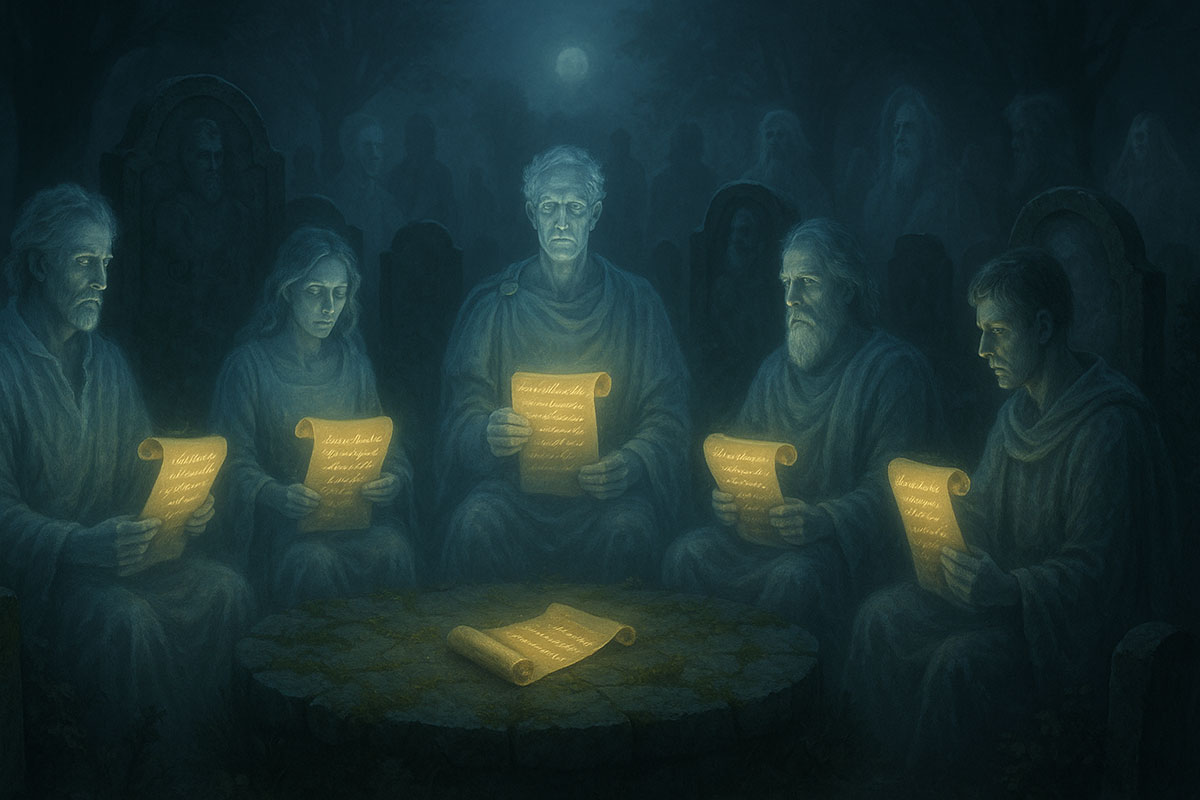
Setting:
The moonlight now falls like a spotlight upon the grave circle. Five spectral figures sit not as ghosts, but as echoes that refuse to fade. The mist parts. No one interrupts. This is the moment they reclaim their voices—not for drama, not for vengeance, but for peace.
Narrated by Time
(The voice is no longer distant—it’s within the circle now. It is Time sitting with them.)
There was no time.
No second chance.
No last embrace.
No final word.
So I grant it now.
Not to change the past—
But to release it.
Speak the words
You never could.
Question One:
“If you had one more minute with the person who hurt you most, what would you say?”
Desdemona’s Spirit (quietly):
To Othello? I would not scream. I would whisper, “Why didn’t you ask?” Before the rage. Before the doubt. Just ask. I would have told you everything. And I still would.
Caesar:
To Brutus, I would say: “I see why you did it. But I wish you had loved me more than you feared what I might become.” I would forgive… but I would mourn first.
Banquo:
To Macbeth? I’d say, “You could have told me.” The prophecy bound us both. I might’ve helped you. You chose fear over brotherhood.
Ghost of King Hamlet:
To Claudius… nothing. He wouldn’t hear it. But to Gertrude, I would say, “I never told you enough—you were the stillness I never earned.”
King Hamlet:
To young Hamlet? “I burdened you. I made you a sword when you needed to be a boy. I should’ve given you comfort, not a cause.”
Question Two:
“Is there someone you still need to forgive?”
Banquo:
Myself. For not seeing it coming. For trusting prophecy. For not leaving sooner. I forgive Macbeth—but not as a friend. As a warning.
Desdemona’s Spirit:
My father. For cursing what he didn’t understand. For breaking my heart before Othello ever did. I forgive him… but it took time.
Caesar:
Rome. The people. For their cheers, their silence, their readiness to trade one tyrant for another. I forgive their fear. It built me. And it broke me.
King Hamlet:
Fortinbras. I saw him as enemy. But he was a future I feared. I forgive him now—for walking the road I never did.
Ghost of King Hamlet:
I forgive Hamlet. For the madness. For the blood. He loved me too fiercely. That was my doing. I forgive him, fully.
Question Three:
“What would you say to the one person who still remembers you wrongly?”
Desdemona’s Spirit:
To the world: “I wasn’t perfect. I wasn’t passive. I fought in silence. But I fought.” Remember that part, too.
Caesar:
To historians: “I was not just ambition. I was sleeplessness. I was grief. I was tired. And still, I led.”
Banquo:
To the playwright: “I was more than a mirror to Macbeth’s guilt. I was a father. A man of doubts. I laughed. I loved.”
Ghost of King Hamlet:
To Horatio: “Tell my son—he didn’t fail me. I failed him. That truth must be known.”
King Hamlet:
To Gertrude: “I judged too quickly. I thought silence meant betrayal. But I see now—your silence was sorrow, not sin.”
Closing by Time
(The voice now blends with theirs. There is no separation between speaker and listener.)
You carried silence
like a shroud.
But tonight,
your words became light.
And perhaps…
in speaking what was left unsaid,
you no longer need to haunt.
You have been heard.
And maybe—
That is enough.
Topic 5: “What Comes After the Ghost?”
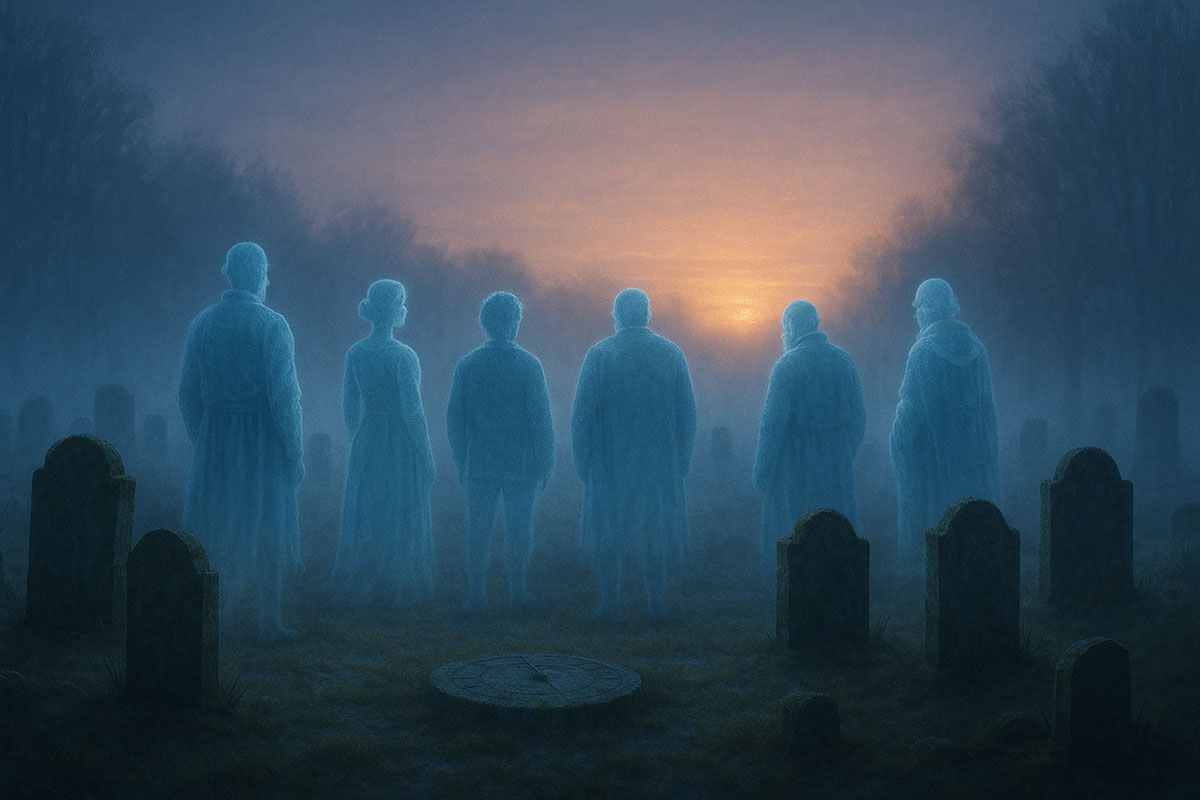
Setting:
The graveyard breathes. The fog begins to lift as if dawn, not death, waits on the edge. The ghosts no longer shimmer—they seem more human now, more whole. A circle of stone once filled with memory now holds the last thing they still search for: release.
Narrated by Time
(The voice is no longer separate. It speaks from within each of them.)
You were not buried.
You were remembered.
But now I ask—
What becomes of a ghost
After it has been heard?
Do you rest?
Do you return?
Do you become something new?
This is not memory.
This is beyond.
Question One:
“If you could step beyond being remembered—would you?”
Desdemona’s Spirit (softly):
Yes. If love no longer needed to die to be called true—then yes. Let me step beyond the poem. Beyond the pity. Let me become peace.
Caesar:
Yes. Let Rome move on. Let leadership mean wisdom, not martyrdom. I was a chapter. Let others write the next one—without me looming behind every ambition.
Banquo:
Yes. I stayed to watch over Fleance. But he has grown. If he forgets me but walks freely… that is enough. I would walk forward now.
Ghost of King Hamlet:
Yes. My son is gone. My story done. What remains is not justice… but stillness. I wish for that more than remembrance now.
King Hamlet:
Yes. Let the crown rust. Let my faults fade. If Hamlet no longer whispers my name in pain, then let the earth close. I will not resist it.
Question Two:
“What would you become, if not a ghost?”
Banquo:
A tree. One no one remembers planting. But its shade—that would matter.
Desdemona’s Spirit:
A wind by the sea. Something gentle. Something unseen, but known.
Caesar:
A law rewritten with compassion. I would become a voice in policy, not in war.
Ghost of King Hamlet:
A silence that comforts, not commands. I was a call to arms—I would become a place to rest.
King Hamlet:
A story told in kindness. Not power. Not blood. Just… a story that ends with someone listening.
Question Three:
“What would you like us—the living—to carry forward?”
Desdemona’s Spirit:
That gentleness is not weakness. That being soft doesn’t mean you should be erased. And that doubt… must be voiced before it destroys.
Caesar:
That power is sacred. And it must serve—not be served. Remember me not for what I ruled, but what I hoped.
Banquo:
That destiny should never outweigh love. That prophecy is just a question. You, the living, must decide the answer.
Ghost of King Hamlet:
That revenge is a heavy heirloom. Pass it down no longer. Let it rust.
King Hamlet:
That justice cannot undo harm. But truth—truth can still heal. Speak it. Even when it shakes the crown.
Final Words by Time
(The moon vanishes. But something remains: warmth, and a kind of light not cast by fire.)
You came with questions.
And left behind your need to answer them.
You spoke your silence.
And in doing so,
you ceased to haunt.
Not forgotten.
Not erased.
But released.
Now go—
Not backward.
Not downward.
But onward.
Final Thoughts by Time
(The fog lifts. The moon has dimmed. But the circle glows faintly, even as it empties.)
You have spoken.
Not as phantoms,
But as truths delayed.
You did not ask for pity.
You asked for place.
A voice.
A second breath.
And now that it is given,
You are no longer the unfinished.
You are no longer the weapon
In someone else’s story.
You are not revenge.
You are not prophecy.
You are free.
Go—not back into silence,
But into peace.
Time holds you now,
Not as ghosts…
But as memory made whole.
Short Bios:
Banquo
A noble soldier and father from Macbeth, caught in the shadow of prophecy. Loyal but wary, he was murdered not for what he did—but for what he might become. He walks the afterlife not as a ghost of vengeance, but as a father who loved too quietly, and a man who never got to choose his fate.
Julius Caesar
Rome’s most powerful man at the moment of his fall. Remembered as ambitious, he was also a visionary burdened by the weight of empire. Betrayed by those he trusted most, his spirit lingers—not to reclaim the crown, but to question whether power is ever truly understood… or just feared.
Desdemona’s Spirit
The silenced heart of Othello, remembered for her purity but rarely for her courage. She loved boldly, defied custom, and died pleading for truth. In death, she does not seek revenge—but to be remembered whole: not as a symbol, but as a woman who spoke, loved, doubted, and was not believed.
King Hamlet
Murdered king and father to Hamlet, spoken of more than he ever spoke. His death sparked Denmark’s unraveling. Once remembered as a proud ruler, he now confronts the cost of legacy passed on in rage. His ghost reveals the man behind the crown—one who ruled with strength, but failed with silence.
The Ghost of King Hamlet
More symbol than soul, he is the specter who demanded revenge and ignited tragedy. But in this realm, he asks: did I guide, or did I curse? More memory than man, he now yearns not for justice, but for release—from the story he became and the son he haunted.
Leave a Reply