

|
Getting your Trinity Audio player ready...
|
What if Susan Cain gathered leading psychologists to redefine strength for modern leaders?
Introduction — Susan Cain
When people hear the phrase The Power of Introverts, they often assume it’s a defense. A counterargument. A correction to a noisy world.
But it was never meant to be that.
It was meant to be a remembering.
For generations, we’ve built schools, workplaces, and social norms around a single cultural ideal: the outgoing, assertive, fast-talking extrovert. The person who thinks out loud. The one who thrives in open offices and speaks first in meetings. Somewhere along the way, quiet became mistaken for weakness.
Yet if you look carefully at the people who change the world, you’ll notice something different. Many of them are not the loudest voices in the room. They are the ones who observe deeply. Who prepare carefully. Who reflect before speaking. Who create in solitude and then offer something meaningful to the world.
Introversion is not about shyness. It is not about social anxiety. It is not about lacking confidence. It is about how we process stimulation. It is about how we recharge. It is about depth over breadth.
An introvert’s mind is often a laboratory of ideas. While others speak, they are synthesizing. While others brainstorm verbally, they are forming quiet structures of thought. And when they finally do speak, it is often deliberate, measured, and meaningful.
In classrooms, this can look like the student who writes beautifully but rarely raises their hand. In workplaces, it can look like the employee who doesn’t dominate meetings but delivers profound insight when given space. In relationships, it can look like someone who may not fill the room with words, but fills it with presence.
The power of introverts is not a loud power. It is not flashy. It is not performative.
It is steady. It is creative. It is enduring.
And perhaps most importantly, it is deeply needed.
We live in a world saturated with noise. The ability to pause, reflect, and think deeply may be one of the rarest and most valuable capacities of our time.
If we learn to recognize that strength—not only in others, but in ourselves—we begin to build a culture where quiet is not overlooked, but honored.
(Note: This is an imaginary conversation, a creative exploration of an idea, and not a real speech or event.)
Topic 1: The Extrovert Ideal and the Quiet Cost

Moderator:
Susan Cain
Panel:
Susan Cain, Adam Grant, Laurie Helgoe, Brian Little, Cal Newport
The room is quiet in the good way. Not awkward quiet, but focused quiet. A long table, warm lighting, a few notebooks open, water glasses catching soft reflections. No stage. No performance. Just the feeling that this conversation is finally being held at a volume introverts can breathe in.
Susan Cain sits at the center, calm and direct. Around her are Adam Grant, Laurie Helgoe, Brian Little, and Cal Newport. Everyone looks like they’ve spent a lifetime watching loudness get confused with leadership, and they’re relieved to name it out loud.
Susan Cain: I want to start with the story underneath the story. We live inside what I call the Extrovert Ideal, this cultural preference for boldness, talkativeness, constant visibility. Where did it come from, and what does it quietly punish?
Adam Grant: A lot of it is economic history. When work shifted from farms and small crafts to corporate life and sales culture, the traits that helped you stand out became socially prized. If you’re selling, presenting, networking, you look like a high performer. Then we started measuring performance by the most visible behaviors. The quiet cost is that we punish people who are thinking, listening, and building depth. We treat them as if they are disengaged when they might be the most engaged person in the room.
Laurie Helgoe: I see it as a kind of cultural misunderstanding, almost a translation error. Introversion gets translated as lack. Lack of confidence, lack of charisma, lack of leadership. The Extrovert Ideal punishes interiority, the private life of the mind. It punishes the slow burn. It rewards the quick spark. And in relationships and classrooms, that creates shame. People learn to hide who they are in order to be accepted.
Brian Little: I think it punishes authenticity in a very specific way. Most people, introverts included, can act out of character when they care about a goal. I call these personal projects. You can become socially bold for a mission. But if the culture demands out-of-character behavior constantly, then you are living in a permanent state of strain. The punishment is chronic depletion. You can still succeed, but you pay for it with your health, your joy, and your sense of self.
Cal Newport: It also punishes deep value creation because deep work does not look impressive in real time. If you’re quietly concentrating, there’s no performance to applaud. In many workplaces, busyness is visible and focus is invisible. Meetings become a substitute for progress. Constant messaging becomes a substitute for clarity. The Extrovert Ideal becomes a proxy for productivity, and that’s disastrous for anyone whose best contributions require uninterrupted thinking.
Susan Cain: I’m hearing a theme. The Extrovert Ideal came from systems that reward visibility, and it punishes depth, interiority, and sustainable energy. Not because those things lack value, but because they’re harder to measure in public.
She pauses, letting the quiet do its job.
Susan Cain: Let’s move from cultural history to real contribution. What do introverts contribute that teams and schools often miss, or worse, mislabel?
Cal Newport: Depth and precision. A lot of meaningful work is made in solitude, then tested publicly. Introverts are often strong at the solitude part. They can hold complex ideas long enough to refine them. But schools often mislabel that as being “not participating,” because participation is measured by speaking. Teams mislabel it as “not a culture fit,” because culture is measured by social energy. The contribution is the work itself, the insight, the craft.
Adam Grant: I’ll add: introverts tend to excel at listening and synthesizing. In group settings, the loudest voice can dominate, but the best answer often comes from someone who has been taking in the whole system. Introverts are more likely to ask, “What are we missing?” They’re often better at building on other people’s ideas rather than competing for airtime. Teams miss this because they confuse speed of response with quality of response.
Laurie Helgoe: Another contribution is emotional spaciousness. Many introverts have a strong capacity to be with complexity, to sit with ambiguity without rushing to a conclusion. In classrooms, that can look like hesitation. In teams, it can look like resistance. But sometimes it’s wisdom. Sometimes it’s an instinct that says, “We don’t understand this yet.” That kind of restraint is rare, and it saves people from costly mistakes.
Brian Little: I think introverts also contribute something we don’t celebrate enough: selective intensity. When they care, they can go deep, and they can carry a project through long stretches of quiet effort. But because they don’t always broadcast enthusiasm, their commitment can be underestimated. Teachers and managers may praise the person who speaks confidently about a plan, while overlooking the person who is actually executing the plan.
Susan Cain: Yes. I’ve met so many people who were told, directly or indirectly, that they were less capable because they weren’t loud. That’s a painful mislabeling. And it’s not just personal. It’s structural.
She leans forward slightly, voice still gentle but more pointed.
Susan Cain: If we accept that quiet people shouldn’t have to perform extroversion to be valued, then the question becomes practical. How do we redesign environments, schools, teams, workplaces, so introverts can contribute fully without burning out?
Brian Little: Start by acknowledging energy management as legitimate. We already accept that athletes need recovery. Knowledge workers need recovery too. Build in spaces where people can work without constant social demand, and normalize choosing those spaces. Also, give multiple channels for contribution. Not everything needs to be spoken in the moment. Written input can be powerful because it allows reflection. If the only way to be heard is to talk fast in a meeting, you are selecting for a narrow personality profile.
Adam Grant: I’d change how we run group discussions. One simple redesign is to ask people to generate ideas independently first, then share. Brainstorming research shows that groups often underperform because loudness and status distort the flow. If you want the best ideas, you need psychological safety plus structure. Another redesign is to make “thinking time” visible. A manager can say, “We’re going to sit quietly for two minutes and write.” That small act protects introverts and improves the whole team.
Cal Newport: I’m going to be blunt. Many environments are designed around distraction. Open offices, constant Slack, endless meetings. If you want introverts to thrive, reduce the number of default interruptions. Create meeting-free blocks. Encourage asynchronous communication. Value output over presence. When people can focus, introverts thrive, and extroverts also produce better work. This is not a niche accommodation. It’s a productivity upgrade.
Laurie Helgoe: In schools, we need to stop equating learning with talking. Some students process internally and then share later, or share in writing, or share one-on-one. Teachers can diversify the ways students demonstrate understanding. Also, honor quiet as a temperament rather than something to fix. The moment a child learns “I am wrong because I am quiet,” you’ve created a lifelong wound. The redesign begins with language. We can say: quiet is a strength, and participation can look many ways.
Susan Cain: I love that you’re all describing redesign as both structural and emotional. Structure gives introverts room. Language gives introverts dignity.
She looks around the table, and you can feel something soften in the air. Not sentimentality, but relief. Like people are finally being described accurately.
Susan Cain: Let me add one more layer, because people listening might be thinking, “Okay, but the world is still loud.” I’m not asking introverts to withdraw. I’m asking us to stop demanding performance as proof of worth. And I’m asking everyone, introvert or extrovert, to recognize that the best ideas often arrive quietly.
Adam Grant: That’s the key. It’s not introverts versus extroverts. It’s environments that distort talent versus environments that reveal it.
Cal Newport: And environments that reveal talent are usually quieter than we think.
Brian Little: Plus kinder. Because they stop forcing people to live out of character all day.
Laurie Helgoe: And more truthful. Because they let people be who they are without apology.
Susan Cain: That feels like a good closing for Topic 1. The Extrovert Ideal isn’t just a preference. It’s a system. It quietly punishes depth and interiority. Introverts contribute listening, synthesis, careful thought, selective intensity, and real creation. And redesign is possible, through structure, language, and norms that make quiet contributions visible and valued.
She gives a small smile that feels like an invitation rather than a conclusion.
Susan Cain: Next, we’ll clear up the confusion that causes so much pain. Introversion is not shyness.
Topic 2: Introversion Is Not Shyness

Moderator:
Elaine Aron (sensory processing sensitivity and the HSP concept)
Panel:
Susan Cain, Elaine Aron, Jonathan Cheek, Jerome Kagan, Brian Little
The room changes. Same warm light, same calm table, but the mood is more clinical in the best way, like everyone agreed to stop using sloppy language about personality.
Elaine Aron sits at the head of the table, composed and precise. Next to her is Susan Cain, quietly energized. Jonathan Cheek brings a steady, careful intelligence. Jerome Kagan has the measured authority of someone who has watched temperament get misunderstood for decades. Brian Little looks ready to protect nuance from simplification.
Elaine Aron: I want to begin by clearing the fog. People confuse introversion with shyness, and they confuse both with social anxiety. What is the cleanest way to separate these in normal language so people stop labeling themselves incorrectly?
Susan Cain: I usually start with a simple sentence. Introversion is about how you recharge. Shyness is about fear of social judgment. Social anxiety is distress that can be intense and persistent, often leading to avoidance. If you love people but need quiet afterward, that’s introversion. If you want connection but hesitate because you fear embarrassment, that’s shyness. If social situations trigger strong anxiety symptoms and disrupt life, that’s closer to social anxiety.
Jonathan Cheek: That’s the clearest framing. I’d add that shyness is not a personality type. It’s a social-emotional pattern. You can be shy and extroverted. You can be confident and introverted. People forget that these traits can cross. The confusion happens because shy people are often quiet, and introverts are often quiet, but the reasons are different.
Jerome Kagan: Temperament comes early. Many differences in reactivity and restraint show up in childhood. Some children are more behaviorally inhibited, which can look like shyness, but it is not identical to introversion. Introversion is a broader style of engagement with stimulation. Shyness and anxiety involve apprehension about evaluation. They overlap in behavior, but the underlying systems are different.
Brian Little: I like to say introversion is not a symptom. It is a temperament. Shyness can be a struggle, and anxiety can be a disorder. Introversion is neither of those by definition. The tragedy is when someone who is simply wired for lower stimulation thinks they are broken and starts trying to fix themselves with constant performance. That creates stress that looks like anxiety even if anxiety wasn’t the original issue.
Elaine Aron: That’s exactly what I see too. When people are misdiagnosed by culture, they start treating temperament as a problem. That leads to unnecessary shame.
She pauses and lets the table breathe.
Elaine Aron: Now let’s get practical. Many people do not realize they are sensitive to stimulation. They call themselves introverts, but what’s really happening is sensory overload. How do stimulation thresholds shape personality, and why does the world misunderstand this so often?
Elaine Aron: I’ll begin. Some people process information more deeply. They notice subtleties, reflect, and get more easily over-aroused by intense environments. That’s not weakness. It’s a nervous system trait. In a high-stimulation culture, that trait gets interpreted as fragility or fussiness. But it often comes with strengths like empathy, conscientiousness, and careful decision-making.
Jerome Kagan: A society that rewards speed misreads reflection. Many children who are highly reactive to novelty are treated as if they have a deficit. But those children often become careful adults who avoid unnecessary risk and think before acting. The misunderstanding comes from one-size-fits-all environments. If you teach and manage as if everyone thrives on the same level of stimulation, you will mislabel half the room.
Jonathan Cheek: The misunderstanding also comes from social narratives. We have a cultural script that says bold equals healthy. Quiet equals problem. That script is especially strong in schools and workplaces. When people do not speak often, others assume they are disengaged or lacking confidence. But often they are just monitoring stimulation, choosing their moments, and processing internally.
Susan Cain: Yes. And even when we say we value diversity, we often mean visible diversity. We forget cognitive diversity and energy diversity. If you’re an introvert in a high-stimulation environment, you can still succeed, but you pay a higher energy cost for the same output. If no one acknowledges that, you start blaming yourself. You think you need to become louder. But the real need is often a better environment and better boundaries.
Brian Little: I want to connect this to motivation. People can do out-of-character behavior for something they deeply care about. An introvert can be charismatic on stage for a mission. But that does not erase the cost. If you ignore stimulation thresholds, you will misread the cost as a character flaw. You will say, “Why can’t you keep this up?” The truth is, they can do it, but they need recovery. The recovery is not optional.
Elaine Aron: That’s a vital point. The world misunderstands because it judges outcomes without noticing the energy bill.
She leans forward slightly, gentle but firm.
Elaine Aron: So here’s the final thing I want to give listeners. One practical habit. If an introvert wants to thrive without pretending to be an extrovert, what is one habit that helps immediately?
Susan Cain: I’d say practice choosing your moments. Give yourself permission to speak when you have something meaningful to add, not just to prove you are present. And build in quiet recovery time the way you would schedule meetings. If you treat recovery as legitimate, you stop living in apology.
Jonathan Cheek: Mine is to create a low-pressure connection routine. Introverts often do better with one-on-one or small group interactions, and those can be planned. Instead of forcing yourself into constant high-energy networking, build deeper relationships with fewer people. You still connect, but in a way that fits your temperament.
Jerome Kagan: I would advise reducing unnecessary novelty in your schedule. Temperament interacts with context. If you pack your days with constant new demands, you increase stress. Create predictable rhythms. That does not mean avoiding growth. It means shaping growth so it is sustainable.
Brian Little: I’ll offer a specific tool. Design your day around projects, not performances. Ask yourself, what is the project that matters, and what is the minimum effective social exposure needed to move it forward? Then do that. And recover. This turns introversion into strategy rather than a limitation.
Elaine Aron: I’ll add one. Learn your signs of overstimulation and treat them as signals, not failures. Irritability, brain fog, feeling flattened, feeling unusually self-critical. Those are often not personality defects. They are your nervous system asking for less input and more processing space.
The room feels lighter. Not because the world became quieter, but because the labels became accurate.
Susan Cain: When people understand this, they stop trying to cure themselves. They start designing their lives.
Brian Little: And they stop confusing adaptation with identity. Acting extroverted for a goal can be beautiful. Being forced into it constantly is corrosive.
Jerome Kagan: The child who was called timid may simply have been cautious. The adult who is called aloof may simply be regulating stimulation.
Jonathan Cheek: And the person who is quiet might be the person who is paying the most attention.
Elaine Aron: That’s a strong close for Topic 2. Introversion is about energy and stimulation. Shyness is about fear of judgment. Social anxiety is distress that can become debilitating. When we separate these clearly, people stop shaming themselves and start choosing environments and habits that support their real temperament.
She smiles, not performative, just kind.
Elaine Aron: Next, we move into the place where introverts are often quietly powerful. Deep work, creativity, and leadership that doesn’t require constant noise.
Topic 3: Deep Work, Creativity, and Quiet Power

Moderator:
Cal Newport
Panel:
Susan Cain, Mihaly Csikszentmihalyi, Angela Duckworth, Cal Newport, Susan Blackmore
The setting shifts into something that feels like an introvert’s natural habitat, but not in a stereotype way. It’s a bright, modern library room with glass walls and soft acoustic panels. Sunlight falls in clean rectangles on the table. Everyone has a notebook. Nobody has to compete for oxygen.
Cal Newport moderates with quiet certainty. He doesn’t seem interested in hype, only in what produces results. Susan Cain sits beside him, attentive and composed. Mihaly Csikszentmihalyi brings a gentle, almost serene presence. Angela Duckworth looks practical, warm, and focused. Susan Blackmore has the curious sharpness of someone who likes ideas that challenge comfortable assumptions.
Cal Newport: Let’s begin with a simple observation. Many of the most original ideas and highest-quality work tend to come from solitude and sustained focus. Yet modern environments push constant interaction. Why do solitude and focus produce originality, and why do open offices sabotage it?
Mihaly Csikszentmihalyi: Originality often emerges when a person enters flow. Flow is deep engagement, a merging of action and awareness. It requires uninterrupted attention and clear goals. Solitude helps because it reduces the social noise that pulls attention away from the task. Open offices sabotage flow by fragmenting attention. Even the possibility of interruption changes your mind’s posture. You stay partially vigilant, which makes deep immersion difficult.
Susan Cain: Introverts often have a natural preference for lower stimulation, which makes it easier for them to access that depth. But this isn’t only about introverts. It’s about human cognition. We all have limits. When a workplace is designed to maximize visibility and constant collaboration, it often reduces the conditions that creativity needs. The quiet mind is where people connect disparate ideas and refine them into something coherent.
Angela Duckworth: I’d add that focus supports perseverance. When you can work without constant social friction, you’re more likely to stay with a difficult problem long enough to improve. Open offices and constant communication tools create the illusion of productivity because you’re busy. But grit is not busyness. Grit is sustained effort toward a goal. Fragmentation makes sustained effort harder.
Susan Blackmore: There’s also the memetic aspect. In noisy environments, you absorb other people’s priorities and emotions. Your mind becomes a receiver for memes, for what is salient in the group. Solitude allows you to become an originator rather than a transmitter. It doesn’t guarantee originality, but it gives it a chance. Open offices, by contrast, reward responsiveness. They select for people who react quickly, not people who think deeply.
Cal Newport: Exactly. Open offices are a perfect design for shallow work, not deep work. They reward availability. But availability is not the same as value.
He pauses, as if he wants listeners to feel how radical it is to say that out loud in a culture that worships being reachable.
Cal Newport: Let’s make this more personal. People often imagine grit as loud determination. But introverts can have a different kind of perseverance. What does quiet grit look like, and why is it often invisible until results show up?
Angela Duckworth: Quiet grit looks like consistency. It’s the person who shows up day after day without needing applause. It’s the person who keeps working even when no one is watching. The reason it is invisible is that we tend to notice dramatic effort. We notice speeches. We notice bold declarations. We don’t notice silent repetition. But silent repetition is where mastery is built.
Susan Cain: I think quiet grit also looks like an internal relationship with purpose. Introverts are often motivated by meaning more than status, not always, but often. They can stay with something for years because it matters, not because it gets attention. The invisibility comes from our tendency to equate confidence with competence. Quiet grit doesn’t announce itself. It just accumulates evidence.
Mihaly Csikszentmihalyi: In flow, effort feels different. It feels intrinsically rewarding. Quiet grit is often the willingness to keep returning to flow even when it is challenging. The person who finds meaning in the process can persist longer than the person who relies on external rewards. It is invisible because the person looks calm. But calm can be a sign of deep engagement, not lack of struggle.
Susan Blackmore: And the invisibility is sometimes a social choice. Many introverts dislike self-promotion. They do not broadcast every step. In modern culture, if you do not broadcast, people assume you are not working. This creates a strange incentive to perform productivity. Quiet grit resists that performance. It’s real effort without the social theater.
Cal Newport: This connects to a practical issue. If you don’t self-promote, you can be overlooked. So the question becomes leadership. Introverts often feel pressure to copy extrovert leadership styles. But that can be exhausting and inauthentic. How can introverts lead powerfully without copying extrovert leadership?
Susan Cain: First, by redefining leadership as impact, not volume. Leadership can be listening deeply, making clear decisions, and creating psychological safety. Introverts can lead by asking better questions and giving others space to contribute. They can lead by being steady. Not every leader needs to be charismatic in the performative sense.
Angela Duckworth: I’d say introvert leadership often excels in preparation. A prepared leader inspires trust. They think through scenarios. They anticipate obstacles. They don’t improvise everything out loud. Also, they can model persistence. Teams often mirror a leader’s emotional regulation. A calm leader can steady an entire group during uncertainty.
Mihaly Csikszentmihalyi: Leaders can also shape environments for flow. An introverted leader may naturally value uninterrupted work and can build a culture that respects deep concentration. That helps everyone. Leadership that protects attention is a form of care.
Susan Blackmore: I’ll add a slightly provocative point. Leadership is also memetic. The leader sets what spreads. Extrovert leadership often spreads urgency and visibility. Introvert leadership can spread reflection and depth. The key is not to hide. It is to choose deliberate communication. Introverts can be very persuasive when they speak with intention rather than constantly.
Cal Newport: I like that. Deliberate communication.
He leans forward slightly, as if offering a concrete bridge.
Cal Newport: Here’s a rule I often give. Be selectively accessible. Don’t be always accessible. That is the difference between leadership and availability.
Susan Cain: And it gives introverts permission to lead as themselves, not as a louder version of someone else.
Angela Duckworth: And it gives extroverts permission too. Many extroverts also need deep work. Quiet strength is not exclusive. It’s human.
Mihaly Csikszentmihalyi: In the end, the deepest satisfaction comes from meaningful engagement. Whether introvert or extrovert, we all need environments that allow that.
Susan Blackmore: And we all need to stop confusing noise with value.
Cal Newport: That feels like the heart of Topic 3. Solitude and focus create the conditions for flow and originality. Quiet grit is consistent effort without the theater of announcement. Introverts can lead powerfully through preparation, steady communication, listening, and building cultures that protect attention.
He gives a small nod, like someone closing a book gently rather than slamming it shut.
Cal Newport: Next, we bring this into the most personal domain. Relationships. Love. Social energy. And the misunderstandings that happen when people assume everyone recharges the same way.
Topic 4: Relationships, Love, and Social Energy

Moderator:
Esther Perel
Panel:
Susan Cain, Esther Perel, John Gottman, Brené Brown, Daniel Goleman
The setting feels intentionally gentle. A quiet counseling room with soft lamps, a low round table, and enough space between chairs that nobody feels crowded. Outside the window, late afternoon light. Inside, a kind of attention that says: we are not here to diagnose each other. We are here to understand each other.
Esther Perel moderates, poised and warm, with the alertness of someone who can hear what people mean, not only what they say. At the table sit Susan Cain, John Gottman, Brené Brown, and Daniel Goleman.
Esther Perel: Let’s start with the misunderstanding that causes so much unnecessary pain. In relationships, an introvert’s need for space can get interpreted as distance, rejection, or lack of love. How do couples misread introvert needs, and what’s really happening underneath?
Susan Cain: A lot of introverts experience love as presence, but they need a different rhythm of presence. They may deeply want connection and still need quiet afterward. The misread happens when a partner thinks, “If you loved me, you’d want more time, more talking, more togetherness.” But for an introvert, too much stimulation can blur the ability to be emotionally available. The space is not a retreat from love. It can be what makes love sustainable.
John Gottman: In my world, this often shows up as negative interpretation. Partners start interpreting neutral behavior as negative. A quiet evening becomes “You don’t care.” A request for alone time becomes “You don’t want me.” Once that pattern starts, conflict escalates quickly. The real issue is usually not the alone time itself. It’s the meaning assigned to it. Healthy couples get better at asking, “What does this mean for you?” instead of assuming.
Brené Brown: I see shame and fear underneath the misread. The partner who wants more interaction may feel unlovable or abandoned. The introvert may feel defective for needing space. Then both people start performing. One person performs neediness to get reassurance. The other performs closeness until they burn out. Nobody is being cruel. They’re protecting themselves. The solution starts when we can name the fear without blaming.
Daniel Goleman: From an emotional intelligence lens, it’s about recognizing different nervous system needs. Some people regulate through talking and proximity. Others regulate through quiet and space. If couples treat one style as the correct style, they end up in a power struggle. Emotional intelligence is noticing what calms your partner, not only what calms you. Then you negotiate. You stop moralizing the difference.
Esther Perel: Yes. The fight is often not about time. It’s about belonging. It’s about reassurance. Space becomes a symbol, and symbols are explosive.
She lets the room settle, then nudges the conversation into a more delicate distinction.
Esther Perel: Let’s talk about recharge time. Many people hear “I need to recharge” and worry it’s avoidance. What does healthy recharge look like, and how do we know it’s not emotional avoidance?
John Gottman: One way to tell is whether the person returns. Healthy self-soothing leads back to engagement. Avoidance leads away from it. In conflict, we often recommend a break when someone is flooded, meaning their physiology is too activated to think clearly. But the break works only if there’s a clear return time and a commitment to come back and talk. That structure turns space into repair, not withdrawal.
Susan Cain: Healthy recharge is intentional and honest. It’s not disappearing. It’s saying, “I want to be with you, and I need a little quiet so I can show up well.” It’s a form of care. Avoidance tends to be vague and indefinite, or it’s used to escape difficult conversations entirely. Many introverts actually prefer depth. They don’t avoid emotion. They avoid overstimulation.
Brené Brown: I would add that avoidance is often driven by fear of vulnerability. Recharge is driven by self-awareness. They can look similar from the outside, so the differentiator is communication. If you can say what you need and why, you’re less likely to be avoiding. If you go silent because you can’t tolerate discomfort, then you might be stuck. We can be compassionate about that and still be honest.
Daniel Goleman: Exactly. Ask, is this regulating or is this disconnecting? Healthy regulation includes a plan, a boundary, and a reconnection. It also includes empathy for the other person’s nervous system. If one partner needs reassurance, a small gesture can go a long way. A text that says, “I’m not leaving you, I’m recharging, I’ll be back at 7.” That’s emotional intelligence in practice.
Esther Perel: That line is powerful. I’m not leaving you. I’m returning to myself so I can return to you.
She leans forward slightly, making it practical.
Esther Perel: Now the part where guilt enters. Introverts often feel they must justify their needs, and partners often feel rejected. How can introverts communicate boundaries clearly without guilt or over-explaining?
Susan Cain: First, name it as a preference, not a verdict. “I recharge best with quiet” is different from “You’re too much.” Second, offer the return. “Let’s talk after dinner” or “I want an hour alone, then I’m yours.” That helps the partner feel secure. And third, stop apologizing for temperament. You can be kind without being ashamed.
Brené Brown: Boundaries without blame. That’s the key. A clean boundary is short, honest, and paired with care. “I need a quiet hour. I love you. I’ll be back.” The guilt often comes from stories we carry, like “I’m selfish” or “I’m difficult.” But boundaries are not a withdrawal of love. They’re a way to protect love from resentment.
John Gottman: I’d add a concrete tool. Use gentle startup, which means you start with “I feel” and “I need” rather than criticism. And when the other partner responds, practice turning toward instead of away. “I hear you.” “Thanks for telling me.” Couples who master those small moments build trust. Then boundaries become normal, not dramatic.
Daniel Goleman: Also, build a shared vocabulary. Couples do better when they can name states. “I’m overloaded.” “I’m depleted.” “I need quiet to reset.” When you can label your internal state, you reduce misunderstanding. The other person doesn’t have to guess. Guessing is where insecurity breeds.
Esther Perel: So what I’m hearing is a model of love that is rhythmic, not constant. A relationship that can breathe.
She smiles at Susan Cain, as if appreciating the long arc of this series.
Susan Cain: Yes. A healthy relationship for an introvert is not less love. It’s love with space to recover and return.
Brené Brown: And for the partner, it’s reassurance without chasing, connection without collapsing boundaries.
John Gottman: And it’s structure that prevents negative interpretation from taking over.
Daniel Goleman: Plus emotional skills that make differences safe.
Esther Perel: That’s our close for Topic 4. Couples misread introvert needs when they assign rejection to silence and distance to space. Healthy recharge includes communication and return. Boundaries work when they’re clean, caring, and consistent. Next, we go wider. Culture, kids, and the future. How to build communities that honor quiet strength instead of treating it like a defect.
Topic 5: Quiet Communities and the Future of Culture

Moderator:
Susan Cain
Panel:
Susan Cain, Adam Grant, Sherry Turkle, Jean Twenge, Cal Newport
The room feels like a community space designed by someone who understands nervous systems. Soft light, comfortable chairs, a table that invites writing more than performing. Outside, the world is loud. Inside, the volume is low enough for thought to form.
Susan Cain moderates again, not because she wants the spotlight, but because she knows how to hold it gently. With her are Adam Grant, Sherry Turkle, Jean Twenge, and Cal Newport. The topic is bigger now than personality. It’s culture. It’s childhood. It’s the future.
Susan Cain: We’ve talked about schools, teams, relationships. Now I want to ask the wide question. In a loud, online world, what does a healthy quiet culture actually look like?
Sherry Turkle: A healthy quiet culture respects presence. It creates spaces where people are not performing for invisible audiences. It values conversation that has pauses and depth, not just constant reaction. The online world trains us to be always on, always responding, always presenting a version of ourselves. Quiet culture says you are allowed to be unedited. It also says solitude is not loneliness, it’s a human need.
Cal Newport: I’d define it operationally. A quiet culture is one where attention is protected. You can do deep work without being punished for being unreachable. You can think without a constant stream of messages. It’s not anti-social. It’s pro-focus. In many organizations and families, the default is interruption. Quiet culture flips that default. It treats concentration as normal and disruption as something you schedule intentionally.
Adam Grant: I think it’s also about how we measure value. Loud cultures reward visibility. Quiet cultures reward substance. You can still celebrate charisma and collaboration, but you don’t confuse talkativeness with insight. In a healthy quiet culture, listening is a skill people admire. People ask better questions. They wait for the best idea, not the fastest idea.
Jean Twenge: I’ll add that a healthy quiet culture helps people tolerate boredom and silence again. Many younger people have grown up with constant stimulation. Silence can feel uncomfortable, even threatening, because it leaves them alone with their thoughts. Quiet culture normalizes that being alone with your mind is not a crisis. It’s part of becoming stable.
Susan Cain: I like that combination. Presence, protected attention, substance over visibility, and a restored comfort with silence. That sounds like a culture that would help everyone, not only introverts.
She pauses, then moves toward the most sensitive part. Children.
Susan Cain: Let’s talk about kids. How do we teach kids that quiet is strength, not weakness or social failure?
Jean Twenge: We have to start by not equating popularity with health. A lot of kids think if they’re not constantly included, something is wrong with them. Adults unintentionally reinforce that by praising outgoing behavior as if it’s the default success path. Teach them that there are different ways to belong. Also teach them practical digital boundaries. If a child’s social world is always in their pocket, they never get a break. They need permission to log off without fear.
Adam Grant: In school settings, I’d redesign participation. Stop making speaking the only visible form of engagement. Let students contribute through writing, small groups, projects, and one-on-one conversations. Also, praise the behaviors that quiet kids often excel at: careful thinking, empathy, persistence, originality. When adults name those strengths, kids learn a new vocabulary for their identity.
Sherry Turkle: I would teach children to value conversation, not just connection. Many kids are connected all day, but they are starved for real talk. Quiet kids often have a lot to say, but they need safety and time. Adults can model this by allowing pauses, not rushing to fill silence, and not treating a quiet child as a problem to solve. Ask questions that invite depth. Then wait.
Cal Newport: I’d teach kids that focus is a superpower. Not a productivity trick, a life skill. Quiet kids often have a natural advantage here if the environment supports it. Build routines that protect attention. Homework without phone distractions. Reading time. Creative time. Let them experience what it feels like to get good at something through sustained effort. That builds confidence that doesn’t depend on being loud.
Susan Cain: There’s a theme: we teach quiet strength by changing what we praise, changing what we measure, and changing the attention environment kids grow up in.
Her tone stays warm, but the question gets more concrete.
Susan Cain: If you could make one change that workplaces can implement this month that would immediately help introverts thrive, what would it be?
Cal Newport: Create meeting-free focus blocks. Put it on the calendar as a norm, not as a special perk. A couple of mornings per week where people know they can concentrate without interruption. This helps introverts, but it also helps everyone who needs deep work to produce real value.
Adam Grant: I’d implement a standard practice for meetings: independent thinking first, then discussion. Two minutes of silent writing before brainstorming or decision-making. It reduces groupthink, it increases idea quality, and it creates a fairer playing field for quieter contributors.
Sherry Turkle: I would reduce the expectation of immediate response. That’s a cultural norm, not a technical one. If people feel they must reply instantly to be seen as competent, you create a constant performance of availability. Make it acceptable to respond thoughtfully later. That single norm shift reduces anxiety and increases the quality of communication.
Jean Twenge: I’d build in quiet spaces, even if it’s small. Not everyone can rebuild an office, but you can designate a quiet room or quiet zones where talking and calls are discouraged. Many workplaces accidentally punish people for needing calm. A dedicated quiet space signals legitimacy.
Susan Cain: I love these because they’re concrete. Focus blocks, silent writing, slower response norms, quiet spaces. None of them require a personality revolution. They require a design revolution.
She looks around the table with the calm conviction of someone who has spent years hearing the same hidden sentence from quiet people: I thought something was wrong with me.
Susan Cain: I want to close Topic 5 by naming something simple. Quiet culture is not about pushing extroverts down. It’s about widening the definition of strength. It’s about making space for depth, reflection, and the kind of presence that does not need to perform itself every minute.
Adam Grant: And when you widen that definition, you unlock a lot of talent that’s been hiding in plain sight.
Cal Newport: You also get better work, because depth produces outcomes.
Jean Twenge: And you get healthier kids, because they stop confusing constant stimulation with belonging.
Sherry Turkle: And you get better relationships, because people learn to be with each other without constantly escaping into noise.
Susan Cain: That’s the heart of it. Quiet is not the absence of power. Quiet is often where power is built.
Final Thoughts by Susan Cain
If there is one thing I hope you carry forward, it is this:
There is no single way to be powerful.
The world does not belong only to the loudest voices. It belongs equally to those who speak softly but think deeply. To those who work quietly behind the scenes. To those who need solitude not because they dislike people, but because solitude is where their best ideas are born.
The question is not whether introverts can succeed in an extroverted world.
The question is whether our world is ready to embrace the full range of human temperament.
When we design classrooms that allow reflection before participation, we unlock students who were previously silent.
When we structure meetings that allow written thinking before verbal debate, we discover insights that would otherwise remain hidden.
When we respect the need for recharge, we prevent burnout and preserve creativity.
And on a more personal level, when introverts stop trying to perform extroversion, something remarkable happens. They stop fighting their own nature. They begin to work with it.
Quiet is not a flaw to be fixed. It is a resource to be cultivated.
So whether you identify as introverted, extroverted, or somewhere in between, I invite you to reconsider what strength looks like.
Sometimes it looks like the person standing on a stage.
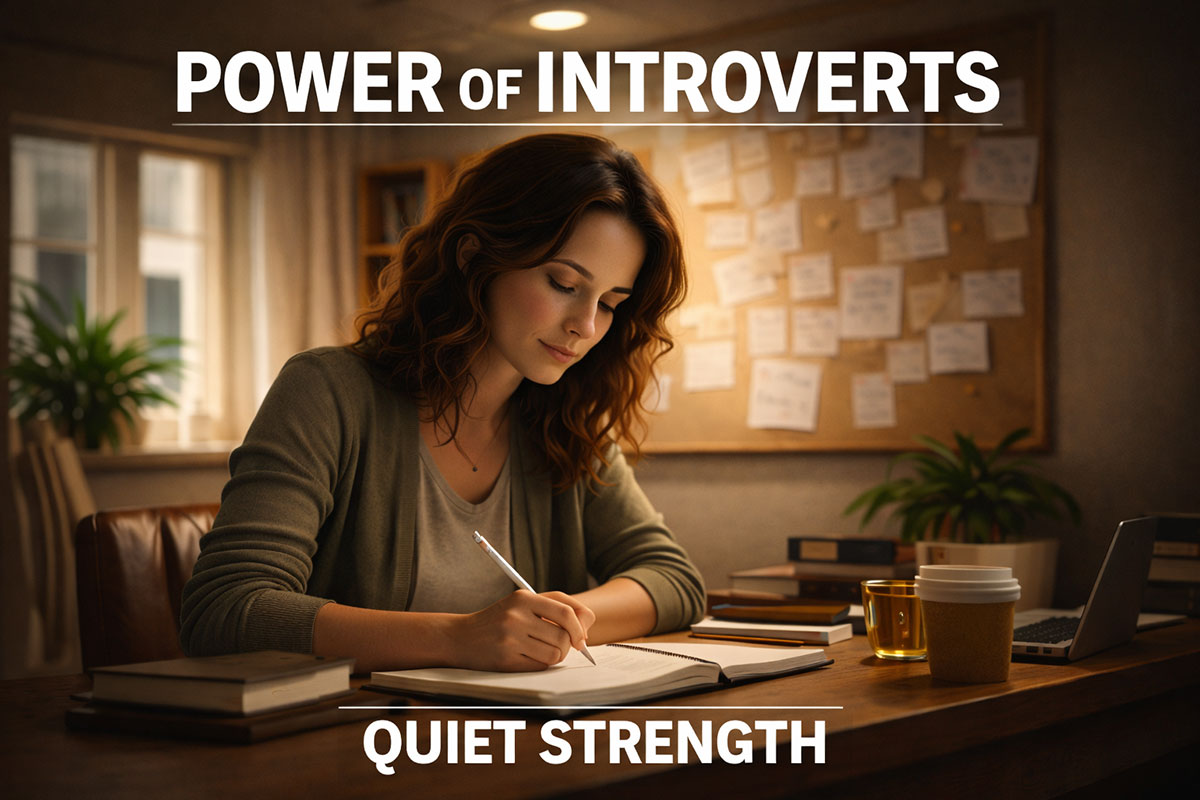
And sometimes it looks like the person sitting quietly at a desk, building something that will one day change the world.
Both matter.
And the quieter one may surprise you.
Short Bios:
Susan Cain
Author of Quiet: The Power of Introverts in a World That Can’t Stop Talking. A leading voice on temperament, introversion research, and designing cultures that value depth and reflection.
Adam Grant
Organizational psychologist and bestselling author focused on workplace culture, collaboration, and how different personality types contribute to high-performing teams.
Brené Brown
Research professor and author known for her work on vulnerability, courage, and emotional authenticity in leadership and relationships.
Cal Newport
Computer science professor and author of Deep Work, advocating focused concentration, meaningful productivity, and distraction-free environments.
Malcolm Gladwell
Journalist and author exploring social science, hidden patterns of human behavior, and the unexpected strengths behind success.
Simon Sinek
Leadership expert and author of Start With Why, emphasizing purpose-driven cultures and human-centered leadership.
Angela Duckworth
Psychologist and author of Grit, researching perseverance, long-term effort, and the internal drivers of achievement.
Daniel Goleman
Psychologist and author of Emotional Intelligence, known for his work on self-awareness, empathy, and social-emotional competencies.
Carol Dweck
Psychologist and author of Mindset, recognized for her research on growth mindset and how beliefs shape learning and resilience.
Esther Perel
Psychotherapist and author specializing in relationships, intimacy, and the emotional dynamics of modern connection.
Amy Cuddy
Social psychologist known for research on presence, confidence, and nonverbal communication.
Sherry Turkle
MIT sociologist and author studying technology, conversation, and how digital culture affects human connection and solitude.
Jonathan Haidt
Social psychologist examining moral psychology, cultural shifts, and generational trends affecting well-being.
Ryan Holiday
Author and modern Stoic thinker focused on reflection, discipline, and the strength found in calm self-control.
Greg McKeown
Author of Essentialism, advocating clarity, focus, and doing less but better.
Naval Ravikant
Entrepreneur and philosopher emphasizing clarity of thought, solitude, leverage, and long-term wisdom.
Jordan Peterson
Clinical psychologist and author exploring responsibility, temperament differences, and meaning-making structures in society.
Maria Popova
Writer and cultural thinker known for deep literary reflection on solitude, creativity, and intellectual life.
Scott Barry Kaufman
Psychologist studying creativity, intelligence, and the strengths often overlooked in quiet individuals.
Tim Ferriss
Entrepreneur and author exploring performance optimization, deliberate practice, and thoughtful experimentation.
Bill Gates
Business leader and philanthropist known for his reflective “Think Weeks” and advocacy for deep reading and strategic solitude.
Mihaly Csikszentmihalyi
Psychologist known for the concept of “flow,” describing the deep focus state where creativity and fulfillment emerge.
Reed Hastings
Co-founder of Netflix, recognized for unconventional workplace culture experiments and autonomy-based leadership.
Priya Parker
Author and facilitator focused on meaningful gatherings and designing conversations with depth and intention.
David Brooks
Columnist and author exploring character, humility, and the moral dimensions of personal growth.
Leave a Reply