

|
Getting your Trinity Audio player ready...
|

Introduction — Karen Armstrong
When we turn to the scriptures of Judaism, Christianity, and Islam, we often encounter passages that seem to divide: “us” from “them,” the faithful from the outsider. But to read these texts only through the lens of exclusion is to misunderstand their origins. These scriptures were composed in times of profound vulnerability, when small communities fought to preserve their identity amid empires, exile, and persecution. Boundaries, then, were not born of arrogance but of survival.
Yet alongside these boundaries lie extraordinary visions of compassion and peace. The Hebrew Bible calls us to love the stranger. The Gospels demand love even for enemies. The Qur’an speaks of God’s mercy encompassing all. In each tradition, the deepest truths are universal, pointing beyond tribe to humanity itself.
Our challenge, then, is to recover that balance. To see both the historical context that shaped exclusivist verses and the transcendent voice that calls us to unity. These conversations you will read are not battles of doctrine but explorations of how survival, myth, politics, and human nature shaped scriptures—while never erasing their higher call to peace.
(Note: This is an imaginary conversation, a creative exploration of an idea, and not a real speech or event)
Topic 1: Survival and Identity: Why Did Scriptures Draw Sharp Boundaries?
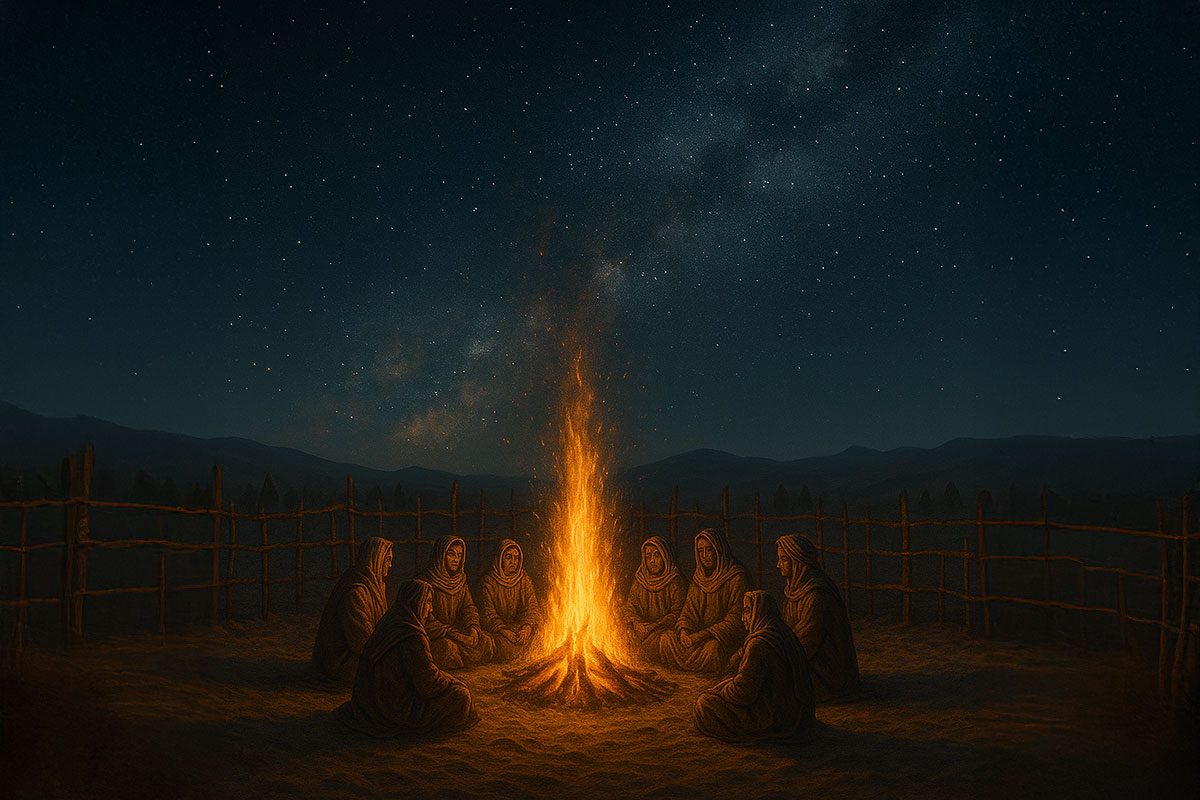
Karen Armstrong (moderator):
When we look back at the early formation of Judaism, Christianity, and Islam, one theme stands out: survival. These communities were small, often persecuted, and fragile. So, my first question is this: Were the “us vs. them” boundaries in scripture primarily about preserving survival in hostile environments, or was there something more?
Rabbi Jonathan Sacks:
The Jewish scriptures arose in a crucible of vulnerability. The Israelites were not a vast empire but a tiny people situated between Egypt and Mesopotamia, the superpowers of the day. Boundaries—Sabbath observance, dietary laws, circumcision—were not about superiority; they were survival codes. Without them, we might have been swallowed by the cultures around us. Imagine a people without land, power, or numbers—identity was our defense. Yet, even in those same texts, you’ll find commandments to love the stranger. It wasn’t exclusion for exclusion’s sake; it was differentiation for endurance.
Reza Aslan:
I agree, but I’d add something. In early Islam, the community in Mecca was marginalized and ridiculed. In Medina, they were threatened militarily. The Qur’an’s sharper boundaries—between believers, hypocrites, and enemies—were strategies for survival in a hostile landscape. But the universalist core was always there: “We made you into nations and tribes so that you may know one another.” So yes, survival was central, but identity wasn’t just about protection—it was about forging a sense of dignity for the downtrodden.
Yuval Noah Harari:
From a historian’s perspective, survival and identity are inseparable. Human tribes always needed clear markers to maintain cohesion. Language, dress, rituals—these prevented collapse into surrounding groups. Religion supercharged this process by giving divine sanction to boundaries. If you broke them, it wasn’t just a social betrayal, it was a cosmic betrayal. That’s why these rules had such power. The paradox is that what preserved identity also fostered suspicion of outsiders.
John Dominic Crossan:
For early Christians, the situation was not only about identity but about radical redefinition. They were a Jewish sect facing rejection by mainstream Judaism and hostility from Rome. Some texts reflect that vulnerability by drawing lines—believers versus non-believers, sheep versus goats. Yet Jesus himself consistently blurred boundaries: speaking with Samaritans, healing Gentiles. The boundaries in Christian scripture reflect less of him and more of the early church trying to survive after his death.
Karen Armstrong:
So perhaps survival was necessary, but survival always comes at a cost. That leads me to another question: How do boundaries that once ensured survival now create conflict in our interconnected world?
Harari:
That’s the tragedy of legacy. A boundary that once protected a minority can, centuries later, justify exclusion or even violence. Think of the dietary laws or purity codes—originally tools of resilience, later transformed into tools of prejudice. In a globalized society, those hard walls become obstacles to cooperation. What once saved you can now strangle you.
Sacks:
I agree, but let’s not underestimate the continued importance of identity. Without boundaries, groups dissolve. What we must do is distinguish between healthy boundaries and hostile ones. Judaism teaches “build fences around the Torah,” but a fence can either guard or imprison. Today, the challenge is to keep identity alive without making it antagonistic. We need to hear both voices of scripture—the call to preserve and the call to embrace.
Crossan:
In Christianity, boundaries hardened into dogmas, and those dogmas fueled centuries of division: Catholics versus Protestants, Christians versus Jews, Christians versus Muslims. The original boundary-setting, which may have been pastoral, became institutionalized and political. The challenge now is rereading the texts with an eye toward inclusivity. Otherwise, ancient survival strategies turn into modern hostilities.
Aslan:
For Islam, too, verses about conflict are often quoted without context. They were revealed in moments of danger, not as eternal calls to enmity. But in today’s fractured world, extremists weaponize those verses to maintain power or fuel fear. The irony is that Islam’s early inclusivity—embracing Jews, Christians, even polytheists in certain covenants—gets lost. Our task is to re-center those universal passages for a global age.
Armstrong:
It seems clear that boundaries cut both ways: they preserve and they divide. So let me pose one last question: Can communities keep their unique identity today without hostility toward outsiders? Or is hostility inevitable once boundaries are drawn?
Crossan:
I believe identity without hostility is possible, but only if we interpret our scriptures historically rather than literally. Once we understand that “enemy” in scripture often meant a specific group at a specific time, we can release it from eternal application. Then identity becomes heritage, not hostility.
Aslan:
Yes. Islam, at its heart, affirms pluralism: “To you your religion, to me mine.” That’s identity without hostility. But it requires teachers, leaders, and communities willing to emphasize those passages. Without reinterpretation, the temptation to use difference as a weapon is always there.
Sacks:
Identity without hostility is not only possible—it is essential. Judaism’s covenant with God was never meant to be exclusive. It was about being a “light to the nations.” To affirm my identity does not mean denying yours. But it does mean I must have one. Without roots, a tree cannot grow. With roots, it can provide shade to all.
Harari:
From a secular lens, identity without hostility is hard but achievable. Humans are wired for in-group loyalty, but we’re also wired for cooperation when survival depends on it. Today, survival depends on global cooperation—climate, nuclear weapons, AI. So evolution may push us to expand the “in-group” to include all humanity. Religion, ironically, can help if it chooses to emphasize its universal teachings.
Armstrong:
And perhaps that is the ultimate transformation: boundaries as markers of beauty and diversity, not as walls of enmity. The scriptures gave our ancestors survival, but they also planted seeds of compassion. Maybe the challenge for us now is to water those seeds until they grow stronger than the fences.
Topic 2: Cosmic Drama — Was “Me Against Them” Always Meant Literally?
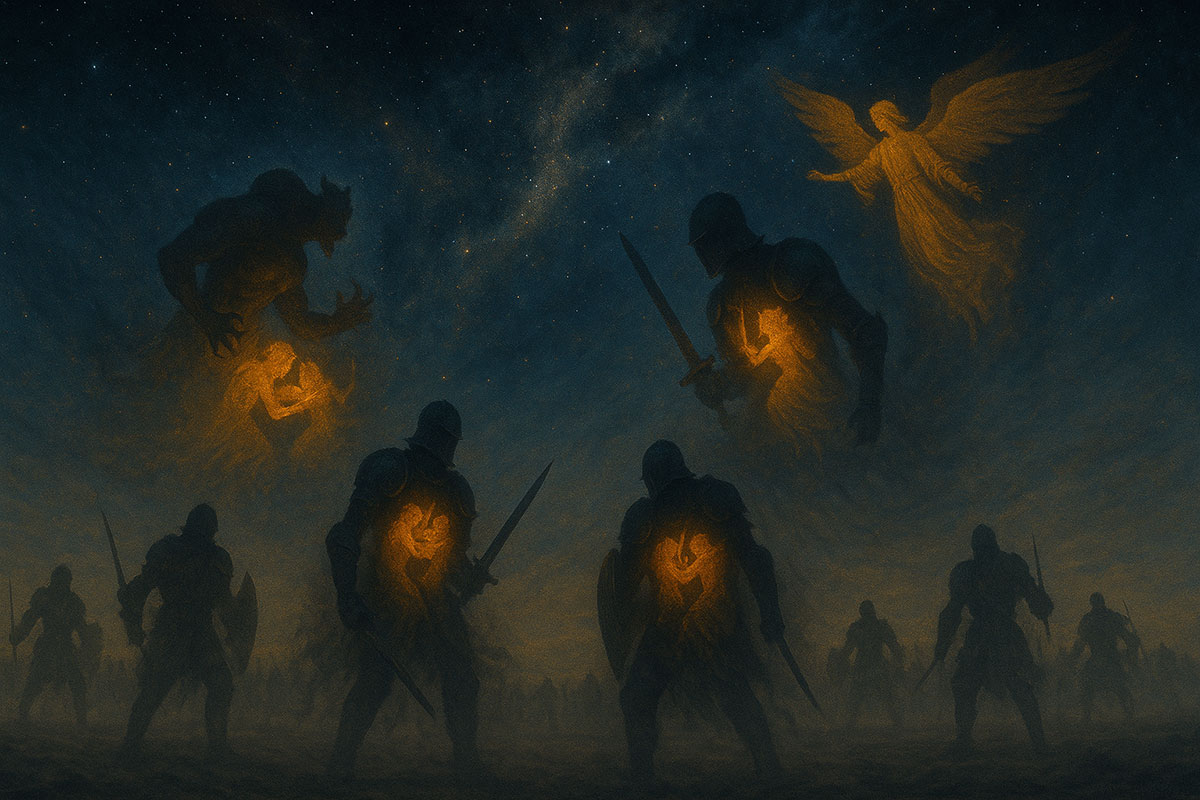
Karen Armstrong (moderator):
So much of scripture seems to stage a cosmic drama: light versus darkness, good versus evil, God’s people versus their enemies. My first question is this: how much of that was meant as metaphor for inner struggle, and how much was meant literally as conflict with other people?
Imam Al-Ghazali:
The Qur’an speaks of jihad, but the greater jihad, as the Prophet taught, is against the self—our greed, arrogance, and anger. The language of “enemies” and “struggle” is often symbolic of these inner battles. Yes, there were times of war when verses were revealed to protect the community. But if you read the Qur’an holistically, you see the emphasis on purifying the heart. To reduce it to mere literal battle is to miss its essence.
Joseph Campbell:
Exactly. Myth is a mirror of the soul. When scripture speaks of slaying enemies, often it’s describing the slaying of inner dragons—fear, doubt, desire. Cultures tell stories in dualistic terms because it’s easier to dramatize the struggle within. But when you literalize the myth, you end up with holy wars instead of holy transformation.
St. Augustine:
In my City of God, I described two cities: one of God, one of man. That is not geography—it is a state of the heart. When scripture speaks of enemies, we should read it spiritually. “Love your enemies” teaches us that the true enemy is not flesh and blood but sin itself. The problem arises when readers forget allegory and apply the texts as marching orders.
Carl Jung:
Psychologically speaking, the enemy is the shadow—those parts of ourselves we deny and project onto others. Religion externalized that shadow into demons, infidels, or heretics. But really, those enemies are inside us. Without integrating the shadow, we will always create scapegoats outside ourselves. Scriptures are archetypal maps of this inner drama.
Philo of Alexandria:
As a Jew immersed in Greek philosophy, I sought to interpret Torah allegorically. When Moses speaks of battles, I see the war of reason against passion, of virtue against vice. These stories are pedagogical—they train the soul. Literalism is dangerous; allegory elevates. It is not Philistines versus Israelites, but wisdom versus folly.
Armstrong:
If scriptures intended so much to be metaphor, why then do humans so often externalize evil instead of seeing it within? Why do we prefer an enemy out there to an enemy in here?
Jung:
Because it is far easier to hate an enemy outside than to confront the abyss within. The ego resists its own flaws. Projection is the simplest escape: I put my anger, greed, or pride onto “the other.” Religion gave divine justification for this projection, which made it even more powerful.
Al-Ghazali:
True. To face oneself requires humility, and humility is rare. But religion is a mirror, if we are brave enough to look. The Prophet said, “The believer is the mirror of his brother.” To see the enemy in the other is to miss the lesson: they reveal the enemy within you.
Campbell:
Myth thrives on drama. People love clear roles: hero and villain, God and Satan. It makes life intelligible. But myth should point us inward, to our own hero’s journey. The “me against them” is supposed to be the ego against its illusions. Unfortunately, societies forget that second layer.
Philo:
Yes. Allegory is the cure. Once you understand that Amalek or Pharaoh is not a nation but a disposition of the soul—arrogance, cruelty—then the text no longer incites violence but calls you to virtue. But allegory requires education, and too often, teachers failed.
Augustine:
And pride is the root of this error. Humanity prefers to exalt itself as “the righteous” and condemn others as “the wicked.” But God alone judges. The true enemy is pride itself—the oldest sin, and the most enduring.
Armstrong:
Then let me ask this: what happens when mythic conflict is misread as a call to violence? What are the consequences, and how should we respond?
Campbell:
When myth is literalized, it becomes ideology. Instead of guiding inner transformation, it justifies outer destruction. Crusades, jihads, persecutions—all stem from reading symbols as commands. The antidote is reclaiming myth as metaphor. Without that, religion devolves into tribal war.
Augustine:
Indeed. When the church wielded the sword, it betrayed Christ’s message. Violence in God’s name corrupts both faith and politics. The response must be to return to love—caritas—as the interpretive lens. Every scripture must be read through the commandment of love.
Al-Ghazali:
Violence cloaked in religion is hypocrisy. The Qur’an condemns aggression except in defense. Yet men of power have always exploited verses to sanctify their ambitions. Our response must be to restore balance: teach that the true jihad is against injustice, including the injustice of misusing scripture.
Philo:
When Israel takes wars literally, it risks becoming what it once suffered. Allegory saves us from that trap. Philosophy teaches us to seek the inner meaning. Without it, sacred words are weapons. With it, they are medicine.
Jung:
The consequence is endless shadow-projection. Whole peoples become scapegoats: Jews, Muslims, Christians—each taking turns as “the enemy.” The only way forward is individuation: every person, every community must integrate its shadow. Until then, scripture will continue to be misused as a mirror turned outward instead of inward.
Armstrong:
So perhaps the cosmic drama was never meant to be about annihilating others, but about awakening ourselves. The battle is real, but its battleground is the heart. And unless we reclaim that truth, myth becomes massacre instead of meaning.
Topic 3: Power and Politics — Who Benefited From Emphasizing Conflict?

Karen Armstrong (moderator):
Throughout history, leaders have leaned on religion to justify power. So let’s begin here: how have rulers or leaders weaponized scripture to unify their followers, and who truly benefited?
Emperor Constantine:
When I embraced Christianity, it was not only a personal conversion—it was a political necessity. Rome was fragmenting. A single faith could unify the empire. Conflict became useful: pagans versus Christians, heretics versus the orthodox. By defining an enemy, I forged unity. Who benefited? The empire did, and so did the bishops who gained imperial backing. But I wonder: did Christ’s message benefit? Perhaps not.
Gandhi:
And there lies the tragedy. Whenever religion is co-opted by power, it loses its soul. In India, I saw British colonizers use Christian scripture to justify domination, and Hindu leaders invoke their texts to stir division. But scripture, rightly read, should disarm power, not sanctify it. The only true benefit goes to those who crave control, never to the people, never to God.
Karen King:
History confirms this. The early church was rife with diverse voices—women prophets, Gnostic thinkers, radical egalitarians. But once Constantine aligned with Christianity, diversity was crushed. Orthodoxy was manufactured to secure power. Conflict was emphasized because “heresy” created a convenient enemy. Who benefited? Those in authority who could silence dissent and claim divine approval.
Ayatollah Khomeini:
I will not deny that scripture and power are intertwined. When I called for revolution, I drew on Qur’anic language of struggle and justice. The enemy—be it the Shah or Western imperialism—was essential to mobilize the masses. Did I benefit? Yes. But so did the downtrodden, who finally had a banner under which to resist tyranny. Scripture is not neutral; it is a sword against oppression, if wielded rightly.
Martin Luther:
My case is more complicated. I sought to free conscience from the tyranny of Rome, but to rally people, I too drew sharp lines: true gospel versus papal corruption, faith versus works. My words inspired reform but also unleashed violence—the Peasants’ War, persecutions, divisions. Did some benefit? Certainly. Princes who broke Rome’s grip gained power. But many peasants who hoped for freedom suffered. Conflict can liberate, but it also burns indiscriminately.
Armstrong:
You’ve all made it clear: emphasizing conflict strengthens leaders, but at great cost. Let me push further: is exclusivism in religion more about theology itself, or about consolidating political power?
Khomeini:
Theology is always political. To claim authority over God’s word is to claim authority over the people. Leaders cannot separate the two. Exclusivism is useful because it transforms obedience into devotion. If you believe dissent is not just treason but blasphemy, power becomes unassailable.
Luther:
Yes, and Rome understood this well. Papal authority claimed to be absolute because it was divine. My protest was theological, but it shook political foundations. Still, I must admit: even my theology became exclusivist in its own way. The temptation is strong to claim God only backs your side.
King:
That’s the key. Exclusivism rarely springs from theology alone. The earliest Christians were far more diverse than later orthodoxy allowed. But once bishops and emperors found power in unity, they defined truth narrowly. Heresy was born not because the texts demanded it, but because politics demanded uniformity.
Constantine:
Indeed. The Nicene Creed was as much imperial strategy as theology. A fractured faith could not hold an empire together. Exclusivism was a tool. Theology gave it language, but power gave it teeth.
Gandhi:
And so religion becomes a servant to politics. True faith must resist this. If scripture is reduced to a political tool, it ceases to be scripture. My reading of the Bhagavad Gita was not a call to arms but to selflessness. Religion must be a lamp for the soul, not a throne for the ruler.
Armstrong:
A sobering reminder. Let me close with this: What would scripture look like if it were interpreted free from state or empire interests? If no ruler ever used it for power, how would we be reading it today?
King:
We would see multiplicity, not uniformity. Women’s voices, mystical voices, radical voices would still shape Christianity. Without empire’s suppression, the canon might be wider, theology more fluid. Scripture would be a living conversation, not a fixed decree.
Gandhi:
We would see compassion, not conquest. The Sermon on the Mount, the Qur’an’s mercy, the Gita’s call to detachment—these would dominate. Without power’s distortion, religions would meet as friends, not rivals. Scripture would be a bridge, not a sword.
Luther:
Perhaps. Yet I also believe conflict is inevitable. Even free of empire, humans would debate, divide, argue over truth. But without empire, those disputes might have remained dialogues, not wars. The scriptures would still provoke, but not persecute.
Khomeini:
I am less romantic. Power cannot be separated from scripture, for religion always has social consequences. Even if not tied to empires, faith produces communities, and communities produce politics. The real question is not whether scripture escapes power, but whether power is used for justice or domination.
Constantine:
And yet, imagine: a Christianity without imperial backing, a faith left underground, marginal, perhaps more faithful to its crucified Lord. Yes, the empire benefited from conflict, but perhaps the church lost its soul in the bargain.
Armstrong:
So it seems we arrive at a paradox: without power, scripture may have remained truer but weaker. With power, it gained strength but often betrayed its core. Perhaps the task of our age is to unbind scripture from empire’s shadow and let its voice speak again—beyond conflict, beyond conquest.
Topic 4: Human Nature — Do We Need Enemies to Define Ourselves?
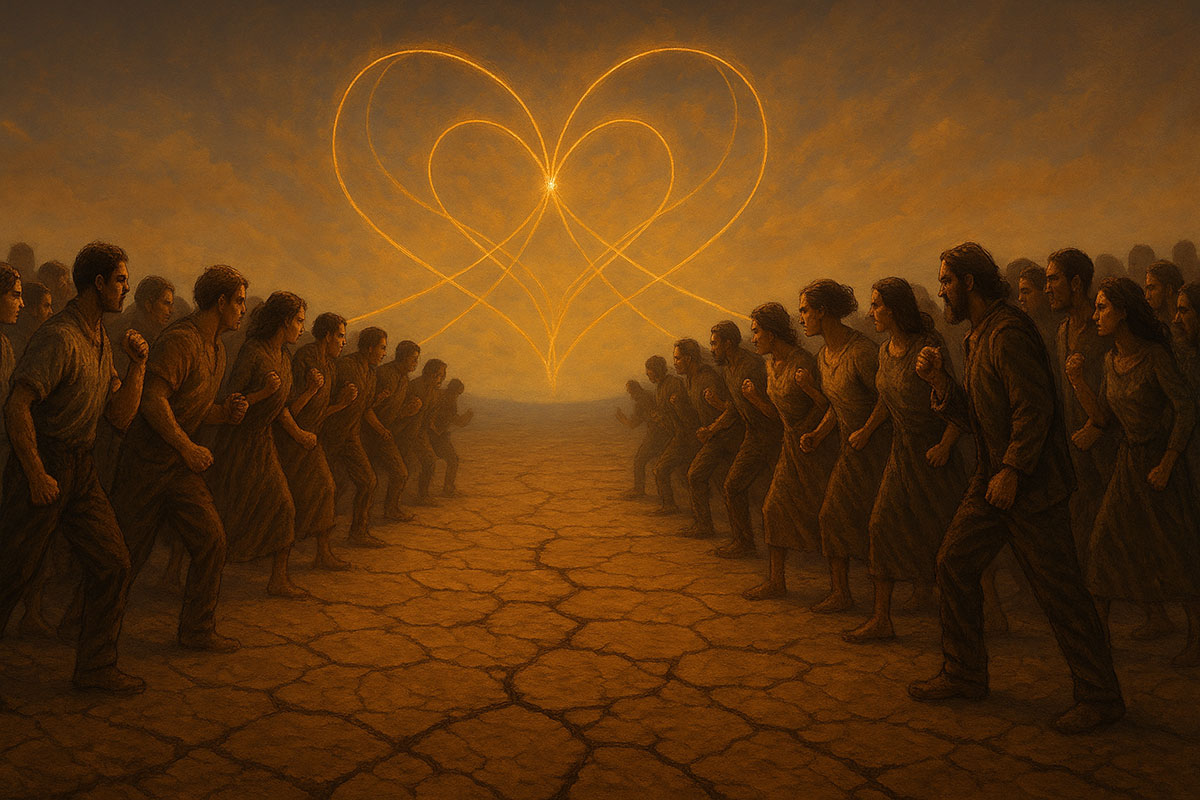
Karen Armstrong (moderator):
We’ve spoken of history and politics, but underneath is human nature. My first question is this: Why do humans so instinctively form “in-groups” and “out-groups”? What is it in us that seems to crave division?
René Girard:
At the heart of human desire lies imitation. We copy each other, we compete, and that competition produces conflict. When tensions rise, societies look for scapegoats to unite against. “In-group” and “out-group” are not just tribal survival tools; they are mechanisms to release violence. We define ourselves by our enemies because it channels aggression away from ourselves.
Sigmund Freud:
I would add that it is psychological as well. Civilization demands we repress our instincts. That repression creates frustration, which must be discharged. The simplest way is to project hostility onto an “other.” Hence religion, nationality, or ideology become excuses to externalize what is boiling within. The in-group bonds through shared hatred.
Cornel West:
But let us not forget the moral side. Tribalism is a distortion of our deep hunger for belonging. We all want to feel seen, valued, loved. When society denies that dignity, people cling to narrower identities—race, class, creed—sometimes against others. The tragedy is that love gets twisted into exclusion.
Desmond Tutu:
Yes. I saw this in apartheid South Africa. Whites needed Blacks as the “enemy” to preserve their false sense of superiority. It was fear masquerading as identity. But Ubuntu teaches us: “I am because you are.” True identity does not require an enemy—it requires relationship. To live otherwise is to live in diminishment.
Karen Armstrong:
So the instinct is real, but perhaps not destiny. Let me ask: is religious tribalism just one form of this deeper human need for identity? Or is it something unique and more dangerous?
Freud:
Religion intensifies the pattern because it sanctifies it. An enemy is no longer just disliked—it is cursed by God. The father-figure of religion becomes the guarantor of hostility. This makes religious tribalism uniquely potent. It binds with both fear and sacred authority.
Girard:
Exactly. When a group cloaks its scapegoating in divine will, the mechanism becomes nearly unbreakable. “God commands us” makes persecution appear holy. Religion often preserves the scapegoat system under the guise of righteousness.
Tutu:
But religion can also undo it. The Gospel I preached called for reconciliation, not vengeance. Scripture reveals the scapegoat—Jesus—as innocent, exposing the lie. Religion is dangerous, yes, but it also holds the cure. It can transform tribal hostility into radical forgiveness.
West:
I agree with Bishop Tutu. Christianity at its best says: there are no outsiders, only children of God. Islam at its best says: there is no superiority except in righteousness. Judaism says: remember you were strangers in Egypt, so love the stranger. Religion is not inherently more dangerous; it simply magnifies whatever spirit we bring to it—hatred or love.
Armstrong:
Which brings me to my last question: Can empathy and forgiveness really break this cycle of needing an enemy? Or is hostility so deeply rooted in us that it will always resurface?
Girard:
The scapegoat mechanism is deeply ingrained, but it is not invincible. The Gospels unmask it. Once you know the scapegoat is innocent, the cycle weakens. Empathy can dissolve the illusion of enmity. But it requires constant vigilance; otherwise, the pattern reasserts itself.
Freud:
I am less hopeful. Hostility is tied to instinct. Empathy may reduce it, but never abolish it. The aggressive drive will always seek outlets. Civilization may redirect it into culture, art, or sport, but it cannot eliminate it. Hostility is a permanent shadow.
Tutu:
Ah, but Freud, I must disagree. I witnessed enemies embrace, murderers confess and be forgiven, victims release hatred. The Truth and Reconciliation Commission was living proof that forgiveness can triumph over vengeance. It is not easy, but it is possible. Hostility need not define us.
West:
Yes, but it demands courage. Empathy is not sentimental; it is fierce. To love your enemy is not to deny their wrong but to see their humanity. That is a radical act. And it is the only way forward, for hostility in the nuclear age is suicide. Empathy is no longer optional; it is survival.
Armstrong:
So perhaps the question is not whether hostility is inevitable, but whether love can become stronger than our instinct to divide. Scriptures gave us both weapons and healing balm. Our task is to choose which to wield.
Topic 5: The Peace Thread — How Do We Elevate the Verses of Unity?
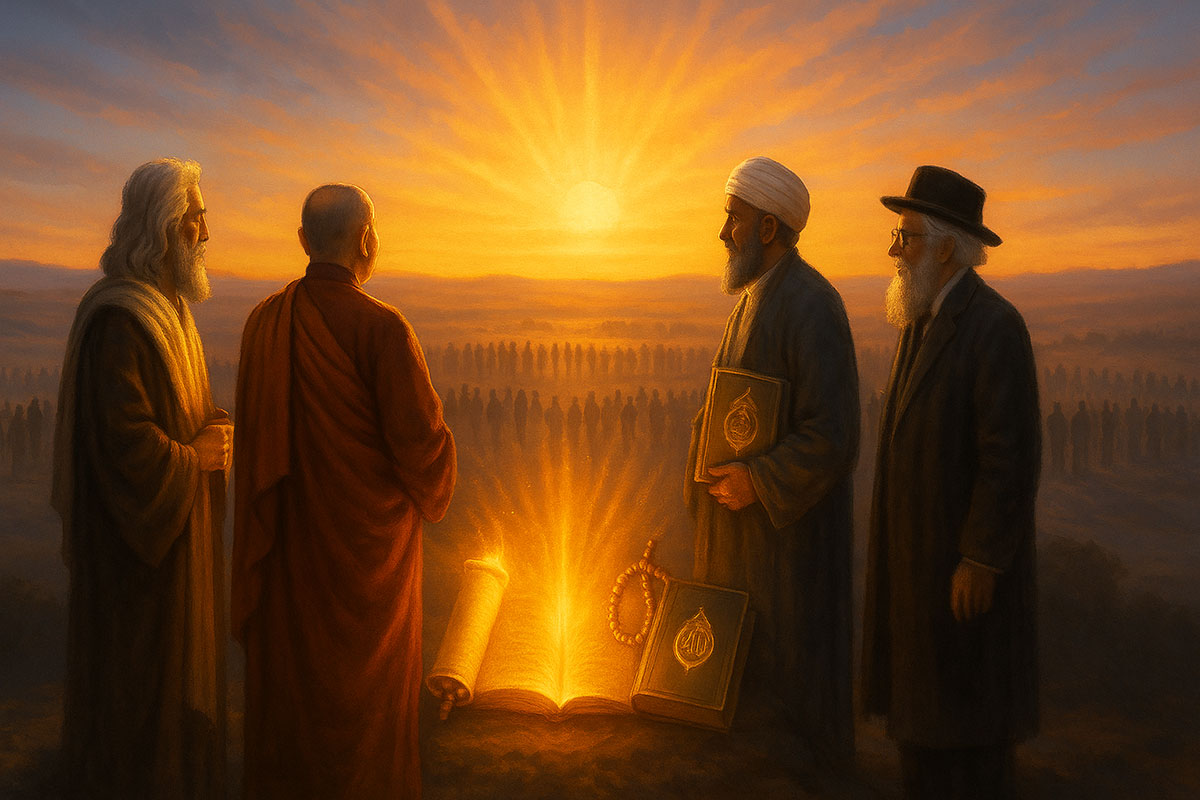
Karen Armstrong (moderator):
We’ve heard how scriptures can divide, but each tradition also carries profound calls for peace. My first question is this: What are the most powerful peace-oriented teachings in your tradition, and why do they matter today?
Rabbi Abraham Joshua Heschel:
For Judaism, one of the most beautiful commands is: “Love the stranger, for you were strangers in Egypt.” That single verse turns history into empathy. Our suffering becomes the foundation for compassion. The prophets spoke endlessly of justice, mercy, peace. The Jewish destiny was never conquest, but to be a “light to the nations.” That remains our greatest contribution.
Dalai Lama:
In Buddhism, compassion is the heart of everything. We speak of karuna—the wish that others be free from suffering. When you see your enemy as suffering too, hatred dissolves. The verse I hold closest is not a scripture alone but a practice: “All beings want happiness; treat them as yourself.” It matters today because our survival as a planet depends on compassion across borders.
Moses:
The Torah gave commandments, but above them all is the Shema: “Hear, O Israel, the Lord is our God, the Lord is one.” If God is one, then creation is one. Division is illusion. Even the laws that seemed tribal were meant to guide people toward holiness, not to enshrine enmity. The highest command is to love God, and by extension, to love what God has made—every human being.
Prophet Muhammad:
The Qur’an says: “God does not forbid you from being kind and just to those who do not fight you because of religion.” Islam means submission to peace. The Prophet’s last sermon emphasized that no Arab is superior to a non-Arab, no white to a black, except by piety. That is unity. These words matter today because Muslims are called to show the world not division, but mercy—the very name of God: al-Rahman, al-Rahim, the Compassionate, the Merciful.
Jesus of Nazareth:
You have heard it said, “Love your neighbor and hate your enemy.” But I say to you: love your enemies and pray for those who persecute you. This is the heart of my teaching. Anyone can love a friend. To love an enemy is to reflect the Father’s perfect love, which shines on the just and unjust alike. This matters today more than ever. The world will not heal through vengeance, but through radical forgiveness.
Armstrong:
Thank you. But if these peace passages are so powerful, why have they so often been overshadowed by conflict-oriented readings? Why is it easier to cling to division than to unity?
Muhammad:
Because fear is powerful. When people are threatened, they reach for verses of defense, not mercy. Leaders exploit that fear, citing scripture to justify violence. But this is a distortion. The peaceful verses are not weak; they are the core. Fear blinds us from seeing them.
Heschel:
Yes, fear and power. The prophets of Israel were marginalized because they spoke of peace. The kings wanted victory, not humility. Today is no different: politicians find more use in warlike slogans than in prophetic whispers. Peace verses are harder because they demand sacrifice, humility, trust.
Dalai Lama:
And because peace is slow, but anger is quick. Hatred mobilizes masses faster than compassion does. That is why teachers must persist, repeating peace again and again. The mind naturally clings to “me versus you.” Meditation retrains the mind to see we are all interdependent.
Moses:
Even in my time, the people wanted golden calves, visible power, easy answers. Peace requires patience and faith. Conflict feels immediate and strong. This is why scripture must be read with wisdom, not convenience. Otherwise, the loudest voice drowns out the deepest truth.
Jesus:
And because loving enemies is the hardest commandment. People prefer vengeance; it feels just. But justice without love becomes cruelty. The peace verses are overshadowed because they demand transformation of the heart. Many read scripture but do not yet live it.
Armstrong:
So then the last question: How can religions today make their peace passages the center, not the margin? How can we elevate unity above division?
Dalai Lama:
By teaching compassion as a daily practice, not a lofty idea. Schools, families, temples, mosques, churches must train the heart. Peace verses must be embodied, not just recited. If compassion becomes habit, unity will follow naturally.
Jesus:
By living as peacemakers. Not by words only, but by deeds. When my followers clothe the poor, forgive debts, feed the hungry, they preach peace louder than sermons. The world listens to love in action.
Moses:
By remembering covenant. Not only Israel’s covenant, but humanity’s covenant with God through creation. The rainbow after the flood was for all people. To elevate unity, we must recall that God’s promises were never meant for one tribe alone, but for all nations.
Muhammad:
By restoring balance. Islam’s name itself comes from salam, peace. If Muslims show justice and mercy, not anger, the peaceful verses will shine again. Interfaith dialogue, acts of kindness, defense of the oppressed—these make unity visible. The Qur’an says: “We made you into nations and tribes so that you may know one another.” That is the call of our time.
Heschel:
By cultivating awe. When we stand in wonder at the world, we see its unity. The enemy becomes a fellow child of God, not a rival. I once marched with Martin Luther King Jr., because I felt it was like “praying with my feet.” That is how peace passages come alive—through action rooted in reverence.
Armstrong:
So perhaps the answer is simple but demanding: embody peace until it becomes louder than war. The scriptures hold both division and unity, but only we can decide which voice will guide the future. If fear fuels division, then only compassion can fuel unity.
Final Thoughts by Rabbi Jonathan Sacks
If history has taught us anything, it is that identity without responsibility leads to conflict. The Hebrew prophets knew this well. They reminded Israel that being chosen did not mean privilege but service: to be a blessing to others, to bring light where there is darkness.
Every faith carries within it both particular and universal strands. We belong to a people, a community, a tradition. That belonging gives us strength. But the danger is when belonging becomes excluding, when loyalty to one’s group is purchased at the cost of hostility to outsiders. Then religion ceases to heal and begins to harm.
The task of our time is to reclaim the universal without erasing the particular. To be deeply rooted in one’s faith yet open to the dignity of others. We do not need to agree to live together in peace. We need only recognize the divine image in the face of the other.
In the end, the scriptures that once guarded tribes now belong to the world. They challenge us still: Will we wield them as weapons, or will we allow them to become the wisdom that heals? The choice is ours.
Short Bios:
Karen Armstrong — British author and former nun, renowned for her works on comparative religion including A History of God. She emphasizes compassion and understanding across faiths.
Rabbi Jonathan Sacks — Former Chief Rabbi of the United Hebrew Congregations of the Commonwealth, philosopher and author, known for bridging faith and modern ethics with works like The Dignity of Difference.
John Dominic Crossan — Irish-American biblical scholar and former Catholic priest, co-founder of the Jesus Seminar, known for exploring the historical Jesus and early Christianity.
Reza Aslan — Iranian-American scholar of religions, writer, and commentator, author of No god but God and Zealot. He often interprets faith in contemporary cultural contexts.
Yuval Noah Harari — Israeli historian and professor, best-selling author of Sapiens and Homo Deus, focusing on the evolution of human societies, narratives, and identities.
St. Augustine — Influential early Christian theologian and philosopher, author of Confessions and City of God, foundational to Western Christianity.
Imam Al-Ghazali — Persian theologian, philosopher, and mystic, a major figure in Islamic thought who emphasized both reason and spirituality.
Philo of Alexandria — Jewish philosopher of the Hellenistic period who merged Jewish theology with Greek philosophy, shaping later religious thought.
Joseph Campbell — American mythologist and writer, author of The Hero with a Thousand Faces, known for the “hero’s journey” archetype.
Carl Jung — Swiss psychiatrist and psychoanalyst, founder of analytical psychology, who explored archetypes, the collective unconscious, and religion’s symbolic role.
Emperor Constantine — Roman emperor who legalized Christianity with the Edict of Milan, convened the Council of Nicaea, and reshaped Christianity’s role in empire.
Ayatollah Khomeini — Iranian revolutionary leader and Shi’a cleric who founded the Islamic Republic of Iran, fusing politics and religious authority.
Martin Luther — German monk and reformer who initiated the Protestant Reformation, challenging the Catholic Church with his Ninety-Five Theses.
Mahatma Gandhi — Leader of India’s nonviolent independence movement, spiritual teacher of ahimsa (nonviolence), and advocate for interfaith harmony.
Karen King — American scholar of early Christianity, professor at Harvard Divinity School, known for her work on Gnostic texts and women’s roles in the early church.
René Girard — French historian and philosopher, creator of “mimetic theory” and the scapegoat mechanism as an explanation of human conflict.
Sigmund Freud — Austrian neurologist and founder of psychoanalysis, who critiqued religion as rooted in psychological need and illusion.
Cornel West — American philosopher, political activist, and public intellectual, blending prophetic Christian thought with critiques of race, class, and justice.
Desmond Tutu — South African Anglican bishop and Nobel laureate, central figure in ending apartheid and leading the Truth and Reconciliation Commission.
Jesus of Nazareth — Central figure of Christianity, teacher and healer whose message of love, forgiveness, and the Kingdom of God reshaped history.
Prophet Muhammad — Founder of Islam, revered as the final prophet, whose teachings emphasized monotheism, justice, and mercy.
Moses — Foundational prophet in Judaism, Christianity, and Islam, lawgiver of the Torah, and leader of the Exodus narrative.
Dalai Lama (Tenzin Gyatso) — Spiritual leader of Tibetan Buddhism, Nobel Peace Prize laureate, and advocate for compassion, peace, and interfaith dialogue.
Rabbi Abraham Joshua Heschel — Jewish theologian and philosopher, mystic writer, and civil rights activist, author of The Prophets and marcher with Martin Luther King Jr.
Leave a Reply