
|
Getting your Trinity Audio player ready...
|
What if Jared Kushner debated this with top diplomacy and theology thinkers?
Introduction by Fareed Zakaria
When people hear the word “peace,” they imagine a handshake, a ceasefire, a moment when the violence stops and the news moves on. But what actually shapes the next decade is rarely the handshake. It is the structure that comes after it: who governs, who pays, who enforces, and who gets to decide when “stability” has truly arrived.
That is what this five-part imaginary roundtable is really about. Not cheerleading, not panic, not prophecy-as-clickbait. We are treating peace as infrastructure.
We begin with legitimacy, the uncomfortable reality that rebuilding a shattered place often requires temporary administrators and external money, yet legitimacy ultimately requires representation and local ownership. Then we examine the psychology of “peace and safety,” how relief can lower vigilance and why narratives of closure can be more seductive than the messy work of durable institutions. From there we look at the phrase “covenant with many” as a lens for what multinational alignment can mean, both as mature cooperation and as a subtle form of consolidation. Next we confront modern power itself: influence that flows through envoys, boards, funding pipelines, and private networks, sometimes faster than democratic processes can keep up. Finally, we ask what happens when a peace model becomes a prototype, a template that can be exported, standardized, and scaled.
You do not have to agree with every interpretation to benefit from the exercise. The point is to sharpen the questions that most coverage skips. Because in the end, the real contest is not between war and peace. It is between peace that restores agency and peace that quietly replaces it.
(Note: This is an imaginary conversation, a creative exploration of an idea, and not a real speech or event.)
Topic 1: Peace as Infrastructure, Who Governs When Guns Go Quiet?
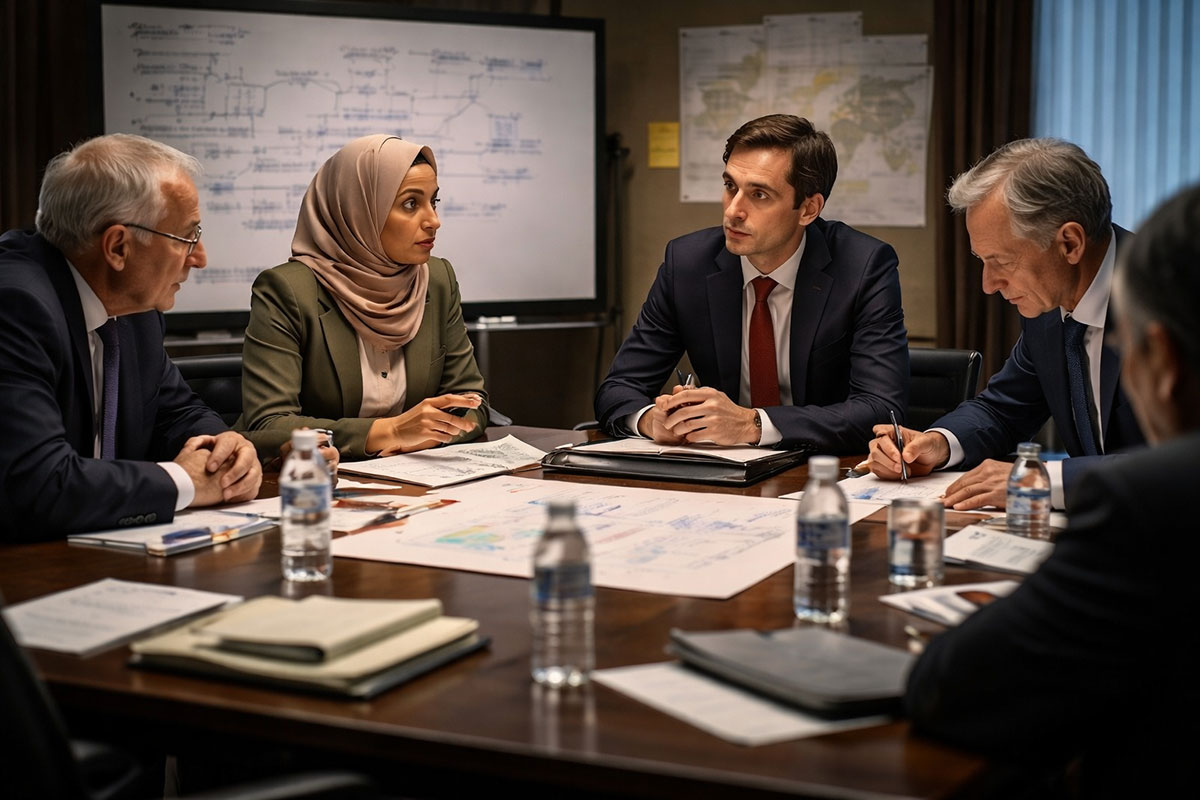
A quiet roundtable in a side room near a diplomatic conference. The windows show a gray Washington morning. No cameras. No flags. Just water glasses, notebooks, and the heavy feeling that “peace” is not a word, it is a machine someone has to operate.
Karen Armstrong: We keep using the word “peace” as if it is a feeling that descends from the sky. But what I hear in this moment is something more concrete. Peace as infrastructure. Peace as administration. Peace as security design. So let me begin simply.
If Gaza is governed by an appointed technocratic committee under an international framework, what makes that governance legitimate?
Mariam Al Masri (Gaza civil society organizer): Legitimacy is not a stamp, it is a lived experience. If my neighbors cannot challenge decisions, cannot remove leaders, cannot even understand who answers to whom, then it is not governance, it is management. People do not want to be managed like a project. They want representation that can be blamed, corrected, replaced. Technocrats can help, yes, but only if they are temporary and accountable to something local that is real, not symbolic.
Ajay Banga: I agree accountability is essential, but legitimacy also comes from outcomes. If a system restores basic services, keeps the lights on, reopens schools, rebuilds clinics, creates jobs, and reduces violence, people begin to experience it as legitimate even before elections are possible. The danger is pretending elections can happen immediately in a destroyed environment with armed factions and shattered institutions. The sequence matters. You build administrative capacity, then political capacity, then you vote in something that can survive.
Jared Kushner: I hear the concern, Mariam, but there is a hard truth. When governance collapses, someone has to rebuild the scaffolding. You can call it management if you want, but the alternative is chaos or militias or corruption. The goal should be a transitional authority with clear milestones and an exit ramp. Legitimacy comes from transparency, timelines, and measurable progress. If it becomes permanent, then it is a problem.
Tony Blair: I have watched this movie many times in many places. The question is not whether technocracy is good or bad. The question is whether it is tethered to a political horizon. If you do not define the path to local ownership, you create a dependency economy where the strongest actors become the ones closest to the money and the permits. That produces a different kind of conflict. The legitimacy is not just ballots. It is whether people can see a future where they are authors, not subjects.
Harold Koh (international law scholar): International legitimacy requires consent and lawful authority. But moral legitimacy requires participation. A transitional arrangement can be lawful and still feel imposed. The solution is not to pretend the world can step away. The solution is to embed Palestinian voices in governing institutions immediately, not as decoration, as decision-makers with vetoes on specific domains. If legitimacy is postponed, resentment becomes the fuel that breaks the infrastructure later.
Karen Armstrong: So legitimacy is not one thing. It is safety, services, consent, timeline, and moral ownership. Let’s tighten the lens.
When reconstruction funding arrives in the billions, does money stabilize peace, or does it quietly purchase control?
Ajay Banga: It can do both. Money is a tool. If it is tied to transparent procurement, independent audits, local hiring, and clear delivery milestones, it stabilizes. If it is distributed through opaque networks and political patronage, it buys control and breeds corruption. The real issue is governance design. When people say “money buys control,” they often mean “the rules are written elsewhere.” So write the rules in public, and enforce them.
Tony Blair: The mistake is imagining money is neutral. It is never neutral. Whoever controls the pipeline controls the priorities. Roads before schools, ports before housing, security contracts before local businesses. Reconstruction can be a form of soft occupation if it ignores local agency. But it can also be liberation if it builds a middle class that is invested in stability. The decisive factor is who decides what gets built first.
Mariam Al Masri: I can tell you what it feels like on the ground. Money arrives with conditions. Not always spoken. Sometimes the condition is silence. Sometimes the condition is gratitude. Sometimes the condition is “do not embarrass the donors.” And people learn quickly that the fastest path to survival is to become politically harmless. That is how money purchases control. Not through a conspiracy. Through hunger and bureaucracy.
Jared Kushner: But the alternative is what, exactly? Leave rubble and call it dignity? People deserve homes, water, functioning hospitals. Conditions can be safeguards, not chains. You do not want reconstruction funds diverted to weapons or tunnels or corrupt networks. Conditionality is not inherently evil. It is a way to protect the investment and protect civilians from another cycle of destruction.
Harold Koh: The line between safeguards and coercion is thinner than policymakers admit. International law cares about self-determination, not just efficiency. If conditions restrict political expression or exclude legitimate local actors from governance, then money becomes leverage against self-determination. The way forward is rights-based conditionality. Conditions that protect civilian rights, not donor preferences. And crucially, an independent mechanism where local communities can file complaints and force correction.
Karen Armstrong: You are circling a profound paradox. Reconstruction is mercy, and also power. Even when no one intends domination, systems can dominate by default.
Now for the hardest question, and I want each of you to answer it without slogans.
Demilitarization and stabilization forces are being discussed as the path to “peace and safety.” What is the difference between real safety and the illusion of safety, and who decides when a society is safe enough to stop being watched?
Tony Blair: Real safety is when violence becomes politically irrational, not just temporarily suppressed. The illusion is when security is outsourced, and everyone relaxes because foreign forces are present. That can hold for a time, but it does not solve the deeper contest for legitimacy and identity. The moment outside forces leave or lose credibility, the illusion cracks. The test is whether local institutions can absorb shocks without returning to armed governance.
Mariam Al Masri: Real safety is when my brother does not fear both directions. Not fear militants for speaking, and not fear security forces for moving. The illusion is when weapons are removed from one side only, while surveillance and raids remain part of life. People learn that “safety” sometimes means “quiet.” Quiet can be produced by fear. A society is safe when people can disagree without punishment. Who decides? The people living there should decide, because they are the ones paying the cost.
Jared Kushner: Safety has to be measurable. If rockets stop, if smuggling stops, if tunnels stop, if attacks stop, you have progress. You cannot base it purely on feelings. But I accept Mariam’s point. If security becomes permanent oversight, it erodes dignity and breeds backlash. The stabilization concept must be time-bound and conditional. Benchmarks, transition steps, local security forces trained and accountable, and then an exit.
Ajay Banga: I think of safety as a ladder. Step one is physical safety, people not dying. Step two is economic safety, people having predictable income and services. Step three is institutional safety, courts and police that are trusted. The illusion happens when we mistake step one for the whole ladder. We declare success too early because the shooting stops, but the system underneath is still brittle. The decision to “stop watching” should be tied to local capacity metrics, not international fatigue or public relations cycles.
Harold Koh: Law gives you a sober warning here. Stabilization forces tend to expand their mandate in practice, even when they begin narrowly. “Temporary” becomes elastic. Real safety includes legal safety, protections against arbitrary detention, collective punishment, or permanent exceptionalism. The illusion is when security is defined only as the absence of attack, rather than the presence of rights. Who decides? Ideally a hybrid structure: local elected bodies as soon as feasible, an independent judiciary mechanism, and international oversight limited to ensuring rights rather than controlling politics.
Karen Armstrong: Listening to all of you, I hear the quiet truth underneath the headlines. Peace is not a signature. It is a living system that can heal or dominate depending on how it is designed.
So here is what I want to do next, and we do not have to resolve it today. I want us to name, with brutal honesty, the non-negotiables for a peace infrastructure that does not become a cage.
Because if peace is built like a machine, then the moral question is who holds the keys, who can turn it off, and who has to live inside it when the world stops paying attention.
Topic 2: “Peace and Safety,” The Psychology of Relief
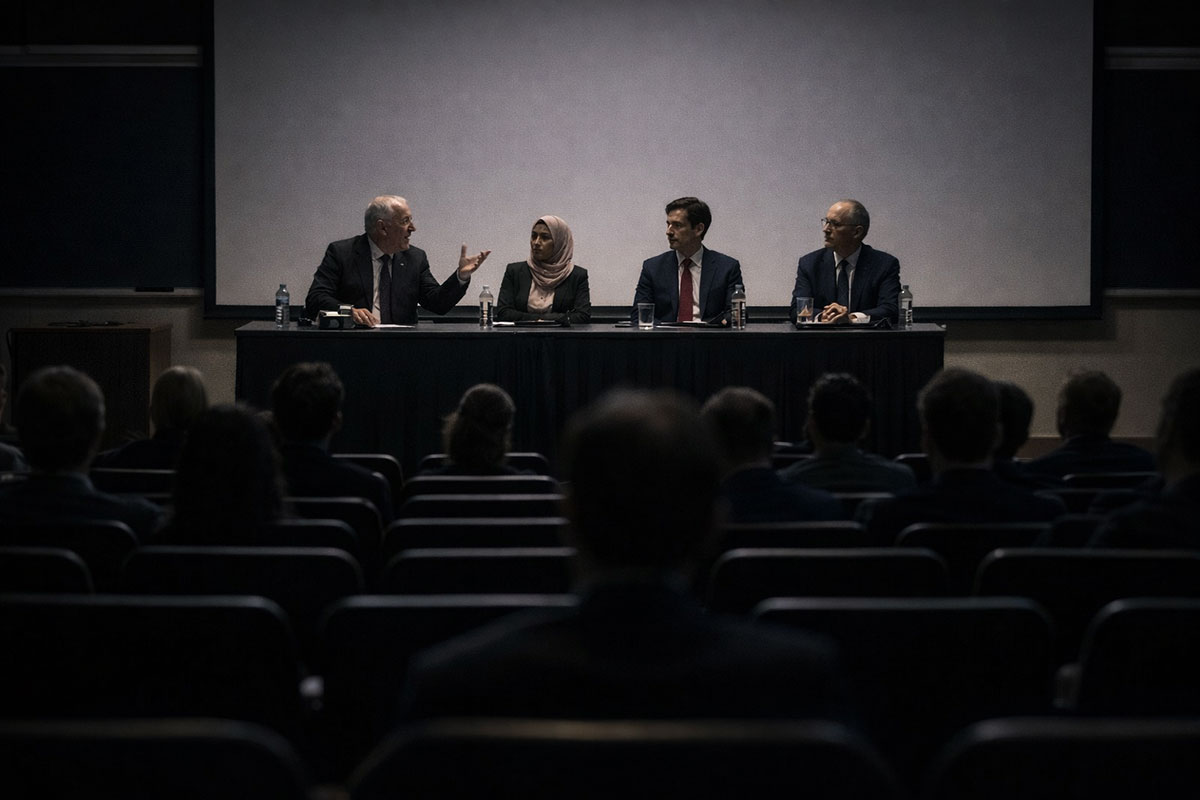
A quiet auditorium that feels more like a university lecture hall than a political stage. The lights are low, the mood is clinical. A large screen behind the panel shows no images, just a blank dark field, as if the room is refusing to be persuaded by spectacle.
Carl Sagan: Human beings are pattern-makers. That is our genius and our weakness. We find meaning, we form narratives, and we relax when a story sounds complete. So I want to begin here.
What is the psychological difference between real peace and narrative peace?
Apostle Paul: There is a peace that comes from reconciliation with God, and there is a peace that comes from arrangement among men. Narrative peace is a proclamation that says, “We are safe now,” while the heart remains unchanged. It is a curtain drawn over a house still filled with smoke. Real peace begins inward and then bears outward fruit. Narrative peace begins outward and demands the inward world submit to it.
Dr. Elena Park (trauma psychologist): Narrative peace is a downshift in the nervous system that happens because people are desperate for relief. When a community has been held in chronic stress, it will cling to any signal that the danger is over. Real peace is slower. It includes the rebuilding of trust, the reduction of hypervigilance, and the creation of predictable, fair systems. Narrative peace is often a single moment, a headline, a ceremony. It works like a sedative. Real peace functions more like rehab.
Leila Haddad (war-zone journalist): I have covered enough ceasefires to know the emotional pattern. Cameras capture handshakes and the world moves on. But people on the ground still sleep lightly. Narrative peace is what outsiders experience when their screens stop showing violence. Real peace is what locals experience when they can argue about ordinary things again, when they can plan weddings without scanning the sky, when “tomorrow” stops feeling like a gamble.
Colonel David Mercer (security strategist): I would define narrative peace as a story that outruns the security architecture. Real peace is a measurable reduction in capability and intent to do harm, paired with governance that can absorb shocks. Narrative peace happens when the international community wants closure. It declares victory over complexity. Real peace is boring. It is maintenance, training, accountability, logistics, and repair. It is not cinematic.
Omar Rahman (conflict mediator): Narrative peace is often a shortcut around legitimacy. You can get quiet without consent. Real peace is consent solidified into institutions. When people feel they had no voice, they may comply temporarily, but their resentment becomes a delayed fuse. The world calls it stability. The community calls it humiliation. That gap is the birthplace of the next conflict.
Carl Sagan: So narrative peace is relief that may be premature, and real peace is the slow work of legitimacy plus trust. Now I want to move to the most uncomfortable part of the text we are building from. It claims the most dangerous moment is not panic but relief.
Why can “relief” become more dangerous than fear?
Dr. Elena Park: Fear keeps you vigilant. Relief makes you porous. In trauma psychology, there is a phenomenon where people function during crisis and collapse after it ends. When the body finally believes it is safe, suppressed grief and rage surface. Relief also creates risk-taking. People stop checking the exits. Institutions stop funding preparedness. Communities stop insisting on transparency. Relief is not bad. It is human. But it is dangerous when it becomes denial, when it becomes certainty.
Colonel David Mercer: From a security angle, high alert is expensive and exhausting, but it is also protective. The moment a population believes “the system has it handled,” individual vigilance drops. Organizations cut budgets. Intelligence collection gets politicized or relaxed. Adversaries exploit that window. Historically, many successful attacks happen after people declare a problem solved. Not because peace is evil, but because complacency is exploitable.
Leila Haddad: Relief changes what editors run. Funding dries up. Attention moves to the next crisis. That creates a vacuum. In that vacuum, abuses can grow, corruption can grow, extremist recruitment can grow. The outside world thinks it is being kind by moving on. But on the ground, moving on can feel like abandonment. Relief for the spectator can become loneliness for the survivor.
Omar Rahman: Relief can also harden a peace into a performance. If donors and diplomats need the story to be “success,” then inconvenient truths become threats. People who point out problems are labeled spoilers. Grievances get shoved under the rug. That is how relief becomes dangerous. It turns peace into a fragile idol that must be protected from honest feedback.
Apostle Paul: When I warned about sleep, it was not because sleep is wicked. It is because sleep makes one unready. A thief does not come because the house is peaceful. He comes because the house believes it is secure. The danger is not the desire for peace. The danger is declaring peace while the heart remains unchanged and the foundations remain sand. Relief without watchfulness is a door left open.
Carl Sagan: The striking thing is that you all describe a common mechanism. The announcement of safety produces a lowering of vigilance, and that lowering creates opportunity for failure, whether moral, political, or military.
Now let’s test the sharpest claim. The text argues that certain structures are designed not only to stop violence, but to produce a feeling of permanence. It points to stabilization forces, demilitarization, reconstruction money, and governance frameworks as “safety-producing.”
When a system is designed to manufacture safety, how do we tell whether it is building stability or merely building complacency?
Colonel David Mercer: Ask two questions. Can the local system operate without the external system? And can the external system be audited and restrained? If local security forces, courts, and civic institutions remain weak, then the “safety” is borrowed, not owned. Borrowed safety breeds dependency. Second, if the stabilization structure is not transparent, not accountable, and not time-bound, then it will tend to expand. That expansion can look like stability while actually producing resentment.
Omar Rahman: I would add a third question. Who can say no? In healthy peace infrastructure, communities have meaningful veto power and grievance channels that actually change outcomes. If the only people with veto power are funders and security partners, then the system is not building consent. It is building compliance.
Leila Haddad: Look at what happens to dissent. If journalists, local activists, and ordinary citizens can criticize the process without being punished or smeared, that is a sign of real stability. If dissent becomes “dangerous to peace,” then peace has become a cover for power. The most revealing stories are not in the summit. They are in what happens to the first whistleblower, the first protest, the first corruption report.
Dr. Elena Park: Watch the nervous system of the population. When safety is real, people become more socially engaged. They take small risks that are healthy: starting businesses, forming associations, speaking openly. When safety is manufactured, people become quiet, careful, cautious in a different way. They comply, but they do not relax. There is a false calm that feels brittle. You can sense it.
Apostle Paul: Safety that is only external is always fragile. A covenant made without righteousness is an agreement with a crack in it. Do not misunderstand me. Restraint on violence is mercy. But if the soul of a people is ignored, if justice is treated as a secondary matter, then what appears to be safety is only a pause. And a pause can be used to prepare greater trouble.
Carl Sagan: If I translate what I’m hearing into a secular diagnostic, it sounds like this. Real peace increases a society’s capacity for truth. Manufactured peace increases a society’s capacity for silence.
So perhaps the practical test is not whether the guns are quiet today, but whether the system can tolerate reality tomorrow.
And that leaves us with a final thread we have not pulled yet. The text frames “peace and safety” as a declaration that can sedate both the world and believers. Whether or not one shares the prophetic conclusions, the psychology is recognizable. We can be lulled by stories that promise closure.
Topic 3: Covenant With Many, When Unity Becomes a Problem

A stone library that feels older than the nations being discussed. A long oak table. Lamps with warm pools of light. Outside, rain taps the windows in a steady rhythm, like a metronome insisting on precision.
N.T. Wright: The phrase that keeps echoing from your source text is simple and dangerous: “confirm the covenant with many.” If we take that seriously, we have to slow down and ask what words are doing, not just what headlines are doing.
So let’s begin with the hinge.
If “confirm” means strengthen what already exists rather than create something brand new, what does that change about how people should read events?
Daniel: You look for lightning, but authority often arrives like scaffolding. The world watches for a moment of spectacle, but the real moment is the quiet solidifying of what was already arranged. Agreements do not fall from the sky. They grow like roots. Then one day a man simply tightens the knot and calls it peace.
Dr. Miriam Levy (Hebrew linguist): Linguistically, the distinction matters because it changes the timeline. If the verb implies making firm, then you should watch the preparatory stages. The back channels, the networks of trust, the administrative structures, the legal mechanisms. In other words, the boring parts. People miss prophecy, if you will, because they are addicted to drama.
Ambassador Alain Dubois (UN diplomat archetype): From the diplomatic angle, this is how most major frameworks actually happen. They start as partial understandings, working groups, side letters, and informal alignments. Then a leader steps in and turns them into a binding instrument. So if someone reads “confirm,” it can sound prophetic, but it is also simply accurate to how international deals mature.
Dr. Helena Strauss (historian of empires): Empires rarely begin with conquest alone. They begin with coordination that feels helpful. A standard. A shared system. A promise of stability. Later, people realize the system has become unavoidable. So “confirm” can be the moment an empire becomes formal without needing to announce itself as empire.
Dr. Samir Qattan (Middle East economist): Economically, confirmation looks like turning pledges into pipelines. That is when dependency becomes structural. Once budgets, contracts, and supply chains lock into a single framework, it becomes costly to leave. Confirmation is when the incentives are arranged so that disagreement becomes financially painful.
N.T. Wright: So we have a convergence. “Confirm” focuses our attention on construction, not ceremony. It also warns us that the most decisive moves can be administrative. Now let’s move to the next phrase that the text leans on.
Daniel says “with many.” Not with one, not with two.
When rivals cooperate under one framework, is that moral maturity, or is it consolidation of control?
Ambassador Alain Dubois: It can be maturity. Rival states can cooperate for narrow goals without surrendering sovereignty. Multilateralism can reduce war, coordinate aid, and create standards that prevent chaos. The mere fact of “many” does not automatically equal tyranny. Sometimes it equals adulthood.
Dr. Helena Strauss: I agree in principle, but history warns us about the emotional seduction of unity. When “many” becomes a moral badge, dissent becomes suspect. People say, “How can you oppose this if everyone supports it?” That is how consensus becomes a weapon. Unity can be a virtue. It can also be a mask.
Dr. Samir Qattan: Economists see this in trade blocs and financial regimes. Cooperation is often sold as mutual benefit, and it can be. But it also centralizes leverage. If access to markets, reconstruction funds, and security guarantees runs through one channel, then the channel becomes a form of power. The question is not whether cooperation is good. The question is who controls the valves.
Dr. Miriam Levy: Notice how easily “with many” can be interpreted as proof of righteousness. People assume, “So many nations cannot be wrong.” But scripture often treats the crowd as spiritually unreliable. That does not mean the crowd is always evil. It means popularity is not the same as truth.
Daniel: Many can agree to build a tower. Many can agree to call it peace. But if it is built without justice, it becomes a high place that demands worship. The danger is not agreement. The danger is agreement that silences the covenant.
N.T. Wright: That brings us to the moral nerve. If a multinational board says it is solving a security problem, the question becomes: solving it for whom, by what means, and at what cost.
So here is the hardest question in this topic.
Can a global framework for peace be morally good and spiritually risky at the same time?
Dr. Samir Qattan: Absolutely. It can reduce immediate suffering while also creating long-term dependency. A system can feed people and also control them. That is not even a conspiracy. It is how incentives work. If the only path to stability runs through external approvals, then the society’s internal agency weakens. You can call that peace. You can also call it a soft cage.
Ambassador Alain Dubois: And yet the absence of a framework can be worse. Failed states invite warlords. Collapsed economies invite extremism. People romanticize sovereignty in theory while civilians pay the price in practice. A framework can be an instrument of mercy. The spiritual risk is when people treat the framework as salvation.
Dr. Helena Strauss: That is the key. When a system starts to claim moral inevitability. When it says, “There is no alternative.” That is when it begins to behave like a rival religion. Not because it mentions God, but because it demands ultimate loyalty.
Dr. Miriam Levy: Spiritually risky does not mean politically doomed. It means idolatry is possible. People can take a human-made structure and load it with ultimate meaning. They can confuse “stability” with “redemption.” In biblical terms, peace without righteousness is unstable, and righteousness without compassion is cruel. The tension is real.
Daniel: You want a peace that holds. Then do not build it on denial. Do not build it on false weights. If the weak have no voice, the structure will stand for a season and then it will crack. Men call it fate. Heaven calls it consequence.
N.T. Wright: I want to land this topic with a practical diagnostic, not a slogan.
If you are watching a “peace framework” rise, what signs would tell you it is healthy cooperation rather than creeping centralization?
Ambassador Alain Dubois: Clear limits. Public mandates. Transparent funding. Independent oversight. A defined end date. If the framework cannot tolerate scrutiny, it is not stable.
Dr. Samir Qattan: Local ownership. If local businesses, local institutions, and local civil society can shape priorities and stop bad projects, you have cooperation. If everything flows one way, from donors to recipients, you have control.
Dr. Helena Strauss: The treatment of dissent. If critics are allowed and even needed, it is healthy. If critics are labeled threats to peace, centralization is already winning.
Dr. Miriam Levy: And the language. When leaders start speaking as if the framework itself is the source of salvation, you are in spiritual danger. No human system deserves that role.
Daniel: Watch the builders. Not only what they build, but what they must silence to keep building.
N.T. Wright: Then this topic has done its job. It has not told the audience what to believe about a single meeting. It has given them a lens.
Peace can be mercy. Peace can be management. Peace can be a stage set. The question is whether the many are cooperating to serve the vulnerable, or cooperating to make a machine that cannot be questioned.
Topic 4: Power Without Office, Unelected Kingmakers
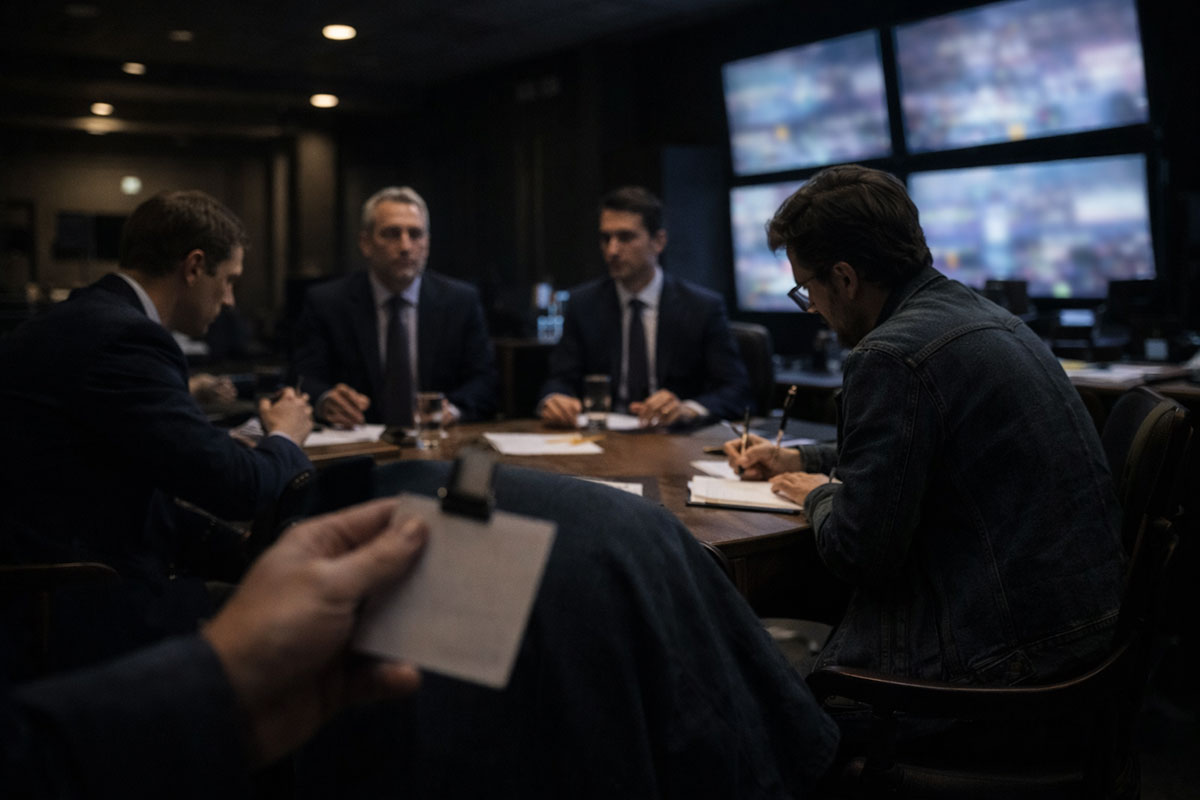
A quiet TV studio after hours. The cameras are off, the LED wall is dark, and the only light comes from a desk lamp and the city glow through the window. It feels like a place where people can finally say what they really think, without having to perform certainty.
Fareed Zakaria: Topic 4 is about something the source text keeps circling. A type of power that does not always wear a uniform, does not always win elections, and yet can move nations. So let’s start with the obvious tension.
When someone has major influence but no public mandate, what checks exist?
Jared Kushner: Checks exist in outcomes and in access. If you are wrong, you lose credibility and people stop taking your calls. If you cannot deliver, you get replaced by someone who can. The assumption that legitimacy only comes from elections ignores how much of global problem-solving is done by networks, not ballots. That said, I understand the concern. The best check is transparency, clear roles, and defined scope. If you are in the room, the public should know why you are there and what you are responsible for.
Prof. Linda Martinez (constitutional law scholar): The problem is that “credibility” is not a democratic check. It is a market check. That works for efficiency, but it is weak for accountability. Elections are not perfect, but they create a clear mechanism for removal, a chain of responsibility, and a public record. Informal power often has none of those. Networks can quietly bypass institutions, and the public only learns later, when the consequences are locked in.
Khalid Al Nuaimi (Gulf sovereign wealth strategist): In global finance, the check is risk. If a project fails, capital moves away. But I accept the professor’s point. Market checks are not moral checks. Money can be disciplined and still be unjust. The real question is whether these informal actors are constrained by rule-bound institutions or whether institutions become tools of the network.
Ambassador Elise Carver (UN senior bureaucrat archetype): Informal influence has always existed. The difference now is scale and speed. A small group can align funding, security commitments, and governance models across borders faster than traditional multilateral bodies can deliberate. The check should be legitimacy through established institutions. UN processes are slow, frustrating, and imperfect, but they exist precisely so that power cannot move too quickly without consent.
Noah Klein (investigative journalist): With respect, ambassador, the UN is also where accountability goes to sleep. I have covered too many programs where no one can answer a simple question, who decided this, who profits, and who is harmed. Informal power thrives in the fog. The check does not exist unless journalists can access contracts, donor conditions, security arrangements, and governance documents. If those are classified or buried, then the public is blind.
Fareed Zakaria: Good. So we have two competing ideas. One says the check is performance and credibility. The other says performance is not enough, and democratic removal and public oversight matter. Let’s sharpen it.
Are “boards” and “special envoys” a practical solution, or are they a democratic bypass?
Jared Kushner: It depends on the design. Some conflicts need speed, coordination, and continuity. Democracies rotate leadership. Bureaucracies move slowly. Boards can create a stable operating framework. But if the board becomes permanent, unaccountable, and insulated, then yes, it becomes a bypass. A board should be a bridge. It should not become a new capital city.
Prof. Linda Martinez: I appreciate the “bridge” language, but we should be honest about incentives. Temporary structures have a habit of becoming permanent, because people build careers around them. Contracts get signed. Security arrangements embed themselves. Once a board controls money and security, it gains the power to define what “reasonable” politics looks like. That is not a bridge. That is a gate.
Ambassador Elise Carver: Sometimes a gate is needed to stop a flood of violence. But yes, I do not deny the risk. The UN has learned, painfully, that transitional authorities can drift. The solution is sunset clauses, audits, and a clear pathway to local self-governance. If you do not build that path from day one, you will not magically discover it later.
Khalid Al Nuaimi: From an investor perspective, boards exist because fragmented responsibility kills projects. You cannot rebuild infrastructure if every decision is contested by ten competing authorities. But here is the tradeoff. Efficiency centralizes power. Centralized power must be restrained, or it will start to treat dissent as friction rather than as freedom.
Noah Klein: And it gets worse. Because “friction” is usually a human being. It is the local organizer who asks why contracts went to foreign firms. It is the whistleblower who reports corruption. It is the journalist who wants to see the agreement. If the board’s success story depends on silence, then the board is not building peace. It is building narrative.
Fareed Zakaria: That word matters. Narrative. Because the source text we are using keeps saying “peace and safety” can become a psychological condition, not just a security outcome. So let’s go deeper into the Kushner angle the text hints at.
When someone has influence without office, how do they gain it? What is the mechanism?
Jared Kushner: Influence comes from alignment. You find what each party wants, and you build a deal where they can all say yes without losing face. You coordinate capital, security needs, diplomatic incentives, and timelines. People assume power is a crown. Often it is simply a map. If you understand the map better than anyone else, you become central.
Khalid Al Nuaimi: That is accurate. Modern power is the ability to synchronize. If you can synchronize donor funding, reconstruction priorities, and security guarantees, then you are not just a negotiator. You are a platform. Platforms become unavoidable because everyone plugs into the same system.
Prof. Linda Martinez: And when someone becomes the platform, they become the unelected legislature. They are writing the order of reality through procurement, security frameworks, and governance conditions. This is why democracies worry about “shadow government.” It is not always malicious. It is structural. The mechanism is coordination at a scale that normal politics cannot match.
Ambassador Elise Carver: Which is why we need institutional guardrails. Transparency, representation, human rights oversight, and clear authority boundaries. Otherwise, the platform becomes a substitute for law.
Noah Klein: And it becomes a substitute for truth. Because once the platform controls access, people become careful. They think, if I criticize this, will my funding get delayed? Will my travel permissions change? Will my organization lose its seat at the table? That is how soft power hardens into coercion. Not with tanks. With dependence.
Fareed Zakaria: So here is the sharpest way to ask it.
Is this a new kind of empire built from finance plus security plus reconstruction?
Khalid Al Nuaimi: “Empire” is a loaded word. But if you define empire as a system where decisions in one center shape the outcomes of many regions, then yes, a network can function like an empire without calling itself one. The currency is not tribute. The currency is access. Access to funding, access to security, access to legitimacy.
Ambassador Elise Carver: I would say it can resemble empire if it lacks consent and accountability. But multilateral coordination can also be the opposite of empire, if it genuinely serves civilian protection and self-determination. The difference is whether the local population becomes co-author or remains recipient.
Prof. Linda Martinez: I will say it plainly. If a framework governs people who did not choose it, and cannot remove it, and cannot revise it, then it is empire in practice, even if it uses humanitarian language.
Jared Kushner: Or it is triage. People living in rubble do not have the luxury of perfect theory. They need water systems, hospitals, safe streets. If you demand full political purity before reconstruction, you will prolong suffering. But I accept the condition. There must be an exit. There must be a path to local ownership. If you cannot articulate the exit, you are not building peace. You are building permanence.
Noah Klein: Then the test is simple. Put the exit on paper. Put the contracts on paper. Put the decision rules on paper. If the public cannot see the machine, the machine will eventually serve itself.
Fareed Zakaria: That brings us to the final question for this topic, and it is the one that connects directly back to Topic 1.
What are the non-negotiable guardrails that keep a powerful “peace machine” from becoming a permanent unelected authority?
Prof. Linda Martinez: Sunset clauses with teeth. Judicial review mechanisms. Public procurement transparency. Local veto power on core issues. Elections scheduled by a defined date, not by vague readiness language.
Ambassador Elise Carver: Independent monitoring of human rights and due process. Clear division of authority between security and governance. Oversight that includes representatives trusted by the local population, not just donors.
Khalid Al Nuaimi: A structure where local economic participation is mandatory. If reconstruction becomes foreign-owned, resentment becomes inevitable. Build local capacity, local firms, local employment. That is not charity, it is stability.
Noah Klein: A protected press and protected whistleblowers. If truth is punished, the system is already corrupting.
Jared Kushner: A written transition plan with measurable milestones and a fixed endpoint, unless extended by genuinely representative local consent. Also, no immunity from scrutiny. If the project is good, it should survive daylight.
Fareed Zakaria: Then we have a conclusion that is uncomfortable but clarifying.
The question is not whether peace frameworks are good or bad. The question is whether they are accountable enough to remain human, and temporary enough to remain legitimate.
Topic 5: Gaza as Prototype, The Template That Scales
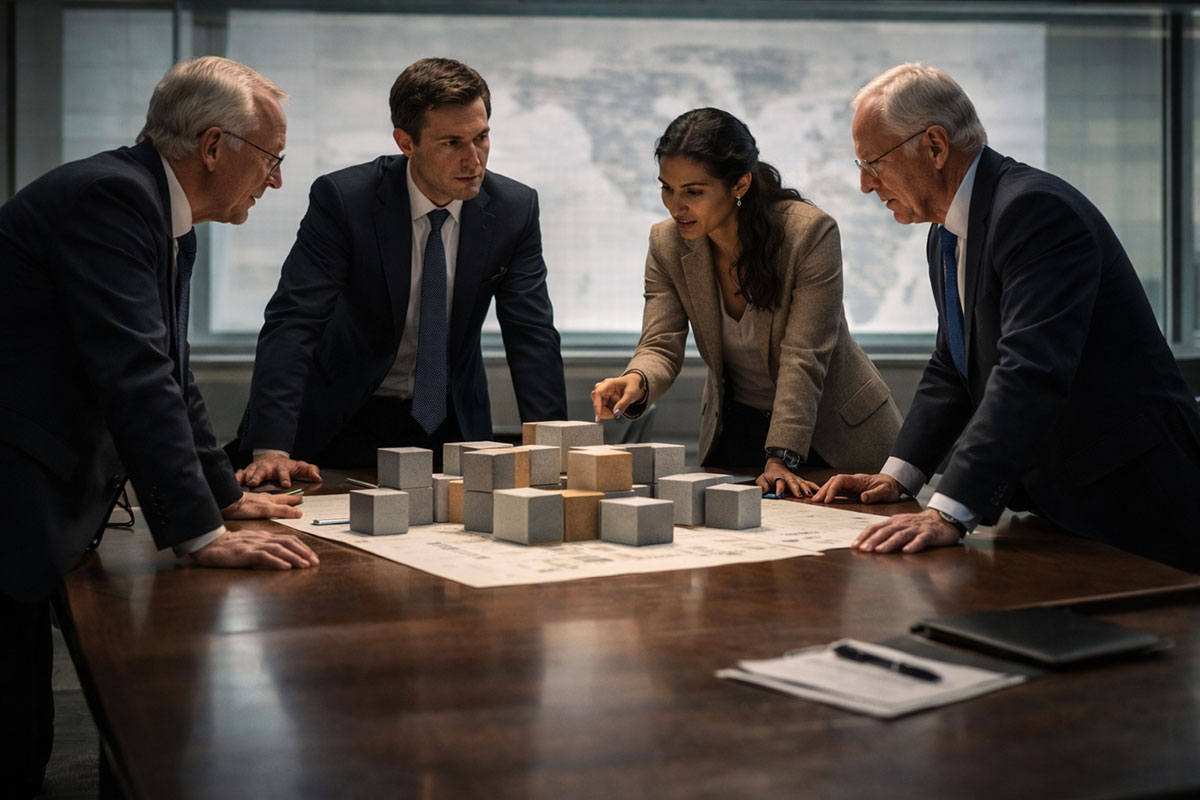
A sleek conference space that feels like a hybrid of a tech summit and a diplomatic forum. Glass walls. Minimalist furniture. A large digital map on the wall, but the labels are blurred, as if the room is trying to talk about the whole world without admitting it.
Yuval Noah Harari: The most important claim in our source context is not about Gaza alone. It is that Gaza is a starting point. A pilot. A prototype. If that is true, then the question becomes bigger than any one conflict.
When a “peace system” becomes a template, what exactly is being scaled? Compassion, or control?
Mina Patel (systems engineer, governance-tech lens): A template scales procedures, not feelings. It scales how decisions are made, how money flows, how security is coordinated, how data is collected, how compliance is measured. You can absolutely embed compassion into those procedures, but the default tendency of systems is to optimize for predictability. Predictability often means control. If you want compassion, you have to engineer it intentionally: transparency, appeal mechanisms, community representation, and limits on surveillance and enforcement.
Dr. Sarah Mendel (humanitarian NGO leader): A scalable model can be a gift if it reduces suffering quickly. But the danger is that the template becomes more important than the people. Humanitarian work can become a checklist: shelter units delivered, calories distributed, incidents reduced. Meanwhile dignity, grief, history, and agency get treated as “soft factors.” A system that scales must also scale listening, not just logistics.
General Robert Hayes (military logistics commander): Let’s be honest. Scaling peace usually means scaling logistics and security. You cannot rebuild without routes, warehouses, perimeter security, and coordination. That is not sinister, it is reality. But the temptation is to keep the security layer in place because it creates stability for the rebuild. Security layers are hard to remove once installed. The longer they stay, the more they feel like governance.
Ambassador Ana Petrovic (small-nation diplomat, Kosovo archetype): Smaller nations like mine join these systems because they offer relevance. You contribute a battalion, you get a voice in the room. That can be healthy multilateralism. But there is a shadow side. The template can become a gatekeeper. If every conflict must be “resolved” through one board, one set of rules, one funding pipeline, then sovereignty becomes conditional on participation.
Rev. Thomas Kline (theologian): The spiritual question is whether the template replaces the need for moral transformation. If “peace” becomes purely a management technique, then it treats humans as variables. Scripture does not deny structure. It warns against towers built without humility. The danger is not cooperation. The danger is a system that claims ultimate authority and offers a kind of salvation without repentance, justice, or truth.
Yuval Noah Harari: So the first answer is that templates scale power. The moral question is what kind of power and with what restraints.
Now let’s get concrete. A scalable peace model usually has components: a legal framework, a security mechanism, a reconstruction pipeline, and an administrative governance layer.
Which part of that package is the most likely to become coercive over time?
Mina Patel: The data layer. Because once you operationalize peace, you begin measuring behavior: risk scores, compliance, movement patterns, financial flows, communication networks. The system begins to treat people as datasets. Even if the intention is security, the outcome can be a permanent surveillance architecture. And when surveillance becomes normal, dissent becomes risky by default.
Dr. Sarah Mendel: The funding layer. Money can discipline. It rewards compliance and punishes non-cooperation. A community can be told, politely, that services depend on meeting “conditions.” Those conditions can start as anti-corruption and safety, then quietly expand into political obedience. The coercion is soft, but it is real.
General Robert Hayes: The security layer. Because security is the easiest thing to justify indefinitely. You can always point to a threat, a rumor, an incident, and say the mission must continue. The security footprint grows, and civilian life adapts around it. The moment you try to reduce it, someone says you are endangering peace. That logic creates permanent militarized normalcy.
Ambassador Ana Petrovic: The governance layer. Appointed administrators can become permanent because they are “stable” and “competent.” Stability becomes the excuse to delay elections. Competence becomes the excuse to sideline messy politics. But politics is where people express dignity. If the template scales governance without representation, it scales resentment.
Rev. Thomas Kline: The spiritual layer is coercive when it is absent. When moral accountability disappears, power fills the vacuum. When a system has no higher reference than efficiency, the vulnerable become costs. In biblical language, it is the worship of order without love.
Yuval Noah Harari: If I translate this into system logic, the coercion risk is highest where permanence becomes convenient: data collection, security mandates, conditional funding, and unelected administration.
Now the source context includes a provocative claim: that a model like this could rival or replace existing international institutions. Let’s treat that as a hypothetical.
If a peace template becomes a global standard, what happens to local cultures, local grievances, and local spiritual narratives?
Dr. Sarah Mendel: They become “case management.” That is the humanitarian fear. People do not fit into templates cleanly. If you scale a model, you will be tempted to standardize the human. That creates cultural flattening. Communities feel erased.
Ambassador Ana Petrovic: Small nations will feel pressured to conform. You either join the standard or you become “uncooperative.” The standard becomes a diplomatic gravity field. You may keep your flag, but your policy choices narrow.
Mina Patel: You also risk brittle failures. Templates work until they meet edge cases. A model that is too standardized can collapse spectacularly when a conflict does not behave like the pilot case. The more centralized the template, the more catastrophic the failure when it breaks.
General Robert Hayes: On the other hand, standardization can reduce chaos. Shared protocols can speed aid, prevent duplication, and coordinate security. The key is modularity. A template should be adaptable, not rigid. If it becomes rigid, it becomes coercive.
Rev. Thomas Kline: Spiritually, local narratives do not disappear. They go underground. You can suppress them, you can ignore them, but you cannot remove them. A template that treats spiritual identity as a nuisance will produce a backlash driven by meaning, not by economics.
Yuval Noah Harari: That leads to the central paradox. Scaling peace requires structure. Structure tends to centralize. Centralization threatens agency.
So I want to end with the most practical question of the five topics.
If you had to design a scalable peace model that reduces suffering but does not become global control infrastructure, what are the essential design principles?
Mina Patel: Modularity and limits. Every power should have a counter-power. Every dataset should have a deletion policy. Every security mandate should have a hard end date and a renewal vote from representatives with local legitimacy.
Dr. Sarah Mendel: Dignity metrics alongside security metrics. Measure participation, due process, freedom of expression, and community satisfaction. If the model only measures violence reduction, it will drift toward coercion.
General Robert Hayes: Clear mission boundaries. If troops are there for stabilization, they should not morph into political police. Separate military functions from civil governance. And plan exit routes the same way you plan supply routes.
Ambassador Ana Petrovic: Local sovereignty baked in. A guaranteed path to elections. Local veto power on cultural and legal issues. The template must serve the people, not replace them.
Rev. Thomas Kline: Truth and humility. No system is salvation. A peace model must confess its limits. It must be willing to be corrected by the voices of the suffering. Otherwise it becomes a tower that believes it is heaven.
Yuval Noah Harari: Then we can name the heart of Topic 5 in one sentence.
The danger is not that peace is attempted. The danger is that peace becomes a machine that cannot be questioned, scaled across the world because it is efficient, while quietly shrinking the human soul to fit the template.
Final Thoughts by Fareed Zakaria
If you step back from the headlines, one truth becomes hard to avoid: modern peace is no longer just diplomacy. It is governance design.
That can be a remarkable opportunity. Coordinated reconstruction can reduce suffering. Stabilization forces can prevent relapse. Multilateral funding can rebuild schools, hospitals, and basic services. But the same instruments can drift. “Temporary” can become permanent. “Security” can become an excuse. “Efficiency” can edge out representation. And once money and enforcement are centralized, accountability is always the first casualty unless it is engineered into the system from the start.
So what should a thoughtful reader watch for?
First, the pathway to local ownership. Not vague promises, but written milestones: representation, elections, judicial independence, and meaningful local veto power on core issues. Second, transparency in the money. Contracts, audits, conflict-of-interest rules, and real consequences for corruption, not ceremonial oversight. Third, boundaries on force. Clear mandates, review dates, and an exit strategy that does not depend on public relations cycles. Fourth, the health of dissent. If journalists, activists, and ordinary citizens can criticize the process without being treated as enemies of peace, the system is probably stable. If criticism becomes “dangerous,” the peace is already turning brittle.
In other words, the question is not whether a peace framework looks impressive. The question is whether it can survive daylight.
Peace worth having does not require you to fall asleep. It requires you to stay awake long enough to demand the guardrails that make peace humane, legitimate, and reversible when it goes wrong.
Short Bios:
Karen Armstrong: Historian of religion known for explaining how faith, identity, and power intertwine, and for pushing moral clarity over tribal slogans.
Mariam Al Masri: Gaza civil society organizer archetype who speaks for everyday governance realities: accountability, representation, dignity, and lived legitimacy.
Ajay Banga: President of the World Bank, focused on development outcomes, institutional capacity, jobs, services, and what it takes to rebuild societies at scale.
Jared Kushner: Deal-focused political operator associated with high-level Middle East negotiations, emphasizing coordination, timelines, measurable benchmarks, and “transitional” frameworks.
Tony Blair: Former UK Prime Minister and longtime Middle East envoy figure, experienced in post-conflict reconstruction tradeoffs, institution-building, and the risks of dependency.
Harold Koh: International law scholar and former U.S. State Department legal adviser, focused on legality, consent, self-determination, and rights-based guardrails.
Carl Sagan: Scientist and communicator who examines how humans form narratives, fall into psychological comfort, and confuse certainty with truth.
Apostle Paul: Early Christian leader and letter-writer whose “peace and safety” warning is often read as a caution against complacency and spiritual sleep.
Dr. Elena Park: Trauma psychologist archetype specializing in how communities react to chronic stress, and how relief can bring both healing and vulnerability.
Leila Haddad: War-zone journalist archetype who contrasts media “closure” with on-the-ground reality, highlighting how attention shifts can enable abuse or corruption.
Colonel David Mercer: Security strategist archetype focused on measurable capability reduction, institutional resilience, and how complacency windows get exploited.
Omar Rahman: Conflict mediator archetype centered on legitimacy, consent, grievance channels, and the difference between compliance and true peace.
N.T. Wright: New Testament scholar known for close-reading biblical language, historical context, and how words like “covenant” and “confirm” change interpretation.
Daniel: Biblical prophet whose visions are often cited in end-times discussions, portrayed here as emphasizing hidden “construction phases” of power.
Dr. Miriam Levy: Hebrew linguist archetype who focuses on what key biblical verbs imply about timing, process, and how “confirm” differs from “create.”
Ambassador Alain Dubois: UN diplomat archetype representing pragmatic multilateral deal-making, institutional legitimacy, and the tradeoffs of speed vs consent.
Dr. Helena Strauss: Historian of empires archetype who studies how “helpful” coordination can harden into unavoidable systems over time.
Dr. Samir Qattan: Middle East economist archetype focused on incentive design, dependency risk, and how funding pipelines can lock in power.
Fareed Zakaria: Global affairs analyst and host known for calm, systems-level framing and for translating power shifts into practical questions about guardrails.
Prof. Linda Martinez: Constitutional law scholar archetype focused on democratic accountability, removal mechanisms, transparency, and preventing “temporary” power from calcifying.
Khalid Al Nuaimi: Gulf sovereign wealth strategist archetype focused on capital flows, leverage, risk, and how financial coordination becomes geopolitical power.
Ambassador Elise Carver: Senior UN bureaucrat archetype emphasizing mandates, oversight, representation, and the dangers of informal networks bypassing institutions.
Noah Klein: Investigative journalist archetype who follows contracts, donor conditions, and secrecy, arguing that truth and access are the real checks on power.
Yuval Noah Harari: Historian and futurist known for analyzing how scalable systems, data, and narratives reshape societies and concentrate control.
Mina Patel: Systems engineer archetype who examines governance as design: procedures, data layers, incentives, modularity, and built-in limits.
Dr. Sarah Mendel: Humanitarian NGO leader archetype focused on dignity, agency, rights protections, and the risk of turning people into checklists.
General Robert Hayes: Military logistics commander archetype focused on operational realities, mission creep, security footprints, and hard-to-remove “temporary” structures.
Ambassador Ana Petrovic: Small-nation diplomat archetype attentive to sovereignty, conditional participation, and how templates can become gatekeepers.
Rev. Thomas Kline: Theologian archetype distinguishing spiritual peace from engineered stability, warning against systems that substitute efficiency for justice and truth.
Leave a Reply