

|
Getting your Trinity Audio player ready...
|
What if W. H. Auden reunited Dante, Shakespeare, and Kafka to defend his legendary reading list—line by line?
Introduction by W. H. Auden
Before we begin, let me confess the real reason I have gathered you here.
It is not because I expect a classroom—or any room—to “solve” the problem of fate. Fate has always been too large for that. And it is not because I imagine that the past is a museum of elegant tragedies, safely sealed behind glass. The past is alive in us. It is the set of instincts we inherit, the excuses we repeat, the fears we dress in respectable language.
I have titled this course Fate and the Individual because, in 1941, the world has made the question unavoidable. When history grows violent, people speak as if they have no choices left. They say the machine is too strong, the orders too absolute, the necessities too urgent. And because they are frightened, they begin to treat moral language as a luxury—something for peacetime, something for poets.
I am not interested in luxury.
The books we have brought into this room—tragedies, confessions, dramas, satires, visionary poems, and the modern labyrinths of despair—were not written to flatter our intelligence. They were written to expose our evasions. Again and again, they ask the same humiliating question: What is an individual when the world insists on being a system? What does it mean to act when every action feels compromised? What does it mean to be responsible when the age offers you a thousand ways to stop feeling responsible?
You will notice that our guests disagree. They ought to. The human condition does not permit a single tidy verdict. Some will insist that fate is a moral order; others will insist it is a faceless mechanism. Some will tell you that conscience is sacred; others will warn you that conscience is often only vanity with a halo. Some will describe love as salvation; others will describe love as the most convincing mask for possession. I have invited them all because a student who hears only one voice learns only one temptation.
My hope is simple, and perhaps unfashionable: that by listening to these arguments, you may become harder to deceive—by governments, by crowds, by lovers, by your own appetite for comfortable stories. If that happens, then the reading will have earned its difficulty.
Let us begin where every serious life begins: with the pressure of the world—and the quiet question of what you will do with it.
(Note: This is an imaginary conversation, a creative exploration of an idea, and not a real speech or event.)
Topic 1 — Fate vs. Freedom When History Turns Dark
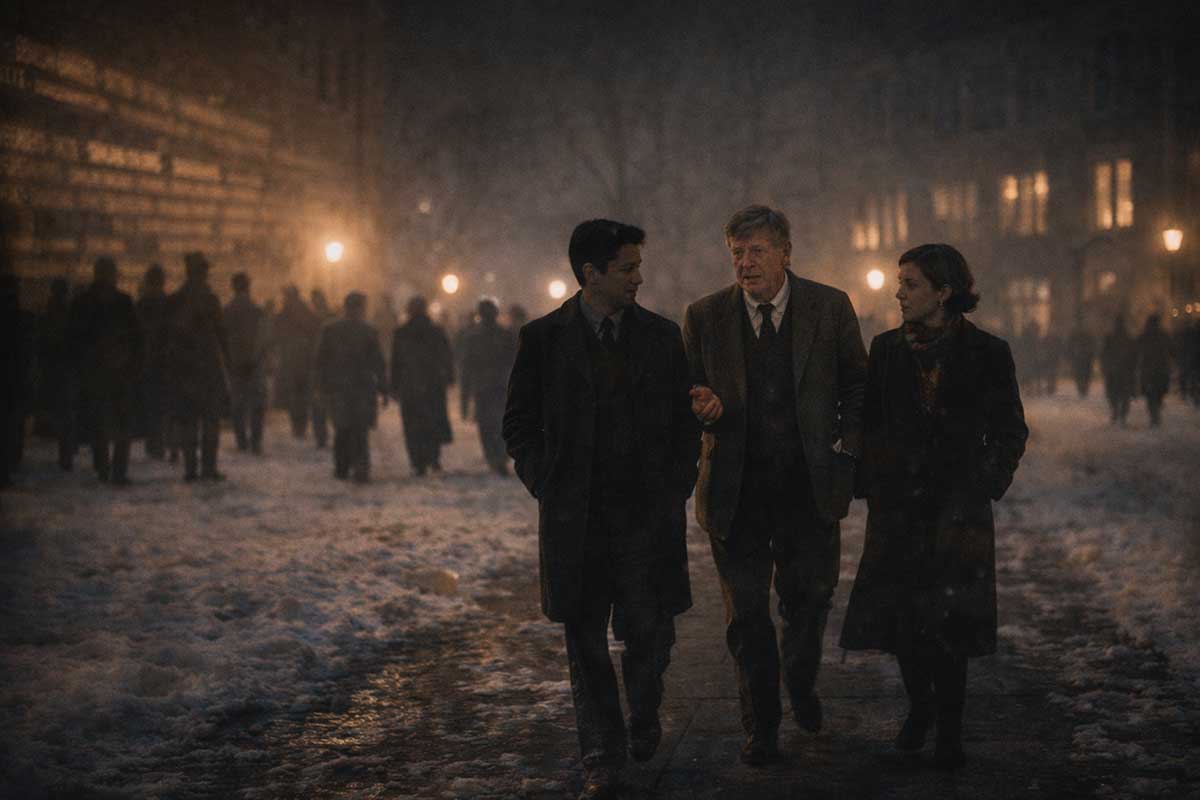
Night air presses against the tall windows of a University of Michigan classroom in 1941. Outside, the campus is calm in a way that feels almost indecent—lamps glowing, footsteps muffled by winter, the ordinary hush of young lives moving between buildings. Inside, the room is warmer than it should be, crowded with bodies and coats, the chalkboard still faintly dusty from a previous lecture on something harmless. W. H. Auden stands at the front with a sheaf of notes, but he doesn’t look down at them yet. He looks at the faces.
There is something different about the way he waits. As if he’s listening for a deeper noise under the room’s silence—radio voices, marching feet, trains, rumors. He clears his throat, not to begin a lesson, but to call a gathering to order.
Around the long table sit five figures who look as if they have been drawn from different centuries and given the same exhausted hour.
Sophocles sits upright, the calm of a man who has watched cities burn and knows how little surprise remains in human affairs. Dostoevsky leans forward, eyes bright and feverish, as if the question itself is already a confession. Kafka is present in a quieter way—like someone who expects the door behind him to open with an official summons at any moment. T. S. Eliot’s face is composed, but his gaze has the tired care of someone who has tried to pray in a room full of clocks. Henry Adams watches with a historian’s restraint, as though every sentence must pass through the sieve of “what forces produced this?”
Auden begins gently, almost politely, as if he’s asking them to help him teach undergraduates—and then his voice tightens.
“In a century like ours,” he says, “with history behaving like a god that doesn’t answer prayers, what is left of the word freedom?”
He pauses, letting the word hang there—freedom—like something precious and suspicious.
“What still counts as a free act,” Auden continues, “when the air is thick with slogans, when fear edits thought, when entire nations behave as if they have no choice? Tell me: what is a free act, and how do you recognize it?”
Sophocles answers first, and his tone is not grand. It is plain, almost judicial.
“A free act,” he says, “is one taken with knowledge of consequence. Not knowledge of every consequence—that would belong to gods—but knowledge enough to know you may lose everything and still choose. In my city, men speak of Fate as if it were an excuse. Yet the chorus knows: Fate is not merely what happens to you. Fate is also what you become when you answer what happens.”
He glances toward Kafka, as if to acknowledge a darker variant.
“Even when the sky is silent, even when the law is crooked, a person has a moment—brief, terrible—when they can choose not to violate what they know.”
Dostoevsky almost laughs, but it’s the laugh of someone who has seen too much mercy and too much cruelty.
“You speak like a tragedian,” he says, “and tragedy is honest. But I would sharpen the blade. A free act is not simply choosing with knowledge. It is choosing when knowledge does not save you. It is choosing when every rational calculation says, ‘Submit.’ Freedom is most visible in a prison cell. Freedom is visible when a man can still say, ‘I am guilty,’ or ‘I forgive,’ or ‘I will not become a beast,’ though the world invites him to be one.”
His eyes dart to Auden.
“In times of terror, the great temptation is to declare the human being merely a product of forces. That is how murder becomes logical. But the soul is not logical. The soul is where freedom hides when history comes with a whip.”
Kafka speaks as if he is reluctant to interrupt, but his words land with quiet finality.
“You are both speaking,” Kafka says, “as if the person always knows where the choice lies. As if the moral shape of the moment is visible. But I have lived in corridors where the choice is not clear because the accusation is not clear. One is summoned, but not told for what. One is condemned, but not told by whom. The world becomes a system of rules you cannot read, yet you are punished for not obeying them.”
He looks at his hands, then up again.
“In that world, you may perform brave gestures and still be absorbed by the machinery. You may refuse to lie and still be declared guilty of a crime you cannot name. So perhaps a free act is not what changes the outcome. Perhaps a free act is what refuses to cooperate with the inner transformation the system demands—the slow conversion of the self into a function.”
Eliot’s voice is soft, almost careful, as if he’s trying not to crush something fragile.
“I am haunted,” Eliot says, “by how easily the word freedom becomes romantic. We imagine a moment of heroism and forget the long desert of fatigue. Many people do not lose freedom in a dramatic act. They lose it by degrees—by exhaustion, by distraction, by the inability to hold a thought long enough to keep it honest.”
He looks toward Sophocles and Dostoevsky, then to Kafka.
“Perhaps the free act is the act of attention. The refusal to be drugged by noise. The refusal to let the soul become merely a reaction. When history grows monstrous, the smallest fidelity—truthfulness, patience, clarity—can become a kind of resistance.”
Henry Adams doesn’t sound like he disagrees; he sounds like he is translating the question into another language.
“I admire the moral courage in what you all say,” Adams replies, “but the historian sees how conditions produce our range of choices. You ask for freedom when the century itself is an engine. I tell you: engines create their own logic. People believe they are choosing; often they are selecting from options manufactured by education, economy, class, and fear.”
He taps a finger on the table, not impatient, but exact.
“A free act might exist. But it is rare, and it is expensive. Most of what we call freedom is simply the absence of pressure. When pressure arrives—war, propaganda, necessity—most people reveal how little of the self was ever truly theirs.”
Auden lets that settle. He does not rush to soothe it.
He moves to the next question, and the air in the room seems to shift, as if the lights dimmed though they haven’t.
“If the question of freedom becomes uncertain,” Auden says, “then perhaps the question of form matters even more. Do our older forms—epic, tragedy, confession—still tell the truth about catastrophe? Or do the modern forms of disorientation, absurdity, and paralysis tell the truth more honestly?”
He looks at Sophocles and then at Kafka, as if naming the battlefield.
Sophocles answers with the steady confidence of someone who believes the human heart has not changed.
“Tragedy remains,” he says, “because it begins with what the human being cannot avoid: death, pride, love, fear, power. Catastrophe does not require new forms. The chorus is still there, whether you call it public opinion or newspapers or ideology. The king is still there, whether you call him a tyrant or a committee. The gods may have changed names, but human blindness has not.”
He turns slightly toward Eliot.
“When a city collapses, the pattern repeats: someone insists on absolute certainty, someone insists on absolute obedience, someone insists on absolute righteousness. The collision is the tragedy.”
Kafka’s response is not an argument against tragedy so much as a confession of what has replaced it.
“Tragedy presumes,” Kafka says, “a stage where the terms are clear enough to be spoken aloud. A law, a family curse, a god, a prophecy. In my world the stage is an office. The terms are hidden in files. The prophecies are stamped forms. The chorus is a line of clerks who do not know what they are doing.”
He pauses, then adds:
“The modern catastrophe is that meaning is confiscated. A person searches for the rule he has broken and finds only a door that leads to another door. In that situation, tragedy can feel like a luxury—like a story from a world where the judge at least had a face.”
Dostoevsky looks almost pained, as if he refuses to surrender the stage to the office.
“And yet,” he says, “your office is only another mask of the old horror. Bureaucracy is not new destiny; it is the modern costume of the ancient demon: fear. If meaning is confiscated, then the human being must become meaning again. Confession remains. Repentance remains. Faith remains—even if it is only the faith that a person must not become a liar.”
He looks at Auden.
“Do not let modern forms become an excuse to abandon the moral drama. Even in the labyrinth, the question is still: will you love, or will you betray love?”
Eliot’s voice is almost a whisper, but it cuts through because it feels tired in a truthful way.
“I distrust,” Eliot says, “any form that makes catastrophe feel coherent. We crave coherence because it comforts us. Modern writing’s disorientation can be a kind of honesty: it shows the soul not as a noble protagonist but as a room after a party—strewn with broken promises and empty words.”
He glances toward Sophocles with respect.
“Tragedy teaches clarity. But perhaps our age must also learn how clarity can be used as propaganda. The modern form may be necessary because it refuses to let us feel noble.”
Henry Adams nods slightly, as if Eliot has said something the historian recognizes.
“Forms,” Adams says, “are also technologies. They evolve to match the world’s complexity. A medieval cosmos can support an epic journey. A modern empire of machines produces a literature of systems, fragmentation, and fatigue.”
He looks at Sophocles, not dismissive, but firm.
“I do not say the old forms are false. I say they can make the modern world look simpler than it is. And simplicity is how we get seduced.”
Auden’s face tightens for the first time, as if the seduction Adams mentions is not theoretical.
He leans on the edge of the desk.
“And if,” Auden says, “the individual cannot stop the machinery—cannot halt armies or undo ideologies—what then is the highest moral task left? Is it witnessing? Resisting? Enduring? Refusing to lie? Or something else?”
Sophocles answers as a dramatist who knows the value of public example.
“The highest task,” he says, “is to keep the human law from replacing the divine law entirely. Not by preaching, but by acting. In a plague, in a war, in tyranny, people copy what they see. If they see only fear, they become fear. If they see one person choose rightly, even in ruin, they remember they are not only animals.”
Dostoevsky’s hands clench as if he’s holding back a storm.
“The highest task,” he says, “is to remain human when the world rewards inhumanity. To keep the ability to pity. To keep the capacity for repentance. To forgive when forgiveness seems insane. Because once the heart dries, the century wins.”
Kafka speaks next, and there is no flourish, only the bleak precision of someone describing a landscape.
“The highest task,” he says, “may be refusal. Not heroic refusal that imagines victory—just refusal to become what the system wants. Refusal to speak its language when its language is built to remove responsibility.”
He looks at Auden as if asking permission to say it plainly.
“If the machinery cannot be stopped, the person must at least avoid becoming a cog willingly.”
Eliot’s reply is both gentler and more severe.
“The highest task,” he says, “is to tell the truth without turning it into a spectacle. To keep a spiritual discipline when everything in the world encourages hysteria or numbness.”
He pauses.
“In other words: to recover reverence. Without reverence, resistance becomes just another form of pride.”
Henry Adams is last, and he sounds like someone who has watched ideals die—not because they were wrong, but because they were fragile.
“The highest task,” Adams says, “is to understand the forces honestly, so you do not mistake illusion for freedom. Witnessing matters. But witnessing without comprehension becomes sentimentality. Resistance matters. But resistance without knowledge becomes theater.”
He looks around the table.
“If a century is an engine, then the moral task is partly engineering: how do you build institutions, habits, education, and culture that make it harder for evil to be efficient?”
Auden stands very still for a moment, as if he’s letting their answers argue inside his own chest.
Then he nods once—small, decisive.
“Good,” he says. “Now my students can no longer pretend these books are merely about the past.”
He looks at the crowded classroom again, the young faces, the winter coats, the fragile normality.
“And none of you,” Auden adds quietly, “can pretend your century will allow you to be innocent.”
The room does not applaud. It simply breathes, as if each person has noticed, for the first time, how heavy a choice can be.
Topic 2 — Conscience Against Law: When Obedience Becomes Sin
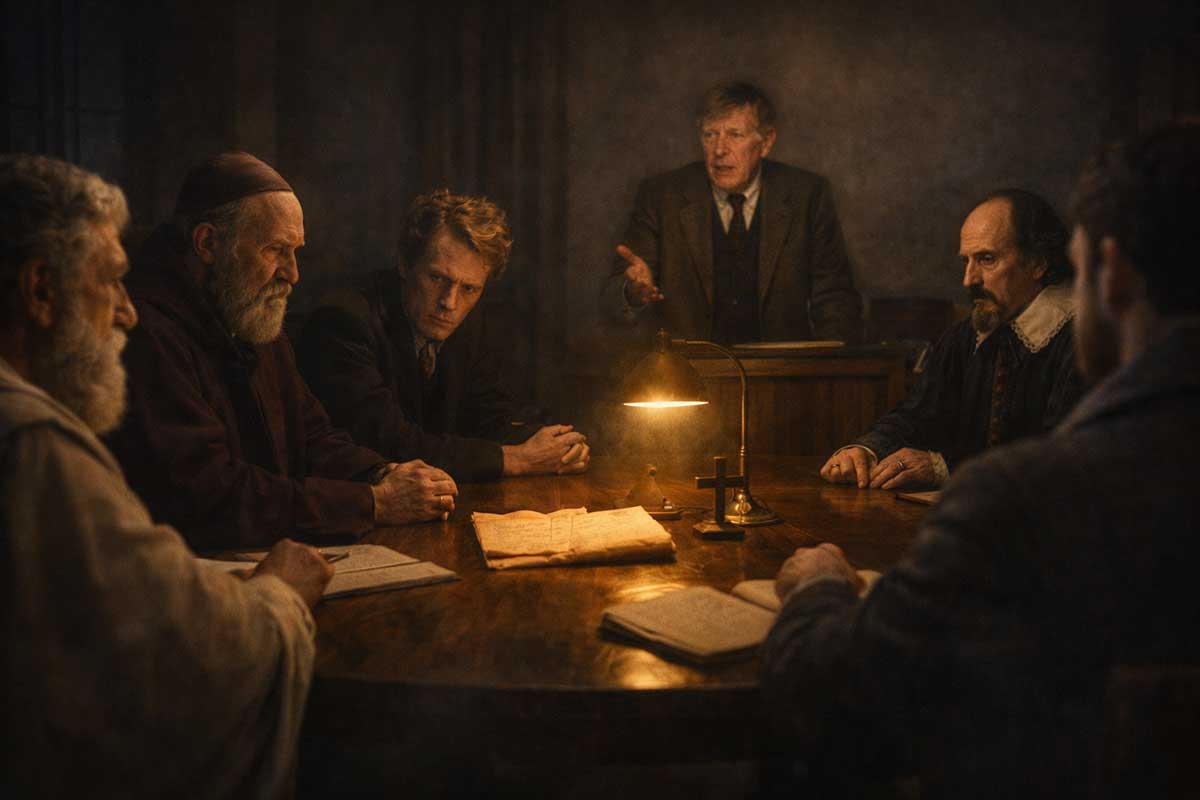
Snow has begun again—thin, deliberate flakes that look like ash in the lamplight.
The same classroom holds its breath, but tonight the mood is different. If Topic 1 felt like standing on a cliff and staring into history’s weather, Topic 2 feels like standing before a door with a lock you don’t recognize—one that might open inward, or not at all.
W. H. Auden returns to the front of the room without ceremony. He has the air of a man who knows that “literature” is a polite word for something far more dangerous: a rehearsal for choices you will not get to decline.
At the long table sit the five who have been summoned for this hour.
Sophocles, steady as stone, brings the posture of a city that has learned the cost of law. St. Augustine sits with inward gravity, as if every public argument must be tried first in the court of the heart. Kierkegaard looks restless, almost impatient with any answer that arrives too easily. Shakespeare watches like a playwright listening for the moment when a noble principle turns into a self-serving performance. Pascal’s eyes carry a strange tenderness—tenderness sharpened by the sense that human beings are both magnificent and absurd.
Auden turns a piece of chalk in his fingers, then sets it down without writing anything.
“When law and conscience collide,” he says, “what is the clearest sign that obedience has become a moral failure rather than a duty?”
He doesn’t sound like he’s asking for theory. He sounds like he’s asking for a test—something a frightened person could use when they have no time to read ten volumes and the state is already knocking.
Sophocles answers first, his voice calm, his words weighted.
“When the law commands you to dishonor the dead,” he says, “or to betray what the gods—or the enduring moral order—require, obedience turns rotten. The city needs laws. Without them, we are animals. But the city also needs limits on its own authority. A ruler’s decree can be lawful and still be impious.”
He pauses, remembering a familiar scene.
“In my play, the king insists he is protecting the city. Yet he protects his pride. The clearest sign is not always cruelty; it is arrogance. When power speaks as though it cannot be wrong, it has already stepped outside the realm of law and into the realm of tyranny.”
Augustine’s response comes like a hand placed gently on a fevered forehead.
“Yes,” he says, “arrogance is the sickness. But I would add another sign: when obedience requires you to lie—first outwardly, then inwardly. The soul is injured when it must call evil good in order to belong.”
He looks toward the students, as if they are the ones on trial.
“Yet conscience is not a simple lamp. It flickers. It can be trained to admire what it should fear. Many people feel righteous while doing wrong. So the sign is not merely that you feel resistance. The sign is that obedience demands you deform your love—love of God, love of neighbor, love of truth—until love becomes fear in a respectable uniform.”
Kierkegaard leans forward, as though Auden’s question is a match brought close to dry wood.
“You speak of conscience as though it were reliable,” he says, glancing between Sophocles and Augustine. “But conscience, too, can become a crowd. Conscience can be nothing more than the voice of the public inside the skull.”
He turns to Auden.
“The clearest sign that obedience is a moral failure is when it is merely automatic—when a person obeys to avoid anxiety, to escape responsibility. Yet there is a danger here: disobedience can be just as automatic. The rebel can be as unfree as the obedient man.”
His eyes harden slightly.
“True moral seriousness begins when you stand alone—when you cannot hide behind the state or behind the mob that opposes it. That solitude is the sign: if obedience allows you to avoid solitude, it is suspect.”
Shakespeare smiles faintly—not amusement, but recognition.
“In my world,” he says, “obedience becomes failure when it becomes performance. When a man obeys the crown while quietly obeying ambition more deeply. When he obeys a friend while obeying jealousy. When he obeys the letter and kills the spirit.”
He taps the table lightly.
“Many people do not notice the moment obedience turns into sin because it comes disguised as loyalty. It comes dressed in duty. It comes with speeches. The sign is theatricality—when people begin speaking in slogans rather than words that cost them something.”
Pascal’s voice is softer than the rest, and therefore unsettling.
“I will give you a sign that is both simple and nearly impossible,” he says. “Obedience becomes moral failure when it is rooted in pride—when you obey because you want to be seen as the obedient one, the proper one, the pure one.”
He looks at Augustine with a kind of kinship.
“The self is the trickster here. The self can make disobedience into vanity and obedience into vanity. The sign is not only in the act, but in the secret pleasure you take from it.”
Auden nods once. He doesn’t correct them. He lets the answers sit like stones placed on a scale.
Then he asks the second question, and the room tightens again.
“Is there any authority—state, church, family, tradition—that can rightly demand the sacrifice of one’s integrity? If so, on what grounds?”
This question lands differently. The first was about recognizing failure; this one is about permission—whether the human being ever has the right to hand over the soul.
Sophocles answers with a tragic bluntness.
“Every authority demands sacrifice,” he says. “The city demands time, taxes, sons for war, silence in certain moments. The family demands loyalty. The gods demand reverence. The question is not whether sacrifice exists—the question is whether sacrifice destroys what it claims to protect.”
He looks up, as if seeing a familiar stage.
“If the city demands you become unjust so that the city may continue, the city has already lost its claim. A city that survives by devouring conscience is only a larger kind of bandit.”
Augustine folds his hands, as though in prayer, but he speaks plainly.
“No authority may demand that you sin,” he says. “But you must be careful: what you call integrity might be stubbornness. You might cling to your ‘integrity’ as a way of refusing humility, refusing correction, refusing love.”
He raises his eyes toward Kierkegaard, aware that the next statement is explosive.
“Yet there are moments when obedience to God places a person in conflict with every earthly authority. In those moments, integrity is not your possession; it is your surrender. You do not protect integrity like a trophy. You offer yourself to truth.”
Kierkegaard’s expression sharpens, and he does not soften his answer.
“There is only one authority that can demand everything,” he says. “And that authority does not speak in the comfortable language of institutions. It speaks in dread. It speaks in the single individual’s encounter with God.”
He pauses, and the air feels colder.
“From the outside, that may look like madness. It may look like crime. It may look like evil. That is precisely the terror of faith: it cannot be proven by ethics, and it cannot be justified to the crowd.”
Shakespeare’s eyes narrow slightly, the way a dramatist watches a character step onto dangerous ground.
“And there,” he says quietly, “is where tragedy becomes blood.”
He looks at Kierkegaard.
“Any doctrine that allows a man to claim a private command that defeats common moral law becomes a ready costume for murder. Men will hear what they want to hear. Devils are excellent ventriloquists.”
His voice grows firmer.
“Authority may demand sacrifice of comfort, of pride, even of reputation. But if it demands the sacrifice of integrity—meaning the sacrifice of mercy, truth, and responsibility—then it is not authority but temptation.”
Pascal speaks next, and his tone is almost sorrowful.
“You are both right and both in danger,” he says, looking from Kierkegaard to Shakespeare. “Kierkegaard speaks of the abyss of faith. Shakespeare speaks of the abyss of self-deception.”
He turns to Auden.
“No authority can rightly demand the destruction of integrity. But the question hides a deeper one: do we even know what integrity is? Most of us are a bundle of half-truths stitched together by habit. We call it integrity because it spares us shame.”
He leans forward slightly.
“If God asks for everything, that is not because God loves cruelty. It is because only total surrender breaks the reign of pride. But pride will imitate surrender and call it holiness. That is why this question is so dangerous.”
Auden’s face is still, but his eyes are awake.
He asks the third question as if he has been saving it.
“What is the line between holy fidelity and dangerous self-righteousness—between the martyr and the fanatic?”
He doesn’t frame it as an academic distinction. He frames it as a matter of life and death, because it is.
Sophocles answers with the wisdom of someone who has watched citizens tear each other apart while insisting they are righteous.
“The fanatic,” he says, “cannot imagine being wrong. The martyr knows he may be wrong and still acts because the act is demanded by conscience and reverence, not by vanity.”
He thinks a moment.
“The martyr accepts suffering as a consequence. The fanatic distributes suffering as a proof.”
Augustine’s reply comes slowly, as though he is searching his own memory for the point where zeal becomes poison.
“The fanatic loves his purity more than he loves God,” he says. “And because he loves his purity, he hates the impurity of others. The martyr weeps for the one who persecutes him. Even if he stands firm, his firmness is not fueled by contempt.”
He looks at the students again.
“If your fidelity makes you less merciful, beware. If it makes you hunger for punishment, beware. If it makes you rejoice at another’s fall, beware. Those are signs of pride wearing a halo.”
Kierkegaard’s eyes flash, not with anger, but with urgency.
“You are describing signs that may be useful,” he says, “but the hardest truth is that the line is invisible from the outside. The crowd cannot tell the difference. Often the crowd kills the martyr and applauds the fanatic.”
He inhales, as if steadying himself.
“The martyr fears God. The fanatic fears shame. The martyr stands in trembling. The fanatic stands in certainty. Faith does not produce swagger. Faith produces dread.”
Shakespeare nods once, the playwright in him recognizing a rhythm.
“Yes,” he says, “dread is honest. Certainty is often costume.”
He turns his gaze toward the imaginary stage only he can see.
“The fanatic begins by imagining the world as a simple tale: heroes and villains, clean and dirty, us and them. The martyr lives in the messy world where motives twist and consequences sting.”
His voice lowers.
“And the surest sign: the fanatic can no longer laugh at himself. He cannot bear the sight of his own contradiction. The martyr can bear it—because he has already surrendered the need to be admired.”
Pascal’s answer is the quietest, and therefore perhaps the most severe.
“The line,” he says, “is pride.”
He lets the word fall like a verdict.
“Pride can inhabit the martyr. Pride can inhabit the rebel. Pride can inhabit the obedient man. Pride is the great talent of the human creature.”
He looks around the table, then back to Auden.
“The martyr is not the one who suffers. Many suffer and become monsters. The martyr is the one whose suffering does not make him cruel. The fanatic is not the one who speaks strongly. The fanatic is the one who cannot tolerate mystery—who cannot tolerate the possibility that God is not his servant.”
Auden steps away from the desk and walks once, slowly, as if to give the room time to survive what it has heard.
He stops and faces them again.
“So,” he says, softly but unmistakably, “when the century demands your allegiance, you must ask: is it asking for your labor—or for your soul? And if it is asking for your soul, you must decide whether you are willing to be lonely.”
He looks at the students—young men who might be drafted, young women who might be asked to applaud things they hate, all of them living at the edge of a moral storm.
“You cannot outsource that decision,” Auden says. “Not to the state. Not to your friends. Not even to your favorite author.”
For a moment, the room is silent in a way that feels like prayer—though no one would dare to name it that.
Then Auden gathers his notes, not because the discussion is finished, but because the hour is.
“Next time,” he says, “we will talk about bargains.”
He lets the words hang, and the five at the table seem to darken slightly, as if each of them has remembered the price.
And outside, the snow keeps falling—patient, indifferent, like history itself.
Topic 3 — The Faustian Bargain: Power, Knowledge, and the Price of a Soul
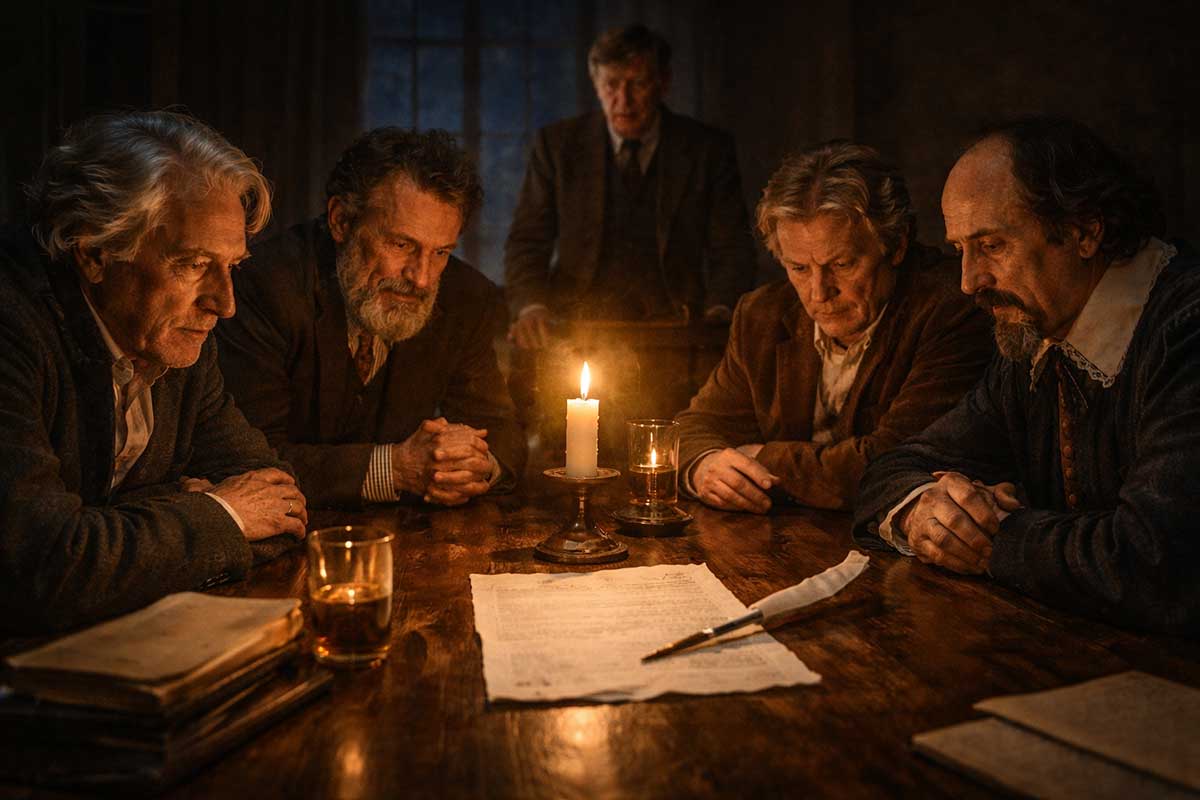
The classroom feels smaller tonight, as if the walls have leaned in to listen.
Outside, Ann Arbor keeps up its ordinary life—streetlights, footsteps, the faint grind of a streetcar—but inside the air has the charged stillness of a room where a confession might be demanded. On the table at the front, Auden has placed no Bible, no manifesto, no political pamphlet. Just a few pages of notes and a thin book that looks like it has been opened and shut too many times by anxious hands.
He stands with that particular calm he has—calm that never feels soothing, only controlled. A man trying to speak honestly while the world is doing everything it can to punish honesty.
Tonight the five at the long table have a different temperature.
Goethe sits as if he has spent a lifetime watching human longing dress itself as nobility. Melville has the sea in his posture—restless, suspicious of any shore that promises certainty. Ben Jonson looks amused in a way that suggests he can already see where the self-deception will begin. William Blake’s eyes are luminous, as if the room is not the room but a veil. Shakespeare watches the group like a playwright listening for the first lie that will set the tragedy in motion.
Auden looks at them, then at his students, and he begins without preamble.
“At what point,” he asks, “does ambition become a bargain—even if no devil ever appears? What is the first quiet trade a person makes that sets the whole fall in motion?”
Goethe answers with a faint, almost weary recognition.
“It begins,” he says, “when the hunger for more becomes a refusal to be human. When the person cannot bear limitation—cannot bear ignorance, cannot bear time, cannot bear mortality. He says, ‘I must have the whole of life.’ That sounds brave, but it is often a disguised contempt for ordinary goodness.”
He lifts a finger slightly, precise.
“The bargain is not first made with a demon; it is made with impatience. The person decides that the slow path of discipline is beneath him. He decides that the world owes him intensity. The devil, if he comes at all, merely offers efficiency.”
Melville’s mouth tightens, as if he distrusts even the word “efficiency.”
“I’ve seen a bargain that never names itself,” he says. “The sea teaches you that a man can be damned without signing anything. Ahab does not say, ‘I bargain for power.’ He says, ‘I will not be mocked by mystery.’ That is the first trade: he gives up humility.”
He leans forward, voice low.
“He trades wonder for conquest. He trades his crew’s lives for the right to strike at what he cannot understand. He trades his own soul for the pleasure of declaring war on the invisible.”
Ben Jonson lets out a small breath that might be laughter, but it isn’t friendly.
“You both speak,” he says, “as if ambition is always grand. Sometimes it is merely profitable.”
He spreads his hands as though presenting a scene onstage.
“The first bargain is often social. A man discovers that pretending costs less than honesty. He discovers that flattery opens doors. He discovers that if he calls greed ‘prudence,’ no one objects. He discovers that if he wraps appetite in a moral story, he can eat in public.”
Jonson’s eyes flick to Auden.
“And here is the truly quiet trade: a person stops being ashamed of what deserves shame. The moment shame dies, the devil needn’t knock. He lives in the house.”
Blake’s face is bright with a strange impatience, as if the others are describing only the symptoms.
“You speak as if the bargain is always with desire,” Blake says, “but the deepest bargain is with deadness. The first trade is not hunger for more—it is surrender of vision.”
He gestures as if drawing a doorway in the air.
“When a person accepts a false moral map—when he says, ‘This is good because the crowd says so; this is evil because the priest says so’—he has sold his imagination. He has sold the divine in him for a cheap label.”
Blake’s voice intensifies, not angry, but electric.
“The devil loves nothing more than a person who believes he is moral while he is asleep.”
Shakespeare finally speaks, and it lands with dramatic clarity.
“The first bargain,” he says, “is often made in language. A man invents a phrase that makes his betrayal sound like duty.”
He looks around the table as if seeing characters step forward.
“He says, ‘I had no choice.’ He says, ‘It was necessary.’ He says, ‘I did it for love.’ That is where the fall begins—not in the act itself, but in the story that excuses the act. Once the story is believed, the next bargain comes easier.”
Auden listens, then nods as if he has heard the hidden harmony: impatience, conquest, social performance, deadened vision, self-justifying language. Five angles on the same door.
He asks the next question almost gently, and that gentleness makes it worse.
“Is the true danger the thirst for power,” Auden says, “or the story we tell ourselves to justify it—progress, love, destiny, necessity? Which is more fatal?”
Goethe answers first, with a physician’s eye for the disease.
“The story,” he says. “Power is obvious. We fear it. But the story is intimate. It speaks with our own voice.”
He looks toward Shakespeare, almost in agreement.
“The story converts guilt into virtue. It says: ‘I am not selfish; I am heroic.’ It says: ‘I am not cruel; I am decisive.’ It says: ‘I am not vain; I am chosen.’ The story is what makes a person able to live with himself while doing what he would once have condemned.”
Melville shakes his head slightly.
“The thirst and the story are married,” he says. “The thirst creates the story, and the story feeds the thirst.”
He looks out toward the windows, as if the darkness outside is ocean.
“Ahab’s story is that the universe is insulting him. That story gives him permission to become a weapon. The danger is not merely that he wants power. The danger is that he thinks power will heal humiliation. It never does. It only spreads it.”
Jonson leans back, comfortable in the uglier truth.
“I would say the story is worse,” he remarks, “because stories are shareable. Power is personal; justification is contagious.”
He smiles thinly.
“When a society begins to speak in noble phrases about base motives, you can smell the rot. The greedy man becomes ‘enterprising.’ The liar becomes ‘strategic.’ The predator becomes ‘a realist.’ That is how an entire city makes a pact without noticing.”
Blake’s eyes flash.
“Yes,” he says, “because the story is often a lie told by a frightened moral system.”
He points, as if accusing the very air.
“The story that calls power ‘necessity’ is the story of a world that has forgotten eternity. The story that calls exploitation ‘progress’ is the story of a world that worships machines. The story that calls cruelty ‘order’ is the story of a world that fears imagination.”
He leans in, voice softer now, and somehow more piercing.
“Power is merely energy. The danger is the spiritual sleep that tells you how to use that energy without seeing what you are becoming.”
Shakespeare speaks with the steadiness of someone who has written too many kings.
“The story is the devil’s favorite costume,” he says. “Give a man a fine narrative, and he will walk into hell as though he were entering a coronation.”
His gaze sharpens.
“But I must warn you: the story can also be true. Sometimes necessity is necessity. Sometimes love is love. That is why the danger is so great. The liar borrows the face of the honest man.”
He looks at Auden, as if they share a grim understanding.
“The question is not whether people tell themselves stories. They must. The question is whether the story can endure daylight—whether it can survive a witness who is not bribed.”
Auden takes a slow breath. The students are very quiet now, the way people get quiet when they recognize themselves.
He doesn’t let them rest.
“If a person has already crossed the line,” Auden asks, “what does redemption look like in a world that rewards the crossing? Confession? Restitution? Renunciation? Or the hard, humiliating work of living differently?”
Goethe answers like a man who believes in education—not as schooling, but as transformation through truth.
“Redemption begins,” he says, “when the person stops romanticizing the fall. When he looks at what he has done without ornament.”
His voice becomes more tender, and more severe.
“Confession is necessary because it breaks the spell of the story. But confession without change is another story. Restitution is the first honest step because it costs something real. Renunciation is sometimes required because the very instrument of temptation must be laid down.”
He pauses.
“And then there is the long work—yes—the work of becoming capable of simplicity again. That is the hardest thing for the ambitious soul.”
Melville’s reply is darker, but not hopeless.
“Some lines cannot be uncrossed,” he says. “The sea does not return what it takes. And a man who has led others into ruin cannot simply apologize and be clean.”
He looks at Goethe as if to say: do not make redemption too tidy.
“Yet there is something like redemption when a man finally stops dragging others into his private war. When he releases the crew. When he accepts that mystery is not an enemy. When he can look at the whale—at the unknown—and not demand it bleed to soothe his pride.”
Jonson’s smile fades. When he speaks, he sounds almost moral against his own will.
“Redemption,” he says, “begins with the end of the con.”
He turns his palm upward.
“The con is not merely that you trick others; it is that you trick yourself. Confession is useless if it is performed for applause. Restitution is useful because it cannot be faked easily. Renunciation is useful because it removes the stage.”
Jonson’s eyes are sharp.
“And if you wish to live differently, you must accept that you will be mocked. The world likes a sinner who keeps entertaining it. The world hates a sinner who becomes honest.”
Blake speaks as if redemption is not primarily legal or social but visionary.
“Redemption,” he says, “is the return of imagination.”
He sees their skepticism and presses on.
“I do not mean fantasy. I mean the ability to perceive the eternal in the human. A person who has crossed the line often cannot see his victim as human anymore. He sees only a piece on a board, a number, a nuisance, a means.”
Blake’s voice steadies into something like compassion.
“To live differently is to regain sight. To see again. To feel again. To let the hard categories melt. And then—yes—restitution, because vision without love is still empty.”
Shakespeare is last, and he speaks like someone who has watched men attempt redemption and fail, and sometimes—rarely—begin again.
“Redemption,” he says, “requires a reckoning with motive.”
He folds his hands, thoughtful.
“Many confess to escape punishment. Many renounce to gain a new reputation. Many repay to buy peace. The world is full of cheap redemptions.”
He looks at Auden.
“But there is one sign I have seen: when a person stops asking to be forgiven and starts asking how to repair what he has broken. When he can endure being misunderstood without turning bitter. When he can live without the crown he once demanded.”
Shakespeare’s voice drops.
“And when he no longer needs to be the hero of the story.”
Auden stands silent for a moment. The room feels as if it has been stripped down to the beams.
Then he speaks, not as a lecturer, but as a man addressing other human beings who may soon be asked to trade their souls for safety, applause, or belonging.
“You’ve all described bargains,” Auden says, “as if they begin in hunger, in pride, in story, in deadness, in language. Perhaps that is the lesson students most resist: that the devil is rarely dramatic.”
He looks down at the chalk, then back up.
“And you’ve described redemption,” he adds, “as if it begins in daylight—the kind of daylight most people avoid.”
Auden turns toward his students, his voice quieter now.
“If you are waiting for a devil with horns,” he says, “you will miss the bargain being offered in ordinary words. And if you are waiting for redemption to feel glorious, you will miss it as well.”
He lets the silence do its work.
“Because the bargain is usually comfortable,” Auden finishes, “and redemption is usually humiliating.”
No one moves. Even Jonson looks less amused.
Outside, the snow continues to fall with patient indifference. Inside, the room feels newly burdened by the knowledge that the most dangerous contracts are the ones you sign without ink.
And Auden, gathering his notes, says only this—almost to himself:
“Next time, we will speak of love—and whether it chooses us, or consumes us.”
He doesn’t dismiss them like a professor. He releases them like a man who knows the century will test every sentence they have just heard.
Topic 4 — Love, Passion, Jealousy: Are We Free in Our Deepest Emotions?
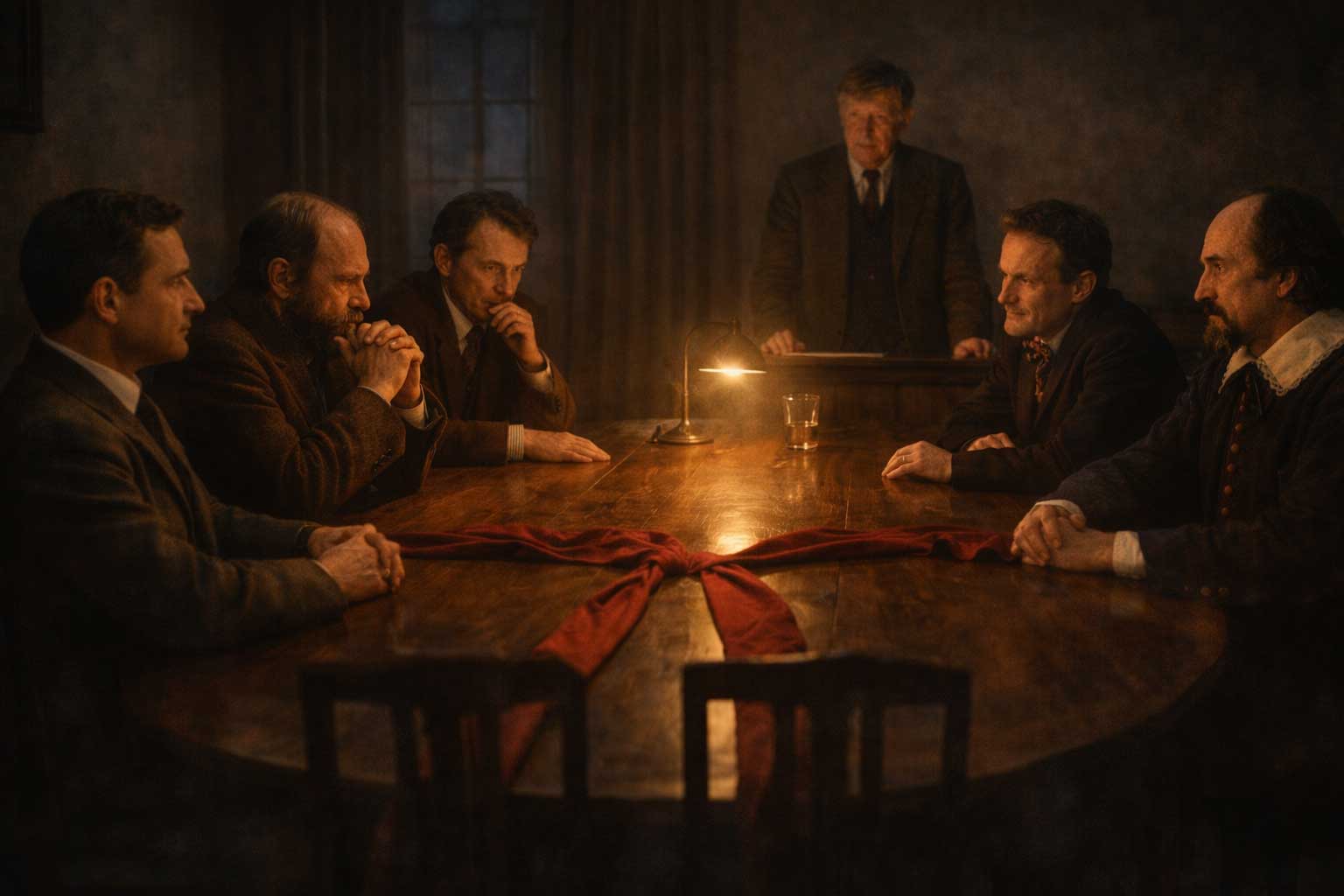
The snow has stopped, but the cold has not.
It lingers in the stone of the building, in the windowpanes, in the students’ shoulders as they shrug off coats and settle into that uneasy attention that has become habitual in this course—an attention sharpened by the sense that what is being discussed is not safely historical. Outside, the world is still at war. Inside, Auden keeps turning the same central problem in the light, as if he believes that if you look long enough you can learn where a human being breaks—and where a human being refuses to.
Tonight, the table feels warmer, almost dangerously so, as if the topic itself has raised the temperature.
Jean Racine sits composed and immaculate, as though tragedy is a form of etiquette: passion brought to the stage so it can be judged. Shakespeare sits with that alert stillness of a man who can smell manipulation in the air before it has a name. Dostoevsky leans forward, restless, as if love is never an aesthetic question but always a question of salvation or damnation. Rilke’s gaze seems turned inward and outward at once—toward solitude, toward the invisible architecture of longing. Baudelaire looks amused and tired, like someone who has walked through pleasure and found a graveyard behind it, then walked back through anyway.
Auden stands at the front, hands in his pockets, not bothering with the chalk.
“We’ve spoken of history,” he says. “We’ve spoken of conscience. We’ve spoken of bargains. Tonight we speak of something that masquerades as innocence.”
He looks at the students first, because he knows they will think they understand this topic better than the others.
“Love,” Auden says, almost gently, “and its cousins—desire, jealousy, obsession. Tell me: when passion takes over, are we responsible in the same way we are for deliberate choices? Or does passion change the moral math?”
Racine answers with calm authority, as if he has been waiting centuries to be asked properly.
“Passion,” he says, “is not a passing feeling. It is a destiny that blooms inside the blood. People like to speak as though they choose their desires, and then they are astonished by the strength of them. In tragedy, we do not pretend the heart is free in the way a mind imagines itself free.”
He inclines his head slightly, acknowledging a hard truth.
“And yet, responsibility remains. Not in the crude sense of ‘you could have done otherwise’—because often you could not. Responsibility lies in recognition. In the moment you realize what is happening within you, you either speak honestly, or you begin to lie. The lie is the moral act.”
Shakespeare’s eyes narrow a fraction.
“Destiny inside the blood,” he repeats. “A fine phrase. Useful to a villain.”
He turns his gaze as if to an unseen stage.
“In my work, passion is often steered. Jealousy does not always arrive as lightning; sometimes it is planted, watered, coached. A man who thinks he is helpless before passion is easily made helpless by another man’s whisper.”
He looks at Auden.
“Does passion change the moral math? It complicates it, yes. But it does not erase it. A man is still accountable for where he places his trust, for whether he demands proof, for whether he humiliates the one he claims to love. Passion is a storm, but the man still chooses whether to throw someone overboard.”
Dostoevsky’s voice comes in fast, almost feverish, as if he cannot allow the discussion to become too refined.
“You speak of storms and stages,” he says, “but you must speak of the soul. Passion is not merely emotion—it is the battlefield where a person reveals what he worships.”
He looks from Racine to Shakespeare.
“Jealousy, lust, devotion—these can seize a man. But do not make the seizure an excuse. The man still has a secret choice: does he seek to possess, or does he seek to love? Does he treat the beloved as a person, or as a remedy for his own emptiness?”
Dostoevsky’s eyes are bright.
“I have seen men commit crimes in the name of love and call it fate. But it is not fate. It is pride—pride that cannot tolerate the beloved as free.”
Rilke speaks softly, as though trying to keep the room from becoming merely accusatory.
“Passion changes the moral math,” he says, “because it reveals what we have not cultivated in ourselves. When a person has not learned solitude—true solitude, not loneliness—he demands that another person cure him.”
He pauses.
“And then love becomes hunger. Hunger is not evil, but it is dangerous. It consumes. It confuses need with destiny. When you are starving, you do not ask whether the meal is poison.”
Baudelaire’s smile returns, but there is no warmth in it.
“How pious,” he says. “How responsible. How clean.”
He leans back slightly, as if he can already predict the audience’s comfort with the moral frames being offered.
“Let us be honest. Passion does not merely complicate responsibility. Sometimes it makes responsibility feel ridiculous. Sometimes the heart behaves like an illness and the mind becomes the servant of it. People do not always choose the object. They discover themselves attached, like a man waking with chains around his wrists.”
His eyes lift toward Auden.
“So yes—passion changes the math. It does not absolve you, but it does explain why so many prefer to remain guilty rather than free. Guilt can be romantic. Freedom is often dull.”
Auden watches them as if he’s measuring the room’s pulse.
Then he turns the question slightly, as if rotating a gem to show the other cut.
“Is love a form of freedom,” he asks, “or is it one of fate’s most convincing disguises?”
Racine answers as if this is the question tragedy has always been asking.
“Love is rarely freedom,” he says. “It is compulsion dressed as beauty. It is the god within us that demands sacrifice. That is why it can feel holy and destructive at once.”
He speaks without cruelty, but without illusion.
“The lover often believes he is choosing, but he is being chosen. Chosen by his own temperament, by his own wounds, by the very structure of his desire. Fate does not always come from outside. Fate often rises from within.”
Shakespeare doesn’t disagree, but he refuses Racine’s pure inevitability.
“Sometimes love is freedom,” he says, “when it frees you from yourself.”
He looks down the table, toward Dostoevsky and Rilke as if seeking allies.
“But love becomes fate when it becomes a story you use to excuse your worst impulses. ‘I could not help it’—that is fate’s favorite sentence. ‘It was love’—that is the disguise.”
His voice sharpens.
“A man who calls his obsession ‘love’ is usually enslaved, and usually making slaves of others.”
Dostoevsky seizes the opening, as if he’s been waiting for the word obsession.
“Love is freedom only when it is willing to suffer without demanding payment,” he says. “When it becomes a demand—when it says, ‘Because I love you, you must belong to me’—it becomes fate in its ugliest form.”
He leans forward, urgent.
“True love does not erase the beloved’s freedom. It reveres it. Anything else is appetite pretending to be virtue.”
Rilke’s reply is quieter, but it carries a deeper melancholy.
“Love can be freedom,” he says, “if it is a meeting of two solitudes that honor each other.”
He glances toward the students, as if to warn them gently.
“But many people want love to be an escape from selfhood. They want the beloved to become a shelter from the terror of being alone. In that case, love is fate—because it is an inevitability born of fear.”
Baudelaire tilts his head as if listening to music no one else hears.
“You all speak of love as if it must justify itself by being virtuous,” he says. “As if love must be a school for goodness.”
He smiles faintly.
“Sometimes love is neither freedom nor fate. Sometimes it is a narcotic. Sometimes it is a splendid poison that makes life bearable. People do not always want liberation. Sometimes they want intensity. Sometimes they want to feel something sharp enough to cut through the numbness of ordinary days.”
He pauses, letting that land where it will.
“And that is why fate wears love’s face so easily. Because people invite it to.”
Auden steps closer to the table now, as if the room has reached the point where it might lie to itself.
He asks the third question slowly, with care, as if it must be placed precisely.
“What is the difference,” Auden says, “between love that enlarges a person and love that consumes them—and how can you tell before it’s too late?”
Racine responds with tragic clarity, almost clinical.
“Love that consumes,” he says, “is love that demands. It demands secrecy, it demands surrender, it demands a world narrowed down to one flame. It makes you abandon proportion. It persuades you that everything outside the beloved is irrelevant.”
His voice stays cool.
“Love that enlarges does not ask you to betray your own moral sight. It does not require you to become smaller. If you find yourself shrinking—shrinking your honesty, shrinking your conscience, shrinking your life—then you are being consumed.”
Shakespeare nods, but he brings it closer to the ugly mechanics.
“You can tell,” he says, “by what the love does to your imagination of other people.”
He looks toward the students again.
“If love makes you suspicious of everyone, if it turns friends into enemies and questions into insults, if it teaches you to interpret every silence as a betrayal—then love is not enlarging you. It is training you to be cruel.”
His voice hardens.
“And you can tell by the presence of a manipulator. Beware any love story that requires a third voice, always whispering. In my tragedies, that whisper is often the instrument of ruin.”
Dostoevsky speaks as if he cannot bear the room staying merely psychological.
“You can tell by whether love creates humility,” he says. “Love that enlarges teaches you repentance. It teaches you to see your own sin without despair. It teaches you to endure the beloved’s freedom without revenge.”
He looks at Racine and Baudelaire as if challenging both.
“Love that consumes cannot endure the beloved as a person. It must reduce the beloved to a possession. It becomes angry at the beloved’s separateness. That anger is the sign. It is the beginning of violence.”
Rilke speaks next, and his words feel like a lamp turned on in a quiet room.
“You can tell by the quality of attention,” he says. “Consuming love looks at the beloved like a mirror. It sees itself. It is hungry for reflection. Enlarging love looks outward, beyond the self, and learns reverence.”
He pauses, then adds something gentle and devastating.
“And you can tell by whether the love leaves you more capable of solitude. If love destroys your ability to be alone, it is not love—it is dependence in a beautiful costume.”
Baudelaire’s expression shifts. For a moment, the amusement thins and something like honesty shows through.
“You want to know before it’s too late,” he says. “But that is precisely what passion refuses to give you—advance notice.”
He leans forward, voice lower.
“Still, there are signs. You can tell when pleasure begins to require cruelty. When beauty begins to require degradation. When tenderness begins to require a wound.”
His eyes flick toward Shakespeare and Dostoevsky.
“And yes—you can tell when you begin to romanticize your own suffering. When you begin to treat pain as proof that the love is real. That is how the poison sweetens itself.”
Auden stands very still. He doesn’t rush to summarize, because he knows the students will try to turn the conversation into advice they can follow like a recipe. He refuses to let it be that comfortable.
“So,” Auden says quietly, “we’ve named compulsion and manipulation, reverence and hunger, humility and self-deception.”
He looks at Racine.
“You say fate rises from within.”
He looks at Shakespeare.
“You say the whisper can steer the storm.”
He looks at Dostoevsky.
“You say love is proved by whether it honors freedom.”
He looks at Rilke.
“You say love must not become an escape from selfhood.”
He looks at Baudelaire.
“You say the poison is invited.”
Auden’s voice remains gentle, but it is not kind in the way people mean when they want to be spared.
“Then perhaps the real question is not whether passion absolves us,” he says. “Perhaps the real question is whether we have trained ourselves enough to survive passion without using it as an excuse to become someone we will later pretend we never were.”
He turns toward the windows. For a moment, the glass reflects the classroom like a second room—students behind students, faces behind faces—like an audience watching itself.
“When the century is violent,” Auden says, “people think love is private.”
He turns back.
“It isn’t,” he adds. “Because the way you love teaches you how you will treat the vulnerable, how you will treat the powerless, how you will treat the truth. Jealousy is not merely romantic. Possession is not merely personal. They are training.”
He gathers his notes, but he does not close the subject. He merely folds it and places it on the table, like something still warm.
“Next,” Auden says, “we go into the labyrinth—into the modern world where fate stops wearing a crown and starts wearing a badge, a form, a rule you can’t find.”
He doesn’t dismiss the class. He releases them again.
And as chairs scrape back and coats are pulled on, the room keeps a low hum—not of excitement, but of recognition. As if the students have discovered that the most dangerous tragedies do not always happen on a stage.
Sometimes they happen in a glance. In a sentence. In the way a person says “mine.”
And outside, the night waits with its ordinary silence, offering no hint of whether it will be tender tomorrow—or whether it will demand another bargain.
Topic 5 — The Modern Labyrinth: Bureaucracy, Identity, and Spiritual Paralysis
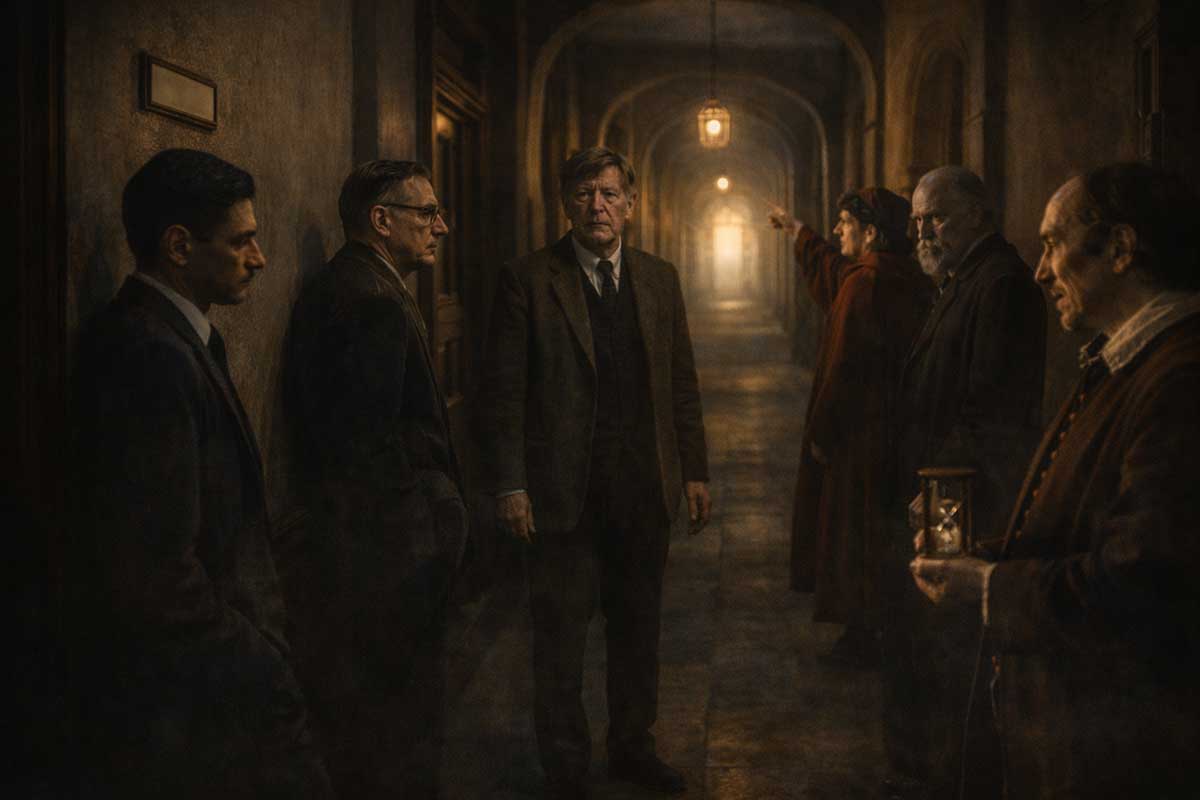
The winter has turned sharper. Not louder—just sharper, like a blade honed slowly in the dark.
The classroom is lit the same way it always is, but tonight the light feels more clinical, as if it belongs to an office rather than a sanctuary. The students arrive quieter than usual, as if Topic 4 has left them raw and Topic 3 has left them suspicious of their own motives. And now Auden is leading them somewhere colder: into the world where the gods do not strike with thunder, but with paperwork; where fate does not announce itself, but files itself.
At the table sit the five who seem made for this territory.
Kafka is almost too appropriate—his presence makes the room feel as if it might be evaluated. Dante sits with the composure of someone who believes there is a map, that even suffering has coordinates. Ibsen carries the uneasy air of a man who has watched the self become an actor in its own life, performing until it forgets who it is. T. S. Eliot looks like someone who has tried to pray inside modern time and felt the words turn to dust. Pascal has the gaze of a man who sees the abyss not as metaphor but as an ordinary fact.
Auden doesn’t begin with an introduction. He begins as if picking up the thread of a question the century itself has been asking.
“In the modern world,” he says, “what replaces the old idea of fate—God, gods, destiny—and why does that replacement feel even harder to appeal to or argue with?”
Kafka answers first, and his voice is not dramatic. It is the voice of someone describing the weather.
“Fate becomes administration,” he says. “It becomes procedure. It becomes the sense that you are already judged, but you do not know the charge, and you cannot locate the judge.”
He looks toward the door, as if half-expecting it to open.
“In the old stories, fate might speak. A prophecy might be uttered. A god might punish. Even if unjust, it is at least visible. In the modern replacement, the force is anonymous. It does not hate you. It does not love you. It does not even know you. That is why it is harder to argue with. You cannot plead with a wall.”
Dante’s response comes with quiet firmness, like a man setting a compass on the table.
“The replacement,” he says, “is not fate but forgetting. Forgetting of order. Forgetting of purpose.”
He doesn’t sound naïve; he sounds sorrowful.
“Even if the modern world no longer believes in God, it still believes in judgment. It still fears guilt. It still longs for meaning. But it has lost the architecture that makes judgment intelligible. So it builds smaller architectures—systems, institutions, hierarchies—and then it serves them as if they were ultimate.”
He looks at Kafka, not dismissive but grave.
“A cosmos without an ultimate end becomes a labyrinth by necessity. It cannot answer why, so it multiplies how.”
Ibsen speaks next, and his voice feels painfully practical.
“What replaces fate,” he says, “is the self’s evasions.”
He glances at the students—young faces that still believe identity is a possession.
“In my work, the individual becomes a series of roles, excuses, and performances. He says, ‘I am this,’ then he flees the consequences of being it. He says, ‘I am free,’ then he avoids responsibility until freedom becomes emptiness.”
He gestures lightly, as if toward an invisible stage.
“The modern world makes it easier to escape into masks. Bureaucracy is one mask. Romance is another. Success is another. Even rebellion is a mask. And the harder it is to appeal to these replacements is simple: they are convenient. People do not appeal to what comforts them—they submit to it.”
Eliot’s voice comes in as if from a room adjacent to this one, a room full of clocks.
“The replacement,” he says, “is distraction and fatigue.”
He looks at his hands as though they are evidence.
“The modern world does not always crush the soul with terror. It dissolves it. It fills the day so completely that the self cannot hear itself think. People are not only ruled by systems; they are ruled by their inability to sit quietly in the presence of their own emptiness.”
He lifts his eyes.
“That is why it is harder to argue with. You cannot argue with numbness. You can only wake from it.”
Pascal speaks last, softly, and something in his softness feels like a verdict.
“What replaces fate,” he says, “is diversion.”
He lets the word stand plainly, almost ordinary.
“Without God, without an ultimate horizon, people must not think too long. So they fill their lives—noise, work, amusements, politics, pleasures—anything to avoid the silence where the abyss waits.”
He looks at Auden.
“This replacement is harder to appeal to because it is not an enemy. It is a seduction. And one does not argue with seduction; one either resists it, or one does not.”
Auden nods, as if the room has named the terrain: administration, forgetting, masks, fatigue, diversion.
He moves into the second question with the calm of a man who knows the answer will be costly.
“If a person is trapped in systems they can’t see or change,” Auden asks, “what does it mean to keep a self intact? What practices, vows, or inner disciplines actually work?”
Kafka’s reply is bleak, but not empty.
“To keep a self intact,” he says, “you must refuse to let the system define your inner language.”
He pauses, searching for the exact sentence.
“Systems turn people into cases. They turn lives into files. The self survives when it insists: I am not my accusation. I am not my title. I am not my outcome.”
He looks down at the table.
“That may not free you. But it keeps you from becoming your own clerk.”
Dante answers as if the question is spiritual before it is political.
“The self stays intact,” he says, “by orienting itself toward an ultimate good.”
He speaks with patient certainty.
“Without an ultimate end, the soul is pulled in every direction by immediate pressure. To keep yourself, you must remember what you are for. Prayer is one practice. But even if you do not pray, you must adopt something like prayer: contemplation, confession, the discipline of examining your life.”
He looks around the room.
“A person must become a pilgrim again—even if the road is inside.”
Ibsen’s response is sharper, almost corrective.
“Vows,” he says, “are not poetry. They are behavioral.”
He leans forward.
“If you want to keep a self intact, stop performing. Stop narrating your life for an audience. Do the small duties you’ve avoided. Speak truth in ordinary rooms. Pay your debts—literal or moral.”
He glances toward Eliot.
“Modern identity dissolves because people flee the boring labor of being a person. The discipline is simple and brutal: choose responsibility and keep choosing it when it stops being flattering.”
Eliot nods slightly, then adds his own angle, quieter and more inward.
“The self,” he says, “is kept intact by the recovery of attention and reverence.”
He chooses the words carefully.
“A vow to tell the truth—yes. A vow to keep promises—yes. But also a vow to stop scattering your soul. Many people are not destroyed by tyranny; they are destroyed by their own fragmentation.”
His voice drops.
“Small disciplines: silence, reading, prayer, liturgy, routine, acts of service. These are not quaint. They are defenses.”
Pascal’s reply is almost gentle, but it has the edge of a man who knows what humans do to avoid God.
“The discipline,” he says, “is to endure the absence of distraction.”
He looks at the students as if speaking directly to them.
“Sit in your room. Close the door. Let the anxiety rise. Let the boredom rise. Let the fear rise. Do not run. That is where the self is formed—by refusing to flee your own consciousness.”
He pauses.
“And then—humility. Because the self that survives the labyrinth is not the proud self. It is the self that knows it is weak and therefore seeks help, seeks grace, seeks truth.”
Auden takes a breath. The room feels like it has been given a set of tools—simple, unglamorous tools, the kind that might actually work.
Then he asks the final question, and it hits with a strange mercy and a strange cruelty at once.
“Is spiritual paralysis a personal failure,” Auden says, “a social condition, or an honest response to living without a coherent moral order? And what would awakening look like now?”
Kafka answers first, and the despair in his words is not theatrical—it is procedural.
“Paralysis can be honest,” he says. “When the rules are hidden, when outcomes are arbitrary, action becomes dangerous because every action may be misinterpreted.”
He looks toward Dante as if he wants to borrow Dante’s certainty but cannot.
“Awakening, then, might not be victory. It might be the decision to act without guarantees. To accept that you will not be understood. To accept that the door may not open and still knock—not because knocking works, but because you refuse to become a ghost.”
Dante’s response comes like a bell struck in a fog.
“Paralysis can be a symptom,” he says, “but it must not become a home.”
He speaks with compassion, not scorn.
“When a moral order is incoherent, the soul staggers. That is natural. But awakening begins when you acknowledge that incoherence is not final. You begin again with repentance—turning. You reorder your loves. You place lesser loves beneath greater loves.”
He looks at Eliot, as if inviting him.
“You find a ladder. You climb.”
Ibsen answers with a colder honesty.
“Paralysis is often cowardice,” he says. “And the modern world is extremely good at making cowardice look sophisticated.”
He shrugs slightly.
“People say they are ‘complicated.’ They say they are ‘processing.’ They say they are ‘not ready.’ Sometimes it is true. Often it is avoidance.”
His tone hardens, not cruelly, but firmly.
“Awakening is decision. It is choosing something that costs you comfort. It is taking responsibility in one concrete place—your family, your work, your promises—until the self stops slipping.”
Eliot speaks as though he’s answering from inside paralysis, not above it.
“Paralysis is both personal and social,” he says. “It is a condition of modern life: too many options, too much noise, too little meaning that holds.”
He pauses, then continues.
“But it can also be honest. When the old words have been abused, the soul distrusts them. When rhetoric has become propaganda, the soul hesitates to speak.”
Eliot’s voice steadies.
“Awakening is not merely willpower. It is the recovery of a language you can believe. It is finding one act of fidelity and repeating it until it becomes a path.”
Pascal’s reply is almost tender, but it carries a sharpness that cuts through excuses.
“Paralysis,” he says, “is often a refusal to face our condition.”
He looks directly at Auden, then at the students.
“We are finite. We are mortal. We are ignorant. We are sinful. We are frightened. Many people are paralyzed because they cannot bear these truths without distraction.”
He lifts his hand slightly.
“Awakening begins with humility. The acceptance that you are not enough—and therefore you must seek what is beyond you.”
He pauses, and the room is completely still.
“And then it begins with love. Not as a feeling, but as a discipline. Love is the only force that can turn a maze into a road.”
Auden stands silent for a moment, as if he has been listening not only to them but to the era itself—its speeches, its uniforms, its claims of necessity.
Then he speaks, and his voice is quiet enough that everyone leans forward.
“So the modern labyrinth,” Auden says, “is not only out there—in ministries and courts and offices. It is also in here—in our hunger to be distracted, our terror of silence, our love of masks, our fatigue, our pride.”
He looks at Kafka.
“If fate becomes administration, we must refuse to become forms.”
He looks at Dante.
“If order has been forgotten, we must remember what we are for.”
He looks at Ibsen.
“If the self is performance, we must stop performing and begin doing.”
He looks at Eliot.
“If language is exhausted, we must recover a truthful tongue.”
He looks at Pascal.
“If diversion is the seduction, we must endure the silence.”
Auden turns toward his students, and the tenderness in his eyes is real—but it is the tenderness you feel for someone who will be tested.
“You came to college to learn to think,” he says. “But you are going to need something harder than thinking.”
He pauses.
“You are going to need the courage to be a person when the world would rather you be a function.”
The room stays silent, not because there is nothing to say, but because everyone feels—without anyone announcing it—that they have been given a description of their own century.
Auden gathers his papers and closes his book.
“That,” he says, “is the end of the list’s last lesson.”
But he doesn’t sound as if anything is ending. He sounds as if the course has only now reached the place it was always aiming for: the point where a student realizes that fate is not merely an idea in a text.
It is the pressure of a life.
And the only answer is the self—kept intact, not by pride, but by practice.
Final Thoughts by W. H. Auden
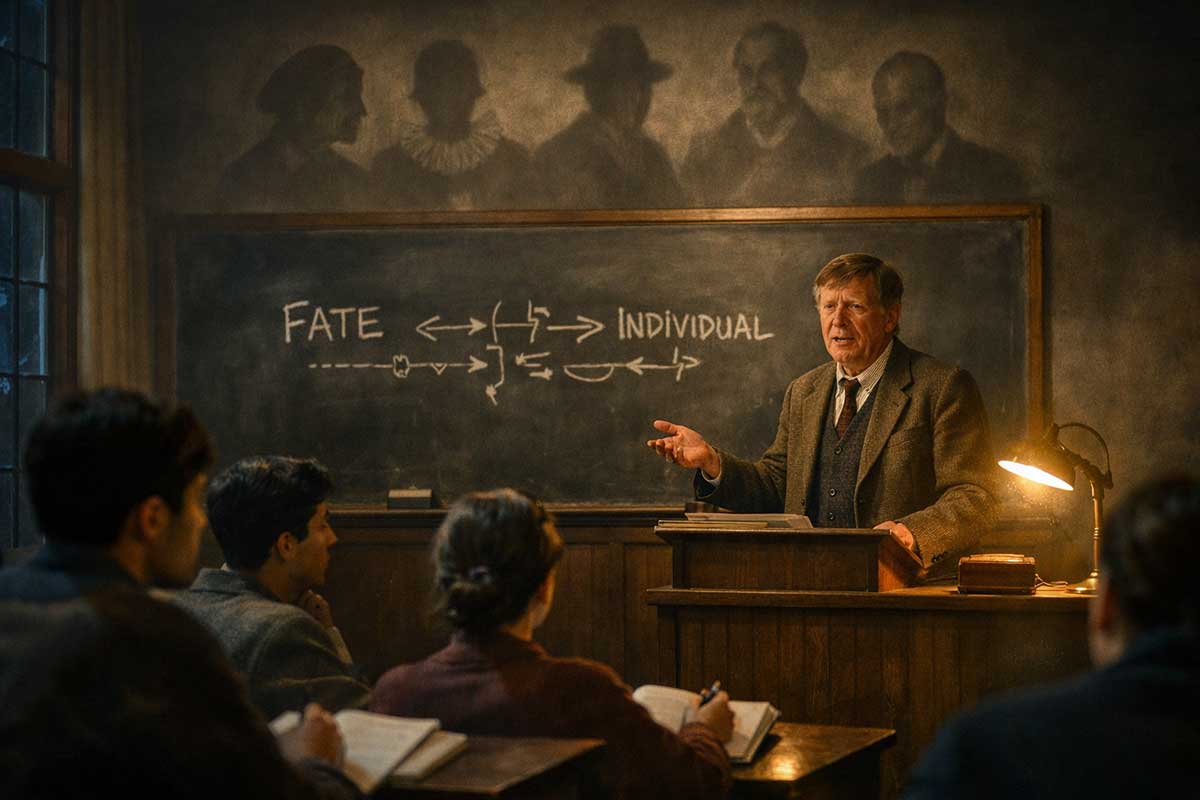
We have traveled a long distance together, though none of us has moved from our chairs.
We began with history—its storms, its engines, its appetite to turn human beings into instruments. We moved to conscience, where the most dangerous lie is the lie that obedience is always virtuous. We faced the bargain—those private trades we make with our own pride, long before any dramatic devil arrives. We entered love, which can either enlarge a person or consume them, and we admitted how easily passion dresses itself as inevitability. And at last we arrived at the modern labyrinth, where fate often wears no crown at all—only a badge, a rule, a form, a clock, a distraction.
If there is one lesson I would leave with you, it is this: fate is not only what happens to you. Fate is also the shape your soul takes in response. The century will always offer you reasons to surrender your responsibility. It will speak the language of necessity. It will speak the language of progress. It will speak the language of loyalty. It will speak the language of love. And if you are tired, if you are lonely, if you are afraid, those languages will sound like relief.
Relief is rarely innocence.
You may not be able to stop the machinery of the age. Most of us cannot. But you can refuse to become machinery yourself. You can refuse the convenient lie. You can keep your attention when distraction begs for your soul. You can practice the small disciplines that preserve a self: truth-telling, promise-keeping, repentance, service, silence, prayer—whatever name you give the act of returning to what matters.
And perhaps the most unsettling truth is also the most hopeful: in every one of these works, even in the darkest, the individual is never merely a victim of circumstance. The individual is always being asked—quietly, relentlessly—to choose what kind of person they will become.
If you have learned anything here, let it be this: do not wait for a heroic moment to prove your integrity. Your fate is being written in ordinary hours—by the stories you allow yourself to believe, by the words you repeat, by the way you love, by the way you refuse to love, by the way you treat the powerless, by the way you treat the truth.
The age will not grant you the privilege of being innocent. But it may grant you something better: the chance to be honest—and therefore, in the deepest sense, free.
Short Bios:
W. H. Auden — Anglo-American poet and critic who treats literature as moral training: how a person stays human when history becomes a machine.
Franz Kafka — Modernist master of the bureaucratic nightmare, showing how invisible systems turn guilt into paperwork and identity into a case file.
Dante Alighieri — Poet of spiritual architecture, mapping the soul’s journey through order, consequence, repentance, and ultimate meaning.
William Shakespeare — Dramatist of conscience under pressure, exposing how power, jealousy, love, and hesitation shape destiny in real time.
St. Augustine — Confessional theologian of inner war, tracing how desire, memory, and grace remake the self from the inside out.
Søren Kierkegaard — Philosopher of faith’s dread and courage, insisting the individual must choose without guarantees and stand alone before God.
Blaise Pascal — Mathematician-mystic of the abyss, arguing that diversion, pride, and fear hide our need for humility and grace.
Henrik Ibsen — Playwright of the modern self, revealing how social roles, cowardice, and “respectability” can dissolve personal responsibility.
T. S. Eliot — Poet of spiritual dryness and modern fatigue, portraying paralysis, fractured attention, and the struggle to recover a truthful language.
Sophocles — Tragic dramatist of civic conflict, crystallizing the moment when conscience collides with law and the cost becomes irreversible.
Jean Racine — French tragedian of controlled fire, staging passion as a form of fate that can destroy dignity from within.
Fyodor Dostoevsky — Novelist of faith and revolt, pushing moral freedom to its breaking point through guilt, grace, and spiritual argument.
Rainer Maria Rilke — Poet of solitude and transformation, treating love and suffering as the furnace where the self becomes real.
Charles Baudelaire — Poet of modern irony and inner exile, exploring desire, decadence, and the sharp conscience hidden beneath beauty.
Johann Wolfgang von Goethe — Poet-thinker of striving, dramatizing the Faustian bargain as the modern hunger for meaning, power, and experience.
Herman Melville — Epic novelist of obsession and the unknowable, probing how a single will can become holy purpose—or catastrophic madness.
Ben Jonson — Satirist of appetite and social masks, exposing how greed and performance turn morality into a game of advantage.
William Blake — Visionary prophet-poet of holy contradictions, collapsing tidy moral binaries to reveal how imagination itself becomes a spiritual battleground.
Leave a Reply