

|
Getting your Trinity Audio player ready...
|
Jonathan Haidt:
We live in an age where the loudest voices win—not because they’re right, but because they’re amplified.
Once, we imagined democracy as a town square—messy, yes, but grounded in trust. Today, that square is fractured, algorithmic, and often weaponized.
The media doesn’t just inform us anymore—it forms us. And sometimes, it divides us.
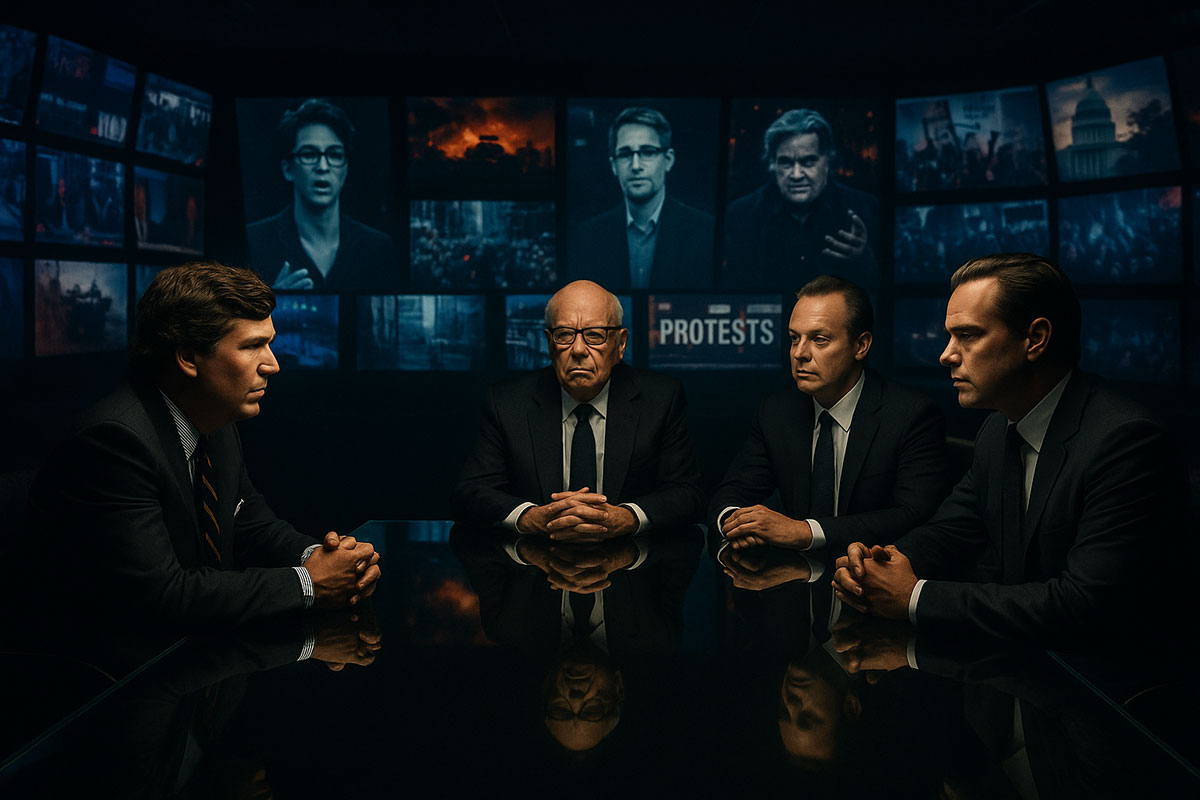
In this series, we’ve invited three of the most powerful and controversial figures in modern media—Tucker Carlson, Rupert Murdoch, and Lachlan Murdoch—to sit down with their fiercest critics, sharpest thinkers, and most persistent questioners.
Together, they explore five fault lines:
How media and war became bedfellows
Whether “America First” is strength or surrender
What it really costs to be the world’s policeman
How Fox News shaped—maybe fractured—national identity
And finally, who really runs this country: the people, or the story they're told
You may not agree with everyone at the table. That’s not the point. The point is that these conversations still matter.
Because when democracy becomes performance, listening becomes the most radical act of all.
(Note: This is an imaginary conversation, a creative exploration of an idea, and not a real speech or event.)

Topic 1: Media and War – Who Really Benefits?
Moderator: Fareed Zakaria
Welcome, everyone. Tonight, we gather not to debate talking points, but to challenge assumptions. The question before us is simple, yet profound: When the media promotes war, who truly benefits? With us are voices from across the political and ideological spectrum. Let's begin.
Fareed
Many media outlets, particularly cable news, have been accused of cheerleading wars—from Iraq to Ukraine. Is this fair? Has the media played a role in escalating conflicts that don’t serve the average American?
Tucker Carlson
It’s absolutely fair. The media doesn’t just report on war—it markets it. I’ve seen it from inside the beast. The lead-up to Iraq was a masterclass in narrative control, and we repeated it in Ukraine. They call it defending democracy, but it’s just defending defense contractors.
Condoleezza Rice
With all due respect, that’s an oversimplification. Yes, the media influences perception, but leadership—Presidents, Congress—make decisions based on intelligence and diplomacy. Media follows the story, it doesn't launch missiles.
Glenn Greenwald
I disagree, Condi. The media sets the premise before the public even knows there’s a debate. It creates consent. Corporate outlets, often owned by war-profiting conglomerates, manufacture the illusion of choice while narrowing the frame to “war is necessary.”
David Frum
I won’t apologize for believing in moral leadership. Sometimes war is necessary—against Saddam, against Putin. Media doesn’t promote war; it reflects the urgency of defending our values. If anything, media has become too timid in standing up to aggression.
Chris Hedges
David, that’s absurd. I was there in Iraq. I’ve watched children die under bombs we dropped. The press isn’t just complicit—it’s culpable. It sanitizes war, ignores its victims, and sells it as strategy. The truth is: war is a racket, and media is the front desk clerk.
Tulsi Gabbard
The real victims are American troops and their families. I served. I’ve seen soldiers die for lies. And media didn’t just go along—they vilified dissenters. When I opposed regime-change wars, I was smeared. That’s not journalism. That’s propaganda.
Lachlan Murdoch
I don’t accept that Fox—or any outlet we run—intentionally promotes war. We reflect what our audience believes and fears. And we also platform dissenting voices—like Tucker himself. That’s balance.
Rupert Murdoch
Wars aren't good for business, contrary to myth. They fragment markets and scare advertisers. But the public deserves strong leadership, and sometimes that includes hard truths. Media has a duty to inform—not pacify.
Fareed
Let’s drill deeper. If war doesn’t benefit average Americans, then who does it benefit—and why do media institutions keep aligning with those interests?
Glenn Greenwald
It benefits the military-industrial complex—contractors, intelligence agencies, lobbying firms. And media acts as a laundering machine, turning classified fear into public urgency. The rest of us? We just pay taxes and bury soldiers.
Tucker Carlson
Bingo. It’s about class. The elite send other people’s kids to die while they collect consulting fees. And the media class? They're courtiers in the palace. They get access, perks, and invitations—as long as they never question the war machine.
David Frum
It benefits freedom. That’s the uncomfortable truth. America’s leadership role—military and moral—has kept peace more often than not. If we retreat into populist skepticism, we risk ceding the world to tyrants.
Chris Hedges
No, David. It benefits empire. We justify invasions with high-minded ideals, but it's always about control—of oil, trade routes, labor. The press recycles myths of “liberation” while children in Yemen starve under bombs dropped with our help.
Rupert Murdoch
War doesn’t benefit media empires—trust me. What it does is reveal who’s serious about protecting civilization. Appeasement has never led to peace. Strength sometimes requires force, and the press must help people understand that.
Tulsi Gabbard
There’s a difference between defense and domination. Americans want safety, not endless occupation. And when media fails to distinguish between legitimate self-defense and profit-driven militarism, we all lose.
Lachlan Murdoch
I agree with Tulsi on this: not all conflict is justifiable. But media reflects democratic discourse. If people want peace, they must demand it—loudly. We don't create sentiment, we follow it.
Condoleezza Rice
War is not a media decision. It’s a sovereign decision made under stress and uncertainty. But yes, media can help frame choices. That’s why it must be held accountable—not demonized wholesale.
Fareed
Final question: If media truly wants to serve the public good, what must change in how war is covered?
Tulsi Gabbard
Start by listening to veterans. Let us tell the truth—not the sanitized, flag-draped version. Show the cost, not just the strategy. Honor life over politics.
David Frum
Ensure balance—but don’t give oxygen to disinformation. There’s a difference between critique and sabotage. Cover threats honestly, but rigorously.
Glenn Greenwald
Decentralize. Break up media monopolies. End cozy press-government ties. Let the independent press thrive without algorithmic strangling or advertiser blackmail.
Chris Hedges
Put reporters back on the ground—embedded with civilians, not just soldiers. Show the suffering. Force the public to look. War isn't a strategy; it’s human horror.
Tucker Carlson
Stop protecting the powerful. Be adversarial. Ask who profits. And for once—just once—stand up before the bombs drop, not after.
Lachlan Murdoch
Encourage dissent without losing clarity. Polarization isn’t a business model—it’s a disease. We must host difficult conversations without destroying public trust.
Condoleezza Rice
Support nuanced journalism. Complexity isn't weakness. The world is dangerous, but not black-and-white. Help Americans be strong and informed.
Rupert Murdoch
Don’t shy away from moral clarity. If evil rises, it must be named. But yes—let’s be better at distinguishing threat from theater.
Closing – Fareed Zakaria
Thank you. Tonight reminded us that war isn't just fought abroad—it’s also waged in headlines, screens, and hearts. Whether media is a mirror or a megaphone, it shapes not just how we see war—but whether we accept it.
Topic 2: America First vs Global Stability – A Clash of Worldviews
Moderator: Margaret Hoover
We live in a fractured world—rising powers, shaky alliances, and internal discontent. One philosophy says America must retreat, protect its own. Another says America must lead, or chaos will follow. Tonight’s conversation isn’t just about policy—it’s about what kind of country we want to be. Let’s begin.
Margaret
Is "America First" a legitimate strategy for preserving national strength, or does it endanger the international order we helped build?
Tucker Carlson
It’s more than legitimate—it’s overdue. For decades we’ve drained our people and treasure to police the world, while our own borders crumble. “America First” isn’t isolationism. It’s prioritizing citizens over ideology.
Anne Applebaum
That view ignores history. After WWII, America chose global engagement not out of charity, but survival. When we retreat, vacuums form. Autocrats fill them. “America First” is often just a polite term for “America Alone.”
Steve Bannon
Anne, that’s globalist myth-making. The American working class has been betrayed—by trade deals, wars, and media narratives like yours. “America First” means rebuilding from the inside. Strength at home = influence abroad.
Peter Zeihan
From a strategic perspective, “America First” isn’t inherently wrong—it just lacks realism. Global trade routes, tech supply chains, energy flows—these require U.S. involvement. Pull back too far, and we lose leverage.
Noam Chomsky
This is classic imperial thinking. America First is morally cleaner than what we’ve been doing—military adventurism cloaked as peacekeeping. But both are flawed if we ignore the human cost of our hegemony.
Rupert Murdoch
We cannot afford sentimentality. The world is brutal. U.S. leadership is necessary not because it’s noble, but because it’s stabilizing. “America First” is a slogan. Order requires engagement.
Lachlan Murdoch
There’s merit in both sides. What matters is intention: are we intervening to serve security or ideology? If it's about spreading democracy, we lose sight of American interests. If it's about balance, that's different.
Robert Kagan
With all due respect, “balance” is a luxury. Great powers don’t get to sit still. America First is dangerous because it signals withdrawal. And history tells us—when America withdraws, the world burns.
Margaret
What happens to global freedom, alliances, and peace if the U.S. abandons its leadership role?
Steve Bannon
Let them stand on their own. NATO needs to grow up. We’ve subsidized Europe for decades. They mocked Trump—but he was right. Sovereignty should be mutual, not parasitic.
Robert Kagan
That’s shortsighted. Our alliances are extensions of our power. Abandoning them doesn’t make us freer—it makes us irrelevant. Democracy survives because America has protected it.
Tucker Carlson
But protected who? The working class here is dying younger, earning less. We lecture about human rights while ignoring fentanyl and broken schools. Global freedom means little if we lose our own country.
Noam Chomsky
Indeed. “Freedom” often masks control. Our support for so-called democracies has included coups, regime changes, and puppet regimes. U.S. leadership hasn’t always meant liberty—it’s meant dominance.
Lachlan Murdoch
Still, there’s danger in total retreat. China will fill the gap, and they won’t promote freedom. The world does need a strong America—but not a self-righteous one.
Anne Applebaum
And yet, without America, liberal democracy is cornered. We’re seeing that now in Hungary, India, and Russia. U.S. soft power—culture, economy, values—matters more than troops.
Peter Zeihan
What we need is smarter presence, not disappearance. Strategic footprint in key zones, with clear ROI. This isn’t about saving the world—it’s about not letting it drag us down when it collapses.
Rupert Murdoch
Isolation is seductive until the crisis comes. Then everyone looks to America. Always. Why? Because no one else has the capacity—or credibility—to lead.
Margaret
What would a responsible, 21st-century U.S. foreign policy look like—balancing American strength with restraint?
Peter Zeihan
Three principles: 1) Secure trade corridors, 2) deter peer rivals, 3) disengage from intractable civil wars. That’s realism—not ideology. We must pick our battles like a mature superpower.
Tucker Carlson
I’d add: End the moral crusades. Americans don’t want empire—they want peace and prosperity. Foreign policy should be boring, quiet, and ruthlessly focused on national survival.
Anne Applebaum
But values matter. If we let authoritarians set global norms, we’ll wake up in a world where truth doesn’t matter and power always wins. American restraint must still include moral leadership.
Steve Bannon
Values are great—but not at the expense of our factories, our sovereignty, or our soul. No more blood for Beltway think tanks. Real policy starts in Youngstown, not Davos.
Noam Chomsky
Let’s begin by telling the truth. About our own past. About our double standards. A responsible policy starts with honesty—and the humility to acknowledge that we don’t always wear the white hat.
Robert Kagan
We need to lead with confidence and principle. Retreating sends a signal to our enemies. The world is watching—especially the ones who'd rather see democracy fail.
Rupert Murdoch
There’s wisdom in recalibration—not abdication. America’s burden is heavy, but history proves it’s necessary. Leadership doesn’t mean war—it means readiness.
Lachlan Murdoch
Fox viewers are tired of the chaos abroad—but they still want strength. Smart strength. We owe them a policy that protects their world without destroying it in the name of saving others.
Margaret Hoover – Closing Thoughts
It’s clear: America stands at a crossroads. Whether we lean inward or reach outward, the stakes remain global. The debate isn't just about strategy—it's about identity. What kind of nation are we? What kind of future will we shape?
Topic 3: The Cost of Being the World’s Policeman
Moderator: Christiane Amanpour
We often hear that America acts as the "world’s policeman"—maintaining peace, protecting trade, stopping aggression. But at what cost? Is this global guardianship a noble burden—or an unsustainable addiction? Let’s unpack this together.
Christiane
The term "world’s policeman" sounds noble, but has it become a liability? What toll has this role taken on the U.S. economically, morally, or strategically?
Tucker Carlson
It’s been a disaster. We spend trillions while our cities rot and our veterans suffer. We've become an empire in denial—waging wars under the banner of peace while ignoring crumbling bridges and failing schools.
John Bolton
With all due respect, that’s isolationist fantasy. American leadership—military and otherwise—has prevented global chaos. Without us, you’d see a lot more bloodshed, not less.
Ron Paul
I’ve said for decades: the Founders warned against this. We can’t afford to babysit the planet. The Constitution doesn't authorize endless war. Policing the world leads to debt, blowback, and moral decay.
Wesley Clark
As a general, I understand the burden—but it’s one we chose. Global stability doesn’t happen on its own. We don’t need to be everywhere—but when America disappears, bad actors step in.
Fiona Hill
We must recognize the psychological toll too—constant deployments, post-9/11 fatigue, cynicism. The longer we maintain this posture without clear wins, the more the world questions our judgment and we question ourselves.
Mehdi Hasan
Let’s be blunt: we’ve committed atrocities while claiming moral high ground. Drones. Torture. Civilian deaths. This role isn't just costly—it’s corrupting. And the media has too often justified it.
Lachlan Murdoch
The cost is real—but so is the expectation. Allies rely on our deterrence. The question isn’t whether we lead, but how to lead without losing our soul.
Rupert Murdoch
I don’t see it as a burden—I see it as inheritance. With power comes duty. Of course there’s cost, but peace has a price. And America, for better or worse, is the world’s last reliable adult.
Christiane
Who actually benefits from the U.S. acting as global enforcer—and who pays the price?
Ron Paul
The winners are the military-industrial complex, contractors, and entrenched interests. The losers? The American taxpayer, soldiers, and every civilian caught in the crossfire of our "liberations."
Tucker Carlson
Exactly. The consultants, weapons manufacturers, and think tankers always win—regardless of who dies. It’s a rigged game. And our kids fight while their kids intern on Capitol Hill.
Wesley Clark
Let’s not forget: there are beneficiaries among allies and civilians we protect. South Korea. Eastern Europe. They wouldn’t be free today without American deterrence.
Mehdi Hasan
But that doesn’t excuse the double standards. We back brutal regimes when it suits us—Saudi Arabia, Egypt—and then claim moral clarity. The people of Yemen, Iraq, and Gaza pay the price, not the elites.
Fiona Hill
And sometimes, we don’t even ask: What is the long-term impact on trust? When we act inconsistently, it fractures alliances and emboldens our rivals. The benefit of power evaporates when it's used recklessly.
Rupert Murdoch
Security has to be measured in outcomes, not ideology. If our presence keeps oil flowing and terrorism at bay, then yes, some benefit. But we must ensure the cost isn’t paid blindly.
John Bolton
What’s expensive is war through hesitation. Weakness invites aggression. Being the world’s policeman is cheaper than world war. The real cost is when we let others fill the vacuum—China, Russia, Iran.
Lachlan Murdoch
Our viewers want strength, not endless sacrifice. There must be accountability—where are our victories? Our allies must share the load, or we invite resentment at home.
Christiane
If we were to scale back U.S. global military involvement, what would responsible retrenchment look like—without leaving the world in chaos?
Fiona Hill
Focus on diplomacy backed by presence—not just power. We need agile regional strategies, not blanket dominance. Rely more on economic statecraft and alliances.
Tucker Carlson
Bring the troops home. Let’s start there. We need to stop pretending we can remake cultures at gunpoint. Invest that money in mental health, infrastructure, and manufacturing. That’s national security.
Wesley Clark
Selective engagement is key. Use military presence to support peacekeeping, not regime change. Maintain air and naval strength—but rethink ground invasions.
Ron Paul
Dismantle the empire. Close bases overseas. Exit NATO. Repeal war powers that have led to endless undeclared conflict. Peace through commerce—not coercion.
John Bolton
Retrenchment is surrender by another name. We pull back, and others surge forward. It’s not about forever wars—it’s about being credible. You don’t keep peace by walking off the field.
Mehdi Hasan
Accountability comes first. No future intervention without full transparency and congressional approval. And the media must stop treating generals as saints and dissenters as traitors.
Lachlan Murdoch
The American public wants something pragmatic. Strength, yes—but with oversight. We need to know what success looks like before we commit. Retrenchment isn't weakness if it’s done with clarity.
Rupert Murdoch
We need to stay, but smarter. Precision. Partnership. Prioritization. Not every crisis requires a carrier group—but nor can we afford to vanish into slogans.
Christiane Amanpour – Closing Thoughts
Being the world’s policeman comes with pride, pressure, and peril. As tonight’s conversation shows, America stands at a crossroads. Do we lead with power—or with presence? The world is watching. And so are we.
Topic 4: Fox News’ Role in Shaping National Identity
Moderator: Bari Weiss
In a fragmented nation, media isn’t just a mirror—it’s a magnifying glass. At the center of the storm is Fox News: praised as a voice for forgotten Americans, blamed as a megaphone for division. Tonight, we ask: Is Fox shaping national identity—or distorting it? Let’s begin.
Bari
Fox News is arguably the most influential conservative network in American history. Is that influence helping define national identity—or deepening the cultural divide?
Tucker Carlson
It depends on what you think America is. If you believe in a globalist, technocratic elite running everything—yeah, we’re the resistance. But if you believe in family, sovereignty, and tradition, Fox has been a lifeline.
Rachel Maddow
Fox didn’t just reflect conservative America—it radicalized it. What began as commentary has often turned into conspiracy. And the identity it shapes is increasingly hostile to pluralism.
Megyn Kelly
There’s a middle ground. Fox gave millions a voice. But over time, the chase for ratings warped that mission. What was once news morphed into tribal entertainment. The line blurred.
Douglas Murray
Every nation has institutions that define its character. In America, the media is one of them. Fox has championed values—individualism, faith, skepticism of government—that many felt had vanished. That’s identity-building, not dividing.
Oliver Darcy
Let’s be honest: Fox has eroded trust in institutions—elections, science, even truth itself. That’s not conservative. That’s chaos packaged as commentary. And we all pay the price.
Lachlan Murdoch
I think our audience would disagree. We don’t tell them what to think—we give them what others ignore. Patriotism, borders, belief. That’s not division—it’s reflection.
Rupert Murdoch
We didn’t invent polarization. We gave voice to one half of the country that legacy media ridiculed or silenced. If that’s divisive, perhaps the real issue lies with those who refused to listen.
Ben Shapiro
Fox isn’t monolithic. There’s opinion, there’s straight news. But yes, it shaped a counterculture—an America tired of being told it’s backward or bigoted. That reaction didn’t come from nowhere.
Bari
What responsibility does Fox have in guiding national dialogue—especially when narratives stoke fear, distrust, or hostility?
Rachel Maddow
A huge one. When you control the microphone for tens of millions, words become weapons. You can’t call the election fake, vaccines poison, and cities war zones—and then shrug.
Tucker Carlson
But what if those questions are real? Fear comes from powerlessness. People should distrust elites when those elites keep lying. Fox gave space to what others dismissed.
Megyn Kelly
Responsibility means drawing lines. You don’t amplify every viral clip or claim. But responsibility also means not silencing genuine dissent. The problem is speed—there’s no time for editorial reflection anymore.
Ben Shapiro
Media outlets shouldn’t act like moral gatekeepers. Give the facts, give the commentary, and let people judge. Responsibility doesn’t mean paternalism. But it does mean accuracy and intellectual rigor.
Oliver Darcy
That sounds nice, but in reality, opinion hosts overshadow journalists at Fox. That imbalance warps what people believe. When fear sells, truth suffers. There is a line, and Fox crosses it—often.
Douglas Murray
Media reflects the anxieties of its time. If people are afraid, we shouldn’t gaslight them. We should address the fear honestly. The real danger is when the media tells people to suppress their instincts.
Rupert Murdoch
I’ve always said: sunlight is the best disinfectant. Our job isn’t to calm the public—it’s to inform them. Sometimes the truth is uncomfortable. But it must be spoken.
Lachlan Murdoch
We walk a fine line. But we also host a spectrum—Gutfeld and Cavuto, Hannity and Baier. If we err, it’s not from malice. It’s from the challenge of scale and speed.
Bari
In a deeply polarized country, how can a network like Fox play a constructive role in fostering unity—or is that even its role?
Ben Shapiro
Media shouldn't manufacture unity. That’s authoritarian. Unity happens when truth is respected. Fox plays a role by highlighting truths others won’t. Unity must come from respect—not censorship.
Megyn Kelly
Fox can help by elevating less extreme voices. Debate is healthy. Screaming matches aren’t. If we want unity, we need to model disagreement without contempt.
Oliver Darcy
Unity doesn’t mean agreeing—it means a shared reality. That starts with facts. Fox can help, but only if it stops treating facts like opinions and vice versa.
Douglas Murray
Unity doesn’t mean everyone hugs and votes the same. It means we recognize each other as part of a shared civilization. Fox reminds viewers that their identity matters—that’s vital, not toxic.
Rachel Maddow
Then stop lying. Stop platforming denialism. Stop pretending your audience wants truth when you’re feeding them fear. Unity starts with honesty, not culture war slogans.
Tucker Carlson
But what if the culture war is real? People feel displaced, mocked, erased. Fox reflects that pain. You can’t heal without first acknowledging the wound.
Rupert Murdoch
Unity is desirable—but not at the expense of truth. If we suppress voices to preserve harmony, we lose the soul of journalism. Debate is not division. It's democracy.
Lachlan Murdoch
Fox has a role to play—not by lecturing, but by listening. We’ll keep doing that, even if it offends. Unity is a byproduct of truth, not a substitute for it.
Bari Weiss – Closing Thoughts
Tonight, we heard not just about Fox—but about the mirror it holds to the American soul. In the fight for facts, fear, and freedom—media doesn’t just report the story. It is the story.
Topic 5: Who Really Runs America – The Voter or the Narrative?
Moderator: Jonathan Haidt
We like to believe that America is run by its people—through voting, debate, and law. But beneath that civic surface lies something murkier: algorithms, headlines, and hidden hands shaping what we think before we vote. So let’s ask: who’s really running America—the voter, or the narrative?
Jonathan
Do American voters still control the direction of the country—or are we being steered by media narratives and institutional gatekeepers?
Tucker Carlson
Voters think they’re in charge, but they aren’t. They’re reacting to curated outrage, to headlines designed for clicks, not clarity. The real power lies with the narrative-makers—and that includes all of us in media.
Kara Swisher
I agree, but let’s be honest: tech is now the bigger narrative machine. Algorithms feed you what you want to believe. Facebook, YouTube, TikTok—they shape the battlefield before media even fires the first shot.
Edward Snowden
Control has migrated from ballots to bandwidth. Surveillance, censorship, behavioral data—they don’t just watch you. They shape your political instincts. The state and Big Tech now collaborate in subtle but chilling ways.
Candace Owens
It’s not just the Left or Big Tech. It's elitism in every form—media, academia, the Beltway. They mock regular Americans and then wonder why people lose trust. Voters try to lead—but they’re manipulated at every turn.
Yuval Levin
Institutions are supposed to shape character, not just amplify rage. But when they break, media and tech fill the gap. That’s dangerous. Democracy dies when structure turns into spectacle.
Rupert Murdoch
The idea that voters are puppets is overstated. We respond to what people care about. But yes, framing matters. Who asks the question often defines the answer.
Lachlan Murdoch
Our job isn’t to program voters—it’s to reflect their concerns. The problem is everyone thinks their view is “the truth.” Narratives thrive because reality is filtered—and fractured.
Matt Taibbi
Let’s not kid ourselves. Voters are less informed and more inflamed. And media—left and right—profits from that. It’s not a conspiracy. It’s a business model. Outrage = attention = revenue.
Jonathan
If narratives are steering public opinion, who creates them—and who benefits the most?
Kara Swisher
Narratives start in boardrooms and war rooms. Sometimes at Fox. Sometimes at CNN. Sometimes inside TikTok’s algorithm lab. Whoever controls velocity controls perception. And perception is power.
Tucker Carlson
And the ones who benefit? The permanent class—career bureaucrats, corporate execs, legacy media. They stay in power by making sure the populist surge never becomes policy.
Edward Snowden
Add intelligence agencies to that list. The merging of state power and private platforms creates a new kind of censorship—not by force, but by friction. Voices disappear quietly, not violently.
Candace Owens
And let’s not forget race, gender, and victimhood being weaponized into narratives too. There’s profit in division. People get book deals, platform boosts, foundation money—for telling stories that keep America angry.
Yuval Levin
Narratives used to emerge from shared reality. Now they’re products—engineered, marketed, consumed. The loss of common facts means whoever tells the best story wins, not whoever tells the truest one.
Matt Taibbi
It’s like a race to the bottom with a golden parachute. The winners are the click farms, the political operatives, and the people who’ve figured out how to weaponize outrage into influence.
Rupert Murdoch
Every outlet crafts a narrative—don’t pretend otherwise. The difference is whether it’s rooted in fact or spun from fantasy. The public isn’t stupid—they know who’s patronizing them and who’s not.
Lachlan Murdoch
We all build narratives. But the ones that last are the ones that resonate. If people keep tuning in, it’s not because they’re brainwashed—it’s because we’re speaking to what matters.
Jonathan
Can we reclaim public trust and civic integrity in a media age driven by outrage, fragmentation, and profit?
Edward Snowden
Only if we expose the architecture of manipulation. Transparency must extend to algorithms, surveillance programs, and editorial policies. Democracy requires sunlight.
Yuval Levin
We need to rebuild institutions that form citizens, not followers. Civic trust starts in schools, in local communities, in how we train people to think—not just react.
Candace Owens
Media must be de-glamorized. The more we turn pundits into celebrities, the more we turn truth into performance. Give the spotlight back to regular Americans.
Matt Taibbi
Step one: punish dishonesty. When news outlets or politicians knowingly lie, there should be consequences—not just ratings boosts. Without accountability, trust is impossible.
Kara Swisher
Tech companies need real regulation. The scale is too massive for “community guidelines” to fix anything. We need transparency, audit trails, and the courage to pierce the veil of data.
Tucker Carlson
Truth must become dangerous again—in the best way. If telling the truth doesn’t cost you something, you’re probably not telling it. Only bravery can restore trust.
Lachlan Murdoch
There’s no going back to 1950s consensus media. But we can build trust by being consistent, honest, and willing to say: “We got it wrong.” That’s leadership.
Rupert Murdoch
Civic integrity doesn’t come from silence—it comes from conflict managed with respect. Debate isn’t the problem. It’s the lack of seriousness that poisons public life.
Jonathan Haidt – Closing Thoughts
Narratives shape nations—but they don’t have to destroy them. In this room, we saw fierce disagreement, yet also a shared desire for clarity. Maybe, just maybe, reclaiming truth starts not with echo chambers—but with uncomfortable conversations.
Final Thoughts by Jonathan Haidt
After five intense conversations, one theme echoes louder than any opinion: truth isn’t just debated—it’s directed.
We heard from journalists, veterans, dissidents, and insiders. We saw tension, contradiction, even a little honesty.
But beneath the arguments was a quieter question: Do we still know what’s real?
We say we trust voters—but we flood them with fear.
We say we support freedom—but we frame it like a product launch.
And we say media is a mirror—but it so often chooses the angle.
What struck me most wasn’t just the disagreement. It was the grief beneath it. A longing for coherence. For belonging. For something more honest than the script.
The work ahead isn’t just about policy or programming. It’s about civic recovery.
If we’re going to reclaim democracy—not just as a process, but as a shared identity—we’ll need courage, clarity, and yes, even conflict. But it has to be real.
The next chapter starts when we stop asking who’s winning—and start asking: Who’s still listening?
Short Bios:
Tucker Carlson
Former Fox News host known for his provocative monologues and America First messaging. Influential among conservatives, polarizing across political lines.
Rupert Murdoch
Media mogul and founder of News Corp and Fox News. Architect of modern conservative media with global reach and political impact.
Lachlan Murdoch
Executive Chairman and CEO of Fox Corporation. Heir to the Murdoch empire, balancing business pragmatism with media strategy.
Edward Snowden
Former NSA contractor turned whistleblower. Exposed mass surveillance programs and ignited global debates on privacy, government power, and freedom.
Rachel Maddow
MSNBC anchor and political commentator. Known for her in-depth reporting and liberal analysis of U.S. policy, media, and history.
Steve Bannon
Former Trump advisor and Breitbart executive. A key architect of populist-nationalist messaging and alternative media disruption.
Matt Taibbi
Independent journalist and former Rolling Stone writer. Critic of media bias, corporate influence, and political hypocrisy.
Sharyl Attkisson
Investigative reporter and media critic. Known for questioning narratives from both sides and advocating journalistic independence.
Tulsi Gabbard
Former U.S. Congresswoman and military veteran. Critic of regime-change wars and establishment narratives, with a growing independent platform.
Jonathan Haidt
Social psychologist and author of The Righteous Mind. Focuses on political polarization, moral psychology, and the impact of social media on democracy.
Leave a Reply