

|
Getting your Trinity Audio player ready...
|
What if Caroline Myss unpacked “Woman in the Fifth Car Back” with top prayer scholars—and a skeptic who challenges every detail?
Introduction by Caroline Myss
People want prayer to be polite.
They want it to be a private comfort, a soothing ritual, a beautiful thought you keep to yourself—something that helps you feel better, but doesn’t ask anything of you.
But the truth is: prayer is not polite. Prayer is power. And the power of prayer is not theatrical—its power is moral.
Because prayer is not a performance. Prayer is a signal. It is an act of alignment. It is what happens when a human being chooses love instead of fear, truth instead of control, compassion instead of the ordinary emotional leakage we call “normal life.”
This story began in a place where most people fail without ever noticing: a traffic jam. Rain. Delays. Irritation. A line of people inconvenienced—while somewhere up the road, a life was hanging in the balance.
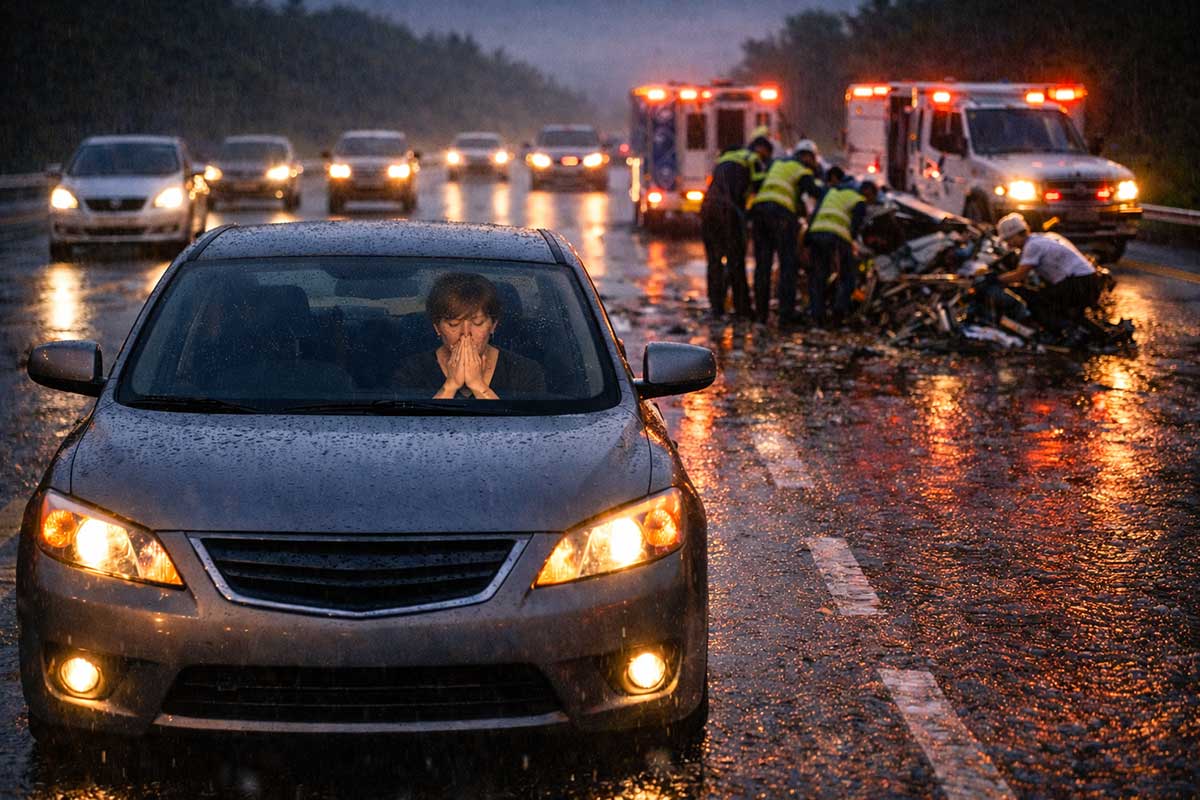
And in that line, there was a detail I will never forget, because it is not symbolic. It is literal. There was a woman in the fifth car back—who was not complaining, not performing, not demanding. She was praying.
And what matters is not the question people always ask—“Why her? Why then?”—as if the purpose of prayer is to satisfy curiosity.
What matters is that among all those human beings, she was the one who cared. She was the one who generated compassion in a moment where compassion is rare.
And that choice—made quietly—became the beginning of a chain of events that showed me something I cannot unlearn:
Prayer is not just something you do. Prayer is something you are capable of—to the degree that your inner life is clean enough to carry it.
Because when prayer is real, it is coherent. It has a signature. It is not mixed with panic, control, or vanity. It is clean compassion—and clean compassion reaches.
So I am not sharing this story to convince you of a doctrine.
I am sharing it to confront you with a spiritual fact you already know but avoid:
You are broadcasting something every day. Fear, resentment, impatience, judgment… or mercy.
And when the moment comes—when someone’s life is in the balance—what you broadcast will matter more than your opinions ever did.
(Note: This is an imaginary conversation, a creative exploration of an idea, and not a real speech or event.)
Topic 1 — The Moral Choice in the Traffic Jam

Moderator: Nick Sasaki
Speakers (5): Caroline Myss, Viktor Frankl, Thich Nhat Hanh, Jonathan Haidt, Kristin Neff
Opening Frame
Nick Sasaki
Before we talk about prayer “working,” we have to face the part of the incident that happens before anything mystical.
A traffic jam. Rain. Emergency lights. A line of drivers stuck in inconvenience while someone up ahead is fighting for her life.
And here’s the first receipt this story offers: most people leaked irritation, but one person generated compassion.
If prayer has power later, it starts here—because prayer is not a trick you do in emergencies. It’s a response you’re capable of only if your inner life is trained.
Caroline, when you tell this story, you always highlight the complaining crowd and the one praying woman. Why is that contrast the real beginning?
Caroline Myss
Because it reveals spiritual character. Compassion is not a personality trait; it’s a moral choice. And most people don’t realize they’re failing that choice in ordinary moments.
Nick’s first question
In that traffic line, what’s the invisible fork in the road—why do most people complain while one person prays?
Viktor Frankl
Because most people live in automatic reaction. The jam becomes “my suffering.” But the fork appears when you recognize a greater suffering nearby. In that moment, you can choose meaning over impulse. The praying woman used the space between stimulus and response.
Jonathan Haidt
Attention is the hinge. The default frame in traffic is self-focus—time pressure, annoyance, entitlement. The outlier is someone who reframes the situation as moral: “Someone is hurt.” Empathy is partly trait, but it’s also the story you tell about what’s happening.
Thich Nhat Hanh
The difference is presence. When you are mindful, you are truly there. Then you can see suffering and your heart responds. Without mindfulness, you are carried by habit energy—irritation, impatience. The jam is not the problem; the absence of presence is the problem.
Kristin Neff
Many people complain because it’s a defense against vulnerability. If you let yourself feel what might be happening up the road, you might feel helpless or scared. Complaint is a shield. Compassion requires the courage to stay open to discomfort.
Caroline Myss
And spiritually, complaint is leakage. It’s an agreement with fear. The one who prays refuses that agreement. She chooses to generate something else—mercy. That’s why she becomes the outlier.
Nick Sasaki
So the fork is attention, presence, emotional courage, and the willingness not to leak fear into the moment.
Nick’s second question
If someone wants to become the kind of person who chooses compassion fast, what’s one daily practice that actually trains that reflex?
Thich Nhat Hanh
One conscious breath, many times a day. When you stop for one breath, you come home to yourself. That is the beginning of compassion. Practice this especially in small irritations. Traffic is a perfect teacher.
Kristin Neff
Micro self-compassion: “This is hard.” It sounds simple, but it changes your nervous system from threat to care. When you’re less harsh with yourself, you’re less reactive with others. Compassion becomes more available.
Jonathan Haidt
Ritualize outward attention. Once a day, choose one person you’d normally ignore—cashier, stranger, neighbor—and silently wish them well or do a small act of kindness. It retrains the default from “me” to “we.”
Viktor Frankl
Ask daily: “What does life ask of me today?” This shifts you from entitlement to responsibility. Compassion becomes faster when you live oriented toward meaning rather than comfort.
Caroline Myss
Integrity. Stop the small lies. Stop the petty resentments. Stop the constant self-justification. Those things pollute compassion. Clean up your inner life and compassion becomes immediate—not because you’re perfect, but because you’re not split inside.
Nick Sasaki
So compassion isn’t just a technique—it’s training the nervous system, training attention, and reducing self-deception.
Nick’s third question
Is “small negativity” harmless venting, or does it shape the emotional climate around suffering?
Jonathan Haidt
It shapes climate. Emotions spread. Complaint becomes a norm. In that atmosphere, compassion feels awkward. But one compassionate act can also reset norms. The stakes are social: what kind of people do we become together?
Kristin Neff
It’s also personal conditioning. Every time you rehearse irritation, you strengthen that pathway. You become less free. Venting feels relieving, but it often trains reactivity.
Thich Nhat Hanh
Negativity waters the seeds of anger in yourself and others. It creates more suffering. When there is already suffering near you, adding anger multiplies it. A calm breath reduces it.
Viktor Frankl
Small negativity is a surrender of freedom. It is a refusal to take responsibility for your inner life. Multiply that surrender by many people and you get a less human world.
Caroline Myss
Negativity is spiritual pollution. It is not neutral. In moments near suffering, it makes you smaller. You don’t have to be saintly—but you must be honest: what you broadcast matters.
Closing Beat — Topic 1 “Receipts” Summary
Nick Sasaki
So Topic 1 gives us the first hard, grounded evidence of what’s to come:
Receipt #1: in the same moment, humans can choose either fear-leakage or compassion-generation.
Receipt #2: compassion is trainable—through presence, attention, self-regulation, and integrity.
Receipt #3: “small negativity” isn’t small; it shapes people and environments.
And this matters because the story’s prayer isn’t floating in the sky. It’s rooted in a person who had already practiced being the kind of person who cares.
Topic 2 — Prayer “Works”: What That Actually Means in This Incident

Moderator: Nick Sasaki
Speakers (5): Caroline Myss, Thomas Keating, Richard Rohr, Andrew Newberg, Lisa Miller
Opening Frame
Nick Sasaki
Topic 1 gave us the ground truth: prayer didn’t start as magic. It started as character—one person choosing compassion under inconvenience.
Now Topic 2 is the part where we tighten the claim everyone throws around too casually: “Prayer works.”
In this incident, “works” could mean three different things, and we’re going to be honest about which ones the story actually supports:
Prayer works because it changes the person praying (calm, coherence, courage).
Prayer works because it reaches the person being prayed for (they feel held, guided, less alone).
Prayer works because it changes outcomes (events, timing, survival).
We’re not going to overclaim. We’re also not going to reduce it into nothing.
Caroline—when you say the prayer “worked,” which meaning are you actually claiming?
Caroline Myss
I’m claiming it reached. It wasn’t just private comfort for the person praying. It became contact—compassion with enough clarity that it could be received.
Nick’s first question
What’s the minimum claim we can responsibly make—something that still counts as “prayer works” even for a skeptic?
Andrew Newberg
Minimum claim: prayer can shift brain and body state—reducing panic, increasing focus, improving emotion regulation. That’s not vague. We can measure changes in stress response and attention. In a crisis, that internal shift matters; it can improve decision-making and resilience.
Lisa Miller
And minimum claim includes connection. People who experience spiritual connection—feeling held by something benevolent—often show greater resilience, especially under threat. Whether you interpret that as God or psychology, the lived effect is: less isolation, more strength.
Thomas Keating
From contemplative prayer: the minimum claim is receptivity. Prayer quiets grasping and opens consent to presence. It doesn’t “make God show up.” It removes resistance. That changes how suffering is endured—less fear, more surrender, more clarity.
Richard Rohr
Prayer works by moving you from separation to union. Even without outcomes changing, you become a different person—less reactive, more compassionate. And because we’re relational beings, that inner change affects the world around you.
Caroline Myss
I accept that baseline, but I want to say: if you stop at “prayer calms me,” you domesticate it. Prayer is meant to align you with truth and love—not just soothe your nervous system.
Nick Sasaki
So the skeptic-friendly baseline is already strong: prayer works as regulation + connection + receptivity + union—all real, all consequential.
Nick’s second question
Now level two: the incident suggests the prayer didn’t just change the woman praying—it affected the receiver’s inner experience. What would count as evidence of that inside this story?
Lisa Miller
Evidence would be a sudden felt sense of being accompanied, guided, or protected—especially without being primed to expect it. That “I’m not alone” shift can be profound and stabilizing.
Andrew Newberg
Yes. If the receiver reports a distinct change—calm or clarity arriving abruptly—that’s meaningful. Also, the key detail here is lack of suggestion: she wasn’t told “someone is praying for you.” That removes one common explanation.
Richard Rohr
And in spiritual terms, that’s what intercession is: love reaching without announcement. The evidence is the quality of the experience—being held, not panicking, sensing benevolence that feels foreign to the chaos.
Thomas Keating
The evidence might be an internal “yes.” A softening, a surrender, a release of resistance in the receiver. Grace often appears quietly. Not fireworks—an opening.
Caroline Myss
The evidence is distinctness. Fear has a signature. Chaos has a signature. But a clean prayer has a signature too—stable, directed, truthful. That’s why I call it a signal. The prayer was not mixed with panic.
Nick Sasaki
So story-evidence looks like: distinctness + abrupt shift + no suggestion + coherence.
Nick’s third question
Level three: outcomes. What’s the most honest way to talk about “prayer changed what happened” without overstating what can be proven?
Andrew Newberg
We can responsibly say prayer may influence outcomes indirectly through known pathways: stress reduction, clarity, faster help-seeking, better decisions, more coordinated response. But direct claims—“prayer altered external events”—can’t be proven from a single narrative.
Lisa Miller
Agreed. We can say: prayer can increase the likelihood of adaptive outcomes by changing inner state and behavior. Whether there’s an additional transpersonal mechanism is beyond what science can confirm.
Thomas Keating
And the tradition warns against treating prayer as transaction. We pray in trust, not control. Outcomes may change, or they may not. Prayer still works because it changes the soul’s posture toward reality.
Richard Rohr
Hold wonder without certainty. If you turn prayer into a scoreboard, you corrupt it. Better language is reverent: “I experienced help,” without claiming you can map exactly how God intervened.
Caroline Myss
Exactly. Don’t insult mystery by trying to domesticate it. The story isn’t asking you to prove prayer like a product demo. It’s asking you to become accountable to love as an active force. If you want proof, become the fifth-car person for someone else.
Closing Beat — Topic 2 “Receipts” Summary
Nick Sasaki
So here’s what we earned—without cheating:
Receipt #1 (baseline): prayer reliably changes inner state—panic → coherence, fear → receptivity.
Receipt #2 (story-level): it can be experienced as contact in the receiver—distinct, coherent, not suggested.
Receipt #3 (outcome language): prayer may influence outcomes indirectly; direct intervention remains mystery, not certainty.
That’s a strong, honest framework for “prayer works,” grounded in this incident.
Topic 3 — The Fifth Car Mystery: The Strongest “Receipts” in the Whole Story
Moderator: Nick Sasaki
Speakers (5): Caroline Myss, Thich Nhat Hanh, Andrew Newberg, Bruce Greyson, Michael Shermer
Opening Frame
Nick Sasaki
If Topic 2 defined what “prayer works” can mean, Topic 3 is where the story puts weight behind it.
Because “the fifth car back” isn’t just a poetic detail. It’s a claim of specific, localized compassion—a real human being in a real place—and that compassion had a quality strong enough to register as help.
So tonight we’re not asking “why her, why then.”
We’re testing three story-receipts:
Outlier compassion: in a crowd of irritation, one person cared.
Distinct signal: the prayer felt coherent and different from fear-noise.
No suggestion: the receiver wasn’t told anyone was praying.
Caroline—first, say it plainly: why do you keep the detail “fifth car back” instead of just “someone prayed”?
Caroline Myss
Because it removes abstraction. It wasn’t “the universe.” It was a human being close enough to be counted—choosing compassion. That’s what gives prayer moral weight. It’s an act.
Nick’s first question
Receipt #1: Why do you think one person prayed when most people complained—what creates an “outlier of mercy” in that exact kind of moment?
Thich Nhat Hanh
Presence. When you are mindful, you touch the moment deeply. You see suffering. Compassion is natural then. Without presence, people are trapped in the story of “my inconvenience.” The outlier is simply awake.
Michael Shermer
Group situations encourage conformity. In traffic, the norm is self-focus and irritation. An outlier is someone who resists that norm and reframes the moment morally. That’s not mysterious; it’s rare moral attention. And the lesson is actionable: train your attention outward.
Andrew Newberg
Habit matters. If this woman had a practiced prayer life, her nervous system and attention patterns are trained to respond with calm focus under stress. That increases the odds she’ll choose prayer instead of complaint. Practice makes compassion more automatic.
Bruce Greyson
In crisis narratives, people remember the calm helper because it changes the emotional weather. When one person embodies care, it stands out dramatically against the background of panic or irritation. It can become the “anchor” the mind returns to.
Caroline Myss
And it’s integrity. People don’t become clean channels in an emergency if they live in spiritual clutter. Outlier mercy is usually the visible tip of a hidden life—someone who has practiced compassion when no one was watching.
Nick Sasaki
So the outlier isn’t random. It’s presence + training + integrity + moral reframing.
Nick’s second question
Receipt #2: Caroline says the prayer felt distinct—a clean line, not chaos. What would make a compassionate intention feel “different” from panic, imagination, or random brain imagery?
Andrew Newberg
Coherence is the key. Panic feels fragmented and noisy. Coherence feels stable and clear. The brain can produce coherent imagery, yes—but coherence is still a meaningful marker: it signals a regulated state, not a chaotic one. If she experienced a “clean line,” it may reflect an organized perception of benevolence—internally generated or externally prompted.
Bruce Greyson
Many NDE accounts describe presences that are unmistakably benevolent—calm, loving, clear. People often say it’s “more real than real.” The distinct quality is part of why it’s transformative. It doesn’t feel like a dream; it feels like contact.
Thich Nhat Hanh
Compassion has peace. It is not dramatic. It is simple and stable. When you are thirsty, you know water. You do not confuse water with fire. In suffering, you can recognize true compassion because it soothes rather than agitates.
Michael Shermer
Here’s the skeptical pressure test: our minds are meaning-making machines. Under extreme stress, you can get a sense of presence. But Caroline’s claim has specificity: not just “I felt something comforting,” but “I perceived a clean, directed compassion amid the noise.” Random pattern-making is often messy. A consistent, coherent “signal” is harder to explain away casually—though not impossible.
Caroline Myss
Exactly. This isn’t about seeing a cartoon halo. It’s about recognizing truth. Fear has a taste. Ego has a taste. But prayer rooted in real compassion has a taste too—clean, quiet, stable. In that state, you can distinguish them.
Nick Sasaki
So “distinct” doesn’t mean flashy. It means coherent, peaceful, truth-like—different from the emotional static around it.
Nick’s third question
Receipt #3: No suggestion. She wasn’t told “someone is praying for you.” What’s the most honest interpretation we can give that respects the experience without claiming certainty we can’t prove?
Michael Shermer
The honest interpretation is: it’s an interesting, meaningful data point. No suggestion reduces expectation effects. But it doesn’t eliminate brain-based explanations for presence experiences. So we should say: the experience is real and consequential; the metaphysical mechanism remains open. And we should focus on what it teaches ethically—be the outlier of mercy.
Andrew Newberg
Agreed. The lack of suggestion makes it less likely to be socially induced placebo. In my view, the strongest claim is: she experienced a coherent benevolent presence that improved her inner state. Whether that came from an external prayer or her brain translating felt safety into imagery is not definitively answerable from one case.
Bruce Greyson
From the NDE research side, we can say: these experiences often occur without prior belief or expectation and can lead to durable life changes. That doesn’t prove an afterlife, but it makes dismissal simplistic. The respectful stance is humility: “We don’t fully understand this, but we take it seriously.”
Thich Nhat Hanh
When love is present, it reaches. The label is less important than the practice. If the story leads people to become more compassionate, then it has touched truth.
Caroline Myss
If someone needs certainty before they allow themselves to believe love is real, they’ll never live with reverence. The point is not to win an argument. The point is that compassion can be perceived as help—and this story calls you to become that help.
Nick Sasaki
So we land it like this: we respect the experience, we keep intellectual humility, and we treat the ethical instruction as non-negotiable.
Closing Beat — Topic 3 “Receipts” Summary
Nick Sasaki
Here’s why Topic 3 is the strongest part of the “prayer worked” arc:
Receipt #1: one person became an outlier of mercy.
Receipt #2: the prayer was experienced as distinct—coherent, peaceful, directed.
Receipt #3: it arrived without suggestion—making it harder to dismiss as expectation alone.
That doesn’t turn the story into laboratory proof. But it does turn it into a serious case for prayer as real contact, not just self-soothing.
Topic 4 — The NDE Perspective: What the “Above the Scene” View Proves (and Doesn’t)

Moderator: Nick Sasaki
Speakers (5): Caroline Myss, Bruce Greyson, Anil Seth, Bessel van der Kolk, Carl Jung
Opening Frame
Nick Sasaki
Topic 3 gave us the strongest internal evidence that prayer can “reach”: outlier compassion, distinct signal, no suggestion.
Now Topic 4 is the pivot: the moment Caroline describes an “above the scene” perspective—seeing the accident and the line of cars from a vantage point that doesn’t feel like ordinary consciousness.
This is where people split into camps. One side declares it proof of the afterlife. The other side dismisses it as brain noise.
But if we keep the receipts approach, the incident offers something more valuable than a fight:
- Priority collapse: ego concerns lose authority instantly.
- Distinct quality: the experience is coherent, not merely chaotic panic.
- After-effect test: what changed afterward becomes the real evidence.
Caroline, before we analyze anything—what did that perspective do to your priorities in the first second?
Caroline Myss
It made my ordinary concerns disappear. It was like being exposed to truth—no bargaining, no performance. Just what matters.
Nick’s first question
Receipt #1: In that “above the scene” view, what falls away first—fear, ego, identity, attachment—and what does that reveal?
Bruce Greyson
Fear often drops first. That’s one of the most consistent reports. People describe peace and clarity even in life-threatening situations. Then ego concerns fade—status, roles, small anxieties. What remains is connection and meaning. That reveals how flimsy our usual priority system is.
Bessel van der Kolk
From a trauma perspective, the body often goes into alarm or shutdown. But we need to distinguish states. Simple dissociation can feel numb or fragmented. Many NDE-like accounts are vivid, organized, and emotionally meaningful. That suggests something beyond a basic collapse—more like a reorganized state where fear quiets and perception becomes strangely clear.
Anil Seth
The brain constructs the self-model—“me in this body, here in this place.” Under extreme conditions, that model can destabilize. When it loosens, you can feel detached from the body or “above” the scene. So what falls away might be the brain’s usual narrative of self. The reveal is: identity is more constructed than we assume.
Carl Jung
In confrontation with death, the ego cannot maintain its illusion of control. The psyche may reveal the Self—a larger, transpersonal center. The “above” vantage point is symbolically significant: it is perspective beyond the ego’s theater. It reveals that life has a moral and meaning dimension the ego tries to ignore.
Caroline Myss
Control collapses first. When control collapses, fear loses fuel. People think fear is primary. It’s not. The ego’s obsession with control generates fear. In that perspective, the control story dies—and you see what you’ve been feeding with your life energy.
Nick Sasaki
So the first receipt is solid: the experience strips away control and ego priority, and forces a truth-based ordering of life.
Nick’s second question
Receipt #2: People often describe NDE perception as coherent and “more real than real.” What’s the most honest claim we can make about that quality without overstating what one story can prove?
Anil Seth
We can say altered states can be intensely vivid and carry a strong sense of certainty. That “realness” doesn’t automatically mean it’s external reality—it may be the brain generating a high-confidence model. So: the quality is psychologically compelling, but it’s not definitive metaphysical evidence.
Bruce Greyson
At the same time, “mere hallucination” is a sloppy phrase. These experiences often have consistent themes and can lead to durable changes. We don’t fully understand why they’re so coherent. I wouldn’t claim proof of consciousness beyond the brain, but I would claim it’s a serious phenomenon that deserves humility and study.
Bessel van der Kolk
Clinically, the coherence matters because it predicts integration. If someone returns with increased compassion and less fear, we treat the experience as meaningful—not as random noise. The quality of the experience becomes part of its therapeutic and moral impact.
Carl Jung
Symbolic reality can be more compelling than physical events because it reveals archetypal truth. Even if you refuse metaphysics, the psyche’s images have a truth-function. “More real than real” may reflect contact with deeper psychic structure—something beyond the persona’s daily fictions.
Caroline Myss
The demand for “proof” is often a defense against transformation. The coherence is the point: fear is chaotic, ego is chaotic—but grace is coherent. The experience has the signature of truth. You can debate mechanisms; you cannot debate what it requires of your life afterward.
Nick Sasaki
So we don’t claim metaphysical certainty from intensity—but we do claim the coherence makes it ethically and psychologically consequential.
Nick’s third question
Receipt #3: After-effects. What changes do people most reliably bring back from this perspective—and why do they struggle to live it once “normal life” returns?
Bruce Greyson
Common changes: less fear of death, more compassion, less materialism, more sense of purpose. The struggle comes from returning to the same environment—old demands, old habits, old social incentives. Without support, people slide back.
Bessel van der Kolk
The nervous system pulls you back to baseline. Insight alone doesn’t rewire the body. People need embodied practices—breath, movement, safe connection—to stabilize the new perspective. Otherwise the old stress loops reclaim them.
Anil Seth
Cognitive inertia. The brain is built for continuity. It absorbs anomalies and restores the familiar self-model unless you change reinforcement—your routines, relationships, and how you interpret your own identity.
Carl Jung
Because individuation costs. The experience often calls you to let an old identity die. That threatens belonging and comfort. Many prefer to keep the old self and turn the experience into a story instead of a transformation.
Caroline Myss
Because integrity is expensive. People want spiritual experiences that inspire without demanding change. But the “above the scene” view returns with one instruction: stop negotiating with the truth. Most people fail not for lack of understanding, but for lack of courage.
Nick Sasaki
So the real evidence isn’t the cinematic “above” view. It’s whether it produces durable changes—and whether you pay the cost to keep them.
Closing Beat — Topic 4 “Receipts” Summary
Nick Sasaki
Here’s what Topic 4 adds to the arc:
- Receipt #1: the perspective collapses ego priorities—control loosens, fear quiets, truth rises.
- Receipt #2: coherence makes it more than “random brain noise,” even if it doesn’t prove metaphysics.
- Receipt #3: the after-effect test is the real proof: compassion, purpose, integrity—often resisted because it costs identity.
Topic 5 — Gratitude That Becomes Action: The Behavioral Proof

Moderator: Nick Sasaki
Speakers (5): Caroline Myss, Robert Emmons, Brené Brown, Adam Grant, Marshall Rosenberg
Opening Frame
Nick Sasaki
If you want the cleanest “proof” that something real happened in Caroline’s incident, it isn’t the metaphysics.
It’s the ending.
She doesn’t just survive and tell a good story. She tracks the woman down. She shows up with flowers. She turns an invisible act of compassion into a real human bond.
That’s why Topic 5 matters: it’s the behavioral receipt that the prayer and the NDE weren’t just emotional entertainment—they produced an embodied response.
Our receipts tonight:
Embodied response: gratitude becomes action, not just feeling.
Vulnerability cost: receiving grace threatens the ego story of control.
Reciprocity loop: the gift multiplies outward—repair, generosity, service.
Caroline—why is this “tracking her down” part essential to the message?
Caroline Myss
Because it separates reverence from sentimentality. Gratitude is a moral response to grace. If you don’t respond, you turn grace into entitlement.
Nick’s first question
Receipt #1: Why do most people stop at “I feel grateful,” but in this incident she converted gratitude into action—tracking the praying woman down?
Robert Emmons
Deep gratitude creates a shift in identity: “I have been given something I did not earn.” When gratitude reaches that level, people are moved to express and reciprocate. Tracking her down is gratitude becoming embodied. It’s not just emotion—it’s transformation into behavior.
Adam Grant
Because gratitude can feel like “debt,” and many people hate that feeling—so they avoid the source and minimize the gift. But healthy gratitude isn’t debt; it’s relationship. Showing up with flowers is saying, “You mattered,” and that strengthens prosocial bonds rather than creating shame.
Brené Brown
It also requires vulnerability. Most people would rather keep their pride than say, “I needed you.” Action exposes you. A doorstep reunion is emotionally naked—beautiful, but scary. That’s why so many people keep gratitude private.
Marshall Rosenberg
Action comes when gratitude becomes specific. Not “thanks for everything,” but “when you did this, it met my need for hope/safety/companionship.” Specific gratitude naturally seeks completion—connection, acknowledgment, relationship.
Caroline Myss
And because the conscience is either honored or silenced. People delay until the ego shrinks the moment: “It wasn’t that big a deal.” She didn’t let the ego shrink it. She honored it while the truth was still alive in her.
Nick Sasaki
So: gratitude becomes action when it’s identity-level, relational (not debt), vulnerable, specific, and not delayed into oblivion.
Nick’s second question
Receipt #2: Why is it hard for people to admit they were saved, supported, or carried—why do we resist receiving?
Brené Brown
Receiving cracks the “I’m fine” armor. It admits you’re human and you needed help. That’s terrifying for people who equate worth with independence. But the truth is: receiving is strength. It’s letting love land.
Adam Grant
There’s also a power dynamic. People like being givers because it feels strong. Receiving feels dependent. But communities work when giving and receiving are reciprocal. If you can’t receive, you’re not independent—you’re controlling connection.
Robert Emmons
Receiving confronts entitlement. Gratitude says, “I didn’t do this alone.” That’s humbling, and humility is hard. But it’s also the gateway to connection and psychological health.
Marshall Rosenberg
People confuse receiving with owing. But acknowledging care is not signing a contract. It’s naming reality: “Your compassion met my need.” That can actually liberate both people from unspoken tension.
Caroline Myss
The ego wants ownership of the story: “I survived because I’m strong.” The soul tells the truth: “I survived because love reached me.” Receiving grace requires humility—and humility is the ego’s hardest discipline.
Nick Sasaki
So the resistance isn’t about flowers; it’s about surrendering the ego’s preferred narrative.
Nick’s third question
Receipt #3: What’s a modern version of “bringing the flowers”—a simple act that turns gratitude into something real, without melodrama or performance?
Marshall Rosenberg
Send a message with three truths:
what you did,
what need it met in me,
how I feel now.
That’s a bouquet made of language.
Robert Emmons
Write a gratitude letter and deliver it—voice or in person. And make one concrete life change that honors the gift. Gratitude becomes real when it shapes choices.
Adam Grant
Multiply the gift: help someone else in a similar position, or connect people who can help each other. Don’t just “repay”—expand the circle of care.
Brené Brown
Let it lead to courage: apology, repair, honesty. Sometimes the bouquet is: “I’ve been withholding love, and I’m done.” Gratitude should make you braver.
Caroline Myss
Do it privately and promptly. Don’t turn reverence into content. The point is to honor grace, not harvest applause.
Nick Sasaki
That might be the cleanest closing instruction in the whole series: respond quickly, specifically, courageously, and without performance.
Closing Beat — Series Arc Summary in One Breath
Nick Sasaki
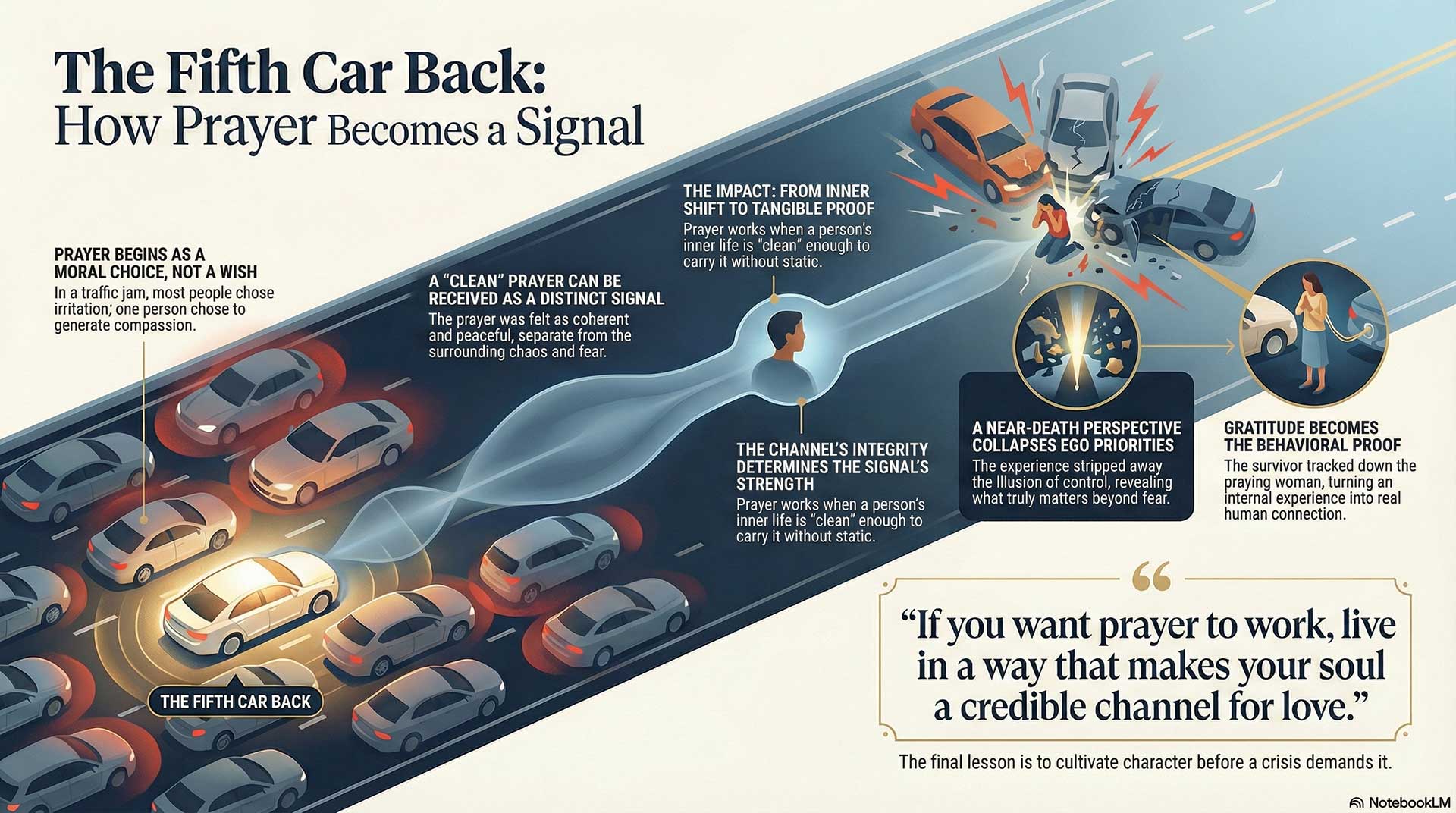
So if we compress the whole incident into a single “prayer really worked” arc:
It starts with character: one person chooses compassion in traffic.
It becomes contact: prayer feels distinct and reaches without suggestion.
It expands into perspective: the ego priority system collapses under truth.
It ends as behavior: gratitude becomes action—proof that the experience changed life, not just mood.
Caroline, last sentence—what is the lesson this incident demands from the viewer?
Caroline Myss
If you want prayer to work, live in a way that makes your soul a credible channel for love.
Final Thoughts by Caroline Myss
If you listen to this story the way most people listen, you will treat it as a mystery to analyze.
You will want to debate mechanisms. You will want to reduce it into psychology or elevate it into spectacle. You will want certainty, and you will want control.
But that is not what this story is for.
This story is not asking you to solve a puzzle.
It is asking you to become a different kind of person.
Because here is what this incident revealed with painful clarity:
Most people live in spiritual unconsciousness. They drift through ordinary moments leaking negativity, rehearsing impatience, feeding resentment—and they never realize they are training themselves to be the kind of person who cannot show up when it matters.
Then they turn around and ask why their prayers feel empty.
Prayer “works” when your life supports it.
Not when your words are emotional.
Not when your crisis is dramatic.
Not when you want a miracle on demand.
Prayer works when compassion has become your reflex.
In this story, a woman in the fifth car back chose compassion in a moment where most people chose complaint. And that compassion had a coherence strong enough to be perceived as help—because it was clean.
Then the second truth arrived: the “above the scene” perspective—where ego collapses and the soul is forced into honesty. That is what near-death experiences do. They strip away your bargaining and leave you with a single question:
Did you live truthfully?
And finally, the ending that proves the story didn’t remain a sensation—it became a moral response:
Gratitude became action. A life touched by grace responded with reverence. A bouquet on a doorstep. Two women smiling. Not because the world became perfect, but because love became real.
So if you want the lesson in one line, here it is:
Do not ask prayer to prove itself to you.
Prove yourself worthy of prayer.
Clean up your inner life. Choose compassion when it is inconvenient. Respond to grace while your conscience is still awake.
And when you find yourself in the fifth car back of someone else’s crisis—be the one who cares.
That is how prayer works.
Short Bios:
Caroline Myss — Christian mystic and bestselling author known for blending spiritual intuition with archetypes, sacred contracts, and the idea that personal truth shapes health and destiny.
Nick Sasaki — Writer/creator of ImaginaryTalks who moderates big-idea roundtables with a focus on practical takeaways, emotional honesty, and story-driven structure.
Richard Rohr — Franciscan priest and contemplative teacher who emphasizes nondual Christianity, inner transformation, and prayer as union rather than control.
Thomas Keating — Trappist monk who helped revive Centering Prayer, teaching prayer as surrender, silence, and consent to divine presence.
Marianne Williamson — Spiritual teacher and author associated with A Course in Miracles, focused on forgiveness, love-based perception, and moral courage.
Lisa Miller — Psychologist and researcher known for scientific work on spirituality as a protective factor for mental health and resilience.
Andrew Newberg — Neuroscientist and “neurotheology” researcher who studies how prayer and spiritual practices affect the brain and human experience.
Bessel van der Kolk — Psychiatrist and trauma expert, author of The Body Keeps the Score, focused on how trauma reshapes body, memory, and perception.
Dan Siegel — Psychiatrist and educator behind “mindsight,” integrating neuroscience with emotional regulation and relational health.
Julia Galef — Writer and rationality thinker known for “scout mindset,” bringing clear, bias-aware reasoning to uncertainty and decision-making.
Michael Shermer — Science writer and skeptic who explores why humans believe, how we detect patterns, and where reasoning goes wrong.
Judith Orloff — Psychiatrist and intuitive/empath teacher focused on sensitivity, boundaries, and distinguishing intuition from emotional overwhelm.
Brené Brown — Research professor and author known for work on shame, vulnerability, courage, and wholehearted living.
Gabor Maté — Physician and author focused on trauma, addiction, and compassion as the doorway to healing.
James Hollis — Jungian analyst and author who explores shadow work, meaning, and the psychological cost of living an unlived life.
Tara Brach — Psychologist and meditation teacher known for radical acceptance and compassion-based mindfulness.
Peter Levine — Creator of Somatic Experiencing, focused on resolving trauma through nervous system completion and embodied safety.
Esther Perel — Therapist and author known for sharp insights on desire, betrayal, power, and modern relationships.
Harriet Lerner — Psychologist and author focused on boundaries, anger, family patterns, and changing stuck relationship dynamics.
Edith Eger — Holocaust survivor, psychologist, and author known for forgiveness, freedom, and resilient meaning-making after trauma.
Thich Nhat Hanh — Zen master and peace activist who taught mindfulness, compassionate speech, and wise boundaries rooted in peace.
Ramani Durvasula — Clinical psychologist known for clear education on narcissistic dynamics, emotional abuse, and recovery through reality-based boundaries.
Viktor Frankl — Psychiatrist and Holocaust survivor, founder of logotherapy, emphasizing meaning, responsibility, and inner freedom.
Parker J. Palmer — Writer and educator focused on living “undivided,” integrity, vocation, and the courage to be real.
Daniel Kahneman — Psychologist and Nobel laureate whose work on cognitive biases shows how self-deception shapes choices and judgment.
Kate Bowler — Theologian and author who critiques “fix-it faith” while honoring real grace, suffering, and honest spirituality.
James Clear — Writer known for behavior change frameworks that treat identity and habits as the practical foundation of transformation.
Leave a Reply