

|
Getting your Trinity Audio player ready...
|
Dr. Marieke de Winkel (Art Historian)
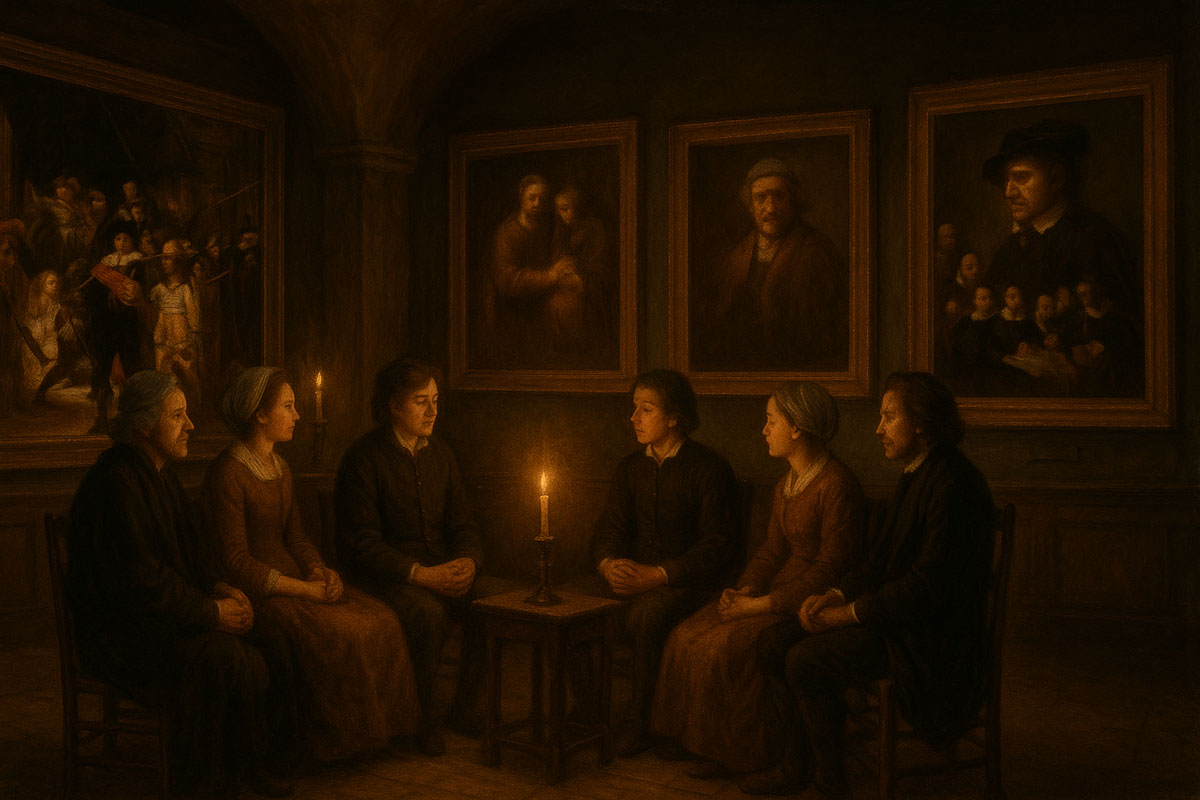
Setting: A quiet gallery before dawn. The paintings are dim but waiting. The chairs are empty—for now.
He painted men as they were, not as they wished to be remembered. He painted women with silence instead of spectacle. He painted his own aging face more than eighty times—not out of vanity, but out of compulsion, as if asking, again and again, ‘Am I still here?’
Rembrandt Harmenszoon van Rijn, born in Leiden in 1606, died nearly penniless in Amsterdam in 1669. And yet today, he fills museums, textbooks, and the imagination of those who look too long at a canvas and begin to feel something stir.
This is not a biography. This is a gathering. Five of his most intimate companions have returned—his wife, his son, his beloved partner, his closest friend, and his teacher. And yes… Rembrandt himself has joined them, not to explain, but to listen.
Together, they will revisit five paintings—not to decode them, but to dwell within them.
Welcome to a room where time does not march, but pauses.
Where the paint still breathes.
Where the soul of a man rests just beneath the varnish.
(Note: This is an imaginary conversation, a creative exploration of an idea, and not a real speech or event.)

Topic 1: The Night Watch — What Was He Really Marching Toward?
Moderator: Dr. Marieke de Winkel (Rembrandt scholar)
Speakers:
Rembrandt van Rijn (the painter himself)
Saskia van Uylenburgh (wife)
Titus van Rijn (son)
Hendrickje Stoffels (partner)
Jan Six (friend and patron)
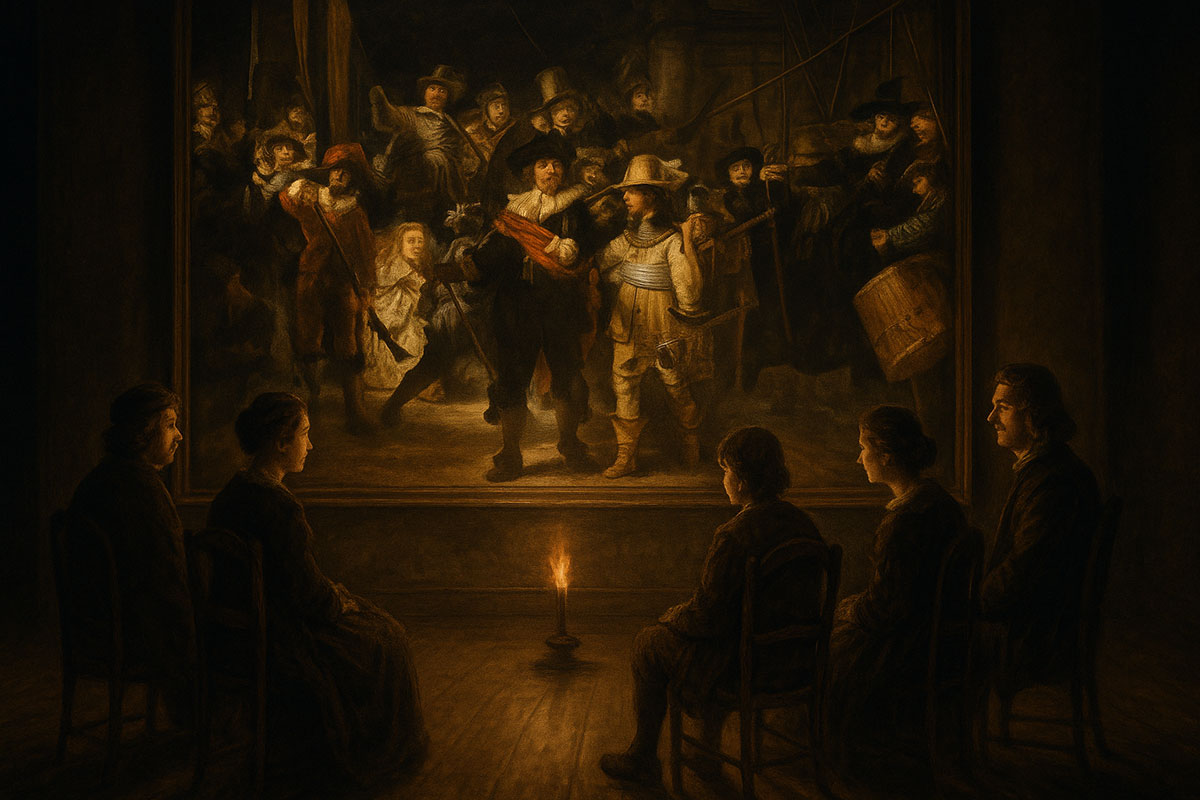
[Scene: A private after-hours gathering inside the Rijksmuseum. "The Night Watch" looms over the group, bathed in warm light. A velvet rope keeps the room empty. Dr. Marieke de Winkel welcomes five spirits seated on low chairs, each with a glass of wine—Rembrandt included.]
Dr. Marieke de Winkel (moderator):
We stand before The Night Watch—a painting that marches, not just in motion, but in meaning. Tonight, I ask each of you: What was Rembrandt truly marching toward when he made this?
Rembrandt van Rijn (with a slow grin):
I was marching toward truth—though truth rarely pays. They asked me for pride; I gave them humanity. I saw men not as heroes but as actors in light and shadow. That little girl? The chicken? That wasn’t madness—it was balance. The eye moves with tension. I didn’t paint what they wanted, I painted what I saw. And they called it failure. But art must defy if it wishes to endure.
Hendrickje Stoffels:
I remember him coming home angry—not loud, but quiet-angry. “They don’t understand,” he muttered. But I saw what he was doing. He wasn’t painting a parade; he was painting a moment in time, mid-breath. I used to watch him study how light hit a dust-speck. In The Night Watch, he captured life at full gallop, imperfect and alive.
Titus van Rijn:
I was just a child, but that painting felt like a storm frozen on canvas. All the motion, the clamor... I used to imagine I was one of those boys tucked in the shadows. My father didn’t just paint faces—he painted fears. Dreams. That’s what he was marching toward: something beyond the eyes.
Saskia van Uylenburgh:
Before I died, he told me of a dream. A painting that wasn’t still but alive. “Sas,” he said, “I want the paint to breathe.” He had begun the sketch for this even then. He saw shadows not as absence of light but as proof that light existed. And yet, when it was unveiled, they whispered, judged. They wanted flattery. He gave them vision.
Jan Six:
And I told him—God knows I tried—“You’re losing commissions with this!” But he shrugged. Said, “Then I lose them.” He knew this piece would cost him. He did it anyway. That’s what makes it great. The Night Watch was a personal rebellion. Against trend, against politics, against silence. He was marching into artistic exile—and didn’t blink.
Dr. Marieke de Winkel:
So you believe this wasn’t just a portrait of a militia, but of a man crossing a threshold. Who was he becoming at that time?
Titus:
He was becoming... unsellable. But unstoppable. The world stopped buying, but he couldn’t stop painting.
Saskia:
He was becoming someone I would have loved even more—less careful, more himself. And that is no small thing.
Hendrickje:
He became light’s servant. Even in darkness, he found glow. Even when mocked.
Jan Six:
He was becoming too much for the world around him. But not enough for history yet. He was out of time—but ahead of it.
Rembrandt (quietly):
I was becoming free.
Dr. Marieke de Winkel:
If you could speak to the world today, Rembrandt, and see your painting as centerpiece of Dutch pride and global admiration... what would you say?
Rembrandt (smiling faintly):
I’d say, “Took you long enough.”
But then I’d ask: “Are you seeing—or still just looking?”
Hendrickje:
He’d walk up close, touch the crackled varnish, and sigh: “I should’ve used more ochre.”
Titus (grinning):
He’d ask where the ladder is. He’d want to fix one brushstroke.
Saskia:
He’d weep. Just once. Then he’d laugh. And say, “Now do you see?”
Jan Six:
He’d still argue about the lighting in the gallery.
Dr. Marieke de Winkel:
And so we begin—not with applause, but with defiance. The Night Watch wasn’t just a commission—it was a compass. And tonight, it has led us deeper into the soul of the man who painted by instinct, not instruction.
Topic 2: The Jewish Bride — Can Love Be Painted Without Words?
Moderator: Dr. Marieke de Winkel (Dutch art historian and Rembrandt scholar)
Speakers:
Rembrandt van Rijn (Painter)
Hendrickje Stoffels (Partner)
Titus van Rijn (Son)
Jan Six (Friend and Patron)
Pieter Lastman (Mentor)
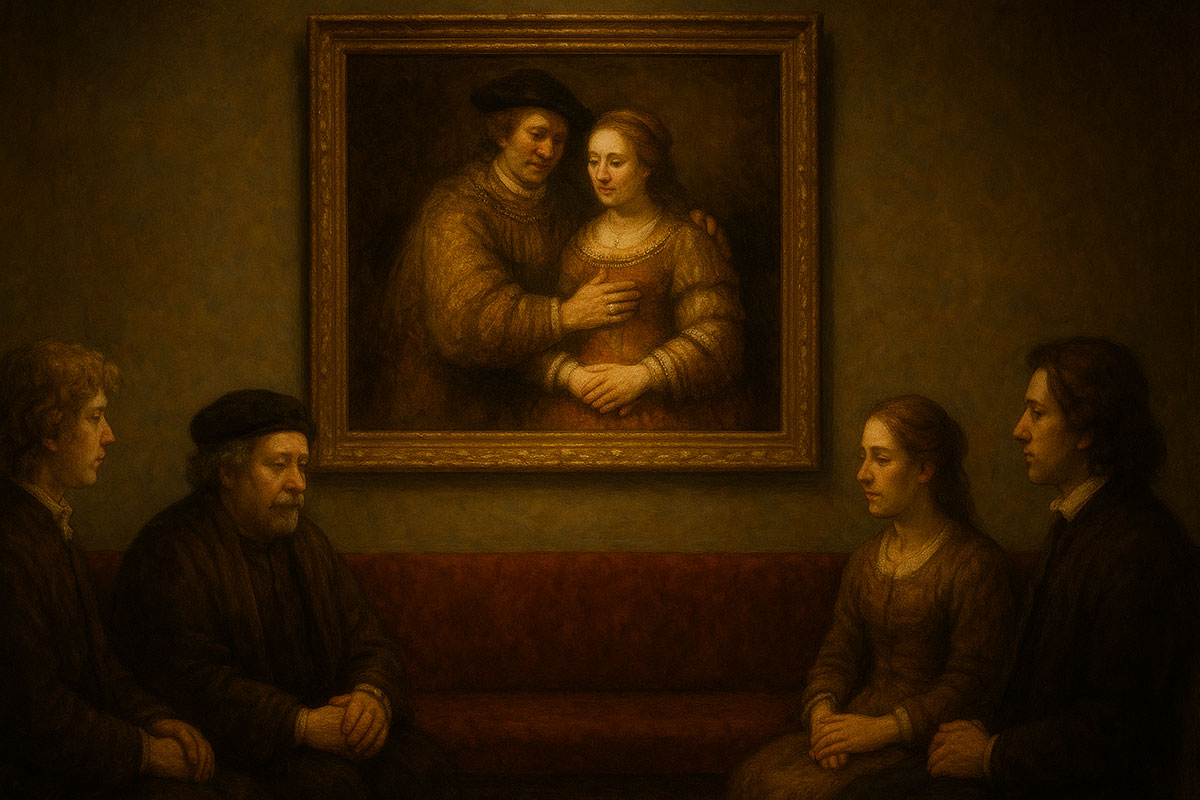
[Scene: A quiet wing of the Rijksmuseum. "The Jewish Bride" hangs alone in a warm, softly lit room. The group gathers on velvet chairs in a semicircle. The atmosphere is reverent, like standing before a whispered confession frozen in paint.]
Dr. Marieke de Winkel (moderator):
Tonight we turn to The Jewish Bride. A painting of a man and a woman—not posed or adorned, but connected. A hand on her chest, his gaze full of awe. No clear narrative, yet somehow unmistakable. My question: Can love be painted without words? Rembrandt, let’s begin with you.
Rembrandt (softly):
I tried to paint what silence feels like when love is real. No titles, no myths. Just two people, wrapped in stillness and trembling. I wasn’t painting history—I was painting mercy. A man who loves gently. A woman who receives without shrinking. I’d lost so much by then. What I had left... was tenderness.
Hendrickje Stoffels (with tears in her eyes):
It was us. You never said it aloud, but I knew. I saw the way your hand shook when you painted his fingers on her dress. How carefully you caught the shimmer of fabric, but gave more light to her skin. It was not just brushwork. It was memory. You weren’t painting models. You were remembering how to love through grief.
Titus van Rijn:
When I first saw it, I asked, “Who are they supposed to be?” And he just smiled and said, “Whoever you need them to be.” I think that was the point. We were losing everything—money, friends, even our name. But this... this was wealth of another kind. My father painted devotion, not decoration. I think he needed to prove to himself it still existed.
Jan Six (nods thoughtfully):
At the time, this didn’t sell well. Too still, too ambiguous, too... human. But I remember walking into his studio and seeing it in progress. I couldn’t speak. There was no spectacle, no glory—just gravity. You looked at it and knew: This is what intimacy looks like when no one is watching.
Pieter Lastman (gentle, proud):
He surpassed me in the one thing I never dared attempt: stillness. I taught him drama, movement, myth. But here... he taught the world restraint. No story, just presence. This was not a biblical couple. This was a man and a woman. A soul meeting a soul. In silence. In awe.
Dr. Marieke de Winkel:
And what was Rembrandt becoming when he painted this?
Hendrickje Stoffels:
Humbled. After all the loss—the bankruptcy, the judgment—he became softer, not harder. I would watch him pause between brushstrokes as if afraid to breathe too loudly. That gentleness... it changed me too.
Titus van Rijn:
He was becoming a man at peace with not being celebrated. He no longer needed the world’s applause. He needed truth, even if it was quiet.
Jan Six:
He was becoming dangerously honest. Even in art, silence is risky. But he no longer chased patrons—he chased meaning.
Pieter Lastman:
He became a monk with a brush. Devoted. Unhurried. Holy in his patience.
Rembrandt (smiling faintly):
I was becoming invisible. And somehow, that made the love visible.
Dr. Marieke de Winkel:
And if the world asked you today what this painting means, what would you tell them?
Rembrandt:
I would say: “It means you are not alone.”
Hendrickje:
I would say: “It means love can survive ruin.”
Titus:
It means there’s strength in softness. That stillness holds more truth than spectacle ever could.
Jan Six:
It means there are paintings meant to be understood not with the eyes—but with the chest.
Pieter Lastman:
It means the master has spoken his final word, and that word is grace.
Dr. Marieke de Winkel (quietly):
And so we leave not with a story—but with a feeling. The Jewish Bride asks nothing but to be felt. It reminds us: not all masterpieces shout. Some simply stand... and stay.
Topic 3: The Return of the Prodigal Son — Was Forgiveness the Final Brushstroke?
Moderator: Dr. Marieke de Winkel (Rembrandt scholar, Rijksmuseum)
Speakers:
Rembrandt van Rijn (Painter)
Titus van Rijn (Son)
Hendrickje Stoffels (Partner)
Saskia van Uylenburgh (Wife)
Pieter Lastman (Mentor)
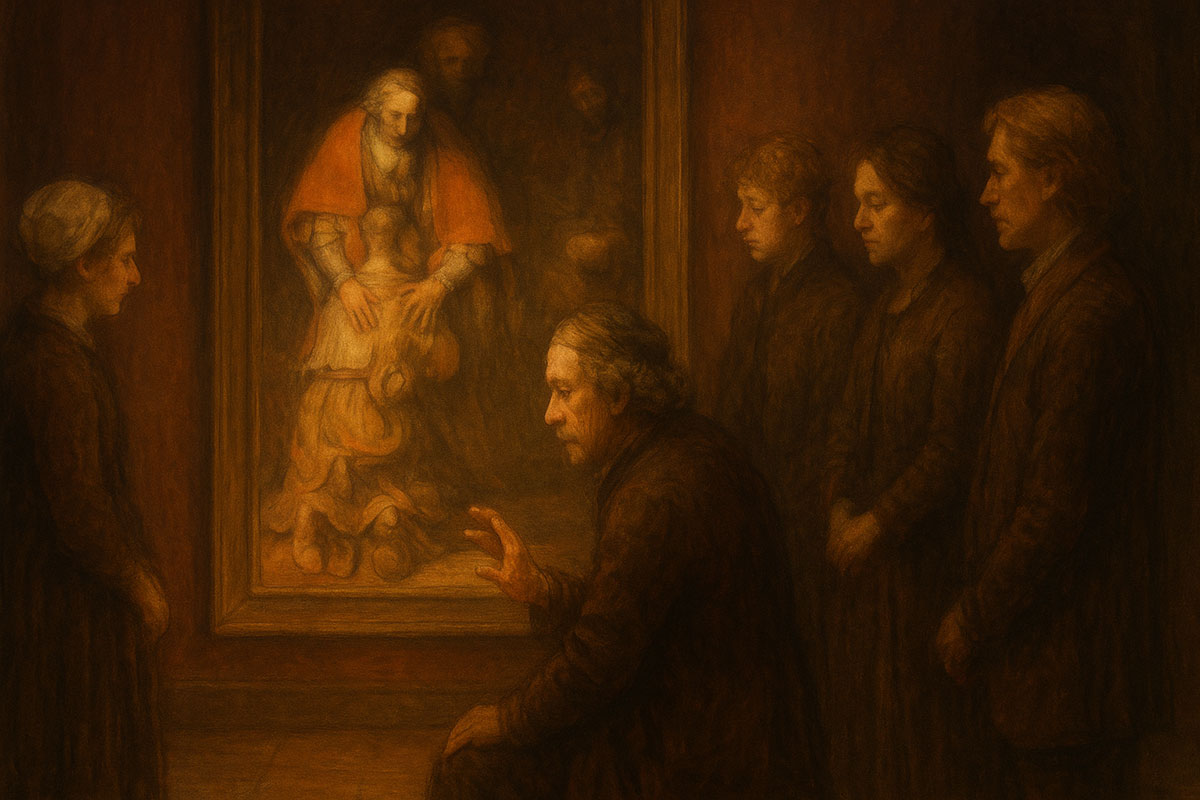
[Scene: A hushed chapel-like gallery at the Hermitage Museum in St. Petersburg. The Return of the Prodigal Son glows in the dimmed light—massive, still, aching. The five speakers sit on wooden benches before it, with Dr. Marieke de Winkel standing just behind, hands gently folded.]
Dr. Marieke de Winkel (moderator):
This painting—Rembrandt’s Return of the Prodigal Son—is often called his last great sermon. A father, silent and aged, embraces his broken son. Light bathes the embrace, while others linger in judgment and shadow. My question: Was forgiveness Rembrandt’s final brushstroke?
Titus van Rijn (softly):
I think so. He painted this not long before he died—and I was already gone. I wonder if he painted me. The younger son, failed, bruised. But also... himself. He was that father too—weathered, tired, still loving. In this painting, he stopped performing. He asked for nothing. He just... forgave.
Rembrandt (gazing up at the canvas):
By the time I painted this, I had lost nearly everything—money, friends, Saskia, even Hendrickje. But the hardest loss was myself. Forgiveness wasn’t just the subject—it was the act of painting itself. Each stroke, a confession. Each shadow, an admission. This wasn’t art. This was absolution.
Hendrickje Stoffels (her voice trembling):
He was different in those days. Quieter. Slower. There were mornings I’d find him just staring out the window—not sketching, just... still. When he began this painting, he didn’t say much. But I knew. I felt it. He wasn’t trying to impress. He was trying to make peace.
Saskia van Uylenburgh (from beyond):
I watched from afar. And when I saw this painting, I cried—not for myself, but for him. This wasn’t just about a father and son. It was about a man who had been prodigal with his own soul. He had spent everything. And now, he returned. Not to glory—but to grace.
Pieter Lastman:
What amazes me is how little drama there is—yet how much it holds. Look at the hands: one firm, one soft. A father as both mother and judge. This is no parable—this is Rembrandt’s will. His quiet theology. He was no longer the student of scripture. He had become the scripture.
Dr. Marieke de Winkel:
Who was Rembrandt becoming in this final stage of his life, through this painting?
Titus:
He was becoming a man without need for praise. Only peace.
Saskia:
He was becoming love. Not romantic love, not fiery love—just love, plain and enduring.
Hendrickje:
He was becoming transparent. I saw through him, and it didn’t frighten me. He stopped hiding behind wit and genius. He let himself be held—by silence, by sorrow, by God.
Pieter Lastman:
He became, at last, unafraid of the dark.
Rembrandt:
I was becoming dust. But even dust can reflect light.
Dr. Marieke de Winkel:
And if you could tell the world one truth this painting reveals—what would it be?
Rembrandt:
That no mistake is too far gone. That love remembers who you were—before the hunger, before the fall.
Titus:
That every son wants to come home. And every father is waiting—even when he says he isn’t.
Hendrickje:
That forgiveness is not earned—it is offered. Freely. Quietly.
Saskia:
That grace does not shout. It opens its arms.
Pieter Lastman:
That the final masterpiece of a man is not what he paints—but what he lets go.
Dr. Marieke de Winkel (gently):
And so we are left with a light that does not blind, but blesses. The Return of the Prodigal Son was not a painting of a story—it was a surrender. Perhaps, in his final brushstroke, Rembrandt forgave the world... and himself.
Topic 4: Self-Portrait with Two Circles — Who Was He When No One Was Watching?
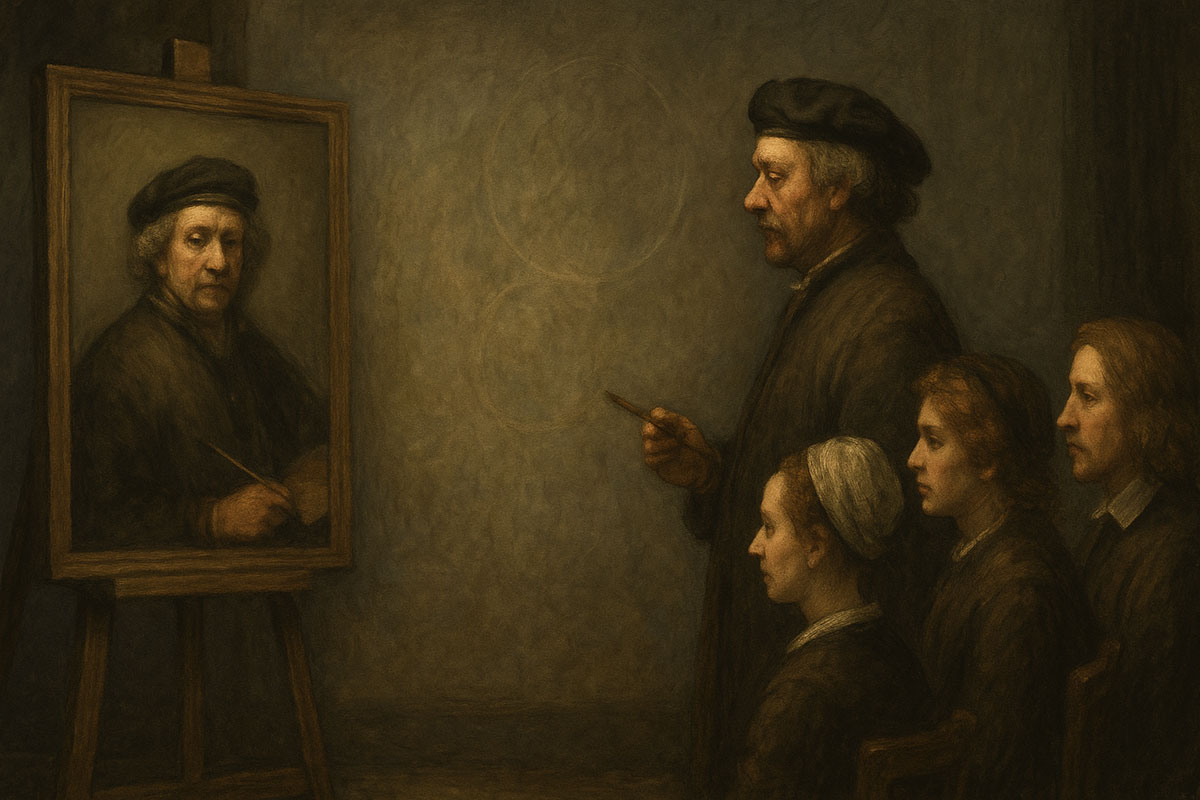
Moderator: Dr. Marieke de Winkel (Rembrandt scholar, Rijksmuseum)
Speakers:
Rembrandt van Rijn (Painter)
Titus van Rijn (Son)
Hendrickje Stoffels (Partner)
Jan Six (Friend and Patron)
Pieter Lastman (Mentor)
[Scene: A private studio-like room in Kenwood House, London, where Self-Portrait with Two Circles hangs. A wooden easel stands empty in the center, paintbrushes neatly arranged beneath. The five speakers sit nearby, with Marieke at a small writing desk, taking notes. Outside the window, gray London skies echo the muted palette of the painting itself.]
Dr. Marieke de Winkel (moderator):
Tonight, we face Rembrandt’s most enigmatic mirror—Self-Portrait with Two Circles. No costume, no props, just his gaze… and those strange, ghostlike circles behind him. My question: Who was Rembrandt when no one was watching?
Rembrandt (steady voice):
Tired. Unafraid. And finally, honest. By then, I had nothing left to prove—no gold, no guild, no illusion of favor. What I had was time. And truth. The circles? Completion without perfection. The face? Weathered. But whole. I didn’t paint myself to be admired. I painted myself to be known.
Titus van Rijn:
It’s strange. This portrait always made me feel closest to him. Not the younger, fancier versions, but this one. The sadness in his eyes didn’t frighten me—it felt familiar. He wasn’t performing anymore. Not for the court, not for the clients. Just... being. And somehow, he was more alive in that stillness than ever before.
Hendrickje Stoffels:
I remember when he worked on this. He didn’t speak much. He would study his face in the mirror, tilt his head slightly, then just... stare. For hours. Sometimes I think he wasn’t painting his face. He was painting the space behind it—the years, the losses, the grace that somehow survived them all.
Jan Six:
This was not the Rembrandt who amused dinner parties or dazzled buyers. This was the Rembrandt who no longer cared if the work sold. There is a kind of power in detachment—not bitterness, but clarity. That circle behind him? I believe it was his way of saying: “I know the whole now. I’ve walked the arc.”
Pieter Lastman (nods):
I used to teach him structure, composition, story. But here, he left it all behind. No symbolic backdrop, no obvious message. Just circles—pure form. Mystery. And the stare of a man who has seen every side of himself and does not flinch. That is what mastery looks like.
Dr. Marieke de Winkel:
And who was he becoming as he painted this?
Titus:
He was becoming real. Not the man others imagined. Not the genius or the debtor. Just... himself.
Hendrickje:
He was becoming someone even I hadn’t seen before. Silent, strong, and stripped of need. That’s why I loved him more in those last years—not less.
Jan Six:
He was becoming immortal in the least theatrical way possible.
Pieter Lastman:
He was becoming the circle itself—unbroken, unfinished, eternal.
Rembrandt:
I was becoming the man I had painted in others all my life. At last, I painted him in me.
Dr. Marieke de Winkel:
And if the world asked you today, Rembrandt, what this portrait means—what would you tell them?
Rembrandt:
It means: I am still here. Not hidden in gold or glory, but in shadow, and still looking back.
Titus:
It means that what remains isn’t always beautiful—but it’s true.
Hendrickje:
It means the soul can speak through silence. If you listen long enough.
Jan Six:
It means the man who lost everything, finally found himself.
Pieter Lastman:
It means the circle of art—and of being—is not about perfection, but return.
Dr. Marieke de Winkel (softly):
And so we see the face not of a master—but of a man. Self-Portrait with Two Circles was not made to impress, but to outlast. It is not a mask—it is a mirror. And we are the ones now being watched.
Topic 5: The Anatomy Lesson of Dr. Nicolaes Tulp — Did He Ever Stop Seeking the Soul?
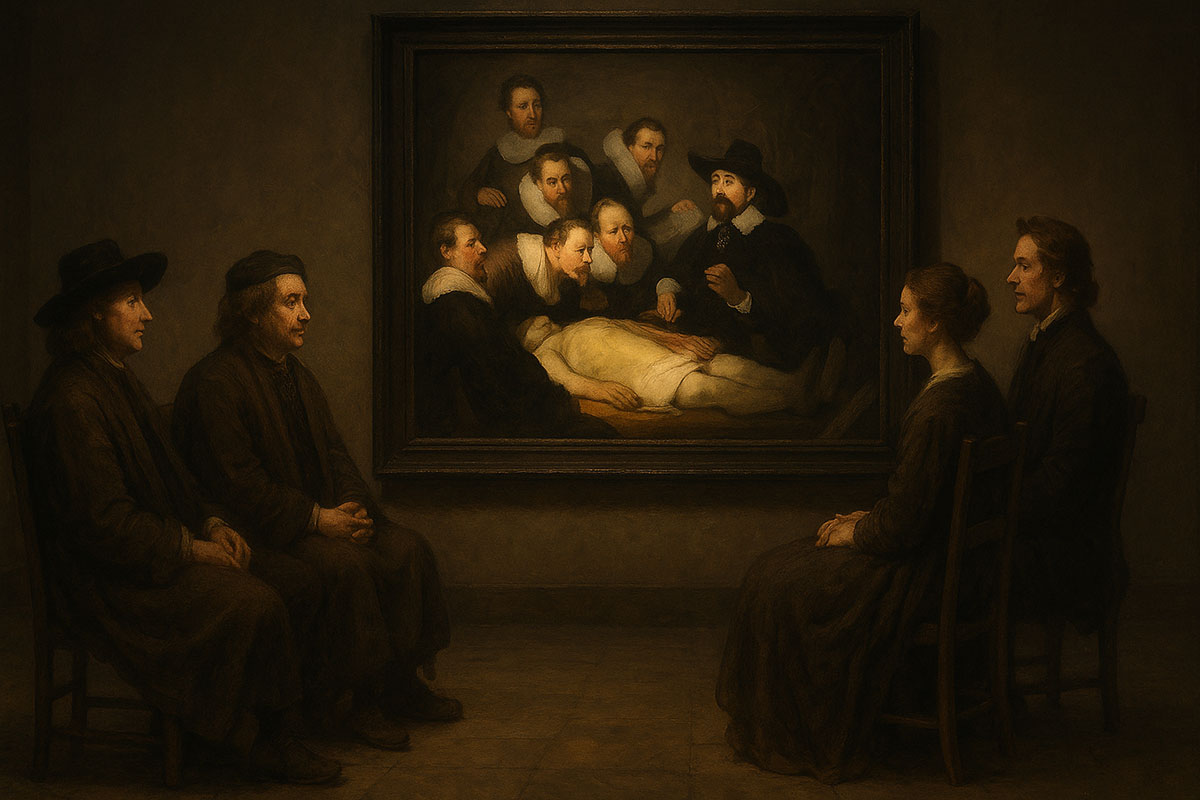
Moderator: Dr. Marieke de Winkel (Dutch art historian and Rembrandt specialist)
Speakers:
Rembrandt van Rijn (Painter)
Saskia van Uylenburgh (Wife)
Titus van Rijn (Son)
Jan Six (Friend and Patron)
Pieter Lastman (Mentor)
[Scene: A stark, formal setting—stone walls, wooden floors, soft museum lighting. The Anatomy Lesson hangs before them, dominated by the cadaver, the professor, and the ring of students. The group sits in a half-circle of stools facing the painting. The room is quiet, almost clinical.]
Dr. Marieke de Winkel (moderator):
When Rembrandt painted The Anatomy Lesson of Dr. Nicolaes Tulp, he was only 26. It’s both a group portrait and a meditation on death, curiosity, and spectacle. Tonight, I ask: Did Rembrandt ever stop seeking the soul—even when painting the body?
Rembrandt (leaning forward):
Never. In fact, especially not then. The body is a door—not a destination. The tendons I painted weren’t just anatomy—they were proof that something deeper once moved them. I wasn’t interested in the corpse. I was interested in the life that had left it.
Jan Six:
It was a bold commission—his first major public work. He could have played it safe, made it stiff and tidy. Instead, he gave it drama, light, tension. He made the dead man the center—not the professor. That was Rembrandt: always tilting the world just slightly to reveal its hidden weight.
Titus:
When I saw it as a child, it frightened me. Not the corpse—but the stillness. Everyone looked alive—but the light fell hardest on the dead. I think my father was already asking questions about time, memory, and what’s left when the voice stops. This wasn’t a painting of medicine. It was a painting of mystery.
Saskia:
He worked day and night on it. He told me once, “Sas, it’s not about what’s cut open—it’s about what’s missing.” He painted the cadaver with such reverence. As if even in death, the body had secrets. Rembrandt sought the soul the way some seek gold—with obsession and awe.
Pieter Lastman:
It was the moment I knew he no longer needed me. He had taken what I taught and surpassed it. This was a painting that held light like breath. He made science into a kind of sermon—not about salvation, but about presence. The soul is not shown. But it is felt.
Dr. Marieke de Winkel:
Who was Rembrandt becoming when he painted this at only 26?
Saskia:
He was becoming brave. He no longer painted to please—he painted to provoke.
Jan Six:
He was becoming someone dangerous to the establishment. Because he saw through it.
Titus:
He was becoming the kind of man who saw death not as an end—but as a frame.
Pieter Lastman:
He was becoming unknowable—even to me. A painter led not by technique, but by conscience.
Rembrandt:
I was becoming a question. A question I would spend the rest of my life trying to answer.
Dr. Marieke de Winkel:
And if the world stood before this painting now and asked: “Why does this matter?”—what would you all say?
Rembrandt:
Because we are all being observed. Even in silence. Especially in stillness.
Saskia:
Because even the lifeless body deserves dignity.
Titus:
Because to look closely is to care. And to care is holy.
Jan Six:
Because truth doesn’t always shout. Sometimes it just lies there—waiting to be seen.
Pieter Lastman:
Because the soul cannot be dissected. But it can be honored.
Dr. Marieke de Winkel (closing her notebook gently):
And so we end where he began. The Anatomy Lesson was not the work of a rising star—but of a searching heart. In carving light into the flesh of the forgotten, Rembrandt gave us not answers—but permission to wonder. He did not stop seeking the soul.
He simply taught us how to see it.
Final Thoughts by Marieke de Winkel (Art Historian)
Setting: A quiet gallery before dawn. The paintings are dim but waiting. The chairs are empty—for now.
He painted men as they were, not as they wished to be remembered. He painted women with silence instead of spectacle. He painted his own aging face more than eighty times—not out of vanity, but out of compulsion, as if asking, again and again, ‘Am I still here?’
Rembrandt Harmenszoon van Rijn, born in Leiden in 1606, died nearly penniless in Amsterdam in 1669. And yet today, he fills museums, textbooks, and the imagination of those who look too long at a canvas and begin to feel something stir.
This is not a biography. This is a gathering. Five of his most intimate companions have returned—his wife, his son, his beloved partner, his closest friend, and his teacher. And yes… Rembrandt himself has joined them, not to explain, but to listen.
Together, they will revisit five paintings—not to decode them, but to dwell within them.
Welcome to a room where time does not march, but pauses.
Where the paint still breathes.
Where the soul of a man rests just beneath the varnish.
Short Bios:
Rembrandt van Rijn
Dutch Baroque master (1606–1669), known for his revolutionary use of light and shadow, emotional depth, and over 80 self-portraits. He painted not just faces, but souls.
Saskia van Uylenburgh
Rembrandt’s beloved first wife and muse. Her early death marked a turning point in his emotional and artistic life. Often portrayed in his most tender early works.
Titus van Rijn
Rembrandt’s only surviving child, deeply cherished. He was painted throughout his life and became Rembrandt’s legal protector during financial decline.
Hendrickje Stoffels
Rembrandt’s devoted partner after Saskia’s death. Both muse and emotional anchor, she appeared in many of his later works and shared in his quietest years.
Jan Six
Amsterdam regent, art lover, and close friend of Rembrandt. Immortalized in one of Rembrandt’s most refined portraits. A patron who appreciated the man behind the genius.
Pieter Lastman
Rembrandt’s early teacher and mentor. A respected history painter who introduced Rembrandt to narrative power and classical structure—lessons Rembrandt would transcend.
Leave a Reply