

Jo van Gogh-Bonger:
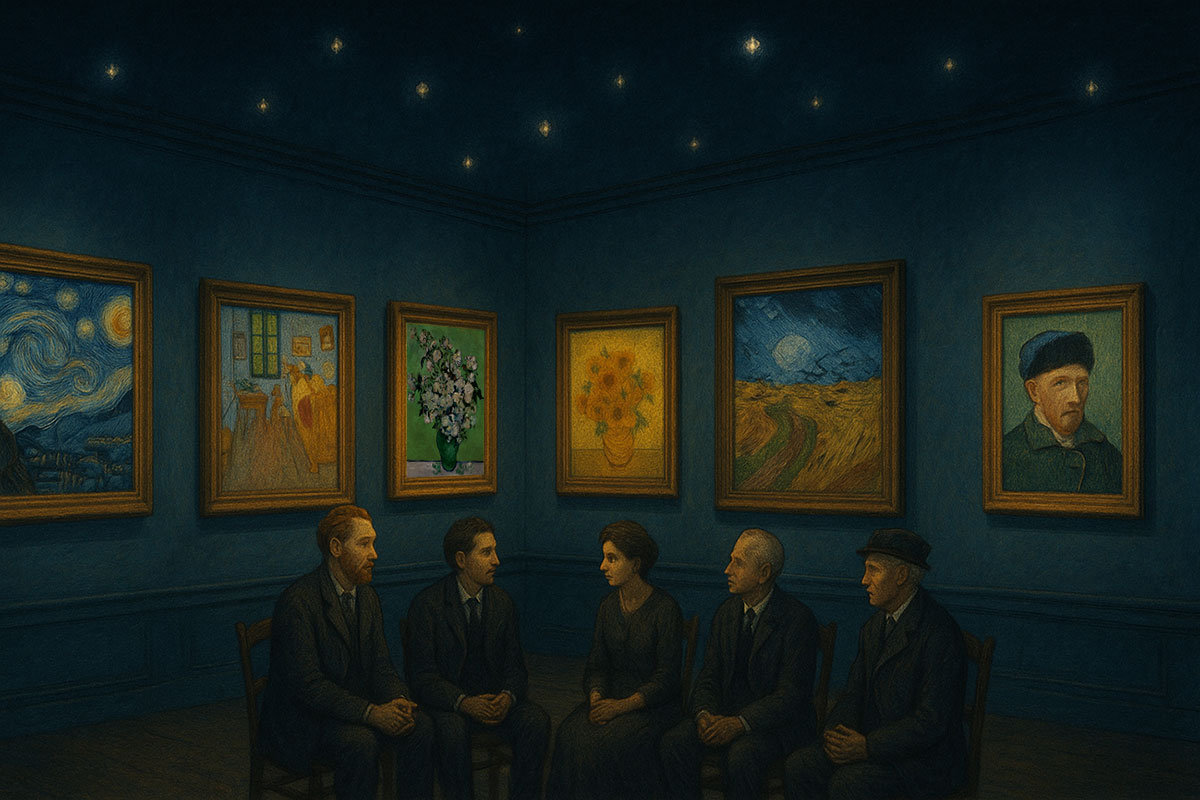
Setting: A quiet museum before opening. The room is dark except for faint golden light on the five paintings. Jo stands alone at the center, holding a letter from Theo.
You know him now.
You know the stars, the sunflowers, the swirling skies.
But there was a time when no one looked.
A time when the canvases sat unbought. The brushstrokes—misunderstood. The letters—unopened.
I was his sister, by marriage. His keeper, by vow.
After Vincent died, and then my Theo—just six months later—I held in my hands more than grief.
I held the pieces of a man who painted not for fame, but for feeling.
Not to impress, but to survive.
He gave the world his silence, his sorrow, his joy, and his awe.
He gave it color when the world turned away.
Tonight, we return to those colors—not as critics, but as companions.
Those who loved him most have gathered here once more. Not in dream, but in memory. Not to explain him, but to feel alongside him.
Five paintings. Five moments.
This is not a lecture. This is a vigil.
You may know his name. But after tonight…
I hope you’ll know his heart.
(Note: This is an imaginary conversation, a creative exploration of an idea, and not a real speech or event.)

Topic 1: Starry Night — Was Beauty Enough to Survive the Darkness?
Moderator: Dr. Wouter van der Veen (Vincent van Gogh expert and biographer)
Speakers:
Vincent van Gogh (Painter)
Theo van Gogh (Brother)
Paul Gauguin (Friend and fellow painter)
Dr. Paul Gachet (Vincent’s physician)
Jo van Gogh-Bonger (Theo’s wife and guardian of Vincent’s legacy)
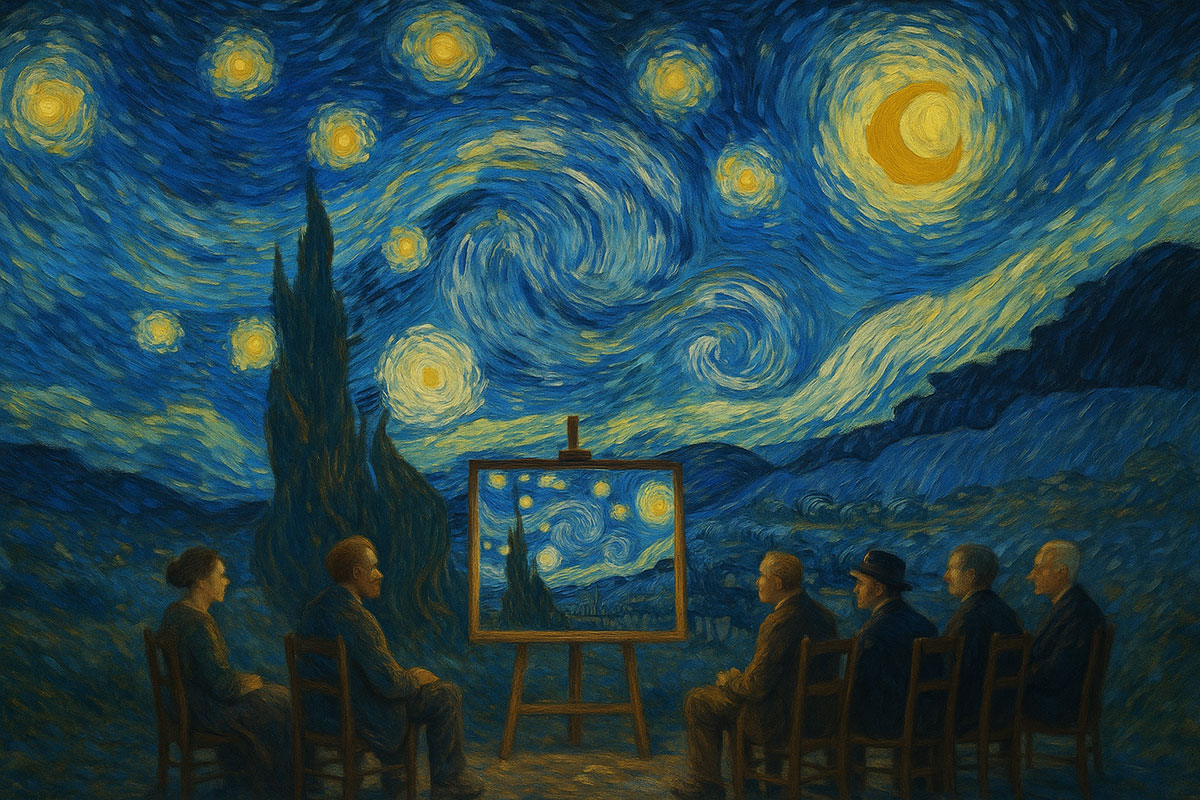
[Scene: A night gallery beneath a vaulted sky of painted stars. The Starry Night hangs center stage. The speakers are gathered on a terrace overlooking the painting, as if the canvas has become the sky itself. The air hums with wind, memory, and something unspoken.]
Dr. Wouter van der Veen (moderator):
Welcome. Tonight, we begin with the painting the world thinks it knows best—Starry Night. But behind every swirling star, there was a man in a hospital bed. Behind every church steeple, a cry for home. I ask you all: Was beauty enough to survive the darkness?
Theo van Gogh (quietly):
I hoped it would be. I truly did. I sent paints, brushes, letters—anything to keep the light burning in him. When I received the canvas, I wept. Not because it was beautiful—though it was—but because I feared it meant he had already left us in spirit. I think Starry Night was not a painting of hope... but of yearning. Beauty was his raft, not his rescue.
Paul Gauguin (leaning back, arms crossed):
He romanticized the stars because the Earth gave him no peace. I always told him—paint from form, not fever. But Vincent was fire. Even when we argued in Arles, I knew he saw things I couldn’t. I once said he painted not the world but his own nervous system. Starry Night wasn’t beauty—it was pressure bleeding out of the soul.
Dr. Paul Gachet (nodding solemnly):
When he painted that sky, he was under my care. Some think he was mad. But I saw moments of extraordinary clarity. I believe beauty was not his escape—it was his testimony. His way of saying, I am still here. That sky is turbulent, yes—but ordered. Even his madness bowed to symmetry. Beauty didn’t save him. But it gave him something to hold while drowning.
Jo van Gogh-Bonger:
When I found it in Theo’s belongings after they both had passed, it haunted me. Why hadn’t the world seen it sooner? The village is dark. The sky blazes. That’s how he lived—misunderstood below, burning above. Beauty was enough... not to save him, perhaps, but to save what was left of him. I carried that light forward.
Vincent van Gogh (softly):
I did not paint the night as it looked. I painted it as it moved inside me. People said I was mad. But that sky was no hallucination—it was prayer. Each swirl, a syllable. Each star, a silence I could not say aloud. Was beauty enough? No. But it was what I had. It was the only voice that did not betray me.
Dr. Wouter van der Veen:
Then who were you becoming in that moment—when the brush touched the canvas under the window of Saint-Rémy?
Vincent:
I was becoming distance. A man watching the world through a pane of silence. I painted not to live, but to prove I had been here.
Theo:
He was becoming someone the world would only love after losing him.
Gauguin:
He was becoming myth. But all he wanted was rest.
Dr. Gachet:
He was becoming still. After so much noise.
Jo:
He was becoming light. Not the kind that shines. The kind that remembers.
Dr. Wouter van der Veen:
And if the world stood before this painting today and asked, “What does it mean?”—what would you say?
Vincent:
It means: Even in the asylum, I saw stars.
Theo:
It means: He never stopped searching for home.
Gauguin:
It means: He saw what none of us dared to look at for long.
Dr. Gachet:
It means: Beauty does not cure. But it consoles.
Jo:
It means: We must listen to the quiet ones. Before they vanish into brilliance.
Dr. Wouter van der Veen (closing):
And so we begin—not with fame or theory, but with longing. Starry Night was not Vincent’s masterpiece. It was his reaching. Not a celebration—but a signal. And tonight, we have heard it.
Topic 2: The Bedroom — Can a Small Room Hold a Whole Soul?
Moderator: Dr. Wouter van der Veen (Van Gogh biographer and historian)
Speakers:
Vincent van Gogh (Painter)
Theo van Gogh (Brother)
Paul Gauguin (Friend and fellow artist)
Jo van Gogh-Bonger (Theo’s wife)
Dr. Paul Gachet (Vincent’s physician)
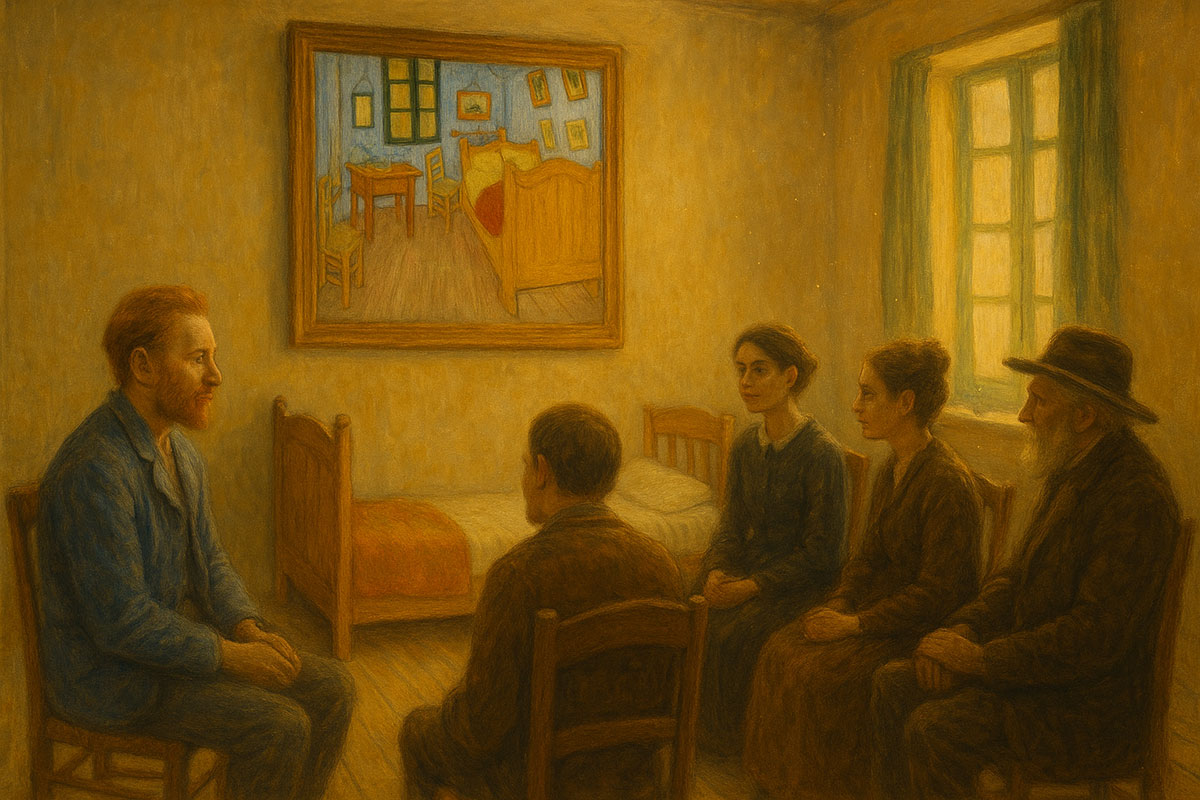
[Scene: A warmly lit reconstruction of Vincent’s yellow-walled bedroom in Arles. On the wall hangs his famous painting The Bedroom. Five chairs are placed in a semicircle near the foot of the bed, beneath a window open to starlight. The tone is tender and fragile, like the brushstrokes of the painting itself.]
Dr. Wouter van der Veen (moderator):
Tonight, we sit inside a painting so personal it feels like an embrace. The Bedroom—simple, quiet, domestic. But it holds more than furniture. I ask you all: Can a small room hold a whole soul?
Jo van Gogh-Bonger (softly):
It did. In this one painting, Vincent left a part of himself—safe, still, and waiting. No crowds. No chaos. Just his chair, his pipe, the sunlight on the wall. When I first saw it, I felt like I had entered his mind. It wasn’t about grandeur. It was about rest. Something he never had enough of.
Paul Gauguin (arms folded):
He fussed over this room like it was a temple. The colors, the arrangement, everything had to be just so. And yet... when I lived with him, that peace unraveled. It was too small for two souls. Or maybe just too small for mine. I don’t think this room held his whole soul—it held his wish for one.
Theo van Gogh:
I remember how excited he was to send me a sketch of it. “I want it to be restful,” he wrote. “Soothing like music.” He wanted stability, simplicity—a room that didn’t argue, didn’t vanish. I think he poured his hopes for sanity into it. It was never just about a bed. It was about belonging.
Dr. Paul Gachet:
Clinically, I viewed this as a self-regulation. A painted boundary. He created the environment he couldn’t find in the world—a room where nothing hurt, where no one shouted. I believe this room was his spiritual refuge. Not a cell, but a sanctuary. That’s what makes it sacred.
Vincent van Gogh (gently):
I painted it to rest the eye and quiet the mind. I was tired—tired of motion, of misunderstanding. So I made a place that could not betray me. The pillow would not argue. The chair would not leave. The sunlight would return, no matter how much I wept the night before.
So yes. My whole soul was there.
Even the broken parts.
Dr. Wouter van der Veen:
Who were you becoming as you painted this?
Vincent:
I was becoming someone who believed—if only briefly—that peace was possible.
Theo:
He was becoming a man who wanted to stay, not wander.
Jo:
He was becoming visible. Not to critics. But to those who loved him.
Gauguin:
He was becoming vulnerable. And that scared both of us.
Dr. Gachet:
He was becoming gentle with himself. That’s rare for the suffering.
Dr. Wouter van der Veen:
And if the world stood before this painting today and asked, “What does it mean?”—what would you tell them?
Vincent:
It means: Even chaos longs for calm.
It means: This is where I wanted to heal.
Theo:
It means: Even a small space can carry enormous grief—and hope.
Jo:
It means: Love lives in the quiet corners.
Gauguin:
It means: Sometimes, art is the only room left to live in.
Dr. Gachet:
It means: A soul is not measured in square meters.
Dr. Wouter van der Veen (closing):
So much has been written about his brushwork, his madness, his color theory. But tonight, we’ve sat where Vincent slept. The Bedroom is not famous for its technique—it is beloved because it whispers.
And when we lean in, we hear not noise, but need.
A small room. A vast heart. And a man who wanted—at last—to stay.
Topic 3: Sunflowers — Why Do We Paint What We’ll Never Own?
Moderator: Dr. Wouter van der Veen (Van Gogh biographer and historian)
Speakers:
Vincent van Gogh (Painter)
Theo van Gogh (Brother)
Paul Gauguin (Friend and fellow artist)
Jo van Gogh-Bonger (Theo’s wife)
Dr. Paul Gachet (Vincent’s physician)
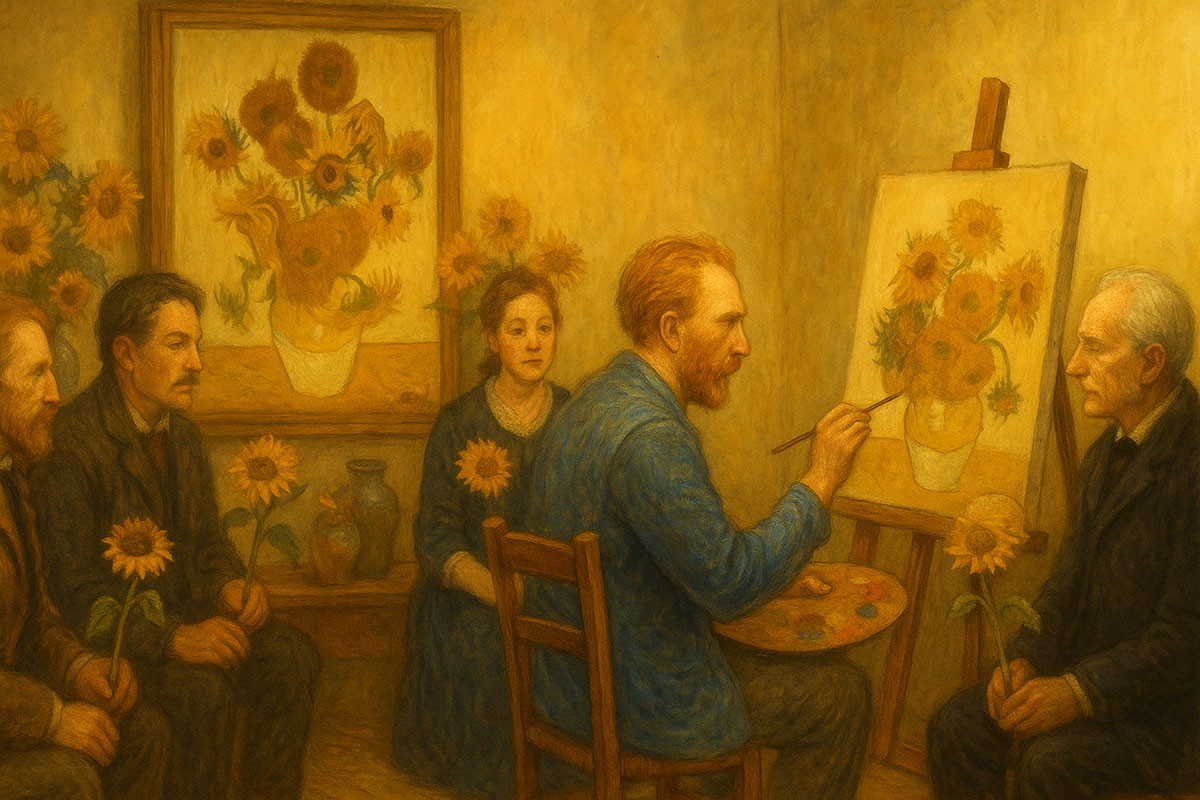
[Scene: A quiet sunlit room filled with yellow tones. The Sunflowers hang in a neat row, vivid and unrepentant. The speakers sit on simple wooden chairs in a semicircle. A single vase of dried sunflowers sits at the center, casting a long shadow across the floor. The mood is curious, unsettled, and golden.]
Dr. Wouter van der Veen (moderator):
Tonight we face what may be his most iconic work—not because it dazzles, but because it endures. Sunflowers—painted over and over, blazing with yellows, decaying in slow motion. I ask you all: Why do we paint what we’ll never own?
Paul Gauguin (bluntly):
He didn’t want to own them. He wanted to outlive them. Those flowers—he arranged them like soldiers, like prophets. They weren’t decoration. They were defiance. He painted them fast, obsessed. I think he wanted to make something that didn’t need permission. Beauty without price.
Theo van Gogh:
He wrote to me about them constantly—worried over the right yellows, the drying time. But what struck me was his urgency. “I want them to burn,” he said. “Like the sun itself.” He knew they would die. That’s why he painted them. To hold a thing you cannot keep—just long enough to say, I saw you.
Jo van Gogh-Bonger:
I found his sunflower sketches tucked in letters, margins, backs of envelopes. Always blooming, always falling apart. When I saw the real ones, they felt like time frozen. He didn’t paint them for fame or sale. He painted them because they wouldn’t stay. I think he needed to make the fading beautiful.
Dr. Paul Gachet:
Clinically, I would say this was therapeutic repetition. The cycle of birth, bloom, and decay—the sunflower was a mirror. Vincent projected onto them—fragile stems, burning heads, petals that refused to fall all at once. He painted what he could never save: others, himself, a sense of permanence.
Vincent van Gogh (quietly):
I painted them for the room. For when Gauguin would arrive. I wanted warmth on the walls. Not to impress him—but to say: Here, you are welcome.
They were joy, grief, madness—all in yellow.
No one owns a sunflower. It turns its face to something greater.
I painted them not to possess, but to praise.
Dr. Wouter van der Veen:
Who were you becoming in those days—surrounded by canvases full of dying suns?
Vincent:
I was becoming someone who could love what was leaving.
Theo:
He was becoming frantic, yes—but also generous. He gave everything away in paint.
Gauguin:
He was becoming someone I couldn’t match in passion. It frightened me.
Jo:
He was becoming myth already—though he never believed it.
Dr. Gachet:
He was becoming, paradoxically, more alive the closer he moved toward collapse.
Dr. Wouter van der Veen:
And if the world asked you, today, what the sunflowers mean—what would you say?
Vincent:
They mean: Even what dies brightly is worth painting.
They mean: I did not look away.
Theo:
They mean: He was still searching for the light, even while fading.
Gauguin:
They mean: Art isn’t about keeping. It’s about giving.
Jo:
They mean: Grief can be golden.
Dr. Gachet:
They mean: He planted something in all of us.
Dr. Wouter van der Veen (closing):
And so we sit beneath painted flowers that no longer wilt. Sunflowers were not symbols. They were surrender. They were joy that hurt to hold. And Vincent—quietly, urgently—gave them to the world.
Not because they were perfect.
But because they were his.
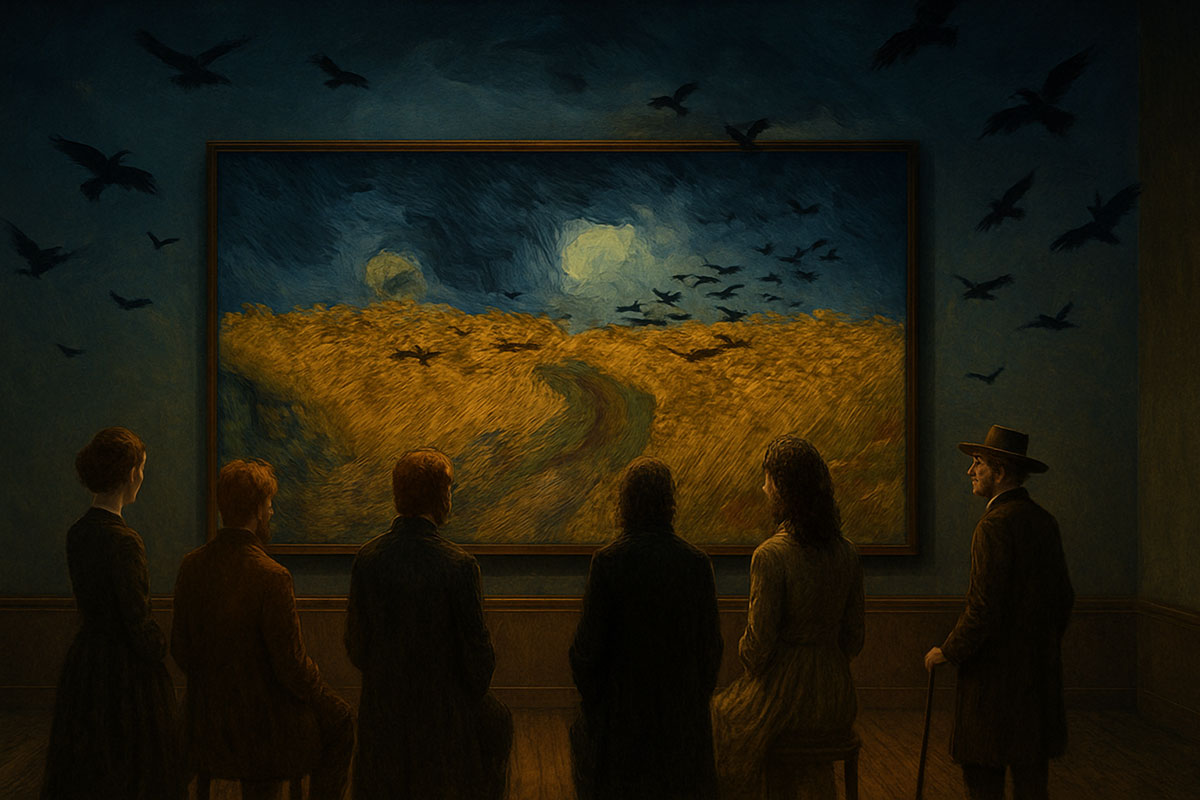
Topic 4: Wheatfield with Crows — Did the Sky Speak Last?
Moderator: Dr. Wouter van der Veen (Van Gogh biographer and historian)
Speakers:
Vincent van Gogh (Painter)
Theo van Gogh (Brother)
Paul Gauguin (Friend and fellow artist)
Jo van Gogh-Bonger (Theo’s wife)
Dr. Paul Gachet (Vincent’s physician)
[Scene: A wide-open space where a reproduction of Wheatfield with Crows stretches floor-to-ceiling on a curved wall. The room is dark, except for the golden wheat and ominous sky. A recorded wind gently plays in the background. The five speakers sit facing the storm.]
Dr. Wouter van der Veen (moderator):
This is perhaps the most debated of all his paintings—Wheatfield with Crows. A painting full of motion and stillness. Light and warning. Was it a goodbye? A final scream? Or simply a field? I ask you all: Did the sky speak last?
Paul Gauguin (sharply):
Yes. And it spoke in a language none of us understood until it was too late. That sky—unnatural, rolling, choking—was Vincent’s mind unfastened. He told me he saw paths leading nowhere. Crows returning to fields already stripped. This wasn’t painted for a buyer. This was painted for God, or the silence after Him.
Jo van Gogh-Bonger (softly):
I couldn’t look at it for years. After Theo died, this was the canvas that haunted me most. It was as if Vincent had left a message not for art history—but for his brother. That he had gone as far as the road allowed. And the sky? It didn’t speak—it wept. Quietly. Relentlessly.
Theo van Gogh:
He sent it with no explanation. Just a letter full of swirling thoughts and concerns. But when I saw it, I felt something close. Like standing on the edge of a storm you can’t run from.
The wheat was golden—but it bowed.
The sky was blue—but it pressed.
I think it spoke. But what it said... was goodbye.
Dr. Paul Gachet:
To the trained eye, this is not chaos. It is control. He made choices: symmetry in disorder, balance in color. But emotionally, yes—it is a cry. The road doesn’t end. It disappears. That’s not artistic ambiguity. That’s psychic exhaustion. He no longer feared death. He feared futility.
Vincent van Gogh (after a long pause):
I painted the field not because I wanted to die—but because I wanted to be heard. The crows were not death. They were watchers.
The wheat was not loss. It was gold—still upright.
But the sky…
The sky was my question. And it has not answered me yet.
Dr. Wouter van der Veen:
Who were you becoming in those final days in Auvers?
Vincent:
I was becoming a whisper in a wind too strong to stand in.
I was becoming still. And tired. And very, very full.
Theo:
He was becoming a man the world didn’t know how to carry.
Gauguin:
He was becoming silence. Even his letters had gaps.
Jo:
He was becoming light—too bright for the room. Too wide for the road.
Dr. Gachet:
He was becoming… free. In a way that frightened all of us.
Dr. Wouter van der Veen:
And if the world, standing beneath this ominous sky today, asked—“What does this mean?”—what would you say?
Vincent:
It means: I went to the fields not to end, but to feel the wind once more.
Theo:
It means: He painted not death, but the moment before it answers.
Jo:
It means: Even despair can be golden at the edges.
Gauguin:
It means: Some voices grow louder after the storm.
Dr. Gachet:
It means: If you are afraid of this sky, then you have understood him.
Dr. Wouter van der Veen (closing):
Wheatfield with Crows is not a painting we solve. It is one we survive. It does not offer clarity. It offers honesty. And in that wind, we hear Vincent—not broken, not lost—but walking… walking… until the canvas ran out.
And the sky, perhaps, spoke last.
But Vincent—
He spoke first.
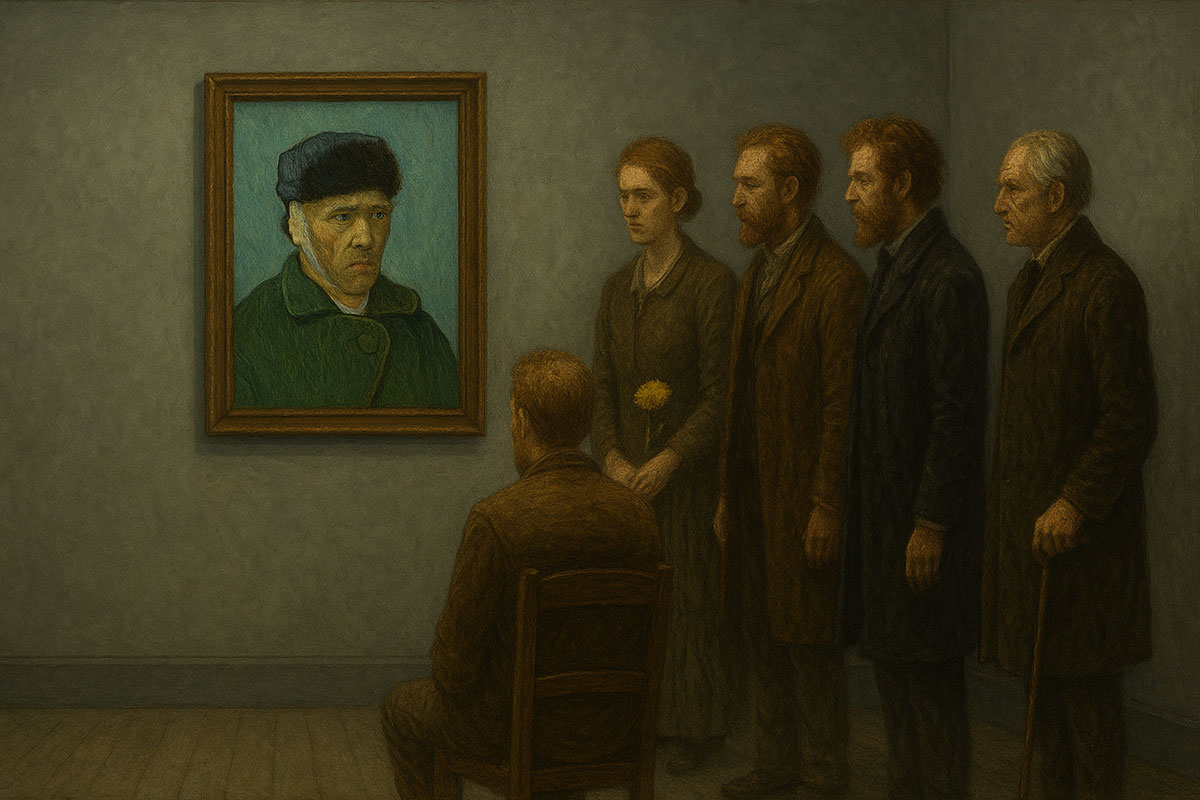
Topic 5: Self-Portrait with Bandaged Ear — What Does Pain Look Like in Paint?
Moderator: Dr. Wouter van der Veen (Van Gogh biographer and historian)
Speakers:
Vincent van Gogh (Painter)
Theo van Gogh (Brother)
Paul Gauguin (Friend and fellow artist)
Jo van Gogh-Bonger (Theo’s wife)
Dr. Paul Gachet (Vincent’s physician)
[Scene: A quiet, sterile space. On a single white wall hangs Self-Portrait with Bandaged Ear. The room is silent except for the subtle ticking of a clock. The painting glows gently under museum light. Five wooden chairs face it like a tribunal—no judgment, only witness.]
Dr. Wouter van der Veen (moderator):
We end with perhaps his most difficult painting—not in technique, but in truth. Self-Portrait with Bandaged Ear. This is not just a face. It is a wound made visible. So I ask you all: What does pain look like in paint?
Theo van Gogh:
It looks like silence. He didn’t write much after it happened. When the painting arrived, I didn’t know what to feel. There he was—alive, yes—but elsewhere. The bandage wasn’t the tragedy. It was the fact that he was already painting again. He couldn’t stop. Not even for grief. Not even for himself.
Paul Gauguin (arms crossed):
He wouldn’t let me see him afterward. Just a letter. A brief one. “I am calmer now.” He had sent me sunflowers. I had given him my absence.
And yet, this painting...
He didn’t paint the pain dramatically. He painted the aftermath. The cool room. The Japanese print. He painted the part that lingers when everything else is over.
And that is more terrifying.
Jo van Gogh-Bonger:
I looked at this portrait many times after both Vincent and Theo were gone. The bandage speaks, yes—but so do the eyes. They are still searching. Still asking. Still trying to remain... here. He didn’t romanticize his suffering. He recorded it. Quietly. Honestly. So we wouldn’t look away.
Dr. Paul Gachet:
To a physician, the wound was clear. But to a human heart, this painting shows restraint. Dignity, even. He did not turn his trauma into a spectacle. He looked at it squarely. And he let us do the same. This was not a cry for help.
This was a declaration: I am still capable of seeing—even if no one sees me.
Vincent van Gogh (slowly):
I painted it so I would not disappear.
I knew people would whisper, avoid, forget.
But in paint, I could choose the angle.
I could hold my own gaze.
I did not paint pain to be pitied.
I painted it to remind myself: You are still here. You are still here.
Dr. Wouter van der Veen:
Who were you becoming in that moment?
Vincent:
I was becoming someone who would survive the night—even if the night returned again and again.
Theo:
He was becoming... separate from all of us. Not distant, just deeper. Like he had gone somewhere we couldn’t follow.
Gauguin:
He was becoming sharper. Less reliant. And less reachable.
Jo:
He was becoming the man history would learn to love too late.
Dr. Gachet:
He was becoming clarity itself—stripped, plain, unadorned.
Dr. Wouter van der Veen:
And if the world asks today, looking at this painting, “What is pain?”—what would you answer?
Vincent:
Pain is what you see when the eyes remain calm, but the air around them trembles.
Theo:
Pain is continuing. Even when there is no applause for it.
Gauguin:
Pain is a mirror. And most people avoid mirrors like this.
Jo:
Pain is loving someone who did not stay—but left you everything.
Dr. Gachet:
Pain is uninvited, but truthfully rendered. And in that... there is healing.
Dr. Wouter van der Veen (closing):
Self-Portrait with Bandaged Ear is not a symbol. It is a man. Not broken—but bearing. Not finished—but recorded. And in bearing witness to that face, we face ourselves.
Vincent did not hide from his pain.
He handed it to the world—framed in color, carved in light.
And for that, he is still here.
Final Thoughts
Setting: A night gallery. All five paintings glow softly. The group has risen. Only Vincent remains seated—gazing at the last painting. Jo places a hand on his shoulder, then turns to the audience.
Jo van Gogh-Bonger:
He was called mad, pitiful, lost.
But what I saw was a man more honest than the world knew how to accept.
He didn’t need correction.
He needed listening.
And though he left early—too early—he did not leave empty.
He left fields of fire.
Windows of blue.
A silence that glows in yellows and swirls.
You see, Vincent didn’t die unknown.
He died having given everything.
And what remains…
is yours to keep.
Vincent van Gogh (softly):
I did not come here to be seen.
I came here to help you see.
I painted not with answers, but with longing.
With questions no one dared ask aloud.
If something in you trembled tonight—then I have not disappeared.
I am not in the madness.
I am in the brushstroke.
In the sky that bends.
In the color that won’t let go.
I am in you—
when you feel too much…
…and still choose to love anyway.
Short Bios:
Vincent van Gogh
Dutch post-impressionist painter (1853–1890), known for his emotionally charged brushwork and luminous color. Though unrecognized in his lifetime, he left behind over 2,000 works that now shape how we see the world—and the self.
Theo van Gogh
Vincent’s younger brother and greatest supporter. An art dealer and confidant whose hundreds of letters with Vincent reveal the painter’s inner life. Without Theo’s faith and funding, many of Vincent’s works would not exist.
Paul Gauguin
French post-impressionist painter and Vincent’s one-time friend and roommate in Arles. Their intense artistic partnership ended in emotional rupture, but his presence deeply shaped Vincent’s final years and vision.
Jo van Gogh-Bonger
Theo’s wife and the steward of Vincent’s legacy. After the deaths of both brothers, she championed Vincent’s work, published their letters, and introduced the world to the genius it once overlooked.
Dr. Paul Gachet
Physician and amateur artist who cared for Vincent during his final weeks in Auvers. Though controversial, he was one of the few who tried to understand Vincent's suffering as something beyond madness—a struggle to stay human through beauty.
Leave a Reply